
Pilgrim volumes and premium access reshape circuit spending
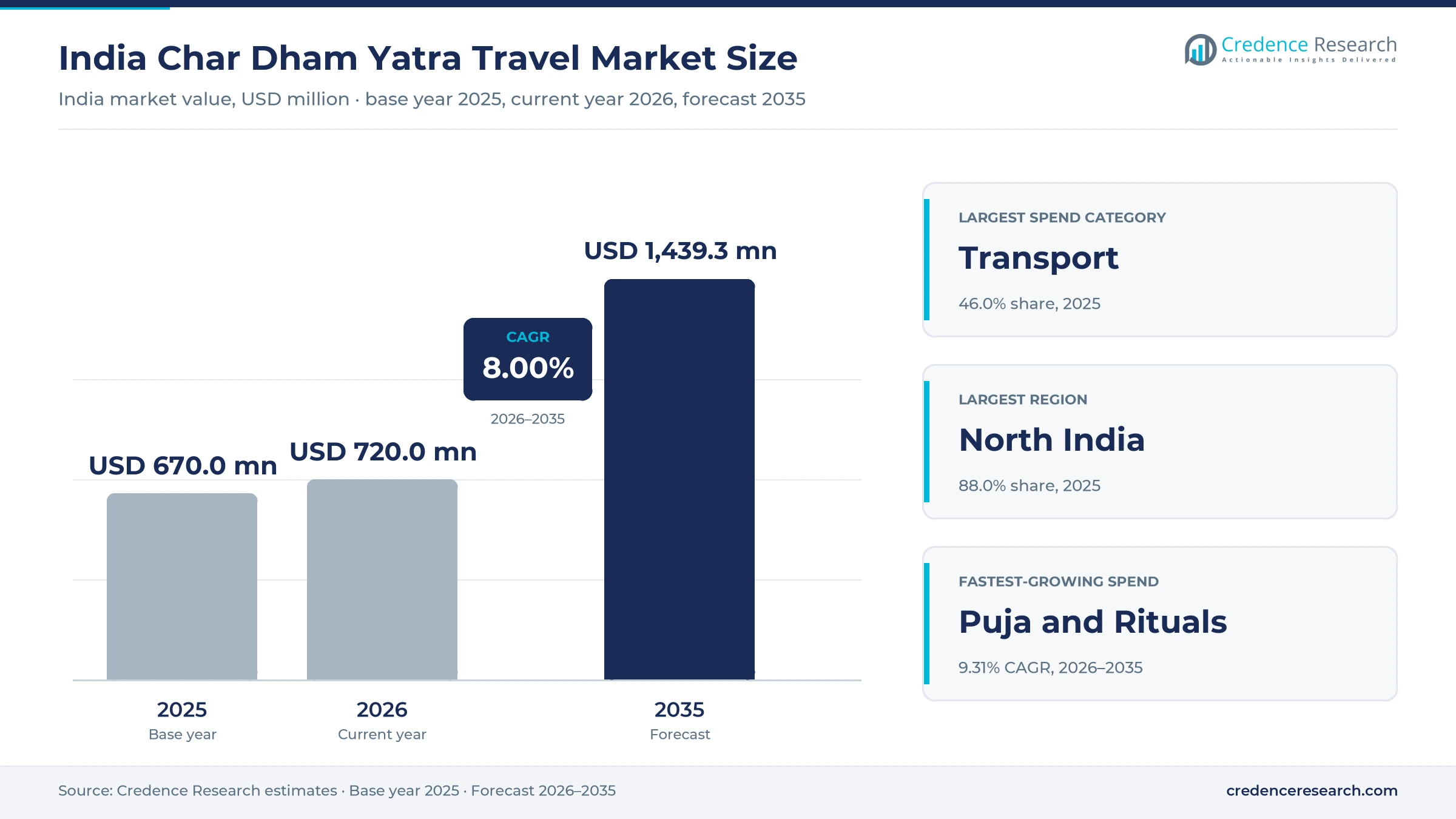
The India Char Dham Yatra travel market was valued at USD 670.0 million in 2025 and is projected to increase from USD 720.0 million in 2026 to USD 1.44 billion by 2035, registering a CAGR of 8.00% during 2026–2035. Demand comes from a season that drew more than 5.1 million pilgrims in 2025 and more than 5.6 million by Oct. 7, 2026, across Yamunotri, Gangotri, Kedarnath and Badrinath. Spending covers road and helicopter transport, rooms, meals and temple rituals, and pilgrims from Maharashtra, Gujarat and Andhra Pradesh add long-distance packages to that base. North India held the largest regional share, 88.0% in 2025, because all four shrines and the gateway towns sit in Uttarakhand. South India is the fastest-growing region at 8.82% a year as air-linked packages from Bengaluru widen. Commercially, the Sonprayag-Kedarnath ropeway awarded in September 2025 will change how the steepest leg is priced once it opens.
What does the Char Dham Yatra travel market count?
The market counts pilgrim spending on the Uttarakhand circuit of Yamunotri, Gangotri, Kedarnath and Badrinath. It covers road and helicopter transport, rooms, food and puja and ritual fees. Buyers purchase through online portals, state agencies, tour operators and local offline agents, often combining several of them on one trip.
The market excludes shopping, general leisure trips to Uttarakhand and the other all-India Char Dham circuit of Badrinath, Dwarka, Puri and Rameswaram. The value chain runs from gateway transport at Haridwar, Rishikesh and Dehradun through hill taxis and buses, helicopter shuttles, roadside hotels and temple committees.
India Char Dham Yatra Travel Market Insights
- The market grows from USD 670.0 million in 2025 to USD 1.44 billion by 2035 at an 8.00% CAGR, because spending per pilgrim is rising alongside the number of pilgrims each season.
- North India held 88.0% of value in 2025 because all four shrines, the gateway towns and most hill transport and rooms sit inside Uttarakhand.
- Transport (Road and Helicopter) led spending with 46.0% of 2025 value, because long Himalayan road legs and helicopter shuttles are priced well above rooms and meals on most itineraries.
- Five helicopter accidents in 2025 led regulators to cut Kedarnath shuttle frequency by 30% for 2026, which moved aviation capacity toward fewer, more tightly supervised sorties.
- Adani Enterprises won the Rs 4,081 crore Sonprayag-Kedarnath ropeway in September 2025, giving operators a long-term new access product to plan around on the steepest leg.
Transport leads spending while rituals grow fastest
Why transport takes the largest share of pilgrim spending
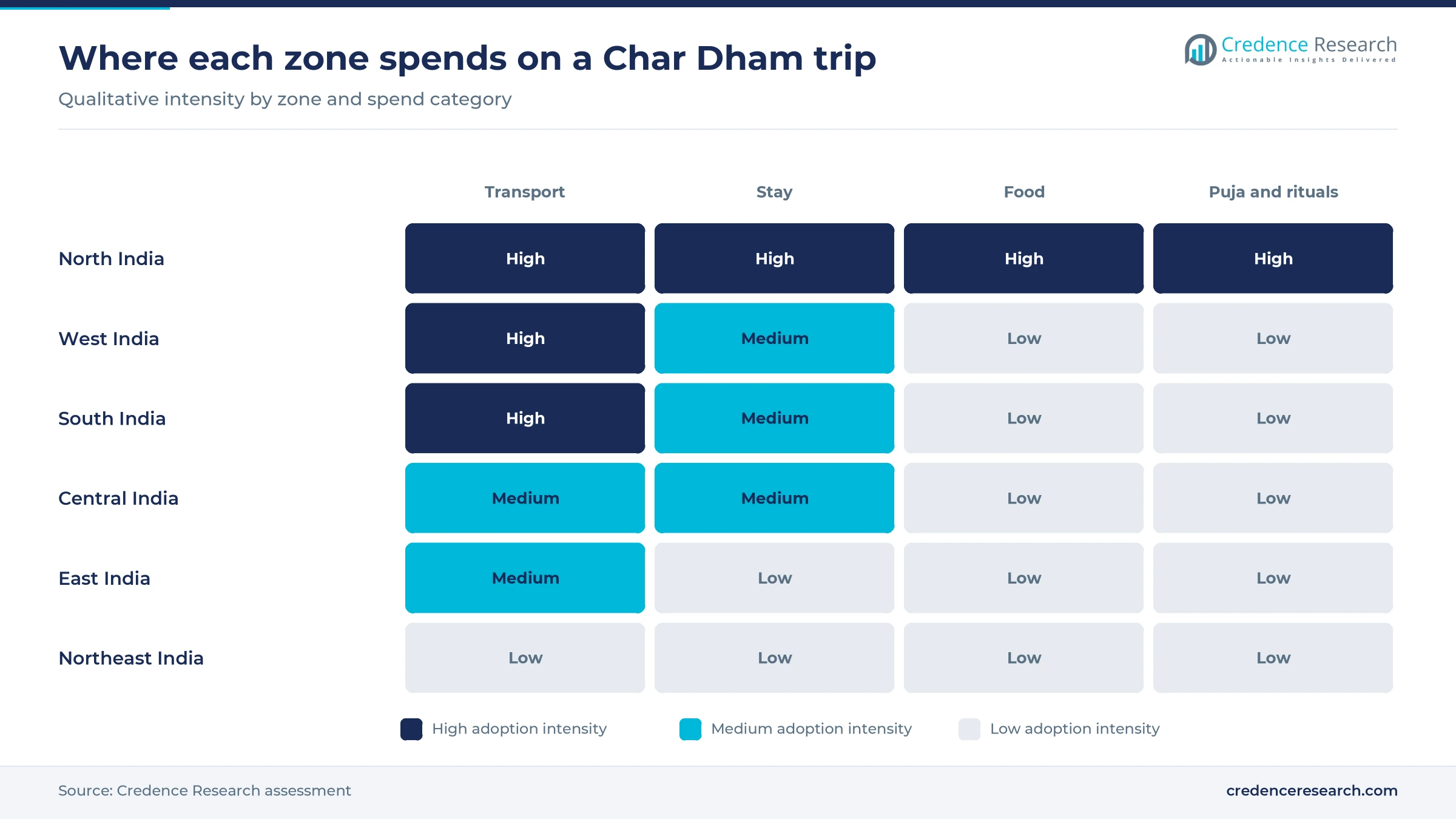
Based on spend category, the market is categorized into transport (road and helicopter), stay, food and puja and rituals. Transport (Road and Helicopter) led with 46.0% of 2025 value because Himalayan distances price every leg, with a tour bus hire costing about Rs 170,000 before a 5% to 7% rise that ETV Bharat reported in March 2025. Helicopter services also earned Rs 35 crore at Kedarnath by May 31, 2025. Puja and Rituals grows fastest at 9.31% a year as the Badri-Kedar Temple Committee raised worship fees by 5% to 10% in April 2026 and proposed a Rs 11 lakh Mega Special Puja package.
Individual trips lead while group tours gain ground
Based on traveler type, the market is categorized into individual and group tour trips. Individual trips led with 58.0% of 2025 value because 53% of pilgrimage trips in India were made outside groups, according to the MakeMyTrip Pilgrimage Travel Trends 2024-25 report published in September 2025. Group Tour trips grow fastest at 8.68% a year as IRCTC sells fixed-date 13-day departures, including Bhopal departures on May 5 and June 1, 2026, reported by Navbharat Live. Justdial data also showed Char Dham package bookings up 73% from January to August 2025.
Offline agents still hold most of the booking value
Based on booking channel, the market is categorized into online and offline agents. Offline Agents led with 68.0% of 2025 value because local selling still dominates, and GMVN had only 14 properties on MakeMyTrip before its 2025 expansion, according to Pioneer Edge. Online grows fastest at 10.09% a year as GMVN raised its MakeMyTrip listings from 14 properties to 54 for 2025. In addition, Kedarnath helicopter seats for 2026 sell only through the IRCTC Heli Yatra portal, ETV Bharat reported on April 1, 2026.
| Segment Group | Leading Sub-segment | Share, 2025 | Fastest-growing Sub-segment | CAGR, 2026–2035 |
|---|---|---|---|---|
| By Spend Category | Transport (Road and Helicopter) | 46.0% | Puja and Rituals | 9.31% |
| By Traveler Type | Individual | 58.0% | Group Tour | 8.68% |
| By Booking Channel | Offline Agents | 68.0% | Online | 10.09% |
Request a Free Sample
Fill in your details and we'll send you a free sample report.
- Sample data tables & charts
- Research methodology
Volumes, helicopter fares and organized selling lift value
Pilgrim volumes and better access widen the visitor base
Pilgrim volume sets the floor for spending on this circuit, and access projects keep raising it. Uttarakhand Chief Minister Pushkar Singh Dhami put the 2025 season above 5.1 million pilgrims, while UNI reported more than 5.6 million by Oct. 7, 2026. Road work shortens the inner loop as well, because the 4.531-km Silkyara Bend-Barkot tunnel will cut 26 km between Gangotri and Yamunotri, according to Construction World. Rail access follows, since the 125.09-km Rishikesh-Karnaprayag line stood at 78% physical progress in September 2026, according to Indian Infrastructure. Justdial also logged a 44% rise in international searches during 2025, although outbound tourism still competes for the same household budgets. In the Credence Research model this adds about 2.96 percentage points to annual growth to 2035.
Helicopter-linked itineraries lift the average ticket size
Premium itineraries raise spending per pilgrim faster than pilgrim counts rise. Round-trip fares for the 2026 season reached Rs 12,762 from Guptkashi and Rs 10,164 from Phata, with a new Gauchar-Badrinath service priced at Rs 22,000 a person. Chardham Tour, a Dehradun agency, sells a six-day charter circuit at Rs 220,000 a person on twin sharing, against a Rs 65,900 starting price for an IRCTC 13-day air package from Bengaluru. Thomas Cook India and SOTC also list a helicopter Char Dham product, according to an April 2023 Free Press Journal report. Helicopter demand earned Rs 61 crore in fares over 48 days of the 2025 Kedarnath season, according to Trip to Temples. In the Credence Research model this adds about 2.16 percentage points to annual growth to 2035.
Online booking and organized operators expand reach
Organized selling pulls more of each trip into channels that can be priced and compared. Online registrations reached nearly 1.82 million before offline counters logged 2,713 pilgrims on their first day in April 2026, which shows how far digital habits have spread among pilgrims. GMVN added listings on MakeMyTrip after a first batch of 14 properties, according to Pioneer Edge. IRCTC now sells Bengaluru and Bhopal departures with fixed dates and inclusive pricing, which gives first-time pilgrims a packaged alternative to local agents. Justdial data also showed Kedarnath demand, with searches up 39% from January to August 2025. In the Credence Research model this adds about 1.60 percentage points to annual growth to 2035.
Distant source states raise the value of each trip
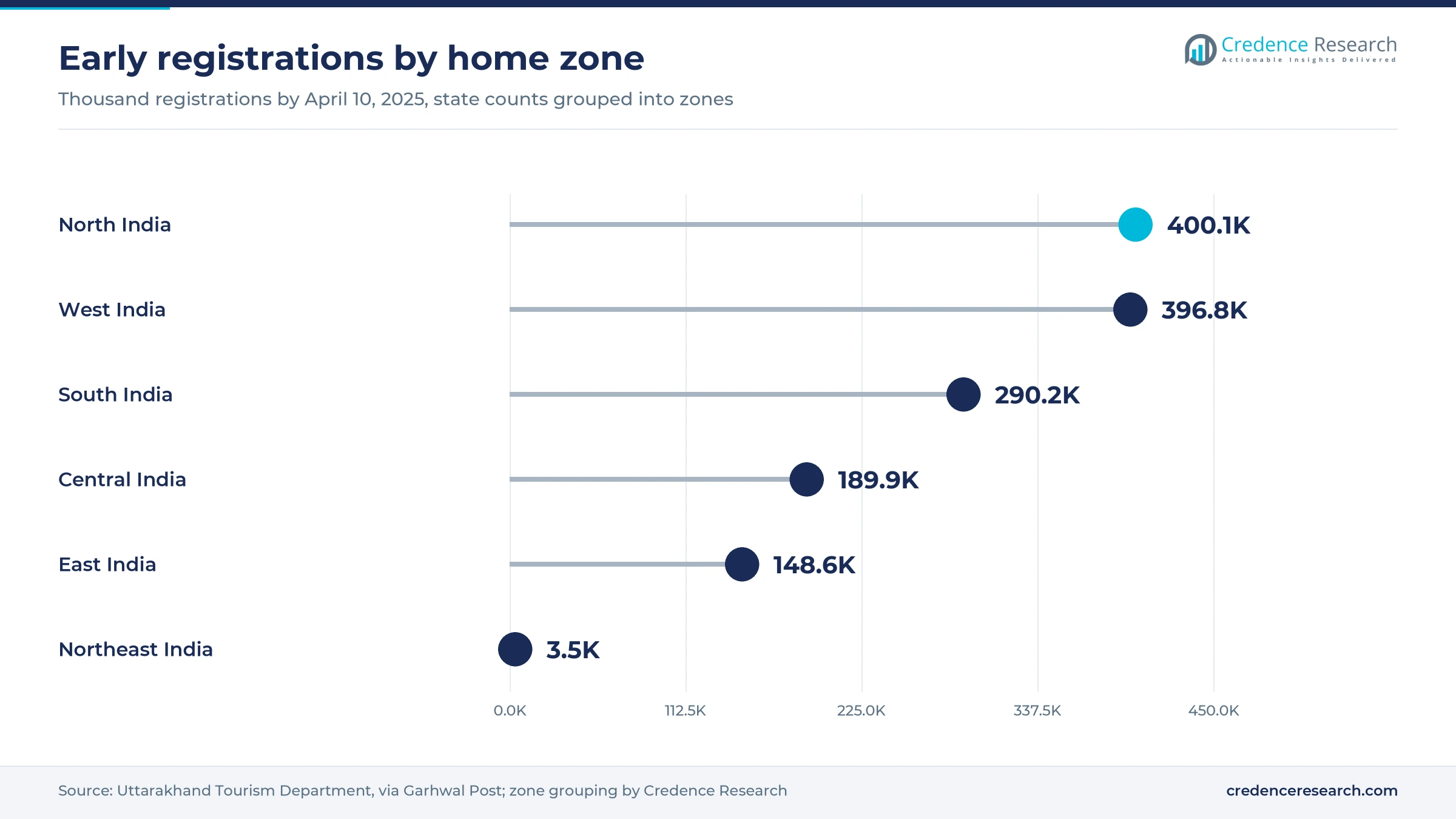
Pilgrims from distant states spend more per trip because they buy long-haul travel and more nights. Maharashtra led early registrations with 257,174 of 1,454,532 entries by April 10, 2025, ahead of Uttar Pradesh at 183,950, according to the Uttarakhand Tourism Department. Madhya Pradesh followed with 144,604 and Gujarat with 139,630, so large volumes start far from the hills. IRCTC prices that distance into its Bengaluru package, which runs 12 nights from Rs 65,900, while a GMVN package from Rishikesh or Haridwar cost about Rs 30,000 a person in 2025, according to ETV Bharat. Andhra Pradesh alone logged 166,899 of those early entries, which supports faster package growth in South India than in North India.
Tighter controls and new ropeway capacity open new options
Shift to fewer, tightly supervised helicopter sorties
Helicopter access is shifting from open growth to rationed, supervised capacity after a difficult 2025 season. Five helicopters crashed during that yatra, and Ashish Chauhan, chief executive of the Uttarakhand Civil Aviation Development Authority, told ETV Bharat in January 2026 that Kedarnath shuttles would fall by 30%. Daily flights from Sahastradhara in Dehradun also dropped from 65 to 40. Eight companies now fly commercial helicopter shuttles on three Kedarnath routes, with Guptkashi limited to 24 daily services and temporary air traffic towers at Kedarnath and Badrinath. Scarcity carries a commercial risk, since the chief minister ordered action against ticket black-marketing before the 2026 season. Fares moved unevenly too, with Phata up Rs 1,322 and Sersi down Rs 2,449.
Rising state control over vehicles and registration
State control is rising over who travels, in which vehicle and on what date. Uttarakhand introduced its 2026 Green Card system for commercial passenger vehicles on March 30, 2026, tying each vehicle to an inspection, according to News On AIR. Garhwal Commissioner Vinay Shankar Pandey also said in February 2026 that pilgrims would pay a nominal registration fee to curb fraudulent entries, Business Today reported. The calendar is moving as well, because shrine doors opened between April 19 and 23 in 2026, against mid-May in 2024, according to the SDC Foundation. Early Char Dham Yatra travel demand responded, with 408,401 pilgrims counted by April 28, 2026, according to the state emergency operations unit in Dehradun. Compliance costs therefore move toward organized fleets, while earlier openings add selling weeks for operators.
Opportunity in ropeway-linked Kedarnath itineraries
The ropeway gives operators a chance to design a new product around the hardest leg of the circuit. Adani Enterprises received the Rs 4,081 crore Sonprayag-Kedarnath award in September 2025, covering 12.9 km and 1,800 passengers an hour per direction. The company says the trip falls from eight or nine hours to 36 minutes, with six years of construction and 29 years of operation. That offer would sit between animal transport, which earned about Rs 67.5 crore from 228,665 riders in 48 days of 2025, and the Rs 6,390 Sersi helicopter fare. Operators that plan shorter Kedarnath stops can therefore sell more circuits per season, particularly to older pilgrims.
Opening for private rooms beside a thin public stock
Rooms offer a clear opening because public inventory is small against the pilgrim base. GMVN has about 50 properties and roughly 600 rooms along the routes, according to Pioneer Edge. Stay demand around Kedarnath brought hotels and restaurants an estimated Rs 140 crore in about a month of 2025, according to ETV Bharat. Travel Mail also describes September as a preferred shoulder month, which supports longer selling periods. GMVN has installed EV charging at 34 locations, which gives electric bus and car operators a starting network on the same roads. Mid-priced private rooms with verified online inventory can therefore capture bookings that public stock cannot serve.
Weather, aviation safety and capacity limits cap the season
Monsoon disruption removes whole selling days
Weather can erase weeks of revenue, which hurts small transporters and hoteliers most. Down To Earth counted 55 zero-pilgrim days and 89 days below 1,000 arrivals across the shrines between April and August 2025. The long-run exposure is larger, because the 2013 Uttarakhand floods cost about $1 billion in lost tourism revenue, according to the World Bank. Operators can respond with shoulder-season departures, although those trips cannot fully replace lost peak weeks.
Aviation safety limits premium capacity
Helicopter safety rules cap the most profitable product on the circuit, which affects operators and premium tour sellers alike. Five crashes during 2025 led to a 30% cut in Kedarnath shuttles for 2026, according to the Uttarakhand Civil Aviation Development Authority. As a result, fewer seats are available on the busiest days, and sellers face black-marketing scrutiny. Weather monitoring tenders and more camera coverage should help over time, but higher compliance costs are likely to keep fares firm through the next tender cycle.
Carrying capacity limits remain unresolved
Capacity remains legally unsettled, which makes long-range planning harder for hotels and fleet owners. A National Green Tribunal record dated Jan. 5, 2024, cited estimates of 8,000 pilgrims a day for Gangotri, 5,000 for Yamunotri and 13,000 for Kedarnath, according to ETV Bharat. Tourism Minister Satpal Maharaj said in April 2026 that only pilgrims who can be safely accommodated should travel at once. However, the government has set no cap on numbers, so operators must plan around a rule that could still change.
Booking shocks spread quickly along the route
Advance bookings can collapse within days, leaving hotels and airlines with sudden refunds. Char Dham Yatra travel demand fell sharply during the India-Pakistan tension of May 2025, when The Statesman reported that nearly half of advance hotel bookings on the routes were cancelled. Travelers from Maharashtra, West Bengal and southern states also cancelled flights after airports closed. Long-distance pilgrims are therefore the most exposed group, and sellers with fixed-date packages face the largest refund burden when such shocks recur.
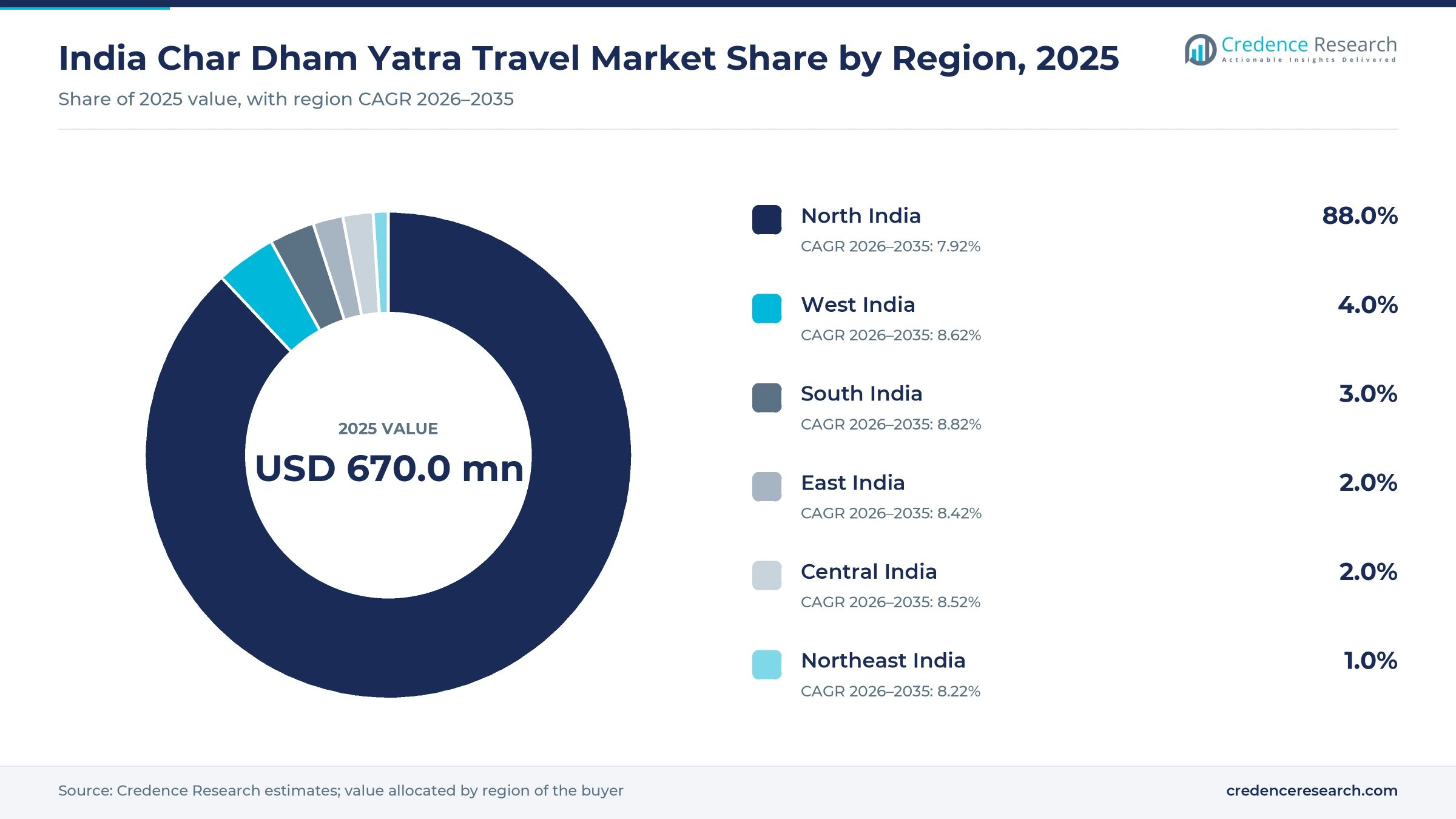
North India earns most spend while far zones book the trips
| Region | Value, 2025 (USD million) | Share, 2025 | CAGR, 2026–2035 |
|---|---|---|---|
| North India | 589.6 | 88.0% | 7.92% |
| West India | 26.8 | 4.0% | 8.62% |
| South India | 20.1 | 3.0% | 8.82% |
| East India | 13.4 | 2.0% | 8.42% |
| Central India | 13.4 | 2.0% | 8.52% |
| Northeast India | 6.7 | 1.0% | 8.22% |
North India earns the on-ground spending
North India held 88.0% of 2025 value and grows at 7.92% a year because rooms, taxis, shuttles and rituals are bought in Uttarakhand. Uttarakhand Tourism Development Board statistics recorded 1,774,264 visits at Badrinath and 1,653,581 at Kedarnath in 2024. The zone also supplies pilgrims, with Uttar Pradesh at 183,950 early registrations in 2025. The Sonprayag line will add cable car and ropeway capacity to this spend base after construction.
West India sends the largest distant pilgrim flow
West India held 4.0% of 2025 value and grows at 8.62% a year, because its pilgrims buy packages and long-haul travel before leaving home. Maharashtra and Gujarat together logged 396,804 early registrations by April 10, 2025, which is more than any other zone outside North India, according to the Uttarakhand Tourism Department. Travelers from Maharashtra were also named among those cancelling flights in May 2025, according to The Statesman, which shows how much of this spend depends on air links.
South India grows fastest on air-linked packages
South India held 3.0% of 2025 value and grows fastest at 8.82% a year, supported by air-linked packages from the zone. IRCTC sells a 12-night departure from Bengaluru starting at Rs 65,900, with a tour start date of Sept. 21, 2026, and a flight into Noida. State registrations also show depth, with Andhra Pradesh at 166,899, Karnataka at 56,029, Telangana at 51,699 and Tamil Nadu at 15,577 by April 10, 2025, according to the Uttarakhand Tourism Department.
Central India buys fixed-date organized tours
Central India held 2.0% of 2025 value and grows at 8.52% a year. Madhya Pradesh is the core of this zone, with 144,604 early registrations by April 10, 2025, while Chhattisgarh added 45,295, according to the Uttarakhand Tourism Department. IRCTC also ran a 12-night package from Bhopal with May 5 and June 1, 2026 departures, Navbharat Live reported. Fixed departures of this kind suit first-time pilgrims from the zone, who often prefer an organized itinerary to arranging separate hill transport themselves.
East India adds a broad agent-led source base
East India held 2.0% of 2025 value and grows at 8.42% a year on a broad but smaller pilgrim base. West Bengal recorded 51,351 early registrations by April 10, 2025, followed by Bihar at 42,430, Odisha at 33,670 and Jharkhand at 21,164, according to the Uttarakhand Tourism Department. Travelers from West Bengal were also among those cancelling flights in May 2025, The Statesman reported. Long travel times from the zone favor agent-sold trips that bundle transfers, rooms and registration help.
Northeast India remains a small early-stage source
Northeast India held 1.0% of 2025 value and grows at 8.22% a year from a very low base. Assam logged 2,423 early registrations by April 10, 2025, while Tripura added 635, Sikkim 247, Manipur 80, Meghalaya 48, and Arunachal Pradesh and Nagaland 18 each, according to the Uttarakhand Tourism Department. These counts show how limited the source base still is. Distance and long connections keep the zone dependent on agents and escorted departures for the foreseeable future.
Dated rules and projects are resetting the circuit
| Development | Status and market relevance |
|---|---|
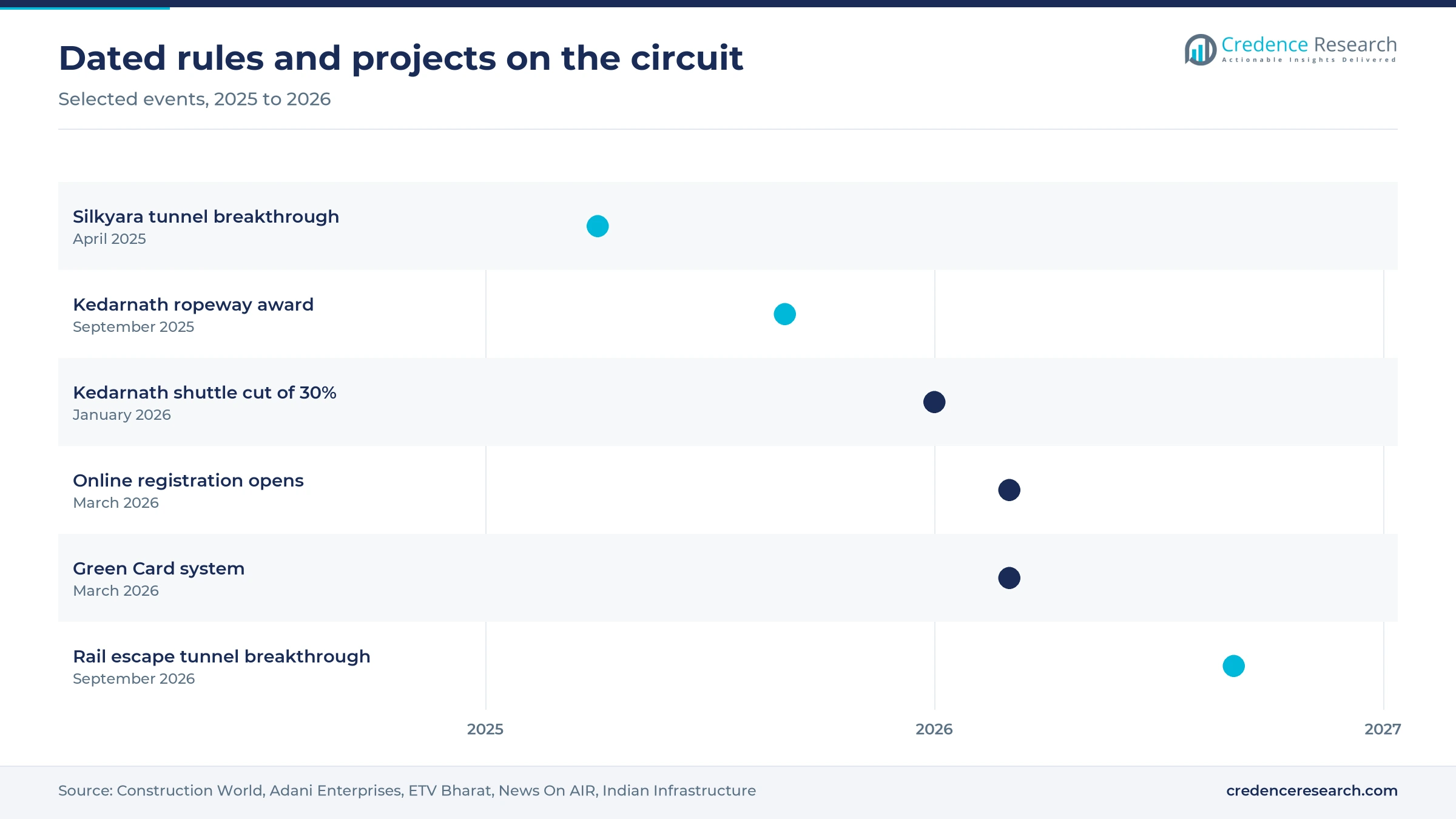
| In April 2025, the 4.531-km Silkyara Bend-Barkot tunnel reached breakthrough, which will cut 26 km between Gangotri and Yamunotri, according to Construction World. | Tunnel breakthrough reported; shortens the western loop of the circuit. |
| In September 2025, Adani Enterprises received the letter of award for the Rs 4,081 crore Sonprayag-Kedarnath ropeway from National Highways Logistics Management Ltd. | Six-year construction period; 29 years of operation after that. |
| In January 2026, the Uttarakhand Civil Aviation Development Authority said Kedarnath shuttle services would fall by 30% after five 2025 crashes. | In force for the 2026 season; fewer seats on peak days. |
| In March 2026, Uttarakhand introduced its Green Card system for commercial passenger vehicles on the yatra, according to News On AIR. | Active for the 2026 season; inspection required before issue. |
| In September 2026, Rail Vikas Nigam completed the final breakthrough of escape tunnel 1 on the Rishikesh-Karnaprayag line, with overall physical progress at 78%, according to Indian Infrastructure. | Completion expected by December 2029; would shorten the rail gap to the hills. |
Digital permits and portals now govern pilgrim movement
- Online registration is mandatory for every pilgrim and opened on March 6 for the 2026 season, with offline counters following on April 17.
- IRCTC Heli Yatra is the only sales portal for Kedarnath helicopter tickets in 2026, according to an April 1, 2026 ETV Bharat report that warned against other websites.
- Green Card permits link each commercial vehicle to a technical inspection and an online application through the Transport Department website.
- Temporary air traffic towers at Kedarnath and Badrinath are staffed by five personnel, supported by weather-monitoring equipment tenders and camera coverage.
Need a Custom Version of This Report?
Tailor the scope, geography, or segments to your exact requirements.
- Custom geography or segment scope
- Direct access to our analyst team
State agencies and aggregators anchor a fragmented field
Competition is split between state bodies, national aggregators and a long tail of local operators. GMVN sells rooms and packages from about 50 route properties, while IRCTC Tourism sells fixed-date packages and acts as the helicopter ticket portal for Kedarnath. MakeMyTrip supplies online reach, including 54 listings for 2025 drawn from the wider 84-property GMVN network across Uttarakhand, and Thomas Cook competes on ready-to-book and helicopter products under its spiritual portfolio. Local taxi, bus and hotel owners still deliver most on-ground services, and bus operators negotiate fares through the Joint Rotation Committee. In aviation, the Uttarakhand Civil Aviation Development Authority awards routes by tender, so eight companies hold 2026 Kedarnath slots. As a result, large sellers compete mainly on assurance, refund handling and seat access rather than on owning assets, while local operators compete on price, route knowledge and availability during the peak weeks of the season.
Companies profiled and their roles in this market
| Company | Type | Role in the market |
|---|---|---|
| GMVN | State tourism corporation | Runs about 50 route properties with roughly 600 rooms and sells packages from Rishikesh and Haridwar. |
| IRCTC Tourism | Public-sector tour seller | Sells 2026 packages from Bengaluru and Bhopal and is the sales portal for Kedarnath helicopter seats. |
| MakeMyTrip | Online travel platform | Listed 54 properties for 2025 from the 84-property GMVN network across Uttarakhand and publishes pilgrimage travel booking data. |
| Thomas Cook | Tour operator | Offers Char Dham journeys, including a helicopter product, through its spiritual portfolio with SOTC. |
| Uttarakhand Taxi and Hotel Operators | Local service providers | Supply hill taxis, buses and rooms on the route, with commercial vehicles needing a 2026 Green Card. |
| Trans Bharat Aviation | Helicopter operator | Selected with Chipsan Aviation for the Guptkashi-Kedarnath route in 2026. |
| Himalayan Heli | Helicopter operator | Selected with Aero Aircraft for the Sersi-Kedarnath route in 2026. |
Value now depends on access quality more than headcount
Credence Research's view is that spending on this circuit will depend more on access quality than on pilgrim headcount over the forecast period. Char Dham Yatra travel volumes already exceed 5 million pilgrims in a good season, while legal capacity questions and weather losses limit further rises. Sellers that secure helicopter seats, verified rooms and refund terms should capture the better margins. The Sonprayag ropeway is the largest single variable, because it could move many Kedarnath pilgrims away from animal transport and shorter helicopter hops, and that shift would change pricing across the whole itinerary.
How the Credence Research estimate was built
The report uses 2025 as the base year and forecasts values for 2026 through 2035. Market values come from the Credence Research model, and regional and segment splits are Credence Research estimates, checked against a bottom-up view of pilgrim counts and per-trip spending. Sources are government statistics, Uttarakhand agency statements, company releases, operator price pages and named press reports opened during this research. No primary interviews or surveys were conducted for this report.
Ropeway and rail links reshape the trip profile by 2035
By 2035 the market is forecast to reach USD 1.44 billion, with growth of 8.00% a year from USD 720.0 million in 2026. The trip itself should look different by then, because the Rishikesh-Karnaprayag line is expected by December 2029 and the Kedarnath ropeway should be running after its six-year build. Those links could shorten itineraries and move spending from long road legs toward rooms, rituals and premium services. Weather exposure and capacity rulings remain the main risks, and operators that build flexible departures and verified inventory should be best placed.
Frequently Asked Questions
How big is the India Char Dham Yatra travel market?
What drives growth in Char Dham travel spending?
Which spending category is largest on the circuit?
Which region holds the largest share?
How much do Kedarnath helicopter tickets cost in 2026?
How will the Kedarnath ropeway affect the market?
What are the main challenges for Char Dham operators?
Who are the main companies in this market?
Table of Content
Chapter 1 Market Segmentation
- 1.1 Segmentation Framework
- 1.1.1 Product and Service Classification
- 1.1.2 Application and End-Use Classification
- 1.1.3 Technology and Solution Classification
- 1.1.4 Customer and Distribution Channel Classification
- 1.1.5 Geographic Segmentation
- 1.1.6 Market Segment Definitions and Boundaries
- 1.2 By Spend Category
- 1.2.1 Transport (Road and Helicopter)
- 1.2.2 Stay
- 1.2.3 Food
- 1.2.4 Puja and Rituals
- 1.3 By Traveler Type
- 1.3.1 Individual
- 1.3.2 Group Tour
- 1.4 By Booking Channel
- 1.4.1 Offline Agents
- 1.4.2 Online
Chapter 2 Introduction
- 2.1 Report Objectives and Scope
- 2.2 Product Definition and Industry Terminology
- 2.3 Market Inclusions and Exclusions
- 2.4 Research Process
- 2.4.1 Primary Research and Expert Interviews
- 2.4.2 Secondary Research and Source Review
- 2.4.3 Top-Down and Bottom-Up Estimation
- 2.4.4 Data Triangulation and Verification
- 2.5 Market Size Measurement Basis
- 2.5.1 2025: USD 670.0 million → 2035: USD 1.44 billion
- 2.6 Historical and Forecast Reference Periods
- 2.6.1 Historical Period: 2018-2025
- 2.6.2 Base Year: 2025
- 2.6.3 Forecast Period: 2025-2035
- 2.7 Research Assumptions and Limitations
Chapter 3 Executive Summary
- 3.1 Market Snapshot and Key Findings
- 3.2 Base-Year Market Size, 2025
- 3.3 Forecast Market Size, 2035
- 3.4 Revenue and Volume Growth Outlook
- 3.5 Key Demand and Supply Indicators
- 3.6 Leading Market Segments
- 3.7 Fastest-Growing Market Opportunities
- 3.8 Regional Performance Highlights
- 3.9 Technology and Industry Transformation
- 3.10 Competitive Landscape Summary
- 3.11 Analyst View and Strategic Implications
Chapter 4 India Char Dham Yatra Travel Market Trends and Developments
- 4.1 Historical Industry Development, 2018-2025
- 4.2 Recent Market Trends and Developments
- 4.3 Demand and Customer Behavior Trends
- 4.4 Technology and Product Innovation
- 4.5 Artificial Intelligence, Automation and Digitalization
- 4.6 Local Manufacturing and Supply Chain Realignment
- 4.7 Industry Partnerships, Mergers and Acquisitions
- 4.8 Sustainability and Circular Economy Developments
- 4.9 Government and Private Sector Investment Trends
- 4.10 Emerging Business Models and Commercialization
- 4.11 Industry Developments and Announcements
Chapter 5 India Char Dham Yatra Travel Market Supply and Demand Analysis
- 5.1 Demand Trend and Consumption Analysis, 2018-2025
- 5.2 Demand Forecast, 2025-2035
- 5.3 Supply Chain Structure and Procurement Trends
- 5.4 Supply-Demand Gap and Bottlenecks
- 5.5 Import Dependence and Sourcing Structure
- 5.6 Regional Supply and Demand Concentration
Chapter 6 India Char Dham Yatra Travel Market Pricing Analysis
- 6.1 Pricing Structure and Measurement
- 6.2 Historical Pricing Trends, 2018-2025
- 6.3 Pricing Outlook, 2025-2035
- 6.4 Pricing by Product and Market Segment
- 6.5 Geographic Pricing Differences
- 6.6 Key Input, Energy, Labor and Logistics Costs
- 6.7 Contract Pricing and Purchasing Models
- 6.8 Pricing Sensitivity and Competitive Positioning
- 6.9 Price, Margin and Profitability Implications
Chapter 7 India Char Dham Yatra Travel Market Dynamics
- 7.1 Market Growth Drivers
- 7.1.1 Demand-Side Drivers
- 7.1.2 Technology and Innovation Drivers
- 7.1.3 Infrastructure and Investment Drivers
- 7.1.4 Regulatory and Policy Drivers
- 7.2 Market Restraints
- 7.2.1 Cost and Affordability Constraints
- 7.2.2 Technology and Adoption Barriers
- 7.2.3 Supply Chain and Operational Constraints
- 7.3 Market Challenges
- 7.3.1 Competitive Pressure and Margin Erosion
- 7.3.2 Skills, Infrastructure and Implementation Gaps
- 7.4 Emerging Market Opportunities
- 7.5 Market Dynamics Impact and Time-Horizon Assessment
Chapter 8 India Char Dham Yatra Travel Value Chain Analysis
- 8.1 Industry Value Chain Overview
- 8.2 Upstream Suppliers and Critical Inputs
- 8.3 Technology and Component Providers
- 8.4 Manufacturing or Service Delivery
- 8.5 Distribution, Channel Partners and Integrators
- 8.6 Downstream Applications and End Users
- 8.7 Value Addition and Profit Pools
- 8.8 Vertical Integration and Outsourcing
- 8.9 Supplier Concentration and Risk
- 8.10 Supply Chain Localization and Resilience
Chapter 9 India Char Dham Yatra Travel Market Regulations and Policies
- 9.1 Relevant Laws, Standards and Compliance Frameworks
- 9.2 Product, Service, Safety and Quality Requirements
- 9.3 Government Policies, Incentives and Subsidies
- 9.4 Imports, Exports and Trade Barriers
- 9.5 Public Procurement and Local Content Requirements
- 9.6 Data Protection, AI and Cybersecurity Compliance
- 9.7 Upcoming Policy Changes and Market Implications
Chapter 10 India Char Dham Yatra Travel Market Hotspots and Opportunities
- 10.1 Market Opportunity Mapping and Growth Hotspots
- 10.2 High-Growth Applications and Customer Groups
- 10.3 Underserved Markets and White-Space Opportunities
- 10.4 Emerging Technology and Product Opportunities
- 10.5 New Capacity and Investment Hotspots
- 10.6 Market Entry and Expansion Opportunities
- 10.7 Distribution and Partnership Opportunities
- 10.8 Near-Term and Long-Term Commercial Potential
- 10.9 Opportunity Attractiveness and Execution Risks
Chapter 11 India Char Dham Yatra Travel Market Outlook, 2025-2035
- 11.1 Market Size and Analysis
- 11.1.1 Revenue (Market Measurement: 2025: USD 670.0 million → 2035: USD 1.44 billion)
- 11.1.2 Historical Market Size, 2018-2025
- 11.1.3 Base-Year Market Size, 2025
- 11.2 Market Forecast, 2025-2035
- 11.2.1 Revenue Forecast to 2035
- 11.2.2 CAGR and Year-on-Year Growth
- 11.2.3 Incremental Revenue Opportunity
- 11.3 Forecast Assumptions and Scenario Analysis
- 11.3.1 Base-Case Forecast
- 11.3.2 Optimistic and Conservative Scenarios
- 11.3.3 Technology, Pricing and Policy Sensitivities
- 11.4 Market Attractiveness and Growth Outlook
Chapter 12 India Char Dham Yatra Travel Market Segmentation and Outlook
- 12.1 Segmentation Summary and Market Shares, 2025
- 12.2 Largest and Fastest-Growing Segments
- 12.3 By Spend Category - Market Size and Forecast, 2025-2035
- 12.3.1 Segment Definition and Scope
- 12.3.2 Historical Market Size, 2018-2025
- 12.3.3 Revenue Forecast, 2025-2035
- 12.3.4 Base-Year Market Share, 2025
- 12.3.5 Segment CAGR and Growth Drivers
- 12.3.6 Subsegment Market Size and Forecast
- 12.3.6.1 Transport (Road and Helicopter)
- 12.3.6.2 Stay
- 12.3.6.3 Food
- 12.3.6.4 Puja and Rituals
- 12.3.7 Subsegment Pricing and Adoption Trends
- 12.3.8 Leading Suppliers and Competition
- 12.3.9 Regional Demand and Opportunities
- 12.4 By Traveler Type - Market Size and Forecast, 2025-2035
- 12.4.1 Segment Definition and Scope
- 12.4.2 Historical Market Size, 2018-2025
- 12.4.3 Revenue Forecast, 2025-2035
- 12.4.4 Base-Year Market Share, 2025
- 12.4.5 Segment CAGR and Growth Drivers
- 12.4.6 Subsegment Market Size and Forecast
- 12.4.6.1 Individual
- 12.4.6.2 Group Tour
- 12.4.7 Subsegment Pricing and Adoption Trends
- 12.4.8 Leading Suppliers and Competition
- 12.4.9 Regional Demand and Opportunities
- 12.5 By Booking Channel - Market Size and Forecast, 2025-2035
- 12.5.1 Segment Definition and Scope
- 12.5.2 Historical Market Size, 2018-2025
- 12.5.3 Revenue Forecast, 2025-2035
- 12.5.4 Base-Year Market Share, 2025
- 12.5.5 Segment CAGR and Growth Drivers
- 12.5.6 Subsegment Market Size and Forecast
- 12.5.6.1 Offline Agents
- 12.5.6.2 Online
- 12.5.7 Subsegment Pricing and Adoption Trends
- 12.5.8 Leading Suppliers and Competition
- 12.5.9 Regional Demand and Opportunities
- 12.6 Segment Growth Comparison
- 12.7 Segment Attractiveness and Priority Matrix
Chapter 13 India Char Dham Yatra Travel Geographic Market Outlook, 2025-2035
- 13.1 Domestic Market Distribution and Demand Clusters
- 13.2 State- or Province-Wise Market Size and Forecast, 2025-2035
- 13.3 City and Metropolitan Market Outlook
- 13.4 Industrial, Manufacturing and Commercial Clusters
- 13.5 Geographic Concentration of Key End Users
- 13.6 Local Pricing and Purchasing Differences
- 13.7 Domestic Production Facilities and Capacity Map
- 13.8 Local Infrastructure and Project Pipeline
- 13.9 State-Level Policy and Incentive Differences
- 13.10 Subnational Investment Hotspots and Opportunities
- 13.11 Distribution and Logistics Networks
- 13.12 Domestic Competitive Footprint
Chapter 14 India Char Dham Yatra Travel Technology, Innovation and Sustainability Outlook
- 14.1 Technology Landscape and Maturity
- 14.2 Product, Process and Service Innovation
- 14.3 AI, Automation and Digital Tools in the Industry
- 14.4 Technology Adoption and Performance Benchmarking
- 14.5 Innovation Pipeline and R&D Investment
- 14.6 Energy Efficiency and Resource Management
- 14.7 Sustainability, Recycling and Circularity
- 14.8 Technology Roadmap, 2025-2035
- 14.9 Risks of Obsolescence and Technology Substitution
Chapter 15 India Char Dham Yatra Travel Market Key Strategic Imperatives
- 15.1 Growth and Market Entry Priorities
- 15.2 High-Return Products and Segments
- 15.3 Pricing, Profitability and Cost Optimization
- 15.4 Technology Investment and Product Differentiation
- 15.5 Supply Chain Localization and Resilience
- 15.6 Distribution and Customer Acquisition
- 15.7 Partnership, Acquisition and Capacity Strategy
- 15.8 Regional Expansion Priorities
- 15.9 Short-, Medium- and Long-Term Actions
Chapter 16 Competition Outlook
- 16.1 Industry Competition Characteristics
- 16.2 Market Structure and Concentration
- 16.3 Market Share and Competitive Positioning, 2025
- 16.4 Company-Wise Revenue and Product Benchmarking
- 16.5 Production and Service Capacity Benchmarking
- 16.6 Technology, Pricing and Differentiation
- 16.7 Regional Footprint and Distribution Strength
- 16.8 Mergers, Acquisitions and Strategic Alliances
- 16.9 New Entrants and Competitive Threats
- 16.10 Porter's Five Forces and Industry Attractiveness
- 16.11 Competitive Outlook, 2025-2035
Chapter 17 Company Profiles
- 17.1 Company Coverage and Selection Criteria
- 17.2 GMVN
- 17.2.1 Business Description
- 17.2.2 Company Ownership and Geographic Presence
- 17.2.3 Product and Service Portfolio
- 17.2.4 Manufacturing and Operating Footprint
- 17.2.5 Financial Performance and Investment
- 17.2.6 Market Share and Competitive Position
- 17.2.7 Technology and Innovation Capabilities
- 17.2.8 Strategic Alliances or Partnerships
- 17.2.9 Recent Developments
- 17.2.10 Growth Strategy and Outlook
- 17.3 IRCTC Tourism
- 17.4 MakeMyTrip
- 17.5 Thomas Cook
- 17.6 Uttarakhand Taxi and Hotel Operators
- 17.7 Other Relevant Market Participants
Note: Every listed company is profiled on the structure shown under the first company. The company list is preliminary and may change based on research findings, market developments, data availability and client requirements.
Chapter 18 Disclaimer
- 18.1 Research and Forecast Disclaimer
- 18.2 Data Source and Estimation Limitations
Note: The depth of individual sections depends on data availability for this market. Volume, capacity, trade and other unit-based metrics are included where applicable.

