
| REPORT ATTRIBUTE | DETAILS |
|---|---|
| Historical Period | 2019-2022 |
| Base Year | 2023 |
| Forecast Period | 2024-2032 |
| India Custom Apparel Market Size 2024 | USD 48.83 Million |
| India Custom Apparel Market, CAGR | 10.36% |
| India Custom Apparel Market Size 2032 | USD 107.46 Million |
Market Overview:
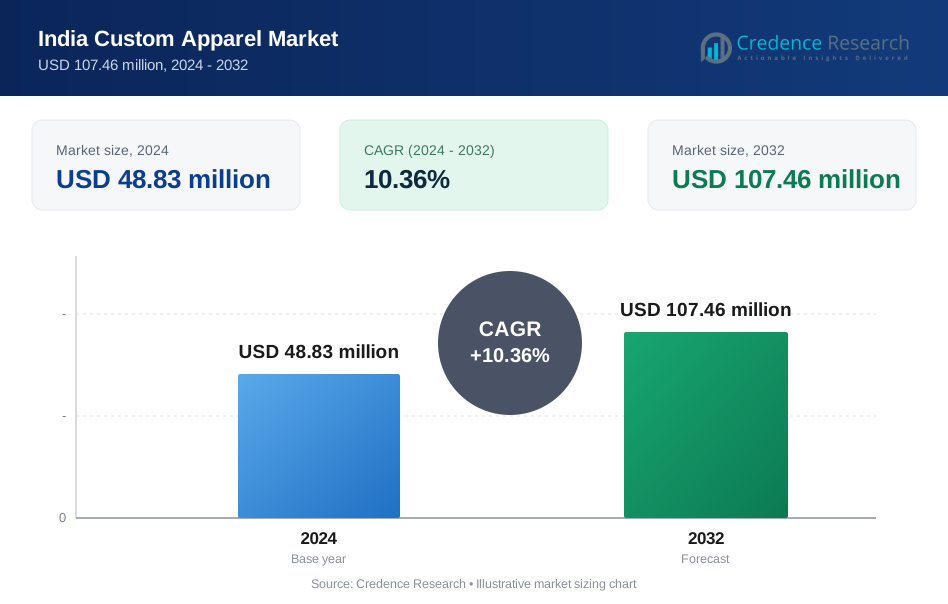
The India Custom Apparel Market is projected to grow from USD 48.83 million in 2024 to an estimated USD 107.46 million by 2032, with a compound annual growth rate (CAGR) of 10.36% from 2024 to 2032.
The growth of the India Custom Apparel Market is fueled by a confluence of factors. Rising disposable incomes, particularly in urban areas, have enabled consumers to prioritize personalized fashion, with Millennials and Gen Z leading this trend. These demographics increasingly demand apparel that resonates with their individual preferences, whether for everyday wear or special occasions. Technological advancements, such as digital printing, 3D body scanning, and automated embroidery, have significantly streamlined the customization process, ensuring precision, faster turnaround times, and superior quality. Additionally, the booming e-commerce sector provides consumers with user-friendly platforms to design and order custom clothing from the comfort of their homes. Furthermore, the growing emphasis on sustainability is steering consumers toward eco-friendly and ethically sourced custom apparel, creating opportunities for brands that align with this ethos.
Regionally, metropolitan hubs such as Mumbai, Delhi, and Bangalore continue to dominate the market due to their affluent, fashion-conscious populations and exposure to global trends. These cities are home to a large number of bespoke boutiques, tech-enabled customization start-ups, and established players offering tailor-made apparel. Meanwhile, Tier-2 and Tier-3 cities, including Pune, Jaipur, and Kochi, are witnessing a surge in demand driven by rising digital connectivity, growing consumer awareness, and the increasing popularity of fashion as a form of self-expression. The expansion of small and medium enterprises (SMEs) in these regions has further fueled accessibility and variety in custom apparel options. Overall, the regional diversity in demand underscores a rapidly evolving market that offers a blend of traditional craftsmanship and modern innovation.
Market Insights:
- The India Custom Apparel Market is projected to grow from USD 48.83 million in 2024 to USD 107.46 million by 2032, achieving a CAGR of 10.36%, driven by rising demand for personalized fashion.
- Millennials and Gen Z consumers are leading the trend for customization, preferring apparel that reflects individuality, particularly for everyday wear and special occasions.
- Technological advancements, including digital printing, 3D body scanning, and automated embroidery, have streamlined production processes, enabling higher precision and efficiency.
- The proliferation of e-commerce platforms has made customization widely accessible, offering user-friendly interfaces, virtual design tools, and convenient doorstep delivery to urban and rural consumers alike.
- Sustainability is a key focus, with consumers increasingly demanding eco-friendly, ethically sourced materials, encouraging brands to adopt green production practices.
- Urban hubs like Mumbai, Delhi, and Bangalore dominate the market with 45% of the share, while Tier-2 cities like Pune and Jaipur are witnessing growing demand due to rising digital connectivity.
- Challenges such as high production costs, longer production cycles, and limited penetration in rural areas hinder scalability but present opportunities for innovative solutions and targeted strategies.
Market Drivers:
Rising Consumer Demand for Personalization
The increasing desire for personalization is a key driver of the India Custom Apparel Market. Consumers, especially Millennials and Gen Z, are seeking unique clothing that reflects their personal style, preferences, and individuality. Custom apparel offers a way to move beyond mass-produced designs, enabling customers to tailor garments to their specific needs, from color and fit to intricate designs. For instance, Bewakoof has reported a 40% increase in sales of personalized clothing in India over the past year, highlighting the strong consumer demand for unique designs that reflect personal style. This shift in consumer preference is further fueled by the influence of social media and digital platforms, where personalized and unique styles are celebrated and shared widely.
Technological Advancements in Apparel Customization
Innovations in digital printing, 3D body scanning, and automated embroidery technologies have revolutionized the customization process in India. These advancements have enabled manufacturers to achieve higher precision and efficiency while reducing production costs and timelines. E-commerce platforms have integrated these technologies to offer virtual customization tools, making the process more accessible to consumers. For instance, Fashion & Lifestyle utilizes 3D body scanning technology to ensure precise measurements and tailored fits, significantly enhancing customer satisfaction. These innovations are not only improving customer satisfaction but also driving the scalability of custom apparel businesses across the country.
Growth of E-Commerce and Digital Platforms
The proliferation of e-commerce platforms has significantly boosted the custom apparel market in India. For instance, Myntra introduced a new feature on its platform, allowing customers to design and order custom apparel directly through the Myntra website. Online retailers now provide user-friendly interfaces that allow customers to create and order personalized clothing effortlessly. The convenience of doorstep delivery and secure payment options further enhance the appeal of these platforms. Additionally, social media platforms act as marketing channels, helping brands showcase their custom offerings to a broader audience and enabling small-scale businesses to compete with larger players. This digital transformation has made customization accessible to consumers across urban and rural areas, driving the market forward.
Increased Focus on Sustainability and Ethical Production
A growing awareness of environmental sustainability and ethical production practices is influencing consumer choices in the custom apparel market. Consumers are increasingly drawn to brands that emphasize eco-friendly materials, minimal waste, and fair labor practices. Custom apparel aligns well with these values by allowing for made-to-order production, which reduces overstock and waste. For instance, No Nasties has adopted sustainable production methods, reducing their carbon footprint and aligning with the increasing demand for ethical sourcing and production practices. Many businesses in India are leveraging this trend, offering sustainable fabrics and transparent supply chains to meet the rising demand for ethical fashion. This focus on sustainability not only supports the environment but also strengthens brand loyalty among conscientious consumers.
Market Trends:
Emergence of Digital Customization Tools
The integration of digital tools in the customization process is shaping the evolution of the India Custom Apparel Market. Brands are increasingly investing in technologies such as virtual fitting rooms, augmented reality (AR), and artificial intelligence (AI)-driven design assistance to enhance customer experience. For instance, companies like Printrove in India utilize direct-to-garment (DTG) printing to offer on-demand custom apparel services, allowing customers to visualize their personalized designs before placing an order, ensuring a better fit and higher satisfaction. These tools enable customers to visualize their personalized designs before placing an order, ensuring a better fit and higher satisfaction. The rise of such innovations is making the process seamless and efficient, attracting tech-savvy consumers who value convenience and precision in their fashion choices.
Growth in Demand for Occasion-Specific Custom Apparel
As consumer preferences shift, there is a notable rise in demand for custom apparel tailored for specific occasions. Weddings, festivals, and corporate events are driving the need for unique and personalized outfits that stand out. In particular, the Indian wedding market has witnessed a surge in demand for custom ethnic wear, such as sherwanis and lehengas, which cater to cultural and individual preferences. For instance, Shreeman offers a wide range of wedding wear for both men and women, including sherwanis and lehengas, blending traditional Indian wedding dresses with modern design. Their collection ensures a unique look for every wedding function, from pre-wedding events like Mehendi to lavish receptions. Similarly, the corporate sector is embracing custom uniforms that enhance brand identity and employee comfort. This trend underscores the growing significance of customized clothing in aligning with cultural and professional contexts.
Expansion of Sustainable Fabric Options
The growing awareness of sustainability has prompted the adoption of eco-friendly fabrics in the custom apparel market. Organic cotton, bamboo, and recycled polyester are gaining traction among consumers who prioritize environmental consciousness. Brands are increasingly offering these options as part of their customization portfolios, appealing to environmentally conscious shoppers. For instance, Bombay Hemp Company (BOHECO) leverages Himalayan hemp to create a versatile range of apparel and accessories, with a mission to educate, cultivate, and motivate through hemp. This trend aligns with the global movement toward green fashion and has been particularly popular in metropolitan areas where sustainability is a prominent consumer concern. By addressing this demand, businesses are not only reducing their environmental footprint but also positioning themselves as ethical and responsible market players.
Rising Popularity of D2C Custom Apparel Brands
Direct-to-consumer (D2C) brands are reshaping the custom apparel landscape in India. These brands bypass traditional retail channels, offering their products directly to customers through online platforms. The D2C model enables businesses to maintain better control over design, production, and pricing while ensuring a personalized shopping experience. For instance, Bewakoof has successfully leveraged the D2C model to offer a wide variety of personalized clothing directly to customers through its online platform. Many emerging brands are leveraging social media and influencer collaborations to market their offerings, fostering deeper connections with their target audience. The success of these brands highlights the growing preference for high-quality, personalized apparel delivered with transparency and convenience, signaling a shift in consumer expectations.
Market Challenges Analysis:
High Production Costs and Limited Scalability
One of the significant restraints in the India Custom Apparel Market is the high production cost associated with personalized clothing. Customization processes often require advanced technologies, skilled labor, and meticulous attention to detail, which increase operational expenses. For small and medium-sized enterprises (SMEs), these costs can hinder scalability and limit their ability to compete with mass-produced apparel brands. The reliance on made-to-order production models also adds logistical complexity, as manufacturers must balance efficiency with the need to cater to individual customer demands.
Time-Intensive Production Process
Custom apparel inherently involves a longer production cycle compared to off-the-shelf clothing. The need for precise design inputs, multiple iterations, and customer approvals delays the final delivery. This time-intensive nature of production can deter consumers seeking faster alternatives, especially in a market where convenience and speed are key factors driving purchasing decisions. As a result, businesses face challenges in meeting customer expectations without compromising on quality or customization.
Limited Penetration in Rural Areas
The custom apparel market in India remains predominantly concentrated in urban areas, with limited penetration in rural regions. Factors such as lower disposable incomes, lack of digital literacy, and minimal exposure to personalized fashion hinder market growth in non-metropolitan areas. Moreover, logistical challenges, including inadequate infrastructure and higher delivery costs, make it difficult for businesses to cater to rural consumers effectively. Bridging this gap requires substantial investment and innovative strategies to expand accessibility.
Sustainability Challenges in Material Sourcing
While sustainability is a growing trend, sourcing eco-friendly materials for custom apparel remains a challenge. Sustainable fabrics often come at a premium, increasing production costs and limiting affordability for a price-sensitive market like India. Additionally, ensuring transparency and ethical practices across the supply chain adds operational complexity. Overcoming these challenges is critical for businesses aiming to align with the global demand for sustainable and ethical fashion.
Market Opportunities:
The India Custom Apparel Market presents a significant growth opportunity driven by evolving consumer preferences and technological advancements. The growing demand for personalized fashion among Millennials and Gen Z consumers is fueling the market's expansion, as these demographics increasingly seek unique, made-to-order apparel that reflects their individuality. The integration of advanced technologies, such as AI-driven design platforms, 3D body scanning, and augmented reality, is creating a seamless and interactive customization experience for consumers. This technological evolution not only enhances customer satisfaction but also allows brands to scale operations and cater to a larger audience efficiently. Moreover, the rise of digital literacy and e-commerce penetration, particularly in Tier-2 and Tier-3 cities, has opened new avenues for brands to expand their reach and capitalize on the untapped demand in these regions.
Sustainability and ethical production practices further present lucrative opportunities for the market. With increasing awareness about environmental impact, consumers are actively seeking custom apparel made from sustainable and eco-friendly materials. Brands that prioritize transparency, offer sustainable options, and embrace a circular fashion approach are poised to capture a loyal customer base. Additionally, the growing corporate and event-based demand for custom apparel provides a unique opportunity for businesses to diversify their offerings and cater to specialized market segments. By leveraging these opportunities, businesses can strengthen their market position and achieve long-term growth in the dynamic and rapidly evolving India Custom Apparel Market.
Market Segmentation Analysis:
The India Custom Apparel Market is segmented by type, end-user, and distribution channel, with each category showcasing unique growth patterns and consumer preferences.
By Type, shirts and suits dominate the market due to their widespread demand across formal and casual settings. Shirts, favored for their versatility, account for a significant share as both individuals and corporate clients opt for tailored options. Suits, particularly for formal events and weddings, are gaining traction, especially in metropolitan regions. Meanwhile, coats and skirts exhibit steady growth, driven by evolving fashion trends and an increasing focus on seasonal apparel.
By End-user, women constitute the largest segment, reflecting their growing interest in personalized clothing for both traditional and contemporary styles. Men also represent a robust market, particularly for custom formal wear such as suits and shirts. The children's segment, while smaller, is expanding as parents seek tailored clothing for special occasions, such as festivals and school events.
By Distribution Channel, the online segment is emerging as a dominant force, driven by the increasing penetration of e-commerce platforms that offer interactive design tools and doorstep delivery. Consumers prefer the convenience of online shopping, particularly in Tier-2 and Tier-3 cities where access to brick-and-mortar custom apparel stores is limited. The offline channel remains relevant, catering to customers seeking personalized consultations and fittings, especially in high-end boutique stores and urban centers.
Segmentation:
By Type
- Coat
- Skirt
- Pants
- Shirt
- Suit
By End-user
- Women
- Men
- Children
By Distribution Channel
- Offline
- Online
Regional Analysis:
The India Custom Apparel Market showcases diverse growth patterns across its regions, with metropolitan cities leading the charge and emerging areas contributing to steady market expansion. Regional dynamics are driven by factors such as disposable income, technological adoption, and consumer preferences, resulting in varied market shares across different zones of the country.
Metropolitan regions like Mumbai, Delhi, and Bangalore dominate the market, accounting for approximately 45% of the total market share. These cities are hubs for fashion-forward consumers who prioritize individuality and are willing to invest in personalized apparel. The presence of numerous bespoke boutiques and tech-driven customization start-ups enhances the availability of options for these consumers. Additionally, these cities benefit from advanced digital infrastructure and a higher concentration of online shoppers, further boosting market accessibility and demand for custom apparel.
Tier-2 cities, including Pune, Jaipur, and Chandigarh, hold an estimated 30% of the market share, reflecting steady growth driven by rising urbanization and disposable income. These regions are witnessing a surge in digital literacy and e-commerce penetration, enabling more consumers to explore customization options. The growing popularity of custom ethnic wear for weddings and special occasions is particularly significant in these cities, where cultural traditions and modern trends intersect to drive demand.
Tier-3 cities and rural areas account for the remaining 25% of the market share, with increasing digital penetration and awareness contributing to gradual growth. Challenges such as limited disposable income and logistical barriers have historically restricted market expansion in these regions. However, improving infrastructure and targeted marketing strategies by brands are opening up opportunities for growth. Government initiatives to promote digital connectivity and entrepreneurship are further expected to play a pivotal role in expanding the custom apparel market in these areas.
Key Player Analysis:
- Adidas AG
- Allied Shirts
- Amazon.com Inc.
- CafePress Inc.
- Carhartt Inc.
- Cimpress Plc
- CustomInk LLC
- Designhill Inc.
- DOWNTOWN CUSTOM PRINTWEAR
- Jakprints
- Lynka Sp. z.o.o.
- Nike Inc.
- Printful Inc.
- Redbubble Ltd.
- Society6 LLC
- Spreadshirt Inc.
- TeeTalkies
- THREADBIRD
- UberPrints Inc.
- Vantage Custom Classics Inc.
- Zazzle Inc.
Competitive Analysis:
The India Custom Apparel Market is characterized by intense competition, driven by a mix of established brands, emerging start-ups, and regional players. Leading apparel brands and e-commerce platforms are leveraging advanced customization technologies, such as AI-driven design tools and 3D body scanning, to offer seamless and personalized experiences to customers. Players like Myntra, Bewakoof, and Cloudtail are dominating the online segment by providing user-friendly customization interfaces, quick delivery options, and competitive pricing. Emerging start-ups and regional boutiques focus on niche markets, offering unique designs, sustainable materials, and traditional craftsmanship. For instance, Bombay Shirt Company specializes in bespoke shirts, providing custom fits and a wide range of fabric option. These businesses cater to customers seeking exclusivity and authenticity in their apparel. The rise of direct-to-consumer (D2C) models has further intensified competition, enabling smaller players to bypass traditional retail channels and build strong consumer connections. This dynamic competition is fostering innovation and driving market growth, making customization increasingly accessible to a broader audience.
Recent Developments:
- In May 2024, Adidas AG unveiled the Team India jersey for the 2024 International T20 World Cup. This new jersey is now accessible to cricket fans through their stores and online platforms. Additionally, Adidas AG announced its ongoing partnership as the official kit sponsor for the Indian cricket team, extending until March 2028.
- In February 2024, PUMA India partnered with Delhi Capitals as their official kit sponsor for the Indian Premier League 2024. This collaboration entails a multi-year agreement with the team, covering training wear, accessories, travel gear, and athleisure, all designed with the same aesthetic as the jersey.
Market Concentration & Characteristics:
The India Custom Apparel Market exhibits a moderately fragmented structure, with no single player holding a dominant market share. The market is characterized by the presence of established e-commerce platforms, emerging direct-to-consumer (D2C) brands, and regional boutiques, each catering to diverse customer segments. Established players focus on leveraging advanced technologies like AI-based design tools and digital printing to scale their operations, while smaller brands emphasize niche offerings such as sustainable fabrics and culturally inspired designs. The market is highly dynamic and consumer-driven, shaped by evolving preferences for personalization, affordability, and convenience. A key characteristic of the market is its adaptability to regional demands, with businesses tailoring their offerings to cater to both urban and rural audiences. Additionally, the rise of online platforms and social media marketing has facilitated wider reach and engagement, fostering healthy competition and innovation across the market.
Report Coverage:
The research report offers an in-depth analysis based on By Type, By End-user and By Distribution Channel. details leading market players, providing an overview of their business, product offerings, investments, revenue streams, and key applications. Additionally, the report includes insights into the competitive environment, SWOT analysis, current market trends, as well as the primary drivers and constraints. Furthermore, it discusses various factors that have driven market expansion in recent years. The report also explores market dynamics, regulatory scenarios, and technological advancements that are shaping the industry. It assesses the impact of external factors and global economic changes on market growth. Lastly, it provides strategic recommendations for new entrants and established companies to navigate the complexities of the market.
Future Outlook:
- The India Custom Apparel Market is expected to grow significantly, driven by rising consumer demand for personalized fashion.
- Advancements in digital technologies, including AI and 3D body scanning, will enhance customization capabilities and efficiency.
- E-commerce platforms will continue to dominate as key distribution channels, expanding access to custom apparel across urban and rural areas.
- Sustainability trends will push brands to adopt eco-friendly fabrics and transparent supply chains, aligning with growing environmental awareness.
- Increasing disposable incomes in Tier-2 and Tier-3 cities will boost demand, creating new growth opportunities for businesses.
- The corporate sector will drive demand for custom uniforms and event-specific apparel, diversifying market applications.
- Direct-to-consumer (D2C) brands will expand, leveraging social media and influencer marketing to capture younger demographics.
- Rising digital literacy and internet penetration in rural areas will gradually improve market accessibility and adoption.
- Integration of virtual fitting rooms and AR tools will enhance customer engagement and satisfaction.
- Collaborative efforts between local artisans and tech-enabled start-ups will merge traditional craftsmanship with modern customization solutions.
Request a Free Sample
Fill in your details and we'll send you a free sample report.
- Sample data tables & charts
- Research methodology
Market Dynamics
Rising Demand for Personalization Among Millennials and Gen Z
Younger consumers in India are increasingly seeking apparel that reflects their individual style and preferences, driving demand for custom clothing options for both everyday wear and special occasions.
Technological Advancements in Customization
Innovations such as digital printing, 3D body scanning, and automated embroidery have streamlined the customization process, enabling higher precision, faster turnaround, and improved scalability for custom apparel providers.
Growth of E-Commerce and Digital Platforms
The proliferation of user-friendly online platforms and virtual design tools has made custom apparel widely accessible, allowing consumers across urban and rural areas to easily design and order personalized clothing.
Increasing Focus on Sustainability and Ethical Production
Consumers are showing a growing preference for eco-friendly and ethically sourced custom apparel, encouraging brands to adopt sustainable materials and transparent supply chains, which further drives market growth.
Expansion into Tier-2 and Tier-3 Cities
Rising disposable incomes, digital literacy, and internet penetration in smaller cities are opening new markets for custom apparel, enabling brands to reach previously untapped consumer segments.
Need a Custom Version of This Report?
Tailor the scope, geography, or segments to your exact requirements.
- Custom geography or segment scope
- Direct access to our analyst team
Frequently Asked Questions
What is the projected growth of the India Custom Apparel Market?
What factors are driving the growth of the market?
Which regions dominate the India Custom Apparel Market?
What challenges does the market face?
Table of Content
Chapter 1 Market Segmentation
- 1.1 Segmentation Framework
- 1.1.1 Product and Service Classification
- 1.1.2 Application and End-Use Classification
- 1.1.3 Technology and Solution Classification
- 1.1.4 Customer and Distribution Channel Classification
- 1.1.5 Geographic Segmentation
- 1.1.6 Market Segment Definitions and Boundaries
- 1.2 By Type
- 1.2.1 Coat
- 1.2.2 Skirt
- 1.2.3 Pants
- 1.2.4 Shirt
- 1.2.5 Suit
- 1.3 By End-user
- 1.3.1 Women
- 1.3.2 Men
- 1.3.3 Children
Chapter 2 Introduction
- 2.1 Report Objectives and Scope
- 2.2 Product Definition and Industry Terminology
- 2.3 Market Inclusions and Exclusions
- 2.4 Research Process
- 2.4.1 Primary Research and Expert Interviews
- 2.4.2 Secondary Research and Source Review
- 2.4.3 Top-Down and Bottom-Up Estimation
- 2.4.4 Data Triangulation and Verification
- 2.5 Market Size Measurement Basis
- 2.5.1 2024: USD 48.83 million → 2032: USD 107.46 million
- 2.6 Historical and Forecast Reference Periods
- 2.6.1 Base Year: 2024
- 2.6.2 Forecast Period: 2024-2032
- 2.7 Research Assumptions and Limitations
Chapter 3 Executive Summary
- 3.1 Market Snapshot and Key Findings
- 3.2 Base-Year Market Size, 2024
- 3.3 Forecast Market Size, 2032
- 3.4 Revenue and Volume Growth Outlook
- 3.5 Key Demand and Supply Indicators
- 3.6 Leading Market Segments
- 3.7 Fastest-Growing Market Opportunities
- 3.8 Regional Performance Highlights
- 3.9 Technology and Industry Transformation
- 3.10 Competitive Landscape Summary
- 3.11 Analyst View and Strategic Implications
Chapter 4 India Custom Apparel Market Trends and Developments
- 4.1 Historical Industry Development
- 4.2 Recent Market Trends and Developments
- 4.3 Demand and Customer Behavior Trends
- 4.4 Technology and Product Innovation
- 4.5 Artificial Intelligence, Automation and Digitalization
- 4.6 Local Manufacturing and Supply Chain Realignment
- 4.7 Industry Partnerships, Mergers and Acquisitions
- 4.8 Sustainability and Circular Economy Developments
- 4.9 Government and Private Sector Investment Trends
- 4.10 Emerging Business Models and Commercialization
- 4.11 Industry Developments and Announcements
Chapter 5 India Custom Apparel Market Production, Supply and Demand Analysis
- 5.1 Demand Trend and Consumption Analysis
- 5.2 Demand Forecast, 2024-2032
- 5.3 Production and Output Trend
- 5.4 Production and Output Forecast, 2024-2032
- 5.5 Installed Capacity and Capacity Utilization
- 5.6 Company-Wise Production Plants and Statistics
- 5.6.1 Installed Production Capacity
- 5.6.2 Actual Production
- 5.6.3 Planned Capacity and Expansion Targets
- 5.7 Supply Chain Structure and Procurement Trends
- 5.8 Supply-Demand Gap and Bottlenecks
- 5.9 Import Dependence and Sourcing Structure
- 5.10 Contract Manufacturing and Outsourcing
- 5.11 Regional Supply and Demand Concentration
Chapter 6 India Custom Apparel Market Pricing Analysis
- 6.1 Pricing Structure and Measurement
- 6.2 Historical Pricing Trends
- 6.3 Pricing Outlook, 2024-2032
- 6.4 Average Selling Price and Unit Economics
- 6.5 Pricing by Product and Market Segment
- 6.6 Geographic Pricing Differences
- 6.7 Key Input, Energy, Labor and Logistics Costs
- 6.8 Contract Pricing and Purchasing Models
- 6.9 Pricing Sensitivity and Competitive Positioning
- 6.10 Price, Margin and Profitability Implications
Chapter 7 India Custom Apparel Market Dynamics
- 7.1 Market Growth Drivers
- 7.1.1 Demand-Side Drivers
- 7.1.2 Technology and Innovation Drivers
- 7.1.3 Infrastructure and Investment Drivers
- 7.1.4 Regulatory and Policy Drivers
- 7.2 Market Restraints
- 7.2.1 Cost and Affordability Constraints
- 7.2.2 Technology and Adoption Barriers
- 7.2.3 Supply Chain and Operational Constraints
- 7.3 Market Challenges
- 7.3.1 Competitive Pressure and Margin Erosion
- 7.3.2 Skills, Infrastructure and Implementation Gaps
- 7.4 Emerging Market Opportunities
- 7.5 Market Dynamics Impact and Time-Horizon Assessment
Chapter 8 India Custom Apparel Value Chain Analysis
- 8.1 Industry Value Chain Overview
- 8.2 Upstream Suppliers and Critical Inputs
- 8.3 Technology and Component Providers
- 8.4 Manufacturing or Service Delivery
- 8.5 Distribution, Channel Partners and Integrators
- 8.6 Downstream Applications and End Users
- 8.7 Value Addition and Profit Pools
- 8.8 Vertical Integration and Outsourcing
- 8.9 Supplier Concentration and Risk
- 8.10 Supply Chain Localization and Resilience
Chapter 9 India Custom Apparel Market Regulations and Policies
- 9.1 Relevant Laws, Standards and Compliance Frameworks
- 9.2 Product, Service, Safety and Quality Requirements
- 9.3 Government Policies, Incentives and Subsidies
- 9.4 Imports, Exports and Trade Barriers
- 9.5 Public Procurement and Local Content Requirements
- 9.6 Environmental and Sustainability Compliance
- 9.7 Upcoming Policy Changes and Market Implications
Chapter 10 India Custom Apparel Market Hotspots and Opportunities
- 10.1 Market Opportunity Mapping and Growth Hotspots
- 10.2 High-Growth Applications and Customer Groups
- 10.3 Underserved Markets and White-Space Opportunities
- 10.4 Emerging Technology and Product Opportunities
- 10.5 New Capacity and Investment Hotspots
- 10.6 Market Entry and Expansion Opportunities
- 10.7 Distribution and Partnership Opportunities
- 10.8 Near-Term and Long-Term Commercial Potential
- 10.9 Opportunity Attractiveness and Execution Risks
Chapter 11 India Custom Apparel Market Outlook, 2024-2032
- 11.1 Market Size and Analysis
- 11.1.1 Revenue (Market Measurement: 2024: USD 48.83 million → 2032: USD 107.46 million)
- 11.1.2 Market Volume and Quantity Sold
- 11.1.3 Historical Market Size
- 11.1.4 Base-Year Market Size, 2024
- 11.2 Market Forecast, 2024-2032
- 11.2.1 Revenue Forecast to 2032
- 11.2.2 Volume Forecast to 2032
- 11.2.3 CAGR and Year-on-Year Growth
- 11.2.4 Incremental Revenue Opportunity
- 11.3 Forecast Assumptions and Scenario Analysis
- 11.3.1 Base-Case Forecast
- 11.3.2 Optimistic and Conservative Scenarios
- 11.3.3 Technology, Pricing and Policy Sensitivities
- 11.4 Market Attractiveness and Growth Outlook
Chapter 12 India Custom Apparel Market Segmentation and Outlook
- 12.1 Segmentation Summary and Market Shares, 2024
- 12.2 Largest and Fastest-Growing Segments
- 12.3 By Type - Market Size and Forecast, 2024-2032
- 12.3.1 Segment Definition and Scope
- 12.3.2 Historical Market Size
- 12.3.3 Revenue Forecast, 2024-2032
- 12.3.4 Volume Forecast, 2024-2032
- 12.3.5 Base-Year Market Share, 2024
- 12.3.6 Segment CAGR and Growth Drivers
- 12.3.7 Subsegment Market Size and Forecast
- 12.3.7.1 Coat
- 12.3.7.2 Skirt
- 12.3.7.3 Pants
- 12.3.7.4 Shirt
- 12.3.7.5 Suit
- 12.3.8 Subsegment Pricing and Adoption Trends
- 12.3.9 Leading Suppliers and Competition
- 12.3.10 Regional Demand and Opportunities
- 12.4 By End-user - Market Size and Forecast, 2024-2032
- 12.4.1 Segment Definition and Scope
- 12.4.2 Historical Market Size
- 12.4.3 Revenue Forecast, 2024-2032
- 12.4.4 Volume Forecast, 2024-2032
- 12.4.5 Base-Year Market Share, 2024
- 12.4.6 Segment CAGR and Growth Drivers
- 12.4.7 Subsegment Market Size and Forecast
- 12.4.7.1 Women
- 12.4.7.2 Men
- 12.4.7.3 Children
- 12.4.8 Subsegment Pricing and Adoption Trends
- 12.4.9 Leading Suppliers and Competition
- 12.4.10 Regional Demand and Opportunities
- 12.5 Segment Growth Comparison
- 12.6 Segment Attractiveness and Priority Matrix
Chapter 13 India Custom Apparel End-Use and Application Market Outlook
- 13.1 End-Use Industry and Customer Demand Structure
- 13.2 Leading Applications and Customer Groups
- 13.3 End-Use Market Size, Share and Forecast
- 13.4 Major End-Use Industry Deep Dives
- 13.4.1 Customer Requirements and Use Cases
- 13.4.2 Demand and Replacement Cycles
- 13.4.3 Technical and Regulatory Considerations
- 13.4.4 Purchasing and Procurement Models
- 13.4.5 Leading Vendors and Distribution Channels
- 13.4.6 Forecast and Commercial Opportunities
- 13.5 Emerging Applications and Cross-Segment Demand
- 13.6 End-Use Industry Investment Priorities
Chapter 14 India Custom Apparel Geographic Market Outlook, 2024-2032
- 14.1 Domestic Market Distribution and Demand Clusters
- 14.2 State- or Province-Wise Market Size and Forecast, 2024-2032
- 14.3 City and Metropolitan Market Outlook
- 14.4 Industrial, Manufacturing and Commercial Clusters
- 14.5 Geographic Concentration of Key End Users
- 14.6 Local Pricing and Purchasing Differences
- 14.7 Domestic Production Facilities and Capacity Map
- 14.8 Local Infrastructure and Project Pipeline
- 14.9 State-Level Policy and Incentive Differences
- 14.10 Subnational Investment Hotspots and Opportunities
- 14.11 Distribution and Logistics Networks
- 14.12 Domestic Competitive Footprint
Chapter 15 India Custom Apparel Technology, Innovation and Sustainability Outlook
- 15.1 Technology Landscape and Maturity
- 15.2 Product, Process and Service Innovation
- 15.3 AI, Automation and Digital Tools in the Industry
- 15.4 Technology Adoption and Performance Benchmarking
- 15.5 Innovation Pipeline and R&D Investment
- 15.6 Patent and Intellectual Property Trends
- 15.7 Energy Efficiency and Resource Management
- 15.8 Sustainability, Recycling and Circularity
- 15.9 Technology Roadmap, 2024-2032
- 15.10 Risks of Obsolescence and Technology Substitution
Chapter 16 India Custom Apparel Market Key Strategic Imperatives
- 16.1 Growth and Market Entry Priorities
- 16.2 High-Return Products and Segments
- 16.3 Pricing, Profitability and Cost Optimization
- 16.4 Technology Investment and Product Differentiation
- 16.5 Supply Chain Localization and Resilience
- 16.6 Distribution and Customer Acquisition
- 16.7 Partnership, Acquisition and Capacity Strategy
- 16.8 Regional Expansion Priorities
- 16.9 Short-, Medium- and Long-Term Actions
Chapter 17 Competition Outlook
- 17.1 Industry Competition Characteristics
- 17.2 Market Structure and Concentration
- 17.3 Market Share and Competitive Positioning, 2024
- 17.4 Company-Wise Revenue and Product Benchmarking
- 17.5 Production and Service Capacity Benchmarking
- 17.6 Technology, Pricing and Differentiation
- 17.7 Regional Footprint and Distribution Strength
- 17.8 Mergers, Acquisitions and Strategic Alliances
- 17.9 New Entrants and Competitive Threats
- 17.10 Porter's Five Forces and Industry Attractiveness
- 17.11 Competitive Outlook, 2024-2032
Chapter 18 Company Profiles
- 18.1 Company Coverage and Selection Criteria
- 18.2 Adidas AG
- 18.2.1 Business Description
- 18.2.2 Company Ownership and Geographic Presence
- 18.2.3 Product and Service Portfolio
- 18.2.4 Manufacturing and Operating Footprint
- 18.2.5 Production Capacity and Expansion Plans
- 18.2.6 Financial Performance and Investment
- 18.2.7 Market Share and Competitive Position
- 18.2.8 Technology and Innovation Capabilities
- 18.2.9 Strategic Alliances or Partnerships
- 18.2.10 Recent Developments
- 18.2.11 Growth Strategy and Outlook
- 18.3 Amazon.com Inc.
- 18.4 Bewakoof
- 18.5 Myntra
- 18.6 CustomInk LLC
- 18.7 Printful Inc.
- 18.8 Bombay Shirt Company
- 18.9 PUMA India
- 18.10 Redbubble Ltd.
- 18.11 Zazzle Inc.
- 18.12 Other Relevant Market Participants
Note: Every listed company is profiled on the structure shown under the first company. The company list is preliminary and may change based on research findings, market developments, data availability and client requirements.
Chapter 19 Disclaimer
- 19.1 Research and Forecast Disclaimer
- 19.2 Data Source and Estimation Limitations
Note: The depth of individual sections depends on data availability for this market. Volume, capacity, trade and other unit-based metrics are included where applicable.

