
ABDM rails are turning paper charts into linked records
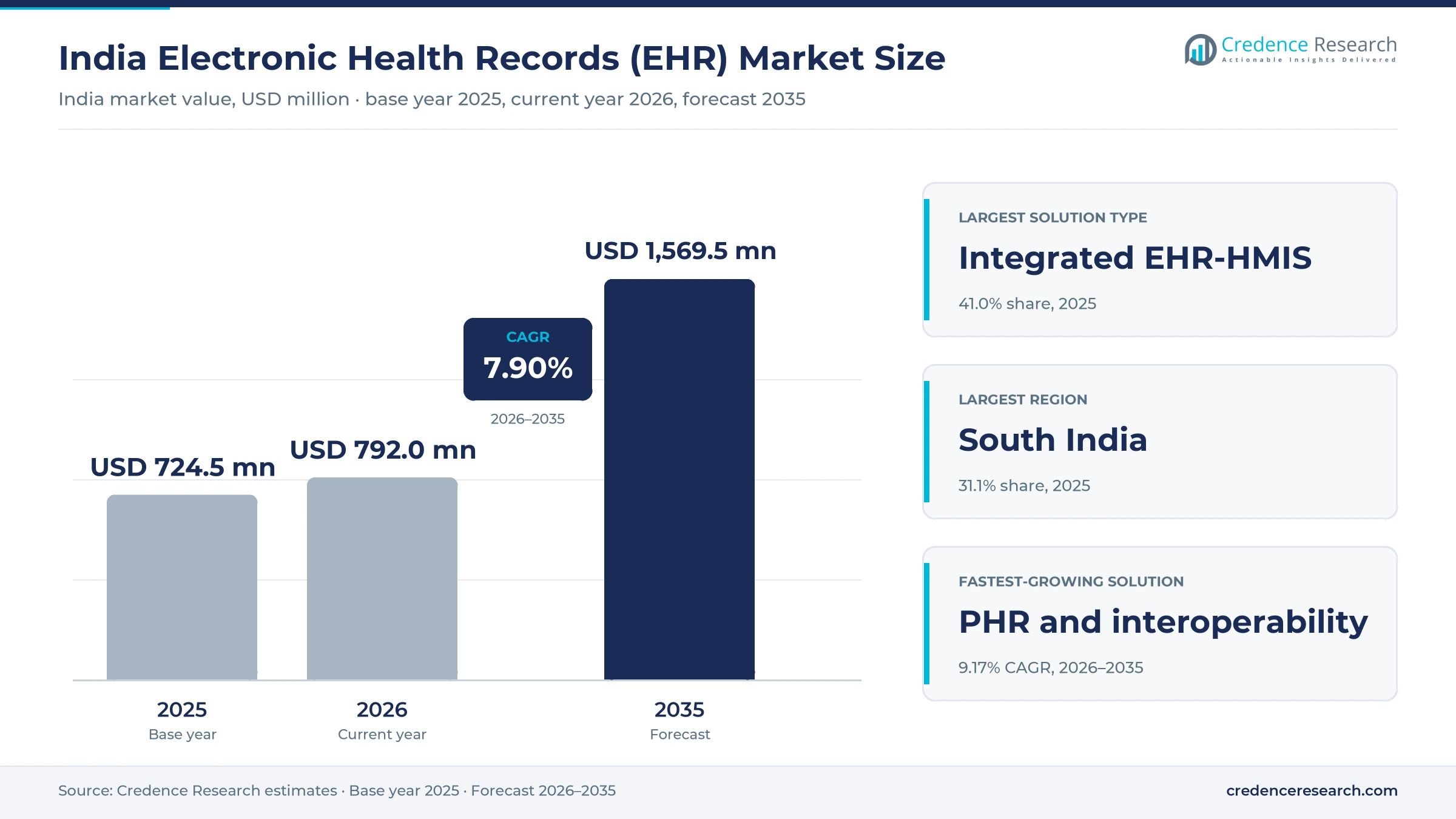
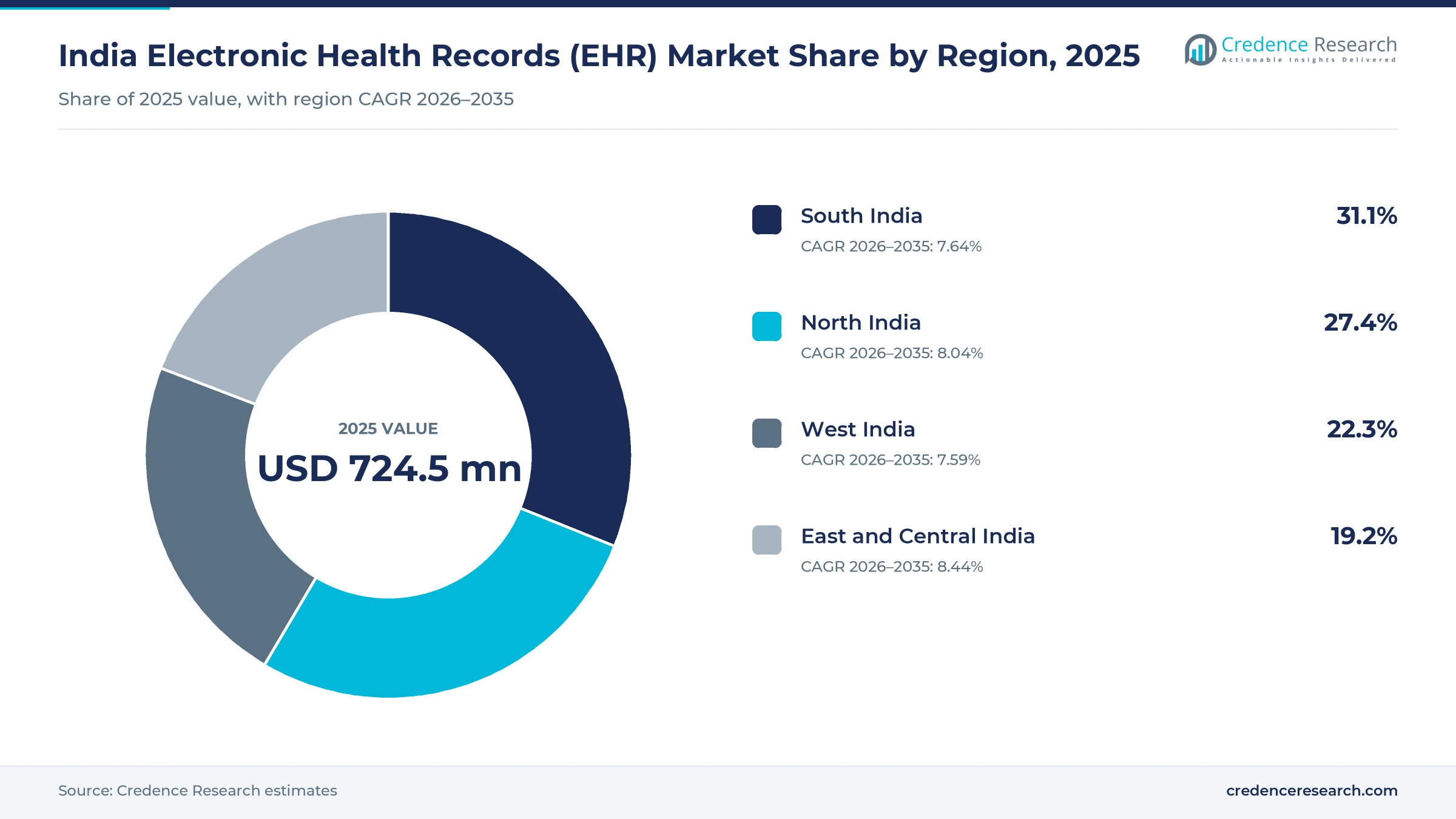
The India electronic health records (EHR) market was valued at USD 724.5 million in 2025 and is projected to increase from USD 792.0 million in 2026 to USD 1.57 billion by 2035, registering a CAGR of 7.90% during 2026–2035. Demand comes from hospitals replacing paper charts with integrated clinical and billing systems, from doctors adopting cloud prescription tools, and from the national push to link every patient record to an Ayushman Bharat Health Account. South India held the largest regional share, 31.1% in 2025, because states such as Kerala run large public eHealth networks and the zone hosts dense private hospital clusters. East and Central India is the fastest-growing region at 8.44% a year, as Bihar and neighboring states move government outpatient registration onto digital systems. However, the rules are changing, because the Digital Personal Data Protection Rules notified in November 2025 give providers 18 months to rebuild consent and data handling.
Which record systems and services does this estimate include?
The estimate measures spending on software that creates, stores and shares patient clinical records across India, including general-purpose and specialty record systems, record modules inside hospital management suites, and patient-held record and interoperability platforms. It counts license fees, subscriptions, implementation, hosting and support paid by hospitals, clinics, diagnostic centers and government health systems.
The estimate excludes stand-alone billing, insurance claims processing, telemedicine visits and medical devices that merely produce data without storing a clinical record. The value chain runs from software developers and cloud hosts through implementation partners to the hospitals, doctors, laboratories and public programs that buy the systems.
India Electronic Health Records (EHR) Market Insights
- The India electronic health records (EHR) market was valued at USD 724.5 million in 2025 and is projected to reach USD 1.57 billion by 2035, registering a CAGR of 7.90% during 2026–2035.
- South India held a 31.1% share of 2025 value, because Kerala's public eHealth system and dense private hospital clusters keep record use high across the zone.
- Integrated EHR-HMIS systems led with a 41.0% share of 2025 value, because multi-specialty hospitals buy clinical records together with billing, pharmacy and laboratory modules.
- More than 104 crore health records were linked to over 93 crore Ayushman Bharat Health Accounts by June 2026, which gives every record system a national exchange layer.
- Personal health record and interoperability platforms grow fastest at 9.17% a year during 2026–2035, as Aarogya Setu 2.0 and private apps let patients hold their own records.
Integrated EHR-HMIS leads as patient-held records grow
Why do integrated EHR-HMIS suites hold the largest value?
Based on solution type, the market is categorized into general-purpose EHR, specialty EHR, integrated EHR-HMIS and personal health record and interoperability platforms. Integrated EHR-HMIS led with a 41.0% share of 2025 value, because hospitals buy clinical records with billing, pharmacy and laboratory modules in one contract. Personal Health Record and Interoperability Platforms grow fastest at 9.17% a year, as national record linking rewards software that moves data between providers.
How fast is cloud deployment replacing local servers?
Based on deployment model, the market is categorized into web/cloud-based, on-premise and hybrid/private cloud systems. Web/Cloud-Based systems led with a 46.0% share of 2025 value, because clinics and small hospitals avoid server costs and pay monthly fees instead. Web/Cloud-Based deployment grows fastest at 8.54% a year, as vendors add offline modes for patchy connections in smaller towns.
Where do multi-specialty hospitals and clinics stand?
Based on care setting, the market is categorized into multi-specialty hospitals, specialty hospitals, ambulatory clinics and physician practices, and diagnostic and imaging centers. Multi-Specialty Hospitals led with a 47.0% share of 2025 value, because inpatient records, orders and discharge summaries need the deepest systems. Ambulatory Clinics and Physician Practices grow fastest at 8.64% a year, as low-cost prescription software spreads beyond the large cities.
How do private chains and public buyers divide demand?
Based on customer type, the market is categorized into large hospital chains, independent hospitals, physician groups and government health systems. Large Hospital Chains led with a 36.0% share of 2025 value, because multi-site groups standardize one record platform across every hospital. Physician Groups grow fastest at 8.58% a year, as shared clinics and specialist networks move from paper to subscription software.
| Segment Group | Leading Sub-segment | Share, 2025 | Fastest-growing Sub-segment | CAGR, 2026–2035 |
|---|---|---|---|---|
| By Solution Type | Integrated EHR-HMIS | 41.0% | Personal Health Record and Interoperability Platforms | 9.17% |
| By Deployment Model | Web/Cloud-Based | 46.0% | Web/Cloud-Based | 8.54% |
| By Care Setting | Multi-Specialty Hospitals | 47.0% | Ambulatory Clinics and Physician Practices | 8.64% |
| By Customer Type | Large Hospital Chains | 36.0% | Physician Groups | 8.58% |
Request a Free Sample
Fill in your details and we'll send you a free sample report.
- Sample data tables & charts
- Research methodology
ABDM links, cloud tools and NABH standards lift adoption
How does national ABDM interoperability pull providers online?
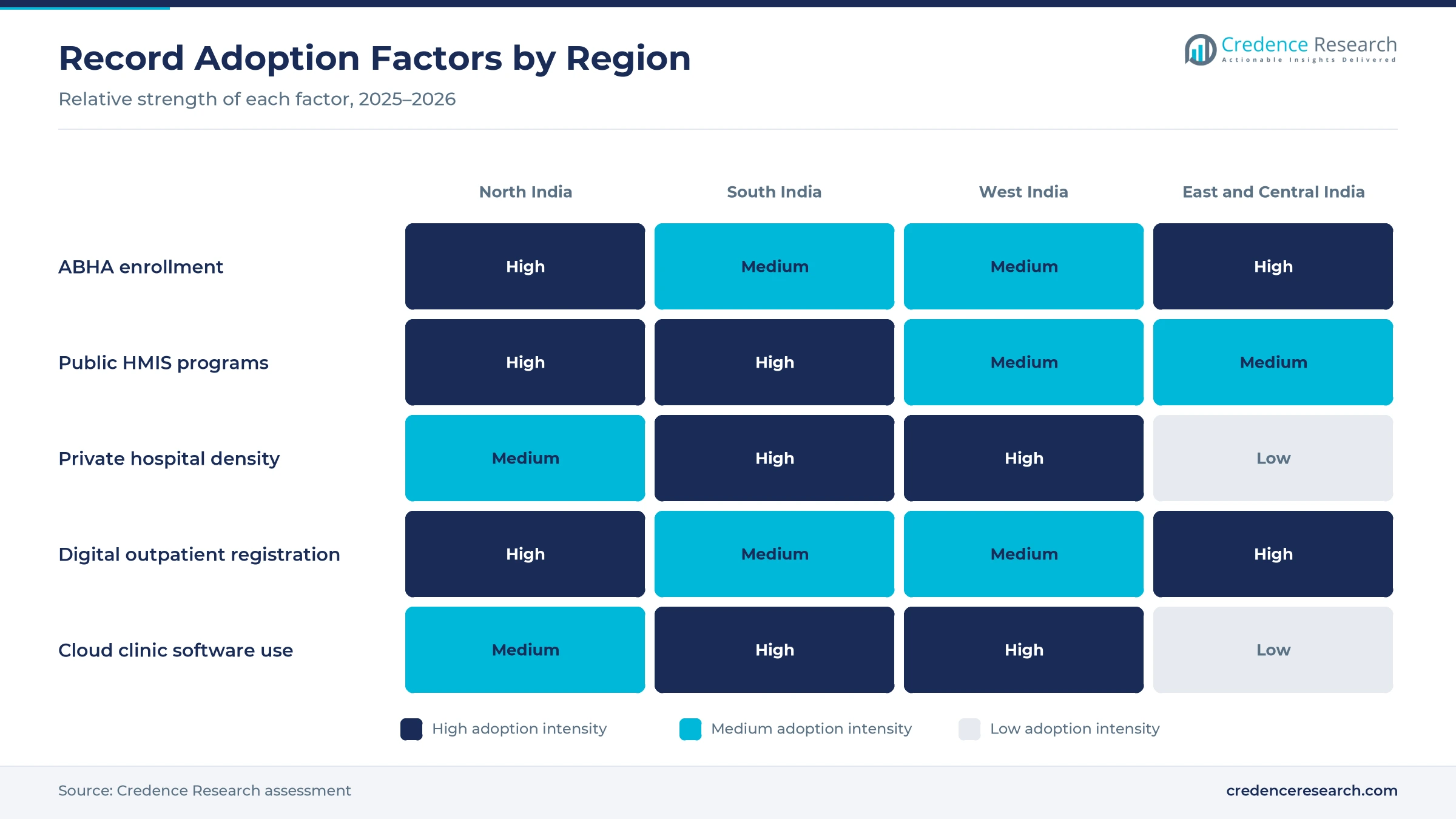
A national exchange layer gives every hospital and clinic a reason to keep records in digital form, because patients can now carry their history between providers. More than 104 crore health records were linked to over 93 crore Ayushman Bharat Health Accounts by June 2026, according to a government factsheet on the mission. The same factsheet shows incentives of more than Rs 107 crore paid to hospitals and over Rs 26 crore to digital solution companies under the Digital Health Incentive Scheme. In addition, 320,973 facilities in 771 districts were using ABDM-enabled software by July 28, 2025, according to a Lok Sabha reply reported by Digital Health News. As a result, interoperability platforms grow fastest at 9.17% a year.
Why is cloud-first digitization spreading among doctors?
Cloud software lets a single doctor or a 30-bed hospital start keeping records without buying servers or hiring IT staff, which opens the market far beyond metropolitan chains. Internet users reached 70% of the population in 2025, up from 49.3% in 2021, according to World Bank data. HealthPlix said in July 2025 that it serves more than 12,000 doctors in 370 cities, with 60% to 70% of them in tier II and tier III cities, according to Entrepreneur India. The government also launched eSushrut@Clinic in June 2026 as a lightweight hospital management system for small clinics, and more than 2,200 facilities had joined it. In turn, web and cloud-based systems hold 46.0% of 2025 value.
How do workflow automation and NABH standards raise demand?
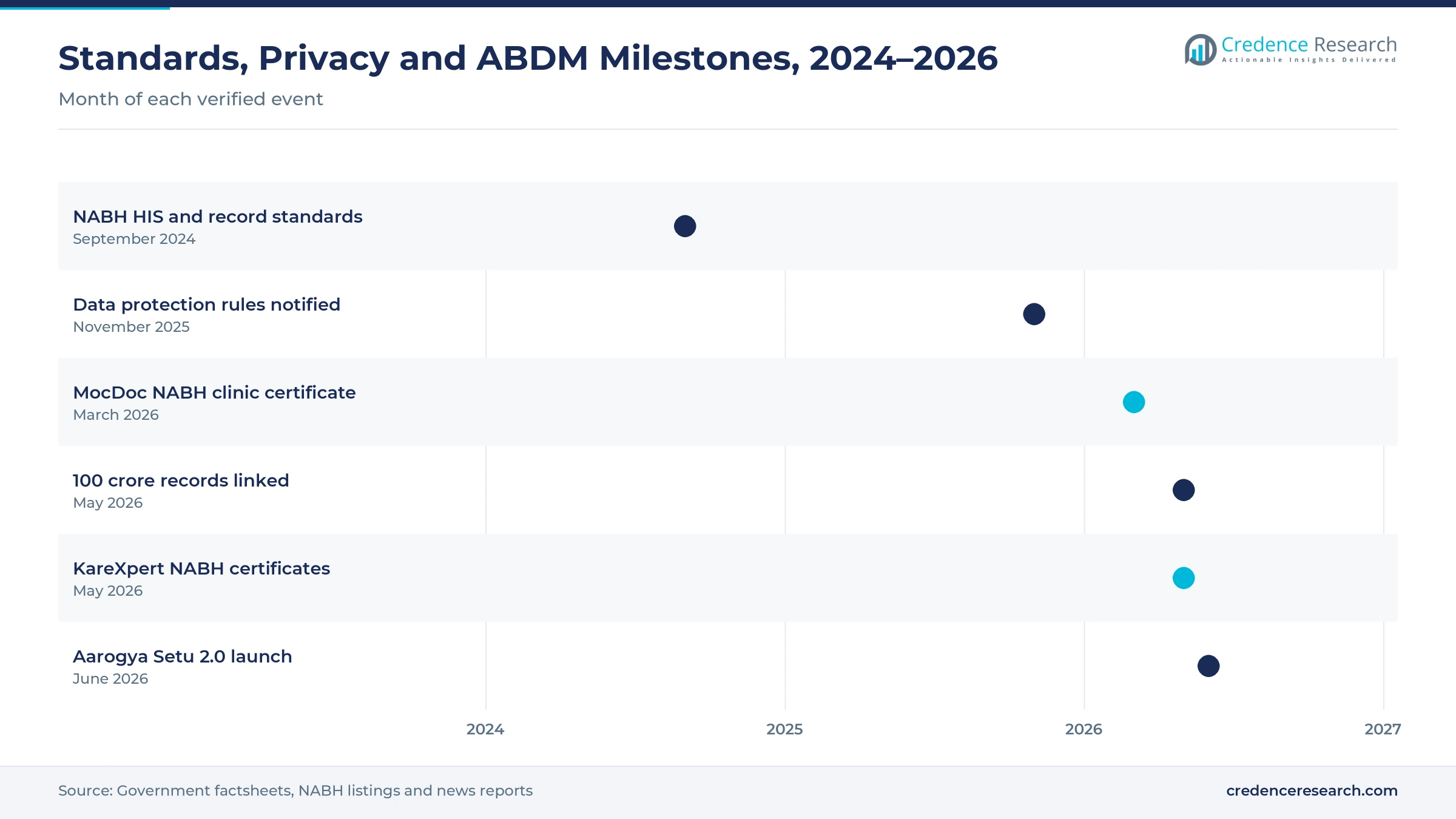
Hospitals now buy record systems against published standards, which pushes vendors to automate orders, medication checks and discharge summaries rather than sell simple digital forms. NABH launched its digital health standards for hospital information and record systems in September 2024, a year after its digital health standards for hospitals. KareXpert holds advanced NABH certificates for both its hospital information and record systems, valid from May 27, 2026, according to the NABH certified software listing. MocDoc and Eka Care also received advanced clinic management certificates in March and April 2026. The Ministry of Health and Family Welfare had already released national EHR standards in December 2016. As a result, integrated EHR-HMIS suites lead with 41.0% of 2025 value.
How does public hospital investment widen the buyer base?
Government programs are adding hospital capacity and paying states to run hospital management software, which turns public facilities into large buyers of record systems. The Pradhan Mantri Ayushman Bharat Health Infrastructure Mission carries an outlay of about Rs 64,180 crore for 2021-22 to 2025-26, and 621 critical care blocks had been approved, according to the Ministry of Health and Family Welfare. All states and union territories receive financial assistance for applications such as eHospital, eSushrut and eUpchaar on the NextGen eHospital platform. AIIMS New Delhi alone generated over 11 lakh ABHA IDs in 2024-25 across a hospital network of about 3,700 beds. In turn, large multi-specialty hospitals hold 47.0% of 2025 value across the country.
AI scribes, QR registration and claims links reshape use
How is the rise of AI scribes changing clinical documentation?
Doctors in busy outpatient clinics often see a patient every few minutes, so typing notes is the main barrier to keeping complete records. Eka Care launched EkaScribe, an AI medical scribe built on its own Parrotlet language model, which turns mixed Hindi and English conversations into structured notes and prescriptions, according to Digital Health News. HealthPlix localizes its platform in 14 languages and says more than 22 million patients have been treated by doctors using it. The Ministry of Health and Family Welfare has also set up three Centers of Excellence for AI in healthcare at AIIMS Delhi, PGIMER Chandigarh and AIIMS Rishikesh. As a result, ambulatory clinics and physician practices grow fastest at 8.64% a year during 2026–2035.
Why is the shift to QR-based registration feeding record systems?
Queue tokens that pull patient details from an ABHA account create a digital record at the first step of every visit, which pushes hospitals to connect registration with clinical software. The Scan and Share service, launched in 2022, had issued more than 23.21 crore ABHA-linked tokens, and a study cited by the government found waiting times fell from about one hour to two to five minutes. Over 91% of patients at government hospitals in Bihar used the QR system in May 2025 across 592 facilities, according to Digital Health News. AIIMS New Delhi also generated 30 lakh Scan and Share tokens in 2024-25. In turn, hospitals that link registration with clinical modules capture more complete records from the first visit.
Can patient-held records open a new consumer channel?
Patients who keep their own records on a phone become a second channel for record vendors, alongside hospitals and clinics. The government launched Aarogya Setu 2.0 on June 29, 2026, as a unified gateway to digital health services and a personal health record. ABHA accounts crossed 90 crore in May 2026, and women held 49.75% of them, according to IANS. Private apps such as Eka Care already offer ABDM-compliant health IDs and record storage, while mobile medical apps add bookings and reminders. As a result, personal health record platforms gain a consumer channel that sits alongside hospital and clinic buyers.
Is there room to link records with insurance claims?
Insurers need clinical evidence to approve hospital claims, so record systems that feed claim files directly can win hospital budgets that billing software alone cannot reach. The National Health Claims Exchange is described in the government factsheet as a digital highway for claims information among payers, providers, beneficiaries and regulators. Aditya Birla Health Insurance, Reliance General Insurance, HDFC Ergo and two other insurers were joining the platform in September 2024, according to Outlook Business. The National Health Authority also held an NHCX innovation meet at IIT Hyderabad on March 6 and 7, 2026, after a hackathon that drew more than 110 solutions. In turn, large hospital chains hold 36.0% of 2025 value.
Privacy rules, small budgets and legacy systems slow uptake
Privacy compliance raises costs for every provider
The Digital Personal Data Protection Rules, notified on Nov. 14, 2025, require clear consent notices and give organizations 18 months for phased compliance. As a result, hospitals and clinics must review how their software captures consent, stores records and reports breaches. Smaller vendors face the heaviest burden, because they must rebuild consent screens and audit logs with few engineers. As a result, platforms that already follow ABDM consent flows gain an edge in hospital tenders.
Small clinics struggle to pay for software and training
Many single-doctor clinics run on thin margins and see record keeping as an extra task rather than a clinical tool. In turn, subscription fees, computer hardware and staff training can delay adoption even when the software itself is cheap. Free government tools such as eSushrut@Clinic help, but they compete with paid vendors for the same users. To win these clinics, vendors bundle prescription printing and appointment tools that save staff time each day.
Legacy systems slow data exchange between hospitals
Older on-premise hospital systems often store records in formats that do not map cleanly to national standards. As a result, hospitals must pay for interfaces or upgrades before they can share records through ABDM gateways. Large chains can fund this work, but independent hospitals may postpone it for years. Vendors respond with FHIR-based connectors and phased migrations that keep billing running while clinical modules move to newer platforms.
Workforce gaps limit complete documentation
Doctors and nurses in crowded public hospitals rarely have time to enter structured data for every patient they see. In turn, many records capture registration and billing details while clinical notes remain on paper or in free text. Incomplete records weaken analytics and decision support, which reduces the value hospitals see from their software. High-volume outpatient departments therefore add voice capture, templates and data entry staff to complete each record.
South India leads while East and Central India grows fastest
| Region | Value, 2025 (USD million) | Share, 2025 | CAGR, 2026–2035 |
|---|---|---|---|
| South India | 225.3 | 31.1% | 7.64% |
| North India | 198.5 | 27.4% | 8.04% |
| West India | 161.6 | 22.3% | 7.59% |
| East and Central India | 139.1 | 19.2% | 8.44% |
How does Kerala's ehealth network keep South India ahead?
South India held a 31.1% share of 2025 value and grows at 7.64% a year, because public and private providers there adopted digital records early. Kerala's eHealth system has been adopted by 751 hospitals and lists more than 8.45 crore registered users, according to Kerala Kaumudi. JIPMER in Puducherry runs 1,828 beds and handles over 15 lakh outpatient visits a year, which creates heavy record volumes. As a result, South India combines mature public networks with dense private hospital demand.
Why does the uttar Pradesh ABHA base anchor North India?
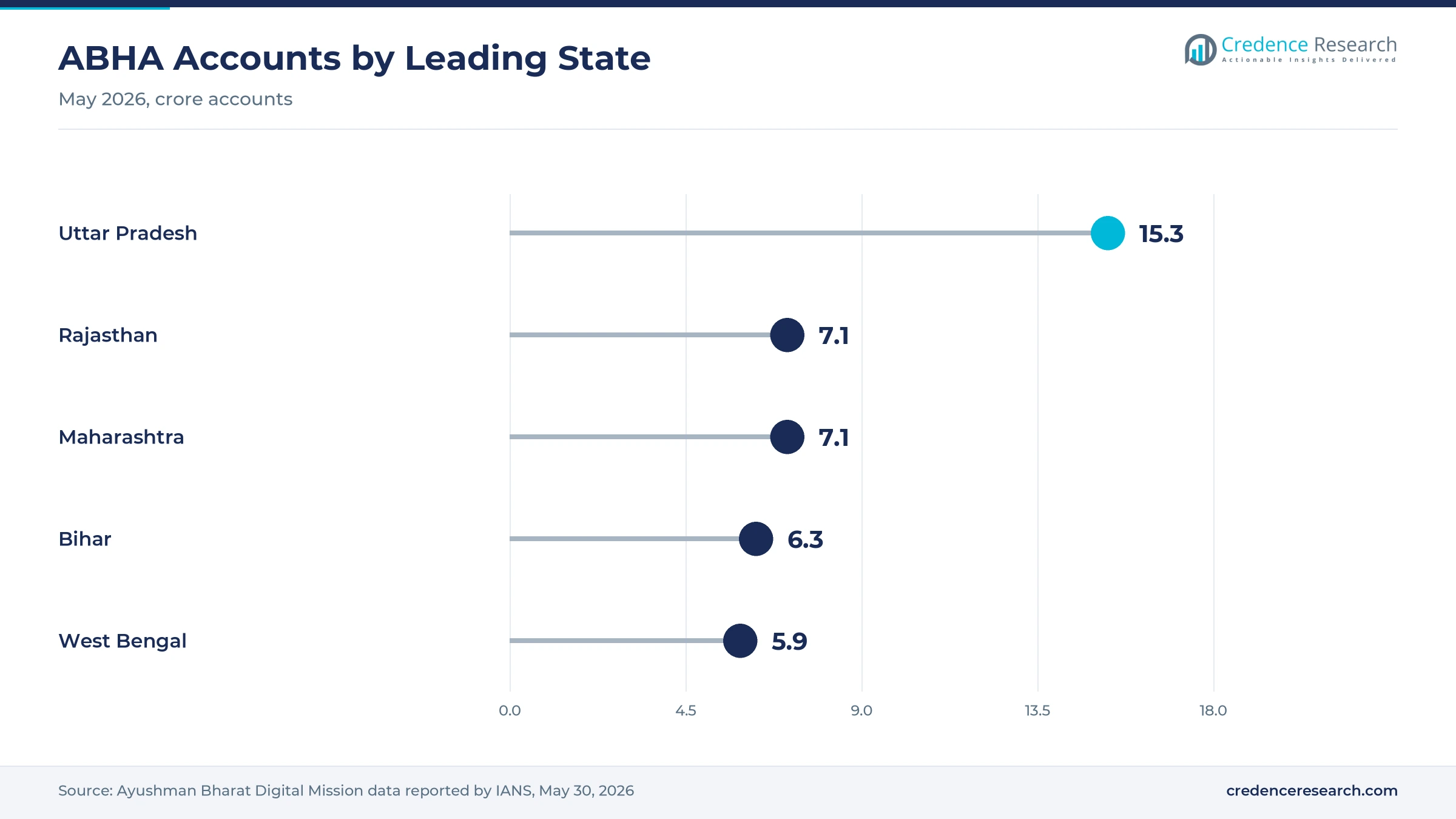
North India held a 27.4% share of 2025 value and grows at 8.04% a year, because the zone holds the largest ABHA base. Uttar Pradesh had more than 15.3 crore ABHA accounts in May 2026, the most of any state, according to IANS. AIIMS New Delhi generated over 11 lakh ABHA IDs and 30 lakh Scan and Share tokens in 2024-25. In turn, central institutes and state programs make government health systems the main buyers in this zone.
How do Maharashtra's private hospitals shape West India?
West India held a 22.3% share of 2025 value and grows at 7.59% a year, because Maharashtra and Gujarat host many private hospitals and diagnostic chains. Maharashtra had about 7.1 crore ABHA accounts in May 2026, up from about 5.9 crore in March 2025, according to IANS. Gujarat was also named among the significant contributors to ABHA enrollment. As a result, the zone relies on private buyers that upgrade to integrated suites.
How is Bihar's digital outpatient push lifting the east?
East and Central India held a 19.2% share of 2025 value and grows fastest at 8.44% a year, because public hospitals are digitizing from a low base. Bihar recorded 2.95 crore digital outpatient registrations, and all 592 government facilities offer digital registration. Bihar and West Bengal held about 6.3 crore and 5.9 crore ABHA accounts in May 2026. In turn, government programs lead record adoption across the whole zone.
Standards, privacy rules and ABDM milestones since 2024
| Development | Status and market relevance |
|---|---|
| In September 2024, NABH launched digital health standards for hospital information and record systems. | Gives hospitals a benchmark for record system purchases |
| In November 2025, the government notified the Digital Personal Data Protection Rules with an 18-month phase-in. | Requires providers and vendors to rebuild consent and data handling |
| In May 2026, KareXpert received advanced NABH certificates for its hospital information and record systems. | Strengthens certified suites in hospital tenders |
| In May 2026, more than 100 crore health records were linked to over 90 crore ABHA accounts. | Expands the national exchange layer for record systems |
| In June 2026, the government launched Aarogya Setu 2.0 as a personal health record and gateway. | Widens patient-held record use across the country |
FHIR APIs, QR tokens and AI scribes shape record systems
- FHIR-based ABDM interfaces follow the NRCeS implementation guide for ABDM, which lets hospital and clinic software exchange records with patient consent.
- QR-linked registration pulls demographic details from an ABHA account into the facility system, which starts a digital record at the queue counter.
- Cloud hospital suites combine registration, billing, pharmacy, laboratory and clinical modules, much like hospital information systems used by the NextGen eHospital platform.
- AI documentation assistants convert spoken consultations into structured notes and prescriptions, which cuts typing time for busy outpatient doctors.
Need a Custom Version of This Report?
Tailor the scope, geography, or segments to your exact requirements.
- Custom geography or segment scope
- Direct access to our analyst team
Clinic software firms and hospital suites compete for scale
Competition combines clinic software providers, hospital suite vendors and government platforms. Practo connects over 5 lakh verified doctors and sells practice management software to clinics and hospitals. HealthPlix serves more than 12,000 doctors across 370 cities with cloud prescription and record tools. Eka Care offers clinic software, ABDM-compliant health IDs and the EkaScribe AI scribe. KareXpert holds advanced NABH certificates for its hospital information and record systems, while MocDoc and eClinical India Pvt Ltd hold advanced NABH clinic and record certifications. Public platforms such as eHospital and eSushrut@Clinic compete for government and small clinic users, often at no license cost to the facility. Vendors compete on ABDM integration, NABH certification, language support, offline use and price, while hospital buyers increasingly ask for certified suites and FHIR connectors in their tenders.
Which vendors hold certified record platforms?
| Company | Type | Role in the market |
|---|---|---|
| Practo Technologies Pvt. Ltd. | Domestic platform | Connects over 5 lakh verified doctors and sells clinic and hospital software |
| HealthPlix Technologies Pvt. Ltd. | Domestic clinic software firm | Serves 12,000-plus doctors in 370 cities |
| Eka Care | Domestic clinic and patient record firm | Advanced NABH clinic certificate and EkaScribe AI scribe |
| KareXpert Technologies Pvt. Ltd. | Domestic hospital suite vendor | Advanced NABH hospital information and record certificates |
| MocDoc | Domestic hospital and clinic software firm | Advanced NABH clinic management certificate from March 2026 |
| eClinical India Pvt Ltd | Domestic EMR vendor | Advanced NABH record system certification |
Interoperable records will decide vendor wins to 2035
Credence Research's view is that India's record market will reward vendors that connect cleanly to ABDM rather than those with the longest feature lists. Integrated EHR-HMIS suites remain the largest category, because hospitals buy clinical and billing modules together. Patient-held record platforms grow fastest as ABHA accounts and Aarogya Setu 2.0 put records in citizens' hands. Privacy compliance will raise costs for small vendors, while NABH certification will separate credible suites in tenders. East and Central India should offer the fastest regional growth through 2035.
Registry, program and provider data shape the sizing
The report uses 2025 as the base year on a calendar basis, and market values come from the Credence Research model. That model combines official ABDM statistics, government factsheets and parliamentary replies, NABH certification listings, World Bank data and company releases. Segment splits and region growth rates are Credence Research estimates, while region shares follow the client's regional split. Sources used are official statistics, government releases, accreditation listings and company releases, and no interviews or surveys were used.
National record links carry adoption deeper by 2035
The India electronic health records (EHR) market is expected to reach USD 1.57 billion by 2035, a 7.90% CAGR during 2026–2035, as ABDM links more records and cloud tools reach smaller towns. Growth should be strongest in personal health record platforms, ambulatory clinics and East and Central India, because these areas start from a low base and gain most from national programs. Privacy compliance, small clinic budgets and legacy systems could slow some buyers, while certification and AI documentation should keep adoption rising through the decade.
Frequently Asked Questions
How big is the India electronic health records (EHR) market?
Which solution type leads the market?
Which region leads the market?
How many health records are linked under ABDM?
What are the NABH standards for record systems?
How do privacy rules affect record system vendors?
Who are the leading companies in the market?
What are the main challenges for adoption?
Table of Content
Chapter 1 Market Segmentation
- 1.1 Segmentation Framework
- 1.1.1 Product and Service Classification
- 1.1.2 Application and End-Use Classification
- 1.1.3 Technology and Solution Classification
- 1.1.4 Customer and Distribution Channel Classification
- 1.1.5 Geographic Segmentation
- 1.1.6 Market Segment Definitions and Boundaries
- 1.2 By Solution Type
- 1.2.1 Integrated EHR-HMIS
- 1.2.2 General-Purpose EHR
- 1.2.3 Specialty EHR
- 1.2.4 Personal Health Record and Interoperability Platforms
- 1.3 By Deployment Model
- 1.3.1 Web/Cloud-Based
- 1.3.2 On-Premise
- 1.3.3 Hybrid/Private Cloud
- 1.4 By Care Setting
- 1.4.1 Multi-Specialty Hospitals
- 1.4.2 Specialty Hospitals
- 1.4.3 Ambulatory Clinics and Physician Practices
- 1.4.4 Diagnostic and Imaging Centers
- 1.5 By Customer Type
- 1.5.1 Large Hospital Chains
- 1.5.2 Independent Hospitals
- 1.5.3 Physician Groups
- 1.5.4 Government Health Systems
Chapter 2 Introduction
- 2.1 Report Objectives and Scope
- 2.2 Product Definition and Industry Terminology
- 2.3 Market Inclusions and Exclusions
- 2.4 Research Process
- 2.4.1 Primary Research and Expert Interviews
- 2.4.2 Secondary Research and Source Review
- 2.4.3 Top-Down and Bottom-Up Estimation
- 2.4.4 Data Triangulation and Verification
- 2.5 Market Size Measurement Basis
- 2.5.1 2025: USD 724.5 million → 2035: USD 1.57 billion
- 2.6 Historical and Forecast Reference Periods
- 2.6.1 Historical Period: 2018-2025
- 2.6.2 Base Year: 2025
- 2.6.3 Forecast Period: 2025-2035
- 2.7 Research Assumptions and Limitations
Chapter 3 Executive Summary
- 3.1 Market Snapshot and Key Findings
- 3.2 Base-Year Market Size, 2025
- 3.3 Forecast Market Size, 2035
- 3.4 Revenue and Volume Growth Outlook
- 3.5 Key Demand and Supply Indicators
- 3.6 Leading Market Segments
- 3.7 Fastest-Growing Market Opportunities
- 3.8 Regional Performance Highlights
- 3.9 Technology and Industry Transformation
- 3.10 Competitive Landscape Summary
- 3.11 Analyst View and Strategic Implications
Chapter 4 India Electronic Health Records (EHR) Market Trends and Developments
- 4.1 Historical Industry Development, 2018-2025
- 4.2 Recent Market Trends and Developments
- 4.3 Demand and Customer Behavior Trends
- 4.4 Technology and Product Innovation
- 4.5 Artificial Intelligence, Automation and Digitalization
- 4.6 Local Manufacturing and Supply Chain Realignment
- 4.7 Industry Partnerships, Mergers and Acquisitions
- 4.8 Sustainability and Circular Economy Developments
- 4.9 Government and Private Sector Investment Trends
- 4.10 Emerging Business Models and Commercialization
- 4.11 Industry Developments and Announcements
Chapter 5 India Electronic Health Records (EHR) Market Production, Supply and Demand Analysis
- 5.1 Demand Trend and Consumption Analysis, 2018-2025
- 5.2 Demand Forecast, 2025-2035
- 5.3 Production and Output Trend, 2018-2025
- 5.4 Production and Output Forecast, 2025-2035
- 5.5 Installed Capacity and Capacity Utilization
- 5.6 Company-Wise Production Plants and Statistics
- 5.6.1 Installed Production Capacity
- 5.6.2 Actual Production
- 5.6.3 Planned Capacity and Expansion Targets
- 5.7 Supply Chain Structure and Procurement Trends
- 5.8 Supply-Demand Gap and Bottlenecks
- 5.9 Import Dependence and Sourcing Structure
- 5.10 Contract Manufacturing and Outsourcing
- 5.11 Regional Supply and Demand Concentration
Chapter 6 India Electronic Health Records (EHR) Market Pricing Analysis
- 6.1 Pricing Structure and Measurement
- 6.2 Historical Pricing Trends, 2018-2025
- 6.3 Pricing Outlook, 2025-2035
- 6.4 Average Selling Price and Unit Economics
- 6.5 Pricing by Product and Market Segment
- 6.6 Geographic Pricing Differences
- 6.7 Key Input, Energy, Labor and Logistics Costs
- 6.8 Contract Pricing and Purchasing Models
- 6.9 Pricing Sensitivity and Competitive Positioning
- 6.10 Price, Margin and Profitability Implications
Chapter 7 India Electronic Health Records (EHR) Market Dynamics
- 7.1 Market Growth Drivers
- 7.1.1 Demand-Side Drivers
- 7.1.2 Technology and Innovation Drivers
- 7.1.3 Infrastructure and Investment Drivers
- 7.1.4 Regulatory and Policy Drivers
- 7.2 Market Restraints
- 7.2.1 Cost and Affordability Constraints
- 7.2.2 Technology and Adoption Barriers
- 7.2.3 Supply Chain and Operational Constraints
- 7.3 Market Challenges
- 7.3.1 Competitive Pressure and Margin Erosion
- 7.3.2 Skills, Infrastructure and Implementation Gaps
- 7.4 Emerging Market Opportunities
- 7.5 Market Dynamics Impact and Time-Horizon Assessment
Chapter 8 India Electronic Health Records (EHR) Value Chain Analysis
- 8.1 Industry Value Chain Overview
- 8.2 Upstream Suppliers and Critical Inputs
- 8.3 Technology and Component Providers
- 8.4 Manufacturing or Service Delivery
- 8.5 Distribution, Channel Partners and Integrators
- 8.6 Downstream Applications and End Users
- 8.7 Value Addition and Profit Pools
- 8.8 Vertical Integration and Outsourcing
- 8.9 Supplier Concentration and Risk
- 8.10 Supply Chain Localization and Resilience
Chapter 9 India Electronic Health Records (EHR) Market Regulations and Policies
- 9.1 Relevant Laws, Standards and Compliance Frameworks
- 9.2 Product, Service, Safety and Quality Requirements
- 9.3 Government Policies, Incentives and Subsidies
- 9.4 Imports, Exports and Trade Barriers
- 9.5 Public Procurement and Local Content Requirements
- 9.6 Environmental and Sustainability Compliance
- 9.7 Upcoming Policy Changes and Market Implications
Chapter 10 India Electronic Health Records (EHR) Market Hotspots and Opportunities
- 10.1 Market Opportunity Mapping and Growth Hotspots
- 10.2 High-Growth Applications and Customer Groups
- 10.3 Underserved Markets and White-Space Opportunities
- 10.4 Emerging Technology and Product Opportunities
- 10.5 New Capacity and Investment Hotspots
- 10.6 Market Entry and Expansion Opportunities
- 10.7 Distribution and Partnership Opportunities
- 10.8 Near-Term and Long-Term Commercial Potential
- 10.9 Opportunity Attractiveness and Execution Risks
Chapter 11 India Electronic Health Records (EHR) Market Outlook, 2025-2035
- 11.1 Market Size and Analysis
- 11.1.1 Revenue (Market Measurement: 2025: USD 724.5 million → 2035: USD 1.57 billion)
- 11.1.2 Market Volume and Quantity Sold
- 11.1.3 Historical Market Size, 2018-2025
- 11.1.4 Base-Year Market Size, 2025
- 11.2 Market Forecast, 2025-2035
- 11.2.1 Revenue Forecast to 2035
- 11.2.2 Volume Forecast to 2035
- 11.2.3 CAGR and Year-on-Year Growth
- 11.2.4 Incremental Revenue Opportunity
- 11.3 Forecast Assumptions and Scenario Analysis
- 11.3.1 Base-Case Forecast
- 11.3.2 Optimistic and Conservative Scenarios
- 11.3.3 Technology, Pricing and Policy Sensitivities
- 11.4 Market Attractiveness and Growth Outlook
Chapter 12 India Electronic Health Records (EHR) Market Segmentation and Outlook
- 12.1 Segmentation Summary and Market Shares, 2025
- 12.2 Largest and Fastest-Growing Segments
- 12.3 By Solution Type - Market Size and Forecast, 2025-2035
- 12.3.1 Segment Definition and Scope
- 12.3.2 Historical Market Size, 2018-2025
- 12.3.3 Revenue Forecast, 2025-2035
- 12.3.4 Volume Forecast, 2025-2035
- 12.3.5 Base-Year Market Share, 2025
- 12.3.6 Segment CAGR and Growth Drivers
- 12.3.7 Subsegment Market Size and Forecast
- 12.3.7.1 Integrated EHR-HMIS
- 12.3.7.2 General-Purpose EHR
- 12.3.7.3 Specialty EHR
- 12.3.7.4 Personal Health Record and Interoperability Platforms
- 12.3.8 Subsegment Pricing and Adoption Trends
- 12.3.9 Leading Suppliers and Competition
- 12.3.10 Regional Demand and Opportunities
- 12.4 By Deployment Model - Market Size and Forecast, 2025-2035
- 12.4.1 Segment Definition and Scope
- 12.4.2 Historical Market Size, 2018-2025
- 12.4.3 Revenue Forecast, 2025-2035
- 12.4.4 Volume Forecast, 2025-2035
- 12.4.5 Base-Year Market Share, 2025
- 12.4.6 Segment CAGR and Growth Drivers
- 12.4.7 Subsegment Market Size and Forecast
- 12.4.7.1 Web/Cloud-Based
- 12.4.7.2 On-Premise
- 12.4.7.3 Hybrid/Private Cloud
- 12.4.8 Subsegment Pricing and Adoption Trends
- 12.4.9 Leading Suppliers and Competition
- 12.4.10 Regional Demand and Opportunities
- 12.5 By Care Setting - Market Size and Forecast, 2025-2035
- 12.5.1 Segment Definition and Scope
- 12.5.2 Historical Market Size, 2018-2025
- 12.5.3 Revenue Forecast, 2025-2035
- 12.5.4 Volume Forecast, 2025-2035
- 12.5.5 Base-Year Market Share, 2025
- 12.5.6 Segment CAGR and Growth Drivers
- 12.5.7 Subsegment Market Size and Forecast
- 12.5.7.1 Multi-Specialty Hospitals
- 12.5.7.2 Specialty Hospitals
- 12.5.7.3 Ambulatory Clinics and Physician Practices
- 12.5.7.4 Diagnostic and Imaging Centers
- 12.5.8 Subsegment Pricing and Adoption Trends
- 12.5.9 Leading Suppliers and Competition
- 12.5.10 Regional Demand and Opportunities
- 12.6 By Customer Type - Market Size and Forecast, 2025-2035
- 12.6.1 Segment Definition and Scope
- 12.6.2 Historical Market Size, 2018-2025
- 12.6.3 Revenue Forecast, 2025-2035
- 12.6.4 Volume Forecast, 2025-2035
- 12.6.5 Base-Year Market Share, 2025
- 12.6.6 Segment CAGR and Growth Drivers
- 12.6.7 Subsegment Market Size and Forecast
- 12.6.7.1 Large Hospital Chains
- 12.6.7.2 Independent Hospitals
- 12.6.7.3 Physician Groups
- 12.6.7.4 Government Health Systems
- 12.6.8 Subsegment Pricing and Adoption Trends
- 12.6.9 Leading Suppliers and Competition
- 12.6.10 Regional Demand and Opportunities
- 12.7 Segment Growth Comparison
- 12.8 Segment Attractiveness and Priority Matrix
Chapter 13 India Electronic Health Records (EHR) End-Use and Application Market Outlook
- 13.1 End-Use Industry and Customer Demand Structure
- 13.2 Leading Applications and Customer Groups
- 13.3 End-Use Market Size, Share and Forecast
- 13.4 Major End-Use Industry Deep Dives
- 13.4.1 Customer Requirements and Use Cases
- 13.4.2 Demand and Replacement Cycles
- 13.4.3 Technical and Regulatory Considerations
- 13.4.4 Purchasing and Procurement Models
- 13.4.5 Leading Vendors and Distribution Channels
- 13.4.6 Forecast and Commercial Opportunities
- 13.5 Emerging Applications and Cross-Segment Demand
- 13.6 End-Use Industry Investment Priorities
Chapter 14 India Electronic Health Records (EHR) Geographic Market Outlook, 2025-2035
- 14.1 Domestic Market Distribution and Demand Clusters
- 14.2 State- or Province-Wise Market Size and Forecast, 2025-2035
- 14.3 City and Metropolitan Market Outlook
- 14.4 Industrial, Manufacturing and Commercial Clusters
- 14.5 Geographic Concentration of Key End Users
- 14.6 Local Pricing and Purchasing Differences
- 14.7 Domestic Production Facilities and Capacity Map
- 14.8 Local Infrastructure and Project Pipeline
- 14.9 State-Level Policy and Incentive Differences
- 14.10 Subnational Investment Hotspots and Opportunities
- 14.11 Distribution and Logistics Networks
- 14.12 Domestic Competitive Footprint
Chapter 15 India Electronic Health Records (EHR) Technology, Innovation and Sustainability Outlook
- 15.1 Technology Landscape and Maturity
- 15.2 Product, Process and Service Innovation
- 15.3 AI, Automation and Digital Tools in the Industry
- 15.4 Technology Adoption and Performance Benchmarking
- 15.5 Innovation Pipeline and R&D Investment
- 15.6 Patent and Intellectual Property Trends
- 15.7 Energy Efficiency and Resource Management
- 15.8 Sustainability, Recycling and Circularity
- 15.9 Technology Roadmap, 2025-2035
- 15.10 Risks of Obsolescence and Technology Substitution
Chapter 16 India Electronic Health Records (EHR) Market Key Strategic Imperatives
- 16.1 Growth and Market Entry Priorities
- 16.2 High-Return Products and Segments
- 16.3 Pricing, Profitability and Cost Optimization
- 16.4 Technology Investment and Product Differentiation
- 16.5 Supply Chain Localization and Resilience
- 16.6 Distribution and Customer Acquisition
- 16.7 Partnership, Acquisition and Capacity Strategy
- 16.8 Regional Expansion Priorities
- 16.9 Short-, Medium- and Long-Term Actions
Chapter 17 Competition Outlook
- 17.1 Industry Competition Characteristics
- 17.2 Market Structure and Concentration
- 17.3 Market Share and Competitive Positioning, 2025
- 17.4 Company-Wise Revenue and Product Benchmarking
- 17.5 Production and Service Capacity Benchmarking
- 17.6 Technology, Pricing and Differentiation
- 17.7 Regional Footprint and Distribution Strength
- 17.8 Mergers, Acquisitions and Strategic Alliances
- 17.9 New Entrants and Competitive Threats
- 17.10 Porter's Five Forces and Industry Attractiveness
- 17.11 Competitive Outlook, 2025-2035
Chapter 18 Company Profiles
- 18.1 Company Coverage and Selection Criteria
- 18.2 Practo Technologies Pvt. Ltd.
- 18.2.1 Business Description
- 18.2.2 Company Ownership and Geographic Presence
- 18.2.3 Product and Service Portfolio
- 18.2.4 Manufacturing and Operating Footprint
- 18.2.5 Production Capacity and Expansion Plans
- 18.2.6 Financial Performance and Investment
- 18.2.7 Market Share and Competitive Position
- 18.2.8 Technology and Innovation Capabilities
- 18.2.9 Strategic Alliances or Partnerships
- 18.2.10 Recent Developments
- 18.2.11 Growth Strategy and Outlook
- 18.3 HealthPlix Technologies Pvt. Ltd.
- 18.4 Eka Care
- 18.5 eClinical India Pvt Ltd
- 18.6 KareXpert Technologies Pvt. Ltd.
- 18.7 MocDoc
- 18.8 Meditab Software
- 18.9 Oracle Health
- 18.10 CrelioHealth
- 18.11 InterSystems
- 18.12 Other Relevant Market Participants
Note: Every listed company is profiled on the structure shown under the first company. The company list is preliminary and may change based on research findings, market developments, data availability and client requirements.
Chapter 19 Disclaimer
- 19.1 Research and Forecast Disclaimer
- 19.2 Data Source and Estimation Limitations
Note: The depth of individual sections depends on data availability for this market. Volume, capacity, trade and other unit-based metrics are included where applicable.

