Public content turned a keepsake into a paid production
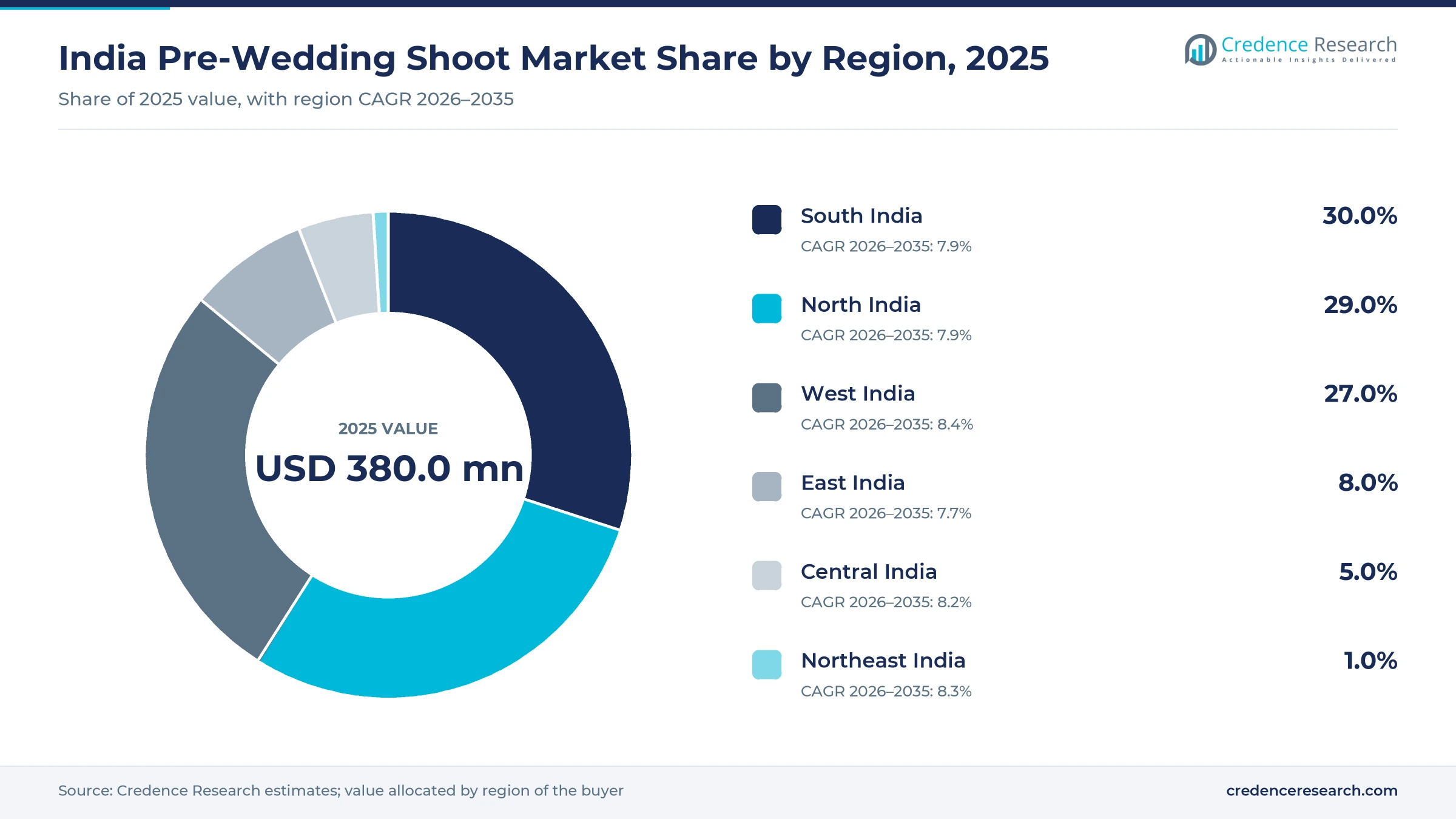
The India pre-wedding shoot market was valued at USD 380.0 million in 2025 and is projected to increase from USD 410.0 million in 2026 to USD 819.6 million by 2035, registering a CAGR of 8.00% during 2026–2035. Spending comes from couples paying photographers, cinematographers, set studios and travel-led crews for a staged session before the ceremony, usually with public release on social platforms in mind. South India held the largest regional share at 30.0% in 2025, narrowly ahead of North India, helped by high domestic travel in Tamil Nadu, Karnataka and Andhra Pradesh. West India is the fastest-growing region at 8.4% a year, as Goa, Alibag and purpose-built sets near Mumbai pull bookings from a dense urban base. About one in four weddings is now a destination event, which raises the travel content of the shoots tied to them. The commercial change to watch is low-cost AI portrait generation, which reached couples during the September 2025 Gemini trend.
What does pre-wedding shoot spending include in India?
The market counts what couples and their families pay for a staged photo or video session held before the ceremony. It includes photographer and cinematographer fees, editing, set or location hire, permits, makeup and outfits bundled in a package, and crew travel. Buyers usually book an independent photographer or a studio directly, often after comparing profiles on a wedding listing platform or Instagram.
The market excludes coverage of the wedding functions themselves, along with albums sold with that coverage, the couple's own holiday costs and any shoot done at no charge by friends. It also excludes sales of camera and drone equipment to the studios themselves. The value chain runs from equipment rental houses and set owners through editors and assistants to the lead photographer, who holds the client relationship and most of the margin.
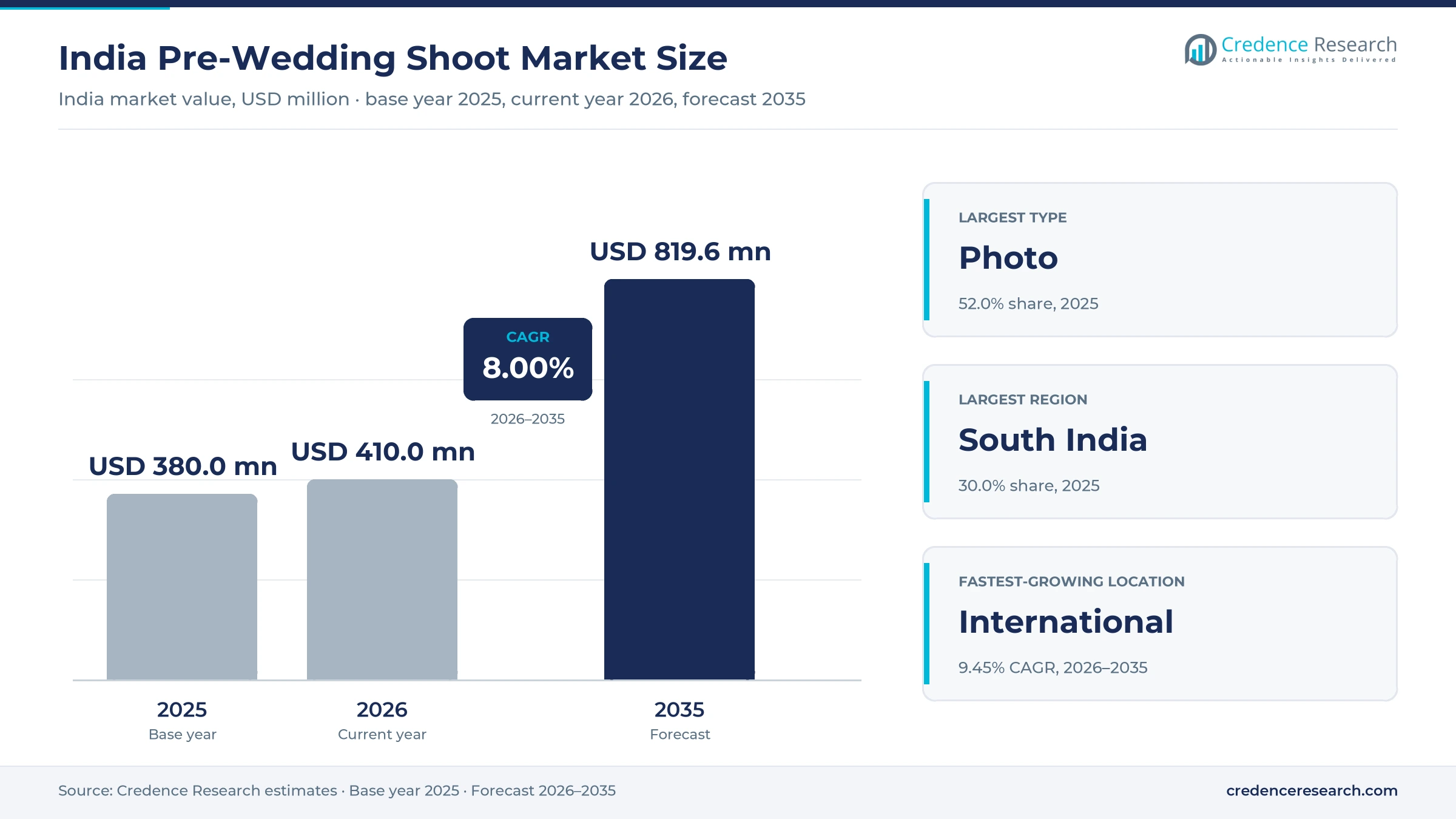
India Pre-Wedding Shoot Market Insights
- The market stands at USD 380.0 million in 2025 and reaches USD 819.6 million by 2035, an 8.00% CAGR over 2026–2035, with value per booking rising faster than the count of weddings.
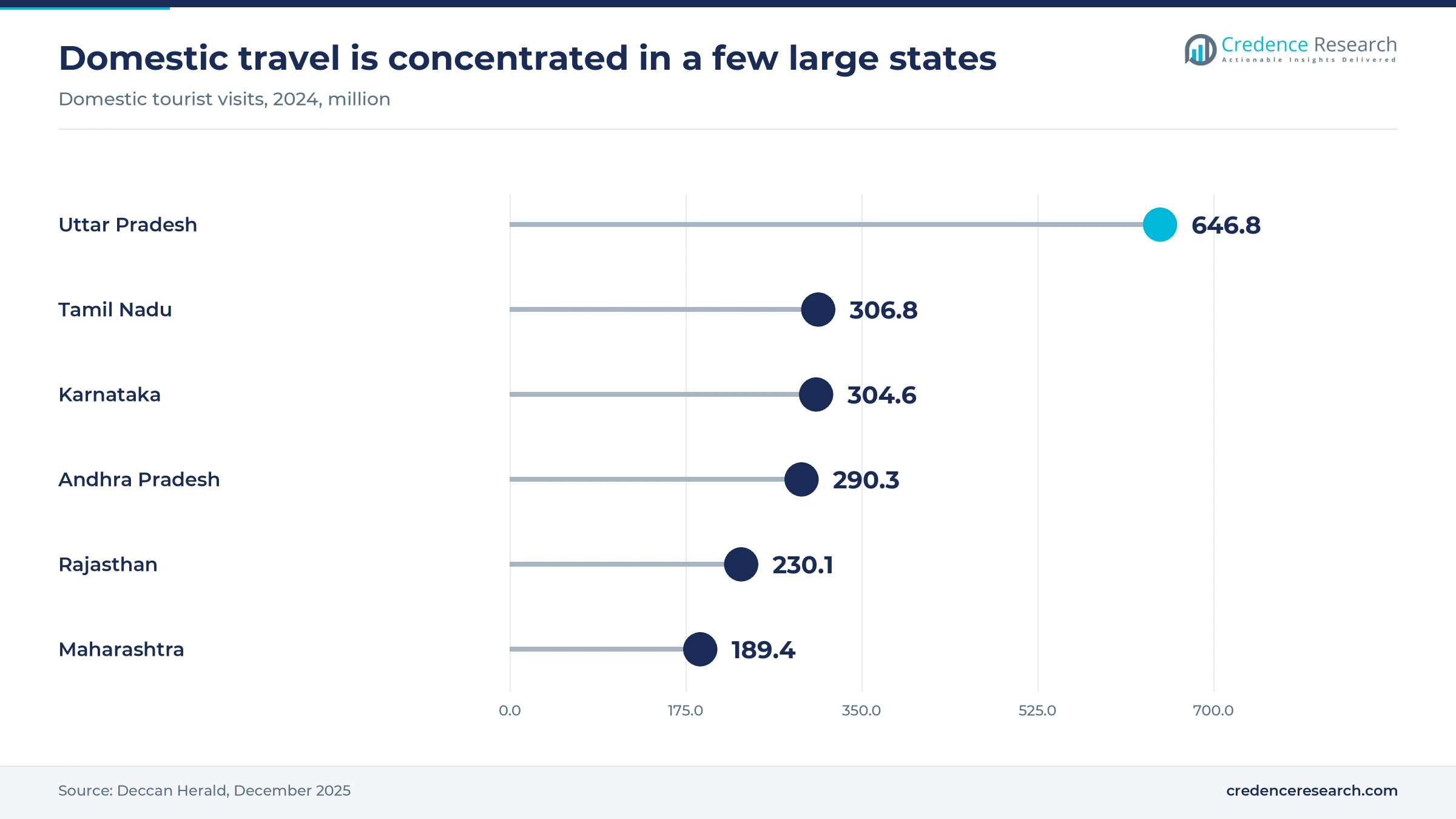
- South India held 30.0% of 2025 value, narrowly ahead of North India, as Tamil Nadu, Karnataka and Andhra Pradesh ranked among the top states for domestic tourist visits in 2024.
- Photo sessions led the type split with 52.0% of 2025 value because entry prices stay low, with one NCR outdoor studio listed at INR 10,000 for four hours.
- Couples tried Google Gemini for AI pre-wedding portraits in September 2025, which gives budget buyers a free alternative and pushes paid studios toward film, travel and production value.
- Competition splits among independent photographers, regional studios and set owners, while WedMeGood, WeddingWire India and WeddingBazaar act as the main listing routes rather than as service providers.
Stills lead by value as travel and premium crews gain
Why do still photo sessions carry the most value?
Based on type, the market is categorized into photo, video/cinematic and destination shoots. Photo sessions led with 52.0% of 2025 value because the entry cost stays low, and WeddingBazaar listed Picture Destination, an outdoor studio in Kundli, at INR 10,000 for four hours in July 2023. Destination shoots grow fastest at 9.5% a year as travel lifts the ticket, and Finnable puts multi-day destination work at INR 1.5 lakh or more against INR 15,000 to INR 50,000 for a half-day session. Cinematic films sit between those poles because they need extra crew and editing time.
How does location change the size of a booking?
Based on location, the market is categorized into local, domestic destination and international shoots. Local sessions led with 62.0% of 2025 value because couples can stay near home, and ThePrint reported in July 2026 that Mumbai couples paid about INR 40,000 to INR 50,000 to book properties in Alibag or nearby. International shoots grow fastest at 9.4% a year as foreign travel widens, with The Policy Edge citing 32.8 million departures by Indian nationals in 2025, up 6.3%. HappyFares quotes five-day Bali trips at INR 1.5 lakh to INR 3 lakh per couple, so each booking carries far more value.
Which package tier is gaining share?
Based on package, the market is categorized into basic and premium offers. Basic bookings led with 58.0% of 2025 value because most couples buy from regional studios, and KDM Production in Shillong lists a pre-wedding session at INR 25,000 a day on WeddingBazaar. Premium work grows fastest at 9.1% a year as named photographers command far higher rates, and ThePrint reported in July 2026 that Gautam Khullar averages INR 5 lakh a day while several other photographers quote INR 2.5 lakh to INR 3 lakh. That spread shows how much room the upper tier still has to gain value.
| Segment Group | Leading Sub-segment | Share, 2025 | Fastest-growing Sub-segment | CAGR, 2026–2035 |
|---|---|---|---|---|
| By Type | Photo | 52.0% | Destination | 9.5% |
| By Location | Local | 62.0% | International | 9.4% |
| By Package | Basic | 58.0% | Premium | 9.1% |
Request a Free Sample
Fill in your details and we'll send you a free sample report.
- Sample data tables & charts
- Research methodology
Reels, travel and film packages lift each booking
Social-media wedding content raises photo budgets
Couples now treat the session as content for public release, and that purpose raises what they will pay for it. The Internet and Mobile Association of India counted about 588 million short-video users in 2025, roughly 61% of the online population, according to Business Today in January 2026. WedMeGood's 2024 report, cited by Business Standard, found that 55% of couples use platforms such as WedMeGood, Instagram and Facebook to find vendors. Bloomberg reported in March 2023 that one couple's lake-fall video reached 13 million Instagram views, which showed photographers how far a single clip can travel. ThePrint described these sessions as content factories in July 2026. In the Credence Research model this adds about 2.96 percentage points to annual growth to 2035.
Destination shoots expand travel and production spending
Moving a session away from home adds flights, rooms, permits and crew days to a bill that once covered only a photographer. The WedMeGood 2025-2026 report found that 38% of couples take pre-wedding trips, and Curly Tales reported from the same survey that about one in four weddings is a destination event. HappyFares quotes premium two-day Udaipur sessions at INR 2 lakh to INR 4 lakh and three-day Andaman sessions at INR 1.2 lakh to INR 2.5 lakh. The travel base is broad too, because The Policy Edge, citing the Ministry of Tourism, reported 4.29 billion domestic visits in 2025, a count inflated by Kumbh Mela crowds. In the Credence Research model this adds about 2.16 percentage points to annual growth to 2035.
Video and short-form packages lift revenue per booking
Studios earn more per booking when a session yields a film and vertical edits as well as stills, because crew and edit hours both increase. WeddingBazaar listings show the gap, with KDM Production charging INR 15,000 a day for candid photography against INR 25,000 a day for cinematic videography. Studios can also sell aerial coverage as a separate line, and Weddings Mafia quotes INR 15,000 to INR 25,000 for a half day. WeddingWire lists Kerala Wedding Photography in Fort Kochi at INR 75,000 to INR 99,999 for a one-day shoot. WedMeGood's May 2018 cost guide put popular photographers at just above INR 50,000 a day, which shows how far top rates have moved. In the Credence Research model this adds about 1.60 percentage points to annual growth to 2035.
Self-funding couples approve more spending on shoots
Couples increasingly pay for their own celebrations, and a session about the couple is an easier line to approve when they hold the budget. YourStory, citing WedMeGood, reported that more than 70% of couples now contribute to their own weddings. Curly Tales reported in December 2025 that 79% rely on savings and that 15% take loans averaging INR 15.5 lakh. Household capacity is also improving, as the Ministry of Statistics and Programme Implementation reported monthly per capita spending of INR 6,996 in urban areas during 2023-24, about 8% higher on the year. The Week reported the Jefferies count of 8 million to 10 million weddings a year in June 2024, which leaves a very large base for even modest gains in uptake.
Film-set studios and AI portraits reshape the offer
Shift toward film-set studios near smaller cities
Built sets are replacing some travel, because a couple can shoot several looks in one day without leaving the region. Jaipur photographer Bhuvan Gaur told ThePrint in July 2026 that studios near small towns recreate Paris, London and snow-clad mountains at lower cost than travel. Sets in the City near Mumbai shows the scale of the format, since WeddingSutra described 30 sets on a 3-acre site in October 2019 and Bloomberg reported 50 fake venues on 7.5 acres in March 2023. Bloomberg also put its top price at about $1,000 a day with makeup, outfits and lighting. Budget options remain, as WeddingBazaar listed Picture Destination at INR 24,000 for 12 hours in July 2023.
Rise of AI-generated couple portraits
AI image tools have become a visible, nearly free alternative for couples who want a cinematic look without a crew. BizzBuzz reported on Sept. 16, 2025, that couples were uploading two selfies to Google's Gemini and generating temple, forest and golden-hour portraits within seconds. PetaPixel reported that the trend appeared mostly confined to India and Indonesia, and it noted that couples could get destination-style images at home. Some users described the output as a virtual trial run before hiring a photographer, which suggests that it can feed bookings as well as replace them. Studios are adopting the same tools, because the WedMeGood 2025-2026 report, drawn from more than 2,000 couples and 500 professionals, found that nearly 24% of wedding vendors use AI in some form.
Opportunity in state wedding campaigns and new circuits
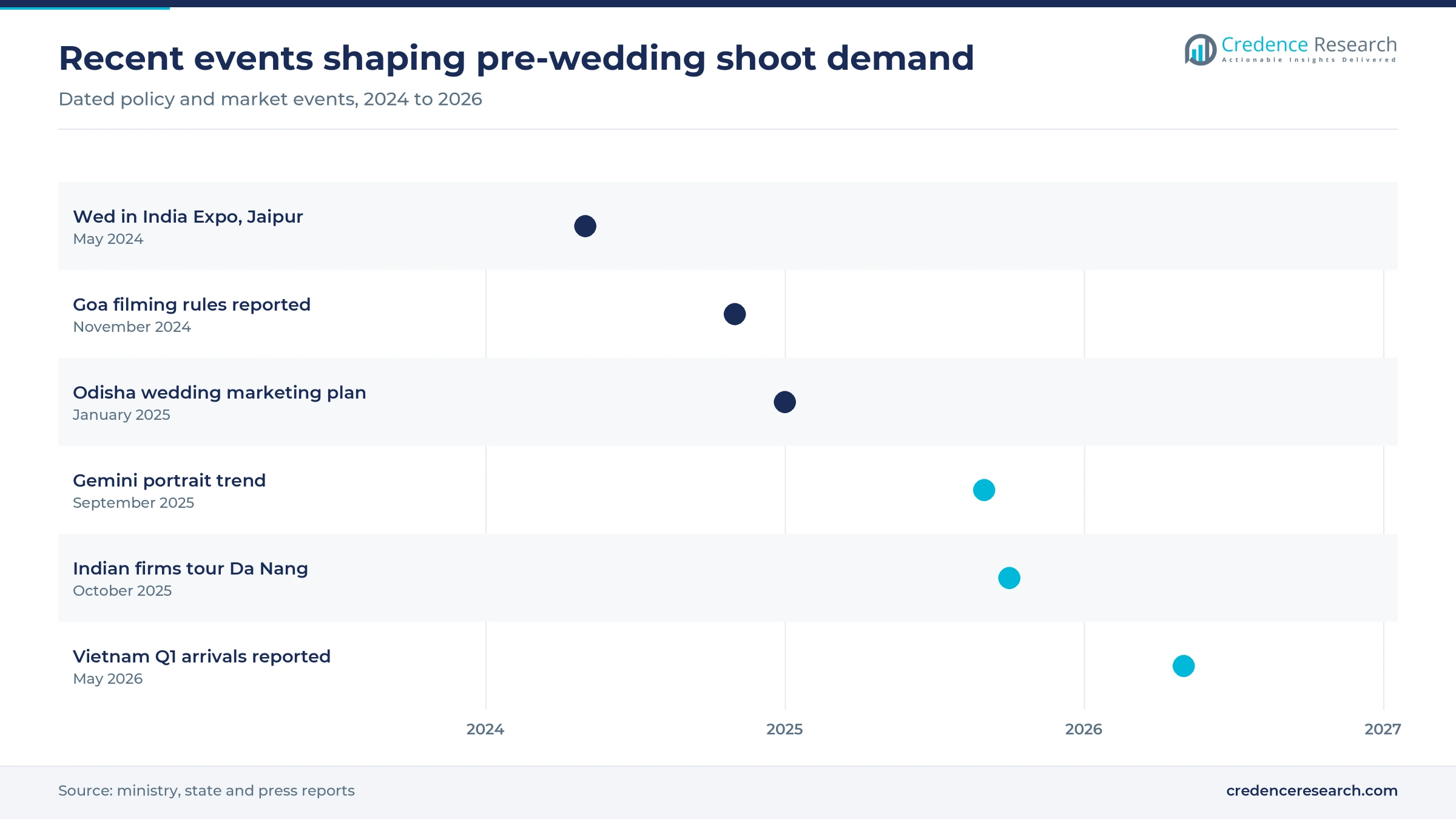
New wedding circuits give studios an opening to sell location packages before competition builds in those places. The Ministry of Tourism told the Lok Sabha on March 24, 2025, that it had launched the India Says I Do campaign and held the Wed in India Expo in Jaipur on May 5, 2024. PTI reported on Jan. 29, 2025, that Odisha would market Puri, Konark and Gopalpur for weddings. Officials cited by The Pioneer counted more than 500 weddings at Uttarakhand's Triyuginarayan temple by May 2025, and Madhya Pradesh Tourism now suggests Khajuraho as a backdrop for these sessions. Studios that hold permits and local crews in these towns could sell repeat packages to planners and hotels.
Opening for overseas packages as southeast Asia courts couples
Southeast Asian tourism bodies are courting Indian wedding business, and that effort opens a route for studios selling packaged outbound travel sessions. Tuoi Tre reported in October 2025 that 30 Indian wedding service companies toured Da Nang, where the incentives on offer included drone filming packages. Indian arrivals in Vietnam reached more than 242,600 in the first quarter of 2026, up over 169%, according to the same newspaper. TTG Asia reported in July 2025 that Thailand draws over 300 Indian destination weddings a year and that a Delhi to Bangkok flight is often cheaper than one to Goa. HappyFares quotes five-day Phuket and Krabi trips at INR 1.2 lakh to INR 2.5 lakh per couple.
Permits, drone limits and softer budgets squeeze studios
How do monument permits raise cost and risk?
Heritage backdrops are in demand, but permission rules vary by owner and state, which complicates quoting. ThePrint reported in July 2026 that Archaeological Survey of India permission for video at protected monuments costs INR 10,000 to INR 15,000. Goa introduced amended rules in November 2024, according to The Goan, which set INR 25,000 a day at government-owned sites and a INR 50,000 fine for filming without permission. Small studios carry the risk of a lost shoot day, so experienced firms build permit lead time into contracts.
Why are softer budgets and AI tools pressuring prices?
Demand for premium coverage is not rising in a straight line, and that makes pricing harder to defend. PTI reported in December 2025 that luxury service Ombre saw average spending per photography assignment fall about 6.8% from 2024, though it stayed 22.1% above 2023. Ombre also reported 30% to 50% fewer wedding shoots than in earlier years. Free Gemini portraits add pressure at the bottom of the market, so basic studios face the sharpest squeeze and are bundling film and editing to protect ticket size.
What do drone limits mean for cinematic work?
Aerial shots are a selling point for cinematic packages, yet they are barred at several of the most requested locations. The Archaeological Survey of India banned drone photography at Hampi, according to Hospet Online in January 2021, and it required special permission for these sessions. Weddings Mafia notes that flights within 5 km of an airport or above 400 feet need clearance, and that India Gate and Qutub Minar are restricted. Studios must therefore scout locations early and price ground-based alternatives into each quote.
How do safety incidents and public backlash affect studios?
The pursuit of viral images has created safety and reputation risks that fall on couples and crews alike. Deccan Herald reported on Dec. 5, 2019, that a couple fell into a river when a country boat capsized during a shoot in Kerala. The same report described a Kerala Police social media warning on intimate photos, which was later withdrawn after critics called it moral policing. Studios that accept risky concepts face liability questions, so written safety limits and location checks are becoming sensible practice.
South leads narrowly while West gains on built sets
| Region | Value, 2025 (USD million) | Share, 2025 | CAGR, 2026–2035 |
|---|---|---|---|
| South India | 114.0 | 30.0% | 7.9% |
| North India | 110.2 | 29.0% | 7.9% |
| West India | 102.6 | 27.0% | 8.4% |
| East India | 30.4 | 8.0% | 7.7% |
| Central India | 19.0 | 5.0% | 8.2% |
| Northeast India | 3.8 | 1.0% | 8.3% |
South India leads on travel-heavy states and studios
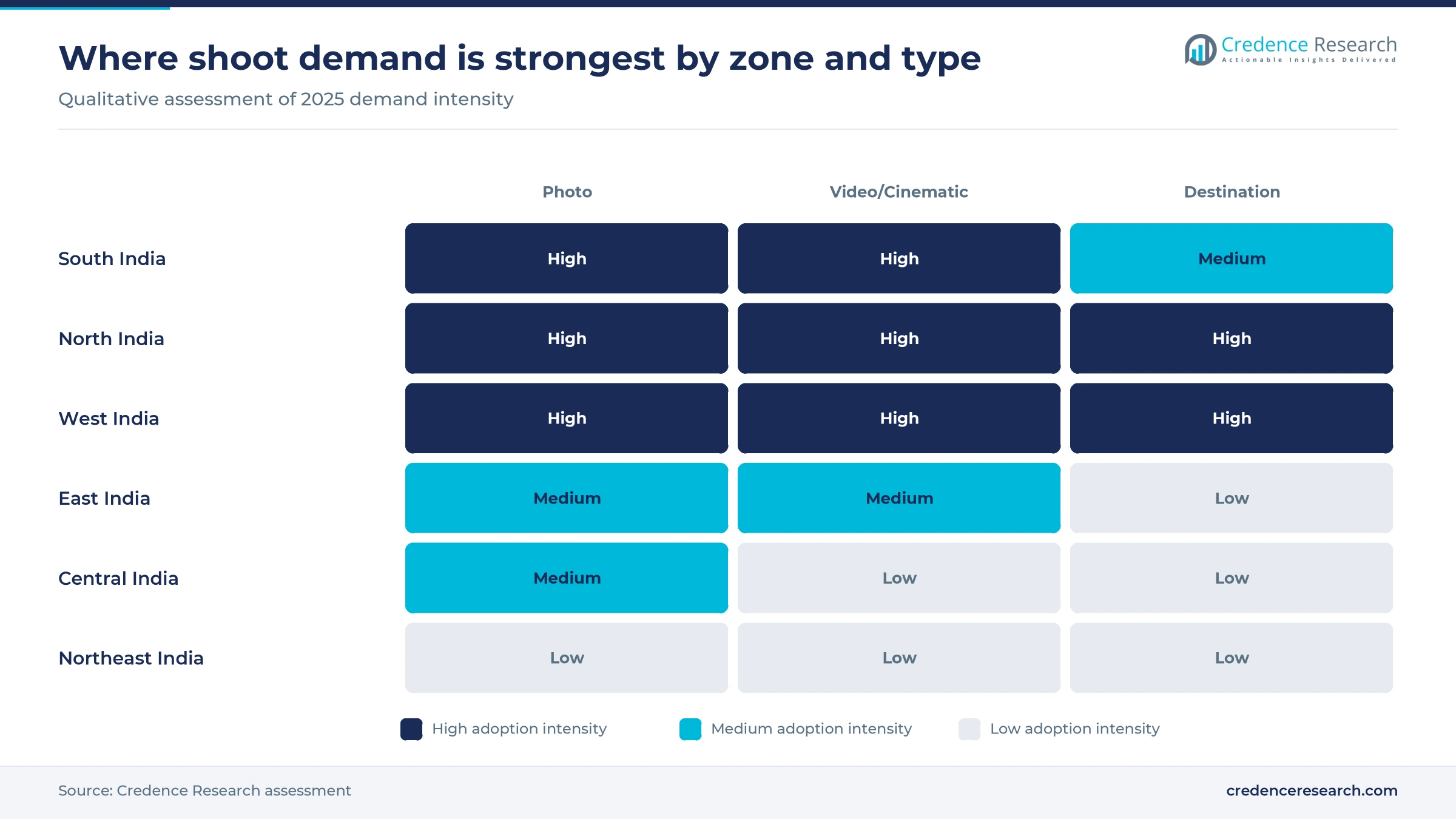
South India held 30.0% of 2025 value and grows at 7.9% a year. Deccan Herald ranked Tamil Nadu, Karnataka and Andhra Pradesh second to fourth for domestic tourist visits in 2024, with 306.8 million, 304.6 million and 290.3 million. HappyFares quotes mid-range Munnar sessions at INR 50,000 to INR 65,000 with a drone, and WeddingWire lists premium one-day work in Fort Kochi. Bengaluru and Hyderabad weddings averaged INR 37 lakh in the WedMeGood survey, which supports steady demand for paid shoots.
Rajasthan heritage and Delhi volume anchor North India
North India held 29.0% of 2025 value and grows at 7.9% a year. The Confederation of All India Traders estimated 480,000 weddings in Delhi for the 2025 season, and it put photography and videography at 2% of national wedding spending. Jaipur recorded the highest average wedding spend in the WedMeGood survey at INR 73 lakh. Rajasthan introduced a charge of INR 5,000 for two hours at Hawa Mahal and other monuments in February 2021, and Travel Trends Today counted more than 120 heritage properties hosting destination weddings.
West India grows fastest on built sets and coastal shoots
West India held 27.0% of 2025 value and grows at 8.4% a year, the fastest of the six zones. Mumbai supports both ends of the market, with Alibag properties close by and Sets in the City on the Mumbai-Nashik Highway. HappyFares quotes two-day Goa sessions at INR 75,000 to INR 3 lakh. PTI reported in December 2025 that destination weddings made up 55% to 60% of premium enquiries at Sheraton Grand Pune, which points to continued demand for travel-led production across the zone.
East India builds on Kolkata landmarks and Odisha beaches
East India held 8.0% of 2025 value and grows at 7.7% a year. ThePrint reported in July 2026 that Kolkata couples use Victoria Memorial and Boroti Bil lake in Sodepur, about 30 km from the city, which keeps travel costs low. OdishaBytes named Talasari and Dagara beaches in Balasore as popular sites in March 2019. Deccan Herald counted 184.5 million domestic tourist visits to West Bengal in 2024, a large pool of regional demand for nearby sessions. Budgets stay modest, though Odisha announced a wedding marketing plan in January 2025 that could lift destination work.
Central India turns heritage towns into shoot backdrops
Central India held 5.0% of 2025 value and grows at 8.2% a year. Madhya Pradesh Tourism promotes Khajuraho as a backdrop and also names Orchha, Gwalior, Bhopal, Indore and Pachmarhi as wedding destinations. It also states that a shoot inside monument premises needs prior permission from the owner, including the Archaeological Survey of India. Deccan Herald counted 133 million domestic tourist visits to the state in 2024, which shows a sizable base of travel demand that studios have yet to fully package.
Northeast India starts small with regional studios
Northeast India held 1.0% of 2025 value and grows at 8.3% a year from a very small base. Local firms supply most of this work, and KDM Production in Shillong lists a combined photo and video package at INR 40,000 for one day on WeddingBazaar. The same firm sells a 40-page album for INR 15,000, a sign of how much print still matters to its buyers. Landscape shoots in Meghalaya could draw couples from other zones, although the zone remains the smallest through 2035.
State campaigns and overseas courtship set the pace
| Development | Status and market relevance |
|---|---|
| In May 2024, the Ministry of Tourism held the Wed in India Expo in Jaipur with Rajasthan's tourism department and FICCI. | Held May 5, 2024; reported to the Lok Sabha in March 2025; supports new venue circuits |
| In November 2024, Goa notified amended monument rules with a INR 25,000 daily filming fee at government-owned sites and a INR 50,000 penalty. | In force; raises the compliance cost of heritage shoots in the state |
| In January 2025, Odisha said it would market Puri, Konark and Gopalpur for weddings and business events, according to PTI. | Announced; hoteliers asked for better air links and incentives |
| In September 2025, couples began generating pre-wedding portraits with Google Gemini, according to BizzBuzz and PetaPixel. | Consumer trend; a free alternative at the low end of the market |
| In October 2025, 30 Indian wedding service companies toured Da Nang resorts on a trip confirmed by the city's tourism department. | Completed; adds a Vietnamese option to overseas packages |
Drones, vertical edits and prompts change the workflow
- Drones add aerial shots at a separately priced rate, and Weddings Mafia quotes INR 25,000 to INR 45,000 for full-day coverage.
- Vertical short-form edits turn one session into clips for release, and about 588 million Indians watched short video in 2025, according to the Internet and Mobile Association of India.
- Generative image tools let a couple preview looks from two selfies, as BizzBuzz described for Google Gemini in September 2025.
- Online vendor profiles shorten the search for a photographer, and WedMeGood reported in its 2025-2026 survey that one in three couples checks online reviews before booking.
Need a Custom Version of This Report?
Tailor the scope, geography, or segments to your exact requirements.
- Custom geography or segment scope
- Direct access to our analyst team
Independent names compete through listings and studios
Competition is highly fragmented, and no single firm dominates a market served largely by independent photographers and small regional studios. Named specialists such as Gautam Khullar, who has shot more than 600 weddings in 10 years, compete on style and reputation at the top of the market. Regional operators in Punjab include the Attari family studio behind R.K. Film Photography, which competes on local knowledge, nearby film-famous locations and lower prices than metro names. Set owners such as Sets in the City and Picture Destination sell space, which reduces travel for couples and their photographers. WedMeGood, WeddingWire India and WeddingBazaar are listing routes rather than service providers, and they influence who gets discovered. Wedding planning services also steer business, and Marigold by Minal first arranged such a shoot in 2014. The contest is mainly about visible portfolios, because a couple usually books after watching earlier work online.
Companies profiled and their roles in this market
| Company | Type | Role in the market |
|---|---|---|
| WeddingNama | Photography studio | Mumbai-based team offering pre-wedding photography, candid photography and cinematography for destination weddings |
| House On The Clouds | Premium photography studio | Bangalore and Mumbai team offering pre-wedding photography, candid coverage and cinematography |
| The Wedding Salad | Photography studio | Mumbai team shooting save-the-date, engagement and pre-wedding sessions |
| Gautam Khullar | Independent photographer | Premium photographer who ran a five-day Japan shoot for one couple, according to ThePrint |
| Seasons by Shalini | Mumbai studio | Shalini Iyer's Mumbai studio quotes INR 2.5 lakh to INR 3 lakh a day |
| Sets in the City | Set owner | Purpose-built photo site near Mumbai, founded by wedding photographer Rajesh Dembla |
| Picture Destination | Outdoor studio | Kundli outdoor studio in the NCR with backdrops and a makeup room, sold hourly |
| R.K. Film Photography | Regional studio | Attari studio shooting pre-wedding sessions since 2011, using the nearby village of Pul Kanjari |
Ticket value matters more than wedding counts
Credence Research's view is that the market's growth depends more on value per booking than on the number of weddings. The Confederation of All India Traders put photography and videography at 2% of wedding spending against 10% for catering, so this remains a small budget line with room to rise. The strongest position belongs to photographers with a recognizable style and to set owners who lower the cost of variety. The most exposed firms are basic studios selling plain stills, because free AI portraits now compete directly with that offer for couples on tight budgets.
How Credence Research built these estimates
The report uses 2025 as the base year and forecasts to 2035. Market values come from the Credence Research model, and segment and regional splits are Credence Research estimates checked against public indicators. Sources used include a trade-body study from the Confederation of All India Traders, government statistics and replies from the Ministry of Statistics and Programme Implementation and the Ministry of Tourism, state tourism and monument notices, the WedMeGood report, published price lists on listing platforms and dated press coverage. No primary interviews or proprietary surveys were conducted for this edition of the report.
Premium crews and travel drive the road to 2035
The market moves from USD 410.0 million in 2026 to USD 819.6 million by 2035, an 8.00% CAGR over 2026–2035. Bookings should keep shifting toward film, travel and larger crews, which raises value per session even if wedding counts stay flat. The session increasingly sits beside stage and floral design as one more budget line built for the camera. The main risks are free AI imagery at the low end, tighter monument and drone rules, and softer premium budgets in some years. Independent photographers should keep most of the work, though listing platforms and set owners will shape how it is found.
Frequently Asked Questions
How big is the India pre-wedding shoot market?
Which type of shoot holds the largest share?
Which location type is growing fastest?
Which region leads the market?
Which region is growing fastest?
What is driving spending on pre-wedding shoots in India?
What are the main challenges for studios?
Who are the main companies in the market?
Table of Content
Chapter 1 Market Segmentation
- 1.1 Segmentation Framework
- 1.1.1 Product and Service Classification
- 1.1.2 Application and End-Use Classification
- 1.1.3 Technology and Solution Classification
- 1.1.4 Customer and Distribution Channel Classification
- 1.1.5 Geographic Segmentation
- 1.1.6 Market Segment Definitions and Boundaries
- 1.2 By Type
- 1.2.1 Photo
- 1.2.2 Video/Cinematic
- 1.2.3 Destination
- 1.3 By Location
- 1.3.1 Local
- 1.3.2 Domestic Destination
- 1.3.3 International
- 1.4 By Package
- 1.4.1 Basic
- 1.4.2 Premium
Chapter 2 Introduction
- 2.1 Report Objectives and Scope
- 2.2 Product Definition and Industry Terminology
- 2.3 Market Inclusions and Exclusions
- 2.4 Research Process
- 2.4.1 Primary Research and Expert Interviews
- 2.4.2 Secondary Research and Source Review
- 2.4.3 Top-Down and Bottom-Up Estimation
- 2.4.4 Data Triangulation and Verification
- 2.5 Market Size Measurement Basis
- 2.5.1 2025: USD 380.0 million → 2035: USD 819.6 million
- 2.6 Historical and Forecast Reference Periods
- 2.6.1 Historical Period: 2018-2025
- 2.6.2 Base Year: 2025
- 2.6.3 Forecast Period: 2025-2035
- 2.7 Research Assumptions and Limitations
Chapter 3 Executive Summary
- 3.1 Market Snapshot and Key Findings
- 3.2 Base-Year Market Size, 2025
- 3.3 Forecast Market Size, 2035
- 3.4 Revenue and Volume Growth Outlook
- 3.5 Key Demand and Supply Indicators
- 3.6 Leading Market Segments
- 3.7 Fastest-Growing Market Opportunities
- 3.8 Regional Performance Highlights
- 3.9 Technology and Industry Transformation
- 3.10 Competitive Landscape Summary
- 3.11 Analyst View and Strategic Implications
Chapter 4 India Pre-Wedding Shoot Market Trends and Developments
- 4.1 Historical Industry Development, 2018-2025
- 4.2 Recent Market Trends and Developments
- 4.3 Demand and Customer Behavior Trends
- 4.4 Technology and Product Innovation
- 4.5 Artificial Intelligence, Automation and Digitalization
- 4.6 Local Manufacturing and Supply Chain Realignment
- 4.7 Industry Partnerships, Mergers and Acquisitions
- 4.8 Sustainability and Circular Economy Developments
- 4.9 Government and Private Sector Investment Trends
- 4.10 Emerging Business Models and Commercialization
- 4.11 Industry Developments and Announcements
Chapter 5 India Pre-Wedding Shoot Market Supply and Demand Analysis
- 5.1 Demand Trend and Consumption Analysis, 2018-2025
- 5.2 Demand Forecast, 2025-2035
- 5.3 Supply Chain Structure and Procurement Trends
- 5.4 Supply-Demand Gap and Bottlenecks
- 5.5 Import Dependence and Sourcing Structure
- 5.6 Regional Supply and Demand Concentration
Chapter 6 India Pre-Wedding Shoot Market Pricing Analysis
- 6.1 Pricing Structure and Measurement
- 6.2 Historical Pricing Trends, 2018-2025
- 6.3 Pricing Outlook, 2025-2035
- 6.4 Pricing by Product and Market Segment
- 6.5 Geographic Pricing Differences
- 6.6 Key Input, Energy, Labor and Logistics Costs
- 6.7 Contract Pricing and Purchasing Models
- 6.8 Pricing Sensitivity and Competitive Positioning
- 6.9 Price, Margin and Profitability Implications
Chapter 7 India Pre-Wedding Shoot Market Dynamics
- 7.1 Market Growth Drivers
- 7.1.1 Demand-Side Drivers
- 7.1.2 Technology and Innovation Drivers
- 7.1.3 Infrastructure and Investment Drivers
- 7.1.4 Regulatory and Policy Drivers
- 7.2 Market Restraints
- 7.2.1 Cost and Affordability Constraints
- 7.2.2 Technology and Adoption Barriers
- 7.2.3 Supply Chain and Operational Constraints
- 7.3 Market Challenges
- 7.3.1 Competitive Pressure and Margin Erosion
- 7.3.2 Skills, Infrastructure and Implementation Gaps
- 7.4 Emerging Market Opportunities
- 7.5 Market Dynamics Impact and Time-Horizon Assessment
Chapter 8 India Pre-Wedding Shoot Value Chain Analysis
- 8.1 Industry Value Chain Overview
- 8.2 Upstream Suppliers and Critical Inputs
- 8.3 Technology and Component Providers
- 8.4 Manufacturing or Service Delivery
- 8.5 Distribution, Channel Partners and Integrators
- 8.6 Downstream Applications and End Users
- 8.7 Value Addition and Profit Pools
- 8.8 Vertical Integration and Outsourcing
- 8.9 Supplier Concentration and Risk
- 8.10 Supply Chain Localization and Resilience
Chapter 9 India Pre-Wedding Shoot Market Regulations and Policies
- 9.1 Relevant Laws, Standards and Compliance Frameworks
- 9.2 Product, Service, Safety and Quality Requirements
- 9.3 Government Policies, Incentives and Subsidies
- 9.4 Imports, Exports and Trade Barriers
- 9.5 Public Procurement and Local Content Requirements
- 9.6 Data Protection, AI and Cybersecurity Compliance
- 9.7 Upcoming Policy Changes and Market Implications
Chapter 10 India Pre-Wedding Shoot Market Hotspots and Opportunities
- 10.1 Market Opportunity Mapping and Growth Hotspots
- 10.2 High-Growth Applications and Customer Groups
- 10.3 Underserved Markets and White-Space Opportunities
- 10.4 Emerging Technology and Product Opportunities
- 10.5 New Capacity and Investment Hotspots
- 10.6 Market Entry and Expansion Opportunities
- 10.7 Distribution and Partnership Opportunities
- 10.8 Near-Term and Long-Term Commercial Potential
- 10.9 Opportunity Attractiveness and Execution Risks
Chapter 11 India Pre-Wedding Shoot Market Outlook, 2025-2035
- 11.1 Market Size and Analysis
- 11.1.1 Revenue (Market Measurement: 2025: USD 380.0 million → 2035: USD 819.6 million)
- 11.1.2 Historical Market Size, 2018-2025
- 11.1.3 Base-Year Market Size, 2025
- 11.2 Market Forecast, 2025-2035
- 11.2.1 Revenue Forecast to 2035
- 11.2.2 CAGR and Year-on-Year Growth
- 11.2.3 Incremental Revenue Opportunity
- 11.3 Forecast Assumptions and Scenario Analysis
- 11.3.1 Base-Case Forecast
- 11.3.2 Optimistic and Conservative Scenarios
- 11.3.3 Technology, Pricing and Policy Sensitivities
- 11.4 Market Attractiveness and Growth Outlook
Chapter 12 India Pre-Wedding Shoot Market Segmentation and Outlook
- 12.1 Segmentation Summary and Market Shares, 2025
- 12.2 Largest and Fastest-Growing Segments
- 12.3 By Type - Market Size and Forecast, 2025-2035
- 12.3.1 Segment Definition and Scope
- 12.3.2 Historical Market Size, 2018-2025
- 12.3.3 Revenue Forecast, 2025-2035
- 12.3.4 Base-Year Market Share, 2025
- 12.3.5 Segment CAGR and Growth Drivers
- 12.3.6 Subsegment Market Size and Forecast
- 12.3.6.1 Photo
- 12.3.6.2 Video/Cinematic
- 12.3.6.3 Destination
- 12.3.7 Subsegment Pricing and Adoption Trends
- 12.3.8 Leading Suppliers and Competition
- 12.3.9 Regional Demand and Opportunities
- 12.4 By Location - Market Size and Forecast, 2025-2035
- 12.4.1 Segment Definition and Scope
- 12.4.2 Historical Market Size, 2018-2025
- 12.4.3 Revenue Forecast, 2025-2035
- 12.4.4 Base-Year Market Share, 2025
- 12.4.5 Segment CAGR and Growth Drivers
- 12.4.6 Subsegment Market Size and Forecast
- 12.4.6.1 Local
- 12.4.6.2 Domestic Destination
- 12.4.6.3 International
- 12.4.7 Subsegment Pricing and Adoption Trends
- 12.4.8 Leading Suppliers and Competition
- 12.4.9 Regional Demand and Opportunities
- 12.5 By Package - Market Size and Forecast, 2025-2035
- 12.5.1 Segment Definition and Scope
- 12.5.2 Historical Market Size, 2018-2025
- 12.5.3 Revenue Forecast, 2025-2035
- 12.5.4 Base-Year Market Share, 2025
- 12.5.5 Segment CAGR and Growth Drivers
- 12.5.6 Subsegment Market Size and Forecast
- 12.5.6.1 Basic
- 12.5.6.2 Premium
- 12.5.7 Subsegment Pricing and Adoption Trends
- 12.5.8 Leading Suppliers and Competition
- 12.5.9 Regional Demand and Opportunities
- 12.6 Segment Growth Comparison
- 12.7 Segment Attractiveness and Priority Matrix
Chapter 13 India Pre-Wedding Shoot Geographic Market Outlook, 2025-2035
- 13.1 Domestic Market Distribution and Demand Clusters
- 13.2 State- or Province-Wise Market Size and Forecast, 2025-2035
- 13.3 City and Metropolitan Market Outlook
- 13.4 Industrial, Manufacturing and Commercial Clusters
- 13.5 Geographic Concentration of Key End Users
- 13.6 Local Pricing and Purchasing Differences
- 13.7 Domestic Production Facilities and Capacity Map
- 13.8 Local Infrastructure and Project Pipeline
- 13.9 State-Level Policy and Incentive Differences
- 13.10 Subnational Investment Hotspots and Opportunities
- 13.11 Distribution and Logistics Networks
- 13.12 Domestic Competitive Footprint
Chapter 14 India Pre-Wedding Shoot Technology, Innovation and Sustainability Outlook
- 14.1 Technology Landscape and Maturity
- 14.2 Product, Process and Service Innovation
- 14.3 AI, Automation and Digital Tools in the Industry
- 14.4 Technology Adoption and Performance Benchmarking
- 14.5 Innovation Pipeline and R&D Investment
- 14.6 Energy Efficiency and Resource Management
- 14.7 Sustainability, Recycling and Circularity
- 14.8 Technology Roadmap, 2025-2035
- 14.9 Risks of Obsolescence and Technology Substitution
Chapter 15 India Pre-Wedding Shoot Market Key Strategic Imperatives
- 15.1 Growth and Market Entry Priorities
- 15.2 High-Return Products and Segments
- 15.3 Pricing, Profitability and Cost Optimization
- 15.4 Technology Investment and Product Differentiation
- 15.5 Supply Chain Localization and Resilience
- 15.6 Distribution and Customer Acquisition
- 15.7 Partnership, Acquisition and Capacity Strategy
- 15.8 Regional Expansion Priorities
- 15.9 Short-, Medium- and Long-Term Actions
Chapter 16 Competition Outlook
- 16.1 Industry Competition Characteristics
- 16.2 Market Structure and Concentration
- 16.3 Market Share and Competitive Positioning, 2025
- 16.4 Company-Wise Revenue and Product Benchmarking
- 16.5 Production and Service Capacity Benchmarking
- 16.6 Technology, Pricing and Differentiation
- 16.7 Regional Footprint and Distribution Strength
- 16.8 Mergers, Acquisitions and Strategic Alliances
- 16.9 New Entrants and Competitive Threats
- 16.10 Porter's Five Forces and Industry Attractiveness
- 16.11 Competitive Outlook, 2025-2035
Chapter 17 Company Profiles
- 17.1 Company Coverage and Selection Criteria
- 17.2 WeddingNama
- 17.2.1 Business Description
- 17.2.2 Company Ownership and Geographic Presence
- 17.2.3 Product and Service Portfolio
- 17.2.4 Manufacturing and Operating Footprint
- 17.2.5 Financial Performance and Investment
- 17.2.6 Market Share and Competitive Position
- 17.2.7 Technology and Innovation Capabilities
- 17.2.8 Strategic Alliances or Partnerships
- 17.2.9 Recent Developments
- 17.2.10 Growth Strategy and Outlook
- 17.3 House On The Clouds
- 17.4 The Wedding Salad
- 17.5 Gautam Khullar
- 17.6 Seasons by Shalini
- 17.7 Sets in the City
- 17.8 Picture Destination
- 17.9 R.K. Film Photography
- 17.10 Other Relevant Market Participants
Note: Every listed company is profiled on the structure shown under the first company. The company list is preliminary and may change based on research findings, market developments, data availability and client requirements.
Chapter 18 Disclaimer
- 18.1 Research and Forecast Disclaimer
- 18.2 Data Source and Estimation Limitations
Note: The depth of individual sections depends on data availability for this market. Volume, capacity, trade and other unit-based metrics are included where applicable.