Fairway homes and scarce club seats set Indian golf value
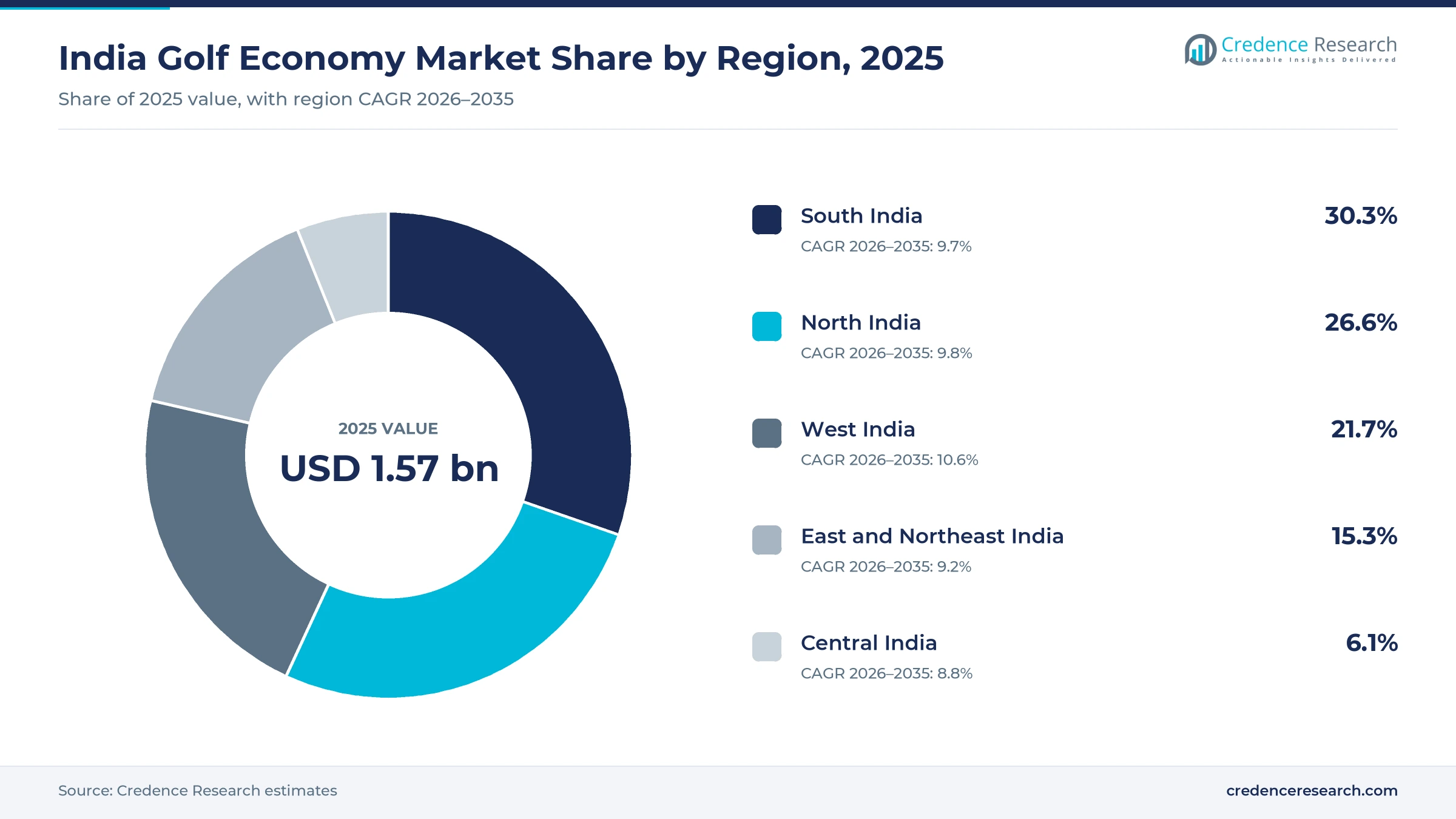
The India golf economy market was valued at USD 1.57 billion in 2025 and is projected to increase from USD 1.73 billion in 2026 to USD 4.01 billion by 2035, registering a CAGR of 9.78% during 2026–2035. Spending rises as a small but affluent golfer base pays more for scarce club access, as developers price homes beside fairways at a premium, and as professional events and golf travel draw larger sponsors. South India held the largest regional share, 30.3% in 2025, anchored by long club waiting lists in Bengaluru and high urban incomes in Telangana, Karnataka and Tamil Nadu. West India is the fastest-growing region at 10.6% a year, as golf-led resort communities take shape near Lonavala, Pune and Goa. Golf-linked real estate premium accounts for the largest share of value, while coaching, events and media grow fastest. Policy attention is rising too, since the Union Tourism Minister called golf tourism a draw for high-value international visitors at the Indian Golf Premier League franchise launch in April 2026, and the Ministry of Tourism said the league would extend tourism into Tier-2 and Tier-3 cities.
Club fees, golf homes, gear and golf travel make up the value
The market counts what buyers in India spend on golf and on assets priced because of golf. It covers course fees, subscriptions and memberships, equipment and apparel, the price premium on homes in golf communities, golf travel and resort stays, and coaching, tournaments, sponsorship and media rights.
The full value of golf-facing homes is outside the scope, since only the premium linked to the course is counted, and spending by Indian golfers on courses abroad is also excluded. The value chain runs from land owners, developers and course designers through clubs, resorts and course managers to retailers, tour operators, event promoters and broadcasters.
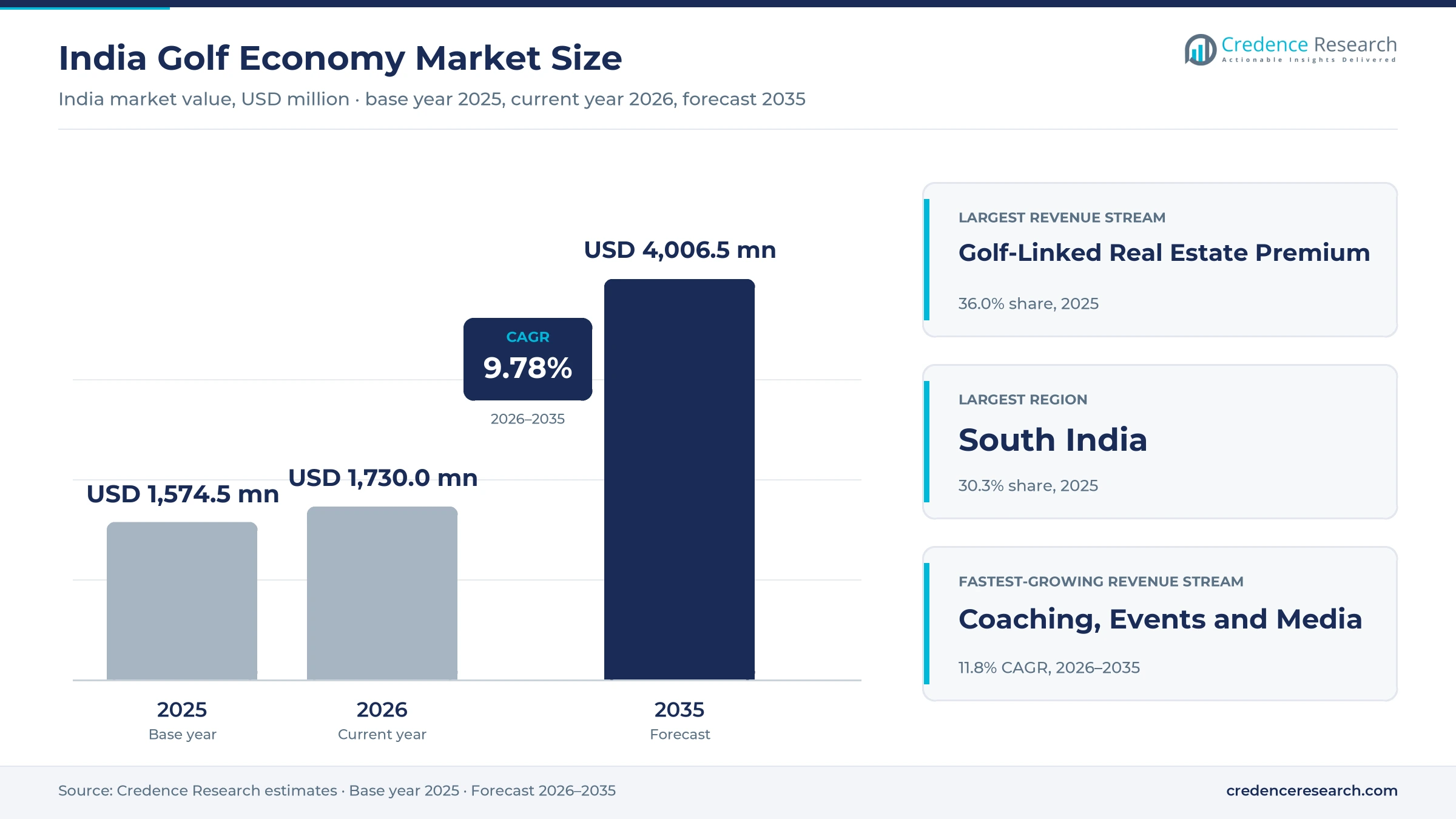
India Golf Economy Market Insights
- The India golf economy grows from USD 1.57 billion in 2025 to USD 4.01 billion by 2035 at a 9.78% CAGR, led by golf-facing homes, events and golf travel.
- South India held the largest regional share at 30.3% in 2025, while West India grows fastest at 10.6% a year on new resort communities.
- Golf-linked real estate premium led with 36.0% of 2025 value, while coaching, events and media grow fastest at 11.8% a year.
- The R&A counted 185,500 golfers and 289 courses in India in 2024, about 640 users per course, so club access rather than demand caps growth.
- The NCLT approved the Adani Enterprises plan for Jaiprakash Associates, owner of Jaypee Greens, on March 17, 2026, moving golf-linked assets to a new owner.
Real estate premium leads as events and media grow fastest
Real estate premium leads as events and media grow fastest
Based on revenue stream, the market is categorized into course operations and memberships, equipment and apparel, golf-linked real estate premium, tourism and hospitality, and coaching, events and media. Golf-Linked Real Estate Premium led with 36.0% of 2025 value because developers build courses mainly to sell homes, and Prestige Group said in August 2025 that it plans three more golf-themed townships of 300 to 400 acres each in Goa, Lonavala and Hyderabad. Coaching, Events and Media grow fastest at 11.8% a year as purses and sponsor budgets rise, and the Professional Golf Tour of India set prize money above INR 33 crore for its 2025 season.
Private clubs lead while public courses grow fastest
Based on facility type, the market is categorized into private member clubs, resort courses, residential golf communities, public and municipal courses, and defence and institutional courses. Private Member Clubs led with 34.0% of 2025 value because entry is rationed and fees are high, and Bangalore Golf Club had at least 3,000 applicants waiting 10 to 20 years when it raised its entrance fee in December 2023. Public and Municipal Courses grow fastest at 12.1% a year from a small base, as the Delhi Development Authority opened memberships in 2025 for its 18-hole Dwarka course.
Affluent golfers lead as golf tourists grow fastest
Based on customer type, the market is categorized into affluent recreational golfers, corporate golfers and sponsors, competitive and professional golfers, junior and academy participants, and golf tourists. Affluent Recreational Golfers led with 45.0% of 2025 value because subscriptions, rounds and gear come mostly from regular club players, and The R&A counted 100,900 registered golfers in India in 2024. Golf Tourists grow fastest at 11.2% a year as tour operators package stays, and Golftripz sells a three-day package with three rounds at Classic Golf and Country Club and a stay at ITC Grand Bharat.
Full-course rounds lead as simulators grow fastest
Based on participation format, the market is categorized into 18-hole course play, 9-hole and executive golf, driving ranges and simulators, tournaments and pro-ams, and instruction and camps. 18-Hole Course Play led with 57.0% of 2025 value because memberships, green fees and caddie charges are built around the full round, and the Lodhi Course at Delhi Golf Club charges foreign visitors USD 95 for 18 holes on weekdays. Driving Ranges and Simulators grow fastest at 11.7% a year as indoor bays spread, and Karma Lakelands opened what it called the first high-tech simulator lounge in Delhi NCR in November 2025.
| Segment Group | Leading Sub-segment | Share, 2025 | Fastest-growing Sub-segment | CAGR, 2026–2035 |
|---|---|---|---|---|
| By Revenue Stream | Golf-Linked Real Estate Premium | 36.0% | Coaching, Events and Media | 11.8% |
| By Facility Type | Private Member Clubs | 34.0% | Public and Municipal Courses | 12.1% |
| By Customer Type | Affluent Recreational Golfers | 45.0% | Golf Tourists | 11.2% |
| By Participation Format | 18-Hole Course Play | 57.0% | Driving Ranges and Simulators | 11.7% |
Entry fees and golf homes carry the highest price points
Pricing in Indian golf works on two very different layers of cost. Rounds are cheap by world standards, while the right to play regularly is expensive, because entrance fees at established clubs ration scarce tee times and rise sharply when waiting lists grow. Public courses now offer fixed-term playing rights at lower prices, which widens access but does not yet change club fees. The largest price point sits in property, since homes in golf communities sell as trophy assets and the course premium moves with luxury housing demand. Equipment prices follow import costs, and the lower GST rate on sports goods since September 2025 cut what buyers pay for clubs and balls.
| Offer or fee | Typical price or fee | Basis |
|---|---|---|
| Delhi Golf Club Lodhi Course, 18 holes | USD 95 weekday and USD 125 weekend for foreign visitors; about USD 70 to 95 for local non-members | Golf Monthly, October 2025 |
| Bangalore Golf Club entrance fee | INR 5 lakh general; INR 40 lakh corporate for two nominees over 10 years | Deccan Herald, December 2023 |
| DDA Dwarka playing rights | INR 9 lakh for five years, non-government category; USD 3,000 a year for foreigners and NRIs | Asian Community News, May 2025 |
| The Dahlias, DLF Phase 5, Gurugram | About INR 72 crore per apartment on average | PTI via Outlook Business, November 2025 |
| GST on sports goods, including golf equipment | 5% from 12% | Press Information Bureau, September 2025 |
Request a Free Sample
Fill in your details and we'll send you a free sample report.
- Sample data tables & charts
- Research methodology
Golfer base, golf homes and big events lift spending
A wider golfer base strains a small course network
India has more golfers than courses can comfortably host, which pushes up the value of every tee time and club seat. The R&A counted 100,900 registered golfers in India in 2024, up 1% on 2023, and 185,500 golfers on 9- and 18-hole courses. The same survey found 289 courses, so demand in India runs at about 640 users per course. New club formats are adding play, since Karma Lakelands began an eight-round amateur team league on Oct. 25, 2025. Course play already holds a 57.0% share of 2025 value, so each new course or league adds fees, food and beverage and caddie income quickly. Developers that bring new courses near large cities can expect early demand rather than a slow build.
Golf-facing luxury homes command a lasting premium
Homes beside fairways sell at prices that make the course itself a revenue engine for developers. DLF had sold 221 of the 420 apartments at The Dahlias in DLF Phase 5, Gurugram, by the September 2025 quarter, at about INR 72 crore each on average. The project launched in October 2024 near DLF Golf and Country Club on Golf Course Road. Karma Lakelands in Gurugram rents chalets and villas beside its course, according to Haryana Tourism, which shows how course land earns from lodging as well as sales. Golf-linked real estate premium holds a 36.0% share of the market, so developers with land beside courses control the largest pool of golf spending in India, and demand for residential property at the top end sets its pace.
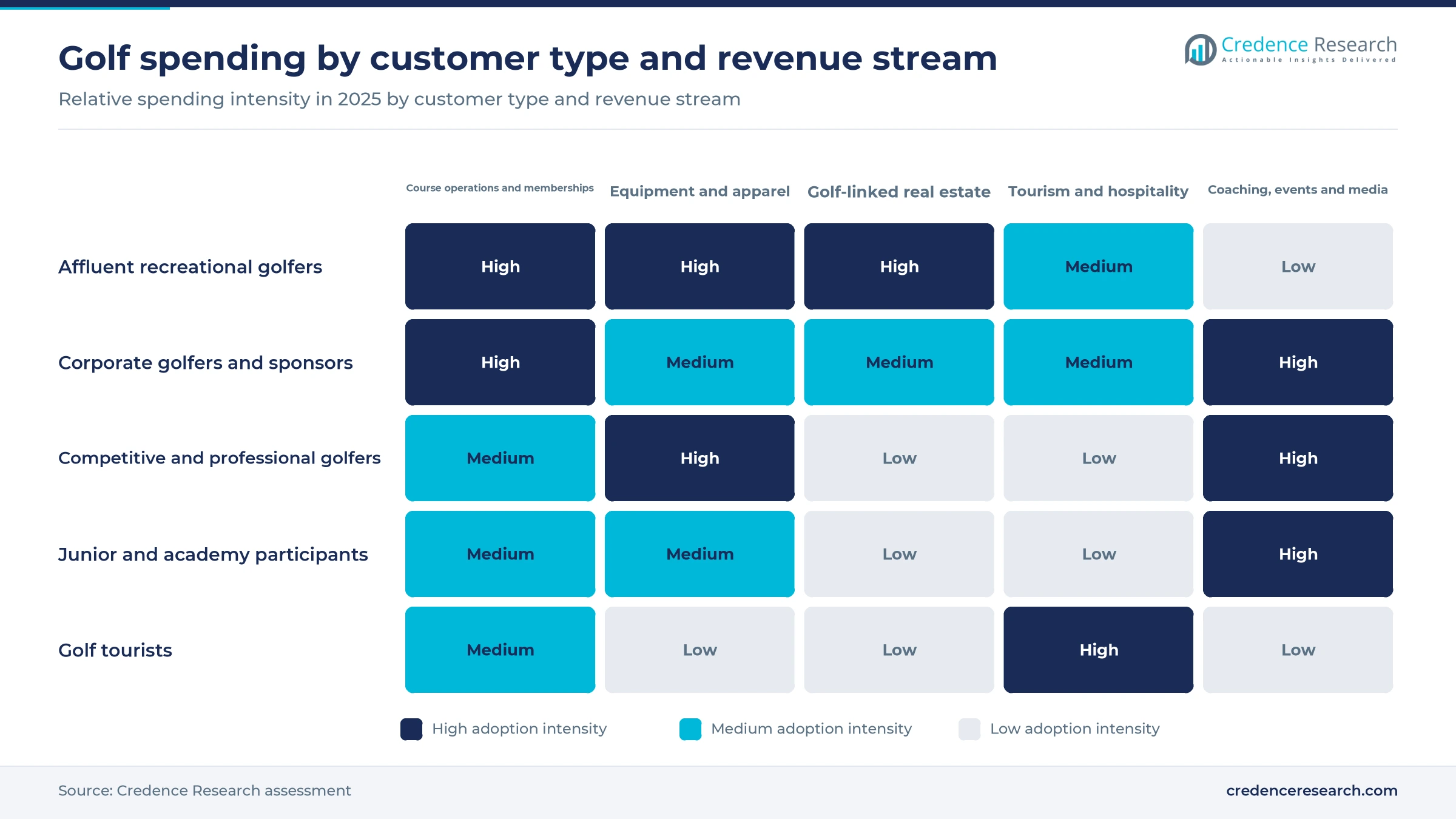
Bigger purses and new leagues draw sponsors and visitors
Larger tournaments bring sponsor money, broadcast exposure and visiting golfers, which lifts spending well beyond prize funds. The Hero Indian Open offered a record USD 2.55 million at DLF Golf and Country Club on March 26-29, 2026, up from USD 2.25 million a year earlier. The DP World India Championship at Delhi Golf Club carried a USD 4 million purse in October 2025 and brought Rory McIlroy to India for the first time. At the Indian Golf Premier League franchise launch on April 2, 2026, the league committed to mobilize USD 2 billion for golf tourism infrastructure. Coaching, events and media grow at 11.8% a year, so event rights and hospitality packages are now worth pricing separately.
Lower tax and online retail cut the cost of equipment
Cheaper and wider access to clubs, balls and apparel lowers the cost of taking up the game. The Press Information Bureau said in September 2025 that GST on toys and sporting goods fell from 12% to 5% under the reforms agreed by the GST Council on Sept. 3, 2025. Golf Buy India sells clubs, bags, shoes and balls online across the country and lists TaylorMade, Callaway, Titleist and Mizuno among its brands, with custom fitting. Golfoy said in June 2025 that physical stores had carried a restricted range, which its online model addresses. Credence Research estimates equipment and apparel at USD 210 million to USD 320 million in 2025, with online sellers reaching most buyers outside the large golf cities.
Simulators, public courses and resort revivals reshape play
Rise of simulator lounges and indoor golf venues
Golf is moving indoors and into entertainment venues, which brings in players who do not yet hold a club membership. Karma Lakelands paired its simulator lounge with year-round virtual play of well-known courses, according to India Golf Weekly in November 2025. Sky Golf opened in Varthur, Bengaluru, in February 2026 with simulation bays, a full bar and on-ground help for first-time players, according to Restaurant India. Driving ranges and simulators grow at 11.7% a year, the fastest CAGR among formats, because a bay session needs no membership, no handicap and no long drive to a course. Screen-based simulators and driving ranges therefore turn food, drink and lessons into a feeder for full-course play.
Shift toward public courses and fixed-term playing rights
Public bodies are starting to offer golf on fixed-term rights rather than lifetime memberships, which widens access below the elite clubs. At the Dwarka course run by the Delhi Development Authority, the non-government playing right costs INR 9 lakh for five years with a monthly subscription of INR 2,200, according to Asian Community News in May 2025. Foreign nationals and NRIs pay USD 3,000 for one year. Public and municipal courses grow at 12.1% a year, the fastest CAGR among facility types, so state land agencies near other large cities could follow the Dwarka model. Fixed-term rights also give younger professionals a first step into regular play long before a private club seat becomes available.
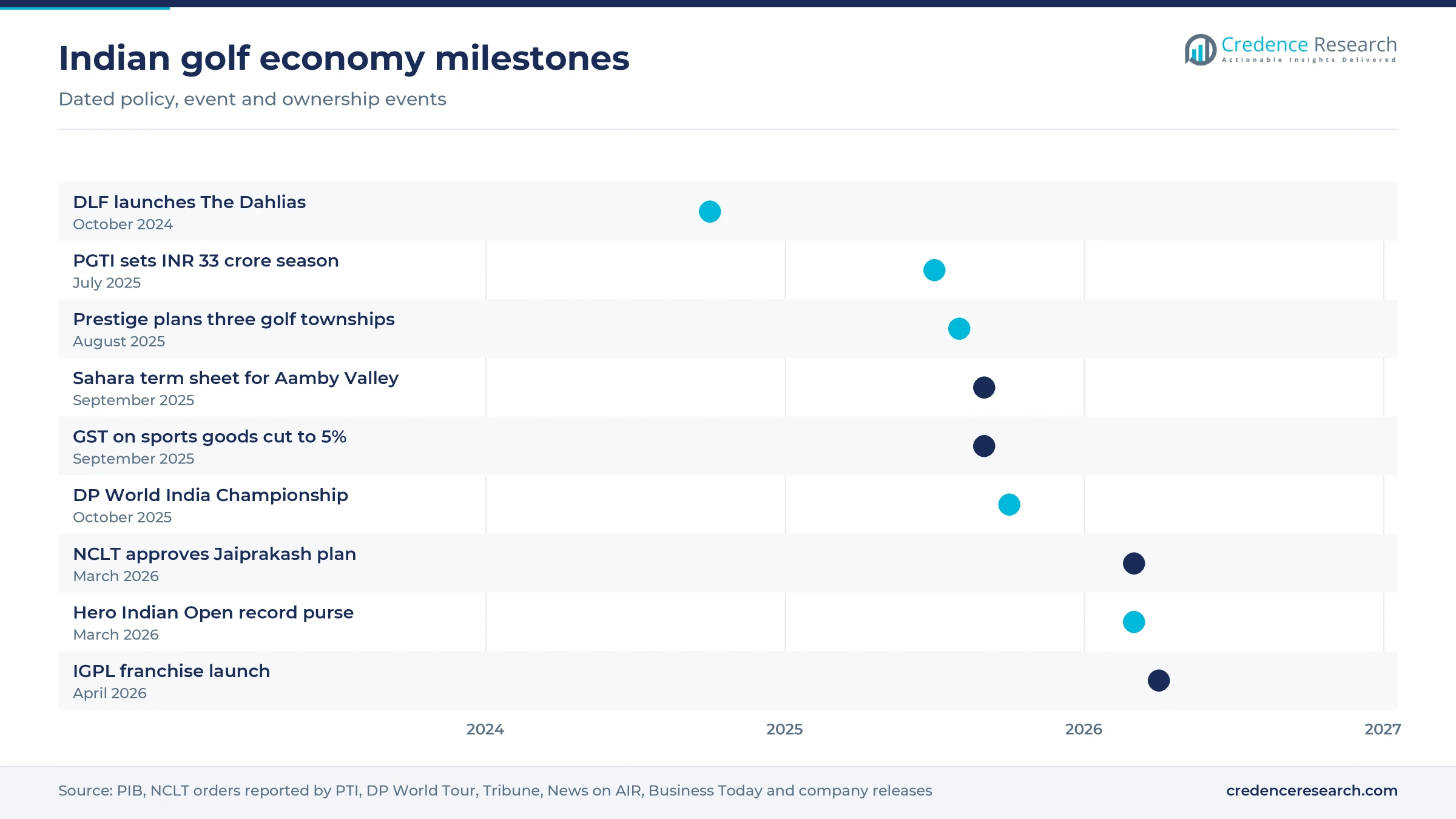
Distressed resort and golf assets open a revival opportunity
Large golf and resort assets held by stressed owners are changing hands, which opens room for reinvestment. Sahara Group filed a term sheet dated Sept. 6, 2025, with the Supreme Court to sell more than 88 properties to the Adani Group, including the 8,810-acre Aamby Valley City in Maharashtra, according to Business Today. The sale needs court approval, and proceeds would go to the SEBI-Sahara refund account. The Jaiprakash Associates resolution listed under developments adds a second large portfolio in Delhi NCR. New owners with capital can refurbish courses, add hotel rooms and restart home sales that stalled during the disputes.
Inbound golf tourism opens a high-value travel opportunity
Foreign golfers pay well for rounds, guides and hotel stays, which makes inbound golf a high-value niche for tourism. The official backing for golf tourism noted in the overview adds promotion by the Ministry of Tourism to this demand from overseas players. Golftripz offers foreign visitors an inventory of about 60 to 70 courses, and pairs Delhi rounds with Golden Triangle sightseeing, according to Outlook Traveller in February 2026. Golf tourists grow at 11.2% a year, the fastest CAGR among customer types, so hotel groups with courses on site can sell packaged stay-and-play itineraries. Operators that bundle guides, transport and tee times can also capture margin that now goes to booking agents abroad.
Closed courses, long waits and land costs limit access
Most courses sit inside cantonments closed to civilians
A large share of the course network is not open to the paying public. Outlook Traveller reported in February 2026 that most of the 289 courses counted by The R&A are in army cantonments and are not open to civilians or tourists. New Delhi and Bengaluru are the only cities with several courses, and those courses are heavily booked. Tour operators and new players therefore compete for a small pool of civilian courses, which limits rounds and fee growth until more public and resort courses open.
Decades-long waiting lists lock out new members
Long queues at established clubs keep spending concentrated among existing members. Delhi Golf Club is said to have about 4,000 members and a waiting list of around 50 years for new members, according to Golf Monthly in October 2025. Applicants with means but no membership instead play as paying guests, travel abroad or join newer clubs farther from city centers. Clubs gain pricing power from the queue, but the market loses players who never start regular golf.
Large land needs make new courses costly near cities
An 18-hole course needs a large block of land, which is scarce and expensive near Indian metros. Oxford Golf Resort near Pune covers 136 acres with its course, clubhouse, driving range, hotel and chalets, according to Business Today in March 2025. Prestige Golfshire near Nandi Hills spans 275 acres with a JW Marriott and villas. Developers can only justify such land by selling homes and hotel rooms around the course, which ties new course supply to the luxury property cycle.
Outbound golf trips divert spending to southeast Asia
Indian golfers spend part of their budgets on courses in Thailand and Vietnam rather than at home. A Mumbai golfer quoted by Outlook Traveller in February 2026 said his groups travel abroad about three times a year, and that a four-day trip costs no more than USD 1,200 excluding airfare. At that price, cheap outbound travel competes directly with Indian courses for the same golfers. Domestic resorts need better course access and pricing to keep these players at home.
South India leads while western resorts grow fastest
| Region | Value, 2025 (USD billion) | Share, 2025 | CAGR, 2026–2035 |
|---|---|---|---|
| South India | 0.48 | 30.3% | 9.7% |
| North India | 0.42 | 26.6% | 9.8% |
| West India | 0.34 | 21.7% | 10.6% |
| East and Northeast India | 0.24 | 15.3% | 9.2% |
| Central India | 0.10 | 6.1% | 8.8% |
South India leads on Bengaluru clubs and high urban incomes
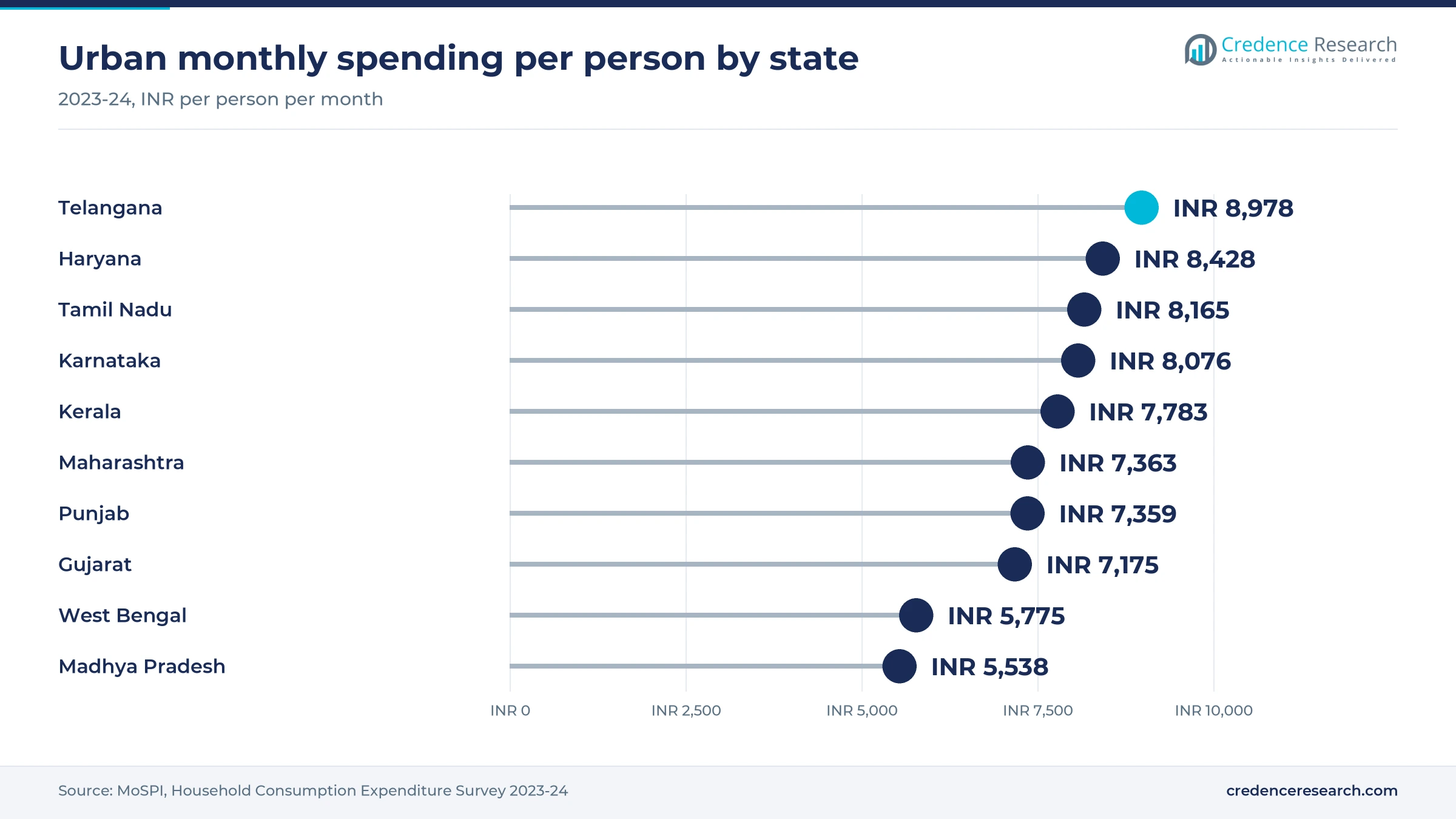
South India held 30.3% of 2025 value and grows at 9.7% a year. Urban monthly spending per person in 2023-24 reached INR 8,978 in Telangana, INR 8,165 in Tamil Nadu and INR 8,076 in Karnataka, among the highest of the major states. Bengaluru combines a heavily booked club scene with Prestige Golfshire near Nandi Hills, and the PGTI held events at Krishnagiri and Kolar in August 2025, including the first Kolar Open. With the Hyderabad township noted above, the zone should hold its lead.
North India pairs flagship events with luxury golf homes
North India held 26.6% of 2025 value and grows at 9.8% a year. Delhi NCR hosts the two richest events in Indian golf, the Hero Indian Open at DLF Golf and Country Club and the DP World India Championship at Delhi Golf Club. Gurugram also holds Karma Lakelands and the 27-hole Classic Golf and Country Club, designed by Jack Nicklaus and developed by Landbase India. Urban spending per person in Haryana reached INR 8,428 a month in 2023-24, a base for premium memberships and homes.
West India grows fastest on new resort communities
West India held 21.7% of 2025 value and grows at 10.6% a year, the fastest of the five zones. The Lonavala and Goa townships noted above sit in this zone. Aamby Valley City in Maharashtra could restart under a new owner if the court approves the sale noted above. Maharashtra drew 3.70 million foreign tourist visits in 2024-25, the most of any state, according to the Ministry of Tourism, which supports stay-and-play demand at resorts such as Oxford Golf Resort.
East and Northeast India grows from a smaller civilian base
East and Northeast India held 15.3% of 2025 value and grows at 9.2% a year. Kolkata has historic clubs, and West Bengal drew 3.12 million foreign tourist visits in 2024-25, the second highest of any state, according to the Ministry of Tourism. The PGTI scheduled NexGen Tour events in Patna and Bhubaneswar for late 2025, its first event in Odisha. Urban spending of INR 5,775 a month per person in West Bengal keeps the paying golfer base smaller than in the south and west.
Central India relies on defense and institutional courses
Central India held 6.1% of 2025 value and grows at 8.8% a year, the slowest of the five zones. Credence Research estimates that cantonment and institutional courses host most rounds in the zone, and such courses rarely sell rounds to paying visitors. Urban spending per person reached INR 5,538 a month in Madhya Pradesh and INR 4,927 in Chhattisgarh in 2023-24, below the urban average of INR 6,996. Few resort or residential golf projects are planned, so the zone keeps its small share.
Purses, insolvency deals and leagues from 2025 to 2026
| Development | Status and market relevance |
|---|---|
| In October 2025, the DP World India Championship at Delhi Golf Club offered a USD 4 million purse. | Held; the richest event staged in India |
| In November 2025, creditors approved the INR 14,535 crore Adani Enterprises plan for Jaiprakash Associates. | NCLT approved on March 17, 2026; Jaypee Greens assets |
| In March 2026, the Hero Indian Open offered a record USD 2.55 million at DLF Golf and Country Club. | Held; co-sanctioned with the DP World Tour |
| In April 2026, the Indian Golf Premier League held its franchise launch in New Delhi. | Launched; USD 2 billion golf tourism commitment |
| In September 2025, Sahara Group filed a term sheet to sell Aamby Valley City and other properties to the Adani Group. | Pending Supreme Court approval |
Launch monitors and booking apps widen access to play
- Simulators with launch monitors track ball speed and spin indoors, which lets malls, clubs and bars sell practice and virtual rounds in any season.
- Tee-time booking platforms let golfers reserve rounds online, which lets clubs fill weekday slots that members leave empty.
- Custom club fitting matches shaft and head to each swing, which helps online and specialty retailers sell premium clubs at higher prices.
- Course and club management software handles members, handicaps and billing, which lets smaller clubs and third-party managers run courses with leaner staff.
Need a Custom Version of This Report?
Tailor the scope, geography, or segments to your exact requirements.
- Custom geography or segment scope
- Direct access to our analyst team
Developers, clubs and booking platforms shape supply
Competition turns on control of land and course access rather than on price. DLF and Prestige Estates Projects use courses to sell high-value homes and hotel rooms, while Jaiprakash Associates and Aamby Valley City Limited hold large golf-linked estates that are moving to new owners. Landbase India runs the Classic Golf and Country Club beside ITC Grand Bharat, and Karma Lakelands combines a course, villas and a simulator lounge in Gurugram. Oxford Golf Resort near Pune sells stays, rounds and corporate events. Service firms compete on reach, convenience and the range of courses they can offer. Golftripz sells golf holidays to inbound visitors, GolfLan runs tee-time booking, and Golf Buy India sells equipment online with custom fitting. Event promoters and title sponsors also shape demand, and the shift toward richer professional tours rewards venues that can host international fields.
Clubs and developers control scarce supply
Supply is concentrated in a few types of owners, each with high barriers to entry. Member-owned clubs such as Delhi Golf Club and Bangalore Golf Club hold prime city land and ration access through entrance fees. Developers such as DLF, Prestige and the Jaypee group build courses to sell homes, and they capture the largest margins through the housing premium. Defense and institutional owners run many courses but sell little to the public. Around them sit smaller players, including tour operators, booking apps, online retailers and simulator venues, where entry is easy but margins are thinner.
Companies profiled and their roles in this market
| Company | Type | Role in the market |
|---|---|---|
| DLF Limited | Real estate developer and course owner | DLF Golf and Country Club; The Dahlias in DLF Phase 5 |
| Prestige Estates Projects Limited | Real estate developer | Prestige Golfshire; golf townships planned in Goa, Lonavala and Hyderabad |
| Jaiprakash Associates Limited | Developer under insolvency resolution | Jaypee Greens; Adani Enterprises plan approved in March 2026 |
| Landbase India Limited | Course developer and operator | Classic Golf and Country Club, a 27-hole Jack Nicklaus design |
| Karma Lakelands | Golf resort and residential community | Gurugram course, golf league and simulator lounge |
| Aamby Valley City Limited | Resort township owner | 8,810-acre Aamby Valley; sale to Adani Group awaiting court approval |
| Oxford Golf Resort | Golf resort operator | 18-hole course near Pune; hosted a 2024-25 corporate golf series final |
| GolfLan Technology Solutions Private Limited | Tee-time booking platform | Cloud-based golf booking and concierge service |
| Golftripz Private Limited | Golf travel operator | Golf holidays for inbound visitors; inventory of about 60 to 70 Indian courses |
| Golf Buy India | Online golf retailer | Ludhiana-based seller of clubs, bags, shoes and apparel with custom fitting |
Access, not demand, decides how fast golf spending grows
Credence Research's view is that access, not demand, will decide how fast golf spending grows in India. Waiting lists, crowded city courses and closed cantonment layouts show that more people want to play than the civilian network can serve. The strongest positions belong to owners of land beside courses, because the housing premium funds new layouts and clubhouses. Events, simulators and golf travel will grow fastest, from a smaller base than memberships and golf homes. Investors should favor projects that open courses to paying visitors and pair them with hotels, rather than closed member-only layouts.
Golfer counts, fees and housing sales anchor the model
The report uses 2025 as the base year and 2026 to 2035 as the forecast period. Market values come from the Credence Research model, which builds each revenue stream from golfer and course counts, published club fees, golf-linked housing sales and event purses. Segment and regional splits are Credence Research estimates built from The R&A participation data, Ministry of Statistics and Programme Implementation household spending data, Ministry of Tourism visitor data, Press Information Bureau releases, company and tour releases, and court and insolvency filings reported in the press. No interviews or primary surveys were conducted for this edition.
Golf homes and tourism carry the gains through 2035
The India golf economy is expected to grow from USD 1.73 billion in 2026 to USD 4.01 billion by 2035 at a 9.78% CAGR. Golf-linked real estate premium will keep the largest share, while coaching, events and media grow fastest from a smaller base. New resort communities in the west and public courses near Delhi will add access, and simulator venues will bring new players into the game. South India will remain the largest zone, and West India will add value fastest. Driving ranges and simulators will turn more casual players into paying golfers by 2035.
Luxury housing and course access decide the 2035 range
The range of outcomes depends on luxury housing demand and on how fast new courses open to paying golfers. A downside case assumes a slowdown in luxury home sales that delays golf townships and cuts the property premium. The base case assumes steady golf-linked housing sales, rising purses and gradual public course growth. An upside case needs new resort courses in Lonavala, Goa and Hyderabad to open on time and inbound golf tourism to scale with league and government backing.
| Scenario | CAGR, 2026–2035 | Value, 2035 | What has to hold |
|---|---|---|---|
| Downside | 7.8% | USD 3.40 billion | Luxury home sales slow, golf townships are delayed and the property premium narrows |
| Base | 9.78% | USD 4.01 billion | Golf-linked housing sales, purses and public course openings keep their recent pace |
| Upside | 11.3% | USD 4.53 billion | New resort courses open on time and inbound golf tourism scales with league backing |
Frequently Asked Questions
How big is the India golf economy market?
Which revenue stream leads Indian golf spending?
Which region of India leads the golf economy?
How many golfers and golf courses does India have?
Why are golf club memberships hard to get in India?
What is the Indian Golf Premier League?
Who are the key companies in the India golf economy market?
How fast are simulators and driving ranges growing in India?
Table of Content
Chapter 1 Market Segmentation
- 1.1 Segmentation Framework
- 1.1.1 Product and Service Classification
- 1.1.2 Application and End-Use Classification
- 1.1.3 Technology and Solution Classification
- 1.1.4 Customer and Distribution Channel Classification
- 1.1.5 Geographic Segmentation
- 1.1.6 Market Segment Definitions and Boundaries
- 1.2 By Revenue Stream
- 1.2.1 Golf-Linked Real Estate Premium
- 1.2.2 Course Operations and Memberships
- 1.2.3 Equipment and Apparel
- 1.2.4 Tourism and Hospitality
- 1.2.5 Coaching, Events and Media
- 1.3 By Facility Type
- 1.3.1 Private Member Clubs
- 1.3.2 Residential Golf Communities
- 1.3.3 Resort Courses
- 1.3.4 Defence and Institutional Courses
- 1.3.5 Public and Municipal Courses
- 1.4 By Customer Type
- 1.4.1 Affluent Recreational Golfers
- 1.4.2 Corporate Golfers and Sponsors
- 1.4.3 Golf Tourists
- 1.4.4 Junior and Academy Participants
- 1.4.5 Competitive and Professional Golfers
- 1.5 By Participation Format
- 1.5.1 18-Hole Course Play
- 1.5.2 Driving Ranges and Simulators
- 1.5.3 Instruction and Camps
- 1.5.4 Tournaments and Pro-Ams
- 1.5.5 9-Hole and Executive Golf
Chapter 2 Introduction
- 2.1 Report Objectives and Scope
- 2.2 Product Definition and Industry Terminology
- 2.3 Market Inclusions and Exclusions
- 2.4 Research Process
- 2.4.1 Primary Research and Expert Interviews
- 2.4.2 Secondary Research and Source Review
- 2.4.3 Top-Down and Bottom-Up Estimation
- 2.4.4 Data Triangulation and Verification
- 2.5 Market Size Measurement Basis
- 2.5.1 2025: USD 1.57 billion → 2035: USD 4.01 billion
- 2.6 Historical and Forecast Reference Periods
- 2.6.1 Historical Period: 2018-2025
- 2.6.2 Base Year: 2025
- 2.6.3 Forecast Period: 2025-2035
- 2.7 Research Assumptions and Limitations
Chapter 3 Executive Summary
- 3.1 Market Snapshot and Key Findings
- 3.2 Base-Year Market Size, 2025
- 3.3 Forecast Market Size, 2035
- 3.4 Revenue and Volume Growth Outlook
- 3.5 Key Demand and Supply Indicators
- 3.6 Leading Market Segments
- 3.7 Fastest-Growing Market Opportunities
- 3.8 Regional Performance Highlights
- 3.9 Technology and Industry Transformation
- 3.10 Competitive Landscape Summary
- 3.11 Analyst View and Strategic Implications
Chapter 4 India Golf Economy Market Trends and Developments
- 4.1 Historical Industry Development, 2018-2025
- 4.2 Recent Market Trends and Developments
- 4.3 Demand and Customer Behavior Trends
- 4.4 Technology and Product Innovation
- 4.5 Artificial Intelligence, Automation and Digitalization
- 4.6 Local Manufacturing and Supply Chain Realignment
- 4.7 Industry Partnerships, Mergers and Acquisitions
- 4.8 Sustainability and Circular Economy Developments
- 4.9 Government and Private Sector Investment Trends
- 4.10 Emerging Business Models and Commercialization
- 4.11 Industry Developments and Announcements
Chapter 5 India Golf Economy Market Supply and Demand Analysis
- 5.1 Demand Trend and Consumption Analysis, 2018-2025
- 5.2 Demand Forecast, 2025-2035
- 5.3 Supply Chain Structure and Procurement Trends
- 5.4 Supply-Demand Gap and Bottlenecks
- 5.5 Import Dependence and Sourcing Structure
- 5.6 Regional Supply and Demand Concentration
Chapter 6 India Golf Economy Market Pricing Analysis
- 6.1 Pricing Structure and Measurement
- 6.2 Historical Pricing Trends, 2018-2025
- 6.3 Pricing Outlook, 2025-2035
- 6.4 Pricing by Product and Market Segment
- 6.5 Geographic Pricing Differences
- 6.6 Key Input, Energy, Labor and Logistics Costs
- 6.7 Contract Pricing and Purchasing Models
- 6.8 Pricing Sensitivity and Competitive Positioning
- 6.9 Price, Margin and Profitability Implications
Chapter 7 India Golf Economy Market Dynamics
- 7.1 Market Growth Drivers
- 7.1.1 Demand-Side Drivers
- 7.1.2 Technology and Innovation Drivers
- 7.1.3 Infrastructure and Investment Drivers
- 7.1.4 Regulatory and Policy Drivers
- 7.2 Market Restraints
- 7.2.1 Cost and Affordability Constraints
- 7.2.2 Technology and Adoption Barriers
- 7.2.3 Supply Chain and Operational Constraints
- 7.3 Market Challenges
- 7.3.1 Competitive Pressure and Margin Erosion
- 7.3.2 Skills, Infrastructure and Implementation Gaps
- 7.4 Emerging Market Opportunities
- 7.5 Market Dynamics Impact and Time-Horizon Assessment
Chapter 8 India Golf Economy Value Chain Analysis
- 8.1 Industry Value Chain Overview
- 8.2 Upstream Suppliers and Critical Inputs
- 8.3 Technology and Component Providers
- 8.4 Manufacturing or Service Delivery
- 8.5 Distribution, Channel Partners and Integrators
- 8.6 Downstream Applications and End Users
- 8.7 Value Addition and Profit Pools
- 8.8 Vertical Integration and Outsourcing
- 8.9 Supplier Concentration and Risk
- 8.10 Supply Chain Localization and Resilience
Chapter 9 India Golf Economy Market Regulations and Policies
- 9.1 Relevant Laws, Standards and Compliance Frameworks
- 9.2 Product, Service, Safety and Quality Requirements
- 9.3 Government Policies, Incentives and Subsidies
- 9.4 Imports, Exports and Trade Barriers
- 9.5 Public Procurement and Local Content Requirements
- 9.6 Data Protection, AI and Cybersecurity Compliance
- 9.7 Upcoming Policy Changes and Market Implications
Chapter 10 India Golf Economy Market Hotspots and Opportunities
- 10.1 Market Opportunity Mapping and Growth Hotspots
- 10.2 High-Growth Applications and Customer Groups
- 10.3 Underserved Markets and White-Space Opportunities
- 10.4 Emerging Technology and Product Opportunities
- 10.5 New Capacity and Investment Hotspots
- 10.6 Market Entry and Expansion Opportunities
- 10.7 Distribution and Partnership Opportunities
- 10.8 Near-Term and Long-Term Commercial Potential
- 10.9 Opportunity Attractiveness and Execution Risks
Chapter 11 India Golf Economy Market Outlook, 2025-2035
- 11.1 Market Size and Analysis
- 11.1.1 Revenue (Market Measurement: 2025: USD 1.57 billion → 2035: USD 4.01 billion)
- 11.1.2 Historical Market Size, 2018-2025
- 11.1.3 Base-Year Market Size, 2025
- 11.2 Market Forecast, 2025-2035
- 11.2.1 Revenue Forecast to 2035
- 11.2.2 CAGR and Year-on-Year Growth
- 11.2.3 Incremental Revenue Opportunity
- 11.3 Forecast Assumptions and Scenario Analysis
- 11.3.1 Base-Case Forecast
- 11.3.2 Optimistic and Conservative Scenarios
- 11.3.3 Technology, Pricing and Policy Sensitivities
- 11.4 Market Attractiveness and Growth Outlook
Chapter 12 India Golf Economy Market Segmentation and Outlook
- 12.1 Segmentation Summary and Market Shares, 2025
- 12.2 Largest and Fastest-Growing Segments
- 12.3 By Revenue Stream - Market Size and Forecast, 2025-2035
- 12.3.1 Segment Definition and Scope
- 12.3.2 Historical Market Size, 2018-2025
- 12.3.3 Revenue Forecast, 2025-2035
- 12.3.4 Base-Year Market Share, 2025
- 12.3.5 Segment CAGR and Growth Drivers
- 12.3.6 Subsegment Market Size and Forecast
- 12.3.6.1 Golf-Linked Real Estate Premium
- 12.3.6.2 Course Operations and Memberships
- 12.3.6.3 Equipment and Apparel
- 12.3.6.4 Tourism and Hospitality
- 12.3.6.5 Coaching, Events and Media
- 12.3.7 Subsegment Pricing and Adoption Trends
- 12.3.8 Leading Suppliers and Competition
- 12.3.9 Regional Demand and Opportunities
- 12.4 By Facility Type - Market Size and Forecast, 2025-2035
- 12.4.1 Segment Definition and Scope
- 12.4.2 Historical Market Size, 2018-2025
- 12.4.3 Revenue Forecast, 2025-2035
- 12.4.4 Base-Year Market Share, 2025
- 12.4.5 Segment CAGR and Growth Drivers
- 12.4.6 Subsegment Market Size and Forecast
- 12.4.6.1 Private Member Clubs
- 12.4.6.2 Residential Golf Communities
- 12.4.6.3 Resort Courses
- 12.4.6.4 Defence and Institutional Courses
- 12.4.6.5 Public and Municipal Courses
- 12.4.7 Subsegment Pricing and Adoption Trends
- 12.4.8 Leading Suppliers and Competition
- 12.4.9 Regional Demand and Opportunities
- 12.5 By Customer Type - Market Size and Forecast, 2025-2035
- 12.5.1 Segment Definition and Scope
- 12.5.2 Historical Market Size, 2018-2025
- 12.5.3 Revenue Forecast, 2025-2035
- 12.5.4 Base-Year Market Share, 2025
- 12.5.5 Segment CAGR and Growth Drivers
- 12.5.6 Subsegment Market Size and Forecast
- 12.5.6.1 Affluent Recreational Golfers
- 12.5.6.2 Corporate Golfers and Sponsors
- 12.5.6.3 Golf Tourists
- 12.5.6.4 Junior and Academy Participants
- 12.5.6.5 Competitive and Professional Golfers
- 12.5.7 Subsegment Pricing and Adoption Trends
- 12.5.8 Leading Suppliers and Competition
- 12.5.9 Regional Demand and Opportunities
- 12.6 By Participation Format - Market Size and Forecast, 2025-2035
- 12.6.1 Segment Definition and Scope
- 12.6.2 Historical Market Size, 2018-2025
- 12.6.3 Revenue Forecast, 2025-2035
- 12.6.4 Base-Year Market Share, 2025
- 12.6.5 Segment CAGR and Growth Drivers
- 12.6.6 Subsegment Market Size and Forecast
- 12.6.6.1 18-Hole Course Play
- 12.6.6.2 Driving Ranges and Simulators
- 12.6.6.3 Instruction and Camps
- 12.6.6.4 Tournaments and Pro-Ams
- 12.6.6.5 9-Hole and Executive Golf
- 12.6.7 Subsegment Pricing and Adoption Trends
- 12.6.8 Leading Suppliers and Competition
- 12.6.9 Regional Demand and Opportunities
- 12.7 Segment Growth Comparison
- 12.8 Segment Attractiveness and Priority Matrix
Chapter 13 India Golf Economy End-Use and Application Market Outlook
- 13.1 End-Use Industry and Customer Demand Structure
- 13.2 Leading Applications and Customer Groups
- 13.3 End-Use Market Size, Share and Forecast
- 13.4 Major End-Use Industry Deep Dives
- 13.4.1 Customer Requirements and Use Cases
- 13.4.2 Demand and Replacement Cycles
- 13.4.3 Technical and Regulatory Considerations
- 13.4.4 Purchasing and Procurement Models
- 13.4.5 Leading Vendors and Distribution Channels
- 13.4.6 Forecast and Commercial Opportunities
- 13.5 Emerging Applications and Cross-Segment Demand
- 13.6 End-Use Industry Investment Priorities
Chapter 14 India Golf Economy Geographic Market Outlook, 2025-2035
- 14.1 Domestic Market Distribution and Demand Clusters
- 14.2 State- or Province-Wise Market Size and Forecast, 2025-2035
- 14.3 City and Metropolitan Market Outlook
- 14.4 Industrial, Manufacturing and Commercial Clusters
- 14.5 Geographic Concentration of Key End Users
- 14.6 Local Pricing and Purchasing Differences
- 14.7 Domestic Production Facilities and Capacity Map
- 14.8 Local Infrastructure and Project Pipeline
- 14.9 State-Level Policy and Incentive Differences
- 14.10 Subnational Investment Hotspots and Opportunities
- 14.11 Distribution and Logistics Networks
- 14.12 Domestic Competitive Footprint
Chapter 15 India Golf Economy Technology, Innovation and Sustainability Outlook
- 15.1 Technology Landscape and Maturity
- 15.2 Product, Process and Service Innovation
- 15.3 AI, Automation and Digital Tools in the Industry
- 15.4 Technology Adoption and Performance Benchmarking
- 15.5 Innovation Pipeline and R&D Investment
- 15.6 Energy Efficiency and Resource Management
- 15.7 Sustainability, Recycling and Circularity
- 15.8 Technology Roadmap, 2025-2035
- 15.9 Risks of Obsolescence and Technology Substitution
Chapter 16 India Golf Economy Market Key Strategic Imperatives
- 16.1 Growth and Market Entry Priorities
- 16.2 High-Return Products and Segments
- 16.3 Pricing, Profitability and Cost Optimization
- 16.4 Technology Investment and Product Differentiation
- 16.5 Supply Chain Localization and Resilience
- 16.6 Distribution and Customer Acquisition
- 16.7 Partnership, Acquisition and Capacity Strategy
- 16.8 Regional Expansion Priorities
- 16.9 Short-, Medium- and Long-Term Actions
Chapter 17 Competition Outlook
- 17.1 Industry Competition Characteristics
- 17.2 Market Structure and Concentration
- 17.3 Market Share and Competitive Positioning, 2025
- 17.4 Company-Wise Revenue and Product Benchmarking
- 17.5 Production and Service Capacity Benchmarking
- 17.6 Technology, Pricing and Differentiation
- 17.7 Regional Footprint and Distribution Strength
- 17.8 Mergers, Acquisitions and Strategic Alliances
- 17.9 New Entrants and Competitive Threats
- 17.10 Porter's Five Forces and Industry Attractiveness
- 17.11 Competitive Outlook, 2025-2035
Chapter 18 Company Profiles
- 18.1 Company Coverage and Selection Criteria
- 18.2 DLF Limited
- 18.2.1 Business Description
- 18.2.2 Company Ownership and Geographic Presence
- 18.2.3 Product and Service Portfolio
- 18.2.4 Manufacturing and Operating Footprint
- 18.2.5 Financial Performance and Investment
- 18.2.6 Market Share and Competitive Position
- 18.2.7 Technology and Innovation Capabilities
- 18.2.8 Strategic Alliances or Partnerships
- 18.2.9 Recent Developments
- 18.2.10 Growth Strategy and Outlook
- 18.3 Prestige Estates Projects Limited
- 18.4 Jaiprakash Associates Limited
- 18.5 Landbase India Limited
- 18.6 Karma Lakelands
- 18.7 Aamby Valley City Limited
- 18.8 Oxford Golf Resort
- 18.9 GolfLan Technology Solutions Private Limited
- 18.10 Golftripz Private Limited
- 18.11 Golf Buy India
- 18.12 Other Relevant Market Participants
Note: Every listed company is profiled on the structure shown under the first company. The company list is preliminary and may change based on research findings, market developments, data availability and client requirements.
Chapter 19 Disclaimer
- 19.1 Research and Forecast Disclaimer
- 19.2 Data Source and Estimation Limitations
Note: The depth of individual sections depends on data availability for this market. Volume, capacity, trade and other unit-based metrics are included where applicable.