
Market Overview:
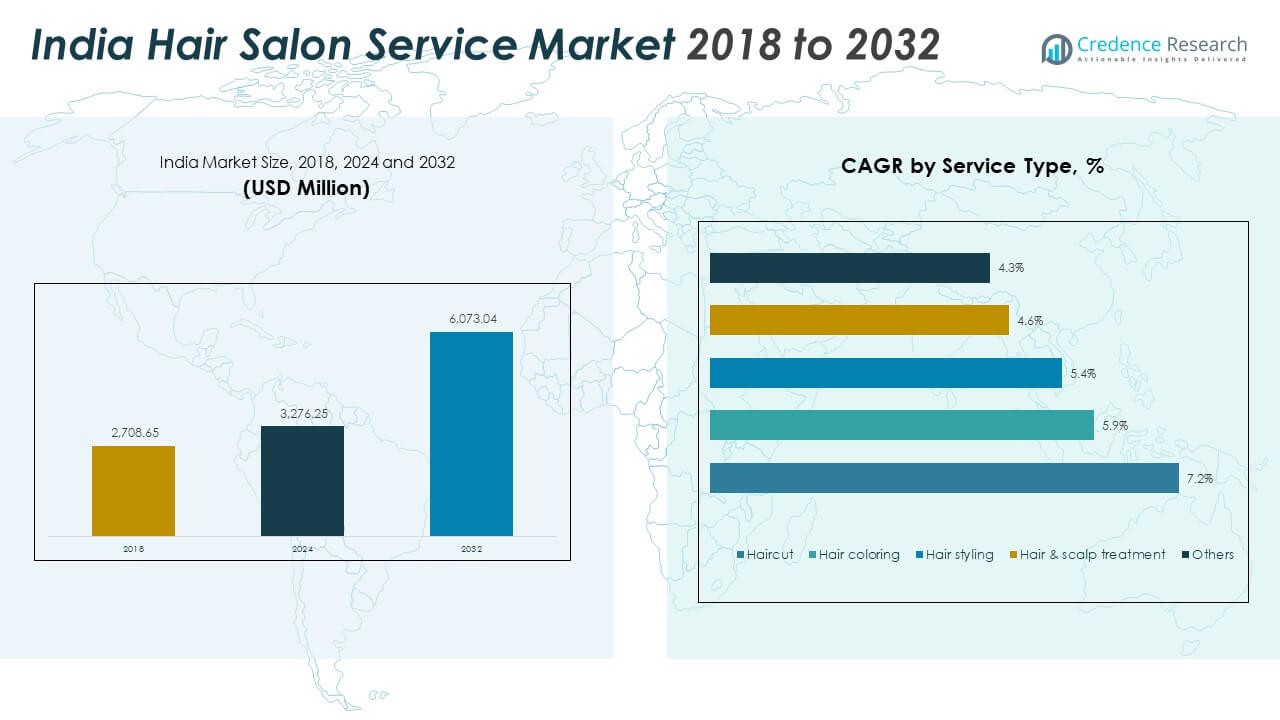
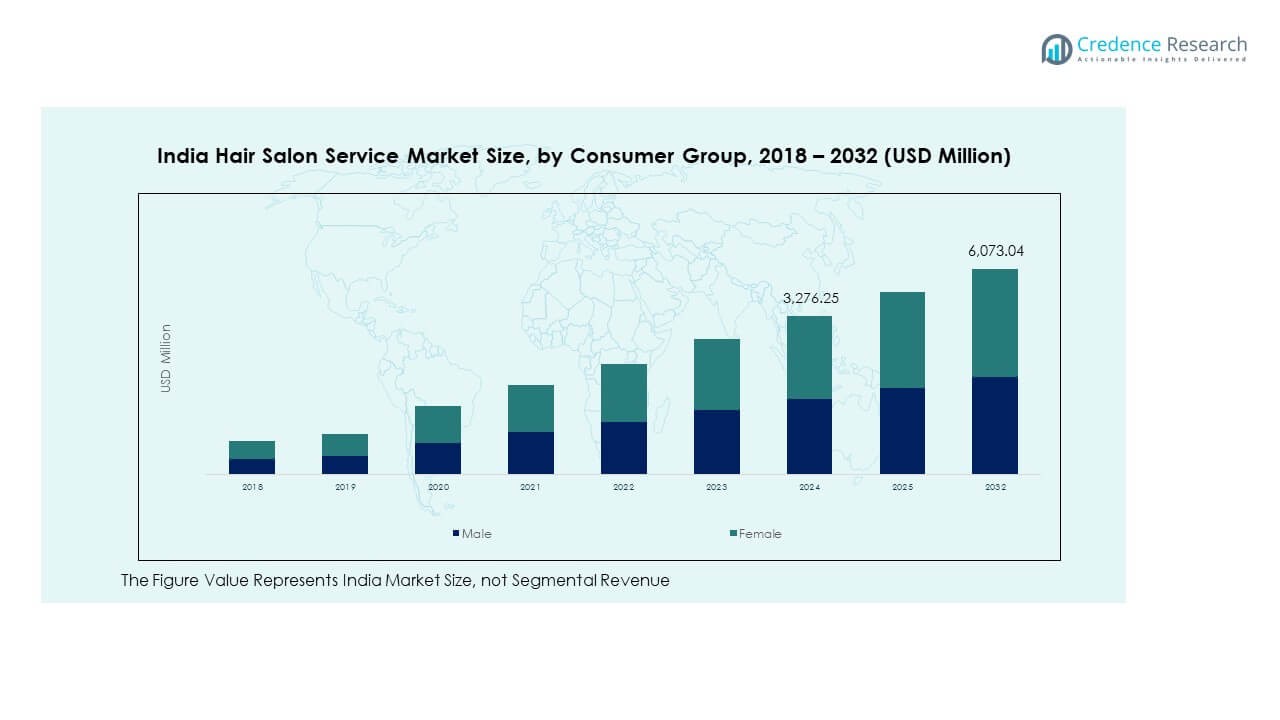
The India Hair Salon Service Market size was valued at USD 2,708.65 million in 2018, rose to USD 3,276.25 million in 2024, and is anticipated to reach USD 6,073.04 million by 2032, at a CAGR of 8.02% during the forecast period.
| REPORT ATTRIBUTE | DETAILS |
|---|---|
| Historical Period | 2020-2023 |
| Base Year | 2024 |
| Forecast Period | 2025-2032 |
| India Hair Salon Service Market Size 2024 | USD 3,276.25 Million |
| India Hair Salon Service Market, CAGR | 8.02% |
| India Hair Salon Service Market Size 2032 | USD 6,073.04 Million |
The growth of the India Hair Salon Service Market is driven by increasing disposable incomes, urbanization, and rising consumer awareness around personal grooming and beauty. The shift toward premium salon services, including hair coloring, styling, and treatments, is also contributing to the market's expansion. The rise of digital platforms for booking salon services and the increasing adoption of mobile and at-home services further fuel market growth. The growing influence of social media and beauty trends among younger generations also propels the demand for salon services.
Regionally, North India leads the market, driven by major urban centers like Delhi and Gurgaon with high disposable incomes and a large consumer base. The West and Central India regions, with cities like Mumbai and Pune, are also significant players in the market, showing strong adoption of salon services. Emerging cities in the South and East, such as Bengaluru and Kolkata, are witnessing rapid growth due to an expanding middle class and increasing awareness about professional haircare services. These regions present high growth potential, as the demand for quality and innovative salon services rises.
Market Insights
- The India Hair Salon Service Market was valued at USD 2,708.65 million in 2018, grew to USD 3,276.25 million in 2024, and is projected to reach USD 6,073.04 million by 2032, at a CAGR of 8.02%.
- North India leads the market with approximately 40% share, driven by major urban centers like Delhi and Gurgaon, where disposable incomes are high and salon services are in high demand. West and Central India follow with around 30%, with cities like Mumbai and Pune showing strong adoption of grooming services.
- South and East India collectively account for 30% of the market share, with rapid growth in tier-2 and tier-3 cities. Rising disposable incomes and increasing urbanization are key drivers in these regions.
- The male segment holds a significant portion of the market, contributing around 45% in 2024, with strong growth in male grooming services, including haircuts, styling, and treatments. The female segment remains dominant, contributing about 55% of the market share.
- The highest growth is seen in the mobile/at-home salon services segment, with increased demand for convenience, followed by the full-service salons segment, which continues to attract consumers looking for premium and comprehensive hair care.
Market Drivers:
Rising Disposable Income Among Consumers
The growing disposable income in India is significantly boosting the demand for hair salon services. Consumers are increasingly willing to spend on premium grooming services, as their purchasing power rises. The India Hair Salon Service Market benefits from this trend, as people opt for quality services and personalized treatments. Urbanization has led to higher disposable income in both metropolitan and emerging tier-2 cities, making salon services more affordable to a wider consumer base. This increase in spending capacity allows more consumers to indulge in luxury services, enhancing market growth.
- For instance, Naturals Salon & Spa, founded in 2000, has grown to over 800 outlets across 20+ states as of July 2025, making it one of India’s largest salon chains with official expansion figures repeatedly cited by the brand and industry press.
Changing Lifestyle Preferences and Grooming Culture
Shifting consumer attitudes towards personal care and grooming are also driving market growth. India’s evolving beauty culture, influenced by global trends, is encouraging people to indulge in regular salon visits. The increasing popularity of hairstyling, hair treatments, and coloring services is changing the dynamics of the India Hair Salon Service Market . Salons now provide specialized services such as hair extensions, scalp treatments, and keratin treatments, which attract consumers seeking enhanced beauty standards. This growing focus on grooming has become an integral part of lifestyle, especially in urban centers.
- For instance, Lakmé Salon operates more than 450 salons and employs over 4,000 experts nationwide as of 2024, supporting specialized beauty services and consistent expansion into premium hair care and grooming treatments.
Technological Advancements in Salon Services
The integration of advanced technologies in salons has fueled the growth of the market. Digital appointment booking, AI-based hair analysis, and online consultations have made salon services more accessible. The rise of mobile and web apps, offering services like doorstep appointments, has improved consumer convenience. Salons are adopting automation and tech-driven tools, enhancing the overall customer experience. These technological innovations are streamlining operations, increasing efficiency, and allowing salons to reach a wider customer base, especially in emerging markets.
Influence of Social Media and Beauty Influencers
Social media platforms and beauty influencers are playing a crucial role in promoting salon services. Platforms like Instagram and YouTube are increasingly influencing consumer preferences by showcasing hairstyling tutorials, reviews, and transformations. Influencers often promote new trends and salons, drawing in their followers. This trend is particularly prevalent among the younger demographic, who are looking to emulate their favorite stars and personalities, contributing to the growth of the India Hair Salon Service Market . This social media influence continues to shape consumer expectations and drive footfall to salons.
Market Trends:
Growth of Specialized Salon Services
There is a rising demand for specialized salon services in India, including premium hair treatments like keratin, Botox, and organic haircare. These services cater to consumers looking for advanced, customized hair care. The India Hair Salon Service Market is seeing the introduction of such services in high-end salons, which focus on quality and results. Specialized treatments are attracting a premium clientele willing to pay more for superior services that meet specific hair care needs. This trend indicates a shift towards more luxurious, tailored salon experiences across the country.
Expansion of Salon Chains and Franchises
The salon industry in India is witnessing a surge in the number of chain salons and franchises. Brands are expanding their presence across cities, from metro hubs to smaller towns, offering standardized services. The rise of well-known salon chains, such as VLCC and Naturals, has been a major trend. These salon chains are expanding rapidly due to their brand recognition and consistent service quality. The India Hair Salon Service Market benefits from this expansion as it offers a more reliable and widespread salon experience. Consumers are now choosing branded salons for their trustworthiness and quality.
Increase in Mobile and At-Home Salon Services
Mobile salons are emerging as a popular trend in India, offering door-to-door beauty and hair care services. With the increasing convenience of at-home services, more consumers are opting for personalized treatments in the comfort of their homes. The India Hair Salon Service Market is seeing growth in mobile salon offerings, particularly among busy professionals and elderly clients. The ease and privacy offered by at-home salons contribute to their growing demand. This convenience has significantly expanded the customer base, especially in metropolitan cities where time-saving services are in high demand.
- For instance, Urban Company’s Salon Prime services (including at-home hair and beauty treatments) have received a customer rating of 4.85 based on over 1.2 million reviews, as published on their official website.
Shift Towards Eco-Friendly and Sustainable Beauty Products
The demand for eco-friendly and sustainable beauty products is rising, and the salon industry is no exception. Consumers are becoming more aware of the environmental impact of salon products, leading to a preference for organic and natural treatments. Salons in India are adopting cruelty-free, vegan, and eco-friendly products to cater to environmentally conscious clients. The trend is driving the India Hair Salon Service Market towards more sustainable beauty practices, as consumers prioritize health and wellness alongside beauty. This shift is also prompting salons to adopt greener operational practices.
- For instance, Enrich launched Born Ethical, a sustainable beauty brand offering vegan, natural, and cruelty-free products packaged in recyclable materials, as officially announced by the company and covered in industry publications.
Market Challenges Analysis:
High Competition and Price Sensitivity
The India Hair Salon Service Market faces significant competition, with numerous salons offering similar services. This intense competition is driving salons to cut prices, particularly in tier-2 and tier-3 cities, which could impact profitability. The price sensitivity of Indian consumers also limits the market’s ability to maintain premium pricing for certain services. Salons must innovate to differentiate themselves in a crowded market and attract clients willing to pay more for superior services. The emergence of budget salons further intensifies this competition, making it difficult to maintain high profit margins.
Lack of Skilled Workforce
A major challenge in the India Hair Salon Service Market is the shortage of well-trained professionals. The industry requires skilled hair stylists, colorists, and beauticians to maintain high service standards. However, there is a gap in the availability of skilled professionals, leading to a lack of consistency in service delivery. To address this, salons must invest in training programs and create career development opportunities to retain talent. The shortage of skilled staff also hinders the growth potential of salons, particularly in smaller towns and rural areas.
Market Opportunities:
Rural Market Expansion
The India Hair Salon Service Market has significant growth opportunities in rural and semi-urban areas. Although metro cities have a well-established salon culture, smaller towns and villages present an untapped market. As disposable income rises in rural areas, there is potential for salons to expand their services beyond traditional haircuts, offering hair treatments and styling services. Salons entering these markets can cater to a growing demand for grooming services, creating new revenue streams. Expanding into these regions presents a profitable growth avenue for salon chains and independent operators.
Health and Wellness Trends
With an increasing focus on health and wellness, there is an opportunity for salons to offer integrated services that combine beauty with health. Wellness-focused salons providing holistic treatments, such as Ayurvedic haircare, stress-relief therapies, and scalp massages, are gaining traction. This trend can help salons tap into a more health-conscious customer base. The India Hair Salon Service Market stands to benefit by offering these complementary services, aligning with evolving consumer preferences. Salons that offer holistic beauty solutions can attract a loyal, wellness-focused clientele.
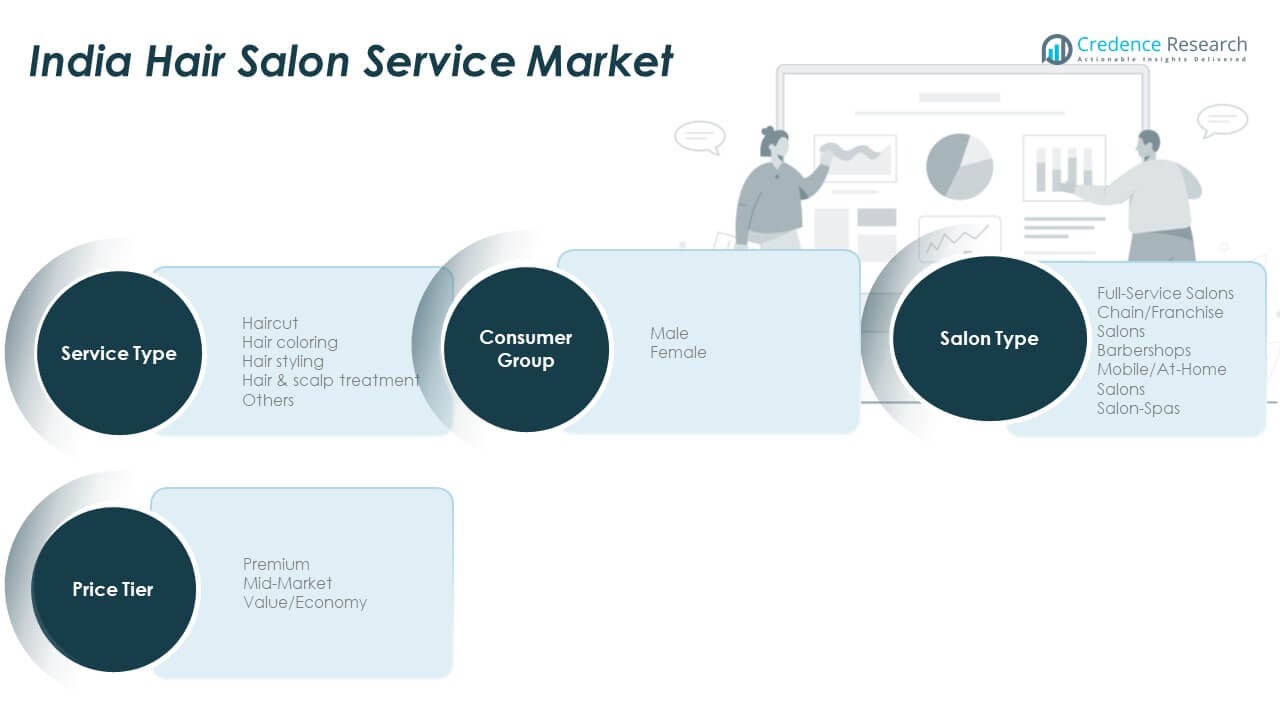
Market Segmentation Analysis
By Service Type
The India Hair Salon Service Market is segmented into various service types, including haircuts, hair coloring, hair styling, hair & scalp treatments, and others. Haircuts remain the most basic and widely offered service across salons, while hair coloring and styling services are gaining popularity due to evolving fashion trends. Hair and scalp treatments are growing in demand as consumers seek personalized care for their hair health. Specialized services such as keratin and organic treatments are also gaining market share in premium salons. This diversification in services is helping salons cater to various consumer needs, expanding their client base.
- For instance, L’Oréal Professionnel’s Metal Detox technology has been shown to reduce hair breakage by up to 99% in one use, according to laboratory testing and in-salon trials conducted by L’Oréal.
By Salon Type
Salon types in the India Hair Salon Service Market include full-service salons, chain/franchise salons, barbershops, mobile/at-home salons, and salon-spas. Full-service salons offer a wide range of services, including haircuts, styling, and treatments, attracting a large consumer base. Chain/franchise salons are rapidly expanding, offering consistent services across locations. Barbershops continue to serve traditional male clientele, while mobile/at-home salons are gaining traction among busy professionals. Salon-spas cater to the high-end market with luxurious services and spa treatments. This segmentation allows consumers to choose services that fit their preferences, budgets, and convenience.
By Consumer Group
The market is segmented by consumer group into male and female segments. The female segment dominates the India Hair Salon Service Market due to higher engagement in grooming and beauty treatments. Women seek hair care and styling services more frequently than men. However, the male segment is growing, driven by increased awareness of grooming and styling services. Men are now opting for specialized services such as beard grooming and hair coloring, which were traditionally dominated by women. This shift is broadening the service offerings and contributing to the market's expansion.
- For instance, Urban Company’s “at-home salon” services, which cater to both male and female customers, have gained significant popularity, with strong demand for grooming and styling services in the home setting,
By Price Range
The India Hair Salon Service Market is further divided based on price range into premium, mid-market, and value/economy segments. Premium salons offer high-end services with premium pricing, targeting affluent consumers. Mid-market salons cater to the mass market, offering a balance between affordability and quality. The value/economy segment serves budget-conscious customers seeking basic services at lower prices. Each segment caters to different income groups and provides varying levels of service and experience. This price-based segmentation enables salons to target a wide range of customers with diverse financial capacities.
Segmentation
By Service Type
- Haircut
- Hair colouring
- Hair styling
- Hair & scalp treatment
- Others
By Salon Type
- Full-Service Salons
- Chain/Franchise Salons
- Barbershops
- Mobile/At-Home Salons
- Salon-Spas
By Consumer Group
- Male
- Female
By Price Range
- Premium
- Mid-Market
- Value/Economy
Regional Analysis
North India Region Dominance (approx. 40 % share)
North India commands roughly 40 % of the India Hair Salon Service Market. Major urban centres such as Delhi, Gurgaon and Chandigarh drive strong demand due to higher incomes and concentrated populations. High awareness of grooming trends and premium service adoption enhance market activity in this region. Franchise salons and branded outlets expand aggressively in metropolitan zones. Consumer willingness to spend on hair treatments and styling supports premium service uptake. Many salons here adopt advanced technology and online bookings to serve affluent clientele.
West & Central India Region (approx. 30 % share)
West and Central India hold an estimated 30 % share of the India Hair Salon Service Market. Mumbai, Pune and Ahmedabad lead the region with vibrant salon ecosystems and strong fashion‑centric demand. Tier‑2 cities in Maharashtra and Gujarat show rising salon penetration and service diversification. Chains and regional brands expand into these growing markets. Marketing campaigns target male grooming and diverse age groups to broaden consumer reach. Competitive pricing combined with quality service helps maintain share in this region.
South & East India Region (approx. 30 % share)
South and East India combined contribute about 30 % to the India Hair Salon Service Market. Southern states such as Karnataka, Tamil Nadu and Telangana show strong adoption of branded salons and treatments. Eastern regions such as West Bengal, Odisha and Bihar are emerging but remain less saturated than metros. Mobile and at‑home salon services gain traction in both urban and semi‑urban areas here. Consumer preferences for specialised hair care and colour services reflect national grooming trends. Market potential remains high in under‑penetrated districts and smaller cities.
Key Player Analysis
- L’Oréal Professionnel / L’Oréal S.A.
- Jawed Habib Hair & Beauty
- Naturals Salon
- BBlunt
- Toni & Guy
- Looks Salon
- VLCC
- Geetanjali Salon
- Enrich Salon
Competitive Analysis
The India Hair Salon Service Market features a mix of national chains, regional brands and independent salons. Major players such as Lakmé Salon, Green Trends, Naturals and Jawed Habib invest in brand building, staff training and service standardization. These chains expand branch networks into tier‑2 and tier‑3 cities to capture underserved segments. Independent salons compete on personalization, local appeal and competitive pricing, which helps them retain cost‑sensitive customers. Mobile and at‑home salon services introduce new competition by offering convenience and flexibility, forcing traditional salons to adopt digital booking and loyalty programmes. Players differentiate through service innovation, such as high‑end treatments, eco‑friendly products and membership models. Operational efficiency remains a key hurdle for smaller operators, while larger chain salons focus on scaling operations and enhancing customer experience to stay competitive.
Recent Developments
- In November 2025, Indian premium haircare brand &Done secured ₹6.5 crore in pre-seed funding led by All In Capital. Since its launch, &Done has partnered with more than 1,500 stylists across over 300 premium salons in tier-1 cities, leveraging a salon-distribution strategy combined with direct-to-consumer products for at-home hair care.
- In September 2025, L’Oréal finalized the acquisition of Color Wow, marking a key step to strengthen its innovation pipeline in professional haircare. Additionally, the company entered into a long-term strategic partnership in luxury beauty and wellness with Kering, which includes the acquisition of the House of Creed and extends L’Oréal’s presence in high-end fragrances and beauty solutions.
- In April 2024, Looks Salon expanded its partnership with Redken, launching "Looks Prive" in Malcha Marg, Delhi. This marks their second flagship collaboration, promising luxurious hair treatments using Redken’s advanced product portfolio and technology.
Report Coverage
The research report offers an in-depth analysis based on Service Type, Salon Type, Consumer Group and Price Range. It details leading market players, providing an overview of their business, product offerings, investments, revenue streams, and key applications. Additionally, the report includes insights into the competitive environment, SWOT analysis, current market trends, as well as the primary drivers and constraints. Furthermore, it discusses various factors that have driven market expansion in recent years. The report also explores market dynamics, regulatory scenarios, and technological advancements that are shaping the industry. It assesses the impact of external factors and global economic changes on market growth. Lastly, it provides strategic recommendations for new entrants and established companies to navigate the complexities of the market.
Future Outlook
- The demand for premium services such as hair treatments, styling, and coloring will continue to rise.
- Consumer preference for personalized grooming experiences will drive salon innovations.
- Mobile and at-home salon services will expand to meet consumer convenience needs.
- Growth in disposable income across urban and semi-urban areas will increase salon spending.
- Salons will focus on offering eco-friendly, organic, and sustainable beauty treatments.
- Chain salons will penetrate tier-2 and tier-3 cities, expanding market reach.
- Advanced technologies like AI-driven hair analysis and online booking will enhance service delivery.
- Men’s grooming services, including haircuts and styling, will see a significant increase in demand.
- Franchise and branded salons will dominate the market as consumers seek consistency and quality.
- Salons will leverage social media influencers and digital marketing to attract younger consumers.

Request a Free Sample
Fill in your details and we'll send you a free sample report.
- Sample data tables & charts
- Research methodology
Need a Custom Version of This Report?
Tailor the scope, geography, or segments to your exact requirements.
- Custom geography or segment scope
- Direct access to our analyst team
Frequently Asked Questions
What is the current market size for India Hair Salon Service Market, and what is its projected size in 2032?
At what Compound Annual Growth Rate is the India Hair Salon Service Market projected to grow between 2024 and 2032?
Which India Hair Salon Service Market segment held the largest share in 2024?
What are the primary factors fueling the growth of the India Hair Salon Service Market?
Who are the leading companies in the India Hair Salon Service Market?
Which region commanded the largest share of the India Hair Salon Service Market in 2024?
Table of Content
Chapter 1 Market Segmentation
- 1.1 Segmentation Framework
- 1.1.1 Product and Service Classification
- 1.1.2 Application and End-Use Classification
- 1.1.3 Technology and Solution Classification
- 1.1.4 Customer and Distribution Channel Classification
- 1.1.5 Geographic Segmentation
- 1.1.6 Market Segment Definitions and Boundaries
Chapter 2 Introduction
- 2.1 Report Objectives and Scope
- 2.2 Product Definition and Industry Terminology
- 2.3 Market Inclusions and Exclusions
- 2.4 Research Process
- 2.4.1 Primary Research and Expert Interviews
- 2.4.2 Secondary Research and Source Review
- 2.4.3 Top-Down and Bottom-Up Estimation
- 2.4.4 Data Triangulation and Verification
- 2.5 Market Size Measurement Basis
- 2.5.1 2024: USD 3,276.25 million → 2032: USD 6,073.04 million
- 2.6 Historical and Forecast Reference Periods
- 2.6.1 Base Year: 2024
- 2.6.2 Forecast Period: 2024-2032
- 2.7 Research Assumptions and Limitations
Chapter 3 Executive Summary
- 3.1 Market Snapshot and Key Findings
- 3.2 Base-Year Market Size, 2024
- 3.3 Forecast Market Size, 2032
- 3.4 Revenue and Volume Growth Outlook
- 3.5 Key Demand and Supply Indicators
- 3.6 Leading Market Segments
- 3.7 Fastest-Growing Market Opportunities
- 3.8 Regional Performance Highlights
- 3.9 Technology and Industry Transformation
- 3.10 Competitive Landscape Summary
- 3.11 Analyst View and Strategic Implications
Chapter 4 India Hair Salon Service Market Trends and Developments
- 4.1 Historical Industry Development
- 4.2 Recent Market Trends and Developments
- 4.3 Demand and Customer Behavior Trends
- 4.4 Technology and Product Innovation
- 4.5 Artificial Intelligence, Automation and Digitalization
- 4.6 Local Manufacturing and Supply Chain Realignment
- 4.7 Industry Partnerships, Mergers and Acquisitions
- 4.8 Sustainability and Circular Economy Developments
- 4.9 Government and Private Sector Investment Trends
- 4.10 Emerging Business Models and Commercialization
- 4.11 Industry Developments and Announcements
Chapter 5 India Hair Salon Service Market Supply and Demand Analysis
- 5.1 Demand Trend and Consumption Analysis
- 5.2 Demand Forecast, 2024-2032
- 5.3 Supply Chain Structure and Procurement Trends
- 5.4 Supply-Demand Gap and Bottlenecks
- 5.5 Import Dependence and Sourcing Structure
- 5.6 Regional Supply and Demand Concentration
Chapter 6 India Hair Salon Service Market Pricing Analysis
- 6.1 Pricing Structure and Measurement
- 6.2 Historical Pricing Trends
- 6.3 Pricing Outlook, 2024-2032
- 6.4 Pricing by Product and Market Segment
- 6.5 Geographic Pricing Differences
- 6.6 Key Input, Energy, Labor and Logistics Costs
- 6.7 Contract Pricing and Purchasing Models
- 6.8 Pricing Sensitivity and Competitive Positioning
- 6.9 Price, Margin and Profitability Implications
Chapter 7 India Hair Salon Service Market Dynamics
- 7.1 Market Growth Drivers
- 7.1.1 Demand-Side Drivers
- 7.1.2 Technology and Innovation Drivers
- 7.1.3 Infrastructure and Investment Drivers
- 7.1.4 Regulatory and Policy Drivers
- 7.2 Market Restraints
- 7.2.1 Cost and Affordability Constraints
- 7.2.2 Technology and Adoption Barriers
- 7.2.3 Supply Chain and Operational Constraints
- 7.3 Market Challenges
- 7.3.1 Competitive Pressure and Margin Erosion
- 7.3.2 Skills, Infrastructure and Implementation Gaps
- 7.4 Emerging Market Opportunities
- 7.5 Market Dynamics Impact and Time-Horizon Assessment
Chapter 8 India Hair Salon Service Value Chain Analysis
- 8.1 Industry Value Chain Overview
- 8.2 Upstream Suppliers and Critical Inputs
- 8.3 Technology and Component Providers
- 8.4 Manufacturing or Service Delivery
- 8.5 Distribution, Channel Partners and Integrators
- 8.6 Downstream Applications and End Users
- 8.7 Value Addition and Profit Pools
- 8.8 Vertical Integration and Outsourcing
- 8.9 Supplier Concentration and Risk
- 8.10 Supply Chain Localization and Resilience
Chapter 9 India Hair Salon Service Market Regulations and Policies
- 9.1 Relevant Laws, Standards and Compliance Frameworks
- 9.2 Product, Service, Safety and Quality Requirements
- 9.3 Government Policies, Incentives and Subsidies
- 9.4 Imports, Exports and Trade Barriers
- 9.5 Public Procurement and Local Content Requirements
- 9.6 Data Protection, AI and Cybersecurity Compliance
- 9.7 Upcoming Policy Changes and Market Implications
Chapter 10 India Hair Salon Service Market Hotspots and Opportunities
- 10.1 Market Opportunity Mapping and Growth Hotspots
- 10.2 High-Growth Applications and Customer Groups
- 10.3 Underserved Markets and White-Space Opportunities
- 10.4 Emerging Technology and Product Opportunities
- 10.5 New Capacity and Investment Hotspots
- 10.6 Market Entry and Expansion Opportunities
- 10.7 Distribution and Partnership Opportunities
- 10.8 Near-Term and Long-Term Commercial Potential
- 10.9 Opportunity Attractiveness and Execution Risks
Chapter 11 India Hair Salon Service Market Outlook, 2024-2032
- 11.1 Market Size and Analysis
- 11.1.1 Revenue (Market Measurement: 2024: USD 3,276.25 million → 2032: USD 6,073.04 million)
- 11.1.2 Historical Market Size
- 11.1.3 Base-Year Market Size, 2024
- 11.2 Market Forecast, 2024-2032
- 11.2.1 Revenue Forecast to 2032
- 11.2.2 CAGR and Year-on-Year Growth
- 11.2.3 Incremental Revenue Opportunity
- 11.3 Forecast Assumptions and Scenario Analysis
- 11.3.1 Base-Case Forecast
- 11.3.2 Optimistic and Conservative Scenarios
- 11.3.3 Technology, Pricing and Policy Sensitivities
- 11.4 Market Attractiveness and Growth Outlook
Chapter 12 India Hair Salon Service Market Segmentation and Outlook
- 12.1 Segmentation Summary and Market Shares, 2024
- 12.2 Largest and Fastest-Growing Segments
- 12.3 Segment Growth Comparison
- 12.4 Segment Attractiveness and Priority Matrix
Chapter 13 India Hair Salon Service Geographic Market Outlook, 2024-2032
- 13.1 Domestic Market Distribution and Demand Clusters
- 13.2 State- or Province-Wise Market Size and Forecast, 2024-2032
- 13.3 City and Metropolitan Market Outlook
- 13.4 Industrial, Manufacturing and Commercial Clusters
- 13.5 Geographic Concentration of Key End Users
- 13.6 Local Pricing and Purchasing Differences
- 13.7 Domestic Production Facilities and Capacity Map
- 13.8 Local Infrastructure and Project Pipeline
- 13.9 State-Level Policy and Incentive Differences
- 13.10 Subnational Investment Hotspots and Opportunities
- 13.11 Distribution and Logistics Networks
- 13.12 Domestic Competitive Footprint
Chapter 14 India Hair Salon Service Technology, Innovation and Sustainability Outlook
- 14.1 Technology Landscape and Maturity
- 14.2 Product, Process and Service Innovation
- 14.3 AI, Automation and Digital Tools in the Industry
- 14.4 Technology Adoption and Performance Benchmarking
- 14.5 Innovation Pipeline and R&D Investment
- 14.6 Energy Efficiency and Resource Management
- 14.7 Sustainability, Recycling and Circularity
- 14.8 Technology Roadmap, 2024-2032
- 14.9 Risks of Obsolescence and Technology Substitution
Chapter 15 India Hair Salon Service Market Key Strategic Imperatives
- 15.1 Growth and Market Entry Priorities
- 15.2 High-Return Products and Segments
- 15.3 Pricing, Profitability and Cost Optimization
- 15.4 Technology Investment and Product Differentiation
- 15.5 Supply Chain Localization and Resilience
- 15.6 Distribution and Customer Acquisition
- 15.7 Partnership, Acquisition and Capacity Strategy
- 15.8 Regional Expansion Priorities
- 15.9 Short-, Medium- and Long-Term Actions
Chapter 16 Competition Outlook
- 16.1 Industry Competition Characteristics
- 16.2 Market Structure and Concentration
- 16.3 Market Share and Competitive Positioning, 2024
- 16.4 Company-Wise Revenue and Product Benchmarking
- 16.5 Production and Service Capacity Benchmarking
- 16.6 Technology, Pricing and Differentiation
- 16.7 Regional Footprint and Distribution Strength
- 16.8 Mergers, Acquisitions and Strategic Alliances
- 16.9 New Entrants and Competitive Threats
- 16.10 Porter's Five Forces and Industry Attractiveness
- 16.11 Competitive Outlook, 2024-2032
Chapter 17 Company Profiles
- 17.1 Company Coverage and Selection Criteria
- 17.2 Leading Market Participants – Standard Profile Structure
- 17.2.1 Business Description
- 17.2.2 Company Ownership and Geographic Presence
- 17.2.3 Product and Service Portfolio
- 17.2.4 Manufacturing and Operating Footprint
- 17.2.5 Financial Performance and Investment
- 17.2.6 Market Share and Competitive Position
- 17.2.7 Technology and Innovation Capabilities
- 17.2.8 Strategic Alliances or Partnerships
- 17.2.9 Recent Developments
- 17.2.10 Growth Strategy and Outlook
- 17.3 Other Relevant Market Participants
Note: Every listed company is profiled on the structure shown under the first company. The company list is preliminary and may change based on research findings, market developments, data availability and client requirements.
Chapter 18 Disclaimer
- 18.1 Research and Forecast Disclaimer
- 18.2 Data Source and Estimation Limitations
Note: The depth of individual sections depends on data availability for this market. Volume, capacity, trade and other unit-based metrics are included where applicable.

