
| REPORT ATTRIBUTE | DETAILS |
|---|---|
| Historical Period | 2020-2023 |
| Base Year | 2024 |
| Forecast Period | 2025-2032 |
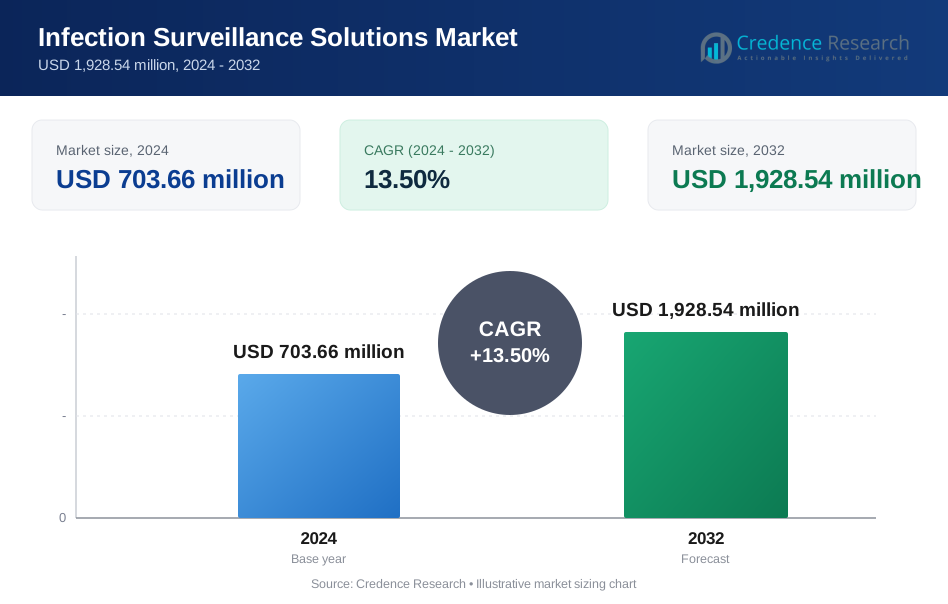
| Infection Surveillance Solutions Market Size 2024 | USD 703.66 million |
| Infection Surveillance Solutions Market, CAGR | 13.50% |
| Infection Surveillance Solutions Market Size 2032 | USD 1,928.54 million |
Market Overview
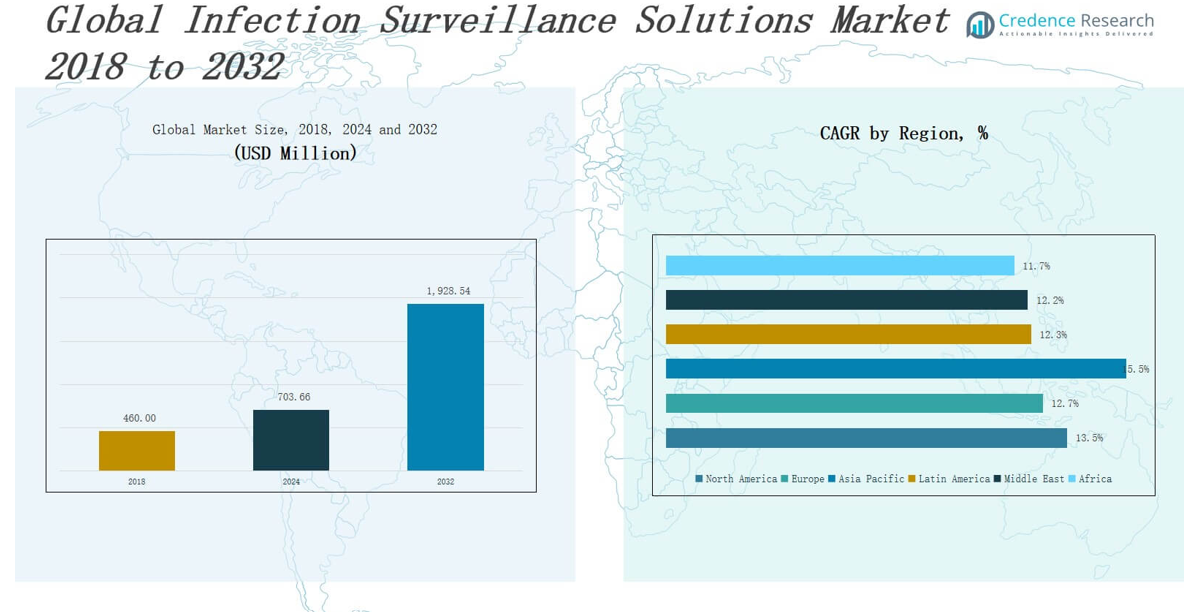
The Infection Surveillance Solutions Market size was valued at USD 460.00 million in 2018 to USD 703.66 million in 2024 and is anticipated to reach USD 1,928.54 million by 2032, at a CAGR of 13.50 % during the forecast period.
The Infection Surveillance Solutions Market is driven by the increasing incidence of healthcare-associated infections (HAIs), rising regulatory mandates for infection control, and growing awareness regarding patient safety and clinical risk management. Healthcare institutions are adopting advanced surveillance software to enhance real-time monitoring, streamline reporting, and ensure regulatory compliance. The shift toward digitized hospital infrastructure, especially in developed economies, further accelerates the integration of infection surveillance systems. Trends indicate a rising demand for cloud-based solutions, artificial intelligence-powered analytics, and interoperable platforms that support seamless data exchange across healthcare settings. The expansion of telehealth and remote patient monitoring is also contributing to broader adoption, particularly in post-acute care environments. Vendors are focusing on offering customizable, user-friendly interfaces and automated alert systems to improve infection detection efficiency. Strategic partnerships between software providers and healthcare organizations are fostering innovation and expanding product capabilities. Collectively, these factors are transforming infection prevention practices and reinforcing the critical role of surveillance in improving healthcare outcomes.
The Infection Surveillance Solutions Market spans North America, Europe, Asia Pacific, Latin America, the Middle East, and Africa, with North America leading due to strong regulatory frameworks and advanced healthcare infrastructure. Europe follows closely, driven by stringent infection control mandates and robust public health systems. Asia Pacific is the fastest-growing region, supported by healthcare digitization and government-led safety initiatives. Latin America and the Middle East show steady progress, fueled by hospital modernization efforts, while Africa holds long-term growth potential amid rising awareness and international health support. Key players include Becton, Dickinson and Company, Cerner Corporation, Wolters Kluwer N.V., Premier Inc., Baxter International, Merative, Ecolab, RLDatix, Epic Systems, bioMérieux SA, Gojo Industries, IBM Watson Health, PointClickCare, and Stanley Healthcare. These companies drive market advancement through AI integration, cloud deployment, and strategic collaborations across healthcare ecosystems.
Market Insights
- The Infection Surveillance Solutions Market was valued at USD 703.66 million in 2024 and is projected to reach USD 1,928.54 million by 2032, growing at a CAGR of 13.50%.
- Rising incidence of healthcare-associated infections (HAIs) and stricter regulatory mandates are pushing hospitals to adopt real-time digital surveillance platforms.
- Cloud-based deployment, AI-powered analytics, and system interoperability are driving demand across healthcare settings, especially in post-acute and long-term care environments.
- High implementation costs and data privacy concerns continue to challenge adoption, particularly among mid-sized facilities in developing regions.
- North America leads the market with USD 314.95 million in 2024, supported by strong regulatory frameworks and widespread EHR integration.
- Asia Pacific is the fastest-growing region with a CAGR of 15.5%, backed by digitization efforts in China, India, and Japan.
- Key players include Becton, Dickinson and Company, Cerner Corporation, Wolters Kluwer, Premier Inc., Baxter, Merative, RLDatix, Epic Systems, and IBM Watson Health.
Market Drivers
Rising Incidence of Healthcare-Associated Infections (HAIs)
The growing prevalence of healthcare-associated infections is a major driver for the Infection Surveillance Solutions Market. HAIs contribute to increased patient morbidity, prolonged hospital stays, and higher healthcare costs. Hospitals are under pressure to adopt surveillance systems that can detect and track infections quickly and accurately. The market is witnessing increased demand from acute care hospitals, surgical centers, and long-term care facilities. Infection tracking tools help reduce transmission and improve patient safety outcomes. Governments and healthcare organizations are reinforcing infection prevention measures. The Infection Surveillance Solutions Market benefits from this focus on patient-centered, technology-enabled healthcare environments.
- For instance, Epic Systems integrates infection surveillance modules with hospital electronic health records (EHRs), enabling acute care hospitals to track infection outbreaks in real time and automate compliance reporting, thereby supporting faster interventions and improved patient outcomes.
Stringent Regulatory Guidelines and Compliance Mandates
Regulatory bodies such as the CDC, WHO, and local health authorities have introduced strict guidelines to manage and report infections. These mandates require healthcare providers to implement structured infection control programs and maintain real-time documentation. The Infection Surveillance Solutions Market responds to this demand by offering systems designed to meet regulatory requirements. Automated alert systems and compliance dashboards improve audit readiness and reporting efficiency. Institutions are adopting digital platforms to avoid penalties and improve accreditation outcomes. Regulatory pressure continues to shape investment in surveillance infrastructure. It positions infection surveillance as a critical operational function in healthcare delivery.
- For instance, VigiLanz Corporation offers automated alert systems that notify infection prevention teams of potential healthcare-associated infections, supporting compliance with regulatory mandates and improving audit readiness.
Digital Transformation of Healthcare Infrastructure
The ongoing digitalization of healthcare facilities strengthens the growth of the Infection Surveillance Solutions Market. Hospitals are deploying electronic health records (EHR), integrating analytics, and streamlining data flow across departments. These changes make it easier to embed surveillance solutions into existing clinical workflows. Real-time tracking, data visualization, and predictive analytics enhance infection response strategies. Integration with hospital IT systems boosts user adoption and system performance. Cloud-based solutions offer scalability and accessibility across care settings. This digital evolution supports proactive infection control and hospital-wide collaboration.
Growing Emphasis on Patient Safety and Quality of Care
Patient safety remains a top priority for healthcare institutions globally. The Infection Surveillance Solutions Market supports this goal by providing tools that improve clinical awareness and risk mitigation. Hospitals use surveillance systems to identify infection trends, track antibiotic resistance, and manage outbreak response. Automated systems reduce manual errors and provide timely insights to infection control teams. These platforms contribute to better patient outcomes and reduced operational risks. The rising focus on value-based care further fuels demand for reliable surveillance technologies. It establishes infection prevention as an integral part of healthcare quality frameworks.
Market Trends
Adoption of Cloud-Based and Remote Monitoring Platforms
Cloud-based deployment models are gaining traction across healthcare institutions for their scalability, cost-effectiveness, and ease of integration. The Infection Surveillance Solutions Market is shifting toward platforms that support remote access, multi-facility integration, and real-time data sharing. Cloud systems eliminate infrastructure constraints and allow centralized infection tracking across hospitals, clinics, and long-term care facilities. They also reduce IT maintenance overhead and offer faster implementation. This trend supports efficient decision-making and continuity of care. It positions cloud solutions as a preferred option for modern infection surveillance strategies.
- For instance, Philips’ eICU program enables critical care teams to remotely monitor ICU patients using advanced analytics, which has been shown to reduce mortality rates and ICU length of stay.
Integration of Artificial Intelligence and Predictive Analytics
Artificial intelligence and machine learning are reshaping the Infection Surveillance Solutions Market by enabling predictive insights and early intervention capabilities. AI-driven platforms analyze large volumes of patient data to identify infection patterns and flag anomalies. These systems improve accuracy in outbreak prediction and antimicrobial resistance detection. Predictive analytics also enhance resource allocation by identifying high-risk patients and areas. It helps healthcare providers intervene proactively, improving infection control outcomes. This integration drives a move toward smarter, more responsive surveillance ecosystems.
Rising Demand for Interoperability and Seamless EHR Integration
Healthcare institutions are prioritizing interoperability to ensure seamless communication across electronic health records, lab systems, and infection control platforms. The Infection Surveillance Solutions Market is responding with tools that can integrate into diverse IT environments without compromising security or performance. Seamless EHR integration improves clinician workflow, reduces duplication, and accelerates response times. Interoperability ensures real-time infection updates are visible across departments. This trend drives adoption among hospitals focused on coordinated care and system-wide efficiency. It also improves the overall usability of surveillance systems.
- For instance, Oulu University Hospital in Finland has implemented a 5G-enabled network to enhance communication between its infection surveillance software and clinical systems, supporting rapid data sharing and coordinated care.
Shift Toward Customizable, User-Friendly Interfaces
Hospitals are increasingly choosing infection surveillance platforms with intuitive interfaces and customizable dashboards. The Infection Surveillance Solutions Market reflects this shift by offering configurable workflows, role-based access, and easy-to-interpret visualizations. User-centric design improves compliance, minimizes training needs, and increases system engagement across clinical and administrative staff. Visual analytics simplify infection trend identification and help teams act quickly. Vendors are investing in human-centered design to meet the usability expectations of healthcare workers. This shift enhances long-term adoption and operational effectiveness.
Market Challenges Analysis
High Implementation Costs and Infrastructure Constraints
The high initial investment required for infection surveillance systems remains a significant barrier, particularly for small and mid-sized healthcare facilities. Licensing fees, integration costs, staff training, and IT infrastructure upgrades contribute to the overall expense. Many institutions struggle to allocate budgets for advanced digital platforms, especially in developing regions. The Infection Surveillance Solutions Market faces resistance from providers who rely on traditional manual processes. Limited technical expertise and system interoperability challenges further complicate implementation. These cost-related constraints slow market penetration across resource-limited settings.
Data Privacy Concerns and Regulatory Compliance Risks
Infection surveillance platforms handle sensitive patient information, making data security and regulatory compliance critical concerns. Healthcare providers must ensure adherence to regional data protection laws such as HIPAA, GDPR, or equivalent local regulations. The Infection Surveillance Solutions Market faces scrutiny regarding encryption standards, data storage practices, and user access controls. Cybersecurity threats and unauthorized data access pose reputational and legal risks to healthcare institutions. Providers hesitate to adopt cloud-based systems without clear guarantees of data integrity and secure transmission. These concerns impact trust and delay adoption among cautious end users.
Market Opportunities
Expanding Healthcare Infrastructure in Emerging Markets
Emerging economies are investing heavily in healthcare modernization, creating strong opportunities for infection surveillance solutions. Governments and private entities are building new hospitals and upgrading existing facilities with advanced digital systems. The Infection Surveillance Solutions Market can benefit from this momentum by offering scalable and cost-effective solutions tailored to regional needs. Local partnerships and government-backed health initiatives support adoption. Vendors have a chance to introduce cloud-based or modular platforms that align with varying infrastructure levels. These markets offer long-term potential for growth and innovation.
Rising Demand for AI-Driven and Real-Time Analytics Tools
The growing emphasis on proactive infection control creates demand for tools powered by artificial intelligence and real-time analytics. Hospitals seek predictive systems that help prevent outbreaks and monitor antimicrobial resistance. The Infection Surveillance Solutions Market can capitalize on this need by integrating machine learning algorithms, natural language processing, and automated alert systems. AI-enhanced solutions support faster decision-making and clinical accuracy. Opportunities also exist in integrating surveillance tools with mobile health platforms and telemedicine systems. This convergence of technologies opens new avenues for market expansion across diverse care environments.
Market Segmentation Analysis:
By Product & Services
The Infection Surveillance Solutions Market is segmented into software and services. Software is further categorized into on-premises and web-based platforms. Web-based software holds a significant share due to its flexibility, remote accessibility, and reduced IT burden. On-premises solutions remain relevant in institutions with strict data control policies. Services include product support & maintenance, training & consulting, and implementation services. Implementation services are vital for seamless system integration, while ongoing support ensures operational continuity. These segments collectively drive end-user efficiency and compliance.
- For instance, Becton Dickinson & Co. offers comprehensive implementation and training services for its infection surveillance platforms, ensuring healthcare staff are proficient in system use and that integration with existing IT infrastructure is seamless.
By End User
The Infection Surveillance Solutions Market serves hospitals, long-term care facilities, and other end users. Hospitals account for the largest share due to their high patient volumes and complex infection control needs. Long-term care facilities are adopting surveillance systems to manage infection risks among vulnerable populations. Other end users include ambulatory surgical centers and rehabilitation clinics that require scalable solutions. The growing need for infection prevention across various care settings supports demand across all end-user categories. It strengthens the market’s relevance in both acute and non-acute care environments.
- For instance, Premier Inc. launched the PINC AI solution specifically for long-term care facilities in June 2022, enabling these centers to monitor infection risks and improve patient safety through automated analytics
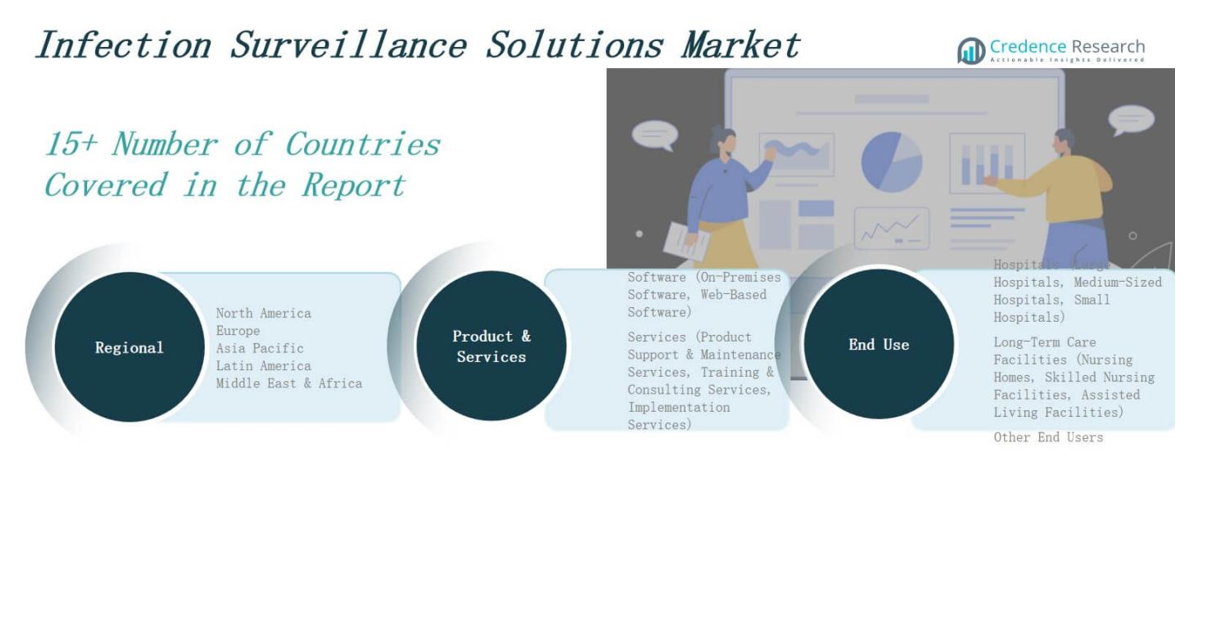
Segments:
Software
- On-Premises Software
- Web-Based Software
Services
- Product Support & Maintenance Services
- Training & Consulting Services
- Implementation Services
Based on End User
- Hospitals
- Long-Term Care Facilities
- Other End Users
Based on Region
- North America
- U.S.
- Canada
- Mexico
- Europe
- Germany
- France
- U.K.
- Italy
- Spain
- Rest of Europe
- Asia Pacific
- China
- Japan
- India
- South Korea
- South-east Asia
- Rest of Asia Pacific
- Latin America
- Brazil
- Argentina
- Rest of Latin America
- Middle East & Africa
- GCC Countries
- South Africa
- Rest of the Middle East and Africa
Regional Analysis
North America
The North America Infection Surveillance Solutions Market size was valued at USD 207.92 million in 2018 to USD 314.95 million in 2024 and is anticipated to reach USD 862.25 million by 2032, at a CAGR of 13.5% during the forecast period. The region holds the largest share of the global market due to widespread adoption of advanced healthcare IT infrastructure and strong regulatory compliance frameworks. Hospitals and long-term care facilities are actively implementing digital surveillance platforms to meet infection control mandates. The presence of major players and ongoing R&D initiatives support innovation and system upgrades. The U.S. leads market demand with high healthcare spending and advanced analytics capabilities. It continues to set benchmarks in infection prevention and electronic surveillance integration.
Europe
The Europe Infection Surveillance Solutions Market size was valued at USD 117.76 million in 2018 to USD 172.94 million in 2024 and is anticipated to reach USD 446.94 million by 2032, at a CAGR of 12.7% during the forecast period. It benefits from stringent healthcare quality standards and a strong public health infrastructure. Countries such as Germany, the UK, and France are deploying automated surveillance tools to reduce healthcare-associated infections. The EU’s emphasis on antimicrobial resistance monitoring and cross-border health data sharing supports adoption. Hospitals are investing in real-time reporting tools and AI-powered analytics. It continues to experience demand growth across both public and private healthcare facilities.
Asia Pacific
The Asia Pacific Infection Surveillance Solutions Market size was valued at USD 75.07 million in 2018 to USD 122.47 million in 2024 and is anticipated to reach USD 386.67 million by 2032, at a CAGR of 15.5% during the forecast period. Rapid healthcare infrastructure development and digital transformation initiatives drive regional growth. Countries such as China, India, and Japan are investing in hospital digitization and patient safety. Government-led infection prevention programs and rising medical tourism also fuel adoption. Cloud-based and mobile-compatible solutions are gaining traction among budget-sensitive institutions. It represents the fastest-growing regional market with expanding private sector participation.
Latin America
The Latin America Infection Surveillance Solutions Market size was valued at USD 25.07 million in 2018 to USD 37.92 million in 2024 and is anticipated to reach USD 95.21 million by 2032, at a CAGR of 12.3% during the forecast period. Demand is growing due to the region’s focus on improving hospital infection control and addressing healthcare inefficiencies. Brazil and Mexico are key contributors with increasing investments in digital health platforms. Limited public funding remains a barrier, but partnerships and donor programs support implementation. Local providers are integrating modular, cost-effective solutions in mid-sized hospitals. It is gradually expanding as awareness and technical readiness improve.
Middle East
The Middle East Infection Surveillance Solutions Market size was valued at USD 18.86 million in 2018 to USD 27.16 million in 2024 and is anticipated to reach USD 67.70 million by 2032, at a CAGR of 12.2% during the forecast period. The region is witnessing rising interest in infection surveillance due to the expansion of smart hospitals and high-end medical centers. Countries like the UAE and Saudi Arabia are leading in digital healthcare adoption. Government initiatives aimed at infection reduction and clinical transparency support market growth. Demand for cloud-based and multilingual platforms is also rising. It is positioning itself as a growing healthcare technology hub.
Africa
The Africa Infection Surveillance Solutions Market size was valued at USD 15.32 million in 2018 to USD 28.22 million in 2024 and is anticipated to reach USD 69.75 million by 2032, at a CAGR of 11.7% during the forecast period. The region faces challenges related to limited infrastructure and funding but presents long-term opportunities. International health agencies are supporting electronic infection monitoring in hospitals across South Africa, Egypt, and Kenya. The market is gradually opening to web-based systems requiring minimal on-site IT resources. Awareness of infection prevention and data-driven health strategies is growing. It remains a developing market with high future potential.
Key Player Analysis
- Becton, Dickinson and Company
- Cerner Corporation
- Premier, Inc.
- Baxter International Inc.
- Wolters Kluwer N.V.
- Merative
- Ecolab
- bioMérieux SA
- Gojo Industries, Inc.
- RLDatix
- Wolters Kluwer Health
- Epic Systems
- Biovigil Healthcare Systems
- Vecna Technologies
- IBM Watson Health
- Medexter Healthcare
- CKM Healthcare Incorporated
- PointClickCare
- Stanley Healthcare
Competitive Analysis
The Infection Surveillance Solutions Market is characterized by the presence of several established and emerging players competing on technology, scalability, and service integration. Key companies such as Becton, Dickinson and Company, Cerner Corporation, and Wolters Kluwer offer comprehensive platforms with advanced analytics and real-time monitoring capabilities. These vendors focus on strategic partnerships, cloud integration, and AI-driven functionalities to enhance infection detection and reporting. New entrants are introducing modular, cost-effective solutions targeting mid-sized healthcare providers. Market players emphasize regulatory compliance, user-friendly design, and interoperability with electronic health records. It remains highly dynamic, driven by continuous innovation, mergers, and regional expansions. Competitive intensity is rising as providers demand scalable, secure, and customizable systems. Companies are also investing in customer support, training, and post-deployment services to strengthen client retention. The Infection Surveillance Solutions Market favors agile players that can align with healthcare digitization trends and evolving infection control requirements across diverse care settings.
Recent Developments
- In 2024, Steris Corporation acquired surgical instrumentation assets from Becton Dickinson and Company for approximately USD 540 million and completed the acquisition of Key Surgical for USD 850 million, strengthening its infection surveillance and surgical solutions portfolio.
- In May 2025, the Fiji Centre for Disease Control launched its first Pathogen Genomics Laboratory to bolster national surveillance capabilities for infectious diseases and antimicrobial resistance.
- In July 2025, Seegene Inc. unveiled STAgora™, an AI-powered infectious disease analytics platform offering real-time PCR‑based diagnostics, predictive modeling, and outbreak tracking globally.
Market Concentration & Characteristics
The Infection Surveillance Solutions Market exhibits moderate to high market concentration, with a few dominant players such as Becton, Dickinson and Company, Cerner Corporation, and Wolters Kluwer holding significant global shares. It features a mix of global corporations and specialized software firms competing on innovation, regulatory compliance, and integration capabilities. Vendors prioritize AI-driven analytics, cloud-based platforms, and seamless interoperability with electronic health records to enhance user value. The market is characterized by long-term contracts, solution customization, and a focus on end-user support services. High entry barriers exist due to stringent healthcare regulations, data security requirements, and the need for deep clinical expertise. Buyers prioritize platforms that offer scalability, real-time monitoring, and actionable insights, driving continuous R&D investments. The Infection Surveillance Solutions Market also demonstrates a growing shift toward modular and subscription-based pricing models to improve affordability and access. It remains dynamic, innovation-driven, and closely aligned with global healthcare digitization trends.
Report Coverage
The research report offers an in-depth analysis based on Product and Service, End-User and Geography. It details leading market players, providing an overview of their business, product offerings, investments, revenue streams, and key applications. Additionally, the report includes insights into the competitive environment, SWOT analysis, current market trends, as well as the primary drivers and constraints. Furthermore, it discusses various factors that have driven market expansion in recent years. The report also explores market dynamics, regulatory scenarios, and technological advancements that are shaping the industry. It assesses the impact of external factors and global economic changes on market growth. Lastly, it provides strategic recommendations for new entrants and established companies to navigate the complexities of the market.
Future Outlook
- Demand for AI-integrated surveillance systems will increase to support early infection detection and predictive risk assessment.
- Cloud-based solutions will gain wider acceptance due to their scalability, ease of deployment, and cost-efficiency.
- Healthcare providers will prioritize platforms that offer real-time data sharing and interoperability with existing hospital systems.
- Adoption in long-term care facilities and ambulatory centers will rise with growing focus on post-acute infection control.
- Vendors will invest in developing multilingual and region-specific solutions to expand into emerging markets.
- Mobile-compatible platforms will become more prevalent to support remote monitoring and decentralized care models.
- Governments will introduce stricter mandates on infection reporting, driving increased compliance-based technology adoption.
- Strategic partnerships between tech firms and healthcare providers will foster innovation and rapid deployment.
- Increased focus on antimicrobial resistance tracking will push demand for advanced analytics features.
- End users will favor customizable, user-friendly interfaces to improve workflow efficiency and staff engagement.
Request a Free Sample
Fill in your details and we'll send you a free sample report.
- Sample data tables & charts
- Research methodology
Need a Custom Version of This Report?
Tailor the scope, geography, or segments to your exact requirements.
- Custom geography or segment scope
- Direct access to our analyst team
Frequently Asked Questions
What is the current size of the Infection Surveillance Solutions Market?
What are the key segments within the Infection Surveillance Solutions Market?
What are some challenges faced by the Infection Surveillance Solutions Market?
Who are the major players in the Infection Surveillance Solutions Market?
Table of Content
Chapter 1. Report Introduction
- 1.1 Report Description & Purpose
- 1.1.1 Report Title & Market Definition
- 1.1.2 Unique Selling Propositions (USP) & Key Differentiators
- 1.1.3 Value Proposition for Stakeholders
- 1.2 Research Objectives
- 1.2.1 Market Sizing Objectives (Volume & Revenue)
- 1.2.2 Segmentation Objectives
- 1.2.3 Competitive Intelligence Objectives
- 1.2.4 Forecast & Scenario Objectives
- 1.3 Report Scope
- 1.3.1 Infection Surveillance Solutions Scope – Types & Subtypes Covered
- 1.3.2 Geographic Scope – Regions & Countries Covered
- 1.3.3 Historical Period, Base Year & Forecast Period (2024; forecast to 2032)
- 1.3.4 Inclusions & Exclusions
- 1.4 HS Code & Classification Framework
- 1.5 Currency, Units & Pricing Basis
- 1.6 Target Stakeholders
- 1.7 Limitations & Assumptions
Chapter 2. Executive Summary
- 2.1 Global Infection Surveillance Solutions Market Snapshot
- 2.1.1 Market Size – Historical (2024) & Forecast (2024-2032) (2024: USD 703.66 million → 2032: USD 1,928.54 million)
- 2.1.2 Volume & Revenue – Global Totals
- 2.1.3 Key Market Highlights – Top Five Facts
- 2.2 Infection Surveillance Solutions Market Segmentation Snapshot
- 2.2.1 Market Split by Region – 2024 vs. 2032
- 2.3 Competitive Snapshot
- 2.3.1 Top 10 Players by Revenue Share – 2024
- 2.3.2 Top 10 Players by Volume Share – 2024
- 2.3.3 Recent Strategic Developments (18-Month Summary)
- 2.4 Key Investment Highlights & Strategic Conclusions
Chapter 3. Infection Surveillance Solutions Market Dynamics & Industry Analysis
- 3.1 Market Overview & Context
- 3.1.1 Infection Surveillance Solutions Market Position in the Broader Automotive Value Chain
- 3.1.2 OEM vs. Replacement Market Dynamics
- 3.1.3 Market Maturity & Development Stage by Region
- 3.2 Infection Surveillance Solutions Market Drivers
- 3.3 Infection Surveillance Solutions Market Restraints & Challenges
- 3.4 Infection Surveillance Solutions Market Opportunities
- 3.5 Porter's Five Forces Analysis
- 3.5.1 Threat of New Entrants
- 3.5.2 Bargaining Power of Suppliers
- 3.5.3 Bargaining Power of Buyers
- 3.5.4 Threat of Substitutes
- 3.5.5 Competitive Rivalry – Intensity Assessment
- 3.6 Infection Surveillance Solutions Value Chain Analysis
- 3.6.1 Upstream – Raw Material/Input Suppliers
- 3.6.1.1 Raw Material/Input 1
- 3.6.1.2 Raw Material/Input 2
- 3.6.1.3 Raw Material/Input 3
- 3.6.2 Midstream – Production/Manufacturing/Service Delivery
- 3.6.2.1 Production/Process Overview
- 3.6.2.2 Key Facility Locations & Capacity by Manufacturer
- 3.6.3 Downstream – Distribution & End Consumer
- 3.6.3.1 Primary Channel – B2B/OEM
- 3.6.3.2 Secondary Channels – Dealer, Retail, Online, Direct
- 3.6.4 Value Chain Profitability Analysis
- 3.6.1 Upstream – Raw Material/Input Suppliers
- 3.7 PESTEL Analysis
- 3.7.1 Political Factors
- 3.7.2 Economic Factors
- 3.7.3 Social Factors
- 3.7.4 Technological Factors
- 3.7.5 Environmental Factors
- 3.7.6 Legal Factors
- 3.8 Infection Surveillance Solutions Supply Chain Analysis
- 3.8.1 Raw Material/Input Supply Risk Assessment
- 3.8.2 Manufacturing Concentration Risk (Geographic Exposure)
- 3.8.3 Trade Disruption Impact Analysis
- 3.9 Regulatory & Policy Landscape
Note: The regulatory and policy landscape section covers regulations based on their applicability to the market, Infection Surveillance Solutions category, geography, and scope of the study. Only regulatory frameworks with a material impact on operations, compliance, trade, sustainability, or market access are analyzed in detail.
Chapter 4. Key Investment Pockets & Opportunity Analysis
- 4.1 Infection Surveillance Solutions Market Attractiveness Analysis
- 4.1.1 By Region – Investment Attractiveness Matrix (Volume × CAGR)
- 4.2 Absolute Revenue Growth Opportunity
- 4.2.1 By Region – Absolute USD Growth Through 2032
- 4.3 Incremental Volume Opportunity
- 4.3.1 By Region – Incremental Volume Through 2032
- 4.3.2 Segment – Incremental Volume
- 4.4 Emerging Submarket Opportunity Deep Dive (Subject to Applicability)
- 4.5 Emerging Market Opportunity Scorecards
- 4.5.1 United States
- 4.5.2 Europe
- 4.5.3 Asia
- 4.5.4 Middle East & Africa
Note: Emerging Market Opportunity Scorecards will be included based on relevance and strategic importance. Regions listed are indicative and may vary depending on data availability and market dynamics.
Chapter 5. Infection Surveillance Solutions Import-Export Analysis & Trade Flows
- 5.1 Global Trade Overview
- 5.1.1 Global Export Value by Country (2024)
- 5.1.2 Global Export Volume by Country (2024)
- 5.1.3 Global Import Value by Country (2024)
- 5.1.4 Global Import Volume by Country (2024)
- 5.1.5 Net Trade Balance by Country (2024)
- 5.2 Export Analysis – Segment
- 5.2.1 Type 1 (HS Code)
- 5.2.2 Type 2 (HS Code)
- 5.2.3 Type 3 (HS Code)
- 5.2.4 Type 4 (HS Code)
- 5.2.5 Type 5 (HS Code)
- 5.3 Import Analysis – Segment
- 5.3.1 Type 1 (HS Code)
- 5.3.2 Type 2 (HS Code)
- 5.3.3 Type 3 (HS Code)
- 5.3.4 Type 4 (HS Code)
- 5.3.5 Type 5 (HS Code)
- 5.4 Average Unit Trade Prices
- 5.4.1 Average Export Price – Segment & Country
- 5.4.2 Average Import Price – Segment & Source Country
- 5.4.3 Price Trends (2024)
- 5.5 Key Trade Route Analysis
- 5.5.1 Trade Route 1
- 5.5.2 Trade Route 2
- 5.5.3 Trade Route 3
- 5.5.4 Trade Route 4
- 5.5.5 Trade Route 5
- 5.6 Trade Policy Impact Assessment
- 5.6.1 US Anti-Dumping & Section 301 Tariffs
- 5.6.2 EU Customs Union Impact
- 5.6.3 Major Free Trade Agreements
- 5.6.4 USMCA Rules of Origin
Note: Trade policy analysis will be included only where relevant to the Infection Surveillance Solutions market.
Chapter 6. Competitive Landscape & Company Benchmarking
- 6.1 Infection Surveillance Solutions Market Concentration & Structure
- 6.1.1 Herfindahl-Hirschman Index (HHI) – vs. 2024
- 6.1.2 Tier 1, Tier 2 & Tier 3 Market Structure
- 6.1.3 Global, Regional & Local Player Dynamics
- 6.2 Infection Surveillance Solutions Market Share Analysis – 2024
- 6.2.1 Global Revenue Share by Company
- 6.2.2 Global Volume Share by Company
- 6.2.3 Regional Revenue Share
- 6.2.4 Market Share Evolution ( vs. 2024)
- 6.2.5 OEM Segment Share by Company
- 6.2.6 Replacement Segment Share by Company
- 6.3 Production/Delivery Capacity & Facility Analysis
- 6.3.1 Global Installed Capacity
- 6.3.2 Capacity Utilization Rates
- 6.3.3 Production/Output Volume
- 6.3.4 Facility Locations & Capacity Map
- 6.3.5 Planned Capacity Additions
- 6.4 Infection Surveillance Solutions Competitive Benchmarking Matrix
- 6.4.1 Revenue, Volume, CAGR & Profitability Comparison
- 6.4.2 Channel Revenue Mix
- 6.4.3 Geographic Revenue Exposure
- 6.4.4 R&D Intensity
- 6.4.5 Sustainability Maturity
- 6.5 Strategic Developments in Infection Surveillance Solutions (Last 24 Months)
- 6.5.1 Mergers, Acquisitions & Divestments
- 6.5.2 New Infection Surveillance Solutions Launches
- 6.5.3 Facility Expansions
- 6.5.4 Strategic Alliances, Joint Ventures & Partnerships
- 6.5.5 Distribution Expansion & Market Entry
- 6.5.6 Sustainability & ESG Initiatives
- 6.6 Competitive Strategy Mapping
- 6.6.1 Leader, Challenger, Follower & Niche Classification
- 6.6.2 Pricing Strategy Comparison
- 6.6.3 Channel Strategy Matrix
Note: Strategic developments are included based on their materiality and the availability of reliable information.
Chapter 7. Global Infection Surveillance Solutions Market – By Distribution Channel
- 7.1 Segment Overview
- 7.1.1 Volume & Revenue Split by Channel (2024 & 2032)
- 7.1.2 Channel Mix Evolution (2024-2032)
Chapter 8. Regional Market Analysis – Global Overview
- 8.1 Global Regional Overview
- 8.1.1 Regional Volume Share
- 8.1.2 Regional Revenue Share
- 8.1.3 Regional Volume by Region
- 8.1.4 Regional Revenue by Region
- 8.1.5 Regional Forecast Through 2032
- 8.2 Cross-Regional Segment Analysis
- 8.2.1 By Distribution Channel
- 8.2.2 By Brand/Price Tier
Chapter 9. North America Infection Surveillance Solutions Market
- 9.1 United States
- 9.2 Canada
- 9.3 Mexico
Chapter 10. Europe Infection Surveillance Solutions Market
- 10.1 Germany
- 10.2 France
- 10.3 Italy
- 10.4 United Kingdom
- 10.5 Spain
- 10.6 Poland
- 10.7 Russia
- 10.8 Netherlands
- 10.9 Belgium
- 10.10 Sweden
- 10.11 Denmark
- 10.12 Norway
- 10.13 Rest of Europe
Chapter 11. Asia Pacific Infection Surveillance Solutions Market
- 11.1 China
- 11.2 India
- 11.3 Japan
- 11.4 South Korea
- 11.5 Thailand
- 11.6 Indonesia
- 11.7 Vietnam
- 11.8 Malaysia
- 11.9 Australia
- 11.10 Rest of Asia Pacific
Chapter 12. Latin America Infection Surveillance Solutions Market
- 12.1 Brazil
- 12.2 Argentina
- 12.3 Colombia
- 12.4 Chile
- 12.5 Rest of Latin America
Chapter 13. Middle East Infection Surveillance Solutions Market
- 13.1 Saudi Arabia
- 13.2 United Arab Emirates
- 13.3 Turkey
- 13.4 Israel
- 13.5 Iran
- 13.6 Rest of the Middle East
Chapter 14. Africa Infection Surveillance Solutions Market
- 14.1 South Africa
- 14.2 Egypt
- 14.3 Nigeria
- 14.4 Morocco
- 14.5 Rest of Africa
Chapter 15. Infection Surveillance Solutions Company Profiles
- 15.1 [Company 01]
- 15.1.1 Company Overview
- 15.1.2 Key Management Personnel
- 15.1.3 Products & Services Portfolio
- 15.1.4 Financial Performance
- 15.1.5 Key Market Focus & Geographic Presence
- 15.1.6 Recent Developments & Strategic Initiatives
Note: The company profile list is preliminary and may change based on research findings, market developments, data availability, and client requirements.
Chapter 16. Appendices
- Appendix A – List of Abbreviations & Acronyms
- Appendix B – Industry Classification Code Reference – Full Series
- Appendix C – Production & Capacity Data Tables
- Appendix D – End-Use & Demand Base Tables
- Appendix E – Consumption & Replacement Rate Assumptions
- Appendix F – ASP Reference Tables
- Appendix G – Manufacturing & Facility Database
- Appendix H – Import-Export Data Tables
- Appendix I – Regulatory Summary Tables
- Appendix J – Primary Research Participant List (Anonymized)
- Appendix K – Primary Research Questionnaire Framework
- Appendix L – Data Sources & Bibliography
- Appendix M – Market Size Divergence & Source Comparison
Chapter 17. Research Methodology
- 17.1 Research Framework & Philosophy
- 17.2 Secondary Research – Sources, Hierarchy & Data Extraction
- 17.3 Data Modeling – Bottom-Up & Top-Down Market Sizing
- 17.4 Primary Research – Stakeholder Framework, LOI & Sample Sizes
- 17.5 Forecast Methodology – Regression, Scenario & Sensitivity Analysis
- 17.6 Quality Control – Four-Layer Validation Framework
- 17.7 Limitations & Standard Assumptions
- 17.8 Disclaimer
