
Market Overview
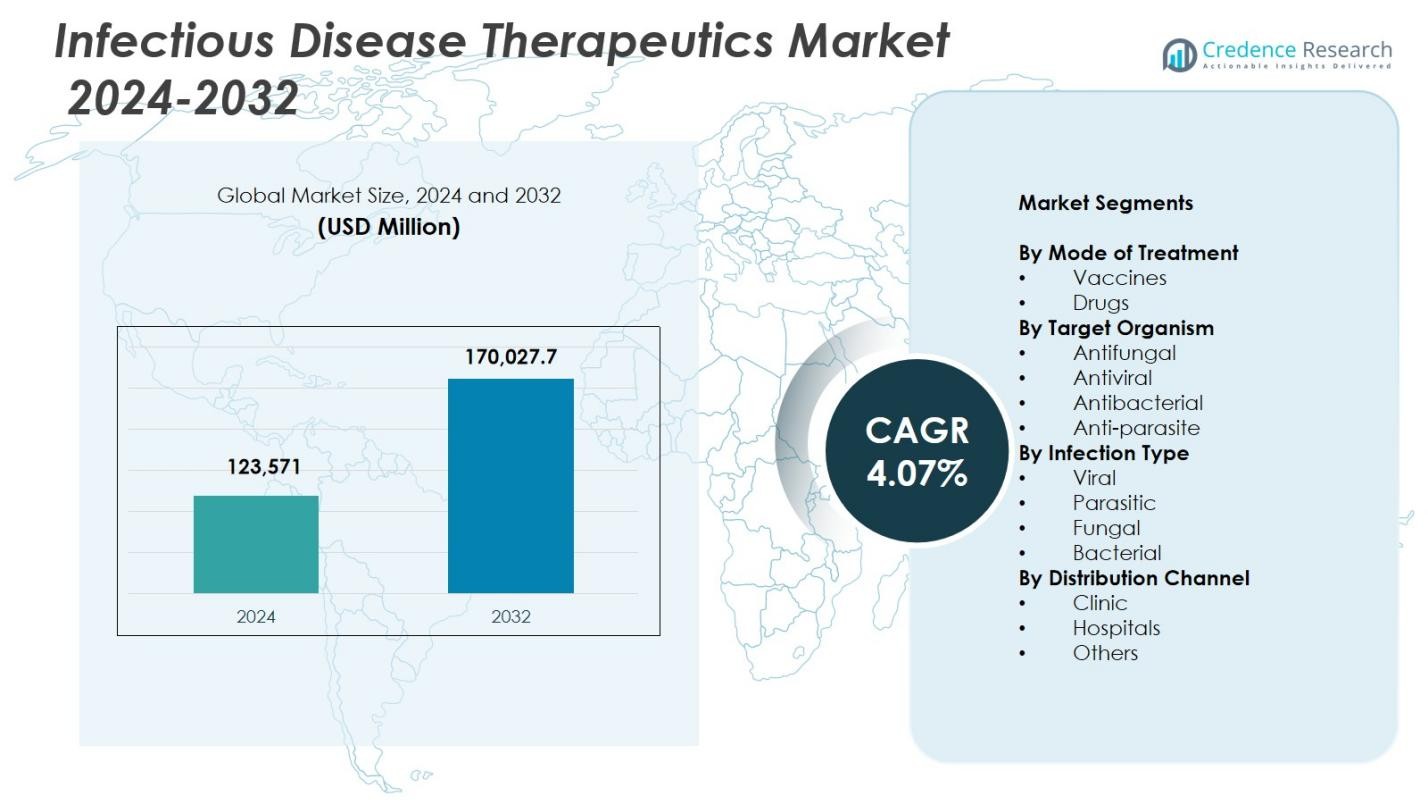
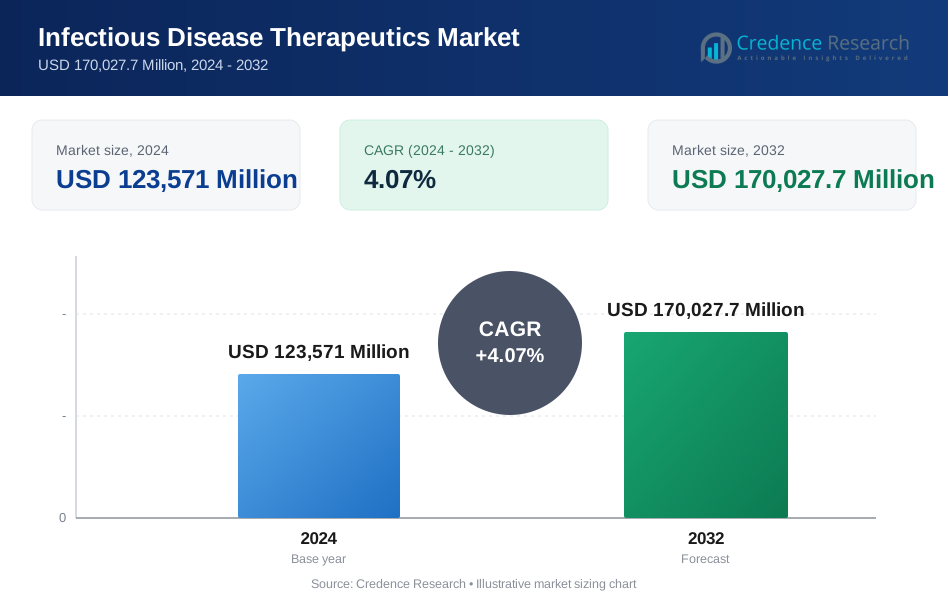
Infectious Disease Therapeutics Market size was valued at USD 123,571 Million in 2024 and is anticipated to reach USD 170,027.7 Million by 2032, at a CAGR of 4.07% during the forecast period.
| REPORT ATTRIBUTE | DETAILS |
|---|---|
| Historical Period | 2020-2023 |
| Base Year | 2024 |
| Forecast Period | 2025-2032 |
| Infectious Disease Therapeutics Market Size 2024 | USD 123,571 Million |
| Infectious Disease Therapeutics Market, CAGR | 4.07% |
| Infectious Disease Therapeutics Market Size 2032 | USD 170,027.7 Million |
Infectious Disease Therapeutics Market features leading players such as GlaxoSmithKline (GSK), Bayer, Johnson & Johnson (Janssen Pharmaceuticals), AstraZeneca, Merck, Bristol-Myers Squibb, Boehringer Ingelheim International, F. Hoffmann-La Roche, Abbott Laboratories, and Gilead Sciences, each strengthening their presence through extensive antiviral, antibacterial, and vaccine portfolios. These companies drive innovation with advanced biologics, mRNA technologies, and broad-spectrum therapeutics addressing rising global disease burdens. North America leads the market with a 39.4% share, supported by strong healthcare infrastructure and high adoption of advanced therapies, while Europe and Asia-Pacific follow as major regions with accelerating treatment demand driven by expanding healthcare access and rising infection prevalence.
Market Insights
- The Infectious Disease Therapeutics Market was valued at USD 123,571 Million in 2024 and is projected to grow at a CAGR of 4.07% through 2032.
- Market growth is driven by rising global infection rates, strong demand for antibacterial and antiviral therapies, and expanding vaccine adoption across public health programs.
- Key trends include rapid advancements in mRNA platforms, increased development of long-acting formulations, and growing focus on precision therapies supported by genomic diagnostics.
- Leading players such as GSK, Merck, Roche, Abbott, and Gilead strengthen their positions through broad therapeutic portfolios, strong R&D pipelines, and strategic collaborations; the drugs segment leads with a 67.4% share.
- Regionally, North America holds the largest share at 39.4%, followed by Europe with 27.6% and Asia-Pacific with 23.1%, driven by expanding healthcare access, rising disease burdens, and increasing adoption of advanced treatment solutions.
Market Segmentation Analysis:
By Mode of Treatment:
The Infectious Disease Therapeutics Market is dominated by the drugs segment, which accounted for 67.4% share in 2024, driven by the rising global burden of bacterial, viral, and fungal infections and the continuous introduction of targeted therapeutics. Strong R&D investments in antiviral, antimicrobial, and broad-spectrum drug portfolios further support its leadership. The vaccines segment, although smaller, continues to gain traction with expanding immunization campaigns, government-backed vaccination programs, and advancements in mRNA and recombinant technologies. Increasing focus on preventive healthcare and rapid vaccine development platforms will strengthen growth within this segment during the forecast period.
- For instance, Innoviva Specialty Therapeutics gained FDA approval for Xacduro (sulbactam-durlobactam) in May 2023 as the first pathogen-targeted therapy for hospital-acquired and ventilator-associated bacterial pneumonia caused by susceptible Acinetobacter baumannii-calcoaceticus complex in adults.
By Target Organism:
The antibacterial segment led the Infectious Disease Therapeutics Market in 2024 with a 41.2% share, supported by the high global incidence of bacterial infections across respiratory, bloodstream, and gastrointestinal conditions. Demand continues to rise due to increasing antimicrobial resistance, prompting accelerated development of novel antibiotics and combination therapies. Antiviral therapeutics also remain significant with expanding treatment needs for chronic and emerging viral diseases. Antifungal and anti-parasite treatments gain steady traction in regions facing higher prevalence of opportunistic infections, tropical diseases, and immunocompromised populations, reinforcing ongoing innovation toward safer, targeted pathogen-specific therapies.
- For instance, Roche advanced zosurabalpin (RG6006), a tethered macrocyclic peptide antibiotic targeting the lipopolysaccharide transporter in carbapenem-resistant Acinetobacter baumannii.
By Infection Type:
The bacterial infection segment dominated the Infectious Disease Therapeutics Market in 2024 with a 38.6% share, propelled by the widespread occurrence of bacterial illnesses and growing concerns around drug-resistant pathogens. Increased hospital-acquired infections, rising surgical procedures, and expanding outpatient care contribute to sustained demand for advanced antibacterial therapies. The viral infection segment also holds substantial market weight due to continued treatment needs for influenza, HIV, hepatitis, and newly emerging viral threats. Fungal and parasitic infections account for smaller yet growing shares, supported by increasing cases in immunocompromised patients and regions with persistent tropical disease burdens.
Key Growth Drivers
Rising Global Burden of Infectious Diseases
The rapid increase in infectious disease prevalence including bacterial, viral, fungal, and parasitic infections remains a major growth driver for the Infectious Disease Therapeutics Market. Expanding incidences of antimicrobial-resistant pathogens, recurrent outbreaks of influenza, dengue, and respiratory infections, and continued global HIV and hepatitis caseloads intensify demand for advanced therapeutic solutions. Aging populations, rising medical comorbidities, and increased hospitalization rates further elevate susceptibility to infections. These factors collectively accelerate investments in drug development and drive continuous evolution of targeted treatments across high-burden disease categories.
- For instance, Cidara Therapeutics' CD388, a drug-Fc conjugate antiviral, received FDA Breakthrough Therapy designation for preventing influenza A and B in high-risk adults and adolescents.
Advancements in Drug Development and Vaccine Technologies
Accelerated innovation in vaccine platforms, biologics, and targeted therapeutics significantly strengthens market expansion. mRNA, viral vector, and recombinant technologies have shortened development timelines and enhanced efficacy profiles, enabling faster responses to emerging pathogens. Similarly, breakthroughs in monoclonal antibodies, broad-spectrum antivirals, and next-generation antibiotics address unmet clinical needs associated with resistance and complex infections. Pharmaceutical companies increasingly focus on precision therapies and host-directed treatments, supported by favorable regulatory pathways and global initiatives to promote research in infectious disease management.
- For instance, BioNTech developed mRNA sequences encoding patient-specific tumor antigens for personalized cancer vaccines, partnering with Pfizer to create one of the first approved mRNA vaccines for COVID-19 that demonstrated high efficacy and safety through sophisticated sequence modifications and delivery strategies.
Strong Government and Institutional Support
Government-backed immunization programs, infectious disease surveillance networks, and funding for antimicrobial resistance mitigation remain pivotal to market growth. Public health agencies, global health bodies, and non-profit organizations actively support R&D through grants, fast-track approvals, and strategic procurement of vaccines and therapeutics. Strengthening of national stockpiles, pandemic-preparedness frameworks, and reimbursement policies for high-impact therapies enhance adoption across both developed and emerging economies. These initiatives create a favorable ecosystem for ongoing innovation, market penetration, and long-term demand for infectious disease treatments.
Key Trends & Opportunities
Expansion of Personalized and Precision Infectious Disease Therapies
A growing shift toward personalized treatment approaches presents major opportunities in the Infectious Disease Therapeutics Market. Genomic profiling, rapid molecular diagnostics, and pathogen-specific resistance mapping enable clinicians to tailor therapies more effectively. Precision antimicrobials and targeted antivirals reduce adverse reactions and improve treatment outcomes, especially for multidrug-resistant infections. Integration of AI-driven decision tools and digital biomarkers accelerates accurate therapy selection, supporting the broader transition toward individualized infectious disease management and enabling new market opportunities for specialized drug formulations.
- For instance, Abbott's ViroSeq system similarly analyzes HIV genotypes from samples with sufficient viral load to optimize treatments.
Growing Adoption of Long-Acting and Combination Therapeutics
Long-acting injectables, fixed-dose combinations, and extended-release formulations are gaining traction as they enhance patient compliance and reduce treatment burdens, particularly in chronic infections such as HIV, tuberculosis, and hepatitis. These therapies also help mitigate resistance development by ensuring consistent dosing and improved treatment adherence. Pharmaceutical companies increasingly invest in multi-mechanism regimens to address complex pathogen behavior and broaden therapeutic efficacy. The demand for simplified, durable treatment options continues to open new development pathways and commercial opportunities across high-priority disease areas.
- For instance, AbbVie's VIEKIRA XR (dasabuvir, ombitasvir, paritaprevir, and ritonavir), FDA-approved in 2016 as an extended-release formulation, enables once-daily oral dosing for hepatitis C treatment.
Key Challenges
Escalating Antimicrobial Resistance
The rapid rise of antimicrobial-resistant pathogens poses a significant challenge to the Infectious Disease Therapeutics Market. Resistance reduces the efficacy of existing antibiotics and antivirals, increases treatment failures, and elevates healthcare costs. Pharmaceutical pipelines for new antibacterial agents remain limited, as development is complex and financially less attractive compared to other therapeutic categories. This imbalance strains healthcare systems and demands urgent innovation, stewardship programs, and collaboration between regulators, drug manufacturers, and global health organizations to sustain the effectiveness of infectious disease treatments.
High Development Costs and Regulatory Complexities
Developing new therapeutics for infectious diseases requires substantial investment, lengthy clinical trials, and rigorous regulatory scrutiny. High research costs, uncertainty in clinical outcomes, and stringent safety requirements often delay commercialization and limit the number of new therapies entering the market. Additionally, fluctuating demand during non-outbreak periods reduces the commercial viability of certain vaccines and anti-infective drugs. These challenges create barriers for both established pharmaceutical companies and emerging biotech firms, slowing innovation and restricting timely availability of advanced therapeutic solutions.
Regional Analysis
North America
North America dominated the Infectious Disease Therapeutics Market with a 39.4% share in 2024, driven by high infection prevalence, strong healthcare infrastructure, and robust adoption of advanced therapeutics. Extensive R&D investments, rapid vaccine innovation, and broad availability of antiviral, antibacterial, and immunotherapy pipelines support sustained regional leadership. Government initiatives for antimicrobial resistance mitigation and pandemic preparedness contribute to consistent therapeutic demand. High diagnostic penetration, strong reimbursement systems, and continuous product launches by major pharmaceutical companies further reinforce North America’s dominant position in the global market.
Europe
Europe held a 27.6% share in 2024, supported by comprehensive public health systems, strong vaccination programs, and established pharmaceutical manufacturing capabilities. Rising incidences of hospital-acquired infections, increasing antimicrobial resistance, and expanding surveillance initiatives drive demand for advanced treatment options. The region benefits from stringent regulatory oversight that encourages development of safe and effective antivirals, antibiotics, and vaccines. Investments in biotech research, government-backed innovation grants, and collaborative infectious disease control frameworks across EU nations strengthen market growth. Growing awareness and early diagnosis initiatives further enhance therapeutic adoption across major European economies.
Asia-Pacific
The Asia-Pacific region accounted for a 23.1% share in 2024, fueled by large population bases, high burden of infectious diseases, and rising healthcare expenditure across emerging economies. Rapid urbanization, expanding access to healthcare services, and increased frequency of viral and bacterial outbreaks elevate demand for advanced therapeutics. Government-led immunization drives, strengthening pharmaceutical manufacturing capacity, and growing investment in infectious disease R&D support regional market expansion. Rising prevalence of tuberculosis, dengue, influenza, and parasitic diseases further accelerates adoption of both preventive and curative therapies throughout the Asia-Pacific landscape.
Latin America
Latin America captured a 6.2% share in 2024, supported by strengthening healthcare systems, rising incidence of vector-borne and viral diseases, and expanding access to essential medicines. Increased public health investments and regional programs targeting dengue, Zika, HIV, and respiratory infections drive demand for advanced therapeutic options. Growing partnerships between governments, global health organizations, and pharmaceutical companies enhance availability of innovative treatments. Despite economic disparities, improving diagnostic capabilities and vaccination outreach programs continue to support steady market growth across key countries such as Brazil, Mexico, and Argentina.
Middle East & Africa
The Middle East & Africa region held a 3.7% share in 2024, influenced by rising infectious disease prevalence, growing urbanization, and uneven access to advanced healthcare infrastructure. High rates of parasitic, bacterial, and viral infections create sustained demand for broad-spectrum therapies and improved vaccination coverage. Ongoing investments in healthcare modernization, expansion of pharmaceutical distribution networks, and international aid programs strengthen therapeutic access. However, challenges such as limited R&D activity and affordability constraints moderate growth. Increasing screening initiatives and government focus on communicable disease control support gradual market expansion across the region.
Market Segmentations:
By Mode of Treatment
- Vaccines
- Drugs
By Target Organism
- Antifungal
- Antiviral
- Antibacterial
- Anti-parasite
By Infection Type
- Viral
- Parasitic
- Fungal
- Bacterial
By Distribution Channel
- Clinic
- Hospitals
- Others
By Geography
- North America
- U.S.
- Canada
- Mexico
- Europe
- Germany
- France
- U.K.
- Italy
- Spain
- Rest of Europe
- Asia Pacific
- China
- Japan
- India
- South Korea
- South-east Asia
- Rest of Asia Pacific
- Latin America
- Brazil
- Argentina
- Rest of Latin America
- Middle East & Africa
- GCC Countries
- South Africa
- Rest of the Middle East and Africa
Competitive Landscape
Competitive landscape in the Infectious Disease Therapeutics Market is shaped by leading players such as GlaxoSmithKline (GSK), Bayer, Johnson & Johnson (Janssen Pharmaceuticals), AstraZeneca, Merck, Bristol-Myers Squibb, Boehringer Ingelheim International, F. Hoffmann-La Roche, Abbott Laboratories, and Gilead Sciences. These companies maintain strong positions through extensive R&D pipelines, wide therapeutic portfolios, and continuous investment in vaccines, antivirals, antibacterials, and biologics. Strategic collaborations with research institutions, government agencies, and biotech firms accelerate innovation and support rapid development of new treatments for emerging pathogens. Market participants focus on expanding manufacturing capabilities, enhancing global distribution networks, and strengthening clinical trial programs to address the rising burden of infectious diseases. Advancements in mRNA technologies, long-acting therapies, and precision antimicrobials further intensify competition, while patent expiries and biosimilar penetration encourage ongoing product differentiation. Companies increasingly prioritize antimicrobial stewardship, resistance mitigation strategies, and data-driven drug development to sustain long-term competitiveness in this evolving market.
Key Player Analysis
- GlaxoSmithKline (GSK)
- Bayer
- Johnson & Johnson (Janssen Pharmaceuticals)
- AstraZeneca
- Merck
- Bristol-Myers Squibb
- Boehringer Ingelheim International
- F. Hoffmann-La Roche
- Abbott Laboratories
- Gilead Sciences
Recent Developments
- In December 2025, Merck announced its acquisition of Cidara Therapeutics for approximately $9.2 billion to advance CD388, a late-stage drug-Fc conjugate antiviral for influenza prevention targeting both influenza A and B viruses.
- In November 2025, GSK plc and its research partners announced a collaboration under the Fleming Initiative to develop new antifungal drugs targeting resistant fungal infections, beginning with efforts against Aspergillus.
- In July 2025, AN2 Therapeutics and Drugs for Neglected Diseases initiative (DNDi) signed an agreement to co-develop an oral compound for chronic Chagas disease, advancing efforts to treat parasitic infections.
Report Coverage
The research report offers an in-depth analysis based on Mode of Treatment, Target Organism, Infection Type, Distribution Channel and Geography. It details leading market players, providing an overview of their business, product offerings, investments, revenue streams, and key applications. Additionally, the report includes insights into the competitive environment, SWOT analysis, current market trends, as well as the primary drivers and constraints. Furthermore, it discusses various factors that have driven market expansion in recent years. The report also explores market dynamics, regulatory scenarios, and technological advancements that are shaping the industry. It assesses the impact of external factors and global economic changes on market growth. Lastly, it provides strategic recommendations for new entrants and established companies to navigate the complexities of the market.
Future Outlook
- The market will experience sustained growth as global infectious disease prevalence continues to rise.
- Advancements in vaccine technologies, including mRNA and recombinant platforms, will accelerate therapeutic innovation.
- Demand for precision and personalized infectious disease treatments will strengthen across major healthcare systems.
- Long-acting and combination therapies will gain wider adoption to improve compliance and reduce resistance risks.
- Government funding and public health initiatives will continue to support large-scale R&D and treatment access.
- Pharmaceutical companies will expand pipelines targeting antimicrobial-resistant pathogens.
- Integration of AI, genomic tools, and rapid diagnostics will enable more targeted therapy development.
- Emerging markets will see stronger adoption as healthcare infrastructure and diagnostic capabilities improve.
- Biologics and monoclonal antibodies will play an increasing role in managing complex and chronic infections.
- Global preparedness for pandemics and outbreaks will remain a central driver for continuous therapeutic investment.
Request a Free Sample
Fill in your details and we'll send you a free sample report.
- Sample data tables & charts
- Research methodology
Need a Custom Version of This Report?
Tailor the scope, geography, or segments to your exact requirements.
- Custom geography or segment scope
- Direct access to our analyst team
Frequently Asked Questions
What is the current market size for Infectious Disease Therapeutics Market, and what is its projected size in 2032?
At what Compound Annual Growth Rate is the Infectious Disease Therapeutics Market projected to grow between 2024 and 2032?
Which Infectious Disease Therapeutics Market segment held the largest share in 2024?
What are the primary factors fueling the growth of the Infectious Disease Therapeutics Market?
Who are the leading companies in the Infectious Disease Therapeutics Market?
Which region commanded the largest share of the Infectious Disease Therapeutics Market in 2024?
Table of Content
Chapter 1. Report Introduction
- 1.1 Report Description & Purpose
- 1.1.1 Report Title & Market Definition
- 1.1.2 Unique Selling Propositions (USP) & Key Differentiators
- 1.1.3 Value Proposition for Stakeholders
- 1.2 Research Objectives
- 1.2.1 Market Sizing Objectives (Volume & Revenue)
- 1.2.2 Segmentation Objectives
- 1.2.3 Competitive Intelligence Objectives
- 1.2.4 Forecast & Scenario Objectives
- 1.3 Report Scope
- 1.3.1 Infectious Disease Therapeutics Scope – Types & Subtypes Covered
- 1.3.2 Geographic Scope – Regions & Countries Covered
- 1.3.3 Historical Period, Base Year & Forecast Period (2024; forecast to 2032)
- 1.3.4 Inclusions & Exclusions
- 1.4 HS Code & Classification Framework
- 1.5 Currency, Units & Pricing Basis
- 1.6 Target Stakeholders
- 1.7 Limitations & Assumptions
Chapter 2. Executive Summary
- 2.1 Global Infectious Disease Therapeutics Market Snapshot
- 2.1.1 Market Size – Historical (2024) & Forecast (2024-2032) (2024: USD 123,571 Million → 2032: USD 170,027.7 Million)
- 2.1.2 Volume & Revenue – Global Totals
- 2.1.3 Key Market Highlights – Top Five Facts
- 2.2 Infectious Disease Therapeutics Market Segmentation Snapshot
- 2.2.1 Market Split by Region – 2024 vs. 2032
- 2.3 Competitive Snapshot
- 2.3.1 Top 10 Players by Revenue Share – 2024
- 2.3.2 Top 10 Players by Volume Share – 2024
- 2.3.3 Recent Strategic Developments (18-Month Summary)
- 2.4 Key Investment Highlights & Strategic Conclusions
Chapter 3. Infectious Disease Therapeutics Market Dynamics & Industry Analysis
- 3.1 Market Overview & Context
- 3.1.1 Infectious Disease Therapeutics Market Position in the Broader Automotive Value Chain
- 3.1.2 OEM vs. Replacement Market Dynamics
- 3.1.3 Market Maturity & Development Stage by Region
- 3.2 Infectious Disease Therapeutics Market Drivers
- 3.3 Infectious Disease Therapeutics Market Restraints & Challenges
- 3.4 Infectious Disease Therapeutics Market Opportunities
- 3.5 Porter's Five Forces Analysis
- 3.5.1 Threat of New Entrants
- 3.5.2 Bargaining Power of Suppliers
- 3.5.3 Bargaining Power of Buyers
- 3.5.4 Threat of Substitutes
- 3.5.5 Competitive Rivalry – Intensity Assessment
- 3.6 Infectious Disease Therapeutics Value Chain Analysis
- 3.6.1 Upstream – Raw Material/Input Suppliers
- 3.6.1.1 Raw Material/Input 1
- 3.6.1.2 Raw Material/Input 2
- 3.6.1.3 Raw Material/Input 3
- 3.6.2 Midstream – Production/Manufacturing/Service Delivery
- 3.6.2.1 Production/Process Overview
- 3.6.2.2 Key Facility Locations & Capacity by Manufacturer
- 3.6.3 Downstream – Distribution & End Consumer
- 3.6.3.1 Primary Channel – B2B/OEM
- 3.6.3.2 Secondary Channels – Dealer, Retail, Online, Direct
- 3.6.4 Value Chain Profitability Analysis
- 3.6.1 Upstream – Raw Material/Input Suppliers
- 3.7 PESTEL Analysis
- 3.7.1 Political Factors
- 3.7.2 Economic Factors
- 3.7.3 Social Factors
- 3.7.4 Technological Factors
- 3.7.5 Environmental Factors
- 3.7.6 Legal Factors
- 3.8 Infectious Disease Therapeutics Supply Chain Analysis
- 3.8.1 Raw Material/Input Supply Risk Assessment
- 3.8.2 Manufacturing Concentration Risk (Geographic Exposure)
- 3.8.3 Trade Disruption Impact Analysis
- 3.9 Regulatory & Policy Landscape
Note: The regulatory and policy landscape section covers regulations based on their applicability to the market, Infectious Disease Therapeutics category, geography, and scope of the study. Only regulatory frameworks with a material impact on operations, compliance, trade, sustainability, or market access are analyzed in detail.
Chapter 4. Key Investment Pockets & Opportunity Analysis
- 4.1 Infectious Disease Therapeutics Market Attractiveness Analysis
- 4.1.1 By Region – Investment Attractiveness Matrix (Volume × CAGR)
- 4.2 Absolute Revenue Growth Opportunity
- 4.2.1 By Region – Absolute USD Growth Through 2032
- 4.3 Incremental Volume Opportunity
- 4.3.1 By Region – Incremental Volume Through 2032
- 4.3.2 Segment – Incremental Volume
- 4.4 Emerging Submarket Opportunity Deep Dive (Subject to Applicability)
- 4.5 Emerging Market Opportunity Scorecards
- 4.5.1 United States
- 4.5.2 Europe
- 4.5.3 Asia
- 4.5.4 Middle East & Africa
Note: Emerging Market Opportunity Scorecards will be included based on relevance and strategic importance. Regions listed are indicative and may vary depending on data availability and market dynamics.
Chapter 5. Infectious Disease Therapeutics Import-Export Analysis & Trade Flows
- 5.1 Global Trade Overview
- 5.1.1 Global Export Value by Country (2024)
- 5.1.2 Global Export Volume by Country (2024)
- 5.1.3 Global Import Value by Country (2024)
- 5.1.4 Global Import Volume by Country (2024)
- 5.1.5 Net Trade Balance by Country (2024)
- 5.2 Export Analysis – Segment
- 5.2.1 Type 1 (HS Code)
- 5.2.2 Type 2 (HS Code)
- 5.2.3 Type 3 (HS Code)
- 5.2.4 Type 4 (HS Code)
- 5.2.5 Type 5 (HS Code)
- 5.3 Import Analysis – Segment
- 5.3.1 Type 1 (HS Code)
- 5.3.2 Type 2 (HS Code)
- 5.3.3 Type 3 (HS Code)
- 5.3.4 Type 4 (HS Code)
- 5.3.5 Type 5 (HS Code)
- 5.4 Average Unit Trade Prices
- 5.4.1 Average Export Price – Segment & Country
- 5.4.2 Average Import Price – Segment & Source Country
- 5.4.3 Price Trends (2024)
- 5.5 Key Trade Route Analysis
- 5.5.1 Trade Route 1
- 5.5.2 Trade Route 2
- 5.5.3 Trade Route 3
- 5.5.4 Trade Route 4
- 5.5.5 Trade Route 5
- 5.6 Trade Policy Impact Assessment
- 5.6.1 US Anti-Dumping & Section 301 Tariffs
- 5.6.2 EU Customs Union Impact
- 5.6.3 Major Free Trade Agreements
- 5.6.4 USMCA Rules of Origin
Note: Trade policy analysis will be included only where relevant to the Infectious Disease Therapeutics market.
Chapter 6. Competitive Landscape & Company Benchmarking
- 6.1 Infectious Disease Therapeutics Market Concentration & Structure
- 6.1.1 Herfindahl-Hirschman Index (HHI) – vs. 2024
- 6.1.2 Tier 1, Tier 2 & Tier 3 Market Structure
- 6.1.3 Global, Regional & Local Player Dynamics
- 6.2 Infectious Disease Therapeutics Market Share Analysis – 2024
- 6.2.1 Global Revenue Share by Company
- 6.2.2 Global Volume Share by Company
- 6.2.3 Regional Revenue Share
- 6.2.4 Market Share Evolution ( vs. 2024)
- 6.2.5 OEM Segment Share by Company
- 6.2.6 Replacement Segment Share by Company
- 6.3 Production/Delivery Capacity & Facility Analysis
- 6.3.1 Global Installed Capacity
- 6.3.2 Capacity Utilization Rates
- 6.3.3 Production/Output Volume
- 6.3.4 Facility Locations & Capacity Map
- 6.3.5 Planned Capacity Additions
- 6.4 Infectious Disease Therapeutics Competitive Benchmarking Matrix
- 6.4.1 Revenue, Volume, CAGR & Profitability Comparison
- 6.4.2 Channel Revenue Mix
- 6.4.3 Geographic Revenue Exposure
- 6.4.4 R&D Intensity
- 6.4.5 Sustainability Maturity
- 6.5 Strategic Developments in Infectious Disease Therapeutics (Last 24 Months)
- 6.5.1 Mergers, Acquisitions & Divestments
- 6.5.2 New Infectious Disease Therapeutics Launches
- 6.5.3 Facility Expansions
- 6.5.4 Strategic Alliances, Joint Ventures & Partnerships
- 6.5.5 Distribution Expansion & Market Entry
- 6.5.6 Sustainability & ESG Initiatives
- 6.6 Competitive Strategy Mapping
- 6.6.1 Leader, Challenger, Follower & Niche Classification
- 6.6.2 Pricing Strategy Comparison
- 6.6.3 Channel Strategy Matrix
Note: Strategic developments are included based on their materiality and the availability of reliable information.
Chapter 7. Global Infectious Disease Therapeutics Market – By Distribution Channel
- 7.1 Segment Overview
- 7.1.1 Volume & Revenue Split by Channel (2024 & 2032)
- 7.1.2 Channel Mix Evolution (2024-2032)
Chapter 8. Regional Market Analysis – Global Overview
- 8.1 Global Regional Overview
- 8.1.1 Regional Volume Share
- 8.1.2 Regional Revenue Share
- 8.1.3 Regional Volume by Region
- 8.1.4 Regional Revenue by Region
- 8.1.5 Regional Forecast Through 2032
- 8.2 Cross-Regional Segment Analysis
- 8.2.1 By Distribution Channel
- 8.2.2 By Brand/Price Tier
Chapter 9. North America Infectious Disease Therapeutics Market
- 9.1 United States
- 9.2 Canada
- 9.3 Mexico
Chapter 10. Europe Infectious Disease Therapeutics Market
- 10.1 Germany
- 10.2 France
- 10.3 Italy
- 10.4 United Kingdom
- 10.5 Spain
- 10.6 Poland
- 10.7 Russia
- 10.8 Netherlands
- 10.9 Belgium
- 10.10 Sweden
- 10.11 Denmark
- 10.12 Norway
- 10.13 Rest of Europe
Chapter 11. Asia Pacific Infectious Disease Therapeutics Market
- 11.1 China
- 11.2 India
- 11.3 Japan
- 11.4 South Korea
- 11.5 Thailand
- 11.6 Indonesia
- 11.7 Vietnam
- 11.8 Malaysia
- 11.9 Australia
- 11.10 Rest of Asia Pacific
Chapter 12. Latin America Infectious Disease Therapeutics Market
- 12.1 Brazil
- 12.2 Argentina
- 12.3 Colombia
- 12.4 Chile
- 12.5 Rest of Latin America
Chapter 13. Middle East Infectious Disease Therapeutics Market
- 13.1 Saudi Arabia
- 13.2 United Arab Emirates
- 13.3 Turkey
- 13.4 Israel
- 13.5 Iran
- 13.6 Rest of the Middle East
Chapter 14. Africa Infectious Disease Therapeutics Market
- 14.1 South Africa
- 14.2 Egypt
- 14.3 Nigeria
- 14.4 Morocco
- 14.5 Rest of Africa
Chapter 15. Infectious Disease Therapeutics Company Profiles
- 15.1 [Company 01]
- 15.1.1 Company Overview
- 15.1.2 Key Management Personnel
- 15.1.3 Products & Services Portfolio
- 15.1.4 Financial Performance
- 15.1.5 Key Market Focus & Geographic Presence
- 15.1.6 Recent Developments & Strategic Initiatives
Note: The company profile list is preliminary and may change based on research findings, market developments, data availability, and client requirements.
Chapter 16. Appendices
- Appendix A – List of Abbreviations & Acronyms
- Appendix B – Industry Classification Code Reference – Full Series
- Appendix C – Production & Capacity Data Tables
- Appendix D – End-Use & Demand Base Tables
- Appendix E – Consumption & Replacement Rate Assumptions
- Appendix F – ASP Reference Tables
- Appendix G – Manufacturing & Facility Database
- Appendix H – Import-Export Data Tables
- Appendix I – Regulatory Summary Tables
- Appendix J – Primary Research Participant List (Anonymized)
- Appendix K – Primary Research Questionnaire Framework
- Appendix L – Data Sources & Bibliography
- Appendix M – Market Size Divergence & Source Comparison
Chapter 17. Research Methodology
- 17.1 Research Framework & Philosophy
- 17.2 Secondary Research – Sources, Hierarchy & Data Extraction
- 17.3 Data Modeling – Bottom-Up & Top-Down Market Sizing
- 17.4 Primary Research – Stakeholder Framework, LOI & Sample Sizes
- 17.5 Forecast Methodology – Regression, Scenario & Sensitivity Analysis
- 17.6 Quality Control – Four-Layer Validation Framework
- 17.7 Limitations & Standard Assumptions
- 17.8 Disclaimer
