
Market overview
Insect Feed Market Size and Outlook
How big is the insect feed market?
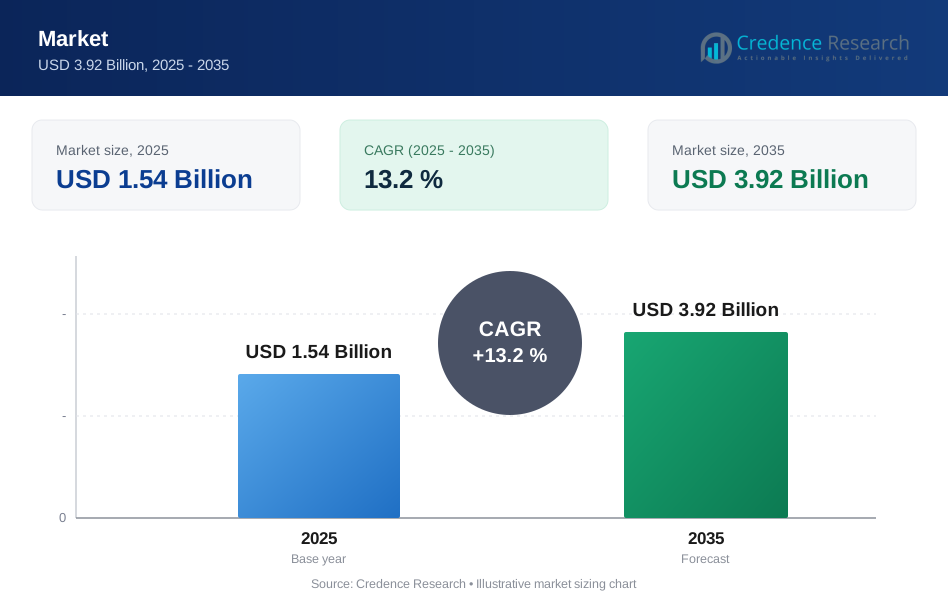
The supplied dataset places the global insect feed market at USD 1.20 billion in 2025, with a separate base-year estimate of USD 1.54 billion and a forecast of USD 3.92 billion by 2035, alongside a supplied revenue CAGR of 13.2%. North America represented 33.85% of 2025 revenue, while black soldier fly larvae accounted for 61.62% by insect species.
The structural case for insect feed rests on diversification of animal-feed protein. Aquaculture is particularly relevant because it continues to expand while capture fisheries are relatively constrained. FAO reported that aquaculture produced 94.4 million metric tons of aquatic animals in 2022 and, for the first time, exceeded capture fisheries as the principal source of aquatic animal production. FAO expects further aquaculture expansion through 2032, reinforcing demand for scalable protein and lipid alternatives to marine ingredients.
Commercial adoption is also changing. Insect ingredients are moving beyond simple fishmeal or soybean meal substitution toward functional feed positioning, where formulators evaluate palatability, amino-acid profile, digestibility, lauric acid, chitin and other bioactive fractions. This matters economically because functional positioning can support higher-value applications in aquafeed and pet food rather than requiring insect meal to compete solely on commodity protein cost.
Scale, however, remains decisive. Innovafeed reported in June 2026 that production at its Nesle site had increased tenfold in three years and production costs had fallen sevenfold, illustrating how automation, facility utilization and process learning can change unit economics. The company also reported more than 15,000 metric tons of protein and oil produced at Nesle over that period.
Geographically, the supplied dataset identifies North America as the largest 2025 region. Europe benefits from established regulatory pathways for insect processed animal protein, while Asia Pacific combines significant aquaculture demand with an expanding producer base. FAO's data provide demand context rather than insect-feed market share: Asia represented 70% of global aquatic animal production in 2022.
What this report answers. The analysis supports decisions on market entry, species and product positioning, feed-formulation partnerships, pricing, regional expansion, manufacturing scale and competitive differentiation through 2035.
Report Attributes
| Attribute | Detail |
|---|---|
| Historical period | 2025 |
| Forecast period | Through 2035 |
| Historical market size | USD 1.20 billion in 2025 |
| Base-year market size | USD 1.54 billion, 2026 |
| Forecast market size | USD 3.92 billion in 2035 |
| Revenue CAGR | 13.2%, supplied estimate |
| Quantitative units | Revenue in USD billions; shares and CAGR in percentages |
| Segments | Animal type, insect species, product form, end user |
| Geography | Global |
| Coverage | Demand, technology, competition, segmentation, regions, policy, developments and opportunities |
| Research cutoff | Sept. 26, 2026 |
Segment analysis
Segmentation by Animal Type, Species, Product Form and End User
How is the insect feed market segmented?
By animal type. Applications comprise aquaculture, poultry, swine, ruminants and pets. Poultry carries the supplied highest growth rate at 17.75% CAGR, while aquaculture remains strategically important because of continuing feed-protein demand.
By insect species. Black soldier fly larvae represented 61.62% in 2025, or a derived USD 739 million when applied to the supplied USD 1.20 billion global value. Mealworms, houseflies and other insects provide differentiated nutrient or production profiles.
By product form. Protein meal led with 57.55%, equivalent to a derived USD 691 million in 2025. Whole larvae target less processed feeding applications, insect oil monetizes the lipid fraction, and frass provides co-product economics.
By end user. Commercial feed mills held 47.75%, a derived USD 573 million in 2025. Integrated livestock producers are identified in the supplied inputs as the fastest-growing customer group at 13.02% CAGR.
| Segment | 2025 share | Revenue model | Growth profile |
|---|---|---|---|
| Commercial feed mills | 47.75% | Recurring ingredient procurement | Largest supplied end-user share |
| Integrated livestock producers | XXXX | Direct or captive procurement | Supplied CAGR 13.02% |
| Smallholder/on-farm systems | XXXX | Smaller-volume/direct purchase | Access and pricing dependent |
Request a Free Sample
Fill in your details and we'll send you a free sample report.
- Sample data tables & charts
- Research methodology
Market Dynamics
Direction of travel
Technology and Commercial Trends to 2035
What are the main trends in the insect feed market?
1. From substitute protein to functional ingredient
Commercial strategies are shifting from one-for-one fishmeal replacement toward targeted inclusion levels where insect fractions deliver nutritional or functional benefits.
2. Automation and process optimization
Industrial producers are investing in breeding control, climate management, feeding, harvesting and downstream fractionation. Scale is becoming a competitive capability rather than simply a capacity metric.
3. Value-chain partnerships
Feed manufacturers, farms and retailers increasingly participate together. In September 2025, BioMar, Innovafeed and Auchan announced large-scale integration of insect protein into shrimp feed in Ecuador, connecting ingredient production, aquafeed and retail demand.
4. Multi-product revenue models
Protein meal is increasingly produced alongside oils and fertilizer products. This improves feedstock utilization and gives manufacturers more routes to monetize insect biomass.
Technology benchmark
Insect Feed: Protein Concentration Across Commercial Insect Meals
How do commercial insect protein meals compare on crude protein concentration?
Commercial products show substantial variation, from manufacturer minimums around 46% to stated values above 70%. Processing and defatting explain part of that spread. Higher crude protein can reduce the quantity required to deliver a protein target, but buyers must also compare amino acids, digestibility, fat, ash, functionality, regulatory eligibility and delivered cost.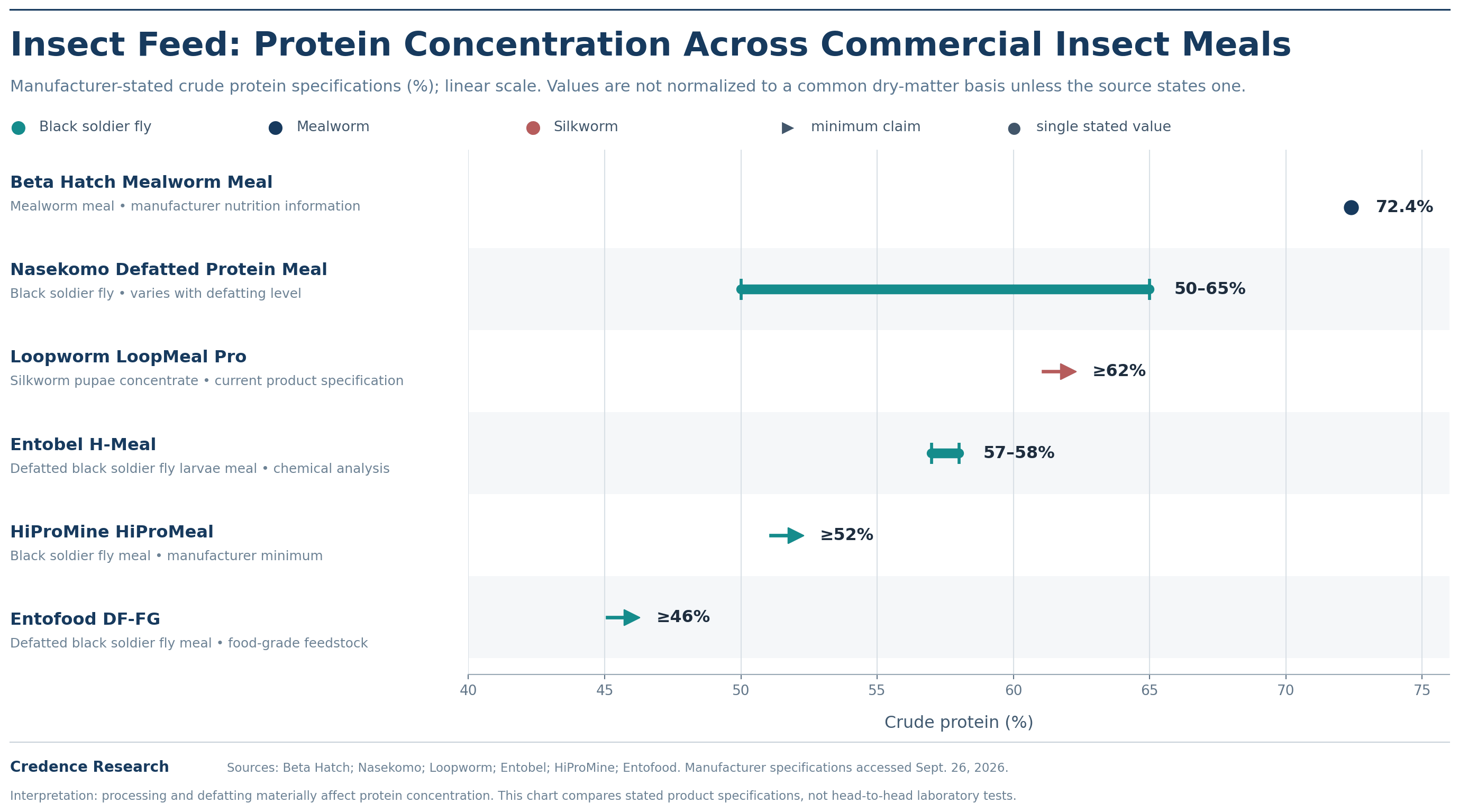
Caption: Manufacturer-stated crude protein specifications for selected commercial insect meals. The comparison is not a standardized head-to-head laboratory test.
| Approach | Function/use case | Verified value | Measurement basis | Source |
|---|---|---|---|---|
| Beta Hatch Mealworm Meal | Feed protein | 72.4% | Manufacturer nutrition information | Beta Hatch |
| Nasekomo defatted meal | Aquafeed/pet food | 50% to 65% | Varies with defatting | Nasekomo |
| Loopworm LoopMeal Pro | Feed protein concentrate | Minimum 62% | Current product specification | Loopworm |
| Entobel H-Meal | Defatted BSFL meal | 57% to 58% | Chemical analysis | Entobel |
| HiProMine HiProMeal | Feed/pet protein | Minimum 52% | Manufacturer specification | HiProMine |
| Entofood DF-FG | Defatted BSFL meal | Minimum 46% | Manufacturer product sheet | Entofood |
Buyer and budget ownership
Feed formulators and procurement teams buy against nutrient matrices and finished-feed economics. Protein percentage therefore matters, but cost per usable amino acid or performance outcome can matter more.
Adoption requirements
Ingredient qualification requires repeatable composition, microbiological safety, supply continuity and compatibility with milling or extrusion systems. Variability can slow approvals even when nominal protein is high.
Pricing power and total cost
Defatting can raise protein concentration while reducing lipid content. Manufacturers therefore need to optimize the combined value of meal and oil rather than maximize protein percentage in isolation.
Constraints
Adoption and Commercial Barriers
What are the main barriers to adoption in the insect feed market?
1. Cost competitiveness
Fishmeal, soybean meal and animal by-products already benefit from mature global supply chains. Insect producers need high plant utilization and predictable feedstock to close the cost gap.
2. Qualification and consistency
Large feed companies require consistent nutrients, contaminants, microbiology and physical properties. Batch variability can lengthen sales cycles.
3. Regulatory fragmentation
Permitted insect species, substrates and target animals differ between jurisdictions, complicating multinational product launches.
4. Scale and capital intensity
Breeding, climate control, drying and processing require substantial capital. Darling Ingredients' 2025 results included restructuring and impairment charges primarily related to EnviroFlight and its CTH business, illustrating that industrial execution remains material even for established groups.
White space
Where the Unserved Demand Sits
Where are the biggest opportunities in the insect feed market?
1. Poultry formulations
The supplied dataset assigns poultry the highest animal-type CAGR at 17.75%. Commercial conversion depends on cost-in-formula and dependable large-volume supply.
2. Functional aquafeed
Shrimp and premium fish diets offer opportunities where palatability, resilience or specialized nutrition can justify value beyond protein replacement.
3. Premium pet food
Novel proteins, traceability and ingredient storytelling create a higher-value route than commodity livestock feed, particularly where regulatory approval is established.
4. Integrated production in emerging markets
Locating insect conversion near food-processing side streams and feed customers can reduce logistics costs and create locally sourced protein, but project economics depend on secure substrate and offtake agreements.
Geography
Regional Market Structure and Growth Outlook
Which region leads the insect feed market?
The supplied dataset identifies North America with 33.85% of global revenue in 2025. No independently sourced regional market dataset matching the exact market definition and year was found, so external indicators below are used only to explain demand and market access.
North America
The region benefits from an established feed and pet-food manufacturing industry and evolving ingredient pathways. FDA's 2025 GRAS inventory entries for EnviroFlight BSFL ingredients illustrate expanding commercial access in companion-animal nutrition.
Europe
Europe combines industrial-scale insect producers with an explicit regulatory framework. EU rules allow insect PAP in aquaculture, poultry and pig feed subject to production, segregation and labeling conditions.
Asia Pacific
Large aquaculture and livestock industries create considerable ingredient demand. FAO reported that Asia generated 70% of global aquatic animal output in 2022. Regional opportunity therefore depends less on theoretical protein demand than on regulation, pricing and local manufacturing economics.
Latin America
Aquaculture creates a commercially relevant entry point. The 2025 BioMar, Innovafeed and Auchan initiative introduced insect protein into commercial shrimp feed in Ecuador, connecting ingredient adoption with downstream retail positioning.
Middle East
The supplied dataset states a 12.42% CAGR. Growth opportunities center on imported-feed substitution and controlled agriculture, but the regional CAGR should be treated cautiously because it is below the supplied global CAGR despite being described as the fastest regional rate.
Africa
Opportunity is tied to local feed affordability, aquaculture development and decentralized circular production. FAO notes substantial unrealized aquaculture potential in parts of Africa, although infrastructure, financing and standardized regulation remain adoption constraints.
Recent Developments and Strategic Implications
| Date | Verified development | Strategic implication |
|---|---|---|
| July 15, 2026 | Loopworm raised USD 3.25 million in pre-Series A funding. | Supports silkworm-based platform expansion and regional diversification beyond BSFL. |
| June 5, 2026 | Innovafeed announced a €51 million funding round following industrial scale-up at Nesle. | Capital shifts increasingly toward commercialization and plant optimization. |
| Jan. 22, 2026 | NaturAlleva agreed to deploy Innovafeed BSFL ingredients commercially across sea bass and sea bream formulations. | Demonstrates movement from trials toward recurring feed demand. |
| Sept. 18, 2025 | FDA listed a no-questions response for EnviroFlight dried BSFL for dogs and cats. | Expands regulatory confidence for U.S. companion-animal formulations. |
| Sept. 2, 2025 | BioMar, Innovafeed and Auchan announced commercial insect-protein use in shrimp feed in Ecuador. | Connects feed adoption to downstream retailer sustainability strategies. |
Need a Custom Version of This Report?
Tailor the scope, geography, or segments to your exact requirements.
- Custom geography or segment scope
- Direct access to our analyst team
Competitive Landscape
Who are the leading companies in the insect feed market?
The competitive field includes industrial BSFL specialists, diversified ingredient companies and emerging regional producers. Differentiation increasingly depends on production cost, nutrient consistency, regulatory access, functional-performance evidence and downstream partnerships rather than insect-rearing technology alone.
| Company | Relevant offering/position | Competitive strength | Strategic focus |
|---|---|---|---|
| Darling Ingredients / EnviroFlight | BSFL ingredients | Parent-company scale | North American feed/pet applications |
| Protix B.V. | BSFL protein, oil and fresh ingredients | Industrial insect platform | Feed and pet food |
| Innovafeed SAS | Hilucia protein, oil, frass | Industrial scale and partnerships | Aquaculture, pet food, agriculture |
| Sentara Group | BSFL meals, larvae, fertilizer | Southeast Asian manufacturing | Feed and circular agriculture |
| Entobel | H-Meal, H-Oil, H-Ferti | Vietnam production base | Aquaculture and feed |
| HiProMine | HiProMeal and functional ingredients | Functional product portfolio | Pet food and aquaculture |
| Nasekomo | Meal, larvae, oil, fertilizer | Multi-output BSFL platform | European feed markets |
| Beta Hatch | Mealworm meal and oil | Species differentiation | U.S. feed applications |
| Loopworm | Silkworm protein and oil | Silkworm processing platform | India and exports |
| Protenga | BSFL protein and oil | Integrated tropical production | Aqua and pet nutrition |
| GreenGrahi | Functional insect ingredients | India-based biotech platform | Aqua, poultry, pets |
Frequently Asked Questions
What is the current size of the insect feed market?
What is the forecast value?
Which product segment leads?
Which region leads?
Table of Content
Chapter 1. Report Introduction
- 1.1 Report Description & Purpose
- 1.1.1 Report Title & Market Definition
- 1.1.2 Unique Selling Propositions (USP) & Key Differentiators
- 1.1.3 Value Proposition for Stakeholders
- 1.2 Research Objectives
- 1.2.1 Market Sizing Objectives (Volume & Revenue)
- 1.2.2 Segmentation Objectives
- 1.2.3 Competitive Intelligence Objectives
- 1.2.4 Forecast & Scenario Objectives
- 1.3 Report Scope
- 1.3.1 Global Insect Feed Market Size, Outlook and Competitive Analysis to 2035 Scope – Types & Subtypes Covered
- 1.3.2 Geographic Scope – Regions & Countries Covered
- 1.3.3 Historical Period, Base Year & Forecast Period (2018-2025; forecast to 2035)
- 1.3.4 Inclusions & Exclusions
- 1.4 HS Code & Classification Framework
- 1.5 Currency, Units & Pricing Basis
- 1.6 Target Stakeholders
- 1.7 Limitations & Assumptions
Chapter 2. Executive Summary
- 2.1 Global Global Insect Feed Market Size, Outlook and Competitive Analysis to 2035 Market Snapshot
- 2.1.1 Market Size – Historical (2018-2025) & Forecast (2025-2035) (2025: USD 1.54 Billion → 2035: USD 3.92 Billion)
- 2.1.2 Volume & Revenue – Global Totals
- 2.1.3 Key Market Highlights – Top Five Facts
- 2.2 Global Insect Feed Market Size, Outlook and Competitive Analysis to 2035 Market Segmentation Snapshot
- 2.2.1 Market Split – Animal type – 2025 vs. 2035 (Volume & Revenue)
- 2.2.2 Market Split – Insect species – 2025 vs. 2035 (Volume & Revenue)
- 2.2.3 Market Split – Product form – 2025 vs. 2035 (Volume & Revenue)
- 2.2.4 Market Split – End user – 2025 vs. 2035 (Volume & Revenue)
- 2.2.5 Market Split by Region – 2025 vs. 2035
- 2.3 Competitive Snapshot
- 2.3.1 Top 10 Players by Revenue Share – 2025
- 2.3.2 Top 10 Players by Volume Share – 2025
- 2.3.3 Recent Strategic Developments (18-Month Summary)
- 2.4 Key Investment Highlights & Strategic Conclusions
Chapter 3. Global Insect Feed Market Size, Outlook and Competitive Analysis to 2035 Market Dynamics & Industry Analysis
- 3.1 Market Overview & Context
- 3.1.1 Global Insect Feed Market Size, Outlook and Competitive Analysis to 2035 Market Position in the Broader Automotive Value Chain
- 3.1.2 OEM vs. Replacement Market Dynamics
- 3.1.3 Market Maturity & Development Stage by Region
- 3.2 Global Insect Feed Market Size, Outlook and Competitive Analysis to 2035 Market Drivers
- 3.3 Global Insect Feed Market Size, Outlook and Competitive Analysis to 2035 Market Restraints & Challenges
- 3.4 Global Insect Feed Market Size, Outlook and Competitive Analysis to 2035 Market Opportunities
- 3.5 Porter's Five Forces Analysis
- 3.5.1 Threat of New Entrants
- 3.5.2 Bargaining Power of Suppliers
- 3.5.3 Bargaining Power of Buyers
- 3.5.4 Threat of Substitutes
- 3.5.5 Competitive Rivalry – Intensity Assessment
- 3.6 Global Insect Feed Market Size, Outlook and Competitive Analysis to 2035 Value Chain Analysis
- 3.6.1 Upstream – Raw Material/Input Suppliers
- 3.6.1.1 Raw Material/Input 1
- 3.6.1.2 Raw Material/Input 2
- 3.6.1.3 Raw Material/Input 3
- 3.6.2 Midstream – Production/Manufacturing/Service Delivery
- 3.6.2.1 Production/Process Overview
- 3.6.2.2 Key Facility Locations & Capacity by Manufacturer
- 3.6.3 Downstream – Distribution & End Consumer
- 3.6.3.1 Primary Channel – B2B/OEM
- 3.6.3.2 Secondary Channels – Dealer, Retail, Online, Direct
- 3.6.4 Value Chain Profitability Analysis
- 3.6.1 Upstream – Raw Material/Input Suppliers
- 3.7 PESTEL Analysis
- 3.7.1 Political Factors
- 3.7.2 Economic Factors
- 3.7.3 Social Factors
- 3.7.4 Technological Factors
- 3.7.5 Environmental Factors
- 3.7.6 Legal Factors
- 3.8 Global Insect Feed Market Size, Outlook and Competitive Analysis to 2035 Supply Chain Analysis
- 3.8.1 Raw Material/Input Supply Risk Assessment
- 3.8.2 Manufacturing Concentration Risk (Geographic Exposure)
- 3.8.3 Trade Disruption Impact Analysis
- 3.9 Regulatory & Policy Landscape
Note: The regulatory and policy landscape section covers regulations based on their applicability to the market, Global Insect Feed Market Size, Outlook and Competitive Analysis to 2035 category, geography, and scope of the study. Only regulatory frameworks with a material impact on operations, compliance, trade, sustainability, or market access are analyzed in detail.
Chapter 4. Key Investment Pockets & Opportunity Analysis
- 4.1 Global Insect Feed Market Size, Outlook and Competitive Analysis to 2035 Market Attractiveness Analysis
- 4.1.1 By Region – Investment Attractiveness Matrix (Volume × CAGR)
- 4.1.2 Animal type – Investment Attractiveness Matrix
- 4.1.3 Insect species – Investment Attractiveness Matrix
- 4.1.4 Product form – Investment Attractiveness Matrix
- 4.1.5 End user – Investment Attractiveness Matrix
- 4.2 Absolute Revenue Growth Opportunity
- 4.2.1 By Region – Absolute USD Growth Through 2035
- 4.2.2 Animal type – Absolute USD Growth
- 4.2.3 Insect species – Absolute USD Growth
- 4.2.4 Product form – Absolute USD Growth
- 4.2.5 End user – Absolute USD Growth
- 4.3 Incremental Volume Opportunity
- 4.3.1 By Region – Incremental Volume Through 2035
- 4.3.2 Animal type – Incremental Volume
- 4.4 Emerging Submarket Opportunity Deep Dive (Subject to Applicability)
- 4.5 Emerging Market Opportunity Scorecards
- 4.5.1 United States
- 4.5.2 Europe
- 4.5.3 Asia
- 4.5.4 Middle East & Africa
Note: Emerging Market Opportunity Scorecards will be included based on relevance and strategic importance. Regions listed are indicative and may vary depending on data availability and market dynamics.
Chapter 5. Global Insect Feed Market Size, Outlook and Competitive Analysis to 2035 Import-Export Analysis & Trade Flows
- 5.1 Global Trade Overview
- 5.1.1 Global Export Value by Country (2018-2025)
- 5.1.2 Global Export Volume by Country (2018-2025)
- 5.1.3 Global Import Value by Country (2018-2025)
- 5.1.4 Global Import Volume by Country (2018-2025)
- 5.1.5 Net Trade Balance by Country (2018-2025)
- 5.2 Export Analysis – Animal type
- 5.2.1 Type 1 (HS Code)
- 5.2.2 Type 2 (HS Code)
- 5.2.3 Type 3 (HS Code)
- 5.2.4 Type 4 (HS Code)
- 5.2.5 Type 5 (HS Code)
- 5.3 Import Analysis – Animal type
- 5.3.1 Type 1 (HS Code)
- 5.3.2 Type 2 (HS Code)
- 5.3.3 Type 3 (HS Code)
- 5.3.4 Type 4 (HS Code)
- 5.3.5 Type 5 (HS Code)
- 5.4 Average Unit Trade Prices
- 5.4.1 Average Export Price – Animal type & Country
- 5.4.2 Average Import Price – Animal type & Source Country
- 5.4.3 Price Trends (2018-2025)
- 5.5 Key Trade Route Analysis
- 5.5.1 Trade Route 1
- 5.5.2 Trade Route 2
- 5.5.3 Trade Route 3
- 5.5.4 Trade Route 4
- 5.5.5 Trade Route 5
- 5.6 Trade Policy Impact Assessment
- 5.6.1 US Anti-Dumping & Section 301 Tariffs
- 5.6.2 EU Customs Union Impact
- 5.6.3 Major Free Trade Agreements
- 5.6.4 USMCA Rules of Origin
Note: Trade policy analysis will be included only where relevant to the Global Insect Feed Market Size, Outlook and Competitive Analysis to 2035 market.
Chapter 6. Competitive Landscape & Company Benchmarking
- 6.1 Global Insect Feed Market Size, Outlook and Competitive Analysis to 2035 Market Concentration & Structure
- 6.1.1 Herfindahl-Hirschman Index (HHI) – 2018 vs. 2025
- 6.1.2 Tier 1, Tier 2 & Tier 3 Market Structure
- 6.1.3 Global, Regional & Local Player Dynamics
- 6.2 Global Insect Feed Market Size, Outlook and Competitive Analysis to 2035 Market Share Analysis – 2025
- 6.2.1 Global Revenue Share by Company
- 6.2.2 Global Volume Share by Company
- 6.2.3 Regional Revenue Share
- 6.2.4 Market Share Evolution (2018 vs. 2025)
- 6.2.5 OEM Segment Share by Company
- 6.2.6 Replacement Segment Share by Company
- 6.3 Production/Delivery Capacity & Facility Analysis
- 6.3.1 Global Installed Capacity
- 6.3.2 Capacity Utilization Rates
- 6.3.3 Production/Output Volume
- 6.3.4 Facility Locations & Capacity Map
- 6.3.5 Planned Capacity Additions
- 6.4 Global Insect Feed Market Size, Outlook and Competitive Analysis to 2035 Competitive Benchmarking Matrix
- 6.4.1 Revenue, Volume, CAGR & Profitability Comparison
- 6.4.2 Channel Revenue Mix
- 6.4.3 Geographic Revenue Exposure
- 6.4.4 R&D Intensity
- 6.4.5 Sustainability Maturity
- 6.5 Strategic Developments in Global Insect Feed Market Size, Outlook and Competitive Analysis to 2035 (Last 24 Months)
- 6.5.1 Mergers, Acquisitions & Divestments
- 6.5.2 New Global Insect Feed Market Size, Outlook and Competitive Analysis to 2035 Launches
- 6.5.3 Facility Expansions
- 6.5.4 Strategic Alliances, Joint Ventures & Partnerships
- 6.5.5 Distribution Expansion & Market Entry
- 6.5.6 Sustainability & ESG Initiatives
- 6.6 Competitive Strategy Mapping
- 6.6.1 Leader, Challenger, Follower & Niche Classification
- 6.6.2 Pricing Strategy Comparison
- 6.6.3 Channel Strategy Matrix
Note: Strategic developments are included based on their materiality and the availability of reliable information.
Chapter 7. Global Global Insect Feed Market Size, Outlook and Competitive Analysis to 2035 Market – Animal type
- 7.1 Segment Overview
- 7.1.1 Market Volume Share (2018, 2025 & 2026)
- 7.1.2 Market Revenue Share (2018, 2025 & 2026)
- 7.1.3 Market Forecast Through 2035
- 7.1.4 Key Growth Drivers & Restraints
- 7.1.5 Leading Brands
- 7.2 Types Covered – Animal type
- Aquaculture
- poultry
- swine
- ruminants
- pets
Chapter 8. Global Global Insect Feed Market Size, Outlook and Competitive Analysis to 2035 Market – Insect species
- 8.1 Segment Overview
- 8.1.1 Market Volume Share (2018, 2025 & 2026)
- 8.1.2 Market Revenue Share (2018, 2025 & 2026)
- 8.1.3 Market Forecast Through 2035
- 8.1.4 Key Growth Drivers & Restraints
- 8.1.5 Leading Brands
- 8.2 Types Covered – Insect species
- Black soldier fly
- mealworm
- housefly
- others
Chapter 9. Global Global Insect Feed Market Size, Outlook and Competitive Analysis to 2035 Market – Product form
- 9.1 Segment Overview
- 9.1.1 Market Volume Share (2018, 2025 & 2026)
- 9.1.2 Market Revenue Share (2018, 2025 & 2026)
- 9.1.3 Market Forecast Through 2035
- 9.1.4 Key Growth Drivers & Restraints
- 9.1.5 Leading Brands
- 9.2 Types Covered – Product form
- Protein meal
- whole dried larvae
- insect oil
- frass fertilizer
Chapter 10. Global Global Insect Feed Market Size, Outlook and Competitive Analysis to 2035 Market – End user
- 10.1 Segment Overview
- 10.1.1 Market Volume Share (2018, 2025 & 2026)
- 10.1.2 Market Revenue Share (2018, 2025 & 2026)
- 10.1.3 Market Forecast Through 2035
- 10.1.4 Key Growth Drivers & Restraints
- 10.1.5 Leading Brands
- 10.2 Types Covered – End user
- Commercial feed mills
- integrated livestock producers
- smallholder/on-farm systems
Chapter 11. Global Global Insect Feed Market Size, Outlook and Competitive Analysis to 2035 Market – By Distribution Channel
- 11.1 Segment Overview
- 11.1.1 Volume & Revenue Split by Channel (2025 & 2035)
- 11.1.2 Channel Mix Evolution (2018-2035)
Chapter 12. Regional Market Analysis – Global Overview
- 12.1 Global Regional Overview
- 12.1.1 Regional Volume Share
- 12.1.2 Regional Revenue Share
- 12.1.3 Regional Volume by Region
- 12.1.4 Regional Revenue by Region
- 12.1.5 Regional Forecast Through 2035
- 12.2 Cross-Regional Segment Analysis
- 12.2.1 Animal type
- 12.2.2 Insect species
- 12.2.3 Product form
- 12.2.4 End user
- 12.2.5 By Distribution Channel
- 12.2.6 By Brand/Price Tier
Chapter 13. North America Global Insect Feed Market Size, Outlook and Competitive Analysis to 2035 Market
- 13.1 United States
- 13.2 Canada
- 13.3 Mexico
Chapter 14. Europe Global Insect Feed Market Size, Outlook and Competitive Analysis to 2035 Market
- 14.1 Germany
- 14.2 France
- 14.3 Italy
- 14.4 United Kingdom
- 14.5 Spain
- 14.6 Poland
- 14.7 Russia
- 14.8 Netherlands
- 14.9 Belgium
- 14.10 Sweden
- 14.11 Denmark
- 14.12 Norway
- 14.13 Rest of Europe
Chapter 15. Asia Pacific Global Insect Feed Market Size, Outlook and Competitive Analysis to 2035 Market
- 15.1 China
- 15.2 India
- 15.3 Japan
- 15.4 South Korea
- 15.5 Thailand
- 15.6 Indonesia
- 15.7 Vietnam
- 15.8 Malaysia
- 15.9 Australia
- 15.10 Rest of Asia Pacific
Chapter 16. Latin America Global Insect Feed Market Size, Outlook and Competitive Analysis to 2035 Market
- 16.1 Brazil
- 16.2 Argentina
- 16.3 Colombia
- 16.4 Chile
- 16.5 Rest of Latin America
Chapter 17. Middle East Global Insect Feed Market Size, Outlook and Competitive Analysis to 2035 Market
- 17.1 Saudi Arabia
- 17.2 United Arab Emirates
- 17.3 Turkey
- 17.4 Israel
- 17.5 Iran
- 17.6 Rest of the Middle East
Chapter 18. Africa Global Insect Feed Market Size, Outlook and Competitive Analysis to 2035 Market
- 18.1 South Africa
- 18.2 Egypt
- 18.3 Nigeria
- 18.4 Morocco
- 18.5 Rest of Africa
Chapter 19. Global Insect Feed Market Size, Outlook and Competitive Analysis to 2035 Company Profiles
- 19.1 Darling Ingredients Inc.
- 19.1.1 Company Overview
- 19.1.2 Key Management Personnel
- 19.1.3 Products & Services Portfolio
- 19.1.4 Financial Performance
- 19.1.5 Key Market Focus & Geographic Presence
- 19.1.6 Recent Developments & Strategic Initiatives
- 19.2 Protix B.V.
- 19.3 InnovaFeed SAS
- 19.4 Sentara Group
- 19.5 Entomo Farms Inc. (Next Millennium Farms Inc.)
- 19.6 Entobel Holding Pte. Ltd.
- 19.7 Hipromine S.A.
- 19.8 nextProtein SAS
- 19.9 Nasekomo AD
- 19.10 Hexafly Enterprises Ltd.
- 19.11 Beta Hatch Inc.
- 19.12 Loopworm Private Limited
- 19.13 Protenga Pte. Ltd.
- 19.14 Keetup India Private Limited
- 19.15 GreenGrahi Solutions Pvt. Ltd.
Note: The company profile list is preliminary and may change based on research findings, market developments, data availability, and client requirements.
Chapter 20. Appendices
- Appendix A – List of Abbreviations & Acronyms
- Appendix B – Industry Classification Code Reference – Full Series
- Appendix C – Production & Capacity Data Tables
- Appendix D – End-Use & Demand Base Tables
- Appendix E – Consumption & Replacement Rate Assumptions
- Appendix F – ASP Reference Tables
- Appendix G – Manufacturing & Facility Database
- Appendix H – Import-Export Data Tables
- Appendix I – Regulatory Summary Tables
- Appendix J – Primary Research Participant List (Anonymized)
- Appendix K – Primary Research Questionnaire Framework
- Appendix L – Data Sources & Bibliography
- Appendix M – Market Size Divergence & Source Comparison
Chapter 21. Research Methodology
- 21.1 Research Framework & Philosophy
- 21.2 Secondary Research – Sources, Hierarchy & Data Extraction
- 21.3 Data Modeling – Bottom-Up & Top-Down Market Sizing
- 21.4 Primary Research – Stakeholder Framework, LOI & Sample Sizes
- 21.5 Forecast Methodology – Regression, Scenario & Sensitivity Analysis
- 21.6 Quality Control – Four-Layer Validation Framework
- 21.7 Limitations & Standard Assumptions
- 21.8 Disclaimer
