
Market Overview:
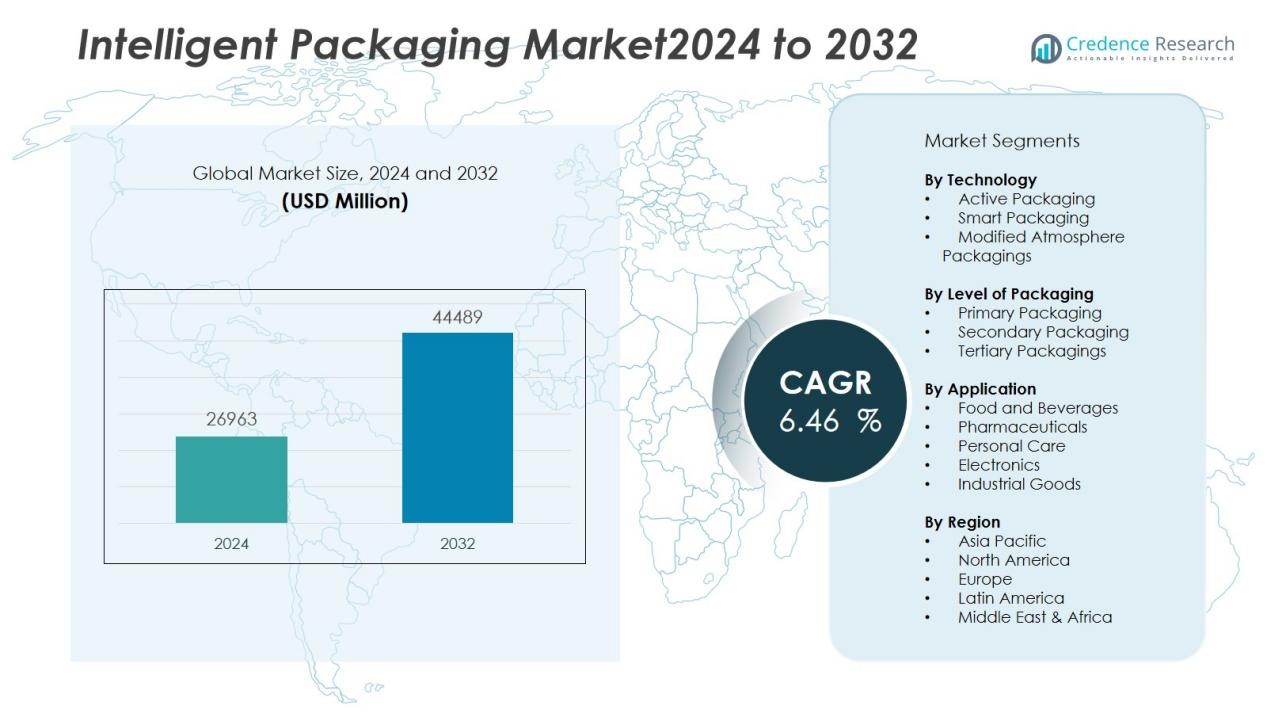
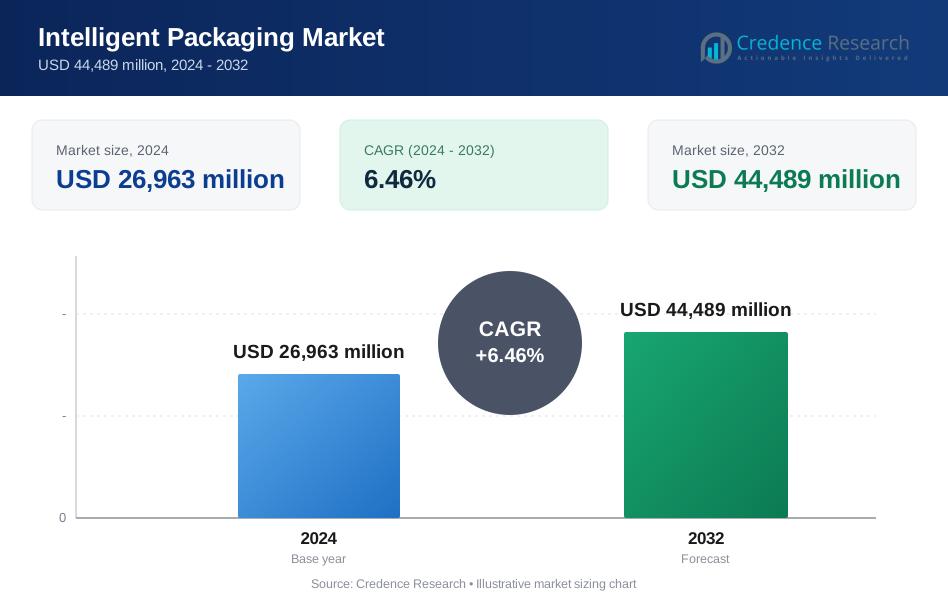
The intelligent packaging market size was valued at USD 26963 million in 2024 and is anticipated to reach USD 44489 million by 2032, at a CAGR of 6.46 % during the forecast period (2024-2032).
| REPORT ATTRIBUTE | DETAILS |
|---|---|
| Historical Period | 2020-2024 |
| Base Year | 2024 |
| Forecast Period | 2025-2032 |
| Intelligent Packaging Market Size 2024 | USD 26963 Million |
| Intelligent Packaging Market, CAGR | 6.46 % |
| Intelligent Packaging Market Size 2032 | USD 44489 Million |
Key drivers shaping the intelligent packaging market include rising consumer awareness of product freshness, safety, and authenticity. Brands leverage intelligent packaging to differentiate offerings through interactive features such as freshness indicators, temperature sensors, and QR-based consumer engagement tools. The pharmaceutical sector relies on smart packaging to monitor temperature-sensitive drugs and ensure regulatory compliance. Food manufacturers benefit from active packaging that releases or absorbs gases to maintain optimal product conditions. The growth in sustainable packaging practices also supports intelligent packaging technologies that reduce food waste and improve inventory management through real-time data capture. Rapid urbanization and changing consumer lifestyles further reinforce the need for convenient, safe, and connected packaging formats.
Regionally, North America leads the intelligent packaging market due to advanced retail infrastructure, technological innovation, and strong demand from the healthcare and food industries. Europe follows closely, supported by strict food safety regulations and sustainability directives that encourage adoption of smart and active packaging. The Asia Pacific region is witnessing the fastest growth, driven by rising disposable incomes, expanding retail and pharmaceutical sectors, and growing investment in cold chain logistics. Latin America and the Middle East & Africa are also emerging markets, supported by increasing food exports and digital transformation in logistics and supply chains.
Market Insights:
- The intelligent packaging market size was USD 26,963 million in 2024 and will reach USD 44,489 million by 2032.
- Consumer demand for freshness, authenticity, and safety drives rapid adoption of intelligent packaging across key sectors.
- Brands leverage interactive features such as QR codes, sensors, and real-time indicators to enhance product engagement.
- The pharmaceutical sector deploys smart packaging to ensure temperature control, traceability, and regulatory compliance.
- High implementation costs and complex integration restrict adoption, especially for small and medium enterprises.
- North America holds 37% share, Europe 29%, and Asia Pacific 23%, with each region shaped by unique regulations and innovation trends.
- Standardization gaps and data security concerns present key challenges, but growth opportunities emerge in food, pharma, and logistics.
Market Drivers:
Rising Demand for Shelf Life Extension and Real-Time Product Monitoring Drives Market Expansion:
The intelligent packaging market benefits from strong demand for solutions that enhance shelf life and product quality. Active packaging technologies—such as oxygen scavengers and moisture absorbers—preserve food and pharmaceutical integrity during storage and transit. Smart indicators and sensors alert stakeholders to temperature deviations, contamination, or spoilage. It addresses growing concerns about food safety and waste reduction. Retailers and manufacturers increasingly deploy condition-monitoring features to ensure compliance and maintain brand trust. This demand creates steady adoption across perishable goods and temperature-sensitive applications.
- For instance, DNP's moisture-absorbing laminate, adopted for medical and diagnostic device packaging, provides continuous moisture absorption of up to 6.0g/m², effectively preventing degradation and preserving sensitive products during the entire supply chain.
Consumer Preference for Transparency and Product Interaction Boosts Market Penetration:
Consumer expectations for transparency, safety, and interactive engagement continue to shape packaging innovations. Intelligent packaging solutions enable users to access real-time information via QR codes, RFID tags, and NFC-enabled labels. It enhances brand engagement and supports traceability for origin, handling, and expiration data. Buyers respond positively to packaging that verifies authenticity, particularly in cosmetics, pharmaceuticals, and premium food. This trend aligns with digital transformation in retail, where packaging becomes a communication and marketing channel. It drives adoption among brands aiming to differentiate and connect with tech-savvy consumers.
- For example, BL.INK’s GS1 Digital Link technology allowed a leading European dairy brand to provide supply chain info, origin, and expiry data for over 50 million yogurt packages in 2024 via a single scannable QR code standard, accessible to consumers and retailers alike.
Stringent Regulations and Supply Chain Integrity Requirements Accelerate Adoption:
Governments and regulatory agencies enforce stringent standards for traceability, safety, and environmental responsibility. The intelligent packaging market supports compliance by integrating features that track and log conditions across supply chains. Pharmaceutical firms and food producers rely on it to prevent counterfeiting and ensure end-to-end visibility. Real-time monitoring systems help logistics providers maintain cold chain integrity and meet audit requirements. This regulatory environment compels investment in packaging that offers actionable data and supply chain control. It strengthens adoption across highly regulated industries.
Technological Advancements and Cost Optimization Fuel Broader Market Deployment:
Advances in printed electronics, flexible sensors, and wireless communication reduce production costs and simplify integration. The intelligent packaging market leverages these innovations to enable scalable solutions for small and large enterprises. Automation in labeling and packaging systems supports cost efficiency while improving accuracy. It becomes viable for use in mid-tier consumer goods and fast-moving retail segments. Brands benefit from data-driven insights on usage, storage, and consumer behavior. This technological maturity accelerates adoption across diverse industry verticals.
Market Trends:
Integration of Digital Connectivity and IoT Capabilities Reshapes Packaging Solutions:
Brands increasingly incorporate digital connectivity and IoT features to transform product packaging into an interactive platform. The intelligent packaging market reflects this trend through widespread adoption of RFID tags, QR codes, and NFC technology. It enables real-time product authentication, inventory management, and direct consumer engagement via smartphones. Packaging now supports traceability and facilitates recalls by instantly updating stakeholders on product status. The shift towards data-driven operations helps brands monitor supply chains and improve transparency from manufacturing to end-user. Digitalization in packaging unlocks new value for companies seeking operational efficiency and consumer loyalty.
- For instance, Kroger implemented Avery Dennison RFID-embedded labels in the bakery department across its stores, allowing item-level identification for accurate inventory and freshness management, covering over 2,700 locations in the United States as of 2024.
Sustainable Materials and Smart Functionality Drive Market Differentiation:
Sustainability and advanced functionality define recent developments in the intelligent packaging market, with a strong focus on eco-friendly substrates and multi-use packaging designs. Companies invest in biodegradable sensors, recyclable films, and compostable labels to align with regulatory demands and customer values. It supports circular economy initiatives by reducing single-use waste and promoting reusable smart components. Advanced features such as time–temperature indicators and gas scavenging layers optimize shelf life while minimizing environmental impact. The combination of green materials with intelligent functions sets new standards for differentiation and brand positioning in a competitive landscape.
- For instance, 3M’s MonitorMark Time Temperature Indicators provide non-reversible, precise records of thermal exposure, allowing manufacturers to monitor exposure above temperature thresholds for up to 48 hours, critically enhancing cold chain compliance for temperature-sensitive goods.
Market Challenges Analysis:
High Implementation Costs and Complex Integration Limit Widespread Adoption:
The intelligent packaging market faces significant barriers from high initial investment and integration complexity. Many small and medium enterprises hesitate to deploy smart packaging solutions due to cost constraints and lack of in-house technical expertise. It often requires specialized equipment, advanced materials, and customized software, which drive up total ownership costs. The challenge extends to system compatibility, where legacy supply chain infrastructure may not easily support new smart features. Companies must justify the return on investment for both operational upgrades and product innovation. This financial and technical burden slows market penetration in price-sensitive regions.
Standardization Gaps and Data Security Concerns Hinder Market Growth:
Fragmented standards for data formats, sensor performance, and wireless protocols create operational uncertainty in the intelligent packaging market. It complicates the development of universally compatible smart packaging, impacting scalability and supply chain efficiency. Brands also face rising concerns about data privacy and protection, especially when packaging collects or transmits consumer information. Meeting regulatory requirements for data security adds complexity to product design. These challenges restrict broader adoption and delay the development of seamless, globally accepted intelligent packaging solutions.
Market Opportunities:
Expansion into Healthcare, Fresh Food, and High-Value Goods Unlocks New Revenue Streams:
The intelligent packaging market presents strong growth prospects in healthcare, fresh food, and premium consumer goods. Pharmaceutical companies leverage smart packaging for drug traceability, anti-counterfeiting, and temperature monitoring. It enables food producers to maintain freshness and compliance through real-time spoilage indicators and tracking features. High-value electronics and luxury brands use intelligent packaging to ensure authenticity and support after-sales engagement. The demand for quality assurance and transparency in these sectors creates substantial opportunities for solution providers. Brands stand to benefit from premium positioning and customer loyalty.
Advancements in Flexible Electronics and Sustainability Accelerate Market Innovation:
Rapid progress in printed electronics, bio-based sensors, and recyclable smart films expands the design possibilities for intelligent packaging. It supports the development of low-cost, scalable solutions suited for mass-market applications and emerging economies. Brands integrate renewable materials and circular packaging models to meet evolving regulatory and consumer expectations. Collaborative efforts between technology developers and packaging manufacturers foster innovation and commercialization of next-generation solutions. This environment favors first movers that align intelligent functionality with sustainability and digital transformation strategies.
Market Segmentation Analysis:
By Technology:
The intelligent packaging market covers three main technology segments: active, smart, and modified atmosphere packaging. Active packaging dominates due to strong demand for oxygen scavengers, moisture absorbers, and antimicrobial layers that extend shelf life. Smart packaging gains momentum through integration of sensors, indicators, RFID tags, and NFC chips, allowing real-time monitoring and traceability. Modified atmosphere packaging remains vital in food and pharmaceutical supply chains, supporting product preservation during transit and storage. It allows brands to optimize safety, transparency, and product performance across sectors.
- For instance, Sealed Air’s Cryovac® MAP for Bakery employs active barrier films and gas-flush processes to extend the shelf life of preservative-free specialty baked goods from the typical 1-2 weeks to over 40 days, delivering an improved freshness window and reduced waste for retailers and consumers.
By Level of Packaging:
Intelligent packaging spans primary, secondary, and tertiary packaging levels. Primary packaging, which directly contacts the product, sees the highest innovation with embedded sensors and indicators for freshness, authenticity, and tamper evidence. Secondary packaging incorporates track-and-trace features for inventory control and logistics optimization. Tertiary packaging leverages intelligent labels and IoT connectivity to streamline bulk shipment management. It addresses the diverse requirements of manufacturers, retailers, and logistics providers.
- For instance, iGPS has equipped every pallet in its global pool—over 15 million—with passive UHF RFID tags, enabling real-time inventory tracking and reducing shipping errors in supply chains worldwide.
By Application:
Key applications include food and beverages, pharmaceuticals, personal care, and electronics. The food and beverage sector leads adoption to ensure freshness and regulatory compliance. Pharmaceutical companies use intelligent packaging for anti-counterfeiting, temperature monitoring, and patient engagement. It finds growing relevance in personal care and consumer electronics, supporting product authentication and interactive branding. The diverse application base drives market growth and ongoing technological advancement.
Segmentations:
By Technology:
- Active Packaging
- Smart Packaging
- Modified Atmosphere Packaging
By Level of Packaging:
- Primary Packaging
- Secondary Packaging
- Tertiary Packaging
By Application:
- Food and Beverages
- Pharmaceuticals
- Personal Care
- Electronics
- Industrial Goods
By Region:
- North America
- U.S.
- Canada
- Mexico
- Europe
- Germany
- France
- U.K.
- Italy
- Spain
- Rest of Europe
- Asia Pacific
- China
- Japan
- India
- South Korea
- South-east Asia
- Rest of Asia Pacific
- Latin America
- Brazil
- Argentina
- Rest of Latin America
- Middle East & Africa
- GCC Countries
- South Africa
- Rest of the Middle East and Africa
Regional Analysis
Regional Analysis:
North America:
North America accounts for 37% share of the intelligent packaging market, driven by strong investment in technology and advanced retail infrastructure. It maintains leadership due to the region’s focus on food safety, product traceability, and compliance within healthcare and consumer goods sectors. Leading companies invest in IoT-enabled packaging to ensure supply chain transparency and meet evolving regulatory requirements. The United States drives market growth through pharmaceutical innovations and widespread adoption of connected packaging in e-commerce and retail. Canada supports expansion with government incentives for smart and sustainable packaging. Consumer demand for convenience and authenticity reinforces steady market momentum.
Europe:
Europe secures a 29% share of the intelligent packaging market, supported by stringent food safety regulations and a strong commitment to sustainability. The region’s established recycling infrastructure and circular economy policies create favorable conditions for adoption of active and smart packaging solutions. Major economies such as Germany, France, and the United Kingdom drive innovation through public-private partnerships and funding for digital transformation projects. European food and beverage manufacturers lead in deploying smart sensors and indicators to comply with strict shelf life and origin labeling laws. Growth accelerates in the healthcare sector as smart packaging ensures product integrity and counteracts falsification. Sustainability drives innovation in recyclable sensors and biodegradable materials.
Asia Pacific:
Asia Pacific holds a 23% share and represents the fastest-growing region in the intelligent packaging market. It benefits from rising disposable income, rapid urbanization, and significant investment in e-commerce logistics infrastructure. China, Japan, and India serve as primary growth engines, supported by large consumer bases and expanding cold chain networks. Manufacturers invest in scalable smart packaging technologies to cater to food safety and pharmaceutical compliance needs. Market participants leverage digitalization trends to enhance brand engagement and operational efficiency. The region presents untapped opportunities for companies investing in affordable, high-volume intelligent packaging solutions.
Key Player Analysis:
- Amcor plc.
- CCL Industries Inc.
- Huhtamaki Global
- Crown Holding Inc.
- Avery Dennison Corporation
- 3M Company
- Tetra Pak International S.A.
- DS Smith
- Honeywell International Inc.
- Sealed Air Corporation
Competitive Analysis:
The intelligent packaging market features strong competition among global leaders and specialized firms focused on innovation and market reach. Major players include Amcor plc, CCL Industries Inc., Huhtamaki Global, Crown Holding Inc., Avery Dennison Corporation, 3M Company, and Tetra Pak International S.A. These companies invest in R&D to develop advanced solutions that integrate smart sensors, RFID technology, and sustainable materials. It emphasizes product differentiation and customization to address diverse needs in food, pharmaceuticals, and electronics. Strategic partnerships, mergers, and acquisitions shape the competitive landscape, with firms targeting digital transformation and regulatory compliance. The sector demonstrates continuous technological progress, while entry barriers remain high due to the capital-intensive nature of innovation and quality standards.
Recent Developments:
- In May 2025, Amcor plc announced a strategic partnership with Metsä Group to jointly develop molded fiber-based food packaging solutions.
- In April 2025, Formed a strategic manufacturing and commercial partnership with Ynvisible Interactive for scalable production and commercialization of printed e-paper displays.
- In July 2025, Launched new compostable ice cream cups that are both home and industrial compostable and recyclable.
Market Concentration & Characteristics:
The intelligent packaging market exhibits moderate concentration, with several global players and a mix of regional specialists competing for share. Leading companies focus on technological innovation, strategic partnerships, and vertical integration to expand their portfolios and address diverse customer needs. It features a high degree of product differentiation, with solutions tailored for food, pharmaceuticals, and high-value consumer goods. Market participants invest in R&D to integrate sensors, wireless communication, and eco-friendly materials into their offerings. The sector demonstrates rapid adoption of digital and IoT capabilities, while scalability and customization remain key competitive characteristics. Continuous advancements and evolving regulations drive frequent product launches and industry collaborations.
Report Coverage:
The research report offers an in-depth analysis based on Technology, Level of Packaging, Application, End Use and Region. It details leading Market players, providing an overview of their business, product offerings, investments, revenue streams, and key applications. Additionally, the report includes insights into the competitive environment, SWOT analysis, current Market trends, as well as the primary drivers and constraints. Furthermore, it discusses various factors that have driven Market expansion in recent years. The report also explores Market dynamics, regulatory scenarios, and technological advancements that are shaping the industry. It assesses the impact of external factors and global economic changes on Market growth. Lastly, it provides strategic recommendations for new entrants and established companies to navigate the complexities of the Market.
Future Outlook:
- Industry adoption will expand into emerging consumer goods sectors, including cosmetics, electronics, and luxury retail.
- Brands will increase focus on integrating real-time sensors into conventional packaging formats.
- Advances in printable electronics will lower production costs and enhance sensor flexibility.
- Sustainable packaging materials will merge with intelligent features to support circular economy goals.
- Ecosystems of packaging, logistics, and data analytics providers will develop collaborative platforms.
- Supply chain players will deploy blockchain-linked packaging to enhance traceability and reduce counterfeit risk.
- Responsive packaging that signals freshness or temperature shifts will gain traction in cold chains.
- Consumers will expect interactive packaging that links physical products with digital experiences.
- Modular smart packaging components will evolve, enabling easy upgrades and multi-use configurations.
- Manufacturers will adopt industry standards for interoperability, enabling broader deployment across geographies and sectors.
Request a Free Sample
Fill in your details and we'll send you a free sample report.
- Sample data tables & charts
- Research methodology
Need a Custom Version of This Report?
Tailor the scope, geography, or segments to your exact requirements.
- Custom geography or segment scope
- Direct access to our analyst team
Frequently Asked Questions
What is the current size of the intelligent packaging market?
What factors are driving the growth of the intelligent packaging market?
What are the key segments within the intelligent packaging market?
What are some challenges faced by the intelligent packaging market?
Who are the major players in the intelligent packaging market?
Table of Content
Chapter 1. Report Introduction
- 1.1 Report Description & Purpose
- 1.1.1 Report Title & Market Definition
- 1.1.2 Unique Selling Propositions (USP) & Key Differentiators
- 1.1.3 Value Proposition for Stakeholders
- 1.2 Research Objectives
- 1.2.1 Market Sizing Objectives (Volume & Revenue)
- 1.2.2 Segmentation Objectives
- 1.2.3 Competitive Intelligence Objectives
- 1.2.4 Forecast & Scenario Objectives
- 1.3 Report Scope
- 1.3.1 Intelligent Packaging Scope – Types & Subtypes Covered
- 1.3.2 Geographic Scope – Regions & Countries Covered
- 1.3.3 Historical Period, Base Year & Forecast Period (2024; forecast to 2032)
- 1.3.4 Inclusions & Exclusions
- 1.4 HS Code & Classification Framework
- 1.5 Currency, Units & Pricing Basis
- 1.6 Target Stakeholders
- 1.7 Limitations & Assumptions
Chapter 2. Executive Summary
- 2.1 Global Intelligent Packaging Market Snapshot
- 2.1.1 Market Size – Historical (2024) & Forecast (2024-2032) (2024: USD 26,963 million → 2032: USD 44,489 million)
- 2.1.2 Volume & Revenue – Global Totals
- 2.1.3 Key Market Highlights – Top Five Facts
- 2.2 Intelligent Packaging Market Segmentation Snapshot
- 2.2.1 Market Split by Region – 2024 vs. 2032
- 2.3 Competitive Snapshot
- 2.3.1 Top 10 Players by Revenue Share – 2024
- 2.3.2 Top 10 Players by Volume Share – 2024
- 2.3.3 Recent Strategic Developments (18-Month Summary)
- 2.4 Key Investment Highlights & Strategic Conclusions
Chapter 3. Intelligent Packaging Market Dynamics & Industry Analysis
- 3.1 Market Overview & Context
- 3.1.1 Intelligent Packaging Market Position in the Broader Automotive Value Chain
- 3.1.2 OEM vs. Replacement Market Dynamics
- 3.1.3 Market Maturity & Development Stage by Region
- 3.2 Intelligent Packaging Market Drivers
- 3.3 Intelligent Packaging Market Restraints & Challenges
- 3.4 Intelligent Packaging Market Opportunities
- 3.5 Porter's Five Forces Analysis
- 3.5.1 Threat of New Entrants
- 3.5.2 Bargaining Power of Suppliers
- 3.5.3 Bargaining Power of Buyers
- 3.5.4 Threat of Substitutes
- 3.5.5 Competitive Rivalry – Intensity Assessment
- 3.6 Intelligent Packaging Value Chain Analysis
- 3.6.1 Upstream – Raw Material/Input Suppliers
- 3.6.1.1 Raw Material/Input 1
- 3.6.1.2 Raw Material/Input 2
- 3.6.1.3 Raw Material/Input 3
- 3.6.2 Midstream – Production/Manufacturing/Service Delivery
- 3.6.2.1 Production/Process Overview
- 3.6.2.2 Key Facility Locations & Capacity by Manufacturer
- 3.6.3 Downstream – Distribution & End Consumer
- 3.6.3.1 Primary Channel – B2B/OEM
- 3.6.3.2 Secondary Channels – Dealer, Retail, Online, Direct
- 3.6.4 Value Chain Profitability Analysis
- 3.6.1 Upstream – Raw Material/Input Suppliers
- 3.7 PESTEL Analysis
- 3.7.1 Political Factors
- 3.7.2 Economic Factors
- 3.7.3 Social Factors
- 3.7.4 Technological Factors
- 3.7.5 Environmental Factors
- 3.7.6 Legal Factors
- 3.8 Intelligent Packaging Supply Chain Analysis
- 3.8.1 Raw Material/Input Supply Risk Assessment
- 3.8.2 Manufacturing Concentration Risk (Geographic Exposure)
- 3.8.3 Trade Disruption Impact Analysis
- 3.9 Regulatory & Policy Landscape
Note: The regulatory and policy landscape section covers regulations based on their applicability to the market, Intelligent Packaging category, geography, and scope of the study. Only regulatory frameworks with a material impact on operations, compliance, trade, sustainability, or market access are analyzed in detail.
Chapter 4. Key Investment Pockets & Opportunity Analysis
- 4.1 Intelligent Packaging Market Attractiveness Analysis
- 4.1.1 By Region – Investment Attractiveness Matrix (Volume × CAGR)
- 4.2 Absolute Revenue Growth Opportunity
- 4.2.1 By Region – Absolute USD Growth Through 2032
- 4.3 Incremental Volume Opportunity
- 4.3.1 By Region – Incremental Volume Through 2032
- 4.3.2 Segment – Incremental Volume
- 4.4 Emerging Submarket Opportunity Deep Dive (Subject to Applicability)
- 4.5 Emerging Market Opportunity Scorecards
- 4.5.1 United States
- 4.5.2 Europe
- 4.5.3 Asia
- 4.5.4 Middle East & Africa
Note: Emerging Market Opportunity Scorecards will be included based on relevance and strategic importance. Regions listed are indicative and may vary depending on data availability and market dynamics.
Chapter 5. Intelligent Packaging Import-Export Analysis & Trade Flows
- 5.1 Global Trade Overview
- 5.1.1 Global Export Value by Country (2024)
- 5.1.2 Global Export Volume by Country (2024)
- 5.1.3 Global Import Value by Country (2024)
- 5.1.4 Global Import Volume by Country (2024)
- 5.1.5 Net Trade Balance by Country (2024)
- 5.2 Export Analysis – Segment
- 5.2.1 Type 1 (HS Code)
- 5.2.2 Type 2 (HS Code)
- 5.2.3 Type 3 (HS Code)
- 5.2.4 Type 4 (HS Code)
- 5.2.5 Type 5 (HS Code)
- 5.3 Import Analysis – Segment
- 5.3.1 Type 1 (HS Code)
- 5.3.2 Type 2 (HS Code)
- 5.3.3 Type 3 (HS Code)
- 5.3.4 Type 4 (HS Code)
- 5.3.5 Type 5 (HS Code)
- 5.4 Average Unit Trade Prices
- 5.4.1 Average Export Price – Segment & Country
- 5.4.2 Average Import Price – Segment & Source Country
- 5.4.3 Price Trends (2024)
- 5.5 Key Trade Route Analysis
- 5.5.1 Trade Route 1
- 5.5.2 Trade Route 2
- 5.5.3 Trade Route 3
- 5.5.4 Trade Route 4
- 5.5.5 Trade Route 5
- 5.6 Trade Policy Impact Assessment
- 5.6.1 US Anti-Dumping & Section 301 Tariffs
- 5.6.2 EU Customs Union Impact
- 5.6.3 Major Free Trade Agreements
- 5.6.4 USMCA Rules of Origin
Note: Trade policy analysis will be included only where relevant to the Intelligent Packaging market.
Chapter 6. Competitive Landscape & Company Benchmarking
- 6.1 Intelligent Packaging Market Concentration & Structure
- 6.1.1 Herfindahl-Hirschman Index (HHI) – vs. 2024
- 6.1.2 Tier 1, Tier 2 & Tier 3 Market Structure
- 6.1.3 Global, Regional & Local Player Dynamics
- 6.2 Intelligent Packaging Market Share Analysis – 2024
- 6.2.1 Global Revenue Share by Company
- 6.2.2 Global Volume Share by Company
- 6.2.3 Regional Revenue Share
- 6.2.4 Market Share Evolution ( vs. 2024)
- 6.2.5 OEM Segment Share by Company
- 6.2.6 Replacement Segment Share by Company
- 6.3 Production/Delivery Capacity & Facility Analysis
- 6.3.1 Global Installed Capacity
- 6.3.2 Capacity Utilization Rates
- 6.3.3 Production/Output Volume
- 6.3.4 Facility Locations & Capacity Map
- 6.3.5 Planned Capacity Additions
- 6.4 Intelligent Packaging Competitive Benchmarking Matrix
- 6.4.1 Revenue, Volume, CAGR & Profitability Comparison
- 6.4.2 Channel Revenue Mix
- 6.4.3 Geographic Revenue Exposure
- 6.4.4 R&D Intensity
- 6.4.5 Sustainability Maturity
- 6.5 Strategic Developments in Intelligent Packaging (Last 24 Months)
- 6.5.1 Mergers, Acquisitions & Divestments
- 6.5.2 New Intelligent Packaging Launches
- 6.5.3 Facility Expansions
- 6.5.4 Strategic Alliances, Joint Ventures & Partnerships
- 6.5.5 Distribution Expansion & Market Entry
- 6.5.6 Sustainability & ESG Initiatives
- 6.6 Competitive Strategy Mapping
- 6.6.1 Leader, Challenger, Follower & Niche Classification
- 6.6.2 Pricing Strategy Comparison
- 6.6.3 Channel Strategy Matrix
Note: Strategic developments are included based on their materiality and the availability of reliable information.
Chapter 7. Global Intelligent Packaging Market – By Distribution Channel
- 7.1 Segment Overview
- 7.1.1 Volume & Revenue Split by Channel (2024 & 2032)
- 7.1.2 Channel Mix Evolution (2024-2032)
Chapter 8. Regional Market Analysis – Global Overview
- 8.1 Global Regional Overview
- 8.1.1 Regional Volume Share
- 8.1.2 Regional Revenue Share
- 8.1.3 Regional Volume by Region
- 8.1.4 Regional Revenue by Region
- 8.1.5 Regional Forecast Through 2032
- 8.2 Cross-Regional Segment Analysis
- 8.2.1 By Distribution Channel
- 8.2.2 By Brand/Price Tier
Chapter 9. North America Intelligent Packaging Market
- 9.1 United States
- 9.2 Canada
- 9.3 Mexico
Chapter 10. Europe Intelligent Packaging Market
- 10.1 Germany
- 10.2 France
- 10.3 Italy
- 10.4 United Kingdom
- 10.5 Spain
- 10.6 Poland
- 10.7 Russia
- 10.8 Netherlands
- 10.9 Belgium
- 10.10 Sweden
- 10.11 Denmark
- 10.12 Norway
- 10.13 Rest of Europe
Chapter 11. Asia Pacific Intelligent Packaging Market
- 11.1 China
- 11.2 India
- 11.3 Japan
- 11.4 South Korea
- 11.5 Thailand
- 11.6 Indonesia
- 11.7 Vietnam
- 11.8 Malaysia
- 11.9 Australia
- 11.10 Rest of Asia Pacific
Chapter 12. Latin America Intelligent Packaging Market
- 12.1 Brazil
- 12.2 Argentina
- 12.3 Colombia
- 12.4 Chile
- 12.5 Rest of Latin America
Chapter 13. Middle East Intelligent Packaging Market
- 13.1 Saudi Arabia
- 13.2 United Arab Emirates
- 13.3 Turkey
- 13.4 Israel
- 13.5 Iran
- 13.6 Rest of the Middle East
Chapter 14. Africa Intelligent Packaging Market
- 14.1 South Africa
- 14.2 Egypt
- 14.3 Nigeria
- 14.4 Morocco
- 14.5 Rest of Africa
Chapter 15. Intelligent Packaging Company Profiles
- 15.1 [Company 01]
- 15.1.1 Company Overview
- 15.1.2 Key Management Personnel
- 15.1.3 Products & Services Portfolio
- 15.1.4 Financial Performance
- 15.1.5 Key Market Focus & Geographic Presence
- 15.1.6 Recent Developments & Strategic Initiatives
Note: The company profile list is preliminary and may change based on research findings, market developments, data availability, and client requirements.
Chapter 16. Appendices
- Appendix A – List of Abbreviations & Acronyms
- Appendix B – Industry Classification Code Reference – Full Series
- Appendix C – Production & Capacity Data Tables
- Appendix D – End-Use & Demand Base Tables
- Appendix E – Consumption & Replacement Rate Assumptions
- Appendix F – ASP Reference Tables
- Appendix G – Manufacturing & Facility Database
- Appendix H – Import-Export Data Tables
- Appendix I – Regulatory Summary Tables
- Appendix J – Primary Research Participant List (Anonymized)
- Appendix K – Primary Research Questionnaire Framework
- Appendix L – Data Sources & Bibliography
- Appendix M – Market Size Divergence & Source Comparison
Chapter 17. Research Methodology
- 17.1 Research Framework & Philosophy
- 17.2 Secondary Research – Sources, Hierarchy & Data Extraction
- 17.3 Data Modeling – Bottom-Up & Top-Down Market Sizing
- 17.4 Primary Research – Stakeholder Framework, LOI & Sample Sizes
- 17.5 Forecast Methodology – Regression, Scenario & Sensitivity Analysis
- 17.6 Quality Control – Four-Layer Validation Framework
- 17.7 Limitations & Standard Assumptions
- 17.8 Disclaimer
