
Market Overview:
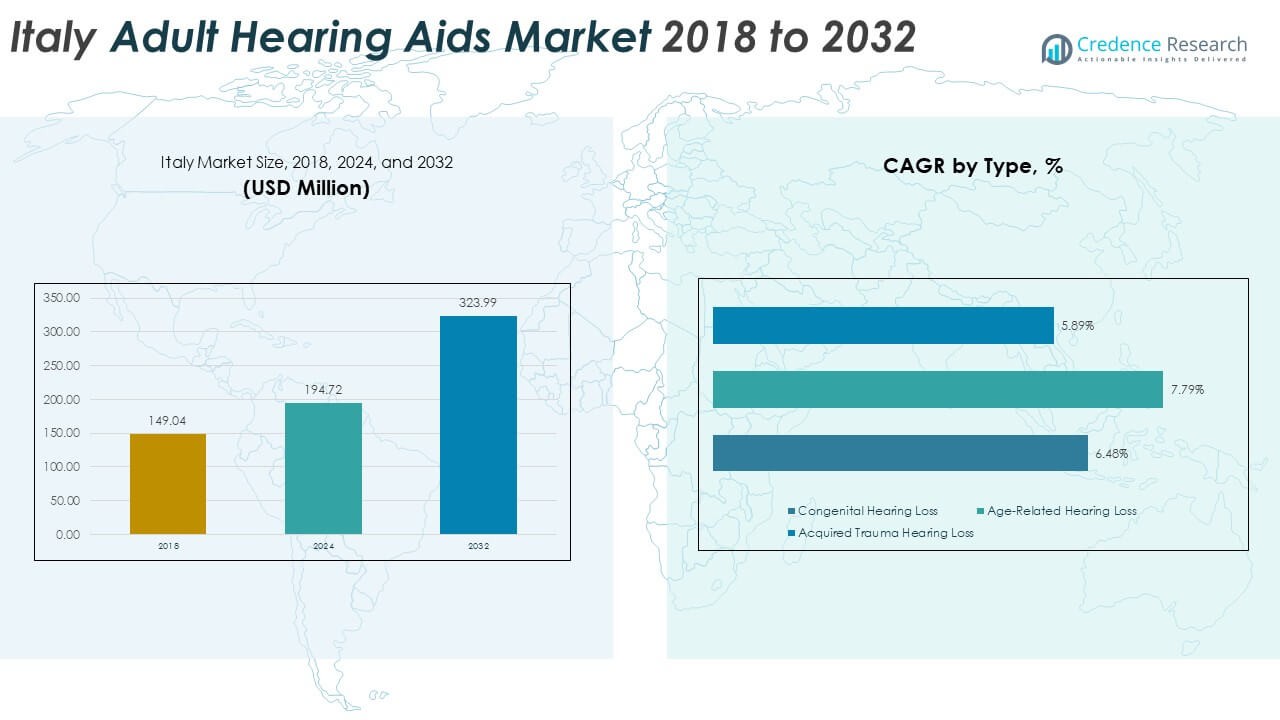
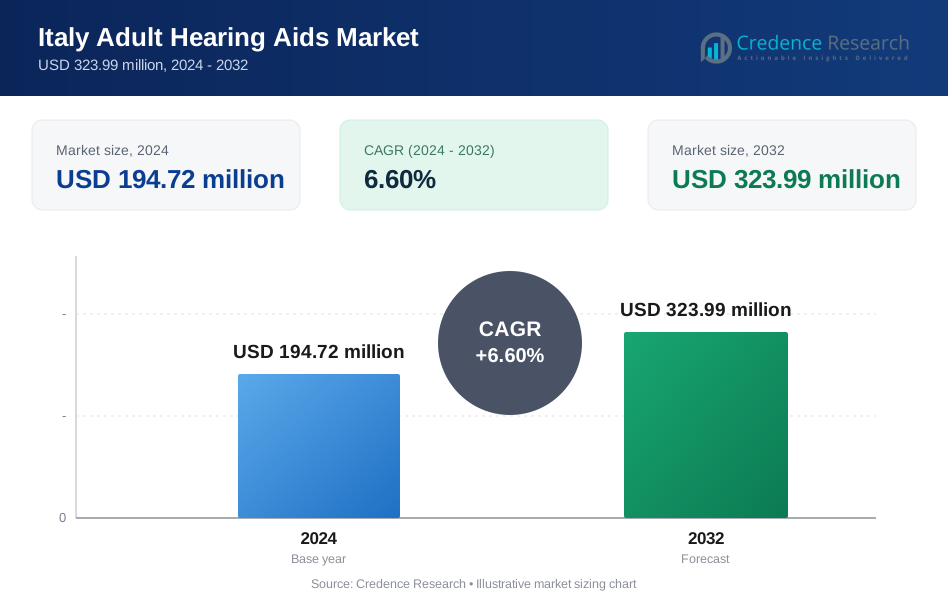
The Italy Adult Hearing Aids Market size was valued at USD 149.04 million in 2018 to USD 194.72 million in 2024 and is anticipated to reach USD 323.99 million by 2032, at a CAGR of 6.60% during the forecast period.
| REPORT ATTRIBUTE | DETAILS |
|---|---|
| Historical Period | 2020-2023 |
| Base Year | 2024 |
| Forecast Period | 2025-2032 |
| Italy Adult Hearing Aids Market Size 2024 | USD 194.72 Million |
| Italy Adult Hearing Aids Market, CAGR | 6.60% |
| Italy Adult Hearing Aids Market Size 2032 | USD 323.99 Million |
The market is gaining traction due to rising cases of age-related hearing loss and growing awareness of early intervention. Increased adoption of digital and smart hearing aids is further driving demand. Government reimbursement policies and improvements in healthcare access encourage wider usage, while technological advances such as Bluetooth-enabled devices and rechargeable models enhance convenience, meeting the needs of tech-savvy adults and elderly users alike.
Regionally, Western Europe remains the leading hub for adult hearing aids, with countries like Germany, France, and Italy showing strong adoption due to advanced healthcare systems and higher disposable incomes. Southern European nations, including Spain and Portugal, are emerging as key markets, supported by increasing awareness and expanding healthcare infrastructure. Meanwhile, Eastern Europe is experiencing gradual growth, driven by rising accessibility and improving affordability of hearing aid solutions.
Market Insights:
- The Italy Adult Hearing Aids Market was valued at USD 149.04 million in 2018, reached USD 194.72 million in 2024, and is projected to hit USD 323.99 million by 2032, registering a CAGR of 6.60%.
- Northern Italy commanded 45% of the market in 2024 due to advanced healthcare infrastructure, strong purchasing power, and high adoption of premium devices, while Central Italy accounted for 30% and Southern Italy for 25%.
- Southern Italy is the fastest-growing region with a 25% share, supported by improving healthcare investments, expanding distribution networks, and gradual reduction of stigma associated with hearing aid use.
- By type, age-related hearing loss dominates the market with nearly half of the total share in 2024, reflecting the aging population’s demand for long-term auditory support.
- Congenital and acquired trauma hearing loss together hold the remaining share, with trauma-driven cases contributing more significantly due to occupational risks and accidents.
Market Drivers
Rising Prevalence of Age-Related Hearing Loss Among the Growing Elderly Population
The rising elderly population directly influences demand for hearing aids across Italy. A large segment of adults faces age-related hearing loss that creates strong dependence on assistive devices. Early screening initiatives by healthcare providers encourage timely diagnosis. Families are increasingly supportive of adopting advanced solutions for their elderly members. The Italy Adult Hearing Aids Market benefits from targeted awareness programs promoting long-term use. Public health campaigns highlight the importance of hearing care as a part of overall wellness. More patients show acceptance of devices compared to past reluctance. This cultural shift continues to strengthen device adoption among seniors.
Expanding Role of Technological Advancements in Driving Adoption
Technology improvements encourage users to adopt new models faster than before. Digital aids now offer noise reduction, Bluetooth pairing, and AI-enabled sound adjustment. Rechargeable batteries reduce dependency on frequent replacements. The Italy Adult Hearing Aids Market experiences momentum from wearable-friendly features. Smartphone integration enables real-time adjustments, improving user comfort and convenience. Health professionals recommend advanced aids over traditional analog models. High product variety caters to both premium and cost-sensitive users. Innovation continues to bridge the gap between medical necessity and lifestyle enhancement.
- For instance, Phonak’s latest Audéo Sphere Infinio hearing aids, featuring the DEEPSONIC™ AI chip, utilize a deep neural network (DNN) trained on millions of sound samples. This technology allows the hearing aids to separate speech from background noise in real-time and from all directions, significantly improving speech clarity and reducing listening effort in noisy situations to enhance user listening comfort.
Supportive Healthcare Policies and Insurance Reimbursement Programs
Insurance coverage and state-supported healthcare programs ease financial barriers for patients. Public reimbursement reduces out-of-pocket expenses and broadens device accessibility. The Italy Adult Hearing Aids Market witnesses improved penetration due to government initiatives. Local authorities promote better healthcare equity by subsidizing essential medical devices. Hospitals and audiology clinics highlight coverage options during consultations. Policy-driven awareness increases acceptance among hesitant users. Financial assistance reassures patients and encourages earlier adoption. These measures create a structured path for sustainable growth in the sector.
- For instance, Italy provides partial reimbursement for hearing aids through its National Health System (NHS) for eligible patients with hearing loss, and a 55 dB threshold is mentioned as the minimum criteria for this public funding.
Rising Awareness Campaigns and Education Programs for Hearing Health
Awareness efforts drive higher acceptance and reduce stigma around hearing aid use. Audiologists and NGOs organize seminars to educate adults about treatment benefits. The Italy Adult Hearing Aids Market benefits from rising outreach in urban and rural areas. Families are encouraged to seek timely intervention through local programs. Medical communities highlight how untreated hearing loss impacts quality of life. Social media campaigns spread knowledge about advanced solutions. Increased visibility builds trust in device efficiency. Awareness activities continue to create favorable conditions for long-term market expansion.
Market Trends
Growing Integration of Smart and Connected Hearing Aid Solutions
Smart hearing aids now integrate seamlessly with mobile devices for improved accessibility. Patients enjoy direct streaming from smartphones, televisions, and laptops. The Italy Adult Hearing Aids Market records strong adoption of wireless connectivity. Companies introduce models with voice-assist compatibility for tech-oriented adults. These advancements support integration into daily lifestyle activities. Consumers value devices offering discreet design with powerful digital functions. Tele-audiology platforms further extend professional support to remote regions. Growing preference for smart aids highlights a broader digital healthcare trend.
Shifting Consumer Preference Toward Rechargeable and Eco-Friendly Devices
Rechargeable models reduce reliance on frequent battery purchases, saving time and money. Patients adopt sustainable solutions that reflect wider European green initiatives. The Italy Adult Hearing Aids Market aligns with demand for energy-efficient medical products. Manufacturers develop compact charging cases for convenience and portability. Improved battery life supports uninterrupted daily use. The appeal extends to both elderly and younger adult patients. Clinics promote rechargeable solutions as cost-efficient over long-term use. This trend highlights how sustainability influences medical device innovation.
Expansion of Online Sales and Remote Fitting Services
E-commerce platforms strengthen distribution for modern hearing aids across Italy. Patients enjoy direct access to a wide range of devices with competitive pricing. The Italy Adult Hearing Aids Market adapts to digital-first retail strategies. Online consultations with audiologists improve convenience for busy adults. Remote fitting tools help fine-tune devices without clinic visits. Companies invest in virtual platforms to expand customer outreach. Rural and semi-urban regions benefit from improved online accessibility. Growing digital healthcare integration accelerates the adoption of online purchase models.
- For instance, Philips offers a Remote Fitting service that enables audiologists to conduct real-time hearing aid adjustments and online counseling sessions via video or phone calls, benefiting clients who cannot easily visit clinics. The system utilizes a connection between compatible Philips HearLink hearing aids and a client's smartphone via 2.4 GHz Bluetooth Low Energy (BLE) technology
Increasing Role of Personalized and Customized Hearing Care Solutions
Patients seek customized aids that adapt to individual hearing patterns. Audiologists rely on advanced software to design personalized solutions. The Italy Adult Hearing Aids Market benefits from tailored fittings and adjustments. Patients value discreet devices aligned with personal preferences. Customization builds stronger trust between patients and healthcare providers. Companies emphasize aesthetic designs that reduce stigma. Demand for individualized care continues to gain strength in urban centers. Personalization becomes a core differentiator in a competitive marketplace.
- For instance, Phonak’s Infinio platform incorporates Biometric Calibration technology, which captures over 1,600 unique data points from a client's ear impression to optimize the individual ear's directional sensitivity.
Market Challenges Analysis
High Cost of Advanced Hearing Aids Restricting Wider Adoption Across Segments
Premium models often remain out of reach for lower-income patients. High upfront costs discourage many from purchasing technologically advanced solutions. The Italy Adult Hearing Aids Market faces a clear barrier in affordability. Limited coverage for some device categories reduces accessibility further. Patients may delay adoption due to financial priorities. Small clinics struggle to recommend premium devices to budget-sensitive patients. Cost restrictions continue to limit overall penetration rates. Addressing this challenge remains crucial for expanding market reach.
Persistent Social Stigma and Low Awareness in Rural Populations
Many adults in rural areas still view hearing aids with hesitation. Stigma prevents individuals from seeking timely intervention. The Italy Adult Hearing Aids Market experiences slower adoption outside urban centers. Limited access to audiology clinics restricts awareness campaigns in these regions. Patients often underestimate the long-term impact of untreated hearing loss. Cultural attitudes delay acceptance of medical devices in certain communities. Healthcare professionals face difficulty in addressing misconceptions. Stigma continues to remain a critical challenge for wider adoption.
Market Opportunities
Rising Demand for AI-Powered Hearing Aids and Telehealth Integration
AI-enabled hearing aids offer adaptive sound processing that enhances clarity across environments. Patients value real-time adjustments without repeated clinical visits. The Italy Adult Hearing Aids Market benefits from growth in telehealth services. Remote care solutions increase accessibility for rural and elderly populations. Integration with digital health records further supports better long-term monitoring. Companies investing in AI-driven products capture strong interest from modern consumers. AI personalization boosts adoption across both tech-savvy and aging demographics. Future innovation in this area presents significant opportunities.
Expanding Potential in Untapped Semi-Urban and Rural Regions
Semi-urban and rural regions remain underpenetrated with limited device availability. Rising healthcare infrastructure investment improves outreach in these areas. The Italy Adult Hearing Aids Market stands to benefit from focused distribution programs. Companies expanding retail presence in smaller towns enhance accessibility. Awareness campaigns addressing stigma build trust among new users. Partnerships with local clinics encourage adoption of cost-friendly devices. Community-led initiatives increase acceptance across wider demographics. Rural market potential represents a critical growth driver for the sector.
Market Segmentation Analysis:
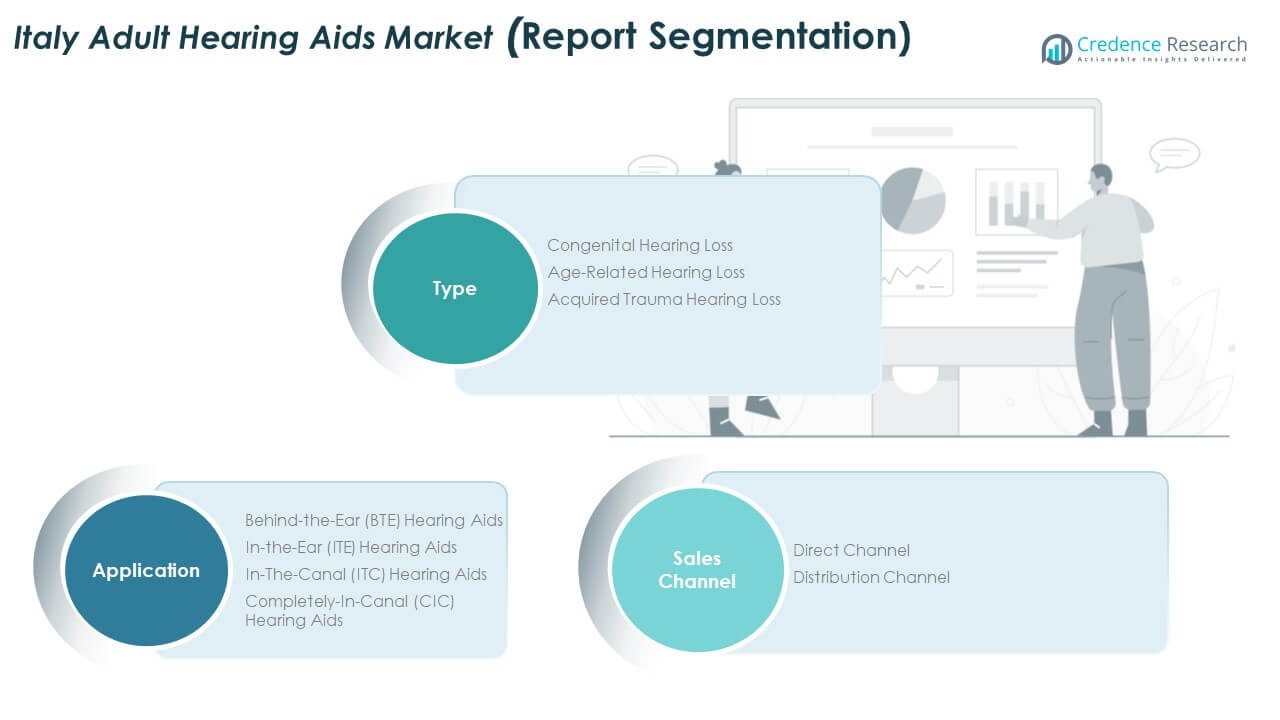
The Italy Adult Hearing Aids Market is segmented
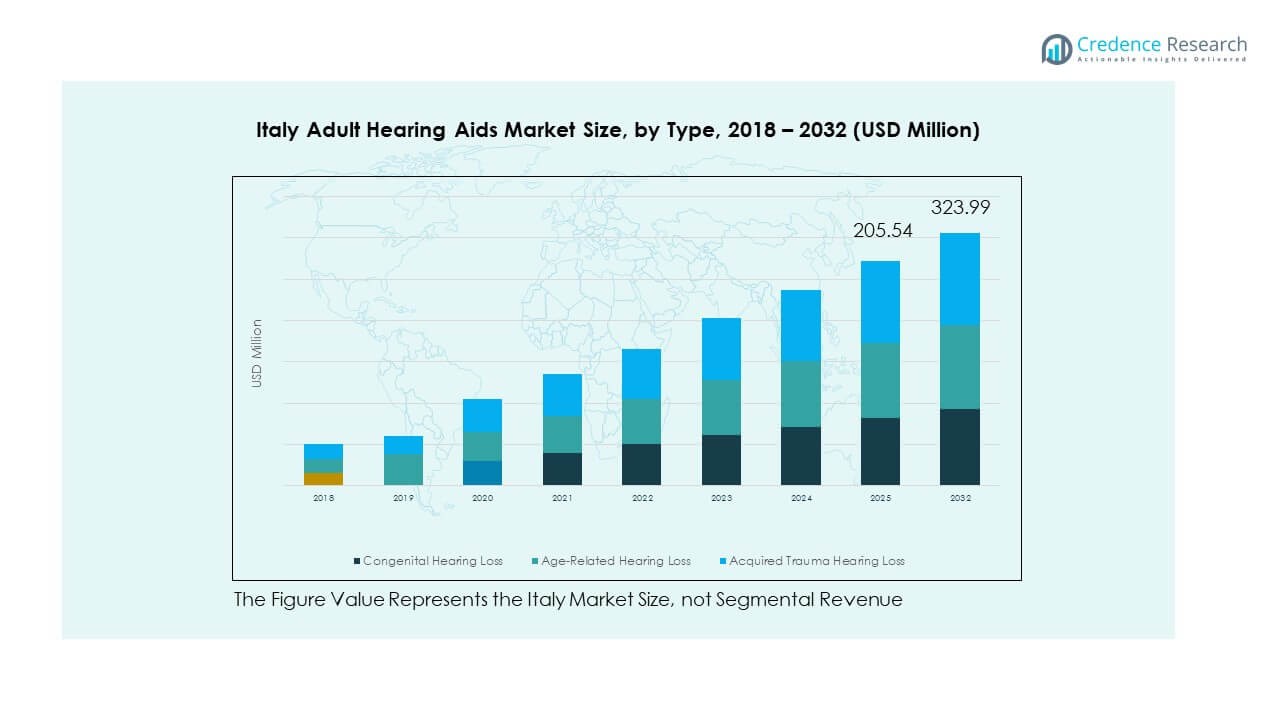
By type into congenital hearing loss, age-related hearing loss, and acquired trauma hearing loss. Age-related hearing loss dominates due to the large elderly population and increasing awareness of early intervention. Congenital hearing loss represents a smaller but stable segment supported by healthcare initiatives for early detection. Acquired trauma hearing loss contributes steadily, driven by accidents and occupational hazards that require medical support and device adoption. Each type reflects a distinct patient base with specific treatment priorities.
- For instance, the Early Hearing Detection and Intervention (EHDI) program in Utah ensures all newborns receive hearing screening within the first month after birth, with those who do not pass ideally completing diagnostic evaluations before 3 months of age and starting intervention services by 6 months. This "1-3-6" benchmark aims to optimize language development in infants with congenital hearing loss by providing early access to necessary support.
By application, the market includes Behind-the-Ear (BTE), In-the-Ear (ITE), In-the-Canal (ITC), and Completely-In-Canal (CIC) hearing aids. BTE devices lead demand due to durability, ease of handling, and suitability for severe cases. ITE and ITC segments gain traction among adults seeking discreet options with advanced features. CIC aids appeal to patients who prioritize aesthetics and comfort, particularly among younger adults. Product variety supports a wide spectrum of user preferences and clinical needs, strengthening overall adoption.
By sales channel, the market is divided into direct and distribution channels. Distribution channels account for a strong share, supported by retail networks, audiology clinics, and pharmacies that provide accessibility nationwide. Direct channels are expanding through company-owned outlets and digital platforms offering personalized fittings and after-sales service. It is witnessing higher online adoption as e-commerce platforms build trust and provide convenience for adults seeking quick access to devices. This diversified sales structure ensures comprehensive coverage across urban and rural regions.
- For instance, Phonak hosts virtual product launches and provides product information on its website, highlighting AI-driven technology like the Audéo Sphere™ Infinio for improved sound clarity, especially in noise.
Segmentation:
By Type
- Congenital Hearing Loss
- Age-Related Hearing Loss
- Acquired Trauma Hearing Loss
By Application
- Behind-the-Ear (BTE) Hearing Aids
- In-the-Ear (ITE) Hearing Aids
- In-The-Canal (ITC) Hearing Aids
- Completely-In-Canal (CIC) Hearing Aids
By Sales Channel
- Direct Channel
- Distribution Channel
Regional Analysis:
Northern Italy holds the largest share of the Italy Adult Hearing Aids Market, accounting for 45% of the overall market. The region benefits from advanced healthcare infrastructure, higher disposable incomes, and widespread awareness of hearing care solutions. Cities like Milan and Turin act as hubs for specialized audiology clinics and retail networks. Strong presence of international manufacturers and distributors supports better product availability. Patients in this region adopt premium devices due to their affordability and lifestyle integration. It remains a key growth center driven by innovation and early adoption of digital aids.
Central Italy contributes 30% of the market share, supported by strong healthcare accessibility and rising awareness of preventive care. Rome and Florence host several established clinics and government-supported initiatives that encourage adoption of hearing aids. The region reflects balanced demand across both premium and cost-effective product categories. Patients show increasing interest in rechargeable and discreet models that combine functionality with convenience. It demonstrates consistent demand growth, driven by public-private collaboration in healthcare programs. Central Italy continues to expand its role as a stable and diversified contributor to the national market.
Southern Italy, including islands such as Sicily and Sardinia, represents 25% of the Italy Adult Hearing Aids Market. This region faces slower adoption due to limited infrastructure and higher prevalence of stigma around hearing aid use. Distribution channels dominate, as direct access to specialized clinics remains limited in rural areas. Patients often rely on retail networks and government support to meet healthcare needs. Growing investments in healthcare facilities are gradually improving accessibility. It shows strong potential for long-term growth once awareness campaigns and rural outreach programs expand further.
Key Player Analysis:
- GN Hearing
- Horentek
- GrandAudition
- WS Audiology
- GN ReSound
- La Otofarma S.p.A
- Sebotek Hearing Systems
- Audina Hearing Instruments
- Microson
- Amplifon
- Phonak
- Others
Competitive Analysis:
The Italy Adult Hearing Aids Market is characterized by the presence of global leaders and strong domestic players. Companies such as GN Hearing, Phonak, WS Audiology, and Amplifon dominate with extensive product portfolios and established retail networks. Local firms like La Otofarma S.p.A and GrandAudition strengthen the market with regional expertise and personalized services. Competitive intensity is shaped by constant product innovation, digital integration, and expansion of service-oriented offerings. It is also influenced by collaborations with healthcare providers that enhance trust and device adoption among patients. Amplifon maintains a leadership role through its extensive retail presence and customer-focused approach. GN ReSound and WS Audiology compete strongly by emphasizing advanced digital technologies, rechargeable models, and Bluetooth-enabled solutions. Niche players such as Sebotek and Audina focus on discreet and specialized devices targeting younger adults and patients seeking aesthetic appeal. It is becoming more competitive as companies leverage online platforms, tele-audiology services, and direct-to-consumer sales models. Strategic developments, including mergers, acquisitions, and new product launches, continue to reshape market dynamics.
Recent Developments:
- In August 2025, William Demant Invest entered a three-year research collaboration with Lineage Cell Therapeutics to develop ReSonance (ANP1), an auditory neuronal cell transplant targeting hearing loss. William Demant will fund up to $12 million for preclinical development in this pioneering initiative.
- In June 2025, Starkey announced a partnership with MED-EL, introducing DualSync, a bimodal streaming technology that allows seamless audio from Apple devices to both Starkey hearing aids (Edge AI and Genesis AI) and MED-EL cochlear implants, launching July 1, 2025. This collaboration aims to unify wireless connectivity for users requiring both technologies.
- In August 2024, Sonova Holding AG launched the Phonak Audéo Infinio Sphere, a new receiver-in-canal (RIC) hearing aid featuring advanced Bluetooth connectivity, IP68+ water resistance, and next-generation fitness tracking capabilities, further establishing their innovation leadership in the adult hearing aids market.
Report Coverage:
The research report offers an in-depth analysis based on Type, Application and Sales Channel. It details leading market players, providing an overview of their business, product offerings, investments, revenue streams, and key applications. Additionally, the report includes insights into the competitive environment, SWOT analysis, current market trends, as well as the primary drivers and constraints. Furthermore, it discusses various factors that have driven market expansion in recent years. The report also explores market dynamics, regulatory scenarios, and technological advancements that are shaping the industry. It assesses the impact of external factors and global economic changes on market growth. Lastly, it provides strategic recommendations for new entrants and established companies to navigate the complexities of the market.
Future Outlook:
- The Italy Adult Hearing Aids Market will expand as aging demographics continue to create consistent demand.
- Rising awareness campaigns will improve early diagnosis rates, encouraging broader adoption across adult groups.
- Technological integration, including AI-driven devices and telehealth support, will drive product innovation.
- Rechargeable and eco-friendly solutions will gain momentum, aligning with sustainability goals and patient convenience.
- Distribution networks will maintain dominance, while direct-to-consumer and online sales channels strengthen steadily.
- Premium hearing aid categories will expand, supported by patients seeking advanced features and better aesthetics.
- Rural and semi-urban markets will emerge as critical growth zones with increasing infrastructure investment.
- Collaborations between healthcare providers and manufacturers will accelerate patient education and trust-building.
- Competitive intensity will rise as global leaders and domestic firms enhance product portfolios and outreach.
- Market expansion will be shaped by policy support, reimbursement improvements, and growing healthcare investments.
Request a Free Sample
Fill in your details and we'll send you a free sample report.
- Sample data tables & charts
- Research methodology
Need a Custom Version of This Report?
Tailor the scope, geography, or segments to your exact requirements.
- Custom geography or segment scope
- Direct access to our analyst team
Frequently Asked Questions
What is the current market size for Italy Adult Hearing Aids Market, and what is its projected size in 2032?
At what Compound Annual Growth Rate is the Italy Adult Hearing Aids Market projected to grow between 2024 and 2032?
Which Italy Adult Hearing Aids Market segment held the largest share in 2024?
What are the primary factors fueling the growth of the Italy Adult Hearing Aids Market?
Who are the leading companies in the Italy Adult Hearing Aids Market?
Which region commanded the largest share of the Italy Adult Hearing Aids Market in 2024?
Table of Content
Chapter 1. Report Introduction
- 1.1 Report Description & Purpose
- 1.1.1 Report Title & Market Definition
- 1.1.2 Unique Selling Propositions (USP) & Key Differentiators
- 1.1.3 Value Proposition for Stakeholders
- 1.2 Research Objectives
- 1.2.1 Market Sizing Objectives (Volume & Revenue)
- 1.2.2 Segmentation Objectives
- 1.2.3 Competitive Intelligence Objectives
- 1.2.4 Forecast & Scenario Objectives
- 1.3 Report Scope
- 1.3.1 Italy Adult Hearing Aids Scope – Types & Subtypes Covered
- 1.3.2 Geographic Scope – Regions & Countries Covered
- 1.3.3 Historical Period, Base Year & Forecast Period (2024; forecast to 2032)
- 1.3.4 Inclusions & Exclusions
- 1.4 HS Code & Classification Framework
- 1.5 Currency, Units & Pricing Basis
- 1.6 Target Stakeholders
- 1.7 Limitations & Assumptions
Chapter 2. Executive Summary
- 2.1 Global Italy Adult Hearing Aids Market Snapshot
- 2.1.1 Market Size – Historical (2024) & Forecast (2024-2032) (2024: USD 194.72 million → 2032: USD 323.99 million)
- 2.1.2 Volume & Revenue – Global Totals
- 2.1.3 Key Market Highlights – Top Five Facts
- 2.2 Italy Adult Hearing Aids Market Segmentation Snapshot
- 2.2.1 Market Split by Region – 2024 vs. 2032
- 2.3 Competitive Snapshot
- 2.3.1 Top 10 Players by Revenue Share – 2024
- 2.3.2 Top 10 Players by Volume Share – 2024
- 2.3.3 Recent Strategic Developments (18-Month Summary)
- 2.4 Key Investment Highlights & Strategic Conclusions
Chapter 3. Italy Adult Hearing Aids Market Dynamics & Industry Analysis
- 3.1 Market Overview & Context
- 3.1.1 Italy Adult Hearing Aids Market Position in the Broader Automotive Value Chain
- 3.1.2 OEM vs. Replacement Market Dynamics
- 3.1.3 Market Maturity & Development Stage by Region
- 3.2 Italy Adult Hearing Aids Market Drivers
- 3.3 Italy Adult Hearing Aids Market Restraints & Challenges
- 3.4 Italy Adult Hearing Aids Market Opportunities
- 3.5 Porter's Five Forces Analysis
- 3.5.1 Threat of New Entrants
- 3.5.2 Bargaining Power of Suppliers
- 3.5.3 Bargaining Power of Buyers
- 3.5.4 Threat of Substitutes
- 3.5.5 Competitive Rivalry – Intensity Assessment
- 3.6 Italy Adult Hearing Aids Value Chain Analysis
- 3.6.1 Upstream – Raw Material/Input Suppliers
- 3.6.1.1 Raw Material/Input 1
- 3.6.1.2 Raw Material/Input 2
- 3.6.1.3 Raw Material/Input 3
- 3.6.2 Midstream – Production/Manufacturing/Service Delivery
- 3.6.2.1 Production/Process Overview
- 3.6.2.2 Key Facility Locations & Capacity by Manufacturer
- 3.6.3 Downstream – Distribution & End Consumer
- 3.6.3.1 Primary Channel – B2B/OEM
- 3.6.3.2 Secondary Channels – Dealer, Retail, Online, Direct
- 3.6.4 Value Chain Profitability Analysis
- 3.6.1 Upstream – Raw Material/Input Suppliers
- 3.7 PESTEL Analysis
- 3.7.1 Political Factors
- 3.7.2 Economic Factors
- 3.7.3 Social Factors
- 3.7.4 Technological Factors
- 3.7.5 Environmental Factors
- 3.7.6 Legal Factors
- 3.8 Italy Adult Hearing Aids Supply Chain Analysis
- 3.8.1 Raw Material/Input Supply Risk Assessment
- 3.8.2 Manufacturing Concentration Risk (Geographic Exposure)
- 3.8.3 Trade Disruption Impact Analysis
- 3.9 Regulatory & Policy Landscape
Note: The regulatory and policy landscape section covers regulations based on their applicability to the market, Italy Adult Hearing Aids category, geography, and scope of the study. Only regulatory frameworks with a material impact on operations, compliance, trade, sustainability, or market access are analyzed in detail.
Chapter 4. Key Investment Pockets & Opportunity Analysis
- 4.1 Italy Adult Hearing Aids Market Attractiveness Analysis
- 4.1.1 By Region – Investment Attractiveness Matrix (Volume × CAGR)
- 4.2 Absolute Revenue Growth Opportunity
- 4.2.1 By Region – Absolute USD Growth Through 2032
- 4.3 Incremental Volume Opportunity
- 4.3.1 By Region – Incremental Volume Through 2032
- 4.3.2 Segment – Incremental Volume
- 4.4 Emerging Submarket Opportunity Deep Dive (Subject to Applicability)
- 4.5 Emerging Market Opportunity Scorecards
- 4.5.1 United States
- 4.5.2 Europe
- 4.5.3 Asia
- 4.5.4 Middle East & Africa
Note: Emerging Market Opportunity Scorecards will be included based on relevance and strategic importance. Regions listed are indicative and may vary depending on data availability and market dynamics.
Chapter 5. Italy Adult Hearing Aids Import-Export Analysis & Trade Flows
- 5.1 Global Trade Overview
- 5.1.1 Global Export Value by Country (2024)
- 5.1.2 Global Export Volume by Country (2024)
- 5.1.3 Global Import Value by Country (2024)
- 5.1.4 Global Import Volume by Country (2024)
- 5.1.5 Net Trade Balance by Country (2024)
- 5.2 Export Analysis – Segment
- 5.2.1 Type 1 (HS Code)
- 5.2.2 Type 2 (HS Code)
- 5.2.3 Type 3 (HS Code)
- 5.2.4 Type 4 (HS Code)
- 5.2.5 Type 5 (HS Code)
- 5.3 Import Analysis – Segment
- 5.3.1 Type 1 (HS Code)
- 5.3.2 Type 2 (HS Code)
- 5.3.3 Type 3 (HS Code)
- 5.3.4 Type 4 (HS Code)
- 5.3.5 Type 5 (HS Code)
- 5.4 Average Unit Trade Prices
- 5.4.1 Average Export Price – Segment & Country
- 5.4.2 Average Import Price – Segment & Source Country
- 5.4.3 Price Trends (2024)
- 5.5 Key Trade Route Analysis
- 5.5.1 Trade Route 1
- 5.5.2 Trade Route 2
- 5.5.3 Trade Route 3
- 5.5.4 Trade Route 4
- 5.5.5 Trade Route 5
- 5.6 Trade Policy Impact Assessment
- 5.6.1 US Anti-Dumping & Section 301 Tariffs
- 5.6.2 EU Customs Union Impact
- 5.6.3 Major Free Trade Agreements
- 5.6.4 USMCA Rules of Origin
Note: Trade policy analysis will be included only where relevant to the Italy Adult Hearing Aids market.
Chapter 6. Competitive Landscape & Company Benchmarking
- 6.1 Italy Adult Hearing Aids Market Concentration & Structure
- 6.1.1 Herfindahl-Hirschman Index (HHI) – vs. 2024
- 6.1.2 Tier 1, Tier 2 & Tier 3 Market Structure
- 6.1.3 Global, Regional & Local Player Dynamics
- 6.2 Italy Adult Hearing Aids Market Share Analysis – 2024
- 6.2.1 Global Revenue Share by Company
- 6.2.2 Global Volume Share by Company
- 6.2.3 Regional Revenue Share
- 6.2.4 Market Share Evolution ( vs. 2024)
- 6.2.5 OEM Segment Share by Company
- 6.2.6 Replacement Segment Share by Company
- 6.3 Production/Delivery Capacity & Facility Analysis
- 6.3.1 Global Installed Capacity
- 6.3.2 Capacity Utilization Rates
- 6.3.3 Production/Output Volume
- 6.3.4 Facility Locations & Capacity Map
- 6.3.5 Planned Capacity Additions
- 6.4 Italy Adult Hearing Aids Competitive Benchmarking Matrix
- 6.4.1 Revenue, Volume, CAGR & Profitability Comparison
- 6.4.2 Channel Revenue Mix
- 6.4.3 Geographic Revenue Exposure
- 6.4.4 R&D Intensity
- 6.4.5 Sustainability Maturity
- 6.5 Strategic Developments in Italy Adult Hearing Aids (Last 24 Months)
- 6.5.1 Mergers, Acquisitions & Divestments
- 6.5.2 New Italy Adult Hearing Aids Launches
- 6.5.3 Facility Expansions
- 6.5.4 Strategic Alliances, Joint Ventures & Partnerships
- 6.5.5 Distribution Expansion & Market Entry
- 6.5.6 Sustainability & ESG Initiatives
- 6.6 Competitive Strategy Mapping
- 6.6.1 Leader, Challenger, Follower & Niche Classification
- 6.6.2 Pricing Strategy Comparison
- 6.6.3 Channel Strategy Matrix
Note: Strategic developments are included based on their materiality and the availability of reliable information.
Chapter 7. Global Italy Adult Hearing Aids Market – By Distribution Channel
- 7.1 Segment Overview
- 7.1.1 Volume & Revenue Split by Channel (2024 & 2032)
- 7.1.2 Channel Mix Evolution (2024-2032)
Chapter 8. Regional Market Analysis – Global Overview
- 8.1 Global Regional Overview
- 8.1.1 Regional Volume Share
- 8.1.2 Regional Revenue Share
- 8.1.3 Regional Volume by Region
- 8.1.4 Regional Revenue by Region
- 8.1.5 Regional Forecast Through 2032
- 8.2 Cross-Regional Segment Analysis
- 8.2.1 By Distribution Channel
- 8.2.2 By Brand/Price Tier
Chapter 9. North America Italy Adult Hearing Aids Market
- 9.1 United States
- 9.2 Canada
- 9.3 Mexico
Chapter 10. Europe Italy Adult Hearing Aids Market
- 10.1 Germany
- 10.2 France
- 10.3 Italy
- 10.4 United Kingdom
- 10.5 Spain
- 10.6 Poland
- 10.7 Russia
- 10.8 Netherlands
- 10.9 Belgium
- 10.10 Sweden
- 10.11 Denmark
- 10.12 Norway
- 10.13 Rest of Europe
Chapter 11. Asia Pacific Italy Adult Hearing Aids Market
- 11.1 China
- 11.2 India
- 11.3 Japan
- 11.4 South Korea
- 11.5 Thailand
- 11.6 Indonesia
- 11.7 Vietnam
- 11.8 Malaysia
- 11.9 Australia
- 11.10 Rest of Asia Pacific
Chapter 12. Latin America Italy Adult Hearing Aids Market
- 12.1 Brazil
- 12.2 Argentina
- 12.3 Colombia
- 12.4 Chile
- 12.5 Rest of Latin America
Chapter 13. Middle East Italy Adult Hearing Aids Market
- 13.1 Saudi Arabia
- 13.2 United Arab Emirates
- 13.3 Turkey
- 13.4 Israel
- 13.5 Iran
- 13.6 Rest of the Middle East
Chapter 14. Africa Italy Adult Hearing Aids Market
- 14.1 South Africa
- 14.2 Egypt
- 14.3 Nigeria
- 14.4 Morocco
- 14.5 Rest of Africa
Chapter 15. Italy Adult Hearing Aids Company Profiles
- 15.1 [Company 01]
- 15.1.1 Company Overview
- 15.1.2 Key Management Personnel
- 15.1.3 Products & Services Portfolio
- 15.1.4 Financial Performance
- 15.1.5 Key Market Focus & Geographic Presence
- 15.1.6 Recent Developments & Strategic Initiatives
Note: The company profile list is preliminary and may change based on research findings, market developments, data availability, and client requirements.
Chapter 16. Appendices
- Appendix A – List of Abbreviations & Acronyms
- Appendix B – Industry Classification Code Reference – Full Series
- Appendix C – Production & Capacity Data Tables
- Appendix D – End-Use & Demand Base Tables
- Appendix E – Consumption & Replacement Rate Assumptions
- Appendix F – ASP Reference Tables
- Appendix G – Manufacturing & Facility Database
- Appendix H – Import-Export Data Tables
- Appendix I – Regulatory Summary Tables
- Appendix J – Primary Research Participant List (Anonymized)
- Appendix K – Primary Research Questionnaire Framework
- Appendix L – Data Sources & Bibliography
- Appendix M – Market Size Divergence & Source Comparison
Chapter 17. Research Methodology
- 17.1 Research Framework & Philosophy
- 17.2 Secondary Research – Sources, Hierarchy & Data Extraction
- 17.3 Data Modeling – Bottom-Up & Top-Down Market Sizing
- 17.4 Primary Research – Stakeholder Framework, LOI & Sample Sizes
- 17.5 Forecast Methodology – Regression, Scenario & Sensitivity Analysis
- 17.6 Quality Control – Four-Layer Validation Framework
- 17.7 Limitations & Standard Assumptions
- 17.8 Disclaimer
