
Market Insights
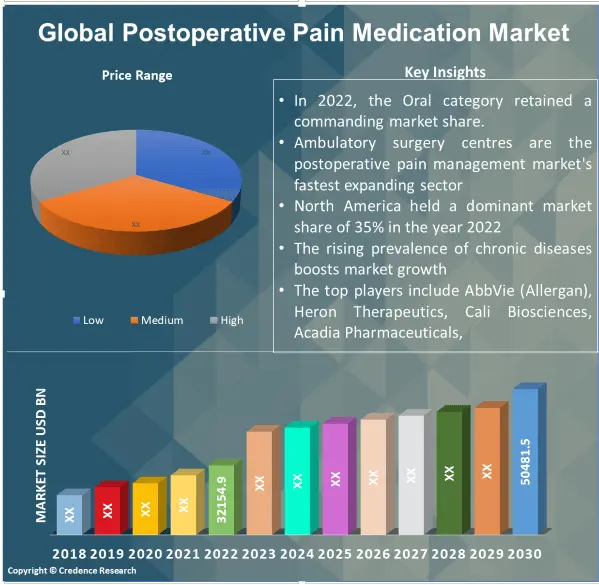
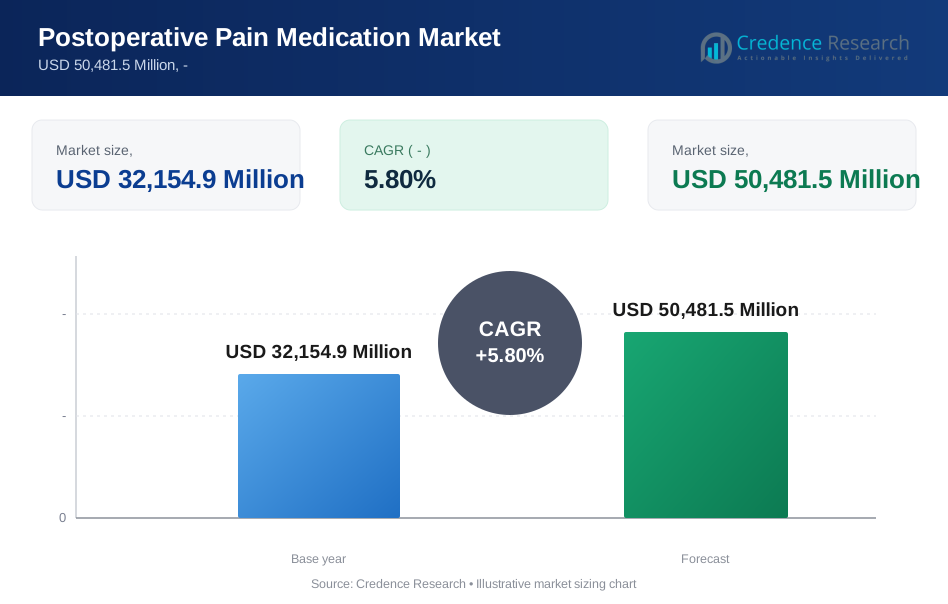
- The global demand for postoperative pain medication was valued at USD 32154.9 Million in 2022 and is expected to reach USD 50481.5 Million in 2030, growing at a CAGR of 5.80% between 2023 and 2030.
- The opioid category maintained a dominant market share, and NSAIDs are predicted to grow at the quickest CAGR.
- The oral category retains a dominant market share, while the intravenous sector holds the market's second highest share.
- Orthopedic surgery is a major player in the postoperative pain treatment sector. Abdominal procedures are another important component of the postoperative pain management market.
- Ambulatory surgery centres are the fastest growing sector in the postoperative pain treatment industry, while hospitals and clinics are another segment with significant market demand.
- Pediatric patients have the highest compound annual growth rate (CAGR), and geriatric patients are another important market segment among them.
- North America held a 35% market share in 2022, and Asia-Pacific is predicted to grow at the fastest CAGR.
- The expansion of ambulatory surgical centres increases the size of the postoperative pain market to drive market growth.
- The unpleasant side effects of medication are hindering market growth.
Executive Summary
Market Definition
Postoperative pain management refers to the medical tactics and interventions used to relieve patients' pain and discomfort following surgical procedures. It entails the administration of drugs, such as analgesics, to control pain and assure the patient's comfort during the recovery phase. Non-pharmacological pain management approaches, such as physical therapy, relaxation techniques, and alternative therapies, may also be used to supplement the pain management plan. Postoperative pain management's primary purpose is to offer effective pain relief, promote patient recovery, and improve overall outcomes following surgery.
Market Overview
It is anticipated that between 2023 and 2030, the worldwide Postoperative Pain Medication Market will expand at a compound annual growth rate (CAGR) of 5.80%from USD 32154.9 million in 2022, the market is projected to be worth USD 50481.5 million by 2030.
The postoperative pain management industry is expected to expand significantly in the future years. Several factors are driving this expansion, including an increase in the number of surgical procedures performed globally. Furthermore, the rising prevalence of chronic conditions demanding surgery, as well as the growing elderly population, are driving market growth.
However, there are certain limitations to consider. The risk of side effects associated with pain drugs is one of the major concerns, which has led to an increasing preference for non-pharmacological pain management strategies. This shift in desire gives an opportunity for the development of novel pain management therapies with minimal adverse effects.
Overall, the market for postoperative pain management presents a great opportunity for companies to deliver novel pain management solutions. There is great potential for significant development and improvement in patient outcomes by addressing the limits of existing drugs and tapping into the desire for non-pharmacological treatments.
Segmentation by Medication Type
- In 2022, the opioid category retained a commanding market share. This is due to the ingestion of opioids or opiates via numerous routes such as oral, transdermal, parenteral, neuraxial, and rectal. Morphine, paracetamol, hydromorphone (Dilaudid), and fentanyl are the most often used intravenous opioids for postoperative pain.
- NSAIDs, are expected to expand at the fastest CAGR of 6.1% between 2022 and 2030. This is because nonsteroidal anti-inflammatory medications are used to manage postoperative pain. NSAIDs, such as Naproxen, are quite effective for postoperative pain control.
Segmentation by Role of Administration
- In 2022, the oral category retained a commanding market share because oral administration is the most common means of treating acute or chronic pain, morphine, hydromorphone, paracetamol, hydrocodone, and oxycodone are commonly utilized.
- The intravenous segment holds the second largest share in the market. Intravenous pain management involves the administration of pain medication directly into the bloodstream, providing quick and effective pain relief.
Segmentation by Surgical Procedure
- One of the most dominant areas in the postoperative pain treatment industry is orthopedic surgery.
- Another key component of the postoperative pain management market is abdominal procedures.
Segmentation by End-Users
- Ambulatory surgery centres are the postoperative pain management market's fastest expanding sector. This is because, when compared to hospitals and clinics, ambulatory surgery centres provide various advantages such as cost-effectiveness, convenience, and quicker recovery times.
- Hospitals and clinics are another segment with considerable market demand. Hospitals and clinics play an important role in providing patients with comprehensive postoperative pain management services.
Segmentation by Patient Profile
- The pediatric patients sector has the greatest compound annual growth rate (CAGR). This is due to increased awareness and focus on pediatric pain management, developments in pediatric surgical methods, and a rising demand for specialist pain management treatments for children having surgery.
- The geriatric patients sector is another key market segment among them. As the population ages, so does the demand for specialized pain care for older persons having surgery.
Segmentation by Region
- North America held a dominant market share of 35% in the year 2022.
- Over the projected period 2022-2030, Asia-Pacific is expected to develop at the quickest CAGR
- The rest of the world, including Latin America, the Middle East, and Africa, supplies the remaining demand for Postoperative Pain Medication.
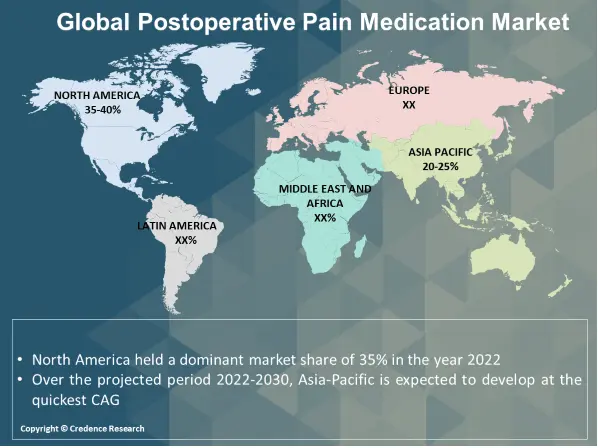
In the year 2022, North America owned a 35% market share. This is due to the existence of key market competitors as well as significant expenditure in the development of innovative treatments. For instance, in October 2021, researchers from Duke University and the University of California discovered kenpaullone, a novel medication for chronic pain, with the KKC2 gene, which is required for pain signal suppression. Such increasing innovation aids in the expansion of the Postoperative Pain Market share.
Asia-Pacific is forecast to expand at the fastest CAGR between 2022 and 2030. This is due to an increase in hospitalizations for surgery. According to the Asian Development Bank, almost 645,000 people are killed in traffic accidents throughout Asia and the Pacific each year. With such a high rate of hospitalization for surgeries and an increase in the number of accidents in this region, demand for postoperative pain management would increase, fueling the expansion of the Postoperative Pain Market share over the projected period.
Key Highlights of the Report
The global Postoperative Pain Medication Market is segmented by medication type, role of administration, surgical procedure, end-users, patient profileand region.The oral and opioid categories maintained a strong market share. Furthermore, ambulatory surgical centres are the fastest growing sector of the postoperative pain treatment industry, and the pediatric patients sector has the highest compound annual growth rate (CAGR), with North Amercaleading the market growth.
The key market drivers include the expanding number of surgical operations globally, growing awareness of the need of excellent pain management, and innovations in pharmaceutical formulations and medicine delivery modalities. Furthermore, the primary issues confronting the postoperative pain management market are the need for effective pain control while minimizing side effects, the heterogeneity in individual pain experiences and treatment reactions, and the need for continuous monitoring and adjustment of pain management strategies.
Nonetheless, North America will have a 35% market share in 2022. This is because there are big market rivals as well as significant investment in the development of innovative medicines. Furthermore, the Asia-Pacific region is expected to develop at the quickest CAGR between 2022 and 2027. This is attributed to an increase in surgical hospitalizations. Each year, about 645,000 people are killed in road accidents across Asia and the Pacific, according to the Asian Development Bank.
What Elements Are Driving the Global Market for Postoperative Pain Medication?
The increasing number of surgical procedures worldwide, rising knowledge about the necessity of good pain management, and advancements in pharmaceutical formulations and medication delivery techniques are the primary market drivers.
What Are The Main Obstacles That The Global Postoperative Pain Medication Market Faces?
The primary issues confronting the postoperative pain medication market are the requirement for effective pain control while reducing side effects, the heterogeneity in individual pain experiences and reactions to treatment, and the necessity for continual monitoring and adjustment of pain management strategies. Furthermore, there may be access issues to specialized pain management services, as well as a need for increased education and understanding about the necessity of comprehensive pain treatment in the healthcare community.
What Market Development Prospects Are There For Postoperative Pain Medication Globally?
The use of multimodal techniques, integration of digital health technology for real-time monitoring, and collaboration between healthcare providers and patients to establish tailored pain management regimens are among the significant potential in the postoperative pain medication market. These prospects seek to improve pain relief, patient satisfaction, and recovery outcomes in postoperative care.
Market Drivers
The global Postoperative Pain Medication Market is driven by several factors. The following are the key drivers of the global Postoperative Pain Medication Market:
Rising Prevalence Of Chronic Diseases
The rising prevalence of chronic diseases such as arthritis and cancer, both of which cause significant pain, raises the demand for pain management and treatment. The World Cancer Research Fund estimates that there will be approximately 18.1 million cancer cases in 2020. Cancer pain can be caused by a tumour pressing against bones, organs, or nerves. For example, compression of the spinal cord caused discomfort when a tumour penetrated the spine and exerted pressure on the spinal cord's nerves. Spinal anesthesia has been shown to be beneficial in the treatment of severe pain in reducing spinal discomfort.The increasing prevalence of chronic diseases such as arthritis and cancer, as well as the necessity for pain management treatment, drive the growth of the Postoperative Pain Industry throughout the projected period of 2022-2027.
Expansion Of Ambulatory Surgical Centres
The expanding number of ambulatory surgery centres (ASCs) boosts the Postoperative Pain Market's growth rate. This is due to the lower cost of treatment when compared to a hospital stay and the more convenient service style of ambulatory surgery centres. Furthermore, the expanding senior population drives up demand for ambulatory surgical centres. According to the Association of Wisconsin Surgery Centres, there are roughly 5,300 ambulatory surgery centres in the United States, with ASCs outnumbering hospitals in several states. Furthermore, surgery centres undertake approximately 23 million surgeries per year, and the Centres for Medicare & Medicaid Services (CMS) approves novel techniques for the ASC environment each year, propelling the Postoperative Pain Industry forward.
Market Restraints
The global Postoperative Pain Medication Market faces some challenges that may hinder its growth. These include the following:
Balancing Effective Pain Control And Side Effect Minimization In Postoperative Pain Medication
One of the most difficult problems is striking a fine balance between efficiently treating pain and limiting harmful adverse effects of pain drugs. It is critical to select the proper medicine combination and dose to offer significant pain relief without producing undesired side effects such as sleepiness, nausea, or respiratory depression. To achieve this balance, pain management regimens must be carefully monitored and adjusted to guarantee maximum patient comfort and safety during the recovery process. To adapt pain management measures, healthcare practitioners must consider specific patient criteria such as age, medical history, and drug sensitivities. Furthermore, continuing research and advances in pain management approaches are aimed at addressing this issue and improving patient outcomes in postoperative care.
Opportunities
The global Postoperative Pain Medication Market offers significant growth opportunities. These include the following:
Multimodal Approaches to Improving Patient Care and Outcomes
The market's use of multimodal techniques offers a potential to improve patient care and results. Healthcare practitioners can construct complete treatment regimens that address the many components of a patient's disease by integrating diverse modalities, such as drugs, physical therapy, and alternative therapies. This method provides for a more individualized and customised approach to patient treatment, taking into consideration individual requirements and preferences. Multimodal techniques can also serve to lessen dependency on a single treatment modality, thereby lowering the risk of adverse effects or medication resistance.
Competitive Landscape
Key Players
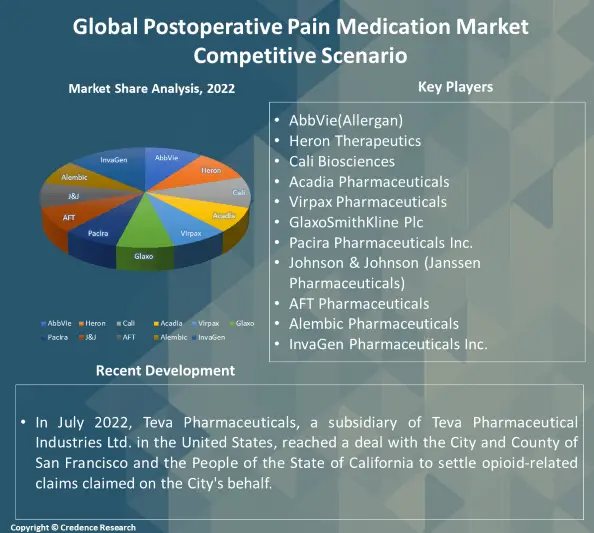
The global Postoperative Pain Medication Market is highly competitive, with several key players. Some of the major players in the market and their market share are as follows:
- AbbVie (Allergan)
- Heron Therapeutics
- Cali Biosciences
- Acadia Pharmaceuticals
- Virpax Pharmaceuticals
- GlaxoSmithKline Plc
- Pacira Pharmaceuticals Inc.
- Johnson & Johnson (Janssen Pharmaceuticals)
- AFT Pharmaceuticals
- Alembic Pharmaceuticals
- InvaGen Pharmaceuticals Inc.
- SiteOne Therapeutics
- Pfizer Inc.
These organizations prioritize medication type innovation, disease area expansion, and mergers and acquisitions to stay competitive.
The global postoperative pain medication market's key players continually seek to stay ahead by offering new Medication Types and developments.
In March 2022, Cali Biosciences Co., Ltd., a biopharmaceutical firm focused on the research and development of novel pharmaceuticals, published positive Phase IIb findings for its perioperative long-acting analgesic medication CPL-01.
In January 2022, Pfizer Inc has entered into a collaboration agreement with Acuitas therapies to develop lipid nanoparticle (LNP) delivery systems for messenger RNA (mRNA)-based therapies. Pfizer has the possibility under this research and option agreement to license Acuitas' LNP technology for up to ten targets for vaccine or therapeutic development on a non-exclusive basis.
In January 2020, Novartis AG has completed its acquisition of The Medicines Company through the merging of its indirect wholly-owned subsidiary, Medusa merging Corporation.
Summary of Key Findings
- The growth of ambulatory surgery centres expands the postoperative pain market to drive market growth.
- Market segmented by medication type, role of administration, surgical procedure, patient profile. end-users and region
- Ambulatory surgical centres are the fastest growing segment of the postoperative pain treatment industry.
- The oral category retained a commanding market share and the intravenous category holds the second largest share in the market
- North America is leading market growth; the market is highly competitive with key players including AbbVie (Allergan), Heron Therapeutics, Cali Biosciences, Acadia Pharmaceuticals, Virpax Pharmaceuticals, GlaxoSmithKline Plc, Pacira Pharmaceuticals Inc
Future Outlook
- There is a growing need for effective postoperative pain management treatments.
- Improvements in medicine composition and administration methods.
- A greater emphasis on individualized pain management approaches.
- An increase in the use of non-pharmacological pain treatment strategies.
- Use of digital health technologies to manage postoperative pain.
- Partnerships and collaborations between pharmaceutical corporations and healthcare professionals.
- Global postoperative pain market expansion, with emerging nations driving growth.
- Raising awareness and providing information about postoperative pain management.
Segmentation
- By Medication Type:
- Non-Opioid Analgesics (NSAIDs, Acetaminophen, etc.)
- Opioid Analgesics (Morphine, Oxycodone, Hydrocodone, etc.)
- Local Anesthetics
- Adjunctive Medications (Muscle Relaxants, Antidepressants, etc.)
- By Route of Administration:
- Oral
- Intravenous
- Intramuscular
- Transdermal
- Epidural
- By Surgical Procedure:
- Orthopedic Surgeries
- Abdominal Surgeries
- Cardiothoracic Surgeries
- Neurosurgical Procedures
- Gynecological Surgeries
- Others
- By End-Users:
- Hospitals and Clinics
- Ambulatory Surgery Centers
- Pain Management Centers
- By Patient Profile:
- Adult Patients
- Pediatric Patients
- Geriatric Patients
- By Region
- North America
- US
- Canada
- Mexico
- Europe
- Germany
- France
- UK.
- Italy
- Spain
- Rest of Europe
- Asia Pacific
- China
- Japan
- India
- South Korea
- South-east Asia
- Rest of Asia Pacific
- Latin America
- Brazil
- Argentina
- Rest of Latin America
- Middle East & Africa
- GCC Countries
- South Africa
- Rest of Middle East and Africa
- North America
Adjacent Markets
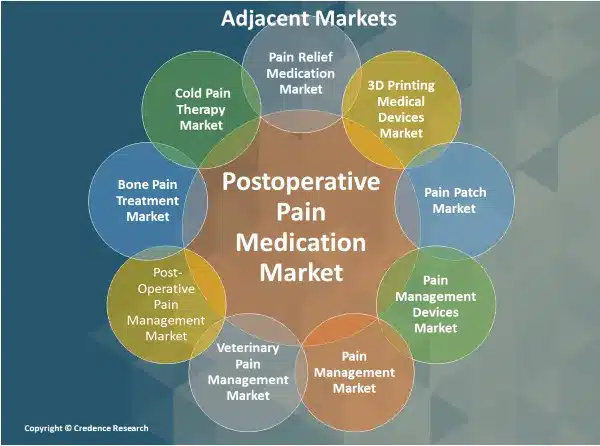
In the Postoperative Pain Medication Market, there are several adjacent markets which has high revenue growth opportunities. The key adjacent markets for Postoperative Pain Medication Market-
Request a Free Sample
Fill in your details and we'll send you a free sample report.
- Sample data tables & charts
- Research methodology
Need a Custom Version of This Report?
Tailor the scope, geography, or segments to your exact requirements.
- Custom geography or segment scope
- Direct access to our analyst team
Frequently Asked Questions
What is the current Surgical Procedure of the worldwide Postoperative Pain Medication Market?
What is the predicted growth rate of the Postoperative Pain Medication Market between 2023 and 2030?
Which segment has the most market share in Route of Administration?
Which Surgical Procedure segment governs the market demand for Postoperative Pain Medication?
Which Patient Profile segment is predicted to grow at the highest rate over the forecast period?
Which region is driving the Postoperative Pain Medication industry forward?
Who are the major players in the global Postoperative Pain Medication Market?
What are the major market drivers of the Postoperative Pain Medication industry?
What are the major market restraints of the Postoperative Pain Medication industry?
What are the major market opportunities of the Postoperative Pain Medication industry?
Table of Content
Chapter 1. Report Introduction
- 1.1 Report Description & Purpose
- 1.1.1 Report Title & Market Definition
- 1.1.2 Unique Selling Propositions (USP) & Key Differentiators
- 1.1.3 Value Proposition for Stakeholders
- 1.2 Research Objectives
- 1.2.1 Market Sizing Objectives (Volume & Revenue)
- 1.2.2 Segmentation Objectives
- 1.2.3 Competitive Intelligence Objectives
- 1.2.4 Forecast & Scenario Objectives
- 1.3 Report Scope
- 1.3.1 Postoperative Pain Medication Scope – Types & Subtypes Covered
- 1.3.2 Geographic Scope – Regions & Countries Covered
- 1.3.3 Historical Period, Base Year & Forecast Period (the historical period; forecast to the forecast period)
- 1.3.4 Inclusions & Exclusions
- 1.4 HS Code & Classification Framework
- 1.5 Currency, Units & Pricing Basis
- 1.6 Target Stakeholders
- 1.7 Limitations & Assumptions
Chapter 2. Executive Summary
- 2.1 Global Postoperative Pain Medication Market Snapshot
- 2.1.1 Market Size – Historical (the historical period) & Forecast (the forecast period) (base year: USD 32,154.9 Million → forecast year: USD 50,481.5 Million)
- 2.1.2 Volume & Revenue – Global Totals
- 2.1.3 Key Market Highlights – Top Five Facts
- 2.2 Postoperative Pain Medication Market Segmentation Snapshot
- 2.2.1 Market Split by Region – vs.
- 2.3 Competitive Snapshot
- 2.3.1 Top 10 Players by Revenue Share –
- 2.3.2 Top 10 Players by Volume Share –
- 2.3.3 Recent Strategic Developments (18-Month Summary)
- 2.4 Key Investment Highlights & Strategic Conclusions
Chapter 3. Postoperative Pain Medication Market Dynamics & Industry Analysis
- 3.1 Market Overview & Context
- 3.1.1 Postoperative Pain Medication Market Position in the Broader Automotive Value Chain
- 3.1.2 OEM vs. Replacement Market Dynamics
- 3.1.3 Market Maturity & Development Stage by Region
- 3.2 Postoperative Pain Medication Market Drivers
- 3.3 Postoperative Pain Medication Market Restraints & Challenges
- 3.4 Postoperative Pain Medication Market Opportunities
- 3.5 Porter's Five Forces Analysis
- 3.5.1 Threat of New Entrants
- 3.5.2 Bargaining Power of Suppliers
- 3.5.3 Bargaining Power of Buyers
- 3.5.4 Threat of Substitutes
- 3.5.5 Competitive Rivalry – Intensity Assessment
- 3.6 Postoperative Pain Medication Value Chain Analysis
- 3.6.1 Upstream – Raw Material/Input Suppliers
- 3.6.1.1 Raw Material/Input 1
- 3.6.1.2 Raw Material/Input 2
- 3.6.1.3 Raw Material/Input 3
- 3.6.2 Midstream – Production/Manufacturing/Service Delivery
- 3.6.2.1 Production/Process Overview
- 3.6.2.2 Key Facility Locations & Capacity by Manufacturer
- 3.6.3 Downstream – Distribution & End Consumer
- 3.6.3.1 Primary Channel – B2B/OEM
- 3.6.3.2 Secondary Channels – Dealer, Retail, Online, Direct
- 3.6.4 Value Chain Profitability Analysis
- 3.6.1 Upstream – Raw Material/Input Suppliers
- 3.7 PESTEL Analysis
- 3.7.1 Political Factors
- 3.7.2 Economic Factors
- 3.7.3 Social Factors
- 3.7.4 Technological Factors
- 3.7.5 Environmental Factors
- 3.7.6 Legal Factors
- 3.8 Postoperative Pain Medication Supply Chain Analysis
- 3.8.1 Raw Material/Input Supply Risk Assessment
- 3.8.2 Manufacturing Concentration Risk (Geographic Exposure)
- 3.8.3 Trade Disruption Impact Analysis
- 3.9 Regulatory & Policy Landscape
Note: The regulatory and policy landscape section covers regulations based on their applicability to the market, Postoperative Pain Medication category, geography, and scope of the study. Only regulatory frameworks with a material impact on operations, compliance, trade, sustainability, or market access are analyzed in detail.
Chapter 4. Key Investment Pockets & Opportunity Analysis
- 4.1 Postoperative Pain Medication Market Attractiveness Analysis
- 4.1.1 By Region – Investment Attractiveness Matrix (Volume × CAGR)
- 4.2 Absolute Revenue Growth Opportunity
- 4.2.1 By Region – Absolute USD Growth Through the forecast period
- 4.3 Incremental Volume Opportunity
- 4.3.1 By Region – Incremental Volume Through the forecast period
- 4.3.2 Segment – Incremental Volume
- 4.4 Emerging Submarket Opportunity Deep Dive (Subject to Applicability)
- 4.5 Emerging Market Opportunity Scorecards
- 4.5.1 United States
- 4.5.2 Europe
- 4.5.3 Asia
- 4.5.4 Middle East & Africa
Note: Emerging Market Opportunity Scorecards will be included based on relevance and strategic importance. Regions listed are indicative and may vary depending on data availability and market dynamics.
Chapter 5. Postoperative Pain Medication Import-Export Analysis & Trade Flows
- 5.1 Global Trade Overview
- 5.1.1 Global Export Value by Country (the historical period)
- 5.1.2 Global Export Volume by Country (the historical period)
- 5.1.3 Global Import Value by Country (the historical period)
- 5.1.4 Global Import Volume by Country (the historical period)
- 5.1.5 Net Trade Balance by Country (the historical period)
- 5.2 Export Analysis – Segment
- 5.2.1 Type 1 (HS Code)
- 5.2.2 Type 2 (HS Code)
- 5.2.3 Type 3 (HS Code)
- 5.2.4 Type 4 (HS Code)
- 5.2.5 Type 5 (HS Code)
- 5.3 Import Analysis – Segment
- 5.3.1 Type 1 (HS Code)
- 5.3.2 Type 2 (HS Code)
- 5.3.3 Type 3 (HS Code)
- 5.3.4 Type 4 (HS Code)
- 5.3.5 Type 5 (HS Code)
- 5.4 Average Unit Trade Prices
- 5.4.1 Average Export Price – Segment & Country
- 5.4.2 Average Import Price – Segment & Source Country
- 5.4.3 Price Trends (the historical period)
- 5.5 Key Trade Route Analysis
- 5.5.1 Trade Route 1
- 5.5.2 Trade Route 2
- 5.5.3 Trade Route 3
- 5.5.4 Trade Route 4
- 5.5.5 Trade Route 5
- 5.6 Trade Policy Impact Assessment
- 5.6.1 US Anti-Dumping & Section 301 Tariffs
- 5.6.2 EU Customs Union Impact
- 5.6.3 Major Free Trade Agreements
- 5.6.4 USMCA Rules of Origin
Note: Trade policy analysis will be included only where relevant to the Postoperative Pain Medication market.
Chapter 6. Competitive Landscape & Company Benchmarking
- 6.1 Postoperative Pain Medication Market Concentration & Structure
- 6.1.1 Herfindahl-Hirschman Index (HHI) – vs.
- 6.1.2 Tier 1, Tier 2 & Tier 3 Market Structure
- 6.1.3 Global, Regional & Local Player Dynamics
- 6.2 Postoperative Pain Medication Market Share Analysis –
- 6.2.1 Global Revenue Share by Company
- 6.2.2 Global Volume Share by Company
- 6.2.3 Regional Revenue Share
- 6.2.4 Market Share Evolution ( vs. )
- 6.2.5 OEM Segment Share by Company
- 6.2.6 Replacement Segment Share by Company
- 6.3 Production/Delivery Capacity & Facility Analysis
- 6.3.1 Global Installed Capacity
- 6.3.2 Capacity Utilization Rates
- 6.3.3 Production/Output Volume
- 6.3.4 Facility Locations & Capacity Map
- 6.3.5 Planned Capacity Additions
- 6.4 Postoperative Pain Medication Competitive Benchmarking Matrix
- 6.4.1 Revenue, Volume, CAGR & Profitability Comparison
- 6.4.2 Channel Revenue Mix
- 6.4.3 Geographic Revenue Exposure
- 6.4.4 R&D Intensity
- 6.4.5 Sustainability Maturity
- 6.5 Strategic Developments in Postoperative Pain Medication (Last 24 Months)
- 6.5.1 Mergers, Acquisitions & Divestments
- 6.5.2 New Postoperative Pain Medication Launches
- 6.5.3 Facility Expansions
- 6.5.4 Strategic Alliances, Joint Ventures & Partnerships
- 6.5.5 Distribution Expansion & Market Entry
- 6.5.6 Sustainability & ESG Initiatives
- 6.6 Competitive Strategy Mapping
- 6.6.1 Leader, Challenger, Follower & Niche Classification
- 6.6.2 Pricing Strategy Comparison
- 6.6.3 Channel Strategy Matrix
Note: Strategic developments are included based on their materiality and the availability of reliable information.
Chapter 7. Global Postoperative Pain Medication Market – By Distribution Channel
- 7.1 Segment Overview
- 7.1.1 Volume & Revenue Split by Channel ( & )
- 7.1.2 Channel Mix Evolution (the forecast period)
Chapter 8. Regional Market Analysis – Global Overview
- 8.1 Global Regional Overview
- 8.1.1 Regional Volume Share
- 8.1.2 Regional Revenue Share
- 8.1.3 Regional Volume by Region
- 8.1.4 Regional Revenue by Region
- 8.1.5 Regional Forecast Through the forecast period
- 8.2 Cross-Regional Segment Analysis
- 8.2.1 By Distribution Channel
- 8.2.2 By Brand/Price Tier
Chapter 9. North America Postoperative Pain Medication Market
- 9.1 United States
- 9.2 Canada
- 9.3 Mexico
Chapter 10. Europe Postoperative Pain Medication Market
- 10.1 Germany
- 10.2 France
- 10.3 Italy
- 10.4 United Kingdom
- 10.5 Spain
- 10.6 Poland
- 10.7 Russia
- 10.8 Netherlands
- 10.9 Belgium
- 10.10 Sweden
- 10.11 Denmark
- 10.12 Norway
- 10.13 Rest of Europe
Chapter 11. Asia Pacific Postoperative Pain Medication Market
- 11.1 China
- 11.2 India
- 11.3 Japan
- 11.4 South Korea
- 11.5 Thailand
- 11.6 Indonesia
- 11.7 Vietnam
- 11.8 Malaysia
- 11.9 Australia
- 11.10 Rest of Asia Pacific
Chapter 12. Latin America Postoperative Pain Medication Market
- 12.1 Brazil
- 12.2 Argentina
- 12.3 Colombia
- 12.4 Chile
- 12.5 Rest of Latin America
Chapter 13. Middle East Postoperative Pain Medication Market
- 13.1 Saudi Arabia
- 13.2 United Arab Emirates
- 13.3 Turkey
- 13.4 Israel
- 13.5 Iran
- 13.6 Rest of the Middle East
Chapter 14. Africa Postoperative Pain Medication Market
- 14.1 South Africa
- 14.2 Egypt
- 14.3 Nigeria
- 14.4 Morocco
- 14.5 Rest of Africa
Chapter 15. Postoperative Pain Medication Company Profiles
- 15.1 [Company 01]
- 15.1.1 Company Overview
- 15.1.2 Key Management Personnel
- 15.1.3 Products & Services Portfolio
- 15.1.4 Financial Performance
- 15.1.5 Key Market Focus & Geographic Presence
- 15.1.6 Recent Developments & Strategic Initiatives
Note: The company profile list is preliminary and may change based on research findings, market developments, data availability, and client requirements.
Chapter 16. Appendices
- Appendix A – List of Abbreviations & Acronyms
- Appendix B – Industry Classification Code Reference – Full Series
- Appendix C – Production & Capacity Data Tables
- Appendix D – End-Use & Demand Base Tables
- Appendix E – Consumption & Replacement Rate Assumptions
- Appendix F – ASP Reference Tables
- Appendix G – Manufacturing & Facility Database
- Appendix H – Import-Export Data Tables
- Appendix I – Regulatory Summary Tables
- Appendix J – Primary Research Participant List (Anonymized)
- Appendix K – Primary Research Questionnaire Framework
- Appendix L – Data Sources & Bibliography
- Appendix M – Market Size Divergence & Source Comparison
Chapter 17. Research Methodology
- 17.1 Research Framework & Philosophy
- 17.2 Secondary Research – Sources, Hierarchy & Data Extraction
- 17.3 Data Modeling – Bottom-Up & Top-Down Market Sizing
- 17.4 Primary Research – Stakeholder Framework, LOI & Sample Sizes
- 17.5 Forecast Methodology – Regression, Scenario & Sensitivity Analysis
- 17.6 Quality Control – Four-Layer Validation Framework
- 17.7 Limitations & Standard Assumptions
- 17.8 Disclaimer
