Japan Machine Learning Medical Software Market Overview:
The Japan Machine Learning Medical Software Market size was valued at USD 77.79 MN in 2021 and reached USD 206.86 MN in 2025. It is anticipated to reach USD 1,145.56 MN by 2032, growing at a CAGR of 27.70% during the forecast period.
| REPORT ATTRIBUTE | DETAILS |
|---|---|
| Historical Period | 2021-2024 |
| Base Year | 2025 |
| Forecast Period | 2025-2032 |
| Japan Machine Learning Medical Software Market Size 2025 | USD 206.86 million |
| Japan Machine Learning Medical Software Market, CAGR | 27.70% |
| Japan Machine Learning Medical Software Market Size 2032 | USD 8,01,145.56 97.12 million |
Japan Machine Learning Medical Software Market Insights
- Market growth is supported by Japan’s health care digitalization, software as a medical device regulation, AI-enabled radiology adoption, hospital workflow automation and rising demand for decision support tools.
- Diagnostic software holds a strong position because radiology, cardiology and oncology workflows increasingly use image analysis, triage, segmentation and clinical decision support.
- Deep learning is gaining momentum because imaging, monitoring and decision support software require advanced pattern recognition across large clinical datasets.
- Cloud deployment is expanding as hospitals seek scalable software, multi-site access, AI model updates and lower infrastructure burden.
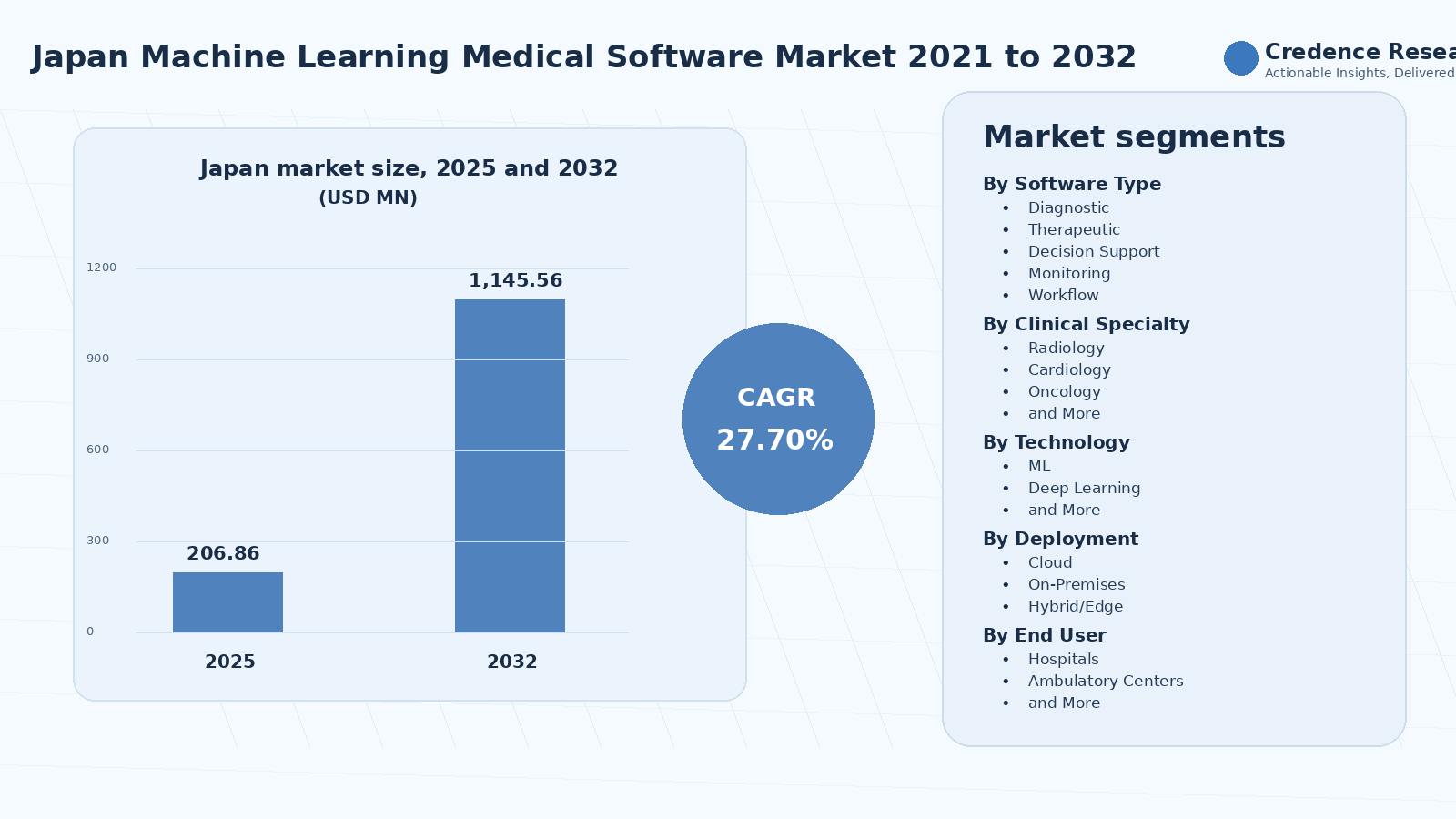
Japan Machine Learning Medical Software Market Segment Insights
By software type
By software type, Diagnostic held the strongest position in 2025 because Japan’s hospitals are increasing use of imaging analytics, lesion detection, triage support and automated reporting tools. Diagnostic software supports radiology, cardiology, oncology and other specialties where clinicians need faster interpretation and workflow efficiency. Decision Support is gaining momentum because physicians require structured insights from imaging, electronic medical records, laboratory data and patient history. Monitoring software is expanding through connected devices, remote patient monitoring and chronic disease care. Workflow software is becoming important as hospitals seek operational efficiency across imaging departments, patient routing and reporting. Therapeutic software remains smaller but is expected to grow as digital therapeutics and algorithm-guided treatment support mature.
By clinical specialty
By clinical specialty, Radiology held a strong position in 2025 because imaging data creates high-volume use cases for machine learning and deep learning software. Radiology applications include CT, MRI, ultrasound, X-ray and nuclear medicine workflow support. Cardiology is gaining demand through arrhythmia detection, echocardiography analysis, cardiac imaging interpretation and remote monitoring. Oncology is expanding through radiation therapy planning, tumor segmentation, genomic interpretation and treatment decision support. Other specialties include neurology, gastroenterology, pathology, ophthalmology, emergency care and surgery. Growth across specialties will depend on clinical validation, integration with hospital IT systems and reimbursement acceptance.
By technology
By technology, Deep Learning held a strong position because medical imaging and clinical pattern recognition require advanced models that can process complex visual and physiological data. ML remains widely used in decision support, risk prediction, workflow routing and monitoring tools. Deep learning has strong relevance in radiology, oncology, cardiology and image-based screening because it improves detection, classification and segmentation workflows. and More includes natural language processing, computer vision, predictive analytics, multimodal AI, federated learning and generative AI tools. Technology adoption will depend on accuracy, explainability, cybersecurity, training data quality and regulatory review. Vendors that combine clinical performance with integration readiness will gain stronger hospital adoption.
By deployment
By deployment, Cloud held a strong position in 2025 because hospitals and ambulatory centers need scalable software delivery, centralized updates and multi-site access. Cloud deployment supports AI model lifecycle management, image access, reporting, collaboration and analytics. On-Premises deployment remains important for hospitals with strict data governance, cybersecurity requirements and internal infrastructure preferences. Hybrid/Edge is gaining relevance because it supports low-latency imaging analysis, local data processing, privacy-sensitive workflows and resilience when connectivity is limited. Japan’s medical data governance and hospital IT modernization will shape deployment choices. Growth will favor platforms that support secure integration with picture archiving and communication systems, electronic medical records and clinical workflow systems.
By end user
By end user, Hospitals held the strongest position in 2025 because advanced imaging, specialty care, diagnostic departments and clinical data infrastructure are concentrated in hospital systems. Hospitals use machine learning medical software for radiology workflow, oncology care, cardiology monitoring, treatment planning and operational efficiency. Ambulatory Centers are gaining demand as outpatient imaging, diagnostic services and chronic care expand. and More includes diagnostic laboratories, specialty clinics, research institutions, academic medical centers and telehealth providers. End-user adoption will depend on budget availability, clinical workflow fit, physician trust, data security and integration with existing systems. Hospitals will remain the primary revenue contributor through 2032.
Key Market Drivers
SaMD regulation and AI medical software pathway development
SaMD regulation and AI medical software pathway development represent major growth drivers for the Japan Machine Learning Medical Software Market. Japan’s regulators are clarifying how software qualifies as a medical device and how AI-enabled software should move through review, approval and clinical use. This improves predictability for vendors developing Diagnostic, Decision Support, Monitoring and Workflow software.
MHLW’s 2025 SaMD sub-forum focused on regulatory approaches for AI-used SaMD and DASH for SaMD2 progress, while PMDA’s SaMD page shows continued activity around medical software review, including 2026 symposia on SaMD, real-world data and generative AI in medicine. This regulatory focus supports commercial confidence and encourages companies to design products for compliant clinical adoption.
Healthcare DX and electronic data infrastructure
Healthcare DX and electronic data infrastructure are strengthening software adoption across Japan. Machine learning medical software depends on digital medical records, structured data exchange, imaging archives, cloud workflows and clinical data access. Japan’s national Healthcare DX push supports a stronger foundation for AI-enabled software used across hospitals, ambulatory centers and specialty care settings.
Japan’s Digital Agency and Ministry of Health, Labour and Welfare are promoting Healthcare DX based on the Roadmap for the Promotion of Healthcare DX, including policies for My Number Card as a health insurance certificate, electronic medical records, electronic prescriptions and Mynaportal. This digital foundation supports cloud, hybrid and workflow-focused medical software adoption.
Radiology workflow automation and hospital efficiency needs
Radiology workflow automation and hospital efficiency needs are creating strong demand for machine learning medical software. Japanese hospitals face pressure to improve imaging throughput, report turnaround and specialist productivity while maintaining diagnostic quality. AI-enabled software can support case prioritization, image reconstruction, segmentation, reading assistance and workflow orchestration.
GE HealthCare Japan announced that its AI-enabled hospital operations efficiency project with Ageo Central Medical Group moved into full-scale implementation from April 1, 2025, after starting in November 2024. GE HealthCare also introduced Genesis Radiology Workspace in 2025 as a cloud-first radiology solution designed to unify workflow and support faster diagnosis. This driver supports strong demand for Diagnostic and Workflow software.
Growth in AI-enabled specialty software platforms
Growth in AI-enabled specialty software platforms supports market expansion across radiology, cardiology, oncology and monitoring workflows. Vendors are embedding machine learning into imaging systems, patient monitoring platforms, diagnostic workspaces and clinical decision tools.
Siemens Healthineers Japan highlights more than 20 years of AI development experience in health care and AI-supported solutions, while Medtronic’s AccuRhythm AI applies deep learning algorithms to cardiac rhythm data to reduce false alerts and clinic review burden. Philips also launched a web-based diagnostic viewer on HealthSuite cloud in 2025 as a SaaS solution with built-in security and scalability across multiple sites. These developments show how global medical technology companies are shifting toward AI-enabled, cloud-ready and workflow-centered medical software.
Key Trends and Opportunities
Cloud-first diagnostic platforms gain traction
Cloud-first diagnostic platforms are gaining traction as hospitals seek multi-site access, scalable image viewing and software updates without heavy local infrastructure investment. Cloud platforms can support radiology reading, remote collaboration, AI inference, reporting and enterprise imaging management. Philips introduced its web-based diagnostic viewer on HealthSuite cloud as a SaaS solution in 2025, with built-in security and scalability across multiple sites. This trend supports Cloud deployment, Diagnostic software and Workflow software. Adoption will depend on cybersecurity readiness, data residency, hospital procurement rules and integration with existing IT systems.
Edge and hybrid deployment support privacy-sensitive use cases
Edge and hybrid deployment are becoming important opportunities because Japanese hospitals need speed, privacy and reliability in clinical workflows. Hybrid/Edge deployment can process imaging data locally while still allowing cloud-based updates, analytics and model management. This is useful for radiology, cardiology and monitoring applications where latency and data sensitivity matter. Hospitals with strict privacy or cybersecurity policies may prefer hybrid models over full-cloud deployments. Vendors that provide flexible deployment options will be better positioned across academic hospitals, regional hospitals and ambulatory centers. This trend will remain important as AI models become more embedded in daily clinical workflows.
Oncology and precision medicine software expands
Oncology and precision medicine software are expanding as machine learning supports tumor profiling, treatment selection, clinical trial matching and multimodal data interpretation. Oncology software can combine imaging, pathology, genomic data and clinical records to support decision-making. Tempus announced expanded strategic agreements with AstraZeneca and Pathos in 2025 to develop a large multimodal foundation model in oncology, and Reuters reported in July 2026 that Tempus agreed to acquire Personalis for about USD 1.5 billion to add cancer testing capability to its AI-enabled precision medicine portfolio. This trend supports Decision Support software, Oncology and ML-driven analytics.
Key Market Challenges
Clinical validation and physician trust
Clinical validation and physician trust remain key challenges for the Japan Machine Learning Medical Software Market. Medical software must show reliable performance across Japanese patient populations, clinical workflows and specialty settings. AI models trained on non-Japanese datasets may not perform consistently without localization and validation. Physicians also need transparent outputs, clear limitations and usable integration into existing workflows. Poorly explained alerts or weak clinical evidence can slow adoption even when technology performs well in testing. Vendors must invest in local studies, usability testing, post-market monitoring and clinical education.
Data governance, privacy and cybersecurity
Data governance, privacy and cybersecurity create adoption barriers for cloud and AI-enabled medical software. Machine learning systems need access to sensitive imaging, clinical, monitoring and patient data. Hospitals must ensure data protection, access control, audit trails and compliance with Japanese regulations. Cloud deployment can improve scalability but may raise concerns around data residency, vendor access and cyber risk. Hybrid/Edge deployment can reduce some concerns but adds complexity. Vendors that offer secure architecture, clear governance and strong compliance documentation will gain stronger buyer confidence.
Integration complexity in hospital IT systems
Integration complexity in hospital IT systems can slow deployment. Machine learning medical software must connect with picture archiving and communication systems, radiology information systems, electronic medical records, laboratory systems, monitoring platforms and billing workflows. Hospitals may operate legacy systems that create interoperability issues. Implementation can require customization, staff training, workflow redesign and ongoing support. Budget cycles and procurement timelines can also delay adoption. Vendors must deliver modular software, open standards support and measurable productivity gains to accelerate adoption.
Regional Analysis
Kanto
Kanto leads the Japan Machine Learning Medical Software Market due to its concentration of advanced hospitals, university medical centers, health technology companies, research institutions and digital health investment. Tokyo and surrounding prefectures support strong demand for diagnostic software, radiology AI, clinical decision support and cloud-based workflow systems. Hospitals in this region are more likely to pilot advanced medical software because they have stronger IT infrastructure and specialist capacity. Vendor partnerships, academic validation and clinical trial activity support regional adoption. Kanto is expected to remain the primary revenue contributor through 2032.
Kansai
Kansai represents a strong market supported by Osaka, Kyoto, Kobe and surrounding medical research clusters. The region has advanced hospitals, academic centers and specialty care networks that support use of AI-enabled diagnostic and decision support software. Radiology, cardiology, oncology and monitoring applications are expected to gain adoption as hospitals modernize workflow and data infrastructure. Kansai also supports collaboration between medical technology vendors, universities and hospital systems. Growth will depend on procurement budgets, clinical validation and integration with hospital systems. The region is expected to remain a key adoption hub.
Report Attribute Details
| Report Attribute | Details |
| Historical Period | 2021–2024 |
| Base Year | 2025 |
| Forecast Period | 2025–2032 |
| Market Size in 2021 | USD 77.79 MN |
| Market Size in 2025 | USD 206.86 MN |
| Market Size in 2032 | USD 1,145.56 MN |
| CAGR | 27.70% |
| Segments Covered | Software Type, Clinical Specialty, Technology, Deployment, End User and Geography |
| Key Companies Covered | GE HealthCare Technologies Inc., Koninklijke Philips N.V., Medtronic plc, Siemens Healthineers AG and Tempus AI, Inc. |
Japan Machine Learning Medical Software Market Segmentations
By Software Type- Diagnostic
- Therapeutic
- Decision Support
- Monitoring
- Workflow
- Radiology
- Cardiology
- Oncology
- and More
- ML
- Deep Learning
- and More
- Cloud
- On-Premises
- Hybrid/Edge
- Hospitals
- Ambulatory Centers
- and More
Key Players
- GE HealthCare Technologies Inc.
- Koninklijke Philips N.V.
- Medtronic plc
- Siemens Healthineers AG
- Tempus AI, Inc.
Recent Developments
- In April 2025, GE HealthCare Japan moved its AI-enabled medical operations efficiency project with Ageo Central Medical Group into full-scale implementation to support hospital workflow and regional care efficiency.
- In November 2025, GE HealthCare introduced Genesis Radiology Workspace, a cloud-first radiology solution designed to unify workflow and support smarter, faster diagnosis.
- In November 2025, Philips introduced a web-based diagnostic viewer on HealthSuite cloud as a SaaS solution with built-in security and scalability across multiple sites.
- In July 2026, Reuters reported that Tempus AI agreed to acquire Personalis for about USD 1.5 billion, adding cancer testing capability to its AI-enabled precision medicine oncology portfolio.
Report Coverage
The research report offers an in-depth analysis based on software type, clinical specialty, technology, deployment, end user and geography. It details leading market players, providing an overview of their business positioning, machine learning software capabilities, diagnostic workflow tools, clinical decision support platforms, monitoring technologies and strategic relevance in the Japan Machine Learning Medical Software Market. The report includes insights into the competitive environment, market trends, growth drivers, restraints and opportunities. It also examines SaMD regulation, Healthcare DX, cloud deployment, radiology workflow automation, AI-enabled monitoring, oncology decision support and hospital IT modernization as major factors shaping market development. The report assesses the impact of clinical validation, data governance, cybersecurity, integration complexity and physician trust on market growth. It provides strategic recommendations for medical software vendors, hospital systems, ambulatory centers, imaging departments, clinical AI developers, investors and new entrants seeking to navigate Japan’s machine learning medical software ecosystem.
Future Outlook
- Demand for machine learning medical software will continue to rise as Japan advances Healthcare DX and hospitals adopt AI-enabled clinical tools.
- Diagnostic software will remain a leading category because radiology, cardiology and oncology use cases require faster interpretation and workflow support.
- Decision Support will gain momentum as clinicians seek structured insights from imaging, clinical records, laboratory data and monitoring systems.
- Monitoring software will expand through connected devices, remote patient care and chronic disease management.
- Workflow software will gain value as hospitals seek operational efficiency and better staff productivity.
- Radiology will remain the largest clinical specialty due to high imaging data volume and strong fit for deep learning.
- Oncology will expand as precision medicine platforms use AI to support genomic interpretation and treatment selection.
- Cloud deployment will grow as hospitals seek scalable software delivery and multi-site access.
- Hybrid/Edge deployment will gain importance where latency, privacy and data residency requirements shape procurement.
- Competitive intensity will increase as vendors compete on clinical accuracy, integration, cybersecurity, cloud readiness, local validation and hospital workflow impact.

Request a Free Sample
Fill in your details and we'll send you a free sample report.
- Sample data tables & charts
- Research methodology
Need a Custom Version of This Report?
Tailor the scope, geography, or segments to your exact requirements.
- Custom geography or segment scope
- Direct access to our analyst team
Frequently Asked Questions
What is the current market size for the Japan Machine Learning Medical Software Market and what is its projected size in 2032?
At what CAGR is the Japan Machine Learning Medical Software Market projected to grow?
Which software type segment is expected to lead the market?
Which clinical specialty supports strong market demand?
Which deployment model is gaining traction?
Who are the leading companies in the market?
Which region leads the Japan market?
Table of Content
Chapter 1 Market Segmentation
- 1.1 Segmentation Framework
- 1.1.1 Product and Service Classification
- 1.1.2 Application and End-Use Classification
- 1.1.3 Technology and Solution Classification
- 1.1.4 Customer and Distribution Channel Classification
- 1.1.5 Geographic Segmentation
- 1.1.6 Market Segment Definitions and Boundaries
Chapter 2 Introduction
- 2.1 Report Objectives and Scope
- 2.2 Product Definition and Industry Terminology
- 2.3 Market Inclusions and Exclusions
- 2.4 Research Process
- 2.4.1 Primary Research and Expert Interviews
- 2.4.2 Secondary Research and Source Review
- 2.4.3 Top-Down and Bottom-Up Estimation
- 2.4.4 Data Triangulation and Verification
- 2.5 Market Size Measurement Basis
- 2.5.1 2025: USD 206.86 MN → 2032: USD 1,145.56 MN
- 2.6 Historical and Forecast Reference Periods
- 2.6.1 Base Year: 2025
- 2.6.2 Forecast Period: 2025-2032
- 2.7 Research Assumptions and Limitations
Chapter 3 Executive Summary
- 3.1 Market Snapshot and Key Findings
- 3.2 Base-Year Market Size, 2025
- 3.3 Forecast Market Size, 2032
- 3.4 Revenue and Volume Growth Outlook
- 3.5 Key Demand and Supply Indicators
- 3.6 Leading Market Segments
- 3.7 Fastest-Growing Market Opportunities
- 3.8 Regional Performance Highlights
- 3.9 Technology and Industry Transformation
- 3.10 Competitive Landscape Summary
- 3.11 Analyst View and Strategic Implications
Chapter 4 Japan Machine Learning Medical Software Market Trends and Developments
- 4.1 Historical Industry Development
- 4.2 Recent Market Trends and Developments
- 4.3 Demand and Customer Behavior Trends
- 4.4 Technology and Product Innovation
- 4.5 Artificial Intelligence, Automation and Digitalization
- 4.6 Local Manufacturing and Supply Chain Realignment
- 4.7 Industry Partnerships, Mergers and Acquisitions
- 4.8 Sustainability and Circular Economy Developments
- 4.9 Government and Private Sector Investment Trends
- 4.10 Emerging Business Models and Commercialization
- 4.11 Industry Developments and Announcements
Chapter 5 Japan Machine Learning Medical Software Market Supply and Demand Analysis
- 5.1 Demand Trend and Consumption Analysis
- 5.2 Demand Forecast, 2025-2032
- 5.3 Supply Chain Structure and Procurement Trends
- 5.4 Supply-Demand Gap and Bottlenecks
- 5.5 Import Dependence and Sourcing Structure
- 5.6 Regional Supply and Demand Concentration
Chapter 6 Japan Machine Learning Medical Software Market Pricing Analysis
- 6.1 Pricing Structure and Measurement
- 6.2 Historical Pricing Trends
- 6.3 Pricing Outlook, 2025-2032
- 6.4 Pricing by Product and Market Segment
- 6.5 Geographic Pricing Differences
- 6.6 Key Input, Energy, Labor and Logistics Costs
- 6.7 Contract Pricing and Purchasing Models
- 6.8 Pricing Sensitivity and Competitive Positioning
- 6.9 Price, Margin and Profitability Implications
Chapter 7 Japan Machine Learning Medical Software Market Dynamics
- 7.1 Market Growth Drivers
- 7.1.1 Demand-Side Drivers
- 7.1.2 Technology and Innovation Drivers
- 7.1.3 Infrastructure and Investment Drivers
- 7.1.4 Regulatory and Policy Drivers
- 7.2 Market Restraints
- 7.2.1 Cost and Affordability Constraints
- 7.2.2 Technology and Adoption Barriers
- 7.2.3 Supply Chain and Operational Constraints
- 7.3 Market Challenges
- 7.3.1 Competitive Pressure and Margin Erosion
- 7.3.2 Skills, Infrastructure and Implementation Gaps
- 7.4 Emerging Market Opportunities
- 7.5 Market Dynamics Impact and Time-Horizon Assessment
Chapter 8 Japan Machine Learning Medical Software Value Chain Analysis
- 8.1 Industry Value Chain Overview
- 8.2 Upstream Suppliers and Critical Inputs
- 8.3 Technology and Component Providers
- 8.4 Manufacturing or Service Delivery
- 8.5 Distribution, Channel Partners and Integrators
- 8.6 Downstream Applications and End Users
- 8.7 Value Addition and Profit Pools
- 8.8 Vertical Integration and Outsourcing
- 8.9 Supplier Concentration and Risk
- 8.10 Supply Chain Localization and Resilience
Chapter 9 Japan Machine Learning Medical Software Market Regulations and Policies
- 9.1 Relevant Laws, Standards and Compliance Frameworks
- 9.2 Product, Service, Safety and Quality Requirements
- 9.3 Government Policies, Incentives and Subsidies
- 9.4 Imports, Exports and Trade Barriers
- 9.5 Public Procurement and Local Content Requirements
- 9.6 Data Protection, AI and Cybersecurity Compliance
- 9.7 Upcoming Policy Changes and Market Implications
Chapter 10 Japan Machine Learning Medical Software Market Hotspots and Opportunities
- 10.1 Market Opportunity Mapping and Growth Hotspots
- 10.2 High-Growth Applications and Customer Groups
- 10.3 Underserved Markets and White-Space Opportunities
- 10.4 Emerging Technology and Product Opportunities
- 10.5 New Capacity and Investment Hotspots
- 10.6 Market Entry and Expansion Opportunities
- 10.7 Distribution and Partnership Opportunities
- 10.8 Near-Term and Long-Term Commercial Potential
- 10.9 Opportunity Attractiveness and Execution Risks
Chapter 11 Japan Machine Learning Medical Software Market Outlook, 2025-2032
- 11.1 Market Size and Analysis
- 11.1.1 Revenue (Market Measurement: 2025: USD 206.86 MN → 2032: USD 1,145.56 MN)
- 11.1.2 Historical Market Size
- 11.1.3 Base-Year Market Size, 2025
- 11.2 Market Forecast, 2025-2032
- 11.2.1 Revenue Forecast to 2032
- 11.2.2 CAGR and Year-on-Year Growth
- 11.2.3 Incremental Revenue Opportunity
- 11.3 Forecast Assumptions and Scenario Analysis
- 11.3.1 Base-Case Forecast
- 11.3.2 Optimistic and Conservative Scenarios
- 11.3.3 Technology, Pricing and Policy Sensitivities
- 11.4 Market Attractiveness and Growth Outlook
Chapter 12 Japan Machine Learning Medical Software Market Segmentation and Outlook
- 12.1 Segmentation Summary and Market Shares, 2025
- 12.2 Largest and Fastest-Growing Segments
- 12.3 Segment Growth Comparison
- 12.4 Segment Attractiveness and Priority Matrix
Chapter 13 Japan Machine Learning Medical Software Geographic Market Outlook, 2025-2032
- 13.1 Domestic Market Distribution and Demand Clusters
- 13.2 State- or Province-Wise Market Size and Forecast, 2025-2032
- 13.3 City and Metropolitan Market Outlook
- 13.4 Industrial, Manufacturing and Commercial Clusters
- 13.5 Geographic Concentration of Key End Users
- 13.6 Local Pricing and Purchasing Differences
- 13.7 Domestic Production Facilities and Capacity Map
- 13.8 Local Infrastructure and Project Pipeline
- 13.9 State-Level Policy and Incentive Differences
- 13.10 Subnational Investment Hotspots and Opportunities
- 13.11 Distribution and Logistics Networks
- 13.12 Domestic Competitive Footprint
Chapter 14 Japan Machine Learning Medical Software Technology, Innovation and Sustainability Outlook
- 14.1 Technology Landscape and Maturity
- 14.2 Product, Process and Service Innovation
- 14.3 AI, Automation and Digital Tools in the Industry
- 14.4 Technology Adoption and Performance Benchmarking
- 14.5 Innovation Pipeline and R&D Investment
- 14.6 Patent and Intellectual Property Trends
- 14.7 Energy Efficiency and Resource Management
- 14.8 Sustainability, Recycling and Circularity
- 14.9 Technology Roadmap, 2025-2032
- 14.10 Risks of Obsolescence and Technology Substitution
Chapter 15 Japan Machine Learning Medical Software Market Key Strategic Imperatives
- 15.1 Growth and Market Entry Priorities
- 15.2 High-Return Products and Segments
- 15.3 Pricing, Profitability and Cost Optimization
- 15.4 Technology Investment and Product Differentiation
- 15.5 Supply Chain Localization and Resilience
- 15.6 Distribution and Customer Acquisition
- 15.7 Partnership, Acquisition and Capacity Strategy
- 15.8 Regional Expansion Priorities
- 15.9 Short-, Medium- and Long-Term Actions
Chapter 16 Competition Outlook
- 16.1 Industry Competition Characteristics
- 16.2 Market Structure and Concentration
- 16.3 Market Share and Competitive Positioning, 2025
- 16.4 Company-Wise Revenue and Product Benchmarking
- 16.5 Production and Service Capacity Benchmarking
- 16.6 Technology, Pricing and Differentiation
- 16.7 Regional Footprint and Distribution Strength
- 16.8 Mergers, Acquisitions and Strategic Alliances
- 16.9 New Entrants and Competitive Threats
- 16.10 Porter's Five Forces and Industry Attractiveness
- 16.11 Competitive Outlook, 2025-2032
Chapter 17 Company Profiles
- 17.1 Company Coverage and Selection Criteria
- 17.2 Leading Market Participants – Standard Profile Structure
- 17.2.1 Business Description
- 17.2.2 Company Ownership and Geographic Presence
- 17.2.3 Product and Service Portfolio
- 17.2.4 Manufacturing and Operating Footprint
- 17.2.5 Financial Performance and Investment
- 17.2.6 Market Share and Competitive Position
- 17.2.7 Technology and Innovation Capabilities
- 17.2.8 Strategic Alliances or Partnerships
- 17.2.9 Recent Developments
- 17.2.10 Growth Strategy and Outlook
- 17.3 Other Relevant Market Participants
Note: Every listed company is profiled on the structure shown under the first company. The company list is preliminary and may change based on research findings, market developments, data availability and client requirements.
Chapter 18 Disclaimer
- 18.1 Research and Forecast Disclaimer
- 18.2 Data Source and Estimation Limitations
Note: The depth of individual sections depends on data availability for this market. Volume, capacity, trade and other unit-based metrics are included where applicable.