
ABS Filament 3D Printing Material Market: USD 1.28 billion in 2025, Growing With Enclosed Printers and Factory Tooling
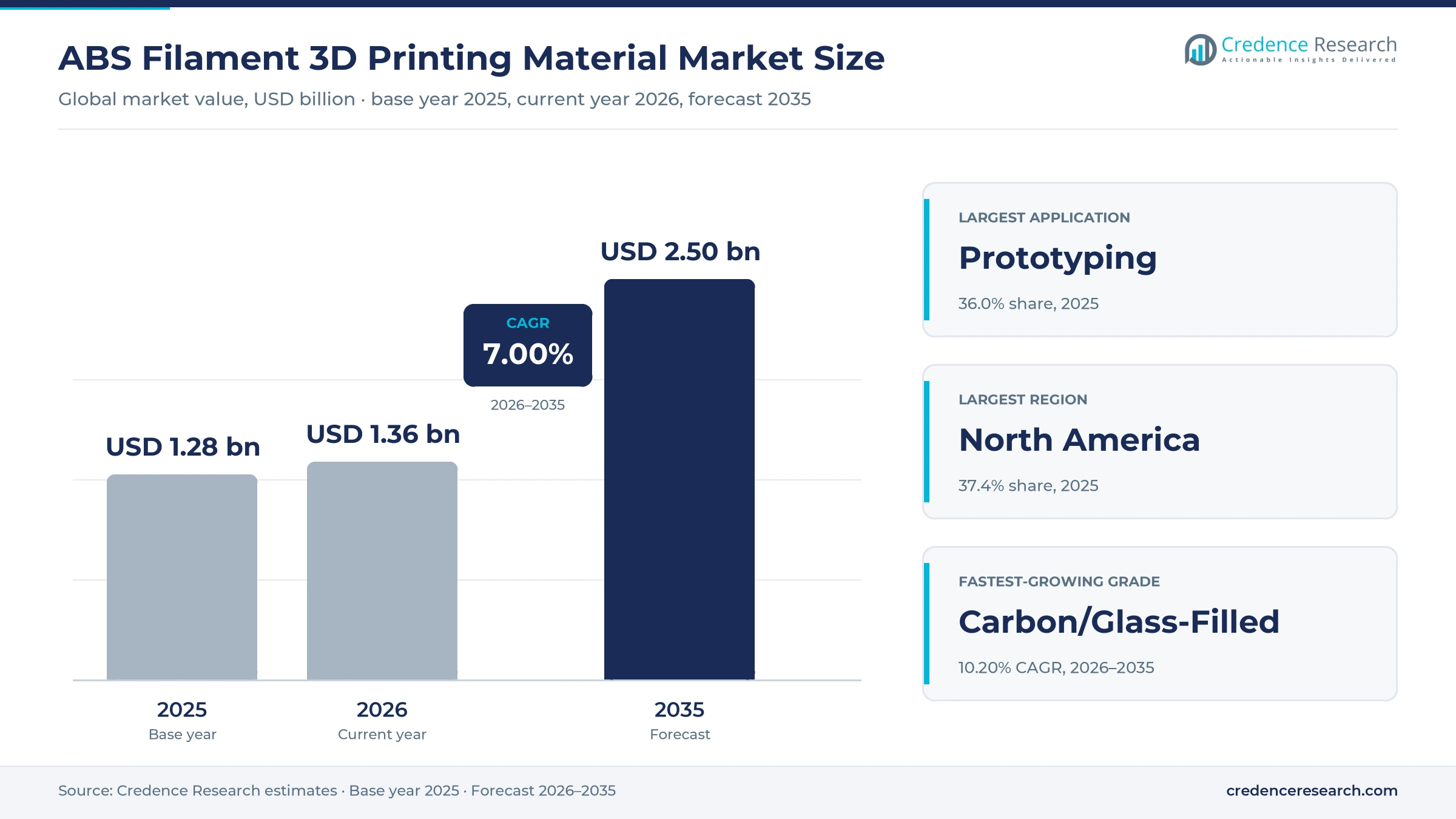
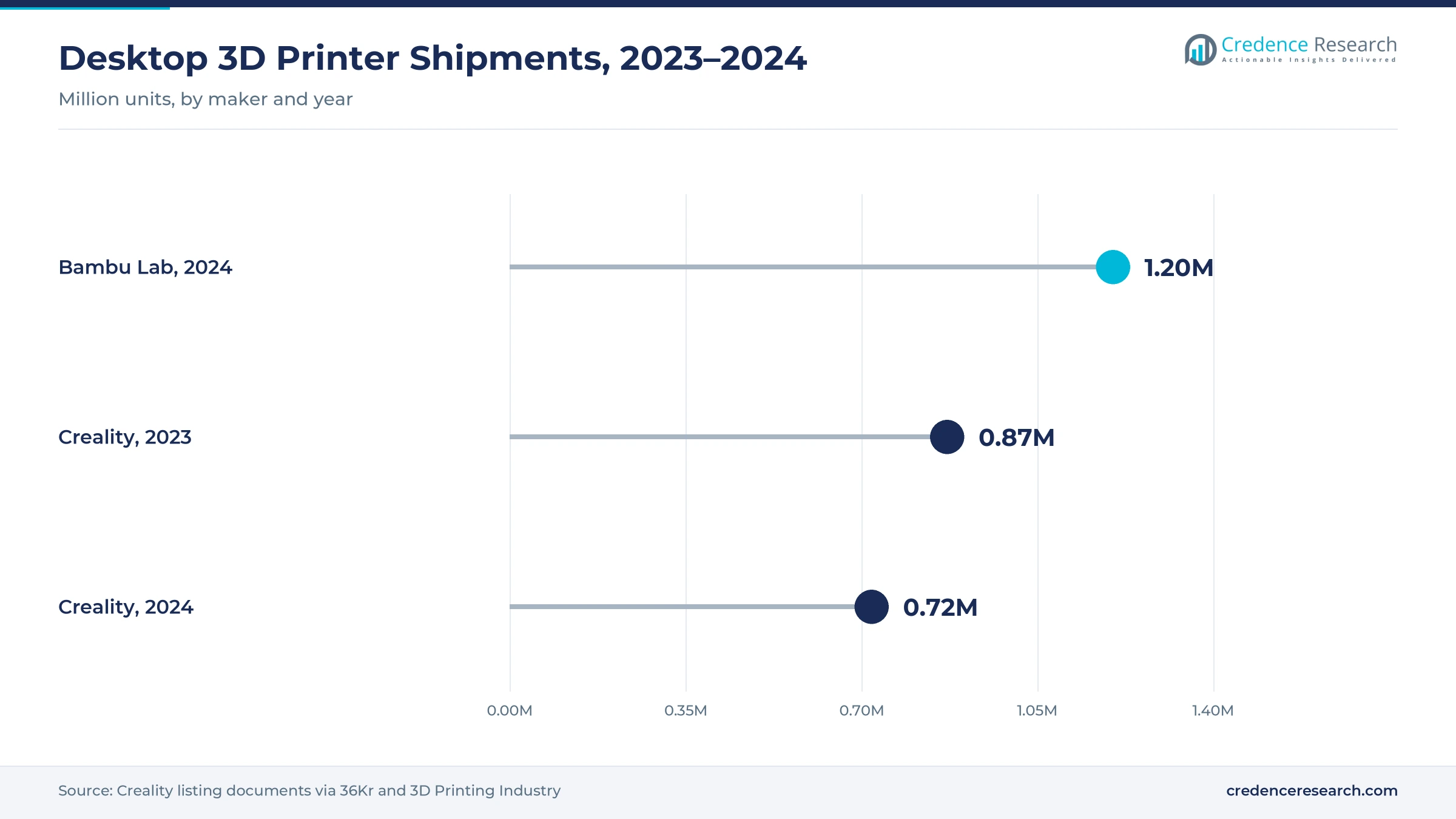
About 1.2 million Bambu Lab printers shipped in 2024, many of them able to print ABS, a filament market Credence Research values at USD 1.28 billion in 2025. The market is projected to reach USD 2.50 billion by 2035, a 7.00% CAGR over 2026–2035, with 2026 estimated at USD 1.36 billion. Demand comes from engineers who need tough, heat-resistant prototypes and shop-floor tools, and from hobbyists with enclosed printers.
ABS is one of the oldest filaments in desktop and industrial material extrusion. It is stronger and more heat resistant than PLA, but it warps without a heated chamber and gives off fumes, so its growth is steady rather than fast.
What does the market cover?
The market covers acrylonitrile butadiene styrene filament and ABS-based blends for fused filament fabrication. The scope includes:
- Standard ABS, ABS+, flame-retardant, carbon- or glass-filled and ESD-safe grades in 1.75 mm, 2.85 mm and 3.00 mm diameters.
- Natural, black, white, colored and specialty formulations.
- Sales through printer makers, material specialists, distributors and online stores.
The scope excludes ASA, PETG, PLA and nylon filaments, ABS pellets and ABS resin for molding. Values are in USD billion at current prices, allocated to the region of the buyer. All filament types are covered in the 3D printing filament market.
How was the estimate built?
All figures are Credence Research estimates, built from installed desktop and industrial FDM printers, the share of prints made in ABS, typical spool use per printer and average selling prices by channel.
Which standard defines the process?
ISO/ASTM 52900:2021, which sets the vocabulary for additive manufacturing and places filament printing under material extrusion, was reviewed and confirmed in 2025, according to ISO.
Report Attributes
| Attribute | Details |
|---|---|
| Historical Period | 2018–2024 |
| Base Year | 2025 |
| Forecast Period | 2026–2035 |
| Market Size 2025 | USD 1.28 billion |
| Market Size 2026 (estimate) | USD 1.36 billion |
| Market Size 2035 (forecast) | USD 2.50 billion |
| CAGR (2026–2035) | 7.00% |
| Segments Covered | By Application, By User Type, By Filament Diameter, By Grade, By Color/Formulation, By Sales Channel |
| Regions Covered | North America, Europe, Asia Pacific, Latin America, Middle East & Africa |
| Companies Covered | Stratasys Ltd., Polymaker, BASF Forward AM, eSUN, Fillamentum, FormFutura, UltiMaker, MatterHackers |
ABS Filament 3D Printing Material Market Insights
- The ABS filament 3D printing material market was worth USD 1.28 billion in 2025 and is forecast to reach USD 2.50 billion by 2035, a 7.00% CAGR over 2026–2035.
- Credence Research estimates the market at USD 1.36 billion in 2026, the current year.
- Industrial functional prototyping and low-volume production is the strongest driver, adding about 1.9 percentage points to the forecast CAGR.
- Prototyping leads applications with 36.0%; production parts grow fastest at 8.71%.
- Carbon- and glass-filled ABS is the fastest-growing grade at 10.20% a year.
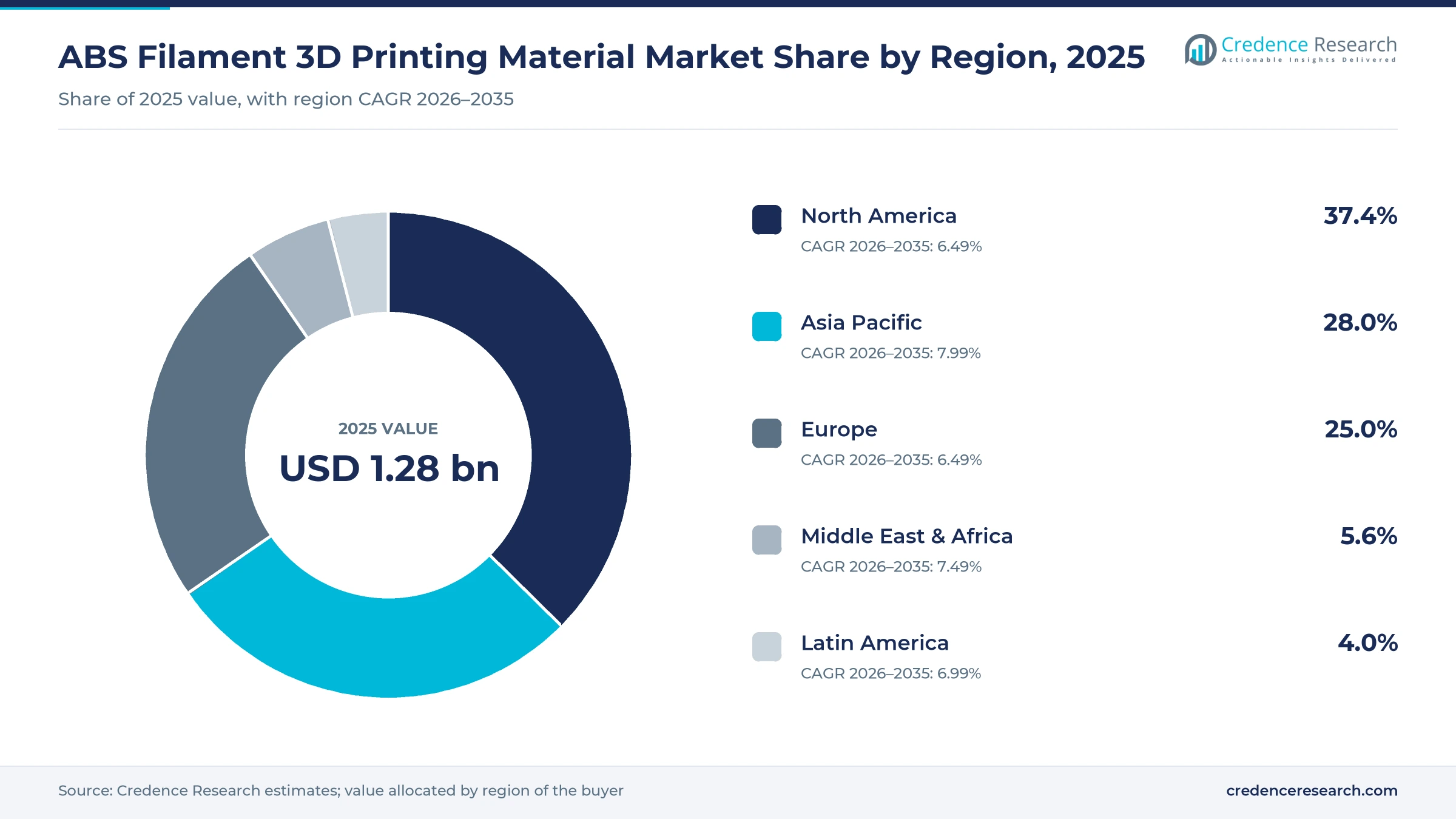
- North America is the largest region at 37.4%; Asia Pacific grows fastest at 7.99%.
Prototyping by Professional Users in 1.75 mm Standard ABS Leads
Which application leads?
Prototyping leads with a 36.0% share in 2025, followed by tools and fixtures, hobby projects, production parts and customized products. Production parts grow fastest at 8.71% a year.
Which user type leads?
Professional and industrial users lead with 44.0% and also grow fastest at 7.97%. Hobbyists form the second-largest group, followed by service bureaus and schools.
Which diameter and grade lead?
The 1.75 mm diameter leads with 72.0% because most desktop printers use it, and it also grows fastest at 7.61%. Standard ABS leads grades with 46.0%, while carbon- and glass-filled ABS grows fastest at 10.20%.
Which color and channel lead?
Black leads colors with 30.0%, and specialty formulations grow fastest at 9.45%. Printer-branded spools lead channels with 30.0%, while e-commerce grows fastest at 8.16%. Related blends are covered in the PC/ABS market.
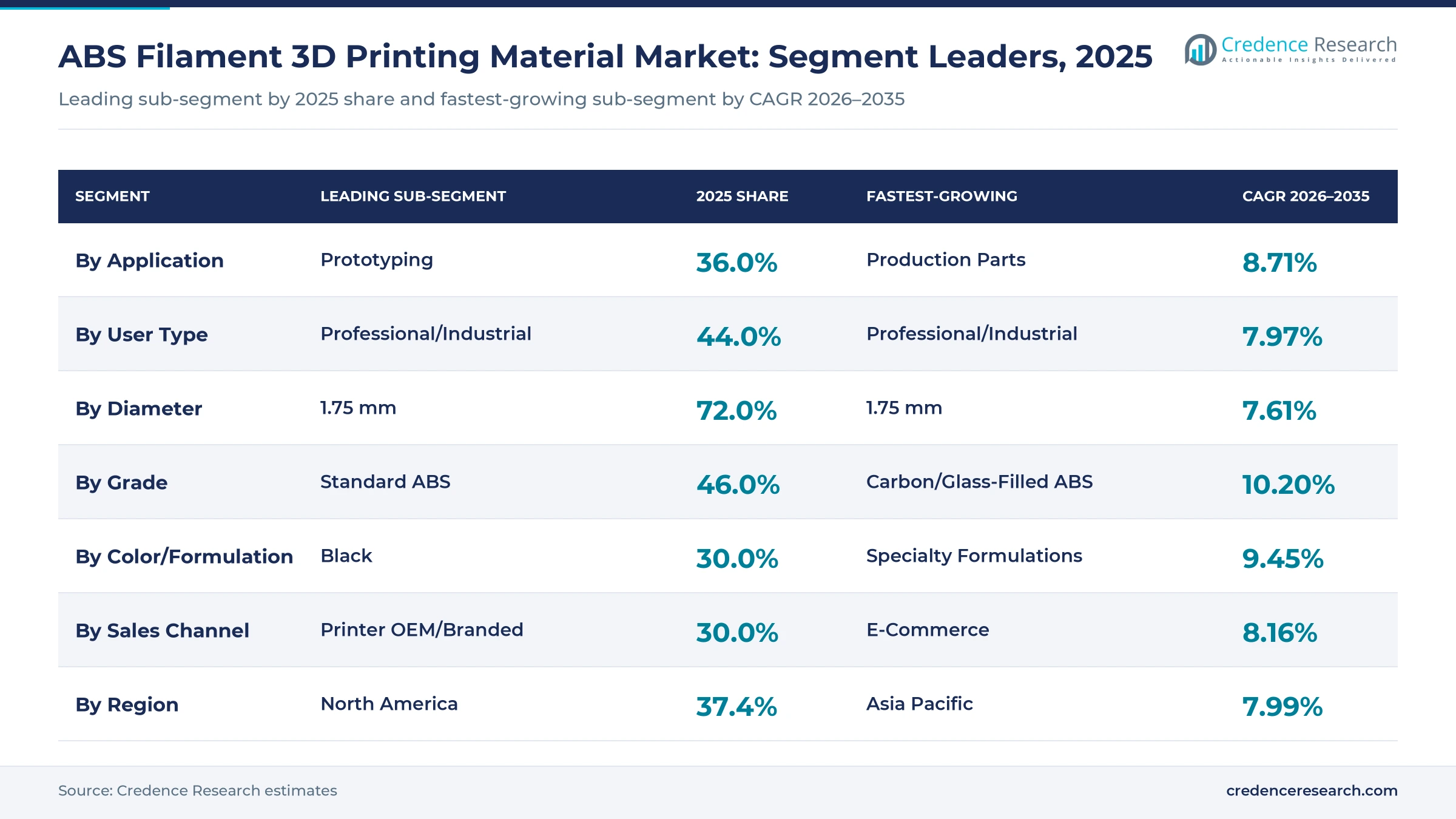
| Segment Group | Leading Sub-segment | 2025 Share | Fastest-growing Sub-segment | CAGR 2026–2035 |
|---|---|---|---|---|
| By Application | Prototyping | 36.0% | Production Parts | 8.71% |
| By User Type | Professional/Industrial | 44.0% | Professional/Industrial | 7.97% |
| By Filament Diameter | 1.75 mm | 72.0% | 1.75 mm | 7.61% |
| By Grade | Standard ABS | 46.0% | Carbon/Glass-Filled ABS | 10.20% |
| By Color/Formulation | Black | 30.0% | Specialty Formulations | 9.45% |
| By Sales Channel | Printer OEM/Branded | 30.0% | E-Commerce | 8.16% |
Request a Free Sample
Fill in your details and we'll send you a free sample report.
- Sample data tables & charts
- Research methodology
Factory Prototyping, a Larger Printer Base and Durable Parts Support Demand
Why does industrial use matter most? (~+1.9% impact on forecast CAGR)
Adoption for industrial functional prototyping and low-volume production is the strongest driver, adding about 1.9 percentage points to the forecast CAGR. Carmakers and machine builders print jigs, fixtures and test parts in ABS because it is tough, cheap and easy to machine after printing. Stratasys announced in September 2026 that its FDM systems are rolling out across more than 20 General Motors plants in North and South America for tooling, fixtures and jigs, according to its press release. The same month it launched the F870 large-format printer, qualified for ABS and a new ABS Draft material, with Toyota and Rivian evaluating it. Professional and industrial users lead with a 44.0% share, and production parts are the fastest-growing application at 8.71% a year.
How does the printer base help? (~+1.5% impact on forecast CAGR)
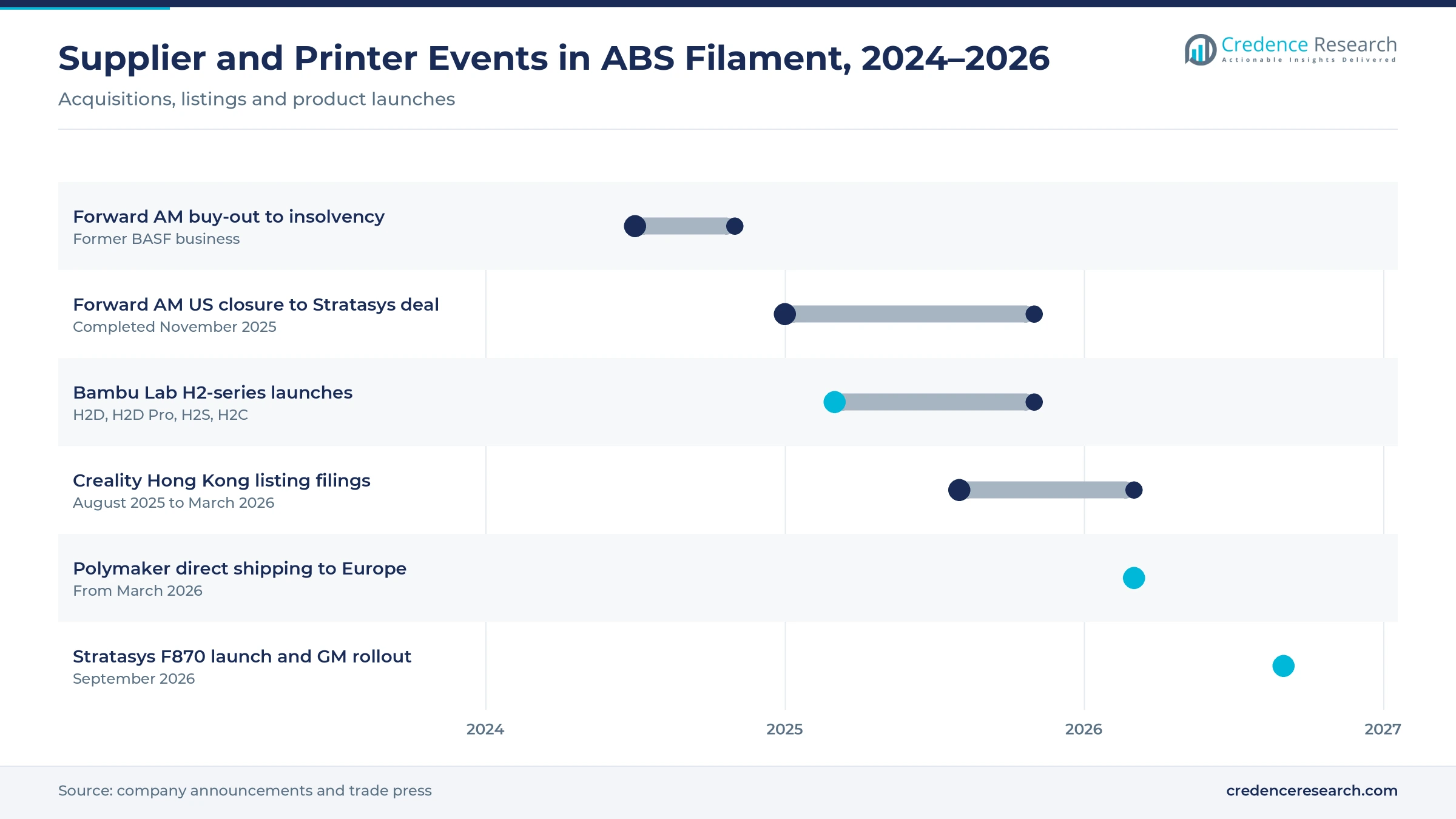
Expansion of the installed FDM printer base adds about 1.5 percentage points to the forecast CAGR. Creality shipped about 4.4 million printers from 2020 to 2024, and Bambu Lab shipped about 1.2 million in 2024, as reported by 3D Printing Industry from Creality's listing documents. More of the new printers have enclosures and heated beds, which ABS needs to avoid warping. Each new enclosed printer adds steady spool demand, though most owners still print mainly in PLA. Printer makers that ship tuned ABS profiles and dryers with their machines make the ABS filament 3D printing material easier to use for new owners, which widens the buyer base beyond experienced users.
Why do durable parts matter? (~+1.0% impact on forecast CAGR)
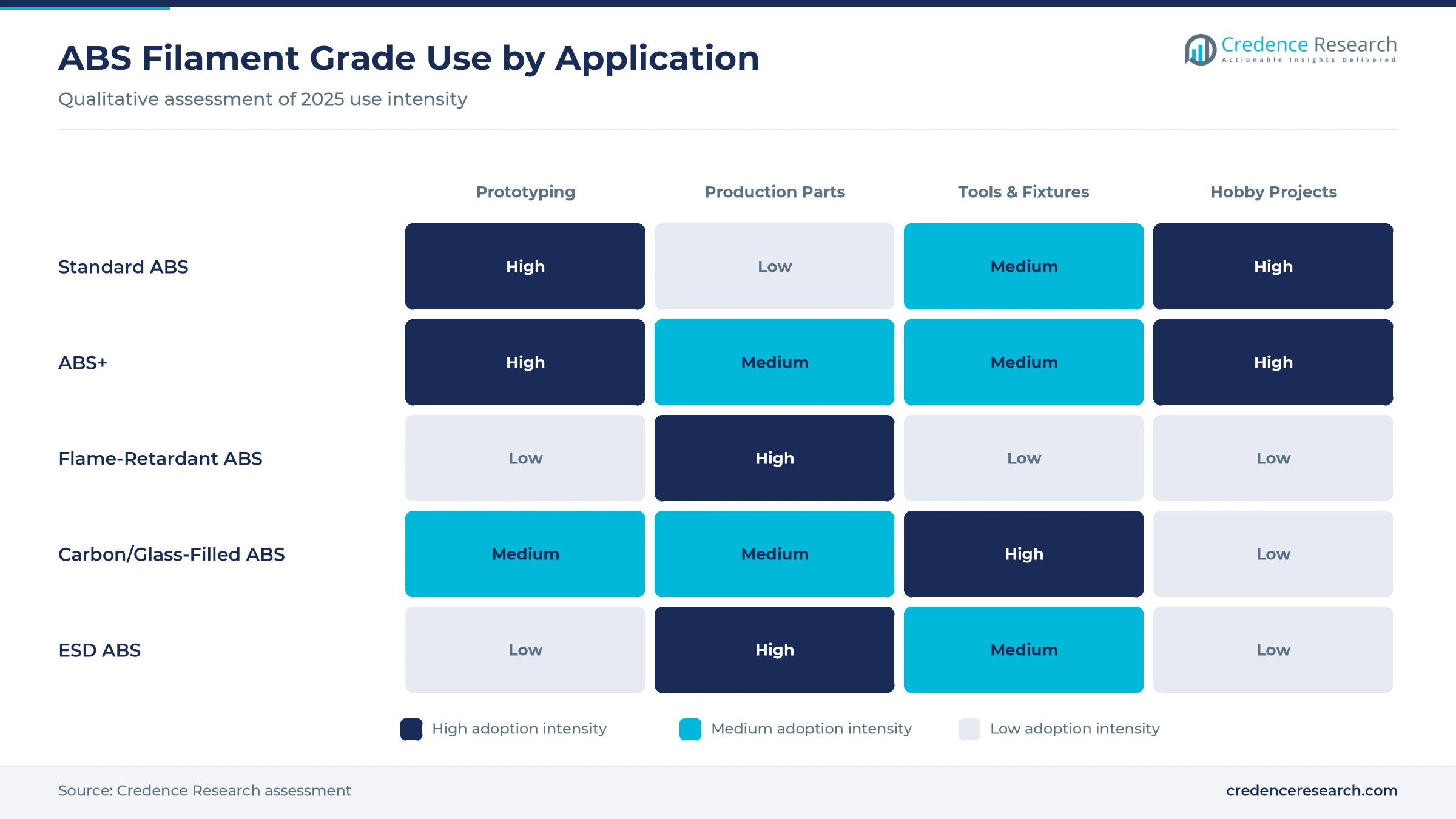
Demand for durable, machinable and cost-efficient thermoplastic parts adds about 1.0 percentage point to the forecast CAGR. ABS keeps its shape at higher temperatures than PLA, can be smoothed with acetone and accepts drilling and tapping. Consumer ABS+ spools sell for around USD 16 in online promotions, far cheaper than engineering filaments. Carbon- and glass-filled ABS is the fastest-growing grade at 10.20% a year as tooling users seek stiffer parts. The 1.75 mm diameter leads with a 72.0% share.
Engineering Grades, Online Sales and Consolidation Among Suppliers
Trend 1: Are engineering grades growing faster?
Yes. Filled, flame-retardant and ESD-safe grades let ABS meet factory and electronics needs. These grades command higher prices than standard ABS, which still leads with a 46.0% share.
Trend 2: Is online selling taking share?
Yes. Printer makers and filament brands sell directly through their own web stores. Polymaker began shipping directly to Europe in March 2026, and e-commerce is the fastest-growing channel at 8.16% a year.
Trend 3: Are suppliers consolidating?
Yes. Forward AM, the former BASF materials business, entered insolvency in late 2024, and Stratasys completed the purchase of its key assets in November 2025, according to TCT Magazine.
Trend 4: Is ASA competing with ABS?
Partly. ASA prints like ABS but resists sunlight better, and suppliers sell the two side by side. Wider plastics use is tracked in the 3D printing plastics market.
Fumes, Warping and Easier Materials Hold Back ABS
Are emissions a concern?
Yes. A study of five desktop printers found ABS and HIPS emitted styrene at about 10 to 110 micrograms per minute, along with ultrafine particles, as reported in Environmental Science & Technology. Schools and offices often prefer PLA for this reason.
Why is ABS hard to print?
ABS shrinks as it cools, so parts warp or crack without an enclosure and heated bed. Open-frame printers, still common in homes and schools, struggle with it.
Are other materials taking share?
Yes. PETG is easier to print and ASA handles outdoor use better. Both compete with ABS for functional parts.
Are prices under pressure?
Yes. Many brands sell similar ABS spools online, and consumer printer volumes have been uneven, so prices stay low.
Where are the opportunities?
Low-odor, flame-retardant and filled ABS grades for factory tooling and electronics enclosures offer higher margins. Suppliers that pair these grades with enclosed printers and print profiles can win industrial buyers. The execution risk is proving consistent quality spool to spool.
North America Leads, Asia Pacific Grows Fastest
ABS filament value is allocated to the region of the buyer.
| Region | Share 2025 | CAGR 2026–2035 |
|---|---|---|
| North America | 37.4% | 6.49% |
| Asia Pacific | 28.0% | 7.99% |
| Europe | 25.0% | 6.49% |
| Middle East & Africa | 5.6% | 7.49% |
| Latin America | 4.0% | 6.99% |
Why does North America lead?
North America holds a 37.4% share in 2025 and grows at 6.49% a year. Automotive plants, machine shops and a large hobbyist base use ABS, and industrial FDM rollouts at carmakers add steady demand.
What shapes Europe?
Europe holds 25.0% and grows at 6.49%. Germany, the Netherlands and the Czech Republic host filament makers, and engineering firms use ABS for tooling.
Why does Asia Pacific grow fastest?
Asia Pacific holds 28.0% and is the fastest-growing region at 7.99% a year. China makes most desktop printers and much of the world's filament, and printer use in schools and factories is rising across the region.
What about Latin America and the Middle East & Africa?
Latin America holds 4.0% and grows at 6.99%, helped by automotive plants in Brazil and Mexico. The Middle East & Africa region holds 5.6% and grows at 7.49%, mostly through online imports.
Product Launches, Rollouts and Acquisitions, 2025–2026
| Development | Status and why it matters |
|---|---|
| In September 2026, Stratasys announced a rollout of FDM systems across more than 20 General Motors plants for tooling and fixtures. | Announced. Adds industrial ABS demand. |
| In September 2026, Stratasys launched the F870 printer, qualified for ABS, ASA, nylon and a new ABS Draft material. | Launched. Toyota and Rivian are evaluating it. |
| In June 2026, INEOS Styrolution announced the closure of a polystyrene site in Illinois. | Announced. Shows cuts in styrenics capacity. |
| In April 2026, Bambu Lab launched the X2D desktop printer. | Launched. Expands enclosed printer base. |
| In March 2026, Polymaker opened direct shipping to Europe from its web store. | Launched. Grows direct online sales. |
| In March 2026, Creality filed an updated prospectus for a Hong Kong listing. | Filed. Shows scale of the desktop printer base. |
| In November 2025, Stratasys completed the acquisition of Forward AM's key assets. | Completed. Consolidates filament supply. |
| In March 2025, Bambu Lab launched the H2D printer, followed by further models through November 2025. | Launched. Adds enclosed printers suited to ABS. |
Need a Custom Version of This Report?
Tailor the scope, geography, or segments to your exact requirements.
- Custom geography or segment scope
- Direct access to our analyst team
Printer Makers, Filament Specialists and Retailers Compete on Price and Quality
The market is fragmented. Printer makers sell branded spools, filament specialists sell engineering grades, and retailers sell many brands online. No share ranking is given because few firms report ABS filament sales.
Who are the printer-linked suppliers?
Stratasys Ltd. sells ABS and other materials for its industrial FDM printers, reported record consumables sales in the second quarter of 2026, and owns the former Forward AM business. UltiMaker sells printers and branded materials and has offered ABS for its professional printers. Desktop makers such as Bambu Lab and Creality, not on the company list, also sell their own filament.
Who are the filament specialists?
Polymaker sells several ABS lines and ASA and ships directly to Europe. eSUN, based in Shenzhen, sells ABS+ in more than 100 countries. FormFutura, based in the Netherlands, lists ABS among its filaments. Fillamentum, a Czech maker, historically offered ABS, but its current ABS range could not be confirmed. BASF Forward AM is now part of Stratasys after its insolvency, and its current ABS products could not be confirmed.
Who are the retailers?
MatterHackers is a US retailer that sells ABS from many brands, including its own lines made by partners.
How do suppliers compete?
Suppliers compete on diameter tolerance, moisture control, color consistency, print profiles and price. In the ABS filament 3D printing material segment, buyers also weigh odor, warping behavior and the availability of flame ratings and safety data sheets for factory use. Brands tied to popular printers gain from default settings, while specialists win on filled and flame-retardant grades.
Frequently Asked Questions
How big is the ABS filament 3D printing material market?
Why is ABS used in 3D printing?
What drives the market?
Which grade grows fastest?
Which region leads?
What holds the market back?
Table of Content
Chapter 1 Market Segmentation
- 1.1 Segmentation Framework
- 1.1.1 Product and Service Classification
- 1.1.2 Application and End-Use Classification
- 1.1.3 Technology and Solution Classification
- 1.1.4 Customer and Distribution Channel Classification
- 1.1.5 Geographic Segmentation
- 1.1.6 Market Segment Definitions and Boundaries
- 1.2 By Application
- 1.2.1 Prototyping
- 1.2.2 Production Parts
- 1.2.3 Customized Products
- 1.2.4 Tools & Fixtures
- 1.2.5 Hobbyist Projects
- 1.3 By User Type
- 1.3.1 Professional/Industrial
- 1.3.2 Hobbyist
- 1.3.3 Educational Institutions
- 1.3.4 Service Bureaus
- 1.4 By Filament Diameter
- 1.4.1 1.75 mm
- 1.4.2 2.85 mm
- 1.4.3 3.00 mm
- 1.5 By Grade
- 1.5.1 Standard ABS
- 1.5.2 ABS+
- 1.5.3 Flame-Retardant ABS
- 1.5.4 Carbon/Glass-Filled ABS
- 1.5.5 ESD ABS
- 1.6 By Color/Formulation
- 1.6.1 Natural
- 1.6.2 Black
- 1.6.3 White
- 1.6.4 Colored
- 1.6.5 Specialty Formulations
- 1.7 By Sales Channel
- 1.7.1 Printer OEM/Branded
- 1.7.2 Material Specialists
- 1.7.3 Distributors
- 1.7.4 E-Commerce
Chapter 2 Introduction
- 2.1 Report Objectives and Scope
- 2.2 Product Definition and Industry Terminology
- 2.3 Market Inclusions and Exclusions
- 2.4 Research Process
- 2.4.1 Primary Research and Expert Interviews
- 2.4.2 Secondary Research and Source Review
- 2.4.3 Top-Down and Bottom-Up Estimation
- 2.4.4 Data Triangulation and Verification
- 2.5 Market Size Measurement Basis
- 2.5.1 2025: USD 1.28 billion → 2035: USD 2.50 billion
- 2.6 Historical and Forecast Reference Periods
- 2.6.1 Historical Period: 2018-2025
- 2.6.2 Base Year: 2025
- 2.6.3 Forecast Period: 2025-2035
- 2.7 Research Assumptions and Limitations
Chapter 3 Executive Summary
- 3.1 Market Snapshot and Key Findings
- 3.2 Base-Year Market Size, 2025
- 3.3 Forecast Market Size, 2035
- 3.4 Revenue and Volume Growth Outlook
- 3.5 Key Demand and Supply Indicators
- 3.6 Leading Market Segments
- 3.7 Fastest-Growing Market Opportunities
- 3.8 Regional Performance Highlights
- 3.9 Technology and Industry Transformation
- 3.10 Competitive Landscape Summary
- 3.11 Analyst View and Strategic Implications
Chapter 4 Global ABS Filament 3D Printing Material Market Trends and Developments
- 4.1 Historical Industry Development, 2018-2025
- 4.2 Recent Market Trends and Developments
- 4.3 Demand and Customer Behavior Trends
- 4.4 Technology and Product Innovation
- 4.5 Artificial Intelligence, Automation and Digitalization
- 4.6 Local Manufacturing and Supply Chain Realignment
- 4.7 Industry Partnerships, Mergers and Acquisitions
- 4.8 Sustainability and Circular Economy Developments
- 4.9 Government and Private Sector Investment Trends
- 4.10 Emerging Business Models and Commercialization
- 4.11 Industry Developments and Announcements
Chapter 5 Global ABS Filament 3D Printing Material Market Production, Supply and Demand Analysis
- 5.1 Demand Trend and Consumption Analysis, 2018-2025
- 5.2 Demand Forecast, 2025-2035
- 5.3 Production and Output Trend, 2018-2025
- 5.4 Production and Output Forecast, 2025-2035
- 5.5 Installed Capacity and Capacity Utilization
- 5.6 Company-Wise Production Plants and Statistics
- 5.6.1 Installed Production Capacity
- 5.6.2 Actual Production
- 5.6.3 Planned Capacity and Expansion Targets
- 5.7 Supply Chain Structure and Procurement Trends
- 5.8 Supply-Demand Gap and Bottlenecks
- 5.9 Import Dependence and Sourcing Structure
- 5.10 Contract Manufacturing and Outsourcing
- 5.11 Regional Supply and Demand Concentration
Chapter 6 Global ABS Filament 3D Printing Material Market Pricing Analysis
- 6.1 Pricing Structure and Measurement
- 6.2 Historical Pricing Trends, 2018-2025
- 6.3 Pricing Outlook, 2025-2035
- 6.4 Average Selling Price and Unit Economics
- 6.5 Pricing by Product and Market Segment
- 6.6 Geographic Pricing Differences
- 6.7 Key Input, Energy, Labor and Logistics Costs
- 6.8 Contract Pricing and Purchasing Models
- 6.9 Pricing Sensitivity and Competitive Positioning
- 6.10 Price, Margin and Profitability Implications
Chapter 7 Global ABS Filament 3D Printing Material Market Dynamics
- 7.1 Market Growth Drivers
- 7.1.1 Demand-Side Drivers
- 7.1.2 Technology and Innovation Drivers
- 7.1.3 Infrastructure and Investment Drivers
- 7.1.4 Regulatory and Policy Drivers
- 7.2 Market Restraints
- 7.2.1 Cost and Affordability Constraints
- 7.2.2 Technology and Adoption Barriers
- 7.2.3 Supply Chain and Operational Constraints
- 7.3 Market Challenges
- 7.3.1 Competitive Pressure and Margin Erosion
- 7.3.2 Skills, Infrastructure and Implementation Gaps
- 7.4 Emerging Market Opportunities
- 7.5 Market Dynamics Impact and Time-Horizon Assessment
Chapter 8 Global ABS Filament 3D Printing Material Value Chain Analysis
- 8.1 Industry Value Chain Overview
- 8.2 Upstream Suppliers and Critical Inputs
- 8.3 Technology and Component Providers
- 8.4 Manufacturing or Service Delivery
- 8.5 Distribution, Channel Partners and Integrators
- 8.6 Downstream Applications and End Users
- 8.7 Value Addition and Profit Pools
- 8.8 Vertical Integration and Outsourcing
- 8.9 Supplier Concentration and Risk
- 8.10 Supply Chain Localization and Resilience
Chapter 9 Global ABS Filament 3D Printing Material Market Regulations and Policies
- 9.1 Relevant Laws, Standards and Compliance Frameworks
- 9.2 Product, Service, Safety and Quality Requirements
- 9.3 Government Policies, Incentives and Subsidies
- 9.4 Imports, Exports and Trade Barriers
- 9.5 Public Procurement and Local Content Requirements
- 9.6 Environmental and Sustainability Compliance
- 9.7 Upcoming Policy Changes and Market Implications
Chapter 10 Global ABS Filament 3D Printing Material Market Hotspots and Opportunities
- 10.1 Market Opportunity Mapping and Growth Hotspots
- 10.2 High-Growth Applications and Customer Groups
- 10.3 Underserved Markets and White-Space Opportunities
- 10.4 Emerging Technology and Product Opportunities
- 10.5 New Capacity and Investment Hotspots
- 10.6 Market Entry and Expansion Opportunities
- 10.7 Distribution and Partnership Opportunities
- 10.8 Near-Term and Long-Term Commercial Potential
- 10.9 Opportunity Attractiveness and Execution Risks
Chapter 11 Global ABS Filament 3D Printing Material Market Outlook, 2025-2035
- 11.1 Market Size and Analysis
- 11.1.1 Revenue (Market Measurement: 2025: USD 1.28 billion → 2035: USD 2.50 billion)
- 11.1.2 Market Volume and Quantity Sold
- 11.1.3 Historical Market Size, 2018-2025
- 11.1.4 Base-Year Market Size, 2025
- 11.2 Market Forecast, 2025-2035
- 11.2.1 Revenue Forecast to 2035
- 11.2.2 Volume Forecast to 2035
- 11.2.3 CAGR and Year-on-Year Growth
- 11.2.4 Incremental Revenue Opportunity
- 11.3 Forecast Assumptions and Scenario Analysis
- 11.3.1 Base-Case Forecast
- 11.3.2 Optimistic and Conservative Scenarios
- 11.3.3 Technology, Pricing and Policy Sensitivities
- 11.4 Market Attractiveness and Growth Outlook
Chapter 12 Global ABS Filament 3D Printing Material Market Segmentation and Outlook
- 12.1 Segmentation Summary and Market Shares, 2025
- 12.2 Largest and Fastest-Growing Segments
- 12.3 By Application - Market Size and Forecast, 2025-2035
- 12.3.1 Segment Definition and Scope
- 12.3.2 Historical Market Size, 2018-2025
- 12.3.3 Revenue Forecast, 2025-2035
- 12.3.4 Volume Forecast, 2025-2035
- 12.3.5 Base-Year Market Share, 2025
- 12.3.6 Segment CAGR and Growth Drivers
- 12.3.7 Subsegment Market Size and Forecast
- 12.3.7.1 Prototyping
- 12.3.7.2 Production Parts
- 12.3.7.3 Customized Products
- 12.3.7.4 Tools & Fixtures
- 12.3.7.5 Hobbyist Projects
- 12.3.8 Subsegment Pricing and Adoption Trends
- 12.3.9 Leading Suppliers and Competition
- 12.3.10 Regional Demand and Opportunities
- 12.4 By User Type - Market Size and Forecast, 2025-2035
- 12.4.1 Segment Definition and Scope
- 12.4.2 Historical Market Size, 2018-2025
- 12.4.3 Revenue Forecast, 2025-2035
- 12.4.4 Volume Forecast, 2025-2035
- 12.4.5 Base-Year Market Share, 2025
- 12.4.6 Segment CAGR and Growth Drivers
- 12.4.7 Subsegment Market Size and Forecast
- 12.4.7.1 Professional/Industrial
- 12.4.7.2 Hobbyist
- 12.4.7.3 Educational Institutions
- 12.4.7.4 Service Bureaus
- 12.4.8 Subsegment Pricing and Adoption Trends
- 12.4.9 Leading Suppliers and Competition
- 12.4.10 Regional Demand and Opportunities
- 12.5 By Filament Diameter - Market Size and Forecast, 2025-2035
- 12.5.1 Segment Definition and Scope
- 12.5.2 Historical Market Size, 2018-2025
- 12.5.3 Revenue Forecast, 2025-2035
- 12.5.4 Volume Forecast, 2025-2035
- 12.5.5 Base-Year Market Share, 2025
- 12.5.6 Segment CAGR and Growth Drivers
- 12.5.7 Subsegment Market Size and Forecast
- 12.5.7.1 1.75 mm
- 12.5.7.2 2.85 mm
- 12.5.7.3 3.00 mm
- 12.5.8 Subsegment Pricing and Adoption Trends
- 12.5.9 Leading Suppliers and Competition
- 12.5.10 Regional Demand and Opportunities
- 12.6 By Grade - Market Size and Forecast, 2025-2035
- 12.6.1 Segment Definition and Scope
- 12.6.2 Historical Market Size, 2018-2025
- 12.6.3 Revenue Forecast, 2025-2035
- 12.6.4 Volume Forecast, 2025-2035
- 12.6.5 Base-Year Market Share, 2025
- 12.6.6 Segment CAGR and Growth Drivers
- 12.6.7 Subsegment Market Size and Forecast
- 12.6.7.1 Standard ABS
- 12.6.7.2 ABS+
- 12.6.7.3 Flame-Retardant ABS
- 12.6.7.4 Carbon/Glass-Filled ABS
- 12.6.7.5 ESD ABS
- 12.6.8 Subsegment Pricing and Adoption Trends
- 12.6.9 Leading Suppliers and Competition
- 12.6.10 Regional Demand and Opportunities
- 12.7 By Color/Formulation - Market Size and Forecast, 2025-2035
- 12.7.1 Segment Definition and Scope
- 12.7.2 Historical Market Size, 2018-2025
- 12.7.3 Revenue Forecast, 2025-2035
- 12.7.4 Volume Forecast, 2025-2035
- 12.7.5 Base-Year Market Share, 2025
- 12.7.6 Segment CAGR and Growth Drivers
- 12.7.7 Subsegment Market Size and Forecast
- 12.7.7.1 Natural
- 12.7.7.2 Black
- 12.7.7.3 White
- 12.7.7.4 Colored
- 12.7.7.5 Specialty Formulations
- 12.7.8 Subsegment Pricing and Adoption Trends
- 12.7.9 Leading Suppliers and Competition
- 12.7.10 Regional Demand and Opportunities
- 12.8 By Sales Channel - Market Size and Forecast, 2025-2035
- 12.8.1 Segment Definition and Scope
- 12.8.2 Historical Market Size, 2018-2025
- 12.8.3 Revenue Forecast, 2025-2035
- 12.8.4 Volume Forecast, 2025-2035
- 12.8.5 Base-Year Market Share, 2025
- 12.8.6 Segment CAGR and Growth Drivers
- 12.8.7 Subsegment Market Size and Forecast
- 12.8.7.1 Printer OEM/Branded
- 12.8.7.2 Material Specialists
- 12.8.7.3 Distributors
- 12.8.7.4 E-Commerce
- 12.8.8 Subsegment Pricing and Adoption Trends
- 12.8.9 Leading Suppliers and Competition
- 12.8.10 Regional Demand and Opportunities
- 12.9 Segment Growth Comparison
- 12.10 Segment Attractiveness and Priority Matrix
Chapter 13 Global ABS Filament 3D Printing Material End-Use and Application Market Outlook
- 13.1 End-Use Industry and Customer Demand Structure
- 13.2 Leading Applications and Customer Groups
- 13.3 End-Use Market Size, Share and Forecast
- 13.4 Major End-Use Industry Deep Dives
- 13.4.1 Customer Requirements and Use Cases
- 13.4.2 Demand and Replacement Cycles
- 13.4.3 Technical and Regulatory Considerations
- 13.4.4 Purchasing and Procurement Models
- 13.4.5 Leading Vendors and Distribution Channels
- 13.4.6 Forecast and Commercial Opportunities
- 13.5 Emerging Applications and Cross-Segment Demand
- 13.6 End-Use Industry Investment Priorities
Chapter 14 Global ABS Filament 3D Printing Material Geographic Market Outlook, 2025-2035
- 14.1 Regional Market Size and Share, 2025
- 14.2 Regional Market Forecast, 2025-2035
- 14.3 Regional Pricing, Production and Demand Differences
- 14.4 North America
- 14.4.1 United States
- 14.4.2 Canada
- 14.4.3 Mexico
- 14.5 Europe
- 14.5.1 Germany
- 14.5.2 France
- 14.5.3 Italy
- 14.5.4 United Kingdom
- 14.5.5 Spain
- 14.5.6 Poland
- 14.5.7 Russia
- 14.5.8 Netherlands
- 14.5.9 Belgium
- 14.5.10 Sweden
- 14.5.11 Denmark
- 14.5.12 Norway
- 14.5.13 Rest of Europe
- 14.6 Asia Pacific
- 14.6.1 China
- 14.6.2 India
- 14.6.3 Japan
- 14.6.4 South Korea
- 14.6.5 Thailand
- 14.6.6 Indonesia
- 14.6.7 Vietnam
- 14.6.8 Malaysia
- 14.6.9 Australia
- 14.6.10 Rest of Asia Pacific
- 14.7 Latin America
- 14.7.1 Brazil
- 14.7.2 Argentina
- 14.7.3 Colombia
- 14.7.4 Chile
- 14.7.5 Rest of Latin America
- 14.8 Middle East
- 14.8.1 Saudi Arabia
- 14.8.2 United Arab Emirates
- 14.8.3 Turkey
- 14.8.4 Israel
- 14.8.5 Iran
- 14.8.6 Rest of the Middle East
- 14.9 Africa
- 14.9.1 South Africa
- 14.9.2 Egypt
- 14.9.3 Nigeria
- 14.9.4 Morocco
- 14.9.5 Rest of Africa
- 14.10 Regional Investment, Policy and Supply Chain Differences
- 14.11 Regional Competitive Landscape
- 14.12 Geographic Growth Hotspots
Chapter 15 Global ABS Filament 3D Printing Material Technology, Innovation and Sustainability Outlook
- 15.1 Technology Landscape and Maturity
- 15.2 Product, Process and Service Innovation
- 15.3 AI, Automation and Digital Tools in the Industry
- 15.4 Technology Adoption and Performance Benchmarking
- 15.5 Innovation Pipeline and R&D Investment
- 15.6 Patent and Intellectual Property Trends
- 15.7 Energy Efficiency and Resource Management
- 15.8 Sustainability, Recycling and Circularity
- 15.9 Technology Roadmap, 2025-2035
- 15.10 Risks of Obsolescence and Technology Substitution
Chapter 16 Global ABS Filament 3D Printing Material Market Key Strategic Imperatives
- 16.1 Growth and Market Entry Priorities
- 16.2 High-Return Products and Segments
- 16.3 Pricing, Profitability and Cost Optimization
- 16.4 Technology Investment and Product Differentiation
- 16.5 Supply Chain Localization and Resilience
- 16.6 Distribution and Customer Acquisition
- 16.7 Partnership, Acquisition and Capacity Strategy
- 16.8 Regional Expansion Priorities
- 16.9 Short-, Medium- and Long-Term Actions
Chapter 17 Competition Outlook
- 17.1 Industry Competition Characteristics
- 17.2 Market Structure and Concentration
- 17.3 Market Share and Competitive Positioning, 2025
- 17.4 Company-Wise Revenue and Product Benchmarking
- 17.5 Production and Service Capacity Benchmarking
- 17.6 Technology, Pricing and Differentiation
- 17.7 Regional Footprint and Distribution Strength
- 17.8 Mergers, Acquisitions and Strategic Alliances
- 17.9 New Entrants and Competitive Threats
- 17.10 Porter's Five Forces and Industry Attractiveness
- 17.11 Competitive Outlook, 2025-2035
Chapter 18 Company Profiles
- 18.1 Company Coverage and Selection Criteria
- 18.2 Stratasys Ltd.
- 18.2.1 Business Description
- 18.2.2 Company Ownership and Geographic Presence
- 18.2.3 Product and Service Portfolio
- 18.2.4 Manufacturing and Operating Footprint
- 18.2.5 Production Capacity and Expansion Plans
- 18.2.6 Financial Performance and Investment
- 18.2.7 Market Share and Competitive Position
- 18.2.8 Technology and Innovation Capabilities
- 18.2.9 Strategic Alliances or Partnerships
- 18.2.10 Recent Developments
- 18.2.11 Growth Strategy and Outlook
- 18.3 Polymaker
- 18.4 BASF Forward AM
- 18.5 eSUN
- 18.6 Fillamentum
- 18.7 FormFutura
- 18.8 UltiMaker
- 18.9 MatterHackers
- 18.10 Other Relevant Market Participants
Note: Every listed company is profiled on the structure shown under the first company. The company list is preliminary and may change based on research findings, market developments, data availability and client requirements.
Chapter 19 Disclaimer
- 19.1 Research and Forecast Disclaimer
- 19.2 Data Source and Estimation Limitations
Note: The depth of individual sections depends on data availability for this market. Volume, capacity, trade and other unit-based metrics are included where applicable.

