
Market Overview
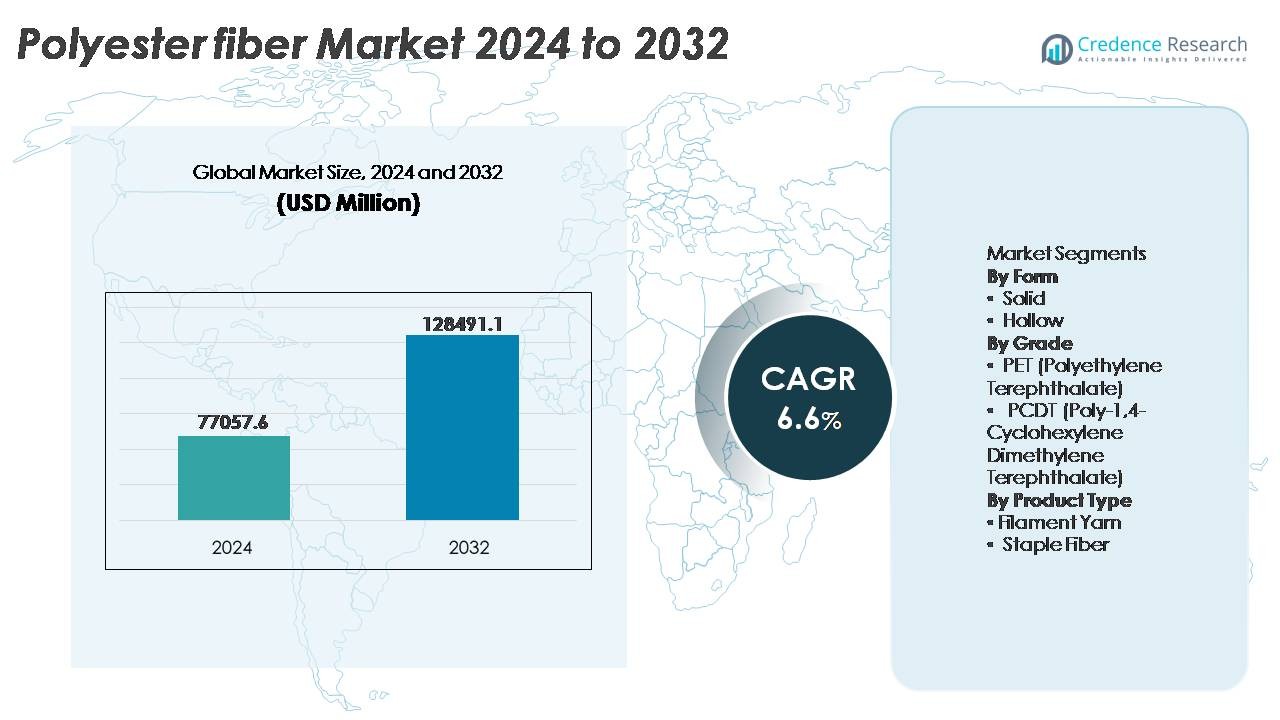
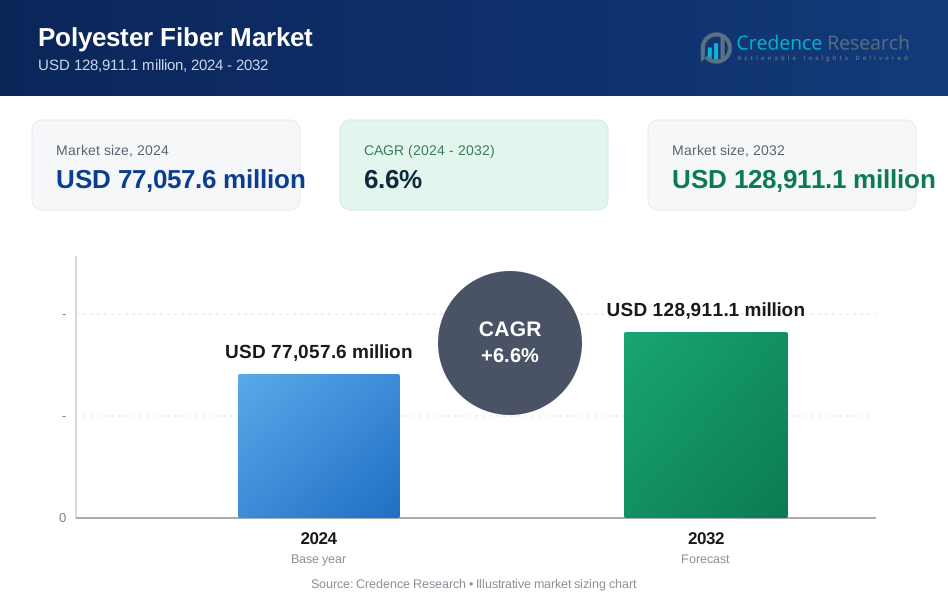
The polyester fiber market was valued at USD 77,057.6 million in 2024 and is projected to reach approximately USD 128,911.1 million by 2032, reflecting a CAGR of 6.6% during the forecast period (2025-2032).
| REPORT ATTRIBUTE | DETAILS |
|---|---|
| Historical Period | 2020-2023 |
| Base Year | 2024 |
| Forecast Period | 2025-2032 |
| Polyester Fiber Market Size 2024 | USD 77,057.6 Million |
| Polyester Fiber Market, CAGR | 6.6% |
| Polyester Fiber Market Size 2032 | USD 128,911.1 Million |
The polyester fiber market is shaped by leading global and regional manufacturers, including Sinopec Yizheng Chemical Fibre, Reliance Industries Limited, Indorama Ventures, Toray Industries, Tongkun Holding Group, Zhejiang Hengyi Group, Sanfame Group, Far Eastern New Century Corporation, Alpek Polyester, and ADVANSA, each leveraging scale, integrated feedstock production, and expanding recycled fiber capabilities to strengthen competitive positioning. Asia Pacific remains the dominant production and consumption hub, commanding over 65% of the global market share, supported by extensive textile manufacturing ecosystems in China, India, and Southeast Asia. North America and Europe follow as key markets for technical and recycled polyester applications, driven by sustainability compliance and demand for performance-grade fibers.
Market Insights
- The global polyester fiber market was valued at USD 77,057.6 million in 2024 and is projected to reach USD 128,911.1 million by 2032, expanding at a CAGR of 6.6% during the forecast period.
- Market growth is driven by rising demand from apparel, home furnishing, and technical textile industries, supported by cost-effective production, material durability, and versatility across weaving, knitting, and nonwoven applications.
- Key trends include increasing adoption of recycled polyester (rPET), development of bio-based alternatives, and rising demand for high-tenacity and functional fibers in automotive, medical, and industrial filtration sectors.
- Competitive dynamics are shaped by integrated manufacturers and sustainability-focused producers, where companies expand capacity, secure feedstock, and invest in circular recycling to reduce dependency on virgin PET supply.
- Asia Pacific dominates the market with over 65% share, while PET fiber accounts for the leading segment; North America and Europe maintain a combined 22% share driven by technical textile and recyclable-grade product demand.
Market Segmentation Analysis:
By Form
Solid polyester fiber represents the dominant sub-segment, capturing the largest market share due to its extensive use in apparel, home furnishings, and industrial textiles. Its high tensile strength, wrinkle resistance, and cost-effectiveness enable large-scale manufacturing for garments, bed linens, and automotive interiors. Solid fibers exhibit superior color retention and withstand repeated washing, making them preferred by textile processors. Hollow fibers continue to gain traction, primarily in insulation products, pillows, and bedding where air-trapping capabilities improve thermal efficiency; however, their adoption remains focused on niche, value-added applications.
- "For instance, Zhejiang Hengyi Group operates high-viscosity solid polyester fiber production across integrated PTA-PET lines with an aggregate capacity exceeding 10 million tons per year of polyester products (including fiber and bottle chips), supported by 13.5 million tons per year of PTA capacity.
By Grade
PET fiber holds the leading market share in the polyester fiber segment, driven by widespread adoption in packaging textiles, clothing, and technical fabrics. Its durability, recyclability, and lightweight characteristics support high-volume production across global supply chains. PET also benefits from established recycling infrastructure, improving sustainability positioning. In contrast, PCDT fiber serves more specialized applications including drapery and high-end interior fabrics due to superior elasticity and resilience, but its higher cost and limited production scale restrict broader market penetration, keeping PET as the primary growth-driven fiber grade.
- For instance, "Indorama Ventureshas made significant investments in its global recycling operations, with a goal to expand its annual rPET bale input capacity to 750,000 tons by 2025. The company's operations include chemical recycling assets, such as joint ventures with partners to scale up depolymerization units capable of processing PET waste feedstock into purified monomers designated for fiber-grade or food-grade polymerization."
By Product Type
Filament yarn leads the product type segmentation, attributed to its capacity to produce smooth, continuous, and high-strength fabrics used in sportswear, fashion apparel, and technical textiles. Its uniform structure allows for enhanced sheen, fabric drape, and performance characteristics that appeal to high-value consumer and industrial applications. Staple fiber remains essential in carpets, nonwoven fabrics, and cushioning, particularly where bulk and texture are required. However, filament yarn maintains market dominance due to efficiency in weaving and knitting operations, lower material waste, and growing demand for premium, lightweight textile solutions.
Key Growth Drivers
Expanding Demand from Apparel and Home Furnishing Industries
The polyester fiber market benefits significantly from rising demand across apparel and home furnishing sectors, fueled by population growth, urban lifestyle shifts, and expanding retail penetration. Polyester’s versatility, moisture resistance, and affordability position it as a preferred fabric in casualwear, sportswear, and fast-fashion supply chains. The fiber’s adaptability to diverse processing techniques including texturizing, dyeing, and blending supports large-scale garment production while meeting evolving design trends. In the home furnishings segment, polyester is widely used in upholstery, bedsheets, curtains, and carpets due to its strength and easy maintenance. Additionally, polyester’s ability to mimic natural fibers like cotton and silk at a lower cost stimulates consumer adoption in price-sensitive markets. E-commerce apparel sales and brand-driven customization further accelerate consumption. As global textile manufacturers prioritize durable and recyclable fibers with lower production costs, polyester's performance characteristics and established manufacturing ecosystem reinforce its market growth trajectory.
- For instance, Reliance Industries Limited operates one of the world’s largest polyester textile operations, with fiber and yarn production capacity exceeding 2.5 million tons annually, supported by continuous polymerization and high-speed texturizing lines enabling bulk volume apparel-grade filament for global fashion and sportswear brands.
Technological Advancements and High-Performance Fiber Development
Advancements in polymer chemistry, fiber customization, and additive integration propel polyester fiber market expansion by enhancing product capability and unlocking premium applications. Innovations such as bio-based PET, flame-retardant grades, low-pill fibers, and anti-microbial coatings cater to evolving end-user requirements, especially in healthcare, protective clothing, automotive interiors, and industrial filtration. High-tenacity polyester fibers deliver excellent dimensional stability and abrasion resistance, positioning them as alternatives to nylon in ropes, seatbelts, tire cords, and conveyor belts. Improvements in fiber spinning, melt processing, and digital finishing techniques reduce material loss and shorten production cycles, making manufacturing more cost-efficient. Additionally, advances in recycling such as chemical depolymerization and enzymatic conversion enable closed-loop circularity, expanding polyester’s sustainability appeal. These ongoing innovations create a favorable environment for differentiated, high-margin products, encouraging investment and expanding the addressable market beyond conventional textile applications.
- For instance,"Indorama Ventures produces high-tenacity polyester tire-cord fibers engineered with excellent tensile strength and thermal resistance suitable for high-speed radial tires, supported by integrated spinning, Twisting, and Heat-setting (TTH) lines distributed across its global polyester industrial fiber facilities."
Growth in Recycling and Circular Economy Adoption
The push toward circular manufacturing is a major growth catalyst, with recycled polyester (rPET) emerging as a strategic material for sustainability-focused industries. Governments and brands commit to recycling targets, reduced carbon footprints, and waste diversion, driving demand for recycled PET fibers sourced from bottles, packaging waste, and textile scraps. Mechanical and chemical recycling technologies improve recyclate quality, enabling rPET to perform comparably to virgin fibers in apparel and industrial uses. Brands in fast fashion, sportswear, and luxury textiles adopt rPET collections to meet sustainability reporting and consumer expectations. Additionally, textile-to-textile recycling initiatives reduce reliance on landfill and incineration, supporting environmental objectives. Cost efficiencies derived from waste utilization attract manufacturers, and collaboration among recyclers, brands, and municipalities strengthens material availability. The growing integration of post-consumer and post-industrial recyclates positions recycled polyester as a mainstream material in next-generation textile production.
Key Trends & Opportunities
Rise of Sustainable and Bio-Based Polyester Fibers
Sustainability commitments and rising consumer awareness present opportunities for bio-based and low-carbon polyester fibers. Manufacturers are developing fibers using renewable feedstocks such as bio-based MEG, recycled ocean plastics, and agricultural waste derivatives. Government-backed environmental regulations and green certification programs encourage adoption of sustainable materials. The shift from “fast fashion volume” to “responsible fashion value” supports demand for traceable, ethically sourced fibers. Advances in chemical recycling producing virgin-quality rPET allow premium applications including performance apparel and medical-grade fabrics. Market players investing in circular design models, biodegradable additives, and carbon-neutral manufacturing processes stand to gain a competitive edge. Partnerships among brands, recyclers, and technology companies accelerate commercialization. As industries create eco-labeled products and expand low-impact textile collections, the sustainable polyester fiber segment becomes a major opportunity frontier for scale, differentiation, and compliance advantages.
- For instance, Indorama Ventures has implemented industrial-scale bottle-to-fiber circular systems supporting recycled polyester fiber production across nine internationally certified ISCC+ sites, enabling traceable supply capability for technical, apparel, and specialty textile applications.
Expansion of Technical Textile Applications
The rise of technical textiles presents a significant opportunity, with polyester fibers increasingly utilized in geotextiles, industrial filtration, automotive components, and medical fabric manufacturing. Attributes including high tenacity, heat resistance, chemical stability, and dimensional accuracy make polyester suitable for demanding operating conditions. Infrastructure projects drive consumption of geotextiles for reinforcement, drainage, separation, and erosion control. In automotive applications, polyester-based fabrics support lightweighting initiatives, replacing heavier materials and improving fuel efficiency. Meanwhile, demand for antimicrobial and liquid-barrier polyester fabrics grows in healthcare environments. Industrial filters, conveyor belts, ropes, and safety equipment also incorporate engineered polyester fibers to improve service life and durability. As automation and mechanized construction expand, so does the need for industrial-grade fibers. The broadening scope of high-performance textile solutions forms a sustained growth channel for polyester fiber manufacturers targeting value-added product categories.
- For instance, Indorama Ventures produces industrial-grade polyester tire-cord fibers engineered with tensile strength grades up to 9.0 grams per denier and controlled thermal shrinkage for high-speed radial tire applications, supported through integrated spinning and heat-setting lines across its industrial fiber division.
Customized, Functional, and Smart Textiles
The adoption of smart and functional textiles enhances growth potential, driven by integration of sensor-embedded fibers, conductive coatings, and phase-changing materials. Polyester fiber serves as a stable substrate for electronic layering and functional finishes, enabling applications in wearable devices, biometric monitoring uniforms, and adaptive climate-control clothing. Outdoor and sports apparel brands increasingly invest in moisture-wicking, UV-protection, anti-odor, and quick-dry finishes to meet performance expectations. Personalization and micro-collection manufacturing models fuel demand for flexible fiber engineering. The defense and aerospace industries experiment with signal-responsive polyester textiles to improve surveillance, thermal management, and protective gear design. These innovations support premium pricing models, expanding margins amid competitive pressure. As Industry 4.0 technologies converge with textile production such as digital printing and nanocoatings polyester’s modification compatibility positions it at the forefront of the functional and intelligent textile revolution.
Key Challenges
Environmental Impact and Resource Dependency
The environmental footprint of polyester fiber production remains a substantial challenge due to dependence on petroleum-derived feedstocks and energy-intensive processes. High carbon emissions, microplastic shedding, and end-of-life waste management issues drive scrutiny from policymakers and environmental groups. While recycling supports circularity, global recycling infrastructure remains inconsistent, limiting material recovery volumes. Mechanical recycling results in quality degradation over multiple cycles, necessitating chemical recycling advancements that are expensive and not yet globally scalable. The textile industry faces mounting pressure to eliminate microplastic release into waterways through pre-treatment, filtration, or fiber modification. Compliance with evolving environmental regulations increases operational costs, particularly for small and mid-sized manufacturers. Addressing environmental concerns while maintaining scale and affordability requires coordinated investment in green chemistry, renewable feedstocks, and waste collection ecosystems.
Volatility in Raw Material Prices and Supply Chain Disruptions
Polyester fiber production is vulnerable to price fluctuations in crude oil derivatives, especially PTA and MEG, which form the essential raw material base. Geopolitical tensions, refinery outages, trade restrictions, and transportation bottlenecks create unpredictability in supply and pricing. Manufacturers often struggle to balance production costs with competitive pricing strategies in a margin-conscious textile industry. Reliance on imports for feedstock compounds risk for emerging economies. Disruptions during global crises, port congestions, or logistics failures amplify lead times, affecting downstream garment manufacturers and retailers operating under rapid product cycles. Inventory misalignment and overproduction risk rise due to demand volatility in fashion-driven markets. To mitigate these challenges, manufacturers increasingly pursue vertical integration, flexible sourcing strategies, recycling-based feedstock generation, and digital supply chain visibility to enhance resilience and cost efficiency.
Regional Analysis
Asia Pacific
Asia Pacific holds the dominant share of the polyester fiber market, accounting for over 65% of global consumption, driven by strong textile manufacturing bases in China, India, Vietnam, and Indonesia. The region benefits from cost-effective labor, large-scale weaving and spinning capacity, and the availability of PTA and MEG feedstocks. China remains the largest producer and consumer, supported by vertically integrated supply chains and surging demand for apparel, home textiles, and industrial-grade fibers. Government-backed expansion in technical textiles, infrastructure, and export-led garment production further reinforces Asia Pacific’s leadership. Increasing adoption of recycled polyester also elevates the region’s sustainability positioning.
Europe
Europe represents approximately 12% of the polyester fiber market, driven by advanced technical textile demand in automotive, geotextiles, filtration, and industrial applications. The region emphasizes sustainability, prompting manufacturers to prioritize recycled and bio-based polyester solutions aligned with EU recycling targets and carbon compliance frameworks. Germany, Italy, and France lead consumption due to robust automotive and performance apparel industries. Import dependency remains notable; however, investments in closed-loop textile recycling and circular design help reduce reliance on virgin feedstock. Premium-grade filament and performance fibers find steady demand from sportswear and specialty textile brands seeking durability, moisture control, and extended product lifecycles.
North America
North America accounts for nearly 10% of the polyester fiber market, supported by strong demand for automotive textiles, hygiene nonwovens, and home furnishings. The United States drives most consumption, particularly in carpet manufacturing, industrial fiber composites, and technical geotextiles used in roadway reinforcement and soil stabilization. The region experiences rapid momentum in recycled polyester initiatives, accelerated by brand commitments to sustainable apparel and packaging. While manufacturing is less concentrated compared to Asia, adoption of chemical recycling technologies expands strategic domestic capacity. The rise of reshoring strategies and material traceability requirements strengthens regional investment opportunities across value-added polyester applications.
Latin America
Latin America holds around 7% market share, with Brazil and Mexico leading fiber consumption across apparel, workwear, and home décor segments. Growing retail fashion penetration, expanding urban populations, and increasing participation of domestic textile manufacturers contribute to steady polyester demand. Import reliance on feedstocks and fibers persists; however, regional producers are gradually investing in recycling infrastructure to supply rPET for branded apparel and packaging. The automotive sector in Mexico and Brazil creates opportunities for polyester-based nonwoven and interior components. Currency volatility, trade fluctuations, and energy costs remain structural hurdles, yet rising manufacturing competitiveness positions the region for moderate long-term expansion.
Middle East & Africa
The Middle East & Africa region captures approximately 6% of the polyester fiber market, supported by the presence of petrochemical feedstock suppliers and expanding textile processing clusters, particularly in Turkey, Egypt, and the UAE. Demand is driven by increasing apparel consumption, infrastructure projects requiring geotextiles, and the development of localized garment manufacturing for export. Turkey acts as a regional hub for polyester filament, supplying European and North African markets. While growth potential is significant, logistical challenges, uneven industrialization, and limited recycling ecosystems restrict broader adoption. Investments in industrial parks and trade-linked manufacturing partnerships improve regional market prospects.
Market Segmentations:
By Form
- Solid
- Hollow
By Grade
- PET (Polyethylene Terephthalate)
- PCDT (Poly-1,4-Cyclohexylene Dimethylene Terephthalate)
By Product Type
- Filament Yarn
- Staple Fiber
By Geography
- North America
- U.S.
- Canada
- Mexico
- Europe
- Germany
- France
- U.K.
- Italy
- Spain
- Rest of Europe
- Asia Pacific
- China
- Japan
- India
- South Korea
- South-east Asia
- Rest of Asia Pacific
- Latin America
- Brazil
- Argentina
- Rest of Latin America
- Middle East & Africa
- GCC Countries
- South Africa
- Rest of the Middle East and Africa
Competitive Landscape
The polyester fiber market is characterized by a highly competitive landscape, driven by the presence of vertically integrated chemical producers, global textile manufacturers, and regional specialty fiber suppliers. Major companies focus on capacity expansion, cost-optimized feedstock sourcing, and the development of high-performance and recycled polyester products to strengthen portfolio differentiation. Collaboration with apparel brands, automotive OEMs, and technical textile manufacturers accelerates adoption of rPET and value-added fibers. Competitive advantage increasingly stems from circular economy capabilities, including chemical recycling, textile waste sourcing, and closed-loop production agreements. Market players also invest in advanced spinning technologies, digital color management, and functional coating solutions to support premium-grade applications. However, pricing pressures, fluctuating raw material costs, and shifting sustainability regulations intensify competition across global markets. As demand evolves toward durable, traceable, and eco-efficient polyester fibers, innovation, supply chain integration, and sustainability-driven production frameworks define the strategic priorities shaping competitive momentum.
Key Player Analysis
- Sinopec Yizheng Chemical Fibre Limited Liability Company (China)
- Far Eastern New Century Corporation (Taiwan)
- Reliance Industries Limited (India)
- Tongkun Holding Group (China)
- Alpek Polyester (Mexico)
- Toray Industries, Inc. (Japan)
- Indorama Ventures Public Company Limited (Thailand)
- Zhejiang Hengyi Group Co., Ltd (China)
- ADVANSA (Turkey)
- Sanfame Group (China)
Recent Developments
- In March 2025 - ADVANSA’s ADVAtex is a 100% recycled polyester fiber made from pre-consumer textile waste. It reduces reliance on virgin materials while maintaining quality. The process transforms textile waste into durable fibers for furniture and mattresses, addressing global textile waste challenges. Certified by GRS and Oeko-Tex.
- In September 2024, Indorama joined a consortium of seven companies (across five countries) to establish what the press release called the “world’s first supply chain for more sustainable polyester fiber,” using CO₂-derived raw materials, renewable and bio-based feedstocks instead of purely fossil-based ones.
- In June 2024,Toray launched new “Toraysee™” cleaning cloths made with polyester fiber that gently remove fingerprints and sebum without scratching surfaces. This indicates continued fiber-to-product integration and use of polyester fiber for specialty applications beyond textiles.
Report Coverage
The research report offers an in-depth analysis based on Form, Grade, Product type and Geography. It details leading market players, providing an overview of their business, product offerings, investments, revenue streams, and key applications. Additionally, the report includes insights into the competitive environment, SWOT analysis, current market trends, as well as the primary drivers and constraints. Furthermore, it discusses various factors that have driven market expansion in recent years. The report also explores market dynamics, regulatory scenarios, and technological advancements that are shaping the industry. It assesses the impact of external factors and global economic changes on market growth. Lastly, it provides strategic recommendations for new entrants and established companies to navigate the complexities of the market.
Future Outlook
- Demand for polyester fiber will continue rising, supported by growth in apparel, home décor, and technical textile applications.
- Recycled polyester will expand as brands and manufacturers adopt circular production and sustainability targets.
- Chemical recycling technologies will advance, enabling higher-quality, closed-loop polyester fiber output.
- Bio-based polyester alternatives will gain traction as companies work to reduce dependence on fossil-based feedstocks.
- High-tenacity and performance-grade fibers will see greater adoption in automotive, aerospace, and industrial applications.
- Digital manufacturing and automated spinning will improve operational efficiency and reduce waste.
- Smart and functional textiles will open new opportunities in healthcare and wearable electronics.
- Capacity expansion in Asia will strengthen supply chain dominance and cost leadership.
- Regulatory pressures on microplastics and waste management will drive innovation in fiber modification.
- Market competition will increasingly favor vertically integrated producers focused on sustainability and specialty fiber solutions.
Request a Free Sample
Fill in your details and we'll send you a free sample report.
- Sample data tables & charts
- Research methodology
Need a Custom Version of This Report?
Tailor the scope, geography, or segments to your exact requirements.
- Custom geography or segment scope
- Direct access to our analyst team
Frequently Asked Questions
What is the current market size for the polyester fiber market, and what is its projected size by 2032?
At what Compound Annual Growth Rate is the polyester fiber market projected to grow between 2024 and 2032?
Which polyester fiber segment held the largest market share in 2024?
What are the primary factors fueling the growth of the polyester fiber market?
Who are the leading companies in the polyester fiber market?
Which region commanded the largest share of the polyester fiber market in 2024?
Table of Content
Chapter 1. Report Introduction
- 1.1 Report Description & Purpose
- 1.1.1 Report Title & Market Definition
- 1.1.2 Unique Selling Propositions (USP) & Key Differentiators
- 1.1.3 Value Proposition for Stakeholders
- 1.2 Research Objectives
- 1.2.1 Market Sizing Objectives (Volume & Revenue)
- 1.2.2 Segmentation Objectives
- 1.2.3 Competitive Intelligence Objectives
- 1.2.4 Forecast & Scenario Objectives
- 1.3 Report Scope
- 1.3.1 Polyester Fiber Scope – Types & Subtypes Covered
- 1.3.2 Geographic Scope – Regions & Countries Covered
- 1.3.3 Historical Period, Base Year & Forecast Period (2024; forecast to 2032)
- 1.3.4 Inclusions & Exclusions
- 1.4 HS Code & Classification Framework
- 1.5 Currency, Units & Pricing Basis
- 1.6 Target Stakeholders
- 1.7 Limitations & Assumptions
Chapter 2. Executive Summary
- 2.1 Global Polyester Fiber Market Snapshot
- 2.1.1 Market Size – Historical (2024) & Forecast (2024-2032) (2024: USD 77,057.6 million → 2032: USD 128,911.1 million)
- 2.1.2 Volume & Revenue – Global Totals
- 2.1.3 Key Market Highlights – Top Five Facts
- 2.2 Polyester Fiber Market Segmentation Snapshot
- 2.2.1 Market Split by Region – 2024 vs. 2032
- 2.3 Competitive Snapshot
- 2.3.1 Top 10 Players by Revenue Share – 2024
- 2.3.2 Top 10 Players by Volume Share – 2024
- 2.3.3 Recent Strategic Developments (18-Month Summary)
- 2.4 Key Investment Highlights & Strategic Conclusions
Chapter 3. Polyester Fiber Market Dynamics & Industry Analysis
- 3.1 Market Overview & Context
- 3.1.1 Polyester Fiber Market Position in the Broader Automotive Value Chain
- 3.1.2 OEM vs. Replacement Market Dynamics
- 3.1.3 Market Maturity & Development Stage by Region
- 3.2 Polyester Fiber Market Drivers
- 3.3 Polyester Fiber Market Restraints & Challenges
- 3.4 Polyester Fiber Market Opportunities
- 3.5 Porter's Five Forces Analysis
- 3.5.1 Threat of New Entrants
- 3.5.2 Bargaining Power of Suppliers
- 3.5.3 Bargaining Power of Buyers
- 3.5.4 Threat of Substitutes
- 3.5.5 Competitive Rivalry – Intensity Assessment
- 3.6 Polyester Fiber Value Chain Analysis
- 3.6.1 Upstream – Raw Material/Input Suppliers
- 3.6.1.1 Raw Material/Input 1
- 3.6.1.2 Raw Material/Input 2
- 3.6.1.3 Raw Material/Input 3
- 3.6.2 Midstream – Production/Manufacturing/Service Delivery
- 3.6.2.1 Production/Process Overview
- 3.6.2.2 Key Facility Locations & Capacity by Manufacturer
- 3.6.3 Downstream – Distribution & End Consumer
- 3.6.3.1 Primary Channel – B2B/OEM
- 3.6.3.2 Secondary Channels – Dealer, Retail, Online, Direct
- 3.6.4 Value Chain Profitability Analysis
- 3.6.1 Upstream – Raw Material/Input Suppliers
- 3.7 PESTEL Analysis
- 3.7.1 Political Factors
- 3.7.2 Economic Factors
- 3.7.3 Social Factors
- 3.7.4 Technological Factors
- 3.7.5 Environmental Factors
- 3.7.6 Legal Factors
- 3.8 Polyester Fiber Supply Chain Analysis
- 3.8.1 Raw Material/Input Supply Risk Assessment
- 3.8.2 Manufacturing Concentration Risk (Geographic Exposure)
- 3.8.3 Trade Disruption Impact Analysis
- 3.9 Regulatory & Policy Landscape
Note: The regulatory and policy landscape section covers regulations based on their applicability to the market, Polyester Fiber category, geography, and scope of the study. Only regulatory frameworks with a material impact on operations, compliance, trade, sustainability, or market access are analyzed in detail.
Chapter 4. Key Investment Pockets & Opportunity Analysis
- 4.1 Polyester Fiber Market Attractiveness Analysis
- 4.1.1 By Region – Investment Attractiveness Matrix (Volume × CAGR)
- 4.2 Absolute Revenue Growth Opportunity
- 4.2.1 By Region – Absolute USD Growth Through 2032
- 4.3 Incremental Volume Opportunity
- 4.3.1 By Region – Incremental Volume Through 2032
- 4.3.2 Segment – Incremental Volume
- 4.4 Emerging Submarket Opportunity Deep Dive (Subject to Applicability)
- 4.5 Emerging Market Opportunity Scorecards
- 4.5.1 United States
- 4.5.2 Europe
- 4.5.3 Asia
- 4.5.4 Middle East & Africa
Note: Emerging Market Opportunity Scorecards will be included based on relevance and strategic importance. Regions listed are indicative and may vary depending on data availability and market dynamics.
Chapter 5. Polyester Fiber Import-Export Analysis & Trade Flows
- 5.1 Global Trade Overview
- 5.1.1 Global Export Value by Country (2024)
- 5.1.2 Global Export Volume by Country (2024)
- 5.1.3 Global Import Value by Country (2024)
- 5.1.4 Global Import Volume by Country (2024)
- 5.1.5 Net Trade Balance by Country (2024)
- 5.2 Export Analysis – Segment
- 5.2.1 Type 1 (HS Code)
- 5.2.2 Type 2 (HS Code)
- 5.2.3 Type 3 (HS Code)
- 5.2.4 Type 4 (HS Code)
- 5.2.5 Type 5 (HS Code)
- 5.3 Import Analysis – Segment
- 5.3.1 Type 1 (HS Code)
- 5.3.2 Type 2 (HS Code)
- 5.3.3 Type 3 (HS Code)
- 5.3.4 Type 4 (HS Code)
- 5.3.5 Type 5 (HS Code)
- 5.4 Average Unit Trade Prices
- 5.4.1 Average Export Price – Segment & Country
- 5.4.2 Average Import Price – Segment & Source Country
- 5.4.3 Price Trends (2024)
- 5.5 Key Trade Route Analysis
- 5.5.1 Trade Route 1
- 5.5.2 Trade Route 2
- 5.5.3 Trade Route 3
- 5.5.4 Trade Route 4
- 5.5.5 Trade Route 5
- 5.6 Trade Policy Impact Assessment
- 5.6.1 US Anti-Dumping & Section 301 Tariffs
- 5.6.2 EU Customs Union Impact
- 5.6.3 Major Free Trade Agreements
- 5.6.4 USMCA Rules of Origin
Note: Trade policy analysis will be included only where relevant to the Polyester Fiber market.
Chapter 6. Competitive Landscape & Company Benchmarking
- 6.1 Polyester Fiber Market Concentration & Structure
- 6.1.1 Herfindahl-Hirschman Index (HHI) – vs. 2024
- 6.1.2 Tier 1, Tier 2 & Tier 3 Market Structure
- 6.1.3 Global, Regional & Local Player Dynamics
- 6.2 Polyester Fiber Market Share Analysis – 2024
- 6.2.1 Global Revenue Share by Company
- 6.2.2 Global Volume Share by Company
- 6.2.3 Regional Revenue Share
- 6.2.4 Market Share Evolution ( vs. 2024)
- 6.2.5 OEM Segment Share by Company
- 6.2.6 Replacement Segment Share by Company
- 6.3 Production/Delivery Capacity & Facility Analysis
- 6.3.1 Global Installed Capacity
- 6.3.2 Capacity Utilization Rates
- 6.3.3 Production/Output Volume
- 6.3.4 Facility Locations & Capacity Map
- 6.3.5 Planned Capacity Additions
- 6.4 Polyester Fiber Competitive Benchmarking Matrix
- 6.4.1 Revenue, Volume, CAGR & Profitability Comparison
- 6.4.2 Channel Revenue Mix
- 6.4.3 Geographic Revenue Exposure
- 6.4.4 R&D Intensity
- 6.4.5 Sustainability Maturity
- 6.5 Strategic Developments in Polyester Fiber (Last 24 Months)
- 6.5.1 Mergers, Acquisitions & Divestments
- 6.5.2 New Polyester Fiber Launches
- 6.5.3 Facility Expansions
- 6.5.4 Strategic Alliances, Joint Ventures & Partnerships
- 6.5.5 Distribution Expansion & Market Entry
- 6.5.6 Sustainability & ESG Initiatives
- 6.6 Competitive Strategy Mapping
- 6.6.1 Leader, Challenger, Follower & Niche Classification
- 6.6.2 Pricing Strategy Comparison
- 6.6.3 Channel Strategy Matrix
Note: Strategic developments are included based on their materiality and the availability of reliable information.
Chapter 7. Global Polyester Fiber Market – By Distribution Channel
- 7.1 Segment Overview
- 7.1.1 Volume & Revenue Split by Channel (2024 & 2032)
- 7.1.2 Channel Mix Evolution (2024-2032)
Chapter 8. Regional Market Analysis – Global Overview
- 8.1 Global Regional Overview
- 8.1.1 Regional Volume Share
- 8.1.2 Regional Revenue Share
- 8.1.3 Regional Volume by Region
- 8.1.4 Regional Revenue by Region
- 8.1.5 Regional Forecast Through 2032
- 8.2 Cross-Regional Segment Analysis
- 8.2.1 By Distribution Channel
- 8.2.2 By Brand/Price Tier
Chapter 9. North America Polyester Fiber Market
- 9.1 United States
- 9.2 Canada
- 9.3 Mexico
Chapter 10. Europe Polyester Fiber Market
- 10.1 Germany
- 10.2 France
- 10.3 Italy
- 10.4 United Kingdom
- 10.5 Spain
- 10.6 Poland
- 10.7 Russia
- 10.8 Netherlands
- 10.9 Belgium
- 10.10 Sweden
- 10.11 Denmark
- 10.12 Norway
- 10.13 Rest of Europe
Chapter 11. Asia Pacific Polyester Fiber Market
- 11.1 China
- 11.2 India
- 11.3 Japan
- 11.4 South Korea
- 11.5 Thailand
- 11.6 Indonesia
- 11.7 Vietnam
- 11.8 Malaysia
- 11.9 Australia
- 11.10 Rest of Asia Pacific
Chapter 12. Latin America Polyester Fiber Market
- 12.1 Brazil
- 12.2 Argentina
- 12.3 Colombia
- 12.4 Chile
- 12.5 Rest of Latin America
Chapter 13. Middle East Polyester Fiber Market
- 13.1 Saudi Arabia
- 13.2 United Arab Emirates
- 13.3 Turkey
- 13.4 Israel
- 13.5 Iran
- 13.6 Rest of the Middle East
Chapter 14. Africa Polyester Fiber Market
- 14.1 South Africa
- 14.2 Egypt
- 14.3 Nigeria
- 14.4 Morocco
- 14.5 Rest of Africa
Chapter 15. Polyester Fiber Company Profiles
- 15.1 [Company 01]
- 15.1.1 Company Overview
- 15.1.2 Key Management Personnel
- 15.1.3 Products & Services Portfolio
- 15.1.4 Financial Performance
- 15.1.5 Key Market Focus & Geographic Presence
- 15.1.6 Recent Developments & Strategic Initiatives
Note: The company profile list is preliminary and may change based on research findings, market developments, data availability, and client requirements.
Chapter 16. Appendices
- Appendix A – List of Abbreviations & Acronyms
- Appendix B – Industry Classification Code Reference – Full Series
- Appendix C – Production & Capacity Data Tables
- Appendix D – End-Use & Demand Base Tables
- Appendix E – Consumption & Replacement Rate Assumptions
- Appendix F – ASP Reference Tables
- Appendix G – Manufacturing & Facility Database
- Appendix H – Import-Export Data Tables
- Appendix I – Regulatory Summary Tables
- Appendix J – Primary Research Participant List (Anonymized)
- Appendix K – Primary Research Questionnaire Framework
- Appendix L – Data Sources & Bibliography
- Appendix M – Market Size Divergence & Source Comparison
Chapter 17. Research Methodology
- 17.1 Research Framework & Philosophy
- 17.2 Secondary Research – Sources, Hierarchy & Data Extraction
- 17.3 Data Modeling – Bottom-Up & Top-Down Market Sizing
- 17.4 Primary Research – Stakeholder Framework, LOI & Sample Sizes
- 17.5 Forecast Methodology – Regression, Scenario & Sensitivity Analysis
- 17.6 Quality Control – Four-Layer Validation Framework
- 17.7 Limitations & Standard Assumptions
- 17.8 Disclaimer
