Market Overview:
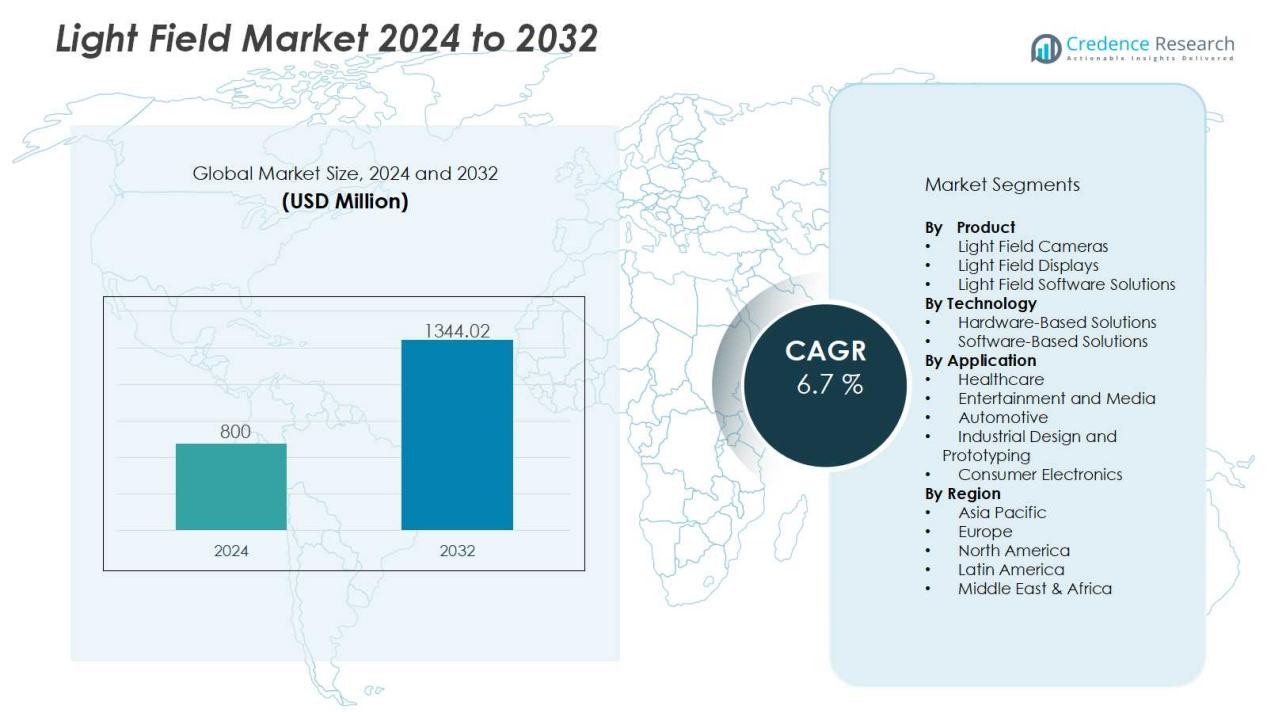
The light field market size was valued at USD 800 million in 2024 and is anticipated to reach USD 1344.02 million by 2032, at a CAGR of 6.7 % during the forecast period.
| REPORT ATTRIBUTE | DETAILS |
|---|---|
| Historical Period | 2020-2023 |
| Base Year | 2024 |
| Forecast Period | 2025-2032 |
| Light Field Market Size 2024 | USD 800 Million |
| Light Field Market, CAGR | 6.7 % |
| Light Field Market Size 2032 | USD 1344.02 Million |
Market drivers include the rapid rise of augmented reality (AR), virtual reality (VR), and mixed reality (MR) technologies. These applications depend on advanced imaging systems, where light field technology enhances depth perception and realism. Additionally, sectors like healthcare, defense, and automotive are leveraging light field solutions for surgical imaging, simulation training, and advanced driver-assistance systems. Growing investment in R&D, along with falling hardware costs, further accelerates adoption.
Regionally, North America dominates the light field market due to strong technological infrastructure, high R&D spending, and the presence of leading players. Europe follows, supported by innovations in automotive and medical imaging applications. Meanwhile, Asia-Pacific is emerging as the fastest-growing region, driven by expanding consumer electronics demand, large-scale adoption of AR/VR devices, and government support for advanced technologies. Latin America and the Middle East are gradually adopting the technology, reflecting a steady expansion of global demand.
Market Insights:
- The light field market size was valued at USD 800 million in 2024 and is anticipated to reach USD 02 million by 2032, at a CAGR of 6.7% during the forecast period.
- Rising adoption of AR, VR, and MR technologies is driving demand for advanced imaging and lifelike rendering.
- Healthcare adoption is expanding with precision imaging, surgical planning, and realistic medical training models fueling growth.
- Automotive and industrial applications are increasing through holographic displays, driver-assistance systems, and advanced prototyping solutions.
- North America held 42% share in 2024, led by strong R&D, healthcare innovation, and automotive adoption.
- Europe accounted for 28% share in 2024, driven by advancements in healthcare imaging and premium automotive displays.
- Asia-Pacific captured 22% share in 2024 and emerged as the fastest-growing region with strong consumer electronics demand.
Market Drivers:
Growing Adoption of AR, VR, and MR Applications Driving Demand:
The light field market is gaining strong momentum from the rapid adoption of augmented reality (AR), virtual reality (VR), and mixed reality (MR) technologies. These immersive solutions require highly realistic visuals and depth perception, which light field technology delivers effectively. It enables lifelike rendering by capturing detailed light rays across multiple directions. This capability supports industries ranging from gaming to enterprise training. It strengthens the role of light field solutions in building next-generation immersive platforms.
- For InstanceThe German Aerospace Center (DLR) has been actively involved in the development of light-field camera technology to enhance 3D geometry measurements in various environments.
Expanding Use in Healthcare for Precision Imaging and Surgical Applications:
The healthcare sector is a key driver for the light field market due to its reliance on advanced imaging. Light field technology allows surgeons and radiologists to view structures in true 3D without requiring external aids. This improves accuracy in planning surgeries and conducting minimally invasive procedures. It also supports medical training by offering highly realistic anatomical models. The growing demand for precision and patient safety fuels adoption within hospitals and research institutes.
- For InstancePhilips' MR 7700 system received FDA clearance in May 2022, enabling up to 35% shorter echo-planar diffusion imaging scan times compared to previous Philips models with the same spatial resolution.
Rising Integration in Automotive and Industrial Applications:
Automotive and industrial sectors are adopting light field systems to enhance visualization and safety. In the automotive space, it enables holographic displays and advanced driver-assistance systems with improved depth cues. Industrial users apply it for simulation, prototyping, and complex product design. This reduces errors in engineering and accelerates development cycles. The versatility of light field solutions reinforces their value in high-stakes environments.
Advancements in Consumer Electronics and Growing R&D Investments:
The expansion of consumer electronics is creating fresh opportunities for the light field market. Devices such as smartphones, cameras, and displays are beginning to integrate light field features for richer visual experiences. It benefits from rising investments in R&D, which continue to reduce production costs and improve system efficiency. Collaborations between technology firms and research institutions accelerate innovation and commercialization. This strong innovation pipeline secures long-term growth across consumer and enterprise markets.
Market Trends:
Integration of Light Field Technology into Immersive Media and Content Creation:
The light field market is witnessing strong momentum from the integration of technology into immersive media platforms. Content creators in gaming, film, and virtual production are exploring light field systems to deliver realistic environments with accurate depth perception. It provides natural parallax and dynamic viewpoints, enhancing the sense of presence for audiences. Studios are adopting light field cameras and displays to reduce reliance on green screens and traditional rendering techniques. This trend is reshaping visual storytelling by creating seamless, interactive content. Market players are investing heavily in partnerships with media and entertainment companies to expand adoption at a commercial scale.
- For instance, Light Field Lab's SolidLight panel, which modulates over 2.5 billion pixels, demonstrated real-time interactive holographic visuals at high resolution, showcasing a major leap in immersive media presentation in 2023.
Growing Focus on Holographic Displays, Consumer Electronics, and AI-Driven Optimization:
The light field market is also defined by the rising demand for holographic displays in consumer electronics and enterprise solutions. Companies are developing advanced devices such as smartphones, AR glasses, and headsets that integrate light field optics for superior realism. It aligns with the demand for compact, energy-efficient, and cost-effective visualization technologies. Artificial intelligence is being applied to optimize rendering processes, reducing computational loads while maintaining high-quality outputs. AI integration strengthens the practicality of light field applications across healthcare, automotive, and industrial sectors. Startups and established firms are targeting scalable solutions, signaling a shift from experimental prototypes to mainstream products. These advancements position light field systems as a central technology for next-generation digital experiences.
- For instance, in September 2025, Stanford researchers introduced a lean 3D headset incorporating AI-polished 3D holograms with a wide field of view, achieving the best 3D display quality with a pixel pitch under 300 nanometers, marking a significant leap for realistic mixed reality devices.
Market Challenges Analysis:
High Cost of Technology and Hardware Complexity Limiting Widespread Adoption:
The light field market faces challenges due to high development costs and complex hardware requirements. Producing light field cameras and displays requires advanced optics and large data processing capabilities, which increase overall expenses. It restricts adoption to specialized industries with significant budgets, leaving mass-market consumer applications limited. The bulky design of current devices further hinders portability and ease of use. Companies must invest in scaling production and improving design efficiency to reduce barriers. Without cost optimization, growth across consumer and enterprise markets remains constrained.
Data Processing Demands and Lack of Standardization Slowing Market Expansion:
Another challenge for the light field market lies in its heavy data requirements. Capturing and rendering multidimensional light rays requires powerful processors, high memory, and robust software, which limit speed and accessibility. It creates integration difficulties with existing platforms and devices. The absence of global standards across formats and interfaces adds complexity, slowing collaboration between manufacturers and developers. Limited compatibility discourages wider adoption across industries seeking seamless solutions. Addressing data efficiency and establishing industry-wide benchmarks are essential to unlock broader commercialization and scalability.
Market Opportunities:
Rising Demand in Healthcare, Automotive, and Industrial Applications Creating New Revenue Streams:
The light field market holds strong opportunities in healthcare, automotive, and industrial sectors where precision and safety are critical. Surgeons and radiologists can leverage light field imaging for detailed, true 3D views that improve diagnostic accuracy and surgical planning. In automotive, holographic displays and driver-assistance systems supported by light field optics enhance safety and user experience. Industrial design and prototyping also benefit from realistic visualization, reducing development errors and costs. It strengthens the market’s relevance beyond entertainment and consumer electronics. Expansion into these sectors ensures steady revenue diversification for technology providers.
Emergence of Consumer Electronics, AR/VR, and AI Integration Driving Mass Adoption:
The light field market is positioned to grow with the integration of technology into consumer devices and immersive platforms. Smartphones, AR glasses, and headsets are beginning to incorporate light field optics for lifelike depth and interactivity. It aligns with growing consumer interest in high-quality digital experiences and immersive media. Artificial intelligence is optimizing rendering processes, making light field systems more efficient and scalable. This fusion of AI with advanced visualization expands opportunities for startups and established firms alike. The rising demand for accessible, portable, and cost-effective solutions paves the way for mainstream adoption.
Market Segmentation Analysis:
By Product:
The light field market by product is divided into cameras, displays, and software solutions. Light field cameras are gaining demand in professional imaging, entertainment, and medical applications due to their ability to capture multidimensional data. Displays hold a strong share, driven by rising use in AR/VR devices, holographic screens, and automotive dashboards. Software solutions are expanding rapidly, supporting rendering, visualization, and content creation across industries. It continues to grow as companies integrate advanced features into consumer and enterprise devices.
- For InstanceTeledyne Princeton Instruments' LightField software, when combined with compatible hardware like the PI-MAX 4 camera, facilitates real-time spectral data processing exceeding 10,000 spectra per second.
By Technology:
The market by technology includes hardware and software-based solutions. Hardware, such as specialized lenses, sensors, and processors, dominates due to its role in capturing and projecting complex light data. Software technologies are expanding to improve data processing efficiency and reduce costs. AI-driven optimization supports real-time rendering and makes systems more scalable. It benefits from the growing push for portable and compact solutions. Integration of both hardware and software ensures seamless performance across applications.
- For instance, Intel’s RealSense D455 depth camera delivers up to 1280×720 stereo depth resolution at 90 frames per second, enabling real-time 3D scene capture for robotics and automation applications.
By Application:
The light field market by application covers healthcare, entertainment, automotive, industrial, and consumer electronics. Healthcare is advancing rapidly with adoption in surgical imaging and diagnostic tools. Entertainment, including gaming and filmmaking, uses light field for immersive storytelling. Automotive players are deploying holographic displays for safety and driver engagement. Industrial and consumer electronics sectors are broadening demand with applications in design, prototyping, and personal devices. It shows strong potential across both enterprise and consumer domains.
Segmentations:
By Product:
- Light Field Cameras
- Light Field Displays
- Light Field Software Solutions
By Technology:
- Hardware-Based Solutions
- Software-Based Solutions
By Application:
- Healthcare
- Entertainment and Media
- Automotive
- Industrial Design and Prototyping
- Consumer Electronics
By Region:
- North America
- U.S.
- Canada
- Mexico
- Europe
- Germany
- France
- U.K.
- Italy
- Spain
- Rest of Europe
- Asia Pacific
- China
- Japan
- India
- South Korea
- South-east Asia
- Rest of Asia Pacific
- Latin America
- Brazil
- Argentina
- Rest of Latin America
- Middle East & Africa
- GCC Countries
- South Africa
- Rest of the Middle East and Africa
Regional Analysis:
North America:
North America held 42% market share in 2024, establishing its position as the global leader. The region benefits from strong technological infrastructure, extensive R&D spending, and early adoption of immersive technologies. The presence of leading companies and startups accelerates product development and commercialization. The light field market in North America also gains momentum from healthcare innovation and the automotive industry’s push toward advanced display systems. It thrives on strong collaboration between research institutions and private players. Government support for innovation ecosystems further strengthens its dominance.
Europe:
Europe accounted for 28% market share in 2024, supported by innovation in healthcare and automotive sectors. The region is focusing on integrating light field systems in surgical imaging, medical training, and premium automotive displays. Strong manufacturing capabilities and academic research drive new applications. The light field market in Europe is supported by strict quality standards, encouraging precision and safety in adoption. It gains added support from partnerships between technology firms and healthcare institutions. Consumer electronics and industrial design are also creating steady demand across the region. The combination of innovation and regulatory backing supports sustained market expansion.
Asia-Pacific:
Asia-Pacific captured 22% market share in 2024 and is the fastest-growing regional market. The growth is supported by strong demand for consumer electronics, including AR/VR devices, smartphones, and smart displays. Rapid industrialization and infrastructure development in China, Japan, South Korea, and India strengthen adoption. The light field market in Asia-Pacific benefits from government initiatives promoting advanced technologies. It also gains momentum from the region’s strong semiconductor and display manufacturing base. Collaboration between local firms and global technology leaders drives product innovation. Expanding applications across entertainment, healthcare, and industrial design position Asia-Pacific as a key growth engine.
Key Player Analysis:
- Lytro
- FoVI 3D
- Avegant
- Japan Display Inc (JDI)
- OTOY
- Holografika
- Lumii
- Light Field Lab
- Raytrix
- Leia
- Toshiba
- NVIDIA
- Ricoh Innovations
Competitive Analysis:
The light field market is characterized by strong competition among innovators and technology leaders. Key players include Lytro, FoVI 3D, Avegant, Japan Display Inc. (JDI), OTOY, Holografika, Lumii, and Light Field Lab, each focusing on distinct strengths across products and applications. Companies are advancing display technologies, immersive imaging solutions, and AI-driven rendering platforms to capture demand in AR, VR, healthcare, and automotive sectors. It benefits from collaborations between startups and global electronics manufacturers that accelerate product development and commercialization. Strategic investments in R&D and partnerships with research institutes are reinforcing competitive positioning. Firms that deliver cost-efficient, scalable, and user-friendly solutions are set to gain stronger market traction. The landscape remains dynamic, with continuous product launches and growing emphasis on holographic displays and content creation driving differentiation.
Recent Developments:
- In June 2024, Vuzix and Avegant announced a strategic partnership to develop an optimized full-color optical reference design for AI-enabled consumer smart glasses, with prototypes unveiled at the Augmented World Expo USA 2024.
- In May 2025, Metavista3D announced it will showcase its innovative 27-inch pseudo-holographic 3D display at Display Week SID 2025, featuring exceptional 2D readability alongside immersive 3D capabilities and eliminating depth distortions without the need for special eyewear.
Report Coverage:
The research report offers an in-depth analysis based on Product, Technology, Application and Region. It details leading Market players, providing an overview of their business, product offerings, investments, revenue streams, and key applications. Additionally, the report includes insights into the competitive environment, SWOT analysis, current Market trends, as well as the primary drivers and constraints. Furthermore, it discusses various factors that have driven Market expansion in recent years. The report also explores Market dynamics, regulatory scenarios, and technological advancements that are shaping the industry. It assesses the impact of external factors and global economic changes on Market growth. Lastly, it provides strategic recommendations for new entrants and established companies to navigate the complexities of the Market.
Future Outlook:
- The light field market will expand through growing adoption in AR, VR, and MR platforms, driven by immersive content demand.
- Healthcare will strengthen its role as a core application area with 3D imaging and surgical precision tools.
- Automotive manufacturers will integrate light field displays to enhance driver-assistance systems and in-vehicle experiences.
- Consumer electronics will adopt light field features in smartphones, AR glasses, and next-generation headsets.
- AI-driven optimization will reduce data processing loads, making solutions more practical and scalable.
- Entertainment and media industries will adopt light field cameras and displays for interactive storytelling.
- Industrial sectors will deploy light field visualization for prototyping, simulation, and advanced training environments.
- Collaborations between research institutions and technology firms will accelerate innovation and commercialization.
- Regional growth in Asia-Pacific will intensify, supported by manufacturing strength and government initiatives.
- Ongoing cost reduction and design improvements will enable mass adoption across consumer and enterprise markets.

Request a Free Sample
Fill in your details and we'll send you a free sample report.
- Sample data tables & charts
- Research methodology
Market Dynamics
Adoption of AR, VR, and MR Technologies
The rapid growth of augmented, virtual, and mixed reality platforms is fueling demand for light field solutions, as these technologies require advanced imaging and depth perception to deliver immersive, lifelike experiences.
Expansion in Healthcare Imaging and Surgical Applications
Light field technology enables true 3D visualization for surgeons and radiologists, improving diagnostic accuracy, surgical planning, and medical training, which is driving adoption in hospitals and research institutions.
Integration in Automotive and Industrial Sectors
Automotive manufacturers and industrial designers are leveraging light field displays for holographic dashboards, advanced driver-assistance systems, and realistic prototyping, enhancing safety, efficiency, and product development.
Advancements in Consumer Electronics and R&D Investment
The integration of light field features into consumer devices like smartphones, AR glasses, and displays is accelerating, supported by increased R&D spending and falling hardware costs, making the technology more accessible and scalable.
AI-Driven Optimization and Content Creation
Artificial intelligence is being used to optimize light field rendering and data processing, enabling real-time applications and supporting the creation of interactive, high-quality content for entertainment, media, and enterprise use.
Need a Custom Version of This Report?
Tailor the scope, geography, or segments to your exact requirements.
- Custom geography or segment scope
- Direct access to our analyst team
Frequently Asked Questions
What is the current market size for the Light Field Market, and what is its projected size in 2032?
At what Compound Annual Growth Rate is the Light Field Market projected to grow between 2024 and 2032?
Which Light Field Market segment held the largest share in 2024?
What are the primary factors fueling the growth of the Light Field Market?
Who are the leading companies in the Light Field Market?
Which region commanded the largest share of the Light Field Market in 2024?
Table of Content
Chapter 1 Market Segmentation
- 1.1 Segmentation Framework
- 1.1.1 Product and Service Classification
- 1.1.2 Application and End-Use Classification
- 1.1.3 Technology and Solution Classification
- 1.1.4 Customer and Distribution Channel Classification
- 1.1.5 Geographic Segmentation
- 1.1.6 Market Segment Definitions and Boundaries
- 1.2 By Product
- 1.2.1 Light Field Cameras
- 1.2.2 Light Field Displays
- 1.2.3 Light Field Software Solutions
- 1.3 By Technology
- 1.3.1 Hardware-Based Solutions
- 1.3.2 Software-Based Solutions
- 1.4 By Application
- 1.4.1 Healthcare
- 1.4.2 Entertainment and Media
- 1.4.3 Automotive
- 1.4.4 Industrial Design and Prototyping
- 1.4.5 Consumer Electronics
Chapter 2 Introduction
- 2.1 Report Objectives and Scope
- 2.2 Product Definition and Industry Terminology
- 2.3 Market Inclusions and Exclusions
- 2.4 Research Process
- 2.4.1 Primary Research and Expert Interviews
- 2.4.2 Secondary Research and Source Review
- 2.4.3 Top-Down and Bottom-Up Estimation
- 2.4.4 Data Triangulation and Verification
- 2.5 Market Size Measurement Basis
- 2.5.1 2024: USD 800 million → 2032: USD 1344.02 million
- 2.6 Historical and Forecast Reference Periods
- 2.6.1 Base Year: 2024
- 2.6.2 Forecast Period: 2024-2032
- 2.7 Research Assumptions and Limitations
Chapter 3 Executive Summary
- 3.1 Market Snapshot and Key Findings
- 3.2 Base-Year Market Size, 2024
- 3.3 Forecast Market Size, 2032
- 3.4 Revenue and Volume Growth Outlook
- 3.5 Key Demand and Supply Indicators
- 3.6 Leading Market Segments
- 3.7 Fastest-Growing Market Opportunities
- 3.8 Regional Performance Highlights
- 3.9 Technology and Industry Transformation
- 3.10 Competitive Landscape Summary
- 3.11 Analyst View and Strategic Implications
Chapter 4 Global Light Field Market Trends and Developments
- 4.1 Historical Industry Development
- 4.2 Recent Market Trends and Developments
- 4.3 Demand and Customer Behavior Trends
- 4.4 Technology and Product Innovation
- 4.5 Artificial Intelligence, Automation and Digitalization
- 4.6 Local Manufacturing and Supply Chain Realignment
- 4.7 Industry Partnerships, Mergers and Acquisitions
- 4.8 Sustainability and Circular Economy Developments
- 4.9 Government and Private Sector Investment Trends
- 4.10 Emerging Business Models and Commercialization
- 4.11 Industry Developments and Announcements
Chapter 5 Global Light Field Market Production, Supply and Demand Analysis
- 5.1 Demand Trend and Consumption Analysis
- 5.2 Demand Forecast, 2024-2032
- 5.3 Production and Output Trend
- 5.4 Production and Output Forecast, 2024-2032
- 5.5 Installed Capacity and Capacity Utilization
- 5.6 Company-Wise Production Plants and Statistics
- 5.6.1 Installed Production Capacity
- 5.6.2 Actual Production
- 5.6.3 Planned Capacity and Expansion Targets
- 5.7 Supply Chain Structure and Procurement Trends
- 5.8 Supply-Demand Gap and Bottlenecks
- 5.9 Import Dependence and Sourcing Structure
- 5.10 Contract Manufacturing and Outsourcing
- 5.11 Regional Supply and Demand Concentration
Chapter 6 Global Light Field Market Pricing Analysis
- 6.1 Pricing Structure and Measurement
- 6.2 Historical Pricing Trends
- 6.3 Pricing Outlook, 2024-2032
- 6.4 Average Selling Price and Unit Economics
- 6.5 Pricing by Product and Market Segment
- 6.6 Geographic Pricing Differences
- 6.7 Key Input, Energy, Labor and Logistics Costs
- 6.8 Contract Pricing and Purchasing Models
- 6.9 Pricing Sensitivity and Competitive Positioning
- 6.10 Price, Margin and Profitability Implications
Chapter 7 Global Light Field Market Dynamics
- 7.1 Market Growth Drivers
- 7.1.1 Demand-Side Drivers
- 7.1.2 Technology and Innovation Drivers
- 7.1.3 Infrastructure and Investment Drivers
- 7.1.4 Regulatory and Policy Drivers
- 7.2 Market Restraints
- 7.2.1 Cost and Affordability Constraints
- 7.2.2 Technology and Adoption Barriers
- 7.2.3 Supply Chain and Operational Constraints
- 7.3 Market Challenges
- 7.3.1 Competitive Pressure and Margin Erosion
- 7.3.2 Skills, Infrastructure and Implementation Gaps
- 7.4 Emerging Market Opportunities
- 7.5 Market Dynamics Impact and Time-Horizon Assessment
Chapter 8 Global Light Field Value Chain Analysis
- 8.1 Industry Value Chain Overview
- 8.2 Upstream Suppliers and Critical Inputs
- 8.3 Technology and Component Providers
- 8.4 Manufacturing or Service Delivery
- 8.5 Distribution, Channel Partners and Integrators
- 8.6 Downstream Applications and End Users
- 8.7 Value Addition and Profit Pools
- 8.8 Vertical Integration and Outsourcing
- 8.9 Supplier Concentration and Risk
- 8.10 Supply Chain Localization and Resilience
Chapter 9 Global Light Field Market Regulations and Policies
- 9.1 Relevant Laws, Standards and Compliance Frameworks
- 9.2 Product, Service, Safety and Quality Requirements
- 9.3 Government Policies, Incentives and Subsidies
- 9.4 Imports, Exports and Trade Barriers
- 9.5 Public Procurement and Local Content Requirements
- 9.6 Environmental and Sustainability Compliance
- 9.7 Upcoming Policy Changes and Market Implications
Chapter 10 Global Light Field Market Hotspots and Opportunities
- 10.1 Market Opportunity Mapping and Growth Hotspots
- 10.2 High-Growth Applications and Customer Groups
- 10.3 Underserved Markets and White-Space Opportunities
- 10.4 Emerging Technology and Product Opportunities
- 10.5 New Capacity and Investment Hotspots
- 10.6 Market Entry and Expansion Opportunities
- 10.7 Distribution and Partnership Opportunities
- 10.8 Near-Term and Long-Term Commercial Potential
- 10.9 Opportunity Attractiveness and Execution Risks
Chapter 11 Global Light Field Market Outlook, 2024-2032
- 11.1 Market Size and Analysis
- 11.1.1 Revenue (Market Measurement: 2024: USD 800 million → 2032: USD 1344.02 million)
- 11.1.2 Market Volume and Quantity Sold
- 11.1.3 Historical Market Size
- 11.1.4 Base-Year Market Size, 2024
- 11.2 Market Forecast, 2024-2032
- 11.2.1 Revenue Forecast to 2032
- 11.2.2 Volume Forecast to 2032
- 11.2.3 CAGR and Year-on-Year Growth
- 11.2.4 Incremental Revenue Opportunity
- 11.3 Forecast Assumptions and Scenario Analysis
- 11.3.1 Base-Case Forecast
- 11.3.2 Optimistic and Conservative Scenarios
- 11.3.3 Technology, Pricing and Policy Sensitivities
- 11.4 Market Attractiveness and Growth Outlook
Chapter 12 Global Light Field Market Segmentation and Outlook
- 12.1 Segmentation Summary and Market Shares, 2024
- 12.2 Largest and Fastest-Growing Segments
- 12.3 By Product - Market Size and Forecast, 2024-2032
- 12.3.1 Segment Definition and Scope
- 12.3.2 Historical Market Size
- 12.3.3 Revenue Forecast, 2024-2032
- 12.3.4 Volume Forecast, 2024-2032
- 12.3.5 Base-Year Market Share, 2024
- 12.3.6 Segment CAGR and Growth Drivers
- 12.3.7 Subsegment Market Size and Forecast
- 12.3.7.1 Light Field Cameras
- 12.3.7.2 Light Field Displays
- 12.3.7.3 Light Field Software Solutions
- 12.3.8 Subsegment Pricing and Adoption Trends
- 12.3.9 Leading Suppliers and Competition
- 12.3.10 Regional Demand and Opportunities
- 12.4 By Technology - Market Size and Forecast, 2024-2032
- 12.4.1 Segment Definition and Scope
- 12.4.2 Historical Market Size
- 12.4.3 Revenue Forecast, 2024-2032
- 12.4.4 Volume Forecast, 2024-2032
- 12.4.5 Base-Year Market Share, 2024
- 12.4.6 Segment CAGR and Growth Drivers
- 12.4.7 Subsegment Market Size and Forecast
- 12.4.7.1 Hardware-Based Solutions
- 12.4.7.2 Software-Based Solutions
- 12.4.8 Subsegment Pricing and Adoption Trends
- 12.4.9 Leading Suppliers and Competition
- 12.4.10 Regional Demand and Opportunities
- 12.5 By Application - Market Size and Forecast, 2024-2032
- 12.5.1 Segment Definition and Scope
- 12.5.2 Historical Market Size
- 12.5.3 Revenue Forecast, 2024-2032
- 12.5.4 Volume Forecast, 2024-2032
- 12.5.5 Base-Year Market Share, 2024
- 12.5.6 Segment CAGR and Growth Drivers
- 12.5.7 Subsegment Market Size and Forecast
- 12.5.7.1 Healthcare
- 12.5.7.2 Entertainment and Media
- 12.5.7.3 Automotive
- 12.5.7.4 Industrial Design and Prototyping
- 12.5.7.5 Consumer Electronics
- 12.5.8 Subsegment Pricing and Adoption Trends
- 12.5.9 Leading Suppliers and Competition
- 12.5.10 Regional Demand and Opportunities
- 12.6 Segment Growth Comparison
- 12.7 Segment Attractiveness and Priority Matrix
Chapter 13 Global Light Field End-Use and Application Market Outlook
- 13.1 End-Use Industry and Customer Demand Structure
- 13.2 Leading Applications and Customer Groups
- 13.3 End-Use Market Size, Share and Forecast
- 13.4 Major End-Use Industry Deep Dives
- 13.4.1 Customer Requirements and Use Cases
- 13.4.2 Demand and Replacement Cycles
- 13.4.3 Technical and Regulatory Considerations
- 13.4.4 Purchasing and Procurement Models
- 13.4.5 Leading Vendors and Distribution Channels
- 13.4.6 Forecast and Commercial Opportunities
- 13.5 Emerging Applications and Cross-Segment Demand
- 13.6 End-Use Industry Investment Priorities
Chapter 14 Global Light Field Geographic Market Outlook, 2024-2032
- 14.1 Regional Market Size and Share, 2024
- 14.2 Regional Market Forecast, 2024-2032
- 14.3 Regional Pricing, Production and Demand Differences
- 14.4 North America
- 14.4.1 United States
- 14.4.2 Canada
- 14.4.3 Mexico
- 14.5 Europe
- 14.5.1 Germany
- 14.5.2 France
- 14.5.3 Italy
- 14.5.4 United Kingdom
- 14.5.5 Spain
- 14.5.6 Poland
- 14.5.7 Russia
- 14.5.8 Netherlands
- 14.5.9 Belgium
- 14.5.10 Sweden
- 14.5.11 Denmark
- 14.5.12 Norway
- 14.5.13 Rest of Europe
- 14.6 Asia Pacific
- 14.6.1 China
- 14.6.2 India
- 14.6.3 Japan
- 14.6.4 South Korea
- 14.6.5 Thailand
- 14.6.6 Indonesia
- 14.6.7 Vietnam
- 14.6.8 Malaysia
- 14.6.9 Australia
- 14.6.10 Rest of Asia Pacific
- 14.7 Latin America
- 14.7.1 Brazil
- 14.7.2 Argentina
- 14.7.3 Colombia
- 14.7.4 Chile
- 14.7.5 Rest of Latin America
- 14.8 Middle East
- 14.8.1 Saudi Arabia
- 14.8.2 United Arab Emirates
- 14.8.3 Turkey
- 14.8.4 Israel
- 14.8.5 Iran
- 14.8.6 Rest of the Middle East
- 14.9 Africa
- 14.9.1 South Africa
- 14.9.2 Egypt
- 14.9.3 Nigeria
- 14.9.4 Morocco
- 14.9.5 Rest of Africa
- 14.10 Regional Investment, Policy and Supply Chain Differences
- 14.11 Regional Competitive Landscape
- 14.12 Geographic Growth Hotspots
Chapter 15 Global Light Field Technology, Innovation and Sustainability Outlook
- 15.1 Technology Landscape and Maturity
- 15.2 Product, Process and Service Innovation
- 15.3 AI, Automation and Digital Tools in the Industry
- 15.4 Technology Adoption and Performance Benchmarking
- 15.5 Innovation Pipeline and R&D Investment
- 15.6 Patent and Intellectual Property Trends
- 15.7 Energy Efficiency and Resource Management
- 15.8 Sustainability, Recycling and Circularity
- 15.9 Technology Roadmap, 2024-2032
- 15.10 Risks of Obsolescence and Technology Substitution
Chapter 16 Global Light Field Market Key Strategic Imperatives
- 16.1 Growth and Market Entry Priorities
- 16.2 High-Return Products and Segments
- 16.3 Pricing, Profitability and Cost Optimization
- 16.4 Technology Investment and Product Differentiation
- 16.5 Supply Chain Localization and Resilience
- 16.6 Distribution and Customer Acquisition
- 16.7 Partnership, Acquisition and Capacity Strategy
- 16.8 Regional Expansion Priorities
- 16.9 Short-, Medium- and Long-Term Actions
Chapter 17 Competition Outlook
- 17.1 Industry Competition Characteristics
- 17.2 Market Structure and Concentration
- 17.3 Market Share and Competitive Positioning, 2024
- 17.4 Company-Wise Revenue and Product Benchmarking
- 17.5 Production and Service Capacity Benchmarking
- 17.6 Technology, Pricing and Differentiation
- 17.7 Regional Footprint and Distribution Strength
- 17.8 Mergers, Acquisitions and Strategic Alliances
- 17.9 New Entrants and Competitive Threats
- 17.10 Porter's Five Forces and Industry Attractiveness
- 17.11 Competitive Outlook, 2024-2032
Chapter 18 Company Profiles
- 18.1 Company Coverage and Selection Criteria
- 18.2 Lytro
- 18.2.1 Business Description
- 18.2.2 Company Ownership and Geographic Presence
- 18.2.3 Product and Service Portfolio
- 18.2.4 Manufacturing and Operating Footprint
- 18.2.5 Production Capacity and Expansion Plans
- 18.2.6 Financial Performance and Investment
- 18.2.7 Market Share and Competitive Position
- 18.2.8 Technology and Innovation Capabilities
- 18.2.9 Strategic Alliances or Partnerships
- 18.2.10 Recent Developments
- 18.2.11 Growth Strategy and Outlook
- 18.3 FoVI 3D
- 18.4 Avegant
- 18.5 Japan Display Inc (JDI)
- 18.6 OTOY
- 18.7 Holografika
- 18.8 Light Field Lab
- 18.9 Raytrix
- 18.10 Leia
- 18.11 NVIDIA
- 18.12 Other Relevant Market Participants
Note: Every listed company is profiled on the structure shown under the first company. The company list is preliminary and may change based on research findings, market developments, data availability and client requirements.
Chapter 19 Disclaimer
- 19.1 Research and Forecast Disclaimer
- 19.2 Data Source and Estimation Limitations
Note: The depth of individual sections depends on data availability for this market. Volume, capacity, trade and other unit-based metrics are included where applicable.