Market Overview:
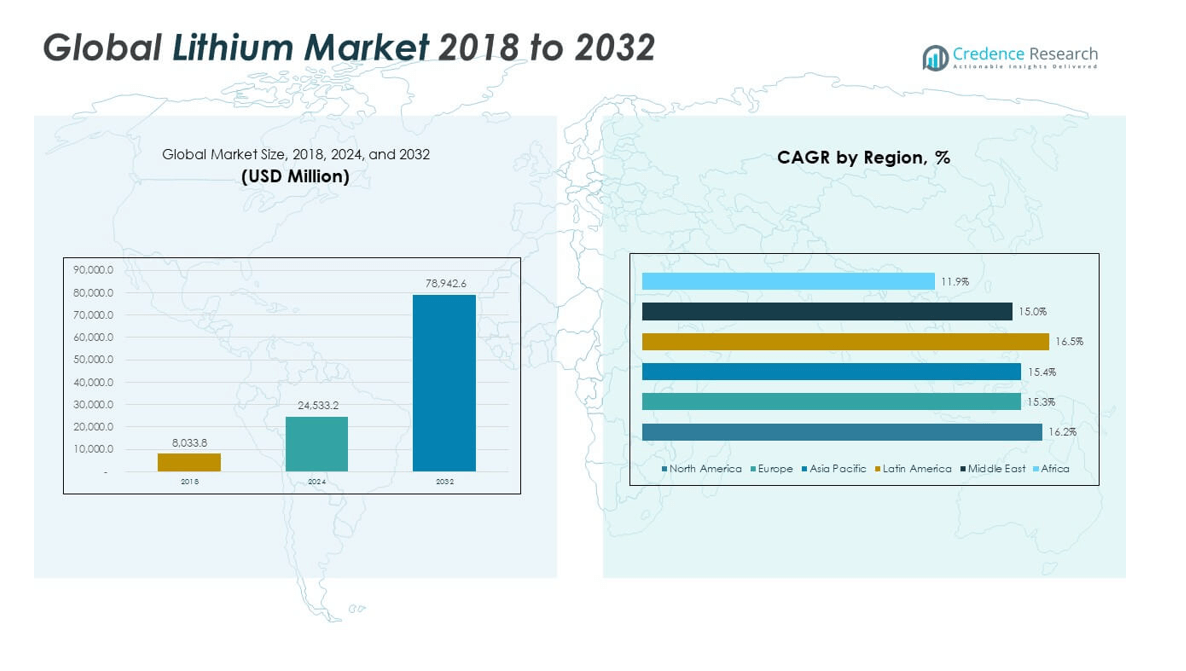
The Global Lithium Market size was valued at USD 8,033.8 million in 2018 to USD 24,533.2 million in 2024 and is anticipated to reach USD 78,942.6 million by 2032, at a CAGR of 15.63% during the forecast period.
| REPORT ATTRIBUTE | DETAILS |
|---|---|
| Historical Period | 2020-2023 |
| Base Year | 2024 |
| Forecast Period | 2025-2032 |
| Lithium Market Size 2024 | USD 24,533.2 million |
| Lithium Market, CAGR | 15.63% |
| Lithium Market Size 2032 | USD 78,942.6 million |
The market is experiencing rapid expansion driven by surging demand for lithium-ion batteries in electric vehicles, portable electronics, and renewable energy storage solutions. Governments worldwide are promoting clean energy adoption, stimulating investments in battery production and lithium mining projects. Technological advancements in battery chemistry are improving performance and cost-efficiency, while growing energy storage requirements in grid applications further strengthen lithium’s market position. Rising demand across industrial applications also supports sustained growth.
Asia-Pacific leads the market due to its dominance in battery manufacturing and large-scale EV adoption, particularly in China, Japan, and South Korea. North America shows strong growth potential, supported by increasing domestic lithium mining initiatives and EV production expansion in the U.S. and Canada. Europe emerges as another significant region, driven by stringent emission regulations and investments in gigafactories. Meanwhile, Latin America, especially Chile and Argentina, is gaining attention as a key lithium supplier, while Africa is an emerging player with untapped reserves and growing exploration activities.
Market Insights:
- The Global Lithium Market was valued at USD 24,533.2 million in 2024 and is projected to reach USD 78,942.6 million by 2032, growing at a CAGR of 15.63%.
- Rising demand for electric vehicles is driving large-scale adoption of lithium-ion batteries, boosting consumption across major economies.
- Expansion of renewable energy projects is increasing the need for efficient energy storage solutions powered by lithium-based technologies.
- Supply chain concentration in resource-rich regions creates vulnerabilities that can impact production stability and pricing.
- Environmental regulations and community opposition to mining projects are restraining the pace of capacity expansion.
- Asia Pacific leads the market in 2024, supported by dominant battery manufacturing capabilities and high EV adoption rates.
- North America and Europe show strong growth potential, driven by domestic mining initiatives, gigafactory projects, and sustainability-focused policies.
Market Drivers
Rising Demand for Electric Vehicles Driving Lithium Consumption Across Global Markets
The surge in electric vehicle adoption is a primary driver for the Global Lithium Market, with automotive manufacturers scaling production to meet stringent emission norms. Lithium-ion batteries power the majority of EVs, delivering high energy density and efficiency. Government incentives and infrastructure development, including charging networks, are further boosting EV demand. Leading markets such as China, Europe, and the United States are pushing for faster transitions to electric mobility. The supply chain is witnessing strategic investments from both automakers and battery producers. Continuous improvements in battery performance are enhancing vehicle range and charging times. Industry players are forming long-term procurement agreements to secure lithium supplies. It is accelerating global production capacities to meet the growing automotive requirements.
- For example, Tesla’s Gigafactory in Nevada has an annual battery cell production capacity target of 35 GWh, designed to supply enough batteries for roughly 500,000 electric vehicles per year. This facility is recognized as one of the largest lithium-ion battery plants in the United States, reinforcing Tesla’s position as a leading domestic producer.
Expanding Energy Storage Systems for Renewable Integration Fueling Market Growth
Renewable energy expansion, particularly in solar and wind sectors, is generating demand for advanced energy storage solutions. Lithium-ion batteries are the preferred choice for grid-scale storage due to their reliability and performance. The Global Lithium Market benefits from large-scale renewable projects aiming to stabilize intermittent energy generation. Governments are prioritizing energy security, prompting investment in storage capacity. Technological advancements are extending battery lifespans, reducing total ownership costs. The utility sector is partnering with technology firms to deploy lithium-based storage systems. Rural electrification initiatives in emerging economies are also increasing lithium demand. It is enabling a more flexible and resilient power infrastructure for modern energy systems.
- For instance, the New York State Energy Research and Development Authority (NYSERDA) targets 6GW of storage by 2030, having already contracted or installed 1.3GW; nearly 500MW of this is bulk storage with lithium-ion batteries.
Rapid Growth of Consumer Electronics Driving Battery-Grade Lithium Usage
The proliferation of smartphones, laptops, tablets, and wearables continues to drive demand for lithium-based batteries. Compact size, lightweight design, and high power output make lithium-ion the standard in portable electronics. The Global Lithium Market benefits from the trend toward high-capacity batteries in premium devices. Technological convergence in consumer electronics is leading to higher energy requirements. Manufacturers are focusing on fast-charging capabilities and longer battery life. E-commerce growth is accelerating global device sales, further fueling demand. The replacement cycle for electronics remains short, sustaining battery consumption. It is positioning lithium producers as key suppliers to the expanding electronics sector.
Industrial and Defense Applications Strengthening Non-Automotive Lithium Demand
Lithium finds growing applications in aerospace, defense, and industrial machinery due to its lightweight and high energy characteristics. The Global Lithium Market is supported by innovations in unmanned aerial vehicles, marine systems, and portable power tools. Industrial automation relies on lithium-based power solutions for uninterrupted operations. Defense agencies are adopting advanced lithium batteries for communication devices, surveillance systems, and energy weapons. Industrial forklifts and material handling equipment are transitioning to lithium-powered systems for efficiency gains. Lithium’s role in advanced lubricants and alloys adds another layer of demand. Specialized storage and energy solutions in remote operations also contribute. It is expanding its footprint beyond conventional battery markets.
Market Trends
Increasing Focus on High-Nickel Cathode Chemistries for Enhanced Battery Performance
Manufacturers are shifting toward high-nickel cathode compositions to improve energy density and reduce reliance on cobalt. The Global Lithium Market is benefiting from this evolution in battery design. These chemistries extend driving range in EVs and improve efficiency in energy storage systems. Cathode advancements are also lowering overall battery costs through higher material utilization. Research collaborations between automakers, battery producers, and mining companies are driving faster adoption. Safety enhancements are being integrated to handle higher energy outputs. Recycling processes are evolving to recover valuable metals from these advanced cathodes. It is enabling a stronger value chain for lithium-based technologies.
- For example, Tesla uses high-nickel cathodes, such as Nickel-Cobalt-Aluminum (NCA), in its longer-range models to achieve higher energy density and extended driving range. This technology supports compliance with Europe’s CO₂ emissions targets, which require a 55% reduction for new cars by 2030 compared to 2021 levels.
Vertical Integration Strategies Strengthening Supply Chain Control
Leading industry players are increasingly investing in vertical integration to secure lithium supply and reduce procurement risks. The Global Lithium Market is seeing automakers acquire stakes in mining projects and battery manufacturers. This strategy reduces exposure to raw material price volatility. Partnerships are being formed across exploration, extraction, processing, and battery production stages. Regional governments are encouraging domestic lithium development to reduce import dependence. These integrated models ensure quality control and faster innovation cycles. Downstream players are also securing offtake agreements to guarantee future supplies. It is creating a more stable and predictable production landscape.
Advancements in Direct Lithium Extraction (DLE) Improving Production Efficiency
The adoption of Direct Lithium Extraction technologies is gaining momentum for its potential to increase recovery rates and reduce environmental impact. The Global Lithium Market is witnessing pilot projects moving into commercial phases. DLE enables faster processing of brine resources compared to traditional evaporation methods. The technology reduces water consumption and operational footprints. Companies are leveraging AI and data analytics to optimize extraction parameters. Strategic partnerships with technology providers are accelerating scalability. This approach is opening new resource bases previously considered uneconomical. It is aligning the industry with sustainability and cost-efficiency goals.
Growth of Lithium Recycling Industry Supporting Circular Economy Goals
The lithium recycling sector is evolving rapidly, driven by sustainability commitments and resource security concerns. The Global Lithium Market is benefiting from advanced recovery technologies capable of extracting high-purity lithium from spent batteries. Regulatory frameworks in key markets mandate recycling quotas and responsible disposal. This trend reduces environmental risks associated with end-of-life batteries. Large-scale recycling plants are being established near major battery manufacturing hubs. Supply chains are incorporating recycled lithium into new battery production. Consumer awareness about eco-friendly disposal is increasing participation rates. It is reinforcing the industry’s shift toward a closed-loop battery lifecycle.
- For instance, Ascend Elements’ Covington, Georgia facility one of the largest in North America can process 30,000 metric tons of used batteries and manufacturing scrap annually, equivalent to about 70,000 EV battery packs.
Market Challenges Analysis
Supply Chain Constraints and Resource Concentration Creating Market Vulnerabilities
The concentration of lithium reserves in a few regions creates supply risks for the Global Lithium Market. Political instability, trade restrictions, and permitting delays can disrupt mining activities. Infrastructure limitations in resource-rich regions slow down production scalability. Environmental concerns and opposition from local communities impact project approvals. Dependence on a limited number of suppliers increases exposure to price volatility. Transportation bottlenecks in remote mining areas further complicate logistics. Exploration and development timelines are lengthy, creating mismatches between demand growth and supply readiness. It is forcing stakeholders to diversify sourcing strategies and invest in alternative resources.
Price Volatility and Capital-Intensive Production Affecting Market Stability
Lithium prices are highly sensitive to fluctuations in demand from key sectors such as EVs and consumer electronics. The Global Lithium Market experiences rapid price swings that challenge long-term planning. High capital requirements for mining and processing facilities limit entry for new players. Cost overruns and delays in project execution reduce investor confidence. Currency exchange fluctuations impact profitability in export-driven markets. Producers face difficulties in balancing investment with market uncertainty. Technological changes can also alter demand forecasts abruptly. It is pushing companies to adopt flexible business models and hedge against commodity risks.
Market Opportunities
Expansion of Battery Gigafactories Creating Long-Term Lithium Demand Prospects
The surge in battery gigafactory projects worldwide is opening significant growth avenues for the Global Lithium Market. These large-scale facilities are driving sustained lithium consumption for EVs, energy storage, and industrial applications. Governments are supporting domestic manufacturing with subsidies and favorable policies. The rise of regional production hubs reduces reliance on imports and strengthens supply chains. Partnerships between automakers and battery producers are securing multi-year procurement deals. It is positioning lithium suppliers to benefit from predictable and large-volume demand over extended periods.
Emerging Applications in Grid Stabilization and Smart Energy Systems Broadening Market Scope
The shift toward decentralized power generation is creating new opportunities for lithium-based storage solutions. The Global Lithium Market is benefiting from adoption in grid balancing, frequency regulation, and backup power systems. Smart grids require responsive and efficient energy storage to integrate renewable sources. Lithium batteries are also entering marine, aviation, and heavy industrial energy applications. R&D investments are unlocking performance improvements for extreme operating conditions. It is enabling lithium to penetrate high-value, specialized energy markets.
Market Segmentation Analysis:
The Global Lithium Market is segmented
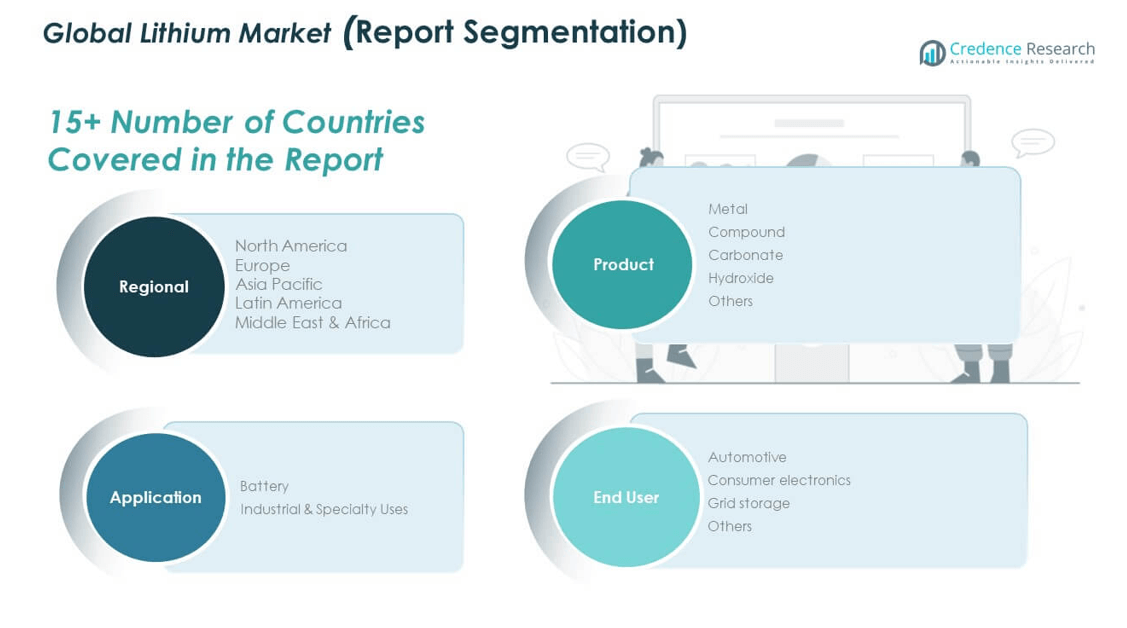
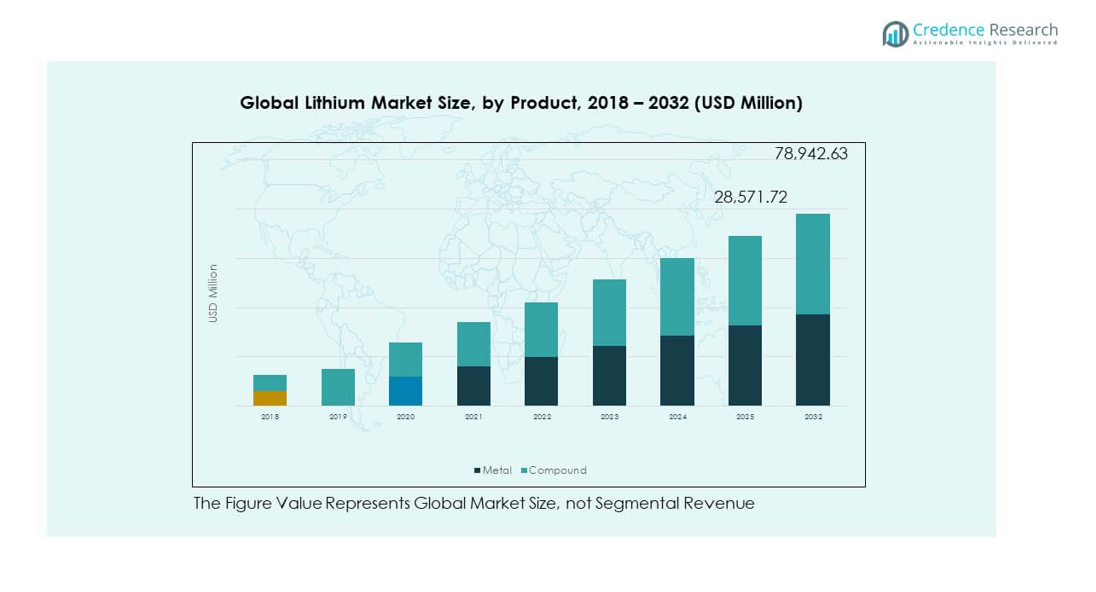
By product into metal and compounds, which include carbonate, hydroxide, and others. Lithium metal plays a vital role in high-performance batteries and specialized applications, while compounds dominate demand due to their essential role in cathode production for lithium-ion batteries. Lithium carbonate remains the most widely used form, particularly in electric vehicle and grid storage batteries, whereas lithium hydroxide is gaining traction for high-nickel cathode chemistries that enhance energy density. Other compound types support niche industrial and specialty uses, contributing to a diversified product portfolio.
- For instance, QuantumScape has advanced lithium metal battery technology offering significantly higher energy density for electric vehicles; their solid-state lithium-metal cells demonstrated in late 2024 showed over 80% capacity retention after 800 cycles, greatly surpassing typical lithium-ion metrics.
By application, the battery segment holds the largest share, driven by rising electric vehicle adoption, expanding renewable energy storage systems, and growing consumer electronics demand. Industrial and specialty uses encompass glass, ceramics, lubricants, and aerospace applications, where lithium’s unique properties offer performance advantages.
- For example, Contemporary Amperex Technology Co. Limited (CATL) is a leading force in battery-grade lithium demand, with production capacity projected to exceed 500 GWh in 2025 to supply both electric vehicle and grid storage markets. Its recently introduced TENER Stack system for utilities delivers single-unit capacities of up to 9 MWh, setting a benchmark for large-scale energy storage solutions.
By end user, automotive leads the market, supported by global electrification trends and investments in battery manufacturing. Consumer electronics remain a significant segment, with demand for high-capacity, lightweight power sources. Grid storage is expanding rapidly in response to renewable integration needs, while other end users include industrial, defense, and specialty manufacturing sectors. It is witnessing balanced growth across segments, with batteries retaining dominance while industrial diversification ensures long-term market resilience.
Segmentation:
By Product
- Metal
- Compound
- Carbonate
- Hydroxide
- Others
By Application
- Battery
- Industrial & Specialty Uses
By End User
- Automotive
- Consumer Electronics
- Grid Storage
- Others
By Region
- North America
- U.S.
- Canada
- Mexico
- Europe
- UK
- France
- Germany
- Italy
- Spain
- Russia
- Belgium
- Netherlands
- Austria
- Sweden
- Poland
- Denmark
- Switzerland
- Rest of Europe
- Asia Pacific
- China
- Japan
- South Korea
- India
- Australia
- Thailand
- Indonesia
- Vietnam
- Malaysia
- Philippines
- Taiwan
- Rest of Asia Pacific
- Latin America
- Brazil
- Argentina
- Peru
- Chile
- Colombia
- Rest of Latin America
- Middle East
- UAE
- KSA
- Israel
- Turkey
- Iran
- Rest of Middle East
- Africa
- Egypt
- Nigeria
- Algeria
- Morocco
- Rest of Africa
Regional Analysis:
North America
The North America Global Lithium Market size was valued at USD 1,856.61 million in 2018 to USD 5,856.79 million in 2024 and is anticipated to reach USD 19,648.82 million by 2032, at a CAGR of 16.2% during the forecast period. In 2024, the region accounted for 23.88% of the global market share. Strong EV adoption, supported by federal incentives and state-level zero-emission vehicle mandates, continues to drive demand. The region benefits from expanding domestic lithium mining operations in the U.S. and Canada, reducing reliance on imports. Leading battery manufacturers are establishing production facilities to meet automaker requirements. Grid storage deployments are increasing to support renewable integration. Strategic partnerships between mining firms and automotive OEMs are securing long-term lithium supply. Investment in recycling infrastructure is also growing to enhance supply chain sustainability. It remains a vital market for both upstream extraction and downstream battery production.
Europe
The Europe Global Lithium Market size was valued at USD 2,113.69 million in 2018 to USD 6,364.27 million in 2024 and is anticipated to reach USD 20,090.90 million by 2032, at a CAGR of 15.3% during the forecast period. In 2024, the region accounted for 25.94% of the global market share. Stringent emission regulations and accelerated EV adoption are the primary growth drivers. Major economies such as Germany, France, and the UK are investing heavily in battery gigafactories. EU funding programs are promoting sustainable mining and refining within the bloc. Demand for energy storage solutions is rising alongside renewable energy expansion. European automakers are entering direct sourcing agreements to secure lithium supplies. The region is also investing in recycling and circular economy initiatives. It plays a pivotal role in shaping global sustainability standards in lithium production and usage.
Asia Pacific
The Asia Pacific Global Lithium Market size was valued at USD 2,901.00 million in 2018 to USD 8,742.24 million in 2024 and is anticipated to reach USD 27,629.92 million by 2032, at a CAGR of 15.4% during the forecast period. In 2024, the region accounted for 35.63% of the global market share. It dominates the global battery manufacturing landscape, led by China, Japan, and South Korea. Large-scale EV adoption in China is a key demand driver, supported by government subsidies and industrial policy. Australia remains a major supplier of lithium spodumene concentrate. Regional players control significant refining and cathode production capacities. Grid-scale storage projects are expanding in developed and emerging economies. Supply chain integration across mining, refining, and cell production is highly advanced. It continues to be the most influential region in shaping pricing, production, and technological development in the sector.
Latin America
The Latin America Global Lithium Market size was valued at USD 696.53 million in 2018 to USD 2,232.17 million in 2024 and is anticipated to reach USD 7,633.75 million by 2032, at a CAGR of 16.5% during the forecast period. In 2024, the region accounted for 9.10% of the global market share. The lithium triangle-Chile, Argentina, and Bolivia-holds some of the largest global lithium reserves. Chile maintains a leading position in lithium carbonate exports. Argentina is accelerating investment in brine extraction projects, attracting international partnerships. Political and regulatory developments influence project timelines. Infrastructure improvements are being prioritized to support higher export volumes. Technological advancements in direct lithium extraction are gaining traction in the region. It remains a critical supplier to global battery manufacturers seeking long-term raw material security.
Middle East
The Middle East Global Lithium Market size was valued at USD 348.67 million in 2018 to USD 1,032.15 million in 2024 and is anticipated to reach USD 3,181.39 million by 2032, at a CAGR of 15.0% during the forecast period. In 2024, the region accounted for 4.21% of the global market share. While the Middle East is not a major lithium producer, it is emerging as a strategic hub for battery assembly and EV distribution. Countries like the UAE and Saudi Arabia are investing in renewable energy and storage projects. Government-backed industrial diversification strategies are encouraging lithium-based technology adoption. The region’s logistics infrastructure positions it as a trade link between Asia, Europe, and Africa. Strategic investments in recycling facilities are being considered to support sustainability goals. Demand for energy storage in large-scale solar projects is on the rise. It is steadily building capabilities in the downstream lithium value chain.
Africa
The Africa Global Lithium Market size was valued at USD 117.29 million in 2018 to USD 305.61 million in 2024 and is anticipated to reach USD 757.85 million by 2032, at a CAGR of 11.9% during the forecast period. In 2024, the region accounted for 1.24% of the global market share. Countries such as Zimbabwe and Namibia are advancing lithium mining projects to supply global markets. Infrastructure challenges and investment gaps limit large-scale production. International mining companies are entering joint ventures to develop high-grade reserves. Government policies are increasingly supportive of mining sector expansion. Lithium exploration is expanding in underdeveloped resource regions. The potential for beneficiation and value addition within Africa is gaining policy attention. It holds strategic importance for diversifying global supply sources amid rising demand.
Key Player Analysis:
- Albemarle Corporation
- Ganfeng Lithium Co. Ltd
- Lithium Australia NL
- Livent
- Morella Corporation Limited
- Sichuan Yahua Industrial Group Co. Ltd
- Tianqi Lithium
- Avalon Advanced Materials Inc.
- Pilbara Minerals
- Mineral Resources Group Co., Ltd.
- Other Key Players
Competitive Analysis:
The Global Lithium Market is characterized by intense competition among established producers and emerging players aiming to secure a share of the rapidly expanding demand. Leading companies such as Albemarle Corporation, Ganfeng Lithium, Tianqi Lithium, and Livent maintain strong market positions through extensive production capacities, vertical integration, and strategic partnerships with battery manufacturers and automakers. It is witnessing continuous capacity expansions, mergers, and acquisitions to strengthen supply chain resilience. Technological innovation in extraction and refining processes is a core competitive differentiator. Companies are focusing on sustainable mining practices to align with environmental regulations. Long-term offtake agreements are becoming critical for securing market share. The competitive landscape is shaped by both geographic resource concentration and the ability to deliver high-purity products consistently.
Recent Developments:
- In Dec 2024, Sigma Lithium Corporation announced it had exceeded its Q4 2024 targets, producing 75,000 tonnes of quintuple zero green lithium. The company highlighted its strong operational performance and commitment to sustainable growth, stating it is well-positioned to surpass its 2025 production target of 270,000 tonnes.
- In January 2023, Albemarle Corporation announced the official launch of Ketjen Corporation, its wholly owned subsidiary dedicated to advanced catalyst solutions for the petrochemical, refining, and specialty chemicals markets. The launch underscores Albemarle's focus on driving innovation to support the energy transition, leveraging Ketjen’s expertise in fluidized catalytic cracking, clean fuels, and hydroprocessing catalyst solutions.
Market Concentration & Characteristics:
The Global Lithium Market exhibits a moderate to high concentration, with a few dominant players controlling a significant portion of global supply. It is defined by resource localization in regions such as South America, Australia, and China, influencing supply dynamics. Entry barriers remain high due to substantial capital requirements, complex regulatory approvals, and technological expertise needed for efficient extraction and processing. Vertical integration across mining, refining, and battery production strengthens competitive advantages. Demand growth from EVs, energy storage, and electronics continues to drive long-term investment, while sustainability commitments are shaping production strategies. Ongoing innovation in extraction technologies is expected to further influence market structure and competitive positioning.
Report Coverage:
The research report offers an in-depth analysis based on Product, Application and End User. It details leading market players, providing an overview of their business, product offerings, investments, revenue streams, and key applications. Additionally, the report includes insights into the competitive environment, SWOT analysis, current market trends, as well as the primary drivers and constraints. Furthermore, it discusses various factors that have driven market expansion in recent years. The report also explores market dynamics, regulatory scenarios, and technological advancements that are shaping the industry. It assesses the impact of external factors and global economic changes on market growth. Lastly, it provides strategic recommendations for new entrants and established companies to navigate the complexities of the market.
Future Outlook:
- Demand from electric vehicles will remain the dominant growth driver, supported by expanding charging infrastructure and government incentives.
- Energy storage applications will gain prominence as renewable energy integration accelerates in power grids worldwide.
- Advances in battery chemistry will improve lithium utilization efficiency and reduce material costs.
- Direct lithium extraction technologies will enhance recovery rates and shorten production timelines.
- Recycling capacity will expand, contributing to supply diversification and sustainability objectives.
- Strategic partnerships between miners, refiners, and battery manufacturers will secure long-term supply stability.
- Geopolitical developments and trade policies will influence sourcing strategies and regional supply chains.
- Exploration activities will increase in underdeveloped resource regions to meet future demand.
- Vertical integration will strengthen competitive positioning across the value chain.
- Investment in environmentally responsible mining will shape industry reputation and regulatory compliance.

Request a Free Sample
Fill in your details and we'll send you a free sample report.
- Sample data tables & charts
- Research methodology
Market Dynamics
Surging Electric Vehicle Adoption
The rapid increase in electric vehicle production and sales, especially in China, Europe, and North America, is driving demand for lithium-ion batteries, which are essential for EVs. Government incentives, stricter emission regulations, and expanding charging infrastructure further accelerate this trend, making automotive the largest end-use segment.
Expansion of Renewable Energy Storage
The global shift toward renewable energy sources like solar and wind is creating a need for efficient grid-scale energy storage solutions. Lithium-ion batteries are the preferred technology for stabilizing intermittent renewable generation, leading to increased lithium consumption in utility and grid storage projects.
Technological Advancements in Battery Chemistry
Ongoing innovations, such as high-nickel cathode chemistries and solid-state lithium-metal batteries, are improving energy density, safety, and cost-efficiency. These advancements boost lithium demand by enabling longer-range EVs and more robust energy storage systems, while also supporting new applications.
Vertical Integration and Supply Chain Investments
Major automakers and battery manufacturers are investing directly in lithium mining and refining to secure long-term supply and reduce exposure to price volatility. This vertical integration strengthens the market by ensuring stable procurement and fostering capacity expansions across the value chain.
Growth in Consumer Electronics and Industrial Applications
The proliferation of smartphones, laptops, wearables, and industrial automation equipment continues to drive demand for high-performance, lightweight lithium batteries. Short replacement cycles and the trend toward higher-capacity devices sustain robust lithium consumption beyond the automotive sector.
Need a Custom Version of This Report?
Tailor the scope, geography, or segments to your exact requirements.
- Custom geography or segment scope
- Direct access to our analyst team
Frequently Asked Questions
What is the current market size for Global Lithium Market, and what is its projected size in 2032?
At what Compound Annual Growth Rate is the Global Lithium Market projected to grow between 2024 and 2032?
What are the primary factors fueling the growth of the Global Lithium Market?
Who are the leading companies in the Global Lithium Market?
Table of Content
Chapter 1 Market Segmentation
- 1.1 Segmentation Framework
- 1.1.1 Product and Service Classification
- 1.1.2 Application and End-Use Classification
- 1.1.3 Technology and Solution Classification
- 1.1.4 Customer and Distribution Channel Classification
- 1.1.5 Geographic Segmentation
- 1.1.6 Market Segment Definitions and Boundaries
- 1.2 By Product
- 1.2.1 Metal
- 1.2.2 Carbonate
- 1.2.3 Hydroxide
- 1.2.4 Others
- 1.3 By End User
- 1.3.1 Automotive
- 1.3.2 Consumer Electronics
- 1.3.3 Grid Storage
- 1.3.4 Others
- 1.4 By Application
- 1.4.1 Battery
- 1.4.2 Industrial & Specialty Uses
Chapter 2 Introduction
- 2.1 Report Objectives and Scope
- 2.2 Product Definition and Industry Terminology
- 2.3 Market Inclusions and Exclusions
- 2.4 Research Process
- 2.4.1 Primary Research and Expert Interviews
- 2.4.2 Secondary Research and Source Review
- 2.4.3 Top-Down and Bottom-Up Estimation
- 2.4.4 Data Triangulation and Verification
- 2.5 Market Size Measurement Basis
- 2.5.1 2024: USD 24,533.2 million → 2032: USD 78,942.6 million
- 2.6 Historical and Forecast Reference Periods
- 2.6.1 Base Year: 2024
- 2.6.2 Forecast Period: 2024-2032
- 2.7 Research Assumptions and Limitations
Chapter 3 Executive Summary
- 3.1 Market Snapshot and Key Findings
- 3.2 Base-Year Market Size, 2024
- 3.3 Forecast Market Size, 2032
- 3.4 Revenue and Volume Growth Outlook
- 3.5 Key Demand and Supply Indicators
- 3.6 Leading Market Segments
- 3.7 Fastest-Growing Market Opportunities
- 3.8 Regional Performance Highlights
- 3.9 Technology and Industry Transformation
- 3.10 Competitive Landscape Summary
- 3.11 Analyst View and Strategic Implications
Chapter 4 Global Lithium Market Trends and Developments
- 4.1 Historical Industry Development
- 4.2 Recent Market Trends and Developments
- 4.3 Demand and Customer Behavior Trends
- 4.4 Technology and Product Innovation
- 4.5 Artificial Intelligence, Automation and Digitalization
- 4.6 Local Manufacturing and Supply Chain Realignment
- 4.7 Industry Partnerships, Mergers and Acquisitions
- 4.8 Sustainability and Circular Economy Developments
- 4.9 Government and Private Sector Investment Trends
- 4.10 Emerging Business Models and Commercialization
- 4.11 Industry Developments and Announcements
Chapter 5 Global Lithium Market Production, Supply and Demand Analysis
- 5.1 Demand Trend and Consumption Analysis
- 5.2 Demand Forecast, 2024-2032
- 5.3 Production and Output Trend
- 5.4 Production and Output Forecast, 2024-2032
- 5.5 Installed Capacity and Capacity Utilization
- 5.6 Company-Wise Production Plants and Statistics
- 5.6.1 Installed Production Capacity
- 5.6.2 Actual Production
- 5.6.3 Planned Capacity and Expansion Targets
- 5.7 Supply Chain Structure and Procurement Trends
- 5.8 Supply-Demand Gap and Bottlenecks
- 5.9 Import Dependence and Sourcing Structure
- 5.10 Contract Manufacturing and Outsourcing
- 5.11 Regional Supply and Demand Concentration
Chapter 6 Global Lithium Market Pricing Analysis
- 6.1 Pricing Structure and Measurement
- 6.2 Historical Pricing Trends
- 6.3 Pricing Outlook, 2024-2032
- 6.4 Average Selling Price and Unit Economics
- 6.5 Pricing by Product and Market Segment
- 6.6 Geographic Pricing Differences
- 6.7 Key Input, Energy, Labor and Logistics Costs
- 6.8 Contract Pricing and Purchasing Models
- 6.9 Pricing Sensitivity and Competitive Positioning
- 6.10 Price, Margin and Profitability Implications
Chapter 7 Global Lithium Market Dynamics
- 7.1 Market Growth Drivers
- 7.1.1 Demand-Side Drivers
- 7.1.2 Technology and Innovation Drivers
- 7.1.3 Infrastructure and Investment Drivers
- 7.1.4 Regulatory and Policy Drivers
- 7.2 Market Restraints
- 7.2.1 Cost and Affordability Constraints
- 7.2.2 Technology and Adoption Barriers
- 7.2.3 Supply Chain and Operational Constraints
- 7.3 Market Challenges
- 7.3.1 Competitive Pressure and Margin Erosion
- 7.3.2 Skills, Infrastructure and Implementation Gaps
- 7.4 Emerging Market Opportunities
- 7.5 Market Dynamics Impact and Time-Horizon Assessment
Chapter 8 Global Lithium Value Chain Analysis
- 8.1 Industry Value Chain Overview
- 8.2 Upstream Suppliers and Critical Inputs
- 8.3 Technology and Component Providers
- 8.4 Manufacturing or Service Delivery
- 8.5 Distribution, Channel Partners and Integrators
- 8.6 Downstream Applications and End Users
- 8.7 Value Addition and Profit Pools
- 8.8 Vertical Integration and Outsourcing
- 8.9 Supplier Concentration and Risk
- 8.10 Supply Chain Localization and Resilience
Chapter 9 Global Lithium Market Regulations and Policies
- 9.1 Relevant Laws, Standards and Compliance Frameworks
- 9.2 Product, Service, Safety and Quality Requirements
- 9.3 Government Policies, Incentives and Subsidies
- 9.4 Imports, Exports and Trade Barriers
- 9.5 Public Procurement and Local Content Requirements
- 9.6 Environmental and Sustainability Compliance
- 9.7 Upcoming Policy Changes and Market Implications
Chapter 10 Global Lithium Market Hotspots and Opportunities
- 10.1 Market Opportunity Mapping and Growth Hotspots
- 10.2 High-Growth Applications and Customer Groups
- 10.3 Underserved Markets and White-Space Opportunities
- 10.4 Emerging Technology and Product Opportunities
- 10.5 New Capacity and Investment Hotspots
- 10.6 Market Entry and Expansion Opportunities
- 10.7 Distribution and Partnership Opportunities
- 10.8 Near-Term and Long-Term Commercial Potential
- 10.9 Opportunity Attractiveness and Execution Risks
Chapter 11 Global Lithium Market Outlook, 2024-2032
- 11.1 Market Size and Analysis
- 11.1.1 Revenue (Market Measurement: 2024: USD 24,533.2 million → 2032: USD 78,942.6 million)
- 11.1.2 Market Volume and Quantity Sold
- 11.1.3 Historical Market Size
- 11.1.4 Base-Year Market Size, 2024
- 11.2 Market Forecast, 2024-2032
- 11.2.1 Revenue Forecast to 2032
- 11.2.2 Volume Forecast to 2032
- 11.2.3 CAGR and Year-on-Year Growth
- 11.2.4 Incremental Revenue Opportunity
- 11.3 Forecast Assumptions and Scenario Analysis
- 11.3.1 Base-Case Forecast
- 11.3.2 Optimistic and Conservative Scenarios
- 11.3.3 Technology, Pricing and Policy Sensitivities
- 11.4 Market Attractiveness and Growth Outlook
Chapter 12 Global Lithium Market Segmentation and Outlook
- 12.1 Segmentation Summary and Market Shares, 2024
- 12.2 Largest and Fastest-Growing Segments
- 12.3 By Product - Market Size and Forecast, 2024-2032
- 12.3.1 Segment Definition and Scope
- 12.3.2 Historical Market Size
- 12.3.3 Revenue Forecast, 2024-2032
- 12.3.4 Volume Forecast, 2024-2032
- 12.3.5 Base-Year Market Share, 2024
- 12.3.6 Segment CAGR and Growth Drivers
- 12.3.7 Subsegment Market Size and Forecast
- 12.3.7.1 Metal
- 12.3.7.2 Carbonate
- 12.3.7.3 Hydroxide
- 12.3.7.4 Others
- 12.3.8 Subsegment Pricing and Adoption Trends
- 12.3.9 Leading Suppliers and Competition
- 12.3.10 Regional Demand and Opportunities
- 12.4 By End User - Market Size and Forecast, 2024-2032
- 12.4.1 Segment Definition and Scope
- 12.4.2 Historical Market Size
- 12.4.3 Revenue Forecast, 2024-2032
- 12.4.4 Volume Forecast, 2024-2032
- 12.4.5 Base-Year Market Share, 2024
- 12.4.6 Segment CAGR and Growth Drivers
- 12.4.7 Subsegment Market Size and Forecast
- 12.4.7.1 Automotive
- 12.4.7.2 Consumer Electronics
- 12.4.7.3 Grid Storage
- 12.4.7.4 Others
- 12.4.8 Subsegment Pricing and Adoption Trends
- 12.4.9 Leading Suppliers and Competition
- 12.4.10 Regional Demand and Opportunities
- 12.5 By Application - Market Size and Forecast, 2024-2032
- 12.5.1 Segment Definition and Scope
- 12.5.2 Historical Market Size
- 12.5.3 Revenue Forecast, 2024-2032
- 12.5.4 Volume Forecast, 2024-2032
- 12.5.5 Base-Year Market Share, 2024
- 12.5.6 Segment CAGR and Growth Drivers
- 12.5.7 Subsegment Market Size and Forecast
- 12.5.7.1 Battery
- 12.5.7.2 Industrial & Specialty Uses
- 12.5.8 Subsegment Pricing and Adoption Trends
- 12.5.9 Leading Suppliers and Competition
- 12.5.10 Regional Demand and Opportunities
- 12.6 Segment Growth Comparison
- 12.7 Segment Attractiveness and Priority Matrix
Chapter 13 Global Lithium End-Use and Application Market Outlook
- 13.1 End-Use Industry and Customer Demand Structure
- 13.2 Leading Applications and Customer Groups
- 13.3 End-Use Market Size, Share and Forecast
- 13.4 Major End-Use Industry Deep Dives
- 13.4.1 Customer Requirements and Use Cases
- 13.4.2 Demand and Replacement Cycles
- 13.4.3 Technical and Regulatory Considerations
- 13.4.4 Purchasing and Procurement Models
- 13.4.5 Leading Vendors and Distribution Channels
- 13.4.6 Forecast and Commercial Opportunities
- 13.5 Emerging Applications and Cross-Segment Demand
- 13.6 End-Use Industry Investment Priorities
Chapter 14 Global Lithium Geographic Market Outlook, 2024-2032
- 14.1 Regional Market Size and Share, 2024
- 14.2 Regional Market Forecast, 2024-2032
- 14.3 Regional Pricing, Production and Demand Differences
- 14.4 North America
- 14.4.1 United States
- 14.4.2 Canada
- 14.4.3 Mexico
- 14.5 Europe
- 14.5.1 Germany
- 14.5.2 France
- 14.5.3 Italy
- 14.5.4 United Kingdom
- 14.5.5 Spain
- 14.5.6 Poland
- 14.5.7 Russia
- 14.5.8 Netherlands
- 14.5.9 Belgium
- 14.5.10 Sweden
- 14.5.11 Denmark
- 14.5.12 Norway
- 14.5.13 Rest of Europe
- 14.6 Asia Pacific
- 14.6.1 China
- 14.6.2 India
- 14.6.3 Japan
- 14.6.4 South Korea
- 14.6.5 Thailand
- 14.6.6 Indonesia
- 14.6.7 Vietnam
- 14.6.8 Malaysia
- 14.6.9 Australia
- 14.6.10 Rest of Asia Pacific
- 14.7 Latin America
- 14.7.1 Brazil
- 14.7.2 Argentina
- 14.7.3 Colombia
- 14.7.4 Chile
- 14.7.5 Rest of Latin America
- 14.8 Middle East
- 14.8.1 Saudi Arabia
- 14.8.2 United Arab Emirates
- 14.8.3 Turkey
- 14.8.4 Israel
- 14.8.5 Iran
- 14.8.6 Rest of the Middle East
- 14.9 Africa
- 14.9.1 South Africa
- 14.9.2 Egypt
- 14.9.3 Nigeria
- 14.9.4 Morocco
- 14.9.5 Rest of Africa
- 14.10 Regional Investment, Policy and Supply Chain Differences
- 14.11 Regional Competitive Landscape
- 14.12 Geographic Growth Hotspots
Chapter 15 Global Lithium Technology, Innovation and Sustainability Outlook
- 15.1 Technology Landscape and Maturity
- 15.2 Product, Process and Service Innovation
- 15.3 AI, Automation and Digital Tools in the Industry
- 15.4 Technology Adoption and Performance Benchmarking
- 15.5 Innovation Pipeline and R&D Investment
- 15.6 Patent and Intellectual Property Trends
- 15.7 Energy Efficiency and Resource Management
- 15.8 Sustainability, Recycling and Circularity
- 15.9 Technology Roadmap, 2024-2032
- 15.10 Risks of Obsolescence and Technology Substitution
Chapter 16 Global Lithium Market Key Strategic Imperatives
- 16.1 Growth and Market Entry Priorities
- 16.2 High-Return Products and Segments
- 16.3 Pricing, Profitability and Cost Optimization
- 16.4 Technology Investment and Product Differentiation
- 16.5 Supply Chain Localization and Resilience
- 16.6 Distribution and Customer Acquisition
- 16.7 Partnership, Acquisition and Capacity Strategy
- 16.8 Regional Expansion Priorities
- 16.9 Short-, Medium- and Long-Term Actions
Chapter 17 Competition Outlook
- 17.1 Industry Competition Characteristics
- 17.2 Market Structure and Concentration
- 17.3 Market Share and Competitive Positioning, 2024
- 17.4 Company-Wise Revenue and Product Benchmarking
- 17.5 Production and Service Capacity Benchmarking
- 17.6 Technology, Pricing and Differentiation
- 17.7 Regional Footprint and Distribution Strength
- 17.8 Mergers, Acquisitions and Strategic Alliances
- 17.9 New Entrants and Competitive Threats
- 17.10 Porter's Five Forces and Industry Attractiveness
- 17.11 Competitive Outlook, 2024-2032
Chapter 18 Company Profiles
- 18.1 Company Coverage and Selection Criteria
- 18.2 Albemarle Corporation
- 18.2.1 Business Description
- 18.2.2 Company Ownership and Geographic Presence
- 18.2.3 Product and Service Portfolio
- 18.2.4 Manufacturing and Operating Footprint
- 18.2.5 Production Capacity and Expansion Plans
- 18.2.6 Financial Performance and Investment
- 18.2.7 Market Share and Competitive Position
- 18.2.8 Technology and Innovation Capabilities
- 18.2.9 Strategic Alliances or Partnerships
- 18.2.10 Recent Developments
- 18.2.11 Growth Strategy and Outlook
- 18.3 Ganfeng Lithium Co. Ltd
- 18.4 Tianqi Lithium
- 18.5 Livent
- 18.6 Pilbara Minerals
- 18.7 Sichuan Yahua Industrial Group Co. Ltd
- 18.8 Lithium Australia NL
- 18.9 Avalon Advanced Materials Inc.
- 18.10 Morella Corporation Limited
- 18.11 Mineral Resources Group Co., Ltd.
- 18.12 Other Relevant Market Participants
Note: Every listed company is profiled on the structure shown under the first company. The company list is preliminary and may change based on research findings, market developments, data availability and client requirements.
Chapter 19 Disclaimer
- 19.1 Research and Forecast Disclaimer
- 19.2 Data Source and Estimation Limitations
Note: The depth of individual sections depends on data availability for this market. Volume, capacity, trade and other unit-based metrics are included where applicable.