Market Overview
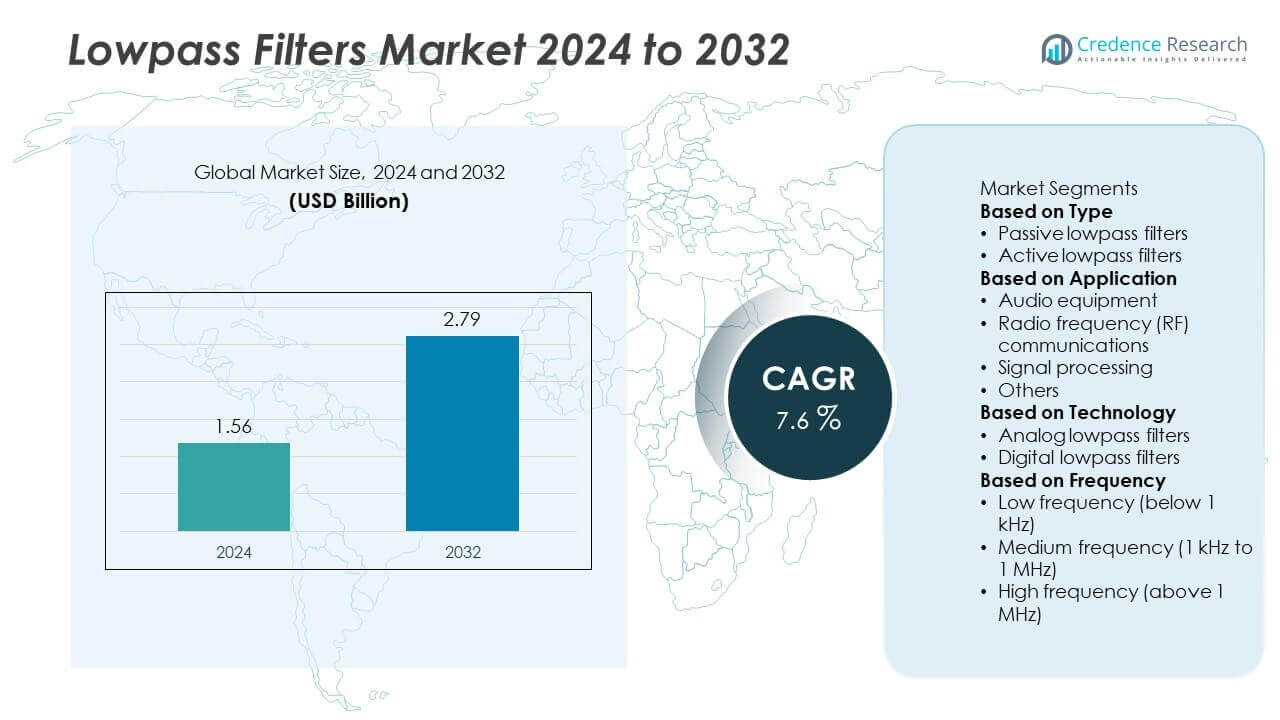
The Lowpass Filters Market was valued at USD 1.56 billion in 2024 and is projected to reach USD 2.79 billion by 2032, growing at a CAGR of 7.6% during the forecast period.
| REPORT ATTRIBUTE | DETAILS |
|---|---|
| Historical Period | 2020-2023 |
| Base Year | 2024 |
| Forecast Period | 2025-2032 |
| Lowpass Filters Market Size 2024 | USD 1.56 Billion |
| Lowpass Filters Market, CAGR | 7.6% |
| Lowpass Filters Market Size 2032 | USD 2.79 Billion |
The Lowpass Filters Market grows with rising demand across consumer electronics, telecommunications, automotive, and healthcare sectors. Expanding 5G infrastructure, IoT adoption, and advanced automotive systems drive steady uptake of high-performance filters.
Asia Pacific leads the Lowpass Filters Market driven by its strong electronics manufacturing base, rapid telecommunication upgrades, and widespread adoption of consumer devices across China, Japan, South Korea, and India. North America follows with growth supported by advanced 5G deployment, rising demand in electric vehicles, and the presence of established semiconductor companies. Europe maintains steady expansion fueled by automotive innovation, industrial automation, and healthcare technology investments, especially in Germany, France, and the UK. Latin America and the Middle East & Africa show emerging potential through increasing digital transformation and infrastructure development projects. Key players such as Analog Devices, Inc., Broadcom Inc., Infineon Technologies AG, and AVX Corporation are focusing on innovation, miniaturization, and integration of lowpass filters into advanced applications. These companies also invest in strategic partnerships, R&D, and regional collaborations to strengthen their product portfolios and ensure reliable supply to both established and emerging markets worldwide.
Market Insights
- The Lowpass Filters Market was valued at USD 1.56 billion in 2024 and is projected to reach USD 2.79 billion by 2032, growing at a CAGR of 7.6%.
- Rising demand in consumer electronics, telecommunications, and automotive applications fuels adoption of lowpass filters for reliable signal processing.
- Growing integration in 5G networks, IoT platforms, and wearable healthcare devices highlights the trend toward miniaturization and multifunctionality.
- Leading players such as Analog Devices, Inc., Broadcom Inc., Infineon Technologies AG, and AVX Corporation compete through innovation, R&D investment, and global distribution.
- High design complexity, manufacturing costs, and technical limitations in high-frequency applications act as key restraints for broader adoption.
- Asia Pacific drives strong growth with robust electronics manufacturing and telecom expansion, while North America and Europe sustain demand through automotive, industrial, and healthcare applications.
- Latin America and the Middle East & Africa emerge as growing markets, supported by infrastructure projects, digital transformation, and rising demand for cost-effective consumer electronics.
Market Drivers
Growing Demand from Consumer Electronics and Communication Devices
The rapid expansion of consumer electronics drives the need for efficient signal processing components. Smartphones, tablets, and connected devices rely on lowpass filters to remove high-frequency noise and maintain clear signals. The Lowpass Filters Market benefits from rising adoption of 5G-enabled devices, IoT platforms, and wireless communication systems. Compact designs and high integration capacity make these filters essential in modern electronics. It helps manufacturers meet consumer expectations for faster connectivity and superior performance. Strong demand for portable electronics ensures steady growth across global markets.
- For instance, AVX Corporation released its LP0402N series low-pass filters, available in 0402 case size (1.0 × 0.5 mm), covering bands from 787 MHz to 5.5 GHz, specifically engineered for smartphones and IoT modules that require miniaturized RF components.
Expansion of Industrial Automation and IoT Applications
Industries adopt automation and smart devices to improve efficiency and monitoring capabilities. Lowpass filters support these systems by ensuring accurate signal transmission in industrial sensors, controllers, and data acquisition units. The Lowpass Filters Market grows as factories integrate IoT and predictive maintenance platforms that rely on reliable signal clarity. Filtration enhances communication across robotics, machine control, and energy management systems. It allows industrial operators to achieve real-time monitoring without signal distortion. Rising investments in Industry 4.0 initiatives fuel further deployment of advanced filters.
- For instance, CTS Corporation expanded its RLF and XLF low-pass filter families, with RLF models supporting up to 20 W average power handling and XLF variants designed in 6.5 × 5 × 2 mm packages capable of managing 6 W per port, making them suitable for robust industrial IoT sensor networks and automation platforms.
Increased Use in Automotive Electronics and Safety Systems
The automotive sector increasingly integrates electronics for infotainment, safety, and driver assistance systems. Lowpass filters ensure precise communication between sensors, control units, and onboard computers. The Lowpass Filters Market expands with the rise of electric vehicles and autonomous driving technologies. Advanced Driver Assistance Systems (ADAS) and battery management platforms rely heavily on these components. It supports seamless vehicle-to-vehicle and vehicle-to-infrastructure communication. Growing emphasis on road safety and smart mobility solutions strengthens filter adoption across the automotive supply chain.
Rising Adoption in Medical Devices and Healthcare Equipment
Medical technology relies on clean, undistorted signals for accurate diagnosis and monitoring. Lowpass filters are critical in imaging devices, patient monitoring systems, and wearable healthcare electronics. The Lowpass Filters Market benefits from rising demand for portable and connected health devices. It ensures reliable operation in ECGs, EEGs, and other diagnostic platforms that require precise signal clarity. Healthcare providers adopt advanced devices to improve patient outcomes, boosting demand for high-performance filters. Growth in telemedicine and digital health platforms further strengthens adoption worldwide.
 Market Trends
Integration of Lowpass Filters in 5G and Next-Generation Networks
The rollout of 5G networks accelerates demand for advanced filtering solutions to manage complex frequency environments. Lowpass filters are integrated into base stations, antennas, and user devices to ensure efficient bandwidth utilization. The Lowpass Filters Market grows with rising deployment of smart infrastructure and next-generation communication systems. It supports stable connectivity by eliminating interference and maintaining signal clarity. Telecom operators adopt customized filters designed for high-speed and low-latency applications. The trend strengthens as global investments in 5G infrastructure continue to expand.
- For instance, Analog Devices introduced the HMC881A tunable low-pass filter, which offers a cutoff range of 2.4 GHz to 4 GHz, a typical insertion loss of 3 dB, and return loss of 16.5 dB. It is suitable for advanced communications applications, such as satellite communication and test and measurement equipment
Miniaturization and Higher Functionality in Consumer Electronics
Manufacturers are focusing on compact and multifunctional lowpass filters to meet the needs of portable electronics. Smartphones, wearables, and IoT devices require smaller yet more efficient filters for performance optimization. The Lowpass Filters Market benefits from this shift toward miniaturized designs that save space without compromising efficiency. It enables product designers to integrate multiple features into sleek consumer devices. Demand for energy-efficient and high-density components supports this trend. The growth of edge devices and portable platforms further accelerates adoption of compact solutions.
- For instance, Abracon, LLC released new ceramic resonant filters designed for Wi-Fi 6E/7 and BLE devices. Abracon's High-Rejection Band Pass Ceramic Filters achieve high-Q performance, low insertion loss (under 2.5 dB), and excellent selectivity through Low-Temperature Co-fired Ceramic (LTCC) manufacturing. Their compact SMD packages, suitable for ultra-compact IoT and wearable platforms, are available in multiple sizes, including packages as small as 1.6 x 0.8 mm for Bluetooth/Wi-Fi and 1.0 x 0.5 mm for UWB applications.
Growing Focus on Automotive Electrification and ADAS Integration
Automakers are increasing reliance on electronic systems for safety, infotainment, and electric powertrains. Lowpass filters play a vital role in reducing electromagnetic interference and improving system reliability. The Lowpass Filters Market expands with greater adoption of electric vehicles, hybrid platforms, and autonomous driving technologies. It ensures accurate data transfer between sensors and controllers within complex automotive systems. Rising global investments in connected vehicle technologies create strong opportunities. The trend aligns with stricter safety standards and the push for cleaner mobility solutions.
Expansion of Healthcare and Wearable Medical Devices
Healthcare technology incorporates lowpass filters to achieve accurate monitoring and diagnostic performance. Portable diagnostic systems and connected medical devices depend on these components for reliable data. The Lowpass Filters Market grows as demand for telehealth platforms, remote monitoring, and wearable healthcare devices rises. It ensures smooth performance in applications like ECG, EEG, and imaging systems. The trend is reinforced by aging populations and increasing focus on preventive healthcare. Growing consumer preference for fitness trackers and health monitoring wearables further strengthens this trajectory.
Market Challenges Analysis
High Design Complexity and Cost of Advanced Filters
Developing lowpass filters for next-generation applications requires high precision and advanced materials. Complex design processes increase production costs, limiting accessibility for smaller manufacturers and price-sensitive markets. The Lowpass Filters Market faces challenges in balancing performance with affordability, particularly in consumer electronics and IoT devices. It must address demands for compact size, high efficiency, and multi-functionality while keeping costs competitive. Limited availability of specialized raw materials further increases expenses for advanced filter designs. These barriers slow adoption in regions with constrained budgets and lower R&D capacity.
Technical Limitations and Integration Challenges Across Industries
Lowpass filters face performance limitations when used in high-frequency and high-speed communication systems. Issues such as signal loss, heat generation, and reduced efficiency impact reliability in demanding applications. The Lowpass Filters Market encounters integration challenges as industries push for miniaturized and multifunctional designs. It requires constant innovation to meet stricter standards in automotive, telecom, and healthcare sectors. Inadequate testing frameworks and lack of skilled expertise add to operational difficulties. These technical constraints restrict scalability and delay widespread adoption in critical applications.
Market Opportunities
Rising Adoption in Emerging Communication and IoT Networks
The expansion of 5G, IoT, and next-generation communication systems creates significant opportunities for advanced filtering solutions. Lowpass filters are essential for ensuring reliable data transmission, reducing interference, and maintaining signal quality in complex frequency environments. The Lowpass Filters Market benefits from the increasing deployment of smart devices, connected homes, and industrial IoT platforms. It enables manufacturers to supply components that align with growing demand for high-speed and low-latency connectivity. The shift toward edge computing and cloud-based applications further accelerates need for high-performance filters. Strong investments in communication infrastructure across Asia and North America strengthen these opportunities.
Expanding Role in Automotive Electronics and Healthcare Devices
The automotive industry presents growth potential with rising adoption of electric vehicles and autonomous systems. Lowpass filters support accurate data transfer in ADAS, infotainment, and power management platforms. The Lowpass Filters Market gains traction as automakers invest in safer, connected, and more efficient vehicle designs. It also finds opportunities in healthcare technology, where portable diagnostics, imaging systems, and wearables require precise signal clarity. Increasing consumer preference for health monitoring devices expands market reach in both developed and emerging regions. Manufacturers focusing on customized solutions for automotive and medical applications can secure strong positions in the global market.
Market Segmentation Analysis:
By Type
The Lowpass Filters Market is segmented into passive and active filters. Passive filters, which rely on resistors, capacitors, and inductors, remain widely used due to their simple design, durability, and cost-effectiveness. Active filters, incorporating transistors or operational amplifiers, are gaining traction for applications requiring higher precision and performance. These filters deliver greater control over frequency response and are suited for miniaturized and integrated devices. It benefits from rising demand for active filters in consumer electronics, medical devices, and automotive systems where high efficiency is critical. The balance between passive affordability and active functionality defines segment growth.
- For instance, Texas Instruments offers the OPA2392, a precision operational amplifier with rail-to-rail input and output and a 13 MHz gain-bandwidth product, making it suitable for active filter circuits. This type of low-noise op amp can be utilized in precision sensor applications for portable medical and automotive systems, such as patient monitors or sensor front-ends.
By Application
Applications include consumer electronics, automotive, industrial, telecommunication, and healthcare. Consumer electronics dominate due to extensive use in smartphones, wearables, and home devices. The Lowpass Filters Market grows within automotive applications, where filters enable accurate communication in ADAS, infotainment, and EV powertrains. Industrial adoption expands with automation, robotics, and IoT integration across smart factories. Telecommunications demand increases as filters support 5G networks, base stations, and connected infrastructure. Healthcare relies on filters in diagnostic systems, imaging platforms, and patient monitoring equipment, making it a rising growth segment. It highlights the importance of filters across diverse industries, from entertainment to critical care.
- For instance, Murata Manufacturing supplies a variety of specialized components, including filters and connectivity modules, that are used in commercial wireless infrastructure, Internet of Things (IoT) devices, and medical imaging systems.
By Technology
Key technologies include analog filters, digital filters, and hybrid systems. Analog filters dominate traditional designs with strong use in low-cost and legacy equipment. Digital filters are expanding rapidly as industries demand programmable, high-precision solutions for modern devices. The Lowpass Filters Market benefits from digital technology in telecommunications, computing, and signal processing applications. Hybrid systems, combining analog and digital strengths, are emerging to meet advanced needs in complex environments. It enables versatile solutions that adapt to both legacy systems and next-generation platforms. This mix of technologies ensures broad application coverage across global industries.
Segments:
Based on Type
- Passive lowpass filters
- Active lowpass filters
Based on Application
- Audio equipment
- Radio frequency (RF) communications
- Signal processing
- Others
Based on Technology
- Analog lowpass filters
- Digital lowpass filters
Based on Frequency
- Low frequency (below 1 kHz)
- Medium frequency (1 kHz to 1 MHz)
- High frequency (above 1 MHz)
Based on the Geography:
- North America
- U.S.
- Canada
- Mexico
- Europe
- UK
- France
- Germany
- Italy
- Spain
- Russia
- Belgium
- Netherlands
- Austria
- Sweden
- Poland
- Denmark
- Switzerland
- Rest of Europe
- Asia Pacific
- China
- Japan
- South Korea
- India
- Australia
- Thailand
- Indonesia
- Vietnam
- Malaysia
- Philippines
- Taiwan
- Rest of Asia Pacific
- Latin America
- Brazil
- Argentina
- Peru
- Chile
- Colombia
- Rest of Latin America
- Middle East
- UAE
- KSA
- Israel
- Turkey
- Iran
- Rest of Middle East
- Africa
- Egypt
- Nigeria
- Algeria
- Morocco
- Rest of Africa
Regional Analysis
North America
North America held around 34% of the Lowpass Filters Market in 2024. The region benefits from strong demand in consumer electronics, telecommunications, and automotive applications. The United States leads adoption with its advanced 5G infrastructure, growing EV market, and strong base of semiconductor manufacturers. Canada contributes with rising investment in smart city projects and healthcare technology. The region also benefits from high R&D spending, encouraging innovation in both active and digital filter technologies. It remains a key market due to the presence of leading electronics firms and the continuous shift toward connected and automated systems.
Europe
Europe accounted for nearly 26% of the Lowpass Filters Market in 2024. The region’s growth is supported by strong automotive manufacturing hubs in Germany, France, and Italy, where filters play a key role in ADAS, infotainment, and EV platforms. The UK and Nordic countries drive demand with expanding 5G deployment and telecom upgrades. Healthcare applications also grow steadily across the region due to high investment in diagnostic equipment and wearable health devices. Eastern Europe contributes with industrial automation projects supported by EU funding. It shows balanced growth across multiple industries, strengthened by sustainability and efficiency-focused technology adoption.
Asia Pacific
Asia Pacific represented about 28% of the Lowpass Filters Market in 2024. The region leads in electronics production, with China, Japan, South Korea, and Taiwan driving large-scale adoption. Strong consumer demand for smartphones, wearables, and IoT devices contributes to regional dominance. India shows rapid growth in telecommunication and automotive applications, boosted by expanding infrastructure and manufacturing capacity. The region also benefits from investments in medical technology and industrial automation. It gains further momentum from government-backed initiatives to strengthen semiconductor and electronics ecosystems, securing Asia Pacific’s role as a global production and consumption hub.
Latin America
Latin America held nearly 7% of the Lowpass Filters Market in 2024. Brazil and Mexico are the leading contributors, supported by automotive, telecom, and industrial applications. Growth in the consumer electronics sector is also notable, driven by rising middle-class demand for connected devices. The region experiences increasing adoption of filters in energy and infrastructure projects, especially in telecommunications. Limited R&D capacity and reliance on imports remain challenges, but collaborations with global manufacturers strengthen accessibility. It is an emerging market with opportunities linked to expanding digital transformation and industrial modernization.
Middle East and Africa
The Middle East and Africa accounted for about 5% of the Lowpass Filters Market in 2024. The Gulf region, led by the UAE and Saudi Arabia, drives adoption through telecom upgrades, industrial automation, and smart city projects. Africa contributes with growing demand in energy, automotive, and consumer electronics sectors. Healthcare technology is also an emerging application area in both sub-regions. The market faces cost and infrastructure challenges, but international partnerships support gradual progress. It presents long-term growth opportunities as investment in digital and industrial infrastructure expands across the region.
Key Player Analysis
- API Technologies Corp.
- Infineon Technologies AG
- Crystek Corporation
- AVX Corporation
- CTS Corporation
- Renesas Electronics
- Broadcom Inc.
- Abracon, LLC
- Analog Devices, Inc.
- Anatech Electronics, Inc.
Competitive Analysis
Competitive landscape of the Lowpass Filters Market includes key players such as Abracon, LLC, Analog Devices, Inc., Anatech Electronics, Inc., API Technologies Corp., AVX Corporation, Broadcom Inc., Crystek Corporation, CTS Corporation, Infineon Technologies AG, and Renesas Electronics. These companies focus on delivering advanced passive and active filter solutions designed to meet the needs of consumer electronics, telecommunications, automotive, and healthcare industries. They compete by investing in miniaturization, higher-frequency handling, and integration of lowpass filters into compact devices. Strong emphasis is placed on supporting 5G infrastructure, IoT ecosystems, and automotive electrification, where precise signal management is critical. Players expand market presence through R&D programs, product innovation, and collaborations with OEMs to ensure compatibility with emerging technologies. Strategic initiatives include mergers, acquisitions, and partnerships aimed at strengthening global distribution networks and enhancing supply chain resilience. Competitive differentiation relies on balancing cost-effectiveness with performance, enabling these companies to address both high-end and cost-sensitive applications across diverse global markets.
Recent Developments
- In July 2025, Renesas Electronics published PCB design guidelines (Rev. 1.00) including recommendations on implementing RC low-pass filters for analog power rail isolation to reduce noise in high-speed interfaces.
- In June 2025, Analog Devices, Inc. introduced ADVentures (ADV), a corporate venture capital fund to invest in innovation-including next-generation analog and filter technologies-though not a low-pass product release, it signals future developments in adjacent areas.
- In March 2024, CTS Corporation saw its RLF and XLF low-pass filter families made available via distributors such as Richardson RFPD-RLF models deliver very low insertion loss (up to 5 dB) and support up to 20 W average power, while XLF models are compact (6.5 × 5 × 2 mm) and suit up to 6 W average power per port.
- In 2024, Abracon, LLC unveiled new high-performance ceramic resonant filters aimed at advanced wireless applications like Wi-Fi 6E/7 and BLE 6.0, designed for low insertion loss, high-Q performance, and compact space.
Report Coverage
The research report offers an in-depth analysis based on Type, Application, Technology, Frequency and Geography. It details leading market players, providing an overview of their business, product offerings, investments, revenue streams, and key applications. Additionally, the report includes insights into the competitive environment, SWOT analysis, current market trends, as well as the primary drivers and constraints. Furthermore, it discusses various factors that have driven market expansion in recent years. The report also explores market dynamics, regulatory scenarios, and technological advancements that are shaping the industry. It assesses the impact of external factors and global economic changes on market growth. Lastly, it provides strategic recommendations for new entrants and established companies to navigate the complexities of the market.
Future Outlook
- Demand for lowpass filters will increase with expansion of 5G networks and IoT devices.
- Miniaturized and multifunctional filter designs will gain traction in consumer electronics.
- Automotive electrification and ADAS technologies will drive higher adoption in vehicles.
- Healthcare devices and wearables will increasingly integrate filters for accurate monitoring.
- Industrial automation and smart factories will strengthen demand for precise signal filtering.
- Hybrid and digital filter technologies will expand applications in high-frequency environments.
- Strategic collaborations with OEMs will support integration into next-generation products.
- Emerging economies will adopt more filters through telecom upgrades and electronics growth.
- Aftermarket and replacement demand will sustain growth in established industries.
- Continuous R&D will focus on enhancing efficiency, cost-effectiveness, and high-frequency performance.

Request a Free Sample
Fill in your details and we'll send you a free sample report.
- Sample data tables & charts
- Research methodology
Market Dynamics
Expansion of 5G Infrastructure and IoT Adoption
The rollout of 5G networks and rapid proliferation of IoT devices require advanced lowpass filters to manage complex frequency environments, reduce interference, and ensure reliable high-speed data transmission in both consumer and industrial applications.
Growth in Consumer Electronics and Miniaturization
Increasing demand for smartphones, wearables, and portable devices drives the need for compact, high-performance lowpass filters that can be integrated into smaller form factors without sacrificing signal quality or efficiency.
Automotive Electrification and ADAS Integration
The shift toward electric vehicles and advanced driver assistance systems (ADAS) is boosting the use of lowpass filters to ensure precise communication between sensors, control units, and infotainment systems, supporting safer and more connected vehicles.
Industrial Automation and Smart Factory Initiatives
Industries are adopting automation and smart manufacturing platforms that rely on lowpass filters for accurate signal processing in sensors, controllers, and robotics, enabling real-time monitoring and efficient operation in Industry 4.0 environments.
Rising Demand in Healthcare and Wearable Medical Devices
The increasing use of portable diagnostic equipment, patient monitoring systems, and wearable health devices requires high-quality lowpass filters to deliver clean, undistorted signals essential for accurate medical data and improved patient outcomes.
Need a Custom Version of This Report?
Tailor the scope, geography, or segments to your exact requirements.
- Custom geography or segment scope
- Direct access to our analyst team
Frequently Asked Questions
What is the current market size for Lowpass Filters, and what is its projected size in 2032?
At what Compound Annual Growth Rate is the Lowpass Filters market projected to grow between 2025 and 2032?
Which Lowpass Filters market segment held the largest share in 2024?
What are the primary factors fueling the growth of the Lowpass Filters market?
Who are the leading companies in the Lowpass Filters market?
Which region commanded the largest share of the Lowpass Filters market in 2024?
Table of Content
Chapter 1 Market Segmentation
- 1.1 Segmentation Framework
- 1.1.1 Product and Service Classification
- 1.1.2 Application and End-Use Classification
- 1.1.3 Technology and Solution Classification
- 1.1.4 Customer and Distribution Channel Classification
- 1.1.5 Geographic Segmentation
- 1.1.6 Market Segment Definitions and Boundaries
- 1.2 By Type
- 1.2.1 Passive lowpass filters
- 1.2.2 Active lowpass filters
- 1.3 By Frequency
- 1.3.1 Low frequency (below 1 kHz)
- 1.3.2 Medium frequency (1 kHz to 1 MHz)
- 1.3.3 High frequency (above 1 MHz)
- 1.4 By Technology
- 1.4.1 Analog lowpass filters
- 1.4.2 Digital lowpass filters
- 1.4.3 Hybrid systems
- 1.5 By Application
- 1.5.1 Audio equipment
- 1.5.2 Radio frequency (RF) communications
- 1.5.3 Signal processing
- 1.5.4 Others
Chapter 2 Introduction
- 2.1 Report Objectives and Scope
- 2.2 Product Definition and Industry Terminology
- 2.3 Market Inclusions and Exclusions
- 2.4 Research Process
- 2.4.1 Primary Research and Expert Interviews
- 2.4.2 Secondary Research and Source Review
- 2.4.3 Top-Down and Bottom-Up Estimation
- 2.4.4 Data Triangulation and Verification
- 2.5 Market Size Measurement Basis
- 2.5.1 2024: USD 1.56 billion → 2032: USD 2.79 billion
- 2.6 Historical and Forecast Reference Periods
- 2.6.1 Base Year: 2024
- 2.6.2 Forecast Period: 2024-2032
- 2.7 Research Assumptions and Limitations
Chapter 3 Executive Summary
- 3.1 Market Snapshot and Key Findings
- 3.2 Base-Year Market Size, 2024
- 3.3 Forecast Market Size, 2032
- 3.4 Revenue and Volume Growth Outlook
- 3.5 Key Demand and Supply Indicators
- 3.6 Leading Market Segments
- 3.7 Fastest-Growing Market Opportunities
- 3.8 Regional Performance Highlights
- 3.9 Technology and Industry Transformation
- 3.10 Competitive Landscape Summary
- 3.11 Analyst View and Strategic Implications
Chapter 4 Global Lowpass Filters Market Trends and Developments
- 4.1 Historical Industry Development
- 4.2 Recent Market Trends and Developments
- 4.3 Demand and Customer Behavior Trends
- 4.4 Technology and Product Innovation
- 4.5 Artificial Intelligence, Automation and Digitalization
- 4.6 Local Manufacturing and Supply Chain Realignment
- 4.7 Industry Partnerships, Mergers and Acquisitions
- 4.8 Sustainability and Circular Economy Developments
- 4.9 Government and Private Sector Investment Trends
- 4.10 Emerging Business Models and Commercialization
- 4.11 Industry Developments and Announcements
Chapter 5 Global Lowpass Filters Market Production, Supply and Demand Analysis
- 5.1 Demand Trend and Consumption Analysis
- 5.2 Demand Forecast, 2024-2032
- 5.3 Production and Output Trend
- 5.4 Production and Output Forecast, 2024-2032
- 5.5 Installed Capacity and Capacity Utilization
- 5.6 Company-Wise Production Plants and Statistics
- 5.6.1 Installed Production Capacity
- 5.6.2 Actual Production
- 5.6.3 Planned Capacity and Expansion Targets
- 5.7 Supply Chain Structure and Procurement Trends
- 5.8 Supply-Demand Gap and Bottlenecks
- 5.9 Import Dependence and Sourcing Structure
- 5.10 Contract Manufacturing and Outsourcing
- 5.11 Regional Supply and Demand Concentration
Chapter 6 Global Lowpass Filters Market Pricing Analysis
- 6.1 Pricing Structure and Measurement
- 6.2 Historical Pricing Trends
- 6.3 Pricing Outlook, 2024-2032
- 6.4 Average Selling Price and Unit Economics
- 6.5 Pricing by Product and Market Segment
- 6.6 Geographic Pricing Differences
- 6.7 Key Input, Energy, Labor and Logistics Costs
- 6.8 Contract Pricing and Purchasing Models
- 6.9 Pricing Sensitivity and Competitive Positioning
- 6.10 Price, Margin and Profitability Implications
Chapter 7 Global Lowpass Filters Market Dynamics
- 7.1 Market Growth Drivers
- 7.1.1 Demand-Side Drivers
- 7.1.2 Technology and Innovation Drivers
- 7.1.3 Infrastructure and Investment Drivers
- 7.1.4 Regulatory and Policy Drivers
- 7.2 Market Restraints
- 7.2.1 Cost and Affordability Constraints
- 7.2.2 Technology and Adoption Barriers
- 7.2.3 Supply Chain and Operational Constraints
- 7.3 Market Challenges
- 7.3.1 Competitive Pressure and Margin Erosion
- 7.3.2 Skills, Infrastructure and Implementation Gaps
- 7.4 Emerging Market Opportunities
- 7.5 Market Dynamics Impact and Time-Horizon Assessment
Chapter 8 Global Lowpass Filters Value Chain Analysis
- 8.1 Industry Value Chain Overview
- 8.2 Upstream Suppliers and Critical Inputs
- 8.3 Technology and Component Providers
- 8.4 Manufacturing or Service Delivery
- 8.5 Distribution, Channel Partners and Integrators
- 8.6 Downstream Applications and End Users
- 8.7 Value Addition and Profit Pools
- 8.8 Vertical Integration and Outsourcing
- 8.9 Supplier Concentration and Risk
- 8.10 Supply Chain Localization and Resilience
Chapter 9 Global Lowpass Filters Market Regulations and Policies
- 9.1 Relevant Laws, Standards and Compliance Frameworks
- 9.2 Product, Service, Safety and Quality Requirements
- 9.3 Government Policies, Incentives and Subsidies
- 9.4 Imports, Exports and Trade Barriers
- 9.5 Public Procurement and Local Content Requirements
- 9.6 Environmental and Sustainability Compliance
- 9.7 Upcoming Policy Changes and Market Implications
Chapter 10 Global Lowpass Filters Market Hotspots and Opportunities
- 10.1 Market Opportunity Mapping and Growth Hotspots
- 10.2 High-Growth Applications and Customer Groups
- 10.3 Underserved Markets and White-Space Opportunities
- 10.4 Emerging Technology and Product Opportunities
- 10.5 New Capacity and Investment Hotspots
- 10.6 Market Entry and Expansion Opportunities
- 10.7 Distribution and Partnership Opportunities
- 10.8 Near-Term and Long-Term Commercial Potential
- 10.9 Opportunity Attractiveness and Execution Risks
Chapter 11 Global Lowpass Filters Market Outlook, 2024-2032
- 11.1 Market Size and Analysis
- 11.1.1 Revenue (Market Measurement: 2024: USD 1.56 billion → 2032: USD 2.79 billion)
- 11.1.2 Market Volume and Quantity Sold
- 11.1.3 Historical Market Size
- 11.1.4 Base-Year Market Size, 2024
- 11.2 Market Forecast, 2024-2032
- 11.2.1 Revenue Forecast to 2032
- 11.2.2 Volume Forecast to 2032
- 11.2.3 CAGR and Year-on-Year Growth
- 11.2.4 Incremental Revenue Opportunity
- 11.3 Forecast Assumptions and Scenario Analysis
- 11.3.1 Base-Case Forecast
- 11.3.2 Optimistic and Conservative Scenarios
- 11.3.3 Technology, Pricing and Policy Sensitivities
- 11.4 Market Attractiveness and Growth Outlook
Chapter 12 Global Lowpass Filters Market Segmentation and Outlook
- 12.1 Segmentation Summary and Market Shares, 2024
- 12.2 Largest and Fastest-Growing Segments
- 12.3 By Type - Market Size and Forecast, 2024-2032
- 12.3.1 Segment Definition and Scope
- 12.3.2 Historical Market Size
- 12.3.3 Revenue Forecast, 2024-2032
- 12.3.4 Volume Forecast, 2024-2032
- 12.3.5 Base-Year Market Share, 2024
- 12.3.6 Segment CAGR and Growth Drivers
- 12.3.7 Subsegment Market Size and Forecast
- 12.3.7.1 Passive lowpass filters
- 12.3.7.2 Active lowpass filters
- 12.3.8 Subsegment Pricing and Adoption Trends
- 12.3.9 Leading Suppliers and Competition
- 12.3.10 Regional Demand and Opportunities
- 12.4 By Frequency - Market Size and Forecast, 2024-2032
- 12.4.1 Segment Definition and Scope
- 12.4.2 Historical Market Size
- 12.4.3 Revenue Forecast, 2024-2032
- 12.4.4 Volume Forecast, 2024-2032
- 12.4.5 Base-Year Market Share, 2024
- 12.4.6 Segment CAGR and Growth Drivers
- 12.4.7 Subsegment Market Size and Forecast
- 12.4.7.1 Low frequency (below 1 kHz)
- 12.4.7.2 Medium frequency (1 kHz to 1 MHz)
- 12.4.7.3 High frequency (above 1 MHz)
- 12.4.8 Subsegment Pricing and Adoption Trends
- 12.4.9 Leading Suppliers and Competition
- 12.4.10 Regional Demand and Opportunities
- 12.5 By Technology - Market Size and Forecast, 2024-2032
- 12.5.1 Segment Definition and Scope
- 12.5.2 Historical Market Size
- 12.5.3 Revenue Forecast, 2024-2032
- 12.5.4 Volume Forecast, 2024-2032
- 12.5.5 Base-Year Market Share, 2024
- 12.5.6 Segment CAGR and Growth Drivers
- 12.5.7 Subsegment Market Size and Forecast
- 12.5.7.1 Analog lowpass filters
- 12.5.7.2 Digital lowpass filters
- 12.5.7.3 Hybrid systems
- 12.5.8 Subsegment Pricing and Adoption Trends
- 12.5.9 Leading Suppliers and Competition
- 12.5.10 Regional Demand and Opportunities
- 12.6 By Application - Market Size and Forecast, 2024-2032
- 12.6.1 Segment Definition and Scope
- 12.6.2 Historical Market Size
- 12.6.3 Revenue Forecast, 2024-2032
- 12.6.4 Volume Forecast, 2024-2032
- 12.6.5 Base-Year Market Share, 2024
- 12.6.6 Segment CAGR and Growth Drivers
- 12.6.7 Subsegment Market Size and Forecast
- 12.6.7.1 Audio equipment
- 12.6.7.2 Radio frequency (RF) communications
- 12.6.7.3 Signal processing
- 12.6.7.4 Others
- 12.6.8 Subsegment Pricing and Adoption Trends
- 12.6.9 Leading Suppliers and Competition
- 12.6.10 Regional Demand and Opportunities
- 12.7 Segment Growth Comparison
- 12.8 Segment Attractiveness and Priority Matrix
Chapter 13 Global Lowpass Filters End-Use and Application Market Outlook
- 13.1 End-Use Industry and Customer Demand Structure
- 13.2 Leading Applications and Customer Groups
- 13.3 End-Use Market Size, Share and Forecast
- 13.4 Major End-Use Industry Deep Dives
- 13.4.1 Customer Requirements and Use Cases
- 13.4.2 Demand and Replacement Cycles
- 13.4.3 Technical and Regulatory Considerations
- 13.4.4 Purchasing and Procurement Models
- 13.4.5 Leading Vendors and Distribution Channels
- 13.4.6 Forecast and Commercial Opportunities
- 13.5 Emerging Applications and Cross-Segment Demand
- 13.6 End-Use Industry Investment Priorities
Chapter 14 Global Lowpass Filters Geographic Market Outlook, 2024-2032
- 14.1 Regional Market Size and Share, 2024
- 14.2 Regional Market Forecast, 2024-2032
- 14.3 Regional Pricing, Production and Demand Differences
- 14.4 North America
- 14.4.1 United States
- 14.4.2 Canada
- 14.4.3 Mexico
- 14.5 Europe
- 14.5.1 Germany
- 14.5.2 France
- 14.5.3 Italy
- 14.5.4 United Kingdom
- 14.5.5 Spain
- 14.5.6 Poland
- 14.5.7 Russia
- 14.5.8 Netherlands
- 14.5.9 Belgium
- 14.5.10 Sweden
- 14.5.11 Denmark
- 14.5.12 Norway
- 14.5.13 Rest of Europe
- 14.6 Asia Pacific
- 14.6.1 China
- 14.6.2 India
- 14.6.3 Japan
- 14.6.4 South Korea
- 14.6.5 Thailand
- 14.6.6 Indonesia
- 14.6.7 Vietnam
- 14.6.8 Malaysia
- 14.6.9 Australia
- 14.6.10 Rest of Asia Pacific
- 14.7 Latin America
- 14.7.1 Brazil
- 14.7.2 Argentina
- 14.7.3 Colombia
- 14.7.4 Chile
- 14.7.5 Rest of Latin America
- 14.8 Middle East
- 14.8.1 Saudi Arabia
- 14.8.2 United Arab Emirates
- 14.8.3 Turkey
- 14.8.4 Israel
- 14.8.5 Iran
- 14.8.6 Rest of the Middle East
- 14.9 Africa
- 14.9.1 South Africa
- 14.9.2 Egypt
- 14.9.3 Nigeria
- 14.9.4 Morocco
- 14.9.5 Rest of Africa
- 14.10 Regional Investment, Policy and Supply Chain Differences
- 14.11 Regional Competitive Landscape
- 14.12 Geographic Growth Hotspots
Chapter 15 Global Lowpass Filters Technology, Innovation and Sustainability Outlook
- 15.1 Technology Landscape and Maturity
- 15.2 Product, Process and Service Innovation
- 15.3 AI, Automation and Digital Tools in the Industry
- 15.4 Technology Adoption and Performance Benchmarking
- 15.5 Innovation Pipeline and R&D Investment
- 15.6 Patent and Intellectual Property Trends
- 15.7 Energy Efficiency and Resource Management
- 15.8 Sustainability, Recycling and Circularity
- 15.9 Technology Roadmap, 2024-2032
- 15.10 Risks of Obsolescence and Technology Substitution
Chapter 16 Global Lowpass Filters Market Key Strategic Imperatives
- 16.1 Growth and Market Entry Priorities
- 16.2 High-Return Products and Segments
- 16.3 Pricing, Profitability and Cost Optimization
- 16.4 Technology Investment and Product Differentiation
- 16.5 Supply Chain Localization and Resilience
- 16.6 Distribution and Customer Acquisition
- 16.7 Partnership, Acquisition and Capacity Strategy
- 16.8 Regional Expansion Priorities
- 16.9 Short-, Medium- and Long-Term Actions
Chapter 17 Competition Outlook
- 17.1 Industry Competition Characteristics
- 17.2 Market Structure and Concentration
- 17.3 Market Share and Competitive Positioning, 2024
- 17.4 Company-Wise Revenue and Product Benchmarking
- 17.5 Production and Service Capacity Benchmarking
- 17.6 Technology, Pricing and Differentiation
- 17.7 Regional Footprint and Distribution Strength
- 17.8 Mergers, Acquisitions and Strategic Alliances
- 17.9 New Entrants and Competitive Threats
- 17.10 Porter's Five Forces and Industry Attractiveness
- 17.11 Competitive Outlook, 2024-2032
Chapter 18 Company Profiles
- 18.1 Company Coverage and Selection Criteria
- 18.2 Analog Devices, Inc.
- 18.2.1 Business Description
- 18.2.2 Company Ownership and Geographic Presence
- 18.2.3 Product and Service Portfolio
- 18.2.4 Manufacturing and Operating Footprint
- 18.2.5 Production Capacity and Expansion Plans
- 18.2.6 Financial Performance and Investment
- 18.2.7 Market Share and Competitive Position
- 18.2.8 Technology and Innovation Capabilities
- 18.2.9 Strategic Alliances or Partnerships
- 18.2.10 Recent Developments
- 18.2.11 Growth Strategy and Outlook
- 18.3 Broadcom Inc.
- 18.4 Infineon Technologies AG
- 18.5 AVX Corporation
- 18.6 CTS Corporation
- 18.7 API Technologies Corp.
- 18.8 Crystek Corporation
- 18.9 Renesas Electronics
- 18.10 Abracon, LLC
- 18.11 Anatech Electronics, Inc.
- 18.12 Other Relevant Market Participants
Note: Every listed company is profiled on the structure shown under the first company. The company list is preliminary and may change based on research findings, market developments, data availability and client requirements.
Chapter 19 Disclaimer
- 19.1 Research and Forecast Disclaimer
- 19.2 Data Source and Estimation Limitations
Note: The depth of individual sections depends on data availability for this market. Volume, capacity, trade and other unit-based metrics are included where applicable.