Market Overview:
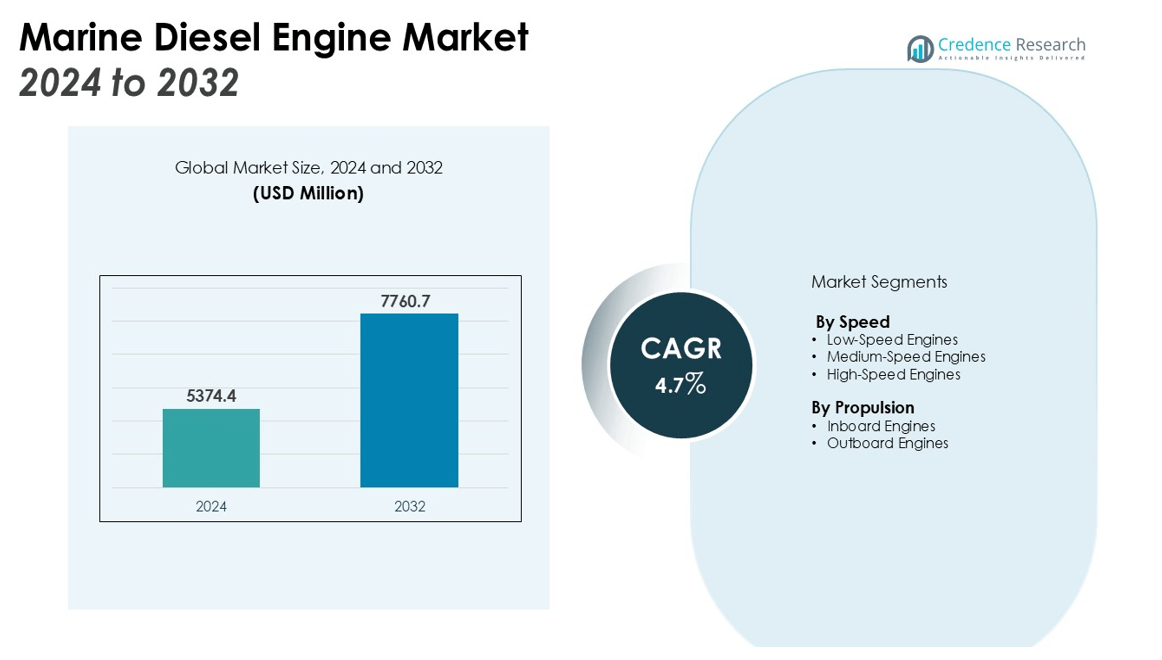
The Marine Diesel Engine Market size was valued at USD 5374.4 million in 2024 and is anticipated to reach USD 7760.7 million by 2032, at a CAGR of 4.7% during the forecast period (2024-2032).
| REPORT ATTRIBUTE | DETAILS |
|---|---|
| Historical Period | 2020-2023 |
| Base Year | 2024 |
| Forecast Period | 2025-2032 |
| Marine Diesel Engine Market Size 2024 | USD 5374.4 million |
| Marine Diesel Engine Market, CAGR | 4.7% |
| Marine Diesel Engine Market Size 2032 | USD 7760.7 million |
Key drivers fueling the growth of the Marine Diesel Engine Market include the rising demand for commercial vessels, advancements in engine technologies for reducing emissions, and the growing trend of adopting environmentally friendly regulations. Additionally, the shift towards cleaner marine fuel options, such as LNG, is also promoting the development of new engine technologies that meet stringent environmental standards. The increasing international trade and maritime transport activities further bolster the demand for high-performance marine diesel engines. Furthermore, the implementation of stricter global emission norms, such as IMO 2020, is driving the adoption of low-emission marine engines.
Regionally, Asia-Pacific dominates the Marine Diesel Engine Market, owing to its robust shipbuilding industry and the presence of major maritime trade hubs such as China, Japan, and South Korea. Europe follows closely, driven by the implementation of stringent environmental regulations and the shift towards eco-friendly marine engines. North America is also a significant market player, with growing investments in the development of energy-efficient technologies for marine vessels. The growing demand for renewable energy-powered vessels and the increasing focus on maritime sustainability further support market growth in these regions.
Market Insights:
- The Marine Diesel Engine Market was valued at USD 5374.4 million in 2024 and is expected to reach USD 7760.7 million by 2032, growing at a CAGR of 4.7%.
- Rising demand for commercial vessels, driven by international trade, boosts the market, particularly in Asia-Pacific’s maritime hubs.
- Advancements in engine technologies, focusing on emission reductions, are driving demand for hybrid and LNG-powered engines to meet IMO 2020 regulations.
- The shift towards cleaner fuels like LNG is fostering the development of engines that comply with stringent environmental standards.
- Growing investments in energy-efficient technologies by manufacturers and shipowners are enhancing fuel efficiency and reducing environmental impact.
- The adoption of hybrid and LNG-powered marine engines is increasing as a sustainable alternative to traditional diesel engines.
- Integration of IoT and AI-powered monitoring systems in marine engines improves operational efficiency, driving market demand for digitalized technologies.
Market Drivers:
Increasing Demand for Commercial Vessels
The rising global demand for commercial vessels is one of the primary drivers of the Marine Diesel Engine Market. With the expansion of international trade and the need for efficient transportation of goods, the shipping industry is witnessing significant growth. As shipping remains the most cost-effective mode of transporting large quantities of goods, the demand for new commercial vessels is increasing, leading to a higher need for marine diesel engines. This growth is especially notable in regions such as Asia-Pacific, where maritime trade hubs are experiencing booming activity.
- For instance, A.P. Moller - Maersk is expanding its fleet with a new class of methanol dual-fuel vessels in 2025, with the company taking delivery of six of these large container ships from Hyundai Heavy Industries to meet modern shipping demands.
Advancements in Engine Technologies and Emission Regulations
The ongoing advancements in engine technologies aimed at reducing emissions are significantly impacting the Marine Diesel Engine Market. With stricter environmental regulations being imposed by the International Maritime Organization (IMO) and other governing bodies, shipbuilders and engine manufacturers are focusing on developing technologies that comply with these standards. The introduction of hybrid and LNG-powered marine engines offers cleaner alternatives while maintaining operational efficiency, driving market demand for advanced marine diesel engines.
- For instance, Yanmar introduced its new Common Rail 6GY135W marine engine, a 6-cylinder unit developed to meet IMO Tier 3 certification standards while delivering a power output of up to 599 kW.
Shifting to Cleaner Marine Fuel Options
The shift towards cleaner marine fuel options, such as liquefied natural gas (LNG), is promoting the development of new engine technologies within the Marine Diesel Engine Market. LNG is becoming a preferred fuel choice due to its lower carbon emissions and its ability to meet stringent environmental regulations. As more vessels are built to accommodate LNG as fuel, demand for engines that are capable of running on these cleaner alternatives is steadily increasing, enhancing overall market growth.
Increasing Investment in Energy-Efficient Technologies
The growing focus on energy-efficient technologies is another significant driver in the Marine Diesel Engine Market. With rising fuel costs and environmental concerns, both shipowners and manufacturers are prioritizing efficiency improvements. Innovations in engine design, fuel management systems, and exhaust treatment technologies contribute to lower fuel consumption and reduced environmental impact, appealing to both economic and regulatory demands in the industry. This trend supports the widespread adoption of advanced marine diesel engines globally.
Market Trends:
Rising Adoption of Hybrid and LNG-powered Marine Engines
A key trend in the Marine Diesel Engine Market is the increasing adoption of hybrid and LNG-powered marine engines. These engines are being developed to comply with stringent emission regulations, including IMO 2020, which mandates reduced sulfur content in marine fuels. Hybrid marine engines, which combine conventional diesel power with electric or LNG technology, offer a more sustainable and cost-effective solution for reducing environmental impact. LNG engines, known for their lower carbon emissions, are becoming a preferred choice for both new builds and retrofitting existing vessels. This trend reflects the industry's shift toward cleaner, greener technologies, responding to both regulatory pressures and growing environmental awareness in the maritime sector.
- For instance, in a vessel study, switching from diesel to LNG fuel demonstrated a notable environmental benefit where the nitrogen oxide (NOx) emission factor was measured at 0.63 g/kWhr.
Focus on Smart and Digitalized Marine Engine Technologies
Another emerging trend in the Marine Diesel Engine Market is the integration of smart and digitalized technologies in marine engines. The growing emphasis on digitalization in the maritime industry is driving the demand for engines equipped with IoT (Internet of Things) capabilities and AI-powered monitoring systems. These technologies enable real-time performance tracking, predictive maintenance, and fuel efficiency optimization, all of which contribute to operational cost reductions and enhanced engine lifespan. As digital technologies continue to evolve, the demand for more sophisticated, connected marine engines is expected to rise, offering fleet operators advanced tools to enhance operational efficiency and meet evolving environmental standards.
- For instance, MAN Energy Solutions' digital platform, MAN CEON, provides real-time monitoring by collecting and evaluating operating data from the hundreds of sensors that are equipped on each of its engines.
Market Challenges Analysis:
Stricter Environmental Regulations and Compliance Costs
One of the primary challenges facing the Marine Diesel Engine Market is the increasing pressure to comply with stringent environmental regulations. Global organizations like the International Maritime Organization (IMO) are imposing stricter emission standards to reduce the environmental impact of maritime operations. These regulations require engine manufacturers to invest heavily in developing technology that meets new sulfur and nitrogen oxide (NOx) emissions limits. As compliance becomes more complex, the associated costs for both manufacturers and operators rise, adding financial strain and slowing down market adoption of new technologies. Meeting these regulatory requirements while maintaining operational efficiency is a significant hurdle for many stakeholders.
Fluctuating Fuel Prices and Operational Costs
Fluctuating fuel prices are another challenge for the Marine Diesel Engine Market. Marine operators are heavily reliant on diesel fuel, and volatility in fuel prices can significantly impact operational expenses. The shift toward alternative fuels like LNG offers long-term cost benefits but requires a significant initial investment in engine retrofits or new vessels, creating financial constraints. These fluctuations not only affect the economic viability of marine operations but also complicate long-term planning for fleet operators and manufacturers. Balancing operational costs with regulatory compliance and fuel efficiency is an ongoing challenge in the market.
Market Opportunities:
Expansion of LNG Infrastructure and Alternative Fuels
A key opportunity in the Marine Diesel Engine Market lies in the expansion of LNG infrastructure and the adoption of alternative fuels. As maritime industries shift toward sustainable practices, LNG is becoming a preferred fuel choice due to its lower emissions compared to traditional marine diesel. The growing number of LNG fueling stations and increased investments in alternative fuel technologies provide significant opportunities for the market. Manufacturers of marine diesel engines can capitalize on this trend by developing engines that are compatible with LNG and other eco-friendly fuels, which will enable them to meet stricter regulatory standards while attracting a broader customer base.
Integration of Advanced Digital and Smart Technologies
Another significant opportunity in the Marine Diesel Engine Market is the integration of advanced digital and smart technologies. The growing demand for efficiency and operational optimization opens avenues for integrating IoT, AI, and machine learning into marine diesel engines. These technologies allow for real-time performance monitoring, predictive maintenance, and enhanced fuel management. By offering engines that provide better connectivity and advanced analytics, manufacturers can address the need for improved fuel efficiency and reduced downtime, which will appeal to fleet operators seeking cost-effective and reliable solutions. This trend towards smart, connected engines presents long-term growth prospects in the market.
Market Segmentation Analysis:
By Speed
The Marine Diesel Engine Market is segmented by speed into low, medium, and high-speed engines. Medium-speed engines hold the largest market share, especially in commercial vessels and large cargo ships, offering a balance of power and efficiency for long voyages. Low-speed engines are typically used in large container vessels and tankers, providing high efficiency at reduced operational costs, making them ideal for prolonged operations. High-speed engines are most common in smaller vessels like ferries and patrol boats, where faster acceleration and higher power output are necessary.
- For instance, the twin ultra-long stroke two-stroke engines from MAN are a key technological feature of Maersk's Triple-E class container ships, designed to achieve maximum efficiency while running at a speed of just 73 revolutions per minute.
By Propulsion
The propulsion segment of the Marine Diesel Engine Market includes inboard and outboard engines. Inboard engines are predominantly used in larger commercial vessels due to their durability and long operational life. These engines provide better fuel efficiency and are capable of sustained use over extended periods. Outboard engines, commonly found in smaller boats and recreational crafts, offer enhanced maneuverability and ease of maintenance. The demand for outboard engines is rising with the growing popularity of recreational boating and technological innovations aimed at improving engine performance and fuel efficiency.
- For instance, Yanmar's 8EY33W medium-speed propulsion engine exemplifies technological advancement, providing a continuous rated power of 4500 kilowatts for marine applications.
Segmentations:
By Speed:- Low-Speed Engines
- Medium-Speed Engines
- High-Speed Engines
- Inboard Engines
- Outboard Engines
- North America
- U.S.
- Canada
- Mexico
- Europe
- Germany
- France
- U.K.
- Italy
- Spain
- Rest of Europe
- Asia Pacific
- China
- Japan
- India
- South Korea
- South-east Asia
- Rest of Asia Pacific
- Latin America
- Brazil
- Argentina
- Rest of Latin America
- Middle East & Africa
- GCC Countries
- South Africa
- Rest of the Middle East and Africa
Regional Analysis:
Asia-Pacific: Leading in Shipbuilding and Maritime Trade
Asia-Pacific holds 38% of the Marine Diesel Engine Market share, driven by its dominance in global shipbuilding and maritime trade. Countries such as China, Japan, and South Korea are major hubs for ship manufacturing, significantly contributing to the region's share. The increasing demand for commercial vessels, along with substantial investments in port infrastructure, fuels the growth of marine diesel engine adoption. The region is also embracing LNG-powered vessels, driven by both environmental regulations and the growing interest in alternative fuels, presenting substantial opportunities for manufacturers to cater to this demand.
Europe: Emphasizing Sustainability and Environmental Regulations
Europe accounts for 30% of the Marine Diesel Engine Market share, mainly influenced by stringent environmental regulations and a strong focus on sustainability. The European Union’s emphasis on reducing greenhouse gas emissions and improving air quality in maritime transport is prompting an increase in the demand for high-efficiency and low-emission marine diesel engines. Countries such as Germany, the Netherlands, and France are leading the way in adopting hybrid and LNG-powered engines. The shift towards greener marine technology aligns with Europe’s broader efforts to meet international environmental standards, creating a strong market for advanced diesel engines and alternative fuel technologies.
North America: Advancing Technology and Energy Efficiency
North America holds 20% of the Marine Diesel Engine Market share due to technological advancements and a focus on energy efficiency. The U.S. has significant investments in energy-efficient marine technologies, with a particular emphasis on reducing operational costs and environmental impact. The market is further supported by the increasing adoption of LNG and other alternative fuels. This region’s robust maritime infrastructure and the growing demand for modernized fleets are driving the need for high-performance engines that comply with regulatory requirements. As environmental awareness grows, North America continues to foster innovations in marine diesel engine technology.
Key Player Analysis:
- Steyr Motors Gmbh
- MTU
- Volvo Group
- Perkins Engines Company Limited
- YANMAR Marine International B.V.
- John Deere
- Cummins Inc.
- Ashok Leyland
- Volvo Penta
- Doosan Infracore
- Caterpillar Inc.
- MAN Engines - A Division of MAN Truck & Bus SE
Competitive Analysis:
The Marine Diesel Engine Market is competitive, with key players such as MAN Energy Solutions, Wärtsilä Corporation, and Caterpillar Inc. leading the industry. These companies focus on technological innovations, fuel efficiency, and compliance with stringent environmental regulations. They invest heavily in research and development to produce advanced marine engines, including hybrid and LNG-powered solutions, to meet the demand for eco-friendly alternatives. Regional players also compete by providing localized, cost-effective solutions. As environmental standards become stricter, manufacturers are focused on developing engines that reduce emissions and optimize fuel consumption. The integration of digital technologies, such as predictive maintenance and fuel management systems, further enhances engine performance, driving the market forward through continuous advancements in operational efficiency and sustainability.
Recent Developments:
- In September 2024, Perkins Engines Company Limited launched its new 2600 Series, a 13-litre engine designed for the power generation industry.
- In June 2025, Perkins Marine announced it was preparing to launch a new range of propulsion engines.
- In August 2025, Caterpillar Inc. announced an agreement with Joule Capital Partners and Wheeler Machinery Co. to provide a power solution for Joule's new High-Performance Compute Data Center Campus in Utah.
Market Concentration & Characteristics:
The Marine Diesel Engine Market is moderately concentrated, with a few key players dominating the landscape. Major companies such as MAN Energy Solutions, Wärtsilä Corporation, and Caterpillar Inc. hold significant market shares due to their technological advancements, strong brand presence, and extensive global distribution networks. These leaders focus on continuous innovation, particularly in fuel-efficient and environmentally friendly engine solutions. The market also includes regional players that offer cost-effective and localized alternatives, contributing to its competitive dynamics. Despite the dominance of a few large companies, the market remains dynamic, with increasing demand for hybrid, LNG-powered, and digitally integrated marine engines. The trend toward sustainability and compliance with international emission standards drives manufacturers to adopt new technologies, ensuring a constantly evolving market.
Report Coverage:
The research report offers an in-depth analysis based on Speed, Propulsion and Region. It details leading market players, providing an overview of their business, product offerings, investments, revenue streams, and key applications. Additionally, the report includes insights into the competitive environment, SWOT analysis, current market trends, as well as the primary drivers and constraints. Furthermore, it discusses various factors that have driven market expansion in recent years. The report also explores market dynamics, regulatory scenarios, and technological advancements that are shaping the industry. It assesses the impact of external factors and global economic changes on market growth. Lastly, it provides strategic recommendations for new entrants and established companies to navigate the complexities of the market.
Future Outlook:
- The Marine Diesel Engine Market will continue to grow due to increasing global trade and the demand for commercial vessels.
- Advancements in hybrid and LNG-powered engines will drive innovation, as shipping companies seek more sustainable fuel alternatives.
- Stringent environmental regulations, such as IMO 2020, will lead to the widespread adoption of low-emission marine engines.
- The growing emphasis on fuel efficiency will result in the development of more energy-efficient engine technologies to reduce operational costs.
- Smart and digital technologies, such as IoT and AI, will play a significant role in enhancing engine performance, predictive maintenance, and fuel management.
- The rise of renewable energy-powered vessels will create new opportunities for the integration of marine diesel engines with alternative power sources.
- Increased investment in port infrastructure, particularly in Asia-Pacific, will support the growth of the market by improving accessibility and efficiency.
- The adoption of cleaner fuels like LNG will continue to expand as more fueling stations and infrastructure are developed globally.
- Regional market dynamics, particularly in Asia-Pacific, will remain a major influence on global market trends.
- The demand for more sustainable and eco-friendly solutions will push manufacturers to continuously innovate and improve marine diesel engine technologies.

Request a Free Sample
Fill in your details and we'll send you a free sample report.
- Sample data tables & charts
- Research methodology
Market Dynamics
Expansion of International Maritime Trade
The growth in global trade volumes is increasing the demand for commercial vessels, which directly drives the need for new and replacement marine diesel engines, especially in major shipping hubs.
Stringent Environmental Regulations
Implementation of regulations such as IMO 2020 is compelling shipowners and manufacturers to adopt low-emission and fuel-efficient marine diesel engines, accelerating market innovation and replacement cycles.
Shift Toward Cleaner Fuels and LNG Adoption
The transition to LNG and hybrid propulsion systems, driven by environmental concerns and regulatory mandates, is fostering the development and uptake of advanced marine diesel engines compatible with alternative fuels.
Technological Advancements in Engine Efficiency
Continuous improvements in engine design, digital monitoring, and fuel management systems are enhancing operational efficiency and reducing lifecycle costs, making modern marine diesel engines more attractive to fleet operators.
Growth in Shipbuilding Activities in Asia-Pacific
Asia-Pacific's dominance in global shipbuilding, supported by investments in port infrastructure and the presence of major manufacturers, is fueling regional demand for marine diesel engines.
Need a Custom Version of This Report?
Tailor the scope, geography, or segments to your exact requirements.
- Custom geography or segment scope
- Direct access to our analyst team
Frequently Asked Questions
What is the current market size for Marine Diesel Engine, and what is its projected size in 2032?
At what Compound Annual Growth Rate is the Marine Diesel Engine market projected to grow between 2024 and 2032?
What are the primary factors fueling the growth of the Marine Diesel Engine market?
Who are the leading companies in the Marine Diesel Engine market?
Table of Content
Chapter 1 Market Segmentation
- 1.1 Segmentation Framework
- 1.1.1 Product and Service Classification
- 1.1.2 Application and End-Use Classification
- 1.1.3 Technology and Solution Classification
- 1.1.4 Customer and Distribution Channel Classification
- 1.1.5 Geographic Segmentation
- 1.1.6 Market Segment Definitions and Boundaries
- 1.2 By Speed
- 1.2.1 Low-Speed Engines
- 1.2.2 Medium-Speed Engines
- 1.2.3 High-Speed Engines
- 1.3 By Fuel Type
- 1.3.1 Conventional Diesel
- 1.3.2 LNG-powered
- 1.3.3 Hybrid
- 1.4 By Propulsion
- 1.4.1 Inboard Engines
- 1.4.2 Outboard Engines
- 1.5 By Application
- 1.5.1 Commercial Vessels
- 1.5.2 Cargo Ships
- 1.5.3 Recreational Boats
- 1.5.4 Military/Patrol Vessels
Chapter 2 Introduction
- 2.1 Report Objectives and Scope
- 2.2 Product Definition and Industry Terminology
- 2.3 Market Inclusions and Exclusions
- 2.4 Research Process
- 2.4.1 Primary Research and Expert Interviews
- 2.4.2 Secondary Research and Source Review
- 2.4.3 Top-Down and Bottom-Up Estimation
- 2.4.4 Data Triangulation and Verification
- 2.5 Market Size Measurement Basis
- 2.5.1 2024: USD 5374.4 million → 2032: USD 7760.7 million
- 2.6 Historical and Forecast Reference Periods
- 2.6.1 Base Year: 2024
- 2.6.2 Forecast Period: 2024-2032
- 2.7 Research Assumptions and Limitations
Chapter 3 Executive Summary
- 3.1 Market Snapshot and Key Findings
- 3.2 Base-Year Market Size, 2024
- 3.3 Forecast Market Size, 2032
- 3.4 Revenue and Volume Growth Outlook
- 3.5 Key Demand and Supply Indicators
- 3.6 Leading Market Segments
- 3.7 Fastest-Growing Market Opportunities
- 3.8 Regional Performance Highlights
- 3.9 Technology and Industry Transformation
- 3.10 Competitive Landscape Summary
- 3.11 Analyst View and Strategic Implications
Chapter 4 Global Marine Diesel Engine Market Trends and Developments
- 4.1 Historical Industry Development
- 4.2 Recent Market Trends and Developments
- 4.3 Demand and Customer Behavior Trends
- 4.4 Technology and Product Innovation
- 4.5 Artificial Intelligence, Automation and Digitalization
- 4.6 Local Manufacturing and Supply Chain Realignment
- 4.7 Industry Partnerships, Mergers and Acquisitions
- 4.8 Sustainability and Circular Economy Developments
- 4.9 Government and Private Sector Investment Trends
- 4.10 Emerging Business Models and Commercialization
- 4.11 Industry Developments and Announcements
Chapter 5 Global Marine Diesel Engine Market Production, Supply and Demand Analysis
- 5.1 Demand Trend and Consumption Analysis
- 5.2 Demand Forecast, 2024-2032
- 5.3 Production and Output Trend
- 5.4 Production and Output Forecast, 2024-2032
- 5.5 Installed Capacity and Capacity Utilization
- 5.6 Company-Wise Production Plants and Statistics
- 5.6.1 Installed Production Capacity
- 5.6.2 Actual Production
- 5.6.3 Planned Capacity and Expansion Targets
- 5.7 Supply Chain Structure and Procurement Trends
- 5.8 Supply-Demand Gap and Bottlenecks
- 5.9 Import Dependence and Sourcing Structure
- 5.10 Contract Manufacturing and Outsourcing
- 5.11 Regional Supply and Demand Concentration
Chapter 6 Global Marine Diesel Engine Market Pricing Analysis
- 6.1 Pricing Structure and Measurement
- 6.2 Historical Pricing Trends
- 6.3 Pricing Outlook, 2024-2032
- 6.4 Average Selling Price and Unit Economics
- 6.5 Pricing by Product and Market Segment
- 6.6 Geographic Pricing Differences
- 6.7 Key Input, Energy, Labor and Logistics Costs
- 6.8 Contract Pricing and Purchasing Models
- 6.9 Pricing Sensitivity and Competitive Positioning
- 6.10 Price, Margin and Profitability Implications
Chapter 7 Global Marine Diesel Engine Market Dynamics
- 7.1 Market Growth Drivers
- 7.1.1 Demand-Side Drivers
- 7.1.2 Technology and Innovation Drivers
- 7.1.3 Infrastructure and Investment Drivers
- 7.1.4 Regulatory and Policy Drivers
- 7.2 Market Restraints
- 7.2.1 Cost and Affordability Constraints
- 7.2.2 Technology and Adoption Barriers
- 7.2.3 Supply Chain and Operational Constraints
- 7.3 Market Challenges
- 7.3.1 Competitive Pressure and Margin Erosion
- 7.3.2 Skills, Infrastructure and Implementation Gaps
- 7.4 Emerging Market Opportunities
- 7.5 Market Dynamics Impact and Time-Horizon Assessment
Chapter 8 Global Marine Diesel Engine Value Chain Analysis
- 8.1 Industry Value Chain Overview
- 8.2 Upstream Suppliers and Critical Inputs
- 8.3 Technology and Component Providers
- 8.4 Manufacturing or Service Delivery
- 8.5 Distribution, Channel Partners and Integrators
- 8.6 Downstream Applications and End Users
- 8.7 Value Addition and Profit Pools
- 8.8 Vertical Integration and Outsourcing
- 8.9 Supplier Concentration and Risk
- 8.10 Supply Chain Localization and Resilience
Chapter 9 Global Marine Diesel Engine Market Regulations and Policies
- 9.1 Relevant Laws, Standards and Compliance Frameworks
- 9.2 Product, Service, Safety and Quality Requirements
- 9.3 Government Policies, Incentives and Subsidies
- 9.4 Imports, Exports and Trade Barriers
- 9.5 Public Procurement and Local Content Requirements
- 9.6 Environmental and Sustainability Compliance
- 9.7 Upcoming Policy Changes and Market Implications
Chapter 10 Global Marine Diesel Engine Market Hotspots and Opportunities
- 10.1 Market Opportunity Mapping and Growth Hotspots
- 10.2 High-Growth Applications and Customer Groups
- 10.3 Underserved Markets and White-Space Opportunities
- 10.4 Emerging Technology and Product Opportunities
- 10.5 New Capacity and Investment Hotspots
- 10.6 Market Entry and Expansion Opportunities
- 10.7 Distribution and Partnership Opportunities
- 10.8 Near-Term and Long-Term Commercial Potential
- 10.9 Opportunity Attractiveness and Execution Risks
Chapter 11 Global Marine Diesel Engine Market Outlook, 2024-2032
- 11.1 Market Size and Analysis
- 11.1.1 Revenue (Market Measurement: 2024: USD 5374.4 million → 2032: USD 7760.7 million)
- 11.1.2 Market Volume and Quantity Sold
- 11.1.3 Historical Market Size
- 11.1.4 Base-Year Market Size, 2024
- 11.2 Market Forecast, 2024-2032
- 11.2.1 Revenue Forecast to 2032
- 11.2.2 Volume Forecast to 2032
- 11.2.3 CAGR and Year-on-Year Growth
- 11.2.4 Incremental Revenue Opportunity
- 11.3 Forecast Assumptions and Scenario Analysis
- 11.3.1 Base-Case Forecast
- 11.3.2 Optimistic and Conservative Scenarios
- 11.3.3 Technology, Pricing and Policy Sensitivities
- 11.4 Market Attractiveness and Growth Outlook
Chapter 12 Global Marine Diesel Engine Market Segmentation and Outlook
- 12.1 Segmentation Summary and Market Shares, 2024
- 12.2 Largest and Fastest-Growing Segments
- 12.3 By Speed - Market Size and Forecast, 2024-2032
- 12.3.1 Segment Definition and Scope
- 12.3.2 Historical Market Size
- 12.3.3 Revenue Forecast, 2024-2032
- 12.3.4 Volume Forecast, 2024-2032
- 12.3.5 Base-Year Market Share, 2024
- 12.3.6 Segment CAGR and Growth Drivers
- 12.3.7 Subsegment Market Size and Forecast
- 12.3.7.1 Low-Speed Engines
- 12.3.7.2 Medium-Speed Engines
- 12.3.7.3 High-Speed Engines
- 12.3.8 Subsegment Pricing and Adoption Trends
- 12.3.9 Leading Suppliers and Competition
- 12.3.10 Regional Demand and Opportunities
- 12.4 By Fuel Type - Market Size and Forecast, 2024-2032
- 12.4.1 Segment Definition and Scope
- 12.4.2 Historical Market Size
- 12.4.3 Revenue Forecast, 2024-2032
- 12.4.4 Volume Forecast, 2024-2032
- 12.4.5 Base-Year Market Share, 2024
- 12.4.6 Segment CAGR and Growth Drivers
- 12.4.7 Subsegment Market Size and Forecast
- 12.4.7.1 Conventional Diesel
- 12.4.7.2 LNG-powered
- 12.4.7.3 Hybrid
- 12.4.8 Subsegment Pricing and Adoption Trends
- 12.4.9 Leading Suppliers and Competition
- 12.4.10 Regional Demand and Opportunities
- 12.5 By Propulsion - Market Size and Forecast, 2024-2032
- 12.5.1 Segment Definition and Scope
- 12.5.2 Historical Market Size
- 12.5.3 Revenue Forecast, 2024-2032
- 12.5.4 Volume Forecast, 2024-2032
- 12.5.5 Base-Year Market Share, 2024
- 12.5.6 Segment CAGR and Growth Drivers
- 12.5.7 Subsegment Market Size and Forecast
- 12.5.7.1 Inboard Engines
- 12.5.7.2 Outboard Engines
- 12.5.8 Subsegment Pricing and Adoption Trends
- 12.5.9 Leading Suppliers and Competition
- 12.5.10 Regional Demand and Opportunities
- 12.6 By Application - Market Size and Forecast, 2024-2032
- 12.6.1 Segment Definition and Scope
- 12.6.2 Historical Market Size
- 12.6.3 Revenue Forecast, 2024-2032
- 12.6.4 Volume Forecast, 2024-2032
- 12.6.5 Base-Year Market Share, 2024
- 12.6.6 Segment CAGR and Growth Drivers
- 12.6.7 Subsegment Market Size and Forecast
- 12.6.7.1 Commercial Vessels
- 12.6.7.2 Cargo Ships
- 12.6.7.3 Recreational Boats
- 12.6.7.4 Military/Patrol Vessels
- 12.6.8 Subsegment Pricing and Adoption Trends
- 12.6.9 Leading Suppliers and Competition
- 12.6.10 Regional Demand and Opportunities
- 12.7 Segment Growth Comparison
- 12.8 Segment Attractiveness and Priority Matrix
Chapter 13 Global Marine Diesel Engine End-Use and Application Market Outlook
- 13.1 End-Use Industry and Customer Demand Structure
- 13.2 Leading Applications and Customer Groups
- 13.3 End-Use Market Size, Share and Forecast
- 13.4 Major End-Use Industry Deep Dives
- 13.4.1 Customer Requirements and Use Cases
- 13.4.2 Demand and Replacement Cycles
- 13.4.3 Technical and Regulatory Considerations
- 13.4.4 Purchasing and Procurement Models
- 13.4.5 Leading Vendors and Distribution Channels
- 13.4.6 Forecast and Commercial Opportunities
- 13.5 Emerging Applications and Cross-Segment Demand
- 13.6 End-Use Industry Investment Priorities
Chapter 14 Global Marine Diesel Engine Geographic Market Outlook, 2024-2032
- 14.1 Regional Market Size and Share, 2024
- 14.2 Regional Market Forecast, 2024-2032
- 14.3 Regional Pricing, Production and Demand Differences
- 14.4 North America
- 14.4.1 United States
- 14.4.2 Canada
- 14.4.3 Mexico
- 14.5 Europe
- 14.5.1 Germany
- 14.5.2 France
- 14.5.3 Italy
- 14.5.4 United Kingdom
- 14.5.5 Spain
- 14.5.6 Poland
- 14.5.7 Russia
- 14.5.8 Netherlands
- 14.5.9 Belgium
- 14.5.10 Sweden
- 14.5.11 Denmark
- 14.5.12 Norway
- 14.5.13 Rest of Europe
- 14.6 Asia Pacific
- 14.6.1 China
- 14.6.2 India
- 14.6.3 Japan
- 14.6.4 South Korea
- 14.6.5 Thailand
- 14.6.6 Indonesia
- 14.6.7 Vietnam
- 14.6.8 Malaysia
- 14.6.9 Australia
- 14.6.10 Rest of Asia Pacific
- 14.7 Latin America
- 14.7.1 Brazil
- 14.7.2 Argentina
- 14.7.3 Colombia
- 14.7.4 Chile
- 14.7.5 Rest of Latin America
- 14.8 Middle East
- 14.8.1 Saudi Arabia
- 14.8.2 United Arab Emirates
- 14.8.3 Turkey
- 14.8.4 Israel
- 14.8.5 Iran
- 14.8.6 Rest of the Middle East
- 14.9 Africa
- 14.9.1 South Africa
- 14.9.2 Egypt
- 14.9.3 Nigeria
- 14.9.4 Morocco
- 14.9.5 Rest of Africa
- 14.10 Regional Investment, Policy and Supply Chain Differences
- 14.11 Regional Competitive Landscape
- 14.12 Geographic Growth Hotspots
Chapter 15 Global Marine Diesel Engine Technology, Innovation and Sustainability Outlook
- 15.1 Technology Landscape and Maturity
- 15.2 Product, Process and Service Innovation
- 15.3 AI, Automation and Digital Tools in the Industry
- 15.4 Technology Adoption and Performance Benchmarking
- 15.5 Innovation Pipeline and R&D Investment
- 15.6 Patent and Intellectual Property Trends
- 15.7 Energy Efficiency and Resource Management
- 15.8 Sustainability, Recycling and Circularity
- 15.9 Technology Roadmap, 2024-2032
- 15.10 Risks of Obsolescence and Technology Substitution
Chapter 16 Global Marine Diesel Engine Market Key Strategic Imperatives
- 16.1 Growth and Market Entry Priorities
- 16.2 High-Return Products and Segments
- 16.3 Pricing, Profitability and Cost Optimization
- 16.4 Technology Investment and Product Differentiation
- 16.5 Supply Chain Localization and Resilience
- 16.6 Distribution and Customer Acquisition
- 16.7 Partnership, Acquisition and Capacity Strategy
- 16.8 Regional Expansion Priorities
- 16.9 Short-, Medium- and Long-Term Actions
Chapter 17 Competition Outlook
- 17.1 Industry Competition Characteristics
- 17.2 Market Structure and Concentration
- 17.3 Market Share and Competitive Positioning, 2024
- 17.4 Company-Wise Revenue and Product Benchmarking
- 17.5 Production and Service Capacity Benchmarking
- 17.6 Technology, Pricing and Differentiation
- 17.7 Regional Footprint and Distribution Strength
- 17.8 Mergers, Acquisitions and Strategic Alliances
- 17.9 New Entrants and Competitive Threats
- 17.10 Porter's Five Forces and Industry Attractiveness
- 17.11 Competitive Outlook, 2024-2032
Chapter 18 Company Profiles
- 18.1 Company Coverage and Selection Criteria
- 18.2 MAN Energy Solutions
- 18.2.1 Business Description
- 18.2.2 Company Ownership and Geographic Presence
- 18.2.3 Product and Service Portfolio
- 18.2.4 Manufacturing and Operating Footprint
- 18.2.5 Production Capacity and Expansion Plans
- 18.2.6 Financial Performance and Investment
- 18.2.7 Market Share and Competitive Position
- 18.2.8 Technology and Innovation Capabilities
- 18.2.9 Strategic Alliances or Partnerships
- 18.2.10 Recent Developments
- 18.2.11 Growth Strategy and Outlook
- 18.3 Wärtsilä Corporation
- 18.4 Caterpillar Inc.
- 18.5 YANMAR Marine International B.V.
- 18.6 Volvo Penta
- 18.7 MTU (Rolls-Royce Power Systems)
- 18.8 Cummins Inc.
- 18.9 Steyr Motors GmbH
- 18.10 Perkins Engines Company Limited
- 18.11 Doosan Infracore
- 18.12 Other Relevant Market Participants
Note: Every listed company is profiled on the structure shown under the first company. The company list is preliminary and may change based on research findings, market developments, data availability and client requirements.
Chapter 19 Disclaimer
- 19.1 Research and Forecast Disclaimer
- 19.2 Data Source and Estimation Limitations
Note: The depth of individual sections depends on data availability for this market. Volume, capacity, trade and other unit-based metrics are included where applicable.