Multi Effect Evaporators Market Overview:
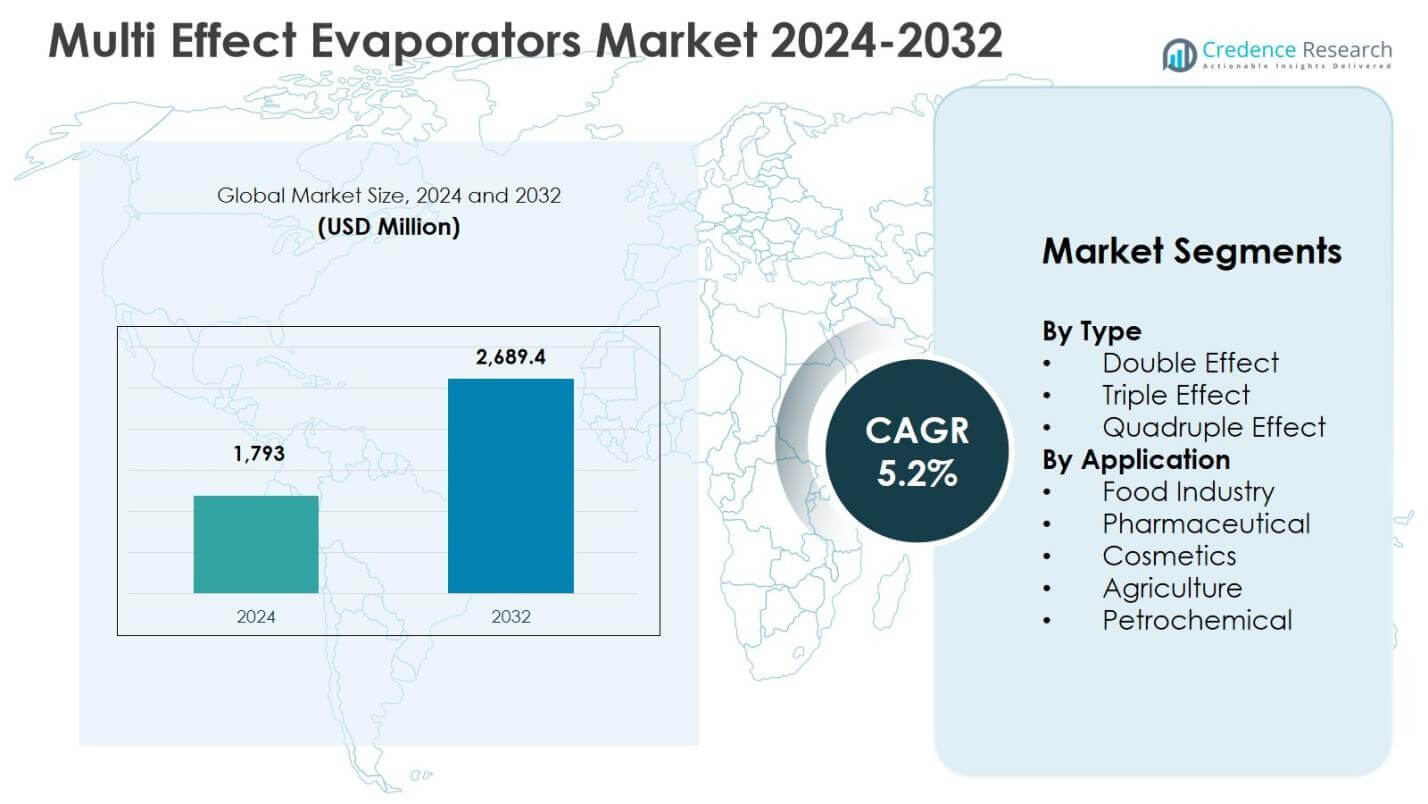
The Multi Effect Evaporators Market size was valued at USD 1,793 million in 2024 and is anticipated to reach USD 2,689.4 million by 2032, at a CAGR of 5.2% during the forecast period.
| REPORT ATTRIBUTE |
DETAILS |
| Historical Period |
2020-2023 |
| Base Year |
2024 |
| Forecast Period |
2025-2032 |
| Multi Effect Evaporators Market Size 2024 |
USD 1,793 million |
| Multi Effect Evaporators Market, CAGR |
5.2% |
| Multi Effect Evaporators Market Size 2032 |
USD 2,689.4 million |
Multi Effect Evaporators Market Insights
- Market growth is driven by rising demand for energy-efficient thermal processing across food, pharmaceutical, and chemical industries, where multi effect systems reduce steam consumption and operating costs while supporting large-scale concentration and solvent recovery operations.
- Market trends indicate strong adoption of triple effect evaporators, which held 42.6% segment share in 2024 due to balanced efficiency and cost, alongside increasing integration of multi effect evaporators with zero-liquid-discharge and water reuse systems.
- Market dynamics face restraints from high initial capital investment and operational complexity, particularly for small and mid-scale facilities, which limits adoption despite long-term efficiency benefits.
- Regionally, Asia-Pacific led with 34.1% share in 2024, followed by North America at 27.8% and Europe at 24.6%, while the food industry remained the leading application segment with a 38.9% share.
Multi Effect Evaporators Market Segmentation Analysis:
By Type:
The Multi Effect Evaporators Market by type is led by Triple Effect evaporators, which accounted for 42.6% market share in 2024, driven by their optimal balance between capital cost, thermal efficiency, and operational simplicity. Triple effect systems are widely adopted across food processing, pharmaceuticals, and chemical industries due to their ability to significantly reduce steam consumption while maintaining high evaporation rates. Double effect evaporators held 31.4% share, supported by demand from small- and mid-scale plants, while quadruple effect systems captured 26.0% share, supported by large-scale industrial facilities prioritizing energy efficiency and long-term operating cost reduction.
- For instance, Goldfinch Evaporators installed a triple effect system for dairy concentration, where steam from one stage heats the next to maximize efficiency. This design supports processing heat-sensitive liquids like milk products while minimizing energy use.
By Application:
By application, the Food Industry dominated the Multi Effect Evaporators Market with a 38.9% share in 2024, driven by strong demand for concentration of dairy products, fruit juices, sugar syrups, and processed foods under strict energy and hygiene standards. Pharmaceutical applications accounted for 24.7% share, supported by rising demand for solvent recovery and heat-sensitive product concentration. Petrochemical applications represented 17.6% share, driven by wastewater treatment and solvent recycling, while agriculture held 10.1% share and cosmetics accounted for 8.7% share, supported by niche formulation and extract concentration requirements.
- For instance, Forbes Marshall supplies multi-effect evaporators (MEE) to dairy processors that increase milk solid concentration from 4-6% to 44% through evaporation, enhancing energy efficiency in production.
Access crucial information at unmatched prices!
Request your sample report today & start making informed decisions powered by Credence Research Inc.!
Download Sample
Key Growth Drivers
Rising Demand for Energy-Efficient Thermal Processing
The Multi Effect Evaporators Market is driven by rising demand for energy-efficient thermal processing solutions across food, pharmaceutical, and chemical industries. Multi effect evaporators reuse latent heat across multiple stages, significantly reducing steam and energy consumption compared to single-effect systems. This efficiency enables manufacturers to lower operating costs while maintaining high evaporation performance. Increasing industrial energy prices and sustainability targets further accelerate adoption, particularly in energy-intensive applications such as dairy concentration, solvent recovery, and wastewater treatment, making energy efficiency a critical purchasing criterion.
- For instance, Wenzhou Qiangzhong Machinery Technology Co., Ltd. supplies multi-effect evaporators designed for pharmaceutical processes, maximizing energy savings via multi-stage latent heat recovery.
Expansion of Food and Pharmaceutical Processing Industries
Growth in food and pharmaceutical processing activities continues to support market expansion. Rising consumption of processed foods, dairy products, fruit concentrates, and nutraceuticals has increased demand for efficient evaporation systems that preserve product quality. In pharmaceutical manufacturing, multi effect evaporators enable precise solvent recovery and processing of heat-sensitive formulations under controlled conditions. Ongoing investments in processing facilities across Asia-Pacific, Latin America, and the Middle East further boost demand, as manufacturers prioritize scalable, hygienic, and compliant evaporation technologies.
- For instance, GEA’s multi-effect evaporators concentrate tomato juice below 70°C to 30–32° Brix, preserving flavor and color while efficiently removing water.
Stricter Environmental and Water-Discharge Regulations
Increasingly stringent environmental regulations related to wastewater discharge and effluent management are a major growth driver for the Multi Effect Evaporators Market. Industries are under pressure to reduce liquid waste generation, recover reusable water, and lower environmental impact. Multi effect evaporators support these objectives by enabling concentration of effluents and integration with water recycling and zero-liquid-discharge systems. Regulatory enforcement in chemicals, petrochemicals, and agro-processing industries is accelerating adoption as compliance becomes mandatory.
Key Trends & Opportunities
Integration with Zero-Liquid-Discharge and Water Reuse Systems
A prominent trend in the Multi Effect Evaporators Market is the increasing integration of evaporators with zero-liquid-discharge and advanced water reuse systems. Industrial facilities are deploying multi effect evaporators as central components in closed-loop water management strategies to reduce freshwater consumption and eliminate wastewater discharge. This trend creates significant opportunities for equipment manufacturers to offer customized, high-capacity evaporator solutions integrated with crystallizers and condensate recovery systems, particularly in water-stressed regions and regulated industrial clusters.
- For instance, Myande Group supplies MVR and multiple-effect evaporation systems for ZLD in high-salt wastewater applications like chemical and pesticide industries. These integrate evaporation with crystallization to optimize energy use and enable water recovery.
Technological Advancements and Automation in Evaporation Systems
Technological advancements in automation, process control, and materials are creating new growth opportunities in the market. Modern multi effect evaporators incorporate advanced sensors, automated controls, and digital monitoring systems to optimize performance and minimize downtime. Improved heat exchanger designs and corrosion-resistant materials enhance efficiency and extend equipment lifespan. These innovations increase adoption among pharmaceutical and specialty chemical manufacturers that require precise process control, creating opportunities for premium, high-value evaporator solutions.
- For instance, Ion Exchange’s INDION Multi-Effect Evaporator incorporates intelligent automation and advanced control systems for real-time monitoring in zero-liquid discharge applications.
Key Challenges
High Initial Capital Investment Requirements
High initial capital costs remain a key challenge for the Multi Effect Evaporators Market, particularly for small and mid-scale manufacturers. Multi effect systems require higher upfront investment due to complex design, multiple effects, and integration with auxiliary equipment. Budget constraints often lead smaller facilities to opt for single-effect or alternative technologies despite higher operating costs. This cost barrier can slow adoption in price-sensitive markets and emerging economies where capital expenditure decisions are closely scrutinized.
Operational Complexity and Maintenance Requirements
Operational complexity and maintenance demands pose another significant challenge for multi effect evaporator adoption. These systems require skilled operators to manage temperature, pressure, and flow balance across multiple effects to maintain optimal performance. Improper operation can reduce efficiency and increase maintenance costs. Additionally, fouling and scaling issues in certain applications increase downtime and servicing requirements. Addressing these challenges requires continuous operator training and investment in advanced monitoring solutions, adding to total lifecycle costs.
Regional Analysis
North America
North America accounted for 27.8% of the Multi Effect Evaporators Market share in 2024, driven by strong demand from the food processing, pharmaceutical, and chemical industries. The region benefits from advanced manufacturing infrastructure, high adoption of energy-efficient technologies, and strict environmental regulations governing wastewater discharge. The United States dominates regional demand due to extensive use of multi effect evaporators in dairy processing, beverage concentration, and solvent recovery. Ongoing investments in zero-liquid-discharge systems and modernization of industrial plants further support market growth across North America.
Europe
Europe captured 24.6% market share in 2024, supported by stringent environmental policies, strong sustainability mandates, and widespread adoption of energy-efficient industrial equipment. Countries such as Germany, France, Italy, and the Netherlands drive demand through food, pharmaceutical, and specialty chemical processing. The region shows high penetration of advanced multi effect evaporators integrated with water reuse and effluent treatment systems. Increasing focus on reducing carbon emissions and industrial water consumption continues to strengthen adoption, particularly in regulated industries seeking compliance with European environmental standards.
Asia-Pacific
Asia-Pacific dominated the Multi Effect Evaporators Market with a 34.1% share in 2024, driven by rapid industrialization, expanding food and beverage processing, and growing pharmaceutical manufacturing. China and India lead regional demand due to large-scale dairy, sugar, chemical, and agro-processing industries. Rising investments in industrial wastewater treatment and zero-liquid-discharge facilities further boost adoption. Cost-efficient manufacturing, availability of skilled labor, and government initiatives supporting sustainable industrial practices position Asia-Pacific as the fastest-growing regional market during the forecast period.
Latin America
Latin America held 7.6% market share in 2024, supported by growing food processing, sugar, ethanol, and agro-industrial sectors. Brazil and Mexico are key contributors, driven by rising demand for concentration processes and wastewater treatment solutions. Increasing regulatory focus on effluent management and water reuse is encouraging industries to adopt multi effect evaporators. Although capital investment constraints limit adoption among smaller facilities, gradual modernization of industrial infrastructure and expanding pharmaceutical production continue to support steady market growth across the region.
Middle East & Africa
The Middle East & Africa accounted for 5.9% of the global market share in 2024, driven by rising investments in water management, petrochemical processing, and food manufacturing. Water scarcity and strict industrial discharge regulations are key factors accelerating adoption of multi effect evaporators in the region. Gulf countries lead demand due to large-scale petrochemical and desalination-related applications, while South Africa supports growth through food and beverage processing. Increasing focus on water recovery and sustainability strengthens long-term regional market potential.
Multi Effect Evaporators Market Segmentations:
By Type
- Double Effect
- Triple Effect
- Quadruple Effect
By Application
- Food Industry
- Pharmaceutical
- Cosmetics
- Agriculture
- Petrochemical
By Geography
- North America
- Europe
- Germany
- France
- U.K.
- Italy
- Spain
- Rest of Europe
- Asia Pacific
- China
- Japan
- India
- South Korea
- South-east Asia
- Rest of Asia Pacific
- Latin America
- Brazil
- Argentina
- Rest of Latin America
- Middle East & Africa
- GCC Countries
- South Africa
- Rest of the Middle East and Africa
Competitive Landscape
Competitive landscape analysis of the Multi Effect Evaporators Market highlights the presence of established global and regional players including GEA Group, ANDRITZ Group, Swenson Technology, Inc., Condorchem Envitech, Rosenblad Design Group, REDA SpA, France Evaporation, SVAAR Process Solutions Pvt. Ltd., TECHNOFORCE, and Concept Process Equipment. The market remains moderately consolidated, with leading companies focusing on customized system design, energy efficiency, and integration with zero-liquid-discharge solutions to strengthen their competitive position. Players emphasize technological innovation, automation, and use of advanced heat-transfer materials to enhance performance and reduce operating costs. Strategic partnerships, regional expansion, and turnkey project capabilities are key competitive strategies, particularly in Asia-Pacific and the Middle East. Mid-sized manufacturers compete by offering cost-effective and application-specific solutions for food, pharmaceutical, and chemical industries. Continuous investment in R&D, after-sales services, and regulatory-compliant solutions remains critical for sustaining long-term competitiveness.
Shape Your Report to Specific Countries or Regions & Enjoy 30% Off!
Key Player Analysis
- Condorchem Envitech
- ANDRITZ GROUP
- Rosenblad Design Group
- TECHNOFORCE
- Swenson Technology, Inc
- Concept Process Equipment
- GEA Group
- REDA SpA
- SVAAR Process Solutions Pvt. Ltd
- France Evaporation
Recent Developments
- In October 2025, ENCO Machinery signed a strategic cooperation agreement with a major Uzbekistan formalin manufacturer to design and supply a 30 t/h triple-effect OSLO evaporation and crystallization system leveraging multi-effect evaporation technology to improve energy efficiency and wastewater reuse capabilities.
- In 2025, Flash Rockwell Technologies introduced the ZeroPoint Evaporator, a portable, skid-mounted, zero-liquid discharge system that treats up to 30,000 gallons of produced water per day using low-pressure flash evaporation powered by waste flare gas.
Report Coverage
The research report offers an in-depth analysis based on Type, Application and Geography. It details leading market players, providing an overview of their business, product offerings, investments, revenue streams, and key applications. Additionally, the report includes insights into the competitive environment, SWOT analysis, current market trends, as well as the primary drivers and constraints. Furthermore, it discusses various factors that have driven market expansion in recent years. The report also explores market dynamics, regulatory scenarios, and technological advancements that are shaping the industry. It assesses the impact of external factors and global economic changes on market growth. Lastly, it provides strategic recommendations for new entrants and established companies to navigate the complexities of the market.
Future Outlook
- Adoption of multi effect evaporators will increase as industries prioritize energy efficiency and reduced steam consumption.
- Food and beverage processing will remain a primary demand driver due to rising consumption of concentrated products.
- Pharmaceutical and specialty chemical applications will expand with growing emphasis on solvent recovery and product purity.
- Integration with zero-liquid-discharge and water reuse systems will accelerate across regulated industries.
- Technological advancements in automation and digital monitoring will improve operational efficiency and reliability.
- Demand from emerging economies will rise with expansion of industrial processing infrastructure.
- Custom-designed evaporator systems will gain preference to meet application-specific process requirements.
- Use of corrosion-resistant materials will increase to support harsh chemical and wastewater environments.
- Strategic collaborations and turnkey project offerings will strengthen competitive positioning among suppliers.
- Focus on sustainable manufacturing practices will continue to shape long-term market development.



