
Market Overview:
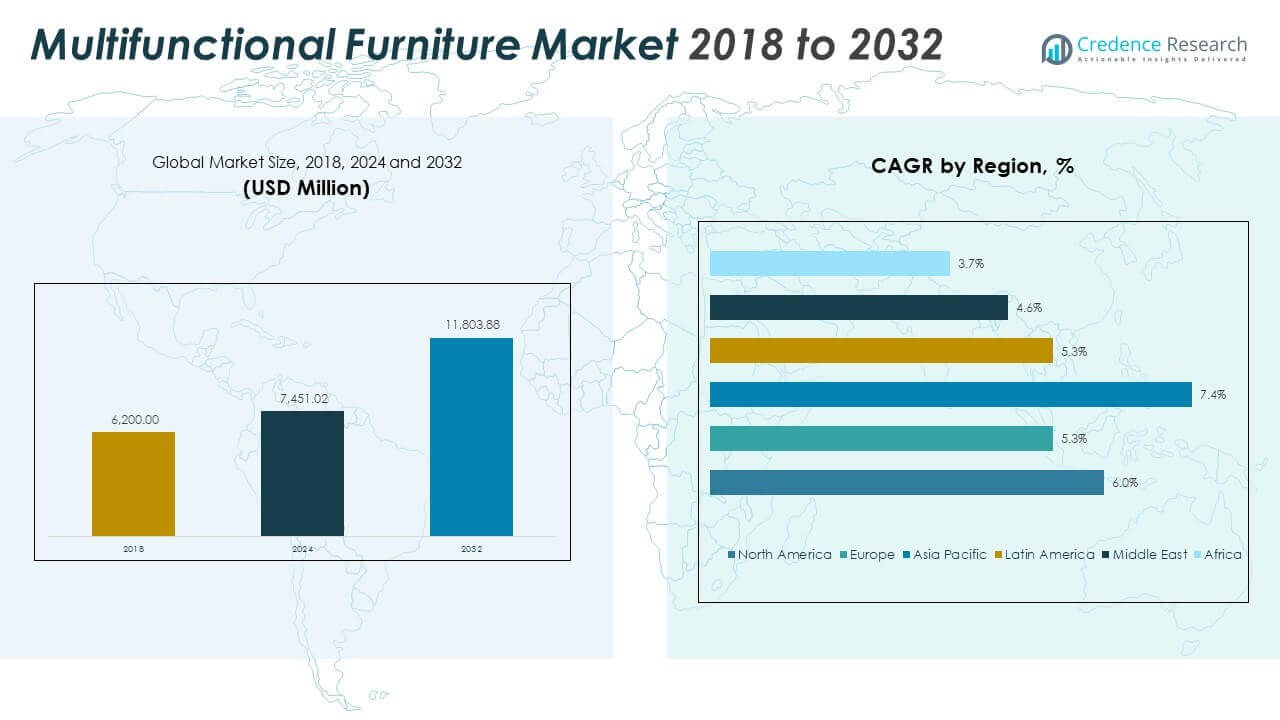
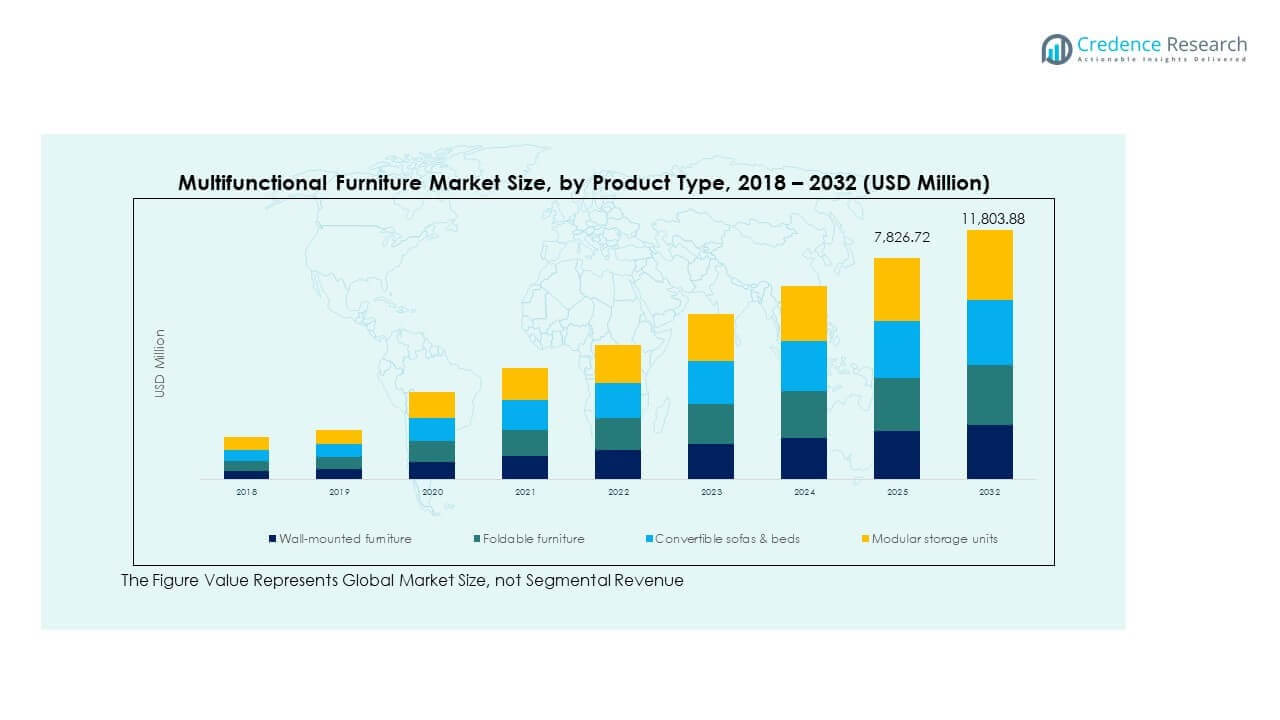
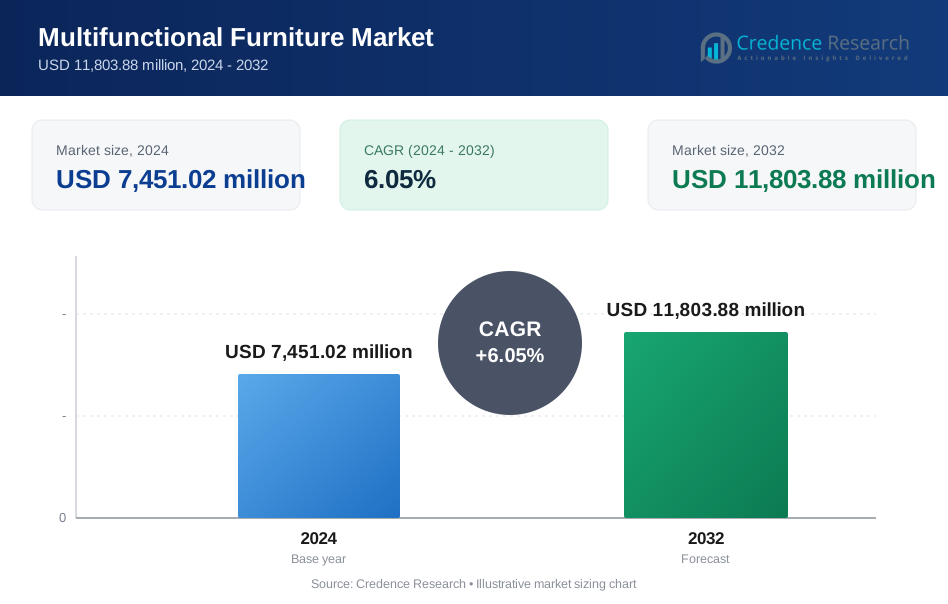
The Multifunctional Furniture Market size was valued at USD 6,200.00 million in 2018 to USD 7,451.02 million in 2024 and is anticipated to reach USD 11,803.88 million by 2032, at a CAGR of 6.05% during the forecast period.
| REPORT ATTRIBUTE | DETAILS |
|---|---|
| Historical Period | 2020-2023 |
| Base Year | 2024 |
| Forecast Period | 2025-2032 |
| Multifunctional Furniture Market Size 2024 | USD 7,451.02 Million |
| Multifunctional Furniture Market, CAGR | 6.05% |
| Multifunctional Furniture Market Size 2032 | USD 11,803.88 Million |
The market is gaining traction due to rising urbanization, shrinking living spaces, and growing consumer preference for space-saving, functional interiors. Increasing demand for furniture that offers dual or multi-use applications, such as sofa beds, foldable tables, or modular storage units, supports sustained market growth. Consumers value convenience, portability, and aesthetic appeal in compact formats. The rise of remote working and compact housing further boosts demand across urban populations. Smart furniture integration and customizable designs are accelerating adoption in both residential and commercial settings.
North America currently leads the market, driven by high urban density, disposable income, and product innovation. Europe follows with strong demand from design-conscious consumers in compact living environments. Asia Pacific is the fastest-growing region, supported by urban population growth, rising income levels, and growing awareness of multifunctional living solutions. Latin America, the Middle East, and Africa are emerging steadily due to infrastructure development and gradual lifestyle shifts. Each region contributes uniquely based on consumer behavior, housing trends, and retail access.
Market Insights:
- The Multifunctional Furniture Market was valued at USD 6,200.00 million in 2018, reached USD 7,451.02 million in 2024, and is projected to hit USD 11,803.88 million by 2032, expanding at a CAGR of 6.05%.
- North America held the largest share in 2024 at approximately 37%, driven by urban density, smart home trends, and strong retail infrastructure. Europe followed with 24.4%, influenced by compact living and sustainable design preferences. Asia Pacific accounted for 24.3%, reflecting strong urbanization and housing demands.
- Asia Pacific is the fastest-growing region with a CAGR of 7.4%, supported by rising middle-class populations, real estate development, and increasing awareness of space-saving solutions.
- Among product types, convertible sofas and beds dominated in 2024, widely adopted in residential apartments for space efficiency and versatility.
- Modular storage units are gaining market share, especially in commercial and co-living spaces, offering flexibility and integration with various interior styles.
Market Drivers
Urbanization and Space Constraints Are Fueling Demand for Compact, Transformable Furniture
The growing urban population is driving demand for living solutions that maximize limited space. Consumers in high-density cities face smaller apartments, making multifunctional designs more appealing. Furniture that combines storage, seating, or sleeping functions helps users optimize limited square footage. In such spaces, traditional bulky items are being replaced by compact, smart furniture solutions. The Multifunctional Furniture Market benefits from these shifting space needs. Foldable beds, expandable dining sets, and modular couches are now standard in urban households. Young professionals and students are key consumers of space-saving products. Real estate developers also integrate such furniture into micro-apartments to attract modern buyers. The market continues to grow as urban living becomes the norm in both developed and emerging regions.
- For instance, IKEA's PLATSA system uses stackable frames in 60 cm widths and 40 cm depths, up to 180 cm high, that click together without tools for customizable storage in tight spaces like under stairs or around windows.
Rising Popularity Among Millennials and Gen Z Boosts Preference for Modular, Flexible Furniture Designs
Changing consumer behavior, especially among younger demographics, is driving innovation in modular and adjustable furniture. Millennials and Gen Z prefer flexibility in home décor, choosing items that serve more than one function. The need to personalize limited space fuels the adoption of stackable chairs, expandable desks, and convertible beds. These consumers value functionality, aesthetics, and affordability in equal measure. The Multifunctional Furniture Market benefits from these evolving needs with trendy, easy-to-assemble products. DIY culture and interest in customization further promote growth. Social media platforms also drive visibility of innovative home setups using multifunctional items. The market aligns with the lifestyle of digital nomads, renters, and remote workers. Brands that meet these expectations are expanding their share.
- For instance, Resource Furniture’s Penelope Desk system features a full-size wall bed integrated with a pivoting desk that stays level when the bed opens, allowing up to 17-inch-high items to remain on the surface. The unit fits in a space under 80 inches tall and supports standard work and sleep use.
Growing Demand from Commercial Sectors Drives Product Integration into Offices, Hospitality, and Retail Spaces
Commercial buyers increasingly adopt multifunctional furniture to improve efficiency and aesthetics. In offices, workspaces need to convert quickly between collaborative zones, private pods, and event spaces. Modular desks, foldable tables, and mobile partitions meet this demand. Hotels and cafes use convertible seating and integrated storage units to enhance guest experience. The Multifunctional Furniture Market serves these sectors with purpose-built, space-saving solutions. Businesses reduce operational costs by using adaptable setups instead of multiple furnishings. Retailers also prefer modular display units that can shift layouts for promotions or seasonal changes. These trends support consistent demand across commercial applications. The market expands as businesses prioritize flexibility and space optimization.
Rising Construction of Small Residential Units and Studio Apartments Bolsters Sales Across Urban Housing Projects
Real estate trends favor compact housing, increasing the demand for furniture that can perform multiple roles. Studio apartments and 1BHK flats dominate new urban construction projects. Buyers of such units seek space-efficient designs that don’t compromise comfort. Furniture with hidden storage, wall-mounted folding tables, or sofa-cum-beds meets this demand. The Multifunctional Furniture Market responds with products that align with compact living. Builders and interior designers also recommend such products to buyers during planning stages. Affordable housing schemes in Asia and Latin America include compact living designs. These conditions foster the continued growth of multifunctional setups. Brands that offer practical yet stylish options are well-positioned for future expansion.
Market Trends
Integration of Smart Furniture Elements Including USB Ports, Wireless Charging, and Automation
Technology integration is reshaping the design and appeal of multifunctional furniture. Consumers prefer units that offer charging ports, speakers, or smart lighting alongside standard uses. These features make furniture more valuable in both residential and commercial settings. For instance, bedside tables now come with wireless charging and mood lighting. The Multifunctional Furniture Market aligns with the smart home trend, offering tech-infused designs. Young tech-savvy buyers view such furniture as a lifestyle upgrade. Offices also seek desks with cable management and power hubs. The line between furniture and smart devices is blurring. Manufacturers continue to embed automation features to gain a competitive edge.
- For instance, Steelcase's Brody WorkLounge offers integrated power modules with standard outlets and USB-A charging, designed to support focused work in education and office environments. Its enclosed, ergonomic design enhances privacy and comfort in compact spaces.
Use of Sustainable and Recyclable Materials Is Growing in Furniture Design and Manufacturing
Environmental concerns shape how furniture is designed, sourced, and sold. Consumers now ask for sustainable, non-toxic, and recyclable materials in their furnishings. Bamboo, engineered wood, recycled metal, and eco-friendly upholstery gain traction. The Multifunctional Furniture Market is embracing this trend with low-waste, long-life designs. Brands label products with sustainability certifications to build trust. Green building codes in some countries also push the use of eco-furniture. Companies respond by offering flat-pack furniture that reduces shipping emissions. Reusability and modularity align with sustainability goals. Environmental values are influencing buying decisions in both B2C and B2B segments.
- For instance, Ashley Furniture’s Yandel Power Lift Recliner features dual-motor adjustability and high-resilience foam cushions, designed for comfort and assisted mobility. It remains one of Ashley’s most popular models for aging-in-place solutions.
Influence of Online-Only Furniture Brands and E-Commerce-Driven Customization Tools
Digital platforms are redefining how consumers browse, visualize, and buy furniture. Online-first brands offer 3D room planners and AR previews to help users assess fit and function. This digital experience boosts the appeal of multifunctional options, which users can virtually test. The Multifunctional Furniture Market sees strong traction in e-commerce channels. Customization and modular add-ons are offered through online configurators. Consumers trust brands that offer clear specs, fast delivery, and video assembly guides. Social media ads and influencer reviews amplify reach. These platforms help niche brands gain loyal customer bases. The online furniture market continues to scale with digital-first innovations.
Rise of Minimalist and Japandi Interior Design Trends in Global Urban Markets
Interior design trends influence how furniture is selected and styled. Minimalist and Japandi styles favor clean lines, multi-use features, and clutter-free spaces. Consumers who follow these aesthetics prefer foldaway or hidden furniture elements. The Multifunctional Furniture Market fits naturally with this decor preference. Products like nesting tables, wall beds, or compact kitchen carts are popular in minimalist homes. These trends are growing in Europe, Japan, and Southeast Asia. The blending of Scandinavian functionality and Japanese simplicity drives strong visual appeal. Brands that offer neutral tones and sleek forms cater to this emerging demand. Interior design shows and influencers help accelerate adoption.
Market Challenges Analysis
High Product Cost Due to Advanced Materials, Mechanisms, and Customization Features Limits Mass Adoption
Many multifunctional furniture units include engineered mechanisms, integrated technology, or modular fittings. These add to the overall cost compared to standard single-function furniture. Consumers with limited budgets may view such products as expensive. In price-sensitive regions, cost becomes a major hurdle to volume sales. The Multifunctional Furniture Market faces barriers in penetrating lower-income demographics. Manufacturing complexity and use of premium materials increase pricing. Customization also drives higher production costs, which are passed to consumers. Entry-level brands often compromise quality to meet affordability, impacting consumer trust. Brands need cost-efficient innovation to widen accessibility.
Limited Awareness in Rural and Semi-Urban Areas Hampers Growth Outside Tier 1 Cities
While multifunctional furniture is popular in major metros, awareness remains low in smaller towns. Traditional furniture retailers often do not stock or promote such options. Customers in semi-urban and rural regions continue to prioritize price over space optimization. The Multifunctional Furniture Market must expand beyond urban bubbles to tap new buyers. Logistics and after-sales service in remote regions add operational challenges. Lack of digital literacy also limits access to online-only furniture brands. Building awareness and showroom presence in Tier 2 and Tier 3 cities is essential. Regional campaigns and partnerships with local retailers can address this gap.
Market Opportunities
Rising Demand for Premium Co-Living and Co-Working Spaces Across Urban Centers Creates Growth Avenues
Shared living and working spaces rely heavily on furniture that serves multiple roles throughout the day. Co-living apartments prefer furniture that can support both social and private functions. Co-working hubs use modular desks, foldable seating, and mobile partitions. The Multifunctional Furniture Market can tap into this growing real estate segment. Developers of shared spaces actively seek vendors offering flexible and durable furniture. Demand is high for designs that improve space utility without sacrificing comfort. Global urban centers are investing in shared infrastructure, fueling adoption.
Expansion into Emerging Markets in Asia-Pacific and Latin America via Affordable Smart Designs
Emerging economies offer high growth potential due to urban population rise and changing lifestyles. Brands that offer affordable, tech-friendly furniture can gain a strong foothold. The Multifunctional Furniture Market can scale operations in India, Vietnam, Brazil, and Mexico. Growing e-commerce access and middle-class spending power support expansion. Localized production and region-specific designs help reduce costs and meet local needs.
Market Segmentation Analysis:
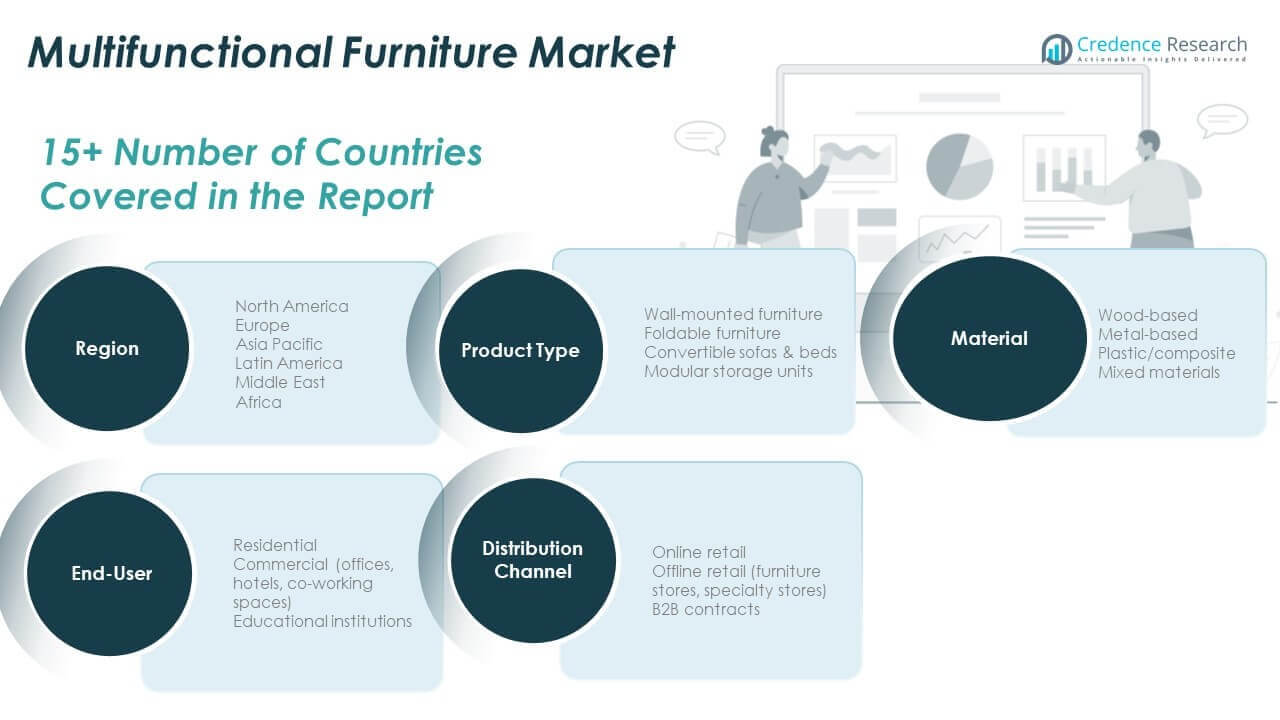
The Multifunctional Furniture Market is segmented by product type, material, end-user, and distribution channel.
By product types, convertible sofas & beds hold a significant share due to their utility in small living spaces. Foldable furniture gains traction in urban apartments and temporary setups. Wall-mounted furniture appeals to minimalist designs, while modular storage units attract demand from both residential and office environments.
- For instance, IKEA's FRIHETEN sofa bed converts into a 144 cm by 199 cm sleeping surface, comfortably fitting two adults. Its hidden storage under the chaise adds further functionality in compact spaces.
By material, wood-based furniture leads in revenue share owing to its durability and aesthetic appeal. Metal-based options offer strength and a modern look, particularly in commercial and industrial settings. Plastic/composite materials remain preferred for cost-sensitive applications. Mixed materials grow steadily as brands blend functionality with design versatility.
By end-user, residential buyers dominate due to rising urbanization and compact living. The commercial segment follows, driven by demand from co-working spaces, hotels, and offices. Educational institutions adopt multifunctional units for flexible classroom and dormitory usage.
By distribution channels, online retail sees rapid growth due to ease of access and custom ordering. Offline retail remains strong in traditional markets and offers physical product inspection. B2B contracts contribute significantly through partnerships with real estate developers and institutional buyers. Each segment aligns with distinct needs, expanding the market's addressable base.
- For instance, online channels are steadily increasing their share in wood furniture sales, with B2B platforms now accounting for an estimated 20% of transactions. Offline retail remains dominant in many regions, favored for physical inspection and showroom service.
Segmentation:
By Product Type
- Wall-mounted furniture
- Foldable furniture
- Convertible sofas & beds
- Modular storage units
By Material
- Wood-based
- Metal-based
- Plastic/Composite
- Mixed materials
By End-User
- Residential
- Commercial (offices, hotels, co-working spaces)
- Educational institutions
By Distribution Channel
- Online retail
- Offline retail (furniture stores, specialty stores)
- B2B contracts
By Region
- North America
- U.S.
- Canada
- Mexico
- Europe
- Germany
- France
- U.K.
- Italy
- Spain
- Rest of Europe
- Asia Pacific
- China
- Japan
- India
- South Korea
- South-east Asia
- Rest of Asia Pacific
- Latin America
- Brazil
- Argentina
- Rest of Latin America
- Middle East & Africa
- GCC Countries
- South Africa
- Rest of the Middle East and Africa
Regional Analysis:
North America
The North America Multifunctional Furniture Market size was valued at USD 2,349.80 million in 2018 to USD 2,791.11 million in 2024 and is anticipated to reach USD 4,415.85 million by 2032, at a CAGR of 6.0% during the forecast period. North America accounts for the largest market share, contributing approximately 37% of the global revenue in 2024. High urbanization and smaller living spaces in cities like New York, Toronto, and Los Angeles drive demand. Consumers prioritize space-saving, premium-quality, and tech-integrated furniture. Residential applications dominate, followed by growing demand from co-working and hospitality sectors. Key players like IKEA and Ashley Global Retail focus on modular and convertible solutions. Online retail continues to scale due to tech-savvy buyers and robust e-commerce infrastructure. B2B partnerships with real estate developers fuel segment growth. Product innovation and sustainability are key competitive differentiators in the region.
Europe
The Europe Multifunctional Furniture Market size was valued at USD 1,574.80 million in 2018 to USD 1,816.36 million in 2024 and is anticipated to reach USD 2,711.97 million by 2032, at a CAGR of 5.3% during the forecast period. Europe holds around 24.4% of the global market share in 2024. Demand is driven by space-efficient living in urban centers such as London, Paris, and Berlin. Consumers favor minimalist designs and sustainable materials. Foldable and modular furniture is widely adopted in both residential and commercial spaces. Brands like Hülsta, Ligne Roset, and BoConcept lead with design-forward offerings. Regulatory support for eco-friendly materials also boosts wood and mixed-material segments. Offline retail remains strong, supported by showroom experiences. E-commerce is rising but slower compared to North America.
Asia Pacific
The Asia Pacific Multifunctional Furniture Market size was valued at USD 1,438.40 million in 2018 to USD 1,809.45 million in 2024 and is anticipated to reach USD 3,178.80 million by 2032, at a CAGR of 7.4% during the forecast period. Asia Pacific contributes roughly 24.3% of the global market share in 2024, closely trailing Europe. Rising urbanization and apartment living in China, India, Japan, and South Korea fuel demand. Rapid e-commerce expansion makes online retail a preferred channel. The residential segment dominates, supported by compact housing trends. Growing middle-class income drives spending on affordable multifunctional options. Local and global brands compete on design, pricing, and distribution. Governments promoting housing and smart cities indirectly support market growth. B2B contracts grow in co-living and hospitality sectors.
Latin America
The Latin America Multifunctional Furniture Market size was valued at USD 483.60 million in 2018 to USD 576.63 million in 2024 and is anticipated to reach USD 860.15 million by 2032, at a CAGR of 5.3% during the forecast period. Latin America holds a 7.7% share of the global market in 2024. Brazil and Mexico lead demand with rising urban middle-class consumers. Residential buyers seek foldable and storage-integrated furniture to maximize limited space. The market is price-sensitive, favoring compact and budget-friendly offerings. Commercial demand is rising from hospitality and office renovations. Offline retail dominates, but online growth is emerging in key cities. Import reliance remains high, affecting price and availability. Local players adapt designs to regional preferences and space usage patterns.
Middle East
The Middle East Multifunctional Furniture Market size was valued at USD 217.00 million in 2018 to USD 242.85 million in 2024 and is anticipated to reach USD 343.56 million by 2032, at a CAGR of 4.6% during the forecast period. The region contributes about 3.3% of the global market share in 2024. Urban expansion in UAE, Saudi Arabia, and Qatar creates demand for modern, flexible interiors. Residential applications dominate, driven by apartment living and real estate growth. Luxury and high-end multifunctional pieces are gaining ground among affluent buyers. Modular designs are used in commercial and hospitality projects. Retail infrastructure is improving, but online penetration remains low. Import-based supply chains affect pricing and lead times. Brands with customizable offerings see better traction in the premium segment.
Africa
The Africa Multifunctional Furniture Market size was valued at USD 136.40 million in 2018 to USD 214.62 million in 2024 and is anticipated to reach USD 293.55 million by 2032, at a CAGR of 3.7% during the forecast period. Africa represents approximately 2.9% of the global market share in 2024. Growth is slow but steady, driven by urban housing development in countries like South Africa, Egypt, and Nigeria. Consumers prioritize low-cost, durable multifunctional units. Residential sales dominate, while commercial demand is emerging in education and office sectors. Retail infrastructure challenges limit market access in rural areas. Most products are imported, creating pricing constraints for mass adoption. Local players are beginning to introduce affordable foldable and wall-mounted options. Government housing initiatives and urban policies offer future opportunities.
Key Player Analysis:
- IKEA
- Hülsta
- Clei
- Resource Furniture
- Ligne Roset
- Murphy Bed
- Expand Furniture
- Milano Smart Living
- Boconcept
- Haworth, Inc
- Ashley Global Retail, LLC
Competitive Analysis:
The Multifunctional Furniture Market features a mix of global brands and regional players competing on innovation, design, and pricing. Companies like IKEA, Resource Furniture, and Clei lead with modular, space-saving solutions that target urban consumers. Expand Furniture and Milano Smart Living focus on foldable and convertible products for compact living. Hülsta and BoConcept emphasize premium designs and sustainable materials. The market rewards brands that combine aesthetics with functionality and ease of assembly. E-commerce expansion allows smaller brands to reach niche audiences and grow share. Players invest in R&D to integrate smart features such as charging ports, automation, and app connectivity. Strategic collaborations with interior designers and real estate developers enhance product visibility. The Multifunctional Furniture Market remains highly competitive, with innovation cycles and customization options shaping buyer preferences. Pricing strategies, regional adaptability, and after-sales support continue to influence brand positioning across residential and commercial segments.
Recent Developments:
- In December 2025, Hülsta was acquired by Austrian investor Albert Hannak following its 2024 insolvency, with plans to relaunch the brand under private ownership while retaining its management team
- In November 2025, IKEA announced a partnership with Best Buy launching shop-in-shop experiences in select U.S. stores in Texas and Florida to offer immersive kitchen and laundry planning with multifunctional furniture solutions.
Report Coverage:
The research report offers an in-depth analysis based on product type, material, end-user, and distribution channel. It details leading market players, providing an overview of their business, product offerings, investments, revenue streams, and key applications. Additionally, the report includes insights into the competitive environment, SWOT analysis, current market trends, as well as the primary drivers and constraints. Furthermore, it discusses various factors that have driven market expansion in recent years. The report also explores market dynamics, regulatory scenarios, and technological advancements that are shaping the industry. It assesses the impact of external factors and global economic changes on market growth. Lastly, it provides strategic recommendations for new entrants and established companies to navigate the complexities of the market.
Future Outlook:
- Urban housing trends will continue to drive demand for compact, dual-purpose furniture across major cities.
- Product innovation will focus on integrating smart technology, storage features, and modular designs.
- Sustainability will shape material choices, favoring recyclable, eco-certified, and low-impact components.
- The residential segment will remain dominant, supported by rising demand for space-efficient solutions.
- Commercial buyers will expand their use of modular furniture in offices, co-working spaces, and hotels.
- Online retail will gain more market share due to convenience, virtual visualization tools, and custom ordering.
- Manufacturers will increase collaboration with real estate and interior design firms for targeted deployments.
- Asia Pacific will emerge as the fastest-growing region due to urban population growth and lifestyle shifts.
- B2B contracts will rise, especially in emerging markets investing in infrastructure and hospitality sectors.
- Competitive differentiation will depend on ease of assembly, pricing strategies, and localized design offerings.
Request a Free Sample
Fill in your details and we'll send you a free sample report.
- Sample data tables & charts
- Research methodology
Need a Custom Version of This Report?
Tailor the scope, geography, or segments to your exact requirements.
- Custom geography or segment scope
- Direct access to our analyst team
Frequently Asked Questions
What is the current market size for Multifunctional Furniture Market, and what is its projected size in 2032?
At what Compound Annual Growth Rate is the Multifunctional Furniture Market projected to grow between 2024 and 2032?
Which Multifunctional Furniture Market market segment held the largest share in 2024?
What are the primary factors fueling the growth of the Multifunctional Furniture Market?
Who are the leading companies in the Multifunctional Furniture Market?
Which region commanded the largest share of the Multifunctional Furniture Market in 2024?
Table of Content
Chapter 1. Report Introduction
- 1.1 Report Description & Purpose
- 1.1.1 Report Title & Market Definition
- 1.1.2 Unique Selling Propositions (USP) & Key Differentiators
- 1.1.3 Value Proposition for Stakeholders
- 1.2 Research Objectives
- 1.2.1 Market Sizing Objectives (Volume & Revenue)
- 1.2.2 Segmentation Objectives
- 1.2.3 Competitive Intelligence Objectives
- 1.2.4 Forecast & Scenario Objectives
- 1.3 Report Scope
- 1.3.1 Multifunctional Furniture Scope – Types & Subtypes Covered
- 1.3.2 Geographic Scope – Regions & Countries Covered
- 1.3.3 Historical Period, Base Year & Forecast Period (2024; forecast to 2032)
- 1.3.4 Inclusions & Exclusions
- 1.4 HS Code & Classification Framework
- 1.5 Currency, Units & Pricing Basis
- 1.6 Target Stakeholders
- 1.7 Limitations & Assumptions
Chapter 2. Executive Summary
- 2.1 Global Multifunctional Furniture Market Snapshot
- 2.1.1 Market Size – Historical (2024) & Forecast (2024-2032) (2024: USD 7,451.02 million → 2032: USD 11,803.88 million)
- 2.1.2 Volume & Revenue – Global Totals
- 2.1.3 Key Market Highlights – Top Five Facts
- 2.2 Multifunctional Furniture Market Segmentation Snapshot
- 2.2.1 Market Split by Region – 2024 vs. 2032
- 2.3 Competitive Snapshot
- 2.3.1 Top 10 Players by Revenue Share – 2024
- 2.3.2 Top 10 Players by Volume Share – 2024
- 2.3.3 Recent Strategic Developments (18-Month Summary)
- 2.4 Key Investment Highlights & Strategic Conclusions
Chapter 3. Multifunctional Furniture Market Dynamics & Industry Analysis
- 3.1 Market Overview & Context
- 3.1.1 Multifunctional Furniture Market Position in the Broader Automotive Value Chain
- 3.1.2 OEM vs. Replacement Market Dynamics
- 3.1.3 Market Maturity & Development Stage by Region
- 3.2 Multifunctional Furniture Market Drivers
- 3.3 Multifunctional Furniture Market Restraints & Challenges
- 3.4 Multifunctional Furniture Market Opportunities
- 3.5 Porter's Five Forces Analysis
- 3.5.1 Threat of New Entrants
- 3.5.2 Bargaining Power of Suppliers
- 3.5.3 Bargaining Power of Buyers
- 3.5.4 Threat of Substitutes
- 3.5.5 Competitive Rivalry – Intensity Assessment
- 3.6 Multifunctional Furniture Value Chain Analysis
- 3.6.1 Upstream – Raw Material/Input Suppliers
- 3.6.1.1 Raw Material/Input 1
- 3.6.1.2 Raw Material/Input 2
- 3.6.1.3 Raw Material/Input 3
- 3.6.2 Midstream – Production/Manufacturing/Service Delivery
- 3.6.2.1 Production/Process Overview
- 3.6.2.2 Key Facility Locations & Capacity by Manufacturer
- 3.6.3 Downstream – Distribution & End Consumer
- 3.6.3.1 Primary Channel – B2B/OEM
- 3.6.3.2 Secondary Channels – Dealer, Retail, Online, Direct
- 3.6.4 Value Chain Profitability Analysis
- 3.6.1 Upstream – Raw Material/Input Suppliers
- 3.7 PESTEL Analysis
- 3.7.1 Political Factors
- 3.7.2 Economic Factors
- 3.7.3 Social Factors
- 3.7.4 Technological Factors
- 3.7.5 Environmental Factors
- 3.7.6 Legal Factors
- 3.8 Multifunctional Furniture Supply Chain Analysis
- 3.8.1 Raw Material/Input Supply Risk Assessment
- 3.8.2 Manufacturing Concentration Risk (Geographic Exposure)
- 3.8.3 Trade Disruption Impact Analysis
- 3.9 Regulatory & Policy Landscape
Note: The regulatory and policy landscape section covers regulations based on their applicability to the market, Multifunctional Furniture category, geography, and scope of the study. Only regulatory frameworks with a material impact on operations, compliance, trade, sustainability, or market access are analyzed in detail.
Chapter 4. Key Investment Pockets & Opportunity Analysis
- 4.1 Multifunctional Furniture Market Attractiveness Analysis
- 4.1.1 By Region – Investment Attractiveness Matrix (Volume × CAGR)
- 4.2 Absolute Revenue Growth Opportunity
- 4.2.1 By Region – Absolute USD Growth Through 2032
- 4.3 Incremental Volume Opportunity
- 4.3.1 By Region – Incremental Volume Through 2032
- 4.3.2 Segment – Incremental Volume
- 4.4 Emerging Submarket Opportunity Deep Dive (Subject to Applicability)
- 4.5 Emerging Market Opportunity Scorecards
- 4.5.1 United States
- 4.5.2 Europe
- 4.5.3 Asia
- 4.5.4 Middle East & Africa
Note: Emerging Market Opportunity Scorecards will be included based on relevance and strategic importance. Regions listed are indicative and may vary depending on data availability and market dynamics.
Chapter 5. Multifunctional Furniture Import-Export Analysis & Trade Flows
- 5.1 Global Trade Overview
- 5.1.1 Global Export Value by Country (2024)
- 5.1.2 Global Export Volume by Country (2024)
- 5.1.3 Global Import Value by Country (2024)
- 5.1.4 Global Import Volume by Country (2024)
- 5.1.5 Net Trade Balance by Country (2024)
- 5.2 Export Analysis – Segment
- 5.2.1 Type 1 (HS Code)
- 5.2.2 Type 2 (HS Code)
- 5.2.3 Type 3 (HS Code)
- 5.2.4 Type 4 (HS Code)
- 5.2.5 Type 5 (HS Code)
- 5.3 Import Analysis – Segment
- 5.3.1 Type 1 (HS Code)
- 5.3.2 Type 2 (HS Code)
- 5.3.3 Type 3 (HS Code)
- 5.3.4 Type 4 (HS Code)
- 5.3.5 Type 5 (HS Code)
- 5.4 Average Unit Trade Prices
- 5.4.1 Average Export Price – Segment & Country
- 5.4.2 Average Import Price – Segment & Source Country
- 5.4.3 Price Trends (2024)
- 5.5 Key Trade Route Analysis
- 5.5.1 Trade Route 1
- 5.5.2 Trade Route 2
- 5.5.3 Trade Route 3
- 5.5.4 Trade Route 4
- 5.5.5 Trade Route 5
- 5.6 Trade Policy Impact Assessment
- 5.6.1 US Anti-Dumping & Section 301 Tariffs
- 5.6.2 EU Customs Union Impact
- 5.6.3 Major Free Trade Agreements
- 5.6.4 USMCA Rules of Origin
Note: Trade policy analysis will be included only where relevant to the Multifunctional Furniture market.
Chapter 6. Competitive Landscape & Company Benchmarking
- 6.1 Multifunctional Furniture Market Concentration & Structure
- 6.1.1 Herfindahl-Hirschman Index (HHI) – vs. 2024
- 6.1.2 Tier 1, Tier 2 & Tier 3 Market Structure
- 6.1.3 Global, Regional & Local Player Dynamics
- 6.2 Multifunctional Furniture Market Share Analysis – 2024
- 6.2.1 Global Revenue Share by Company
- 6.2.2 Global Volume Share by Company
- 6.2.3 Regional Revenue Share
- 6.2.4 Market Share Evolution ( vs. 2024)
- 6.2.5 OEM Segment Share by Company
- 6.2.6 Replacement Segment Share by Company
- 6.3 Production/Delivery Capacity & Facility Analysis
- 6.3.1 Global Installed Capacity
- 6.3.2 Capacity Utilization Rates
- 6.3.3 Production/Output Volume
- 6.3.4 Facility Locations & Capacity Map
- 6.3.5 Planned Capacity Additions
- 6.4 Multifunctional Furniture Competitive Benchmarking Matrix
- 6.4.1 Revenue, Volume, CAGR & Profitability Comparison
- 6.4.2 Channel Revenue Mix
- 6.4.3 Geographic Revenue Exposure
- 6.4.4 R&D Intensity
- 6.4.5 Sustainability Maturity
- 6.5 Strategic Developments in Multifunctional Furniture (Last 24 Months)
- 6.5.1 Mergers, Acquisitions & Divestments
- 6.5.2 New Multifunctional Furniture Launches
- 6.5.3 Facility Expansions
- 6.5.4 Strategic Alliances, Joint Ventures & Partnerships
- 6.5.5 Distribution Expansion & Market Entry
- 6.5.6 Sustainability & ESG Initiatives
- 6.6 Competitive Strategy Mapping
- 6.6.1 Leader, Challenger, Follower & Niche Classification
- 6.6.2 Pricing Strategy Comparison
- 6.6.3 Channel Strategy Matrix
Note: Strategic developments are included based on their materiality and the availability of reliable information.
Chapter 7. Global Multifunctional Furniture Market – By Distribution Channel
- 7.1 Segment Overview
- 7.1.1 Volume & Revenue Split by Channel (2024 & 2032)
- 7.1.2 Channel Mix Evolution (2024-2032)
Chapter 8. Regional Market Analysis – Global Overview
- 8.1 Global Regional Overview
- 8.1.1 Regional Volume Share
- 8.1.2 Regional Revenue Share
- 8.1.3 Regional Volume by Region
- 8.1.4 Regional Revenue by Region
- 8.1.5 Regional Forecast Through 2032
- 8.2 Cross-Regional Segment Analysis
- 8.2.1 By Distribution Channel
- 8.2.2 By Brand/Price Tier
Chapter 9. North America Multifunctional Furniture Market
- 9.1 United States
- 9.2 Canada
- 9.3 Mexico
Chapter 10. Europe Multifunctional Furniture Market
- 10.1 Germany
- 10.2 France
- 10.3 Italy
- 10.4 United Kingdom
- 10.5 Spain
- 10.6 Poland
- 10.7 Russia
- 10.8 Netherlands
- 10.9 Belgium
- 10.10 Sweden
- 10.11 Denmark
- 10.12 Norway
- 10.13 Rest of Europe
Chapter 11. Asia Pacific Multifunctional Furniture Market
- 11.1 China
- 11.2 India
- 11.3 Japan
- 11.4 South Korea
- 11.5 Thailand
- 11.6 Indonesia
- 11.7 Vietnam
- 11.8 Malaysia
- 11.9 Australia
- 11.10 Rest of Asia Pacific
Chapter 12. Latin America Multifunctional Furniture Market
- 12.1 Brazil
- 12.2 Argentina
- 12.3 Colombia
- 12.4 Chile
- 12.5 Rest of Latin America
Chapter 13. Middle East Multifunctional Furniture Market
- 13.1 Saudi Arabia
- 13.2 United Arab Emirates
- 13.3 Turkey
- 13.4 Israel
- 13.5 Iran
- 13.6 Rest of the Middle East
Chapter 14. Africa Multifunctional Furniture Market
- 14.1 South Africa
- 14.2 Egypt
- 14.3 Nigeria
- 14.4 Morocco
- 14.5 Rest of Africa
Chapter 15. Multifunctional Furniture Company Profiles
- 15.1 [Company 01]
- 15.1.1 Company Overview
- 15.1.2 Key Management Personnel
- 15.1.3 Products & Services Portfolio
- 15.1.4 Financial Performance
- 15.1.5 Key Market Focus & Geographic Presence
- 15.1.6 Recent Developments & Strategic Initiatives
Note: The company profile list is preliminary and may change based on research findings, market developments, data availability, and client requirements.
Chapter 16. Appendices
- Appendix A – List of Abbreviations & Acronyms
- Appendix B – Industry Classification Code Reference – Full Series
- Appendix C – Production & Capacity Data Tables
- Appendix D – End-Use & Demand Base Tables
- Appendix E – Consumption & Replacement Rate Assumptions
- Appendix F – ASP Reference Tables
- Appendix G – Manufacturing & Facility Database
- Appendix H – Import-Export Data Tables
- Appendix I – Regulatory Summary Tables
- Appendix J – Primary Research Participant List (Anonymized)
- Appendix K – Primary Research Questionnaire Framework
- Appendix L – Data Sources & Bibliography
- Appendix M – Market Size Divergence & Source Comparison
Chapter 17. Research Methodology
- 17.1 Research Framework & Philosophy
- 17.2 Secondary Research – Sources, Hierarchy & Data Extraction
- 17.3 Data Modeling – Bottom-Up & Top-Down Market Sizing
- 17.4 Primary Research – Stakeholder Framework, LOI & Sample Sizes
- 17.5 Forecast Methodology – Regression, Scenario & Sensitivity Analysis
- 17.6 Quality Control – Four-Layer Validation Framework
- 17.7 Limitations & Standard Assumptions
- 17.8 Disclaimer
