
Market Overview:
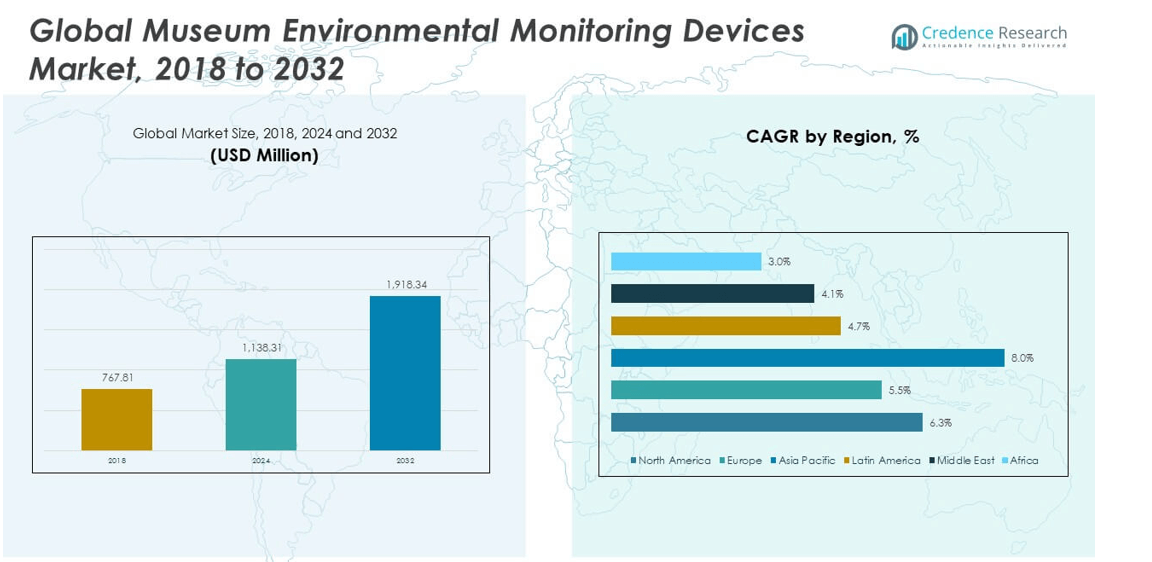
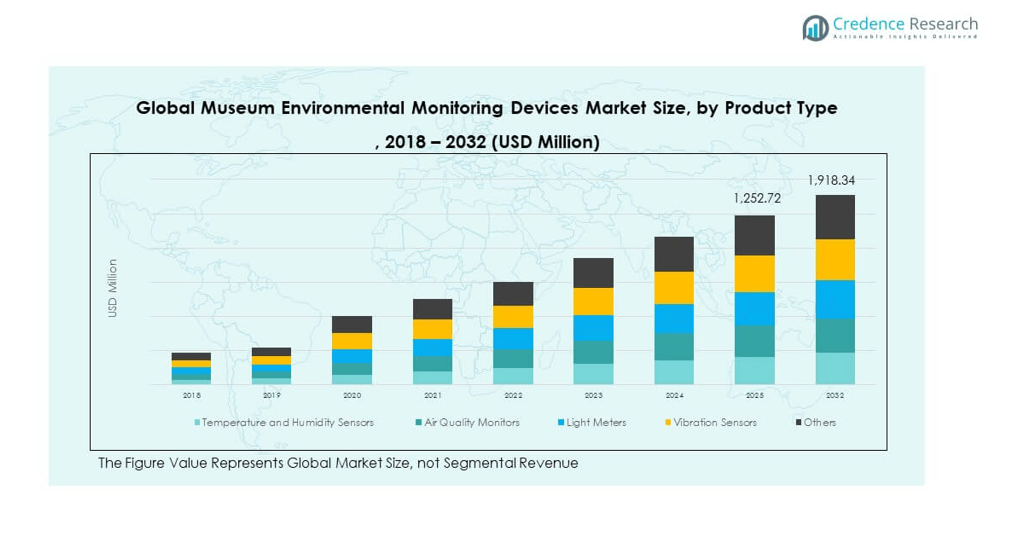
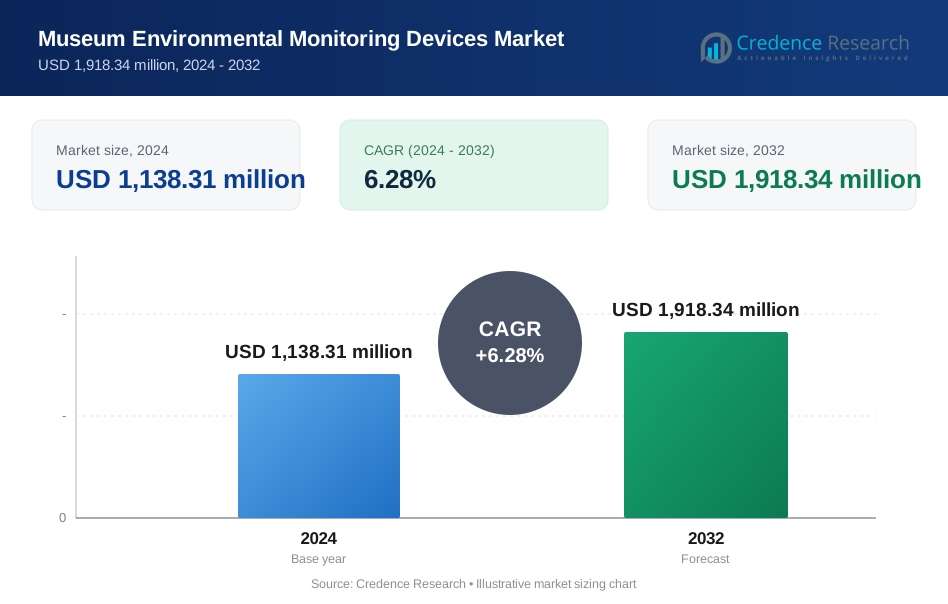
The Global Museum Environmental Monitoring Devices Market size was valued at USD 767.81 million in 2018, increased to USD 1,138.31 million in 2024, and is anticipated to reach USD 1,918.34 million by 2032, at a CAGR of 6.28% during the forecast period.
| REPORT ATTRIBUTE | DETAILS |
|---|---|
| Historical Period | 2020-2023 |
| Base Year | 2024 |
| Forecast Period | 2025-2032 |
| Museum Environmental Monitoring Devices Market Size 2024 | USD 1,138.31 million |
| Museum Environmental Monitoring Devices Market, CAGR | 6.28% |
| Museum Environmental Monitoring Devices Market Size 2032 | USD 1,918.34 million |
The Global Museum Environmental Monitoring Devices Market is driven by the growing need to preserve art, artifacts, and historical objects under controlled environmental conditions. Rising investments in cultural heritage protection, coupled with stricter regulations on museum conservation standards, are fueling adoption. Technological advancements in wireless sensors, data analytics, and IoT-enabled monitoring systems enhance real-time tracking of temperature, humidity, and air quality, ensuring better artifact preservation and reduced operational risks.
North America leads this market due to high museum density and strong government funding for heritage preservation. Europe follows, supported by advanced conservation infrastructure and the presence of major cultural institutions. Asia Pacific is emerging rapidly with rising investments in museum modernization across China, Japan, and India. Growing public awareness about cultural asset preservation and government-backed restoration programs are key factors strengthening market growth in developing regions.
Market Insights:
- The Global Museum Environmental Monitoring Devices Market was valued at USD 767.81 million in 2018, rose to USD 1,138.31 million in 2024, and is projected to reach USD 1,918.34 million by 2032, growing at a CAGR of 6.28%.
- North America held the largest share of 43%, driven by high museum density, advanced conservation technologies, and consistent funding. Europe followed with 27%, supported by strict heritage preservation standards, while Asia Pacific held 20%, boosted by ongoing modernization and digitalization projects.
- Asia Pacific is the fastest-growing region with an 8.0% CAGR and a 20% share, driven by cultural investments and infrastructure expansion in China, Japan, and India.
- By product type, Temperature and Humidity Sensors dominated with about 42% share, underscoring their critical role in preserving artifacts under controlled conditions.
- Air Quality Monitors held roughly 21%, while Light Meters, Vibration Sensors, and Others together accounted for the remaining 37%, reflecting diverse monitoring requirements across museums and galleries.
Market Drivers:
Growing Focus on Cultural Heritage Conservation and Preservation Needs
The Global Museum Environmental Monitoring Devices Market is strongly driven by the global emphasis on preserving cultural heritage and art collections. Museums, galleries, and archives are adopting advanced environmental monitoring systems to protect delicate artifacts from damage caused by humidity, light, and temperature fluctuations. Governments and cultural bodies are enforcing stricter conservation standards, leading to higher adoption of IoT-based monitoring devices. Increased awareness of preventive conservation encourages continuous monitoring rather than reactive restoration. Technological progress allows better precision in detecting microclimatic changes. Institutions seek cost-effective solutions that extend the life of collections. Museums are also focusing on reducing maintenance costs through automated systems. The rising global attention to preserving national identity strengthens this demand.
- For instance, Hanwell Solutions provides environmental monitoring sensors used in major archives, with humidity accuracy of ±3% RH and temperature accuracy of ±0.2°C, enabling precise climate control for preservation requirements.
Adoption of Wireless and IoT-Enabled Monitoring Systems for Real-Time Data
The integration of IoT and wireless connectivity drives the efficiency of environmental monitoring systems. Museums now rely on remote sensing technologies that transmit real-time data to centralized management platforms. It enables proactive adjustments in HVAC systems and lighting to maintain stable environmental conditions. The Global Museum Environmental Monitoring Devices Market benefits from the flexibility and scalability of these digital solutions. Compact wireless sensors simplify installation in heritage buildings without causing structural damage. Cloud-based analytics allow curators to interpret environmental data with greater accuracy. Continuous innovation in sensor miniaturization improves usability. Growing demand for integrated monitoring and reporting tools enhances system adoption across institutions.
- For instance, Vaisala’s wireless RFL100 data loggers provide real-time temperature and humidity tracking with wireless transmission and up to 18 months battery life, supporting rapid environmental response in sensitive areas.
Rising Government Funding and International Heritage Protection Programs
Governments and cultural organizations are allocating larger budgets for heritage protection. UNESCO and national cultural agencies are introducing initiatives to safeguard historical sites and artifacts through digital monitoring. Such programs encourage museums to deploy modern environmental control systems to comply with international preservation guidelines. The Global Museum Environmental Monitoring Devices Market benefits from these policy-driven investments. Public-private partnerships are increasing for sustainable conservation projects. Grant programs for technology modernization are improving affordability for smaller museums. The growing number of restoration and renovation projects is creating steady demand for monitoring devices. These initiatives also promote the use of eco-friendly and energy-efficient systems.
Technological Innovations in Sensor Accuracy and Predictive Maintenance Capabilities
Advances in sensor technology have enhanced precision, reliability, and durability in monitoring systems. New-generation sensors measure parameters like CO₂ levels, UV exposure, and pollutants with higher accuracy. Predictive maintenance powered by AI helps institutions address potential risks before they damage exhibits. The Global Museum Environmental Monitoring Devices Market benefits from such innovation-driven reliability. Integration with smart building systems enables automatic control responses based on environmental data. Manufacturers are focusing on non-invasive devices to suit historical structures. Portable and modular systems are also gaining popularity among temporary exhibitions. These innovations ensure continuous protection of valuable collections and reduce operational downtime.
Market Trends:
Integration of Artificial Intelligence and Data Analytics in Museum Monitoring Systems
AI and analytics are transforming environmental monitoring by enabling data-driven decision-making. Museums use predictive algorithms to anticipate environmental fluctuations and prevent damage to exhibits. The Global Museum Environmental Monitoring Devices Market is witnessing the adoption of intelligent platforms that automate control actions. These tools support long-term trend analysis, helping curators maintain optimal conditions. Machine learning models identify recurring anomalies that signal equipment issues. The combination of AI and historical data improves predictive conservation planning. Museums prefer such systems for their efficiency and low human intervention. This trend increases precision and sustainability in preservation management.
- For instance, Libelium’s AI-integrated IoT solutions for environmental monitoring have been deployed in European heritage projects to analyze over 100,000 data points per month, allowing early detection of humidity and temperature fluctuations.
Shift Toward Cloud-Based and Mobile-Accessible Monitoring Platforms
The demand for cloud-based monitoring systems is growing due to their convenience and scalability. Curators and facility managers can access environmental data anytime through mobile apps and dashboards. It enhances response time and enables quick decision-making in emergencies. The Global Museum Environmental Monitoring Devices Market is evolving with cloud-enabled devices that ensure secure data storage. Multi-site museums manage multiple collections through centralized digital platforms. This connectivity simplifies compliance with regulatory reporting standards. Vendors are offering subscription-based services for easier implementation. Cloud solutions are reducing maintenance costs while improving accessibility and transparency.
- For instance, Monnit Corporation’s iMonnit cloud platform allows users to monitor thousands of wireless sensor nodes remotely and receive instant alerts when temperature or humidity exceed set thresholds.
Increasing Use of Sustainable and Energy-Efficient Monitoring Equipment
Environmental sustainability is becoming a priority for museums worldwide. New monitoring devices are designed to reduce power consumption and environmental impact. The Global Museum Environmental Monitoring Devices Market is shifting toward products that support green certification goals. Solar-powered sensors and low-energy communication modules are being introduced. Museums are adopting eco-conscious technologies to align with global climate objectives. Manufacturers are focusing on recyclable materials and reduced waste in device production. These developments appeal to institutions seeking long-term sustainability. Energy-efficient solutions also lower operational costs and extend device lifespan.
Expansion of Museum Infrastructure and Smart Cultural Buildings
The rising number of new museums and renovation projects fuels market expansion. Governments are investing in smart cultural buildings that integrate automation and digital preservation tools. The Global Museum Environmental Monitoring Devices Market benefits from this infrastructure modernization wave. New museums are incorporating environmental sensors during construction to ensure compliance with conservation standards. Architectural designs are integrating concealed sensor networks that preserve visual aesthetics. The rise of traveling exhibitions and digital archives also increases portable device demand. Growing tourism and cultural exchange programs strengthen this expansion trend. Such investments ensure long-term protection and modernization of heritage assets.
Market Challenges Analysis:
High Initial Installation and Maintenance Costs in Legacy Infrastructure
The deployment of advanced environmental monitoring systems requires significant capital investment. Many heritage institutions operate with limited budgets, making large-scale modernization difficult. The Global Museum Environmental Monitoring Devices Market faces challenges in cost-sensitive regions where funding is inconsistent. Retrofitting older buildings with digital sensors demands specialized installation due to structural limitations. Maintenance costs increase when replacing or recalibrating sensitive devices. Smaller museums often delay upgrades due to lack of technical expertise. Cost barriers limit access to cloud-based analytics or real-time control systems. Vendors must balance innovation with affordability to achieve wider adoption.
Data Management, Integration, and Cybersecurity Concerns in Digital Monitoring Systems
The growing reliance on connected monitoring devices introduces risks related to data privacy and cybersecurity. Museums collect vast environmental datasets requiring secure storage and transmission. The Global Museum Environmental Monitoring Devices Market must address vulnerabilities in wireless and IoT-based networks. Cyberattacks or data corruption can disrupt preservation workflows. Integration challenges arise when merging systems from multiple vendors. Limited technical knowledge among museum staff hampers effective data management. Ensuring compatibility with legacy systems remains difficult. Manufacturers are now focusing on stronger encryption, software updates, and user-friendly security protocols.
Market Opportunities:
Expansion of Smart Museums and Digital Transformation Projects Worldwide
The growing adoption of smart museum initiatives and digital transformation projects offers new growth opportunities. Governments are funding modernization programs that integrate automation, AI, and IoT technologies for efficient conservation. The Global Museum Environmental Monitoring Devices Market benefits from this transition to intelligent infrastructure. Museums are embracing predictive environmental management to ensure sustained preservation. Emerging economies are investing in new cultural facilities with built-in monitoring networks. Vendors offering scalable, interoperable, and cloud-compatible systems will capture greater market share. Digitalization also enhances visitor experiences, boosting institutional value and engagement.
Development of Affordable, Portable, and Scalable Monitoring Solutions for Smaller Institutions
The demand for low-cost and easy-to-install monitoring systems is increasing among small and regional museums. The Global Museum Environmental Monitoring Devices Market is creating opportunities for compact, battery-powered, and wireless devices. These systems require minimal maintenance while offering reliable performance. Startups and mid-sized manufacturers are innovating in modular sensor platforms for flexible use. Portable solutions are ideal for temporary exhibitions and field preservation projects. Cloud-based analytics further reduce infrastructure costs. Expanding access to affordable technology will strengthen global cultural preservation efforts and widen adoption across developing regions.
Market Segmentation Analysis:
By Product Type
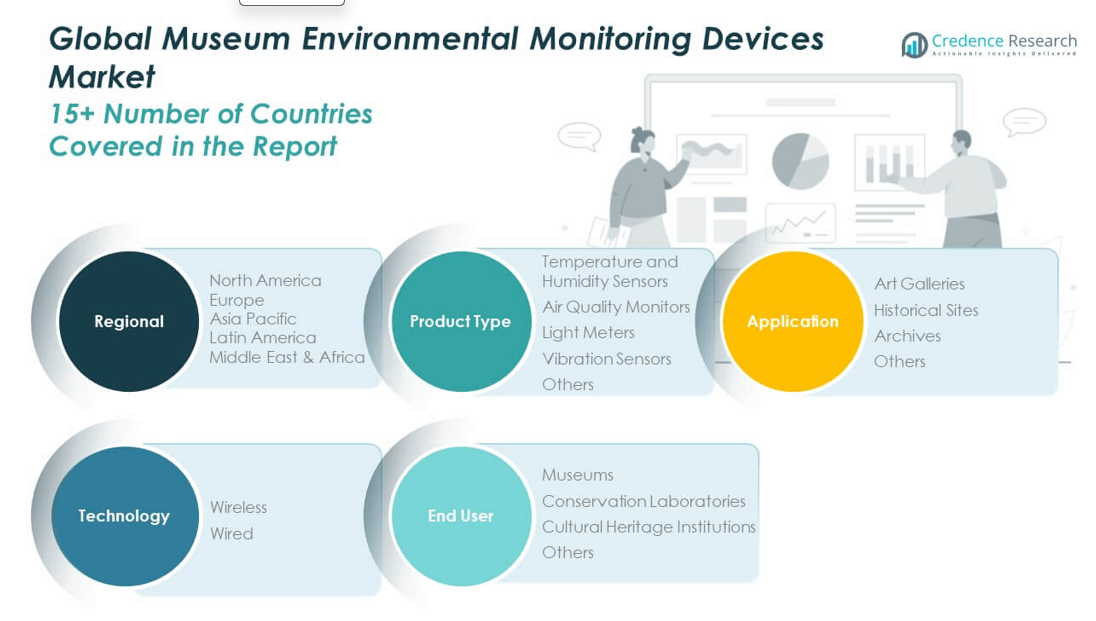
The Global Museum Environmental Monitoring Devices Market is segmented into temperature and humidity sensors, air quality monitors, light meters, vibration sensors, and others. Temperature and humidity sensors lead the market due to their critical role in preserving artworks and artifacts. Air quality monitors are gaining traction, driven by increasing focus on pollutant and particulate control in enclosed heritage environments. Light meters play a key role in maintaining illumination levels to prevent fading or material degradation. Vibration sensors are essential in monitoring sensitive displays and protecting exhibits from structural movements. Other devices, including integrated control systems, provide advanced automation and real-time environmental management.
- For instance, T&D Corporation's standard TR-72nw temperature and humidity data loggers deliver measurement accuracy up to ±0.5°C and ±5% RH, with data transmitted via LAN for remote monitoring. The high-precision model (TR-72nw-S) achieves the ±0.3°C and ±2.5% RH accuracy mentioned in the original statement.
By Application
The market caters to art galleries, historical sites, archives, and others. Art galleries hold the largest share, emphasizing climate stability for preservation of valuable collections. Historical sites increasingly adopt these systems to maintain structural integrity and protect ancient materials. Archives follow, using precision monitoring to safeguard documents and manuscripts from humidity fluctuations. Other applications include research institutions and museums with digital exhibits, where consistent environmental conditions ensure data integrity and material longevity.
- For instance, ELPRO’s ECOLOG-PRO monitoring system is used in archives and museums to manage temperature and humidity levels, with measurement accuracy of ±0.2°C and ±1.5% RH, ensuring reliable protection of cultural materials in storage and display environments.
Segmentation:
By Product Type
- Temperature and Humidity Sensors
- Air Quality Monitors
- Light Meters
- Vibration Sensors
- Others
By Application
- Art Galleries
- Historical Sites
- Archives
- Others
By Technology
- Wireless
- Wired
By End User
- Museums
- Conservation Laboratories
- Cultural Heritage Institutions
- Others
By Region
- North America
- U.S.
- Canada
- Mexico
- Europe
- Germany
- France
- U.K.
- Italy
- Spain
- Rest of Europe
- Asia Pacific
- China
- Japan
- India
- South Korea
- South-east Asia
- Rest of Asia Pacific
- Latin America
- Brazil
- Argentina
- Rest of Latin America
- Middle East & Africa
- GCC Countries
- South Africa
- Rest of the Middle East and Africa
Regional Analysis:
North America
The North America Global Museum Environmental Monitoring Devices Market size was valued at USD 335.03 million in 2018, increased to USD 491.53 million in 2024, and is anticipated to reach USD 830.66 million by 2032, at a CAGR of 6.3% during the forecast period. North America held a 43% share of the global market in 2024, driven by extensive museum infrastructure and advanced conservation technologies. The region benefits from strong government funding for heritage preservation and early adoption of IoT-based monitoring solutions. The U.S. leads the market due to its high number of museums and robust research ecosystem. Canada and Mexico contribute through modernization projects and expanding digital preservation initiatives. Institutions in this region emphasize energy-efficient systems and real-time environmental tracking. Strategic partnerships between technology firms and museum organizations support innovation. Strong emphasis on sustainability and data-driven conservation enhances overall regional market strength.
Europe
The Europe Global Museum Environmental Monitoring Devices Market size was valued at USD 219.01 million in 2018, increased to USD 313.04 million in 2024, and is anticipated to reach USD 496.86 million by 2032, at a CAGR of 5.5% during the forecast period. Europe accounted for 27% of the global market in 2024, supported by rich cultural heritage and strict preservation regulations. The region’s major contributors include the UK, Germany, France, Italy, and Spain, which host some of the world’s most advanced museums. The adoption of climate-controlled and sensor-based monitoring systems is expanding rapidly. European institutions prioritize precision and automation in environmental control. Investments from EU cultural programs and government grants continue to drive technological upgrades. Smart museum projects and cross-border collaborations are enhancing knowledge transfer. The market benefits from a strong manufacturing base for environmental monitoring devices across Western Europe.
Asia Pacific
The Asia Pacific Global Museum Environmental Monitoring Devices Market size was valued at USD 143.93 million in 2018, increased to USD 231.75 million in 2024, and is anticipated to reach USD 443.58 million by 2032, at a CAGR of 8.0% during the forecast period. Asia Pacific captured 20% of the global market in 2024, driven by rising investments in cultural preservation and infrastructure development. China, Japan, India, and South Korea lead regional adoption with growing museum modernization projects. Governments are investing heavily in digital heritage conservation programs. The expanding tourism sector fuels demand for smart environmental monitoring systems. Local manufacturers are producing cost-effective and energy-efficient sensors tailored to regional needs. Technological advancements and collaborations with global brands accelerate market growth. Growing awareness of preventive conservation among institutions strengthens long-term demand across developing economies.
Latin America
The Latin America Global Museum Environmental Monitoring Devices Market size was valued at USD 36.35 million in 2018, increased to USD 53.22 million in 2024, and is anticipated to reach USD 79.42 million by 2032, at a CAGR of 4.7% during the forecast period. Latin America represented 5% of the global market in 2024, with Brazil, Mexico, and Argentina driving the majority of demand. The region is gradually adopting environmental monitoring systems to preserve its growing number of cultural centers and art institutions. Public museums are integrating affordable wireless systems to enhance artifact protection. Government funding for heritage programs is increasing, though still limited compared to developed regions. International collaborations and training programs are helping institutions modernize preservation practices. The expansion of private art galleries and cultural tourism boosts adoption. Market growth remains steady as awareness and accessibility improve across major urban centers.
Middle East
The Middle East Global Museum Environmental Monitoring Devices Market size was valued at USD 22.36 million in 2018, increased to USD 30.41 million in 2024, and is anticipated to reach USD 43.58 million by 2032, at a CAGR of 4.1% during the forecast period. The region accounted for 3% of the global market in 2024, supported by rising investments in new museum projects. The UAE, Saudi Arabia, and Qatar are leading in adopting advanced monitoring technologies for large-scale cultural institutions. Government-backed heritage preservation initiatives and smart infrastructure projects drive progress. The Global Museum Environmental Monitoring Devices Market in this region benefits from partnerships with international technology providers. Institutions focus on humidity and air quality control to protect artifacts from desert climates. Ongoing museum developments, such as the Louvre Abu Dhabi, stimulate demand. Regional diversification and tourism development support market expansion.
Africa
The Africa Global Museum Environmental Monitoring Devices Market size was valued at USD 11.13 million in 2018, increased to USD 18.35 million in 2024, and is anticipated to reach USD 24.24 million by 2032, at a CAGR of 3.0% during the forecast period. Africa contributed 2% of the global market in 2024, showing gradual progress in heritage preservation infrastructure. South Africa, Egypt, and Kenya are leading adopters, supported by international cultural partnerships. Many museums in the region still rely on basic monitoring systems due to funding limitations. Efforts from global organizations promote training and technology transfer. Emerging initiatives in digitization and smart preservation are driving small-scale modernization. Climate-sensitive heritage sites are adopting portable sensors for protection. The market is gradually evolving with growing recognition of cultural and tourism value across African nations.
Key Player Analysis:
- Vaisala Oyj
- Testo SE & Co. KGaA
- Delta Controls
- Hanwell Solutions Ltd
- Rotronic AG
- Fluke Corporation
- Monnit Corporation
Competitive Analysis:
The competitive landscape of the Global Museum Environmental Monitoring Devices Market remains moderately fragmented, with several global firms and niche players vying for share. Leading players invest heavily in R&D and aim to deliver high-precision sensors and integrated platforms. It faces rivalry from established instrumentation and sensor companies branching into museum solutions. Many firms differentiate via strong service networks, calibration support, and software ecosystems. Mergers or partnerships help some firms expand their geographic reach and product portfolios. It pressures smaller vendors to specialize or collaborate. Customer loyalty and long sales cycles influence competitive positioning. Companies strive to maintain margins while lowering unit costs to capture emerging market segments.
Recent Developments:
- Vaisala Oyj reinforced its leadership in artifact protection with its cloud-based humidity and temperature monitoring solutions, critical for museums and collections environments. Their technology advances artifact preservation by providing high-precision environmental controls paired with cloud access for real-time data analysis to ensure priceless objects remain safe from adverse conditions.
- Delta Controls (Delta Electronics group) unveiled future-ready building automation systems in September 2025, integrating advanced air quality and climate controls relevant for museum installations. Their recent showcases included solutions for smart building management suitable for art and heritage preservation, featuring real-time monitoring of humidity and temperature for collections care.
- Hanwell Solutions Ltd made an organizational move by appointing a new European Distribution Manager. This decision boosts the support and custom integration of wireless museum environmental monitoring solutions for European cultural institutions, improving access and service quality for museum clients.
- Monnit Corporation released new sensors in October 2025 targeting occupancy and environmental monitoring; the PoE- X™ People Counter is now in beta testing.
Report Coverage:
The research report offers an in-depth analysis based on Product Type and Application segments. It details leading market players, providing an overview of their business, product offerings, investments, revenue streams, and key applications. Additionally, the report includes insights into the competitive environment, SWOT analysis, current market trends, as well as the primary drivers and constraints. Furthermore, it discusses various factors that have driven market expansion in recent years. The report also explores market dynamics, regulatory scenarios, and technological advancements that are shaping the industry. It assesses the impact of external factors and global economic changes on market growth. Lastly, it provides strategic recommendations for new entrants and established companies to navigate the complexities of the market.
Future Outlook:
- Adoption of AI-driven predictive monitoring will grow steadily.
- Wireless and battery-powered sensors will dominate new installations.
- Growth in emerging economies will open new markets.
- Demand for lower-cost modular systems will increase.
- Cloud platforms will standardize cross-site monitoring.
- Sustainability and energy efficiency will become must-have features.
- Partnerships between tech firms and cultural institutions will expand.
- Retrofit solutions will gain traction for legacy buildings.
- Data interoperability and open standards will gain importance.
- Focus on climate resilience will drive adoption in sensitive regions.
Request a Free Sample
Fill in your details and we'll send you a free sample report.
- Sample data tables & charts
- Research methodology
Need a Custom Version of This Report?
Tailor the scope, geography, or segments to your exact requirements.
- Custom geography or segment scope
- Direct access to our analyst team
Frequently Asked Questions
What is the current market size for Global Museum Environmental Monitoring Devices Market, and what is its projected size in 2032?
At what Compound Annual Growth Rate is the Global Museum Environmental Monitoring Devices Market projected to grow between 2025 and 2032?
Which market segment held the largest share in 2024?
What are the primary factors fueling the Global Museum Environmental Monitoring Devices Market’s growth?
Who are the leading companies in the Global Museum Environmental Monitoring Devices Market?
Table of Content
Chapter 1. Report Introduction
- 1.1 Report Description & Purpose
- 1.1.1 Report Title & Market Definition
- 1.1.2 Unique Selling Propositions (USP) & Key Differentiators
- 1.1.3 Value Proposition for Stakeholders
- 1.2 Research Objectives
- 1.2.1 Market Sizing Objectives (Volume & Revenue)
- 1.2.2 Segmentation Objectives
- 1.2.3 Competitive Intelligence Objectives
- 1.2.4 Forecast & Scenario Objectives
- 1.3 Report Scope
- 1.3.1 Museum Environmental Monitoring Devices Scope – Types & Subtypes Covered
- 1.3.2 Geographic Scope – Regions & Countries Covered
- 1.3.3 Historical Period, Base Year & Forecast Period (2024; forecast to 2032)
- 1.3.4 Inclusions & Exclusions
- 1.4 HS Code & Classification Framework
- 1.5 Currency, Units & Pricing Basis
- 1.6 Target Stakeholders
- 1.7 Limitations & Assumptions
Chapter 2. Executive Summary
- 2.1 Global Museum Environmental Monitoring Devices Market Snapshot
- 2.1.1 Market Size – Historical (2024) & Forecast (2024-2032) (2024: USD 1,138.31 million → 2032: USD 1,918.34 million)
- 2.1.2 Volume & Revenue – Global Totals
- 2.1.3 Key Market Highlights – Top Five Facts
- 2.2 Museum Environmental Monitoring Devices Market Segmentation Snapshot
- 2.2.1 Market Split by Region – 2024 vs. 2032
- 2.3 Competitive Snapshot
- 2.3.1 Top 10 Players by Revenue Share – 2024
- 2.3.2 Top 10 Players by Volume Share – 2024
- 2.3.3 Recent Strategic Developments (18-Month Summary)
- 2.4 Key Investment Highlights & Strategic Conclusions
Chapter 3. Museum Environmental Monitoring Devices Market Dynamics & Industry Analysis
- 3.1 Market Overview & Context
- 3.1.1 Museum Environmental Monitoring Devices Market Position in the Broader Automotive Value Chain
- 3.1.2 OEM vs. Replacement Market Dynamics
- 3.1.3 Market Maturity & Development Stage by Region
- 3.2 Museum Environmental Monitoring Devices Market Drivers
- 3.3 Museum Environmental Monitoring Devices Market Restraints & Challenges
- 3.4 Museum Environmental Monitoring Devices Market Opportunities
- 3.5 Porter's Five Forces Analysis
- 3.5.1 Threat of New Entrants
- 3.5.2 Bargaining Power of Suppliers
- 3.5.3 Bargaining Power of Buyers
- 3.5.4 Threat of Substitutes
- 3.5.5 Competitive Rivalry – Intensity Assessment
- 3.6 Museum Environmental Monitoring Devices Value Chain Analysis
- 3.6.1 Upstream – Raw Material/Input Suppliers
- 3.6.1.1 Raw Material/Input 1
- 3.6.1.2 Raw Material/Input 2
- 3.6.1.3 Raw Material/Input 3
- 3.6.2 Midstream – Production/Manufacturing/Service Delivery
- 3.6.2.1 Production/Process Overview
- 3.6.2.2 Key Facility Locations & Capacity by Manufacturer
- 3.6.3 Downstream – Distribution & End Consumer
- 3.6.3.1 Primary Channel – B2B/OEM
- 3.6.3.2 Secondary Channels – Dealer, Retail, Online, Direct
- 3.6.4 Value Chain Profitability Analysis
- 3.6.1 Upstream – Raw Material/Input Suppliers
- 3.7 PESTEL Analysis
- 3.7.1 Political Factors
- 3.7.2 Economic Factors
- 3.7.3 Social Factors
- 3.7.4 Technological Factors
- 3.7.5 Environmental Factors
- 3.7.6 Legal Factors
- 3.8 Museum Environmental Monitoring Devices Supply Chain Analysis
- 3.8.1 Raw Material/Input Supply Risk Assessment
- 3.8.2 Manufacturing Concentration Risk (Geographic Exposure)
- 3.8.3 Trade Disruption Impact Analysis
- 3.9 Regulatory & Policy Landscape
Note: The regulatory and policy landscape section covers regulations based on their applicability to the market, Museum Environmental Monitoring Devices category, geography, and scope of the study. Only regulatory frameworks with a material impact on operations, compliance, trade, sustainability, or market access are analyzed in detail.
Chapter 4. Key Investment Pockets & Opportunity Analysis
- 4.1 Museum Environmental Monitoring Devices Market Attractiveness Analysis
- 4.1.1 By Region – Investment Attractiveness Matrix (Volume × CAGR)
- 4.2 Absolute Revenue Growth Opportunity
- 4.2.1 By Region – Absolute USD Growth Through 2032
- 4.3 Incremental Volume Opportunity
- 4.3.1 By Region – Incremental Volume Through 2032
- 4.3.2 Segment – Incremental Volume
- 4.4 Emerging Submarket Opportunity Deep Dive (Subject to Applicability)
- 4.5 Emerging Market Opportunity Scorecards
- 4.5.1 United States
- 4.5.2 Europe
- 4.5.3 Asia
- 4.5.4 Middle East & Africa
Note: Emerging Market Opportunity Scorecards will be included based on relevance and strategic importance. Regions listed are indicative and may vary depending on data availability and market dynamics.
Chapter 5. Museum Environmental Monitoring Devices Import-Export Analysis & Trade Flows
- 5.1 Global Trade Overview
- 5.1.1 Global Export Value by Country (2024)
- 5.1.2 Global Export Volume by Country (2024)
- 5.1.3 Global Import Value by Country (2024)
- 5.1.4 Global Import Volume by Country (2024)
- 5.1.5 Net Trade Balance by Country (2024)
- 5.2 Export Analysis – Segment
- 5.2.1 Type 1 (HS Code)
- 5.2.2 Type 2 (HS Code)
- 5.2.3 Type 3 (HS Code)
- 5.2.4 Type 4 (HS Code)
- 5.2.5 Type 5 (HS Code)
- 5.3 Import Analysis – Segment
- 5.3.1 Type 1 (HS Code)
- 5.3.2 Type 2 (HS Code)
- 5.3.3 Type 3 (HS Code)
- 5.3.4 Type 4 (HS Code)
- 5.3.5 Type 5 (HS Code)
- 5.4 Average Unit Trade Prices
- 5.4.1 Average Export Price – Segment & Country
- 5.4.2 Average Import Price – Segment & Source Country
- 5.4.3 Price Trends (2024)
- 5.5 Key Trade Route Analysis
- 5.5.1 Trade Route 1
- 5.5.2 Trade Route 2
- 5.5.3 Trade Route 3
- 5.5.4 Trade Route 4
- 5.5.5 Trade Route 5
- 5.6 Trade Policy Impact Assessment
- 5.6.1 US Anti-Dumping & Section 301 Tariffs
- 5.6.2 EU Customs Union Impact
- 5.6.3 Major Free Trade Agreements
- 5.6.4 USMCA Rules of Origin
Note: Trade policy analysis will be included only where relevant to the Museum Environmental Monitoring Devices market.
Chapter 6. Competitive Landscape & Company Benchmarking
- 6.1 Museum Environmental Monitoring Devices Market Concentration & Structure
- 6.1.1 Herfindahl-Hirschman Index (HHI) – vs. 2024
- 6.1.2 Tier 1, Tier 2 & Tier 3 Market Structure
- 6.1.3 Global, Regional & Local Player Dynamics
- 6.2 Museum Environmental Monitoring Devices Market Share Analysis – 2024
- 6.2.1 Global Revenue Share by Company
- 6.2.2 Global Volume Share by Company
- 6.2.3 Regional Revenue Share
- 6.2.4 Market Share Evolution ( vs. 2024)
- 6.2.5 OEM Segment Share by Company
- 6.2.6 Replacement Segment Share by Company
- 6.3 Production/Delivery Capacity & Facility Analysis
- 6.3.1 Global Installed Capacity
- 6.3.2 Capacity Utilization Rates
- 6.3.3 Production/Output Volume
- 6.3.4 Facility Locations & Capacity Map
- 6.3.5 Planned Capacity Additions
- 6.4 Museum Environmental Monitoring Devices Competitive Benchmarking Matrix
- 6.4.1 Revenue, Volume, CAGR & Profitability Comparison
- 6.4.2 Channel Revenue Mix
- 6.4.3 Geographic Revenue Exposure
- 6.4.4 R&D Intensity
- 6.4.5 Sustainability Maturity
- 6.5 Strategic Developments in Museum Environmental Monitoring Devices (Last 24 Months)
- 6.5.1 Mergers, Acquisitions & Divestments
- 6.5.2 New Museum Environmental Monitoring Devices Launches
- 6.5.3 Facility Expansions
- 6.5.4 Strategic Alliances, Joint Ventures & Partnerships
- 6.5.5 Distribution Expansion & Market Entry
- 6.5.6 Sustainability & ESG Initiatives
- 6.6 Competitive Strategy Mapping
- 6.6.1 Leader, Challenger, Follower & Niche Classification
- 6.6.2 Pricing Strategy Comparison
- 6.6.3 Channel Strategy Matrix
Note: Strategic developments are included based on their materiality and the availability of reliable information.
Chapter 7. Global Museum Environmental Monitoring Devices Market – By Distribution Channel
- 7.1 Segment Overview
- 7.1.1 Volume & Revenue Split by Channel (2024 & 2032)
- 7.1.2 Channel Mix Evolution (2024-2032)
Chapter 8. Regional Market Analysis – Global Overview
- 8.1 Global Regional Overview
- 8.1.1 Regional Volume Share
- 8.1.2 Regional Revenue Share
- 8.1.3 Regional Volume by Region
- 8.1.4 Regional Revenue by Region
- 8.1.5 Regional Forecast Through 2032
- 8.2 Cross-Regional Segment Analysis
- 8.2.1 By Distribution Channel
- 8.2.2 By Brand/Price Tier
Chapter 9. North America Museum Environmental Monitoring Devices Market
- 9.1 United States
- 9.2 Canada
- 9.3 Mexico
Chapter 10. Europe Museum Environmental Monitoring Devices Market
- 10.1 Germany
- 10.2 France
- 10.3 Italy
- 10.4 United Kingdom
- 10.5 Spain
- 10.6 Poland
- 10.7 Russia
- 10.8 Netherlands
- 10.9 Belgium
- 10.10 Sweden
- 10.11 Denmark
- 10.12 Norway
- 10.13 Rest of Europe
Chapter 11. Asia Pacific Museum Environmental Monitoring Devices Market
- 11.1 China
- 11.2 India
- 11.3 Japan
- 11.4 South Korea
- 11.5 Thailand
- 11.6 Indonesia
- 11.7 Vietnam
- 11.8 Malaysia
- 11.9 Australia
- 11.10 Rest of Asia Pacific
Chapter 12. Latin America Museum Environmental Monitoring Devices Market
- 12.1 Brazil
- 12.2 Argentina
- 12.3 Colombia
- 12.4 Chile
- 12.5 Rest of Latin America
Chapter 13. Middle East Museum Environmental Monitoring Devices Market
- 13.1 Saudi Arabia
- 13.2 United Arab Emirates
- 13.3 Turkey
- 13.4 Israel
- 13.5 Iran
- 13.6 Rest of the Middle East
Chapter 14. Africa Museum Environmental Monitoring Devices Market
- 14.1 South Africa
- 14.2 Egypt
- 14.3 Nigeria
- 14.4 Morocco
- 14.5 Rest of Africa
Chapter 15. Museum Environmental Monitoring Devices Company Profiles
- 15.1 [Company 01]
- 15.1.1 Company Overview
- 15.1.2 Key Management Personnel
- 15.1.3 Products & Services Portfolio
- 15.1.4 Financial Performance
- 15.1.5 Key Market Focus & Geographic Presence
- 15.1.6 Recent Developments & Strategic Initiatives
Note: The company profile list is preliminary and may change based on research findings, market developments, data availability, and client requirements.
Chapter 16. Appendices
- Appendix A – List of Abbreviations & Acronyms
- Appendix B – Industry Classification Code Reference – Full Series
- Appendix C – Production & Capacity Data Tables
- Appendix D – End-Use & Demand Base Tables
- Appendix E – Consumption & Replacement Rate Assumptions
- Appendix F – ASP Reference Tables
- Appendix G – Manufacturing & Facility Database
- Appendix H – Import-Export Data Tables
- Appendix I – Regulatory Summary Tables
- Appendix J – Primary Research Participant List (Anonymized)
- Appendix K – Primary Research Questionnaire Framework
- Appendix L – Data Sources & Bibliography
- Appendix M – Market Size Divergence & Source Comparison
Chapter 17. Research Methodology
- 17.1 Research Framework & Philosophy
- 17.2 Secondary Research – Sources, Hierarchy & Data Extraction
- 17.3 Data Modeling – Bottom-Up & Top-Down Market Sizing
- 17.4 Primary Research – Stakeholder Framework, LOI & Sample Sizes
- 17.5 Forecast Methodology – Regression, Scenario & Sensitivity Analysis
- 17.6 Quality Control – Four-Layer Validation Framework
- 17.7 Limitations & Standard Assumptions
- 17.8 Disclaimer
