
Market overview
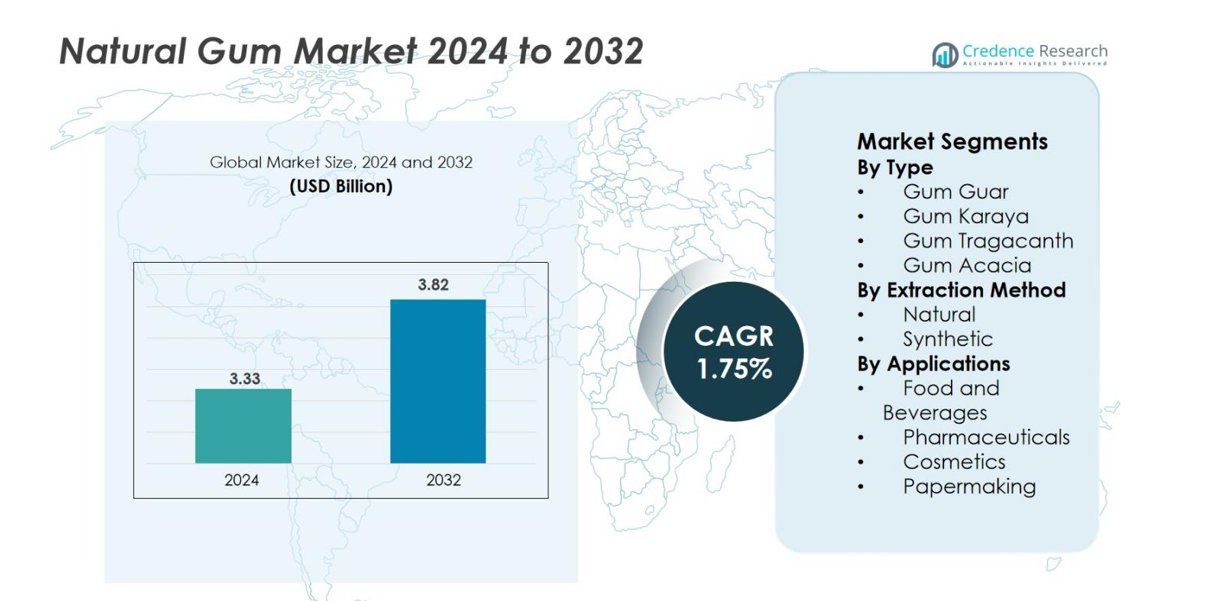
The natural gum market was valued at approximately USD 3.33 billion in 2024 and is expected to reach USD 3.82 billion by 2032, growing at a compound annual growth rate (CAGR) of 1.75% during the forecast period.
| REPORT ATTRIBUTE | DETAILS |
|---|---|
| Historical Period | 2020-2023 |
| Base Year | 2024 |
| Forecast Period | 2025-2032 |
| Natural Gum Market Size 2024 | USD 3.33 billion |
| Natural Gum Market, CAGR | 1.75% |
| Natural Gum Market Size 2032 | USD 3.82 billion |
The Natural Gum market features major players including Cargill, Incorporated, CP Kelco, Tate & Lyle PLC, Ashland Global Holdings Inc., Archer Daniels Midland Company, Firmenich International SA, Sensient Technologies Corporation, Kerry Group plc, Palsgaard A/S and Ingredion Incorporated. These firms leverage global production networks, R&D investments and strategic partnerships to maintain a competitive edge. Regionally, North America leads with a market share of approximately 45.7 %, underscoring its dominance in clean‑label natural ingredients and high consumption of processed food and beverage products.
Market Insights
- The global natural gum market was valued at approximately USD 3.33 billion in 2024 and is projected to reach USD 3.82 billion by 2032, growing at a CAGR of 1.75% during the forecast period.
- Key drivers of the market include the rising demand for clean-label and natural ingredients, increased adoption in food, pharmaceutical, and cosmetic applications, and the focus on sustainability and renewable sourcing.
- Market trends highlight significant growth in emerging applications such as functional foods, pharmaceuticals, and cosmetics, with natural gums being increasingly used as stabilisers, thickeners, and emulsifiers.
- Competitive analysis shows that major players like Cargill, CP Kelco, and Ingredion dominate the market, with North America holding the largest regional share at approximately 45.7%. Companies are expanding globally to strengthen their presence in growing markets.
- Market restraints include the volatility of raw material prices, supply chain disruptions, and the challenge of meeting diverse regulatory standards across regions.
Market Segmentation Analysis
By Type
The Natural Gum market is segmented into various types, including Gum Guar, Gum Karaya, Gum Tragacanth, and Gum Acacia. Among these, Gum Guar holds the dominant position, contributing the largest market share, driven by its versatile applications in food, pharmaceuticals, and industrial sectors. Gum Guar accounts for approximately 35% of the market share. This dominance is attributed to its natural thickening properties, which make it essential in food formulations, particularly in gluten-free products. The rising demand for natural and clean-label ingredients continues to bolster the market growth for Gum Guar.
- For instance, Lucid Colloids Ltd. focuses on customized guar gum derivatives serving food, pharmaceuticals, and personal care industries, reflecting the rising demand for natural and clean-label ingredients.
By Extraction Method
The market is divided into natural and synthetic extraction methods, with the natural extraction method taking the lead, holding about 70% of the market share. This preference is largely due to the increasing consumer shift toward clean-label and organic products, which enhances the demand for naturally sourced gums. Natural extraction methods are favored for their environmentally friendly and sustainable production processes, which resonate with the growing consumer demand for eco-conscious and health-oriented products. As consumer trends continue to lean toward authenticity and natural ingredients, the natural extraction segment will likely maintain its stronghold.
- For instance, Symrise focuses on green and sustainable extraction methods, producing natural ingredients that cater to food and personal care industries while meeting consumer demand for organic products.
By Applications
The Natural Gum market finds wide applications across food and beverages, pharmaceuticals, cosmetics, and papermaking. The food and beverage segment leads the market, holding the largest share of approximately 45%. This is driven by the growing consumer demand for natural additives, including stabilizers, emulsifiers, and thickeners, especially in clean-label, gluten-free, and organic food products. The food industry's ongoing focus on healthier alternatives and natural ingredients is fueling the segment's growth. Additionally, the increasing use of natural gums in functional foods and beverages further supports the dominance of this application segment.
Key Growth Drivers
Rising consumer demand for natural and clean‑label ingredients
The global shift toward healthier lifestyles and greater ingredient transparency has significantly elevated demand for naturally sourced gums in food, pharmaceutical, and cosmetic applications. As consumers increasingly prefer plant‑based additives and avoid synthetic alternatives, the market for natural gums grows accordingly. This shift is particularly evident in regions like North America where clean‑label trends are strong. The preference for natural gums is reinforced by their multi‑functional roles - as thickeners, stabilizers, emulsifiers and binders offering manufacturers a versatile ingredient option. The growing appetite for such ingredients drives producers to expand production capacity and diversify product portfolios, thereby accelerating market expansion.
- For instance, companies like Cargill and Ingredion are expanding production capacities and diversifying portfolios to supply natural gums for growing clean-label product lines in North America, reflecting the rising consumer preference for transparency, sustainability, and multifunctional natural ingredients.
Expansion of processed foods, convenience foods and functional applications
Processed and convenience foods continue to proliferate globally, especially in emerging economies with rising disposable incomes and changing dietary patterns. Natural gums have become vital in these sectors by improving texture, stability and shelf‑life of foods and beverages. The need to deliver consistent sensory quality in ready‑to‑eat meals, gluten‑free bakery goods and plant‑based dairy alternatives has enhanced the importance of natural gums. Additionally, the pharmaceutical and nutraceutical markets are leveraging natural gums for drug delivery systems and functional food formulations. This convergence of food‐industry growth and functional ingredient demand serves as a pivotal driver for the natural gum market.
- For instance, guar gum is widely used as a natural gluten-free binder in bakery products, enhancing dough performance, moisture retention, and texture, as seen in products from companies like Sunita Hydrocolloids.
Sustainability and renewable sourcing emphasis
Environmental concerns and regulatory pressures around sustainability are compelling manufacturers to favour renewable and biodegradable materials. Natural gums derived from plant sources meet this requirement and are increasingly preferred over synthetic additives. The adoption of sustainable harvesting practices, traceable supply chains and eco‑friendly processing reinforce the market’s growth potential. Companies aligning with sustainable development goals (SDGs) are also finding strategic advantage, which further bolsters the demand for natural gums. This emphasis on renewable sourcing and eco‑credentials creates a compelling value proposition for manufacturers and end‑users alike.
Key Trends & Opportunities
Penetration into new end‑use industries
While food and beverages remain the dominant application for natural gums, emerging fields such as cosmetics, pharmaceuticals, and advanced papermaking offer significant growth opportunities. For instance, natural gums are increasingly used as film‑formers, emulsifiers and stabilisers in skincare and haircare formulations, and as excipients or binders in controlled‑release pharmaceuticals. As industry boundaries blur and multifunctional ingredients are sought, natural gums are poised to penetrate these niche yet growing segments. Companies that adapt formulations to meet regulatory and performance requirements in these verticals can maximise opportunity.
- For instance, Gum Arabic is widely employed by companies like Givaudan and Nexira in natural cosmetic formulations for its thickening and emulsifying properties.
Geographic expansion in emerging markets
Emerging economies in Asia‑Pacific, Latin America and Africa present a major growth frontier for natural gum suppliers. Rapid urbanisation, a rising middle class and increasing food processing industry investment drive demand for ingredient‑rich products and clean‑label formulations in these regions. Manufacturers can tap local raw‑material availability and develop region‑specific offerings (e.g., locally sourced guar gum). Strategic partnerships, production capacity expansions and localisation of supply chains in these geographies can serve as key growth levers over the next decade.
- For instance, India and Pakistan remain leading producers of guar gum, supplying both local and export markets, while companies like Sunita Hydrocolloids have expanded production capacities to meet rising regional demand.
Key Challenges
Raw‑material supply volatility and cost pressures
Natural gums are sourced from plant species whose yield and quality are influenced by climatic conditions, agricultural practices and harvesting cycles. Fluctuations due to weather extremes, crop diseases or geopolitical trade disruptions can impact supply continuity and push input costs higher. These cost pressures challenge both producers and end‑users, potentially squeezing margins or forcing price increases. The dependency on agricultural raw materials therefore remains a key risk factor requiring mitigation through supply‑chain resilience and strategic sourcing.
Quality control, standardization and regulatory complexity
Natural gum ingredients must comply with varying food‑, pharma‑ and cosmetic‑grade standards across jurisdictions. Ensuring batch‑to‑batch consistency, managing contaminant thresholds, and aligning with region‑specific regulatory definitions of “natural” present operational burdens. Inconsistent quality or regulatory non‑compliance can impair market entry and erode trust. The lack of unified global standards for natural gums adds complexity, and companies must invest in rigorous testing, traceability and certification systems to manage this challenge effectively.
Regional Analysis
North America
The North America region dominates the natural gum market, capturing 45.7% of global revenue in 2024. Growth is propelled by strong demand for clean-label ingredients, high consumption of processed food and beverage products, and robust regulatory frameworks favouring plant-based additives. Manufacturers in the U.S. and Canada are prioritising natural extraction methods and sustainability, thereby reinforcing market leadership and encouraging continued investment in capacity and innovation.
Europe
Europe holds a substantial share of the natural gum market, accounting for 25% of the global market in 2024. Growth in this region is driven by consumer demand for natural, organic ingredients and advancing applications in food, pharmaceuticals, and cosmetics. The region’s mature processed-food and personal-care sectors support adoption of natural gums as stabilisers and thickeners. Its positioning just behind North America reflects its strategic importance and moderate growth outlook.
Asia Pacific
The Asia Pacific region is emerging as a high-growth market for natural gums, with a current share of 18% in 2024. The region is supported by a rising population, a growing middle class, an expanding food processing industry, and increased awareness of clean-label ingredients. Although its current share is lower than North America or Europe, the region is expected to register the fastest CAGR, making it a key target for capacity expansions and supply-chain localisation.
Latin America & Middle East & Africa (MEA)
Latin America and MEA collectively account for 11.3% of the global natural gum market. Emerging food-processing infrastructure, increasing cosmetic and pharmaceutical use of natural ingredients, and evolving regulatory frameworks all present growth opportunities. While share percentages are smaller compared to other regions, both regions are expected to gain in significance over the forecast period as companies seek to diversify regional risk and tap new end-use growth.
Market Segmentations
By Type
- Gum Guar
- Gum Karaya
- Gum Tragacanth
- Gum Acacia
By Extraction Method
- Natural
- Synthetic
By Applications
- Food and Beverages
- Pharmaceuticals
- Cosmetics
- Papermaking
By Geography
- North America
- U.S.
- Canada
- Mexico
- Europe
- Germany
- France
- U.K.
- Italy
- Spain
- Rest of Europe
- Asia Pacific
- China
- Japan
- India
- South Korea
- South-east Asia
- Rest of Asia Pacific
- Latin America
- Brazil
- Argentina
- Rest of Latin America
- Middle East & Africa
- GCC Countries
- South Africa
- Rest of the Middle East and Africa
Competitive Landscape
The competitive landscape of the natural gum market is characterised by moderate concentration, with leading global chemical and ingredients firms vying across food, pharmaceutical, and cosmetics applications. Companies such as Cargill, Incorporated, CP Kelco, Ingredion Incorporated, Tate & Lyle PLC, Archer Daniels Midland Company, Ashland Global Holdings Inc., Sensient Technologies Corporation, Kerry Group and Palsgaard A/S maintain substantial footprints in production, R&D, and supply‑chain integration. These players consistently invest in sustainable sourcing, clean‑label ingredient development and global manufacturing capacity expansions. They compete on the basis of product purity, functional performance, application versatility, and regulatory compliance. Despite a number of smaller niche suppliers, the dominance of these established firms-who collectively hold over half the market share-creates high entry barriers and drives consolidation, partnerships and innovation to differentiate and capture specialised sub‑segments.
Key Player Analysis
- Kerry
- Archer Daniels Midland Company
- Ashland
- Sensient Technologies Corporation
- Palsgaard
- Cargill
- Tate & Lyle
- Ingredion Incorporated
- CP Kelco
- Firmenich
Recent Developments
- In July 2025, Gift of Life Marrow Registry announced a partnership with DOUBLEMINT® (part of Mars, Incorporated) and Labcorp to launch “Hero Gum” a chewing-gum-based donor-registration kit.
- In 2024, Tate & Lyle significantly expanded its presence in the natural gum sector by acquiring CP Kelco for $1.8 billion.
- In 2023, CP Kelco reinforced its leadership in the natural gum sector by significantly expanding its biogum production capacities in the U.S. and China. The company completed a 40% capacity increase at its Okmulgee, Oklahoma facility and added low acyl gellan gum production capabilities at its Wulian, China plant
Report Coverage
The research report offers an in-depth analysis based on Type, Extraction Method, Application and Geography. It details leading market players, providing an overview of their business, product offerings, investments, revenue streams, and key applications. Additionally, the report includes insights into the competitive environment, SWOT analysis, current market trends, as well as the primary drivers and constraints. Furthermore, it discusses various factors that have driven market expansion in recent years. The report also explores market dynamics, regulatory scenarios, and technological advancements that are shaping the industry. It assesses the impact of external factors and global economic changes on market growth. Lastly, it provides strategic recommendations for new entrants and established companies to navigate the complexities of the market.
Future Outlook
- Manufacturers will increasingly develop advanced processing technologies to enhance purity and functionality of natural gums, meeting stringent industry standards.
- The integration of natural gums into plant‑based food systems will gain momentum as demand for clean‑label, vegan and gluten‑free formulations expands.
- Expansion into emerging regions, particularly Asia Pacific and Latin America where food processing and cosmetic industries are growing rapidly, will open new market opportunities.
- Strategic alliances and acquisitions among key players will accelerate, enabling broader product portfolios and access to advanced extraction methods.
- Brands will emphasise sustainable sourcing, traceability and environmental credentials of natural gums to align with consumer preference for ethical ingredients.
- Diversification into non‑food applications such as pharmaceuticals, personal care and advanced papermaking will boost growth beyond traditional food markets.
- The share of premium natural gum grades with enhanced functional attributes will expand, driving higher value growth segments.
- Supply‑chain resilience, including vertical integration and raw‑material risk management, will become a competitive differentiator for leading players.
- Regulatory harmonisation and increased recognition of plant‑based stabilisers will support wider adoption across multiple geographies.
- Despite modest overall growth rates, niche high‑growth segments within the natural gum market will attract investment and innovation, shaping the market’s future trajectory.

Request a Free Sample
Fill in your details and we'll send you a free sample report.
- Sample data tables & charts
- Research methodology
Need a Custom Version of This Report?
Tailor the scope, geography, or segments to your exact requirements.
- Custom geography or segment scope
- Direct access to our analyst team
Frequently Asked Questions
What is the current market size for the Natural Gum Market, and what is its projected size in 2032?
At what Compound Annual Growth Rate is the Natural Gum Market projected to grow between 2025 and 2032?
Which Natural Gum Market segment held the largest share in 2024?
What are the primary factors fueling the growth of the Natural Gum Market?
Who are the leading companies in the Natural Gum Market?
Which region commanded the largest share of the Natural Gum Market in 2024?
Table of Content
Chapter 1 Market Segmentation
- 1.1 Segmentation Framework
- 1.1.1 Product and Service Classification
- 1.1.2 Application and End-Use Classification
- 1.1.3 Technology and Solution Classification
- 1.1.4 Customer and Distribution Channel Classification
- 1.1.5 Geographic Segmentation
- 1.1.6 Market Segment Definitions and Boundaries
Chapter 2 Introduction
- 2.1 Report Objectives and Scope
- 2.2 Product Definition and Industry Terminology
- 2.3 Market Inclusions and Exclusions
- 2.4 Research Process
- 2.4.1 Primary Research and Expert Interviews
- 2.4.2 Secondary Research and Source Review
- 2.4.3 Top-Down and Bottom-Up Estimation
- 2.4.4 Data Triangulation and Verification
- 2.5 Market Size Measurement Basis
- 2.5.1 2024: USD 3.33 billion → 2032: USD 3.82 billion
- 2.6 Historical and Forecast Reference Periods
- 2.6.1 Base Year: 2024
- 2.6.2 Forecast Period: 2024-2032
- 2.7 Research Assumptions and Limitations
Chapter 3 Executive Summary
- 3.1 Market Snapshot and Key Findings
- 3.2 Base-Year Market Size, 2024
- 3.3 Forecast Market Size, 2032
- 3.4 Revenue and Volume Growth Outlook
- 3.5 Key Demand and Supply Indicators
- 3.6 Leading Market Segments
- 3.7 Fastest-Growing Market Opportunities
- 3.8 Regional Performance Highlights
- 3.9 Technology and Industry Transformation
- 3.10 Competitive Landscape Summary
- 3.11 Analyst View and Strategic Implications
Chapter 4 Global Natural Gum Market Trends and Developments
- 4.1 Historical Industry Development
- 4.2 Recent Market Trends and Developments
- 4.3 Demand and Customer Behavior Trends
- 4.4 Technology and Product Innovation
- 4.5 Artificial Intelligence, Automation and Digitalization
- 4.6 Local Manufacturing and Supply Chain Realignment
- 4.7 Industry Partnerships, Mergers and Acquisitions
- 4.8 Sustainability and Circular Economy Developments
- 4.9 Government and Private Sector Investment Trends
- 4.10 Emerging Business Models and Commercialization
- 4.11 Industry Developments and Announcements
Chapter 5 Global Natural Gum Market Production, Supply and Demand Analysis
- 5.1 Demand Trend and Consumption Analysis
- 5.2 Demand Forecast, 2024-2032
- 5.3 Production and Output Trend
- 5.4 Production and Output Forecast, 2024-2032
- 5.5 Installed Capacity and Capacity Utilization
- 5.6 Company-Wise Production Plants and Statistics
- 5.6.1 Installed Production Capacity
- 5.6.2 Actual Production
- 5.6.3 Planned Capacity and Expansion Targets
- 5.7 Supply Chain Structure and Procurement Trends
- 5.8 Supply-Demand Gap and Bottlenecks
- 5.9 Import Dependence and Sourcing Structure
- 5.10 Contract Manufacturing and Outsourcing
- 5.11 Regional Supply and Demand Concentration
Chapter 6 Global Natural Gum Market Pricing Analysis
- 6.1 Pricing Structure and Measurement
- 6.2 Historical Pricing Trends
- 6.3 Pricing Outlook, 2024-2032
- 6.4 Average Selling Price and Unit Economics
- 6.5 Pricing by Product and Market Segment
- 6.6 Geographic Pricing Differences
- 6.7 Key Input, Energy, Labor and Logistics Costs
- 6.8 Contract Pricing and Purchasing Models
- 6.9 Pricing Sensitivity and Competitive Positioning
- 6.10 Price, Margin and Profitability Implications
Chapter 7 Global Natural Gum Market Dynamics
- 7.1 Market Growth Drivers
- 7.1.1 Demand-Side Drivers
- 7.1.2 Technology and Innovation Drivers
- 7.1.3 Infrastructure and Investment Drivers
- 7.1.4 Regulatory and Policy Drivers
- 7.2 Market Restraints
- 7.2.1 Cost and Affordability Constraints
- 7.2.2 Technology and Adoption Barriers
- 7.2.3 Supply Chain and Operational Constraints
- 7.3 Market Challenges
- 7.3.1 Competitive Pressure and Margin Erosion
- 7.3.2 Skills, Infrastructure and Implementation Gaps
- 7.4 Emerging Market Opportunities
- 7.5 Market Dynamics Impact and Time-Horizon Assessment
Chapter 8 Global Natural Gum Value Chain Analysis
- 8.1 Industry Value Chain Overview
- 8.2 Upstream Suppliers and Critical Inputs
- 8.3 Technology and Component Providers
- 8.4 Manufacturing or Service Delivery
- 8.5 Distribution, Channel Partners and Integrators
- 8.6 Downstream Applications and End Users
- 8.7 Value Addition and Profit Pools
- 8.8 Vertical Integration and Outsourcing
- 8.9 Supplier Concentration and Risk
- 8.10 Supply Chain Localization and Resilience
Chapter 9 Global Natural Gum Market Regulations and Policies
- 9.1 Relevant Laws, Standards and Compliance Frameworks
- 9.2 Product, Service, Safety and Quality Requirements
- 9.3 Government Policies, Incentives and Subsidies
- 9.4 Imports, Exports and Trade Barriers
- 9.5 Public Procurement and Local Content Requirements
- 9.6 Environmental and Sustainability Compliance
- 9.7 Upcoming Policy Changes and Market Implications
Chapter 10 Global Natural Gum Market Hotspots and Opportunities
- 10.1 Market Opportunity Mapping and Growth Hotspots
- 10.2 High-Growth Applications and Customer Groups
- 10.3 Underserved Markets and White-Space Opportunities
- 10.4 Emerging Technology and Product Opportunities
- 10.5 New Capacity and Investment Hotspots
- 10.6 Market Entry and Expansion Opportunities
- 10.7 Distribution and Partnership Opportunities
- 10.8 Near-Term and Long-Term Commercial Potential
- 10.9 Opportunity Attractiveness and Execution Risks
Chapter 11 Global Natural Gum Market Outlook, 2024-2032
- 11.1 Market Size and Analysis
- 11.1.1 Revenue (Market Measurement: 2024: USD 3.33 billion → 2032: USD 3.82 billion)
- 11.1.2 Market Volume and Quantity Sold
- 11.1.3 Historical Market Size
- 11.1.4 Base-Year Market Size, 2024
- 11.2 Market Forecast, 2024-2032
- 11.2.1 Revenue Forecast to 2032
- 11.2.2 Volume Forecast to 2032
- 11.2.3 CAGR and Year-on-Year Growth
- 11.2.4 Incremental Revenue Opportunity
- 11.3 Forecast Assumptions and Scenario Analysis
- 11.3.1 Base-Case Forecast
- 11.3.2 Optimistic and Conservative Scenarios
- 11.3.3 Technology, Pricing and Policy Sensitivities
- 11.4 Market Attractiveness and Growth Outlook
Chapter 12 Global Natural Gum Market Segmentation and Outlook
- 12.1 Segmentation Summary and Market Shares, 2024
- 12.2 Largest and Fastest-Growing Segments
- 12.3 Segment Growth Comparison
- 12.4 Segment Attractiveness and Priority Matrix
Chapter 13 Global Natural Gum Geographic Market Outlook, 2024-2032
- 13.1 Regional Market Size and Share, 2024
- 13.2 Regional Market Forecast, 2024-2032
- 13.3 Regional Pricing, Production and Demand Differences
- 13.4 North America
- 13.4.1 United States
- 13.4.2 Canada
- 13.4.3 Mexico
- 13.5 Europe
- 13.5.1 Germany
- 13.5.2 France
- 13.5.3 Italy
- 13.5.4 United Kingdom
- 13.5.5 Spain
- 13.5.6 Poland
- 13.5.7 Russia
- 13.5.8 Netherlands
- 13.5.9 Belgium
- 13.5.10 Sweden
- 13.5.11 Denmark
- 13.5.12 Norway
- 13.5.13 Rest of Europe
- 13.6 Asia Pacific
- 13.6.1 China
- 13.6.2 India
- 13.6.3 Japan
- 13.6.4 South Korea
- 13.6.5 Thailand
- 13.6.6 Indonesia
- 13.6.7 Vietnam
- 13.6.8 Malaysia
- 13.6.9 Australia
- 13.6.10 Rest of Asia Pacific
- 13.7 Latin America
- 13.7.1 Brazil
- 13.7.2 Argentina
- 13.7.3 Colombia
- 13.7.4 Chile
- 13.7.5 Rest of Latin America
- 13.8 Middle East
- 13.8.1 Saudi Arabia
- 13.8.2 United Arab Emirates
- 13.8.3 Turkey
- 13.8.4 Israel
- 13.8.5 Iran
- 13.8.6 Rest of the Middle East
- 13.9 Africa
- 13.9.1 South Africa
- 13.9.2 Egypt
- 13.9.3 Nigeria
- 13.9.4 Morocco
- 13.9.5 Rest of Africa
- 13.10 Regional Investment, Policy and Supply Chain Differences
- 13.11 Regional Competitive Landscape
- 13.12 Geographic Growth Hotspots
Chapter 14 Global Natural Gum Technology, Innovation and Sustainability Outlook
- 14.1 Technology Landscape and Maturity
- 14.2 Product, Process and Service Innovation
- 14.3 AI, Automation and Digital Tools in the Industry
- 14.4 Technology Adoption and Performance Benchmarking
- 14.5 Innovation Pipeline and R&D Investment
- 14.6 Patent and Intellectual Property Trends
- 14.7 Energy Efficiency and Resource Management
- 14.8 Sustainability, Recycling and Circularity
- 14.9 Technology Roadmap, 2024-2032
- 14.10 Risks of Obsolescence and Technology Substitution
Chapter 15 Global Natural Gum Market Key Strategic Imperatives
- 15.1 Growth and Market Entry Priorities
- 15.2 High-Return Products and Segments
- 15.3 Pricing, Profitability and Cost Optimization
- 15.4 Technology Investment and Product Differentiation
- 15.5 Supply Chain Localization and Resilience
- 15.6 Distribution and Customer Acquisition
- 15.7 Partnership, Acquisition and Capacity Strategy
- 15.8 Regional Expansion Priorities
- 15.9 Short-, Medium- and Long-Term Actions
Chapter 16 Competition Outlook
- 16.1 Industry Competition Characteristics
- 16.2 Market Structure and Concentration
- 16.3 Market Share and Competitive Positioning, 2024
- 16.4 Company-Wise Revenue and Product Benchmarking
- 16.5 Production and Service Capacity Benchmarking
- 16.6 Technology, Pricing and Differentiation
- 16.7 Regional Footprint and Distribution Strength
- 16.8 Mergers, Acquisitions and Strategic Alliances
- 16.9 New Entrants and Competitive Threats
- 16.10 Porter's Five Forces and Industry Attractiveness
- 16.11 Competitive Outlook, 2024-2032
Chapter 17 Company Profiles
- 17.1 Company Coverage and Selection Criteria
- 17.2 Leading Market Participants – Standard Profile Structure
- 17.2.1 Business Description
- 17.2.2 Company Ownership and Geographic Presence
- 17.2.3 Product and Service Portfolio
- 17.2.4 Manufacturing and Operating Footprint
- 17.2.5 Production Capacity and Expansion Plans
- 17.2.6 Financial Performance and Investment
- 17.2.7 Market Share and Competitive Position
- 17.2.8 Technology and Innovation Capabilities
- 17.2.9 Strategic Alliances or Partnerships
- 17.2.10 Recent Developments
- 17.2.11 Growth Strategy and Outlook
- 17.3 Other Relevant Market Participants
Note: Every listed company is profiled on the structure shown under the first company. The company list is preliminary and may change based on research findings, market developments, data availability and client requirements.
Chapter 18 Disclaimer
- 18.1 Research and Forecast Disclaimer
- 18.2 Data Source and Estimation Limitations
Note: The depth of individual sections depends on data availability for this market. Volume, capacity, trade and other unit-based metrics are included where applicable.

