
Market Overview:
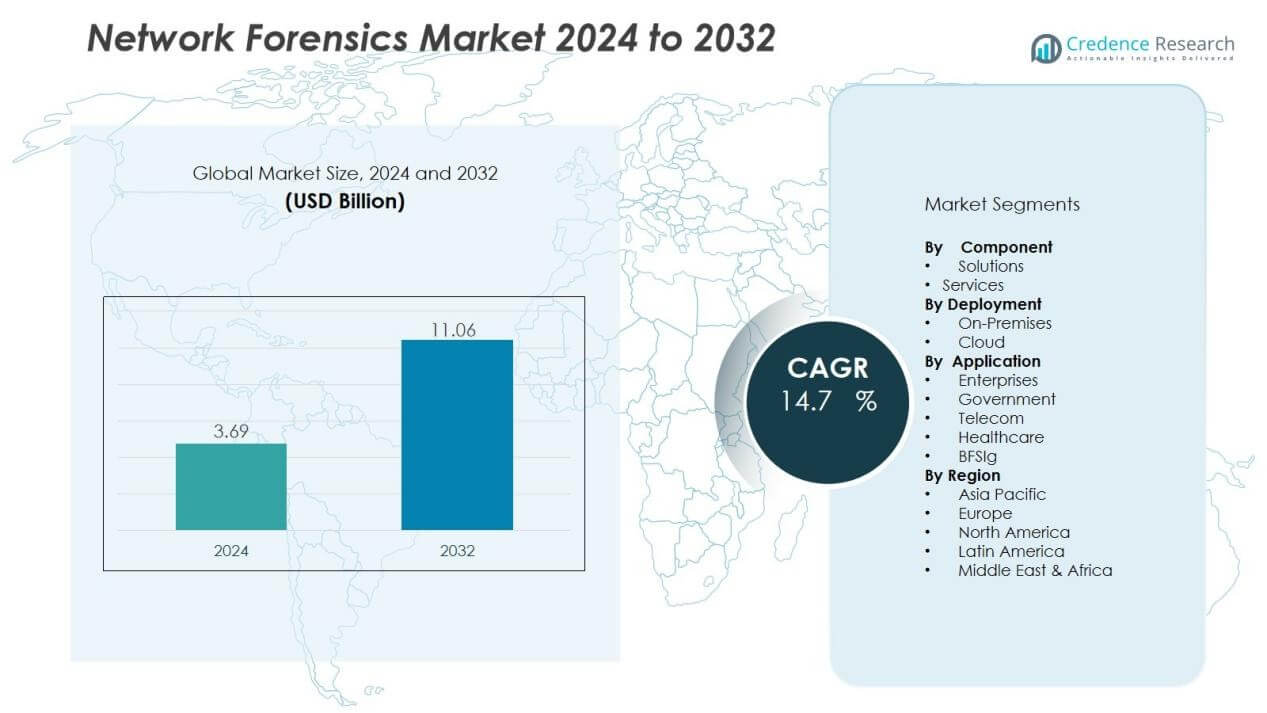
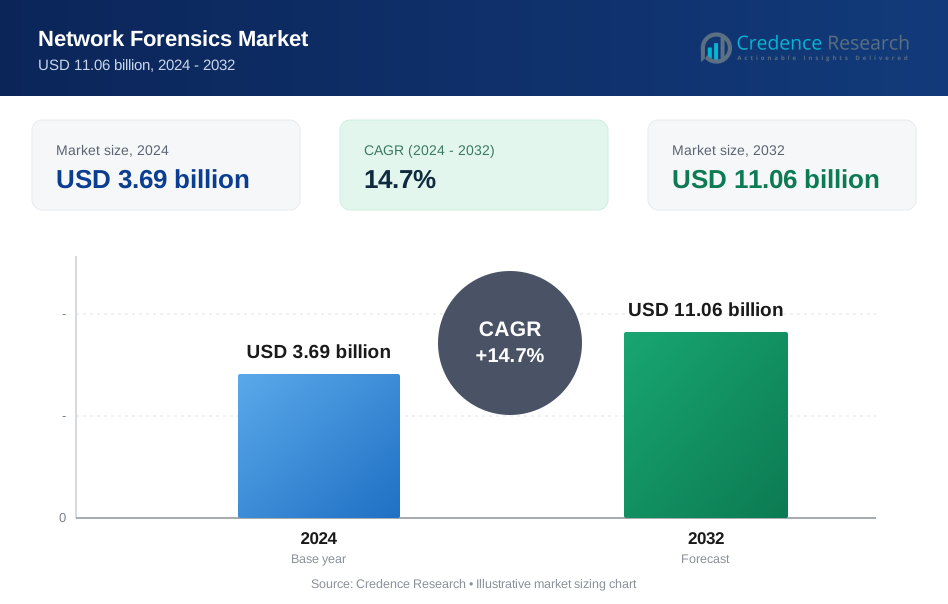
The network forensics market size was valued at USD 3.69 billion in 2024 and is anticipated to reach USD 11.06 billion by 2032, at a CAGR of 14.7 % during the forecast period (2024-2032).
| REPORT ATTRIBUTE | DETAILS |
|---|---|
| Historical Period | 2020-2023 |
| Base Year | 2024 |
| Forecast Period | 2025-2032 |
| Network Forensics Market Size 2024 | USD 3.69 Billion |
| Network Forensics Market, CAGR | 14.7% |
| Network Forensics Market Size 2032 | USD 11.06 Billion |
Key growth drivers include the growing sophistication of cyberattacks, demand for real-time incident response, and rising awareness of data protection. Organizations are investing in network forensics tools to detect anomalies, track malicious activities, and support compliance with stringent data privacy regulations. Advancements in AI, machine learning, and automation are also enhancing the accuracy and efficiency of forensic analysis, making these solutions more effective for enterprises of all sizes.
Regionally, North America dominates the network forensics market, supported by mature cybersecurity infrastructure, high adoption rates, and strong government initiatives. Europe follows closely, driven by GDPR compliance and rising cybercrime incidents. The Asia-Pacific region is projected to grow fastest, fueled by rapid digitalization, expanding cloud networks, and increasing investments in cybersecurity by emerging economies such as India and China. Latin America and the Middle East & Africa are also gaining traction with improving IT infrastructure and growing awareness of cyber resilience.
Market Insights:
- The network forensics market was valued at USD 3.69 billion in 2024 and is projected to reach USD 11.06 billion by 2032, growing at a CAGR of 14.7%.
- Rising cybersecurity threats such as ransomware, phishing, and insider attacks are driving adoption of advanced forensic tools.
- Strict compliance mandates like GDPR and HIPAA are pushing enterprises to integrate network forensics for data protection.
- Expanding cloud infrastructure and remote workforces are increasing demand for solutions that ensure real-time traffic monitoring.
- Advancements in AI and machine learning are enhancing automation, accuracy, and efficiency in forensic investigations.
- North America leads the market with 38% share, followed by Europe at 27% in 2024.
- Asia-Pacific is projected to grow fastest, fueled by rapid digitalization, cloud adoption, and cybersecurity investments in India and China.
- High implementation costs, privacy concerns, and shortage of skilled professionals remain key challenges for market growth.
Market Drivers:
Rising Cybersecurity Threats Driving Advanced Forensic Adoption:
The network forensics market is fueled by the sharp rise in cyberattacks, data breaches, and insider threats. Enterprises face constant risks from ransomware, phishing, and advanced persistent threats, which require faster detection and mitigation. Network forensics tools provide organizations with deeper visibility into traffic patterns, enabling them to trace malicious activity back to its source. It strengthens the ability to identify vulnerabilities and respond effectively to evolving threats.
- For instance, Cisco Stealthwatch Flow Collector 4200 can process up to 120 000 flows per second, enabling security teams to analyze encrypted network traffic in real time and pinpoint anomalies without decryption.
Growing Compliance Mandates and Data Protection Requirements:
Strict regulatory frameworks across industries are pushing organizations to adopt forensic solutions. GDPR in Europe, HIPAA in the U.S., and other global data protection laws require transparent security practices and incident reporting. The network forensics market benefits as enterprises integrate forensic tools to maintain compliance and safeguard sensitive data. It enables timely audits and supports legal investigations through accurate evidence collection.
Expansion of Cloud Infrastructure and Remote Workforces:
The surge in cloud adoption and remote work environments has expanded the attack surface for organizations. Traditional security measures struggle to provide visibility into distributed networks and hybrid infrastructures. The network forensics market addresses these gaps by offering advanced monitoring, investigation, and response capabilities across on-premises and cloud environments. It ensures real-time traffic analysis and supports secure collaboration across global teams.
- For instance, Cisco Secure Network Analytics (v7.4.2) can process 3,000,000 flows per second for threat detection across hybrid networks.
Integration of Artificial Intelligence and Automation Enhancing Capabilities:
Rapid technological advancements are transforming the efficiency of network forensics. AI and machine learning enable automated threat detection, reducing investigation times and human error. The network forensics market leverages these technologies to deliver predictive insights and improve proactive security measures. It empowers organizations to act on anomalies faster, strengthening defenses against increasingly sophisticated cyberattacks.
Market Trends:
Growing Use of AI, Machine Learning, and Automation in Forensic Analysis:
The network forensics market is experiencing a strong shift toward advanced technologies like AI and machine learning. These tools automate threat detection, reduce investigation time, and increase accuracy in identifying anomalies. Automation supports faster root-cause analysis, helping organizations respond more effectively to complex cyber threats. It also allows security teams to manage larger data volumes without straining resources. Vendors are integrating predictive analytics to strengthen proactive defense strategies. This trend is driving adoption across enterprises seeking cost-efficient and scalable solutions.
- For instance, in June 2025, Cisco unveiled its new AI-driven Secure Network Analytics platform, which processed over 450 billion network events daily for predictive threat identification in enterprise deployments.
Increasing Focus on Cloud Security, Remote Workforce Monitoring, and Real-Time Incident Response:
The rapid move to cloud platforms and hybrid IT models has expanded the attack surface for businesses. The network forensics market is addressing this challenge by offering solutions tailored for multi-cloud visibility and remote workforce monitoring. Organizations prioritize tools that provide real-time traffic analysis and incident response to prevent financial and reputational losses. It is pushing vendors to develop more flexible, cloud-native forensic tools with enhanced scalability. Demand for endpoint monitoring and cross-border data analysis is also rising. These factors collectively reflect the market’s shift toward adaptive and resilient security infrastructures.
- For Instance, Palo Alto Networks' Cortex XSIAM is an AI-driven security operations platform that was first introduced in 2022 and is continuously updated with new capabilities. It is widely used by many large enterprises, including Fortune 500 companies, to provide comprehensive security across multi-cloud environments.
Market Challenges Analysis:
High Implementation Costs and Complexity Limiting Adoption:
The network forensics market faces challenges due to the high cost of advanced tools and infrastructure. Smaller organizations often lack the budget to invest in comprehensive forensic solutions, which limits widespread adoption. Complex deployment and integration with existing systems further create barriers for enterprises. It requires specialized expertise to manage forensic platforms, raising training and operational costs. Many businesses also struggle with aligning forensic solutions to their existing cybersecurity framework. This financial and technical burden restricts accessibility for mid-sized firms and startups.
Data Privacy Concerns and Shortage of Skilled Cybersecurity Professionals:
Rising data privacy regulations create concerns about storing and analyzing sensitive traffic data. The network forensics market must address compliance risks tied to cross-border data monitoring and evidence handling. Limited availability of skilled professionals with deep forensic expertise also slows adoption. It leaves organizations dependent on third-party vendors, which can increase operational risks. Growing data volumes and encrypted traffic further strain investigative capabilities. These challenges highlight the need for simplified solutions and stronger talent development within the industry.
Market Opportunities:
Rising Demand for Cloud-Native and Scalable Forensic Solutions:
The network forensics market holds strong opportunities with the expansion of cloud adoption across industries. Enterprises require scalable and flexible forensic tools to secure hybrid and multi-cloud environments. Vendors offering cloud-native solutions gain a competitive edge by meeting evolving enterprise needs. It enables continuous monitoring, faster investigations, and seamless integration with existing cloud platforms. Growing remote workforces further strengthen the demand for solutions that provide visibility across distributed networks. These factors create significant growth potential for providers focused on cloud-ready forensic platforms.
Increasing Adoption Across Critical Infrastructure and Emerging Economies:
Critical infrastructure sectors such as healthcare, energy, and finance are investing heavily in cybersecurity. The network forensics market benefits from this trend as organizations seek advanced tools to detect, trace, and mitigate attacks. It supports compliance and ensures operational continuity in industries where downtime carries high risks. Emerging economies in Asia-Pacific, Latin America, and the Middle East are also increasing investments in cybersecurity infrastructure. Governments and enterprises in these regions are prioritizing forensics to counter rising cyber threats. This creates new opportunities for vendors to expand into high-growth markets with tailored solutions.
Market Segmentation Analysis:
By Component:
The network forensics market is segmented into solutions and services. Solutions, including forensic hardware and software, dominate due to rising demand for advanced traffic analysis and monitoring tools. Services such as consulting, training, and managed forensics are gaining traction, driven by the need for expert guidance and faster deployment. It enables organizations to maximize return on investment while addressing complex security challenges. Both segments play a vital role in ensuring end-to-end forensic capabilities.
- For instance, Magnet Forensics’ Magnet AXIOM 7.9 supports processing mobile images of up to 50 GB of data in a single device analysis.
By Deployment Mode:
The market is divided into on-premises and cloud-based deployment. On-premises solutions hold a strong share, supported by organizations that require full control over sensitive data and infrastructure. Cloud deployment is expanding rapidly due to its scalability, cost-effectiveness, and ability to secure hybrid IT environments. It is particularly appealing for enterprises with distributed operations and growing remote workforces. Cloud adoption is expected to accelerate further with the integration of AI-driven forensic tools.
- For Instance, Mayo Clinic utilizes a cloud-based electronic health records (EHR) system managed by Epic to store and access clinical data for millions of patients, including managing over 10 million patient records leveraged by its digital pathology platform in 2025.
By Application:
The network forensics market serves applications in enterprises, government, telecom, healthcare, and BFSI sectors. Enterprises dominate adoption, focusing on real-time monitoring, compliance, and data breach response. Government and defense agencies leverage forensic tools to address cyber espionage and national security risks. It also finds demand in healthcare and BFSI, where data protection and regulatory adherence are critical. Each application area highlights the market’s role in safeguarding digital ecosystems across industries.
Segmentations:
By Component:
- Solutions
- Services
By Deployment Mode:
- On-Premises
- Cloud
By Application:
- Enterprises
- Government
- Telecom
- Healthcare
- BFSI
By Region:
- North America
- U.S.
- Canada
- Mexico
- Europe
- UK
- France
- Germany
- Italy
- Spain
- Russia
- Belgium
- Netherlands
- Austria
- Sweden
- Poland
- Denmark
- Switzerland
- Rest of Europe
- Asia Pacific
- China
- Japan
- South Korea
- India
- Australia
- Thailand
- Indonesia
- Vietnam
- Malaysia
- Philippines
- Taiwan
- Rest of Asia Pacific
- Latin America
- Brazil
- Argentina
- Peru
- Chile
- Colombia
- Rest of Latin America
- Middle East
- UAE
- KSA
- Israel
- Turkey
- Iran
- Rest of Middle East
- Africa
- Egypt
- Nigeria
- Algeria
- Morocco
- Rest of Africa
Regional Analysis:
North America:
North America held 38% market share in the network forensics market in 2024, driven by advanced cybersecurity infrastructure. The region benefits from strong government initiatives, strict compliance standards, and high adoption of digital technologies. Enterprises in the U.S. and Canada are heavily investing in forensic tools to address sophisticated cyberattacks. It supports faster response to threats and aligns with regulatory frameworks like HIPAA and CCPA. The presence of leading cybersecurity vendors also strengthens the regional landscape. Strong demand from sectors such as finance, healthcare, and defense further reinforces North America’s dominance.
Europe:
Europe accounted for 27% market share in the network forensics market in 2024, supported by strict data protection regulations. The enforcement of GDPR and rising cybercrime incidents are driving the adoption of forensic solutions. Enterprises across Germany, the U.K., and France are prioritizing investments in advanced monitoring and compliance tools. It reflects the region’s focus on data privacy, regulatory alignment, and strong incident response capabilities. Growing adoption in industries like banking, automotive, and public services enhances regional demand. The availability of skilled cybersecurity professionals further supports Europe’s market position.
Asia-Pacific:
Asia-Pacific secured 22% market share in the network forensics market in 2024, fueled by rapid digitalization and expanding IT infrastructure. Governments and enterprises in China, India, and Japan are increasing investments in cybersecurity resilience. It reflects rising concerns over state-sponsored attacks, financial crimes, and cloud security vulnerabilities. Adoption is accelerating in industries such as telecommunications, banking, and e-commerce. Vendors are capitalizing on strong growth potential by offering localized solutions tailored to regional needs. Asia-Pacific is projected to record the highest growth rate, making it a critical focus area for future expansion.
Key Player Analysis:
- Broadcom
- CrowdStrike
- Cisco
- Fortinet
- Juniper
- IBM
- LogRhythm
- SolarWinds
- RSA Security
- Splunk
Competitive Analysis:
The network forensics market is highly competitive, shaped by continuous innovation and rising security demands. Leading players such as Broadcom, CrowdStrike, Cisco, Fortinet, Juniper, IBM, and LogRhythm are investing in advanced technologies to strengthen their market positions. It reflects a landscape where vendors focus on enhancing detection accuracy, reducing investigation times, and integrating AI-driven capabilities. Companies are expanding their product portfolios to address cloud security, endpoint visibility, and real-time analysis requirements. Strategic collaborations, acquisitions, and global expansion remain key approaches to capture emerging opportunities. It also highlights a growing emphasis on managed services, enabling enterprises to overcome resource and expertise gaps. Vendors that combine scalable solutions with regulatory compliance support are expected to secure a strong competitive edge in this evolving market.
Recent Developments:
- In August 2025, CrowdStrike announced its intent to acquire Onum, a real-time telemetry pipeline company, to enhance its Falcon Next-Gen SIEM and accelerate autonomous AI-driven cybersecurity.
- In August 2025, Fortinet was named a Leader in the 2025 Gartner® Magic Quadrant™ for Hybrid Mesh Firewall and introduced its next-generation SASE firewall platform.
Report Coverage:
The research report offers an in-depth analysis based on Component, Deployment Mode, Application and Region. It details leading Market players, providing an overview of their business, product offerings, investments, revenue streams, and key applications. Additionally, the report includes insights into the competitive environment, SWOT analysis, current Market trends, as well as the primary drivers and constraints. Furthermore, it discusses various factors that have driven Market expansion in recent years. The report also explores Market dynamics, regulatory scenarios, and technological advancements that are shaping the industry. It assesses the impact of external factors and global economic changes on Market growth. Lastly, it provides strategic recommendations for new entrants and established companies to navigate the complexities of the Market.
Future Outlook:
- The network forensics market will witness strong adoption driven by the increasing frequency of advanced cyber threats.
- Enterprises will prioritize real-time monitoring and investigation tools to strengthen security resilience.
- Cloud-native forensic solutions will gain traction as hybrid and multi-cloud environments expand globally.
- Integration of AI and machine learning will enhance predictive analysis and automated threat detection.
- Vendors will focus on providing scalable platforms that can handle growing network data volumes.
- The market will see rising demand from critical sectors such as healthcare, finance, and defense.
- Regulatory compliance and strict data protection laws will continue to shape purchasing decisions.
- Asia-Pacific will emerge as a key growth hub due to rapid digitalization and cybersecurity investments.
- Partnerships between technology providers and governments will accelerate innovation in forensic solutions.
- The industry will evolve toward user-friendly tools, reducing complexity and lowering barriers to adoption.
Request a Free Sample
Fill in your details and we'll send you a free sample report.
- Sample data tables & charts
- Research methodology
Need a Custom Version of This Report?
Tailor the scope, geography, or segments to your exact requirements.
- Custom geography or segment scope
- Direct access to our analyst team
Frequently Asked Questions
What is the current market size for the Network Forensics Market, and what is its projected size in 2032?
At what Compound Annual Growth Rate is the Network Forensics Market projected to grow between 2024 and 2032?
Which Network Forensics Market segment held the largest share in 2024?
What are the primary factors fueling the growth of the Network Forensics Market?
Who are the leading companies in the Network Forensics Market?
Which region commanded the largest share of the Network Forensics Market in 2024?
Table of Content
Chapter 1. Report Introduction
- 1.1 Report Description & Purpose
- 1.1.1 Report Title & Market Definition
- 1.1.2 Unique Selling Propositions (USP) & Key Differentiators
- 1.1.3 Value Proposition for Stakeholders
- 1.2 Research Objectives
- 1.2.1 Market Sizing Objectives (Volume & Revenue)
- 1.2.2 Segmentation Objectives
- 1.2.3 Competitive Intelligence Objectives
- 1.2.4 Forecast & Scenario Objectives
- 1.3 Report Scope
- 1.3.1 Network Forensics Scope – Types & Subtypes Covered
- 1.3.2 Geographic Scope – Regions & Countries Covered
- 1.3.3 Historical Period, Base Year & Forecast Period (2024; forecast to 2032)
- 1.3.4 Inclusions & Exclusions
- 1.4 HS Code & Classification Framework
- 1.5 Currency, Units & Pricing Basis
- 1.6 Target Stakeholders
- 1.7 Limitations & Assumptions
Chapter 2. Executive Summary
- 2.1 Global Network Forensics Market Snapshot
- 2.1.1 Market Size – Historical (2024) & Forecast (2024-2032) (2024: USD 3.69 billion → 2032: USD 11.06 billion)
- 2.1.2 Volume & Revenue – Global Totals
- 2.1.3 Key Market Highlights – Top Five Facts
- 2.2 Network Forensics Market Segmentation Snapshot
- 2.2.1 Market Split by Region – 2024 vs. 2032
- 2.3 Competitive Snapshot
- 2.3.1 Top 10 Players by Revenue Share – 2024
- 2.3.2 Top 10 Players by Volume Share – 2024
- 2.3.3 Recent Strategic Developments (18-Month Summary)
- 2.4 Key Investment Highlights & Strategic Conclusions
Chapter 3. Network Forensics Market Dynamics & Industry Analysis
- 3.1 Market Overview & Context
- 3.1.1 Network Forensics Market Position in the Broader Automotive Value Chain
- 3.1.2 OEM vs. Replacement Market Dynamics
- 3.1.3 Market Maturity & Development Stage by Region
- 3.2 Network Forensics Market Drivers
- 3.3 Network Forensics Market Restraints & Challenges
- 3.4 Network Forensics Market Opportunities
- 3.5 Porter's Five Forces Analysis
- 3.5.1 Threat of New Entrants
- 3.5.2 Bargaining Power of Suppliers
- 3.5.3 Bargaining Power of Buyers
- 3.5.4 Threat of Substitutes
- 3.5.5 Competitive Rivalry – Intensity Assessment
- 3.6 Network Forensics Value Chain Analysis
- 3.6.1 Upstream – Raw Material/Input Suppliers
- 3.6.1.1 Raw Material/Input 1
- 3.6.1.2 Raw Material/Input 2
- 3.6.1.3 Raw Material/Input 3
- 3.6.2 Midstream – Production/Manufacturing/Service Delivery
- 3.6.2.1 Production/Process Overview
- 3.6.2.2 Key Facility Locations & Capacity by Manufacturer
- 3.6.3 Downstream – Distribution & End Consumer
- 3.6.3.1 Primary Channel – B2B/OEM
- 3.6.3.2 Secondary Channels – Dealer, Retail, Online, Direct
- 3.6.4 Value Chain Profitability Analysis
- 3.6.1 Upstream – Raw Material/Input Suppliers
- 3.7 PESTEL Analysis
- 3.7.1 Political Factors
- 3.7.2 Economic Factors
- 3.7.3 Social Factors
- 3.7.4 Technological Factors
- 3.7.5 Environmental Factors
- 3.7.6 Legal Factors
- 3.8 Network Forensics Supply Chain Analysis
- 3.8.1 Raw Material/Input Supply Risk Assessment
- 3.8.2 Manufacturing Concentration Risk (Geographic Exposure)
- 3.8.3 Trade Disruption Impact Analysis
- 3.9 Regulatory & Policy Landscape
Note: The regulatory and policy landscape section covers regulations based on their applicability to the market, Network Forensics category, geography, and scope of the study. Only regulatory frameworks with a material impact on operations, compliance, trade, sustainability, or market access are analyzed in detail.
Chapter 4. Key Investment Pockets & Opportunity Analysis
- 4.1 Network Forensics Market Attractiveness Analysis
- 4.1.1 By Region – Investment Attractiveness Matrix (Volume × CAGR)
- 4.2 Absolute Revenue Growth Opportunity
- 4.2.1 By Region – Absolute USD Growth Through 2032
- 4.3 Incremental Volume Opportunity
- 4.3.1 By Region – Incremental Volume Through 2032
- 4.3.2 Segment – Incremental Volume
- 4.4 Emerging Submarket Opportunity Deep Dive (Subject to Applicability)
- 4.5 Emerging Market Opportunity Scorecards
- 4.5.1 United States
- 4.5.2 Europe
- 4.5.3 Asia
- 4.5.4 Middle East & Africa
Note: Emerging Market Opportunity Scorecards will be included based on relevance and strategic importance. Regions listed are indicative and may vary depending on data availability and market dynamics.
Chapter 5. Network Forensics Import-Export Analysis & Trade Flows
- 5.1 Global Trade Overview
- 5.1.1 Global Export Value by Country (2024)
- 5.1.2 Global Export Volume by Country (2024)
- 5.1.3 Global Import Value by Country (2024)
- 5.1.4 Global Import Volume by Country (2024)
- 5.1.5 Net Trade Balance by Country (2024)
- 5.2 Export Analysis – Segment
- 5.2.1 Type 1 (HS Code)
- 5.2.2 Type 2 (HS Code)
- 5.2.3 Type 3 (HS Code)
- 5.2.4 Type 4 (HS Code)
- 5.2.5 Type 5 (HS Code)
- 5.3 Import Analysis – Segment
- 5.3.1 Type 1 (HS Code)
- 5.3.2 Type 2 (HS Code)
- 5.3.3 Type 3 (HS Code)
- 5.3.4 Type 4 (HS Code)
- 5.3.5 Type 5 (HS Code)
- 5.4 Average Unit Trade Prices
- 5.4.1 Average Export Price – Segment & Country
- 5.4.2 Average Import Price – Segment & Source Country
- 5.4.3 Price Trends (2024)
- 5.5 Key Trade Route Analysis
- 5.5.1 Trade Route 1
- 5.5.2 Trade Route 2
- 5.5.3 Trade Route 3
- 5.5.4 Trade Route 4
- 5.5.5 Trade Route 5
- 5.6 Trade Policy Impact Assessment
- 5.6.1 US Anti-Dumping & Section 301 Tariffs
- 5.6.2 EU Customs Union Impact
- 5.6.3 Major Free Trade Agreements
- 5.6.4 USMCA Rules of Origin
Note: Trade policy analysis will be included only where relevant to the Network Forensics market.
Chapter 6. Competitive Landscape & Company Benchmarking
- 6.1 Network Forensics Market Concentration & Structure
- 6.1.1 Herfindahl-Hirschman Index (HHI) – vs. 2024
- 6.1.2 Tier 1, Tier 2 & Tier 3 Market Structure
- 6.1.3 Global, Regional & Local Player Dynamics
- 6.2 Network Forensics Market Share Analysis – 2024
- 6.2.1 Global Revenue Share by Company
- 6.2.2 Global Volume Share by Company
- 6.2.3 Regional Revenue Share
- 6.2.4 Market Share Evolution ( vs. 2024)
- 6.2.5 OEM Segment Share by Company
- 6.2.6 Replacement Segment Share by Company
- 6.3 Production/Delivery Capacity & Facility Analysis
- 6.3.1 Global Installed Capacity
- 6.3.2 Capacity Utilization Rates
- 6.3.3 Production/Output Volume
- 6.3.4 Facility Locations & Capacity Map
- 6.3.5 Planned Capacity Additions
- 6.4 Network Forensics Competitive Benchmarking Matrix
- 6.4.1 Revenue, Volume, CAGR & Profitability Comparison
- 6.4.2 Channel Revenue Mix
- 6.4.3 Geographic Revenue Exposure
- 6.4.4 R&D Intensity
- 6.4.5 Sustainability Maturity
- 6.5 Strategic Developments in Network Forensics (Last 24 Months)
- 6.5.1 Mergers, Acquisitions & Divestments
- 6.5.2 New Network Forensics Launches
- 6.5.3 Facility Expansions
- 6.5.4 Strategic Alliances, Joint Ventures & Partnerships
- 6.5.5 Distribution Expansion & Market Entry
- 6.5.6 Sustainability & ESG Initiatives
- 6.6 Competitive Strategy Mapping
- 6.6.1 Leader, Challenger, Follower & Niche Classification
- 6.6.2 Pricing Strategy Comparison
- 6.6.3 Channel Strategy Matrix
Note: Strategic developments are included based on their materiality and the availability of reliable information.
Chapter 7. Global Network Forensics Market – By Distribution Channel
- 7.1 Segment Overview
- 7.1.1 Volume & Revenue Split by Channel (2024 & 2032)
- 7.1.2 Channel Mix Evolution (2024-2032)
Chapter 8. Regional Market Analysis – Global Overview
- 8.1 Global Regional Overview
- 8.1.1 Regional Volume Share
- 8.1.2 Regional Revenue Share
- 8.1.3 Regional Volume by Region
- 8.1.4 Regional Revenue by Region
- 8.1.5 Regional Forecast Through 2032
- 8.2 Cross-Regional Segment Analysis
- 8.2.1 By Distribution Channel
- 8.2.2 By Brand/Price Tier
Chapter 9. North America Network Forensics Market
- 9.1 United States
- 9.2 Canada
- 9.3 Mexico
Chapter 10. Europe Network Forensics Market
- 10.1 Germany
- 10.2 France
- 10.3 Italy
- 10.4 United Kingdom
- 10.5 Spain
- 10.6 Poland
- 10.7 Russia
- 10.8 Netherlands
- 10.9 Belgium
- 10.10 Sweden
- 10.11 Denmark
- 10.12 Norway
- 10.13 Rest of Europe
Chapter 11. Asia Pacific Network Forensics Market
- 11.1 China
- 11.2 India
- 11.3 Japan
- 11.4 South Korea
- 11.5 Thailand
- 11.6 Indonesia
- 11.7 Vietnam
- 11.8 Malaysia
- 11.9 Australia
- 11.10 Rest of Asia Pacific
Chapter 12. Latin America Network Forensics Market
- 12.1 Brazil
- 12.2 Argentina
- 12.3 Colombia
- 12.4 Chile
- 12.5 Rest of Latin America
Chapter 13. Middle East Network Forensics Market
- 13.1 Saudi Arabia
- 13.2 United Arab Emirates
- 13.3 Turkey
- 13.4 Israel
- 13.5 Iran
- 13.6 Rest of the Middle East
Chapter 14. Africa Network Forensics Market
- 14.1 South Africa
- 14.2 Egypt
- 14.3 Nigeria
- 14.4 Morocco
- 14.5 Rest of Africa
Chapter 15. Network Forensics Company Profiles
- 15.1 [Company 01]
- 15.1.1 Company Overview
- 15.1.2 Key Management Personnel
- 15.1.3 Products & Services Portfolio
- 15.1.4 Financial Performance
- 15.1.5 Key Market Focus & Geographic Presence
- 15.1.6 Recent Developments & Strategic Initiatives
Note: The company profile list is preliminary and may change based on research findings, market developments, data availability, and client requirements.
Chapter 16. Appendices
- Appendix A – List of Abbreviations & Acronyms
- Appendix B – Industry Classification Code Reference – Full Series
- Appendix C – Production & Capacity Data Tables
- Appendix D – End-Use & Demand Base Tables
- Appendix E – Consumption & Replacement Rate Assumptions
- Appendix F – ASP Reference Tables
- Appendix G – Manufacturing & Facility Database
- Appendix H – Import-Export Data Tables
- Appendix I – Regulatory Summary Tables
- Appendix J – Primary Research Participant List (Anonymized)
- Appendix K – Primary Research Questionnaire Framework
- Appendix L – Data Sources & Bibliography
- Appendix M – Market Size Divergence & Source Comparison
Chapter 17. Research Methodology
- 17.1 Research Framework & Philosophy
- 17.2 Secondary Research – Sources, Hierarchy & Data Extraction
- 17.3 Data Modeling – Bottom-Up & Top-Down Market Sizing
- 17.4 Primary Research – Stakeholder Framework, LOI & Sample Sizes
- 17.5 Forecast Methodology – Regression, Scenario & Sensitivity Analysis
- 17.6 Quality Control – Four-Layer Validation Framework
- 17.7 Limitations & Standard Assumptions
- 17.8 Disclaimer
