Market Overview:
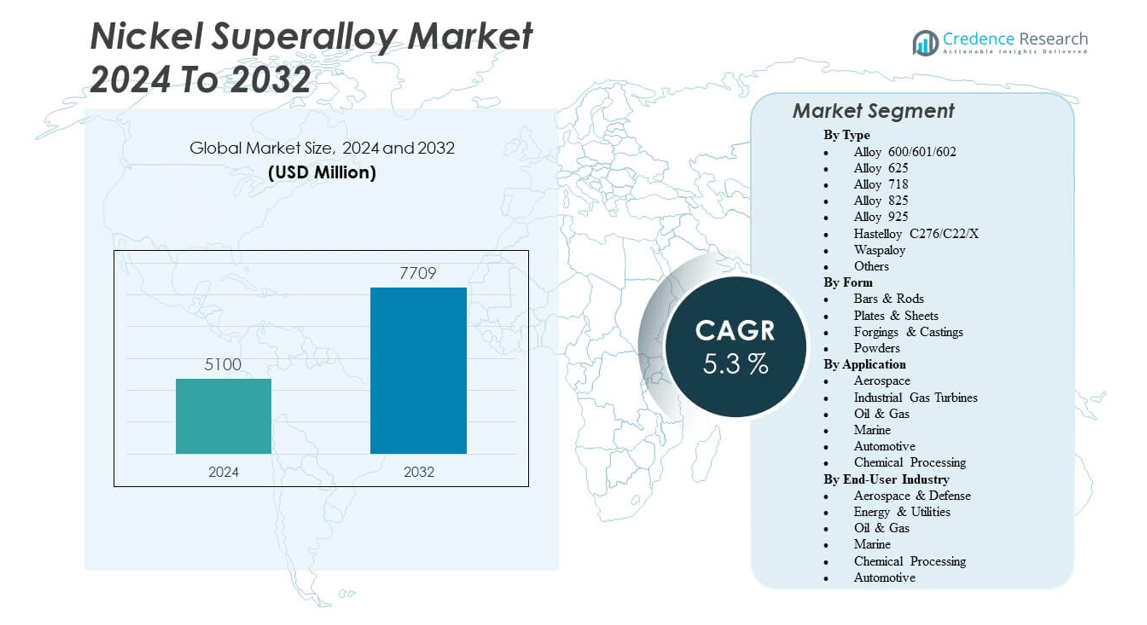
The Nickel Superalloy Market is projected to grow from USD 5100 million in 2024 to an estimated USD 7709 million by 2032, with a compound annual growth rate (CAGR) of 5.3% from 2024 to 2032.
| REPORT ATTRIBUTE | DETAILS |
|---|---|
| Historical Period | 2020-2023 |
| Base Year | 2024 |
| Forecast Period | 2025-2032 |
| Nickel Superalloy Market Size 2024 | USD 5100 million |
| Nickel Superalloy Market, CAGR | 5.3% |
| Nickel Superalloy Market Size 2032 | USD 7709 million |
Market growth is driven by increasing demand from aerospace, power generation, and oil and gas industries. Nickel superalloys are widely used due to their exceptional resistance to heat, corrosion, and mechanical stress in extreme environments. The rising need for efficient jet engines, gas turbines, and industrial equipment strengthens adoption. Furthermore, advancements in additive manufacturing and material innovations expand design possibilities, supporting broader industrial use.
Regionally, North America leads the market, supported by strong aerospace and defense manufacturing capabilities. Europe follows with significant adoption across advanced engineering sectors and sustainable energy initiatives. Asia Pacific is emerging as the fastest-growing region, propelled by rapid industrialization, expanding aviation fleets, and energy infrastructure investments in countries like China and India. The Middle East shows potential due to growing oil and gas activities, while Latin America presents steady but limited growth opportunities.
Market Insights:
- The Nickel Superalloy Market is projected to grow from USD 5100 million in 2024 to USD 7709 million by 2032, at a CAGR of 5.3%.
- Rising aerospace demand drives market growth as jet engines and turbines require heat-resistant alloys.
- Expanding power generation capacity supports adoption, with gas turbines and nuclear plants using nickel-based alloys.
- Oil and gas projects increase reliance on corrosion-resistant alloys for pipelines, valves, and drilling equipment.
- High production costs and raw material volatility remain restraints, challenging smaller manufacturers in the market.
- North America holds the largest share due to strong aerospace and defense industries and advanced R&D activity.
- Asia Pacific emerges as the fastest-growing region, driven by industrialization, aviation expansion, and energy infrastructure investments.
Market Drivers:
Rising Aerospace and Defense Applications Supporting Market Expansion
The demand for lightweight, heat-resistant alloys in aerospace drives growth in the Nickel Superalloy Market. Aircraft engines rely on these materials to withstand extreme conditions while ensuring safety. Defense programs across developed economies support stable demand with consistent procurement cycles. It gains traction from military jet engines and next-generation fighter programs. The market benefits from rising global air travel and new aircraft deliveries. Engine manufacturers emphasize durability and fuel efficiency, boosting alloy usage. Strong collaborations between alloy producers and aerospace firms strengthen long-term contracts. Continuous adoption of advanced manufacturing methods supports performance improvements in critical defense systems.
Growing Role of Energy and Power Generation in Market Development
Global energy demand supports the use of nickel superalloys in turbines and reactors. Power plants require materials that perform under thermal stress and corrosion. The Nickel Superalloy Market benefits from modernization of power infrastructure in major regions. Gas turbines in combined cycle plants depend on alloys to sustain efficiency. It plays a central role in nuclear facilities where safety and durability remain essential. Renewable energy integration also increases turbine demand across wind and hybrid projects. Rising electricity consumption in developing countries strengthens industrial adoption. Industry players focus on extending turbine life cycles, enhancing demand consistency.
Expansion in Oil, Gas, and Industrial Applications Strengthening Market Growth
The oil and gas sector requires reliable materials for exploration and refining equipment. Superalloys withstand pressure and corrosive environments found in offshore platforms and refineries. The Nickel Superalloy Market gains resilience from investment in petrochemical projects. It remains essential for valves, pumps, and pipelines where strength is critical. Industrial equipment manufacturers rely on its properties for performance in harsh settings. Growth in chemical plants and metallurgical industries increases usage scope. Maintenance and replacement cycles support stable aftermarket demand worldwide. End-user reliance on safe, long-lasting materials ensures continued preference for nickel-based solutions.
- For instance, ExxonMobil’s Julia oilfield in the Gulf of Mexico deployed subsea production systems rated for 15,000 psi, reflecting the need for advanced materials capable of withstanding extreme deepwater pressures. Nickel-based superalloys such as Inconel 625 are widely recognized in subsea oil and gas applications for their corrosion resistance and durability in high-pressure, high-temperature environments, making them essential in similar deepwater developments.
Technological Innovations and Additive Manufacturing Shaping Market Growth
Advances in additive manufacturing enhance design flexibility for complex alloy components. It enables cost-efficient production of customized parts with reduced material waste. The Nickel Superalloy Market benefits from rapid prototyping in aerospace and medical devices. 3D printing adoption accelerates development of lighter, stronger, and precise components. Rising research investments improve heat tolerance and corrosion resistance of alloys. Partnerships between research institutions and manufacturers expand innovation pipelines. Digital design platforms support integration of new alloys in modern systems. Strong focus on innovation keeps demand steady across diverse industries.
- For instance, Siemens successfully 3D-printed a fully functional gas turbine blade using a nickel superalloy, tested at rotational speeds of 13,000 revolutions per minute and temperatures above 1,250°C, demonstrating breakthrough additive manufacturing capabilities.
Market Trends:
Increasing Use of Sustainable Materials in Manufacturing Processes
Manufacturers emphasize sustainability in alloy production to meet environmental targets. Recycled nickel and efficient smelting methods reduce carbon footprints in the supply chain. The Nickel Superalloy Market observes strong interest in eco-friendly materials for long-term use. It aligns with global goals for lowering emissions across heavy industries. Governments encourage sustainable practices by enforcing stricter environmental policies. Customers increasingly prefer suppliers committed to responsible sourcing practices. Energy-efficient furnaces and new recycling technologies improve production processes. Industry players explore closed-loop models to strengthen material recovery and cost savings.
Growing Adoption of Digital Tools and Simulation in Alloy Design
Digital design systems enable precise simulation of alloy performance before deployment. It reduces testing costs and accelerates the development cycle for critical components. The Nickel Superalloy Market benefits from predictive modeling in aerospace and automotive. Digital twins allow real-time performance monitoring in turbines and engines. Simulation tools also enhance failure analysis, improving reliability standards. Manufacturers optimize designs by integrating machine learning with material science. Global companies adopt these technologies to maintain competitiveness in specialized markets. Rapid adoption of virtual validation reshapes R&D strategies across industries.
- For instance, DARWIN™ (Design Assessment of Reliability With INspection), developed by Southwest Research Institute under FAA funding, has been validated as a probabilistic life-prediction tool for turbine engine rotors. The software integrates fracture mechanics, material variability, and inspection data to estimate component reliability, supporting compliance with U.S. Federal Aviation Administration Advisory Circulars and enhancing safety assessments in aerospace turbine applications.
Rising Integration of Superalloys in Medical Implants and Devices
The medical sector adopts nickel superalloys for implants requiring strength and biocompatibility. It supports advanced prosthetics and surgical devices where durability is critical. The Nickel Superalloy Market expands into healthcare with high-performance material demand. Orthopedic implants, dental prosthetics, and surgical instruments utilize these alloys widely. Rising healthcare infrastructure investments accelerate adoption across emerging economies. Biocompatible coatings and precision manufacturing improve acceptance in medical use. Research into lightweight alloys enhances patient comfort and safety. Growing medical tourism further strengthens demand for advanced surgical materials.
- For instance, electropolished nickel–titanium (Nitinol) stents used in vascular treatments have demonstrated superior corrosion resistance and reduced nickel ion release in immersion studies. These performance improvements enhance biocompatibility, aligning with the rising integration of nickel-based alloys in medical implants and surgical devices.
Expanding Role of Superalloys in Automotive and Electric Mobility Solutions
Automotive firms integrate nickel alloys in engines and exhaust systems for efficiency. It also gains importance in electric mobility due to thermal management needs. The Nickel Superalloy Market adapts to demand from hybrid and EV segments. Manufacturers prioritize alloys that enhance battery and motor system durability. Stringent emission regulations increase reliance on efficient alloy components. Automotive R&D explores alloy integration in turbochargers and high-performance systems. Industry collaborations with alloy producers accelerate innovation for next-gen vehicles. Expanding electric infrastructure ensures stable demand from mobility solutions.
Market Challenges Analysis:
High Production Costs and Resource Dependency Restraining Growth
The production of nickel superalloys requires expensive raw materials and complex processes. High costs create challenges for smaller manufacturers competing with global players. The Nickel Superalloy Market struggles with price volatility of nickel and cobalt. It faces resource dependency risks due to limited mining regions. Production also demands advanced technology and skilled labor, raising operational expenses. End-users hesitate to adopt high-cost alloys in budget-constrained sectors. Limited supply of critical minerals increases procurement challenges for manufacturers. Environmental restrictions on mining further constrain raw material availability.
Complex Manufacturing Standards and Substitution Threats Impacting Market
Manufacturers must comply with stringent certification standards in aerospace and energy sectors. Failure to meet regulations results in delays and financial losses. The Nickel Superalloy Market faces challenges from growing interest in alternative alloys. It competes with titanium and advanced ceramics in certain applications. Technical barriers limit new entrants from scaling production quickly. Market players invest heavily in R&D to maintain compliance with global standards. Substitution threats pressurize alloy producers to improve cost-effectiveness. Constant need for innovation adds further strain on profitability.
Market Opportunities:
Expanding Role in Space Exploration and Advanced Aviation Programs
New investments in space exploration create opportunities for high-performance materials. It supports rockets, satellites, and spacecraft that require durability under extreme heat. The Nickel Superalloy Market benefits from collaborations with global space agencies. Commercial aviation programs also increase adoption of next-gen engines with alloy components. Rising air passenger numbers boost demand for fuel-efficient aircraft materials. Space tourism initiatives introduce additional markets for specialized alloys. Strategic government funding accelerates R&D in high-performance aerospace materials. Demand for advanced alloys in hypersonic travel strengthens the long-term outlook.
Growing Industrial Automation and Renewable Energy Projects Driving Future Growth
Industrial automation expands the need for durable materials in robotics and equipment. It relies on nickel alloys for reliable performance in high-stress environments. The Nickel Superalloy Market gains from renewable energy projects integrating turbines and hybrid systems. Expanding wind and solar infrastructure creates consistent opportunities for alloy applications. Growth in hydrogen energy initiatives enhances demand for corrosion-resistant materials. Manufacturers focus on creating alloys that support cleaner energy transitions. Collaborations between energy firms and material scientists strengthen innovation pipelines. Future demand remains linked to sustainability and digital industrialization trends.
Market Segmentation Analysis:
By type, the Nickel Superalloy Market demonstrates strong demand across alloy types, with grades such as Alloy 600/601/602, Alloy 625, and Alloy 718 widely utilized in aerospace engines and turbines due to their high-temperature strength. Alloy 825 and Alloy 925 serve vital roles in oil and gas operations, while Hastelloy and Waspaloy extend applications to chemical processing and industrial components. It gains momentum from tailored alloys addressing specific industry needs, while the “Others” category covers niche and emerging grades that strengthen flexibility across applications.
- For example, Outokumpu’s Ultra Alloy 825 is a central material in sour gas fields and carbon capture infrastructure for oil and gas extraction, corrosion resistance is confirmed by its use in fractionating trays and air-cooled heat exchangers in refineries and hydrogen systems.
By form, bars and rods remain highly adopted in aerospace and defense for structural applications, while plates and sheets are preferred in marine and automotive industries. Forgings and castings dominate heavy-duty equipment manufacturing due to durability requirements, while powders gain traction in additive manufacturing, enabling precise and cost-efficient production. The Nickel Superalloy Market strengthens its position by adapting forms to diverse production methods and end-use needs.
- For example, Scot Forge delivers open-die forged nickel superalloy components for defense and nuclear applications, while Precision Castparts Corp produces nickel alloy cast turbine rotors and pressure vessels for power generation.
By application, aerospace leads the market with extensive use in turbine blades, jet engines, and critical components. Industrial gas turbines in power plants also rely heavily on nickel-based alloys for efficiency. Oil and gas operations deploy them in valves, pumps, and pipelines, while marine industries use them for corrosion resistance. Automotive and chemical processing sectors extend their scope, supporting balanced adoption across industries.
By end-user industry, aerospace and defense hold the largest share, followed by energy and utilities. Oil and gas remains vital, while chemical processing and automotive industries continue to expand demand, reflecting wide industrial integration.
Segmentation:
By Type
- Alloy 600/601/602
- Alloy 625
- Alloy 718
- Alloy 825
- Alloy 925
- Hastelloy C276/C22/X
- Waspaloy
- Others
By Form
- Bars & Rods
- Plates & Sheets
- Forgings & Castings
- Powders
By Application
- Aerospace
- Industrial Gas Turbines
- Oil & Gas
- Marine
- Automotive
- Chemical Processing
By End-User Industry
- Aerospace & Defense
- Energy & Utilities
- Oil & Gas
- Marine
- Chemical Processing
- Automotive
By Region
- North America
- U.S.
- Canada
- Mexico
- Europe
- UK
- France
- Germany
- Italy
- Spain
- Russia
- Belgium
- Netherlands
- Austria
- Sweden
- Poland
- Denmark
- Switzerland
- Rest of Europe
- Asia Pacific
- China
- Japan
- South Korea
- India
- Australia
- Thailand
- Indonesia
- Vietnam
- Malaysia
- Philippines
- Taiwan
- Rest of Asia Pacific
- Latin America
- Brazil
- Argentina
- Peru
- Chile
- Colombia
- Rest of Latin America
- Middle East
- UAE
- KSA
- Israel
- Turkey
- Iran
- Rest of Middle East
- Africa
- Egypt
- Nigeria
- Algeria
- Morocco
- Rest of Africa
Regional Analysis:
North America holds the largest share of the Nickel Superalloy Market at 34%, driven by advanced aerospace, defense, and energy sectors. The region benefits from strong aircraft engine production and extensive use in power generation turbines. It also gains momentum from investments in industrial gas turbines and oilfield equipment. Leading aerospace manufacturers and defense contractors contribute to consistent demand. It remains a critical market due to high R&D spending and presence of established alloy producers. Government-backed energy initiatives strengthen market stability across diverse industrial applications.
Europe accounts for 27% of the market, supported by robust aerospace manufacturing hubs in Germany, France, and the UK. Strong chemical processing industries and emphasis on renewable energy projects increase alloy usage. The region prioritizes materials with high efficiency and sustainability, aligning with regulatory standards. It shows strong growth in marine applications due to shipbuilding activities and advanced naval programs. It benefits from close collaboration between alloy producers and industrial end-users. Regional innovation pipelines continue to introduce new materials with better corrosion resistance and heat performance.
Asia Pacific secures 25% of the market, emerging as the fastest-growing region. Expanding aviation fleets in China and India fuel higher demand for jet engines and turbine components. Strong energy infrastructure investments support wide adoption of nickel alloys in gas turbines and power plants. Japan and South Korea play vital roles with advanced automotive and electronics industries adopting high-performance alloys. It gains resilience from industrial diversification, with chemical and marine sectors expanding rapidly. The Middle East & Africa and Latin America collectively account for 14% of the market, supported by oil and gas activities, marine applications, and developing aerospace programs.
Key Player Analysis:
- Precision Castparts Corp. (PCC)
- Allegheny Technologies Incorporated (ATI)
- Carpenter Technology Corporation
- Haynes International Inc.
- Special Metals Corporation
- Doncasters Group Ltd.
- VDM Metals GmbH
- Nippon Yakin Kogyo Co., Ltd.
- Rolled Alloys Inc.
- Hitachi Metals
- Sandvik AB
- Arconic Corporation
Competitive Analysis:
The Nickel Superalloy Market is highly competitive with global and regional players focusing on innovation, supply reliability, and industry partnerships. Leading companies such as ATI Inc., Precision Castparts Corp., VSMPO-AVISMA, Haynes International, and Special Metals dominate with extensive product portfolios and strong distribution networks. It maintains intensity through constant R&D investment aimed at improving material performance under extreme conditions. Strategic alliances with aerospace, energy, and oil and gas companies strengthen market positioning. Regional players compete through cost-effective production and niche alloy development. Continuous innovation, sustainability practices, and customer-focused solutions remain key strategies for sustaining leadership in the industry.
Recent Developments:
- In August 2025, EverMetal Holdings acquired CAI Custom Alloys LLC, a processor of nickel-based superalloy scrap. The strategic acquisition enhances domestic recycling capacity and secures supply chains for aerospace, defense, power generation, and medical industries.
- In April 2025, QuesTek Innovations LLC introduced a novel nickel-based superalloy designed for additive manufacturing in collaboration with Stoke Space. This high-performance alloy, fully qualified for the Zenith engine’s extreme oxygen-rich combustion environment, supports durable, high-frequency rocket reuse.
- In June 2024, Alloyed and Aubert & Duval launched ABD‑1000AM, a new nickel superalloy engineered for additive manufacturing. The alloy delivers high-temperature strength beyond 1000 °C and crack-free printability, expanding applications across aerospace, power, automotive, defense, and space sectors.
Report Coverage:
The research report offers an in-depth analysis based on Type, Form, Application and End-User Industry. It details leading market players, providing an overview of their business, product offerings, investments, revenue streams, and key applications. Additionally, the report includes insights into the competitive environment, SWOT analysis, current market trends, as well as the primary drivers and constraints. Furthermore, it discusses various factors that have driven market expansion in recent years. The report also explores market dynamics, regulatory scenarios, and technological advancements that are shaping the industry. It assesses the impact of external factors and global economic changes on market growth. Lastly, it provides strategic recommendations for new entrants and established companies to navigate the complexities of the market.
Future Outlook:
- Aerospace demand will remain the strongest driver, with advanced jet engines requiring durable and heat-resistant alloys.
- Industrial gas turbines will expand usage, supported by rising electricity generation and global energy modernization efforts.
- Oil and gas investments in offshore drilling and refining will continue to boost demand for corrosion-resistant alloys.
- Marine applications will strengthen as shipbuilding and naval defense programs emphasize long-lasting, high-performance materials.
- Automotive innovation will increase alloy adoption, driven by emission standards and lightweight design requirements.
- Additive manufacturing will unlock growth by reducing production waste and enabling precision alloy component development.
- Emerging economies will accelerate adoption as industrialization and infrastructure projects demand advanced materials.
- Sustainability initiatives will reshape production, with greater focus on recycling and low-emission manufacturing practices.
- Strategic collaborations between alloy producers and aerospace or energy companies will enhance technology pipelines.
- Continuous research will lead to alloys with higher efficiency, durability, and adaptability across multiple industries.

Request a Free Sample
Fill in your details and we'll send you a free sample report.
- Sample data tables & charts
- Research methodology
Market Dynamics
Aerospace and Defense Applications
The need for lightweight, heat-resistant alloys in jet engines and military aircraft is a primary growth driver, as these components must withstand extreme temperatures and mechanical stress. Ongoing global air travel growth and new aircraft deliveries, along with defense procurement cycles, ensure sustained demand for nickel superalloys.
Expansion of Power Generation and Energy Infrastructure
Modernization of power plants and the expansion of gas turbines and nuclear facilities require materials that maintain performance under high thermal and corrosive stress. The push for more efficient and durable turbines in both conventional and renewable energy sectors is increasing the adoption of nickel superalloys.
Growth in Oil & Gas and Industrial Sectors
Nickel superalloys are essential for equipment exposed to high pressure and corrosive environments, such as pipelines, valves, and drilling systems in oil and gas operations. Investments in petrochemical and industrial projects, especially in deepwater and harsh environments, are driving market growth.
Advancements in Additive Manufacturing and Material Innovation
Technological progress in 3D printing and alloy development enables the production of complex, high-performance components with reduced waste and improved properties. This expands the application scope of nickel superalloys in aerospace, medical, and automotive industries.
Sustainability and Recycling Initiatives
Increasing emphasis on sustainable manufacturing processes, including the use of recycled nickel and efficient smelting, is driving market growth. Environmental regulations and customer preference for eco-friendly materials are encouraging manufacturers to adopt greener production methods, supporting long-term market expansion.
Need a Custom Version of This Report?
Tailor the scope, geography, or segments to your exact requirements.
- Custom geography or segment scope
- Direct access to our analyst team
Frequently Asked Questions
What is the current market size for Nickel Superalloy Market, and what is its projected size in 2032?
Which Nickel Superalloy Market segment held the largest share in 2024?
What are the primary factors fueling the growth of the Nickel Superalloy Market?
Who are the leading companies in the Nickel Superalloy Market?
Table of Content
Chapter 1 Market Segmentation
- 1.1 Segmentation Framework
- 1.1.1 Product and Service Classification
- 1.1.2 Application and End-Use Classification
- 1.1.3 Technology and Solution Classification
- 1.1.4 Customer and Distribution Channel Classification
- 1.1.5 Geographic Segmentation
- 1.1.6 Market Segment Definitions and Boundaries
- 1.2 By Form
- 1.2.1 Bars & Rods
- 1.2.2 Plates & Sheets
- 1.2.3 Forgings & Castings
- 1.2.4 Powders
- 1.3 By Type
- 1.3.1 Alloy 600/601/602
- 1.3.2 Alloy 625
- 1.3.3 Alloy 718
- 1.3.4 Alloy 825
- 1.3.5 Alloy 925
- 1.3.6 Hastelloy C276/C22/X
- 1.3.7 Waspaloy
- 1.3.8 Others
- 1.4 By Application
- 1.4.1 Aerospace
- 1.4.2 Industrial Gas Turbines
- 1.4.3 Oil & Gas
- 1.4.4 Marine
- 1.4.5 Automotive
- 1.4.6 Chemical Processing
- 1.5 By End-User Industry
- 1.5.1 Aerospace & Defense
- 1.5.2 Energy & Utilities
- 1.5.3 Oil & Gas
- 1.5.4 Marine
- 1.5.5 Chemical Processing
- 1.5.6 Automotive
Chapter 2 Introduction
- 2.1 Report Objectives and Scope
- 2.2 Product Definition and Industry Terminology
- 2.3 Market Inclusions and Exclusions
- 2.4 Research Process
- 2.4.1 Primary Research and Expert Interviews
- 2.4.2 Secondary Research and Source Review
- 2.4.3 Top-Down and Bottom-Up Estimation
- 2.4.4 Data Triangulation and Verification
- 2.5 Market Size Measurement Basis
- 2.5.1 2024: USD 5100 million → 2032: USD 7709 million
- 2.6 Historical and Forecast Reference Periods
- 2.6.1 Base Year: 2024
- 2.6.2 Forecast Period: 2024-2032
- 2.7 Research Assumptions and Limitations
Chapter 3 Executive Summary
- 3.1 Market Snapshot and Key Findings
- 3.2 Base-Year Market Size, 2024
- 3.3 Forecast Market Size, 2032
- 3.4 Revenue and Volume Growth Outlook
- 3.5 Key Demand and Supply Indicators
- 3.6 Leading Market Segments
- 3.7 Fastest-Growing Market Opportunities
- 3.8 Regional Performance Highlights
- 3.9 Technology and Industry Transformation
- 3.10 Competitive Landscape Summary
- 3.11 Analyst View and Strategic Implications
Chapter 4 Global Nickel Superalloy Market Trends and Developments
- 4.1 Historical Industry Development
- 4.2 Recent Market Trends and Developments
- 4.3 Demand and Customer Behavior Trends
- 4.4 Technology and Product Innovation
- 4.5 Artificial Intelligence, Automation and Digitalization
- 4.6 Local Manufacturing and Supply Chain Realignment
- 4.7 Industry Partnerships, Mergers and Acquisitions
- 4.8 Sustainability and Circular Economy Developments
- 4.9 Government and Private Sector Investment Trends
- 4.10 Emerging Business Models and Commercialization
- 4.11 Industry Developments and Announcements
Chapter 5 Global Nickel Superalloy Market Production, Supply and Demand Analysis
- 5.1 Demand Trend and Consumption Analysis
- 5.2 Demand Forecast, 2024-2032
- 5.3 Production and Output Trend
- 5.4 Production and Output Forecast, 2024-2032
- 5.5 Installed Capacity and Capacity Utilization
- 5.6 Company-Wise Production Plants and Statistics
- 5.6.1 Installed Production Capacity
- 5.6.2 Actual Production
- 5.6.3 Planned Capacity and Expansion Targets
- 5.7 Supply Chain Structure and Procurement Trends
- 5.8 Supply-Demand Gap and Bottlenecks
- 5.9 Import Dependence and Sourcing Structure
- 5.10 Contract Manufacturing and Outsourcing
- 5.11 Regional Supply and Demand Concentration
Chapter 6 Global Nickel Superalloy Market Pricing Analysis
- 6.1 Pricing Structure and Measurement
- 6.2 Historical Pricing Trends
- 6.3 Pricing Outlook, 2024-2032
- 6.4 Average Selling Price and Unit Economics
- 6.5 Pricing by Product and Market Segment
- 6.6 Geographic Pricing Differences
- 6.7 Key Input, Energy, Labor and Logistics Costs
- 6.8 Contract Pricing and Purchasing Models
- 6.9 Pricing Sensitivity and Competitive Positioning
- 6.10 Price, Margin and Profitability Implications
Chapter 7 Global Nickel Superalloy Market Dynamics
- 7.1 Market Growth Drivers
- 7.1.1 Demand-Side Drivers
- 7.1.2 Technology and Innovation Drivers
- 7.1.3 Infrastructure and Investment Drivers
- 7.1.4 Regulatory and Policy Drivers
- 7.2 Market Restraints
- 7.2.1 Cost and Affordability Constraints
- 7.2.2 Technology and Adoption Barriers
- 7.2.3 Supply Chain and Operational Constraints
- 7.3 Market Challenges
- 7.3.1 Competitive Pressure and Margin Erosion
- 7.3.2 Skills, Infrastructure and Implementation Gaps
- 7.4 Emerging Market Opportunities
- 7.5 Market Dynamics Impact and Time-Horizon Assessment
Chapter 8 Global Nickel Superalloy Value Chain Analysis
- 8.1 Industry Value Chain Overview
- 8.2 Upstream Suppliers and Critical Inputs
- 8.3 Technology and Component Providers
- 8.4 Manufacturing or Service Delivery
- 8.5 Distribution, Channel Partners and Integrators
- 8.6 Downstream Applications and End Users
- 8.7 Value Addition and Profit Pools
- 8.8 Vertical Integration and Outsourcing
- 8.9 Supplier Concentration and Risk
- 8.10 Supply Chain Localization and Resilience
Chapter 9 Global Nickel Superalloy Market Regulations and Policies
- 9.1 Relevant Laws, Standards and Compliance Frameworks
- 9.2 Product, Service, Safety and Quality Requirements
- 9.3 Government Policies, Incentives and Subsidies
- 9.4 Imports, Exports and Trade Barriers
- 9.5 Public Procurement and Local Content Requirements
- 9.6 Environmental and Sustainability Compliance
- 9.7 Upcoming Policy Changes and Market Implications
Chapter 10 Global Nickel Superalloy Market Hotspots and Opportunities
- 10.1 Market Opportunity Mapping and Growth Hotspots
- 10.2 High-Growth Applications and Customer Groups
- 10.3 Underserved Markets and White-Space Opportunities
- 10.4 Emerging Technology and Product Opportunities
- 10.5 New Capacity and Investment Hotspots
- 10.6 Market Entry and Expansion Opportunities
- 10.7 Distribution and Partnership Opportunities
- 10.8 Near-Term and Long-Term Commercial Potential
- 10.9 Opportunity Attractiveness and Execution Risks
Chapter 11 Global Nickel Superalloy Market Outlook, 2024-2032
- 11.1 Market Size and Analysis
- 11.1.1 Revenue (Market Measurement: 2024: USD 5100 million → 2032: USD 7709 million)
- 11.1.2 Market Volume and Quantity Sold
- 11.1.3 Historical Market Size
- 11.1.4 Base-Year Market Size, 2024
- 11.2 Market Forecast, 2024-2032
- 11.2.1 Revenue Forecast to 2032
- 11.2.2 Volume Forecast to 2032
- 11.2.3 CAGR and Year-on-Year Growth
- 11.2.4 Incremental Revenue Opportunity
- 11.3 Forecast Assumptions and Scenario Analysis
- 11.3.1 Base-Case Forecast
- 11.3.2 Optimistic and Conservative Scenarios
- 11.3.3 Technology, Pricing and Policy Sensitivities
- 11.4 Market Attractiveness and Growth Outlook
Chapter 12 Global Nickel Superalloy Market Segmentation and Outlook
- 12.1 Segmentation Summary and Market Shares, 2024
- 12.2 Largest and Fastest-Growing Segments
- 12.3 By Form - Market Size and Forecast, 2024-2032
- 12.3.1 Segment Definition and Scope
- 12.3.2 Historical Market Size
- 12.3.3 Revenue Forecast, 2024-2032
- 12.3.4 Volume Forecast, 2024-2032
- 12.3.5 Base-Year Market Share, 2024
- 12.3.6 Segment CAGR and Growth Drivers
- 12.3.7 Subsegment Market Size and Forecast
- 12.3.7.1 Bars & Rods
- 12.3.7.2 Plates & Sheets
- 12.3.7.3 Forgings & Castings
- 12.3.7.4 Powders
- 12.3.8 Subsegment Pricing and Adoption Trends
- 12.3.9 Leading Suppliers and Competition
- 12.3.10 Regional Demand and Opportunities
- 12.4 By Type - Market Size and Forecast, 2024-2032
- 12.4.1 Segment Definition and Scope
- 12.4.2 Historical Market Size
- 12.4.3 Revenue Forecast, 2024-2032
- 12.4.4 Volume Forecast, 2024-2032
- 12.4.5 Base-Year Market Share, 2024
- 12.4.6 Segment CAGR and Growth Drivers
- 12.4.7 Subsegment Market Size and Forecast
- 12.4.7.1 Alloy 600/601/602
- 12.4.7.2 Alloy 625
- 12.4.7.3 Alloy 718
- 12.4.7.4 Alloy 825
- 12.4.7.5 Alloy 925
- 12.4.7.6 Hastelloy C276/C22/X
- 12.4.7.7 Waspaloy
- 12.4.7.8 Others
- 12.4.8 Subsegment Pricing and Adoption Trends
- 12.4.9 Leading Suppliers and Competition
- 12.4.10 Regional Demand and Opportunities
- 12.5 By Application - Market Size and Forecast, 2024-2032
- 12.5.1 Segment Definition and Scope
- 12.5.2 Historical Market Size
- 12.5.3 Revenue Forecast, 2024-2032
- 12.5.4 Volume Forecast, 2024-2032
- 12.5.5 Base-Year Market Share, 2024
- 12.5.6 Segment CAGR and Growth Drivers
- 12.5.7 Subsegment Market Size and Forecast
- 12.5.7.1 Aerospace
- 12.5.7.2 Industrial Gas Turbines
- 12.5.7.3 Oil & Gas
- 12.5.7.4 Marine
- 12.5.7.5 Automotive
- 12.5.7.6 Chemical Processing
- 12.5.8 Subsegment Pricing and Adoption Trends
- 12.5.9 Leading Suppliers and Competition
- 12.5.10 Regional Demand and Opportunities
- 12.6 By End-User Industry - Market Size and Forecast, 2024-2032
- 12.6.1 Segment Definition and Scope
- 12.6.2 Historical Market Size
- 12.6.3 Revenue Forecast, 2024-2032
- 12.6.4 Volume Forecast, 2024-2032
- 12.6.5 Base-Year Market Share, 2024
- 12.6.6 Segment CAGR and Growth Drivers
- 12.6.7 Subsegment Market Size and Forecast
- 12.6.7.1 Aerospace & Defense
- 12.6.7.2 Energy & Utilities
- 12.6.7.3 Oil & Gas
- 12.6.7.4 Marine
- 12.6.7.5 Chemical Processing
- 12.6.7.6 Automotive
- 12.6.8 Subsegment Pricing and Adoption Trends
- 12.6.9 Leading Suppliers and Competition
- 12.6.10 Regional Demand and Opportunities
- 12.7 Segment Growth Comparison
- 12.8 Segment Attractiveness and Priority Matrix
Chapter 13 Global Nickel Superalloy End-Use and Application Market Outlook
- 13.1 End-Use Industry and Customer Demand Structure
- 13.2 Leading Applications and Customer Groups
- 13.3 End-Use Market Size, Share and Forecast
- 13.4 Major End-Use Industry Deep Dives
- 13.4.1 Customer Requirements and Use Cases
- 13.4.2 Demand and Replacement Cycles
- 13.4.3 Technical and Regulatory Considerations
- 13.4.4 Purchasing and Procurement Models
- 13.4.5 Leading Vendors and Distribution Channels
- 13.4.6 Forecast and Commercial Opportunities
- 13.5 Emerging Applications and Cross-Segment Demand
- 13.6 End-Use Industry Investment Priorities
Chapter 14 Global Nickel Superalloy Geographic Market Outlook, 2024-2032
- 14.1 Regional Market Size and Share, 2024
- 14.2 Regional Market Forecast, 2024-2032
- 14.3 Regional Pricing, Production and Demand Differences
- 14.4 North America
- 14.4.1 United States
- 14.4.2 Canada
- 14.4.3 Mexico
- 14.5 Europe
- 14.5.1 Germany
- 14.5.2 France
- 14.5.3 Italy
- 14.5.4 United Kingdom
- 14.5.5 Spain
- 14.5.6 Poland
- 14.5.7 Russia
- 14.5.8 Netherlands
- 14.5.9 Belgium
- 14.5.10 Sweden
- 14.5.11 Denmark
- 14.5.12 Norway
- 14.5.13 Rest of Europe
- 14.6 Asia Pacific
- 14.6.1 China
- 14.6.2 India
- 14.6.3 Japan
- 14.6.4 South Korea
- 14.6.5 Thailand
- 14.6.6 Indonesia
- 14.6.7 Vietnam
- 14.6.8 Malaysia
- 14.6.9 Australia
- 14.6.10 Rest of Asia Pacific
- 14.7 Latin America
- 14.7.1 Brazil
- 14.7.2 Argentina
- 14.7.3 Colombia
- 14.7.4 Chile
- 14.7.5 Rest of Latin America
- 14.8 Middle East
- 14.8.1 Saudi Arabia
- 14.8.2 United Arab Emirates
- 14.8.3 Turkey
- 14.8.4 Israel
- 14.8.5 Iran
- 14.8.6 Rest of the Middle East
- 14.9 Africa
- 14.9.1 South Africa
- 14.9.2 Egypt
- 14.9.3 Nigeria
- 14.9.4 Morocco
- 14.9.5 Rest of Africa
- 14.10 Regional Investment, Policy and Supply Chain Differences
- 14.11 Regional Competitive Landscape
- 14.12 Geographic Growth Hotspots
Chapter 15 Global Nickel Superalloy Technology, Innovation and Sustainability Outlook
- 15.1 Technology Landscape and Maturity
- 15.2 Product, Process and Service Innovation
- 15.3 AI, Automation and Digital Tools in the Industry
- 15.4 Technology Adoption and Performance Benchmarking
- 15.5 Innovation Pipeline and R&D Investment
- 15.6 Patent and Intellectual Property Trends
- 15.7 Energy Efficiency and Resource Management
- 15.8 Sustainability, Recycling and Circularity
- 15.9 Technology Roadmap, 2024-2032
- 15.10 Risks of Obsolescence and Technology Substitution
Chapter 16 Global Nickel Superalloy Market Key Strategic Imperatives
- 16.1 Growth and Market Entry Priorities
- 16.2 High-Return Products and Segments
- 16.3 Pricing, Profitability and Cost Optimization
- 16.4 Technology Investment and Product Differentiation
- 16.5 Supply Chain Localization and Resilience
- 16.6 Distribution and Customer Acquisition
- 16.7 Partnership, Acquisition and Capacity Strategy
- 16.8 Regional Expansion Priorities
- 16.9 Short-, Medium- and Long-Term Actions
Chapter 17 Competition Outlook
- 17.1 Industry Competition Characteristics
- 17.2 Market Structure and Concentration
- 17.3 Market Share and Competitive Positioning, 2024
- 17.4 Company-Wise Revenue and Product Benchmarking
- 17.5 Production and Service Capacity Benchmarking
- 17.6 Technology, Pricing and Differentiation
- 17.7 Regional Footprint and Distribution Strength
- 17.8 Mergers, Acquisitions and Strategic Alliances
- 17.9 New Entrants and Competitive Threats
- 17.10 Porter's Five Forces and Industry Attractiveness
- 17.11 Competitive Outlook, 2024-2032
Chapter 18 Company Profiles
- 18.1 Company Coverage and Selection Criteria
- 18.2 Precision Castparts Corp. (PCC)
- 18.2.1 Business Description
- 18.2.2 Company Ownership and Geographic Presence
- 18.2.3 Product and Service Portfolio
- 18.2.4 Manufacturing and Operating Footprint
- 18.2.5 Production Capacity and Expansion Plans
- 18.2.6 Financial Performance and Investment
- 18.2.7 Market Share and Competitive Position
- 18.2.8 Technology and Innovation Capabilities
- 18.2.9 Strategic Alliances or Partnerships
- 18.2.10 Recent Developments
- 18.2.11 Growth Strategy and Outlook
- 18.3 Allegheny Technologies Incorporated (ATI)
- 18.4 Carpenter Technology Corporation
- 18.5 Haynes International Inc.
- 18.6 Special Metals Corporation
- 18.7 Doncasters Group Ltd.
- 18.8 VDM Metals GmbH
- 18.9 Nippon Yakin Kogyo Co., Ltd.
- 18.10 Rolled Alloys Inc.
- 18.11 Hitachi Metals
- 18.12 Other Relevant Market Participants
Note: Every listed company is profiled on the structure shown under the first company. The company list is preliminary and may change based on research findings, market developments, data availability and client requirements.
Chapter 19 Disclaimer
- 19.1 Research and Forecast Disclaimer
- 19.2 Data Source and Estimation Limitations
Note: The depth of individual sections depends on data availability for this market. Volume, capacity, trade and other unit-based metrics are included where applicable.