
| REPORT ATTRIBUTE | DETAILS |
|---|---|
| Historical Period | 2019-2022 |
| Base Year | 2023 |
| Forecast Period | 2024-2032 |
| Non-Alcoholic Energy Drinks Market Size 2023 | USD 151251.2 Million |
| Non-Alcoholic Energy Drinks Market, CAGR | 6.8% |
| Non-Alcoholic Energy Drinks Market Size 2032 | USD 273426.2 Million |
Market Insights
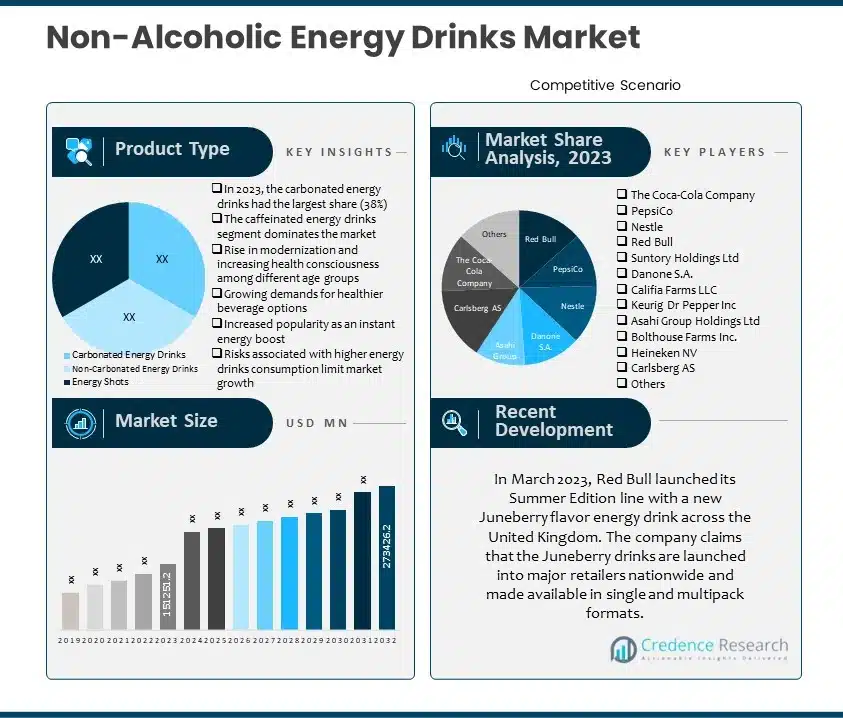
- The global demand for non-alcoholic energy drinks was valued at USD 151251.2 Million in 2023 and is expected to reach USD 273426.2 Million in 2032, growing at a CAGR of 6.8% between 2024 and 2032.
- The carbonated energy drinks are the market leader by product type, accounting for more than 38% of total value in 2023, while the energy shots category is likely to increase substantially over the forecast time frame.
- The athletes and fitness enthusiasts category leads the global market needs for non-alcoholic energy drinks in terms of target consumers, accounting for more than 30% share in 2023.
- Over the projection period, the online retail distribution channels are likely to grow at the highest rate, while supermarkets and hypermarkets dominated the market in 2023 with a 28% share.
- Caffeinated energy drinks lead the market with 32% of the total revenue share by ingredients segment. In contrast, sugar-free or low-calorie energy drinks will expand fastest in the projected period.
- North America continues to propel the rapid growth of the non-alcoholic energy drinks industry, accounting for more than one-third of the global market in 2023, while Europe and the Asia Pacific combined account for just under 54%. In 2023, Europe had a market share of more than 18%.
- Energy drinks are part of the larger soft drink or non-alcoholic beverage markets, which also include fruit and vegetable juices, sports drinks, carbonated drinks, non-carbonated packaged drinks, ready-to-drink tea and coffee, caffeinated beverages, and other functional beverages.
- The market is expanding beyond traditional demographics, with non-alcoholic energy drinks appealing to a wider range of consumers, including athletes, fitness enthusiasts, students, and professionals seeking a quick energy boost.
Executive Summary
Market Definition
The non-alcoholic energy drinks market encompasses the segment of the beverage industry dedicated to the production, distribution, and sale of energy-enhancing beverages that do not contain alcohol. These beverages are formulated to provide consumers with a boost of energy, typically through the inclusion of stimulants such as caffeine, taurine, B vitamins, and other ingredients known for their energizing properties. Non-alcoholic energy drinks are designed to increase alertness, improve focus, and combat fatigue, making them popular choices for individuals seeking a rapid energy boost. The market includes various brands, flavors, packaging formats, and distribution channels catering to diverse consumer preferences and lifestyles.
Market Overview
The global non-alcoholic energy drinks market has witnessed consistent growth over recent years and is set to grow at a CAGR of 6.8% between 2024 and 2032. The market was valued at USD 151251.2 million in 2023 and is expected to reach USD 273426.2 million in 2032.
The main factor behind the substantial market revenue growth is the surge in global consumption of soft drinks. According to the Federal Statistical Office, the yearly average per capita consumption of soft drinks in Germany has climbed from 114.7 liters in 2020 to 118.4 liters in 2021. Aside from this, increased urbanization, rising disposable incomes, and people's busy lifestyles are also important factors supporting market expansion. In addition, as people become more health-conscious, non-alcoholic beverages are gaining popularity around the world, further boosting market sales growth.
As per the UN Comtrade statistics, the volume of non-alcoholic beverages imported into Hungary reached its peak in 2022 at 174 million euros, up from 154 million euros in 2021. Furthermore, the growing popularity of professional sports, leisure outdoor activities, exercise, and physical fitness generates global market demand for nutritional supplements such as energy drinks.
Leading manufacturers are also focused on developing sugar-free drinks to meet the market needs of people with diabetes and other chronic medical conditions. For example, the Australian soft drink manufacturer Nexba introduced a line of energy beverages in 2022 that are sugar- and caffeine-free and contain vitamins and prebiotics. Nexba Natural Energy drinks have no artificial ingredients and are available in two flavors: Lemon & Yuzu and Wild Citrus. The business claims that the flavors contain ginseng extract, vitamin B complex, and vitamin C, which help to boost digestive health and energy levels. As a result, the factors outlined above are projected to have a favorable impact on the non-alcoholic energy drink market revenue during the research period.
Segmentation by Product Type
- Carbonated energy drinks remain the primary product choice among the general population, capturing a majority share of over 38% in terms of market value in 2023. The enduring popularity of carbonated options is attributed to their wide availability, familiar taste profiles, and association with mainstream beverage consumption habits.
- Non-carbonated energy drinks and energy shots are expected to increase rapidly, with both segments experiencing the fastest CAGRs. The increasing demand for healthier alternatives and convenient, on-the-go energy solutions is propelling these segments forward.
Segmentation by Ingredients
- Caffeinated energy drinks emerged as the dominant ingredients category, commanding a substantial revenue share of over 32% in 2023. The stimulating effects of caffeine, combined with the popularity of energy drinks as a quick energy boost, contribute to the strong demand for caffeinated variants.
- Sugar-free or low-calorie energy drinks are on track for robust market growth, owing to the escalating health consciousness among consumers and regulatory efforts to address concerns regarding excessive sugar consumption. These formulations cater to health-conscious individuals seeking to manage calorie intake without compromising on taste or energy-enhancing benefits.
Segmentation by Target Consumer
- The global market for non-alcoholic energy drinks caters to a diverse range of consumers, with the general population and students collectively constituting a substantial portion of the market demand. These segments are drawn to energy drinks for various reasons, including increased alertness, improved focus, and enhanced performance during daily activities and study sessions.
- Athletes and fitness enthusiasts emerge as key target consumers, contributing over 30% of the overall revenue share in 2023. The fitness-oriented demographic prefers energy drinks to improve workout performance, endurance, and post-exercise recovery, resulting in continuous market demands within this segment.
Segmentation by Distribution Channel
- Supermarkets and hypermarkets emerge as the dominant distribution channels for non-alcoholic energy drinks, capturing more than 28% of the total market share in 2023. These retail outlets offer extensive product selections, competitive pricing, and convenient one-stop shopping experiences, attracting a large consumer base.
- Convenience stores, online retail platforms, drugstores, and pharmacies collectively fulfill the remaining market needs for non-alcoholic energy drinks. The proliferation of e-commerce platforms and changing consumer shopping habits fuel the growth of online retail channels, also providing consumers with greater accessibility and convenience in purchasing energy beverages.
Segmentation by Region
- North America stands out as a leading global market for non-alcoholic energy drinks, contributing to over one-third of the revenue growth in 2023. This region primarily benefits from a strong consumer culture around energy drinks, coupled with extensive marketing efforts and product innovation by leading industry players.
- Europe and Asia Pacific collectively account for just under 54% of the market share in 2023, with Europe holding over 18% in the same year. These regions exhibit growing consumer awareness of energy drink consumption patterns, regulatory initiatives, and evolving preferences toward healthier beverage options.
- The rest of the world, encompassing Latin America, the Middle East, and Africa, is an expanding marketplace for non-alcoholic energy drinks due to growing urbanization, rising disposable incomes, and extended distribution channels. As consumer lifestyles and preferences evolve, these regions present untapped opportunities for market expansion and penetration.
In terms of region, North America dominates the non-alcoholic energy drink industry. The U.S. and Canada provide for the majority of regional revenue contributions. Caffeine is the main ingredient in the most of non-alcoholic energy drinks. The United States Association reports that over 90% of Americans consume caffeine on a daily basis. This is the primary reason behind the high usage of energy drinks in North America. Besides, with higher incomes and a greater awareness of health, people seek active lifestyles, which leads to an increasing interest in sports and other forms of exercise. Thus, major players use these marketing channels to their advantage in order to reach a wider audience of regional customers. For instance, in 2021, Red Bull, an Austrian firm mainly focused on energy drinks, launched its latest world sports series, the FIM Hard Enduro World Championship, as part of its sports-based marketing strategy. These promotional tactics have been successful in increasing the awareness of a particular non-alcoholic energy beverage, particularly among youth.
Asia-Pacific has traditionally been a prominent consumer market for non-alcoholic energy drinks, accounting for the vast majority of global soft drink sales revenues. Increased consumer health awareness, increasing preference for alternative dairy beverages, and expanding sales of natural and organic fruit juices are the major factors driving the Asia Pacific market. The majority of people in nations like South Korea and Japan are intolerant to lactose. This attribute contributes to the popularity of dairy-replacement beverages in many nations. In addition, the Asia Pacific non-alcoholic energy drink market is lucrative due to a large potential user base, high demand for healthy beverages, and a diverse retail landscape. In January 2020, for example, Sipfree, an online marketplace for non-alcoholic wines, spirits, and beers, was introduced in Hong Kong. Sales of Sipfree surged significantly even during the COVID-19 pandemic. Such expansions are projected to create profitable opportunities in the Asia Pacific non-alcoholic drinks market throughout the forecast period.
Furthermore, exposure to digital advertising increases interest in energy drinks amongst young individuals, particularly the Generation Z demographic. Gen Z is gaining popularity as the most recent generational cohort of customers, prompting major brands to develop new methods to keep up with changing trends and maintain their market position. For example, in July 2023, C4 Energy, an American energy drink manufacturer, announced a partnership with WWE to launch new co-branded energy drinks. According to the corporation, this collaboration is critical for reaching out to Gen Z consumers who value authenticity from influencers and marketers.
Key Highlights of the Report
The global non-alcoholic energy drinks market is segmented by product type, ingredients, target consumer, distribution channel, and region. Carbonated energy drinks remain the most popular product type among customers, with a diverse range of flavors and established brand awareness. Caffeinated energy drinks dominate the market landscape in terms of ingredients, providing a quick energy boost to consumers, while sugar-free or low-calorie variants are gaining traction amidst growing health consciousness.
Energy drinks are really popular these days. A quick search on Google for ‘energy drink’ returns millions of results. As per the Waitrose Food & Drink Report released in October 2021, searches for alcohol-free drinks are increasing by 22% annually. Brands have been keeping up with current trends by launching new products or extending their current offerings. The major brands, such as Monster, Red Bull, and Rockstar, have been there for a while, but there has recently been a rise in the number of new energy drink products entering the market.
Non-alcoholic energy drinks are extremely popular among people of all ages. There are currently numerous different varieties of energy drinks on the global market, each with its distinct formulation. While some individuals drink energy drinks for the caffeine, others use them for the minerals and vitamins they contain. The ingredients in non-alcoholic energy drinks can vary considerably from one product to another. However, most energy drinks contain some combination of caffeine, B vitamins, sugar, and amino acids. The most common substance in energy drinks is caffeine, a stimulant that helps with alertness and energy. Sugar is also typically contained in energy drinks, which provide a rapid supply of energy. B vitamins play an important role in metabolism, converting food into useful energy.
North America had the majority of the global non-alcoholic energy drink market share. The expanding geriatric and obese population, as well as increased awareness about wellness, physical activity, and preventive health care, have all contributed to the rise of the non-alcoholic energy drink market in North America. As per the U.S. Department of Health & Human Services, nearly 90% of Americans consume more sodium than is advised for a healthy diet. Moreover, Europe is the second-largest region in the non-alcoholic energy drinks industry, owing to rising consumer health consciousness and a hectic lifestyle. Furthermore, growing health consciousness, as well as changes in consumer lifestyle and increased awareness of health wellness products, are likely to boost the growth of the non-alcoholic energy drinks market in Asia Pacific.
What Are The Main Drivers Of The Global Non-Alcoholic Energy Drinks Market?
The global trend of increasing urbanization, disposable income, and consumer health consciousness has led to a growth in the market demand for non-alcoholic energy drinks. Long, unpredictable work hours and a rise in social gatherings are both influencing customers to consume energy drinks. Energy drinks that are both healthy and sugar-free are becoming more popular due to the increasing frequency of diseases associated with sedentary lifestyles, a growing population of health-conscious customers, and increased awareness of active lifestyles. The market for non-alcoholic energy drinks is also expected to grow due to increased promotional and advertising efforts.
What Are The Major Challenges Faced By The Global Non-Alcoholic Energy Drinks Market?
Non-alcoholic energy drinks have various negative repercussions for society and the environment as they rely extensively on natural resources such as water and electricity. Decreased water availability, increased pollution, and indirect greenhouse gas emissions all lead to a disruption in natural resource availability, which is expected to limit market production capacity.
What Are The Growth Opportunities In The Global Non-Alcoholic Energy Drinks Market?
With the rise of an active lifestyle, including visiting the gym on a regular basis and developing hobbies such as rock climbing, hiking, and others, the demand for an energy booster source has increased, propelling the non-alcoholic energy drinks industry forward. The expanding millennial population and the availability of various resources to promote beverages as a suitable energy solution, coupled with other product benefits, will also speed up the expansion of the energy drinks market throughout the forecast period.
Market Drivers
Several factors contribute to the growth of the global non-alcoholic energy drinks market. The primary factors propelling the global non-alcoholic energy drinks market are as follows:
Consumers Seeking Healthy Alternatives to Alcoholic and Sugary Beverages
Alcohol intake is one of the leading risk factors for numerous diseases worldwide. According to WHO (World Health Organisation), hazardous alcohol use is a contributing cause of over 200 diseases and injuries. It causes nearly 3 million fatalities per year, accounting for 5.3% of all deaths. In addition, the National Centre for Health Statistics reported that the death rate from alcohol misuse in the U.S. increased from 13.1 to 14.4 deaths per 100,000 people between 2020 and 2021. Thus, there has been an increase in demand for healthier alternatives to traditional alcoholic beverages in an effort to minimize alcohol dependence.
Besides, with the rising prevalence of diabetes and other chronic medical conditions, people are becoming more conscious of their diets and implementing healthy eating habits into their everyday lives. Leading companies are capitalizing on this customer market demand for low-sugar choices to broaden their consumer base. For example, in 2023, Rockstar Energy expanded its product line by introducing two refreshing, zero-sugar flavors: Rockstar Refresh Strawberry & Lime and Watermelon & Kiwi. As per the company, each can of the flavors offers 21 calories, a high vitamin C content, crisp flavors, and no added sugar. These factors propel the non-alcoholic energy drink market forward.
Market Restraints
The global non-alcoholic energy drinks market faces certain challenges that may limit its growth. These consist of the following:
Concerns Associated with Higher Energy Drinks Consumption
Consuming more energy drinks than is recommended may result in weight gain, excessive blood sugar, and other health issues. Caffeine, taurine, and sugar in these drinks raise insulin levels, which makes them harmful for people with diabetes. People have been concerned and have refrained from trying these energy drinks. Extreme energy drink ingredients make them unsuitable for a significant number of potential consumers. When it comes to energy drinks for children, there are plenty of grey areas. While some companies, like Monster Energy Drinks, concur that kids under the age of 12 should not be encouraged to consume these drinks, others claim there is no upper age limit.
Content such as synthetic caffeine, artificial chemicals, additives, and preservatives have a negative impact on the brand image of these beverages, which may limit the growth of the non-alcoholic energy drink market by connecting it with health problems. Although this has increased demand for organic drinks, overall market demand for standard beverages could decline, impeding the expansion of the industry.
Opportunities
The global non-alcoholic energy drinks market offers significant growth opportunities. These consist of the following:
Emergence of Nutritious Beverages
Rising customer preferences for nutrient-dense beverages have prompted manufacturers to introduce multiple kinds of nutritious products to the market. Consumers, particularly millennials, are becoming more experimental and open to trying new and more nutritious alternatives to conventional soft drinks. The young population is growing more health-conscious, pushing up demand for zero-calorie or low-calorie beverages.
Furthermore, athletes usually consume energy and sports drinks during high-intensity activity to replace fluids and electrolytes while also providing quick energy. As a result, it is mostly used by athletes, gym goers, and fitness enthusiasts to accelerate rehydration, offer rapid energy, and help general recovery after exercise. For example, in February 2022, Applied Nutrition released its new L-Carnitine sports drink. This new drink has no added sugar, no calories, 1,500 mg of L-carnitine, and vitamins B3, B6, and B12.
Competitive Landscape
Key Players
The non-alcoholic energy drinks industry is highly competitive, with international brands accounting for the majority of total market sales. The following are a few of the most prominent market players and their market shares:
- The Coca-Cola Company
- PepsiCo
- Nestle
- Red Bull
- Suntory Holdings Ltd
- Danone S.A.
- Califia Farms LLC
- Keurig Dr Pepper Inc
- Asahi Group Holdings Ltd
- Bolthouse Farms Inc.
- Heineken NV
- Coolberg Beverages Pvt Ltd
- Goya Foods Inc
- Anheuser-Busch InBev SA/NV
- Carlsberg AS
- Others
Companies operating in this market are actively focusing on product convenience and personalization and providing zero-calorie, healthy, and low-sugar variants. Another important strategy adopted by leading players is advertising through sports event sponsorships and celebrity endorsements. They are also emphasizing partnerships with domestic companies to scale their production units and take advantage of the huge potential for growth in developing countries.
In September 2023, Tata Consumer Products (TCP) entered the fast-developing energy drinks market with the launch of Say Never Energy Drink. The Energy Drink comes in two colorful flavors, blue and red, both of which are designed to provide an energy boost.
In September 2022, Gatorade, an American sports-themed beverages & food company, entered the energy drinks market with its first caffeinated beverage, Fast Twitch. A 12-ounce container contains 200mg of caffeine, as well as electrolytes and B vitamins. This beverage was developed in collaboration with NFL and sports performance experts.
In September 2022, Coca-Cola Europacific Partners (CCEP) expanded its Monster product line with two additional flavors to appeal to a wider range of consumers. The classic Monster energy drink line now includes two new flavors: Monster Reserve White Pineapple and Monster Reserve Watermelon.
In February 2022, PepsiCo Inc. released a hemp-based energy drink to the U.S. market. This beverage possessed hemp oil, spearmint, lemon balm, vitamin B, and caffeine.
Summary of Key Findings
- The global market is segmented by product type, ingredients, target consumer, distribution channel, and region.
- Non-alcoholic energy drinks often contain functional ingredients such as vitamins, minerals, amino acids, and herbal extracts, which are perceived to provide energy-boosting properties without the use of caffeine or artificial stimulants.
- The market is further segmented based on product types such as energy shots, energy drinks, and energy-enhancing powders, each catering to distinct consumer preferences and usage occasions, ranging from pre-workout supplementation to daily energy boosts.
- The non-alcoholic energy drinks market is highly competitive, with key players including Red Bull GmbH, Monster Beverage Corporation, PepsiCo Inc., and The Coca-Cola Company dominating the industry.
- Brand differentiation through innovative marketing campaigns, celebrity endorsements, and product positioning as lifestyle enhancers or performance boosters is crucial for companies to stand out in a crowded marketplace and build brand loyalty among consumers.
Future Outlook
- The market is witnessing a shift towards healthier formulations, with a focus on natural sweeteners (e.g., stevia, monk fruit), zero-calorie options, and reduced sugar content to align with growing health and wellness trends.
- Non-alcoholic energy drink brands are expanding into new geographical markets, including tier-2 and tier-3 cities, rural areas, and emerging economies, leveraging distribution partnerships and localized marketing strategies to tap into untapped consumer segments.
- Companies are heavily investing in R&D activities to innovate and differentiate their product offerings, leveraging advancements in food science, technology, and nutritional research to develop next-generation non-alcoholic energy drinks with enhanced efficacy and consumer appeal.
How CXOs Can Benefit from the Credence Research Non-Alcoholic Energy Drinks Market Report:
The Credence Research Non-Alcoholic Energy Drinks Market Report offers CXOs a comprehensive overview of the market, covering:
- Market Size and Growth Forecast: The report provides detailed estimates of the global non-alcoholic energy drinks market size, segmented by product type, ingredients, target consumer, distribution channel, and region. It also offers forecasts for market growth up to 2032, highlighting key trends and driving factors shaping the market landscape.
- Market Segmentation: The report segments the non-alcoholic energy drinks market by product type, ingredients, target consumer, distribution channel, and region. This segmentation provides CXOs with a granular understanding of the market dynamics and specific opportunities within each segment.
- Competitive Landscape: The report profiles the major players in the non-alcoholic energy drinks market and provides insights into their strategies, product portfolios, and financial performance. This information can help CXOs to identify and assess their competition.
- Key Trends and Drivers: The report identifies and analyses the major trends and drivers shaping the non-alcoholic energy drinks market size. This information can help CXOs to make informed decisions about their investments and strategies. For instance, the report highlights the rising consumer preference for sugar-free or low-calorie energy drinks as a significant trend, guiding CXOs in product development and marketing strategies.
CXOs can leverage insights from the Credence Research Non-Alcoholic Energy Drinks Market Report to:
- Identify Growth Opportunities:The report assists CXOs in identifying promising growth opportunities within the non-alcoholic energy drinks market. For example, the report highlights the increasing demand for energy drinks among health-conscious consumers and the potential for innovation in natural ingredients and functional formulations.
- Make Informed Investment Decisions:The report can help CXOs make informed investment decisions about non-alcoholic energy drinks. For instance, understanding the growing popularity of online retail channels for energy drink sales may prompt CXOs to allocate resources toward e-commerce strategies.
- Develop Competitive Strategies:The report equips CXOs with valuable insights to develop competitive strategies for their non-alcoholic energy drinks businesses. This may include differentiation strategies based on product innovation, pricing strategies, or market positioning approaches to capture market share effectively.
- Track Market Developments:The report enables CXOs to stay ahead of market developments and emerging trends, allowing them to adapt their strategies accordingly.
Overall, the Credence Research Non-Alcoholic Energy Drinks Market Report proves to be a valuable resource for CXOs seeking a deeper understanding of the market and identifying growth opportunities.
Segmentation
- By Product Type
- Carbonated Energy Drinks
- Non-Carbonated Energy Drinks
- Energy Shots
- By Ingredients
- Caffeinated Energy Drinks
- Herbal Energy Drinks
- Vitamin-Enhanced Energy Drinks
- Sugar-Free or Low-Calorie Energy Drinks
- By Target Consumer
- General Population
- Athletes and Fitness Enthusiasts
- Students
- Others
- By Distribution Channel
- Supermarkets and Hypermarkets
- Convenience Stores
- Online Retail
- Drugstores and Pharmacies
- Others
- By Region
- North America
- The U.S.
- Canada
- Mexico
- Europe
- Germany
- France
- The U.K.
- Italy
- Spain
- Rest of Europe
- Asia Pacific
- China
- Japan
- India
- South Korea
- South-east Asia
- Rest of Asia Pacific
- Latin America
- Brazil
- Argentina
- Rest of Latin America
- Middle East & Africa
- GCC Countries
- South Africa
- Rest of the Middle East and Africa
- North America

Request a Free Sample
Fill in your details and we'll send you a free sample report.
- Sample data tables & charts
- Research methodology
Market Dynamics
Health-Conscious Consumer Shift
Increasing awareness of health and wellness is driving consumers to seek alternatives to sugary sodas and alcoholic beverages, boosting demand for sugar-free, low-calorie, and functional energy drinks.
Urbanization and Busy Lifestyles
Rising urbanization and fast-paced lifestyles are leading consumers, especially young professionals and students, to seek convenient energy-boosting beverages to support long work hours and active routines.
Expansion of Distribution Channels
The proliferation of online retail and the dominance of supermarkets and hypermarkets have made energy drinks more accessible, supporting market growth by reaching a wider consumer base.
Product Innovation and Diversification
Manufacturers are introducing new flavors, functional ingredients (such as vitamins, herbal extracts, and prebiotics), and healthier formulations to cater to evolving consumer preferences and regulatory trends, fueling market expansion.
Sports and Fitness Trends
The growing popularity of sports, fitness activities, and active lifestyles is increasing the consumption of energy drinks among athletes and fitness enthusiasts, who seek performance and recovery benefits.
Need a Custom Version of This Report?
Tailor the scope, geography, or segments to your exact requirements.
- Custom geography or segment scope
- Direct access to our analyst team
Frequently Asked Questions
What is the current size of the global non-alcoholic energy drinks market?
What is the expected growth rate of the non-alcoholic energy drinks market between 2024 and 2032?
Which category is leading the revenue share in terms of product type?
Which region is fueling the growth of the non-alcoholic energy drinks industry?
Who are the major players in the global non-alcoholic energy drinks market?
Table of Content
Chapter 1 Market Segmentation
- 1.1 Segmentation Framework
- 1.1.1 Product and Service Classification
- 1.1.2 Application and End-Use Classification
- 1.1.3 Technology and Solution Classification
- 1.1.4 Customer and Distribution Channel Classification
- 1.1.5 Geographic Segmentation
- 1.1.6 Market Segment Definitions and Boundaries
- 1.2 By Ingredients
- 1.2.1 Caffeinated Energy Drinks
- 1.2.2 Herbal Energy Drinks
- 1.2.3 Vitamin-Enhanced Energy Drinks
- 1.2.4 Sugar-Free or Low-Calorie Energy Drinks
- 1.3 By Product Type
- 1.3.1 Carbonated Energy Drinks
- 1.3.2 Non-Carbonated Energy Drinks
- 1.3.3 Energy Shots
- 1.4 By Target Consumer
- 1.4.1 General Population
- 1.4.2 Athletes and Fitness Enthusiasts
- 1.4.3 Students
- 1.4.4 Others
Chapter 2 Introduction
- 2.1 Report Objectives and Scope
- 2.2 Product Definition and Industry Terminology
- 2.3 Market Inclusions and Exclusions
- 2.4 Research Process
- 2.4.1 Primary Research and Expert Interviews
- 2.4.2 Secondary Research and Source Review
- 2.4.3 Top-Down and Bottom-Up Estimation
- 2.4.4 Data Triangulation and Verification
- 2.5 Market Size Measurement Basis
- 2.5.1 2023: USD 151251.2 Million → 2032: USD 273,426.2 Million
- 2.6 Historical and Forecast Reference Periods
- 2.6.1 Base Year: 2023
- 2.6.2 Forecast Period: 2023-2032
- 2.7 Research Assumptions and Limitations
Chapter 3 Executive Summary
- 3.1 Market Snapshot and Key Findings
- 3.2 Base-Year Market Size, 2023
- 3.3 Forecast Market Size, 2032
- 3.4 Revenue and Volume Growth Outlook
- 3.5 Key Demand and Supply Indicators
- 3.6 Leading Market Segments
- 3.7 Fastest-Growing Market Opportunities
- 3.8 Regional Performance Highlights
- 3.9 Technology and Industry Transformation
- 3.10 Competitive Landscape Summary
- 3.11 Analyst View and Strategic Implications
Chapter 4 Global Non-Alcoholic Energy Drinks Market Trends and Developments
- 4.1 Historical Industry Development
- 4.2 Recent Market Trends and Developments
- 4.3 Demand and Customer Behavior Trends
- 4.4 Technology and Product Innovation
- 4.5 Artificial Intelligence, Automation and Digitalization
- 4.6 Local Manufacturing and Supply Chain Realignment
- 4.7 Industry Partnerships, Mergers and Acquisitions
- 4.8 Sustainability and Circular Economy Developments
- 4.9 Government and Private Sector Investment Trends
- 4.10 Emerging Business Models and Commercialization
- 4.11 Industry Developments and Announcements
Chapter 5 Global Non-Alcoholic Energy Drinks Market Production, Supply and Demand Analysis
- 5.1 Demand Trend and Consumption Analysis
- 5.2 Demand Forecast, 2023-2032
- 5.3 Production and Output Trend
- 5.4 Production and Output Forecast, 2023-2032
- 5.5 Installed Capacity and Capacity Utilization
- 5.6 Company-Wise Production Plants and Statistics
- 5.6.1 Installed Production Capacity
- 5.6.2 Actual Production
- 5.6.3 Planned Capacity and Expansion Targets
- 5.7 Supply Chain Structure and Procurement Trends
- 5.8 Supply-Demand Gap and Bottlenecks
- 5.9 Import Dependence and Sourcing Structure
- 5.10 Contract Manufacturing and Outsourcing
- 5.11 Regional Supply and Demand Concentration
Chapter 6 Global Non-Alcoholic Energy Drinks Market Pricing Analysis
- 6.1 Pricing Structure and Measurement
- 6.2 Historical Pricing Trends
- 6.3 Pricing Outlook, 2023-2032
- 6.4 Average Selling Price and Unit Economics
- 6.5 Pricing by Product and Market Segment
- 6.6 Geographic Pricing Differences
- 6.7 Key Input, Energy, Labor and Logistics Costs
- 6.8 Contract Pricing and Purchasing Models
- 6.9 Pricing Sensitivity and Competitive Positioning
- 6.10 Price, Margin and Profitability Implications
Chapter 7 Global Non-Alcoholic Energy Drinks Market Dynamics
- 7.1 Market Growth Drivers
- 7.1.1 Demand-Side Drivers
- 7.1.2 Technology and Innovation Drivers
- 7.1.3 Infrastructure and Investment Drivers
- 7.1.4 Regulatory and Policy Drivers
- 7.2 Market Restraints
- 7.2.1 Cost and Affordability Constraints
- 7.2.2 Technology and Adoption Barriers
- 7.2.3 Supply Chain and Operational Constraints
- 7.3 Market Challenges
- 7.3.1 Competitive Pressure and Margin Erosion
- 7.3.2 Skills, Infrastructure and Implementation Gaps
- 7.4 Emerging Market Opportunities
- 7.5 Market Dynamics Impact and Time-Horizon Assessment
Chapter 8 Global Non-Alcoholic Energy Drinks Value Chain Analysis
- 8.1 Industry Value Chain Overview
- 8.2 Upstream Suppliers and Critical Inputs
- 8.3 Technology and Component Providers
- 8.4 Manufacturing or Service Delivery
- 8.5 Distribution, Channel Partners and Integrators
- 8.6 Downstream Applications and End Users
- 8.7 Value Addition and Profit Pools
- 8.8 Vertical Integration and Outsourcing
- 8.9 Supplier Concentration and Risk
- 8.10 Supply Chain Localization and Resilience
Chapter 9 Global Non-Alcoholic Energy Drinks Market Regulations and Policies
- 9.1 Relevant Laws, Standards and Compliance Frameworks
- 9.2 Product, Service, Safety and Quality Requirements
- 9.3 Government Policies, Incentives and Subsidies
- 9.4 Imports, Exports and Trade Barriers
- 9.5 Public Procurement and Local Content Requirements
- 9.6 Environmental and Sustainability Compliance
- 9.7 Upcoming Policy Changes and Market Implications
Chapter 10 Global Non-Alcoholic Energy Drinks Market Hotspots and Opportunities
- 10.1 Market Opportunity Mapping and Growth Hotspots
- 10.2 High-Growth Applications and Customer Groups
- 10.3 Underserved Markets and White-Space Opportunities
- 10.4 Emerging Technology and Product Opportunities
- 10.5 New Capacity and Investment Hotspots
- 10.6 Market Entry and Expansion Opportunities
- 10.7 Distribution and Partnership Opportunities
- 10.8 Near-Term and Long-Term Commercial Potential
- 10.9 Opportunity Attractiveness and Execution Risks
Chapter 11 Global Non-Alcoholic Energy Drinks Market Outlook, 2023-2032
- 11.1 Market Size and Analysis
- 11.1.1 Revenue (Market Measurement: 2023: USD 151251.2 Million → 2032: USD 273,426.2 Million)
- 11.1.2 Market Volume and Quantity Sold
- 11.1.3 Historical Market Size
- 11.1.4 Base-Year Market Size, 2023
- 11.2 Market Forecast, 2023-2032
- 11.2.1 Revenue Forecast to 2032
- 11.2.2 Volume Forecast to 2032
- 11.2.3 CAGR and Year-on-Year Growth
- 11.2.4 Incremental Revenue Opportunity
- 11.3 Forecast Assumptions and Scenario Analysis
- 11.3.1 Base-Case Forecast
- 11.3.2 Optimistic and Conservative Scenarios
- 11.3.3 Technology, Pricing and Policy Sensitivities
- 11.4 Market Attractiveness and Growth Outlook
Chapter 12 Global Non-Alcoholic Energy Drinks Market Segmentation and Outlook
- 12.1 Segmentation Summary and Market Shares, 2023
- 12.2 Largest and Fastest-Growing Segments
- 12.3 By Ingredients - Market Size and Forecast, 2023-2032
- 12.3.1 Segment Definition and Scope
- 12.3.2 Historical Market Size
- 12.3.3 Revenue Forecast, 2023-2032
- 12.3.4 Volume Forecast, 2023-2032
- 12.3.5 Base-Year Market Share, 2023
- 12.3.6 Segment CAGR and Growth Drivers
- 12.3.7 Subsegment Market Size and Forecast
- 12.3.7.1 Caffeinated Energy Drinks
- 12.3.7.2 Herbal Energy Drinks
- 12.3.7.3 Vitamin-Enhanced Energy Drinks
- 12.3.7.4 Sugar-Free or Low-Calorie Energy Drinks
- 12.3.8 Subsegment Pricing and Adoption Trends
- 12.3.9 Leading Suppliers and Competition
- 12.3.10 Regional Demand and Opportunities
- 12.4 By Product Type - Market Size and Forecast, 2023-2032
- 12.4.1 Segment Definition and Scope
- 12.4.2 Historical Market Size
- 12.4.3 Revenue Forecast, 2023-2032
- 12.4.4 Volume Forecast, 2023-2032
- 12.4.5 Base-Year Market Share, 2023
- 12.4.6 Segment CAGR and Growth Drivers
- 12.4.7 Subsegment Market Size and Forecast
- 12.4.7.1 Carbonated Energy Drinks
- 12.4.7.2 Non-Carbonated Energy Drinks
- 12.4.7.3 Energy Shots
- 12.4.8 Subsegment Pricing and Adoption Trends
- 12.4.9 Leading Suppliers and Competition
- 12.4.10 Regional Demand and Opportunities
- 12.5 By Target Consumer - Market Size and Forecast, 2023-2032
- 12.5.1 Segment Definition and Scope
- 12.5.2 Historical Market Size
- 12.5.3 Revenue Forecast, 2023-2032
- 12.5.4 Volume Forecast, 2023-2032
- 12.5.5 Base-Year Market Share, 2023
- 12.5.6 Segment CAGR and Growth Drivers
- 12.5.7 Subsegment Market Size and Forecast
- 12.5.7.1 General Population
- 12.5.7.2 Athletes and Fitness Enthusiasts
- 12.5.7.3 Students
- 12.5.7.4 Others
- 12.5.8 Subsegment Pricing and Adoption Trends
- 12.5.9 Leading Suppliers and Competition
- 12.5.10 Regional Demand and Opportunities
- 12.6 Segment Growth Comparison
- 12.7 Segment Attractiveness and Priority Matrix
Chapter 13 Global Non-Alcoholic Energy Drinks Geographic Market Outlook, 2023-2032
- 13.1 Regional Market Size and Share, 2023
- 13.2 Regional Market Forecast, 2023-2032
- 13.3 Regional Pricing, Production and Demand Differences
- 13.4 North America
- 13.4.1 United States
- 13.4.2 Canada
- 13.4.3 Mexico
- 13.5 Europe
- 13.5.1 Germany
- 13.5.2 France
- 13.5.3 Italy
- 13.5.4 United Kingdom
- 13.5.5 Spain
- 13.5.6 Poland
- 13.5.7 Russia
- 13.5.8 Netherlands
- 13.5.9 Belgium
- 13.5.10 Sweden
- 13.5.11 Denmark
- 13.5.12 Norway
- 13.5.13 Rest of Europe
- 13.6 Asia Pacific
- 13.6.1 China
- 13.6.2 India
- 13.6.3 Japan
- 13.6.4 South Korea
- 13.6.5 Thailand
- 13.6.6 Indonesia
- 13.6.7 Vietnam
- 13.6.8 Malaysia
- 13.6.9 Australia
- 13.6.10 Rest of Asia Pacific
- 13.7 Latin America
- 13.7.1 Brazil
- 13.7.2 Argentina
- 13.7.3 Colombia
- 13.7.4 Chile
- 13.7.5 Rest of Latin America
- 13.8 Middle East
- 13.8.1 Saudi Arabia
- 13.8.2 United Arab Emirates
- 13.8.3 Turkey
- 13.8.4 Israel
- 13.8.5 Iran
- 13.8.6 Rest of the Middle East
- 13.9 Africa
- 13.9.1 South Africa
- 13.9.2 Egypt
- 13.9.3 Nigeria
- 13.9.4 Morocco
- 13.9.5 Rest of Africa
- 13.10 Regional Investment, Policy and Supply Chain Differences
- 13.11 Regional Competitive Landscape
- 13.12 Geographic Growth Hotspots
Chapter 14 Global Non-Alcoholic Energy Drinks Technology, Innovation and Sustainability Outlook
- 14.1 Technology Landscape and Maturity
- 14.2 Product, Process and Service Innovation
- 14.3 AI, Automation and Digital Tools in the Industry
- 14.4 Technology Adoption and Performance Benchmarking
- 14.5 Innovation Pipeline and R&D Investment
- 14.6 Patent and Intellectual Property Trends
- 14.7 Energy Efficiency and Resource Management
- 14.8 Sustainability, Recycling and Circularity
- 14.9 Technology Roadmap, 2023-2032
- 14.10 Risks of Obsolescence and Technology Substitution
Chapter 15 Global Non-Alcoholic Energy Drinks Market Key Strategic Imperatives
- 15.1 Growth and Market Entry Priorities
- 15.2 High-Return Products and Segments
- 15.3 Pricing, Profitability and Cost Optimization
- 15.4 Technology Investment and Product Differentiation
- 15.5 Supply Chain Localization and Resilience
- 15.6 Distribution and Customer Acquisition
- 15.7 Partnership, Acquisition and Capacity Strategy
- 15.8 Regional Expansion Priorities
- 15.9 Short-, Medium- and Long-Term Actions
Chapter 16 Competition Outlook
- 16.1 Industry Competition Characteristics
- 16.2 Market Structure and Concentration
- 16.3 Market Share and Competitive Positioning, 2023
- 16.4 Company-Wise Revenue and Product Benchmarking
- 16.5 Production and Service Capacity Benchmarking
- 16.6 Technology, Pricing and Differentiation
- 16.7 Regional Footprint and Distribution Strength
- 16.8 Mergers, Acquisitions and Strategic Alliances
- 16.9 New Entrants and Competitive Threats
- 16.10 Porter's Five Forces and Industry Attractiveness
- 16.11 Competitive Outlook, 2023-2032
Chapter 17 Company Profiles
- 17.1 Company Coverage and Selection Criteria
- 17.2 Red Bull GmbH
- 17.2.1 Business Description
- 17.2.2 Company Ownership and Geographic Presence
- 17.2.3 Product and Service Portfolio
- 17.2.4 Manufacturing and Operating Footprint
- 17.2.5 Production Capacity and Expansion Plans
- 17.2.6 Financial Performance and Investment
- 17.2.7 Market Share and Competitive Position
- 17.2.8 Technology and Innovation Capabilities
- 17.2.9 Strategic Alliances or Partnerships
- 17.2.10 Recent Developments
- 17.2.11 Growth Strategy and Outlook
- 17.3 Monster Beverage Corporation
- 17.4 The Coca-Cola Company
- 17.5 PepsiCo Inc.
- 17.6 Nestle
- 17.7 Suntory Holdings Ltd
- 17.8 Danone S.A.
- 17.9 Asahi Group Holdings Ltd
- 17.10 Keurig Dr Pepper Inc
- 17.11 Bolthouse Farms Inc.
- 17.12 Other Relevant Market Participants
Note: Every listed company is profiled on the structure shown under the first company. The company list is preliminary and may change based on research findings, market developments, data availability and client requirements.
Chapter 18 Disclaimer
- 18.1 Research and Forecast Disclaimer
- 18.2 Data Source and Estimation Limitations
Note: The depth of individual sections depends on data availability for this market. Volume, capacity, trade and other unit-based metrics are included where applicable.

