Market Overview:
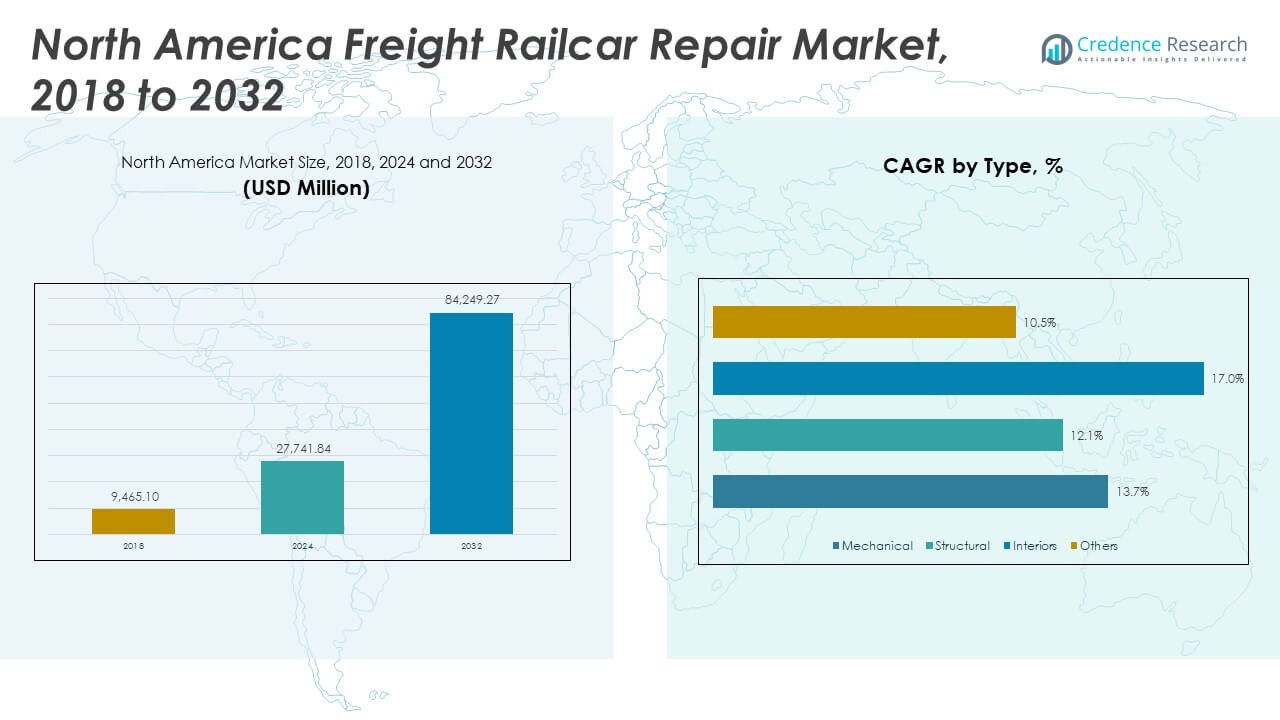
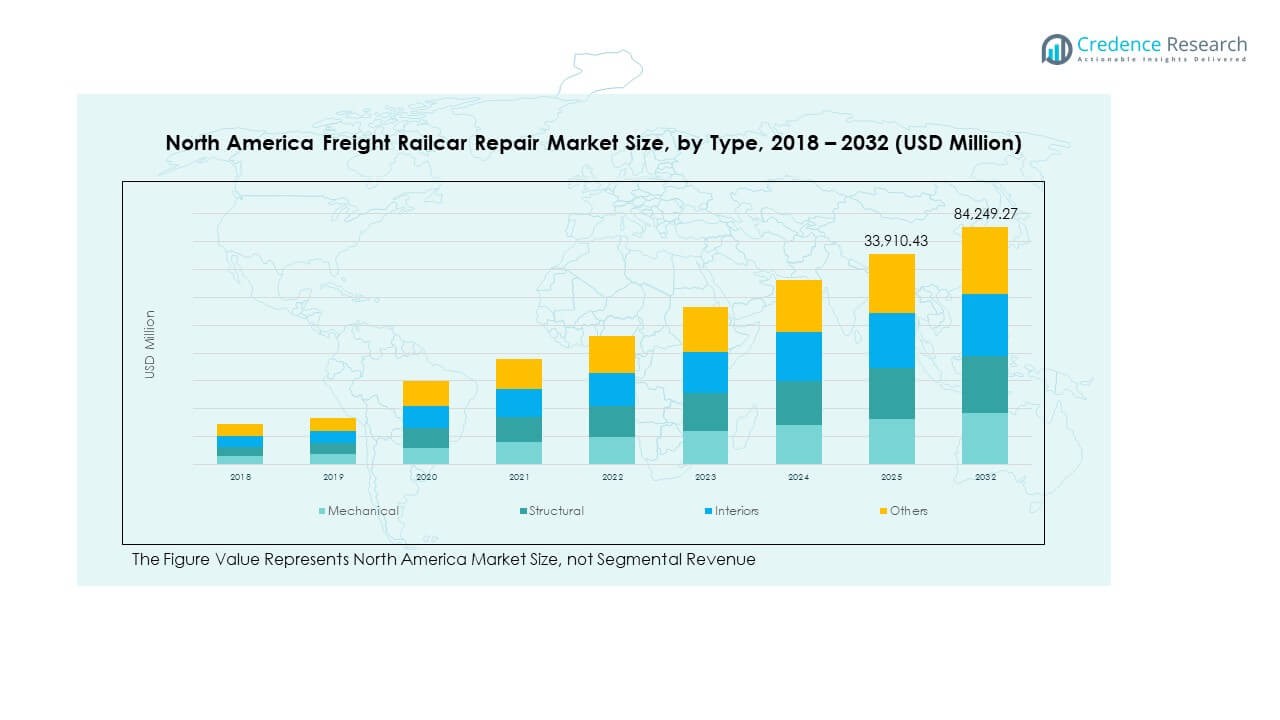
The North America Freight Railcar Repair Market size was valued at USD 9,465.10 million in 2018 to USD 27,741.84 million in 2024 and is anticipated to reach USD 84,249.27 million by 2032, at a CAGR of 13.88 % during the forecast period.
| REPORT ATTRIBUTE | DETAILS |
|---|---|
| Historical Period | 2020-2023 |
| Base Year | 2024 |
| Forecast Period | 2025-2032 |
| North America Freight Railcar Repair Market Size 2024 | USD 27,741.84 Million |
| North America Freight Railcar Repair Market, CAGR | 13.88 % |
| North America Freight Railcar Repair Market Size 2032 | USD 84,249.27 Million |
The market growth is primarily supported by rising freight transportation volumes across sectors such as manufacturing, mining, and agriculture. Operators increasingly focus on preventive maintenance to reduce downtime and extend asset life. Government policies supporting rail infrastructure development and the enforcement of strict safety standards accelerate service adoption. Technological improvements, including digital inspection and predictive maintenance, enhance reliability and lower operational costs. Expanding trade within North America further strengthens demand for heavy and light repair activities across fleets.
Regionally, the United States dominates the market due to its extensive rail infrastructure and high concentration of freight operations. Canada maintains stable demand supported by bulk commodity transport and modernization of rolling stock. Mexico emerges as a growing segment driven by expanding intermodal networks and cross-border trade. Each subregion invests in advanced maintenance networks and certified facilities to sustain performance standards. The rising interconnectivity of rail systems across North America supports long-term repair service expansion.
Market Insights
- The North America Freight Railcar Repair Market was valued at USD 9,465.10 million in 2018, reached USD 27,741.84 million in 2024, and is projected to hit USD 84,249.27 million by 2032, growing at a CAGR of 13.88 %.
- The United States holds around 70 % share of the market due to its large freight network and high repair volume, while Canada and Mexico follow with 15 % each, supported by commodity transport and cross-border trade.
- Mexico is the fastest-growing region with a 15 % share, driven by industrial expansion, new rail links, and increased demand for repair services near border corridors.
- Mechanical repairs account for about 45 % of the market, supported by rising maintenance needs for brake systems, axles, and wheelsets across aging fleets.
- Structural and interior segments together represent roughly 40 %, reflecting ongoing refurbishment and corrosion control efforts that extend railcar lifespans across North America.
Market Drivers
Growing Freight Volumes Fueling Repair Demand
The North America Freight Railcar Repair Market expands as freight rail operators carry increasing tonnage across bulk sectors such as chemicals, agriculture and minerals. Older cars see heightened wear from heavier loads and longer cycles, so repair shops receive more inflow. Shippers require reliable railcar availability, prompting service providers to enhance capacity and turnaround. Maintenance budgets rise when carriers prioritise uptime and lifecycle extension of rolling stock. Cost-effective repair solutions emerge to retain competitiveness amid freight demand growth. Fleet operators push for standardized refurbishment programs to avoid unscheduled downtime. Industry players scale networks and adopt modular repair platforms to meet demand. This sustained volume growth underpins consistent demand for repair and overhaul services across the region.
Aging Carfleets Driving Maintenance Activity and Asset Life Extension
Operators in the region still deploy large fleets of railcars whose components approach wear limits, and repair providers manage increasing structural, mechanical and interior refurbishment orders. The age profile of many units compels operators to invest in heavy overhauls rather than premature replacement. Repair shops offer life-extension programmes that reduce capital outlay and defer full asset renewal budgets. Service providers introduce advanced diagnostics and condition monitoring to identify faults early and plan preventive work. Railcar owners recognise that proper repair schedules reduce regulatory risk and unexpected failures. The market for major structural repairs, wheels, axles, braking systems and couplers grows steadily. Repair providers expand mobile and on-site offerings to access railcars in service. This ageing-fleet dynamic remains a key driver in the market landscape.
- For instance, Canadian National Railway (CN) has expanded its collaboration with technology providers like Wabtec and Wi-Tronix to utilize real-time condition monitoring systems across its aging fleet, reducing unexpected failures by tracking over 1 million operational hours annually.
Stricter Safety And Regulatory Mandates Enhancing Repair Requirements
Regulators in North America enforce inspection, maintenance and defect‐correction obligations for freight rail equipment, and operators respond by increasing repair and refurbishment investments. Preventive maintenance and defect remediation programmes become standard across major carriers, raising demand for repair services. Failure to comply risks costly fines, service disruption or derailment exposure, so railcar owners adopt comprehensive repair contracts. Repair workshops adapt to regulatory complexity and offer certified services for wheelset, braking and structural compliance tasks. The regulatory push leads to faster turnaround, higher quality standards and a preference for organised service networks over ad hoc fixes. Repair providers that offer accredited services gain competitive advantage. In aggregate, increasing safety demands build momentum in the repair market.
Technological Advancements And Service Network Expansion Supporting Market Growth
Repair businesses introduce advanced diagnostic tools, predictive-maintenance platforms, mobile repair units and digital inspection systems to enhance repair efficiency and lower downtime. Operators adopt condition-based monitoring solutions to flag railcar repair requirements before failure, enabling service providers to capture more scheduled work. Mobile repair solutions permit field repairs at terminals, yards and intermodal hubs, reducing transit time to workshop. Service networks expand region-wide to support large fleets and rapid turnaround. Repair providers invest in workforce training, certification and process standardisation to meet customer expectations. Technology integration allows operators to track repair status and fleet health in real time, creating repeatable service models. These innovations generate competitive value and drive further penetration of repair services.
- For instance, The Greenbrier Companies have implemented digital inspection and monitoring systems across their maintenance and repair network to enhance operational efficiency. The company operates over 16,000 leased railcars under its Leasing & Management Services segment, supported by mobile repair operations positioned at major North American freight hubs.
Market Trends
Rise Of Mobile Repair Services And On-Site Field Support
The North America Freight Railcar Repair Market shifts toward mobile repair units and field-based services that minimise railcar off-line time when compared to depot-based repairs. Service providers dispatch mobile crews equipped with diagnostic gear, welding equipment and component replacement tools directly to rail yards or customer facilities. Operators prefer this model because it reduces logistics and railcar transit costs, thereby supporting higher fleet utilisation. Mobile service adoption helps carriers schedule repairs outside peak service hours and avoid costly downtime. It also allows for rapid response to wheel or brake defects discovered in-field. Repair firms build geographically distributed teams to serve major corridors and terminals efficiently. This trend supports flexibility in repair scheduling and network coverage. It also exerts competitive pressure on traditional fixed-site workshops to enhance response capabilities.
- For instance, TrinityRail, a leading railcar leasing and maintenance company, reported a lease fleet utilization rate of 97.0% at the end of 2024, reflecting its effective service model including mobile repair capabilities that help reduce offline railcar time.
Adoption Of Predictive And Condition-Based Maintenance Approaches
Service providers and railcar owners increasingly employ sensors, IoT platforms and analytics to monitor component health in real-time, enabling repair triggers before failures occur. The North America Freight Railcar Repair Market benefits when operators adopt condition-based maintenance models rather than reactive repair regimes. Predictive diagnostics enable repair shops to forecast wear on wheelsets, axles, bearings and couplers, schedule work proactively and allocate resources accordingly. This shift improves railcar availability, lowers unplanned downtime and extends asset life. Responsibility for repair planning transitions to data-driven platforms, which support long-term contracts and repeat business for service providers. The trend enhances value capture for both repair contractors and railcar owners through improved fleet reliability and lower total cost of ownership.
Increased Focus On Fleet Life-Cycle Refurbishment Rather Than Replacement
Operators in North America face high capital costs when replacing large freight-car fleets, so they increasingly favour refurbishment and major overhauls over procurement of new units. The North America Freight Railcar Repair Market gains from this shift, as major structural rewinds, interior rebuilds and mechanical system renewals become more common. Repair facilities develop full-service refurbishment capabilities that cover structural, mechanical and interior work under single contracts. Carriers bundle repair contracts covering life-cycle refurbishment, monitoring and long-term maintenance. This trend supports higher-value repair work and fosters deeper relationships between fleet owners and service providers. It also stabilises demand cycles for repair firms who increasingly manage multi-year programmes for major asset rebuilds.
Shift Toward Digital Workflows, Automation And Data Integration
Repair providers invest in digital inspection cameras, automated measurement systems, enterprise repair-management software and remote monitoring platforms. The North America Freight Railcar Repair Market experiences growth when operators require transparent repair status tracking, component traceability and rapid turnarounds facilitated by digital workflows. Workshops adopt automation for wheel-turning, axle re-conditioning and structural inspection, lowering manual labour and improving consistency. Data integration between carriers and repair facilities supports predictive scheduling, inventory optimisation and spare-parts management. This trend widens repair firms’ service offering beyond basic maintenance into full-lifecycle asset support. It helps operators benchmark repair quality, turnaround times and cost-effectiveness across the network.
- For instance, FreightCar America, Inc. operates advanced manufacturing and repair facilities equipped with automated welding, digital design tools, and precision fabrication systems to enhance repair efficiency and quality. The company continues to modernize its processes to improve consistency and reduce downtime across its North American service operations.
Emergence Of Sustainable Repair Practices And Recycled Materials
Repair providers in the region engage sustainable strategies such as reuse of components, remanufacturing of wheelsets and adoption of lighter materials for structural repairs. The North America Freight Railcar Repair Market reflects these practices when operators emphasise total asset life-cycle costs and environmental mandates. Service firms introduce remanufactured axles and wheels, certified for safety standards, reducing waste and lowering input costs for carriers. Eco-certified repair programmes become a differentiator for maintenance providers. Railcar owners incorporate sustainability metrics into repair contracts and favour vendors offering recycled-material options. This trend helps reduce environmental impact and supports broader industry goals for carbon-intensity reduction in freight transport.
Market Challenges Analysis
High Cost And Downtime Pressures On Fleet Owners And Repair Providers
Repair contracts for the North America Freight Railcar Repair Market often involve significant labour, parts and logistics costs when major overhauls or structural repairs are required. Fleet owners face revenue loss when railcars sit idle during repair or transit to a workshop, which incentivises faster turnaround but stresses provider capacity. Repair firms contend with challenging schedules, specialised labour shortage and need to source heavy components such as wheelsets or couplers quickly. Fluctuations in steel and forged-metal prices add cost risk for every repair engagement. Some operators delay non-critical refurbishments to conserve capital during slower freight cycles, which can cause backlog and bottleneck in repair networks. Repair providers must balance speed, quality and cost-control to maintain profitability while satisfying operator expectations. These constraints can restrict market growth and place downward pressure on margins for both carriers and service firms.
Complex Regulatory Compliance And Fleet Heterogeneity Create Operational Strain
The North America Freight Railcar Repair Market evolves in an environment of stringent safety and maintenance standards enforced by federal agencies and industry bodies. Repair providers must maintain certifications, track components, adapt to multiple car types and manage documentation for each repair job. Car fleets often include diverse models from different generations, which complicates standardisation of repair processes and raises training needs. Operators face the challenge of coordinating multiple repair providers, scheduling downtime and ensuring compliance without disrupting service. Supply-chain disruptions for specialised parts or forged components may delay repair cycles. Repair firms must maintain robust inventory, skilled labour and process controls, which raise operating overhead. These operational strains, when combined with fluctuating freight volumes, reduce flexibility for repair networks and create headwinds for market expansion.
Market Opportunities
Expansion Of Leasing Fleet And Outsourced Maintenance Programmes
The North America Freight Railcar Repair Market stands to benefit when railcar-leasing companies and major operators shift toward outsourced repair‐and-maintenance agreements rather than in-house servicing. Operators prefer partner networks that deliver scheduled refurbishment, predictive maintenance and turn-key repair solutions across their national fleets. Repair providers that offer full-service life-cycle management contracts capture these opportunities and establish long-term relationships. Demand for modular repair solutions and mobile field teams across freight corridors also grows. These service models increase repeat business, create recurring revenue streams and support repair-network scaling. Service providers that invest in national coverage, digital platforms and remote diagnostics position themselves for this growth path.
Growth In Emerging Freight Corridors And Intermodal Expansion Driving Repair Work
Freight corridors linking Canada, Mexico and the United States continue to expand, and the North America Freight Railcar Repair Market benefits when new intermodal terminals, cross‐border trade and bulk commodity flows require rigorous railcar upkeep. Repair firms that establish presence near emerging logistics hubs position themselves to serve growth segments. Demand for mobile repairs at intermodal yards and border crossings increases. Operators handling cross-border traffic need standardised repair workflows across countries, creating opportunity for multi-national service providers. Repair providers that adapt to these logistic shifts and offer flexible, rapid-response services secure greater share in the broader maintenance ecosystem. This dynamic supports sustained growth in the repair market.
Market Segmentation Analysis
By Type
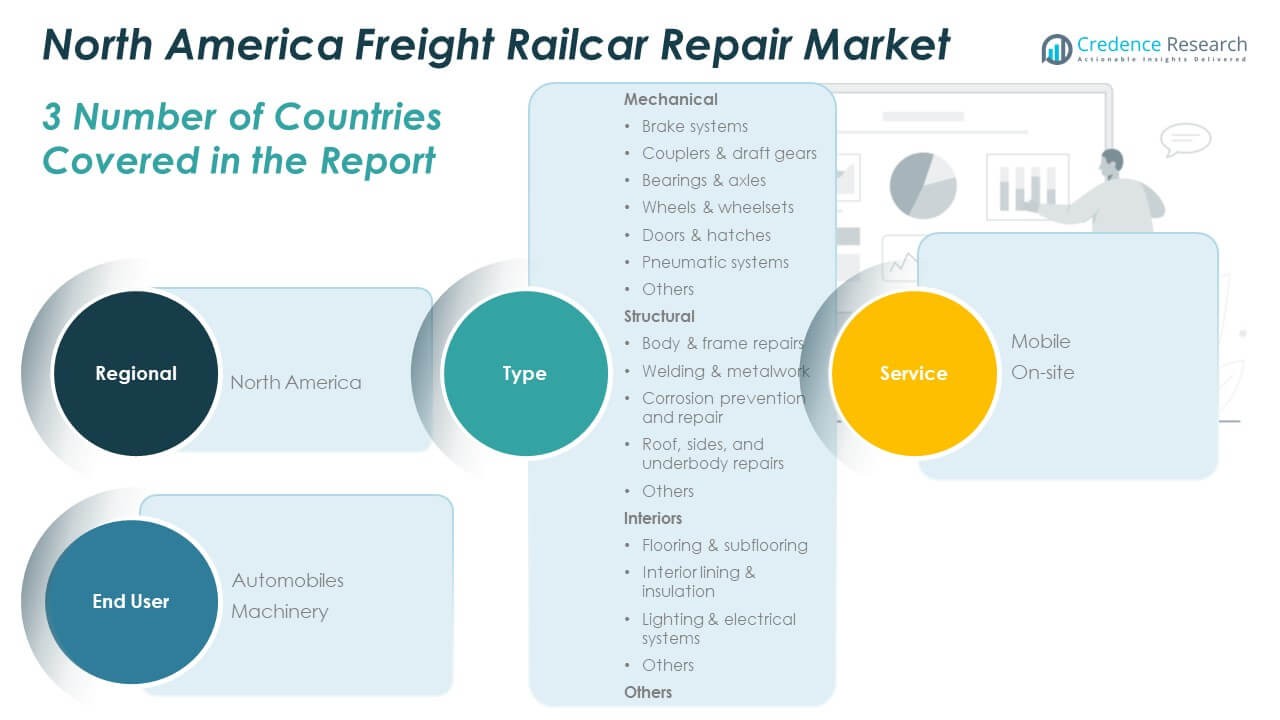
The North America Freight Railcar Repair Market is driven by mechanical repairs involving brake systems, couplers, bearings, axles, wheels, doors, and pneumatic systems. Mechanical work forms the core of repair operations since it ensures load stability and operational safety. Demand rises with aging fleets that require component replacements to maintain compliance and performance standards. Structural repairs include body and frame reinforcement, welding, and corrosion control. These services extend vehicle life and preserve asset value. Interior maintenance focuses on flooring, insulation, and lighting repairs that improve operator safety and cargo integrity. Each type contributes uniquely to overall reliability, supporting continuous freight movement.
- For instance, Wabtec Corporation’s Electronically Controlled Pneumatic (ECP) brake system is designed to shorten stopping distances by 40–60% and improve fuel efficiency while supporting higher average train speeds. The system has been successfully deployed across freight rail networks, demonstrating reliable long-term operational performance.
By Service
Service segmentation highlights mobile and on-site repair solutions. Mobile repair units gain traction due to faster turnaround and lower transport costs for damaged railcars. Operators prefer this option for minor faults detected at yards or terminals. On-site services dominate large-scale projects requiring heavy tools, lifting systems, and certified facilities. The combination of mobile responsiveness and comprehensive workshop capabilities helps repair providers address diverse customer needs. It strengthens operational efficiency across the regional rail network.
By End User
End-user segmentation is led by the automobile and machinery sectors. Automotive manufacturers depend on freight rail for vehicle and component transport, driving steady repair demand for specialized railcars. Machinery shipments require durable, structurally reinforced cars to handle heavy industrial loads. It pushes repair firms to deliver precision-engineered solutions that meet weight and stability requirements. Both segments continue to shape service demand through consistent logistics movement and equipment safety standards.
- For example, Union Pacific reported more than 4,500 active locomotives and around 300,000 rail cars under its maintenance responsibility, continually investing in mechanical teams and infrastructure to support high-volume freight, including vehicle and heavy machinery transport. Their ongoing commitments to inspection, repair, and modernization programs in 2024 underpin this segment’s maintenance demand.
Segmentation
By Type
- Mechanical
- Brake systems
- Couplers & draft gears
- Bearings & axles
- Wheels & wheelsets
- Doors & hatches
- Pneumatic systems
- Others
- Structural
- Body & frame repairs
- Welding & metalwork
- Corrosion prevention and repair
- Roof, sides, and underbody repairs
- Others
- Interiors
- Flooring & subflooring
- Interior lining & insulation
- Lighting & electrical systems
- Others
- Others
By Service
- Mobile
- On-site
By End User
- Automobiles
- Machinery
Regional Analysis
United States Dominance in the Market
The United States accounts for approximately 70 % of the North America Freight Railcar Repair Market, reflecting its vast freight rail network and significant repair demand. It features the largest number of ageing freight railcars requiring maintenance and overhaul. Major railcar operators in the U.S. prioritise lifecycle extension and regulatory compliance, driving repair volumes. Dense intermodal and bulk freight operations catalyse frequent component replacement and refurbishment cycles. Repair service providers with national footprints focus heavily on this market due to scale and complexity. Equipment manufacturers and repair workshops invest in technology and capacity in the U.S. to meet demand. Turnaround time and service quality metrics often set the benchmark within this sub-region.
Canada’s Steady Share and Market Growth
Canada holds around 15 % of the North America Freight Railcar Repair Market, driven by its large rail corridors and cross-border links with the U.S. The Canadian market emphasises heavy-haul freight such as minerals, grain and forestry products, necessitating specialised structural and mechanical repairs. Domestic repair yards and mobile units support operators with long distances and remote locations. The regulatory framework and fleet standards align closely with U.S. practices, making repair service models transferable across the border. Repair providers servicing Canada expand presence near major rail hubs and port gateways, enabling operational efficiency. Growth in Canada benefits from rail infrastructure investment and the need to sustain older rolling-stock fleets.
Mexico’s Emerging Repair Market Presence
Mexico contributes roughly 15 % of the regional freight railcar repair market while emerging rapidly thanks to expanding freight volumes and logistics linkages with the U.S. and Canada. The country’s concession-based rail network and growing trade flows stimulate demand for repair services and mobile support. Repair service firms establish operations near border crossings and intermodal terminals to capture this growth. Operators in Mexico face increasing fleet utilisation and wear-out of components, which elevates repair needs. Service providers that adapt to local conditions, bilingual labour pools and cross-border logistics gain competitive advantage. This emerging market segment offers repair firms scope for regional expansion and diversified service offerings.
Key Player Analysis
Competitive Analysis
The North America Freight Railcar Repair Market is characterized by a concentrated competitive landscape led by established players with strong regional footprints. Key participants such as Wabtec Corporation, Progress Rail, Siemens, Alstom, and TTX Company dominate through integrated service networks and technical expertise. It features a mix of full-service providers and niche specialists focusing on mechanical, structural, and refurbishment operations. These companies invest in predictive maintenance tools, automation, and mobile service platforms to improve repair turnaround and reliability. Strategic partnerships with railcar manufacturers and leasing firms strengthen customer retention. Mid-sized players like Greenbrier Companies, GATX Corporation, and The Andersons Rail Group maintain competitiveness by offering cost-effective maintenance programs and expanding mobile repair coverage. Technological integration through digital diagnostics, sensor-based inspection, and remote monitoring enhances operational efficiency across repair yards. It drives performance transparency and supports long-term service contracts with major operators. Firms also pursue mergers and acquisitions to consolidate market presence and expand capabilities in emerging repair hubs. Competitive intensity grows as service providers adopt data-driven maintenance frameworks and expand multi-country operations within North America.
Recent Developments
- In April 2025, FreightCar America, Inc. announced orders for 1,250 railcars valued at $141 million, reflecting strong demand and market share gains. The orders highlight growth in key railcar types such as gondolas, open-top hoppers, and covered hopper cars. FreightCar America's operational initiatives and product innovation continue to drive its success in the North American railcar market.
Report Coverage
The research report offers an in-depth analysis based on Type, Service and End User. It details leading market players, providing an overview of their business, product offerings, investments, revenue streams, and key applications. Additionally, the report includes insights into the competitive environment, SWOT analysis, current market trends, as well as the primary drivers and constraints. Furthermore, it discusses various factors that have driven market expansion in recent years. The report also explores market dynamics, regulatory scenarios, and technological advancements that are shaping the industry. It assesses the impact of external factors and global economic changes on market growth. Lastly, it provides strategic recommendations for new entrants and established companies to navigate the complexities of the market.
Future Outlook
- Demand for freight railcar repair services will rise with growing freight volumes and ageing fleets.
- Regulatory compliance will intensify, prompting operators to invest more in certified repair and inspection programs.
- Technological upgrades such as predictive analytics and digital diagnostics will enhance efficiency across repair networks.
- Expansion of mobile and on-site repair units will reduce downtime and improve operational flexibility for fleet operators.
- Sustainability initiatives will encourage the adoption of remanufactured components and eco-friendly repair materials.
- Cross-border trade expansion under regional agreements will increase maintenance demand across interconnected freight routes.
- Integration of IoT-based monitoring systems will help detect faults early, enabling condition-based maintenance schedules.
- Repair service providers will form partnerships with railcar manufacturers to deliver end-to-end maintenance solutions.
- Workforce training and automation investments will address skilled labor shortages in large repair facilities.
- Consolidation through mergers and acquisitions will create broader service networks and enhance competitive stability.

Request a Free Sample
Fill in your details and we'll send you a free sample report.
- Sample data tables & charts
- Research methodology
Need a Custom Version of This Report?
Tailor the scope, geography, or segments to your exact requirements.
- Custom geography or segment scope
- Direct access to our analyst team
Frequently Asked Questions
What is the current market size for North America Freight Railcar Repair Market, and what is its projected size in 2032?
At what Compound Annual Growth Rate is the North America Freight Railcar Repair Market projected to grow between 2024 and 2032?
Which North America Freight Railcar Repair Market segment held the largest share in 2024?
What are the primary factors fueling the growth of the North America Freight Railcar Repair Market?
Who are the leading companies in the North America Freight Railcar Repair Market?
Which region commanded the largest share of the North America Freight Railcar Repair Market in 2024?
Table of Content
Chapter 1 Market Segmentation
- 1.1 Segmentation Framework
- 1.1.1 Product and Service Classification
- 1.1.2 Application and End-Use Classification
- 1.1.3 Technology and Solution Classification
- 1.1.4 Customer and Distribution Channel Classification
- 1.1.5 Geographic Segmentation
- 1.1.6 Market Segment Definitions and Boundaries
Chapter 2 Introduction
- 2.1 Report Objectives and Scope
- 2.2 Product Definition and Industry Terminology
- 2.3 Market Inclusions and Exclusions
- 2.4 Research Process
- 2.4.1 Primary Research and Expert Interviews
- 2.4.2 Secondary Research and Source Review
- 2.4.3 Top-Down and Bottom-Up Estimation
- 2.4.4 Data Triangulation and Verification
- 2.5 Market Size Measurement Basis
- 2.5.1 2024: USD 27,741.84 million → 2032: USD 84,249.27 million
- 2.6 Historical and Forecast Reference Periods
- 2.6.1 Base Year: 2024
- 2.6.2 Forecast Period: 2024-2032
- 2.7 Research Assumptions and Limitations
Chapter 3 Executive Summary
- 3.1 Market Snapshot and Key Findings
- 3.2 Base-Year Market Size, 2024
- 3.3 Forecast Market Size, 2032
- 3.4 Revenue and Volume Growth Outlook
- 3.5 Key Demand and Supply Indicators
- 3.6 Leading Market Segments
- 3.7 Fastest-Growing Market Opportunities
- 3.8 Regional Performance Highlights
- 3.9 Technology and Industry Transformation
- 3.10 Competitive Landscape Summary
- 3.11 Analyst View and Strategic Implications
Chapter 4 North America Freight Railcar Repair Market Trends and Developments
- 4.1 Historical Industry Development
- 4.2 Recent Market Trends and Developments
- 4.3 Demand and Customer Behavior Trends
- 4.4 Technology and Product Innovation
- 4.5 Artificial Intelligence, Automation and Digitalization
- 4.6 Local Manufacturing and Supply Chain Realignment
- 4.7 Industry Partnerships, Mergers and Acquisitions
- 4.8 Sustainability and Circular Economy Developments
- 4.9 Government and Private Sector Investment Trends
- 4.10 Emerging Business Models and Commercialization
- 4.11 Industry Developments and Announcements
Chapter 5 North America Freight Railcar Repair Market Production, Supply and Demand Analysis
- 5.1 Demand Trend and Consumption Analysis
- 5.2 Demand Forecast, 2024-2032
- 5.3 Production and Output Trend
- 5.4 Production and Output Forecast, 2024-2032
- 5.5 Installed Capacity and Capacity Utilization
- 5.6 Company-Wise Production Plants and Statistics
- 5.6.1 Installed Production Capacity
- 5.6.2 Actual Production
- 5.6.3 Planned Capacity and Expansion Targets
- 5.7 Supply Chain Structure and Procurement Trends
- 5.8 Supply-Demand Gap and Bottlenecks
- 5.9 Import Dependence and Sourcing Structure
- 5.10 Contract Manufacturing and Outsourcing
- 5.11 Regional Supply and Demand Concentration
Chapter 6 North America Freight Railcar Repair Market Pricing Analysis
- 6.1 Pricing Structure and Measurement
- 6.2 Historical Pricing Trends
- 6.3 Pricing Outlook, 2024-2032
- 6.4 Average Selling Price and Unit Economics
- 6.5 Pricing by Product and Market Segment
- 6.6 Geographic Pricing Differences
- 6.7 Key Input, Energy, Labor and Logistics Costs
- 6.8 Contract Pricing and Purchasing Models
- 6.9 Pricing Sensitivity and Competitive Positioning
- 6.10 Price, Margin and Profitability Implications
Chapter 7 North America Freight Railcar Repair Market Dynamics
- 7.1 Market Growth Drivers
- 7.1.1 Demand-Side Drivers
- 7.1.2 Technology and Innovation Drivers
- 7.1.3 Infrastructure and Investment Drivers
- 7.1.4 Regulatory and Policy Drivers
- 7.2 Market Restraints
- 7.2.1 Cost and Affordability Constraints
- 7.2.2 Technology and Adoption Barriers
- 7.2.3 Supply Chain and Operational Constraints
- 7.3 Market Challenges
- 7.3.1 Competitive Pressure and Margin Erosion
- 7.3.2 Skills, Infrastructure and Implementation Gaps
- 7.4 Emerging Market Opportunities
- 7.5 Market Dynamics Impact and Time-Horizon Assessment
Chapter 8 North America Freight Railcar Repair Value Chain Analysis
- 8.1 Industry Value Chain Overview
- 8.2 Upstream Suppliers and Critical Inputs
- 8.3 Technology and Component Providers
- 8.4 Manufacturing or Service Delivery
- 8.5 Distribution, Channel Partners and Integrators
- 8.6 Downstream Applications and End Users
- 8.7 Value Addition and Profit Pools
- 8.8 Vertical Integration and Outsourcing
- 8.9 Supplier Concentration and Risk
- 8.10 Supply Chain Localization and Resilience
Chapter 9 North America Freight Railcar Repair Market Regulations and Policies
- 9.1 Relevant Laws, Standards and Compliance Frameworks
- 9.2 Product, Service, Safety and Quality Requirements
- 9.3 Government Policies, Incentives and Subsidies
- 9.4 Imports, Exports and Trade Barriers
- 9.5 Public Procurement and Local Content Requirements
- 9.6 Environmental and Sustainability Compliance
- 9.7 Upcoming Policy Changes and Market Implications
Chapter 10 North America Freight Railcar Repair Market Hotspots and Opportunities
- 10.1 Market Opportunity Mapping and Growth Hotspots
- 10.2 High-Growth Applications and Customer Groups
- 10.3 Underserved Markets and White-Space Opportunities
- 10.4 Emerging Technology and Product Opportunities
- 10.5 New Capacity and Investment Hotspots
- 10.6 Market Entry and Expansion Opportunities
- 10.7 Distribution and Partnership Opportunities
- 10.8 Near-Term and Long-Term Commercial Potential
- 10.9 Opportunity Attractiveness and Execution Risks
Chapter 11 North America Freight Railcar Repair Market Outlook, 2024-2032
- 11.1 Market Size and Analysis
- 11.1.1 Revenue (Market Measurement: 2024: USD 27,741.84 million → 2032: USD 84,249.27 million)
- 11.1.2 Market Volume and Quantity Sold
- 11.1.3 Historical Market Size
- 11.1.4 Base-Year Market Size, 2024
- 11.2 Market Forecast, 2024-2032
- 11.2.1 Revenue Forecast to 2032
- 11.2.2 Volume Forecast to 2032
- 11.2.3 CAGR and Year-on-Year Growth
- 11.2.4 Incremental Revenue Opportunity
- 11.3 Forecast Assumptions and Scenario Analysis
- 11.3.1 Base-Case Forecast
- 11.3.2 Optimistic and Conservative Scenarios
- 11.3.3 Technology, Pricing and Policy Sensitivities
- 11.4 Market Attractiveness and Growth Outlook
Chapter 12 North America Freight Railcar Repair Market Segmentation and Outlook
- 12.1 Segmentation Summary and Market Shares, 2024
- 12.2 Largest and Fastest-Growing Segments
- 12.3 Segment Growth Comparison
- 12.4 Segment Attractiveness and Priority Matrix
Chapter 13 North America Freight Railcar Repair Geographic Market Outlook, 2024-2032
- 13.1 Regional Market Size and Country-Level Shares, 2024
- 13.2 Country Market Size Comparison, 2024
- 13.3 Country Market Forecasts, 2024-2032
- 13.4 Subregional Industrial and Demand Clusters
- 13.5 Intra-Regional Pricing and Cost Differences
- 13.6 Cross-Border Trade and Supply Networks
- 13.7 Regional Supply and Demand Balances
- 13.8 Country Opportunity Comparison and Prioritization
Note: Every listed country is covered on the structure shown under the first country.
Chapter 14 North America Freight Railcar Repair Technology, Innovation and Sustainability Outlook
- 14.1 Technology Landscape and Maturity
- 14.2 Product, Process and Service Innovation
- 14.3 AI, Automation and Digital Tools in the Industry
- 14.4 Technology Adoption and Performance Benchmarking
- 14.5 Innovation Pipeline and R&D Investment
- 14.6 Patent and Intellectual Property Trends
- 14.7 Energy Efficiency and Resource Management
- 14.8 Sustainability, Recycling and Circularity
- 14.9 Technology Roadmap, 2024-2032
- 14.10 Risks of Obsolescence and Technology Substitution
Chapter 15 North America Freight Railcar Repair Market Key Strategic Imperatives
- 15.1 Growth and Market Entry Priorities
- 15.2 High-Return Products and Segments
- 15.3 Pricing, Profitability and Cost Optimization
- 15.4 Technology Investment and Product Differentiation
- 15.5 Supply Chain Localization and Resilience
- 15.6 Distribution and Customer Acquisition
- 15.7 Partnership, Acquisition and Capacity Strategy
- 15.8 Regional Expansion Priorities
- 15.9 Short-, Medium- and Long-Term Actions
Chapter 16 Competition Outlook
- 16.1 Industry Competition Characteristics
- 16.2 Market Structure and Concentration
- 16.3 Market Share and Competitive Positioning, 2024
- 16.4 Company-Wise Revenue and Product Benchmarking
- 16.5 Production and Service Capacity Benchmarking
- 16.6 Technology, Pricing and Differentiation
- 16.7 Regional Footprint and Distribution Strength
- 16.8 Mergers, Acquisitions and Strategic Alliances
- 16.9 New Entrants and Competitive Threats
- 16.10 Porter's Five Forces and Industry Attractiveness
- 16.11 Competitive Outlook, 2024-2032
Chapter 17 Company Profiles
- 17.1 Company Coverage and Selection Criteria
- 17.2 Leading Market Participants – Standard Profile Structure
- 17.2.1 Business Description
- 17.2.2 Company Ownership and Geographic Presence
- 17.2.3 Product and Service Portfolio
- 17.2.4 Manufacturing and Operating Footprint
- 17.2.5 Production Capacity and Expansion Plans
- 17.2.6 Financial Performance and Investment
- 17.2.7 Market Share and Competitive Position
- 17.2.8 Technology and Innovation Capabilities
- 17.2.9 Strategic Alliances or Partnerships
- 17.2.10 Recent Developments
- 17.2.11 Growth Strategy and Outlook
- 17.3 Other Relevant Market Participants
Note: Every listed company is profiled on the structure shown under the first company. The company list is preliminary and may change based on research findings, market developments, data availability and client requirements.
Chapter 18 Disclaimer
- 18.1 Research and Forecast Disclaimer
- 18.2 Data Source and Estimation Limitations
Note: The depth of individual sections depends on data availability for this market. Volume, capacity, trade and other unit-based metrics are included where applicable.