
Market Overview:
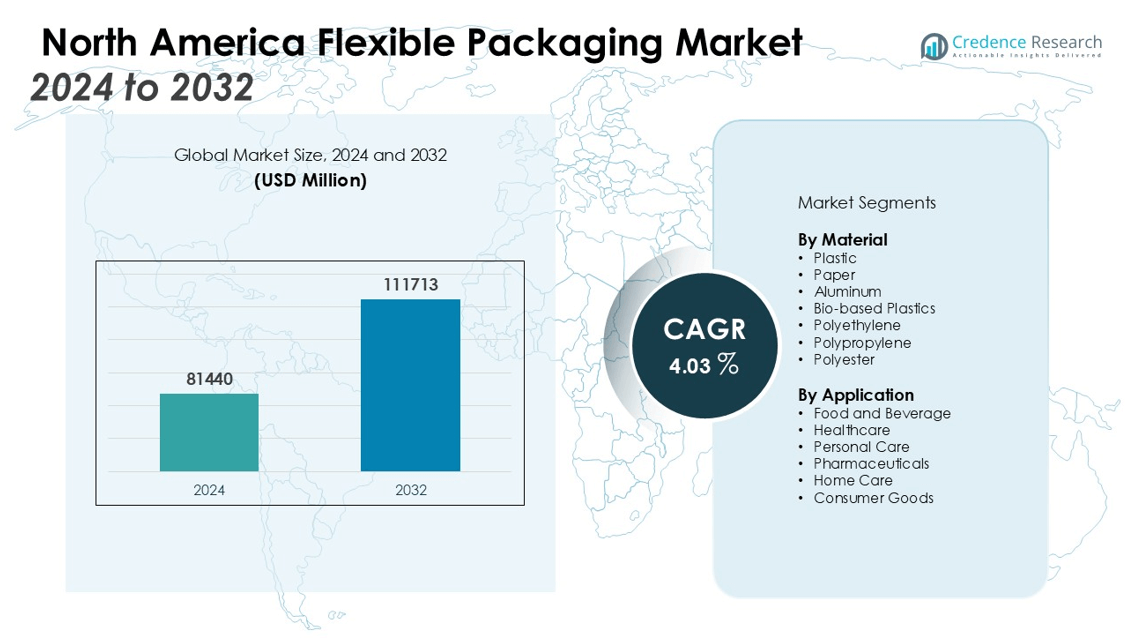
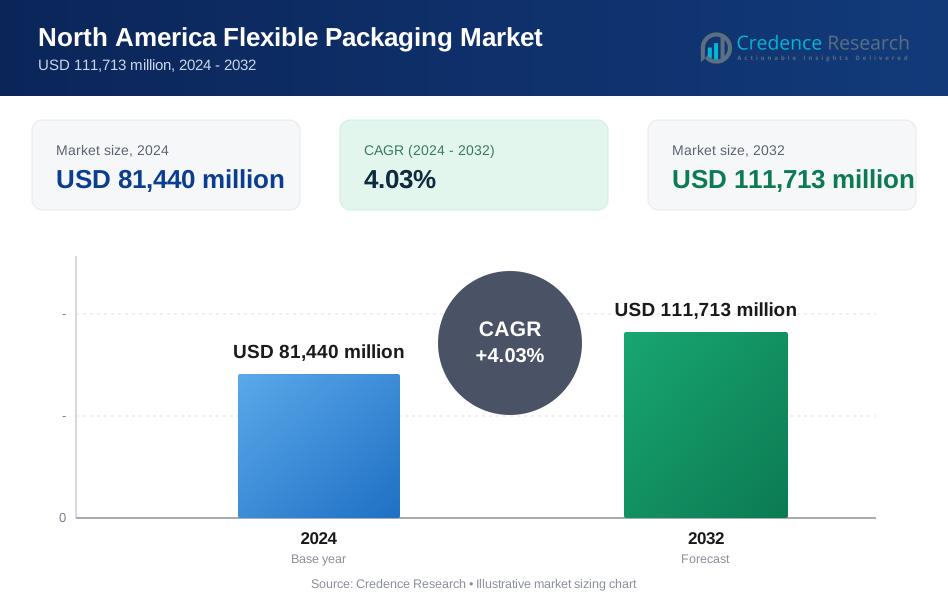
The North America Flexible Packaging Market size was valued at USD 81440 million in 2024 and is anticipated to reach USD 111713 million by 2032, at a CAGR of 4.03% during the forecast period (2024-2032).
| REPORT ATTRIBUTE | DETAILS |
|---|---|
| Historical Period | 2020-2023 |
| Base Year | 2024 |
| Forecast Period | 2025-2032 |
| North America Flexible Packaging Market Size 2024 | USD 81440 million |
| North America Flexible Packaging Market, CAGR | 4.03% |
| North America Flexible Packaging Market Size 2032 | USD 111713 million |
Key drivers fueling the market’s expansion include a shift towards sustainable and eco-friendly packaging, driven by growing consumer awareness and stringent environmental regulations. The adoption of recyclable, biodegradable, and multi-functional materials is gaining momentum, as brands seek to reduce their environmental footprint. Additionally, advancements in packaging technology, such as enhanced barrier properties, improved durability, and customization options, are further propelling market growth. The rise of e-commerce and the demand for innovative packaging solutions to ensure product safety and visibility also contribute significantly to the market's positive outlook.
Regionally, North America is one of the leading markets for flexible packaging, with the U.S. being the primary contributor. The region benefits from the presence of established packaging manufacturers and strong demand from end-use industries such as food and beverage, pharmaceuticals, and healthcare. Furthermore, increasing sustainability initiatives by major brands and rising consumer preference for convenience packaging are fueling the market’s growth across the region.
Market Insights:
- The North America Flexible Packaging Market is expected to grow from USD 81,440 million in 2024 to USD 111,713 million by 2032, driven by the increasing demand for sustainable packaging solutions.
- Technological advancements in flexible packaging materials are enhancing product protection, shelf life, and customization, fueling growth in various industries such as food, beverage, and pharmaceuticals.
- Consumer demand for sustainable packaging is on the rise, with recyclable, biodegradable, and multi-functional materials becoming more common to meet both regulatory pressures and environmental goals.
- The expansion of e-commerce is significantly contributing to the market’s growth, as businesses seek lightweight, durable, and cost-effective packaging that ensures product safety during transportation.
- Rising consumer preferences for convenience and portability, particularly in on-the-go products, is driving innovation in compact, resealable, and easy-to-use flexible packaging formats.
- High costs associated with sustainable materials and regulatory compliance challenges pose hurdles for widespread adoption of eco-friendly packaging solutions in the market.
- The United States remains the largest market, holding 70% of the market share, driven by strong demand from industries like food and beverage, pharmaceuticals, and healthcare, alongside technological advancements in packaging.
Market Drivers:
Growing Demand for Sustainable Packaging Solutions
The North America Flexible Packaging Market is witnessing a surge in demand for sustainable packaging alternatives. As consumers and governments push for more eco-friendly practices, companies are adopting recyclable, compostable, and biodegradable materials. This shift is not only driven by consumer demand but also by stricter environmental regulations aimed at reducing plastic waste. The focus on sustainability is prompting manufacturers to innovate with plant-based films, recycled content, and water-based inks to meet both environmental goals and consumer expectations.
- For instance, Amcor purchased more than 224,000 metric tons of recycled material for its packaging solutions in 2024.
Technological Advancements in Packaging Materials
Technological innovations in flexible packaging materials are a significant driver for the North America Flexible Packaging Market. The development of high-performance films with superior barrier properties enhances product protection and extends shelf life without compromising on design or usability. Advancements in packaging technologies, such as intelligent packaging and improved sealing methods, are helping to meet the evolving needs of industries like food and beverage and pharmaceuticals. These innovations also provide brands with greater customization options, allowing for more appealing and efficient packaging solutions.
Growth in E-commerce and Online Retail
The expansion of e-commerce in North America is playing a crucial role in driving the demand for flexible packaging. Online retail requires packaging that is lightweight, durable, and capable of withstanding the stresses of transportation and handling. Flexible packaging offers a cost-effective and efficient solution, ensuring product safety and visibility. With the rise of direct-to-consumer sales models, brands are increasingly opting for flexible packaging to enhance the consumer unboxing experience while reducing packaging costs and environmental impact.
- For instance, DS Smith surpassed its 2025 target by replacing 1.2 billion pieces of plastic with fiber-based, recyclable packaging solutions across its North American and European operations.
Consumer Preference for Convenience and Portability
Changing consumer lifestyles are driving the demand for convenient, easy-to-use, and portable packaging solutions. The North America Flexible Packaging Market benefits from the growing popularity of on-the-go products, especially in food and beverage, personal care, and healthcare sectors. Flexible packaging’s ability to provide compact, lightweight, and resealable options aligns with consumer preferences for products that offer convenience and functionality. Brands are responding to these demands by using flexible materials to create products that fit into consumers’ fast-paced, mobile lifestyles.
Market Trends:
Shift Toward Sustainable and Eco-Friendly Packaging
Sustainability continues to be a significant trend in the North America Flexible Packaging Market, as both consumers and companies prioritize eco-friendly packaging solutions. Brands are increasingly adopting biodegradable, recyclable, and compostable materials to reduce plastic waste and meet environmental regulations. Recycled content in packaging is gaining traction, with a focus on closed-loop systems to minimize the use of virgin materials. This shift is driven by growing environmental consciousness and consumer demand for products that align with sustainable practices. Flexible packaging's adaptability to various eco-friendly materials, such as plant-based films and water-based coatings, makes it an ideal choice for companies looking to improve their environmental footprint while maintaining product performance and aesthetic appeal. The trend toward sustainability is expected to strengthen as more regulatory pressures and consumer demands emerge.
- For instance, Sealed Air has launched a new BUBBLE WRAP® brand packaging material that is made with at least 90 recycled-content, sourced from post-industrial materials that would otherwise end up in landfills.
Technological Integration and Smart Packaging Innovations
Technological advancements are shaping the future of the North America Flexible Packaging Market, with a growing focus on smart packaging and digital innovations. Packaging solutions equipped with sensors, QR codes, and RFID technology are gaining popularity, allowing brands to provide real-time product information and enhance consumer engagement. These innovations enable more efficient supply chain management, improve product traceability, and offer added convenience for consumers. In addition, the development of high-performance, multi-layer films with enhanced barrier properties is helping to preserve product freshness and extend shelf life. As packaging technology continues to evolve, manufacturers are incorporating automation, digital printing, and advanced materials to create packaging solutions that are not only functional but also visually appealing and cost-effective.
- For instance, Avery Dennison’s introduction of the industry’s first RFID-enabled label for PET packaging, recognized by the Association of Plastic Recyclers in July 2025, enhances recyclability and delivers accurate supply chain tracking for over 50 top brands in the consumer goods sector.
Market Challenges Analysis:
High Costs of Sustainable Materials
One of the key challenges facing the North America Flexible Packaging Market is the high cost of sustainable materials. While consumer demand for eco-friendly packaging continues to grow, the use of recyclable and biodegradable materials often comes with a higher price tag compared to traditional plastic. This increases the overall production costs for manufacturers, which may result in higher product prices for consumers. Smaller companies, in particular, may face difficulty in transitioning to sustainable packaging due to limited budgets or access to cost-effective alternative materials. This price disparity creates a barrier to widespread adoption of environmentally friendly packaging solutions across the industry.
Regulatory Compliance and Recycling Challenges
The complexity of regulatory compliance is another challenge for the North America Flexible Packaging Market. As governments impose stricter regulations on packaging materials and waste management, companies must navigate the changing landscape of environmental laws. Flexible packaging often faces difficulties in the recycling process, as many materials are multi-layered or contain mixed plastics, complicating the recycling stream. The lack of standardized recycling infrastructure in certain regions further exacerbates these challenges, preventing companies from achieving the desired sustainability goals. Companies must invest in research, new technologies, and process improvements to comply with these regulations and ensure that packaging materials can be efficiently recycled.
Market Opportunities:
Growth of E-Commerce and Online Retail
The rapid expansion of e-commerce presents significant opportunities for the North America Flexible Packaging Market. As online shopping continues to increase, the demand for lightweight, durable, and protective packaging solutions grows. Flexible packaging offers an ideal solution for e-commerce businesses, ensuring product safety during transportation while minimizing costs. The rise of direct-to-consumer models and subscription services also creates a need for customizable packaging options that enhance customer experience and brand recognition. Companies in the flexible packaging industry can capitalize on this trend by offering tailored solutions that meet the specific needs of e-commerce companies, providing convenience, sustainability, and cost-effectiveness.
Advancements in Smart Packaging and Digital Solutions
The integration of smart technologies in packaging provides a unique opportunity for the North America Flexible Packaging Market. With innovations such as QR codes, RFID, and sensors, packaging is becoming more interactive and informative for consumers. These technologies enhance the consumer experience by providing product traceability, real-time information, and greater engagement opportunities. Brands can use smart packaging to differentiate themselves in the competitive market and offer added value to customers. As technological advancements continue, the potential for growth in this area expands, presenting manufacturers with opportunities to develop cutting-edge packaging solutions that meet the evolving demands of consumers and retailers.
Market Segmentation Analysis:
By Material
The material segment is primarily dominated by plastic, which holds the largest share due to its versatility, durability, and cost-effectiveness. Polyethylene, polypropylene, and polyester are among the most commonly used materials, offering various benefits such as moisture resistance and flexibility. The increasing demand for recyclable and biodegradable materials is prompting manufacturers to shift toward sustainable alternatives like paper, aluminum, and bio-based plastics. These materials are gaining traction due to growing environmental awareness and regulatory pressures on reducing plastic waste. The use of these eco-friendly materials is expected to rise steadily as consumers and companies continue to prioritize sustainability.
- For instance, TotalEnergies Corbion operates a dedicated PLA (polylactic acid) production facility in Rayong, Thailand with an annual capacity of 75,000tons, consistently running at this full output to meet bioplastics demand.
By Application
In terms of application, the food and beverage sector leads the North America Flexible Packaging Market, accounting for the largest share. Flexible packaging is highly favored in this industry due to its ability to preserve product freshness, extend shelf life, and offer convenience to consumers. It is widely used for snacks, beverages, dairy, and frozen foods. The healthcare and personal care sectors also represent significant application areas, driven by the need for protective packaging for pharmaceuticals and hygiene products. As consumer demand for convenience and portability increases, flexible packaging is becoming the preferred choice for many industries. Its adaptability to various products and ease of customization further fuel its growth across these diverse sectors.
- For instance, Bolthouse Farms' Baby Carrot ShakeDowns introduced a divided pouch design, keeping seasoning and carrots separate at the point of consumption and launching a single-serve snack that tops out at 25 calories per package.
Segmentations:
By Material
- Plastic
- Paper
- Aluminum
- Bio-based Plastics
- Polyethylene
- Polypropylene
- Polyester
By Application
- Food and Beverage
- Healthcare
- Personal Care
- Pharmaceuticals
- Home Care
- Consumer Goods
By Region
- United States
- Canada
- Mexico
Regional Analysis:
United States Market Overview
The United States holds 70% of the North America Flexible Packaging Market, driven by a strong demand from key industries, especially food and beverage, which represents a significant portion of the market. The country's substantial packaging manufacturing base and the increasing emphasis on sustainable packaging solutions further bolster its market leadership. Technological innovations in packaging materials, along with the rise of e-commerce, continue to fuel growth, ensuring that the U.S. remains a key contributor to the regional market.
Canada Market Insights
Canada captures 15% of the North America Flexible Packaging Market, with steady growth in demand driven by the food, healthcare, and personal care industries. Consumer preferences for convenience, along with a growing focus on environmentally friendly packaging solutions, are key factors supporting this growth. Canadian manufacturers are investing in new packaging technologies and sustainable materials to meet the rising demand for eco-conscious options. The proximity to the U.S. market also fosters trade and collaboration, strengthening Canada’s position within the region.
Mexico Market Outlook
Mexico accounts for 10% of the North America Flexible Packaging Market, benefiting from rapid industrialization and expanding export sectors. The growing demand in food and beverage, automotive, and pharmaceuticals drives the need for innovative packaging solutions. Mexico's expanding manufacturing capabilities, along with a focus on sustainability, are key to the country's increasing market share. The rise of e-commerce in the region further accelerates the need for lightweight and durable packaging, positioning Mexico as a critical growth area in the North American market.
Key Player Analysis:
- Mondi PLC
- Amcor PLC
- Sigma Plastics Group Inc.
- Novolex Holdings Inc.
- Transcontinental Inc.
- American Packaging Corporation
- Sealed Air Corp.
- PPC Flexible Packaging LLC
- Printpack Inc.
- Berry Global Inc.
- Emmerson Packaging
- Charter Next Generation Inc.
- Constantia Flexibles
- ProAmpac LLC
Competitive Analysis:
The North America Flexible Packaging Market is highly competitive, with key players continually innovating to meet the growing demand for sustainable and cost-effective packaging solutions. Major companies such as Amcor plc, Berry Global, Inc., and Sealed Air Corporation dominate the market, leveraging their strong manufacturing capabilities and extensive distribution networks. These players focus on technological advancements, including the development of eco-friendly materials, smart packaging, and customization options, to stay ahead of the competition. Smaller companies are also emerging, offering specialized solutions and tapping into niche segments. The increasing emphasis on sustainability has prompted both large and small players to invest in biodegradable, recyclable, and renewable materials. Regional players are strategically expanding their presence, focusing on partnerships and collaborations to enhance their market share. The competitive landscape is further intensified by regulatory pressures and changing consumer preferences, prompting continuous adaptation and innovation in packaging solutions.
Recent Developments:
- In July 2025, Amcor announced a registered exchange offer following the successful completion of its combination with Berry Global, positioning itself as a global leader in consumer and healthcare packaging solutions.
- In July 2025, Amcor used its CleanStream® recycle-ready material to maintain the premium image for Aqua Allegoria luxury hand creams.
- In March 2024, Mondi reached an agreement in principle to acquire UK-based rival DS Smith Plc for USD6.50billion, aiming to create a leading pan-European packaging giant.
- In March 2024, ProAmpac announced a definitive agreement to acquire Gelpac, a producer of multiwall paper and poly-woven packaging products, broadening its reach in North America.
Market Concentration & Characteristics:
The North America Flexible Packaging Market exhibits a moderately concentrated structure, with a few key players commanding a significant share of the market. Major companies such as Amcor, Berry Global, and Sealed Air hold substantial market positions, benefiting from strong distribution networks, technological expertise, and global reach. Despite this, the market also hosts numerous smaller and regional players, which foster competition through specialization, niche solutions, and rapid innovation. The market is characterized by high product customization, with manufacturers focusing on developing flexible, sustainable packaging options that meet specific industry demands, such as food, beverage, healthcare, and personal care. As consumer preferences shift towards eco-friendly solutions, key players are increasingly investing in renewable materials and advanced packaging technologies. The overall competitive environment is dynamic, driven by technological advancements, sustainability trends, and evolving regulatory standards across the region.
Report Coverage:
The research report offers an in-depth analysis based on Material, Application and Region. It details leading market players, providing an overview of their business, product offerings, investments, revenue streams, and key applications. Additionally, the report includes insights into the competitive environment, SWOT analysis, current market trends, as well as the primary drivers and constraints. Furthermore, it discusses various factors that have driven market expansion in recent years. The report also explores market dynamics, regulatory scenarios, and technological advancements that are shaping the industry. It assesses the impact of external factors and global economic changes on market growth. Lastly, it provides strategic recommendations for new entrants and established companies to navigate the complexities of the market.
Future Outlook:
- Sustainability remains a central focus, with increasing demand for recyclable, biodegradable, and compostable materials driven by consumer preferences and regulatory pressures.
- Technological advancements are enhancing packaging performance, including innovations in barrier properties, smart packaging, and digital printing, offering brands greater customization and functionality.
- The food and beverage sector continues to dominate the market, accounting for the largest share, due to the demand for extended shelf life, convenience, and product protection.
- E-commerce growth is driving the need for lightweight, durable, and cost-effective packaging solutions that ensure product safety during transportation.
- Regulatory initiatives, such as laws mandating recyclable or compostable packaging, are influencing packaging design and material selection.
- The rise of smart packaging technologies, including QR codes and RFID, is enhancing consumer engagement and providing real-time product information.
- Multilayered and coextruded films are gaining popularity for their superior barrier properties, extending product freshness and reducing waste.
- Consumer demand for on-the-go and single-serve packaging formats is increasing, prompting innovation in pouch and sachet designs.
- The competitive landscape is marked by strategic mergers and acquisitions, with companies investing in sustainable practices and technological advancements to maintain market leadership.
- There is a growing focus on reducing food waste through improved packaging solutions that enhance product preservation and shelf life.
Request a Free Sample
Fill in your details and we'll send you a free sample report.
- Sample data tables & charts
- Research methodology
Need a Custom Version of This Report?
Tailor the scope, geography, or segments to your exact requirements.
- Custom geography or segment scope
- Direct access to our analyst team
Frequently Asked Questions
What is the current size of the North America Flexible Packaging Market?
What are the key segments within the North America Flexible Packaging Market?
What are some challenges faced by the North America Flexible Packaging Market?
Who are the major players in the North America Flexible Packaging Market?
Table of Content
Chapter 1. Report Introduction
- 1.1 Report Description & Purpose
- 1.1.1 Report Title & Market Definition
- 1.1.2 Unique Selling Propositions (USP) & Key Differentiators
- 1.1.3 Value Proposition for Stakeholders
- 1.2 Research Objectives
- 1.2.1 Market Sizing Objectives (Volume & Revenue)
- 1.2.2 Segmentation Objectives
- 1.2.3 Competitive Intelligence Objectives
- 1.2.4 Forecast & Scenario Objectives
- 1.3 Report Scope
- 1.3.1 North America Flexible Packaging Scope – Types & Subtypes Covered
- 1.3.2 Geographic Scope – Regions & Countries Covered
- 1.3.3 Historical Period, Base Year & Forecast Period (2024; forecast to 2032)
- 1.3.4 Inclusions & Exclusions
- 1.4 HS Code & Classification Framework
- 1.5 Currency, Units & Pricing Basis
- 1.6 Target Stakeholders
- 1.7 Limitations & Assumptions
Chapter 2. Executive Summary
- 2.1 Global North America Flexible Packaging Market Snapshot
- 2.1.1 Market Size – Historical (2024) & Forecast (2024-2032) (2024: USD 81,440 million → 2032: USD 111,713 million)
- 2.1.2 Volume & Revenue – Global Totals
- 2.1.3 Key Market Highlights – Top Five Facts
- 2.2 North America Flexible Packaging Market Segmentation Snapshot
- 2.2.1 Market Split by Region – 2024 vs. 2032
- 2.3 Competitive Snapshot
- 2.3.1 Top 10 Players by Revenue Share – 2024
- 2.3.2 Top 10 Players by Volume Share – 2024
- 2.3.3 Recent Strategic Developments (18-Month Summary)
- 2.4 Key Investment Highlights & Strategic Conclusions
Chapter 3. North America Flexible Packaging Market Dynamics & Industry Analysis
- 3.1 Market Overview & Context
- 3.1.1 North America Flexible Packaging Market Position in the Broader Automotive Value Chain
- 3.1.2 OEM vs. Replacement Market Dynamics
- 3.1.3 Market Maturity & Development Stage by Region
- 3.2 North America Flexible Packaging Market Drivers
- 3.3 North America Flexible Packaging Market Restraints & Challenges
- 3.4 North America Flexible Packaging Market Opportunities
- 3.5 Porter's Five Forces Analysis
- 3.5.1 Threat of New Entrants
- 3.5.2 Bargaining Power of Suppliers
- 3.5.3 Bargaining Power of Buyers
- 3.5.4 Threat of Substitutes
- 3.5.5 Competitive Rivalry – Intensity Assessment
- 3.6 North America Flexible Packaging Value Chain Analysis
- 3.6.1 Upstream – Raw Material/Input Suppliers
- 3.6.1.1 Raw Material/Input 1
- 3.6.1.2 Raw Material/Input 2
- 3.6.1.3 Raw Material/Input 3
- 3.6.2 Midstream – Production/Manufacturing/Service Delivery
- 3.6.2.1 Production/Process Overview
- 3.6.2.2 Key Facility Locations & Capacity by Manufacturer
- 3.6.3 Downstream – Distribution & End Consumer
- 3.6.3.1 Primary Channel – B2B/OEM
- 3.6.3.2 Secondary Channels – Dealer, Retail, Online, Direct
- 3.6.4 Value Chain Profitability Analysis
- 3.6.1 Upstream – Raw Material/Input Suppliers
- 3.7 PESTEL Analysis
- 3.7.1 Political Factors
- 3.7.2 Economic Factors
- 3.7.3 Social Factors
- 3.7.4 Technological Factors
- 3.7.5 Environmental Factors
- 3.7.6 Legal Factors
- 3.8 North America Flexible Packaging Supply Chain Analysis
- 3.8.1 Raw Material/Input Supply Risk Assessment
- 3.8.2 Manufacturing Concentration Risk (Geographic Exposure)
- 3.8.3 Trade Disruption Impact Analysis
- 3.9 Regulatory & Policy Landscape
Note: The regulatory and policy landscape section covers regulations based on their applicability to the market, North America Flexible Packaging category, geography, and scope of the study. Only regulatory frameworks with a material impact on operations, compliance, trade, sustainability, or market access are analyzed in detail.
Chapter 4. Key Investment Pockets & Opportunity Analysis
- 4.1 North America Flexible Packaging Market Attractiveness Analysis
- 4.1.1 By Region – Investment Attractiveness Matrix (Volume × CAGR)
- 4.2 Absolute Revenue Growth Opportunity
- 4.2.1 By Region – Absolute USD Growth Through 2032
- 4.3 Incremental Volume Opportunity
- 4.3.1 By Region – Incremental Volume Through 2032
- 4.3.2 Segment – Incremental Volume
- 4.4 Emerging Submarket Opportunity Deep Dive (Subject to Applicability)
- 4.5 Emerging Market Opportunity Scorecards
- 4.5.1 United States
- 4.5.2 Europe
- 4.5.3 Asia
- 4.5.4 Middle East & Africa
Note: Emerging Market Opportunity Scorecards will be included based on relevance and strategic importance. Regions listed are indicative and may vary depending on data availability and market dynamics.
Chapter 5. North America Flexible Packaging Import-Export Analysis & Trade Flows
- 5.1 Global Trade Overview
- 5.1.1 Global Export Value by Country (2024)
- 5.1.2 Global Export Volume by Country (2024)
- 5.1.3 Global Import Value by Country (2024)
- 5.1.4 Global Import Volume by Country (2024)
- 5.1.5 Net Trade Balance by Country (2024)
- 5.2 Export Analysis – Segment
- 5.2.1 Type 1 (HS Code)
- 5.2.2 Type 2 (HS Code)
- 5.2.3 Type 3 (HS Code)
- 5.2.4 Type 4 (HS Code)
- 5.2.5 Type 5 (HS Code)
- 5.3 Import Analysis – Segment
- 5.3.1 Type 1 (HS Code)
- 5.3.2 Type 2 (HS Code)
- 5.3.3 Type 3 (HS Code)
- 5.3.4 Type 4 (HS Code)
- 5.3.5 Type 5 (HS Code)
- 5.4 Average Unit Trade Prices
- 5.4.1 Average Export Price – Segment & Country
- 5.4.2 Average Import Price – Segment & Source Country
- 5.4.3 Price Trends (2024)
- 5.5 Key Trade Route Analysis
- 5.5.1 Trade Route 1
- 5.5.2 Trade Route 2
- 5.5.3 Trade Route 3
- 5.5.4 Trade Route 4
- 5.5.5 Trade Route 5
- 5.6 Trade Policy Impact Assessment
- 5.6.1 US Anti-Dumping & Section 301 Tariffs
- 5.6.2 EU Customs Union Impact
- 5.6.3 Major Free Trade Agreements
- 5.6.4 USMCA Rules of Origin
Note: Trade policy analysis will be included only where relevant to the North America Flexible Packaging market.
Chapter 6. Competitive Landscape & Company Benchmarking
- 6.1 North America Flexible Packaging Market Concentration & Structure
- 6.1.1 Herfindahl-Hirschman Index (HHI) – vs. 2024
- 6.1.2 Tier 1, Tier 2 & Tier 3 Market Structure
- 6.1.3 Global, Regional & Local Player Dynamics
- 6.2 North America Flexible Packaging Market Share Analysis – 2024
- 6.2.1 Global Revenue Share by Company
- 6.2.2 Global Volume Share by Company
- 6.2.3 Regional Revenue Share
- 6.2.4 Market Share Evolution ( vs. 2024)
- 6.2.5 OEM Segment Share by Company
- 6.2.6 Replacement Segment Share by Company
- 6.3 Production/Delivery Capacity & Facility Analysis
- 6.3.1 Global Installed Capacity
- 6.3.2 Capacity Utilization Rates
- 6.3.3 Production/Output Volume
- 6.3.4 Facility Locations & Capacity Map
- 6.3.5 Planned Capacity Additions
- 6.4 North America Flexible Packaging Competitive Benchmarking Matrix
- 6.4.1 Revenue, Volume, CAGR & Profitability Comparison
- 6.4.2 Channel Revenue Mix
- 6.4.3 Geographic Revenue Exposure
- 6.4.4 R&D Intensity
- 6.4.5 Sustainability Maturity
- 6.5 Strategic Developments in North America Flexible Packaging (Last 24 Months)
- 6.5.1 Mergers, Acquisitions & Divestments
- 6.5.2 New North America Flexible Packaging Launches
- 6.5.3 Facility Expansions
- 6.5.4 Strategic Alliances, Joint Ventures & Partnerships
- 6.5.5 Distribution Expansion & Market Entry
- 6.5.6 Sustainability & ESG Initiatives
- 6.6 Competitive Strategy Mapping
- 6.6.1 Leader, Challenger, Follower & Niche Classification
- 6.6.2 Pricing Strategy Comparison
- 6.6.3 Channel Strategy Matrix
Note: Strategic developments are included based on their materiality and the availability of reliable information.
Chapter 7. Global North America Flexible Packaging Market – By Distribution Channel
- 7.1 Segment Overview
- 7.1.1 Volume & Revenue Split by Channel (2024 & 2032)
- 7.1.2 Channel Mix Evolution (2024-2032)
Chapter 8. Regional Market Analysis – Global Overview
- 8.1 Global Regional Overview
- 8.1.1 Regional Volume Share
- 8.1.2 Regional Revenue Share
- 8.1.3 Regional Volume by Region
- 8.1.4 Regional Revenue by Region
- 8.1.5 Regional Forecast Through 2032
- 8.2 Cross-Regional Segment Analysis
- 8.2.1 By Distribution Channel
- 8.2.2 By Brand/Price Tier
Chapter 9. North America North America Flexible Packaging Market
- 9.1 United States
- 9.2 Canada
- 9.3 Mexico
Chapter 10. Europe North America Flexible Packaging Market
- 10.1 Germany
- 10.2 France
- 10.3 Italy
- 10.4 United Kingdom
- 10.5 Spain
- 10.6 Poland
- 10.7 Russia
- 10.8 Netherlands
- 10.9 Belgium
- 10.10 Sweden
- 10.11 Denmark
- 10.12 Norway
- 10.13 Rest of Europe
Chapter 11. Asia Pacific North America Flexible Packaging Market
- 11.1 China
- 11.2 India
- 11.3 Japan
- 11.4 South Korea
- 11.5 Thailand
- 11.6 Indonesia
- 11.7 Vietnam
- 11.8 Malaysia
- 11.9 Australia
- 11.10 Rest of Asia Pacific
Chapter 12. Latin America North America Flexible Packaging Market
- 12.1 Brazil
- 12.2 Argentina
- 12.3 Colombia
- 12.4 Chile
- 12.5 Rest of Latin America
Chapter 13. Middle East North America Flexible Packaging Market
- 13.1 Saudi Arabia
- 13.2 United Arab Emirates
- 13.3 Turkey
- 13.4 Israel
- 13.5 Iran
- 13.6 Rest of the Middle East
Chapter 14. Africa North America Flexible Packaging Market
- 14.1 South Africa
- 14.2 Egypt
- 14.3 Nigeria
- 14.4 Morocco
- 14.5 Rest of Africa
Chapter 15. North America Flexible Packaging Company Profiles
- 15.1 [Company 01]
- 15.1.1 Company Overview
- 15.1.2 Key Management Personnel
- 15.1.3 Products & Services Portfolio
- 15.1.4 Financial Performance
- 15.1.5 Key Market Focus & Geographic Presence
- 15.1.6 Recent Developments & Strategic Initiatives
Note: The company profile list is preliminary and may change based on research findings, market developments, data availability, and client requirements.
Chapter 16. Appendices
- Appendix A – List of Abbreviations & Acronyms
- Appendix B – Industry Classification Code Reference – Full Series
- Appendix C – Production & Capacity Data Tables
- Appendix D – End-Use & Demand Base Tables
- Appendix E – Consumption & Replacement Rate Assumptions
- Appendix F – ASP Reference Tables
- Appendix G – Manufacturing & Facility Database
- Appendix H – Import-Export Data Tables
- Appendix I – Regulatory Summary Tables
- Appendix J – Primary Research Participant List (Anonymized)
- Appendix K – Primary Research Questionnaire Framework
- Appendix L – Data Sources & Bibliography
- Appendix M – Market Size Divergence & Source Comparison
Chapter 17. Research Methodology
- 17.1 Research Framework & Philosophy
- 17.2 Secondary Research – Sources, Hierarchy & Data Extraction
- 17.3 Data Modeling – Bottom-Up & Top-Down Market Sizing
- 17.4 Primary Research – Stakeholder Framework, LOI & Sample Sizes
- 17.5 Forecast Methodology – Regression, Scenario & Sensitivity Analysis
- 17.6 Quality Control – Four-Layer Validation Framework
- 17.7 Limitations & Standard Assumptions
- 17.8 Disclaimer
