Market Overview:
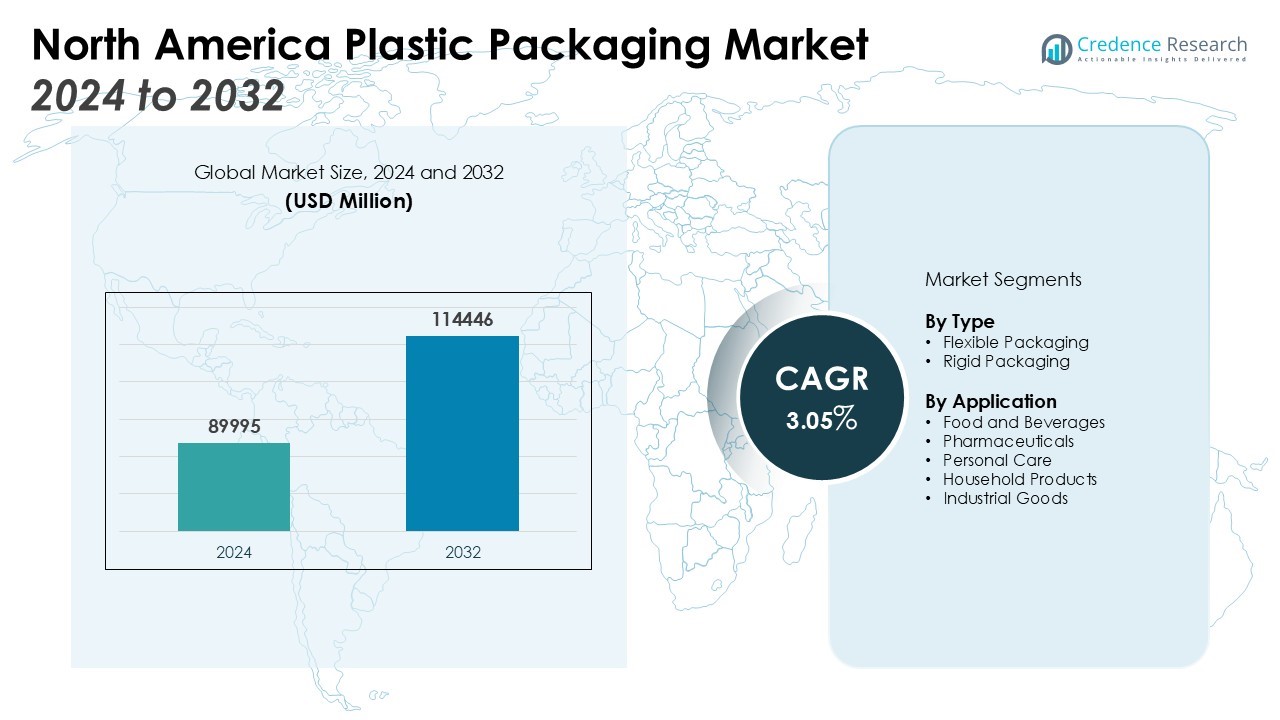
The North America Plastic Packaging Market size was valued at USD 89995 million in 2024 and is anticipated to reach USD 114446 million by 2032, at a CAGR of 3.05% during the forecast period (2024-2032).
| REPORT ATTRIBUTE | DETAILS |
|---|---|
| Historical Period | 2020-2024 |
| Base Year | 2024 |
| Forecast Period | 2025-2032 |
| North America Plastic Packaging Market Size 2024 | USD 89995 Million |
| North America Plastic Packaging Market, CAGR | 3.05% |
| North America Plastic Packaging Market Size 2032 | USD 114446 Million |
Key market drivers include increasing consumer preference for convenient, on-the-go packaging solutions and stringent regulations promoting recyclable and sustainable packaging materials. The surge in e-commerce and home delivery services accelerates the need for secure and efficient packaging, while leading brands continue to invest in research and development to enhance product shelf life and reduce environmental impact. Strategic collaborations among packaging manufacturers and brand owners are accelerating the shift toward sustainable and high-performance packaging, with digital printing and smart packaging technologies gaining traction to improve traceability and consumer engagement.
Regionally, the United States dominates the North America Plastic Packaging Market, supported by a well-established consumer goods sector and significant investments in packaging innovation. Canada benefits from expanding food processing and pharmaceutical industries, contributing to overall regional growth. The region’s focus on circular economy principles and the adoption of eco-friendly packaging solutions positions North America as a frontrunner in sustainable plastic packaging initiatives. Robust supply chain infrastructure and growing investments in automation technologies further reinforce the region’s leadership in the global plastic packaging sector.
Market Insights:
- The North America Plastic Packaging Market was valued at USD 89,995 million in 2024 and is projected to reach USD 114,446 million by 2032, registering a CAGR of 3.05% from 2024 to 2032.
- Rising consumer demand for convenient, lightweight, and on-the-go packaging is driving growth in food, beverage, and personal care sectors.
- E-commerce expansion and home delivery trends are increasing the need for secure, tamper-evident, and functional packaging solutions.
- Technological advancements such as digital printing, smart labeling, and automation are transforming packaging performance and supply chain efficiency.
- Stringent regulations on plastic waste and recycling are accelerating the adoption of recyclable, compostable, and biodegradable packaging across the region.
- The United States holds 76% of the regional market share, supported by its robust manufacturing base and strong investment in packaging innovation.
- Canada and Mexico contribute 17% and 7% respectively, with Canada advancing sustainable packaging initiatives and Mexico offering cost-efficient manufacturing for flexible and rigid packaging needs.
Market Drivers:
Rising Demand for Convenience and Lightweight Solutions Fuels Market Growth
The North America Plastic Packaging Market is experiencing strong demand for convenient, lightweight, and portable packaging, particularly in the food, beverage, and personal care sectors. Consumers favor single-serve, resealable, and easy-open formats that fit busy lifestyles and urban living. Brands are responding by developing innovative designs that extend shelf life and minimize waste. Retailers value packaging that protects products and reduces damage during transport.
Innovation and Technology Adoption Transform Packaging Performance
Technological advancements are reshaping the North America Plastic Packaging Market as companies adopt digital printing, active packaging, and smart labeling solutions. Features like QR codes and temperature indicators enhance product traceability and consumer engagement. Automation in manufacturing processes ensures quality and efficiency. Ongoing R&D delivers high-barrier films and recyclable materials to meet market and regulatory needs.
- For instance, ePac Flexible Packaging utilizes HP Indigo 20000 digital presses, allowing brands to run multiple SKUs in a single print run, significantly reducing packaging waste and set-up time.
Regulatory Emphasis on Sustainability Shapes Industry Priorities
Increasing regulatory focus on plastic waste and recycling is pushing the North America Plastic PackagingMarket toward sustainable practices. Governments and industry bodies are setting strict standards on recyclability and labeling. Companies are introducing recyclable, compostable, and biodegradable packaging and using more post-consumer resin. This aligns with growing consumer environmental awareness and drives market adoption of green solutions.
E-Commerce Acceleration Elevates Secure and Functional Packaging Needs
The rapid rise of e-commerce and direct-to-consumer sales is driving demand for durable and protective plastic packaging. Packaging must safeguard products during shipping and storage, offering tamper-evident and easy-to-open features. Growth in online grocery and subscription models is increasing the need for specialized packaging. The market is adapting to changing retail channels by prioritizing innovation and functional design.
- For instance, Imperfect Foods, an online grocery delivery company, saves 500,000 pounds of packaging waste from landfills each month by reusing gel packs and insulated liners through its customer take-back program.
Market Trends:
Sustainable Packaging Solutions and Circular Economy Initiatives Reshape Industry Direction
The North America Plastic Packaging Market is witnessing a decisive shift toward sustainable packaging solutions, driven by regulatory mandates and heightened consumer demand for eco-friendly products. Companies are adopting recyclable, biodegradable, and compostable materials across diverse product lines. The use of post-consumer recycled (PCR) content is expanding, supported by investments in closed-loop recycling infrastructure and material recovery systems. Major packaging producers are partnering with brand owners and retailers to implement circular economy strategies, reducing single-use plastics and prioritizing resource efficiency. Brands are also focusing on light weighting, which cuts material usage and lowers transportation emissions. It is accelerating the transition to more sustainable and responsible packaging practices across the region.
- For instance, Notpla has developed packaging from seaweed that biodegrades within four to six weeks, offering a genuine alternative to single-use plastic.
Smart Packaging, Personalization, and Digital Technologies Enhance Market Competitiveness
Technological innovation is transforming the North America Plastic Packaging Market, with digital printing, smart packaging, and interactive features gaining rapid traction. Brands leverage QR codes, RFID tags, and augmented reality elements to boost traceability, product authentication, and consumer engagement. Smart packaging technologies are improving supply chain visibility and supporting temperature or freshness monitoring for perishable goods. Personalization and customization of packaging designs help brands differentiate in crowded markets and respond to evolving consumer preferences. The adoption of automation and advanced robotics in packaging production enhances quality and operational efficiency. It is enabling faster product launches and a more agile response to shifting market demands.
- For instance, Coca-Cola’s “It’s Mine” campaign created millions of unique Diet Coke 12-oz. glass contour bottles through partnership with HP Indigo digital printing technology, ensuring that every bottle featured a design distinct from all others during the 2025 campaign.
Market Challenges Analysis:
Stringent Environmental Regulations and Evolving Compliance Standards Create Pressure
The North America Plastic Packaging Market faces mounting challenges due to strict environmental regulations and shifting compliance requirements. Government mandates on single-use plastics, minimum recycled content, and waste management standards require significant operational changes. Companies must adapt production processes, invest in sustainable materials, and update labeling to align with evolving policies. Non-compliance risks include financial penalties, reputational harm, and restricted market access. It is intensifying the focus on innovation and collaboration across the value chain. The complex regulatory landscape demands proactive monitoring and strategic planning from industry participants.
Volatile Raw Material Prices and Supply Chain Disruptions Impact Profitability
The North America Plastic Packaging Market is affected by fluctuating raw material costs and ongoing supply chain uncertainties. Resin price volatility directly influences production expenses and profit margins for manufacturers. Supply chain disruptions, such as transportation bottlenecks and labor shortages, hinder timely delivery and inventory management. Companies must implement cost-control measures and diversify sourcing strategies to maintain stability. It challenges both large players and small manufacturers to balance operational efficiency with responsiveness. Market participants continue to seek long-term partnerships and digital tools to mitigate risks and ensure reliable supply.
Market Opportunities:
Expansion of Sustainable Packaging Solutions Unlocks New Growth Avenues
The North America Plastic Packaging Market presents strong opportunities through the expansion of sustainable packaging options. Increasing consumer and regulatory demand for recyclable, biodegradable, and compostable products opens new revenue streams for manufacturers. Investment in advanced materials and closed-loop recycling technologies enables companies to capture value from circular economy initiatives. It supports collaboration with brand owners seeking to strengthen their environmental credentials. The integration of post-consumer resin and bio-based plastics into mainstream packaging aligns with retailer and end-user expectations. This trend positions the market to lead in eco-innovation and responsible production.
Growth in E-Commerce and Technological Advancements Fuels Market Potential
The surge in e-commerce activity and rising demand for customized, secure packaging solutions provide significant opportunities in the North America Plastic Packaging Market. Companies can capitalize on the need for tamper-evident, easy-to-handle, and lightweight designs tailored for direct-to-consumer shipments. The adoption of digital printing, automation, and smart packaging enhances operational agility and supply chain efficiency. It enables manufacturers to offer greater flexibility, meet evolving logistics requirements, and reduce lead times. Embracing these technologies will allow market participants to differentiate their offerings and capture a broader customer base.
Market Segmentation Analysis:
By Type
The North America Plastic PackagingMarket features two primary segments: flexible and rigid packaging. Flexible packaging-including pouches, films, and bags-commands leading share due to its lightweight nature, design versatility, and cost efficiency. It supports resealable and sustainable solutions for a range of consumer goods, making it the preferred choice for brands prioritizing convenience and sustainability. Rigid packaging, which includes bottles, containers, and trays, remains critical for applications requiring superior product protection and structural integrity. It is widely adopted in beverages, pharmaceuticals, and household care products, where durability and security are essential.
- For instance, Berry Global’s ClariPPil polypropylene bottle for healthcare achieves a RecyClass A recyclability certification and delivers up to 84 percent improved moisture ingress protection compared to traditional PET containers.
By Application
The market covers food and beverages, pharmaceuticals, personal care, household products, and industrial goods. Food and beverage applications lead the segment, reflecting strong consumer demand for freshness, safety, and easy-to-use packaging. The pharmaceuticals sector is expanding rapidly, driven by rigorous safety standards and growing demand for tamper-evident solutions. Personal care and household products utilize advanced packaging to enhance brand differentiation and support sustainability goals. The North America Plastic Packaging Market leverages its diverse application spectrum to foster ongoing innovation and address the evolving needs of end users.
- For instance, Amcor’s AmPrima® Plus packaging reduced the carbon footprint per pouch by 22 according to a certified life cycle assessment in 2025.
Segmentations:
By Type
- Flexible Packaging
- Rigid Packaging
By Application
- Food and Beverages
- Pharmaceuticals
- Personal Care
- Household Products
- Industrial Goods
By Region
- United States
- Canada
- Mexico
Regional Analysis:
United States Drives Regional Leadership Through Scale and Innovation
The United States holds 76% share of the North America Plastic Packaging Market, reflecting its leadership in advanced manufacturing, high consumer demand, and rapid innovation adoption. With extensive supply chains across food and beverage, pharmaceuticals, and personal care, the country drives implementation of smart packaging, digital printing, and sustainable materials. Regulatory frameworks promote recycled content and eco-friendly solutions, supporting the shift toward circular economy practices. Robust logistics infrastructure and a broad research base position the United States as a strategic center for packaging suppliers and technology providers. It maintains a central role in launching next-generation packaging solutions for the region.
Canada Advances Industrial Growth and Sustainability Initiatives
Canada accounts for 17% of the North America Plastic Packaging Market, benefiting from strong industrial growth in food processing, pharmaceuticals, and retail. Its emphasis on sustainability results in major investments in recyclable and compostable packaging solutions. Provincial regulations and national standards require continual adaptation, encouraging companies to prioritize environmental responsibility. Canadian manufacturers collaborate with international brands to develop high-performance, region-specific packaging. The market rewards innovation while maintaining a focus on reduced environmental impact. It stands out for progressive policy alignment and commitment to sustainability.
Mexico Strengthens Position Through Cost-Efficient Manufacturing
Mexico represents 7% of the North America Plastic PackagingMarket, supported by cost-competitive manufacturing and geographic proximity to the United States. The country supplies flexible and rigid packaging to industries such as food and beverage, automotive, and electronics. Foreign direct investment and advantageous trade agreements foster technology transfer and sector growth. Mexican firms increasingly utilize automation and sustainable practices to meet international quality standards. It attracts global packaging companies aiming to diversify supply chains and capitalize on regional opportunities.
Key Player Analysis:
- Bemis Company, Inc.
- Huhtamaki Oyj
- Amcor plc
- Berry Global Group, Inc.
- Constantia Flexibles Group GmbH
- Coveris Holdings S.A.
- Mondi Group
- Printpack, Inc.
- Sealed Air Corporation
- Sonoco Products Company
- WestRock Company
Competitive Analysis:
The North America Plastic Packaging Market features a highly competitive landscape shaped by leading global and regional players. Companies such as Amcor plc, Berry Global Group, Sealed Air Corporation, Sonoco Products Company, and WestRock Company hold substantial market shares through diversified product portfolios and strong distribution networks. It witnesses continuous innovation, with firms investing in sustainable materials, digital printing, and advanced barrier technologies to address regulatory and consumer demands. Strategic mergers, acquisitions, and collaborations drive market consolidation and expansion. Leading players focus on expanding production capacity, improving operational efficiency, and developing eco-friendly packaging to strengthen their competitive positions. Smaller and mid-sized companies compete by offering specialized solutions, flexible manufacturing, and responsive customer service. The market rewards innovation, adaptability, and the ability to meet evolving end-user requirements.
Recent Developments:
- In April 2025, Amcor announced the completion of its all-stock combination with Berry Global, significantly expanding its global market position, portfolio, and innovation capabilities.
- In June 2025, Sonoco launched a 100% recycled fiber paper can with a paper bottom in North America, with up to 90% post-consumer material content.
Market Concentration & Characteristics:
The North America Plastic Packaging Market demonstrates moderate to high market concentration, with a few large multinational corporations commanding significant shares alongside a competitive field of regional and specialized players. It is characterized by rapid innovation cycles, a strong focus on sustainability, and the integration of advanced technologies such as smart packaging and digital printing. Leading companies invest in product development and supply chain optimization to maintain an edge, while stringent regulatory standards accelerate the shift toward recyclable and eco-friendly materials. The market values operational efficiency, quality assurance, and the ability to deliver customized packaging solutions tailored to diverse industry needs.
Report Coverage:
The research report offers an in-depth analysis based on Type, Application and Region. It details leading market players, providing an overview of their business, product offerings, investments, revenue streams, and key applications. Additionally, the report includes insights into the competitive environment, SWOT analysis, current market trends, as well as the primary drivers and constraints. Furthermore, it discusses various factors that have driven market expansion in recent years. The report also explores market dynamics, regulatory scenarios, and technological advancements that are shaping the industry. It assesses the impact of external factors and global economic changes on market growth. Lastly, it provides strategic recommendations for new entrants and established companies to navigate the complexities of the market.
Future Outlook:
- Investment in bio-based and compostable plastics will expand to meet growing environmental expectations.
- Brands will adopt digital printing technologies to enhance personalization and reduce time-to-market.
- Smart packaging with QR codes and sensors will become standard in multiple segments for better traceability.
- Demand for high-barrier films and lightweight materials will grow in food, pharmaceutical, and personal care sectors.
- Circular economy initiatives and closed-loop recycling systems will reshape production and supply chain strategies.
- Automation and robotics in manufacturing will advance, raising efficiency and reducing production costs.
- Collaborative partnerships between packaging companies and major brand owners will accelerate eco-innovation.
- Regional players will enhance capabilities to support nearshoring and reduce supply chain dependency.
- Regulations on single-use plastics will tighten, prompting broader adoption of recycled and refillable packaging formats.
- Consumer engagement through interactive packaging features will strengthen brand loyalty and influence packaging design.

Request a Free Sample
Fill in your details and we'll send you a free sample report.
- Sample data tables & charts
- Research methodology
Market Dynamics
Consumer Preference for Convenience and On-the-Go Packaging
The shift toward busy lifestyles and urbanization in North America is driving demand for lightweight, resealable, and easy-to-carry plastic packaging, especially in food, beverage, and personal care sectors. Brands are innovating with single-serve and portable formats to meet these evolving consumer needs.
Stringent Sustainability Regulations and Eco-Friendly Initiatives
Government mandates and industry standards on recyclability, compostability, and use of post-consumer resin are accelerating the adoption of sustainable plastic packaging. Companies are investing in recyclable, biodegradable, and bio-based materials to comply with regulations and appeal to environmentally conscious consumers.
E-Commerce and Home Delivery Growth
The rapid expansion of e-commerce and direct-to-consumer delivery models is increasing the need for secure, tamper-evident, and functional plastic packaging. Packaging must protect products during shipping and offer features like easy opening and resealability, driving innovation in design and materials.
Technological Advancements in Packaging
Adoption of digital printing, smart labeling, and automation is transforming packaging performance and supply chain efficiency. Features such as QR codes, temperature indicators, and high-barrier films enhance traceability, product safety, and consumer engagement, making packaging smarter and more responsive to market needs.
Strategic Collaborations and Circular Economy Initiatives
Partnerships between packaging manufacturers and brand owners are accelerating the shift toward circular economy models, focusing on closed-loop recycling and resource efficiency. These collaborations foster innovation in sustainable packaging solutions and help companies meet both regulatory and consumer expectations.
Need a Custom Version of This Report?
Tailor the scope, geography, or segments to your exact requirements.
- Custom geography or segment scope
- Direct access to our analyst team
Frequently Asked Questions
What is the current size of the North America Plastic Packaging Market?
What factors are driving the growth of the North America Plastic Packaging Market?
What are the key segments within the North America Plastic Packaging Market?
What are some challenges faced by the North America Plastic Packaging Market?
Who are the major players in the North America Plastic Packaging Market?
Which segment is leading the market share?
Table of Content
Chapter 1 Market Segmentation
- 1.1 Segmentation Framework
- 1.1.1 Product and Service Classification
- 1.1.2 Application and End-Use Classification
- 1.1.3 Technology and Solution Classification
- 1.1.4 Customer and Distribution Channel Classification
- 1.1.5 Geographic Segmentation
- 1.1.6 Market Segment Definitions and Boundaries
- 1.2 By Type
- 1.2.1 Flexible Packaging
- 1.2.2 Rigid Packaging
- 1.3 By Material
- 1.3.1 Polyethylene (PE)
- 1.3.2 Polypropylene (PP)
- 1.3.3 Polyethylene Terephthalate (PET)
- 1.3.4 Polystyrene (PS)
- 1.3.5 Others (including bio-based plastics)
- 1.4 By Application
- 1.4.1 Food and Beverages
- 1.4.2 Pharmaceuticals
- 1.4.3 Personal Care
- 1.4.4 Household Products
- 1.4.5 Industrial Goods
Chapter 2 Introduction
- 2.1 Report Objectives and Scope
- 2.2 Product Definition and Industry Terminology
- 2.3 Market Inclusions and Exclusions
- 2.4 Research Process
- 2.4.1 Primary Research and Expert Interviews
- 2.4.2 Secondary Research and Source Review
- 2.4.3 Top-Down and Bottom-Up Estimation
- 2.4.4 Data Triangulation and Verification
- 2.5 Market Size Measurement Basis
- 2.5.1 2024: USD 89,995 million → 2032: USD 114,446 million
- 2.6 Historical and Forecast Reference Periods
- 2.6.1 Base Year: 2024
- 2.6.2 Forecast Period: 2024-2032
- 2.7 Research Assumptions and Limitations
Chapter 3 Executive Summary
- 3.1 Market Snapshot and Key Findings
- 3.2 Base-Year Market Size, 2024
- 3.3 Forecast Market Size, 2032
- 3.4 Revenue and Volume Growth Outlook
- 3.5 Key Demand and Supply Indicators
- 3.6 Leading Market Segments
- 3.7 Fastest-Growing Market Opportunities
- 3.8 Regional Performance Highlights
- 3.9 Technology and Industry Transformation
- 3.10 Competitive Landscape Summary
- 3.11 Analyst View and Strategic Implications
Chapter 4 North America Plastic Packaging Market Trends and Developments
- 4.1 Historical Industry Development
- 4.2 Recent Market Trends and Developments
- 4.3 Demand and Customer Behavior Trends
- 4.4 Technology and Product Innovation
- 4.5 Artificial Intelligence, Automation and Digitalization
- 4.6 Local Manufacturing and Supply Chain Realignment
- 4.7 Industry Partnerships, Mergers and Acquisitions
- 4.8 Sustainability and Circular Economy Developments
- 4.9 Government and Private Sector Investment Trends
- 4.10 Emerging Business Models and Commercialization
- 4.11 Industry Developments and Announcements
Chapter 5 North America Plastic Packaging Market Production, Supply and Demand Analysis
- 5.1 Demand Trend and Consumption Analysis
- 5.2 Demand Forecast, 2024-2032
- 5.3 Production and Output Trend
- 5.4 Production and Output Forecast, 2024-2032
- 5.5 Installed Capacity and Capacity Utilization
- 5.6 Company-Wise Production Plants and Statistics
- 5.6.1 Installed Production Capacity
- 5.6.2 Actual Production
- 5.6.3 Planned Capacity and Expansion Targets
- 5.7 Supply Chain Structure and Procurement Trends
- 5.8 Supply-Demand Gap and Bottlenecks
- 5.9 Import Dependence and Sourcing Structure
- 5.10 Contract Manufacturing and Outsourcing
- 5.11 Regional Supply and Demand Concentration
Chapter 6 North America Plastic Packaging Market Pricing Analysis
- 6.1 Pricing Structure and Measurement
- 6.2 Historical Pricing Trends
- 6.3 Pricing Outlook, 2024-2032
- 6.4 Average Selling Price and Unit Economics
- 6.5 Pricing by Product and Market Segment
- 6.6 Geographic Pricing Differences
- 6.7 Key Input, Energy, Labor and Logistics Costs
- 6.8 Contract Pricing and Purchasing Models
- 6.9 Pricing Sensitivity and Competitive Positioning
- 6.10 Price, Margin and Profitability Implications
Chapter 7 North America Plastic Packaging Market Dynamics
- 7.1 Market Growth Drivers
- 7.1.1 Demand-Side Drivers
- 7.1.2 Technology and Innovation Drivers
- 7.1.3 Infrastructure and Investment Drivers
- 7.1.4 Regulatory and Policy Drivers
- 7.2 Market Restraints
- 7.2.1 Cost and Affordability Constraints
- 7.2.2 Technology and Adoption Barriers
- 7.2.3 Supply Chain and Operational Constraints
- 7.3 Market Challenges
- 7.3.1 Competitive Pressure and Margin Erosion
- 7.3.2 Skills, Infrastructure and Implementation Gaps
- 7.4 Emerging Market Opportunities
- 7.5 Market Dynamics Impact and Time-Horizon Assessment
Chapter 8 North America Plastic Packaging Value Chain Analysis
- 8.1 Industry Value Chain Overview
- 8.2 Upstream Suppliers and Critical Inputs
- 8.3 Technology and Component Providers
- 8.4 Manufacturing or Service Delivery
- 8.5 Distribution, Channel Partners and Integrators
- 8.6 Downstream Applications and End Users
- 8.7 Value Addition and Profit Pools
- 8.8 Vertical Integration and Outsourcing
- 8.9 Supplier Concentration and Risk
- 8.10 Supply Chain Localization and Resilience
Chapter 9 North America Plastic Packaging Market Regulations and Policies
- 9.1 Relevant Laws, Standards and Compliance Frameworks
- 9.2 Product, Service, Safety and Quality Requirements
- 9.3 Government Policies, Incentives and Subsidies
- 9.4 Imports, Exports and Trade Barriers
- 9.5 Public Procurement and Local Content Requirements
- 9.6 Environmental and Sustainability Compliance
- 9.7 Upcoming Policy Changes and Market Implications
Chapter 10 North America Plastic Packaging Market Hotspots and Opportunities
- 10.1 Market Opportunity Mapping and Growth Hotspots
- 10.2 High-Growth Applications and Customer Groups
- 10.3 Underserved Markets and White-Space Opportunities
- 10.4 Emerging Technology and Product Opportunities
- 10.5 New Capacity and Investment Hotspots
- 10.6 Market Entry and Expansion Opportunities
- 10.7 Distribution and Partnership Opportunities
- 10.8 Near-Term and Long-Term Commercial Potential
- 10.9 Opportunity Attractiveness and Execution Risks
Chapter 11 North America Plastic Packaging Market Outlook, 2024-2032
- 11.1 Market Size and Analysis
- 11.1.1 Revenue (Market Measurement: 2024: USD 89,995 million → 2032: USD 114,446 million)
- 11.1.2 Market Volume and Quantity Sold
- 11.1.3 Historical Market Size
- 11.1.4 Base-Year Market Size, 2024
- 11.2 Market Forecast, 2024-2032
- 11.2.1 Revenue Forecast to 2032
- 11.2.2 Volume Forecast to 2032
- 11.2.3 CAGR and Year-on-Year Growth
- 11.2.4 Incremental Revenue Opportunity
- 11.3 Forecast Assumptions and Scenario Analysis
- 11.3.1 Base-Case Forecast
- 11.3.2 Optimistic and Conservative Scenarios
- 11.3.3 Technology, Pricing and Policy Sensitivities
- 11.4 Market Attractiveness and Growth Outlook
Chapter 12 North America Plastic Packaging Market Segmentation and Outlook
- 12.1 Segmentation Summary and Market Shares, 2024
- 12.2 Largest and Fastest-Growing Segments
- 12.3 By Type - Market Size and Forecast, 2024-2032
- 12.3.1 Segment Definition and Scope
- 12.3.2 Historical Market Size
- 12.3.3 Revenue Forecast, 2024-2032
- 12.3.4 Volume Forecast, 2024-2032
- 12.3.5 Base-Year Market Share, 2024
- 12.3.6 Segment CAGR and Growth Drivers
- 12.3.7 Subsegment Market Size and Forecast
- 12.3.7.1 Flexible Packaging
- 12.3.7.2 Rigid Packaging
- 12.3.8 Subsegment Pricing and Adoption Trends
- 12.3.9 Leading Suppliers and Competition
- 12.3.10 Regional Demand and Opportunities
- 12.4 By Material - Market Size and Forecast, 2024-2032
- 12.4.1 Segment Definition and Scope
- 12.4.2 Historical Market Size
- 12.4.3 Revenue Forecast, 2024-2032
- 12.4.4 Volume Forecast, 2024-2032
- 12.4.5 Base-Year Market Share, 2024
- 12.4.6 Segment CAGR and Growth Drivers
- 12.4.7 Subsegment Market Size and Forecast
- 12.4.7.1 Polyethylene (PE)
- 12.4.7.2 Polypropylene (PP)
- 12.4.7.3 Polyethylene Terephthalate (PET)
- 12.4.7.4 Polystyrene (PS)
- 12.4.7.5 Others (including bio-based plastics)
- 12.4.8 Subsegment Pricing and Adoption Trends
- 12.4.9 Leading Suppliers and Competition
- 12.4.10 Regional Demand and Opportunities
- 12.5 By Application - Market Size and Forecast, 2024-2032
- 12.5.1 Segment Definition and Scope
- 12.5.2 Historical Market Size
- 12.5.3 Revenue Forecast, 2024-2032
- 12.5.4 Volume Forecast, 2024-2032
- 12.5.5 Base-Year Market Share, 2024
- 12.5.6 Segment CAGR and Growth Drivers
- 12.5.7 Subsegment Market Size and Forecast
- 12.5.7.1 Food and Beverages
- 12.5.7.2 Pharmaceuticals
- 12.5.7.3 Personal Care
- 12.5.7.4 Household Products
- 12.5.7.5 Industrial Goods
- 12.5.8 Subsegment Pricing and Adoption Trends
- 12.5.9 Leading Suppliers and Competition
- 12.5.10 Regional Demand and Opportunities
- 12.6 Segment Growth Comparison
- 12.7 Segment Attractiveness and Priority Matrix
Chapter 13 North America Plastic Packaging End-Use and Application Market Outlook
- 13.1 End-Use Industry and Customer Demand Structure
- 13.2 Leading Applications and Customer Groups
- 13.3 End-Use Market Size, Share and Forecast
- 13.4 Major End-Use Industry Deep Dives
- 13.4.1 Customer Requirements and Use Cases
- 13.4.2 Demand and Replacement Cycles
- 13.4.3 Technical and Regulatory Considerations
- 13.4.4 Purchasing and Procurement Models
- 13.4.5 Leading Vendors and Distribution Channels
- 13.4.6 Forecast and Commercial Opportunities
- 13.5 Emerging Applications and Cross-Segment Demand
- 13.6 End-Use Industry Investment Priorities
Chapter 14 North America Plastic Packaging Geographic Market Outlook, 2024-2032
- 14.1 Regional Market Size and Country-Level Shares, 2024
- 14.2 Country Market Size Comparison, 2024
- 14.3 Country Market Forecasts, 2024-2032
- 14.4 Subregional Industrial and Demand Clusters
- 14.5 Intra-Regional Pricing and Cost Differences
- 14.6 Cross-Border Trade and Supply Networks
- 14.7 Regional Supply and Demand Balances
- 14.8 Country Opportunity Comparison and Prioritization
Note: Every listed country is covered on the structure shown under the first country.
Chapter 15 North America Plastic Packaging Technology, Innovation and Sustainability Outlook
- 15.1 Technology Landscape and Maturity
- 15.2 Product, Process and Service Innovation
- 15.3 AI, Automation and Digital Tools in the Industry
- 15.4 Technology Adoption and Performance Benchmarking
- 15.5 Innovation Pipeline and R&D Investment
- 15.6 Patent and Intellectual Property Trends
- 15.7 Energy Efficiency and Resource Management
- 15.8 Sustainability, Recycling and Circularity
- 15.9 Technology Roadmap, 2024-2032
- 15.10 Risks of Obsolescence and Technology Substitution
Chapter 16 North America Plastic Packaging Market Key Strategic Imperatives
- 16.1 Growth and Market Entry Priorities
- 16.2 High-Return Products and Segments
- 16.3 Pricing, Profitability and Cost Optimization
- 16.4 Technology Investment and Product Differentiation
- 16.5 Supply Chain Localization and Resilience
- 16.6 Distribution and Customer Acquisition
- 16.7 Partnership, Acquisition and Capacity Strategy
- 16.8 Regional Expansion Priorities
- 16.9 Short-, Medium- and Long-Term Actions
Chapter 17 Competition Outlook
- 17.1 Industry Competition Characteristics
- 17.2 Market Structure and Concentration
- 17.3 Market Share and Competitive Positioning, 2024
- 17.4 Company-Wise Revenue and Product Benchmarking
- 17.5 Production and Service Capacity Benchmarking
- 17.6 Technology, Pricing and Differentiation
- 17.7 Regional Footprint and Distribution Strength
- 17.8 Mergers, Acquisitions and Strategic Alliances
- 17.9 New Entrants and Competitive Threats
- 17.10 Porter's Five Forces and Industry Attractiveness
- 17.11 Competitive Outlook, 2024-2032
Chapter 18 Company Profiles
- 18.1 Company Coverage and Selection Criteria
- 18.2 Amcor plc
- 18.2.1 Business Description
- 18.2.2 Company Ownership and Geographic Presence
- 18.2.3 Product and Service Portfolio
- 18.2.4 Manufacturing and Operating Footprint
- 18.2.5 Production Capacity and Expansion Plans
- 18.2.6 Financial Performance and Investment
- 18.2.7 Market Share and Competitive Position
- 18.2.8 Technology and Innovation Capabilities
- 18.2.9 Strategic Alliances or Partnerships
- 18.2.10 Recent Developments
- 18.2.11 Growth Strategy and Outlook
- 18.3 Berry Global Group, Inc.
- 18.4 Sealed Air Corporation
- 18.5 Sonoco Products Company
- 18.6 WestRock Company
- 18.7 Bemis Company, Inc.
- 18.8 Huhtamaki Oyj
- 18.9 Constantia Flexibles Group GmbH
- 18.10 Mondi Group
- 18.11 Printpack, Inc.
- 18.12 Other Relevant Market Participants
Note: Every listed company is profiled on the structure shown under the first company. The company list is preliminary and may change based on research findings, market developments, data availability and client requirements.
Chapter 19 Disclaimer
- 19.1 Research and Forecast Disclaimer
- 19.2 Data Source and Estimation Limitations
Note: The depth of individual sections depends on data availability for this market. Volume, capacity, trade and other unit-based metrics are included where applicable.