
| REPORT ATTRIBUTE | DETAILS |
|---|---|
| Historical Period | 2019-2022 |
| Base Year | 2023 |
| Forecast Period | 2024-2032 |
| Off-Road All-Terrain E-Scooter Market Size 2024 | USD 1728.4 Million |
| Off-Road All-Terrain E-Scooter Market, CAGR | 5.3% |
| Off-Road All-Terrain E-Scooter Market Size 2032 | USD 2612.58 Million |
Market Overview:
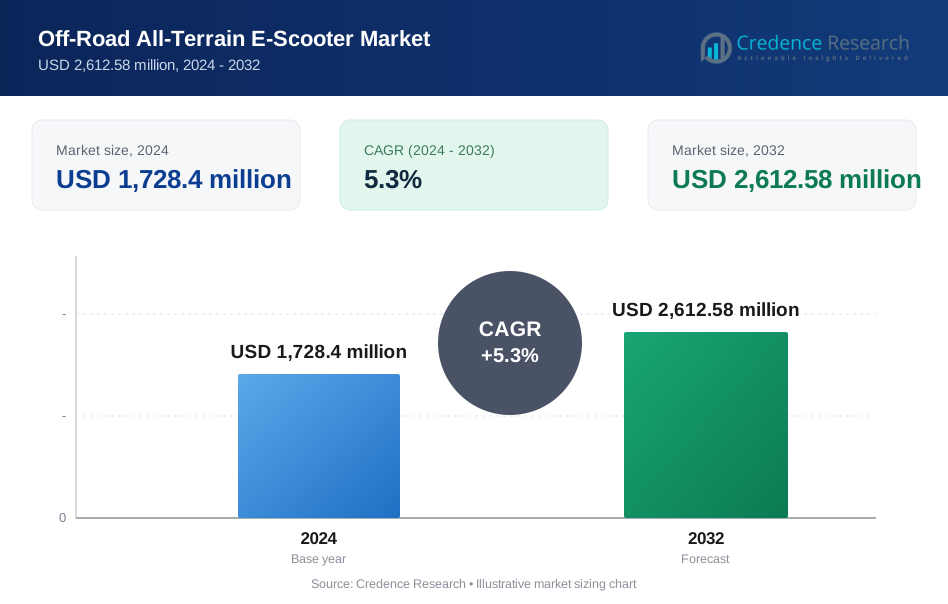
The Off-Road All-Terrain E-Scooter Market is projected to grow from USD 1728.4 million in 2024 to an estimated USD 2612.58 million by 2032, with a compound annual growth rate (CAGR) of 5.3% from 2024 to 2032.
Several key drivers are fueling the growth of the Off-Road All-Terrain E-Scooter market. The increasing awareness about environmental sustainability has prompted consumers to seek eco-friendly alternatives to traditional vehicles, with electric scooters offering a greener solution. Additionally, advancements in battery technology and electric motor efficiency have enhanced the performance and range of these scooters, making them more attractive to both recreational users and commuters. The demand for off-road vehicles is also rising as outdoor adventure activities gain popularity globally, increasing the need for robust, all-terrain transportation options.
Regionally, the Off-Road All-Terrain E-Scooter market exhibits a strong presence in North America and Europe, where there is a high affinity for outdoor activities and eco-conscious transportation solutions. In North America, the market is driven by a strong demand for recreational off-road vehicles and sustainable mobility solutions. Europe follows closely, where environmental regulations and growing consumer preference for green transportation contribute to market expansion. The Asia Pacific region is also emerging as a key market, driven by increasing urbanization and technological advancements in electric mobility.
Market Drivers:
Rising Demand for Eco-Friendly Transportation:
One of the primary drivers for the Off-Road All-Terrain E-Scooter market is the growing demand for environmentally friendly transportation solutions. Consumers are increasingly aware of the environmental impact of traditional gas-powered vehicles, leading to a significant shift toward electric mobility. Off-road e-scooters, being powered by clean energy, offer a sustainable alternative that aligns with the global trend of reducing carbon footprints. This demand is further bolstered by government initiatives and incentives promoting electric vehicles, fostering market growth. For instance, the Indian government introduced the FAME II scheme in 2019, providing subsidies up to INR 55,000 for electric two-wheelers.
Advancements in Battery and Motor Technology:
Technological advancements in battery technology and electric motor systems have played a crucial role in enhancing the performance of off-road e-scooters. Improvements in battery life, charging speed, and energy efficiency have made e-scooters more reliable and practical for long-distance rides on rough terrains. For instance, advancements in lithium-ion battery technology have resulted in scooters like the KAABO Wolf Warrior 11 which has a range of 70 miles and a charging time of 8 hours. The integration of high-performance electric motors ensures that these scooters can tackle rugged environments, providing users with a seamless off-road experience. These innovations make off-road e-scooters an increasingly viable option for a wider range of users.
Growing Popularity of Outdoor and Adventure Sports:
The rise in outdoor activities and adventure sports has significantly contributed to the demand for off-road vehicles. Consumers are seeking new ways to engage in off-road sports, exploration, and recreational activities, driving the need for durable, all-terrain vehicles. Off-road e-scooters provide an exciting and versatile mode of transportation, offering enthusiasts the opportunity to explore rough terrains such as mountain trails, forests, and sandy dunes. For instance, the Dualtron Ultra 2 is designed specifically for such environments, with features like dual motors and hydraulic suspension. This growing recreational market is a key factor fueling demand for off-road e-scooters.
Government Regulations and Incentives:
Government policies and regulations focused on promoting sustainable transportation are also driving the growth of the off-road all-terrain e-scooter market. Many regions have introduced financial incentives, tax breaks, and subsidies to encourage the adoption of electric vehicles, including e-scooters. Additionally, stricter emissions regulations for traditional vehicles are pushing consumers toward more eco-friendly alternatives, further supporting the demand for off-road e-scooters as a greener mode of transport. For example, the European Union has set ambitious targets for reducing emissions, leading countries like Norway to offer incentives up to NOK 25,000 for electric scooter purchases.
Market Trends:
Growth in Demand for Off-Road All-Terrain E-Scooters:
The Off-Road All-Terrain E-Scooter market is experiencing significant expansion as consumers increasingly seek eco-friendly, durable, and versatile alternatives to traditional transportation methods. This growth is fueled by advancements in electric vehicle (EV) technology, such as improved battery life, faster charging times, and enhanced motor efficiency. For instance, the Segway X160 model now boasts a battery life extending up to 60 miles on a single charge and can be fully charged in 4 hours. E-scooters designed for all-terrain use are in high demand, particularly in urban areas and outdoor recreational spaces, where users value flexibility, sustainability, and the ability to navigate rough terrain, such as rocky paths, muddy trails, and steep inclines.
Eco-Conscious Transportation Solutions:
A key trend in the market is the growing preference for sustainable and eco-friendly transportation. Off-road e-scooters provide an environmentally friendly alternative to fuel-powered vehicles, helping to reduce carbon emissions and environmental impact. For instance, the KAABO Wolf Warrior e-scooter can reduce CO2 emissions by approximately 120 grams per kilometer compared to a traditional gasoline-powered scooter. As sustainability becomes a central concern for consumers and governments, manufacturers are focusing on developing products that use recyclable materials, energy-efficient batteries, and eco-friendly production processes. These features appeal to environmentally conscious customers who prioritize green solutions in their mobility choices.
Enhanced Safety Features and Technology Integration:
With the rise of off-road e-scooters used in challenging terrains, safety is becoming a critical consideration for manufacturers. Enhanced braking systems, shock absorption technologies, and improved lighting for night riding are increasingly being incorporated into new models. For instance, the Dualtron Ultra 2 e-scooter features dual hydraulic brakes and an LED lighting system that ensures visibility even in poor conditions. Additionally, smart technologies such as GPS tracking, real-time diagnostics, and anti-theft features are being added to ensure greater security and convenience for users, further elevating the appeal of these vehicles across a wide demographic.
Collaborations and Innovation in the Industry:
A growing trend in the off-road e-scooter market is the collaboration between manufacturers and outdoor adventure companies, merging transportation with recreational activities. For instance, companies like BOYZTOYZ E-Scooters are partnering with national parks to create specialized scooters for nature trails. These partnerships are driving innovation, enabling the development of more versatile and technologically advanced e-scooters. As consumers seek multi-purpose mobility solutions that serve both commuting and recreational needs, the market continues to evolve, with new products designed to meet the demands of outdoor enthusiasts and urban dwellers alike. The future of the market looks promising, driven by technological advancements and shifting consumer preferences.
Market Challenges Analysis:
High Production and Purchase Costs:
A key challenge in the Off-Road All-Terrain E-Scooter market is the high cost of production and the final purchase price. The advanced technology required for all-terrain vehicles, including powerful motors, long-lasting batteries, and durable materials, significantly increases production costs. These factors translate into higher prices for consumers, limiting the market’s accessibility, particularly in regions where consumers are price-sensitive or where electric vehicle adoption is still in its early stages. Affordability remains a barrier to widespread adoption of these vehicles.
Regulatory Challenges:
The regulatory landscape for off-road e-scooters presents a significant challenge for the market. Varying and inconsistent regulations across different regions create complications for manufacturers and consumers alike. Many governments have yet to establish clear, comprehensive rules for the use of off-road e-scooters, leaving gaps in regulations related to speed limits, weight restrictions, and designated riding areas. The lack of uniformity and clarity in these laws may impede market expansion and introduce legal uncertainties, deterring both manufacturers from scaling operations and consumers from investing in these vehicles.
Battery Life and Charging Infrastructure:
Battery life remains a critical issue for off-road all-terrain e-scooters. While technological advances have improved battery efficiency, consumers continue to demand longer battery life for extended rides in rugged environments. The expectation for off-road e-scooters to perform reliably over longer distances without frequent recharging is increasing. In addition, the absence of widespread charging infrastructure in remote or off-road areas further limits the practicality of these vehicles, especially for users seeking outdoor adventures far from urban charging stations.
Competition from Alternative Modes of Transport:
The off-road e-scooter market faces significant competition from alternative modes of transport, including electric bikes and traditional off-road vehicles. These alternatives often offer similar functionalities, such as off-road capabilities and higher speed, which may appeal to a similar consumer base. As a result, some consumers may prefer these established alternatives over the newer e-scooter models, which may slow the growth and adoption of off-road e-scooters in the market. This competitive pressure poses a challenge for manufacturers trying to differentiate their products and attract a loyal customer base.
Market Segmentation Analysis:
By Tire Type, the market is divided into pneumatic and solid tires. Pneumatic tires dominate due to their superior shock absorption and traction on rough terrains, offering a smoother ride on surfaces like gravel and mud. Solid tires are more durable and puncture-resistant but may sacrifice comfort, making them less popular for off-road conditions.
By Frame Material, the market includes aluminum, steel, and carbon fiber frames. Aluminum is the most widely used material, valued for its lightweight and corrosion-resistant properties. Steel frames offer durability and stability, particularly on rougher terrains, while carbon fiber, though more expensive, provides a high strength-to-weight ratio, appealing to high-performance riders.
By Speed Range, off-road e-scooters are available in various speed categories, typically ranging from 15 km/h to over 80 km/h. Mid-range speeds (25-50 km/h) are the most popular for recreational use, providing a balance of safety and performance. High-speed models cater to enthusiasts and experienced riders, particularly in the premium segment.
Segmentations:
By Tire Type
- Pneumatic Tires
- Solid Tires
By Frame Material
- Aluminum
- Steel
- Carbon Fiber
By Speed Range
- Low Speed (15-25 km/h)
- Mid Speed (25-50 km/h)
- High Speed (50-80 km/h)
- Premium Speed (Above 80 km/h)
By Region
- North America
-
- United States
- Canada
- Europe
-
- Germany
- United Kingdom
- France
- Asia-Pacific
-
- China
- Japan
- India
- Latin America
- Brazil
- Mexico
- Middle East & Africa
-
- UAE
- South Africa
Regional Analysis:
North America holds approximately 35% of the global Off-Road All-Terrain E-Scooter market share, making it the largest market. The region's market growth is driven by urban commuters seeking eco-friendly transportation options and outdoor enthusiasts looking for recreational vehicles. The increasing adoption of electric vehicles, government incentives for green transportation, and a trend towards sustainable living are all significant growth drivers. North America’s preference for high-performance models with advanced features continues to propel demand. The rising focus on reducing carbon footprints among consumers and businesses alike will continue to drive the adoption of sustainable mobility solutions. The presence of major manufacturers in North America also contributes to the region’s strong market position.
In Europe, strong environmental awareness and supportive government policies contribute to the market’s growth, which accounts for around 30% of the global market share. Countries like Germany, the United Kingdom, and France are leading the charge, with government initiatives promoting clean transportation solutions. Additionally, Europe's focus on reducing carbon emissions and increasing participation in outdoor activities and adventure sports is stimulating demand for all-terrain e-scooters. The region is also seeing a rise in urban mobility solutions as cities become more pedestrian and cyclist-friendly. European manufacturers are increasingly introducing innovative e-scooter designs, which further boosts the appeal of these vehicles.
Asia-Pacific is witnessing the highest growth rate, contributing 25% to the market. China, Japan, and India are driving this expansion due to rapid urbanization, rising disposable incomes, and an increasing preference for sustainable transportation. China’s development of electric vehicle infrastructure and a young, tech-savvy population are also factors accelerating the demand for off-road e-scooters. Additionally, China’s dominance in manufacturing and supply chain management makes it a critical player in the global market. In India, a growing middle class and government initiatives to reduce pollution are driving the adoption of electric mobility solutions, including e-scooters.
Latin America holds 5-7% of the market share, with countries like Brazil and Mexico beginning to show an increasing interest in sustainable mobility. Although the market is still in its infancy, government policies encouraging electric vehicle adoption are expected to boost market growth in the future. As urbanization increases across the region, the demand for eco-friendly and efficient transportation options is expected to rise. Additionally, the popularity of outdoor sports and adventure tourism in countries like Brazil is contributing to the growing interest in off-road e-scooters.
Middle East & Africa contribute 3-5% of the market share. The demand in this region is gradually growing, driven by interest in sustainable transportation and recreational outdoor activities, although factors like limited infrastructure and higher costs of electric vehicles may slow widespread adoption. The United Arab Emirates (UAE) and South Africa are leading the charge in adopting electric mobility solutions, with governments offering incentives for electric vehicle purchases. Despite these challenges, there is a growing interest in sustainable mobility as awareness about environmental issues continues to rise.
Key Player Analysis:
- Ampere
- NIU
- Hero Electric
- Ultraviolette Automotive
- OlatunewnparaSimple Energy
- Revolt Motors
- Okinawa Autotech
- Tork Motorcycles
- Segway
- Boom Motors
Competitive Analysis:
The Off-Road All-Terrain E-Scooter market is highly competitive, with several key players driving innovation and shaping industry trends. Leading companies are focusing on technological advancements, such as enhanced battery life, improved motor efficiency, and integrated smart features, to differentiate their offerings. Major manufacturers such as Razor, Segway-Ninebot, and Dualtron are well-established in the market, leveraging their brand reputation and distribution networks to capture significant market share. Newer entrants are emphasizing niche segments, offering unique features tailored to specific consumer needs, such as eco-friendly materials, customizable designs, and rugged durability for extreme terrains. Competition is also intensified by the growing number of startups that are bringing innovative designs and advanced technologies to market. For instance, Apollo Scooters, a startup, has introduced a dual-motor e-scooter with an advanced suspension system for rough terrains. Pricing strategies, product quality, and customer service are crucial factors influencing market share, as consumers increasingly demand value for money, performance, and safety. Strategic partnerships, mergers, and acquisitions are also common as companies seek to expand their product portfolios and enhance their market presence.
Recent Developments:
- In November 2024, Ultraviolette Automotive unveiled the Concept X electric adventure motorcycle at EICMA 2024.
- In May 2023, Simple Energy launched its first electric scooter 'Simple One'.
- In October 2024, Segway unveiled the ZT3 Pro all-terrain electric scooter with 1600W motor and advanced stability features.
- In November 2023, NIU launched their first electric dirt bike XQi3 in two versions - Wild (off-road) and Street (street-legal).
Market Concentration & Characteristics:
The Off-Road All-Terrain E-Scooter market exhibits moderate concentration, with a few key players dominating the space, while also witnessing the presence of emerging brands introducing innovative products. Major companies such as Razor, Segway-Ninebot, and Dualtron maintain significant market share due to their established reputations, extensive distribution channels, and continuous product innovations. These industry leaders focus on high-performance models, incorporating advanced features like longer battery life, superior shock absorption, and rugged frame materials. However, the market also presents opportunities for smaller manufacturers and startups to carve out niche segments by offering specialized products that cater to specific consumer needs, such as eco-friendly designs or customizable options. The market is characterized by intense competition, driven by factors like pricing, product quality, and technological advancements. As consumer demand for off-road e-scooters grows, new entrants are adopting aggressive marketing strategies to enhance their visibility and market penetration.
Report Coverage:
The research report offers an in-depth analysis based on Tire Type, Frame Material and Speed Range. It details leading market players, providing an overview of their business, product offerings, investments, revenue streams, and key applications. Additionally, the report includes insights into the competitive environment, SWOT analysis, current market trends, as well as the primary drivers and constraints. Furthermore, it discusses various factors that have driven market expansion in recent years. The report also explores market dynamics, regulatory scenarios, and technological advancements that are shaping the industry. It assesses the impact of external factors and global economic changes on market growth. Lastly, it provides strategic recommendations for new entrants and established companies to navigate the complexities of the market.
Future Outlook:
- The demand for off-road all-terrain e-scooters will continue to grow as consumers seek sustainable, versatile, and eco-friendly transportation options.
- Technological advancements in battery life, motor efficiency, and charging infrastructure will enhance the overall performance and appeal of off-road e-scooters.
- As urban mobility solutions evolve, the adoption of e-scooters for commuting and recreational use will become more widespread.
- Governments will increasingly introduce policies and incentives that promote green transportation, driving further adoption of electric vehicles, including off-road e-scooters.
- Manufacturers will focus on offering high-performance, customizable models tailored to specific consumer needs, such as long-range capabilities and enhanced safety features.
- The integration of smart technologies, such as GPS tracking, anti-theft systems, and real-time diagnostics, will become a standard feature in off-road e-scooters.
- The market will see significant growth in Asia-Pacific, driven by urbanization, rising disposable incomes, and increased environmental awareness.
- Competition will intensify as new players enter the market with innovative designs and competitive pricing strategies.
- Consumer interest in outdoor recreation and adventure sports will drive demand for durable, high-performance all-terrain e-scooters.
- Partnerships between e-scooter manufacturers and outdoor adventure companies will lead to new product offerings and expanded market reach.
Request a Free Sample
Fill in your details and we'll send you a free sample report.
- Sample data tables & charts
- Research methodology
Need a Custom Version of This Report?
Tailor the scope, geography, or segments to your exact requirements.
- Custom geography or segment scope
- Direct access to our analyst team
Frequently Asked Questions
What is the projected growth of the Off-Road All-Terrain E-Scooter market?
What are the key factors driving the growth of the Off-Road All-Terrain E-Scooter market?
Which regions are leading the Off-Road All-Terrain E-Scooter market?
How have advancements in battery technology affected the market?
Why is there an increasing demand for off-road e-scooters?
Table of Content
Chapter 1. Report Introduction
- 1.1 Report Description & Purpose
- 1.1.1 Report Title & Market Definition
- 1.1.2 Unique Selling Propositions (USP) & Key Differentiators
- 1.1.3 Value Proposition for Stakeholders
- 1.2 Research Objectives
- 1.2.1 Market Sizing Objectives (Volume & Revenue)
- 1.2.2 Segmentation Objectives
- 1.2.3 Competitive Intelligence Objectives
- 1.2.4 Forecast & Scenario Objectives
- 1.3 Report Scope
- 1.3.1 Off-Road All-Terrain E-Scooter Scope – Types & Subtypes Covered
- 1.3.2 Geographic Scope – Regions & Countries Covered
- 1.3.3 Historical Period, Base Year & Forecast Period (2024; forecast to 2032)
- 1.3.4 Inclusions & Exclusions
- 1.4 HS Code & Classification Framework
- 1.5 Currency, Units & Pricing Basis
- 1.6 Target Stakeholders
- 1.7 Limitations & Assumptions
Chapter 2. Executive Summary
- 2.1 Global Off-Road All-Terrain E-Scooter Market Snapshot
- 2.1.1 Market Size – Historical (2024) & Forecast (2024-2032) (2024: USD 1,728.4 million → 2032: USD 2,612.58 million)
- 2.1.2 Volume & Revenue – Global Totals
- 2.1.3 Key Market Highlights – Top Five Facts
- 2.2 Off-Road All-Terrain E-Scooter Market Segmentation Snapshot
- 2.2.1 Market Split by Region – 2024 vs. 2032
- 2.3 Competitive Snapshot
- 2.3.1 Top 10 Players by Revenue Share – 2024
- 2.3.2 Top 10 Players by Volume Share – 2024
- 2.3.3 Recent Strategic Developments (18-Month Summary)
- 2.4 Key Investment Highlights & Strategic Conclusions
Chapter 3. Off-Road All-Terrain E-Scooter Market Dynamics & Industry Analysis
- 3.1 Market Overview & Context
- 3.1.1 Off-Road All-Terrain E-Scooter Market Position in the Broader Automotive Value Chain
- 3.1.2 OEM vs. Replacement Market Dynamics
- 3.1.3 Market Maturity & Development Stage by Region
- 3.2 Off-Road All-Terrain E-Scooter Market Drivers
- 3.3 Off-Road All-Terrain E-Scooter Market Restraints & Challenges
- 3.4 Off-Road All-Terrain E-Scooter Market Opportunities
- 3.5 Porter's Five Forces Analysis
- 3.5.1 Threat of New Entrants
- 3.5.2 Bargaining Power of Suppliers
- 3.5.3 Bargaining Power of Buyers
- 3.5.4 Threat of Substitutes
- 3.5.5 Competitive Rivalry – Intensity Assessment
- 3.6 Off-Road All-Terrain E-Scooter Value Chain Analysis
- 3.6.1 Upstream – Raw Material/Input Suppliers
- 3.6.1.1 Raw Material/Input 1
- 3.6.1.2 Raw Material/Input 2
- 3.6.1.3 Raw Material/Input 3
- 3.6.2 Midstream – Production/Manufacturing/Service Delivery
- 3.6.2.1 Production/Process Overview
- 3.6.2.2 Key Facility Locations & Capacity by Manufacturer
- 3.6.3 Downstream – Distribution & End Consumer
- 3.6.3.1 Primary Channel – B2B/OEM
- 3.6.3.2 Secondary Channels – Dealer, Retail, Online, Direct
- 3.6.4 Value Chain Profitability Analysis
- 3.6.1 Upstream – Raw Material/Input Suppliers
- 3.7 PESTEL Analysis
- 3.7.1 Political Factors
- 3.7.2 Economic Factors
- 3.7.3 Social Factors
- 3.7.4 Technological Factors
- 3.7.5 Environmental Factors
- 3.7.6 Legal Factors
- 3.8 Off-Road All-Terrain E-Scooter Supply Chain Analysis
- 3.8.1 Raw Material/Input Supply Risk Assessment
- 3.8.2 Manufacturing Concentration Risk (Geographic Exposure)
- 3.8.3 Trade Disruption Impact Analysis
- 3.9 Regulatory & Policy Landscape
Note: The regulatory and policy landscape section covers regulations based on their applicability to the market, Off-Road All-Terrain E-Scooter category, geography, and scope of the study. Only regulatory frameworks with a material impact on operations, compliance, trade, sustainability, or market access are analyzed in detail.
Chapter 4. Key Investment Pockets & Opportunity Analysis
- 4.1 Off-Road All-Terrain E-Scooter Market Attractiveness Analysis
- 4.1.1 By Region – Investment Attractiveness Matrix (Volume × CAGR)
- 4.2 Absolute Revenue Growth Opportunity
- 4.2.1 By Region – Absolute USD Growth Through 2032
- 4.3 Incremental Volume Opportunity
- 4.3.1 By Region – Incremental Volume Through 2032
- 4.3.2 Segment – Incremental Volume
- 4.4 Emerging Submarket Opportunity Deep Dive (Subject to Applicability)
- 4.5 Emerging Market Opportunity Scorecards
- 4.5.1 United States
- 4.5.2 Europe
- 4.5.3 Asia
- 4.5.4 Middle East & Africa
Note: Emerging Market Opportunity Scorecards will be included based on relevance and strategic importance. Regions listed are indicative and may vary depending on data availability and market dynamics.
Chapter 5. Off-Road All-Terrain E-Scooter Import-Export Analysis & Trade Flows
- 5.1 Global Trade Overview
- 5.1.1 Global Export Value by Country (2024)
- 5.1.2 Global Export Volume by Country (2024)
- 5.1.3 Global Import Value by Country (2024)
- 5.1.4 Global Import Volume by Country (2024)
- 5.1.5 Net Trade Balance by Country (2024)
- 5.2 Export Analysis – Segment
- 5.2.1 Type 1 (HS Code)
- 5.2.2 Type 2 (HS Code)
- 5.2.3 Type 3 (HS Code)
- 5.2.4 Type 4 (HS Code)
- 5.2.5 Type 5 (HS Code)
- 5.3 Import Analysis – Segment
- 5.3.1 Type 1 (HS Code)
- 5.3.2 Type 2 (HS Code)
- 5.3.3 Type 3 (HS Code)
- 5.3.4 Type 4 (HS Code)
- 5.3.5 Type 5 (HS Code)
- 5.4 Average Unit Trade Prices
- 5.4.1 Average Export Price – Segment & Country
- 5.4.2 Average Import Price – Segment & Source Country
- 5.4.3 Price Trends (2024)
- 5.5 Key Trade Route Analysis
- 5.5.1 Trade Route 1
- 5.5.2 Trade Route 2
- 5.5.3 Trade Route 3
- 5.5.4 Trade Route 4
- 5.5.5 Trade Route 5
- 5.6 Trade Policy Impact Assessment
- 5.6.1 US Anti-Dumping & Section 301 Tariffs
- 5.6.2 EU Customs Union Impact
- 5.6.3 Major Free Trade Agreements
- 5.6.4 USMCA Rules of Origin
Note: Trade policy analysis will be included only where relevant to the Off-Road All-Terrain E-Scooter market.
Chapter 6. Competitive Landscape & Company Benchmarking
- 6.1 Off-Road All-Terrain E-Scooter Market Concentration & Structure
- 6.1.1 Herfindahl-Hirschman Index (HHI) – vs. 2024
- 6.1.2 Tier 1, Tier 2 & Tier 3 Market Structure
- 6.1.3 Global, Regional & Local Player Dynamics
- 6.2 Off-Road All-Terrain E-Scooter Market Share Analysis – 2024
- 6.2.1 Global Revenue Share by Company
- 6.2.2 Global Volume Share by Company
- 6.2.3 Regional Revenue Share
- 6.2.4 Market Share Evolution ( vs. 2024)
- 6.2.5 OEM Segment Share by Company
- 6.2.6 Replacement Segment Share by Company
- 6.3 Production/Delivery Capacity & Facility Analysis
- 6.3.1 Global Installed Capacity
- 6.3.2 Capacity Utilization Rates
- 6.3.3 Production/Output Volume
- 6.3.4 Facility Locations & Capacity Map
- 6.3.5 Planned Capacity Additions
- 6.4 Off-Road All-Terrain E-Scooter Competitive Benchmarking Matrix
- 6.4.1 Revenue, Volume, CAGR & Profitability Comparison
- 6.4.2 Channel Revenue Mix
- 6.4.3 Geographic Revenue Exposure
- 6.4.4 R&D Intensity
- 6.4.5 Sustainability Maturity
- 6.5 Strategic Developments in Off-Road All-Terrain E-Scooter (Last 24 Months)
- 6.5.1 Mergers, Acquisitions & Divestments
- 6.5.2 New Off-Road All-Terrain E-Scooter Launches
- 6.5.3 Facility Expansions
- 6.5.4 Strategic Alliances, Joint Ventures & Partnerships
- 6.5.5 Distribution Expansion & Market Entry
- 6.5.6 Sustainability & ESG Initiatives
- 6.6 Competitive Strategy Mapping
- 6.6.1 Leader, Challenger, Follower & Niche Classification
- 6.6.2 Pricing Strategy Comparison
- 6.6.3 Channel Strategy Matrix
Note: Strategic developments are included based on their materiality and the availability of reliable information.
Chapter 7. Global Off-Road All-Terrain E-Scooter Market – By Distribution Channel
- 7.1 Segment Overview
- 7.1.1 Volume & Revenue Split by Channel (2024 & 2032)
- 7.1.2 Channel Mix Evolution (2024-2032)
Chapter 8. Regional Market Analysis – Global Overview
- 8.1 Global Regional Overview
- 8.1.1 Regional Volume Share
- 8.1.2 Regional Revenue Share
- 8.1.3 Regional Volume by Region
- 8.1.4 Regional Revenue by Region
- 8.1.5 Regional Forecast Through 2032
- 8.2 Cross-Regional Segment Analysis
- 8.2.1 By Distribution Channel
- 8.2.2 By Brand/Price Tier
Chapter 9. North America Off-Road All-Terrain E-Scooter Market
- 9.1 United States
- 9.2 Canada
- 9.3 Mexico
Chapter 10. Europe Off-Road All-Terrain E-Scooter Market
- 10.1 Germany
- 10.2 France
- 10.3 Italy
- 10.4 United Kingdom
- 10.5 Spain
- 10.6 Poland
- 10.7 Russia
- 10.8 Netherlands
- 10.9 Belgium
- 10.10 Sweden
- 10.11 Denmark
- 10.12 Norway
- 10.13 Rest of Europe
Chapter 11. Asia Pacific Off-Road All-Terrain E-Scooter Market
- 11.1 China
- 11.2 India
- 11.3 Japan
- 11.4 South Korea
- 11.5 Thailand
- 11.6 Indonesia
- 11.7 Vietnam
- 11.8 Malaysia
- 11.9 Australia
- 11.10 Rest of Asia Pacific
Chapter 12. Latin America Off-Road All-Terrain E-Scooter Market
- 12.1 Brazil
- 12.2 Argentina
- 12.3 Colombia
- 12.4 Chile
- 12.5 Rest of Latin America
Chapter 13. Middle East Off-Road All-Terrain E-Scooter Market
- 13.1 Saudi Arabia
- 13.2 United Arab Emirates
- 13.3 Turkey
- 13.4 Israel
- 13.5 Iran
- 13.6 Rest of the Middle East
Chapter 14. Africa Off-Road All-Terrain E-Scooter Market
- 14.1 South Africa
- 14.2 Egypt
- 14.3 Nigeria
- 14.4 Morocco
- 14.5 Rest of Africa
Chapter 15. Off-Road All-Terrain E-Scooter Company Profiles
- 15.1 [Company 01]
- 15.1.1 Company Overview
- 15.1.2 Key Management Personnel
- 15.1.3 Products & Services Portfolio
- 15.1.4 Financial Performance
- 15.1.5 Key Market Focus & Geographic Presence
- 15.1.6 Recent Developments & Strategic Initiatives
Note: The company profile list is preliminary and may change based on research findings, market developments, data availability, and client requirements.
Chapter 16. Appendices
- Appendix A – List of Abbreviations & Acronyms
- Appendix B – Industry Classification Code Reference – Full Series
- Appendix C – Production & Capacity Data Tables
- Appendix D – End-Use & Demand Base Tables
- Appendix E – Consumption & Replacement Rate Assumptions
- Appendix F – ASP Reference Tables
- Appendix G – Manufacturing & Facility Database
- Appendix H – Import-Export Data Tables
- Appendix I – Regulatory Summary Tables
- Appendix J – Primary Research Participant List (Anonymized)
- Appendix K – Primary Research Questionnaire Framework
- Appendix L – Data Sources & Bibliography
- Appendix M – Market Size Divergence & Source Comparison
Chapter 17. Research Methodology
- 17.1 Research Framework & Philosophy
- 17.2 Secondary Research – Sources, Hierarchy & Data Extraction
- 17.3 Data Modeling – Bottom-Up & Top-Down Market Sizing
- 17.4 Primary Research – Stakeholder Framework, LOI & Sample Sizes
- 17.5 Forecast Methodology – Regression, Scenario & Sensitivity Analysis
- 17.6 Quality Control – Four-Layer Validation Framework
- 17.7 Limitations & Standard Assumptions
- 17.8 Disclaimer
