
Market Overview:
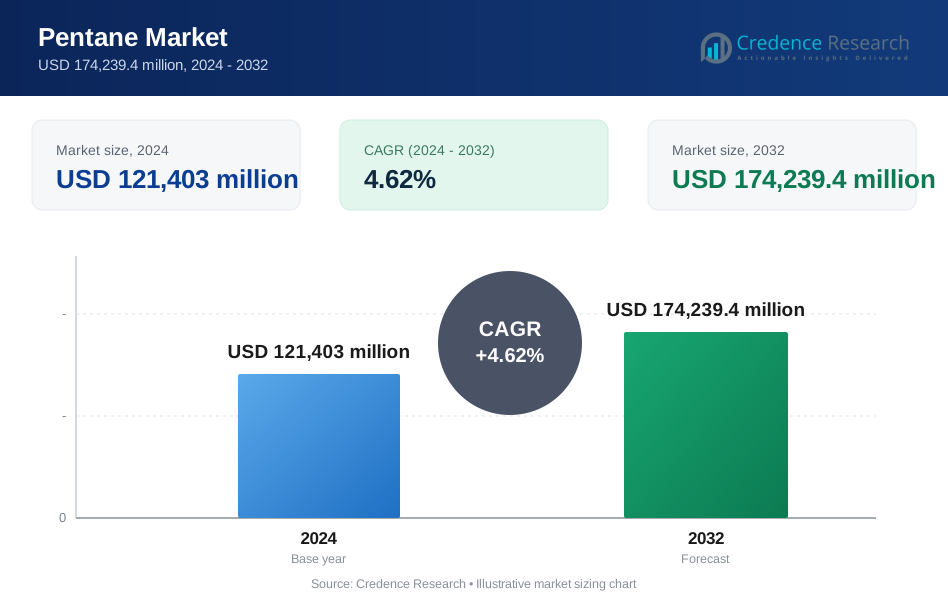
The Pentane market was valued at USD 121,403 million in 2024 and is projected to reach USD 174,239.4 million by 2032. The market is expected to expand at a CAGR of 4.62% during the forecast period.
| REPORT ATTRIBUTE | DETAILS |
|---|---|
| Historical Period | 2020-2023 |
| Base Year | 2024 |
| Forecast Period | 2025-2032 |
| Pentane Market Size 2024 | USD 121,403 million |
| Pentane Market, CAGR | 4.62% |
| Pentane Market Size 2032 | USD 174,239.4 million |
Market growth is driven by rising use of pentane as a blowing agent in insulation foams. Construction and cold-chain logistics increase demand for rigid polyurethane and polystyrene foams. Petrochemical producers use pentane as a solvent and reaction medium in polymer processing. Fuel blending applications also support consumption due to volatility control needs. Industrial users prefer pentane for its low boiling point and process efficiency. Growth in appliance manufacturing further supports foam insulation demand. Chemical producers benefit from stable feedstock availability. Regulatory acceptance in controlled applications sustains adoption.
Asia Pacific leads the Pentane market due to strong construction and manufacturing activity. China, India, and Southeast Asia drive demand from insulation, packaging, and appliance sectors. North America remains a key market due to advanced petrochemical infrastructure and foam production capacity. Europe shows steady demand supported by energy-efficient building standards. The Middle East benefits from abundant hydrocarbon feedstocks and export-oriented production. Latin America emerges with gradual growth from industrial expansion. Regional demand follows infrastructure development and downstream chemical investments.

Market Insights:
- The Pentane market was valued at USD 121,403 million in 2024 and is projected to reach USD 174,239.4 million by 2032, growing at a CAGR of 4.62% during the forecast period.
- Asia Pacific leads with about 42% share due to strong construction and manufacturing activity, followed by North America at nearly 28% driven by petrochemical capacity, and Europe at around 20% supported by energy-efficient building norms.
- Asia Pacific is also the fastest-growing region, holding the largest share and driven by urbanization, cold-chain expansion, and appliance manufacturing growth.
- By application, blowing agents account for nearly 55% share, supported by dominant use in insulation foams, while chemical solvents hold around 25% due to steady petrochemical demand.
- By type, n-Pentane represents about 48% share from broad industrial use, while iso-Pentane contributes nearly 38% due to rising preference in high-efficiency insulation applications.
Market Drivers:
Rising Demand From Thermal Insulation And Foam Manufacturing Applications
The Pentane market benefits from strong insulation demand across construction sectors. Rigid foam producers rely on pentane for uniform cell structure and stable expansion. Housing and commercial building activity increases insulation usage. Cold storage facilities expand to support food and pharmaceutical needs. Appliance manufacturers use foam insulation to improve energy efficiency. Pentane supports lightweight and durable insulation materials. Manufacturers value predictable performance during foam processing. These factors sustain steady industrial demand across regions.
- For instance, BASF reports that n-Pentane-based EPS systems deliver thermal conductivity near 0.032 W/mK in building insulation panels.
Growing Use In Petrochemical Processing And Specialty Solvent Applications
The Pentane market gains support from rising petrochemical production activities. Chemical plants use pentane as a solvent and reaction medium. Volatility properties support efficient separation processes. Polymer manufacturing relies on controlled solvent behavior. Refineries integrate pentane in blending and formulation operations. Stable feedstock access supports continuous operations. Producers prefer compatibility with existing systems. This driver maintains demand across core chemical industries.
- For instance, pentane blowing agents support consistent polymer bead expansion in EPS resin processing.
Expansion Of Cold Chain Logistics And Packaging Infrastructure
Cold chain networks expand across food and pharmaceutical distribution. Insulated containers depend on high-performance foam materials. Pentane-based foams maintain temperature stability during transport. Online grocery delivery raises cold storage needs. Pharmaceutical logistics require strict thermal protection. Packaging producers scale foam output to meet demand. Pentane enables cost-efficient insulation production. These logistics trends reinforce long-term consumption.
Regulatory Acceptance In Controlled Industrial And Commercial Uses
Regulatory bodies allow pentane use under defined safety norms. Industrial users follow strict storage and handling practices. Compliance supports continued adoption in foam and chemical sectors. Manufacturers invest in safer processing equipment. Monitoring systems reduce operational risk exposure. Workforce training strengthens safety performance. Supply chains align with compliance standards. This environment supports stable market operations.
Market Trends:
Shift Toward Process Efficiency And Optimized Chemical Utilization
Producers focus on improving efficiency across chemical operations. Pentane usage aligns with yield optimization goals. Manufacturers refine formulations to reduce waste. Automation supports accurate dosing and control. Process systems improve production consistency. Efficiency gains support cost management efforts. Companies seek reliable input performance. This trend shapes procurement strategies.
- For instance, BASF states that automated dispensing systems (such as Autofroth®) utilize precise flow controllers to ensure consistent ratios of components and blowing agents, improving foam batch repeatability across insulation production lines.
Integration Of Advanced Safety Systems In Production Facilities
Chemical plants adopt advanced safety monitoring solutions. Sensors track vapor concentration and temperature levels. Automation lowers risk of unplanned shutdowns. Pentane handling benefits from controlled environments. Producers upgrade storage and transfer systems. Training programs enhance operational discipline. Compliance systems improve reliability. This trend supports sustained industrial use.
- For instance, Arkema reports closed storage and transfer systems reduce pentane vapor exposure risks.
Regional Diversification Of Manufacturing And Supply Networks
Producers expand manufacturing footprints across regions. Diversified plants reduce supply chain risks. Emerging economies attract new foam production units. Local output supports faster customer delivery. Regional sourcing improves competitiveness. Pentane suppliers align capacity with local demand. Supply flows become more balanced. Market structure grows more distributed.
Increased Focus On Material Performance Consistency
End users demand consistent foam and solvent performance. Quality control standards gain higher priority. Pentane suppliers invest in purity management systems. Stable composition supports repeatable outcomes. Manufacturers reduce batch variation risks. Supplier audits strengthen long-term partnerships. Consistency improves downstream reliability. This trend influences supplier selection.
Market Challenges Analysis:
Volatility Risks Related To Feedstock Availability And Price Stability
The Pentane market faces exposure to hydrocarbon supply shifts. Refinery output changes affect availability levels. Price movement complicates procurement planning. Manufacturers manage margin pressure during fluctuations. Inventory planning requires accurate forecasting. Supply gaps disrupt foam production schedules. Producers seek diversified sourcing options. These challenges demand strong supply coordination.
Operational Safety And Storage Complexity Across Industrial Sites
Pentane requires strict storage and handling controls. Flammability increases compliance requirements. Facilities invest in specialized containment systems. Training needs raise operational costs. Smaller producers face higher entry barriers. Regulatory audits require continuous oversight. Any lapse affects production continuity. These factors restrict ease of expansion.
Market Opportunities:
Growth Potential In Emerging Construction And Infrastructure Markets
The Pentane market gains opportunity from expanding infrastructure projects. Emerging economies increase residential and commercial development. Insulation demand rises with building quality standards. Foam producers add capacity near growth hubs. Local production improves market access. Pentane suppliers reach new customer segments. Infrastructure investment supports sustained consumption. This opportunity strengthens long-term growth prospects.
Innovation In High-Performance Foam And Specialty Material Applications
Manufacturers develop advanced insulation and specialty materials. Pentane supports improved foam density control. Specialty applications demand precise chemical behavior. Research efforts focus on efficiency and output quality. Producers collaborate with material science partners. Customized solutions expand application scope. Innovation improves product differentiation. These developments open new revenue pathways.
Market Segmentation Analysis:
By Type
The Pentane market shows clear differentiation across product types based on performance needs. n-Pentane leads due to broad use in foam insulation and solvent applications. It offers stable volatility and reliable expansion behavior. Iso-Pentane gains preference in high-efficiency insulation foams due to better thermal properties. Appliance and construction manufacturers favor this type for energy-focused designs. Neo-Pentane serves niche applications where precise vapor pressure control matters. Limited volume demand supports specialty chemical use. Type selection depends on process compatibility and end-use standards.
- For instance, BASF confirms n-Pentane remains the primary blowing agent for EPS construction insulation.
By Composition
Blended compositions address varied industrial requirements. Pentane 85/15 and 80/20 blends see strong adoption in rigid foam production. These blends provide balanced expansion and density control. Pentane 70/30 and 60/40 server applications that require moderate volatility. Pentane 50/50 supports flexible formulation needs across manufacturers. Pentane 20/80 finds use in specialized processes where controlled evaporation matters. Composition choice aligns with equipment design and product specifications.
By Application
Blowing agents represent the primary application segment. Foam insulation producers rely on pentane for consistent cell structure. Electronic cleansing applications use it for effective residue removal. Chemical solvent use supports polymer and petrochemical processing. Aerosol propellant applications remain selective due to handling requirements. Each application demands specific purity and performance standards. End-user requirements drive product selection across segments.
Segmentation:
By Type- n-Pentane
- Iso-Pentane (Isopentane)
- Neo-Pentane (Neopentane)
- Pentane 85/15
- Pentane 80/20
- Pentane 70/30
- Pentane 60/40
- Pentane 50/50
- Pentane 20/80
- Blowing agent
- Electronic cleansing (cleaning)
- Chemical solvent
- Aerosol propellant
Regional Segments
- North America
- U.S.
- Canada
- Mexico
- Europe
- Germany
- France
- U.K.
- Italy
- Spain
- Rest of Europe
- Asia Pacific
- China
- Japan
- India
- South Korea
- South-east Asia
- Rest of Asia Pacific
- Latin America
- Brazil
- Argentina
- Rest of Latin America
- Middle East & Africa
- GCC Countries
- South Africa
- Rest of the Middle East and Africa
Regional Analysis:
Asia Pacific Leads With Strong Manufacturing And Construction Demand
The Pentane market sees Asia Pacific holding the largest share at around 42%. China drives demand through large-scale foam insulation and appliance manufacturing. Rapid urban development supports consistent insulation material use. India contributes through rising cold chain and infrastructure expansion. Southeast Asia strengthens regional demand with growing packaging industries. Local production capacity supports cost efficiency and supply stability. Industrial growth keeps Asia Pacific in a leading position.
North America Maintains A Strong Position With Advanced Petrochemical Infrastructure
North America accounts for nearly 28% of the global market share. The United States leads due to well-established petrochemical and foam production capacity. Energy-efficient building standards increase insulation material usage. Appliance manufacturing supports steady pentane consumption. Advanced safety systems enable controlled industrial handling. Stable feedstock availability supports continuous supply. These factors sustain regional demand strength.
Europe And Rest Of The World Show Balanced And Emerging Demand Patterns
Europe holds about 20% of the market share, supported by strict building efficiency regulations. Germany, France, and the UK lead regional consumption. Focus on insulation upgrades supports steady demand. Latin America and the Middle East and Africa together account for nearly 10%. These regions benefit from infrastructure expansion and petrochemical investments. Export-oriented production supports gradual growth. Emerging markets show improving adoption across industrial applications.
Key Player Analysis:
- ExxonMobil Corporation
- Phillips 66 Company
- Royal Dutch Shell Plc
- Chevron Corporation
- INEOS AG
- Maruzen Petrochemical Co., Ltd.
- SK Innovation Co., Ltd.
Competitive Analysis:
The Pentane market shows moderate consolidation with global petrochemical majors holding strong positions. Leading companies control supply through integrated refining and distribution networks. These players focus on product consistency and reliable delivery. Regional producers compete through proximity to end users and flexible supply contracts. Technology upgrades improve safety and handling efficiency. Strategic capacity alignment supports long-term customer relationships. It remains competitive due to standardized products and price sensitivity. Operational efficiency and compliance strength shape competitive advantage.
Recent Developments:
- In a significant consolidation move, Phillips 66 announced on September 9-10, 2025, a definitive agreement to acquire the remaining 50% ownership interest in WRB Refining from subsidiaries of Cenovus Energy for $1.4 billion. The transaction is subject to customary purchase price adjustments and is expected to close in the fourth quarter of 2025. This acquisition grants Phillips 66 complete ownership of the Wood River refinery in Illinois and the Borger refinery in Texas, two strategically important refining assets that contribute to pentane and specialty hydrocarbon production. According to CEO Mark Lashier, the acquisition is projected to deliver operational and commercial synergies of approximately $50 million annually through full integration of these assets into the broader Phillips 66 value chain, while unlocking opportunities for low-capital, high-return projects that enhance long-term shareholder value. The move strengthens Phillips 66's integrated refining and chemicals business, particularly its collaboration with Chevron through Chevron Phillips Chemical, a joint venture focused on pentane and specialty chemical production in North America.
- Maruzen Petrochemical announced on October 28, 2024, with official confirmation on April 1, 2025, a strategic decision to shut down its ethylene production facility in Chiba by fiscal year 2026/27 (April 2026 – March 2027). This consolidation initiative, coordinated with Sumitomo Chemical, involves transferring all ethylene production to the Keiyo Ethylene joint venture, which maintains shareholding ratios of 55% for Maruzen and 45% for Sumitomo Chemical. The Chiba facility originally operated at 525,000 metric tons per year capacity, while the consolidated Keiyo Ethylene plant operates at 768,000 tons per year, offering enhanced production efficiency and economies of scale. This optimization strategy is driven by persistent low operating rates across Japanese ethylene plants due to global oversupply conditions exacerbated by China's large-scale capacity expansions, coupled with declining domestic demand. By consolidating at the more modern, efficient Keiyo facility, Maruzen and Sumitomo aim to reduce carbon dioxide emissions and maintain competitive positioning in the Japanese petrochemical complex while improving overall profitability through higher utilization rates.
Report Coverage:
The research report offers an in-depth analysis based on Type, Composition, Application, and Region. It details leading market players, providing an overview of their business, product offerings, investments, revenue streams, and key applications. Additionally, the report includes insights into the competitive environment, SWOT analysis, current market trends, as well as the primary drivers and constraints. Furthermore, it discusses various factors that have driven market expansion in recent years. The report also explores market dynamics, regulatory scenarios, and technological advancements that are shaping the industry. It assesses the impact of external factors and global economic changes on market growth. Lastly, it provides strategic recommendations for new entrants and established companies to navigate the complexities of the market.
Future Outlook:
- Preventive pet wellness will gain stronger acceptance among owners focused on long-term health.
- Demand for natural and clean-label supplements will continue to shape product development.
- Veterinary recommendations will play a central role in guiding supplement adoption.
- E-commerce platforms will expand market reach and support repeat purchases.
- Personalized nutrition solutions will attract owners seeking targeted skin and coat benefits.
- Premium supplement brands will benefit from rising pet humanization trends.
- Urban pet adoption will support sustained demand growth across major regions.
- Product innovation will focus on improved absorption and visible results.
- Emerging markets will show higher awareness of pet skin and coat health.
- Brand trust and clinical credibility will remain critical for long-term success.
Request a Free Sample
Fill in your details and we'll send you a free sample report.
- Sample data tables & charts
- Research methodology
Need a Custom Version of This Report?
Tailor the scope, geography, or segments to your exact requirements.
- Custom geography or segment scope
- Direct access to our analyst team
Frequently Asked Questions
What is the current market size for Pentane market, and what is its projected size in 2032?
At what Compound Annual Growth Rate is the Pentane market projected to grow between 2025 and 2032?
Which Pentane market segment held the largest share in 2024?
What are the primary factors fueling the growth of the Pentane market?
Who are the leading companies in the Pentane market?
Which region commanded the largest share of the Pentane market in 2024?
Table of Content
Chapter 1 Market Segmentation
- 1.1 Segmentation Framework
- 1.1.1 Product and Service Classification
- 1.1.2 Application and End-Use Classification
- 1.1.3 Technology and Solution Classification
- 1.1.4 Customer and Distribution Channel Classification
- 1.1.5 Geographic Segmentation
- 1.1.6 Market Segment Definitions and Boundaries
Chapter 2 Introduction
- 2.1 Report Objectives and Scope
- 2.2 Product Definition and Industry Terminology
- 2.3 Market Inclusions and Exclusions
- 2.4 Research Process
- 2.4.1 Primary Research and Expert Interviews
- 2.4.2 Secondary Research and Source Review
- 2.4.3 Top-Down and Bottom-Up Estimation
- 2.4.4 Data Triangulation and Verification
- 2.5 Market Size Measurement Basis
- 2.5.1 2024: USD 121,403 million → 2032: USD 174,239.4 million
- 2.6 Historical and Forecast Reference Periods
- 2.6.1 Base Year: 2024
- 2.6.2 Forecast Period: 2024-2032
- 2.7 Research Assumptions and Limitations
Chapter 3 Executive Summary
- 3.1 Market Snapshot and Key Findings
- 3.2 Base-Year Market Size, 2024
- 3.3 Forecast Market Size, 2032
- 3.4 Revenue and Volume Growth Outlook
- 3.5 Key Demand and Supply Indicators
- 3.6 Leading Market Segments
- 3.7 Fastest-Growing Market Opportunities
- 3.8 Regional Performance Highlights
- 3.9 Technology and Industry Transformation
- 3.10 Competitive Landscape Summary
- 3.11 Analyst View and Strategic Implications
Chapter 4 Global Pentane Market Trends and Developments
- 4.1 Historical Industry Development
- 4.2 Recent Market Trends and Developments
- 4.3 Demand and Customer Behavior Trends
- 4.4 Technology and Product Innovation
- 4.5 Artificial Intelligence, Automation and Digitalization
- 4.6 Local Manufacturing and Supply Chain Realignment
- 4.7 Industry Partnerships, Mergers and Acquisitions
- 4.8 Sustainability and Circular Economy Developments
- 4.9 Government and Private Sector Investment Trends
- 4.10 Emerging Business Models and Commercialization
- 4.11 Industry Developments and Announcements
Chapter 5 Global Pentane Market Production, Supply and Demand Analysis
- 5.1 Demand Trend and Consumption Analysis
- 5.2 Demand Forecast, 2024-2032
- 5.3 Production and Output Trend
- 5.4 Production and Output Forecast, 2024-2032
- 5.5 Installed Capacity and Capacity Utilization
- 5.6 Company-Wise Production Plants and Statistics
- 5.6.1 Installed Production Capacity
- 5.6.2 Actual Production
- 5.6.3 Planned Capacity and Expansion Targets
- 5.7 Supply Chain Structure and Procurement Trends
- 5.8 Supply-Demand Gap and Bottlenecks
- 5.9 Import Dependence and Sourcing Structure
- 5.10 Contract Manufacturing and Outsourcing
- 5.11 Regional Supply and Demand Concentration
Chapter 6 Global Pentane Market Pricing Analysis
- 6.1 Pricing Structure and Measurement
- 6.2 Historical Pricing Trends
- 6.3 Pricing Outlook, 2024-2032
- 6.4 Average Selling Price and Unit Economics
- 6.5 Pricing by Product and Market Segment
- 6.6 Geographic Pricing Differences
- 6.7 Key Input, Energy, Labor and Logistics Costs
- 6.8 Contract Pricing and Purchasing Models
- 6.9 Pricing Sensitivity and Competitive Positioning
- 6.10 Price, Margin and Profitability Implications
Chapter 7 Global Pentane Market Dynamics
- 7.1 Market Growth Drivers
- 7.1.1 Demand-Side Drivers
- 7.1.2 Technology and Innovation Drivers
- 7.1.3 Infrastructure and Investment Drivers
- 7.1.4 Regulatory and Policy Drivers
- 7.2 Market Restraints
- 7.2.1 Cost and Affordability Constraints
- 7.2.2 Technology and Adoption Barriers
- 7.2.3 Supply Chain and Operational Constraints
- 7.3 Market Challenges
- 7.3.1 Competitive Pressure and Margin Erosion
- 7.3.2 Skills, Infrastructure and Implementation Gaps
- 7.4 Emerging Market Opportunities
- 7.5 Market Dynamics Impact and Time-Horizon Assessment
Chapter 8 Global Pentane Value Chain Analysis
- 8.1 Industry Value Chain Overview
- 8.2 Upstream Suppliers and Critical Inputs
- 8.3 Technology and Component Providers
- 8.4 Manufacturing or Service Delivery
- 8.5 Distribution, Channel Partners and Integrators
- 8.6 Downstream Applications and End Users
- 8.7 Value Addition and Profit Pools
- 8.8 Vertical Integration and Outsourcing
- 8.9 Supplier Concentration and Risk
- 8.10 Supply Chain Localization and Resilience
Chapter 9 Global Pentane Market Regulations and Policies
- 9.1 Relevant Laws, Standards and Compliance Frameworks
- 9.2 Product, Service, Safety and Quality Requirements
- 9.3 Government Policies, Incentives and Subsidies
- 9.4 Imports, Exports and Trade Barriers
- 9.5 Public Procurement and Local Content Requirements
- 9.6 Environmental and Sustainability Compliance
- 9.7 Upcoming Policy Changes and Market Implications
Chapter 10 Global Pentane Market Hotspots and Opportunities
- 10.1 Market Opportunity Mapping and Growth Hotspots
- 10.2 High-Growth Applications and Customer Groups
- 10.3 Underserved Markets and White-Space Opportunities
- 10.4 Emerging Technology and Product Opportunities
- 10.5 New Capacity and Investment Hotspots
- 10.6 Market Entry and Expansion Opportunities
- 10.7 Distribution and Partnership Opportunities
- 10.8 Near-Term and Long-Term Commercial Potential
- 10.9 Opportunity Attractiveness and Execution Risks
Chapter 11 Global Pentane Market Outlook, 2024-2032
- 11.1 Market Size and Analysis
- 11.1.1 Revenue (Market Measurement: 2024: USD 121,403 million → 2032: USD 174,239.4 million)
- 11.1.2 Market Volume and Quantity Sold
- 11.1.3 Historical Market Size
- 11.1.4 Base-Year Market Size, 2024
- 11.2 Market Forecast, 2024-2032
- 11.2.1 Revenue Forecast to 2032
- 11.2.2 Volume Forecast to 2032
- 11.2.3 CAGR and Year-on-Year Growth
- 11.2.4 Incremental Revenue Opportunity
- 11.3 Forecast Assumptions and Scenario Analysis
- 11.3.1 Base-Case Forecast
- 11.3.2 Optimistic and Conservative Scenarios
- 11.3.3 Technology, Pricing and Policy Sensitivities
- 11.4 Market Attractiveness and Growth Outlook
Chapter 12 Global Pentane Market Segmentation and Outlook
- 12.1 Segmentation Summary and Market Shares, 2024
- 12.2 Largest and Fastest-Growing Segments
- 12.3 Segment Growth Comparison
- 12.4 Segment Attractiveness and Priority Matrix
Chapter 13 Global Pentane Geographic Market Outlook, 2024-2032
- 13.1 Regional Market Size and Share, 2024
- 13.2 Regional Market Forecast, 2024-2032
- 13.3 Regional Pricing, Production and Demand Differences
- 13.4 North America
- 13.4.1 United States
- 13.4.2 Canada
- 13.4.3 Mexico
- 13.5 Europe
- 13.5.1 Germany
- 13.5.2 France
- 13.5.3 Italy
- 13.5.4 United Kingdom
- 13.5.5 Spain
- 13.5.6 Poland
- 13.5.7 Russia
- 13.5.8 Netherlands
- 13.5.9 Belgium
- 13.5.10 Sweden
- 13.5.11 Denmark
- 13.5.12 Norway
- 13.5.13 Rest of Europe
- 13.6 Asia Pacific
- 13.6.1 China
- 13.6.2 India
- 13.6.3 Japan
- 13.6.4 South Korea
- 13.6.5 Thailand
- 13.6.6 Indonesia
- 13.6.7 Vietnam
- 13.6.8 Malaysia
- 13.6.9 Australia
- 13.6.10 Rest of Asia Pacific
- 13.7 Latin America
- 13.7.1 Brazil
- 13.7.2 Argentina
- 13.7.3 Colombia
- 13.7.4 Chile
- 13.7.5 Rest of Latin America
- 13.8 Middle East
- 13.8.1 Saudi Arabia
- 13.8.2 United Arab Emirates
- 13.8.3 Turkey
- 13.8.4 Israel
- 13.8.5 Iran
- 13.8.6 Rest of the Middle East
- 13.9 Africa
- 13.9.1 South Africa
- 13.9.2 Egypt
- 13.9.3 Nigeria
- 13.9.4 Morocco
- 13.9.5 Rest of Africa
- 13.10 Regional Investment, Policy and Supply Chain Differences
- 13.11 Regional Competitive Landscape
- 13.12 Geographic Growth Hotspots
Chapter 14 Global Pentane Technology, Innovation and Sustainability Outlook
- 14.1 Technology Landscape and Maturity
- 14.2 Product, Process and Service Innovation
- 14.3 AI, Automation and Digital Tools in the Industry
- 14.4 Technology Adoption and Performance Benchmarking
- 14.5 Innovation Pipeline and R&D Investment
- 14.6 Patent and Intellectual Property Trends
- 14.7 Energy Efficiency and Resource Management
- 14.8 Sustainability, Recycling and Circularity
- 14.9 Technology Roadmap, 2024-2032
- 14.10 Risks of Obsolescence and Technology Substitution
Chapter 15 Global Pentane Market Key Strategic Imperatives
- 15.1 Growth and Market Entry Priorities
- 15.2 High-Return Products and Segments
- 15.3 Pricing, Profitability and Cost Optimization
- 15.4 Technology Investment and Product Differentiation
- 15.5 Supply Chain Localization and Resilience
- 15.6 Distribution and Customer Acquisition
- 15.7 Partnership, Acquisition and Capacity Strategy
- 15.8 Regional Expansion Priorities
- 15.9 Short-, Medium- and Long-Term Actions
Chapter 16 Competition Outlook
- 16.1 Industry Competition Characteristics
- 16.2 Market Structure and Concentration
- 16.3 Market Share and Competitive Positioning, 2024
- 16.4 Company-Wise Revenue and Product Benchmarking
- 16.5 Production and Service Capacity Benchmarking
- 16.6 Technology, Pricing and Differentiation
- 16.7 Regional Footprint and Distribution Strength
- 16.8 Mergers, Acquisitions and Strategic Alliances
- 16.9 New Entrants and Competitive Threats
- 16.10 Porter's Five Forces and Industry Attractiveness
- 16.11 Competitive Outlook, 2024-2032
Chapter 17 Company Profiles
- 17.1 Company Coverage and Selection Criteria
- 17.2 Leading Market Participants – Standard Profile Structure
- 17.2.1 Business Description
- 17.2.2 Company Ownership and Geographic Presence
- 17.2.3 Product and Service Portfolio
- 17.2.4 Manufacturing and Operating Footprint
- 17.2.5 Production Capacity and Expansion Plans
- 17.2.6 Financial Performance and Investment
- 17.2.7 Market Share and Competitive Position
- 17.2.8 Technology and Innovation Capabilities
- 17.2.9 Strategic Alliances or Partnerships
- 17.2.10 Recent Developments
- 17.2.11 Growth Strategy and Outlook
- 17.3 Other Relevant Market Participants
Note: Every listed company is profiled on the structure shown under the first company. The company list is preliminary and may change based on research findings, market developments, data availability and client requirements.
Chapter 18 Disclaimer
- 18.1 Research and Forecast Disclaimer
- 18.2 Data Source and Estimation Limitations
Note: The depth of individual sections depends on data availability for this market. Volume, capacity, trade and other unit-based metrics are included where applicable.
