
Market Overview:
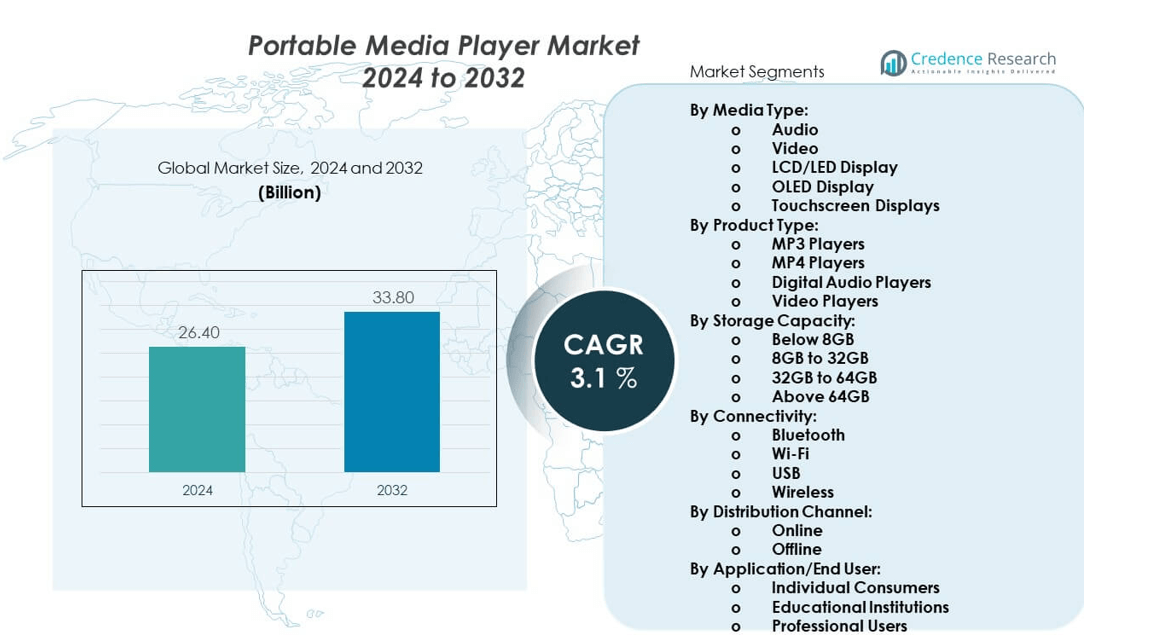
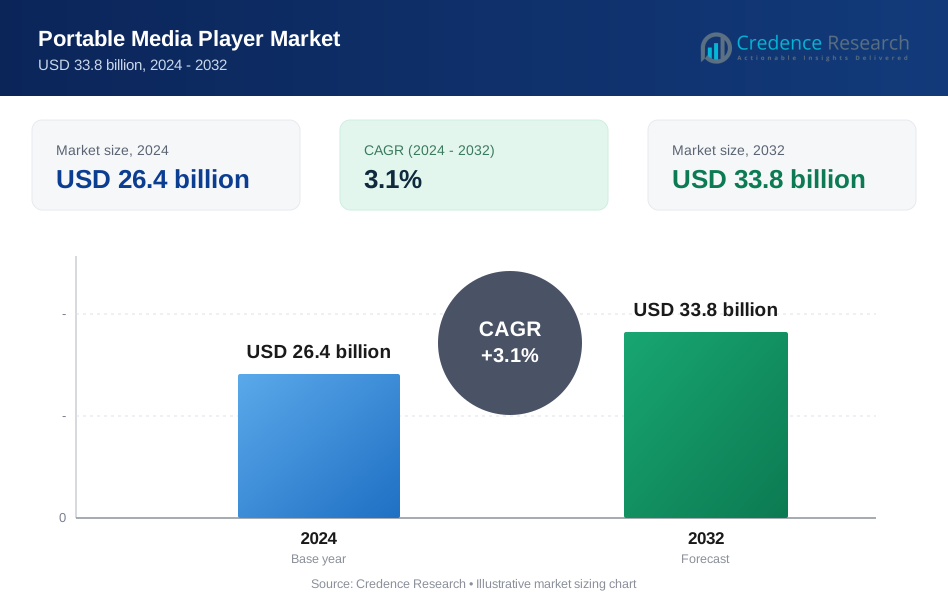
The portable media player market is projected to grow from USD 26.4 billion in 2024 to an estimated USD 33.8 billion by 2032, with a compound annual growth rate (CAGR) of 3.1% from 2024 to 2032.
| REPORT ATTRIBUTE | DETAILS |
|---|---|
| Historical Period | 2020-2023 |
| Base Year | 2024 |
| Forecast Period | 2025-2032 |
| Portable Media Player Market Size 2024 | USD 26.4 billion |
| Portable Media Player Market, CAGR | 3.1% |
| Portable Media Player Market Size 2032 | USD 33.8 billion |
Growing consumer focus on mobility, convenience, and entertainment drives the portable media player market. The market benefits from rising demand for devices supporting wireless connectivity, larger storage, and extended battery life. Shifts toward fitness and travel-oriented gadgets also boost product appeal, while the popularity of offline playback options complements streaming services. Brands invest heavily in design upgrades, durability improvements, and ecosystem integration to retain users and address evolving lifestyle needs.
Regional growth in the portable media player market reflects both established and emerging economies. North America and Europe lead adoption due to advanced consumer electronics ecosystems and high spending on premium devices. Asia Pacific is emerging as the fastest-growing region, supported by rising disposable incomes, youth-oriented entertainment trends, and strong manufacturing bases in countries like China, Japan, and South Korea. Latin America and the Middle East & Africa show increasing potential as affordable devices and localized content drive new demand.
Market Insights:
- The portable media player market is projected to grow from USD 26.4 billion in 2024 to USD 33.8 billion by 2032, registering a CAGR of 3.1% during the forecast period.
- Rising demand for high-resolution audio, wireless connectivity, and multifunctional devices drives consistent market expansion.
- Growing consumer adoption in fitness, sports, and travel activities fuels demand for compact, durable, and water-resistant models.
- Competition from smartphones and other multipurpose devices restrains adoption of standalone media players.
- Lengthening replacement cycles and shifting consumer spending patterns further limit growth in certain regions.
- North America and Europe lead adoption, driven by advanced consumer electronics ecosystems and high spending on premium devices.
- Asia Pacific emerges as the fastest-growing region, supported by rising disposable incomes, strong youth demographics, and manufacturing strength in China, Japan, and South Korea.
Market Drivers:
Growing Demand for High-Quality Audio and Versatile Entertainment:
The portable media player market is driven by strong consumer demand for immersive audio and entertainment. Users increasingly value high-resolution sound and compatibility with multiple formats, which strengthens premium sales. Audiophiles favor noise cancellation, deep bass, and lossless playback for a superior experience. Gaming content adoption also expands demand, as players double as handheld entertainment devices. Bluetooth and wireless headphone support create added convenience for consumers. Long-lasting battery performance ensures continuous entertainment during travel or outdoor activities. Lightweight and compact designs improve portability while maintaining durability. It grows steadily as innovation enhances both design and performance.
- For instance, Astell & Kern’s A&norma SR35 supports playback up to 32-bit/384kHz with DSD256 and MQA formats, delivering exceptionally clear and detailed sound with three headphone outputs (3.5mm, 4.4mm, and 2.5mm), meeting the needs of demanding audiophiles. Gaming content adoption also expands demand, as players double as handheld entertainment devices.
Rising Adoption Supported by Fitness, Sports, and On-the-Go Lifestyles:
Consumer focus on fitness and active routines creates consistent demand for portable media players. Devices designed for workouts, running, or cycling attract health-conscious buyers. Water resistance, shockproof features, and compact designs strengthen appeal for outdoor use. Offline playback capabilities are valued by athletes during remote or network-limited activities. The portable media player market expands further as devices sync with fitness apps and wearables. GPS and performance tracking integration increase relevance for sports enthusiasts. Compact models that deliver convenience without compromising quality appeal to travelers. It benefits from consumer interest in balancing lifestyle needs with entertainment.
- For instance, Sony’s NW-A306 offers durable IPX5 water resistance and long playback time that suits active users who need robust and reliable media devices during fitness activities. Offline playback capabilities are valued by athletes during remote or network-limited activities. The portable media player market expands further as devices sync with fitness apps and wearables.
Integration of Advanced Connectivity and Smart Features Enhancing Utility:
Connectivity advancements play a critical role in strengthening the market outlook. Media players increasingly support Wi-Fi, Bluetooth, and NFC, improving wireless communication. Smartphone pairing and smart home integration expand the ecosystem of device usage. Streaming access and cloud storage options ensure continuous entertainment for users. The portable media player market thrives on combining traditional playback with modern connectivity. Voice assistant functions and AI-based recommendations improve personalization. Families favor secure devices with parental controls, boosting consumer trust. It grows as smarter features align with user convenience and technological adoption.
Youth-Oriented Entertainment and Demand for Affordable Multimedia Experiences:
Youth consumption patterns drive significant growth in demand for feature-rich portable players. Younger consumers seek affordable entertainment solutions for music, video, and casual gaming. Offline video storage options appeal to students and travelers with limited internet access. The portable media player market benefits from strong youth interest in multimedia engagement. Social media compatibility and interactive features create higher usage among younger demographics. Affordable pricing combined with innovative designs expands reach in emerging economies. Content-sharing features encourage adoption among peer groups and networks. It strengthens growth by aligning product design with evolving youth entertainment trends.
Market Trends:
Growing Popularity of Compact and Wearable Media Devices:
The trend toward compact, wearable devices supports wider adoption among tech-savvy consumers. Portable players designed as clip-on units or wrist-wearables appeal to active users. Integration with wearable ecosystems such as fitness trackers expands functionality. The portable media player market records rising demand for lightweight models offering maximum convenience. Travelers and commuters increasingly prefer discreet devices over bulkier alternatives. Advances in miniaturization enhance durability and user comfort. Compact players with long battery life strengthen adoption in sports and leisure use. It grows as consumers prioritize ease of use alongside entertainment.
- For instance, devices like the FiiO M11S incorporate dual ESS DACs for high-quality sound in a compact Android player, combining portability with rich audio. Travelers and commuters increasingly prefer discreet devices over bulkier alternatives. Advances in miniaturization enhance durability and user comfort. Compact players with long battery life strengthen adoption in sports and leisure use. T
Expansion of Hybrid Devices Combining Media and Communication Functions:
Hybrid devices merging communication and entertainment gain attention in global markets. Manufacturers experiment with models that combine messaging, recording, and streaming functions. The portable media player market benefits from innovation blending multiple services in one device. Users prefer all-in-one gadgets that reduce the need for separate products. Expansion into gaming and productivity tools enhances product versatility. Hybrid devices appeal to students and professionals managing work and entertainment. Software updates increase adaptability, extending device lifespan and relevance. It gains market strength as consumers value multifunctional and connected solutions.
- For example, Microsoft’s continuing development of its Media Player software integrates broad media functionalities tailored for Windows, increasing device versatility.
Rising Influence of Retro-Inspired and Niche Product Offerings:
Retro-inspired designs create a strong trend among collectors and nostalgic buyers. Vinyl-styled interfaces and cassette-inspired designs attract attention in premium segments. The portable media player market benefits from niche demand where style enhances product appeal. Limited edition launches build exclusivity and drive higher brand engagement. Youth consumers view retro models as fashionable accessories blending tradition and modernity. These products generate cultural appeal, especially in markets with strong music heritage. Niche customization adds further value by targeting lifestyle preferences. It expands through diversified offerings that balance technology with design identity.
Increasing Role of Sustainable Manufacturing and Eco-Friendly Materials:
Sustainability shapes product development across multiple consumer electronics categories. The portable media player market reflects this shift with eco-friendly designs and recyclable materials. Manufacturers adopt biodegradable plastics and low-energy components to address environmental concerns. Consumers increasingly favor brands with visible sustainability commitments. Energy-efficient batteries reduce electronic waste while improving long-term usability. Packaging innovations further highlight responsible production practices in competitive markets. Partnerships with recycling programs add credibility to green initiatives. It advances with sustainable practices that match growing consumer environmental awareness.
Market Challenges Analysis:
Rising Competition from Smartphones and Multipurpose Consumer Electronics:
Competition from smartphones remains the largest challenge for media players worldwide. Smartphones integrate music, video, gaming, and connectivity into a single device. The portable media player market struggles to differentiate against such versatile alternatives. Consumers often prioritize smartphones over standalone media players for convenience. Price-conscious buyers prefer multipurpose devices, limiting media player adoption. High smartphone penetration in mature economies restricts replacement demand for portable players. Brands must innovate in specialized functions to retain a competitive edge. It faces difficulty in shifting consumer preference from all-in-one devices.
Declining Replacement Cycles and Shifts in Consumer Spending Patterns:
Lengthening replacement cycles reduce market opportunities for new media players. Consumers delay upgrades, as durable products last for years without performance loss. The portable media player market experiences slow turnover due to reliability improvements. Economic shifts influence spending priorities, with many consumers opting for smartphones instead. Price sensitivity further limits high-end device sales, particularly in emerging economies. Strong competition from streaming-enabled devices reduces traditional player demand. Limited differentiation among brands creates additional pricing pressures. It remains challenged by consumer spending habits that favor multifunctional and long-lasting devices.
Market Opportunities:
Expansion into Emerging Economies with Affordable and Feature-Rich Devices:
Emerging economies create major growth opportunities for portable media players. Rising disposable incomes and youth demographics drive higher adoption of entertainment devices. The portable media player market expands further with affordable models tailored to price-sensitive buyers. Feature-rich designs catering to multimedia and offline access attract student and rural populations. Distribution through online retail platforms increases reach in underserved areas. Localized content integration ensures cultural and regional relevance. Affordable device options strengthen adoption among first-time buyers. It secures growth by bridging affordability with advanced entertainment functions.
Growth Potential in Specialized Segments like Professional Audio and Niche Entertainment:
Specialized markets create new growth avenues for manufacturers. Professional audio users demand high-resolution playback and studio-grade performance. The portable media player market benefits from innovation targeting niche segments. Collectors value retro-inspired and limited-edition designs for personal and cultural appeal. Gaming-oriented devices enhance experiences with dedicated controls and superior graphics. High-end consumers invest in luxury devices with premium design and advanced materials. These specialized markets deliver higher margins and brand recognition. It achieves stronger growth by focusing on distinct user groups with specialized needs.
Market Segmentation Analysis:
By Media Type
The portable media player market is segmented by media type into audio, video, LCD/LED display, OLED display, and touchscreen displays. Audio players dominate due to strong demand for music playback devices among casual users and professionals. Video players record significant growth with rising youth interest in portable entertainment. LCD/LED displays remain widely adopted for their cost efficiency and durability. OLED displays show high potential in premium categories, offering superior visuals and low power consumption. Touchscreen displays strengthen usability, driving adoption across high-end segments.
- For instance, high-end models like the Astell & Kern A&ultima SP3000 support 32-bit/768kHz PCM with DSD512 and MQA, featuring flagship DAC chips that deliver pristine audio quality, reinforcing the dominance of audio-centric devices.
By Product Type
By product type, the market includes MP3 players, MP4 players, digital audio players, and video players. MP3 players continue to hold notable share due to affordability and ease of use. MP4 players gain traction with video compatibility and multifunction features. Digital audio players grow among audiophiles who value lossless formats and premium sound. Video players expand among students, travelers, and gaming enthusiasts. The portable media player market benefits from product variety that addresses both entry-level and professional demands.
- For instance, Sony’s NW-A306 MP3 player offers a balance of quality and cost, with support for lossless audio formats and a 45-hour battery life, appealing to a broad user base. MP4 players gain traction with video compatibility and multifunction features. Digital audio players grow among audiophiles who value lossless formats and premium sound. Video players expand among students, travelers, and gaming enthusiasts.
By Storage Capacity
Segmentation by storage capacity covers below 8GB, 8GB to 32GB, 32GB to 64GB, and above 64GB. Devices below 8GB remain relevant for basic users and cost-sensitive markets. The 8GB to 32GB segment records strong adoption, balancing affordability and storage needs. Devices with 32GB to 64GB capacity attract consumers requiring higher media storage. Above 64GB devices dominate premium segments, appealing to professionals and enthusiasts with large libraries. It reflects growing preference for larger storage as content consumption rises.
By Connectivity
By connectivity, the portable media player market is classified into Bluetooth, Wi-Fi, USB, and wireless. Bluetooth dominates due to compatibility with headphones, speakers, and car audio systems. Wi-Fi-based devices expand with rising adoption of streaming services and cloud access. USB remains essential for fast data transfer and charging. Wireless technologies support broader integration with smart devices and IoT ecosystems. Connectivity options play a critical role in driving user experience and purchase decisions.
By Distribution Channel
Distribution channels include online and offline sales. Online channels record rapid growth, supported by e-commerce platforms and direct-to-consumer strategies. Consumers prefer online purchases for affordability, variety, and ease of access. Offline channels, including specialty stores and retail chains, remain relevant in developed markets. It provides consumers with the advantage of physical inspection and instant product availability. Hybrid strategies by brands support both online and offline growth simultaneously.
By Application/End User
End-user segmentation includes individual consumers, educational institutions, and professional users. Individual consumers remain the largest group, driven by demand for personal entertainment and fitness usage. Educational institutions adopt portable media players for language learning, lectures, and student engagement. Professional users, such as musicians, broadcasters, and content creators, favor high-capacity and high-resolution models. The portable media player market grows as diverse end-user groups continue to expand adoption.
Segmentation:
- By Media Type:
- Audio
- Video
- LCD/LED Display
- OLED Display
- Touchscreen Displays
- By Product Type:
- MP3 Players
- MP4 Players
- Digital Audio Players
- Video Players
- By Storage Capacity:
- Below 8GB
- 8GB to 32GB
- 32GB to 64GB
- Above 64GB
- By Connectivity:
- Bluetooth
- Wi-Fi
- USB
- Wireless
- By Distribution Channel:
- Online
- Offline
- By Application/End User:
- Individual Consumers
- Educational Institutions
- Professional Users
- By Region
- North America
- U.S.
- Canada
- Mexico
- Europe
- Germany
- France
- U.K.
- Italy
- Spain
- Rest of Europe
- Asia Pacific
- China
- Japan
- India
- South Korea
- South-east Asia
- Rest of Asia Pacific
- Latin America
- Brazil
- Argentina
- Rest of Latin America
- Middle East & Africa
- GCC Countries
- South Africa
- Rest of the Middle East and Africa
- North America
Regional Analysis:
North America and Europe Leading with Strong Market Base
North America dominates the portable media player market with a 35% share, supported by high consumer spending and advanced electronics infrastructure. The region benefits from strong demand for premium audio devices and integration with smart ecosystems. Leading brands capture customer loyalty through continuous innovation and ecosystem-based services. Europe follows with a 28% share, driven by a growing preference for durable, stylish, and eco-friendly products. Rising fitness and outdoor culture in both regions support consistent device adoption. It gains strength in developed economies where consumers prioritize quality and brand reliability.
Asia Pacific Emerging as Fastest-Growing Market
Asia Pacific holds a 25% share of the portable media player market, with rapid growth led by China, Japan, and South Korea. Expanding youth populations and rising disposable incomes boost adoption across multiple demographics. Strong local manufacturing capabilities and competitive pricing strategies make the region highly dynamic. The trend of offline entertainment and rising demand in rural areas support entry-level product adoption. Growing popularity of gaming and music streaming services enhances device relevance. It continues to grow as regional players expand distribution and target cost-sensitive consumers.
Latin America and Middle East & Africa Showing Gradual Growth
Latin America accounts for 7% of the portable media player market, supported by rising urbanization and youth-driven demand. Online sales platforms play a key role in increasing accessibility to affordable models. The Middle East & Africa represent 5% of the market, with growth linked to expanding internet penetration and entertainment trends. Consumers in these regions favor entry-level and mid-range devices due to cost considerations. Localized content availability enhances product acceptance among younger buyers. It reflects steady but limited growth where affordability and distribution remain key challenges.
Key Player Analysis:
- Apple Inc.
- Sony Corporation
- Samsung Electronics Co., Ltd.
- Microsoft Corporation
- Astell&Kern
- Cowon Systems, Inc.
- Philips Electronics
- Pioneer Corporation
- Archos S.A.
- Toshiba Corporation
- SanDisk Corporation
- Creative Technology Ltd.
- iRiver (Astell & Kern)
- Panasonic Corporation
- LG Electronics
Competitive Analysis:
The portable media player market features intense competition among global technology leaders and specialized audio firms. Apple, Sony, and Samsung dominate with strong brand recognition, ecosystem integration, and wide product portfolios. Companies like Astell&Kern, Cowon Systems, and Creative Technology focus on premium audio solutions for niche consumers. Microsoft and Philips target multifunction devices that align with professional and entertainment needs. Competition also extends to mid-tier brands such as Archos, Toshiba, and SanDisk, which emphasize affordability and storage innovations. The portable media player market grows increasingly competitive with rapid product refresh cycles, connectivity upgrades, and design innovation. It continues to attract new players focused on customization and youth-driven entertainment trends.
Recent Developments:
- Sony Corporation announced a strategic partnership with BandLab Technologies on April 30, 2025. This collaboration aims to empower creators through Sony's Spatial Sound technology integrated into BandLab's social music creation app, enabling immersive music creation and experience for millions of users worldwide.
- Astell&Kern launched a new flagship digital audio player, the A&ultima SP4000, in May 2025 at High End Munich, featuring advanced audio circuitry and technologies for superior sound quality, marking a significant innovation in their product line.
- Philips Electronics expanded its partnership with Medtronic as of June 2025, focusing on healthcare technologies and patient monitoring solutions, which is outside the portable media player market.
- Pioneer Corporation announced at CES 2025 in January a next-level integrated auto sound platform for vehicles, supporting immersive experiences like Dolby Atmos compatible with Apple CarPlay, showcasing innovation in in-vehicle audio sound solutions
Market Concentration & Characteristics:
The portable media player market is moderately concentrated, with a few global leaders holding significant influence alongside niche brands serving specialized users. It is characterized by rapid innovation cycles, strong demand for multifunctionality, and brand-driven consumer loyalty. Premium players dominate through design, audio quality, and ecosystem integration, while mid-tier and entry-level products gain traction in emerging regions. Product differentiation largely depends on storage, connectivity, and durability. The portable media player market reflects a balance of established technology leaders and innovative challengers, creating a dynamic competitive environment.
Report Coverage:
The research report offers an in-depth analysis based on media type, product type, storage capacity, connectivity, distribution channel, and end user. It details leading market players, providing an overview of their business, product offerings, investments, revenue streams, and key applications. Additionally, the report includes insights into the competitive environment, SWOT analysis, current market trends, as well as the primary drivers and constraints. Furthermore, it discusses various factors that have driven market expansion in recent years. The report also explores market dynamics, regulatory scenarios, and technological advancements that are shaping the industry. It assesses the impact of external factors and global economic changes on market growth. Lastly, it provides strategic recommendations for new entrants and established companies to navigate the complexities of the market.
Future Outlook:
- Rising demand for premium audio quality will drive innovation in sound technologies.
- Compact and wearable devices will gain traction among fitness and travel users.
- Integration of AI and voice assistants will enhance user personalization.
- Emerging markets will expand adoption through affordable and feature-rich models.
- Hybrid devices combining media and communication functions will strengthen demand.
- Sustainable materials and eco-friendly manufacturing will shape brand strategies.
- Professional and niche segments will create high-margin growth opportunities.
- Online retail channels will dominate distribution with increasing consumer preference.
- Retro-inspired designs will continue to attract collectors and youth audiences.
- Connectivity advancements with Wi-Fi and wireless ecosystems will remain a key growth driver.
Request a Free Sample
Fill in your details and we'll send you a free sample report.
- Sample data tables & charts
- Research methodology
Need a Custom Version of This Report?
Tailor the scope, geography, or segments to your exact requirements.
- Custom geography or segment scope
- Direct access to our analyst team
Frequently Asked Questions
What is the current market size for Portable media player market, and what is its projected size in 2032?
At what Compound Annual Growth Rate is the Portable media player market projected to grow between 2025 and 2032?
What are the primary factors fueling the growth of the Portable media player market?
Who are the leading companies in the Portable media player market?
Table of Content
Chapter 1. Report Introduction
- 1.1 Report Description & Purpose
- 1.1.1 Report Title & Market Definition
- 1.1.2 Unique Selling Propositions (USP) & Key Differentiators
- 1.1.3 Value Proposition for Stakeholders
- 1.2 Research Objectives
- 1.2.1 Market Sizing Objectives (Volume & Revenue) (Volume Where Applicable)
- 1.2.2 Segmentation Objectives
- 1.2.3 Competitive Intelligence Objectives
- 1.2.4 Forecast & Scenario Objectives
- 1.3 Report Scope
- 1.3.1 Portable Media Player Scope – Segments & Subsegments Covered
- 1.3.2 Geographic Scope – Regions & Countries Covered
- 1.3.3 Historical Period, Base Year & Forecast Period (2024; forecast to 2032)
- 1.3.4 Inclusions & Exclusions
- 1.4 Industry Classification & Applicable Codes
- 1.5 Currency, Measurement Units & Valuation Basis
- 1.6 Target Stakeholders
- 1.7 Limitations & Assumptions
Chapter 2. Executive Summary
- 2.1 Global Portable Media Player Market Snapshot
- 2.1.1 Market Size – Historical (2024) & Forecast (2024-2032) (2024: USD 26.4 billion → 2032: USD 33.8 billion)
- 2.1.2 Volume & Revenue – Global Totals (Volume Where Applicable)
- 2.1.3 Key Market Highlights – Top Five Facts
- 2.2 Portable Media Player Market Segmentation Snapshot
- 2.2.1 Market Split by Region – 2024 vs. 2032
- 2.3 Competitive Snapshot
- 2.3.1 Top 10 Players by Revenue Share – 2024
- 2.3.2 Top 10 Players by Volume Share – 2024 (Volume Where Applicable)
- 2.3.3 Recent Strategic Developments (18-Month Summary)
- 2.4 Key Investment Highlights & Strategic Conclusions
Chapter 3. Portable Media Player Market Dynamics & Industry Analysis
- 3.1 Market Overview & Context
- 3.1.1 Portable Media Player Market Position in the Broader Industry Value Chain
- 3.1.2 Demand Structure & Purchasing Dynamics
- 3.1.3 Market Maturity & Development Stage by Region
- 3.2 Portable Media Player Market Drivers
- 3.3 Portable Media Player Market Restraints & Challenges
- 3.4 Portable Media Player Market Opportunities
- 3.5 Porter's Five Forces Analysis
- 3.5.1 Threat of New Entrants
- 3.5.2 Bargaining Power of Suppliers
- 3.5.3 Bargaining Power of Buyers
- 3.5.4 Threat of Substitutes
- 3.5.5 Competitive Rivalry – Intensity Assessment
- 3.6 Portable Media Player Value Chain Analysis
- 3.6.1 Upstream – Key Inputs, Resources & Suppliers
- 3.6.1.1 Key Input/Resource 1
- 3.6.1.2 Key Input/Resource 2
- 3.6.1.3 Key Input/Resource 3
- 3.6.2 Midstream – Core Operations & Value Creation
- 3.6.2.1 Operating Model & Process Overview
- 3.6.2.2 Key Operating Locations & Capabilities by Company
- 3.6.3 Downstream – Market Channels & End Users
- 3.6.3.1 Direct Sales & Customer Engagement Channels
- 3.6.3.2 Indirect Sales, Intermediaries & Partner Channels
- 3.6.4 Value Chain Profitability Analysis
- 3.6.1 Upstream – Key Inputs, Resources & Suppliers
- 3.7 PESTEL Analysis
- 3.7.1 Political Factors
- 3.7.2 Economic Factors
- 3.7.3 Social Factors
- 3.7.4 Technological Factors
- 3.7.5 Environmental Factors
- 3.7.6 Legal Factors
- 3.8 Portable Media Player Supply Chain Analysis
- 3.8.1 Critical Input & Resource Availability Risk Assessment
- 3.8.2 Supplier & Operational Concentration Risk (Geographic Exposure)
- 3.8.3 Supply & Service Disruption Impact Analysis
- 3.9 Regulatory & Policy Landscape
Note: The regulatory and policy landscape section covers regulations based on their applicability to the market, Portable Media Player category, geography, and scope of the study. Only regulatory frameworks with a material impact on operations, compliance, trade, sustainability, or market access are analyzed in detail.
Chapter 4. Key Investment Pockets & Opportunity Analysis
- 4.1 Portable Media Player Market Attractiveness Analysis
- 4.1.1 By Region – Investment Attractiveness Matrix (Market Size × CAGR)
- 4.2 Absolute Revenue Growth Opportunity
- 4.2.1 By Region – Absolute Revenue Growth Through 2032
- 4.3 Incremental Demand Opportunity
- 4.3.1 By Region – Incremental Demand Through 2032
- 4.3.2 Segment – Incremental Demand
- 4.4 Emerging Submarket Opportunity Deep Dive (Subject to Applicability)
- 4.5 Priority Market Opportunity Scorecards
- 4.5.1 United States
- 4.5.2 Europe
- 4.5.3 Asia
- 4.5.4 Middle East & Africa
Note: Priority market opportunity scorecards reflect the geographic scope and strategic relevance of the study. Listed markets are indicative and may be adapted to the industry.
Chapter 5. Portable Media Player Cross-Border Trade & Market Access Analysis
- 5.1 International Trade & Cross-Border Activity Overview
- 5.1.1 Global Export Value by Country (2024)
- 5.1.2 Global Export Volume by Country (2024) (Volume Where Applicable)
- 5.1.3 Global Import Value by Country (2024)
- 5.1.4 Global Import Volume by Country (2024) (Volume Where Applicable)
- 5.1.5 Net Trade Balance by Country (2024)
- 5.2 Export Analysis – Segment
- 5.2.1 Category 1 (Applicable Classification Code)
- 5.2.2 Category 2 (Applicable Classification Code)
- 5.2.3 Category 3 (Applicable Classification Code)
- 5.2.4 Category 4 (Applicable Classification Code)
- 5.2.5 Category 5 (Applicable Classification Code)
- 5.3 Import Analysis – Segment
- 5.3.1 Category 1 (Applicable Classification Code)
- 5.3.2 Category 2 (Applicable Classification Code)
- 5.3.3 Category 3 (Applicable Classification Code)
- 5.3.4 Category 4 (Applicable Classification Code)
- 5.3.5 Category 5 (Applicable Classification Code)
- 5.4 Cross-Border Pricing & Transaction Benchmarks
- 5.4.1 Export Pricing – Segment & Country
- 5.4.2 Import Pricing – Segment & Source Country
- 5.4.3 Price Trends (2024)
- 5.5 Key Cross-Border Trade & Delivery Routes
- 5.5.1 Cross-Border Trade/Delivery Route 1
- 5.5.2 Cross-Border Trade/Delivery Route 2
- 5.5.3 Cross-Border Trade/Delivery Route 3
- 5.5.4 Cross-Border Trade/Delivery Route 4
- 5.5.5 Cross-Border Trade/Delivery Route 5
- 5.6 Trade Policy & Market Access Impact Assessment
- 5.6.1 Tariff & Non-Tariff Barriers
- 5.6.2 Regional Trade & Economic Integration Frameworks
- 5.6.3 Bilateral & Multilateral Trade Agreements
- 5.6.4 Cross-Border Operating, Licensing & Localization Requirements
Note: This chapter applies where cross-border trade or delivery is relevant to Portable Media Player. Goods, services, and digital offerings are assessed using applicable classifications and transaction measures. Import-export volumes, trade balances, and route analyses are included only where meaningful to the market.
Chapter 6. Competitive Landscape & Company Benchmarking
- 6.1 Portable Media Player Market Concentration & Structure
- 6.1.1 Herfindahl-Hirschman Index (HHI) – the historical period vs. 2024
- 6.1.2 Leading, Mid-Sized & Emerging Player Structure
- 6.1.3 Global, Regional & Local Player Dynamics
- 6.2 Portable Media Player Market Share Analysis – 2024
- 6.2.1 Global Revenue Share by Company
- 6.2.2 Global Volume Share by Company (Volume Where Applicable)
- 6.2.3 Regional Revenue Share
- 6.2.4 Market Share Evolution (the historical period vs. 2024)
- 6.2.5 Company Market Share by Key Segment
- 6.2.6 Company Market Share by Customer Group
- 6.3 Operating Scale, Capacity & Infrastructure Analysis
- 6.3.1 Global Operating Scale & Supply Capacity
- 6.3.2 Resource Utilization & Operating Efficiency
- 6.3.3 Output, Service Delivery & Activity Metrics
- 6.3.4 Operating Footprint & Infrastructure Map
- 6.3.5 Planned Operational & Capacity Expansion
- 6.4 Portable Media Player Competitive Benchmarking Matrix
- 6.4.1 Revenue, Growth, Profitability & Operating Metric Comparison
- 6.4.2 Channel Revenue Mix
- 6.4.3 Geographic Revenue Exposure
- 6.4.4 R&D Intensity
- 6.4.5 Sustainability Maturity
- 6.5 Strategic Developments in Portable Media Player (Last 24 Months)
- 6.5.1 Mergers, Acquisitions & Divestments
- 6.5.2 New Products, Services & Solutions in Portable Media Player
- 6.5.3 Operational & Infrastructure Expansions
- 6.5.4 Strategic Alliances, Joint Ventures & Partnerships
- 6.5.5 Distribution Expansion & Market Entry
- 6.5.6 Sustainability & ESG Initiatives
- 6.6 Competitive Strategy Mapping
- 6.6.1 Leader, Challenger, Follower & Niche Classification
- 6.6.2 Pricing Strategy Comparison
- 6.6.3 Channel Strategy Matrix
Note: Strategic developments are included based on their materiality and the availability of reliable information.
Chapter 7. Global Portable Media Player Market – By Sales & Delivery Channel
- 7.1 Segment Overview
- 7.1.1 Volume & Revenue Split by Channel (2024 & 2032) (Volume Where Applicable)
- 7.1.2 Channel Mix Evolution (2024-2032)
Chapter 8. Regional Market Analysis – Global Overview
- 8.1 Global Regional Overview
- 8.1.1 Regional Volume Share (Volume Where Applicable)
- 8.1.2 Regional Revenue Share
- 8.1.3 Regional Volume by Region (Volume Where Applicable)
- 8.1.4 Regional Revenue by Region
- 8.1.5 Regional Forecast Through 2032
- 8.2 Cross-Regional Segment Analysis
- 8.2.1 By Sales & Delivery Channel
- 8.2.2 By Competitive Positioning & Price Tier
Chapter 9. North America Portable Media Player Market
- 9.1 United States
- 9.2 Canada
- 9.3 Mexico
Chapter 10. Europe Portable Media Player Market
- 10.1 Germany
- 10.2 France
- 10.3 Italy
- 10.4 United Kingdom
- 10.5 Spain
- 10.6 Poland
- 10.7 Russia
- 10.8 Netherlands
- 10.9 Belgium
- 10.10 Sweden
- 10.11 Denmark
- 10.12 Norway
- 10.13 Rest of Europe
Chapter 11. Asia Pacific Portable Media Player Market
- 11.1 China
- 11.2 India
- 11.3 Japan
- 11.4 South Korea
- 11.5 Thailand
- 11.6 Indonesia
- 11.7 Vietnam
- 11.8 Malaysia
- 11.9 Australia
- 11.10 Rest of Asia Pacific
Chapter 12. Latin America Portable Media Player Market
- 12.1 Brazil
- 12.2 Argentina
- 12.3 Colombia
- 12.4 Chile
- 12.5 Rest of Latin America
Chapter 13. Middle East Portable Media Player Market
- 13.1 Saudi Arabia
- 13.2 United Arab Emirates
- 13.3 Turkey
- 13.4 Israel
- 13.5 Iran
- 13.6 Rest of the Middle East
Chapter 14. Africa Portable Media Player Market
- 14.1 South Africa
- 14.2 Egypt
- 14.3 Nigeria
- 14.4 Morocco
- 14.5 Rest of Africa
Chapter 15. Portable Media Player Company Profiles
- 15.1 [Company 01]
- 15.1.1 Company Overview
- 15.1.2 Key Management Personnel
- 15.1.3 Products & Services Portfolio
- 15.1.4 Financial Performance
- 15.1.5 Key Market Focus & Geographic Presence
- 15.1.6 Recent Developments & Strategic Initiatives
Note: The company profile list is preliminary and may change based on research findings, market developments, data availability, and client requirements.
Chapter 16. Appendices
- Appendix A – List of Abbreviations & Acronyms
- Appendix B – Industry Classification Code Reference – Full Series
- Appendix C – Supply, Output & Operating Capacity Data Tables
- Appendix D – End-Use & Demand Base Tables
- Appendix E – Demand, Adoption & Usage Assumptions
- Appendix F – Pricing & Revenue Metric Reference Tables
- Appendix G – Company Operations & Infrastructure Database
- Appendix H – Cross-Border Trade & Activity Data Tables (Where Applicable)
- Appendix I – Regulatory Summary Tables
- Appendix J – Primary Research Participant List (Anonymized)
- Appendix K – Primary Research Questionnaire Framework
- Appendix L – Data Sources & Bibliography
- Appendix M – Market Size Divergence & Source Comparison
Chapter 17. Research Methodology
- 17.1 Research Framework & Philosophy
- 17.2 Secondary Research – Sources, Hierarchy & Data Extraction
- 17.3 Data Modeling – Bottom-Up & Top-Down Market Sizing
- 17.4 Primary Research – Stakeholder Framework, LOI & Sample Sizes
- 17.5 Forecast Methodology – Regression, Scenario & Sensitivity Analysis
- 17.6 Quality Control – Four-Layer Validation Framework
- 17.7 Limitations & Standard Assumptions
- 17.8 Disclaimer
