|
DETAILS |
|---|---|
| Historical Period | 2020-2023 |
| Base Year | 2024 |
| Forecast Period | 2025-2032 |
| Power Management IC (PMIC) ASIC Market Size 2024 | USD 18,733.41 Million |
| Power Management IC (PMIC) ASIC Market, CAGR | 5.34 % |
| Power Management IC (PMIC) ASIC Market Size 2032 | USD 29,279.67 Million |
Market Overview
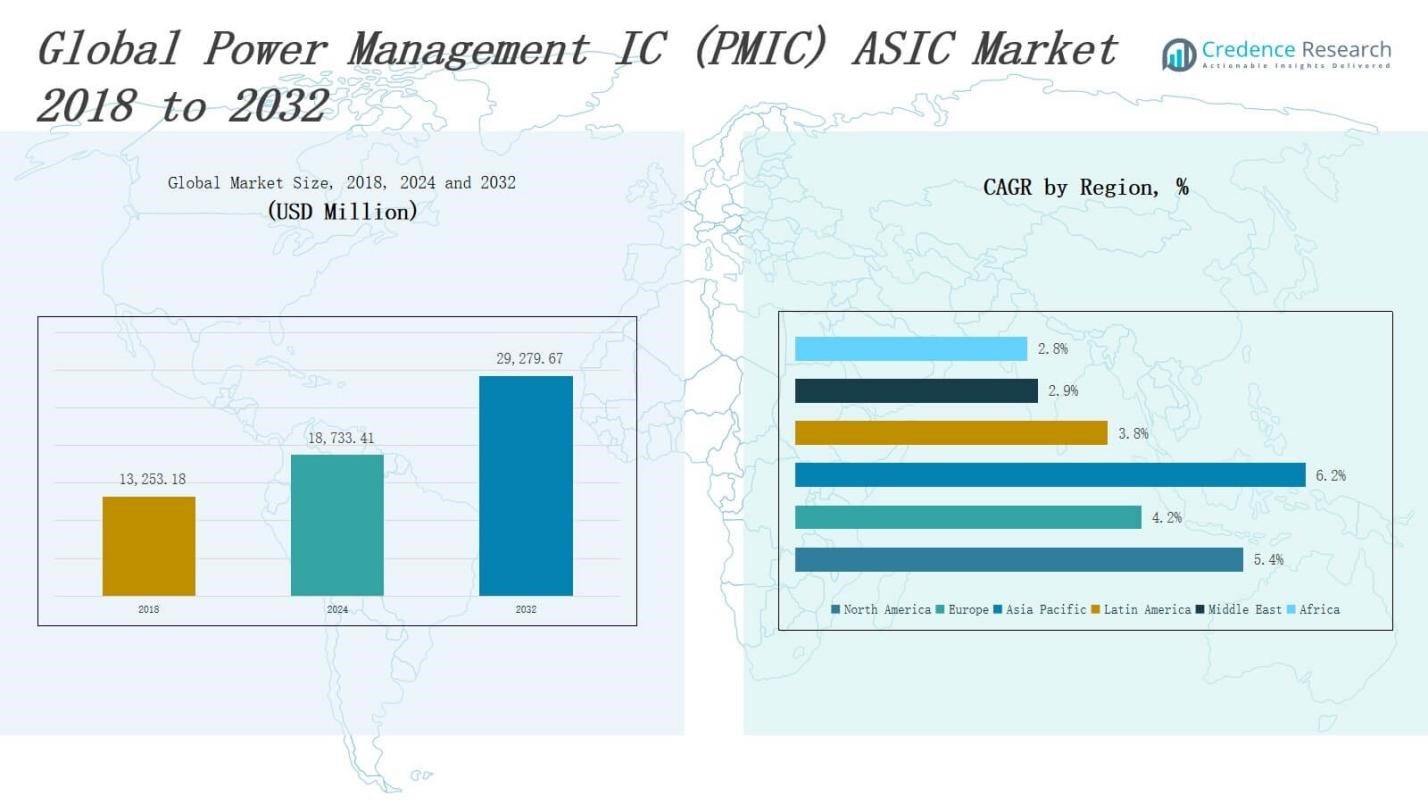
The Power Management IC (PMIC) ASIC Market size was valued at USD 13,253.18 million in 2018 to USD 18,733.41 million in 2024 and is anticipated to reach USD 29,279.67 million by 2032, at a CAGR of 5.34 % during the forecast period.
The Power Management IC (PMIC) ASIC market is driven by the escalating demand for energy-efficient electronics across consumer devices, automotive systems, and industrial equipment. The rapid adoption of electric vehicles, 5G infrastructure, and IoT-connected devices has intensified the need for custom PMICs that offer high integration, low power consumption, and real-time voltage regulation. OEMs prioritize ASIC-based power management solutions to optimize battery performance, extend device lifespan, and support miniaturization. Trends shaping the market include the shift toward advanced semiconductor nodes such as 5nm and 3nm for higher performance-per-watt, and increasing integration of AI features to enable dynamic power optimization. The growing complexity of SoC architectures in smartphones and wearables also drives demand for highly configurable PMICs. Moreover, PMIC ASICs are playing a critical role in data center energy efficiency, particularly in hyperscale computing environments. Regulatory pressure to reduce carbon emissions further accelerates innovation in low-leakage, high-efficiency PMIC architectures across end-user applications.
The Power Management IC (PMIC) ASIC Market spans North America, Europe, Asia Pacific, Latin America, the Middle East, and Africa, with Asia Pacific holding the largest share due to strong semiconductor manufacturing and consumer electronics demand. North America leads in R&D and EV adoption, while Europe shows strength in automotive and industrial automation. Latin America sees rising demand in consumer electronics, and the Middle East invests in smart infrastructure and energy systems. Africa is gradually expanding with telecom and off-grid energy applications. Key players in the market include Texas Instruments, Analog Devices, STMicroelectronics, NXP Semiconductors, Infineon Technologies, Qualcomm, Renesas Electronics, Onsemi, Vishay, ROHM, Maxim Integrated, and Dialog Semiconductor. These companies compete on power efficiency, integration, and advanced process technologies to meet the diverse needs of each regional market segment.
Market Insights
- The Power Management IC (PMIC) ASIC Market size was valued at USD 13,253.18 million in 2018, reached USD 18,733.41 million in 2024, and is projected to hit USD 29,279.67 million by 2032, growing at a CAGR of 5.34%.
- Increasing demand for energy-efficient electronics in consumer devices, EVs, and industrial systems is driving adoption of custom PMIC ASICs with high integration and low power consumption.
- Advanced semiconductor nodes like 5nm and 3nm, along with embedded AI for dynamic power optimization, are key trends enhancing chip performance and efficiency.
- Rising EV adoption and electrification of vehicles create demand for programmable PMICs capable of managing battery systems, infotainment, and ADAS features.
- The market faces design complexity challenges due to diverse application requirements, thermal constraints, and the need for seamless SoC integration.
- Global supply chain disruptions and limited foundry capacity impact chip availability, raise production costs, and delay time-to-market for PMIC ASICs.
- Asia Pacific holds the largest market share (40%), followed by North America (26%) and Europe (17%), with Latin America, the Middle East, and Africa showing emerging growth potential.
Market Drivers
Rising Demand for Energy-Efficient Consumer Electronics
The Power Management IC (PMIC) ASIC Market is expanding rapidly due to the growing need for efficient power consumption in smartphones, laptops, tablets, and wearable devices. Consumers expect longer battery life and faster charging, compelling OEMs to integrate advanced PMIC ASICs for precision voltage regulation and real-time power control. It enables compact system designs with fewer components while maintaining optimal thermal performance. The trend toward miniaturized, multifunctional devices further supports demand for custom power solutions.
- For instance, Samsung’s Galaxy Watch series uses advanced PMICs to achieve multi-day battery life in a compact wearable form factor, meeting consumer expectations for portability and efficiency.
Acceleration of Electric Vehicle and Automotive Electronics Adoption
Automotive electrification significantly drives the Power Management IC (PMIC) ASIC Market. EV manufacturers rely on custom PMIC ASICs to manage complex power requirements across battery systems, infotainment units, and ADAS components. It enhances efficiency, ensures thermal stability, and reduces system size. With the transition to fully electric powertrains, OEMs require highly reliable and programmable power ICs. These chips are critical for optimizing battery charging and enabling intelligent energy distribution in next-generation vehicles.
- For instance, Texas Instruments supplies battery-monitoring ASICs that enable precise cell voltage and temperature measurement, autonomous cell balancing, and automatic host-reverse-wakeup functions in EVs, directly enhancing driving range and thermal safety.
Proliferation of IoT and Edge Computing Devices
The Power Management IC (PMIC) ASIC Market benefits from the explosive growth of IoT and edge computing technologies. Billions of connected devices require ultra-low power consumption to support continuous data sensing, processing, and wireless communication. It supports power efficiency in compact devices like smart sensors, industrial controllers, and medical monitors. Tailored PMIC ASICs are essential for enabling real-time operation while minimizing battery drain. Developers prioritize integrated solutions with scalable voltage rails and dynamic power adjustment.
Regulatory Pressure and Industry Shift to Sustainable Power Solutions
Environmental regulations and energy efficiency standards are influencing design practices across the Power Management IC (PMIC) ASIC Market. Governments worldwide are enforcing stricter guidelines to reduce carbon emissions in electronics, encouraging manufacturers to adopt energy-optimized chips. It drives innovation in low-leakage, high-efficiency circuit architectures and advanced power gating techniques. Companies invest in application-specific ICs to meet regulatory targets while improving product sustainability. The shift aligns with corporate ESG commitments and market differentiation strategies.
Market Trends
Integration of AI-Driven Power Optimization in Chip Design
The Power Management IC (PMIC) ASIC Market is witnessing a trend toward embedding artificial intelligence to enhance dynamic power control. AI-based PMICs can adjust voltage and current levels based on workload, temperature, and usage patterns in real time. It enables adaptive power distribution, improving device efficiency and performance. Developers are implementing machine learning models to predict power demands and extend battery life. AI integration is becoming standard across premium consumer electronics and data-intensive applications. This trend supports the development of intelligent, context-aware power architectures.
- For instance, Intel incorporated AI in designing its Meteor Lake processors, which include a dedicated Neural Processing Unit (NPU) alongside CPU and GPU cores, enabling dynamic power management that enhances performance and energy efficiency during AI-intensive tasks like image and video processing.
Shift Toward Advanced Semiconductor Process Nodes
Manufacturers in the Power Management IC (PMIC) ASIC Market are transitioning to 5nm and 3nm fabrication technologies to deliver improved power density and performance-per-watt. These advanced nodes enable more transistors per unit area, allowing for greater functionality in smaller chips. It supports high-efficiency power control in compact devices where board space is limited. Advanced lithography helps reduce leakage current and thermal loss. The adoption of these nodes is expanding across consumer, automotive, and industrial sectors. This shift enhances integration and performance while reducing overall system power consumption.
- For instance, Samsung’s 3nm Gate-All-Around (GAA) process achieves 45% power savings compared to its 5nm FinFET process, directly benefiting applications where energy efficiency is critical, such as mobile and IoT devices.
Growing Use of System-in-Package (SiP) and Heterogeneous Integration
Designers are increasingly leveraging system-in-package (SiP) architectures in the Power Management IC (PMIC) ASIC Market to combine multiple power functions within a single module. This trend supports multifunctional designs with reduced size, cost, and power loss. It simplifies PCB layout while improving thermal management and signal integrity. SiP allows integration of analog, digital, and RF components alongside PMICs. Heterogeneous integration enhances compatibility with complex SoCs used in wearables, smartphones, and EVs. It is reshaping power management design in high-density electronic systems.
Emergence of Smart PMICs for Multi-Rail Power Delivery
Smart PMICs capable of managing multiple power domains are gaining traction in the Power Management IC (PMIC) ASIC Market. Devices such as smartphones, AR/VR headsets, and automotive ECUs require tightly regulated, independent voltage rails for different subsystems. It supports intelligent sequencing, fault detection, and energy monitoring in real time. Smart PMICs reduce design complexity and offer programmable features tailored to the application. Demand is rising for configurable ICs that support fast system startup and shutdown. This trend aligns with the need for scalable and energy-efficient system architectures.
Market Challenges Analysis
Complexity in Design and Integration Across Diverse Applications
The Power Management IC (PMIC) ASIC Market faces challenges due to the rising complexity of designing application-specific chips that meet stringent performance, thermal, and form factor requirements. Each end-use sector-automotive, consumer electronics, industrial, or telecom-demands unique voltage, current, and power sequencing profiles. It increases the time and cost associated with chip design, simulation, and validation. Developers must ensure compatibility with a wide range of processors and SoCs while maintaining efficiency and reliability. Achieving seamless integration with other ICs on crowded PCBs poses technical constraints. Customization requirements slow down time-to-market and elevate production risks.
Supply Chain Volatility and Foundry Capacity Constraints
The Power Management IC (PMIC) ASIC Market continues to encounter risks stemming from global semiconductor supply chain disruptions and limited foundry capacity. High demand for advanced nodes has led to allocation issues, affecting smaller fabless companies and delaying product rollout. It becomes difficult to secure long-term wafer supply at competitive prices. Regulatory restrictions on certain materials and geopolitical trade tensions further strain the procurement process. Manufacturing lead times have increased, impacting delivery schedules and inflating costs. Sustained supply chain pressure challenges scalability and responsiveness across end-user industries.
Market Opportunities
Expansion in Renewable Energy and Battery Management Applications
The Power Management IC (PMIC) ASIC Market holds strong opportunities in the renewable energy sector, particularly in solar inverters, battery storage systems, and grid-connected devices. These applications require highly efficient power conversion and voltage regulation to optimize energy use and maintain grid stability. It supports development of custom PMICs tailored for dynamic load conditions and real-time monitoring. The rise in residential and commercial energy storage projects accelerates demand for advanced battery management systems. Companies can capitalize on designing ASICs that improve energy density, system reliability, and thermal efficiency. This segment opens avenues for long-term, scalable growth.
Increased Adoption Across Emerging Technologies and Smart Devices
The Power Management IC (PMIC) ASIC Market presents growth potential in emerging technologies such as AR/VR, robotics, and next-generation wireless infrastructure. These devices demand compact, ultra-low power solutions with multi-domain voltage control and advanced thermal management. It allows developers to offer differentiated products with high integration and configurable performance. The rise of smart cities and connected infrastructure creates ongoing demand for efficient power control in edge computing nodes, sensors, and communication devices. Opportunities exist in co-developing custom PMICs with OEMs to address specific power profiles. Market players can strengthen their competitive edge by targeting niche, fast-growing segments.
Market Segmentation Analysis:
By Product Type
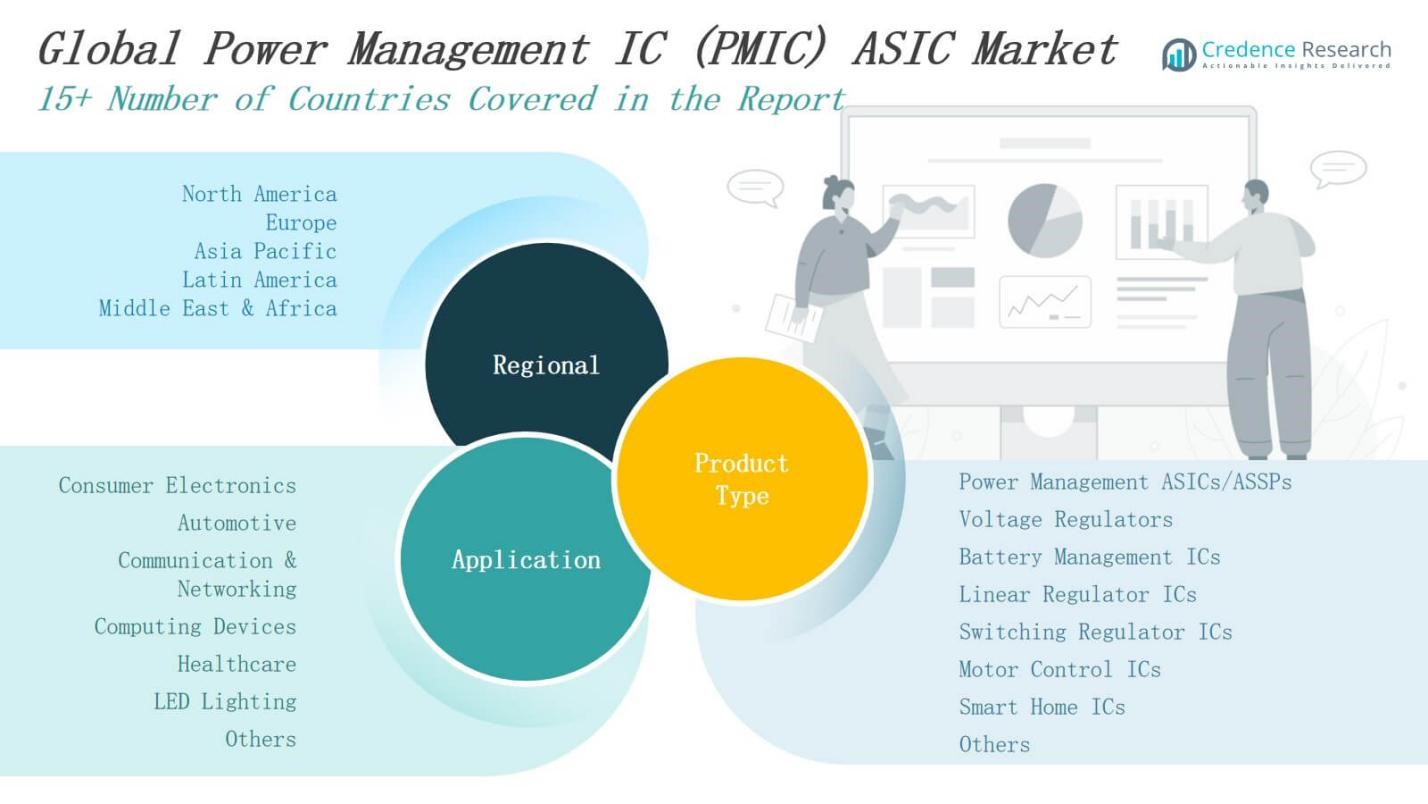
The Power Management IC (PMIC) ASIC Market includes Power Management ASICs/ASSPs, Voltage Regulators, Battery Management ICs, Linear Regulator ICs, Switching Regulator ICs, Motor Control ICs, Smart Home ICs, and Others. Battery Management ICs lead due to their role in EVs and portable devices. Switching and Linear Regulators are essential in consumer and industrial electronics. It supports high efficiency, integration, and compact system design across applications.
- For instance, Texas Instruments’ BQ series Battery Management ICs are widely used in electric vehicles to monitor cell voltage, temperature, and state of charge, ensuring safe and efficient battery operation.
By Application
The market covers Consumer Electronics, Automotive, Communication & Networking, Computing Devices, Healthcare, LED Lighting, and Others. Consumer Electronics dominates due to rising demand for efficient power use in smartphones and wearables. Automotive and Communication segments grow with EVs and 5G expansion. It enables optimized power delivery and thermal control across sectors needing compact, reliable solutions.
- For instance, Audi, in partnership with Alta Devices, is developing thin, flexible solar cells for integration into panoramic glass roofs, with the goal of powering ancillary systems like air conditioning and extending EV range.
Segments:
Based on Product Type
- Power Management ASICs/ASSPs
- Voltage Regulators
- Battery Management ICs
- Linear Regulator ICs
- Switching Regulator ICs
- Motor Control ICs
- Smart Home ICs
- Others
Based on Application
- Consumer Electronics
- Automotive
- Communication & Networking
- Computing Devices
- Healthcare
- LED Lighting
- Others
Based on Region
North America
- U.S.
- Canada
- Mexico
Europe
- UK
- France
- Germany
- Italy
- Spain
- Russia
- Rest of Europe
Asia Pacific
- China
- Japan
- South Korea
- India
- Australia
- Southeast Asia
- Rest of Asia Pacific
Latin America
- Brazil
- Argentina
- Rest of Latin America
Middle East
- GCC Countries
- Israel
- Turkey
- Rest of Middle East
Africa
- South Africa
- Egypt
- Rest of Africa
Regional Analysis
North America
The North America Power Management IC (PMIC) ASIC Market size was valued at USD 3,820.02 million in 2018 to USD 5,314.65 million in 2024 and is anticipated to reach USD 8,341.75 million by 2032, at a CAGR of 5.4% during the forecast period. North America holds a 26% share of the global market, driven by strong demand from consumer electronics, data centers, and electric vehicles. The region benefits from the presence of key semiconductor manufacturers and advanced R&D infrastructure. It supports widespread adoption of high-performance, application-specific PMICs in automotive, telecom, and industrial automation. The U.S. leads the region, backed by federal incentives for clean energy and growing investment in EV infrastructure. Canada and Mexico are expanding their semiconductor and automotive electronics ecosystems, contributing to regional growth.
Europe
The Europe Power Management IC (PMIC) ASIC Market size was valued at USD 2,625.76 million in 2018 to USD 3,519.93 million in 2024 and is anticipated to reach USD 5,033.05 million by 2032, at a CAGR of 4.2% during the forecast period. Europe accounts for approximately 17% of the global market, with growth centered around automotive applications, particularly in Germany, France, and the UK. It plays a critical role in powering safety systems, infotainment, and battery management in EVs. Stringent environmental regulations and increasing demand for energy-efficient electronics support market expansion. The region also invests in industrial automation and smart grid technologies, requiring intelligent PMIC solutions. Local manufacturing and chip design hubs further strengthen the regional market position.
Asia Pacific
The Asia Pacific Power Management IC (PMIC) ASIC Market size was valued at USD 5,581.22 million in 2018 to USD 8,191.33 million in 2024 and is anticipated to reach USD 13,612.06 million by 2032, at a CAGR of 6.2% during the forecast period. Asia Pacific dominates the global market with a 40% share, led by China, Japan, South Korea, and Taiwan. It benefits from large-scale consumer electronics production and strong demand in smartphones, laptops, and electric vehicles. The region is a major hub for chip fabrication and foundry services, supporting cost-effective and scalable PMIC ASIC deployment. Rapid industrialization and smart city development fuel additional demand. Governments across the region prioritize domestic semiconductor capabilities, reinforcing supply chain resilience and technological innovation.
Latin America
The Latin America Power Management IC (PMIC) ASIC Market size was valued at USD 637.78 million in 2018 to USD 890.51 million in 2024 and is anticipated to reach USD 1,234.89 million by 2032, at a CAGR of 3.8% during the forecast period. Latin America represents around 4% of the global market, with Brazil and Mexico as key contributors. It shows growing demand for PMIC ASICs in consumer electronics, automotive, and industrial automation sectors. Rising digitalization and increased focus on renewable energy applications support regional adoption. It benefits from cross-border partnerships and expanding local electronics manufacturing. Supply chain integration and infrastructure investment are helping drive market growth.
Middle East
The Middle East Power Management IC (PMIC) ASIC Market size was valued at USD 347.63 million in 2018 to USD 446.30 million in 2024 and is anticipated to reach USD 580.43 million by 2032, at a CAGR of 2.9% during the forecast period. The region holds a modest share of the global market, driven by industrial projects and smart infrastructure initiatives. It sees increased application of PMIC ASICs in telecom, healthcare, and consumer electronics. Gulf Cooperation Council (GCC) countries invest in smart city programs and renewable energy, creating opportunities for intelligent power control systems. It also benefits from growing adoption of electric vehicles in selected markets. Demand for efficient power delivery solutions continues to rise in utility and infrastructure sectors.
Africa
The Africa Power Management IC (PMIC) ASIC Market size was valued at USD 240.77 million in 2018 to USD 370.70 million in 2024 and is anticipated to reach USD 477.49 million by 2032, at a CAGR of 2.8% during the forecast period. Africa holds a small share of the global market but shows steady progress in energy access, off-grid solar, and telecom infrastructure. It relies on PMIC ASICs for compact, low-power solutions in mobile devices, energy storage systems, and medical equipment. Countries like South Africa and Egypt are seeing increased electronics manufacturing and digital transformation. It supports energy-efficient solutions that help reduce system cost and improve reliability. Investment in local technology ecosystems could accelerate future adoption.
Key Player Analysis
- Onsemi
- Dialog Semiconductor
- Vishay
- ROHM
- Analog Devices
- Qualcomm
- Renesas Electronics
- Maxim Integrated
- NXP Semiconductors
- Infineon Technologies
- STMicroelectronics
- Texas Instruments
Competitive Analysis
The Power Management IC (PMIC) ASIC Market is highly competitive, with leading players focusing on innovation, integration, and power efficiency to gain market share. Companies such as Texas Instruments, STMicroelectronics, and Renesas Electronics invest heavily in R&D to develop application-specific solutions for EVs, IoT devices, and data centers. It reflects strong demand for high-performance, low-power chips across multiple end-use sectors. Players are expanding foundry partnerships and optimizing chip architectures to improve voltage regulation and thermal performance. Firms like Qualcomm and Onsemi target emerging segments such as 5G infrastructure and wearables with advanced mixed-signal capabilities. Mergers, strategic acquisitions, and technology collaborations remain common strategies to enhance product portfolios and global reach. Regional players are also gaining traction by offering cost-effective, tailored PMIC ASICs to meet localized requirements. The market landscape continues to evolve with the adoption of 3nm and 5nm nodes, giving a competitive edge to manufacturers that can scale efficiently and innovate consistently.
Recent Developments
- In February 2025, Infineon Technologies introduced the OPTIREG™ TLF35585, a multi-rail PMIC developed for safety-critical automotive applications.
- In May 2025, Microchip Technology unveiled the MCP16701 PMIC, engineered to support high-performance MPUs and FPGAs used in AI-enabled embedded systems.
- In March 2023, Texas Instruments launched a new family of electromagnetic interference (EMI) filter integrated circuits, including the TPSF12C1, TPSF12C3, TPSF12C1-Q1, and TPSF12C3-Q1, which are the industry's first stand-alone active EMI filter ICs
- In April 2025, Asahi Kasei Microdevices (AKM) launched the AP4413 series, an ultra-low-current energy-harvesting PMIC tailored for IoT sensors and Bluetooth trackers.
Market Concentration & Characteristics
The Power Management IC (PMIC) ASIC Market exhibits moderate to high market concentration, with a few dominant players controlling a significant share of global revenues. Companies such as Texas Instruments, Analog Devices, and STMicroelectronics lead the market through advanced process technologies, deep IP portfolios, and long-standing customer relationships. It features high entry barriers due to capital-intensive R&D, specialized design expertise, and complex integration requirements across varied applications. The market is characterized by rapid innovation cycles, increasing customization, and tight coupling with end-use system requirements, particularly in EVs, smartphones, and IoT devices. Demand for miniaturized, energy-efficient, and application-specific solutions pushes suppliers to invest in low-power design, mixed-signal integration, and advanced semiconductor nodes. Strategic partnerships with foundries and OEMs support differentiation and scalability. It remains technology-driven, with players focusing on process efficiency, reliability, and performance to gain competitive advantage in sectors demanding compact, high-functionality power management solutions.
Report Coverage
The research report offers an in-depth analysis based on Product Type, Application, End-User and Geography. It details leading market players, providing an overview of their business, product offerings, investments, revenue streams, and key applications. Additionally, the report includes insights into the competitive environment, SWOT analysis, current market trends, as well as the primary drivers and constraints. Furthermore, it discusses various factors that have driven market expansion in recent years. The report also explores market dynamics, regulatory scenarios, and technological advancements that are shaping the industry. It assesses the impact of external factors and global economic changes on market growth. Lastly, it provides strategic recommendations for new entrants and established companies to navigate the complexities of the market.
Future Outlook
- Demand for custom PMIC ASICs will increase with the growth of electric vehicles and energy storage systems.
- Consumer electronics will continue to drive miniaturized, high-efficiency power solutions.
- Integration of AI features into PMICs will enable smarter power optimization across devices.
- Use of 3nm and 5nm process nodes will expand to support performance and power efficiency.
- IoT and edge computing growth will create demand for ultra-low power, application-specific PMICs.
- Data centers will adopt advanced PMICs to improve energy efficiency in high-performance computing.
- Automotive OEMs will seek highly reliable and thermally stable PMIC ASICs for next-gen vehicles.
- Supply chain localization and foundry diversification will become a strategic priority for manufacturers.
- Regulatory focus on energy efficiency will accelerate innovation in low-leakage power management designs.
- Strategic partnerships between chipmakers and system integrators will shape future product development.

Request a Free Sample
Fill in your details and we'll send you a free sample report.
- Sample data tables & charts
- Research methodology
Need a Custom Version of This Report?
Tailor the scope, geography, or segments to your exact requirements.
- Custom geography or segment scope
- Direct access to our analyst team
Frequently Asked Questions
What is the current size of the Power Management IC (PMIC) ASIC Market?
What factors are driving the growth of the Power Management IC (PMIC) ASIC Market?
What are the key segments within the Power Management IC (PMIC) ASIC Market?
What are some challenges faced by the Power Management IC (PMIC) ASIC Market?
Who are the major players in the Power Management IC (PMIC) ASIC Market?
Table of Content
Chapter 1. Report Introduction
- 1.1 Report Description & Purpose
- 1.1.1 Report Title & Market Definition
- 1.1.2 Unique Selling Propositions (USP) & Key Differentiators
- 1.1.3 Value Proposition for Stakeholders
- 1.2 Research Objectives
- 1.2.1 Market Sizing Objectives (Volume & Revenue) (Volume Where Applicable)
- 1.2.2 Segmentation Objectives
- 1.2.3 Competitive Intelligence Objectives
- 1.2.4 Forecast & Scenario Objectives
- 1.3 Report Scope
- 1.3.1 Power Management IC (PMIC) ASIC Scope – Segments & Subsegments Covered
- 1.3.2 Geographic Scope – Regions & Countries Covered
- 1.3.3 Historical Period, Base Year & Forecast Period (2024; forecast to 2032)
- 1.3.4 Inclusions & Exclusions
- 1.4 Industry Classification & Applicable Codes
- 1.5 Currency, Measurement Units & Valuation Basis
- 1.6 Target Stakeholders
- 1.7 Limitations & Assumptions
Chapter 2. Executive Summary
- 2.1 Global Power Management IC (PMIC) ASIC Market Snapshot
- 2.1.1 Market Size – Historical (2024) & Forecast (2024-2032) (2024: USD 18,733.41 million → 2032: USD 29,279.67 million)
- 2.1.2 Volume & Revenue – Global Totals (Volume Where Applicable)
- 2.1.3 Key Market Highlights – Top Five Facts
- 2.2 Power Management IC (PMIC) ASIC Market Segmentation Snapshot
- 2.2.1 Market Split by Region – 2024 vs. 2032
- 2.3 Competitive Snapshot
- 2.3.1 Top 10 Players by Revenue Share – 2024
- 2.3.2 Top 10 Players by Volume Share – 2024 (Volume Where Applicable)
- 2.3.3 Recent Strategic Developments (18-Month Summary)
- 2.4 Key Investment Highlights & Strategic Conclusions
Chapter 3. Power Management IC (PMIC) ASIC Market Dynamics & Industry Analysis
- 3.1 Market Overview & Context
- 3.1.1 Power Management IC (PMIC) ASIC Market Position in the Broader Industry Value Chain
- 3.1.2 Demand Structure & Purchasing Dynamics
- 3.1.3 Market Maturity & Development Stage by Region
- 3.2 Power Management IC (PMIC) ASIC Market Drivers
- 3.3 Power Management IC (PMIC) ASIC Market Restraints & Challenges
- 3.4 Power Management IC (PMIC) ASIC Market Opportunities
- 3.5 Porter's Five Forces Analysis
- 3.5.1 Threat of New Entrants
- 3.5.2 Bargaining Power of Suppliers
- 3.5.3 Bargaining Power of Buyers
- 3.5.4 Threat of Substitutes
- 3.5.5 Competitive Rivalry – Intensity Assessment
- 3.6 Power Management IC (PMIC) ASIC Value Chain Analysis
- 3.6.1 Upstream – Key Inputs, Resources & Suppliers
- 3.6.1.1 Key Input/Resource 1
- 3.6.1.2 Key Input/Resource 2
- 3.6.1.3 Key Input/Resource 3
- 3.6.2 Midstream – Core Operations & Value Creation
- 3.6.2.1 Operating Model & Process Overview
- 3.6.2.2 Key Operating Locations & Capabilities by Company
- 3.6.3 Downstream – Market Channels & End Users
- 3.6.3.1 Direct Sales & Customer Engagement Channels
- 3.6.3.2 Indirect Sales, Intermediaries & Partner Channels
- 3.6.4 Value Chain Profitability Analysis
- 3.6.1 Upstream – Key Inputs, Resources & Suppliers
- 3.7 PESTEL Analysis
- 3.7.1 Political Factors
- 3.7.2 Economic Factors
- 3.7.3 Social Factors
- 3.7.4 Technological Factors
- 3.7.5 Environmental Factors
- 3.7.6 Legal Factors
- 3.8 Power Management IC (PMIC) ASIC Supply Chain Analysis
- 3.8.1 Critical Input & Resource Availability Risk Assessment
- 3.8.2 Supplier & Operational Concentration Risk (Geographic Exposure)
- 3.8.3 Supply & Service Disruption Impact Analysis
- 3.9 Regulatory & Policy Landscape
Note: The regulatory and policy landscape section covers regulations based on their applicability to the market, Power Management IC (PMIC) ASIC category, geography, and scope of the study. Only regulatory frameworks with a material impact on operations, compliance, trade, sustainability, or market access are analyzed in detail.
Chapter 4. Key Investment Pockets & Opportunity Analysis
- 4.1 Power Management IC (PMIC) ASIC Market Attractiveness Analysis
- 4.1.1 By Region – Investment Attractiveness Matrix (Market Size × CAGR)
- 4.2 Absolute Revenue Growth Opportunity
- 4.2.1 By Region – Absolute Revenue Growth Through 2032
- 4.3 Incremental Demand Opportunity
- 4.3.1 By Region – Incremental Demand Through 2032
- 4.3.2 Segment – Incremental Demand
- 4.4 Emerging Submarket Opportunity Deep Dive (Subject to Applicability)
- 4.5 Priority Market Opportunity Scorecards
- 4.5.1 United States
- 4.5.2 Europe
- 4.5.3 Asia
- 4.5.4 Middle East & Africa
Note: Priority market opportunity scorecards reflect the geographic scope and strategic relevance of the study. Listed markets are indicative and may be adapted to the industry.
Chapter 5. Power Management IC (PMIC) ASIC Cross-Border Trade & Market Access Analysis
- 5.1 International Trade & Cross-Border Activity Overview
- 5.1.1 Global Export Value by Country (2024)
- 5.1.2 Global Export Volume by Country (2024) (Volume Where Applicable)
- 5.1.3 Global Import Value by Country (2024)
- 5.1.4 Global Import Volume by Country (2024) (Volume Where Applicable)
- 5.1.5 Net Trade Balance by Country (2024)
- 5.2 Export Analysis – Segment
- 5.2.1 Category 1 (Applicable Classification Code)
- 5.2.2 Category 2 (Applicable Classification Code)
- 5.2.3 Category 3 (Applicable Classification Code)
- 5.2.4 Category 4 (Applicable Classification Code)
- 5.2.5 Category 5 (Applicable Classification Code)
- 5.3 Import Analysis – Segment
- 5.3.1 Category 1 (Applicable Classification Code)
- 5.3.2 Category 2 (Applicable Classification Code)
- 5.3.3 Category 3 (Applicable Classification Code)
- 5.3.4 Category 4 (Applicable Classification Code)
- 5.3.5 Category 5 (Applicable Classification Code)
- 5.4 Cross-Border Pricing & Transaction Benchmarks
- 5.4.1 Export Pricing – Segment & Country
- 5.4.2 Import Pricing – Segment & Source Country
- 5.4.3 Price Trends (2024)
- 5.5 Key Cross-Border Trade & Delivery Routes
- 5.5.1 Cross-Border Trade/Delivery Route 1
- 5.5.2 Cross-Border Trade/Delivery Route 2
- 5.5.3 Cross-Border Trade/Delivery Route 3
- 5.5.4 Cross-Border Trade/Delivery Route 4
- 5.5.5 Cross-Border Trade/Delivery Route 5
- 5.6 Trade Policy & Market Access Impact Assessment
- 5.6.1 Tariff & Non-Tariff Barriers
- 5.6.2 Regional Trade & Economic Integration Frameworks
- 5.6.3 Bilateral & Multilateral Trade Agreements
- 5.6.4 Cross-Border Operating, Licensing & Localization Requirements
Note: This chapter applies where cross-border trade or delivery is relevant to Power Management IC (PMIC) ASIC. Goods, services, and digital offerings are assessed using applicable classifications and transaction measures. Import-export volumes, trade balances, and route analyses are included only where meaningful to the market.
Chapter 6. Competitive Landscape & Company Benchmarking
- 6.1 Power Management IC (PMIC) ASIC Market Concentration & Structure
- 6.1.1 Herfindahl-Hirschman Index (HHI) – vs. 2024
- 6.1.2 Leading, Mid-Sized & Emerging Player Structure
- 6.1.3 Global, Regional & Local Player Dynamics
- 6.2 Power Management IC (PMIC) ASIC Market Share Analysis – 2024
- 6.2.1 Global Revenue Share by Company
- 6.2.2 Global Volume Share by Company (Volume Where Applicable)
- 6.2.3 Regional Revenue Share
- 6.2.4 Market Share Evolution ( vs. 2024)
- 6.2.5 Company Market Share by Key Segment
- 6.2.6 Company Market Share by Customer Group
- 6.3 Operating Scale, Capacity & Infrastructure Analysis
- 6.3.1 Global Operating Scale & Supply Capacity
- 6.3.2 Resource Utilization & Operating Efficiency
- 6.3.3 Output, Service Delivery & Activity Metrics
- 6.3.4 Operating Footprint & Infrastructure Map
- 6.3.5 Planned Operational & Capacity Expansion
- 6.4 Power Management IC (PMIC) ASIC Competitive Benchmarking Matrix
- 6.4.1 Revenue, Growth, Profitability & Operating Metric Comparison
- 6.4.2 Channel Revenue Mix
- 6.4.3 Geographic Revenue Exposure
- 6.4.4 R&D Intensity
- 6.4.5 Sustainability Maturity
- 6.5 Strategic Developments in Power Management IC (PMIC) ASIC (Last 24 Months)
- 6.5.1 Mergers, Acquisitions & Divestments
- 6.5.2 New Products, Services & Solutions in Power Management IC (PMIC) ASIC
- 6.5.3 Operational & Infrastructure Expansions
- 6.5.4 Strategic Alliances, Joint Ventures & Partnerships
- 6.5.5 Distribution Expansion & Market Entry
- 6.5.6 Sustainability & ESG Initiatives
- 6.6 Competitive Strategy Mapping
- 6.6.1 Leader, Challenger, Follower & Niche Classification
- 6.6.2 Pricing Strategy Comparison
- 6.6.3 Channel Strategy Matrix
Note: Strategic developments are included based on their materiality and the availability of reliable information.
Chapter 7. Global Power Management IC (PMIC) ASIC Market – By Sales & Delivery Channel
- 7.1 Segment Overview
- 7.1.1 Volume & Revenue Split by Channel (2024 & 2032) (Volume Where Applicable)
- 7.1.2 Channel Mix Evolution (2024-2032)
Chapter 8. Regional Market Analysis – Global Overview
- 8.1 Global Regional Overview
- 8.1.1 Regional Volume Share (Volume Where Applicable)
- 8.1.2 Regional Revenue Share
- 8.1.3 Regional Volume by Region (Volume Where Applicable)
- 8.1.4 Regional Revenue by Region
- 8.1.5 Regional Forecast Through 2032
- 8.2 Cross-Regional Segment Analysis
- 8.2.1 By Sales & Delivery Channel
- 8.2.2 By Competitive Positioning & Price Tier
Chapter 9. North America Power Management IC (PMIC) ASIC Market
- 9.1 United States
- 9.2 Canada
- 9.3 Mexico
Chapter 10. Europe Power Management IC (PMIC) ASIC Market
- 10.1 Germany
- 10.2 France
- 10.3 Italy
- 10.4 United Kingdom
- 10.5 Spain
- 10.6 Poland
- 10.7 Russia
- 10.8 Netherlands
- 10.9 Belgium
- 10.10 Sweden
- 10.11 Denmark
- 10.12 Norway
- 10.13 Rest of Europe
Chapter 11. Asia Pacific Power Management IC (PMIC) ASIC Market
- 11.1 China
- 11.2 India
- 11.3 Japan
- 11.4 South Korea
- 11.5 Thailand
- 11.6 Indonesia
- 11.7 Vietnam
- 11.8 Malaysia
- 11.9 Australia
- 11.10 Rest of Asia Pacific
Chapter 12. Latin America Power Management IC (PMIC) ASIC Market
- 12.1 Brazil
- 12.2 Argentina
- 12.3 Colombia
- 12.4 Chile
- 12.5 Rest of Latin America
Chapter 13. Middle East Power Management IC (PMIC) ASIC Market
- 13.1 Saudi Arabia
- 13.2 United Arab Emirates
- 13.3 Turkey
- 13.4 Israel
- 13.5 Iran
- 13.6 Rest of the Middle East
Chapter 14. Africa Power Management IC (PMIC) ASIC Market
- 14.1 South Africa
- 14.2 Egypt
- 14.3 Nigeria
- 14.4 Morocco
- 14.5 Rest of Africa
Chapter 15. Power Management IC (PMIC) ASIC Company Profiles
- 15.1 [Company 01]
- 15.1.1 Company Overview
- 15.1.2 Key Management Personnel
- 15.1.3 Products & Services Portfolio
- 15.1.4 Financial Performance
- 15.1.5 Key Market Focus & Geographic Presence
- 15.1.6 Recent Developments & Strategic Initiatives
Note: The company profile list is preliminary and may change based on research findings, market developments, data availability, and client requirements.
Chapter 16. Appendices
- Appendix A – List of Abbreviations & Acronyms
- Appendix B – Industry Classification Code Reference – Full Series
- Appendix C – Supply, Output & Operating Capacity Data Tables
- Appendix D – End-Use & Demand Base Tables
- Appendix E – Demand, Adoption & Usage Assumptions
- Appendix F – Pricing & Revenue Metric Reference Tables
- Appendix G – Company Operations & Infrastructure Database
- Appendix H – Cross-Border Trade & Activity Data Tables (Where Applicable)
- Appendix I – Regulatory Summary Tables
- Appendix J – Primary Research Participant List (Anonymized)
- Appendix K – Primary Research Questionnaire Framework
- Appendix L – Data Sources & Bibliography
- Appendix M – Market Size Divergence & Source Comparison
Chapter 17. Research Methodology
- 17.1 Research Framework & Philosophy
- 17.2 Secondary Research – Sources, Hierarchy & Data Extraction
- 17.3 Data Modeling – Bottom-Up & Top-Down Market Sizing
- 17.4 Primary Research – Stakeholder Framework, LOI & Sample Sizes
- 17.5 Forecast Methodology – Regression, Scenario & Sensitivity Analysis
- 17.6 Quality Control – Four-Layer Validation Framework
- 17.7 Limitations & Standard Assumptions
- 17.8 Disclaimer