
| REPORT ATTRIBUTE | DETAILS |
|---|---|
| Historical Period | 2020-2023 |
| Base Year | 2024 |
| Forecast Period | 2025-2032 |
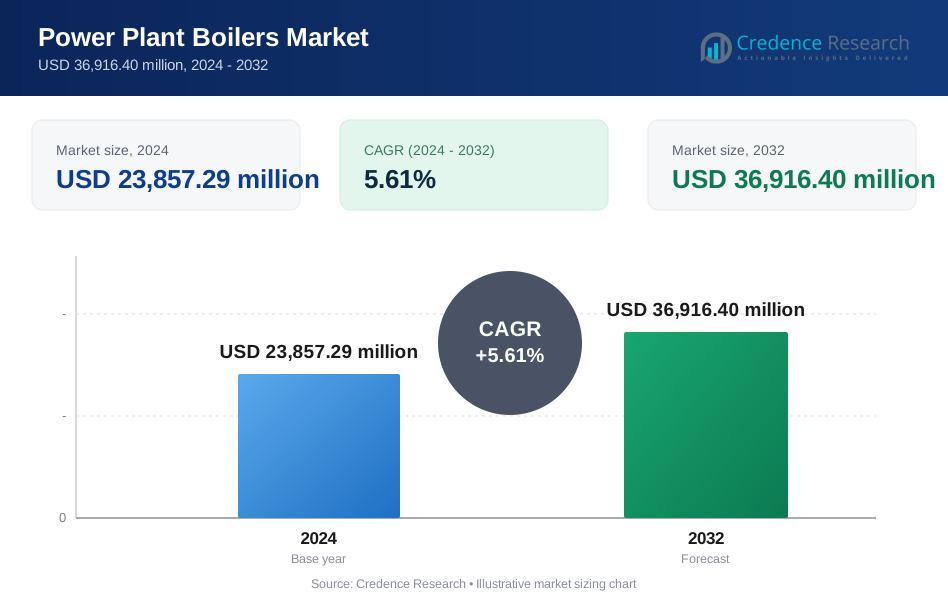
| Power Plant Boilers Market Size 2024 | USD 23,857.29 million |
| Power Plant Boilers Market, CAGR | 5.61% |
| Power Plant Boilers Market Size 2032 | USD 36,916.40 million |
Market Overview
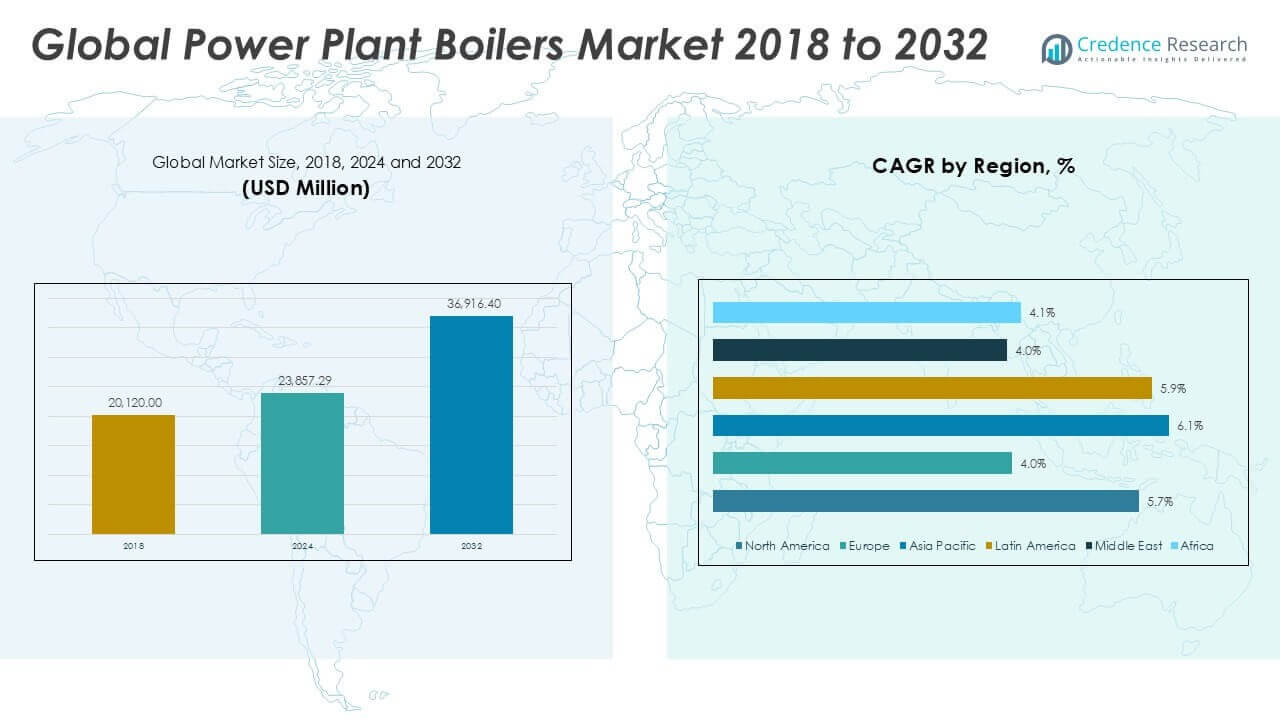
The Global Power Plant Boilers Market is projected to grow from USD 23,857.29 million in 2024 to an estimated USD 36,916.40 million by 2032, with a compound annual growth rate (CAGR) of 5.61% from 2025 to 2032.
Key drivers fueling the Power Plant Boilers Market include the growing global energy demand, especially from developing regions undergoing rapid industrialization. Environmental regulations encouraging the adoption of cleaner and more efficient boiler technologies promote innovation and upgrades in existing power plants. Trends such as integrating renewable energy sources with traditional boilers and advancements in automation and control systems enhance operational efficiency and reduce emissions. The shift toward low-carbon power generation further propels the adoption of advanced boiler technologies, emphasizing sustainability.
Geographically, the Asia-Pacific region dominates the Power Plant Boilers Market, accounting for a significant share due to rapid industrial growth and increasing energy consumption in countries like China and India. North America and Europe follow, driven by modernization efforts and stringent environmental standards that promote the deployment of advanced boiler solutions. Key players shaping the market landscape include Babcock & Wilcox Enterprises, Mitsubishi Heavy Industries, General Electric, Doosan Lentjes, and Thermax Limited, focusing on innovation, strategic partnerships, and expanding their global footprint to capture rising demand.
Market Insights
- The Global Power Plant Boilers Market is projected to grow from USD 23,857.29 million in 2024 to USD 36,916.40 million by 2032, registering a CAGR of 5.61% between 2025 and 2032.
- Rising global energy demand, fueled by rapid industrialization in developing economies, serves as a primary driver for market growth.
- Environmental regulations enforcing lower emissions push power plants to adopt cleaner, more efficient boiler technologies, accelerating innovation.
- High capital expenditure and maintenance costs pose challenges, limiting adoption, especially in emerging markets with budget constraints.
- Asia-Pacific dominates the market due to expanding industrial activities and increasing power generation capacity in countries like China and India.
- North America and Europe follow, driven by modernization initiatives and stringent environmental standards promoting advanced boiler solutions.
- Emerging markets in Latin America, the Middle East, and Africa offer growth potential amid infrastructure development and rising energy access initiatives.
Market Drivers
Rising Global Energy Demand and Industrialization Accelerating Market Growth
The Global Power Plant Boilers Market experiences strong growth driven by the increasing global demand for energy, particularly in developing and industrializing economies. Rapid urbanization and expanding industrial activities in countries such as China, India, and Southeast Asian nations require greater power generation capacity. It plays a critical role in meeting the rising electricity needs by enabling efficient thermal energy conversion. The expanding infrastructure for electricity generation and distribution creates continuous opportunities for boiler manufacturers. Governments’ focus on improving energy access and reliability further supports market expansion. Investment in new power plants and capacity upgrades fuels demand for advanced boiler technologies that deliver higher efficiency and lower emissions. Industrial sectors like manufacturing, chemical, and steel industries contribute significantly to the demand for reliable boiler systems.
- For instance, in 2024, over 2,300 commercial power plant boilers were installed globally, with 1,200 units deployed in Asia-Pacific to support growing industrial and urban energy demands
Stringent Environmental Regulations Driving Adoption of Cleaner Technologies
Environmental concerns and strict government regulations act as major drivers in the Global Power Plant Boilers Market. Regulatory bodies impose limits on emissions of pollutants such as sulfur dioxide (SO2), nitrogen oxides (NOx), and particulate matter, pushing power plants to adopt cleaner and more efficient boiler systems. It encourages manufacturers to develop advanced technologies like ultra-supercritical boilers and low-NOx burners to reduce environmental impact. Compliance with international agreements and national policies to lower carbon footprints creates pressure on power producers to upgrade existing plants or build new plants with sustainable technologies. The demand for boilers compatible with biomass and other renewable fuels increases in line with carbon reduction goals. These regulations foster innovation in emissions control and energy efficiency.
- For instance, in 2024, over 900 power plants worldwide adopted ultra-supercritical boiler technology to comply with stricter emission regulations, reducing sulfur dioxide and nitrogen oxide emissions significantly
Technological Advancements Enhancing Operational Efficiency and Reliability
Technological improvements in boiler design and automation significantly influence the Global Power Plant Boilers Market. Innovations such as digital monitoring, predictive maintenance, and control systems optimize boiler performance and reduce downtime. It enables precise management of combustion processes, improving fuel efficiency and lowering operating costs. Integration of advanced materials enhances boiler durability under high temperature and pressure conditions. Enhanced safety features and remote diagnostics further attract power plant operators to modern boiler solutions. Continuous R\&D investments by leading companies focus on developing compact, modular, and scalable boiler units suited for various applications. These advancements help power plants comply with environmental standards while maximizing output.
Shift Towards Sustainable and Renewable Energy Sources Supporting Market Transformation
The increasing emphasis on sustainability impacts the Global Power Plant Boilers Market by driving demand for boilers that operate on alternative and renewable fuels. Transitioning from traditional coal-fired boilers to biomass, waste-to-energy, and co-firing systems reduces greenhouse gas emissions. It encourages power plants to retrofit or replace aging infrastructure with cleaner technologies. Policies promoting renewable energy adoption support investment in hybrid boiler systems combining conventional and renewable fuels. This shift aligns with global efforts to achieve net-zero emissions and energy diversification. Market participants respond by expanding their product portfolios to include eco-friendly boilers with flexible fuel compatibility. The growing trend towards green energy integration strengthens the market’s future growth prospects.
Market Trends
Adoption of Advanced Ultra-Supercritical and Supercritical Boiler Technologies for Enhanced Efficiency
The Global Power Plant Boilers Market shows a clear trend toward adopting ultra-supercritical (USC) and supercritical (SC) boiler technologies to improve thermal efficiency and reduce fuel consumption. These high-pressure, high-temperature boilers operate at conditions that maximize energy extraction from fuel, significantly lowering greenhouse gas emissions per unit of electricity generated. It supports power producers in meeting stringent environmental regulations and sustainability targets. Power plants are increasingly replacing older subcritical boilers with these advanced systems to enhance operational performance. Manufacturers invest heavily in research to optimize materials and design for durability under extreme conditions. The trend helps utilities reduce operational costs while maintaining reliability. Growing awareness about energy efficiency among stakeholders further accelerates this transition.
- For instance, the Advanced Ultra Supercritical (AUSC) Technology Demonstration Plant planned under India's Ministry of Power and NTPC will feature an 800 MW AUSC boiler, expected to improve plant efficiency to 46%, significantly reducing coal consumption and CO2 emissions.
Integration of Digital Technologies and Automation Enhancing Boiler Operations
Digitalization and automation emerge as key trends in the Global Power Plant Boilers Market, revolutionizing operational management and maintenance. It incorporates real-time monitoring, predictive analytics, and remote diagnostics to improve boiler reliability and safety. Automation of combustion control and load management enhances fuel efficiency and reduces emissions. Data-driven decision-making enables power plants to anticipate equipment failures, minimizing downtime and maintenance expenses. Leading manufacturers develop smart boiler systems equipped with IoT sensors and AI-based software to optimize performance continuously. The growing demand for Industry 4.0 solutions drives the integration of digital tools in boiler operations. This trend supports power plants in achieving higher efficiency and regulatory compliance.
- For instance, the Boiler Automation Systems Market had 210+ industry report pages and covered hardware and software solutions for predictive maintenance and real-time monitoring, supporting industries like oil and gas, power generation, and manufacturing.
Growing Preference for Biomass and Waste-to-Energy Boilers Supporting Renewable Energy Goals
The Global Power Plant Boilers Market witnesses increased adoption of biomass and waste-to-energy boilers, aligning with global renewable energy initiatives. It reflects the shift toward sustainable fuel sources that reduce carbon footprints and promote circular economy principles. Power plants retrofit existing boilers or install new units capable of handling various biomass feedstocks and municipal solid waste. This trend supports governments’ renewable portfolio standards and climate commitments. Manufacturers respond by offering versatile boilers with fuel flexibility and advanced emissions control technologies. Biomass and waste boilers provide an alternative to coal-fired systems, helping utilities diversify their energy mix. Growing investments in bioenergy infrastructure strengthen market momentum in this segment.
Rising Demand for Modular and Compact Boiler Designs to Meet Diverse Energy Needs
The Global Power Plant Boilers Market trends toward modular and compact boiler designs to cater to smaller-scale and distributed power generation projects. It enables faster installation, scalability, and easier maintenance, appealing to emerging economies and remote locations. These boilers suit decentralized energy systems, industrial applications, and combined heat and power (CHP) plants. Manufacturers focus on developing compact units with flexible fuel compatibility and enhanced automation features. The modular approach reduces capital expenditure and project lead times. Growing interest in microgrids and off-grid solutions further drives demand for such boiler systems. This trend reflects the market’s shift toward adaptable and customer-centric power generation solutions.
Market Challenges
High Capital Expenditure and Maintenance Costs Restrict Market Expansion
The Global Power Plant Boilers Market faces challenges due to the high capital investment required for advanced boiler technologies. Procuring and installing ultra-supercritical and supercritical boilers demands substantial upfront expenditure, which can limit adoption, especially in developing economies. It also incurs significant operational and maintenance costs, including skilled labor requirements and periodic overhauls. The complexity of modern boiler systems necessitates specialized training and parts, raising total ownership costs. Limited availability of financing options for large-scale projects further restrains market growth. Power producers often face budget constraints when upgrading aging infrastructure. These financial barriers slow the replacement of outdated equipment with more efficient systems.
- For instance, over 400 large-scale power plant projects worldwide faced delays in boiler system upgrades due to financial constraints between 2023 and 2025
Environmental Concerns and Competition from Renewable Energy Sources Impact Market Demand
The Global Power Plant Boilers Market contends with growing environmental concerns that challenge traditional fossil fuel-based boilers. Strict emission norms and increasing carbon pricing pressure power plants to reduce reliance on coal and other fossil fuels. It faces stiff competition from rapidly expanding renewable energy sources such as solar, wind, and hydropower, which attract substantial investment due to their low operational costs and minimal environmental impact. Transitioning to low-carbon energy systems requires significant shifts in infrastructure and policy support. The uncertainty around fossil fuel availability and future regulatory frameworks creates hesitation among stakeholders to invest heavily in conventional boiler technology. These factors collectively hinder market growth and require adaptation to cleaner and more flexible energy solutions.
Market Opportunities
Expansion in Emerging Economies Presents Significant Growth Opportunities
The Global Power Plant Boilers Market benefits from expanding industrialization and urbanization in emerging economies such as India, Southeast Asia, and Africa. It offers opportunities to deploy new power generation capacities to meet growing electricity demand and improve grid reliability. Governments in these regions prioritize infrastructure development and energy access, supporting investments in modern boiler technologies. The rising need for replacement and retrofit of aging power plants creates further demand. Market players can leverage local partnerships and tailor solutions to regional fuel availability and regulatory requirements. Expanding presence in these fast-growing markets enables companies to capture untapped potential. The focus on affordable and reliable power supplies drives ongoing project approvals and capacity additions.
Adoption of Clean and Hybrid Boiler Technologies Enhances Market Potential
The Global Power Plant Boilers Market gains momentum from the shift toward environmentally sustainable and flexible boiler solutions. It opens avenues for manufacturers to develop and supply biomass, waste-to-energy, and hybrid fuel boilers that reduce carbon emissions. Growing emphasis on decarbonization and renewable integration encourages power producers to adopt low-emission technologies. The increasing demand for modular and compact boilers supports distributed generation and combined heat and power applications. Innovation in advanced materials and digital controls further strengthens product offerings. Companies investing in eco-friendly and technologically advanced boilers can differentiate themselves and expand market share. This trend aligns with global climate goals and evolving energy policies, creating a favorable environment for growth.
Market Segmentation Analysis
By Process
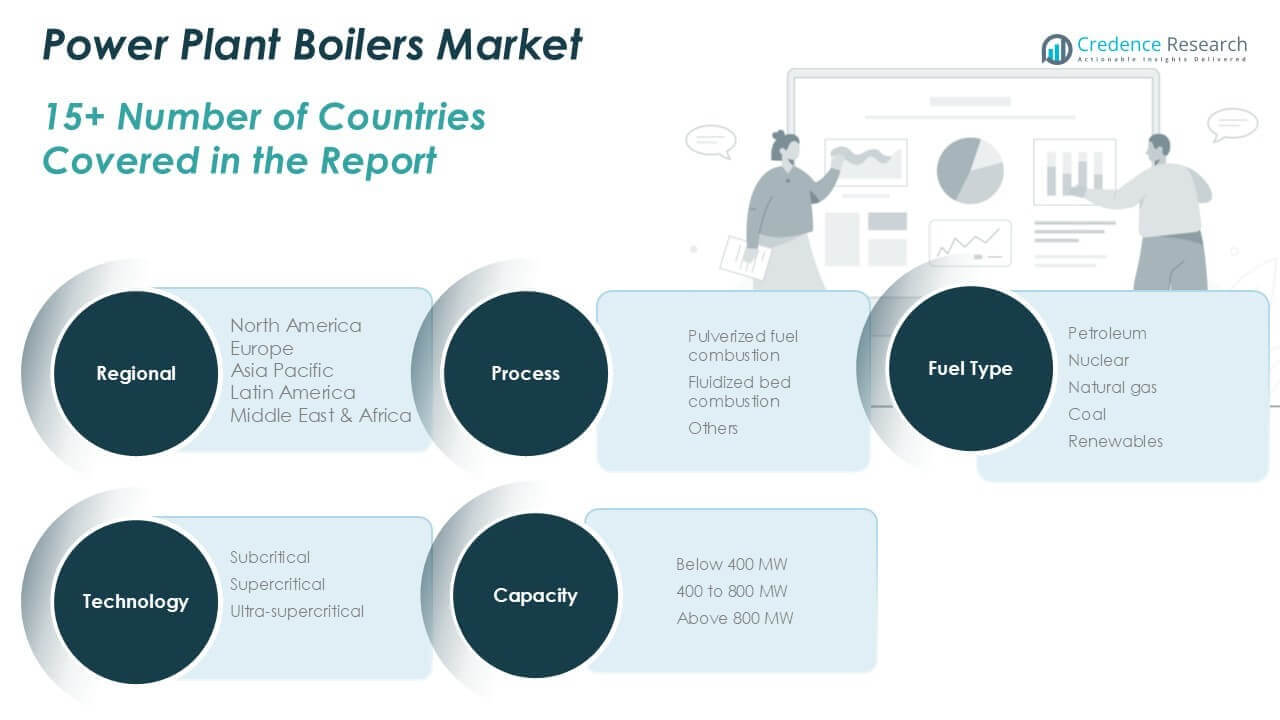
The Global Power Plant Boilers Market divides into key process segments, including pulverized fuel combustion, fluidized bed combustion, and others. Pulverized fuel combustion holds a significant share due to its widespread use in conventional thermal power plants, offering high efficiency and proven technology. Fluidized bed combustion gains traction for its ability to burn low-quality fuels and reduce emissions through better fuel-air mixing. Other processes include emerging and specialized combustion techniques tailored to specific fuel types and operational requirements. It caters to diverse power generation needs across regions and fuel sources.
By Fuel Type
The market segments by fuel type into petroleum, nuclear, natural gas, coal, and renewables. Coal-fired boilers dominate due to the abundant availability and established infrastructure, particularly in Asia-Pacific. Natural gas boilers show strong growth driven by cleaner combustion and lower emissions compared to coal. Renewable fuel boilers, including biomass and waste-to-energy, gain momentum with increasing environmental regulations and sustainability goals. Nuclear fuel segments cater to specific high-capacity plants requiring robust boiler systems. Petroleum-based boilers serve niche applications but face challenges due to fluctuating fuel prices and environmental concerns.
By Technology
The Global Power Plant Boilers Market categorizes technology into subcritical, supercritical, and ultra-supercritical boilers. Subcritical boilers maintain a notable share owing to their reliability and lower initial costs, especially in developing markets. Supercritical and ultra-supercritical technologies grow rapidly because they offer superior thermal efficiency and reduced emissions, aligning with global energy efficiency targets. Investments in advanced materials and designs support the deployment of these high-efficiency boilers in new and upgraded power plants.
By Capacity
The market segments capacity into below 400 MW, 400 to 800 MW, and above 800 MW. Boilers with capacities above 800 MW capture significant revenue due to their application in large-scale power plants requiring high output and efficiency. Mid-range capacities between 400 to 800 MW serve both utility and industrial needs, balancing flexibility and performance. Smaller capacity boilers under 400 MW cater to decentralized power generation, industrial processes, and regions with limited grid infrastructure. It addresses diverse capacity requirements across global power generation markets
Segments
Based on Process
- Pulverized fuel combustion
- Fluidized bed combustion
- Others
Based on Fuel Type
- Petroleum
- Nuclear
- Natural gas
- Coal
- Renewables
Based on Technology
- Subcritical
- Supercritical
- Ultra-supercritical
Based on Capacity
- Below 400 MW
- 400 to 800 MW
- Above 800 MW
Based on Region
- North America
- U.S.
- Canada
- Mexico
- Europe
- UK
- France
- Germany
- Italy
- Spain
- Russia
- Belgium
- Netherlands
- Austria
- Sweden
- Poland
- Denmark
- Switzerland
- Rest of Europe
- Asia Pacific
- China
- Japan
- South Korea
- India
- Australia
- Thailand
- Indonesia
- Vietnam
- Malaysia
- Philippines
- Taiwan
- Rest of Asia Pacific
- Latin America
- Brazil
- Argentina
- Peru
- Chile
- Colombia
- Rest of Latin America
- Middle East
- UAE
- KSA
- Israel
- Turkey
- Iran
- Rest of Middle East
- Africa
- Egypt
- Nigeria
- Algeria
- Morocco
- Rest of Africa
Regional Analysis
North America Power Plant Boilers Market
The North America segment holds a significant share in the Global Power Plant Boilers Market, valued at USD 5,614.28 million in 2024, expected to reach USD 8,728.14 million by 2032, growing at a CAGR of 5.7%. It commands roughly 23.5% of the global market share in 2024, driven by ongoing modernization of aging infrastructure and stringent emission regulations. The U.S. leads this growth due to heavy investments in clean coal technologies and natural gas-fired boilers. Canada contributes through expanding renewable integration and energy efficiency initiatives. The market benefits from advanced manufacturing capabilities and technological innovation in boiler systems. Power utilities prioritize upgrades that improve operational efficiency and reduce environmental impact.
Europe Power Plant Boilers Market
Europe accounts for a market size of USD 3,385.39 million in 2024, projected to reach USD 4,629.38 million by 2032, representing about 14.2% of the global market share. It grows at a CAGR of 4.0%, supported by regulatory mandates to lower emissions and transition toward sustainable energy. Germany, the U.K., and France lead demand for ultra-supercritical and biomass-compatible boilers. The focus on decarbonization encourages retrofitting existing plants and adopting hybrid boiler technologies. Investment in research and government incentives stimulate innovation and market stability. Europe’s mature power sector emphasizes efficiency improvements and compliance with the European Green Deal objectives.
Asia Pacific Power Plant Boilers Market
Asia Pacific dominates the Global Power Plant Boilers Market with a market value of USD 13,033.52 million in 2024, expected to rise to USD 20,937.28 million by 2032, holding approximately 54.6% of the global share. It records a CAGR of 6.1%, driven by China, India, Japan, and Southeast Asian nations. Rapid industrial growth and urbanization fuel demand for new power generation capacity. Governments prioritize energy security and infrastructure development, supporting large-scale projects. The market also sees significant investment in clean coal and renewable biomass boilers. Increasing environmental awareness promotes adoption of advanced, efficient boiler technologies.
Latin America Power Plant Boilers Market
Latin America’s market size stands at USD 775.96 million in 2024 and is projected to reach USD 1,221.86 million by 2032, accounting for about 3.3% of the global market share. It grows at a CAGR of 5.9%, led by Brazil, Mexico, and Argentina. Expansion of power infrastructure and modernization projects boost boiler demand. Focus on renewable fuel-based boilers and compliance with emission standards gains traction. Governments implement policies to improve energy access and reliability. Market participants explore partnerships and local manufacturing to address regional needs.
Middle East Power Plant Boilers Market
The Middle East market is valued at USD 676.80 million in 2024, expected to reach USD 918.06 million by 2032, representing approximately 2.8% of the global share. It grows at a CAGR of 4.0%, driven by countries like Saudi Arabia, UAE, and Qatar investing in diversified power generation sources. The region focuses on integrating natural gas and renewable biomass boilers to reduce oil dependence. Infrastructure development and energy efficiency projects support market expansion. Investments target advanced boiler technologies to meet environmental and performance requirements. Regional demand centers on high-capacity boilers suited for harsh climatic conditions.
Africa Power Plant Boilers Market
Africa’s market size reaches USD 371.34 million in 2024, rising to USD 481.68 million by 2032, holding around 1.6% of the global market share. It grows at a CAGR of 4.1%, driven primarily by South Africa, Nigeria, and Egypt. Expanding industrialization and rural electrification projects fuel demand for power plant boilers. The region prioritizes affordable and reliable power generation, supporting smaller capacity and biomass boilers. Infrastructure investments and international funding aid capacity additions. Market growth reflects gradual energy sector development and efforts to reduce power deficits.
Key players
- General Electric Company
- Babcock & Wilcox Enterprises, Inc.
- Mitsubishi Heavy Industries, Ltd.
- Siemens
- Doosan Corporation
- Dongfang Electric Corporation
- IHI Corporation
- John Wood Group PLC
- Bharat Heavy Electricals Limited
- Thermax Limited
- ANDRITZ
- Sumitomo Heavy Industries, Ltd.
Competitive Analysis
The Global Power Plant Boilers Market features intense competition among established multinational corporations and emerging regional players. Companies such as General Electric Company, Babcock & Wilcox, and Mitsubishi Heavy Industries lead by leveraging advanced technologies and comprehensive product portfolios. It thrives on innovation in efficiency, emissions control, and digital integration to maintain market leadership. Strategic mergers, acquisitions, and partnerships enable players to expand their global footprint and enhance service offerings. Focus on sustainable boiler solutions aligns with evolving regulatory demands, giving competitive advantage to firms investing in eco-friendly technologies. The market favors companies with strong R\&D capabilities and customer-centric approaches. New entrants face high entry barriers due to capital intensity and technology complexity, consolidating the position of existing players.
Recent Developments
- In May 2025, GE Vernova, the energy division of General Electric, reported \$10.6 billion in revenue for Q4 2024, driven by increased demand for power plants and gas turbines, particularly from AI data centers.
- In April 2025, Bharat Heavy Electricals Limited (BHEL) announced plans to commission 9 GW of thermal power generation capacity in India during the fiscal year 2024–25, the highest annual addition of thermal power capacity in the country's history.
- In May 2025, ANDRITZ secured an order to supply a new recovery boiler, evaporation plant, and power boiler to Green Bay Packaging in the USA, highlighting its strong position in the renewable energy sector.
- In May 2025, Thermax Limited showcased its energy and environment solutions at Boiler India 2024, demonstrating its commitment to innovation in the boiler industry.
- In May 2025, IHI Corporation reported progress in its fuel ammonia business, including the development and commercialization of boilers, gas turbines, and marine engines, aligning with global decarbonization efforts.
- In May 2025, Doosan Corporation announced plans to secure 10.7 trillion KRW in orders for 2025, with a focus on expanding its core business, including power plant boilers.
- In May 2025, Mitsubishi Heavy Industries (MHI) reported strong demand for gas turbines, with a record third-quarter earnings and an increased annual net profit forecast for fiscal 2024/25, driven by orders in the power plant sector.
- In May 2025, Dongfang Electric Corporation continued to expand its presence in the global power plant boiler market, securing significant contracts in Asia and Africa, contributing to the company's robust order book.
Market Concentration and Characteristics
The Global Power Plant Boilers Market exhibits a moderately concentrated competitive landscape, dominated by a few key multinational corporations such as General Electric, Babcock & Wilcox, and Mitsubishi Heavy Industries. It features high entry barriers due to substantial capital investment requirements, advanced technology development, and stringent regulatory compliance. Market participants focus on innovation, product customization, and service excellence to differentiate themselves. The demand for high-efficiency, low-emission boilers drives competition toward sustainable and technologically advanced solutions. Regional players maintain presence in local markets by catering to specific fuel types and capacity requirements. The market’s characteristics include long project life cycles, complex supply chains, and strong customer relationships, emphasizing the importance of after-sales support and maintenance services. This structure fosters steady growth and encourages continuous improvement in performance and environmental standards.
Report Coverage
The research report offers an in-depth analysis based on Process, Fuel Type, Technology, Capacity and Region. It details leading market players, providing an overview of their business, product offerings, investments, revenue streams, and key applications. Additionally, the report includes insights into the competitive environment, SWOT analysis, current market trends, as well as the primary drivers and constraints. Furthermore, it discusses various factors that have driven market expansion in recent years. The report also explores market dynamics, regulatory scenarios, and technological advancements that are shaping the industry. It assesses the impact of external factors and global economic changes on market growth. Lastly, it provides strategic recommendations for new entrants and established companies to navigate the complexities of the market.
Future Outlook
- The Global Power Plant Boilers Market will continue expanding due to rising global energy demand and the need for reliable power generation infrastructure.
- Increasing adoption of ultra-supercritical and supercritical boiler technologies will drive efficiency improvements and reduce emissions in power plants worldwide.
- Regulatory pressures focused on environmental sustainability will accelerate the transition to low-emission and biomass-compatible boiler solutions.
- Integration of digital technologies such as IoT, AI, and predictive maintenance will optimize boiler operations, reduce downtime, and lower operational costs.
- Emerging economies in Asia Pacific, Latin America, and Africa will offer significant growth opportunities driven by industrialization and electrification initiatives.
- Market players will prioritize innovation in modular and compact boiler designs to meet the needs of decentralized and distributed power generation.
- The shift toward renewable fuels and hybrid systems will expand, enabling power plants to diversify their fuel mix and comply with stricter emission standards.
- Strategic collaborations and mergers among key players will enhance technological capabilities and strengthen global market presence.
- Investments in research and development will focus on advanced materials and combustion techniques to improve boiler durability and efficiency.
- The Global Power Plant Boilers Market will see increased emphasis on lifecycle services and digital solutions, providing end-to-end support from installation to maintenance.
Request a Free Sample
Fill in your details and we'll send you a free sample report.
- Sample data tables & charts
- Research methodology
Need a Custom Version of This Report?
Tailor the scope, geography, or segments to your exact requirements.
- Custom geography or segment scope
- Direct access to our analyst team
Frequently Asked Questions
What was the market size of the Global Power Plant Boilers Market in 2023, and what is its forecast for 2032?
What are the main factors driving growth in the Global Power Plant Boilers Market?
Which boiler types are included in the Global Power Plant Boilers Market?
Which regions dominate the Global Power Plant Boilers Market?
Table of Content
Chapter 1. Report Introduction
- 1.1 Report Description & Purpose
- 1.1.1 Report Title & Market Definition
- 1.1.2 Unique Selling Propositions (USP) & Key Differentiators
- 1.1.3 Value Proposition for Stakeholders
- 1.2 Research Objectives
- 1.2.1 Market Sizing Objectives (Volume & Revenue)
- 1.2.2 Segmentation Objectives
- 1.2.3 Competitive Intelligence Objectives
- 1.2.4 Forecast & Scenario Objectives
- 1.3 Report Scope
- 1.3.1 Power Plant Boilers Scope – Types & Subtypes Covered
- 1.3.2 Geographic Scope – Regions & Countries Covered
- 1.3.3 Historical Period, Base Year & Forecast Period (2024; forecast to 2032)
- 1.3.4 Inclusions & Exclusions
- 1.4 HS Code & Classification Framework
- 1.5 Currency, Units & Pricing Basis
- 1.6 Target Stakeholders
- 1.7 Limitations & Assumptions
Chapter 2. Executive Summary
- 2.1 Global Power Plant Boilers Market Snapshot
- 2.1.1 Market Size – Historical (2024) & Forecast (2024-2032) (2024: USD 23,857.29 million → 2032: USD 36,916.40 million)
- 2.1.2 Volume & Revenue – Global Totals
- 2.1.3 Key Market Highlights – Top Five Facts
- 2.2 Power Plant Boilers Market Segmentation Snapshot
- 2.2.1 Market Split by Region – 2024 vs. 2032
- 2.3 Competitive Snapshot
- 2.3.1 Top 10 Players by Revenue Share – 2024
- 2.3.2 Top 10 Players by Volume Share – 2024
- 2.3.3 Recent Strategic Developments (18-Month Summary)
- 2.4 Key Investment Highlights & Strategic Conclusions
Chapter 3. Power Plant Boilers Market Dynamics & Industry Analysis
- 3.1 Market Overview & Context
- 3.1.1 Power Plant Boilers Market Position in the Broader Automotive Value Chain
- 3.1.2 OEM vs. Replacement Market Dynamics
- 3.1.3 Market Maturity & Development Stage by Region
- 3.2 Power Plant Boilers Market Drivers
- 3.3 Power Plant Boilers Market Restraints & Challenges
- 3.4 Power Plant Boilers Market Opportunities
- 3.5 Porter's Five Forces Analysis
- 3.5.1 Threat of New Entrants
- 3.5.2 Bargaining Power of Suppliers
- 3.5.3 Bargaining Power of Buyers
- 3.5.4 Threat of Substitutes
- 3.5.5 Competitive Rivalry – Intensity Assessment
- 3.6 Power Plant Boilers Value Chain Analysis
- 3.6.1 Upstream – Raw Material/Input Suppliers
- 3.6.1.1 Raw Material/Input 1
- 3.6.1.2 Raw Material/Input 2
- 3.6.1.3 Raw Material/Input 3
- 3.6.2 Midstream – Production/Manufacturing/Service Delivery
- 3.6.2.1 Production/Process Overview
- 3.6.2.2 Key Facility Locations & Capacity by Manufacturer
- 3.6.3 Downstream – Distribution & End Consumer
- 3.6.3.1 Primary Channel – B2B/OEM
- 3.6.3.2 Secondary Channels – Dealer, Retail, Online, Direct
- 3.6.4 Value Chain Profitability Analysis
- 3.6.1 Upstream – Raw Material/Input Suppliers
- 3.7 PESTEL Analysis
- 3.7.1 Political Factors
- 3.7.2 Economic Factors
- 3.7.3 Social Factors
- 3.7.4 Technological Factors
- 3.7.5 Environmental Factors
- 3.7.6 Legal Factors
- 3.8 Power Plant Boilers Supply Chain Analysis
- 3.8.1 Raw Material/Input Supply Risk Assessment
- 3.8.2 Manufacturing Concentration Risk (Geographic Exposure)
- 3.8.3 Trade Disruption Impact Analysis
- 3.9 Regulatory & Policy Landscape
Note: The regulatory and policy landscape section covers regulations based on their applicability to the market, Power Plant Boilers category, geography, and scope of the study. Only regulatory frameworks with a material impact on operations, compliance, trade, sustainability, or market access are analyzed in detail.
Chapter 4. Key Investment Pockets & Opportunity Analysis
- 4.1 Power Plant Boilers Market Attractiveness Analysis
- 4.1.1 By Region – Investment Attractiveness Matrix (Volume × CAGR)
- 4.2 Absolute Revenue Growth Opportunity
- 4.2.1 By Region – Absolute USD Growth Through 2032
- 4.3 Incremental Volume Opportunity
- 4.3.1 By Region – Incremental Volume Through 2032
- 4.3.2 Segment – Incremental Volume
- 4.4 Emerging Submarket Opportunity Deep Dive (Subject to Applicability)
- 4.5 Emerging Market Opportunity Scorecards
- 4.5.1 United States
- 4.5.2 Europe
- 4.5.3 Asia
- 4.5.4 Middle East & Africa
Note: Emerging Market Opportunity Scorecards will be included based on relevance and strategic importance. Regions listed are indicative and may vary depending on data availability and market dynamics.
Chapter 5. Power Plant Boilers Import-Export Analysis & Trade Flows
- 5.1 Global Trade Overview
- 5.1.1 Global Export Value by Country (2024)
- 5.1.2 Global Export Volume by Country (2024)
- 5.1.3 Global Import Value by Country (2024)
- 5.1.4 Global Import Volume by Country (2024)
- 5.1.5 Net Trade Balance by Country (2024)
- 5.2 Export Analysis – Segment
- 5.2.1 Type 1 (HS Code)
- 5.2.2 Type 2 (HS Code)
- 5.2.3 Type 3 (HS Code)
- 5.2.4 Type 4 (HS Code)
- 5.2.5 Type 5 (HS Code)
- 5.3 Import Analysis – Segment
- 5.3.1 Type 1 (HS Code)
- 5.3.2 Type 2 (HS Code)
- 5.3.3 Type 3 (HS Code)
- 5.3.4 Type 4 (HS Code)
- 5.3.5 Type 5 (HS Code)
- 5.4 Average Unit Trade Prices
- 5.4.1 Average Export Price – Segment & Country
- 5.4.2 Average Import Price – Segment & Source Country
- 5.4.3 Price Trends (2024)
- 5.5 Key Trade Route Analysis
- 5.5.1 Trade Route 1
- 5.5.2 Trade Route 2
- 5.5.3 Trade Route 3
- 5.5.4 Trade Route 4
- 5.5.5 Trade Route 5
- 5.6 Trade Policy Impact Assessment
- 5.6.1 US Anti-Dumping & Section 301 Tariffs
- 5.6.2 EU Customs Union Impact
- 5.6.3 Major Free Trade Agreements
- 5.6.4 USMCA Rules of Origin
Note: Trade policy analysis will be included only where relevant to the Power Plant Boilers market.
Chapter 6. Competitive Landscape & Company Benchmarking
- 6.1 Power Plant Boilers Market Concentration & Structure
- 6.1.1 Herfindahl-Hirschman Index (HHI) – vs. 2024
- 6.1.2 Tier 1, Tier 2 & Tier 3 Market Structure
- 6.1.3 Global, Regional & Local Player Dynamics
- 6.2 Power Plant Boilers Market Share Analysis – 2024
- 6.2.1 Global Revenue Share by Company
- 6.2.2 Global Volume Share by Company
- 6.2.3 Regional Revenue Share
- 6.2.4 Market Share Evolution ( vs. 2024)
- 6.2.5 OEM Segment Share by Company
- 6.2.6 Replacement Segment Share by Company
- 6.3 Production/Delivery Capacity & Facility Analysis
- 6.3.1 Global Installed Capacity
- 6.3.2 Capacity Utilization Rates
- 6.3.3 Production/Output Volume
- 6.3.4 Facility Locations & Capacity Map
- 6.3.5 Planned Capacity Additions
- 6.4 Power Plant Boilers Competitive Benchmarking Matrix
- 6.4.1 Revenue, Volume, CAGR & Profitability Comparison
- 6.4.2 Channel Revenue Mix
- 6.4.3 Geographic Revenue Exposure
- 6.4.4 R&D Intensity
- 6.4.5 Sustainability Maturity
- 6.5 Strategic Developments in Power Plant Boilers (Last 24 Months)
- 6.5.1 Mergers, Acquisitions & Divestments
- 6.5.2 New Power Plant Boilers Launches
- 6.5.3 Facility Expansions
- 6.5.4 Strategic Alliances, Joint Ventures & Partnerships
- 6.5.5 Distribution Expansion & Market Entry
- 6.5.6 Sustainability & ESG Initiatives
- 6.6 Competitive Strategy Mapping
- 6.6.1 Leader, Challenger, Follower & Niche Classification
- 6.6.2 Pricing Strategy Comparison
- 6.6.3 Channel Strategy Matrix
Note: Strategic developments are included based on their materiality and the availability of reliable information.
Chapter 7. Global Power Plant Boilers Market – By Distribution Channel
- 7.1 Segment Overview
- 7.1.1 Volume & Revenue Split by Channel (2024 & 2032)
- 7.1.2 Channel Mix Evolution (2024-2032)
Chapter 8. Regional Market Analysis – Global Overview
- 8.1 Global Regional Overview
- 8.1.1 Regional Volume Share
- 8.1.2 Regional Revenue Share
- 8.1.3 Regional Volume by Region
- 8.1.4 Regional Revenue by Region
- 8.1.5 Regional Forecast Through 2032
- 8.2 Cross-Regional Segment Analysis
- 8.2.1 By Distribution Channel
- 8.2.2 By Brand/Price Tier
Chapter 9. North America Power Plant Boilers Market
- 9.1 United States
- 9.2 Canada
- 9.3 Mexico
Chapter 10. Europe Power Plant Boilers Market
- 10.1 Germany
- 10.2 France
- 10.3 Italy
- 10.4 United Kingdom
- 10.5 Spain
- 10.6 Poland
- 10.7 Russia
- 10.8 Netherlands
- 10.9 Belgium
- 10.10 Sweden
- 10.11 Denmark
- 10.12 Norway
- 10.13 Rest of Europe
Chapter 11. Asia Pacific Power Plant Boilers Market
- 11.1 China
- 11.2 India
- 11.3 Japan
- 11.4 South Korea
- 11.5 Thailand
- 11.6 Indonesia
- 11.7 Vietnam
- 11.8 Malaysia
- 11.9 Australia
- 11.10 Rest of Asia Pacific
Chapter 12. Latin America Power Plant Boilers Market
- 12.1 Brazil
- 12.2 Argentina
- 12.3 Colombia
- 12.4 Chile
- 12.5 Rest of Latin America
Chapter 13. Middle East Power Plant Boilers Market
- 13.1 Saudi Arabia
- 13.2 United Arab Emirates
- 13.3 Turkey
- 13.4 Israel
- 13.5 Iran
- 13.6 Rest of the Middle East
Chapter 14. Africa Power Plant Boilers Market
- 14.1 South Africa
- 14.2 Egypt
- 14.3 Nigeria
- 14.4 Morocco
- 14.5 Rest of Africa
Chapter 15. Power Plant Boilers Company Profiles
- 15.1 [Company 01]
- 15.1.1 Company Overview
- 15.1.2 Key Management Personnel
- 15.1.3 Products & Services Portfolio
- 15.1.4 Financial Performance
- 15.1.5 Key Market Focus & Geographic Presence
- 15.1.6 Recent Developments & Strategic Initiatives
Note: The company profile list is preliminary and may change based on research findings, market developments, data availability, and client requirements.
Chapter 16. Appendices
- Appendix A – List of Abbreviations & Acronyms
- Appendix B – Industry Classification Code Reference – Full Series
- Appendix C – Production & Capacity Data Tables
- Appendix D – End-Use & Demand Base Tables
- Appendix E – Consumption & Replacement Rate Assumptions
- Appendix F – ASP Reference Tables
- Appendix G – Manufacturing & Facility Database
- Appendix H – Import-Export Data Tables
- Appendix I – Regulatory Summary Tables
- Appendix J – Primary Research Participant List (Anonymized)
- Appendix K – Primary Research Questionnaire Framework
- Appendix L – Data Sources & Bibliography
- Appendix M – Market Size Divergence & Source Comparison
Chapter 17. Research Methodology
- 17.1 Research Framework & Philosophy
- 17.2 Secondary Research – Sources, Hierarchy & Data Extraction
- 17.3 Data Modeling – Bottom-Up & Top-Down Market Sizing
- 17.4 Primary Research – Stakeholder Framework, LOI & Sample Sizes
- 17.5 Forecast Methodology – Regression, Scenario & Sensitivity Analysis
- 17.6 Quality Control – Four-Layer Validation Framework
- 17.7 Limitations & Standard Assumptions
- 17.8 Disclaimer
