
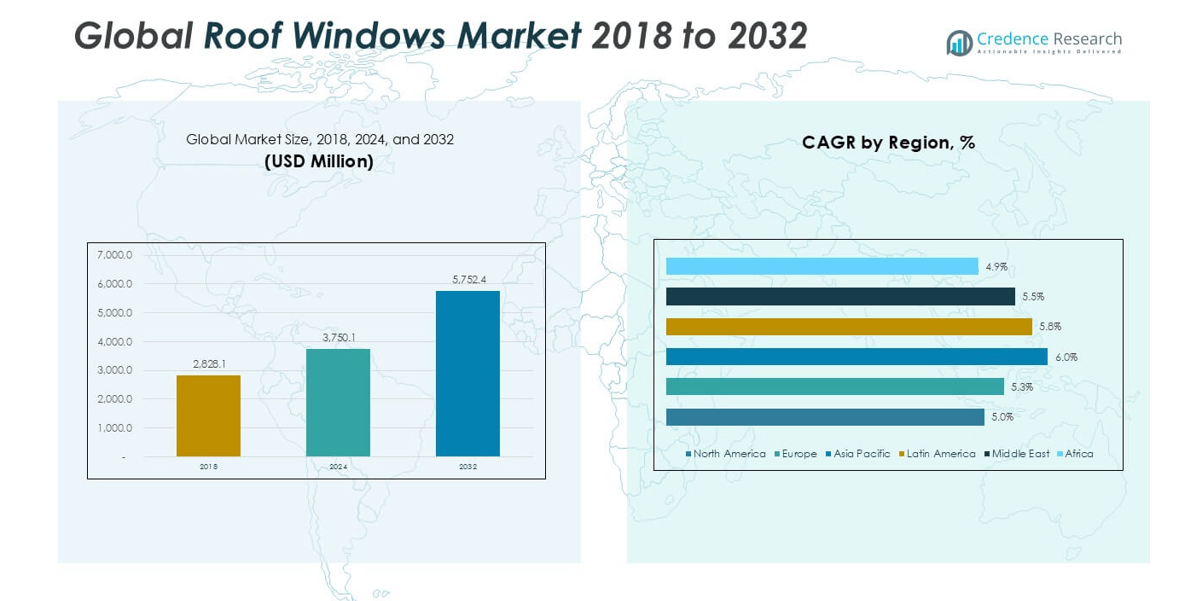
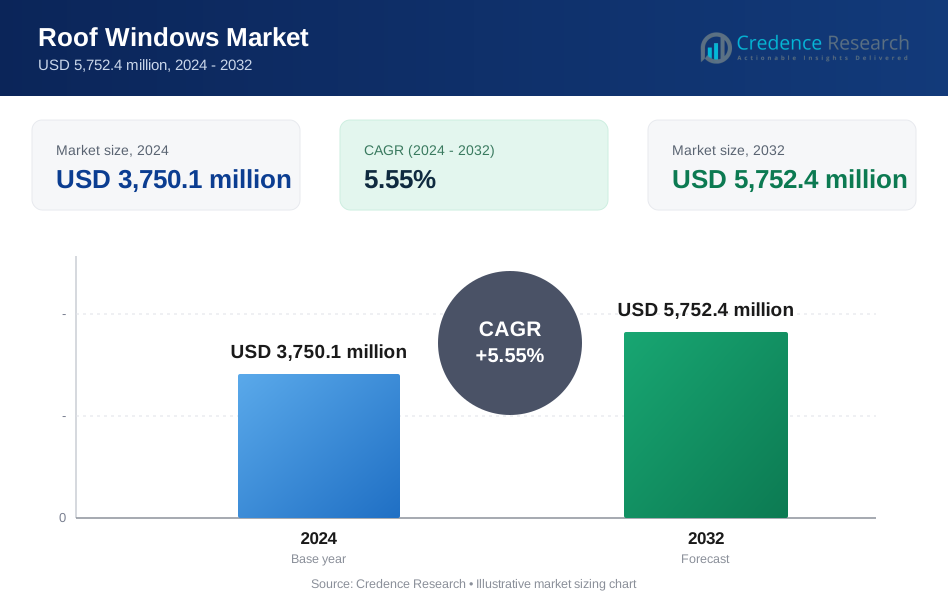
Roof Windows market size was valued at USD 2,828.1 million in 2018, increased to USD 3,750.1 million in 2024, and is anticipated to reach USD 5,752.4 million by 2032, at a CAGR of 5.55% during the forecast period.
| REPORT ATTRIBUTE | DETAILS |
|---|---|
| Historical Period | 2020-2023 |
| Base Year | 2024 |
| Forecast Period | 2025-2032 |
| Roof Windows Market Size 2024 | USD 3,750.1 million |
| Roof Windows Market, CAGR | 5.55% |
| Roof Windows Market Size 2032 | USD 5,752.4 million |
The roof windows market is led by major players such as Fakro, Velux Group, Roto Frank AG, Sunlux Roof Windows, and Lamilux, who dominate through extensive product ranges, advanced glazing technologies, and strong distribution networks. These companies invest in R&D to deliver energy-efficient, smart, and sustainable roof window solutions, addressing global green building initiatives. Europe holds the largest market share at 27%, driven by strict energy efficiency regulations and a mature renovation sector. Asia Pacific follows with 37% share, supported by rapid urbanization and rising construction activities, making it the fastest-growing regional market.
Market Insights
- The global roof windows market was valued at USD 3,750.1 million in 2024 and is projected to reach USD 5,752.4 million by 2032, growing at a CAGR of 5.55%.
- Rising demand for energy-efficient buildings, renovation projects, and sustainable construction drives adoption, with wood-based roof windows leading the type segment due to superior insulation and design appeal.
- Key trends include adoption of smart, automated roof windows with rain sensors and remote control, and use of recyclable, eco-friendly materials aligning with global green building standards.
- The market is moderately consolidated with leading players such as Fakro, Velux Group, and Roto Frank AG focusing on product innovation, partnerships, and global expansion to strengthen their presence.
- Asia Pacific holds the largest regional share at 37%, followed by Europe at 27% and North America at 23%, with double-glazing dominating by glazing type due to energy efficiency benefits.
Market Segmentation Analysis:
By Type
Wood dominates the roof windows market, accounting for the largest revenue share due to its superior insulation properties and aesthetic appeal. Demand is strong in residential applications, particularly in Europe and North America, where wooden frames match traditional architecture. Polyurethane (PU) follows as a preferred choice in moisture-prone areas like kitchens and bathrooms because of its durability and low maintenance. PVC and metal options cater to cost-sensitive and industrial projects. The market benefits from innovations in weather-resistant coatings and sustainable sourcing of wood materials, supporting eco-conscious construction trends.
- For instance, in 2023, VELUX Group supplied a wide range of roof window products to markets across Europe and the U.S., among others. The company, which reported a total revenue of EUR 2.91 billion for the year, produces roof windows in various materials, including timber frames.
By Application
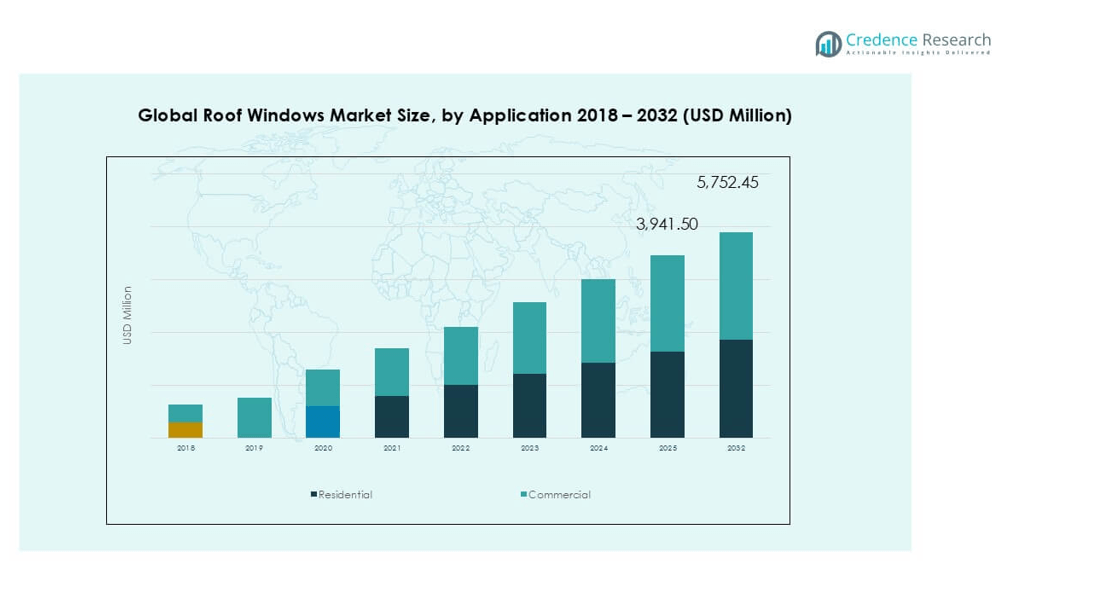
The residential segment leads the roof windows market, holding a significant share driven by rising demand for natural light, improved ventilation, and energy efficiency in homes. Growth is supported by renovation projects and green building initiatives that encourage daylighting solutions. Commercial installations grow steadily, with increasing adoption in offices, educational facilities, and hospitality spaces to enhance occupant well-being and reduce energy costs. Government incentives for energy-efficient construction further boost adoption across both segments, with residential continuing to outpace commercial demand due to higher installation volumes in urban housing projects.
- For instance, Germany's federal funding for efficient buildings (BEG) program, implemented through institutions like KfW, supported energy-efficient upgrades to thousands of homes in 2023. This included funding for individual measures such as replacing windows, as well as comprehensive renovations.
By Glazing Type
Double-glazing dominates the roof windows market, offering an optimal balance between thermal efficiency, cost, and sound insulation. Its high market share is driven by stringent building regulations promoting energy savings and homeowners seeking lower utility bills. Triple glazing is gaining traction in colder regions, supported by demand for superior insulation and condensation prevention. Single-glazing remains limited to low-cost or temporary structures due to poor energy performance. Advancements in low-emissivity coatings and argon-filled glass units further enhance the efficiency of double- and triple-glazed roof windows, fueling their adoption across residential and commercial applications.
Market Overview
Rising Demand for Energy-Efficient Buildings
Energy-efficient construction drives roof window adoption as homeowners and builders focus on reducing energy consumption. Roof windows improve natural lighting and ventilation, lowering dependence on artificial lighting and HVAC systems. Compliance with building energy codes and certifications such as LEED and BREEAM encourages wider use. Growing awareness of sustainability and rising energy costs push consumers toward solutions that deliver better insulation. This driver is most prominent in developed markets like Europe and North America but is rapidly gaining momentum in Asia-Pacific’s urban housing developments.
- For instance, VELUX significantly improved its operational sustainability in 2023 by increasing energy efficiency at its production sites and transitioning to 100% documented renewable electricity across the company. For its product portfolio, the company launched new products designed with a lower carbon footprint and increased the proportion of recyclable, zero-plastic packaging in Europe to 97%.
Increase in Renovation and Remodeling Activities
Renovation projects account for a major share of roof window installations, particularly in aging housing stocks. Homeowners seek to enhance aesthetics, indoor comfort, and property value by adding daylight solutions. Government-backed renovation incentives and subsidies for energy-efficient upgrades further support market expansion. The trend is strong in Europe, where historical buildings are being modernized with modern glazing solutions. Rising consumer interest in premium living spaces fuels demand for stylish roof windows that blend design with functionality, offering a long-term growth opportunity for manufacturers.
- For instance, Keylite Roof Windows reported a 14% year-on-year increase in renovation-related orders in 2023, primarily from residential retrofits in Ireland and the UK.
Rapid Urbanization and Rising Disposable Incomes
Urbanization accelerates construction activity, particularly in residential sectors where compact housing benefits from improved daylight access. Rising disposable incomes enable consumers to invest in premium roof windows that improve living conditions and energy performance. Growth in emerging economies such as India and China creates significant opportunities for global manufacturers. New housing projects increasingly integrate smart and automated roof windows for convenience. This shift toward modern housing infrastructure creates a steady demand pipeline and supports long-term market growth across developing and developed regions.
Key Trends & Opportunities
Adoption of Smart and Automated Roof Windows
Technological advancements are driving demand for smart roof windows equipped with rain sensors, remote control, and integration with home automation systems. These solutions improve user convenience, enhance indoor air quality, and optimize energy usage. Growth is fueled by consumer preference for connected home solutions and rising investments in smart building infrastructure. Manufacturers focus on expanding product portfolios with solar-powered and Wi-Fi-enabled systems, opening new revenue streams. This trend is particularly strong in developed regions where smart home penetration is high.
- For instance, FAKRO has offered Z-Wave-enabled roof windows and compatible accessories for many years, enabling remote operation and automated functions. The company released new products in 2024, such as solar-powered roof windows that use Z-Wave technology.
Shift Toward Sustainable and Recyclable Materials
Manufacturers are increasingly adopting sustainably sourced wood, recyclable PVC, and low-impact coatings to meet green building standards. Growing regulatory pressure on reducing carbon footprints encourages companies to invest in eco-friendly production. This trend also appeals to environmentally conscious homeowners and architects prioritizing sustainable construction practices. Adoption of circular economy principles and compliance with global standards, such as EU’s EcoDesign directive, further drive demand for environmentally responsible roof windows, presenting a strong opportunity for product differentiation.
- For instance, the Roto Group aims to reduce its Scope 1 and 2 greenhouse gas emissions by 50% by 2030, compared to a 2022 baseline. Scope 1 emissions are direct, and Scope 2 are indirect, from purchased energy.
Key Challenges
High Installation and Maintenance Costs
Roof window installation involves significant labor and structural modifications, leading to higher upfront costs compared to traditional windows. This limits adoption in cost-sensitive markets, particularly in developing countries. Maintenance costs also add to the burden, especially for wooden frames that require regular treatment to prevent decay. Price-sensitive consumers often opt for alternatives, slowing market penetration. Addressing this challenge requires manufacturers to develop cost-efficient solutions and partner with installers to offer bundled services and financing options that make roof windows more affordable.
Stringent Building Codes and Compliance Requirements
Roof window manufacturers face challenges in meeting diverse building codes and safety standards across regions. Compliance with fire resistance, energy performance, and structural integrity regulations can increase production costs. Frequent updates in regulations require continuous product redesign and testing, impacting profitability and time-to-market. Smaller manufacturers may struggle to keep up with certification requirements, creating entry barriers. Streamlining compliance processes and investing in R&D to develop versatile, code-compliant solutions are critical for sustaining market competitiveness.
Regional Analysis
North America
North America accounted for 23% market share in 2024, valued at USD 862.41 million, up from USD 669.41 million in 2018. The market is projected to reach USD 1,271.29 million by 2032, growing at a CAGR of 5.0%. Growth is driven by strong renovation demand, energy-efficient construction, and government incentives promoting daylighting solutions. The U.S. dominates with extensive adoption of roof windows in residential housing upgrades and commercial retrofits. Manufacturers focus on smart, automated products to meet consumer demand for convenience and sustainability, supporting steady market expansion across the region.
Europe
Europe leads the global market with 27% share in 2024, valued at USD 1,025.11 million, up from USD 782.53 million in 2018. The region is forecast to reach USD 1,546.83 million by 2032 at a CAGR of 5.3%. Growth is supported by a mature construction industry, strict energy efficiency regulations, and high demand for aesthetic and functional roof windows. Countries such as Germany, the UK, and France drive adoption in residential renovations. Manufacturers benefit from strong sustainability initiatives, boosting sales of energy-efficient glazing and eco-friendly materials. Europe remains a key hub for innovation and premium product launches.
Asia Pacific
Asia Pacific holds 37% market share, the largest globally, with 2024 revenue of USD 1,375.10 million, up from USD 1,008.78 million in 2018. The market is expected to reach USD 2,185.93 million by 2032, registering the fastest CAGR of 6.0%. Rapid urbanization, rising disposable incomes, and booming residential construction drive demand. China, India, and Japan are the key contributors, with growing interest in daylight solutions for compact housing. Manufacturers are expanding their presence through local production and distribution networks. Increasing adoption of energy-efficient and smart roof windows strengthens market growth across emerging economies in this region.
Latin America
Latin America captured 8% market share in 2024, valued at USD 282.92 million, rising from USD 210.69 million in 2018. The market is projected to hit USD 441.21 million by 2032, with a CAGR of 5.8%. Demand is fueled by improving construction activity, rising urban housing projects, and growing adoption of natural lighting solutions. Brazil and Mexico lead the market due to increased residential renovations and government initiatives supporting green building standards. Opportunities are expanding as consumers seek cost-effective yet energy-efficient roof windows, prompting global brands to strengthen regional distribution and partnerships with local construction firms.
Middle East
The Middle East represented 3% market share in 2024, with revenues of USD 120.81 million, up from USD 91.35 million in 2018. The market is anticipated to reach USD 184.65 million by 2032 at a CAGR of 5.5%. Growth is supported by rising investments in residential and hospitality construction projects, particularly in the UAE and Saudi Arabia. Demand for premium, heat-reflective glazing solutions is increasing due to the hot climate. Manufacturers are introducing products designed for superior thermal insulation and solar protection, aligning with sustainable building regulations and energy-efficiency targets across the Gulf Cooperation Council (GCC) nations.
Africa
Africa accounted for 2% market share in 2024, generating USD 83.73 million, an increase from USD 65.33 million in 2018. The market is forecast to reach USD 122.53 million by 2032, growing at a CAGR of 4.9%. Market growth is supported by urban development projects and rising demand for affordable housing solutions in countries such as South Africa and Nigeria. Adoption remains gradual due to limited awareness and price sensitivity. However, growing initiatives to improve building energy efficiency and access to daylight solutions present opportunities for international players to introduce low-cost, durable roof windows suitable for local conditions.
Market Segmentations:
By Type
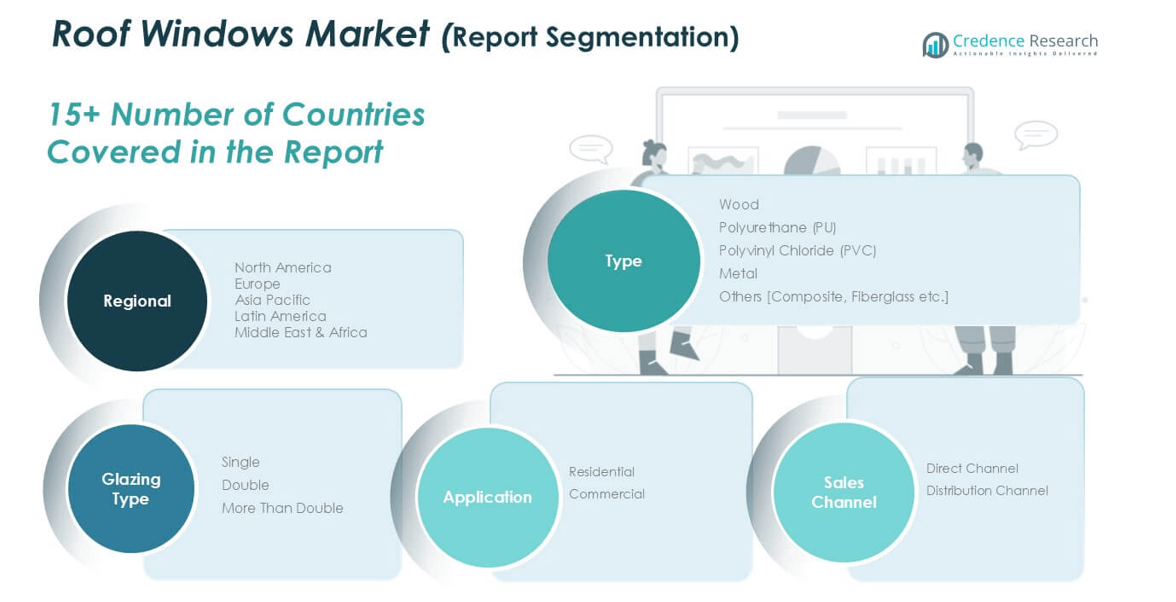
- Wood
- Polyurethane (PU)
- Polyvinyl Chloride (PVC)
- Metal
- Others
By Application
- Residential
- Commercial
By Glazing Type
- Single
- Double
- Triple and More
By Sales Channel
- Direct Channel
- Distribution Channel
By Geography
- North America
- U.S.
- Canada
- Mexico
- Europe
- Germany
- France
- U.K.
- Italy
- Spain
- Rest of Europe
- Asia Pacific
- China
- Japan
- India
- South Korea
- South-east Asia
- Rest of Asia Pacific
- Latin America
- Brazil
- Argentina
- Rest of Latin America
- Middle East & Africa
- GCC Countries
- South Africa
- Rest of the Middle East and Africa
Competitive Landscape
The roof windows market is moderately consolidated, with leading players such as Fakro, Velux Group, and Roto Frank AG holding a significant share through extensive product portfolios and global distribution networks. These companies focus on innovation, offering energy-efficient, smart, and sustainable roof window solutions to meet evolving building regulations and customer preferences. Regional players like Keylite Roof Windows, Sunlux Roof Windows, and Lamilux strengthen market competition by targeting cost-sensitive segments and providing customized solutions. Strategic initiatives include partnerships with construction firms, geographic expansion, and continuous investment in R&D to develop advanced glazing and automation features. The competitive environment also sees new entrants offering eco-friendly and budget-friendly options, driving price competition. Mergers, acquisitions, and product launches remain key strategies for market players aiming to expand market reach and enhance brand presence across residential and commercial segments globally.
Key Player Analysis
- Fakro
- Velux Group
- Roto Frank AG
- Sunlux Roof Windows
- Lamilux
- Keylite Roof Windows
- Skylights Plus
- Dakea
- RoofLITE
- AHRD
- Tegola Canadese
- Natural Light Co. Ltd.
- Solstro
- VivaTerra
- Bilka Steel
- Faelux
- Alwitra
- DAKOTA
- Sunsquare
- INLUX
Recent Developments
- In 2023, LAMILUX launched the Modular Glass Skylight MS78 (also referred to as a Modular Glass Roof), a customizable daylight system for buildings that combines flexibility, rapid installation, and a focus on aesthetics and sustainability.
- In April 2025, Velux launched the VELUX Skylight System, with a solar-powered, pre-installed room-darkening shade as a standard feature on all glass skylights from April 7, 2025. The new shade design lets in more daylight and provides improved thermal performance (45% U-value improvement, 19% better solar heat gain coefficient). The Skylight System supports smart home integration and features built-in rain sensors.
- In March 2025, Velux and Guardian Glass announced a joint development agreement for tempered vacuum insulated glass (VIG). This collaboration aims to advance VIG technology, focusing on developing manufacturing processes and capabilities to meet the growing demand for high-performance, energy-efficient windows
Report Coverage
The research report offers an in-depth analysis based on Type, Application, Glazing Type, Sales Channel and Geography. It details leading market players, providing an overview of their business, product offerings, investments, revenue streams, and key applications. Additionally, the report includes insights into the competitive environment, SWOT analysis, current market trends, as well as the primary drivers and constraints. Furthermore, it discusses various factors that have driven market expansion in recent years. The report also explores market dynamics, regulatory scenarios, and technological advancements that are shaping the industry. It assesses the impact of external factors and global economic changes on market growth. Lastly, it provides strategic recommendations for new entrants and established companies to navigate the complexities of the market.
Future Outlook
- Demand for energy-efficient roof windows will rise as green building adoption increases globally.
- Smart and automated roof windows will gain strong traction in residential and commercial projects.
- Manufacturers will invest more in sustainable materials and recyclable components to meet regulations.
- Double- and triple-glazed products will dominate due to thermal insulation and energy savings benefits.
- Asia Pacific will remain the fastest-growing region driven by urbanization and rising construction activity.
- Europe will sustain steady growth supported by renovation projects and strict energy standards.
- Partnerships with construction firms and distributors will expand market reach for key players.
- Product innovation will focus on solar-powered, remote-controlled, and rain-sensor-enabled roof windows.
- Cost reduction initiatives will target wider adoption in price-sensitive developing markets.
- Increased awareness of daylighting benefits will support demand across residential and non-residential sectors.
Request a Free Sample
Fill in your details and we'll send you a free sample report.
- Sample data tables & charts
- Research methodology
Need a Custom Version of This Report?
Tailor the scope, geography, or segments to your exact requirements.
- Custom geography or segment scope
- Direct access to our analyst team
Frequently Asked Questions
What is the current market size for Roof Windows market, and what is its projected size in 2032?
At what Compound Annual Growth Rate is the Roof Windows market projected to grow between 2025 and 2032?
Which Roof Windows market segment held the largest share in 2024?
What are the primary factors fueling the growth of the Roof Windows market?
Who are the leading companies in the Roof Windows market?
Table of Content
Chapter 1. Report Introduction
- 1.1 Report Description & Purpose
- 1.1.1 Report Title & Market Definition
- 1.1.2 Unique Selling Propositions (USP) & Key Differentiators
- 1.1.3 Value Proposition for Stakeholders
- 1.2 Research Objectives
- 1.2.1 Market Sizing Objectives (Volume & Revenue)
- 1.2.2 Segmentation Objectives
- 1.2.3 Competitive Intelligence Objectives
- 1.2.4 Forecast & Scenario Objectives
- 1.3 Report Scope
- 1.3.1 Roof Windows Scope – Types & Subtypes Covered
- 1.3.2 Geographic Scope – Regions & Countries Covered
- 1.3.3 Historical Period, Base Year & Forecast Period (2024; forecast to 2032)
- 1.3.4 Inclusions & Exclusions
- 1.4 HS Code & Classification Framework
- 1.5 Currency, Units & Pricing Basis
- 1.6 Target Stakeholders
- 1.7 Limitations & Assumptions
Chapter 2. Executive Summary
- 2.1 Global Roof Windows Market Snapshot
- 2.1.1 Market Size – Historical (2024) & Forecast (2024-2032) (2024: USD 3,750.1 million → 2032: USD 5,752.4 million)
- 2.1.2 Volume & Revenue – Global Totals
- 2.1.3 Key Market Highlights – Top Five Facts
- 2.2 Roof Windows Market Segmentation Snapshot
- 2.2.1 Market Split by Region – 2024 vs. 2032
- 2.3 Competitive Snapshot
- 2.3.1 Top 10 Players by Revenue Share – 2024
- 2.3.2 Top 10 Players by Volume Share – 2024
- 2.3.3 Recent Strategic Developments (18-Month Summary)
- 2.4 Key Investment Highlights & Strategic Conclusions
Chapter 3. Roof Windows Market Dynamics & Industry Analysis
- 3.1 Market Overview & Context
- 3.1.1 Roof Windows Market Position in the Broader Automotive Value Chain
- 3.1.2 OEM vs. Replacement Market Dynamics
- 3.1.3 Market Maturity & Development Stage by Region
- 3.2 Roof Windows Market Drivers
- 3.3 Roof Windows Market Restraints & Challenges
- 3.4 Roof Windows Market Opportunities
- 3.5 Porter's Five Forces Analysis
- 3.5.1 Threat of New Entrants
- 3.5.2 Bargaining Power of Suppliers
- 3.5.3 Bargaining Power of Buyers
- 3.5.4 Threat of Substitutes
- 3.5.5 Competitive Rivalry – Intensity Assessment
- 3.6 Roof Windows Value Chain Analysis
- 3.6.1 Upstream – Raw Material/Input Suppliers
- 3.6.1.1 Raw Material/Input 1
- 3.6.1.2 Raw Material/Input 2
- 3.6.1.3 Raw Material/Input 3
- 3.6.2 Midstream – Production/Manufacturing/Service Delivery
- 3.6.2.1 Production/Process Overview
- 3.6.2.2 Key Facility Locations & Capacity by Manufacturer
- 3.6.3 Downstream – Distribution & End Consumer
- 3.6.3.1 Primary Channel – B2B/OEM
- 3.6.3.2 Secondary Channels – Dealer, Retail, Online, Direct
- 3.6.4 Value Chain Profitability Analysis
- 3.6.1 Upstream – Raw Material/Input Suppliers
- 3.7 PESTEL Analysis
- 3.7.1 Political Factors
- 3.7.2 Economic Factors
- 3.7.3 Social Factors
- 3.7.4 Technological Factors
- 3.7.5 Environmental Factors
- 3.7.6 Legal Factors
- 3.8 Roof Windows Supply Chain Analysis
- 3.8.1 Raw Material/Input Supply Risk Assessment
- 3.8.2 Manufacturing Concentration Risk (Geographic Exposure)
- 3.8.3 Trade Disruption Impact Analysis
- 3.9 Regulatory & Policy Landscape
Note: The regulatory and policy landscape section covers regulations based on their applicability to the market, Roof Windows category, geography, and scope of the study. Only regulatory frameworks with a material impact on operations, compliance, trade, sustainability, or market access are analyzed in detail.
Chapter 4. Key Investment Pockets & Opportunity Analysis
- 4.1 Roof Windows Market Attractiveness Analysis
- 4.1.1 By Region – Investment Attractiveness Matrix (Volume × CAGR)
- 4.2 Absolute Revenue Growth Opportunity
- 4.2.1 By Region – Absolute USD Growth Through 2032
- 4.3 Incremental Volume Opportunity
- 4.3.1 By Region – Incremental Volume Through 2032
- 4.3.2 Segment – Incremental Volume
- 4.4 Emerging Submarket Opportunity Deep Dive (Subject to Applicability)
- 4.5 Emerging Market Opportunity Scorecards
- 4.5.1 United States
- 4.5.2 Europe
- 4.5.3 Asia
- 4.5.4 Middle East & Africa
Note: Emerging Market Opportunity Scorecards will be included based on relevance and strategic importance. Regions listed are indicative and may vary depending on data availability and market dynamics.
Chapter 5. Roof Windows Import-Export Analysis & Trade Flows
- 5.1 Global Trade Overview
- 5.1.1 Global Export Value by Country (2024)
- 5.1.2 Global Export Volume by Country (2024)
- 5.1.3 Global Import Value by Country (2024)
- 5.1.4 Global Import Volume by Country (2024)
- 5.1.5 Net Trade Balance by Country (2024)
- 5.2 Export Analysis – Segment
- 5.2.1 Type 1 (HS Code)
- 5.2.2 Type 2 (HS Code)
- 5.2.3 Type 3 (HS Code)
- 5.2.4 Type 4 (HS Code)
- 5.2.5 Type 5 (HS Code)
- 5.3 Import Analysis – Segment
- 5.3.1 Type 1 (HS Code)
- 5.3.2 Type 2 (HS Code)
- 5.3.3 Type 3 (HS Code)
- 5.3.4 Type 4 (HS Code)
- 5.3.5 Type 5 (HS Code)
- 5.4 Average Unit Trade Prices
- 5.4.1 Average Export Price – Segment & Country
- 5.4.2 Average Import Price – Segment & Source Country
- 5.4.3 Price Trends (2024)
- 5.5 Key Trade Route Analysis
- 5.5.1 Trade Route 1
- 5.5.2 Trade Route 2
- 5.5.3 Trade Route 3
- 5.5.4 Trade Route 4
- 5.5.5 Trade Route 5
- 5.6 Trade Policy Impact Assessment
- 5.6.1 US Anti-Dumping & Section 301 Tariffs
- 5.6.2 EU Customs Union Impact
- 5.6.3 Major Free Trade Agreements
- 5.6.4 USMCA Rules of Origin
Note: Trade policy analysis will be included only where relevant to the Roof Windows market.
Chapter 6. Competitive Landscape & Company Benchmarking
- 6.1 Roof Windows Market Concentration & Structure
- 6.1.1 Herfindahl-Hirschman Index (HHI) – vs. 2024
- 6.1.2 Tier 1, Tier 2 & Tier 3 Market Structure
- 6.1.3 Global, Regional & Local Player Dynamics
- 6.2 Roof Windows Market Share Analysis – 2024
- 6.2.1 Global Revenue Share by Company
- 6.2.2 Global Volume Share by Company
- 6.2.3 Regional Revenue Share
- 6.2.4 Market Share Evolution ( vs. 2024)
- 6.2.5 OEM Segment Share by Company
- 6.2.6 Replacement Segment Share by Company
- 6.3 Production/Delivery Capacity & Facility Analysis
- 6.3.1 Global Installed Capacity
- 6.3.2 Capacity Utilization Rates
- 6.3.3 Production/Output Volume
- 6.3.4 Facility Locations & Capacity Map
- 6.3.5 Planned Capacity Additions
- 6.4 Roof Windows Competitive Benchmarking Matrix
- 6.4.1 Revenue, Volume, CAGR & Profitability Comparison
- 6.4.2 Channel Revenue Mix
- 6.4.3 Geographic Revenue Exposure
- 6.4.4 R&D Intensity
- 6.4.5 Sustainability Maturity
- 6.5 Strategic Developments in Roof Windows (Last 24 Months)
- 6.5.1 Mergers, Acquisitions & Divestments
- 6.5.2 New Roof Windows Launches
- 6.5.3 Facility Expansions
- 6.5.4 Strategic Alliances, Joint Ventures & Partnerships
- 6.5.5 Distribution Expansion & Market Entry
- 6.5.6 Sustainability & ESG Initiatives
- 6.6 Competitive Strategy Mapping
- 6.6.1 Leader, Challenger, Follower & Niche Classification
- 6.6.2 Pricing Strategy Comparison
- 6.6.3 Channel Strategy Matrix
Note: Strategic developments are included based on their materiality and the availability of reliable information.
Chapter 7. Global Roof Windows Market – By Distribution Channel
- 7.1 Segment Overview
- 7.1.1 Volume & Revenue Split by Channel (2024 & 2032)
- 7.1.2 Channel Mix Evolution (2024-2032)
Chapter 8. Regional Market Analysis – Global Overview
- 8.1 Global Regional Overview
- 8.1.1 Regional Volume Share
- 8.1.2 Regional Revenue Share
- 8.1.3 Regional Volume by Region
- 8.1.4 Regional Revenue by Region
- 8.1.5 Regional Forecast Through 2032
- 8.2 Cross-Regional Segment Analysis
- 8.2.1 By Distribution Channel
- 8.2.2 By Brand/Price Tier
Chapter 9. North America Roof Windows Market
- 9.1 United States
- 9.2 Canada
- 9.3 Mexico
Chapter 10. Europe Roof Windows Market
- 10.1 Germany
- 10.2 France
- 10.3 Italy
- 10.4 United Kingdom
- 10.5 Spain
- 10.6 Poland
- 10.7 Russia
- 10.8 Netherlands
- 10.9 Belgium
- 10.10 Sweden
- 10.11 Denmark
- 10.12 Norway
- 10.13 Rest of Europe
Chapter 11. Asia Pacific Roof Windows Market
- 11.1 China
- 11.2 India
- 11.3 Japan
- 11.4 South Korea
- 11.5 Thailand
- 11.6 Indonesia
- 11.7 Vietnam
- 11.8 Malaysia
- 11.9 Australia
- 11.10 Rest of Asia Pacific
Chapter 12. Latin America Roof Windows Market
- 12.1 Brazil
- 12.2 Argentina
- 12.3 Colombia
- 12.4 Chile
- 12.5 Rest of Latin America
Chapter 13. Middle East Roof Windows Market
- 13.1 Saudi Arabia
- 13.2 United Arab Emirates
- 13.3 Turkey
- 13.4 Israel
- 13.5 Iran
- 13.6 Rest of the Middle East
Chapter 14. Africa Roof Windows Market
- 14.1 South Africa
- 14.2 Egypt
- 14.3 Nigeria
- 14.4 Morocco
- 14.5 Rest of Africa
Chapter 15. Roof Windows Company Profiles
- 15.1 [Company 01]
- 15.1.1 Company Overview
- 15.1.2 Key Management Personnel
- 15.1.3 Products & Services Portfolio
- 15.1.4 Financial Performance
- 15.1.5 Key Market Focus & Geographic Presence
- 15.1.6 Recent Developments & Strategic Initiatives
Note: The company profile list is preliminary and may change based on research findings, market developments, data availability, and client requirements.
Chapter 16. Appendices
- Appendix A – List of Abbreviations & Acronyms
- Appendix B – Industry Classification Code Reference – Full Series
- Appendix C – Production & Capacity Data Tables
- Appendix D – End-Use & Demand Base Tables
- Appendix E – Consumption & Replacement Rate Assumptions
- Appendix F – ASP Reference Tables
- Appendix G – Manufacturing & Facility Database
- Appendix H – Import-Export Data Tables
- Appendix I – Regulatory Summary Tables
- Appendix J – Primary Research Participant List (Anonymized)
- Appendix K – Primary Research Questionnaire Framework
- Appendix L – Data Sources & Bibliography
- Appendix M – Market Size Divergence & Source Comparison
Chapter 17. Research Methodology
- 17.1 Research Framework & Philosophy
- 17.2 Secondary Research – Sources, Hierarchy & Data Extraction
- 17.3 Data Modeling – Bottom-Up & Top-Down Market Sizing
- 17.4 Primary Research – Stakeholder Framework, LOI & Sample Sizes
- 17.5 Forecast Methodology – Regression, Scenario & Sensitivity Analysis
- 17.6 Quality Control – Four-Layer Validation Framework
- 17.7 Limitations & Standard Assumptions
- 17.8 Disclaimer
