
Market Overview
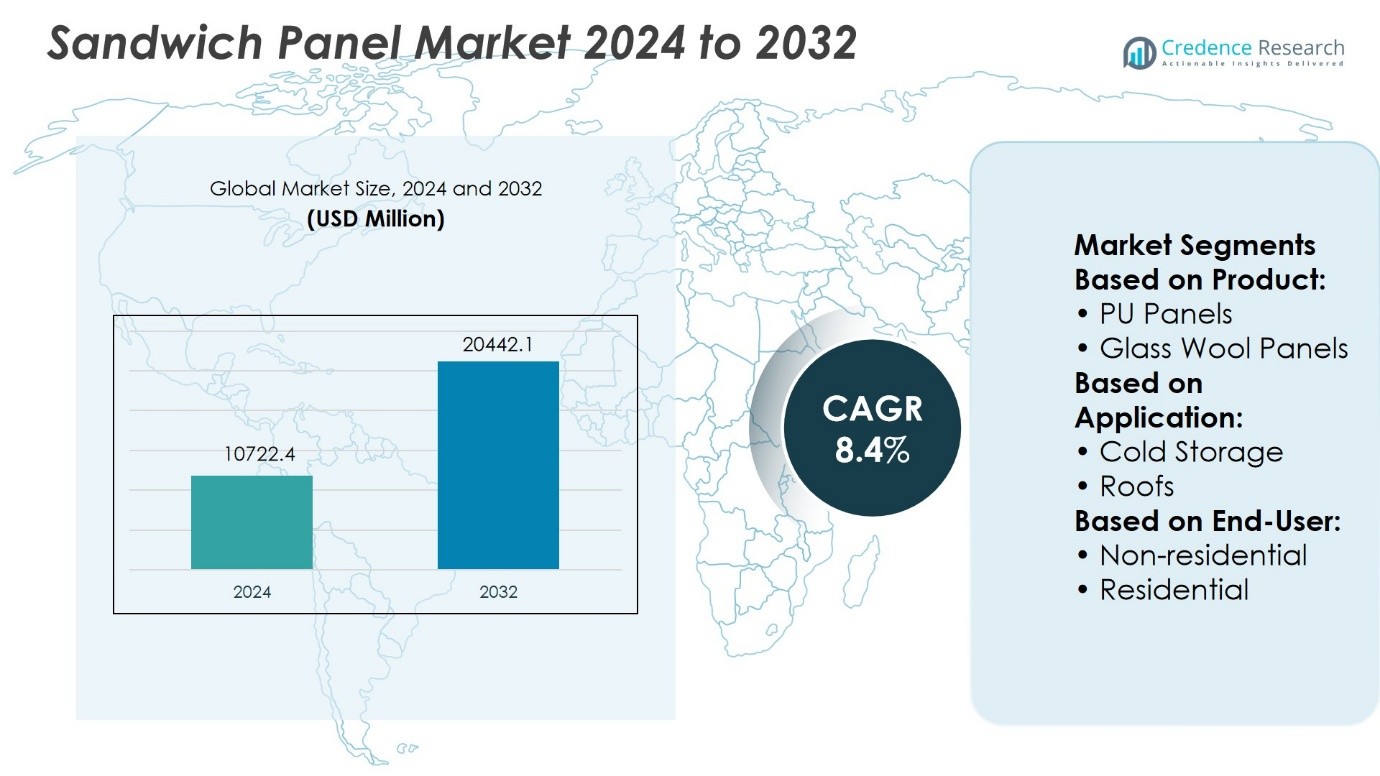
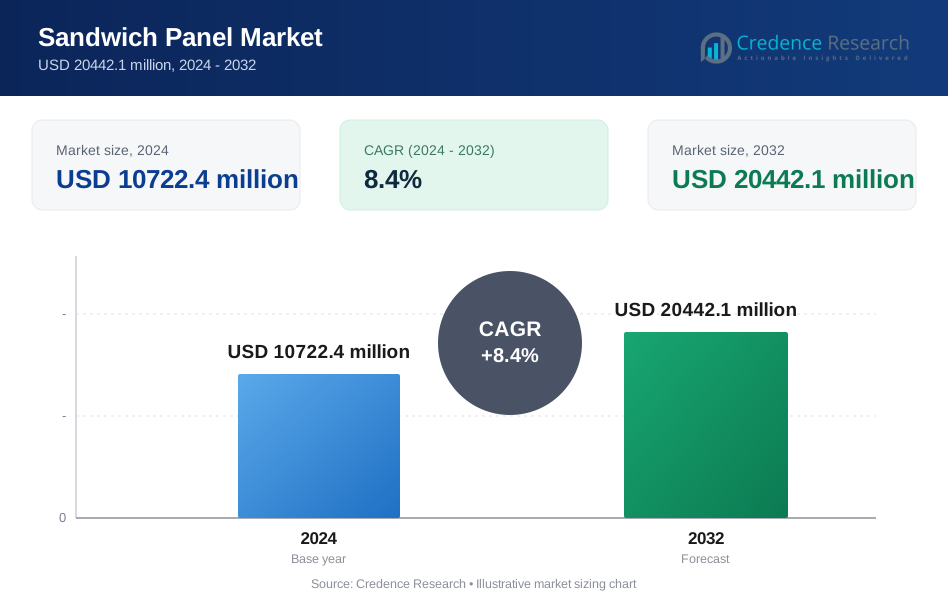
Sandwich Panel Market size was valued at USD 10722.4 million in 2024 and is anticipated to reach USD 20442.1 million by 2032, at a CAGR of 8.4% during the forecast period.| REPORT ATTRIBUTE | DETAILS |
|---|---|
| Historical Period | 2020-2024 |
| Base Year | 2024 |
| Forecast Period | 2025-2032 |
| Sandwich Panel Market Size 2024 | USD 10722.4 Million |
| Sandwich Panel Market, CAGR | 8.4% |
| Sandwich Panel Market Size 2032 | USD 20442.1 Million |
Market Insights
- The Sandwich Panel Market size was valued at USD 10722.4 million in 2024 and is projected to reach USD 20442.1 million by 2032, at a CAGR of 8.4%.
- Rising demand for energy-efficient construction and rapid urbanization drive consistent market growth.
- Expanding cold storage facilities and logistics hubs strengthen adoption across industrial sectors.
- Lightweight composites, recyclable cores, and eco-friendly coatings shape key market trends.
- Leading companies focus on innovation, sustainability, and strategic partnerships to enhance competitiveness.
- Volatile raw material prices and strict compliance requirements act as restraints for smaller manufacturers.
- Europe leads the market, followed by Asia-Pacific, North America, Latin America, and the Middle East & Africa, reflecting diverse regional growth patterns.
Market Drivers
Expanding Demand in Construction and Infrastructure Development The Sandwich Panel Market benefits strongly from rapid growth in construction and infrastructure projects across residential, commercial, and industrial sectors. Rising urbanization and large-scale development projects create demand for efficient, durable, and cost-effective building solutions. It provides thermal insulation, structural strength, and quick installation, which meet the needs of fast-paced projects. Governments promoting energy-efficient buildings support the adoption of these panels in both developed and emerging markets. It also aligns with modern architectural requirements that emphasize lightweight materials and sustainable practices. The expanding infrastructure pipeline in Asia-Pacific and the Middle East ensures a steady demand trajectory.- For instance, Kingspan Group reported installing more than 250 million square meters of insulated sandwich panels across global projects by 2023, with its QuadCore Technology panels delivering a certified thermal conductivity.
- For instance, Isopan S.p.A. developed its Green Roof sandwich panels with an insulation core achieving a thermal transmittance as low as 0.15 W/m²K and certified over 12 million square meters of panels with LEED and BREEAM standards.
Market Trends
Increasing Preference for Lightweight and Durable Construction Materials The Sandwich Panel Market reflects a strong shift toward lightweight yet durable building solutions that reduce structural load without compromising strength. It delivers significant advantages in construction speed, cost efficiency, and long-term performance. Demand intensifies in high-rise projects and modular buildings where reduced weight is critical. It also ensures extended lifespan through resistance to corrosion, weather, and mechanical stress. Growing adoption in transportation and prefabricated housing highlights its versatility. This trend positions panels as a cornerstone of modern construction practices.- For instance, Metecno Group engineered lightweight polyurethane-core sandwich panels maintaining compressive strength above 150 kPa, and by 2023, the company had supplied more than 95 million square meters of these panels globally for industrial and modular construction projects.
- For instance, in temperature-controlled applications, Kingspan also reports tested R-values of 7.5 per inch (~189 mm) for its insulation cores, delivering strong thermal control across operating temperatures ranging from –40 °C to +93 °C.
Market Challenges Analysis
Fluctuating Raw Material Prices and Supply Chain Constraints The Sandwich Panel Market faces significant challenges due to volatility in raw material prices, particularly steel, aluminum, and core insulation materials. It directly impacts production costs and reduces profit margins for manufacturers. Global supply chain disruptions further create delays in procurement and distribution, increasing overall project timelines. It becomes difficult for producers to maintain price stability when raw material availability fluctuates. Dependence on imports in certain regions intensifies vulnerability to currency shifts and trade restrictions. This challenge pressures companies to optimize sourcing strategies and explore alternative materials. Stringent Regulatory Compliance and Limited Awareness in Emerging Markets Compliance with energy efficiency, fire safety, and environmental standards poses another challenge for the Sandwich Panel Market. It requires continuous investment in R&D to meet evolving regulations across different regions. Smaller manufacturers struggle to match the cost of innovation while maintaining competitive pricing. It also faces barriers in emerging economies where awareness about advanced building materials remains low. Traditional construction practices dominate in many markets, restricting wider adoption. Overcoming regulatory hurdles and enhancing market education remain critical for long-term growth.Market Opportunities
Expansion in Green Building and Sustainable Infrastructure Projects The Sandwich Panel Market holds strong opportunities in the global shift toward sustainable construction and green-certified buildings. It aligns with policies that encourage energy-efficient materials and eco-friendly practices. Growing investments in renewable energy facilities, smart cities, and green industrial parks create demand for advanced insulated panels. It supports developers in achieving compliance with LEED and BREEAM standards, enhancing market attractiveness. Rising adoption of recyclable cores and low-emission adhesives positions panels as a preferred solution for environmentally responsible projects. This opportunity ensures long-term relevance in the evolving construction sector. Rising Demand from Emerging Economies and Industrial Growth Rapid industrialization and urban development in Asia-Pacific, Latin America, and the Middle East create favorable opportunities for the Sandwich Panel Market. It enables cost-efficient and quick construction of warehouses, factories, and logistics hubs that support expanding trade activities. Government-backed affordable housing and infrastructure programs further boost demand for prefabricated structures. It caters to sectors such as food processing, pharmaceuticals, and e-commerce logistics where insulated and durable facilities are essential. Growing foreign direct investments in manufacturing and construction strengthen adoption across these markets. This expansion secures new growth avenues for global and regional players.Market Segmentation Analysis:
By Product The Sandwich Panel Market divides by product into PU panels and glass wool panels, both serving distinct roles in construction and insulation. PU panels dominate due to their excellent thermal insulation and energy efficiency, making them the preferred choice for cold storage and industrial facilities. It ensures reduced energy consumption and lower maintenance, which appeal to developers in cost-sensitive projects. Glass wool panels gain traction where fire resistance and acoustic performance are critical, such as in commercial complexes and public infrastructure. It also offers recyclability, aligning with growing demand for sustainable materials. The combination of insulation performance and versatility secures both products strong adoption across varied applications.- For instance, Owens Corning Thermafiber® FireSpan® mineral wool insulation is specifically engineered for perimeter fire containment in curtain wall systems, and fire exposure for up to 5 hours, maintaining structural integrity without backer bars.
- For instance, Kingspan QuadCore® KS1000RW Roof Panels are designed for high-performance and lightweight roofing applications. Specifically, a 100mm thick panel offers excellent thermal insulation (low U-value) for efficient installation and temperature control over large roof areas.
Segments:
Based on Product:- PU Panels
- Glass Wool Panels
- Cold Storage
- Roofs
- Non-residential
- Residential
- North America
- U.S.
- Canada
- Mexico
- Europe
- Germany
- France
- U.K.
- Italy
- Spain
- Rest of Europe
- Asia Pacific
- China
- Japan
- India
- South Korea
- South-east Asia
- Rest of Asia Pacific
- Latin America
- Brazil
- Argentina
- Rest of Latin America
- Middle East & Africa
- GCC Countries
- South Africa
- Rest of the Middle East and Africa
Regional Analysis
North America North America accounts for 23% of the Sandwich Panel Market, supported by advanced construction practices and strict energy efficiency regulations. The region emphasizes sustainable building materials, driving the adoption of insulated panels in commercial and industrial facilities. It benefits from strong demand in cold storage and logistics infrastructure, particularly in the United States, where e-commerce and food distribution require reliable temperature-controlled solutions. Canada demonstrates growth in residential applications, supported by government incentives for energy-efficient housing. The presence of established manufacturers and high awareness of green certifications further sustain adoption. Rising investment in prefabricated buildings strengthens North America’s position as a key contributor to global demand. Europe Europe holds the largest share at 32% of the Sandwich Panel Market, driven by stringent building codes and sustainability targets. The European Union enforces strict energy regulations, encouraging builders to adopt high-performance insulation materials. It experiences strong demand in industrial warehousing, cold storage, and modern commercial spaces. Germany, France, and Italy lead in advanced manufacturing of panels, while Eastern Europe shows rapid adoption through infrastructure expansion. The region also focuses on fire-resistant solutions, with mineral wool panels gaining significant traction in urban projects. Supportive policies for circular economy and green-certified buildings consolidate Europe’s leadership in this market. Asia-Pacific Asia-Pacific represents 28% of the Sandwich Panel Market, supported by rapid urbanization and large-scale industrial growth. China, India, and Southeast Asian countries invest heavily in affordable housing, logistics hubs, and manufacturing parks that rely on quick and cost-effective construction. It also benefits from government-backed infrastructure programs that encourage energy-efficient and lightweight materials. Cold storage facilities expand across the region due to rising demand for processed food and pharmaceuticals. Japan and South Korea demonstrate technological advancements in fire-retardant and eco-friendly panels. The combination of population growth, industrialization, and policy support positions Asia-Pacific as the fastest-growing regional market. Latin America Latin America contributes 7% of the Sandwich Panel Market, with demand centered on industrial and commercial projects. Brazil and Mexico lead adoption due to growth in logistics, food processing, and retail infrastructure. It demonstrates gradual acceptance in residential construction, particularly in prefabricated housing solutions that address urban population needs. Limited awareness and higher initial costs remain barriers, yet ongoing government housing initiatives create opportunities. Cold storage expansion in agricultural economies further drives demand for PU panels. Regional players focus on expanding distribution networks to meet the needs of cost-sensitive markets. Middle East and Africa The Middle East and Africa account for 10% of the Sandwich Panel Market, driven by infrastructure expansion and urban development projects. Gulf countries invest heavily in commercial complexes, airports, and industrial hubs where insulated panels provide durability and efficiency. It also finds strong demand in cold storage, supporting food security initiatives in import-dependent nations. Africa demonstrates early adoption, led by South Africa and Nigeria, where urban growth and industrialization accelerate. Fire-resistant and lightweight panels are gaining traction in high-temperature climates. Continuous government spending on construction supports steady growth, although limited manufacturing capacity makes the region dependent on imports.Key Player Analysis
- Owens Corning
- Metecno Group
- American Insulated Panel
- Kingspan Group
- KPS Global
- Isopan
- Green Span Profiles
- Dana Group of Companies
- PFB Corporation
- Metl-Span
Competitive Analysis
The Sandwich Panel Market features led by Kingspan Group, Owens Corning, Isopan, PFB Corporation, Metecno Group, Green Span Profiles, American Insulated Panel, Metl-Span, KPS Global, and Dana Group of Companies. The Sandwich Panel Market demonstrates intense competition, with companies focusing on innovation, sustainability, and regional expansion to strengthen their positions. Market leaders invest in advanced insulation technologies, fire-resistant materials, and recyclable components to align with evolving regulatory standards. Strong emphasis on energy efficiency supports adoption across industrial, commercial, and residential applications. Manufacturers differentiate through tailored solutions for cold storage, logistics hubs, and modular construction, where thermal performance and quick installation remain critical. Strategic mergers, acquisitions, and partnerships expand global reach while enabling entry into emerging economies. Continuous R&D ensures improvements in panel durability, design flexibility, and cost efficiency, reinforcing competitiveness in a rapidly evolving construction landscape.Recent Developments
- In April 2025, Philips launched the Series 7000, i9000, and i9000 Prestige Ultra electric shavers in India, featuring advanced AI-powered SkinIQ technology that adapts to individual skin and beard types for an optimized, irritation-free shave.
- In January 2025, In India, rapid urbanization and infrastructure development fuel demand for thermally efficient sandwich panels. The India market is expected to grow at a CAGR of 8.4% from 2025 to 2031, with companies like Metecno Group and Kingspan Group actively expanding their insulated and fire-resistant panel offerings for commercial and industrial.
- In June 2024, Kingspan completed the acquisition of a Thailand-based manufacturer of insulated panels, FatekAdvance Insulation Company. The facility in the Rojana Industrial Park Ayutthaya has been renamed Kingspan Insulated Panels (Thailand) Co, Limited. They aim to manufacture sandwich panels together.
- In April 2024, Supplier WNL B.V. and SAB-profiel (a manufacturer collaborating with Tata Steel Limited) resulted in the development of a unique and durable sandwich roof panel system for greenhouses called the WNL Easyjoint.
Market Concentration & Characteristics
The Sandwich Panel Market reflects a moderately concentrated structure, characterized by the dominance of global manufacturers alongside a competitive base of regional players. It is defined by high entry barriers due to capital-intensive production processes, strict regulatory requirements, and the need for advanced insulation technologies. Leading companies secure strong positions through innovation, large distribution networks, and a broad portfolio of fire-resistant and energy-efficient solutions. It also shows a clear orientation toward sustainable materials and compliance with green building standards, which enhance differentiation in mature markets. Regional producers compete by offering cost-effective and locally adapted products, especially in emerging economies where affordability influences adoption. The market maintains steady growth potential, supported by rising demand from cold storage, industrial warehouses, and prefabricated housing, while competition continues to drive product development and price optimization.Report Coverage
The research report offers an in-depth analysis based on Product Type, Application, End-User and Geography. It details leading market players, providing an overview of their business, product offerings, investments, revenue streams, and key applications. Additionally, the report includes insights into the competitive environment, SWOT analysis, current market trends, as well as the primary drivers and constraints. Furthermore, it discusses various factors that have driven market expansion in recent years. The report also explores market dynamics, regulatory scenarios, and technological advancements that are shaping the industry. It assesses the impact of external factors and global economic changes on market growth. Lastly, it provides strategic recommendations for new entrants and established companies to navigate the complexities of the market.Future Outlook
- The Sandwich Panel Market will expand with rising demand for energy-efficient construction materials.
- It will gain momentum from the growth of prefabricated and modular building projects.
- Cold storage and logistics infrastructure will remain a core driver of adoption.
- Fire-resistant and sustainable panels will capture stronger attention from regulators and builders.
- Industrial growth in emerging economies will strengthen opportunities for manufacturers.
- Technological advancements will improve durability, insulation, and design flexibility.
- Strategic mergers and partnerships will enhance global distribution networks.
- Growing emphasis on recyclable and eco-friendly materials will influence product development.
- Residential adoption will increase with government-backed affordable housing programs.
- Digital modeling and automation will streamline production and expand customization.
Request a Free Sample
Fill in your details and we'll send you a free sample report.
- Sample data tables & charts
- Research methodology
Need a Custom Version of This Report?
Tailor the scope, geography, or segments to your exact requirements.
- Custom geography or segment scope
- Direct access to our analyst team
Frequently Asked Questions
What is the current market size for Sandwich Panel Market, and what is its projected size in 2032?
At what Compound Annual Growth Rate is the Sandwich Panel Market projected to grow between 2025 and 2032?
Which Sandwich Panel Market segment held the largest share in 2024?
What are the primary factors fueling the growth of the Sandwich Panel Market?
Who are the leading companies in the Sandwich Panel Market?
Which region commanded the largest share of the Sandwich Panel Market in 2024?
Table of Content
Chapter 1. Report Introduction
- 1.1 Report Description & Purpose
- 1.1.1 Report Title & Market Definition
- 1.1.2 Unique Selling Propositions (USP) & Key Differentiators
- 1.1.3 Value Proposition for Stakeholders
- 1.2 Research Objectives
- 1.2.1 Market Sizing Objectives (Volume & Revenue)
- 1.2.2 Segmentation Objectives
- 1.2.3 Competitive Intelligence Objectives
- 1.2.4 Forecast & Scenario Objectives
- 1.3 Report Scope
- 1.3.1 Sandwich Panel Scope – Types & Subtypes Covered
- 1.3.2 Geographic Scope – Regions & Countries Covered
- 1.3.3 Historical Period, Base Year & Forecast Period (2024; forecast to 2032)
- 1.3.4 Inclusions & Exclusions
- 1.4 HS Code & Classification Framework
- 1.5 Currency, Units & Pricing Basis
- 1.6 Target Stakeholders
- 1.7 Limitations & Assumptions
Chapter 2. Executive Summary
- 2.1 Global Sandwich Panel Market Snapshot
- 2.1.1 Market Size – Historical (2024) & Forecast (2024-2032) (2024: USD 10722.4 million → 2032: USD 20442.1 million)
- 2.1.2 Volume & Revenue – Global Totals
- 2.1.3 Key Market Highlights – Top Five Facts
- 2.2 Sandwich Panel Market Segmentation Snapshot
- 2.2.1 Market Split by Region – 2024 vs. 2032
- 2.3 Competitive Snapshot
- 2.3.1 Top 10 Players by Revenue Share – 2024
- 2.3.2 Top 10 Players by Volume Share – 2024
- 2.3.3 Recent Strategic Developments (18-Month Summary)
- 2.4 Key Investment Highlights & Strategic Conclusions
Chapter 3. Sandwich Panel Market Dynamics & Industry Analysis
- 3.1 Market Overview & Context
- 3.1.1 Sandwich Panel Market Position in the Broader Automotive Value Chain
- 3.1.2 OEM vs. Replacement Market Dynamics
- 3.1.3 Market Maturity & Development Stage by Region
- 3.2 Sandwich Panel Market Drivers
- 3.3 Sandwich Panel Market Restraints & Challenges
- 3.4 Sandwich Panel Market Opportunities
- 3.5 Porter's Five Forces Analysis
- 3.5.1 Threat of New Entrants
- 3.5.2 Bargaining Power of Suppliers
- 3.5.3 Bargaining Power of Buyers
- 3.5.4 Threat of Substitutes
- 3.5.5 Competitive Rivalry – Intensity Assessment
- 3.6 Sandwich Panel Value Chain Analysis
- 3.6.1 Upstream – Raw Material/Input Suppliers
- 3.6.1.1 Raw Material/Input 1
- 3.6.1.2 Raw Material/Input 2
- 3.6.1.3 Raw Material/Input 3
- 3.6.2 Midstream – Production/Manufacturing/Service Delivery
- 3.6.2.1 Production/Process Overview
- 3.6.2.2 Key Facility Locations & Capacity by Manufacturer
- 3.6.3 Downstream – Distribution & End Consumer
- 3.6.3.1 Primary Channel – B2B/OEM
- 3.6.3.2 Secondary Channels – Dealer, Retail, Online, Direct
- 3.6.4 Value Chain Profitability Analysis
- 3.6.1 Upstream – Raw Material/Input Suppliers
- 3.7 PESTEL Analysis
- 3.7.1 Political Factors
- 3.7.2 Economic Factors
- 3.7.3 Social Factors
- 3.7.4 Technological Factors
- 3.7.5 Environmental Factors
- 3.7.6 Legal Factors
- 3.8 Sandwich Panel Supply Chain Analysis
- 3.8.1 Raw Material/Input Supply Risk Assessment
- 3.8.2 Manufacturing Concentration Risk (Geographic Exposure)
- 3.8.3 Trade Disruption Impact Analysis
- 3.9 Regulatory & Policy Landscape
Note: The regulatory and policy landscape section covers regulations based on their applicability to the market, Sandwich Panel category, geography, and scope of the study. Only regulatory frameworks with a material impact on operations, compliance, trade, sustainability, or market access are analyzed in detail.
Chapter 4. Key Investment Pockets & Opportunity Analysis
- 4.1 Sandwich Panel Market Attractiveness Analysis
- 4.1.1 By Region – Investment Attractiveness Matrix (Volume × CAGR)
- 4.2 Absolute Revenue Growth Opportunity
- 4.2.1 By Region – Absolute USD Growth Through 2032
- 4.3 Incremental Volume Opportunity
- 4.3.1 By Region – Incremental Volume Through 2032
- 4.3.2 Segment – Incremental Volume
- 4.4 Emerging Submarket Opportunity Deep Dive (Subject to Applicability)
- 4.5 Emerging Market Opportunity Scorecards
- 4.5.1 United States
- 4.5.2 Europe
- 4.5.3 Asia
- 4.5.4 Middle East & Africa
Note: Emerging Market Opportunity Scorecards will be included based on relevance and strategic importance. Regions listed are indicative and may vary depending on data availability and market dynamics.
Chapter 5. Sandwich Panel Import-Export Analysis & Trade Flows
- 5.1 Global Trade Overview
- 5.1.1 Global Export Value by Country (2024)
- 5.1.2 Global Export Volume by Country (2024)
- 5.1.3 Global Import Value by Country (2024)
- 5.1.4 Global Import Volume by Country (2024)
- 5.1.5 Net Trade Balance by Country (2024)
- 5.2 Export Analysis – Segment
- 5.2.1 Type 1 (HS Code)
- 5.2.2 Type 2 (HS Code)
- 5.2.3 Type 3 (HS Code)
- 5.2.4 Type 4 (HS Code)
- 5.2.5 Type 5 (HS Code)
- 5.3 Import Analysis – Segment
- 5.3.1 Type 1 (HS Code)
- 5.3.2 Type 2 (HS Code)
- 5.3.3 Type 3 (HS Code)
- 5.3.4 Type 4 (HS Code)
- 5.3.5 Type 5 (HS Code)
- 5.4 Average Unit Trade Prices
- 5.4.1 Average Export Price – Segment & Country
- 5.4.2 Average Import Price – Segment & Source Country
- 5.4.3 Price Trends (2024)
- 5.5 Key Trade Route Analysis
- 5.5.1 Trade Route 1
- 5.5.2 Trade Route 2
- 5.5.3 Trade Route 3
- 5.5.4 Trade Route 4
- 5.5.5 Trade Route 5
- 5.6 Trade Policy Impact Assessment
- 5.6.1 US Anti-Dumping & Section 301 Tariffs
- 5.6.2 EU Customs Union Impact
- 5.6.3 Major Free Trade Agreements
- 5.6.4 USMCA Rules of Origin
Note: Trade policy analysis will be included only where relevant to the Sandwich Panel market.
Chapter 6. Competitive Landscape & Company Benchmarking
- 6.1 Sandwich Panel Market Concentration & Structure
- 6.1.1 Herfindahl-Hirschman Index (HHI) – vs. 2024
- 6.1.2 Tier 1, Tier 2 & Tier 3 Market Structure
- 6.1.3 Global, Regional & Local Player Dynamics
- 6.2 Sandwich Panel Market Share Analysis – 2024
- 6.2.1 Global Revenue Share by Company
- 6.2.2 Global Volume Share by Company
- 6.2.3 Regional Revenue Share
- 6.2.4 Market Share Evolution ( vs. 2024)
- 6.2.5 OEM Segment Share by Company
- 6.2.6 Replacement Segment Share by Company
- 6.3 Production/Delivery Capacity & Facility Analysis
- 6.3.1 Global Installed Capacity
- 6.3.2 Capacity Utilization Rates
- 6.3.3 Production/Output Volume
- 6.3.4 Facility Locations & Capacity Map
- 6.3.5 Planned Capacity Additions
- 6.4 Sandwich Panel Competitive Benchmarking Matrix
- 6.4.1 Revenue, Volume, CAGR & Profitability Comparison
- 6.4.2 Channel Revenue Mix
- 6.4.3 Geographic Revenue Exposure
- 6.4.4 R&D Intensity
- 6.4.5 Sustainability Maturity
- 6.5 Strategic Developments in Sandwich Panel (Last 24 Months)
- 6.5.1 Mergers, Acquisitions & Divestments
- 6.5.2 New Sandwich Panel Launches
- 6.5.3 Facility Expansions
- 6.5.4 Strategic Alliances, Joint Ventures & Partnerships
- 6.5.5 Distribution Expansion & Market Entry
- 6.5.6 Sustainability & ESG Initiatives
- 6.6 Competitive Strategy Mapping
- 6.6.1 Leader, Challenger, Follower & Niche Classification
- 6.6.2 Pricing Strategy Comparison
- 6.6.3 Channel Strategy Matrix
Note: Strategic developments are included based on their materiality and the availability of reliable information.
Chapter 7. Global Sandwich Panel Market – By Distribution Channel
- 7.1 Segment Overview
- 7.1.1 Volume & Revenue Split by Channel (2024 & 2032)
- 7.1.2 Channel Mix Evolution (2024-2032)
Chapter 8. Regional Market Analysis – Global Overview
- 8.1 Global Regional Overview
- 8.1.1 Regional Volume Share
- 8.1.2 Regional Revenue Share
- 8.1.3 Regional Volume by Region
- 8.1.4 Regional Revenue by Region
- 8.1.5 Regional Forecast Through 2032
- 8.2 Cross-Regional Segment Analysis
- 8.2.1 By Distribution Channel
- 8.2.2 By Brand/Price Tier
Chapter 9. North America Sandwich Panel Market
- 9.1 United States
- 9.2 Canada
- 9.3 Mexico
Chapter 10. Europe Sandwich Panel Market
- 10.1 Germany
- 10.2 France
- 10.3 Italy
- 10.4 United Kingdom
- 10.5 Spain
- 10.6 Poland
- 10.7 Russia
- 10.8 Netherlands
- 10.9 Belgium
- 10.10 Sweden
- 10.11 Denmark
- 10.12 Norway
- 10.13 Rest of Europe
Chapter 11. Asia Pacific Sandwich Panel Market
- 11.1 China
- 11.2 India
- 11.3 Japan
- 11.4 South Korea
- 11.5 Thailand
- 11.6 Indonesia
- 11.7 Vietnam
- 11.8 Malaysia
- 11.9 Australia
- 11.10 Rest of Asia Pacific
Chapter 12. Latin America Sandwich Panel Market
- 12.1 Brazil
- 12.2 Argentina
- 12.3 Colombia
- 12.4 Chile
- 12.5 Rest of Latin America
Chapter 13. Middle East Sandwich Panel Market
- 13.1 Saudi Arabia
- 13.2 United Arab Emirates
- 13.3 Turkey
- 13.4 Israel
- 13.5 Iran
- 13.6 Rest of the Middle East
Chapter 14. Africa Sandwich Panel Market
- 14.1 South Africa
- 14.2 Egypt
- 14.3 Nigeria
- 14.4 Morocco
- 14.5 Rest of Africa
Chapter 15. Sandwich Panel Company Profiles
- 15.1 [Company 01]
- 15.1.1 Company Overview
- 15.1.2 Key Management Personnel
- 15.1.3 Products & Services Portfolio
- 15.1.4 Financial Performance
- 15.1.5 Key Market Focus & Geographic Presence
- 15.1.6 Recent Developments & Strategic Initiatives
Note: The company profile list is preliminary and may change based on research findings, market developments, data availability, and client requirements.
Chapter 16. Appendices
- Appendix A – List of Abbreviations & Acronyms
- Appendix B – Industry Classification Code Reference – Full Series
- Appendix C – Production & Capacity Data Tables
- Appendix D – End-Use & Demand Base Tables
- Appendix E – Consumption & Replacement Rate Assumptions
- Appendix F – ASP Reference Tables
- Appendix G – Manufacturing & Facility Database
- Appendix H – Import-Export Data Tables
- Appendix I – Regulatory Summary Tables
- Appendix J – Primary Research Participant List (Anonymized)
- Appendix K – Primary Research Questionnaire Framework
- Appendix L – Data Sources & Bibliography
- Appendix M – Market Size Divergence & Source Comparison
Chapter 17. Research Methodology
- 17.1 Research Framework & Philosophy
- 17.2 Secondary Research – Sources, Hierarchy & Data Extraction
- 17.3 Data Modeling – Bottom-Up & Top-Down Market Sizing
- 17.4 Primary Research – Stakeholder Framework, LOI & Sample Sizes
- 17.5 Forecast Methodology – Regression, Scenario & Sensitivity Analysis
- 17.6 Quality Control – Four-Layer Validation Framework
- 17.7 Limitations & Standard Assumptions
- 17.8 Disclaimer
