
Alfalfa Market Overview
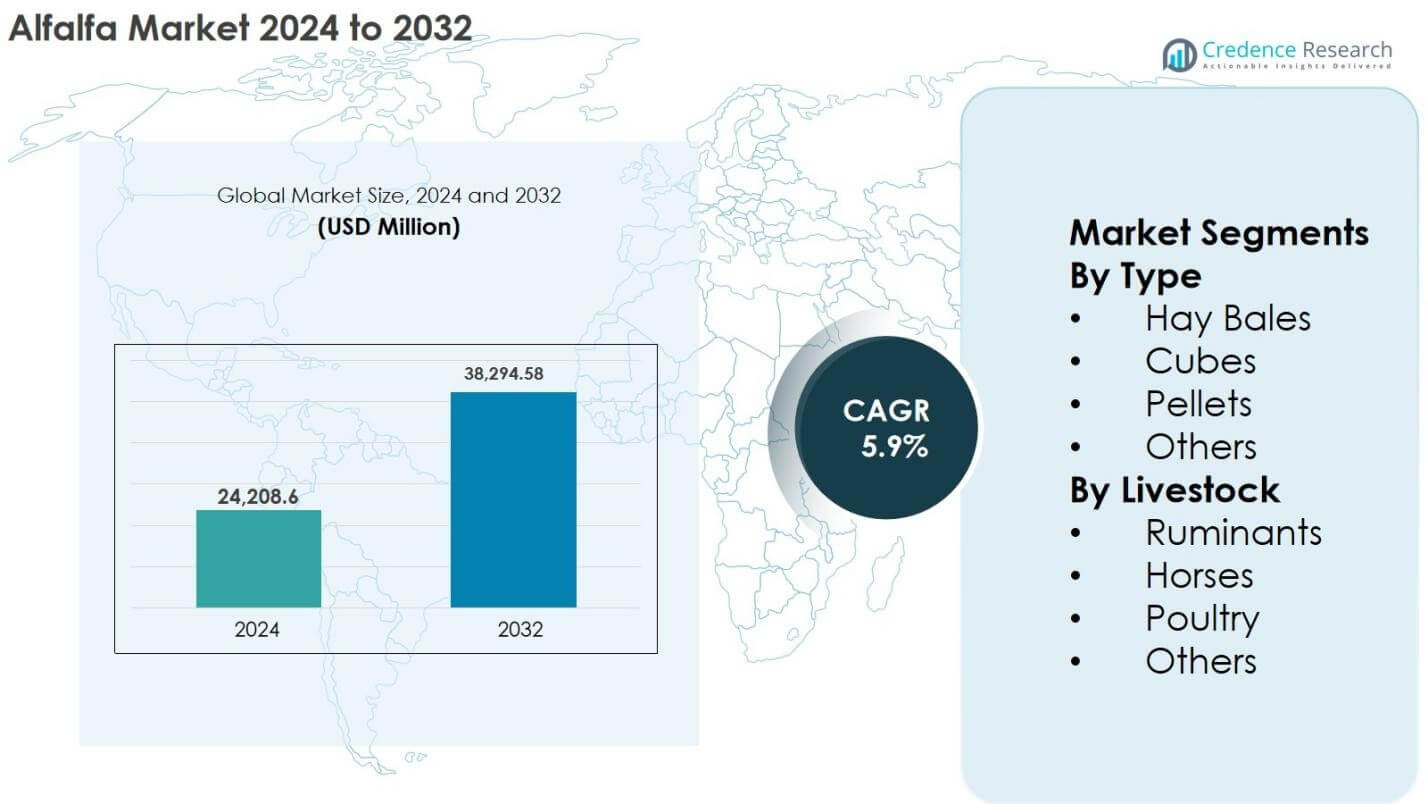
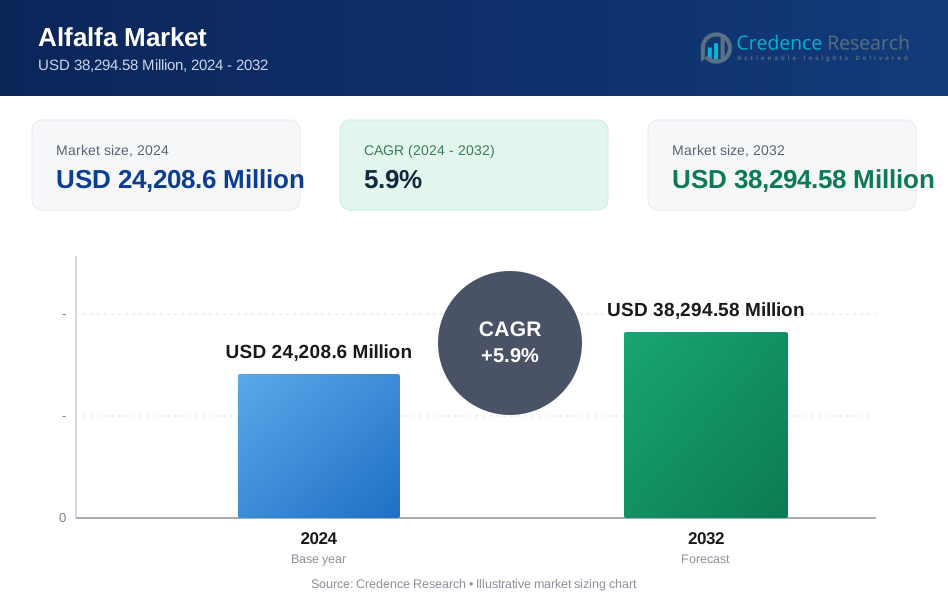
Alfalfa market size was valued at USD 24,208.6 million in 2024 and is projected to reach USD 38,294.58 million by 2032, implying a CAGR of 5.9% over the forecast period.
| REPORT ATTRIBUTE | DETAILS |
|---|---|
| Historical Period | 2020-2023 |
| Base Year | 2024 |
| Forecast Period | 2025-2032 |
| Alfalfa Market Size 2024 | USD 24,208.6 million |
| Alfalfa Market, CAGR | 5.9% |
| Alfalfa Market Size 2032 | USD 38,294.58 million |
Market activity is supported by global forage processors and export-oriented suppliers. Key players such as Anderson Hay & Grain Inc., Al Dahra ACX Global Inc., Standlee Premium Products LLC, Green Prairie International, Border Valley Trading, Cubeit Hay Company, Haykingdom Inc., Bailey Farms, Knight Ag Sourcing, and Alfalfa Monegros SL are expanding processing capacity, logistics capabilities, and value-added formats such as pellets and compressed bales. North America led in 2024 with a 34.6% share, supported by large-scale dairy and beef production and exports to Asia and the Middle East. Asia-Pacific accounted for 28.9% and is described as the fastest-growing region, linked to growth in commercial livestock farming and import demand for premium forage.
Alfalfa Market Insights
- The alfalfa market was valued at USD 24,208.6 million in 2024 and is expected to reach USD 38,294.58 million by 2032, growing at a CAGR of 5.9% during the forecast period.
- Demand is supported by use of high-protein forage in dairy and beef production, increased focus on feed efficiency, and wider adoption in commercial livestock diets. Ruminants represented 58.3% of demand in 2024, indicating the market’s concentration in cattle, sheep, and goat feed systems.
- Trends include higher adoption of value-added formats such as pellets and cubes, increased use of dehydrated hay in export supply chains, and process improvements in baling, storage, and handling that can improve quality consistency and logistics efficiency.
- Competition includes processors and exporters expanding capacity and infrastructure, including Anderson Hay & Grain Inc., Al Dahra ACX Global Inc., Standlee Premium Products LLC, Green Prairie International, and Border Valley Trading, supported by partnerships and long-term supply agreements.
- North America led in 2024 with a 34.6% share, followed by Asia-Pacific (28.9%), Europe (23.8%), Latin America (7.6%), and Middle East & Africa (5.1%). Regional shares reflect differences in livestock intensity, domestic forage availability, and reliance on imports.
Alfalfa Market Segmentation Analysis:
By Type
Hay bales accounted for 46.8% of the market in 2024. This share is linked to strong demand from dairy and beef producers, established handling practices, and bulk transport suitability within traditional forage supply chains. Pellets are growing as commercial operations adopt compact formats that support more consistent feed inclusion and longer shelf life. Cubes are gaining use in equine and specialty livestock programs where handling convenience and portioning are priorities. Other formats, including chopped and meal, are expanding with broader use of ration formulation and precision-feeding practices.
- For instance, Cargill’s Nutrena line includes alfalfa-based pelleted feeds positioned around more uniform protein and fiber content and improved storage stability for larger operations.
By Livestock
Ruminants represented 58.3% of the market in 2024. This reflects alfalfa’s fit for rations that require both protein and effective fiber for rumen function, supporting dairy and beef systems as well as sheep and goat production. Demand is supported by expansion in dairy and meat output in parts of Asia, Latin America, and the Middle East. Poultry remains smaller but is developing in specialty systems where forage blends are used. Other livestock demand is supported by diversified feeding applications within mixed farming systems. • For instance, the U.S. Dairy Forage Research Center and University of Wisconsin extension materials commonly describe alfalfa as a core forage component in high-producing dairy rations due to its effective fiber and rumen-degradable protein characteristics.
Alfalfa Market Key Growth Drivers
Rising Demand for High-Protein Livestock Feed
Alfalfa demand is primarily supported by its role as a protein- and fiber-rich forage used in dairy, beef, and small ruminant diets. Commercial livestock operations often use alfalfa to support productivity outcomes such as milk yield and feed conversion, particularly where ration balancing and consistent forage quality are prioritized. Expansion of intensive dairy and livestock systems in parts of Asia, the Middle East, and Latin America also supports demand. Adoption is further supported by improvements in cultivation and handling practices that can raise yield and stabilize quality, including irrigation upgrades and seed improvements. However, the extent of productivity gains depends on ration design, forage grade, and local feed economics.
- For instance, newer cultivars with improved drought tolerance and pest resistance are being adopted in some producing regions, and precision practices such as GPS-guided irrigation and variable-rate nutrient management are used to stabilize forage quality and resource efficiency.
Expansion of Export-Oriented Hay and Forage Trade
- Export demand supports market growth where feed-deficit regions depend on imported forage due to land and water constraints. Importers in East Asia and Gulf markets commonly source premium alfalfa from established producing regions to support expanding dairy and livestock industries. Investments in dehydration, densification, and container logistics can improve shipping efficiency and quality retention. Long-term supply agreements and demand for pellets and cubes also support trade flows. At the same time, exports remain exposed to freight costs, port constraints, and policy changes, which can affect price and availability.For instance, constraints on domestic water use in parts of Asia are associated with continued reliance on imported alfalfa from the United States and other origins for large-scale dairy operations.
Shift Toward Sustainable and Regenerative Farming Systems
Alfalfa cultivation can align with regenerative practices because the crop fixes nitrogen and is used in rotations to support soil structure and longer-term productivity. These attributes can reduce reliance on synthetic nitrogen inputs in some cropping systems and support soil health objectives. Drought-tolerant varieties and more efficient irrigation practices can strengthen suitability in semi-arid regions, though irrigation dependence remains a constraint in many producing areas. Policy incentives and sustainability-linked supply chain requirements may increase adoption, particularly where traceability and environmental claims influence procurement decisions.
Alfalfa Market Key Trends & Opportunities
Rising Adoption of Value-Added and Processed Alfalfa Products
Value-added formats such as pellets, cubes, and dehydrated meal are gaining share as commercial farms and feed manufacturers prioritize consistent quality, storage efficiency, and reduced handling losses. Processing improvements can help preserve nutrients and improve product stability for export markets. Equine and specialty livestock segments also support demand for standardized, portionable products. This trend enables processors to diversify revenue and reduce exposure to bulk hay price swings, although processing economics depend on energy costs, equipment utilization, and access to reliable raw material supply.
- For instance, Standlee Premium Western Forage produces alfalfa pellets and cubes positioned around controlled particle size and more uniform nutritional profiles for equine and livestock applications.
Opportunities in Precision Feeding and Emerging Livestock Markets
Precision-feeding adoption supports more structured use of alfalfa within ration optimization programs, particularly where producers use data-driven formulation to target performance and reduce waste. Emerging livestock categories such as goats and sheep, and niche segments such as premium equine feeding, can create incremental demand for specialized formats and higher-grade forage. In developing markets, projects aimed at improving smallholder productivity can expand forage use where irrigation, agronomy support, and market access are addressed.
- For instance, FAO and national extension initiatives have documented programs promoting improved forages, including alfalfa, to upgrade smallholder sheep and goat systems and reduce reliance on purchased concentrates.
Alfalfa Market Key Challenges
Climate Variability and Water Resource Constraints
Drought, irregular rainfall, and declining groundwater levels can reduce yield and increase variability in forage quality. In irrigation-dependent regions, rising water costs and tighter regulation can limit planted area or raise production costs. Heat stress and seasonal variability can also affect protein and fiber balance, creating inconsistency for processors and exporters. Producers increasingly adopt drought-tolerant varieties and efficient irrigation systems, but these responses can increase capital and operating requirements.
Price Volatility and Trade Dependency Risks
Pricing is sensitive to freight rates, currency movements, and trade policy changes that affect export competitiveness and importer purchasing decisions. Logistics disruptions can reduce supply reliability, and competition from alternative forages or plant-protein feeds can increase when alfalfa prices rise. Geopolitical risks, port congestion, and shipping constraints can affect delivery schedules and working capital. In response, market participants often diversify destinations, increase processing flexibility, and strengthen contract structures, though these measures may not fully offset external shocks.
Alfalfa Market Regional Analysis
North America
North America held 34.6% of the market in 2024, supported by large dairy and beef sectors, established forage management practices, and significant export volumes to Asia and the Middle East. Demand is reinforced by processing and logistics capabilities that support premium hay and processed formats such as pellets. Sustainability and rotation practices also support cultivation, while adoption of irrigation, baling, and storage technologies can improve quality consistency.
Europe
Europe accounted for 23.8% in 2024, supported by established dairy production, feed-quality requirements, and structured production systems in countries such as France, Spain, and Italy. Sustainability-focused reforms and rotation practices support integration of alfalfa in some cropping systems. However, climate variability and land-use constraints can influence output, increasing the importance of yield- and water-efficiency improvements.
Asia-Pacific
Asia-Pacific represented 28.9% in 2024 and is described as the fastest-growing region. Demand is linked to expansion of commercial dairy and livestock operations and continued reliance on imports in several markets due to limited domestic forage resources. Adoption of pellets and cubes in integrated feed programs supports growth, and improvements in distribution and storage infrastructure can increase penetration of higher-grade forage products.
Latin America
Latin America held 7.6% in 2024, supported by expansion in beef and dairy systems and gradual adoption of improved forage practices. Growth is moderated by climate variability, uneven mechanization, and competition from alternative forage crops in some areas. Investments in irrigation efficiency, seed development, and export-grade processing could improve longer-term positioning where economics support scaling.
Middle East & Africa
Middle East & Africa accounted for 5.1% in 2024, with demand concentrated in import-reliant Gulf markets supporting intensive dairy and camel production. Water scarcity and land constraints limit domestic output, reinforcing dependence on international suppliers and long-term trade relationships. Some African markets are expanding cultivation through irrigation and livestock productivity programs, but high logistics costs and water-related policy restrictions continue to limit large-scale production.
Alfalfa Market Segmentations:
By Type
- Hay Bales
- Cubes
- Pellets
- Others
By Livestock
- Ruminants
- Horses
- Poultry
- Others
By Geography
- North America
- U.S.
- Canada
- Mexico
- Europe
- Germany
- France
- U.K.
- Italy
- Spain
- Rest of Europe
- Asia Pacific
- China
- Japan
- India
- South Korea
- South-east Asia
- Rest of Asia Pacific
- Latin America
- Brazil
- Argentina
- Rest of Latin America
- Middle East & Africa
- GCC Countries
- South Africa
- Rest of the Middle East and Africa
Competitive Landscape
The competitive landscape is moderately consolidated, with established processors, exporters, and integrated feed suppliers operating across global and regional markets. Key players include Anderson Hay & Grain Inc., Al Dahra ACX Global Inc., Standlee Premium Products LLC, Green Prairie International, Border Valley Trading, Cubeit Hay Company, Haykingdom Inc., Bailey Farms, Knight Ag Sourcing, and Alfalfa Monegros SL. Competitive strategies commonly include investment in dehydration and densification capacity, adoption of advanced baling and storage practices, and operation of quality-certified export programs. Companies are also expanding value-added formats such as pellets, cubes, and compressed bales to serve dairy, equine, and commercial livestock customers. Partnerships with distributors, long-term supply agreements with import-reliant markets, and investment in logistics hubs support market access. Differentiation increasingly relies on nutritional consistency, traceability, and sustainability-related claims in higher-grade segments, although the ability to substantiate such claims depends on data quality and certification scope.
Key Player Analysis
- Green Prairie International
- Anderson Hay & Grain Inc.
- Haykingdom Inc.
- Cubeit Hay Company
- Al Dahra ACX Global Inc.
- Standlee Premium Products, LLC
- Bailey Farms
- Alfalfa Monegros SL
- Border Valley Trading
- Knight Ag Sourcing
Recent Developments
In December 2025, DLF North America launched its “We Love Alfalfa” campaign aimed at promoting the crop’s role and encouraging collaboration across the industry.
In October 2025, Leaft Foods launched an Alfalfa Protein Concentrate (APC) product for pet food and entered a distribution partnership with Meateor Pet Food Ingredients New Zealand to serve the U.S. market, with European expansion planned for 2026.
Report Coverage
The report analyzes the market by type, livestock, and geography. It profiles key companies by business focus and product positioning and reviews competitive dynamics, including drivers, constraints, and current trends. It also considers market dynamics, regulatory context, and technology developments influencing production, processing, and distribution. The analysis discusses external factors and macroeconomic conditions that may affect demand and provides strategic considerations for new entrants and established participants.
Future Outlook
- The market is expected to expand as livestock producers increase use of higher-protein forage to support dairy and beef productivity.
- Export demand is expected to remain important where feed-deficit regions rely on imports to support commercial livestock growth.
- Pellets, cubes, and dehydrated meal are expected to gain share due to handling efficiency, storage benefits, and more standardized nutrition.
- Processing and handling improvements in baling density, dehydration, and nutrient preservation are expected to support quality consistency and supply reliability.
- Regenerative and sustainability-oriented farming practices are expected to support alfalfa rotation use where water and land economics allow.
- Precision-feeding adoption is expected to increase structured inclusion of alfalfa in commercial ration formulations.
- Irrigation efficiency investments and drought-tolerant varieties are expected to remain central to managing climate and water risks.
- Consolidation is possible as leading exporters expand capacity and strengthen long-term supply agreements, though smaller regional suppliers may persist in local markets.
- Specialty livestock and premium equine nutrition are expected to support demand for higher-grade and processed alfalfa formats.
- Trade policy, logistics capacity, and infrastructure upgrades are expected to influence global supply reliability and pricing volatility.
Request a Free Sample
Fill in your details and we'll send you a free sample report.
- Sample data tables & charts
- Research methodology
Need a Custom Version of This Report?
Tailor the scope, geography, or segments to your exact requirements.
- Custom geography or segment scope
- Direct access to our analyst team
Frequently Asked Questions
What is the current market size for Alfalfa Market, and what is its projected size in 2032?
At what Compound Annual Growth Rate is the Alfalfa Market projected to grow between 2024 and 2032?
Which Alfalfa Market segment held the largest share in 2024?
What are the primary factors fueling the growth of the Alfalfa Market?
Who are the leading companies in the Alfalfa Market?
Which region commanded the largest share of the Alfalfa Market in 2024?
Table of Content
Chapter 1. Report Introduction
- 1.1 Report Description & Purpose
- 1.1.1 Report Title & Market Definition
- 1.1.2 Unique Selling Propositions (USP) & Key Differentiators
- 1.1.3 Value Proposition for Stakeholders
- 1.2 Research Objectives
- 1.2.1 Market Sizing Objectives (Volume & Revenue)
- 1.2.2 Segmentation Objectives
- 1.2.3 Competitive Intelligence Objectives
- 1.2.4 Forecast & Scenario Objectives
- 1.3 Report Scope
- 1.3.1 Alfalfa Scope – Types & Subtypes Covered
- 1.3.2 Geographic Scope – Regions & Countries Covered
- 1.3.3 Historical Period, Base Year & Forecast Period (2024; forecast to 2032)
- 1.3.4 Inclusions & Exclusions
- 1.4 HS Code & Classification Framework
- 1.5 Currency, Units & Pricing Basis
- 1.6 Target Stakeholders
- 1.7 Limitations & Assumptions
Chapter 2. Executive Summary
- 2.1 Global Alfalfa Market Snapshot
- 2.1.1 Market Size – Historical (2024) & Forecast (2024-2032) (2024: USD 24,208.6 Million → 2032: USD 38,294.58 Million)
- 2.1.2 Volume & Revenue – Global Totals
- 2.1.3 Key Market Highlights – Top Five Facts
- 2.2 Alfalfa Market Segmentation Snapshot
- 2.2.1 Market Split by Region – 2024 vs. 2032
- 2.3 Competitive Snapshot
- 2.3.1 Top 10 Players by Revenue Share – 2024
- 2.3.2 Top 10 Players by Volume Share – 2024
- 2.3.3 Recent Strategic Developments (18-Month Summary)
- 2.4 Key Investment Highlights & Strategic Conclusions
Chapter 3. Alfalfa Market Dynamics & Industry Analysis
- 3.1 Market Overview & Context
- 3.1.1 Alfalfa Market Position in the Broader Automotive Value Chain
- 3.1.2 OEM vs. Replacement Market Dynamics
- 3.1.3 Market Maturity & Development Stage by Region
- 3.2 Alfalfa Market Drivers
- 3.3 Alfalfa Market Restraints & Challenges
- 3.4 Alfalfa Market Opportunities
- 3.5 Porter's Five Forces Analysis
- 3.5.1 Threat of New Entrants
- 3.5.2 Bargaining Power of Suppliers
- 3.5.3 Bargaining Power of Buyers
- 3.5.4 Threat of Substitutes
- 3.5.5 Competitive Rivalry – Intensity Assessment
- 3.6 Alfalfa Value Chain Analysis
- 3.6.1 Upstream – Raw Material/Input Suppliers
- 3.6.1.1 Raw Material/Input 1
- 3.6.1.2 Raw Material/Input 2
- 3.6.1.3 Raw Material/Input 3
- 3.6.2 Midstream – Production/Manufacturing/Service Delivery
- 3.6.2.1 Production/Process Overview
- 3.6.2.2 Key Facility Locations & Capacity by Manufacturer
- 3.6.3 Downstream – Distribution & End Consumer
- 3.6.3.1 Primary Channel – B2B/OEM
- 3.6.3.2 Secondary Channels – Dealer, Retail, Online, Direct
- 3.6.4 Value Chain Profitability Analysis
- 3.6.1 Upstream – Raw Material/Input Suppliers
- 3.7 PESTEL Analysis
- 3.7.1 Political Factors
- 3.7.2 Economic Factors
- 3.7.3 Social Factors
- 3.7.4 Technological Factors
- 3.7.5 Environmental Factors
- 3.7.6 Legal Factors
- 3.8 Alfalfa Supply Chain Analysis
- 3.8.1 Raw Material/Input Supply Risk Assessment
- 3.8.2 Manufacturing Concentration Risk (Geographic Exposure)
- 3.8.3 Trade Disruption Impact Analysis
- 3.9 Regulatory & Policy Landscape
Note: The regulatory and policy landscape section covers regulations based on their applicability to the market, Alfalfa category, geography, and scope of the study. Only regulatory frameworks with a material impact on operations, compliance, trade, sustainability, or market access are analyzed in detail.
Chapter 4. Key Investment Pockets & Opportunity Analysis
- 4.1 Alfalfa Market Attractiveness Analysis
- 4.1.1 By Region – Investment Attractiveness Matrix (Volume × CAGR)
- 4.2 Absolute Revenue Growth Opportunity
- 4.2.1 By Region – Absolute USD Growth Through 2032
- 4.3 Incremental Volume Opportunity
- 4.3.1 By Region – Incremental Volume Through 2032
- 4.3.2 Segment – Incremental Volume
- 4.4 Emerging Submarket Opportunity Deep Dive (Subject to Applicability)
- 4.5 Emerging Market Opportunity Scorecards
- 4.5.1 United States
- 4.5.2 Europe
- 4.5.3 Asia
- 4.5.4 Middle East & Africa
Note: Emerging Market Opportunity Scorecards will be included based on relevance and strategic importance. Regions listed are indicative and may vary depending on data availability and market dynamics.
Chapter 5. Alfalfa Import-Export Analysis & Trade Flows
- 5.1 Global Trade Overview
- 5.1.1 Global Export Value by Country (2024)
- 5.1.2 Global Export Volume by Country (2024)
- 5.1.3 Global Import Value by Country (2024)
- 5.1.4 Global Import Volume by Country (2024)
- 5.1.5 Net Trade Balance by Country (2024)
- 5.2 Export Analysis – Segment
- 5.2.1 Type 1 (HS Code)
- 5.2.2 Type 2 (HS Code)
- 5.2.3 Type 3 (HS Code)
- 5.2.4 Type 4 (HS Code)
- 5.2.5 Type 5 (HS Code)
- 5.3 Import Analysis – Segment
- 5.3.1 Type 1 (HS Code)
- 5.3.2 Type 2 (HS Code)
- 5.3.3 Type 3 (HS Code)
- 5.3.4 Type 4 (HS Code)
- 5.3.5 Type 5 (HS Code)
- 5.4 Average Unit Trade Prices
- 5.4.1 Average Export Price – Segment & Country
- 5.4.2 Average Import Price – Segment & Source Country
- 5.4.3 Price Trends (2024)
- 5.5 Key Trade Route Analysis
- 5.5.1 Trade Route 1
- 5.5.2 Trade Route 2
- 5.5.3 Trade Route 3
- 5.5.4 Trade Route 4
- 5.5.5 Trade Route 5
- 5.6 Trade Policy Impact Assessment
- 5.6.1 US Anti-Dumping & Section 301 Tariffs
- 5.6.2 EU Customs Union Impact
- 5.6.3 Major Free Trade Agreements
- 5.6.4 USMCA Rules of Origin
Note: Trade policy analysis will be included only where relevant to the Alfalfa market.
Chapter 6. Competitive Landscape & Company Benchmarking
- 6.1 Alfalfa Market Concentration & Structure
- 6.1.1 Herfindahl-Hirschman Index (HHI) – vs. 2024
- 6.1.2 Tier 1, Tier 2 & Tier 3 Market Structure
- 6.1.3 Global, Regional & Local Player Dynamics
- 6.2 Alfalfa Market Share Analysis – 2024
- 6.2.1 Global Revenue Share by Company
- 6.2.2 Global Volume Share by Company
- 6.2.3 Regional Revenue Share
- 6.2.4 Market Share Evolution ( vs. 2024)
- 6.2.5 OEM Segment Share by Company
- 6.2.6 Replacement Segment Share by Company
- 6.3 Production/Delivery Capacity & Facility Analysis
- 6.3.1 Global Installed Capacity
- 6.3.2 Capacity Utilization Rates
- 6.3.3 Production/Output Volume
- 6.3.4 Facility Locations & Capacity Map
- 6.3.5 Planned Capacity Additions
- 6.4 Alfalfa Competitive Benchmarking Matrix
- 6.4.1 Revenue, Volume, CAGR & Profitability Comparison
- 6.4.2 Channel Revenue Mix
- 6.4.3 Geographic Revenue Exposure
- 6.4.4 R&D Intensity
- 6.4.5 Sustainability Maturity
- 6.5 Strategic Developments in Alfalfa (Last 24 Months)
- 6.5.1 Mergers, Acquisitions & Divestments
- 6.5.2 New Alfalfa Launches
- 6.5.3 Facility Expansions
- 6.5.4 Strategic Alliances, Joint Ventures & Partnerships
- 6.5.5 Distribution Expansion & Market Entry
- 6.5.6 Sustainability & ESG Initiatives
- 6.6 Competitive Strategy Mapping
- 6.6.1 Leader, Challenger, Follower & Niche Classification
- 6.6.2 Pricing Strategy Comparison
- 6.6.3 Channel Strategy Matrix
Note: Strategic developments are included based on their materiality and the availability of reliable information.
Chapter 7. Global Alfalfa Market – By Distribution Channel
- 7.1 Segment Overview
- 7.1.1 Volume & Revenue Split by Channel (2024 & 2032)
- 7.1.2 Channel Mix Evolution (2024-2032)
Chapter 8. Regional Market Analysis – Global Overview
- 8.1 Global Regional Overview
- 8.1.1 Regional Volume Share
- 8.1.2 Regional Revenue Share
- 8.1.3 Regional Volume by Region
- 8.1.4 Regional Revenue by Region
- 8.1.5 Regional Forecast Through 2032
- 8.2 Cross-Regional Segment Analysis
- 8.2.1 By Distribution Channel
- 8.2.2 By Brand/Price Tier
Chapter 9. North America Alfalfa Market
- 9.1 United States
- 9.2 Canada
- 9.3 Mexico
Chapter 10. Europe Alfalfa Market
- 10.1 Germany
- 10.2 France
- 10.3 Italy
- 10.4 United Kingdom
- 10.5 Spain
- 10.6 Poland
- 10.7 Russia
- 10.8 Netherlands
- 10.9 Belgium
- 10.10 Sweden
- 10.11 Denmark
- 10.12 Norway
- 10.13 Rest of Europe
Chapter 11. Asia Pacific Alfalfa Market
- 11.1 China
- 11.2 India
- 11.3 Japan
- 11.4 South Korea
- 11.5 Thailand
- 11.6 Indonesia
- 11.7 Vietnam
- 11.8 Malaysia
- 11.9 Australia
- 11.10 Rest of Asia Pacific
Chapter 12. Latin America Alfalfa Market
- 12.1 Brazil
- 12.2 Argentina
- 12.3 Colombia
- 12.4 Chile
- 12.5 Rest of Latin America
Chapter 13. Middle East Alfalfa Market
- 13.1 Saudi Arabia
- 13.2 United Arab Emirates
- 13.3 Turkey
- 13.4 Israel
- 13.5 Iran
- 13.6 Rest of the Middle East
Chapter 14. Africa Alfalfa Market
- 14.1 South Africa
- 14.2 Egypt
- 14.3 Nigeria
- 14.4 Morocco
- 14.5 Rest of Africa
Chapter 15. Alfalfa Company Profiles
- 15.1 [Company 01]
- 15.1.1 Company Overview
- 15.1.2 Key Management Personnel
- 15.1.3 Products & Services Portfolio
- 15.1.4 Financial Performance
- 15.1.5 Key Market Focus & Geographic Presence
- 15.1.6 Recent Developments & Strategic Initiatives
Note: The company profile list is preliminary and may change based on research findings, market developments, data availability, and client requirements.
Chapter 16. Appendices
- Appendix A – List of Abbreviations & Acronyms
- Appendix B – Industry Classification Code Reference – Full Series
- Appendix C – Production & Capacity Data Tables
- Appendix D – End-Use & Demand Base Tables
- Appendix E – Consumption & Replacement Rate Assumptions
- Appendix F – ASP Reference Tables
- Appendix G – Manufacturing & Facility Database
- Appendix H – Import-Export Data Tables
- Appendix I – Regulatory Summary Tables
- Appendix J – Primary Research Participant List (Anonymized)
- Appendix K – Primary Research Questionnaire Framework
- Appendix L – Data Sources & Bibliography
- Appendix M – Market Size Divergence & Source Comparison
Chapter 17. Research Methodology
- 17.1 Research Framework & Philosophy
- 17.2 Secondary Research – Sources, Hierarchy & Data Extraction
- 17.3 Data Modeling – Bottom-Up & Top-Down Market Sizing
- 17.4 Primary Research – Stakeholder Framework, LOI & Sample Sizes
- 17.5 Forecast Methodology – Regression, Scenario & Sensitivity Analysis
- 17.6 Quality Control – Four-Layer Validation Framework
- 17.7 Limitations & Standard Assumptions
- 17.8 Disclaimer
