
Market Overview
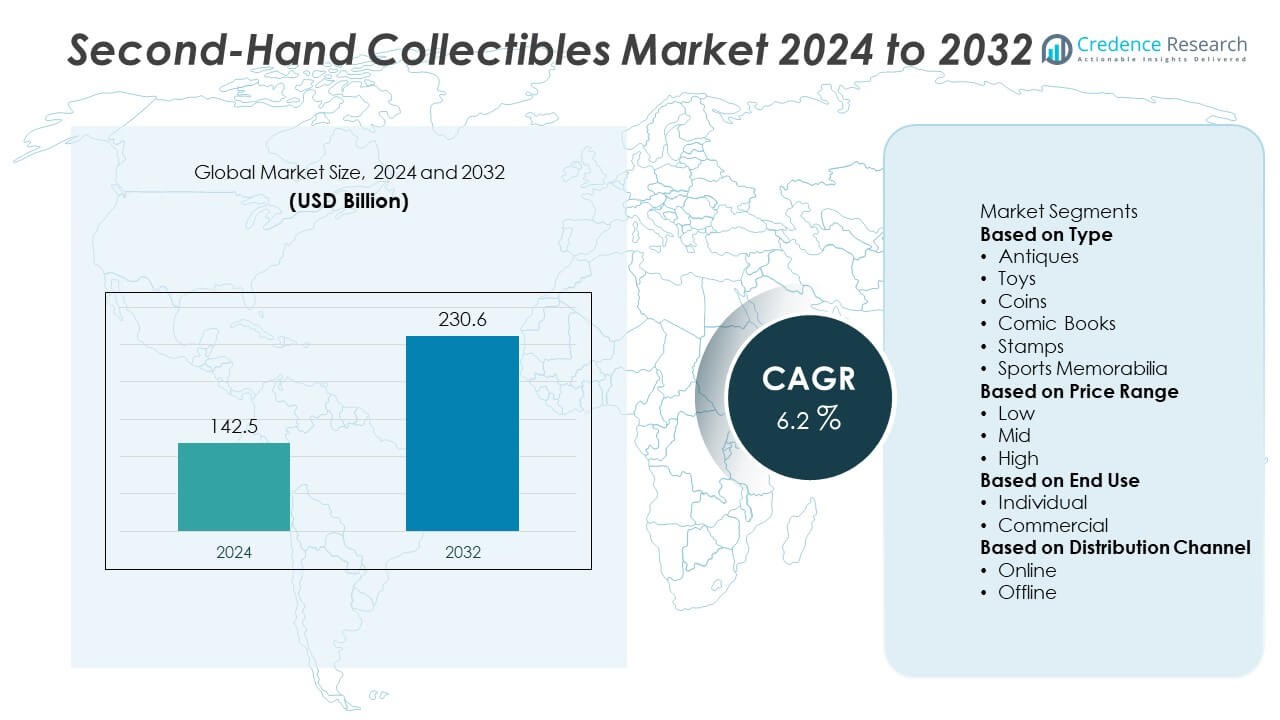
The Second-Hand Collectibles Market was valued at USD 142.5 billion in 2024 and is projected to reach USD 230.6 billion by 2032, expanding at a CAGR of 6.2% during the forecast period.
| REPORT ATTRIBUTE | DETAILS |
|---|---|
| Historical Period | 2020-2024 |
| Base Year | 2024 |
| Forecast Period | 2025-2032 |
| Second-Hand Collectibles Market Size 2024 | USD 142.5 Billion |
| Second-Hand Collectibles Market, CAGR | 6.2% |
| Second-Hand Collectibles Market Size 2032 | USD 230.6 Billion |
The Second-Hand Collectibles Market grows on the back of rising consumer interest in vintage, rare, and limited-edition items supported by cultural nostalgia and investment value. It benefits from digital platforms and online auctions that expand access, improve transparency, and connect global buyers with niche collectibles.
The Second-Hand Collectibles Market shows robust activity across North America, Europe, and Asia-Pacific, driven by high consumer engagement, cultural affinity for rare items, and growing online adoption. North America leads with a mature collector base, supported by strong e-commerce penetration and established auction houses, which enhance accessibility to both vintage and contemporary collectibles. Europe follows closely, fueled by a rich heritage of art, antiques, and historical memorabilia, encouraging both local and international buyers to participate in the market. Asia-Pacific experiences rapid growth due to increasing disposable incomes, expanding middle-class populations, and rising interest in Western pop culture and rare collectibles. Key players shaping this regional landscape include eBay, Christie's, Heritage Auctions, and Bonhams, all of which leverage technological innovations, extensive networks, and global auction events to connect buyers and sellers efficiently. Their presence underlines the importance of digital platforms and trusted brands in driving market growth.
Market Insights
- The Second-Hand Collectibles Market size was valued at USD 142.5 billion in 2024 and is anticipated to reach USD 230.6 billion by 2032, growing at a CAGR of 6.2% during the forecast period.
- Rising consumer interest in rare and vintage items drives demand, supported by increasing disposable incomes and cultural appreciation for collectibles.
- Growing adoption of online platforms and auction sites enhances accessibility and convenience, allowing collectors to participate in global sales.
- Key players such as eBay, Christie's, Heritage Auctions, and Bonhams dominate the market, leveraging strong brand reputation, extensive networks, and digital engagement strategies.
- Challenges include authenticity verification, counterfeit risks, and inconsistent supply of rare items, which can affect buyer confidence and market stability.
- North America leads the market with high collector engagement and strong online infrastructure, Europe shows growth due to historical art and antiques, and Asia-Pacific demonstrates rapid expansion driven by increasing interest in global pop culture collectibles.
- Emerging markets present opportunities through digitization of auction processes, mobile commerce, and collaborations between local sellers and international platforms, enhancing market reach and customer engagement.
Market Drivers
Rising Consumer Interest in Vintage and Rare Items
The Second-Hand Collectibles Market benefits from growing consumer enthusiasm for vintage, rare, and nostalgic items. It attracts collectors seeking unique pieces such as rare coins, stamps, trading cards, and memorabilia. The surge in cultural appreciation for retro and heritage products reinforces steady demand. It also gains momentum from younger consumers who value authenticity and exclusivity over mass-produced goods. Marketplaces both online and offline create greater visibility and accessibility for niche collectibles. This factor strengthens consistent demand across diverse buyer segments.
- For instance, As of Q1 2025, eBay hosts approximately 2.3 billion active listings across its various categories, which includes a wide range of items such as electronics, collectibles, luxury goods, and fashion
Digital Platforms and E-Commerce Expansion
It grows strongly with the expansion of e-commerce platforms that simplify access to collectibles on a global scale. Online auction sites, specialized resale platforms, and peer-to-peer marketplaces facilitate secure transactions and broaden market reach. It benefits from the integration of authentication tools and digital certificates that improve buyer trust. Social media platforms amplify visibility for sellers and drive consumer engagement in collectible communities. Global connectivity allows niche items to reach buyers who previously had limited access. This driver positions technology as a central factor in reshaping industry dynamics.
- For instance, Christie's issued blockchain‑based digital certificates of ownership for 130 lots in a photography auction, utilizing technology to enhance provenance tracking and trust in high‑value collectible transactions
Sustainability and Circular Economy Preferences
It gains traction from the rising appeal of sustainable consumption and circular economy practices. Consumers increasingly purchase pre-owned collectibles to reduce waste and promote reuse of valuable resources. The market reflects a broader cultural shift where consumers prioritize environmental responsibility alongside personal interest. It also strengthens through corporate and platform-level initiatives promoting certified resale and recycling. Growing emphasis on sustainability aligns well with the demand for durable items with long life cycles. This driver reinforces the market’s relevance in both ethical and lifestyle-based consumption.
Rising Wealth and Investment Value of Collectibles
It benefits from increasing recognition of collectibles as investment-grade assets. Rare items such as luxury watches, vintage artworks, and limited-edition products appreciate in value over time, attracting both casual collectors and serious investors. The market reflects rising participation from high-net-worth individuals and institutional buyers diversifying portfolios. It gains momentum from dedicated auction houses and online platforms offering transparent valuation and global reach. Collectibles are also viewed as hedges against economic volatility, supporting sustained demand. This driver underscores the dual role of collectibles as both passion-driven purchases and financial assets.
Market Trends
Growing Popularity of Online Auctions and Digital Marketplaces
The Second-Hand Collectibles Market shows strong momentum through the expansion of online auctions and specialized resale platforms. It reflects shifting consumer preference toward digital channels that offer transparency, competitive pricing, and global accessibility. Buyers increasingly rely on online platforms for rare stamps, vintage sports memorabilia, and trading cards. It also benefits from secure payment solutions and integrated authentication services that build trust. The convenience of digital auctions accelerates participation from younger demographics and international buyers. This trend establishes online marketplaces as central hubs for collectible transactions worldwide.
- For instance, as of Q2 2025, eBay reported having approximately 2.4 billion live listings and 1 million active buyers globally, demonstrating the vast scale and reach that digital marketplaces offer to collectible enthusiasts
Integration of Authentication and Blockchain Solutions
It demonstrates increasing adoption of authentication technologies to address concerns of counterfeiting and value misrepresentation. Platforms use blockchain, digital certificates, and AI-powered verification to ensure product authenticity. Collectors of luxury watches, rare coins, and artworks value these tools for preserving credibility and resale value. It also benefits from strategic partnerships between marketplaces and authentication service providers. Blockchain records provide immutable proof of ownership and transaction history, which reassures buyers. This trend strengthens transparency and enhances the long-term growth of the market.
- For instance, Christie's partnered with crypto wallet Kresus to issue permanent, blockchain-backed digital ownership certificates for 132 lots at their October 2, 2024 photography auction in New York, leveraging Coinbase's Base blockchain.
Rising Influence of Pop Culture and Limited Editions
It experiences higher demand for collectibles tied to pop culture, entertainment, and limited-edition releases. Trading cards, comic books, and movie memorabilia attract younger generations influenced by digital fandom and nostalgia. The popularity of streaming platforms and gaming culture further boosts interest in related merchandise. It also records strong engagement for limited-edition sneakers, designer collaborations, and exclusive collectibles. Celebrity endorsements and partnerships add aspirational value to products in high demand. This trend reflects cultural shifts that expand the appeal of collectibles beyond traditional collector bases.
Sustainability and Ethical Collecting Practices
It gains traction from growing awareness of sustainability and ethical sourcing in the resale market. Collectors prefer second-hand items that promote reuse, durability, and reduced environmental impact. It also benefits from resale platforms adopting green certifications and sustainable packaging practices. The shift toward conscious consumerism encourages demand for pre-owned luxury items and antiques. Institutional players highlight the environmental benefits of extending product life cycles through certified resale. This trend positions sustainability as a defining feature of future market growth.
Market Challenges Analysis
Authentication Risks and Counterfeit Concerns
The Second-Hand Collectibles Market faces persistent challenges from counterfeit products and fraudulent transactions. It struggles when rare coins, artworks, and luxury items are misrepresented or replicated with advanced forgeries. Authentication remains costly and time-intensive, which discourages smaller platforms and independent sellers. It often requires specialized expertise and third-party verification to maintain buyer trust. The lack of standardized global certification systems increases risk for investors and collectors. These challenges slow market confidence and highlight the need for scalable, transparent authentication solutions across categories.
Market Fragmentation and Pricing Volatility
It encounters hurdles from fragmented market structures and inconsistent pricing mechanisms. Collectibles often lack standardized valuation, leading to disparities between auction prices, retail listings, and peer-to-peer transactions. It also faces volatility driven by shifting consumer interests, cultural trends, and speculative demand. Smaller sellers and regional markets struggle to compete with global platforms that dominate visibility. Regulatory variations across countries complicate cross-border transactions and logistics. These conditions create uncertainty for buyers and investors, making price stability and transparency critical challenges in sustaining long-term growth.
Market Opportunities
Expansion of Digital Marketplaces and Global Reach
The Second-Hand Collectibles Market creates strong opportunities through the expansion of digital platforms that connect buyers and sellers worldwide. It benefits from online auctions, resale apps, and specialized e-commerce platforms that simplify access to rare and vintage items. Integration of secure payment systems and digital authentication tools further enhances trust and transaction speed. It also enables niche collectibles such as trading cards, rare books, and vintage fashion to reach new audiences across international borders. The growing adoption of mobile platforms broadens participation among younger demographics. This opportunity reinforces the role of technology in scaling the industry and driving consistent engagement.
Rising Appeal of Collectibles as Investment Assets
It gains opportunities from the increasing recognition of collectibles as alternative investments with long-term value potential. Investors view rare coins, luxury watches, and limited-edition items as appreciating assets that diversify portfolios. It also benefits from institutional support, with auction houses and financial firms offering valuation services and collectible funds. Rising participation from high-net-worth individuals strengthens demand for exclusive items that hold both cultural and financial significance. It creates potential for platforms to develop tools for pricing transparency and investment tracking. This opportunity positions collectibles as dual-purpose assets, fulfilling both lifestyle aspirations and financial strategies.
Market Segmentation Analysis:
By Type
The Second-Hand Collectibles Market shows strong segmentation by type, covering categories such as coins, stamps, art, antiques, trading cards, luxury goods, and memorabilia. It reflects consistent demand for traditional items like coins and stamps that appeal to long-standing collector bases, while trading cards and pop culture memorabilia attract younger audiences. Art and antiques hold significant appeal due to their cultural and historic value, often commanding higher resale prices. Luxury collectibles, including watches, handbags, and jewelry, gain attention from buyers seeking exclusivity and investment-grade assets. It also records steady growth in niche categories such as sports memorabilia and vintage fashion, which expand appeal across demographics. This segmentation demonstrates the diversity of buyer motivations, from passion-driven purchases to financial investments.
- For instance, Heritage Auctions maintains a publicly searchable archive of 7 million past auction records, covering such diverse collectible types-from coins to comic art to vintage memorabilia-demonstrating the platform’s ability to serve collectors across the full range of market segments
By Price Range
It exhibits clear variation across price ranges, spanning low, mid, and premium segments. Low-priced collectibles appeal to mass-market buyers who value affordability and entry-level engagement. Mid-range items capture a wide customer base, including hobbyists and enthusiasts seeking authenticity without excessive cost. Premium collectibles dominate auctions and specialized platforms, supported by demand from high-net-worth individuals and serious investors. It highlights the importance of transparent valuation and authentication in premium transactions to ensure buyer trust. The segmentation also reflects regional differences, with emerging economies showing stronger interest in mid- and low-range products, while developed markets emphasize premium categories. This diversity ensures a balanced demand structure across multiple tiers of consumers.
- For instance, Heritage Auctions reported over 2 million registered online bidder-members as of May 2025, underscoring the platform’s capacity to engage collectors across all price ranges-from entry-level to ultra-premium-demonstrating its wide-reaching influence across diverse price segments
By End Use
It demonstrates segmentation by end use, primarily divided into personal, investment, and institutional categories. Personal use drives demand from collectors motivated by passion, nostalgia, and cultural appreciation. Investment use continues to expand as collectibles gain traction as alternative assets with long-term appreciation potential. Institutional buyers, including museums, auction houses, and galleries, contribute through acquisitions for cultural preservation and exhibitions. It also reflects growing activity from online platforms that cater to both personal and investment buyers with tailored services. This segmentation highlights the evolving nature of demand where collectibles fulfill dual roles as lifestyle products and financial instruments.
Segments:
Based on Type
- Antiques
- Toys
- Coins
- Comic Books
- Stamps
- Sports Memorabilia
Based on Price Range
- Low
- Mid
- High
Based on End Use
- Individual
- Commercial
Based on Distribution Channel
- Online
- Offline
Based on the Geography:
- North America
- U.S.
- Canada
- Mexico
- Europe
- UK
- France
- Germany
- Italy
- Spain
- Russia
- Belgium
- Netherlands
- Austria
- Sweden
- Poland
- Denmark
- Switzerland
- Rest of Europe
- Asia Pacific
- China
- Japan
- South Korea
- India
- Australia
- Thailand
- Indonesia
- Vietnam
- Malaysia
- Philippines
- Taiwan
- Rest of Asia Pacific
- Latin America
- Brazil
- Argentina
- Peru
- Chile
- Colombia
- Rest of Latin America
- Middle East
- UAE
- KSA
- Israel
- Turkey
- Iran
- Rest of Middle East
- Africa
- Egypt
- Nigeria
- Algeria
- Morocco
- Rest of Africa
Regional Analysis
North America
North America holds around 28% of the global Second-Hand Collectibles Market share, supported by strong consumer interest in antiques, trading cards, and sports memorabilia. The United States dominates the region, with cultural enthusiasm for baseball cards, comic books, and vintage sports equipment driving consistent demand. It benefits from a mature resale ecosystem, including online platforms, auction houses, and specialty stores. Canada adds steady demand, particularly in art and vintage furniture, reflecting cultural appreciation for unique items. Digital marketplaces such as eBay and StockX expand access to collectibles and strengthen cross-border transactions. Rising investment-oriented purchases, including rare coins and luxury watches, also contribute to sustained growth. The region emphasizes authentication and transparency, which increases buyer confidence in higher-value categories.
Europe
Europe accounts for approximately 30% of the Second-Hand Collectibles Market share, making it one of the most dominant regions globally. The market reflects centuries-old traditions of collecting antiques, fine art, and rare coins. The UK, Germany, France, and Italy serve as key hubs, supported by well-established auction houses such as Sotheby’s and Christie’s. It also benefits from growing demand for vintage fashion, classic cars, and limited-edition luxury items. The region shows higher penetration of premium-priced collectibles, appealing to high-net-worth individuals and investors. Cross-border trading is facilitated by integrated digital platforms that enhance transparency and accessibility. Europe’s strict regulations on authentication and provenance records ensure trust in the resale ecosystem, which sustains premium demand.
Asia-Pacific
Asia-Pacific leads the global Second-Hand Collectibles Market with an estimated 34% market share, supported by rapid growth in China, Japan, South Korea, and India. It reflects strong demand for luxury goods, pop culture collectibles, and rare antiques. China dominates the regional market with rising interest in traditional art, stamps, and jewelry, while Japan maintains its position as a hub for anime, manga, and gaming collectibles. South Korea’s K-pop and entertainment-driven memorabilia expand appeal among younger buyers. India shows growing demand for coins, art, and cultural artifacts, driven by a rising middle class and expanding online resale platforms. The region also benefits from rapid adoption of mobile commerce, which strengthens cross-border trade opportunities. Asia-Pacific emphasizes both affordability for mass markets and exclusivity for premium buyers, ensuring balanced growth across segments.
Latin America
Latin America contributes about 5% of the Second-Hand Collectibles Market share, with Brazil, Mexico, and Argentina as leading contributors. The market reflects steady interest in cultural antiques, regional artwork, and sports memorabilia, particularly football-related items. It faces challenges from limited infrastructure and regulatory gaps that affect authentication and pricing consistency. Online platforms are expanding visibility and improving access to global markets, though affordability remains a decisive factor in consumer purchases. Rising disposable incomes and urbanization are slowly expanding mid-range and premium demand in metropolitan areas. Local auction houses and community-driven resale markets continue to play a central role in the region’s development.
Middle East & Africa
The Middle East & Africa region holds close to 3% of the Second-Hand Collectibles Market share, reflecting a mix of luxury-driven demand and affordability-focused consumption. Gulf countries such as the UAE and Saudi Arabia lead the market with strong interest in luxury watches, rare art, and jewelry, driven by high purchasing power. In contrast, African markets show stronger interest in culturally significant antiques and affordable collectibles. It faces structural challenges such as limited authentication services and fragmented distribution channels. However, regional auction houses and e-commerce platforms are expanding their reach, offering opportunities for growth. Rising tourism and cultural exhibitions also enhance awareness of collectibles across the region.
Key Player Analysis
- ComicConnect
- Bonhams
- Golden Auctions
- Julien's Auctions
- Invaluable
- Heritage Auctions
- eBay
- BiddingForGood
- Christie's
- Hakes Auctions
Competitive Analysis
The competitive landscape of the Second-Hand Collectibles Market, including key players such as ComicConnect, Bonhams, Golden Auctions, Julien's Auctions, Invaluable, Heritage Auctions, eBay, BiddingForGood, Christie's, and Hakes Auctions, is shaped by a mix of traditional auction houses, niche platforms, and large-scale online marketplaces. Companies maintain leadership by leveraging strong brand recognition, robust digital infrastructure, and curated offerings that cater to diverse collector segments. Market players differentiate through specialized services such as expert appraisals, authentication tools, and high-profile curated events, enhancing buyer confidence and attracting high-value consignments. The adoption of virtual auction platforms and integration of data-driven insights allows firms to expand global reach and streamline customer experiences. Focus on rare and premium items, regional specialization, and client-centric services supports sustained market leadership. Continuous investment in technology, digital engagement, and personalized offerings enables companies to respond to evolving consumer demand, drive operational efficiency, and reinforce competitive positioning in the dynamic second-hand collectibles space. The emphasis on innovation and trust-building remains central to maintaining long-term market presence and enhancing value for collectors worldwide.
Recent Developments
- In September 2024, Bonhams held its first hybrid auction combining in-person and live-stream bidding for vintage watches and collectibles, attracting international buyers.
- In November 2023, Julien's Auctions conducted a high-profile celebrity memorabilia auction live-streamed globally, achieving record engagement and bids.
- In November 2023, COMC, a leader in the sports trading card industry, and eBay Inc. unveiled the formation of a new partnership designed to propel the hobby of trading cards into new growth. Through this alliance, eBay is also making an investment in COMC, which shows its commitment to supporting sellers and collectors within the community. This partnership will introduce cutting-edge solutions that will energize and empower hobbyists throughout their collecting experiences. Founded to shake up the collecting experience for trading cards, COMC uses technology and innovative measures to surmount the daily hardships and enable the collectors to get fully involved in their passion.
- In September 2023, Youtooz, a top player in the international market, is transforming the licensed products industry with its wide variety of popular characters. The company has recently received major funding from Decathlon Capital Partners, setting it up for growth. Having produced more than 500 limited figures, Youtooz has focused on capturing internet icons, including content creators, musicians, and memes. Its specialization is its major factor as it keeps building influence in the world of collectibles.
Report Coverage
The research report offers an in-depth analysis based on Type, Price Range, End Use, Distribution Channel and Geography. It details leading market players, providing an overview of their business, product offerings, investments, revenue streams, and key applications. Additionally, the report includes insights into the competitive environment, SWOT analysis, current market trends, as well as the primary drivers and constraints. Furthermore, it discusses various factors that have driven market expansion in recent years. The report also explores market dynamics, regulatory scenarios, and technological advancements that are shaping the industry. It assesses the impact of external factors and global economic changes on market growth. Lastly, it provides strategic recommendations for new entrants and established companies to navigate the complexities of the market.
Future Outlook
- The Second-Hand Collectibles Market will expand with growing interest in rare and vintage items.
- Online auction platforms will drive broader participation and global reach.
- Technology integration will enhance authentication and reduce counterfeit risks.
- Mobile applications will simplify access and improve the buying experience.
- Social media channels will influence collector trends and demand patterns.
- Emerging markets will contribute significantly to market growth due to rising disposable income.
- Collaborations between marketplaces and brands will increase availability of exclusive collections.
- Data analytics will optimize pricing strategies and inventory management.
- Sustainable consumption will boost demand for pre-owned and collectible items.
- Investment-focused collectibles will attract new collector segments and increase recurring transactions.

Request a Free Sample
Fill in your details and we'll send you a free sample report.
- Sample data tables & charts
- Research methodology
Market Dynamics
Rising Consumer Interest in Vintage and Rare Items
Growing enthusiasm for vintage, rare, and nostalgic collectibles is driving demand, as consumers seek unique items with cultural or personal significance. This trend is reinforced by younger buyers valuing authenticity and exclusivity, expanding the collector base.
Expansion of Digital Platforms and E-Commerce
The proliferation of online auction sites, resale platforms, and peer-to-peer marketplaces has made it easier for buyers and sellers to connect globally. Digital tools and authentication services increase transparency and trust, broadening market reach and participation.
Sustainability and Circular Economy Preferences
Consumers are increasingly motivated by sustainability, choosing pre-owned collectibles to reduce waste and support the reuse of valuable resources. This aligns with broader cultural shifts toward ethical consumption and extends the lifecycle of collectible goods.
Rising Wealth and Investment Value of Collectibles
Collectibles are increasingly viewed as alternative investment assets, attracting high-net-worth individuals and institutional buyers. The potential for appreciation in value, especially for rare and limited-edition items, supports sustained demand and positions collectibles as both passion purchases and financial instruments.
Influence of Pop Culture and Limited Editions
The popularity of pop culture, entertainment memorabilia, and limited-edition releases is attracting new, younger collectors. Celebrity endorsements, digital fandoms, and exclusive collaborations are expanding the appeal of collectibles beyond traditional audiences.
Need a Custom Version of This Report?
Tailor the scope, geography, or segments to your exact requirements.
- Custom geography or segment scope
- Direct access to our analyst team
Frequently Asked Questions
What is the current market size for the Second-Hand Collectibles market, and what is its projected size in 2032?
At what Compound Annual Growth Rate is the Second-Hand Collectibles market projected to grow between 2025 and 2032?
Which Second-Hand Collectibles market segment held the largest share in 2024?
What are the primary factors fueling the growth of the Second-Hand Collectibles market?
Who are the leading companies in the Second-Hand Collectibles market?
Which region commanded the largest share of the Second-Hand Collectibles market in 2024?
Table of Content
Chapter 1 Market Segmentation
- 1.1 Segmentation Framework
- 1.1.1 Product and Service Classification
- 1.1.2 Application and End-Use Classification
- 1.1.3 Technology and Solution Classification
- 1.1.4 Customer and Distribution Channel Classification
- 1.1.5 Geographic Segmentation
- 1.1.6 Market Segment Definitions and Boundaries
- 1.2 By Type
- 1.2.1 Antiques
- 1.2.2 Toys
- 1.2.3 Coins
- 1.2.4 Comic Books
- 1.2.5 Stamps
- 1.2.6 Sports Memorabilia
- 1.3 By End Use
- 1.3.1 Individual
- 1.3.2 Commercial
- 1.4 By Price Range
- 1.4.1 Low
- 1.4.2 Mid
- 1.4.3 High
Chapter 2 Introduction
- 2.1 Report Objectives and Scope
- 2.2 Product Definition and Industry Terminology
- 2.3 Market Inclusions and Exclusions
- 2.4 Research Process
- 2.4.1 Primary Research and Expert Interviews
- 2.4.2 Secondary Research and Source Review
- 2.4.3 Top-Down and Bottom-Up Estimation
- 2.4.4 Data Triangulation and Verification
- 2.5 Market Size Measurement Basis
- 2.5.1 2024: USD 142.5 billion → 2032: USD 230.6 billion
- 2.6 Historical and Forecast Reference Periods
- 2.6.1 Base Year: 2024
- 2.6.2 Forecast Period: 2024-2032
- 2.7 Research Assumptions and Limitations
Chapter 3 Executive Summary
- 3.1 Market Snapshot and Key Findings
- 3.2 Base-Year Market Size, 2024
- 3.3 Forecast Market Size, 2032
- 3.4 Revenue and Volume Growth Outlook
- 3.5 Key Demand and Supply Indicators
- 3.6 Leading Market Segments
- 3.7 Fastest-Growing Market Opportunities
- 3.8 Regional Performance Highlights
- 3.9 Technology and Industry Transformation
- 3.10 Competitive Landscape Summary
- 3.11 Analyst View and Strategic Implications
Chapter 4 Global Second-Hand Collectibles Market Trends and Developments
- 4.1 Historical Industry Development
- 4.2 Recent Market Trends and Developments
- 4.3 Demand and Customer Behavior Trends
- 4.4 Technology and Product Innovation
- 4.5 Artificial Intelligence, Automation and Digitalization
- 4.6 Local Manufacturing and Supply Chain Realignment
- 4.7 Industry Partnerships, Mergers and Acquisitions
- 4.8 Sustainability and Circular Economy Developments
- 4.9 Government and Private Sector Investment Trends
- 4.10 Emerging Business Models and Commercialization
- 4.11 Industry Developments and Announcements
Chapter 5 Global Second-Hand Collectibles Market Production, Supply and Demand Analysis
- 5.1 Demand Trend and Consumption Analysis
- 5.2 Demand Forecast, 2024-2032
- 5.3 Production and Output Trend
- 5.4 Production and Output Forecast, 2024-2032
- 5.5 Installed Capacity and Capacity Utilization
- 5.6 Company-Wise Production Plants and Statistics
- 5.6.1 Installed Production Capacity
- 5.6.2 Actual Production
- 5.6.3 Planned Capacity and Expansion Targets
- 5.7 Supply Chain Structure and Procurement Trends
- 5.8 Supply-Demand Gap and Bottlenecks
- 5.9 Import Dependence and Sourcing Structure
- 5.10 Contract Manufacturing and Outsourcing
- 5.11 Regional Supply and Demand Concentration
Chapter 6 Global Second-Hand Collectibles Market Pricing Analysis
- 6.1 Pricing Structure and Measurement
- 6.2 Historical Pricing Trends
- 6.3 Pricing Outlook, 2024-2032
- 6.4 Average Selling Price and Unit Economics
- 6.5 Pricing by Product and Market Segment
- 6.6 Geographic Pricing Differences
- 6.7 Key Input, Energy, Labor and Logistics Costs
- 6.8 Contract Pricing and Purchasing Models
- 6.9 Pricing Sensitivity and Competitive Positioning
- 6.10 Price, Margin and Profitability Implications
Chapter 7 Global Second-Hand Collectibles Market Dynamics
- 7.1 Market Growth Drivers
- 7.1.1 Demand-Side Drivers
- 7.1.2 Technology and Innovation Drivers
- 7.1.3 Infrastructure and Investment Drivers
- 7.1.4 Regulatory and Policy Drivers
- 7.2 Market Restraints
- 7.2.1 Cost and Affordability Constraints
- 7.2.2 Technology and Adoption Barriers
- 7.2.3 Supply Chain and Operational Constraints
- 7.3 Market Challenges
- 7.3.1 Competitive Pressure and Margin Erosion
- 7.3.2 Skills, Infrastructure and Implementation Gaps
- 7.4 Emerging Market Opportunities
- 7.5 Market Dynamics Impact and Time-Horizon Assessment
Chapter 8 Global Second-Hand Collectibles Value Chain Analysis
- 8.1 Industry Value Chain Overview
- 8.2 Upstream Suppliers and Critical Inputs
- 8.3 Technology and Component Providers
- 8.4 Manufacturing or Service Delivery
- 8.5 Distribution, Channel Partners and Integrators
- 8.6 Downstream Applications and End Users
- 8.7 Value Addition and Profit Pools
- 8.8 Vertical Integration and Outsourcing
- 8.9 Supplier Concentration and Risk
- 8.10 Supply Chain Localization and Resilience
Chapter 9 Global Second-Hand Collectibles Market Regulations and Policies
- 9.1 Relevant Laws, Standards and Compliance Frameworks
- 9.2 Product, Service, Safety and Quality Requirements
- 9.3 Government Policies, Incentives and Subsidies
- 9.4 Imports, Exports and Trade Barriers
- 9.5 Public Procurement and Local Content Requirements
- 9.6 Environmental and Sustainability Compliance
- 9.7 Upcoming Policy Changes and Market Implications
Chapter 10 Global Second-Hand Collectibles Market Hotspots and Opportunities
- 10.1 Market Opportunity Mapping and Growth Hotspots
- 10.2 High-Growth Applications and Customer Groups
- 10.3 Underserved Markets and White-Space Opportunities
- 10.4 Emerging Technology and Product Opportunities
- 10.5 New Capacity and Investment Hotspots
- 10.6 Market Entry and Expansion Opportunities
- 10.7 Distribution and Partnership Opportunities
- 10.8 Near-Term and Long-Term Commercial Potential
- 10.9 Opportunity Attractiveness and Execution Risks
Chapter 11 Global Second-Hand Collectibles Market Outlook, 2024-2032
- 11.1 Market Size and Analysis
- 11.1.1 Revenue (Market Measurement: 2024: USD 142.5 billion → 2032: USD 230.6 billion)
- 11.1.2 Market Volume and Quantity Sold
- 11.1.3 Historical Market Size
- 11.1.4 Base-Year Market Size, 2024
- 11.2 Market Forecast, 2024-2032
- 11.2.1 Revenue Forecast to 2032
- 11.2.2 Volume Forecast to 2032
- 11.2.3 CAGR and Year-on-Year Growth
- 11.2.4 Incremental Revenue Opportunity
- 11.3 Forecast Assumptions and Scenario Analysis
- 11.3.1 Base-Case Forecast
- 11.3.2 Optimistic and Conservative Scenarios
- 11.3.3 Technology, Pricing and Policy Sensitivities
- 11.4 Market Attractiveness and Growth Outlook
Chapter 12 Global Second-Hand Collectibles Market Segmentation and Outlook
- 12.1 Segmentation Summary and Market Shares, 2024
- 12.2 Largest and Fastest-Growing Segments
- 12.3 By Type - Market Size and Forecast, 2024-2032
- 12.3.1 Segment Definition and Scope
- 12.3.2 Historical Market Size
- 12.3.3 Revenue Forecast, 2024-2032
- 12.3.4 Volume Forecast, 2024-2032
- 12.3.5 Base-Year Market Share, 2024
- 12.3.6 Segment CAGR and Growth Drivers
- 12.3.7 Subsegment Market Size and Forecast
- 12.3.7.1 Antiques
- 12.3.7.2 Toys
- 12.3.7.3 Coins
- 12.3.7.4 Comic Books
- 12.3.7.5 Stamps
- 12.3.7.6 Sports Memorabilia
- 12.3.8 Subsegment Pricing and Adoption Trends
- 12.3.9 Leading Suppliers and Competition
- 12.3.10 Regional Demand and Opportunities
- 12.4 By End Use - Market Size and Forecast, 2024-2032
- 12.4.1 Segment Definition and Scope
- 12.4.2 Historical Market Size
- 12.4.3 Revenue Forecast, 2024-2032
- 12.4.4 Volume Forecast, 2024-2032
- 12.4.5 Base-Year Market Share, 2024
- 12.4.6 Segment CAGR and Growth Drivers
- 12.4.7 Subsegment Market Size and Forecast
- 12.4.7.1 Individual
- 12.4.7.2 Commercial
- 12.4.8 Subsegment Pricing and Adoption Trends
- 12.4.9 Leading Suppliers and Competition
- 12.4.10 Regional Demand and Opportunities
- 12.5 By Price Range - Market Size and Forecast, 2024-2032
- 12.5.1 Segment Definition and Scope
- 12.5.2 Historical Market Size
- 12.5.3 Revenue Forecast, 2024-2032
- 12.5.4 Volume Forecast, 2024-2032
- 12.5.5 Base-Year Market Share, 2024
- 12.5.6 Segment CAGR and Growth Drivers
- 12.5.7 Subsegment Market Size and Forecast
- 12.5.7.1 Low
- 12.5.7.2 Mid
- 12.5.7.3 High
- 12.5.8 Subsegment Pricing and Adoption Trends
- 12.5.9 Leading Suppliers and Competition
- 12.5.10 Regional Demand and Opportunities
- 12.6 Segment Growth Comparison
- 12.7 Segment Attractiveness and Priority Matrix
Chapter 13 Global Second-Hand Collectibles End-Use and Application Market Outlook
- 13.1 End-Use Industry and Customer Demand Structure
- 13.2 Leading Applications and Customer Groups
- 13.3 End-Use Market Size, Share and Forecast
- 13.4 Major End-Use Industry Deep Dives
- 13.4.1 Customer Requirements and Use Cases
- 13.4.2 Demand and Replacement Cycles
- 13.4.3 Technical and Regulatory Considerations
- 13.4.4 Purchasing and Procurement Models
- 13.4.5 Leading Vendors and Distribution Channels
- 13.4.6 Forecast and Commercial Opportunities
- 13.5 Emerging Applications and Cross-Segment Demand
- 13.6 End-Use Industry Investment Priorities
Chapter 14 Global Second-Hand Collectibles Geographic Market Outlook, 2024-2032
- 14.1 Regional Market Size and Share, 2024
- 14.2 Regional Market Forecast, 2024-2032
- 14.3 Regional Pricing, Production and Demand Differences
- 14.4 North America
- 14.4.1 United States
- 14.4.2 Canada
- 14.4.3 Mexico
- 14.5 Europe
- 14.5.1 Germany
- 14.5.2 France
- 14.5.3 Italy
- 14.5.4 United Kingdom
- 14.5.5 Spain
- 14.5.6 Poland
- 14.5.7 Russia
- 14.5.8 Netherlands
- 14.5.9 Belgium
- 14.5.10 Sweden
- 14.5.11 Denmark
- 14.5.12 Norway
- 14.5.13 Rest of Europe
- 14.6 Asia Pacific
- 14.6.1 China
- 14.6.2 India
- 14.6.3 Japan
- 14.6.4 South Korea
- 14.6.5 Thailand
- 14.6.6 Indonesia
- 14.6.7 Vietnam
- 14.6.8 Malaysia
- 14.6.9 Australia
- 14.6.10 Rest of Asia Pacific
- 14.7 Latin America
- 14.7.1 Brazil
- 14.7.2 Argentina
- 14.7.3 Colombia
- 14.7.4 Chile
- 14.7.5 Rest of Latin America
- 14.8 Middle East
- 14.8.1 Saudi Arabia
- 14.8.2 United Arab Emirates
- 14.8.3 Turkey
- 14.8.4 Israel
- 14.8.5 Iran
- 14.8.6 Rest of the Middle East
- 14.9 Africa
- 14.9.1 South Africa
- 14.9.2 Egypt
- 14.9.3 Nigeria
- 14.9.4 Morocco
- 14.9.5 Rest of Africa
- 14.10 Regional Investment, Policy and Supply Chain Differences
- 14.11 Regional Competitive Landscape
- 14.12 Geographic Growth Hotspots
Chapter 15 Global Second-Hand Collectibles Technology, Innovation and Sustainability Outlook
- 15.1 Technology Landscape and Maturity
- 15.2 Product, Process and Service Innovation
- 15.3 AI, Automation and Digital Tools in the Industry
- 15.4 Technology Adoption and Performance Benchmarking
- 15.5 Innovation Pipeline and R&D Investment
- 15.6 Patent and Intellectual Property Trends
- 15.7 Energy Efficiency and Resource Management
- 15.8 Sustainability, Recycling and Circularity
- 15.9 Technology Roadmap, 2024-2032
- 15.10 Risks of Obsolescence and Technology Substitution
Chapter 16 Global Second-Hand Collectibles Market Key Strategic Imperatives
- 16.1 Growth and Market Entry Priorities
- 16.2 High-Return Products and Segments
- 16.3 Pricing, Profitability and Cost Optimization
- 16.4 Technology Investment and Product Differentiation
- 16.5 Supply Chain Localization and Resilience
- 16.6 Distribution and Customer Acquisition
- 16.7 Partnership, Acquisition and Capacity Strategy
- 16.8 Regional Expansion Priorities
- 16.9 Short-, Medium- and Long-Term Actions
Chapter 17 Competition Outlook
- 17.1 Industry Competition Characteristics
- 17.2 Market Structure and Concentration
- 17.3 Market Share and Competitive Positioning, 2024
- 17.4 Company-Wise Revenue and Product Benchmarking
- 17.5 Production and Service Capacity Benchmarking
- 17.6 Technology, Pricing and Differentiation
- 17.7 Regional Footprint and Distribution Strength
- 17.8 Mergers, Acquisitions and Strategic Alliances
- 17.9 New Entrants and Competitive Threats
- 17.10 Porter's Five Forces and Industry Attractiveness
- 17.11 Competitive Outlook, 2024-2032
Chapter 18 Company Profiles
- 18.1 Company Coverage and Selection Criteria
- 18.2 eBay
- 18.2.1 Business Description
- 18.2.2 Company Ownership and Geographic Presence
- 18.2.3 Product and Service Portfolio
- 18.2.4 Manufacturing and Operating Footprint
- 18.2.5 Production Capacity and Expansion Plans
- 18.2.6 Financial Performance and Investment
- 18.2.7 Market Share and Competitive Position
- 18.2.8 Technology and Innovation Capabilities
- 18.2.9 Strategic Alliances or Partnerships
- 18.2.10 Recent Developments
- 18.2.11 Growth Strategy and Outlook
- 18.3 Christie's
- 18.4 Heritage Auctions
- 18.5 Bonhams
- 18.6 ComicConnect
- 18.7 Julien's Auctions
- 18.8 Golden Auctions
- 18.9 Invaluable
- 18.10 BiddingForGood
- 18.11 Hakes Auctions
- 18.12 Other Relevant Market Participants
Note: Every listed company is profiled on the structure shown under the first company. The company list is preliminary and may change based on research findings, market developments, data availability and client requirements.
Chapter 19 Disclaimer
- 19.1 Research and Forecast Disclaimer
- 19.2 Data Source and Estimation Limitations
Note: The depth of individual sections depends on data availability for this market. Volume, capacity, trade and other unit-based metrics are included where applicable.

