
Market Overview
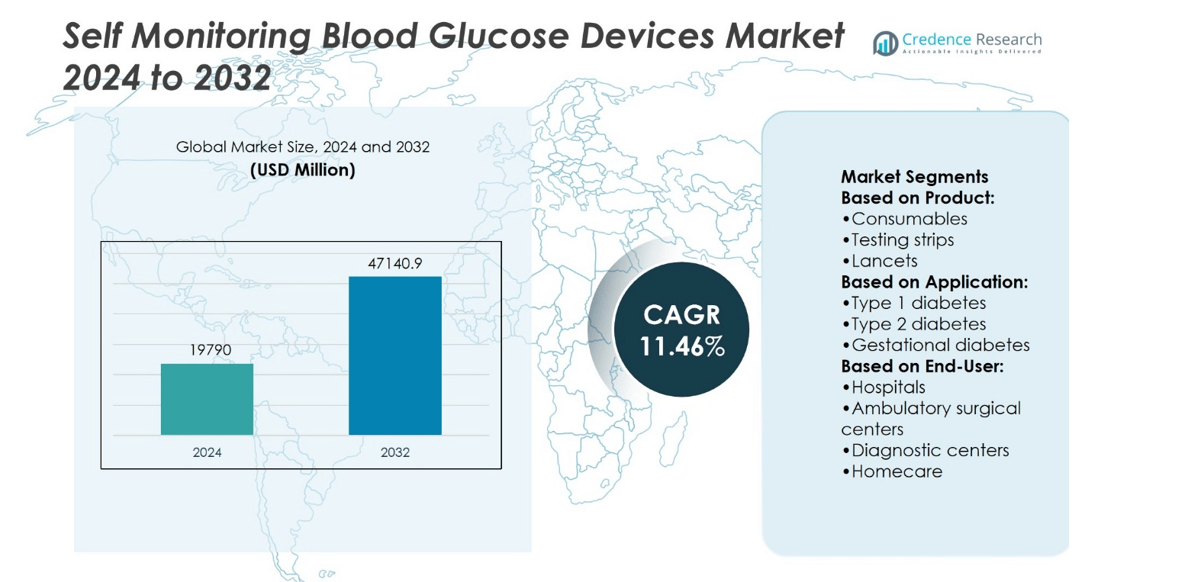
Self-Monitoring Blood Glucose Devices Market size was valued at USD 19790 million in 2024 and is anticipated to reach USD 47140.9 million by 2032, at a CAGR of 11.46% during the forecast period.
| REPORT ATTRIBUTE | DETAILS |
|---|---|
| Historical Period | 2020-2023 |
| Base Year | 2024 |
| Forecast Period | 2025-2032 |
| Self-Monitoring Blood Glucose Devices Market Size 2024 | USD 19790 million |
| Self-Monitoring Blood Glucose Devices Market, CAGR | 11.46% |
| Self-Monitoring Blood Glucose Devices Market Size 2032 | USD 47140.9 million |
The Self-Monitoring Blood Glucose Devices Market grows through rising diabetes prevalence, greater patient awareness, and stronger emphasis on early disease management. Demand increases as patients seek reliable, maintenance-free solutions for daily monitoring and better treatment adherence. Technological progress in biosensors, wireless connectivity, and mobile app integration enhances device accuracy and usability. Non-invasive innovations and compact designs support higher compliance, particularly among aging and tech-savvy populations. The market also reflects broader healthcare trends, with cloud-based platforms, AI-driven insights, and remote monitoring strengthening personalized care and expanding adoption across homecare, hospitals, and diagnostic settings.
The Self-Monitoring Blood Glucose Devices Market shows strong geographical presence, with North America leading due to advanced infrastructure, followed by Europe with supportive healthcare systems and Asia-Pacific showing rapid growth from large diabetic populations. Latin America and the Middle East & Africa demonstrate steady adoption driven by rising awareness. Key players shaping the market include Abbott Laboratories, F. Hoffmann-La Roche, Ascensia Diabetes Care Holdings, LifeScan, Arkray, Bionime Corporation, DarioHealth, AgaMatrix, All Medicus, and B. Braun Melsungen.
Market Insights
- The Self-Monitoring Blood Glucose Devices Market was valued at USD 19,790 million in 2024 and is expected to reach USD 47,140.9 million by 2032, at a CAGR of 11.46%.
- Rising diabetes prevalence and growing patient awareness drive strong demand for reliable self-monitoring solutions.
- Advancements in biosensors, wireless connectivity, and mobile applications enhance device performance and usability.
- Increasing focus on non-invasive technologies and compact designs supports higher compliance among diverse patient groups.
- Competition intensifies as leading players invest in innovation, partnerships, and digital health integration.
- High costs of consumables and inconsistent insurance coverage limit adoption in some regions.
- North America leads the market, Europe shows steady growth, Asia-Pacific expands rapidly, while Latin America and the Middle East & Africa display gradual adoption supported by awareness initiatives.
Market Drivers
Rising Diabetes Prevalence and Growing Patient Awareness
The Self-Monitoring Blood Glucose Devices Market benefits from the rising number of people diagnosed with diabetes globally. Urbanization, sedentary lifestyles, and dietary changes drive higher incidence rates across both type 1 and type 2 diabetes. Healthcare systems promote early detection and self-management to reduce complications. Patients show stronger awareness of blood glucose control and actively adopt digital tools. Governments and medical associations run campaigns that highlight the risks of uncontrolled diabetes. This expanding awareness base creates consistent demand for self-monitoring solutions.
- For instance, Bionime launched the RIGHTEST GM700 SB Bluetooth glucometer in July 2017, designed for high accuracy and seamless connectivity. The device transmits each test result via Bluetooth 4.0 to the Rightest CARE mobile app, supporting long-term tracking and remote sharing with healthcare providers. It stores 500 test results in its internal memory, giving patients a detailed glucose history for trend analysis.
Technological Advancements in Monitoring Accuracy and Connectivity
The Self-Monitoring Blood Glucose Devices Market advances through innovation in sensor accuracy, wireless connectivity, and compact designs. Manufacturers introduce products with shorter response times and higher reliability for clinical and personal use. Wireless integration with smartphones and health apps enhances tracking and data sharing with providers. It strengthens personalized treatment planning and patient compliance. Cloud platforms and AI-driven analytics extend device functionality beyond simple measurement. These improvements differentiate offerings and raise adoption among both patients and physicians.
- For instance, LifeScan OneTouch Ultra 2 meter produces a blood glucose result in 5 seconds. This quick turnaround improves responsiveness for users. For tracking and sharing data with providers, the meter uses a download port to transfer results via a cable to a computer.
Supportive Healthcare Policies and Insurance Reimbursement Models
The Self-Monitoring Blood Glucose Devices Market gains momentum through favorable healthcare policies and structured reimbursement programs. Governments expand coverage for testing supplies and devices to reduce patient costs. Insurance payers recognize the long-term benefits of improved glucose control and support adoption. Hospitals and clinics incorporate self-monitoring into standard care protocols to lower complication risks. It enables broader access in developed and developing markets. Policy alignment with public health strategies ensures a stable foundation for sustained market growth.
Expansion of Homecare and Preference for User-Friendly Devices
The Self-Monitoring Blood Glucose Devices Market sees strong growth from the expansion of homecare settings. Patients prefer devices that are portable, simple, and minimally invasive. User-friendly interfaces and fast test strips increase convenience for regular monitoring. It empowers individuals to manage health outside clinical environments. Aging populations with chronic conditions further strengthen this trend. The shift toward at-home care and personalized monitoring solutions continues to reinforce long-term demand.
Market Trends
Integration of Digital Health Platforms and Mobile Applications
The Self-Monitoring Blood Glucose Devices Market evolves through integration with digital health platforms. Devices now connect seamlessly with smartphones, tablets, and cloud-based systems. Mobile applications support trend analysis, reminders, and physician access to patient data. It improves real-time decision-making and encourages better disease management. Patients benefit from data visualization and tailored health recommendations. This trend reflects the broader movement toward connected healthcare ecosystems.
- For instance, DarioHealth’s system uses a 0.3‑microliter blood sample and delivers glucose results in six seconds, syncing instantly with its mobile app. The apps support trend analysis, reminders, and physician access.
Growing Demand for Minimally Invasive and Non-Invasive Technologies
The Self-Monitoring Blood Glucose Devices Market demonstrates rising demand for user comfort and less invasive testing. Needle-free technologies and continuous sensors gain preference among patients. Companies focus on reducing pain, sample size, and device footprint. It aligns with patient-centered care and supports higher compliance rates. Non-invasive approaches attract attention due to their potential to simplify testing routines. This transition reshapes consumer expectations and accelerates product innovation.
- For instance, Abbott's FreeStyle Libre 3 sensor is just 2.9 mm thick and 21 mm in diameter, with the filament inserted only about 5 mm under the skin. This compact design reduces physical discomfort and supports discreet monitoring. While not non-invasive, its minimal invasiveness and easier routines meet patient expectations.
Increasing Adoption of Continuous Monitoring with Advanced Sensors
The Self-Monitoring Blood Glucose Devices Market benefits from continuous monitoring technologies. Advanced biosensors provide real-time glucose values and predictive alerts. It enhances safety for patients managing fluctuating glucose levels. Continuous tracking supports tighter control for high-risk groups, including children and elderly patients. Integration with insulin pumps further demonstrates system efficiency. This ongoing shift positions continuous monitoring as a cornerstone of market growth.
Expansion of Personalized Care and Remote Patient Management
The Self-Monitoring Blood Glucose Devices Market reflects the expansion of personalized care models. Remote monitoring platforms enable healthcare providers to supervise patients beyond clinical visits. Telemedicine integration ensures timely interventions and treatment adjustments. It reduces hospital admissions and supports long-term cost savings. Data-driven personalization strengthens engagement by addressing individual health needs. This trend secures a larger role for self-monitoring devices within modern healthcare delivery.
Market Challenges Analysis
High Cost of Devices and Limited Accessibility in Emerging Economies
The Self-Monitoring Blood Glucose Devices Market faces constraints due to high product and maintenance costs. Test strips, lancets, and advanced sensors often carry recurring expenses that burden patients. Insurance coverage remains inconsistent across regions, creating gaps in affordability. It restricts adoption in low- and middle-income countries where diabetes prevalence is rising. Distribution networks in rural areas lack adequate reach, further limiting accessibility. Manufacturers encounter difficulty balancing innovation with cost efficiency while meeting consumer expectations.
Technical Limitations, Accuracy Concerns, and User Compliance Issues
The Self-Monitoring Blood Glucose Devices Market also contends with technical challenges that impact adoption. Accuracy variations between brands and models reduce physician confidence and affect patient trust. It complicates treatment decisions when data does not align with laboratory results. Many users struggle with calibration, proper handling, and storage requirements for devices. Inconsistent user compliance weakens long-term effectiveness of monitoring programs. Battery life, sensor wear, and environmental conditions add to device limitations. These issues highlight the need for continuous improvements in design, durability, and ease of use.
Market Opportunities
Expansion Potential in Emerging Economies and Untapped Demographics
The Self-Monitoring Blood Glucose Devices Market presents strong opportunities in emerging economies with growing diabetic populations. Rising awareness, government health campaigns, and improving healthcare infrastructure create favorable conditions for adoption. It enables manufacturers to expand distribution and tailor cost-effective devices to local markets. Untapped demographics such as rural communities and younger age groups also represent potential demand. Companies that focus on localized education and partnerships with healthcare providers strengthen outreach. Strategic investment in these regions positions brands to capture long-term growth.
Innovation in Non-Invasive Technologies and Connected Ecosystems
The Self-Monitoring Blood Glucose Devices Market also benefits from innovation in painless and user-friendly technologies. Non-invasive monitoring solutions appeal to patients seeking comfort and convenience. It creates a path for higher compliance and frequent usage among diverse age groups. Integration with connected health ecosystems enhances real-time data access for providers and caregivers. Advancements in biosensors, AI-driven analytics, and wearable formats expand product appeal. These innovations establish opportunities for differentiation and stronger market competitiveness.
Market Segmentation Analysis:
By Product
The Self-Monitoring Blood Glucose Devices Market divides into meters, consumables, testing strips, and lancets. Self-monitoring meters remain the foundation, offering digital accuracy and portable use for daily management. Testing strips hold the largest recurring demand due to single-use application and high consumption rates among patients. Lancets form another critical category, supporting regular sampling and safe handling. Consumables overall dominate revenue streams, driven by replacement cycles and rising diabetic populations. It underscores the importance of reliable supply chains and consistent quality standards across product categories.
- For instance, Roche’s Accu-Chek Guide test strips need only 0.6 µL of blood and deliver a result in under 4 seconds. Its Safe-T-Pro Plus lancet offers 3 depth settings of 1.3 mm, 1.8 mm, and 2.3 mm, supporting accurate and safe sampling.
By Application
The market segments by application into type 1 diabetes, type 2 diabetes, and gestational diabetes. Type 2 diabetes dominates due to higher global prevalence and ongoing lifestyle-related risk factors. Patients with type 1 diabetes rely on frequent monitoring to manage insulin therapy effectively. Gestational diabetes contributes a growing share with rising maternal age and increased screening programs. Each segment emphasizes continuous monitoring to prevent complications and improve treatment outcomes. It highlights how device design and accuracy play vital roles in managing diverse patient needs.
- For instance, Arkray’s GLUCOCARD S meter needs only 0.3 µL of blood and delivers results in 5 seconds, supporting frequent monitoring in type 1 patients. The same device also suits type 2 and gestational diabetes with minimal discomfort.
By End User
The Self-Monitoring Blood Glucose Devices Market divides by end user into hospitals, ambulatory surgical centers, diagnostic centers, homecare, and other uses. Hospitals remain a central hub for adoption, supported by integrated patient management systems. Diagnostic centers contribute through early detection and ongoing testing services. Ambulatory surgical centers rely on monitoring for perioperative diabetic management. Homecare shows rapid growth as patients seek independence and convenience in disease control. It reflects the broader transition toward decentralized care and patient empowerment. Other end uses contribute niche demand where specialized monitoring is required, strengthening the market’s diversity.
Segments:
Based on Product:
- Consumables
- Testing strips
- Lancets
Based on Application:
- Type 1 diabetes
- Type 2 diabetes
- Gestational diabetes
Based on End-User:
- Hospitals
- Ambulatory surgical centers
- Diagnostic centers
- Homecare
Based on the Geography:
- North America
- U.S.
- Canada
- Mexico
- Europe
- UK
- France
- Germany
- Italy
- Spain
- Russia
- Belgium
- Netherlands
- Austria
- Sweden
- Poland
- Denmark
- Switzerland
- Rest of Europe
- Asia Pacific
- China
- Japan
- South Korea
- India
- Australia
- Thailand
- Indonesia
- Vietnam
- Malaysia
- Philippines
- Taiwan
- Rest of Asia Pacific
- Latin America
- Brazil
- Argentina
- Peru
- Chile
- Colombia
- Rest of Latin America
- Middle East
- UAE
- KSA
- Israel
- Turkey
- Iran
- Rest of Middle East
- Africa
- Egypt
- Nigeria
- Algeria
- Morocco
- Rest of Africa
Regional Analysis
North America
North America holds the largest share of the Self-Monitoring Blood Glucose Devices Market, accounting for around 38% of the global market. The region benefits from advanced healthcare infrastructure, strong insurance coverage, and high patient awareness. The United States leads adoption with a large diabetic population and continuous product innovation. Canada also contributes significantly with government-supported diabetes management programs. Companies in the region focus on integrating digital platforms and remote monitoring features, supporting higher compliance. It demonstrates a well-established ecosystem that supports both clinical and home-based monitoring. The strong regulatory framework ensures device quality, accuracy, and patient safety, reinforcing North America’s leadership.
Europe
Europe represents the second-largest share, with around 27% of the global market. Widespread healthcare coverage, public health initiatives, and aging populations drive demand. Germany, France, and the United Kingdom lead in adoption due to robust hospital networks and advanced clinical practices. The region sees strong emphasis on patient education and preventive care, increasing routine monitoring. It also benefits from growing use of digital health tools integrated with self-monitoring systems. EU regulations ensure strict quality standards, boosting consumer confidence in device performance. Europe’s position remains strong due to a blend of established demand and ongoing innovation in patient-centric solutions.
Asia-Pacific
Asia-Pacific accounts for nearly 24% of the Self-Monitoring Blood Glucose Devices Market, making it a high-growth region. China, India, and Japan dominate demand due to large diabetic populations and increasing healthcare expenditure. Rising urbanization and dietary changes accelerate the prevalence of diabetes across the region. Governments focus on expanding access to affordable monitoring devices, particularly in public health programs. It shows rapid growth in homecare adoption as patients seek convenient disease management solutions. Local manufacturing and cost-effective product offerings expand accessibility across developing markets. Asia-Pacific stands out as a dynamic region with significant long-term potential.
Latin America
Latin America holds about 6% of the global market share. Countries such as Brazil, Mexico, and Argentina drive adoption with increasing awareness and expanding healthcare access. The region still faces challenges with affordability and uneven insurance coverage. It demonstrates steady demand growth as healthcare systems focus on early diagnosis and chronic disease management. International players expand partnerships with local distributors to improve availability. Homecare adoption gains pace as patients adopt user-friendly and portable devices. Latin America continues to evolve as a market with rising importance for global manufacturers.
Middle East and Africa
The Middle East and Africa contribute nearly 5% of the total market. The Gulf Cooperation Council (GCC) countries lead adoption due to high prevalence of diabetes and modern healthcare infrastructure. South Africa and other African nations show gradual uptake as awareness campaigns expand. It faces obstacles in affordability and limited distribution across rural areas. Governments in the Middle East promote screening initiatives and subsidize diabetic care. Partnerships with regional healthcare providers improve availability of advanced monitoring solutions. While relatively smaller in share, the region presents untapped opportunities for future growth.
Key Player Analysis
- Bionime Corporation
- LifeScan
- DarioHealth
- Abbott Laboratories
- Ascensia Diabetes Care Holdings
- Hoffmann-La Roche
- Arkray
- All Medicus
- AgaMatrix
- Braun Melsungen
Competitive Analysis
The Self-Monitoring Blood Glucose Devices Market companies include Abbott Laboratories, AgaMatrix, All Medicus, Arkray, Ascensia Diabetes Care Holdings, B. Braun Melsungen, Bionime Corporation, DarioHealth, F. Hoffmann-La Roche, and LifeScan. The Self-Monitoring Blood Glucose Devices Market remains highly competitive, driven by continuous innovation and patient-focused solutions. Companies invest in advanced sensor technologies, wireless integration, and user-friendly designs to enhance accuracy and convenience. The market emphasizes digital connectivity, with devices increasingly linked to smartphones, apps, and cloud platforms for real-time monitoring and data sharing. Affordability and accessibility also influence competitive strategies, especially in emerging economies where demand is rising. Firms pursue regulatory approvals and partnerships to expand reach, while also focusing on improving patient compliance through minimally invasive or non-invasive solutions. The competitive landscape centers on differentiation in technology, reliability, and integration with broader digital health ecosystems, ensuring sustained growth opportunities across global regions.
Recent Developments
- In November 2024, Ascensia Diabetes Care collaborated with Fitterfly Healthtech to develop a free 21-day Diabetes Management Program offered on Ascensia glucometer devices. It is anticipated that diabetes care will be more effective with this program.
- In March 2023, Abbott received U.S. FDA approval for the integration of its FreeStyle Libre 3 and FreeStyle Libre 2 integrated continuous glucose monitoring (iCGM) system sensors with automated insulin delivery (AID) systems. Both the FreeStyle Libre 3 and FreeStyle Libre 2 sensors are currently accessible in the U.S., with approval for use in individuals aged four years and older.
- In February 2023, Ascensia Diabetes Care Holdings AG, the developer of the CONTOUR BGM system portfolio, globally partnered with SNAQ, a mobile application offering nutritional insights for individuals managing diabetes.
- In February 2023, according to Bloomberg, Apple is progressing towards developing a non-invasive blood glucose monitoring device that could be incorporated into the Apple Watch. The non-invasive device will use lasers to detect glucose levels, replacing the traditional finger prick test. It is currently in the early stage and could be made commercially available once it is made smaller.
Report Coverage
The research report offers an in-depth analysis based on Product, Application, End-User and Geography. It details leading market players, providing an overview of their business, product offerings, investments, revenue streams, and key applications. Additionally, the report includes insights into the competitive environment, SWOT analysis, current market trends, as well as the primary drivers and constraints. Furthermore, it discusses various factors that have driven market expansion in recent years. The report also explores market dynamics, regulatory scenarios, and technological advancements that are shaping the industry. It assesses the impact of external factors and global economic changes on market growth. Lastly, it provides strategic recommendations for new entrants and established companies to navigate the complexities of the market.
Future Outlook
- The market will see higher adoption of connected devices with mobile health integration.
- Continuous innovation in minimally invasive and non-invasive technologies will shape future demand.
- Patient preference for compact and user-friendly devices will influence product design.
- Cloud-based platforms will expand data accessibility for patients and healthcare providers.
- Remote monitoring and telemedicine support will strengthen device relevance in chronic care.
- Emerging economies will offer strong growth opportunities through rising diabetic populations.
- Regulatory focus on accuracy and safety will drive product improvements and compliance.
- Aging populations worldwide will increase demand for home-based monitoring solutions.
- Artificial intelligence and predictive analytics will enhance personalized disease management.
- Strategic collaborations and partnerships will accelerate innovation and global market penetration.

Request a Free Sample
Fill in your details and we'll send you a free sample report.
- Sample data tables & charts
- Research methodology
Market Dynamics
Rising Diabetes Prevalence and Patient Awareness
The increasing global incidence of diabetes, driven by urbanization, sedentary lifestyles, and dietary changes, is expanding the patient base for self-monitoring blood glucose devices. Enhanced awareness campaigns and education initiatives encourage early detection and self-management, fueling consistent demand for these devices.
Technological Advancements in Monitoring Accuracy and Connectivity
Continuous innovation in biosensors, wireless connectivity, and mobile app integration is improving device accuracy, usability, and patient engagement. These advancements enable real-time data sharing and personalized treatment, making self-monitoring more attractive to both patients and healthcare providers.
Supportive Healthcare Policies and Insurance Reimbursement
Favorable healthcare policies and expanded insurance coverage for testing supplies and devices are reducing out-of-pocket costs for patients. This support increases accessibility and adoption, especially in developed markets where structured reimbursement models are in place.
Expansion of Homecare and User-Friendly Device Design
The shift toward home-based care and patient empowerment is driving demand for portable, easy-to-use, and minimally invasive devices. Aging populations and chronic disease management trends further reinforce the need for convenient self-monitoring solutions outside clinical settings.
Integration with Digital Health Platforms and Remote Monitoring
The integration of self-monitoring devices with digital health platforms, cloud-based systems, and telemedicine is enhancing remote patient management. This trend supports real-time interventions, improves compliance, and aligns with the broader movement toward connected healthcare ecosystems.
Need a Custom Version of This Report?
Tailor the scope, geography, or segments to your exact requirements.
- Custom geography or segment scope
- Direct access to our analyst team
Frequently Asked Questions
What is the current market size for the Self-Monitoring Blood Glucose Devices Market, and what is its projected size in 2032?
At what Compound Annual Growth Rate is the Self-Monitoring Blood Glucose Devices Market projected to grow between 2025 and 2032?
Which Self-Monitoring Blood Glucose Devices Market segment held the largest share in 2024?
What are the primary factors fueling the growth of the Self-Monitoring Blood Glucose Devices Market?
Table of Content
Chapter 1 Market Segmentation
- 1.1 Segmentation Framework
- 1.1.1 Product and Service Classification
- 1.1.2 Application and End-Use Classification
- 1.1.3 Technology and Solution Classification
- 1.1.4 Customer and Distribution Channel Classification
- 1.1.5 Geographic Segmentation
- 1.1.6 Market Segment Definitions and Boundaries
- 1.2 By Product
- 1.2.1 Consumables
- 1.2.2 Testing strips
- 1.2.3 Lancets
- 1.3 By End-User
- 1.3.1 Hospitals
- 1.3.2 Ambulatory surgical centers
- 1.3.3 Diagnostic centers
- 1.3.4 Homecare
- 1.4 By Application
- 1.4.1 Type 1 diabetes
- 1.4.2 Type 2 diabetes
- 1.4.3 Gestational diabetes
Chapter 2 Introduction
- 2.1 Report Objectives and Scope
- 2.2 Product Definition and Industry Terminology
- 2.3 Market Inclusions and Exclusions
- 2.4 Research Process
- 2.4.1 Primary Research and Expert Interviews
- 2.4.2 Secondary Research and Source Review
- 2.4.3 Top-Down and Bottom-Up Estimation
- 2.4.4 Data Triangulation and Verification
- 2.5 Market Size Measurement Basis
- 2.5.1 2024: USD 19,790 million → 2032: USD 47,140.9 million
- 2.6 Historical and Forecast Reference Periods
- 2.6.1 Base Year: 2024
- 2.6.2 Forecast Period: 2024-2032
- 2.7 Research Assumptions and Limitations
Chapter 3 Executive Summary
- 3.1 Market Snapshot and Key Findings
- 3.2 Base-Year Market Size, 2024
- 3.3 Forecast Market Size, 2032
- 3.4 Revenue and Volume Growth Outlook
- 3.5 Key Demand and Supply Indicators
- 3.6 Leading Market Segments
- 3.7 Fastest-Growing Market Opportunities
- 3.8 Regional Performance Highlights
- 3.9 Technology and Industry Transformation
- 3.10 Competitive Landscape Summary
- 3.11 Analyst View and Strategic Implications
Chapter 4 Global Self-Monitoring Blood Glucose Devices Market Trends and Developments
- 4.1 Historical Industry Development
- 4.2 Recent Market Trends and Developments
- 4.3 Demand and Customer Behavior Trends
- 4.4 Technology and Product Innovation
- 4.5 Artificial Intelligence, Automation and Digitalization
- 4.6 Local Manufacturing and Supply Chain Realignment
- 4.7 Industry Partnerships, Mergers and Acquisitions
- 4.8 Sustainability and Circular Economy Developments
- 4.9 Government and Private Sector Investment Trends
- 4.10 Emerging Business Models and Commercialization
- 4.11 Industry Developments and Announcements
Chapter 5 Global Self-Monitoring Blood Glucose Devices Market Production, Supply and Demand Analysis
- 5.1 Demand Trend and Consumption Analysis
- 5.2 Demand Forecast, 2024-2032
- 5.3 Production and Output Trend
- 5.4 Production and Output Forecast, 2024-2032
- 5.5 Installed Capacity and Capacity Utilization
- 5.6 Company-Wise Production Plants and Statistics
- 5.6.1 Installed Production Capacity
- 5.6.2 Actual Production
- 5.6.3 Planned Capacity and Expansion Targets
- 5.7 Supply Chain Structure and Procurement Trends
- 5.8 Supply-Demand Gap and Bottlenecks
- 5.9 Import Dependence and Sourcing Structure
- 5.10 Contract Manufacturing and Outsourcing
- 5.11 Regional Supply and Demand Concentration
Chapter 6 Global Self-Monitoring Blood Glucose Devices Market Pricing Analysis
- 6.1 Pricing Structure and Measurement
- 6.2 Historical Pricing Trends
- 6.3 Pricing Outlook, 2024-2032
- 6.4 Average Selling Price and Unit Economics
- 6.5 Pricing by Product and Market Segment
- 6.6 Geographic Pricing Differences
- 6.7 Key Input, Energy, Labor and Logistics Costs
- 6.8 Contract Pricing and Purchasing Models
- 6.9 Pricing Sensitivity and Competitive Positioning
- 6.10 Price, Margin and Profitability Implications
Chapter 7 Global Self-Monitoring Blood Glucose Devices Market Dynamics
- 7.1 Market Growth Drivers
- 7.1.1 Demand-Side Drivers
- 7.1.2 Technology and Innovation Drivers
- 7.1.3 Infrastructure and Investment Drivers
- 7.1.4 Regulatory and Policy Drivers
- 7.2 Market Restraints
- 7.2.1 Cost and Affordability Constraints
- 7.2.2 Technology and Adoption Barriers
- 7.2.3 Supply Chain and Operational Constraints
- 7.3 Market Challenges
- 7.3.1 Competitive Pressure and Margin Erosion
- 7.3.2 Skills, Infrastructure and Implementation Gaps
- 7.4 Emerging Market Opportunities
- 7.5 Market Dynamics Impact and Time-Horizon Assessment
Chapter 8 Global Self-Monitoring Blood Glucose Devices Value Chain Analysis
- 8.1 Industry Value Chain Overview
- 8.2 Upstream Suppliers and Critical Inputs
- 8.3 Technology and Component Providers
- 8.4 Manufacturing or Service Delivery
- 8.5 Distribution, Channel Partners and Integrators
- 8.6 Downstream Applications and End Users
- 8.7 Value Addition and Profit Pools
- 8.8 Vertical Integration and Outsourcing
- 8.9 Supplier Concentration and Risk
- 8.10 Supply Chain Localization and Resilience
Chapter 9 Global Self-Monitoring Blood Glucose Devices Market Regulations and Policies
- 9.1 Relevant Laws, Standards and Compliance Frameworks
- 9.2 Product, Service, Safety and Quality Requirements
- 9.3 Government Policies, Incentives and Subsidies
- 9.4 Imports, Exports and Trade Barriers
- 9.5 Public Procurement and Local Content Requirements
- 9.6 Environmental and Sustainability Compliance
- 9.7 Upcoming Policy Changes and Market Implications
Chapter 10 Global Self-Monitoring Blood Glucose Devices Market Hotspots and Opportunities
- 10.1 Market Opportunity Mapping and Growth Hotspots
- 10.2 High-Growth Applications and Customer Groups
- 10.3 Underserved Markets and White-Space Opportunities
- 10.4 Emerging Technology and Product Opportunities
- 10.5 New Capacity and Investment Hotspots
- 10.6 Market Entry and Expansion Opportunities
- 10.7 Distribution and Partnership Opportunities
- 10.8 Near-Term and Long-Term Commercial Potential
- 10.9 Opportunity Attractiveness and Execution Risks
Chapter 11 Global Self-Monitoring Blood Glucose Devices Market Outlook, 2024-2032
- 11.1 Market Size and Analysis
- 11.1.1 Revenue (Market Measurement: 2024: USD 19,790 million → 2032: USD 47,140.9 million)
- 11.1.2 Market Volume and Quantity Sold
- 11.1.3 Historical Market Size
- 11.1.4 Base-Year Market Size, 2024
- 11.2 Market Forecast, 2024-2032
- 11.2.1 Revenue Forecast to 2032
- 11.2.2 Volume Forecast to 2032
- 11.2.3 CAGR and Year-on-Year Growth
- 11.2.4 Incremental Revenue Opportunity
- 11.3 Forecast Assumptions and Scenario Analysis
- 11.3.1 Base-Case Forecast
- 11.3.2 Optimistic and Conservative Scenarios
- 11.3.3 Technology, Pricing and Policy Sensitivities
- 11.4 Market Attractiveness and Growth Outlook
Chapter 12 Global Self-Monitoring Blood Glucose Devices Market Segmentation and Outlook
- 12.1 Segmentation Summary and Market Shares, 2024
- 12.2 Largest and Fastest-Growing Segments
- 12.3 By Product - Market Size and Forecast, 2024-2032
- 12.3.1 Segment Definition and Scope
- 12.3.2 Historical Market Size
- 12.3.3 Revenue Forecast, 2024-2032
- 12.3.4 Volume Forecast, 2024-2032
- 12.3.5 Base-Year Market Share, 2024
- 12.3.6 Segment CAGR and Growth Drivers
- 12.3.7 Subsegment Market Size and Forecast
- 12.3.7.1 Consumables
- 12.3.7.2 Testing strips
- 12.3.7.3 Lancets
- 12.3.8 Subsegment Pricing and Adoption Trends
- 12.3.9 Leading Suppliers and Competition
- 12.3.10 Regional Demand and Opportunities
- 12.4 By End-User - Market Size and Forecast, 2024-2032
- 12.4.1 Segment Definition and Scope
- 12.4.2 Historical Market Size
- 12.4.3 Revenue Forecast, 2024-2032
- 12.4.4 Volume Forecast, 2024-2032
- 12.4.5 Base-Year Market Share, 2024
- 12.4.6 Segment CAGR and Growth Drivers
- 12.4.7 Subsegment Market Size and Forecast
- 12.4.7.1 Hospitals
- 12.4.7.2 Ambulatory surgical centers
- 12.4.7.3 Diagnostic centers
- 12.4.7.4 Homecare
- 12.4.8 Subsegment Pricing and Adoption Trends
- 12.4.9 Leading Suppliers and Competition
- 12.4.10 Regional Demand and Opportunities
- 12.5 By Application - Market Size and Forecast, 2024-2032
- 12.5.1 Segment Definition and Scope
- 12.5.2 Historical Market Size
- 12.5.3 Revenue Forecast, 2024-2032
- 12.5.4 Volume Forecast, 2024-2032
- 12.5.5 Base-Year Market Share, 2024
- 12.5.6 Segment CAGR and Growth Drivers
- 12.5.7 Subsegment Market Size and Forecast
- 12.5.7.1 Type 1 diabetes
- 12.5.7.2 Type 2 diabetes
- 12.5.7.3 Gestational diabetes
- 12.5.8 Subsegment Pricing and Adoption Trends
- 12.5.9 Leading Suppliers and Competition
- 12.5.10 Regional Demand and Opportunities
- 12.6 Segment Growth Comparison
- 12.7 Segment Attractiveness and Priority Matrix
Chapter 13 Global Self-Monitoring Blood Glucose Devices End-Use and Application Market Outlook
- 13.1 End-Use Industry and Customer Demand Structure
- 13.2 Leading Applications and Customer Groups
- 13.3 End-Use Market Size, Share and Forecast
- 13.4 Major End-Use Industry Deep Dives
- 13.4.1 Customer Requirements and Use Cases
- 13.4.2 Demand and Replacement Cycles
- 13.4.3 Technical and Regulatory Considerations
- 13.4.4 Purchasing and Procurement Models
- 13.4.5 Leading Vendors and Distribution Channels
- 13.4.6 Forecast and Commercial Opportunities
- 13.5 Emerging Applications and Cross-Segment Demand
- 13.6 End-Use Industry Investment Priorities
Chapter 14 Global Self-Monitoring Blood Glucose Devices Geographic Market Outlook, 2024-2032
- 14.1 Regional Market Size and Share, 2024
- 14.2 Regional Market Forecast, 2024-2032
- 14.3 Regional Pricing, Production and Demand Differences
- 14.4 North America
- 14.4.1 United States
- 14.4.2 Canada
- 14.4.3 Mexico
- 14.5 Europe
- 14.5.1 Germany
- 14.5.2 France
- 14.5.3 Italy
- 14.5.4 United Kingdom
- 14.5.5 Spain
- 14.5.6 Poland
- 14.5.7 Russia
- 14.5.8 Netherlands
- 14.5.9 Belgium
- 14.5.10 Sweden
- 14.5.11 Denmark
- 14.5.12 Norway
- 14.5.13 Rest of Europe
- 14.6 Asia Pacific
- 14.6.1 China
- 14.6.2 India
- 14.6.3 Japan
- 14.6.4 South Korea
- 14.6.5 Thailand
- 14.6.6 Indonesia
- 14.6.7 Vietnam
- 14.6.8 Malaysia
- 14.6.9 Australia
- 14.6.10 Rest of Asia Pacific
- 14.7 Latin America
- 14.7.1 Brazil
- 14.7.2 Argentina
- 14.7.3 Colombia
- 14.7.4 Chile
- 14.7.5 Rest of Latin America
- 14.8 Middle East
- 14.8.1 Saudi Arabia
- 14.8.2 United Arab Emirates
- 14.8.3 Turkey
- 14.8.4 Israel
- 14.8.5 Iran
- 14.8.6 Rest of the Middle East
- 14.9 Africa
- 14.9.1 South Africa
- 14.9.2 Egypt
- 14.9.3 Nigeria
- 14.9.4 Morocco
- 14.9.5 Rest of Africa
- 14.10 Regional Investment, Policy and Supply Chain Differences
- 14.11 Regional Competitive Landscape
- 14.12 Geographic Growth Hotspots
Chapter 15 Global Self-Monitoring Blood Glucose Devices Technology, Innovation and Sustainability Outlook
- 15.1 Technology Landscape and Maturity
- 15.2 Product, Process and Service Innovation
- 15.3 AI, Automation and Digital Tools in the Industry
- 15.4 Technology Adoption and Performance Benchmarking
- 15.5 Innovation Pipeline and R&D Investment
- 15.6 Patent and Intellectual Property Trends
- 15.7 Energy Efficiency and Resource Management
- 15.8 Sustainability, Recycling and Circularity
- 15.9 Technology Roadmap, 2024-2032
- 15.10 Risks of Obsolescence and Technology Substitution
Chapter 16 Global Self-Monitoring Blood Glucose Devices Market Key Strategic Imperatives
- 16.1 Growth and Market Entry Priorities
- 16.2 High-Return Products and Segments
- 16.3 Pricing, Profitability and Cost Optimization
- 16.4 Technology Investment and Product Differentiation
- 16.5 Supply Chain Localization and Resilience
- 16.6 Distribution and Customer Acquisition
- 16.7 Partnership, Acquisition and Capacity Strategy
- 16.8 Regional Expansion Priorities
- 16.9 Short-, Medium- and Long-Term Actions
Chapter 17 Competition Outlook
- 17.1 Industry Competition Characteristics
- 17.2 Market Structure and Concentration
- 17.3 Market Share and Competitive Positioning, 2024
- 17.4 Company-Wise Revenue and Product Benchmarking
- 17.5 Production and Service Capacity Benchmarking
- 17.6 Technology, Pricing and Differentiation
- 17.7 Regional Footprint and Distribution Strength
- 17.8 Mergers, Acquisitions and Strategic Alliances
- 17.9 New Entrants and Competitive Threats
- 17.10 Porter's Five Forces and Industry Attractiveness
- 17.11 Competitive Outlook, 2024-2032
Chapter 18 Company Profiles
- 18.1 Company Coverage and Selection Criteria
- 18.2 Abbott Laboratories
- 18.2.1 Business Description
- 18.2.2 Company Ownership and Geographic Presence
- 18.2.3 Product and Service Portfolio
- 18.2.4 Manufacturing and Operating Footprint
- 18.2.5 Production Capacity and Expansion Plans
- 18.2.6 Financial Performance and Investment
- 18.2.7 Market Share and Competitive Position
- 18.2.8 Technology and Innovation Capabilities
- 18.2.9 Strategic Alliances or Partnerships
- 18.2.10 Recent Developments
- 18.2.11 Growth Strategy and Outlook
- 18.3 F. Hoffmann-La Roche
- 18.4 Ascensia Diabetes Care Holdings
- 18.5 LifeScan
- 18.6 Arkray
- 18.7 Bionime Corporation
- 18.8 DarioHealth
- 18.9 AgaMatrix
- 18.10 All Medicus
- 18.11 B. Braun Melsungen
- 18.12 Other Relevant Market Participants
Note: Every listed company is profiled on the structure shown under the first company. The company list is preliminary and may change based on research findings, market developments, data availability and client requirements.
Chapter 19 Disclaimer
- 19.1 Research and Forecast Disclaimer
- 19.2 Data Source and Estimation Limitations
Note: The depth of individual sections depends on data availability for this market. Volume, capacity, trade and other unit-based metrics are included where applicable.

