
Diagnostic imaging devices market grows on scanner renewal
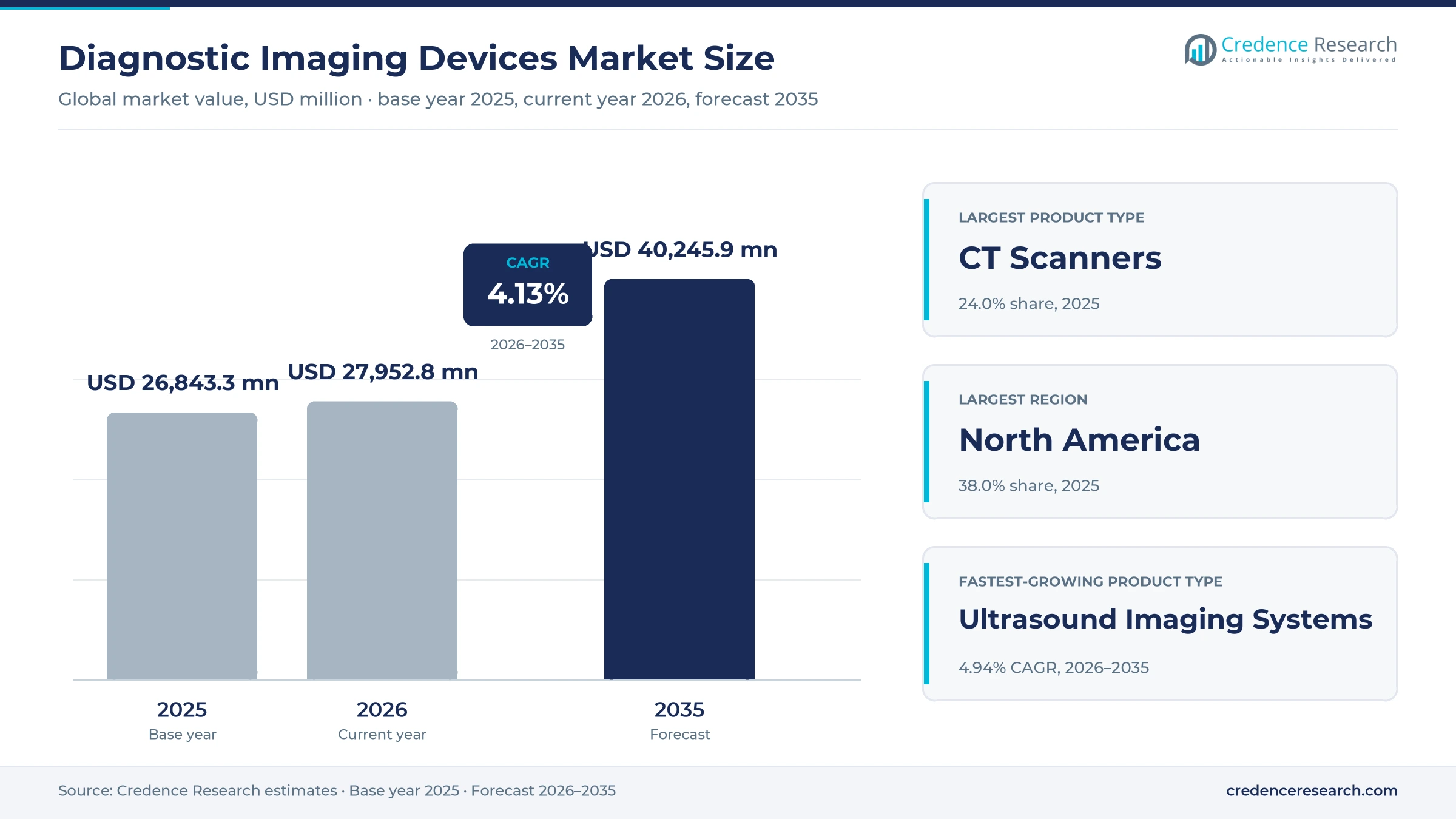
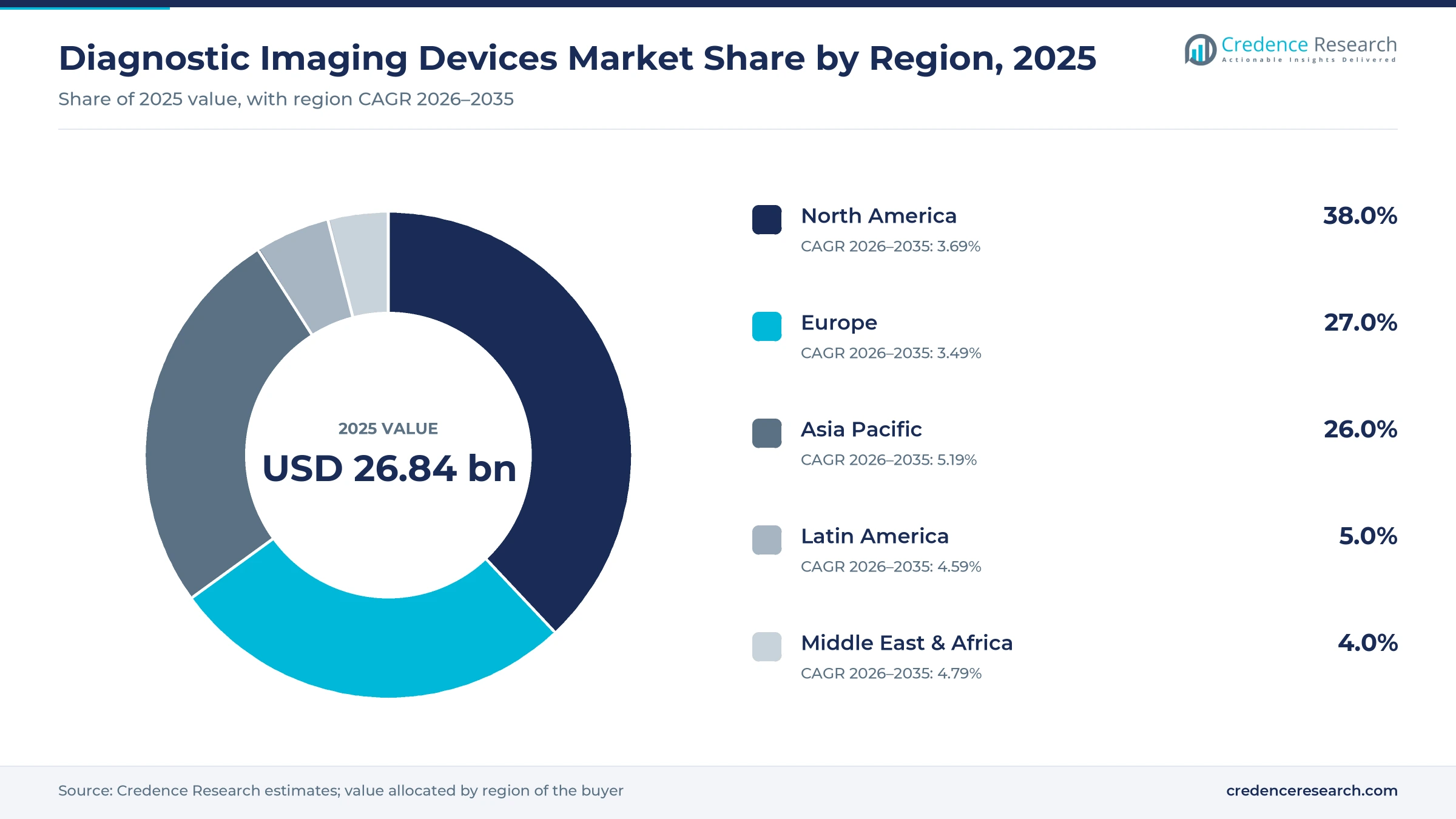
The global diagnostic imaging devices market was valued at USD 26.84 billion in 2025 and is projected to increase from USD 27.95 billion in 2026 to USD 40.25 billion by 2035, registering a CAGR of 4.13% during 2026–2035. Demand comes from aging populations, a rising cancer burden and the need to replace older scanner fleets in hospitals and outpatient centers. North America held the largest regional share, 38.0% in 2025, because high scan volumes and broad reimbursement support premium computed tomography and magnetic resonance systems. Asia Pacific is the fastest-growing region at 5.19% a year, as China, India and Southeast Asia add hospital beds and county-level imaging capacity. The technology picture changed in 2025 and 2026, when U.S. regulators cleared several MRI scanners that need little or no helium refilling. As a result, buyers can now place MRI in smaller sites and lower the running cost of each scanner.
Which imaging systems and care settings does this analysis cover?
The analysis counts X-ray equipment, ultrasound imaging systems, nuclear imaging systems, magnetic resonance imaging systems, computed tomography scanners and other imaging hardware, valued at manufacturer selling prices. Hospitals buy most high-end systems through capital budgets and tenders, while clinics, ambulatory surgical centers and home care providers buy portable ultrasound and digital X-ray units.
Contrast agents, radiotracers, service contracts and image management software sold without hardware sit outside the scope of this analysis. The value chain runs from detector, magnet and transducer suppliers through system makers to distributors, group purchasing bodies and the radiologists who select equipment for each department.
Diagnostic Imaging Devices Market Insights
- The diagnostic imaging devices market grows from USD 26.84 billion in 2025 to USD 40.25 billion by 2035, a 4.13% CAGR driven by scanner renewal and rising scan volumes.
- North America held 38.0% of global imaging device value in 2025, supported by high procedure density and established reimbursement for advanced scans.
- Computed tomography scanners led product types with 24.0% of 2025 value, while ultrasound systems grow fastest at 4.94% a year.
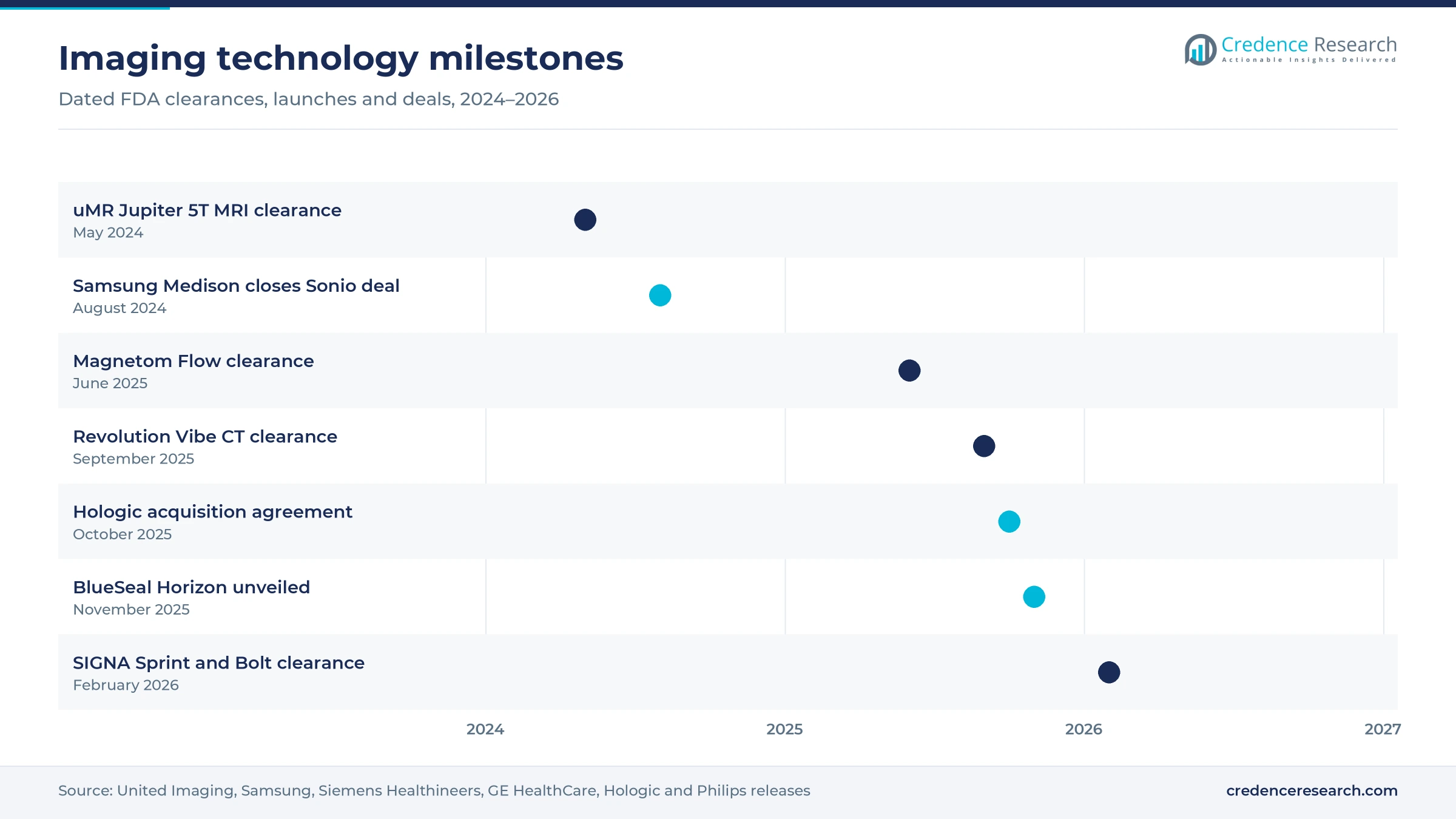
- In June 2025, Siemens Healthineers received FDA clearance for a new Magnetom Flow model, a 1.5 tesla MRI scanner that needs only 0.7 liters of liquid helium.
- Blackstone and TPG agreed in October 2025 to acquire Hologic for up to USD 79 per share, which brings private equity ownership to breast imaging.
CT scanners lead as ultrasound gains pace
Why do CT scanners lead product spending?
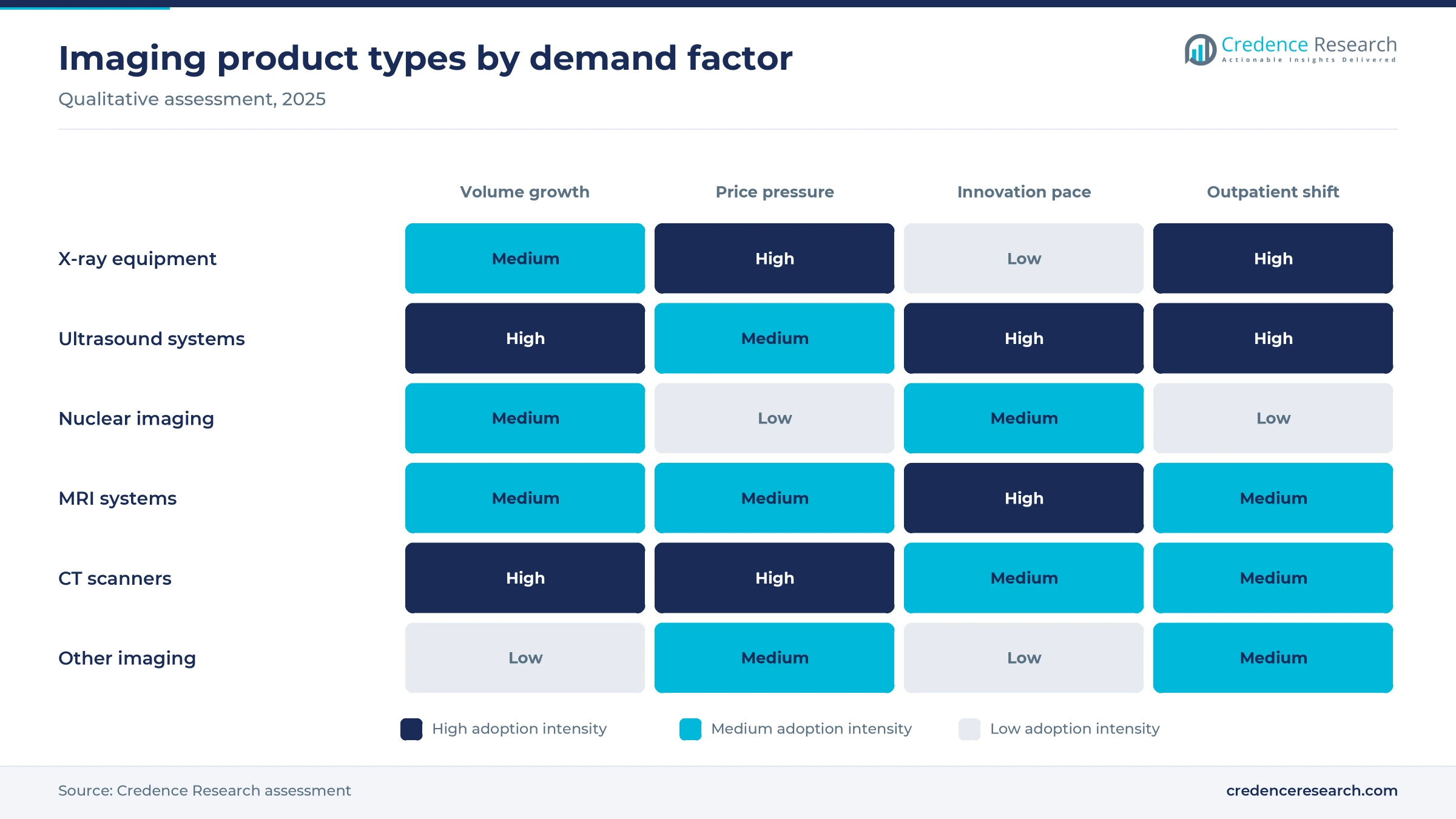
Based on product type, the market is categorized into X-ray equipment, ultrasound imaging systems, nuclear imaging systems, MRI, CT scanners and others. Computed Tomography (CT) Scanners led with a 24.0% share of 2025 value, because emergency, trauma, cancer and cardiac pathways all depend on fast cross-sectional scans. Ultrasound Imaging Systems grow fastest at 4.94% a year, as compact and handheld units spread to clinics, emergency rooms and home visits. X-ray keeps the largest installed base, but lower unit prices limit its value share.
Which care settings buy most imaging equipment?
Based on end user, the market is categorized into hospitals, home care settings, ambulatory surgical centers, research institutes and clinics. The Hospital segment led with a 58.0% share of 2025 value, because hospitals house the CT, MRI and nuclear medicine suites that complex diagnosis requires. The Home Care Setting segment grows fastest at 6.08% a year, as portable ultrasound and X-ray units let clinicians scan frail patients at home. Clinics also gain volume as payers move routine scans out of hospitals.
How fast are portable systems gaining share?
Based on modality, the market is categorized into portable and standalone systems. The Standalone segment led with a 76.0% share of 2025 value, because CT, MRI and nuclear imaging scanners are fixed installations with high unit prices. The Portable segment grows fastest at 5.47% a year, as battery-powered ultrasound and mobile X-ray units reach bedside, emergency and rural care. Portable systems also cost far less per unit, which helps smaller sites start imaging services.
| Segment Group | Leading Sub-segment | Share, 2025 | Fastest-growing Sub-segment | CAGR, 2026–2035 |
|---|---|---|---|---|
| By Product Type | Computed Tomography (CT) Scanners | 24.0% | Ultrasound Imaging Systems | 4.94% |
| By End User | Hospital | 58.0% | Home Care Setting | 6.08% |
| By Modality | Standalone | 76.0% | Portable | 5.47% |
Request a Free Sample
Fill in your details and we'll send you a free sample report.
- Sample data tables & charts
- Research methodology
Cancer burden and aging patients lift scan volumes
How does the rising cancer burden sustain imaging demand?
The growing cancer burden creates steady imaging demand, because diagnosis, staging and treatment follow-up all depend on scans. The World Health Organization estimated 20 million new cancer cases and 9.7 million cancer deaths in 2022, and it projects more than 35 million new cases by 2050, a 77% increase. Each new patient typically needs several CT, MRI or PET scans over the course of care. As a result, oncology programs drive steady purchases of cross-sectional and nuclear imaging systems.
Why do aging populations raise scan volumes?
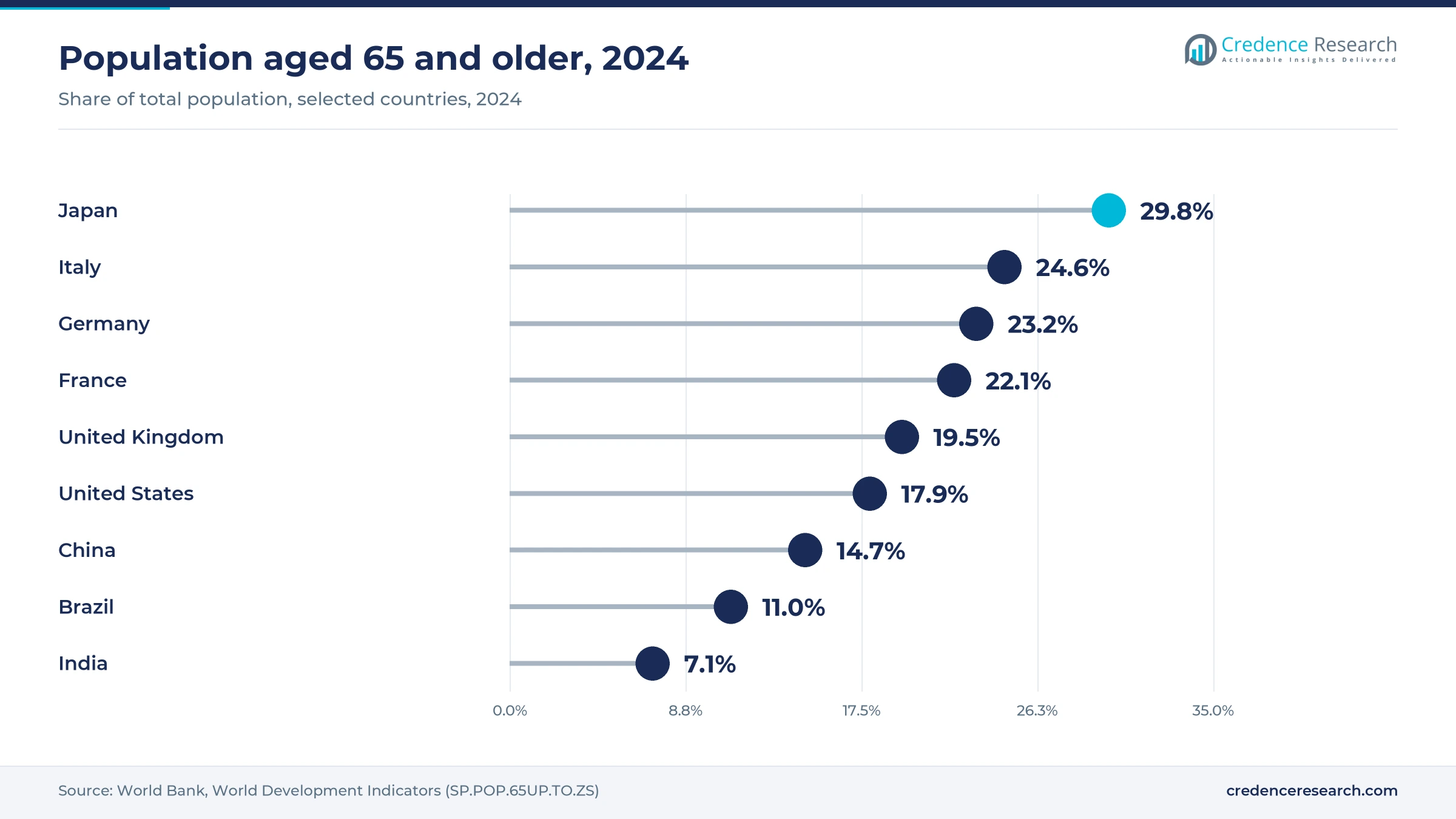
Aging populations raise scan volumes, because older adults face more cancer, heart disease, stroke and joint problems that need imaging. World Bank data show that people aged 65 and older made up 29.8% of Japan's population and 24.6% of Italy's in 2024, compared with 17.9% in the United States. China reached 14.7% in the same year, which signals fast growth in demand ahead. In turn, health systems in aging countries add scanner capacity and replace older units more often.
How does fleet replacement support steady equipment orders?
Replacement of aging scanner fleets supports steady orders, because older CT and MRI systems use more energy, need more service and lack current dose reduction tools. Scanner upgrades also bring new imaging protocols, which change how departments plan their use of contrast media for each exam. Hospitals in Europe and North America often keep scanners for a decade or longer before replacing them. New systems offer faster scans, lower radiation dose and AI-based image reconstruction. As a result, replacement demand forms a large and predictable share of annual equipment spending in mature markets.
Why does cardiac and cancer screening widen outpatient use?
Wider screening widens outpatient imaging, because coronary CT angiography, lung cancer screening and breast imaging are increasingly performed outside hospitals. In September 2025, GE HealthCare announced FDA clearance of its Revolution Vibe CT system, which is designed for coronary CT angiography and can capture the full heart in a single beat. Screening programs that use mammography also add steady volumes across hospitals and imaging centers. In turn, clinics and imaging centers become a growing buyer group.
Helium-free MRI and AI workflows reshape purchasing
How is helium-free MRI shifting scanner purchases?
Helium-free MRI is shifting scanner purchases, because conventional magnets need large volumes of a scarce and costly gas. In June 2025, Siemens Healthineers announced FDA clearance of Magnetom Flow.Ace, which needs only 0.7 liters of liquid helium compared with more than 1,000 liters for typical scanners. Price swings in helium supply make this design attractive for hospitals. As a result, low-helium magnets are becoming a standard request in MRI tenders.
Why is AI-driven workflow rising in importance?
AI-driven workflow is rising in importance, because imaging departments face staff shortages and growing exam backlogs. In February 2026, GE HealthCare announced FDA clearance of SIGNA Sprint, SIGNA Bolt and the SIGNA One workflow ecosystem, which uses an automated camera for patient positioning. Vendors now combine deep learning reconstruction with automated protocols to shorten scan times. In turn, buyers judge scanners on throughput and ease of use as well as image quality.
Can sealed 3.0T magnets open a premium MRI opportunity?
MRI makers have a clear opening in high-field systems with sealed magnets, because 3.0T scanners still rely on large helium volumes. In November 2025, Philips unveiled BlueSeal Horizon, a 3.0T platform with 7 liters of helium permanently enclosed, although it remains a work in progress and is not yet for sale. Philips reports more than 2,000 BlueSeal 1.5T systems installed worldwide. As a result, premium MRI could move into sites without helium infrastructure.
Where can imaging makers win share in emerging markets?
Imaging makers have room to grow in Asia, Latin America and Africa, where many district hospitals still lack CT or MRI. Patients in these regions often travel long distances for basic scans, which delays diagnosis of cancer and stroke. Companies that pair affordable systems with training, financing and remote service can build loyalty early. As a result, mid-range CT, digital X-ray and portable ultrasound have strong prospects in these regions over the next decade.
Capital costs, staff shortages and tenders slow uptake
Why do high capital costs limit scanner adoption?
High capital costs limit scanner adoption, because a CT or MRI installation requires a major hospital budget along with shielding and room construction. Smaller hospitals and clinics in low- and middle-income countries often cannot finance such purchases without public support. Even in wealthy countries, budget cycles can delay replacement for several years. As a result, suppliers increasingly offer leasing, refurbished systems and pay-per-use contracts to win orders.
How do radiology staff shortages slow capacity growth?
Shortages of radiologists and technologists slow capacity growth, because every scan needs trained staff to acquire and report images. Many regions outside large cities have few radiologists, which leads to long reporting delays even where scanners exist. Departments add radiology information systems to manage worklists, but these tools cannot replace reporting staff. Training programs take years to expand, and burnout raises turnover in busy departments. In turn, installed systems in some markets run below capacity, which slows repeat purchases.
Why does tender-based pricing pressure margins?
Tender-based purchasing pressures margins, because public hospitals in Europe, China and other markets buy imaging systems through competitive bids. Domestic makers in China compete strongly on price for CT, MRI and X-ray systems, which pushes global suppliers to cut prices. Buyers also expect long warranties and bundled service at no added cost. As a result, unit volumes can rise faster than market value, especially for mid-range systems.
How do radiation safety and cybersecurity rules add cost?
Radiation safety and cybersecurity rules add cost, because imaging systems must meet dose limits and protect connected patient data. Regulators require dose tracking, software validation and security documentation before clearance in major markets. Hospitals must also run quality checks and staff training for every X-ray and CT unit. In turn, compliance favors large suppliers and slows the entry of smaller device makers.
North America leads as Asia Pacific adds scanners
| Region | Value, 2025 (USD billion) | Share, 2025 | CAGR, 2026–2035 |
|---|---|---|---|
| North America | 10.20 | 38.0% | 3.69% |
| Europe | 7.25 | 27.0% | 3.49% |
| Asia Pacific | 6.98 | 26.0% | 5.19% |
| Latin America | 1.34 | 5.0% | 4.59% |
| Middle East & Africa | 1.07 | 4.0% | 4.79% |
Why does North America hold the largest regional share?
North America held a 38.0% share of 2025 value and grows at 3.69% a year through 2035. The United States drives this position, because hospitals and imaging centers perform high volumes of CT, MRI and ultrasound exams. People aged 65 and older made up 17.9% of the U.S. population in 2024, according to World Bank data, which keeps scan demand rising. U.S. regulators cleared several new CT and MRI systems between 2024 and 2026, which keeps premium technologies reaching this region first.
How fast is Asia Pacific adding imaging capacity?
Asia Pacific held a 26.0% share of 2025 value and is the fastest-growing region at 5.19% a year. China and India are adding hospital and county-level imaging capacity, which brings CT and MRI to patients who previously traveled for scans. Japan contributes high-value replacement demand from an aging population, where people aged 65 and older made up 29.8% of residents in 2024. United Imaging and Neusoft compete strongly in China, while Samsung Medison and Canon Medical Systems lead in ultrasound and CT.
What shapes demand across Europe?
Europe held a 27.0% share of 2025 value and grows at 3.49% a year, the slowest pace of the five regions. Germany, France, Italy and the United Kingdom account for most spending, and people aged 65 and older made up 24.6% of Italy's population and 23.2% of Germany's in 2024. Tender-based purchasing and tight hospital budgets hold back price growth. However, energy and helium costs push hospitals to replace older MRI and CT systems with more efficient models.
Where is Latin America adding demand?
Latin America held a 5.0% share of 2025 value and grows at 4.59% a year through 2035. Brazil and Mexico lead regional demand, and people aged 65 and older made up 11.0% of Brazil's population in 2024. Private hospital groups invest in CT and MRI, while public systems buy X-ray and ultrasound through tenders.
What limits growth in the Middle East and Africa?
The Middle East and Africa held a 4.0% share of 2025 value and grows at 4.79% a year through 2035. Gulf states add higher-value demand from new hospitals that buy advanced CT and MRI systems. Access in sub-Saharan Africa remains limited, because many countries have few scanners outside capital cities.
FDA clearances and deals in imaging since 2024
| Development | Status and market relevance |
|---|---|
| In June 2025, Siemens Healthineers received FDA clearance for Magnetom Flow.Ace, a 1.5 tesla MRI scanner with a closed helium circuit. | Cleared; needs only 0.7 liters of liquid helium over its lifetime |
| In September 2025, GE HealthCare received FDA 510(k) clearance for the Revolution Vibe CT system for coronary CT angiography. | Cleared; first global installation in France |
| In October 2025, Hologic agreed to be acquired by funds managed by Blackstone and TPG for up to USD 79 per share. | Agreed; closing expected in the first half of 2026, subject to approvals |
| In November 2025, Philips unveiled BlueSeal Horizon, a helium-free 3.0T MRI platform, at the RSNA annual meeting. | Work in progress; not yet available for sale |
| In February 2026, GE HealthCare received FDA clearance for SIGNA Sprint with Freelium, SIGNA Bolt and SIGNA One. | Cleared; CE marking expected before the end of 2026 |
Sealed magnets, photon detectors and AI lead innovation
- Sealed low-helium magnets cut helium use to a few liters, which removes quench pipes and lowers the cost of installing MRI in smaller sites.
- Ultra-high-field MRI such as the United Imaging uMR Jupiter 5T system, cleared by the FDA in May 2024, offers finer detail for whole-body imaging.
- Deep learning reconstruction reduces image noise and scan time, which lets departments run more exams with the same staff.
- AI-assisted ultrasound such as the Sonio software that Samsung Medison acquired in August 2024, recognizes fetal views and checks image quality in real time.
Need a Custom Version of This Report?
Tailor the scope, geography, or segments to your exact requirements.
- Custom geography or segment scope
- Direct access to our analyst team
Global imaging leaders face fast-rising Chinese makers
Competition is led by large global imaging companies that sell across several modalities, from X-ray to MRI. GE HealthCare, Siemens Healthineers and Philips compete in CT, MRI, ultrasound and nuclear imaging, and all three now market MRI systems with low helium use. Canon Medical Systems is strong in CT and ultrasound, while Hitachi and Shimadzu are long-standing Japanese participants, with Shimadzu focused on X-ray, fluoroscopy and angiography systems. Hologic specializes in breast imaging and skeletal health, and Samsung Medison and Esaote compete in ultrasound and compact MRI. United Imaging and Neusoft have grown quickly from their home market in China and now sell CT and MRI systems abroad. Allengers serves price-sensitive hospitals in India, and AMICO supplies X-ray equipment in Russia and nearby markets. As a result, buyers weigh image quality, service reach, financing and price when choosing suppliers.
Companies profiled and their roles in this market
| Company | Type | Role in the market |
|---|---|---|
| General Electric Company | Diversified | GE HealthCare CT, MRI including SIGNA Sprint and Bolt, ultrasound and nuclear imaging |
| Siemens Healthcare Private Limited | Diversified | Siemens Healthineers CT, MRI including Magnetom Flow, X-ray and ultrasound |
| Koninklijke Philips N.V. | Diversified | BlueSeal MRI, CT, ultrasound and X-ray systems |
| CANON MEDICAL SYSTEM CORPORATION | Diversified | CT, MRI, ultrasound and X-ray systems |
| Hologic, Inc. | Specialist | Mammography, breast tomosynthesis and skeletal health imaging |
| Samsung Medison Co., Ltd. | Specialist | Ultrasound systems and Sonio AI reporting software |
| Shanghai Lianying Medical Technology Co., Ltd. | Diversified | United Imaging CT, MRI including uMR Jupiter 5T, and molecular imaging |
| Neusoft Corporation | Diversified | Neusoft Medical CT, MRI and X-ray systems |
| Hitachi Ltd. | Diversified | Japanese industrial group with a legacy imaging equipment presence |
| Shimadzu Medical Pvt. Ltd. | Specialist | X-ray, fluoroscopy and angiography systems |
| ESAOTE SPA | Specialist | Ultrasound and dedicated MRI systems |
| Allengers | Regional | X-ray and imaging systems for hospitals in India |
| NP JSC AMICO | Regional | X-ray equipment for hospitals in Russia and nearby markets |
Ultrasound and low-helium MRI set the growth pace
Credence Research's view is that ultrasound and low-helium MRI will set the pace of growth through 2035, because both widen the number of sites that can offer imaging. The overall market grows at 4.13% a year, supported by aging populations and hospital building in Asia Pacific. CT keeps the largest value share, but tender pricing limits its growth in mature markets. Companies that combine efficient scanners with AI workflow, service and financing will win the most new orders, while single-modality suppliers face pressure from bundled contracts.
How Credence Research sized imaging equipment spending
The report uses 2025 as the base year and 2026 to 2035 as the forecast period. Market values come from the Credence Research model, which builds spending by product type, end user, modality and region. Regional and segment splits are Credence Research estimates informed by World Health Organization and World Bank statistics, U.S. regulator decisions and company press releases and filings. No primary interviews or surveys were used in preparing this edition of the report.
Imaging equipment spending outlook to 2035
By 2035, the diagnostic imaging devices market is projected to reach USD 40.25 billion, with growth led by ultrasound, low-helium MRI and outpatient CT. Computed tomography will remain the largest product area, although price pressure will keep its value growth moderate. North America keeps the highest spending per patient, while Asia Pacific adds the most new scanners. Portable systems will take a larger share of routine exams in clinics and homes. As a result, advantage will depend on efficiency, AI workflow and service reach.
Frequently Asked Questions
How big is the global diagnostic imaging devices market?
Which product type leads the diagnostic imaging devices market?
Which region leads imaging equipment spending?
Which end user buys the most imaging equipment?
Why does helium-free MRI matter for this market?
How fast are portable imaging systems growing?
Who are the leading diagnostic imaging device companies?
What restrains growth in diagnostic imaging devices?
Table of Content
Chapter 1 Market Segmentation
- 1.1 Segmentation Framework
- 1.1.1 Product and Service Classification
- 1.1.2 Application and End-Use Classification
- 1.1.3 Technology and Solution Classification
- 1.1.4 Customer and Distribution Channel Classification
- 1.1.5 Geographic Segmentation
- 1.1.6 Market Segment Definitions and Boundaries
- 1.2 By Product Type
- 1.2.1 X-ray Equipment
- 1.2.2 Ultrasound Imaging Systems
- 1.2.3 Nuclear Imaging Systems
- 1.2.4 Magnetic Resonance Imaging (MRI)
- 1.2.5 Computed Tomography (CT) Scanners
- 1.2.6 Others
- 1.3 By End User
- 1.3.1 Hospital
- 1.3.2 Home Care Setting
- 1.3.3 Ambulatory Surgical Centers
- 1.3.4 Research Institutes
- 1.3.5 Clinics
- 1.4 By Modality
- 1.4.1 Portable
- 1.4.2 Standalone
Chapter 2 Introduction
- 2.1 Report Objectives and Scope
- 2.2 Product Definition and Industry Terminology
- 2.3 Market Inclusions and Exclusions
- 2.4 Research Process
- 2.4.1 Primary Research and Expert Interviews
- 2.4.2 Secondary Research and Source Review
- 2.4.3 Top-Down and Bottom-Up Estimation
- 2.4.4 Data Triangulation and Verification
- 2.5 Market Size Measurement Basis
- 2.5.1 2025: USD 26.84 billion → 2035: USD 40.25 billion
- 2.6 Historical and Forecast Reference Periods
- 2.6.1 Historical Period: 2018-2025
- 2.6.2 Base Year: 2025
- 2.6.3 Forecast Period: 2025-2035
- 2.7 Research Assumptions and Limitations
Chapter 3 Executive Summary
- 3.1 Market Snapshot and Key Findings
- 3.2 Base-Year Market Size, 2025
- 3.3 Forecast Market Size, 2035
- 3.4 Revenue and Volume Growth Outlook
- 3.5 Key Demand and Supply Indicators
- 3.6 Leading Market Segments
- 3.7 Fastest-Growing Market Opportunities
- 3.8 Regional Performance Highlights
- 3.9 Technology and Industry Transformation
- 3.10 Competitive Landscape Summary
- 3.11 Analyst View and Strategic Implications
Chapter 4 Global Diagnostic Imaging Devices Market Trends and Developments
- 4.1 Historical Industry Development, 2018-2025
- 4.2 Recent Market Trends and Developments
- 4.3 Demand and Customer Behavior Trends
- 4.4 Technology and Product Innovation
- 4.5 Artificial Intelligence, Automation and Digitalization
- 4.6 Local Manufacturing and Supply Chain Realignment
- 4.7 Industry Partnerships, Mergers and Acquisitions
- 4.8 Sustainability and Circular Economy Developments
- 4.9 Government and Private Sector Investment Trends
- 4.10 Emerging Business Models and Commercialization
- 4.11 Industry Developments and Announcements
Chapter 5 Global Diagnostic Imaging Devices Market Production, Supply and Demand Analysis
- 5.1 Demand Trend and Consumption Analysis, 2018-2025
- 5.2 Demand Forecast, 2025-2035
- 5.3 Production and Output Trend, 2018-2025
- 5.4 Production and Output Forecast, 2025-2035
- 5.5 Installed Capacity and Capacity Utilization
- 5.6 Company-Wise Production Plants and Statistics
- 5.6.1 Installed Production Capacity
- 5.6.2 Actual Production
- 5.6.3 Planned Capacity and Expansion Targets
- 5.7 Supply Chain Structure and Procurement Trends
- 5.8 Supply-Demand Gap and Bottlenecks
- 5.9 Import Dependence and Sourcing Structure
- 5.10 Contract Manufacturing and Outsourcing
- 5.11 Regional Supply and Demand Concentration
Chapter 6 Global Diagnostic Imaging Devices Market Pricing Analysis
- 6.1 Pricing Structure and Measurement
- 6.2 Historical Pricing Trends, 2018-2025
- 6.3 Pricing Outlook, 2025-2035
- 6.4 Average Selling Price and Unit Economics
- 6.5 Pricing by Product and Market Segment
- 6.6 Geographic Pricing Differences
- 6.7 Key Input, Energy, Labor and Logistics Costs
- 6.8 Contract Pricing and Purchasing Models
- 6.9 Pricing Sensitivity and Competitive Positioning
- 6.10 Price, Margin and Profitability Implications
Chapter 7 Global Diagnostic Imaging Devices Market Dynamics
- 7.1 Market Growth Drivers
- 7.1.1 Demand-Side Drivers
- 7.1.2 Technology and Innovation Drivers
- 7.1.3 Infrastructure and Investment Drivers
- 7.1.4 Regulatory and Policy Drivers
- 7.2 Market Restraints
- 7.2.1 Cost and Affordability Constraints
- 7.2.2 Technology and Adoption Barriers
- 7.2.3 Supply Chain and Operational Constraints
- 7.3 Market Challenges
- 7.3.1 Competitive Pressure and Margin Erosion
- 7.3.2 Skills, Infrastructure and Implementation Gaps
- 7.4 Emerging Market Opportunities
- 7.5 Market Dynamics Impact and Time-Horizon Assessment
Chapter 8 Global Diagnostic Imaging Devices Value Chain Analysis
- 8.1 Industry Value Chain Overview
- 8.2 Upstream Suppliers and Critical Inputs
- 8.3 Technology and Component Providers
- 8.4 Manufacturing or Service Delivery
- 8.5 Distribution, Channel Partners and Integrators
- 8.6 Downstream Applications and End Users
- 8.7 Value Addition and Profit Pools
- 8.8 Vertical Integration and Outsourcing
- 8.9 Supplier Concentration and Risk
- 8.10 Supply Chain Localization and Resilience
Chapter 9 Global Diagnostic Imaging Devices Market Regulations and Policies
- 9.1 Relevant Laws, Standards and Compliance Frameworks
- 9.2 Product, Service, Safety and Quality Requirements
- 9.3 Government Policies, Incentives and Subsidies
- 9.4 Imports, Exports and Trade Barriers
- 9.5 Public Procurement and Local Content Requirements
- 9.6 Environmental and Sustainability Compliance
- 9.7 Upcoming Policy Changes and Market Implications
Chapter 10 Global Diagnostic Imaging Devices Market Hotspots and Opportunities
- 10.1 Market Opportunity Mapping and Growth Hotspots
- 10.2 High-Growth Applications and Customer Groups
- 10.3 Underserved Markets and White-Space Opportunities
- 10.4 Emerging Technology and Product Opportunities
- 10.5 New Capacity and Investment Hotspots
- 10.6 Market Entry and Expansion Opportunities
- 10.7 Distribution and Partnership Opportunities
- 10.8 Near-Term and Long-Term Commercial Potential
- 10.9 Opportunity Attractiveness and Execution Risks
Chapter 11 Global Diagnostic Imaging Devices Market Outlook, 2025-2035
- 11.1 Market Size and Analysis
- 11.1.1 Revenue (Market Measurement: 2025: USD 26.84 billion → 2035: USD 40.25 billion)
- 11.1.2 Market Volume and Quantity Sold
- 11.1.3 Historical Market Size, 2018-2025
- 11.1.4 Base-Year Market Size, 2025
- 11.2 Market Forecast, 2025-2035
- 11.2.1 Revenue Forecast to 2035
- 11.2.2 Volume Forecast to 2035
- 11.2.3 CAGR and Year-on-Year Growth
- 11.2.4 Incremental Revenue Opportunity
- 11.3 Forecast Assumptions and Scenario Analysis
- 11.3.1 Base-Case Forecast
- 11.3.2 Optimistic and Conservative Scenarios
- 11.3.3 Technology, Pricing and Policy Sensitivities
- 11.4 Market Attractiveness and Growth Outlook
Chapter 12 Global Diagnostic Imaging Devices Market Segmentation and Outlook
- 12.1 Segmentation Summary and Market Shares, 2025
- 12.2 Largest and Fastest-Growing Segments
- 12.3 By Product Type - Market Size and Forecast, 2025-2035
- 12.3.1 Segment Definition and Scope
- 12.3.2 Historical Market Size, 2018-2025
- 12.3.3 Revenue Forecast, 2025-2035
- 12.3.4 Volume Forecast, 2025-2035
- 12.3.5 Base-Year Market Share, 2025
- 12.3.6 Segment CAGR and Growth Drivers
- 12.3.7 Subsegment Market Size and Forecast
- 12.3.7.1 X-ray Equipment
- 12.3.7.2 Ultrasound Imaging Systems
- 12.3.7.3 Nuclear Imaging Systems
- 12.3.7.4 Magnetic Resonance Imaging (MRI)
- 12.3.7.5 Computed Tomography (CT) Scanners
- 12.3.7.6 Others
- 12.3.8 Subsegment Pricing and Adoption Trends
- 12.3.9 Leading Suppliers and Competition
- 12.3.10 Regional Demand and Opportunities
- 12.4 By End User - Market Size and Forecast, 2025-2035
- 12.4.1 Segment Definition and Scope
- 12.4.2 Historical Market Size, 2018-2025
- 12.4.3 Revenue Forecast, 2025-2035
- 12.4.4 Volume Forecast, 2025-2035
- 12.4.5 Base-Year Market Share, 2025
- 12.4.6 Segment CAGR and Growth Drivers
- 12.4.7 Subsegment Market Size and Forecast
- 12.4.7.1 Hospital
- 12.4.7.2 Home Care Setting
- 12.4.7.3 Ambulatory Surgical Centers
- 12.4.7.4 Research Institutes
- 12.4.7.5 Clinics
- 12.4.8 Subsegment Pricing and Adoption Trends
- 12.4.9 Leading Suppliers and Competition
- 12.4.10 Regional Demand and Opportunities
- 12.5 By Modality - Market Size and Forecast, 2025-2035
- 12.5.1 Segment Definition and Scope
- 12.5.2 Historical Market Size, 2018-2025
- 12.5.3 Revenue Forecast, 2025-2035
- 12.5.4 Volume Forecast, 2025-2035
- 12.5.5 Base-Year Market Share, 2025
- 12.5.6 Segment CAGR and Growth Drivers
- 12.5.7 Subsegment Market Size and Forecast
- 12.5.7.1 Portable
- 12.5.7.2 Standalone
- 12.5.8 Subsegment Pricing and Adoption Trends
- 12.5.9 Leading Suppliers and Competition
- 12.5.10 Regional Demand and Opportunities
- 12.6 Segment Growth Comparison
- 12.7 Segment Attractiveness and Priority Matrix
Chapter 13 Global Diagnostic Imaging Devices End-Use and Application Market Outlook
- 13.1 End-Use Industry and Customer Demand Structure
- 13.2 Leading Applications and Customer Groups
- 13.3 End-Use Market Size, Share and Forecast
- 13.4 Major End-Use Industry Deep Dives
- 13.4.1 Customer Requirements and Use Cases
- 13.4.2 Demand and Replacement Cycles
- 13.4.3 Technical and Regulatory Considerations
- 13.4.4 Purchasing and Procurement Models
- 13.4.5 Leading Vendors and Distribution Channels
- 13.4.6 Forecast and Commercial Opportunities
- 13.5 Emerging Applications and Cross-Segment Demand
- 13.6 End-Use Industry Investment Priorities
Chapter 14 Global Diagnostic Imaging Devices Geographic Market Outlook, 2025-2035
- 14.1 Regional Market Size and Share, 2025
- 14.2 Regional Market Forecast, 2025-2035
- 14.3 Regional Pricing, Production and Demand Differences
- 14.4 North America
- 14.4.1 United States
- 14.4.2 Canada
- 14.4.3 Mexico
- 14.5 Europe
- 14.5.1 Germany
- 14.5.2 France
- 14.5.3 Italy
- 14.5.4 United Kingdom
- 14.5.5 Spain
- 14.5.6 Poland
- 14.5.7 Russia
- 14.5.8 Netherlands
- 14.5.9 Belgium
- 14.5.10 Sweden
- 14.5.11 Denmark
- 14.5.12 Norway
- 14.5.13 Rest of Europe
- 14.6 Asia Pacific
- 14.6.1 China
- 14.6.2 India
- 14.6.3 Japan
- 14.6.4 South Korea
- 14.6.5 Thailand
- 14.6.6 Indonesia
- 14.6.7 Vietnam
- 14.6.8 Malaysia
- 14.6.9 Australia
- 14.6.10 Rest of Asia Pacific
- 14.7 Latin America
- 14.7.1 Brazil
- 14.7.2 Argentina
- 14.7.3 Colombia
- 14.7.4 Chile
- 14.7.5 Rest of Latin America
- 14.8 Middle East
- 14.8.1 Saudi Arabia
- 14.8.2 United Arab Emirates
- 14.8.3 Turkey
- 14.8.4 Israel
- 14.8.5 Iran
- 14.8.6 Rest of the Middle East
- 14.9 Africa
- 14.9.1 South Africa
- 14.9.2 Egypt
- 14.9.3 Nigeria
- 14.9.4 Morocco
- 14.9.5 Rest of Africa
- 14.10 Regional Investment, Policy and Supply Chain Differences
- 14.11 Regional Competitive Landscape
- 14.12 Geographic Growth Hotspots
Chapter 15 Global Diagnostic Imaging Devices Technology, Innovation and Sustainability Outlook
- 15.1 Technology Landscape and Maturity
- 15.2 Product, Process and Service Innovation
- 15.3 AI, Automation and Digital Tools in the Industry
- 15.4 Technology Adoption and Performance Benchmarking
- 15.5 Innovation Pipeline and R&D Investment
- 15.6 Patent and Intellectual Property Trends
- 15.7 Energy Efficiency and Resource Management
- 15.8 Sustainability, Recycling and Circularity
- 15.9 Technology Roadmap, 2025-2035
- 15.10 Risks of Obsolescence and Technology Substitution
Chapter 16 Global Diagnostic Imaging Devices Market Key Strategic Imperatives
- 16.1 Growth and Market Entry Priorities
- 16.2 High-Return Products and Segments
- 16.3 Pricing, Profitability and Cost Optimization
- 16.4 Technology Investment and Product Differentiation
- 16.5 Supply Chain Localization and Resilience
- 16.6 Distribution and Customer Acquisition
- 16.7 Partnership, Acquisition and Capacity Strategy
- 16.8 Regional Expansion Priorities
- 16.9 Short-, Medium- and Long-Term Actions
Chapter 17 Competition Outlook
- 17.1 Industry Competition Characteristics
- 17.2 Market Structure and Concentration
- 17.3 Market Share and Competitive Positioning, 2025
- 17.4 Company-Wise Revenue and Product Benchmarking
- 17.5 Production and Service Capacity Benchmarking
- 17.6 Technology, Pricing and Differentiation
- 17.7 Regional Footprint and Distribution Strength
- 17.8 Mergers, Acquisitions and Strategic Alliances
- 17.9 New Entrants and Competitive Threats
- 17.10 Porter's Five Forces and Industry Attractiveness
- 17.11 Competitive Outlook, 2025-2035
Chapter 18 Company Profiles
- 18.1 Company Coverage and Selection Criteria
- 18.2 General Electric Company
- 18.2.1 Business Description
- 18.2.2 Company Ownership and Geographic Presence
- 18.2.3 Product and Service Portfolio
- 18.2.4 Manufacturing and Operating Footprint
- 18.2.5 Production Capacity and Expansion Plans
- 18.2.6 Financial Performance and Investment
- 18.2.7 Market Share and Competitive Position
- 18.2.8 Technology and Innovation Capabilities
- 18.2.9 Strategic Alliances or Partnerships
- 18.2.10 Recent Developments
- 18.2.11 Growth Strategy and Outlook
- 18.3 Hitachi Ltd.
- 18.4 Hologic, Inc.
- 18.5 Koninklijke Philips N.V.
- 18.6 Samsung Medison Co., Ltd.
- 18.7 Shimadzu Medical Pvt. Ltd.
- 18.8 CANON MEDICAL SYSTEM CORPORATION
- 18.9 ESAOTE SPA
- 18.10 Allengers
- 18.11 Siemens Healthcare Private Limited
- 18.12 Neusoft Corporation
- 18.13 NP JSC AMICO
- 18.14 Shanghai Lianying Medical Technology Co., Ltd.
- 18.15 Other Relevant Market Participants
Note: Every listed company is profiled on the structure shown under the first company. The company list is preliminary and may change based on research findings, market developments, data availability and client requirements.
Chapter 19 Disclaimer
- 19.1 Research and Forecast Disclaimer
- 19.2 Data Source and Estimation Limitations
Note: The depth of individual sections depends on data availability for this market. Volume, capacity, trade and other unit-based metrics are included where applicable.

