
Market Overview
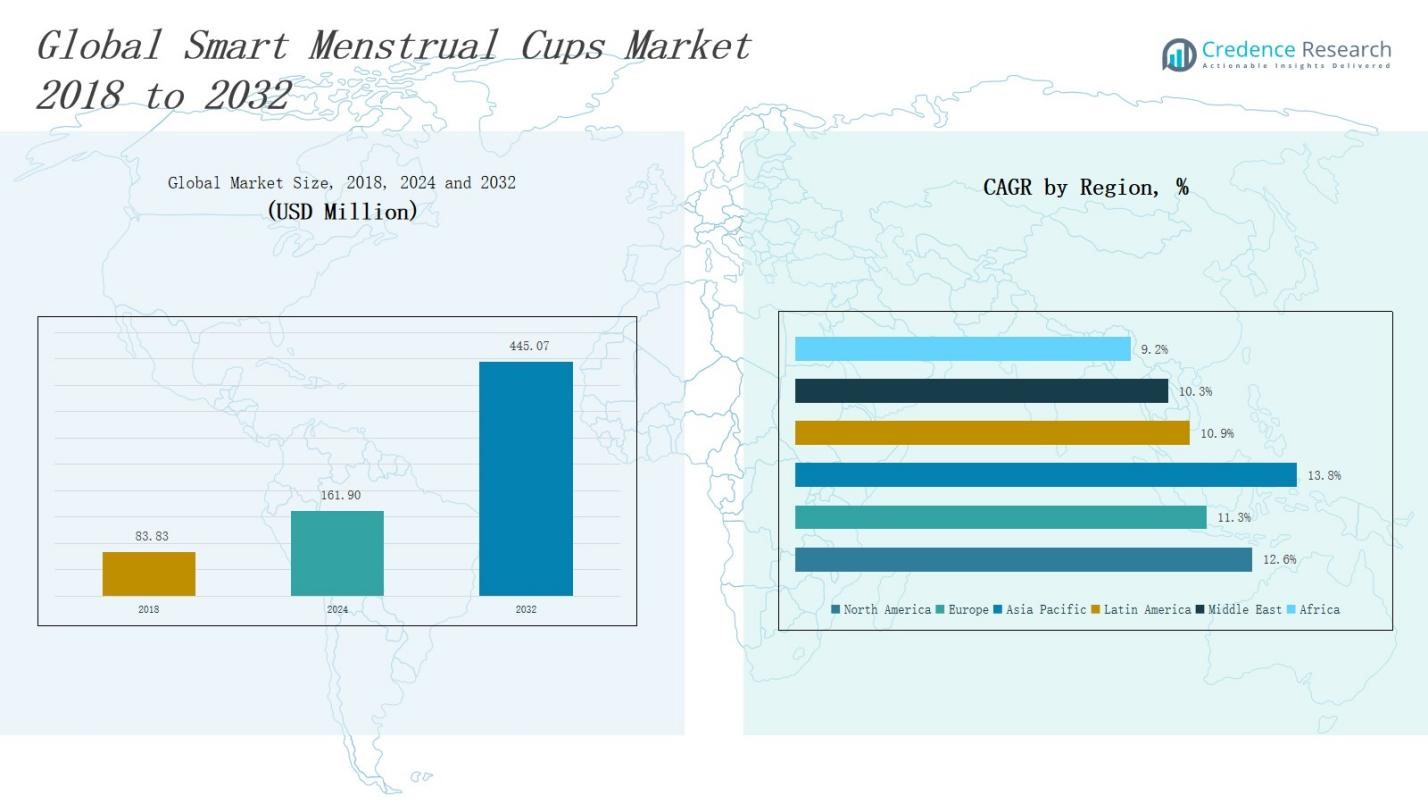
The Smart Menstrual Cups Market size was valued at USD 83.83 million in 2018 to USD 161.90 million in 2024 and is anticipated to reach USD 445.07 million by 2032, at a CAGR of 12.56% during the forecast period.
| REPORT ATTRIBUTE | DETAILS |
|---|---|
| Historical Period | 2020-2023 |
| Base Year | 2024 |
| Forecast Period | 2025-2032 |
| Smart Menstrual Cups Market Size 2024 | USD 161.90 million |
| Smart Menstrual Cups Market, CAGR | 6.1% |
| Smart Menstrual Cups Market Size 2032 | USD 445.07 million |
The Smart Menstrual Cups Market is driven by rising demand for sustainable, tech-enabled feminine hygiene solutions and growing awareness of menstrual health. Increased smartphone penetration and interest in connected health devices support adoption of smart menstrual cups with sensors for tracking flow and usage patterns. Consumers seek reusable, eco-friendly alternatives to disposable products, aligning with environmental concerns. Trends include integration with mobile apps, real-time health monitoring, and the use of medical-grade, biocompatible materials. Manufacturers focus on user comfort, accurate data collection, and personalized insights, reflecting a broader shift toward smart, sustainable, and health-conscious menstrual care solutions.
The Smart Menstrual Cups Market spans North America, Europe, Asia Pacific, Latin America, the Middle East, and Africa. North America leads in market share, while Asia Pacific shows the fastest growth. Europe follows with strong sustainability adoption. Latin America, the Middle East, and Africa show rising potential driven by awareness and digital access. Key players include LOONCUP, Intimina (Lily Cup Smart), Saalt, Diva International, Lunette, Kindara, Femly, Me Luna, Ruby Cup, and SckoonCup. These companies compete through innovation, app integration, eco-friendly materials, and direct-to-consumer strategies across diverse regions.
Market Insights
- The Smart Menstrual Cups Market was valued at USD 83.83 million in 2018 and is projected to reach USD 445.07 million by 2032, growing at a CAGR of 12.56%.
- Consumers are increasingly adopting smart menstrual cups for their sustainability, reusability, and health-tracking capabilities via mobile apps.
- North America leads the market due to strong femtech presence and digital health integration, followed by Europe and rapidly growing Asia Pacific.
- High product costs and limited insurance support continue to restrict adoption in low-income regions.
- Asia Pacific shows the fastest growth, fueled by smartphone access, public health campaigns, and local manufacturing.
- Cultural stigma, lack of awareness, and privacy concerns slow adoption in the Middle East and Africa, despite growing digital access.
- Key players including LOONCUP, Intimina, Saalt, and Diva International are driving innovation through connected devices, ergonomic designs, and direct-to-consumer strategies.
Market Drivers
Growing Demand for Sustainable and Reusable Menstrual Solutions
The Smart Menstrual Cups Market is gaining traction due to increasing consumer preference for eco-friendly and cost-effective menstrual products. Traditional disposable products generate significant waste, prompting a shift toward reusable alternatives. Smart menstrual cups appeal to environmentally conscious consumers who value sustainability without compromising functionality. Rising awareness campaigns about menstrual health and hygiene are educating users on long-term benefits. It supports waste reduction and promotes responsible consumption. Governments and NGOs are reinforcing this shift.
Technological Advancements and Integration with Mobile Health Platforms
Integration of menstrual cups with mobile health apps is fueling market growth by offering users real-time data and health tracking. Smart features such as flow detection, usage reminders, and temperature monitoring provide added value. Consumers increasingly seek health insights and personalized recommendations. The Smart Menstrual Cups Market benefits from innovations in wearable technology and sensor miniaturization. It enhances the user experience by making menstrual management data-driven. Brands are emphasizing usability, connectivity, and app functionality.
- For instance, Asan Cup launched a free period tracking app that not only monitors cycle phases, mood, flow, and symptoms but also informs users about the environmental impact of their menstrual choices, bridging health and sustainability awareness.
- For instance, Emm, a UK-based femtech company, offers a smart menstrual cup with integrated biosensors that automatically track menstrual flow rate, total volume, and cycle length, transmitting data to an app for personalized health insights without manual input.
Growing Acceptance of Femtech and Digital Wellness Devices
The broader growth of the femtech industry supports adoption of smart menstrual devices that combine comfort, connectivity, and health tracking. Women are embracing digital solutions that support wellness, reproductive health, and convenience. The Smart Menstrual Cups Market benefits from this paradigm shift, positioning itself within the rising digital health ecosystem. It attracts consumers seeking innovation in intimate care. Increased investment in femtech startups fosters product development. Media attention and user testimonials build confidence and market momentum.
Market Trends
Integration of IoT and App-Based Tracking Capabilities
The Smart Menstrual Cups Market is witnessing a strong trend toward integration of Internet of Things (IoT) features and app-based tracking. Consumers value real-time monitoring of menstrual health through Bluetooth-enabled sensors linked to smartphones. These features help track flow intensity, duration, and timing, promoting better menstrual awareness. It enables users to receive alerts and insights for health management. Brands are optimizing user interfaces and app design to increase engagement. This digital integration enhances product functionality.
- For instance, the Looncup uses embedded sensors and Bluetooth to connect with a smartphone app that tracks fluid volume, color, and cycle changes, helping users know when to empty the cup for optimal hygiene.
Focus on Biocompatible Materials and Product Comfort
Manufacturers are prioritizing medical-grade silicone and other biocompatible materials to ensure user safety and comfort. Comfort, flexibility, and hypoallergenic properties are now standard design expectations. The Smart Menstrual Cups Market is aligning product development with health standards and user feedback. It emphasizes innovation in ergonomic designs and leak prevention features. Enhanced material quality also extends product lifespan. Companies are differentiating through tactile design and sensitivity to physical activity or sleep patterns.
- For instance, Chemco Group manufactures menstrual cups from medical-grade silicone that is recyclable and biocompatible, ensuring safety and minimizing environmental impact. They offer customizable softness, flexibility, and durability options tailored for user comfort.
Expansion of Femtech Startups and Direct-to-Consumer Strategies
The market is benefiting from a surge in femtech startups that target digitally literate and health-aware consumers. These companies leverage social media, influencers, and direct-to-consumer models to build trust and visibility. The Smart Menstrual Cups Market is evolving beyond legacy brands, driven by agile entrants with smart innovation. It gains momentum through transparent communication, inclusive marketing, and user-centric design. Startups are focusing on subscription models and community engagement to drive brand loyalty.
Market Challenges Analysis
High Product Cost and Limited Affordability Across Low-Income Segments
Smart menstrual cups are priced significantly higher than traditional menstrual products, limiting accessibility for cost-sensitive consumers. High production costs due to embedded sensors, Bluetooth modules, and companion app development contribute to premium pricing. The Smart Menstrual Cups Market faces difficulty in penetrating developing regions where affordability and basic menstrual hygiene access remain challenges. It struggles to reach users unfamiliar with or skeptical of smart healthcare devices. Limited insurance coverage and lack of government subsidies reduce uptake. Brands must address pricing gaps through scalable innovation or localized pricing models.
Lack of Awareness and Cultural Barriers to Adoption
Consumer hesitancy around intravaginal products and privacy concerns linked to data tracking hinder adoption in conservative and less digitally aware communities. Many potential users are unfamiliar with how smart menstrual cups work or feel uncomfortable using app-linked devices for intimate care. The Smart Menstrual Cups Market experiences slow adoption in regions where menstrual taboos persist or digital literacy is low. It requires targeted education campaigns to build trust and dispel misconceptions. Language barriers and limited healthcare outreach compound the problem. These cultural and informational gaps limit the pace of global expansion.
Market Opportunities
Expansion into Emerging Markets with Rising Digital Health Adoption
Growing smartphone penetration and increasing awareness of digital health tools in emerging economies present a strong opportunity for market expansion. Urban populations in Asia, Africa, and Latin America are adopting smart technologies and seeking sustainable healthcare alternatives. The Smart Menstrual Cups Market can tap into this shift by offering localized education and affordable product variants. It benefits from partnerships with NGOs and government initiatives that promote menstrual hygiene. Companies can expand through mobile health apps tailored to regional languages. First-mover advantage in these regions can establish long-term brand loyalty.
Product Diversification Through Health Monitoring and Data Analytics
There is a clear opportunity to position smart menstrual cups as tools for broader reproductive health tracking. Integration of features such as ovulation monitoring, infection alerts, and hormonal insights can attract users seeking comprehensive wellness solutions. The Smart Menstrual Cups Market can evolve into a platform for digital diagnostics and menstrual health management. It allows brands to offer subscription-based services or data-driven personalization. Collaborations with healthcare providers and femtech platforms can extend product utility. Diversified functionality increases user retention and expands the addressable market.
Market Segmentation Analysis:
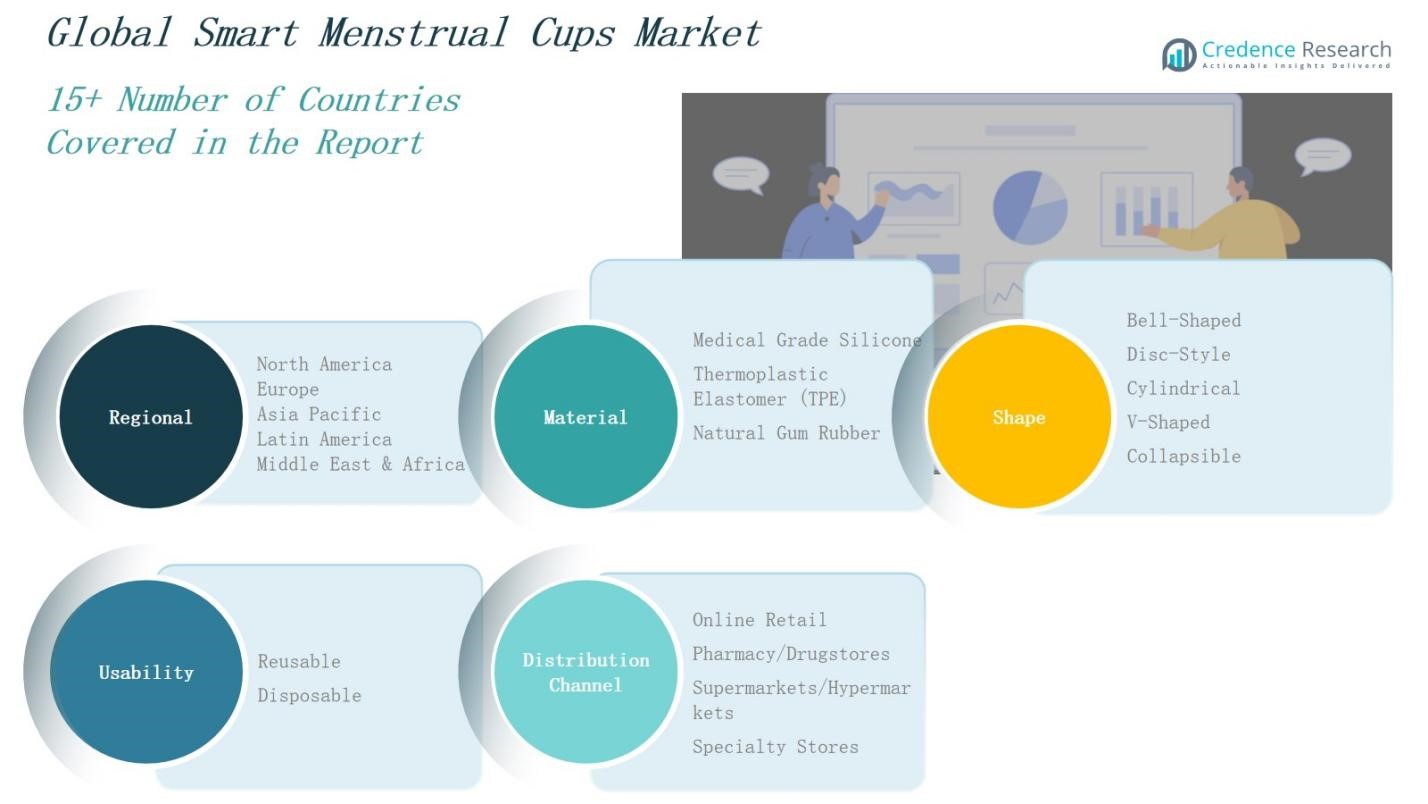
By Material
The Smart Menstrual Cups Market segments by material into medical grade silicone, thermoplastic elastomer (TPE), and natural gum rubber. Medical grade silicone holds the largest share due to its biocompatibility, flexibility, and durability. It ensures safety, comfort, and long-term usage, making it the preferred choice among users. TPE offers a softer, more flexible alternative and suits users with silicone sensitivities. Natural gum rubber appeals to consumers seeking organic options but remains niche due to allergen concerns.
- For instance, the Aarya Medical Grade Silicone Reusable Menstrual Cup, made from USP Class VI liquid silicone rubber, is FDA approved and tested for biocompatibility, offering an odor-free, leak-proof design with up to 12 hours of use per wear.
By Shape
The market categorizes shape into bell-shaped, disc-style, cylindrical, V-shaped, and collapsible types. Bell-shaped cups dominate due to their ease of insertion, secure fit, and suitability for various cervix positions. Disc-style options appeal to users seeking discreet wear during physical activity or intercourse. Cylindrical and V-shaped cups cater to anatomical variations and personal preferences. Collapsible designs are gaining traction among travelers and minimalists valuing portability and convenience.
- For instance, FemmyCycle offers a bell-shaped cup with an internal funnel-like lip that enhances spill protection and sealing. Their design prioritizes comfort with a wider bell form suited for secure wear.
By Usability
Smart menstrual cups are available in reusable and disposable formats. Reusable cups lead the Smart Menstrual Cups Market due to their cost-efficiency and eco-friendly profile. Consumers favor them for their multi-year usability and reduced waste output. Disposable smart cups target short-term use and appeal to first-time users or travelers. It remains a smaller segment but holds potential where hygiene concerns or cultural preferences limit reusable adoption.
Segments:
Based on Material:
- Medical Grade Silicone
- Thermoplastic Elastomer (TPE)
- Natural Gum Rubber
Based on Shape:
- Bell-Shaped
- Disc-Style
- Cylindrical
- V-Shaped
- Collapsible
Based on Usability:
- Reusable
- Disposable
Based on Distribution Channel:
- Online Retail
- Pharmacy/Drugstores
- Supermarkets/Hypermarkets
- Specialty Stores
Based on Region:
- North America
- U.S.
- Canada
- Mexico
- Europe
- Germany
- France
- U.K.
- Italy
- Spain
- Rest of Europe
- Asia Pacific
- China
- Japan
- India
- South Korea
- South-east Asia
- Rest of Asia Pacific
- Latin America
- Brazil
- Argentina
- Rest of Latin America
- Middle East & Africa
- GCC Countries
- South Africa
- Rest of the Middle East and Africa
Regional Analysis
North America
The North America Smart Menstrual Cups Market size was valued at USD 35.83 million in 2018 to USD 68.45 million in 2024 and is anticipated to reach USD 188.71 million by 2032, at a CAGR of 12.6% during the forecast period. North America holds the largest market share globally due to high consumer awareness, widespread access to digital health tools, and strong presence of femtech companies. It benefits from early adoption of smart wearables and app-based health solutions. Supportive regulatory environments and reimbursement initiatives enhance market penetration. The U.S. dominates the region, followed by Canada, with well-established e-commerce and healthcare infrastructure.
Europe
The Europe Smart Menstrual Cups Market size was valued at USD 17.11 million in 2018 to USD 31.39 million in 2024 and is anticipated to reach USD 79.17 million by 2032, at a CAGR of 11.3% during the forecast period. Europe ranks second in market share, driven by growing environmental awareness and strong demand for sustainable feminine hygiene products. Consumers prefer reusable smart menstrual solutions aligned with EU regulations promoting eco-friendly products. Germany, France, and the UK lead regional adoption, supported by rising femtech startups and digital health education. It continues to benefit from well-regulated product standards and innovation in health monitoring.
Asia Pacific
The Asia Pacific Smart Menstrual Cups Market size was valued at USD 23.16 million in 2018 to USD 47.33 million in 2024 and is anticipated to reach USD 142.42 million by 2032, at a CAGR of 13.8% during the forecast period. Asia Pacific is the fastest-growing regional market due to rising smartphone penetration, digital health awareness, and increasing urbanization. India, China, Japan, and South Korea are key contributors, with expanding middle-class populations and a growing focus on women’s health. It benefits from public health campaigns and partnerships promoting menstrual hygiene. Local manufacturing and tech startups are also driving product availability and affordability.
Latin America
The Latin America Smart Menstrual Cups Market size was valued at USD 4.04 million in 2018 to USD 7.71 million in 2024 and is anticipated to reach USD 18.82 million by 2032, at a CAGR of 10.9% during the forecast period. Latin America shows moderate growth driven by increasing awareness of sustainable menstrual products and digital inclusion. Brazil and Mexico lead in regional demand, supported by online retail growth and NGO-led education programs. The Smart Menstrual Cups Market in this region faces barriers such as price sensitivity and limited distribution in rural areas. It continues to expand with localized branding and affordable solutions.
Middle East
The Middle East Smart Menstrual Cups Market size was valued at USD 2.44 million in 2018 to USD 4.33 million in 2024 and is anticipated to reach USD 10.11 million by 2032, at a CAGR of 10.3% during the forecast period. Growth in this region stems from increasing digital literacy and gradual cultural openness toward innovative menstrual solutions. Urban centers in the UAE, Saudi Arabia, and Israel are adopting smart menstrual products, aided by rising disposable income and wellness-focused consumer behavior. It faces resistance in conservative segments, but education campaigns and e-commerce platforms are improving access and acceptance.
Africa
The Africa Smart Menstrual Cups Market size was valued at USD 1.25 million in 2018 to USD 2.68 million in 2024 and is anticipated to reach USD 5.83 million by 2032, at a CAGR of 9.2% during the forecast period. Africa holds the smallest market share but presents long-term potential through government and NGO interventions addressing menstrual health gaps. South Africa and Egypt lead regional adoption, supported by improving healthcare infrastructure and digital outreach. The Smart Menstrual Cups Market in this region faces challenges such as affordability, cultural stigma, and limited awareness. Efforts to localize manufacturing and education are slowly fostering acceptance.
Key Player Analysis
- Femly
- Me Luna
- Saalt
- SckoonCup
- Diva International
- Kindara
- LOONCUP
- Ruby Cup
- Lunette
- Intimina (Lily Cup Smart)
Competitive Analysis
The Smart Menstrual Cups Market features a competitive landscape led by both established hygiene brands and emerging femtech innovators. Companies such as LOONCUP, Intimina (Lily Cup Smart), and Saalt focus on integrating app connectivity and sensor-based tracking to enhance user experience. Players like Diva International and Lunette emphasize medical-grade materials and ergonomic design. Startups including Femly and SckoonCup target niche segments with sustainable and inclusive branding. It remains driven by innovation, product differentiation, and user education. Strategic partnerships, e-commerce expansion, and direct-to-consumer models help companies build loyalty and scale. Competitive success depends on balancing functionality, affordability, and comfort. Companies are also investing in multilingual mobile platforms, real-time flow analysis, and eco-conscious packaging. Marketing strategies increasingly highlight personalized health tracking and data security, appealing to tech-savvy and health-conscious users. Players that align with evolving user preferences and privacy standards are likely to maintain long-term competitive advantages in the smart menstrual care segment.
Recent Developments
- In July 2023, &SISTERS, a sustainable period care brand, acquired Mooncup®, the world’s first silicone menstrual cup brand. This acquisition supports &SISTERS’ mission to mainstream plastic-free period products.
- In January 2023, a new menstrual cup called Leia Sustainable Menstrual Cup was launched by a New Product Development Company in Louisiana, featuring design improvements such as a slanted, firm grip and easy-to-hold rings for removal and adjustment.
- In December 2024, femtech startup Bettii Pod raised £400,000 in funding to advance its innovative menstrual cup washing solution designed for use in public restrooms, addressing hygiene and sustainability needs.
- On May 26, 2025, Women’s Global Health Innovations introduced the Bfree Cup, the world’s first boil-free, antibacterial menstrual cup in Canada. This launch aims to simplify hygiene and reduce heat-related maintenance burdens
Market Concentration & Characteristics
The Smart Menstrual Cups Market shows moderate concentration, with a mix of established hygiene brands and emerging femtech startups competing across global regions. Leading players such as LOONCUP, Intimina, Diva International, and Saalt maintain a significant share through strong brand recognition, proprietary technology, and app integration. It remains characterized by rapid innovation, user-centric product design, and a growing shift toward sustainability. Market participants focus on personalized health tracking, medical-grade materials, and seamless user experiences. Entry barriers are moderate due to the need for regulatory compliance, software integration, and consumer trust in intimate health products. The market favors companies with strong e-commerce presence, digital health partnerships, and investment in education and awareness campaigns. It continues to evolve through direct-to-consumer models, subscription services, and hybrid wellness platforms. Regional dynamics vary, with high adoption in North America and Europe, while Asia Pacific leads in growth. Competitive differentiation centers on comfort, data accuracy, affordability, and privacy features.
Report Coverage
The research report offers an in-depth analysis based on Material, Shape, Usability, Distribution Channel and Region. It details leading market players, providing an overview of their business, product offerings, investments, revenue streams, and key applications. Additionally, the report includes insights into the competitive environment, SWOT analysis, current market trends, as well as the primary drivers and constraints. Furthermore, it discusses various factors that have driven market expansion in recent years. The report also explores market dynamics, regulatory scenarios, and technological advancements that are shaping the industry. It assesses the impact of external factors and global economic changes on market growth. Lastly, it provides strategic recommendations for new entrants and established companies to navigate the complexities of the market.
Future Outlook
- Demand for smart menstrual cups will grow as consumers prioritize reusable and eco-friendly hygiene solutions.
- Mobile app integration will become standard, offering personalized health tracking and real-time usage insights.
- Companies will expand product lines to include additional reproductive health monitoring features.
- E-commerce platforms will play a dominant role in product accessibility and consumer engagement.
- Market players will focus on affordability to reach underserved populations in emerging markets.
- Regulatory approvals and certifications will gain importance to ensure product safety and credibility.
- Femtech startups will continue driving innovation through sensor miniaturization and ergonomic design.
- Educational campaigns will reduce stigma and improve adoption in culturally conservative regions.
- Data privacy and cybersecurity will become critical as digital health tracking expands.
- Strategic collaborations between tech firms and healthcare providers will enhance product value and market reach.

Request a Free Sample
Fill in your details and we'll send you a free sample report.
- Sample data tables & charts
- Research methodology
Market Dynamics
Sustainable and Reusable Menstrual Solutions
Growing environmental awareness and the need to reduce menstrual waste are driving consumers toward smart menstrual cups, which offer a reusable, eco-friendly alternative to disposables. This aligns with global sustainability goals and appeals to cost-conscious, environmentally minded users.
Integration with Mobile Health Platforms
The ability to track menstrual health data in real time via smartphone apps is a major draw for tech-savvy consumers. Smart menstrual cups with sensors and app connectivity provide personalized health insights, usage reminders, and flow tracking, enhancing user engagement and perceived value.
Rising Femtech Adoption and Digital Wellness Trends
The broader acceptance of femtech and digital health devices is fueling demand for smart menstrual cups. Women are increasingly seeking connected, data-driven solutions for reproductive health, and investment in femtech startups is accelerating product innovation and market expansion.
Focus on Personal Health Monitoring and Preventive Care
Consumers are prioritizing self-monitoring tools that empower them with actionable health information. Smart menstrual cups enable detailed tracking of menstrual patterns, supporting early detection of irregularities and proactive reproductive health management.
Expansion in Emerging Markets with Digital Health Growth
Increasing smartphone penetration and digital health awareness in emerging economies, especially in Asia Pacific and Latin America, are opening new markets for smart menstrual cups. Localized education, affordable variants, and partnerships with NGOs are helping to overcome barriers and drive adoption.
Need a Custom Version of This Report?
Tailor the scope, geography, or segments to your exact requirements.
- Custom geography or segment scope
- Direct access to our analyst team
Frequently Asked Questions
What is the current size of the Smart Menstrual Cups Market?
What factors are driving the growth of the Smart Menstrual Cups Market?
What are the key segments within the Smart Menstrual Cups Market?
What are some challenges faced by the Smart Menstrual Cups Market?
Who are the major players in the Smart Menstrual Cups Market?
Table of Content
Chapter 1 Market Segmentation
- 1.1 Segmentation Framework
- 1.1.1 Product and Service Classification
- 1.1.2 Application and End-Use Classification
- 1.1.3 Technology and Solution Classification
- 1.1.4 Customer and Distribution Channel Classification
- 1.1.5 Geographic Segmentation
- 1.1.6 Market Segment Definitions and Boundaries
- 1.2 By Shape
- 1.2.1 Bell-Shaped
- 1.2.2 Disc-Style
- 1.2.3 Cylindrical
- 1.2.4 V-Shaped
- 1.2.5 Collapsible
- 1.3 By Material
- 1.3.1 Medical Grade Silicone
- 1.3.2 Thermoplastic Elastomer (TPE)
- 1.3.3 Natural Gum Rubber
- 1.4 By Usability
- 1.4.1 Reusable
- 1.4.2 Disposable
Chapter 2 Introduction
- 2.1 Report Objectives and Scope
- 2.2 Product Definition and Industry Terminology
- 2.3 Market Inclusions and Exclusions
- 2.4 Research Process
- 2.4.1 Primary Research and Expert Interviews
- 2.4.2 Secondary Research and Source Review
- 2.4.3 Top-Down and Bottom-Up Estimation
- 2.4.4 Data Triangulation and Verification
- 2.5 Market Size Measurement Basis
- 2.5.1 2024: USD 161.90 million → 2032: USD 445.07 million
- 2.6 Historical and Forecast Reference Periods
- 2.6.1 Base Year: 2024
- 2.6.2 Forecast Period: 2024-2032
- 2.7 Research Assumptions and Limitations
Chapter 3 Executive Summary
- 3.1 Market Snapshot and Key Findings
- 3.2 Base-Year Market Size, 2024
- 3.3 Forecast Market Size, 2032
- 3.4 Revenue and Volume Growth Outlook
- 3.5 Key Demand and Supply Indicators
- 3.6 Leading Market Segments
- 3.7 Fastest-Growing Market Opportunities
- 3.8 Regional Performance Highlights
- 3.9 Technology and Industry Transformation
- 3.10 Competitive Landscape Summary
- 3.11 Analyst View and Strategic Implications
Chapter 4 Global Smart Menstrual Cups Market Trends and Developments
- 4.1 Historical Industry Development
- 4.2 Recent Market Trends and Developments
- 4.3 Demand and Customer Behavior Trends
- 4.4 Technology and Product Innovation
- 4.5 Artificial Intelligence, Automation and Digitalization
- 4.6 Local Manufacturing and Supply Chain Realignment
- 4.7 Industry Partnerships, Mergers and Acquisitions
- 4.8 Sustainability and Circular Economy Developments
- 4.9 Government and Private Sector Investment Trends
- 4.10 Emerging Business Models and Commercialization
- 4.11 Industry Developments and Announcements
Chapter 5 Global Smart Menstrual Cups Market Production, Supply and Demand Analysis
- 5.1 Demand Trend and Consumption Analysis
- 5.2 Demand Forecast, 2024-2032
- 5.3 Production and Output Trend
- 5.4 Production and Output Forecast, 2024-2032
- 5.5 Installed Capacity and Capacity Utilization
- 5.6 Company-Wise Production Plants and Statistics
- 5.6.1 Installed Production Capacity
- 5.6.2 Actual Production
- 5.6.3 Planned Capacity and Expansion Targets
- 5.7 Supply Chain Structure and Procurement Trends
- 5.8 Supply-Demand Gap and Bottlenecks
- 5.9 Import Dependence and Sourcing Structure
- 5.10 Contract Manufacturing and Outsourcing
- 5.11 Regional Supply and Demand Concentration
Chapter 6 Global Smart Menstrual Cups Market Pricing Analysis
- 6.1 Pricing Structure and Measurement
- 6.2 Historical Pricing Trends
- 6.3 Pricing Outlook, 2024-2032
- 6.4 Average Selling Price and Unit Economics
- 6.5 Pricing by Product and Market Segment
- 6.6 Geographic Pricing Differences
- 6.7 Key Input, Energy, Labor and Logistics Costs
- 6.8 Contract Pricing and Purchasing Models
- 6.9 Pricing Sensitivity and Competitive Positioning
- 6.10 Price, Margin and Profitability Implications
Chapter 7 Global Smart Menstrual Cups Market Dynamics
- 7.1 Market Growth Drivers
- 7.1.1 Demand-Side Drivers
- 7.1.2 Technology and Innovation Drivers
- 7.1.3 Infrastructure and Investment Drivers
- 7.1.4 Regulatory and Policy Drivers
- 7.2 Market Restraints
- 7.2.1 Cost and Affordability Constraints
- 7.2.2 Technology and Adoption Barriers
- 7.2.3 Supply Chain and Operational Constraints
- 7.3 Market Challenges
- 7.3.1 Competitive Pressure and Margin Erosion
- 7.3.2 Skills, Infrastructure and Implementation Gaps
- 7.4 Emerging Market Opportunities
- 7.5 Market Dynamics Impact and Time-Horizon Assessment
Chapter 8 Global Smart Menstrual Cups Value Chain Analysis
- 8.1 Industry Value Chain Overview
- 8.2 Upstream Suppliers and Critical Inputs
- 8.3 Technology and Component Providers
- 8.4 Manufacturing or Service Delivery
- 8.5 Distribution, Channel Partners and Integrators
- 8.6 Downstream Applications and End Users
- 8.7 Value Addition and Profit Pools
- 8.8 Vertical Integration and Outsourcing
- 8.9 Supplier Concentration and Risk
- 8.10 Supply Chain Localization and Resilience
Chapter 9 Global Smart Menstrual Cups Market Regulations and Policies
- 9.1 Relevant Laws, Standards and Compliance Frameworks
- 9.2 Product, Service, Safety and Quality Requirements
- 9.3 Government Policies, Incentives and Subsidies
- 9.4 Imports, Exports and Trade Barriers
- 9.5 Public Procurement and Local Content Requirements
- 9.6 Environmental and Sustainability Compliance
- 9.7 Upcoming Policy Changes and Market Implications
Chapter 10 Global Smart Menstrual Cups Market Hotspots and Opportunities
- 10.1 Market Opportunity Mapping and Growth Hotspots
- 10.2 High-Growth Applications and Customer Groups
- 10.3 Underserved Markets and White-Space Opportunities
- 10.4 Emerging Technology and Product Opportunities
- 10.5 New Capacity and Investment Hotspots
- 10.6 Market Entry and Expansion Opportunities
- 10.7 Distribution and Partnership Opportunities
- 10.8 Near-Term and Long-Term Commercial Potential
- 10.9 Opportunity Attractiveness and Execution Risks
Chapter 11 Global Smart Menstrual Cups Market Outlook, 2024-2032
- 11.1 Market Size and Analysis
- 11.1.1 Revenue (Market Measurement: 2024: USD 161.90 million → 2032: USD 445.07 million)
- 11.1.2 Market Volume and Quantity Sold
- 11.1.3 Historical Market Size
- 11.1.4 Base-Year Market Size, 2024
- 11.2 Market Forecast, 2024-2032
- 11.2.1 Revenue Forecast to 2032
- 11.2.2 Volume Forecast to 2032
- 11.2.3 CAGR and Year-on-Year Growth
- 11.2.4 Incremental Revenue Opportunity
- 11.3 Forecast Assumptions and Scenario Analysis
- 11.3.1 Base-Case Forecast
- 11.3.2 Optimistic and Conservative Scenarios
- 11.3.3 Technology, Pricing and Policy Sensitivities
- 11.4 Market Attractiveness and Growth Outlook
Chapter 12 Global Smart Menstrual Cups Market Segmentation and Outlook
- 12.1 Segmentation Summary and Market Shares, 2024
- 12.2 Largest and Fastest-Growing Segments
- 12.3 By Shape - Market Size and Forecast, 2024-2032
- 12.3.1 Segment Definition and Scope
- 12.3.2 Historical Market Size
- 12.3.3 Revenue Forecast, 2024-2032
- 12.3.4 Volume Forecast, 2024-2032
- 12.3.5 Base-Year Market Share, 2024
- 12.3.6 Segment CAGR and Growth Drivers
- 12.3.7 Subsegment Market Size and Forecast
- 12.3.7.1 Bell-Shaped
- 12.3.7.2 Disc-Style
- 12.3.7.3 Cylindrical
- 12.3.7.4 V-Shaped
- 12.3.7.5 Collapsible
- 12.3.8 Subsegment Pricing and Adoption Trends
- 12.3.9 Leading Suppliers and Competition
- 12.3.10 Regional Demand and Opportunities
- 12.4 By Material - Market Size and Forecast, 2024-2032
- 12.4.1 Segment Definition and Scope
- 12.4.2 Historical Market Size
- 12.4.3 Revenue Forecast, 2024-2032
- 12.4.4 Volume Forecast, 2024-2032
- 12.4.5 Base-Year Market Share, 2024
- 12.4.6 Segment CAGR and Growth Drivers
- 12.4.7 Subsegment Market Size and Forecast
- 12.4.7.1 Medical Grade Silicone
- 12.4.7.2 Thermoplastic Elastomer (TPE)
- 12.4.7.3 Natural Gum Rubber
- 12.4.8 Subsegment Pricing and Adoption Trends
- 12.4.9 Leading Suppliers and Competition
- 12.4.10 Regional Demand and Opportunities
- 12.5 By Usability - Market Size and Forecast, 2024-2032
- 12.5.1 Segment Definition and Scope
- 12.5.2 Historical Market Size
- 12.5.3 Revenue Forecast, 2024-2032
- 12.5.4 Volume Forecast, 2024-2032
- 12.5.5 Base-Year Market Share, 2024
- 12.5.6 Segment CAGR and Growth Drivers
- 12.5.7 Subsegment Market Size and Forecast
- 12.5.7.1 Reusable
- 12.5.7.2 Disposable
- 12.5.8 Subsegment Pricing and Adoption Trends
- 12.5.9 Leading Suppliers and Competition
- 12.5.10 Regional Demand and Opportunities
- 12.6 Segment Growth Comparison
- 12.7 Segment Attractiveness and Priority Matrix
Chapter 13 Global Smart Menstrual Cups Geographic Market Outlook, 2024-2032
- 13.1 Regional Market Size and Share, 2024
- 13.2 Regional Market Forecast, 2024-2032
- 13.3 Regional Pricing, Production and Demand Differences
- 13.4 North America
- 13.4.1 United States
- 13.4.2 Canada
- 13.4.3 Mexico
- 13.5 Europe
- 13.5.1 Germany
- 13.5.2 France
- 13.5.3 Italy
- 13.5.4 United Kingdom
- 13.5.5 Spain
- 13.5.6 Poland
- 13.5.7 Russia
- 13.5.8 Netherlands
- 13.5.9 Belgium
- 13.5.10 Sweden
- 13.5.11 Denmark
- 13.5.12 Norway
- 13.5.13 Rest of Europe
- 13.6 Asia Pacific
- 13.6.1 China
- 13.6.2 India
- 13.6.3 Japan
- 13.6.4 South Korea
- 13.6.5 Thailand
- 13.6.6 Indonesia
- 13.6.7 Vietnam
- 13.6.8 Malaysia
- 13.6.9 Australia
- 13.6.10 Rest of Asia Pacific
- 13.7 Latin America
- 13.7.1 Brazil
- 13.7.2 Argentina
- 13.7.3 Colombia
- 13.7.4 Chile
- 13.7.5 Rest of Latin America
- 13.8 Middle East
- 13.8.1 Saudi Arabia
- 13.8.2 United Arab Emirates
- 13.8.3 Turkey
- 13.8.4 Israel
- 13.8.5 Iran
- 13.8.6 Rest of the Middle East
- 13.9 Africa
- 13.9.1 South Africa
- 13.9.2 Egypt
- 13.9.3 Nigeria
- 13.9.4 Morocco
- 13.9.5 Rest of Africa
- 13.10 Regional Investment, Policy and Supply Chain Differences
- 13.11 Regional Competitive Landscape
- 13.12 Geographic Growth Hotspots
Chapter 14 Global Smart Menstrual Cups Technology, Innovation and Sustainability Outlook
- 14.1 Technology Landscape and Maturity
- 14.2 Product, Process and Service Innovation
- 14.3 AI, Automation and Digital Tools in the Industry
- 14.4 Technology Adoption and Performance Benchmarking
- 14.5 Innovation Pipeline and R&D Investment
- 14.6 Patent and Intellectual Property Trends
- 14.7 Energy Efficiency and Resource Management
- 14.8 Sustainability, Recycling and Circularity
- 14.9 Technology Roadmap, 2024-2032
- 14.10 Risks of Obsolescence and Technology Substitution
Chapter 15 Global Smart Menstrual Cups Market Key Strategic Imperatives
- 15.1 Growth and Market Entry Priorities
- 15.2 High-Return Products and Segments
- 15.3 Pricing, Profitability and Cost Optimization
- 15.4 Technology Investment and Product Differentiation
- 15.5 Supply Chain Localization and Resilience
- 15.6 Distribution and Customer Acquisition
- 15.7 Partnership, Acquisition and Capacity Strategy
- 15.8 Regional Expansion Priorities
- 15.9 Short-, Medium- and Long-Term Actions
Chapter 16 Competition Outlook
- 16.1 Industry Competition Characteristics
- 16.2 Market Structure and Concentration
- 16.3 Market Share and Competitive Positioning, 2024
- 16.4 Company-Wise Revenue and Product Benchmarking
- 16.5 Production and Service Capacity Benchmarking
- 16.6 Technology, Pricing and Differentiation
- 16.7 Regional Footprint and Distribution Strength
- 16.8 Mergers, Acquisitions and Strategic Alliances
- 16.9 New Entrants and Competitive Threats
- 16.10 Porter's Five Forces and Industry Attractiveness
- 16.11 Competitive Outlook, 2024-2032
Chapter 17 Company Profiles
- 17.1 Company Coverage and Selection Criteria
- 17.2 LOONCUP
- 17.2.1 Business Description
- 17.2.2 Company Ownership and Geographic Presence
- 17.2.3 Product and Service Portfolio
- 17.2.4 Manufacturing and Operating Footprint
- 17.2.5 Production Capacity and Expansion Plans
- 17.2.6 Financial Performance and Investment
- 17.2.7 Market Share and Competitive Position
- 17.2.8 Technology and Innovation Capabilities
- 17.2.9 Strategic Alliances or Partnerships
- 17.2.10 Recent Developments
- 17.2.11 Growth Strategy and Outlook
- 17.3 Intimina (Lily Cup Smart)
- 17.4 Saalt
- 17.5 Diva International
- 17.6 Lunette
- 17.7 Kindara
- 17.8 Femly
- 17.9 Me Luna
- 17.10 Ruby Cup
- 17.11 SckoonCup
- 17.12 Other Relevant Market Participants
Note: Every listed company is profiled on the structure shown under the first company. The company list is preliminary and may change based on research findings, market developments, data availability and client requirements.
Chapter 18 Disclaimer
- 18.1 Research and Forecast Disclaimer
- 18.2 Data Source and Estimation Limitations
Note: The depth of individual sections depends on data availability for this market. Volume, capacity, trade and other unit-based metrics are included where applicable.

