
| REPORT ATTRIBUTE | DETAILS |
|---|---|
| Historical Period | 2020-2023 |
| Base Year | 2024 |
| Forecast Period | 2025-2032 |
| Temporary Power Marke tSize 2024 | USD 5245 million |
| Temporary Power Market, CAGR | 8.9% |
| Temporary Power Market Size 2032 | USD 10374.5 million |
Market Overview:
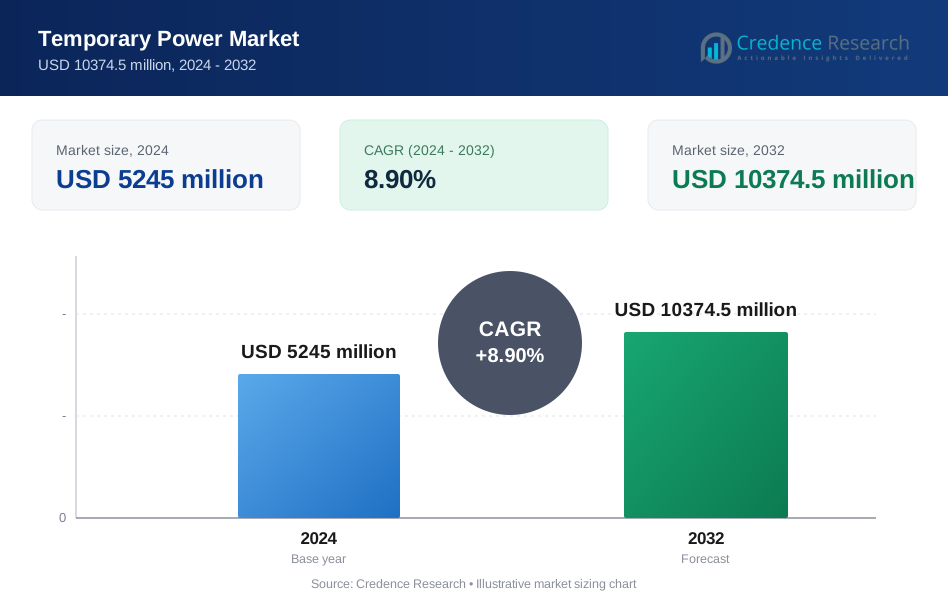
The Temporary Power Market size was valued at USD 5245 million in 2024 and is anticipated to reach USD 10374.5 million by 2032, at a CAGR of 8.9% during the forecast period (2024-2032).
Market growth is primarily propelled by the rising frequency of power outages and grid failures, which create a critical need for contingency solutions, especially in emerging economies with underdeveloped infrastructure. Additionally, the growing volume of infrastructure projects, coupled with rapid urbanization and industrialization, is spurring demand for portable and scalable power systems. Temporary power solutions are also gaining traction due to the expanding construction industry, where project timelines and remote site locations require quick, efficient, and cost-effective power delivery. The growing reliance on digital connectivity and data-driven operations further elevates the importance of uninterrupted power supply in diverse sectors. Technological advancements, including hybrid and renewable-powered units, further bolster market expansion by offering sustainable alternatives that align with global energy transition goals.
Regionally, Asia Pacific holds the largest share of the Temporary Power Market, driven by significant infrastructure development, industrial growth, and frequent natural disasters necessitating emergency power deployment. China, India, and Southeast Asian countries are major contributors, owing to robust construction activity and government initiatives for rural electrification. In addition, rising investments in smart city projects are fueling the demand for flexible power solutions across the region. North America follows, supported by the strong presence of key market players and high adoption across utilities and events management. Europe exhibits steady growth, led by modernization of grid infrastructure and increased adoption in event management and disaster recovery applications. Latin America and the Middle East & Africa are witnessing accelerated growth, propelled by ongoing investments in infrastructure and growing awareness regarding energy reliability. The increasing need for backup power during grid upgrades and maintenance activities is expected to further strengthen regional market growth.
Market Insights:
- The Temporary Power Market is valued at USD 5245 million and is expected to reach USD 10374.5 million by 2032, growing at a CAGR of 8.9% during the forecast period.
- Increasing power outages and grid failures globally drive the need for reliable backup power solutions, especially in regions with underdeveloped infrastructure, creating strong market demand.
- Significant infrastructure projects, coupled with rapid urbanization and industrialization, are creating the need for portable, scalable temporary power solutions, especially in remote construction sites.
- Technological innovations in hybrid and renewable-powered units, along with advancements in digital controls and remote monitoring, are positioning the market for sustainable and efficient power delivery.
- The growing demand for temporary power in large-scale events, seasonal activities, utility upgrades, and remote locations continues to drive the market’s expansion.
- Stringent environmental regulations and fluctuating fuel costs pose operational challenges for temporary power providers, requiring investment in cleaner, more efficient technologies.
- Asia Pacific leads with a 39% market share, followed by North America at 29%. Europe, Latin America, and the Middle East & Africa exhibit steady growth, driven by infrastructure investments and rising demand for flexible power solutions.
Market Drivers:
Growing Incidence of Power Outages and Need for Reliable Energy Supply
The Temporary Power Market is experiencing strong demand due to the increasing frequency of power outages and grid failures worldwide. Utilities and critical industries require rapid, reliable backup solutions to ensure business continuity and minimize disruptions. Frequent storms, natural disasters, and aging infrastructure often lead to unexpected interruptions, prompting organizations to invest in temporary power systems. These solutions help maintain essential services during emergencies and planned maintenance. Industries such as healthcare, telecommunications, and data centers depend on uninterrupted energy, making backup power a strategic priority. Temporary power providers continue to innovate to deliver faster response times and greater reliability to meet these pressing needs.
Surge in Infrastructure Projects and Construction Activity Fuels Market Expansion
Rising infrastructure development and large-scale construction activity significantly drive growth in the Temporary Power Market. Urbanization and industrialization are creating numerous new project sites, many of which lack grid connectivity in early phases. Construction firms rely on temporary generators and mobile substations to ensure seamless operations and stay on schedule. The growing emphasis on timely project delivery has increased the reliance on flexible, scalable power solutions. Investments in smart city initiatives, transportation, and utility upgrades further amplify demand. Temporary power rentals offer a cost-effective approach, allowing companies to match power supply with dynamic site requirements.
- For instance, Aggreko provided temporary power solutions for nine community solar projects in New York, totaling 59 MW, enhancing renewable energy access and supporting large-scale infrastructure development in the region.
Rapid Technological Advancements and Shift Toward Sustainable Power Solutions
Technological innovation is reshaping the Temporary Power Market through advanced, eco-friendly equipment. Hybrid systems, incorporating renewable sources such as solar and battery storage, are gaining traction among environmentally conscious organizations. Digital controls and remote monitoring capabilities enable efficient power management, reduce fuel consumption, and lower emissions. This trend aligns with global sustainability goals and regulatory mandates for cleaner energy alternatives. Temporary power providers are investing in R&D to expand product offerings with improved performance and lower environmental impact. These advancements position temporary power as an integral part of modern energy transition strategies.
- For instance, Enerwhere Sustainable Energy DMCC deployed a mobile solar-plus-storage unit with a PV capacity of 74 kW and a storage capacity of 50 kWh, achieving 50% renewable energy penetration in 24-hour operation for off-grid applications.
Rising Demand in Events, Utilities, and Remote Locations Bolsters Market Growth
Large public events, seasonal activities, and utility maintenance operations increasingly require temporary power support. The Temporary Power Market is benefiting from the growing scale and complexity of entertainment, sports, and corporate events, which need reliable, high-capacity energy. Utilities deploy temporary solutions during planned grid upgrades, disaster recovery, and remote service expansions. Mining, oil & gas, and military operations in off-grid areas also drive market demand for portable, robust power systems. The flexibility and scalability of modern temporary power offerings allow organizations to adapt quickly to changing operational needs, strengthening market prospects for the foreseeable future.
Market Trends:
Accelerated Adoption of Hybrid and Renewable-Powered Temporary Power Solutions
The Temporary Power Market is witnessing a notable shift toward hybrid and renewable-powered systems, driven by global sustainability mandates and rising environmental awareness among end users. Companies are integrating solar panels, battery storage, and advanced inverters into traditional diesel generator fleets to minimize fuel consumption and carbon emissions. This approach supports both regulatory compliance and cost savings, particularly in regions facing stringent emission standards. Hybrid systems also improve operational efficiency by enabling automated switching between power sources based on demand and availability. Temporary power providers are expanding their product portfolios to include modular, eco-friendly solutions that cater to diverse industry needs. It reflects a growing trend among industrial and event clients to opt for cleaner, quieter, and more flexible power sources.
- For instance, United Rentals deployed a POWR2 POWRBANK PRO battery energy storage system paired with a 70kVA/56kW diesel generator at the 2025 Delray Beach Open, allowing uninterrupted power supply for event infrastructure and eliminating the need for two parallel diesel generators used in previous years.
Increasing Deployment of Digital Technologies for Remote Monitoring and Predictive Maintenance
The integration of digital technologies is transforming the Temporary Power Market by enhancing system reliability, operational transparency, and user control. Remote monitoring solutions now allow operators to track equipment performance, fuel consumption, and system health in real time from centralized dashboards. Predictive maintenance features use analytics to detect issues early, minimizing downtime and extending asset life. Digital connectivity streamlines fleet management for large-scale deployments across multiple locations, supporting rapid response and efficient resource allocation. This technological evolution aligns with client expectations for smarter, data-driven solutions and improved service quality. It is strengthening the position of temporary power providers as trusted partners in mission-critical operations.
- For instance, IDE Systems’ Erica smart Energy Management System enables real-time monitoring and remote control of up to 32 power circuits per distribution board, providing live data on energy consumption for construction sites and events.
Market Challenges Analysis:
Stringent Environmental Regulations and Rising Fuel Costs Pose Operational Constraints
The Temporary Power Market faces increasing challenges from evolving environmental regulations and the volatility of fuel prices. Governments are tightening emission standards for diesel generators, placing pressure on providers to invest in cleaner technologies and upgrade fleets. These requirements raise operational costs and limit the deployment of conventional systems in some regions. Fuel price fluctuations add another layer of uncertainty, impacting project budgeting and overall profitability for both providers and end users. Compliance with complex permitting processes and local environmental laws often extends project timelines. It can discourage smaller players from entering or expanding within the market.
Logistical Complexities and Supply Chain Disruptions Impact Service Delivery
Logistical hurdles and supply chain disruptions continue to hinder the timely delivery of temporary power solutions. Transporting bulky generators and associated equipment to remote or disaster-affected sites demands extensive planning and reliable infrastructure. Delays in equipment availability or parts shortages can interrupt project schedules and reduce customer satisfaction. The Temporary Power Market must navigate customs regulations and variable import duties when operating across international borders. It requires robust contingency strategies and close supplier partnerships to maintain operational resilience and service quality.
Market Opportunities:
Rising Demand from Infrastructure Development and Expanding Industrialization
The Temporary Power Market presents significant growth opportunities due to the surge in infrastructure projects and expanding industrial activity worldwide. Large-scale construction, mining, and oil & gas operations in developing regions are driving the need for reliable, mobile power sources. Governments are investing heavily in smart city initiatives, renewable energy integration, and rural electrification, all of which require temporary power solutions for site setup and grid transition phases. It positions providers to capitalize on multi-phase project requirements and long-term rental contracts. The expanding logistics and data center sectors further widen the addressable market for temporary power solutions.
Technological Advancements and Growing Adoption of Sustainable Power Solutions
Rapid innovation in hybrid and renewable-powered temporary power units offers providers new avenues for market expansion. Companies are introducing modular, energy-efficient systems that combine solar, battery, and conventional power sources to address environmental concerns and meet evolving regulatory standards. Adoption of remote monitoring and predictive analytics enables enhanced service delivery and operational transparency, appealing to customers seeking both sustainability and reliability. The Temporary Power Market is well-positioned to serve emerging needs in disaster recovery, healthcare, and remote communications infrastructure. It allows market participants to differentiate through advanced technologies and value-added services.
Market Segmentation Analysis:
By Fuel Type
The market is primarily divided into diesel, gas, hybrid, and renewable fuel types. Diesel-powered temporary power solutions dominate due to their availability, reliability, and high power output. Diesel generators remain a preferred choice in sectors requiring uninterrupted power, such as construction and utilities. However, there is a noticeable shift towards hybrid and renewable-powered systems, driven by the need for cleaner, more sustainable energy sources. Solar and battery storage solutions are gaining traction, particularly in environmentally conscious regions, as these systems reduce fuel dependency and lower emissions.
- For instance, the Jackery Solar Generator 1000 Pro provides a continuous output of 1,000 watts and has been field-tested to power a Dometic CFX3 Dual-Zone Cooler for up to 24 hours on a single charge during outdoor expeditions.
By End-Use
The Temporary Power Market also segments by end-use, including construction, events, industrial, commercial, and utilities. The construction sector accounts for a significant share, with demand driven by the need for reliable power on remote job sites. Temporary power systems are essential for maintaining operations and meeting project timelines. The events segment is another key driver, with temporary power used in large-scale events, festivals, and exhibitions requiring high-capacity energy. Utilities also rely on temporary power during grid maintenance, emergency situations, and outages. Industrial and commercial applications are expanding due to the increasing need for backup power in factories, data centers, and retail operations. Each of these end-use sectors requires flexible, scalable power solutions to meet dynamic and often urgent needs.
- For instance, Aggreko supplied temporary electricity systems to all 43 competition venues, the Athletes Village, and the International Broadcast Centre for the Tokyo 2020 Olympic and Paralympic Games.
Segmentations:
By Fuel Type
- Diesel
- Gas
- Hybrid
- Renewable
By End-Use
- Construction
- Events
- Industrial
- Commercial
- Utilities
By Region
- North America
- S.
- Canada
- Mexico
- Europe
- UK
- France
- Germany
- Italy
- Spain
- Russia
- Rest of Europe
- Asia Pacific
- China
- Japan
- South Korea
- India
- Australia
- Southeast Asia
- Rest of Asia Pacific
- Latin America
- Brazil
- Argentina
- Rest of Latin America
- Middle East
- GCC Countries
- Israel
- Turkey
- Rest of Middle East
- Africa
- South Africa
- Egypt
- Rest of Africa
Regional Analysis:
Asia Pacific Leads Market Growth with Robust Infrastructure Development and Rising Demand
Asia Pacific captures 39% of the global Temporary Power Market, maintaining the largest share among all regions. The region benefits from rapid industrialization, urban expansion, and significant infrastructure investment. China, India, and Southeast Asian nations are witnessing substantial construction activity, frequent power outages, and rising demand for flexible, reliable power solutions. Governments across the region are actively pursuing rural electrification and smart city development, which require scalable temporary power systems for both transitional and emergency needs. The region’s vulnerability to natural disasters and severe weather events further accelerates the adoption of mobile power units for disaster response and recovery. Key market players are expanding their regional presence, supported by rising public and private sector investment in utilities and transportation networks. It creates a dynamic, competitive environment that supports continued market growth.
North America Benefits from Strong Utility Sector and Diverse End-User Applications
North America holds a 29% share of the global Temporary Power Market, ranking second among major regions. The region is supported by a mature utility sector and a high concentration of commercial and industrial users. The United States and Canada are investing in grid modernization and renewable energy integration, both of which increase reliance on temporary power during infrastructure upgrades and emergency repairs. The events, entertainment, and data center industries also contribute to strong demand for temporary energy solutions. Temporary power providers are leveraging digital technologies to deliver advanced, reliable services to a wide customer base. The region’s regulatory framework encourages the adoption of cleaner, more efficient solutions, further boosting market prospects. It allows companies to innovate and expand service offerings to meet evolving client requirements.
Europe, Latin America, and Middle East & Africa Show Steady and Emerging Growth Trends
Europe accounts for 19% of the global Temporary Power Market, while Latin America holds 7% and the Middle East & Africa represent 6%. Europe’s market is characterized by modernization of legacy grid systems, growing investments in event management, and heightened disaster recovery initiatives. Countries such as Germany, the United Kingdom, and France are focusing on sustainable, low-emission power options to meet regulatory requirements and environmental goals. Latin America is experiencing increased demand, fueled by infrastructure development, mining, and oil & gas projects, particularly in Brazil and Mexico. The Middle East & Africa region is expanding rapidly, supported by large-scale construction, energy diversification, and the need for reliable backup power in remote or off-grid locations. Market participants are building strong local partnerships to navigate regulatory complexities and respond to regional challenges. It positions these regions as important contributors to the long-term global market outlook.
Key Player Analysis:
- Cummins, Inc.
- Aggreko
- Atlas Copco CB
- Kohler Co., Inc.
- APR Energy PLC
- Ashted Group PLC
- Caterpillar, Inc.
- United Rentals, Inc.
- Smart Energy Solutions
- Rental Solutions & Services LLC
Competitive Analysis:
The Temporary Power Market is highly competitive, with numerous established players dominating the landscape. Key market participants include companies such as Aggreko, Caterpillar, Cummins, and United Rentals, which offer a wide range of temporary power solutions across different industries. These companies provide power generation equipment, including diesel, gas, and hybrid generators, along with ancillary services such as fuel management and maintenance. The market is characterized by strong competition in terms of service offerings, pricing, and technological innovations. Companies are increasingly focusing on expanding their product portfolios to include more eco-friendly solutions, such as hybrid and renewable-powered units, to meet the growing demand for sustainable energy sources. The competition is also intensified by the increasing reliance on digital technologies for remote monitoring and efficient power management. Market players with strong global presence and strategic partnerships continue to lead in market share.
Recent Developments:
- In June 2025, Aggreko launched three new natural gas generators (350 kW, 1500 kW, and a 1500 kW Rapid Deploy model) as part of its Greener Upgrades portfolio, aiming to provide efficient, lower-emission modular power solutions for diverse industrial needs.
- In February 2025, APR Energy partnered with Duos Technologies to deploy four mobile gas turbines, providing 100 MW of behind-the-meter power for a major US-based AI hyperscaler, supporting urgent data center power needs.
- In June 2025, Cummins launched a containerized Battery Energy Storage System (BESS) product line, expanding its portfolio in clean energy solutions.
Market Concentration & Characteristics:
The Temporary Power Market is moderately concentrated, with a few major players holding significant market share. Leading companies such as Aggreko, Caterpillar, Cummins, and United Rentals dominate, offering a wide range of temporary power solutions across various sectors. The market is characterized by high competition in terms of service offerings, pricing, and technological advancements. Companies focus on providing flexible, scalable, and reliable power systems to meet the dynamic needs of industries like construction, events, utilities, and data centers. The increasing demand for sustainable energy solutions has led to a rise in hybrid and renewable-powered units, creating new opportunities for differentiation. While the market is concentrated at the top, there is room for smaller players to innovate with niche offerings, particularly in renewable energy and digital power management solutions. It continues to evolve with growing demand for clean, efficient, and reliable temporary power sources.
Report Coverage:
The research report offers an in-depth analysis based on Fuel Type, End-Use and Region. It details leading market players, providing an overview of their business, product offerings, investments, revenue streams, and key applications. Additionally, the report includes insights into the competitive environment, SWOT analysis, current market trends, as well as the primary drivers and constraints. Furthermore, it discusses various factors that have driven market expansion in recent years. The report also explores market dynamics, regulatory scenarios, and technological advancements that are shaping the industry. It assesses the impact of external factors and global economic changes on market growth. Lastly, it provides strategic recommendations for new entrants and established companies to navigate the complexities of the market.
Future Outlook:
- Continued growth in construction, events, and utilities sectors will drive the need for temporary power solutions.
- Integration of renewable energy sources with traditional generators will enhance efficiency and sustainability.
- Adoption of remote monitoring and predictive maintenance technologies will improve service reliability and operational efficiency.
- Developing regions, particularly in Asia Pacific and Africa, will experience increased demand due to infrastructure development and energy access needs.
- Stricter environmental regulations will necessitate the adoption of cleaner and more efficient power generation methods.
- The rise of renewable energy projects will require flexible temporary power solutions during grid integration phases.
- Growing concerns over climate change and natural disasters will boost the demand for reliable backup power systems.
- Ongoing research and development will lead to more efficient and cost-effective temporary power solutions.
- The market will see increased competition, leading to improved service offerings and pricing strategies.
- Companies will form alliances to enhance service capabilities and expand market reach.
Request a Free Sample
Fill in your details and we'll send you a free sample report.
- Sample data tables & charts
- Research methodology
Need a Custom Version of This Report?
Tailor the scope, geography, or segments to your exact requirements.
- Custom geography or segment scope
- Direct access to our analyst team
Frequently Asked Questions
What is the current size of the Temporary Power Market?
What factors are driving the growth of the Temporary Power Market?
What are the key segments within the Temporary Power Market?
What are some challenges faced by the Temporary Power Market?
Table of Content
Chapter 1. Report Introduction
- 1.1 Report Description & Purpose
- 1.1.1 Report Title & Market Definition
- 1.1.2 Unique Selling Propositions (USP) & Key Differentiators
- 1.1.3 Value Proposition for Stakeholders
- 1.2 Research Objectives
- 1.2.1 Market Sizing Objectives (Volume & Revenue) (Volume Where Applicable)
- 1.2.2 Segmentation Objectives
- 1.2.3 Competitive Intelligence Objectives
- 1.2.4 Forecast & Scenario Objectives
- 1.3 Report Scope
- 1.3.1 Temporary Power Scope – Segments & Subsegments Covered
- 1.3.2 Geographic Scope – Regions & Countries Covered
- 1.3.3 Historical Period, Base Year & Forecast Period (2024; forecast to 2032)
- 1.3.4 Inclusions & Exclusions
- 1.4 Industry Classification & Applicable Codes
- 1.5 Currency, Measurement Units & Valuation Basis
- 1.6 Target Stakeholders
- 1.7 Limitations & Assumptions
Chapter 2. Executive Summary
- 2.1 Global Temporary Power Market Snapshot
- 2.1.1 Market Size – Historical (2024) & Forecast (2024-2032) (2024: USD 5245 million → 2032: USD 10374.5 million)
- 2.1.2 Volume & Revenue – Global Totals (Volume Where Applicable)
- 2.1.3 Key Market Highlights – Top Five Facts
- 2.2 Temporary Power Market Segmentation Snapshot
- 2.2.1 Market Split by Region – 2024 vs. 2032
- 2.3 Competitive Snapshot
- 2.3.1 Top 10 Players by Revenue Share – 2024
- 2.3.2 Top 10 Players by Volume Share – 2024 (Volume Where Applicable)
- 2.3.3 Recent Strategic Developments (18-Month Summary)
- 2.4 Key Investment Highlights & Strategic Conclusions
Chapter 3. Temporary Power Market Dynamics & Industry Analysis
- 3.1 Market Overview & Context
- 3.1.1 Temporary Power Market Position in the Broader Industry Value Chain
- 3.1.2 Demand Structure & Purchasing Dynamics
- 3.1.3 Market Maturity & Development Stage by Region
- 3.2 Temporary Power Market Drivers
- 3.3 Temporary Power Market Restraints & Challenges
- 3.4 Temporary Power Market Opportunities
- 3.5 Porter's Five Forces Analysis
- 3.5.1 Threat of New Entrants
- 3.5.2 Bargaining Power of Suppliers
- 3.5.3 Bargaining Power of Buyers
- 3.5.4 Threat of Substitutes
- 3.5.5 Competitive Rivalry – Intensity Assessment
- 3.6 Temporary Power Value Chain Analysis
- 3.6.1 Upstream – Key Inputs, Resources & Suppliers
- 3.6.1.1 Key Input/Resource 1
- 3.6.1.2 Key Input/Resource 2
- 3.6.1.3 Key Input/Resource 3
- 3.6.2 Midstream – Core Operations & Value Creation
- 3.6.2.1 Operating Model & Process Overview
- 3.6.2.2 Key Operating Locations & Capabilities by Company
- 3.6.3 Downstream – Market Channels & End Users
- 3.6.3.1 Direct Sales & Customer Engagement Channels
- 3.6.3.2 Indirect Sales, Intermediaries & Partner Channels
- 3.6.4 Value Chain Profitability Analysis
- 3.6.1 Upstream – Key Inputs, Resources & Suppliers
- 3.7 PESTEL Analysis
- 3.7.1 Political Factors
- 3.7.2 Economic Factors
- 3.7.3 Social Factors
- 3.7.4 Technological Factors
- 3.7.5 Environmental Factors
- 3.7.6 Legal Factors
- 3.8 Temporary Power Supply Chain Analysis
- 3.8.1 Critical Input & Resource Availability Risk Assessment
- 3.8.2 Supplier & Operational Concentration Risk (Geographic Exposure)
- 3.8.3 Supply & Service Disruption Impact Analysis
- 3.9 Regulatory & Policy Landscape
Note: The regulatory and policy landscape section covers regulations based on their applicability to the market, Temporary Power category, geography, and scope of the study. Only regulatory frameworks with a material impact on operations, compliance, trade, sustainability, or market access are analyzed in detail.
Chapter 4. Key Investment Pockets & Opportunity Analysis
- 4.1 Temporary Power Market Attractiveness Analysis
- 4.1.1 By Region – Investment Attractiveness Matrix (Market Size × CAGR)
- 4.2 Absolute Revenue Growth Opportunity
- 4.2.1 By Region – Absolute Revenue Growth Through 2032
- 4.3 Incremental Demand Opportunity
- 4.3.1 By Region – Incremental Demand Through 2032
- 4.3.2 Segment – Incremental Demand
- 4.4 Emerging Submarket Opportunity Deep Dive (Subject to Applicability)
- 4.5 Priority Market Opportunity Scorecards
- 4.5.1 United States
- 4.5.2 Europe
- 4.5.3 Asia
- 4.5.4 Middle East & Africa
Note: Priority market opportunity scorecards reflect the geographic scope and strategic relevance of the study. Listed markets are indicative and may be adapted to the industry.
Chapter 5. Temporary Power Cross-Border Trade & Market Access Analysis
- 5.1 International Trade & Cross-Border Activity Overview
- 5.1.1 Global Export Value by Country (2024)
- 5.1.2 Global Export Volume by Country (2024) (Volume Where Applicable)
- 5.1.3 Global Import Value by Country (2024)
- 5.1.4 Global Import Volume by Country (2024) (Volume Where Applicable)
- 5.1.5 Net Trade Balance by Country (2024)
- 5.2 Export Analysis – Segment
- 5.2.1 Category 1 (Applicable Classification Code)
- 5.2.2 Category 2 (Applicable Classification Code)
- 5.2.3 Category 3 (Applicable Classification Code)
- 5.2.4 Category 4 (Applicable Classification Code)
- 5.2.5 Category 5 (Applicable Classification Code)
- 5.3 Import Analysis – Segment
- 5.3.1 Category 1 (Applicable Classification Code)
- 5.3.2 Category 2 (Applicable Classification Code)
- 5.3.3 Category 3 (Applicable Classification Code)
- 5.3.4 Category 4 (Applicable Classification Code)
- 5.3.5 Category 5 (Applicable Classification Code)
- 5.4 Cross-Border Pricing & Transaction Benchmarks
- 5.4.1 Export Pricing – Segment & Country
- 5.4.2 Import Pricing – Segment & Source Country
- 5.4.3 Price Trends (2024)
- 5.5 Key Cross-Border Trade & Delivery Routes
- 5.5.1 Cross-Border Trade/Delivery Route 1
- 5.5.2 Cross-Border Trade/Delivery Route 2
- 5.5.3 Cross-Border Trade/Delivery Route 3
- 5.5.4 Cross-Border Trade/Delivery Route 4
- 5.5.5 Cross-Border Trade/Delivery Route 5
- 5.6 Trade Policy & Market Access Impact Assessment
- 5.6.1 Tariff & Non-Tariff Barriers
- 5.6.2 Regional Trade & Economic Integration Frameworks
- 5.6.3 Bilateral & Multilateral Trade Agreements
- 5.6.4 Cross-Border Operating, Licensing & Localization Requirements
Note: This chapter applies where cross-border trade or delivery is relevant to Temporary Power. Goods, services, and digital offerings are assessed using applicable classifications and transaction measures. Import-export volumes, trade balances, and route analyses are included only where meaningful to the market.
Chapter 6. Competitive Landscape & Company Benchmarking
- 6.1 Temporary Power Market Concentration & Structure
- 6.1.1 Herfindahl-Hirschman Index (HHI) – vs. 2024
- 6.1.2 Leading, Mid-Sized & Emerging Player Structure
- 6.1.3 Global, Regional & Local Player Dynamics
- 6.2 Temporary Power Market Share Analysis – 2024
- 6.2.1 Global Revenue Share by Company
- 6.2.2 Global Volume Share by Company (Volume Where Applicable)
- 6.2.3 Regional Revenue Share
- 6.2.4 Market Share Evolution ( vs. 2024)
- 6.2.5 Company Market Share by Key Segment
- 6.2.6 Company Market Share by Customer Group
- 6.3 Operating Scale, Capacity & Infrastructure Analysis
- 6.3.1 Global Operating Scale & Supply Capacity
- 6.3.2 Resource Utilization & Operating Efficiency
- 6.3.3 Output, Service Delivery & Activity Metrics
- 6.3.4 Operating Footprint & Infrastructure Map
- 6.3.5 Planned Operational & Capacity Expansion
- 6.4 Temporary Power Competitive Benchmarking Matrix
- 6.4.1 Revenue, Growth, Profitability & Operating Metric Comparison
- 6.4.2 Channel Revenue Mix
- 6.4.3 Geographic Revenue Exposure
- 6.4.4 R&D Intensity
- 6.4.5 Sustainability Maturity
- 6.5 Strategic Developments in Temporary Power (Last 24 Months)
- 6.5.1 Mergers, Acquisitions & Divestments
- 6.5.2 New Products, Services & Solutions in Temporary Power
- 6.5.3 Operational & Infrastructure Expansions
- 6.5.4 Strategic Alliances, Joint Ventures & Partnerships
- 6.5.5 Distribution Expansion & Market Entry
- 6.5.6 Sustainability & ESG Initiatives
- 6.6 Competitive Strategy Mapping
- 6.6.1 Leader, Challenger, Follower & Niche Classification
- 6.6.2 Pricing Strategy Comparison
- 6.6.3 Channel Strategy Matrix
Note: Strategic developments are included based on their materiality and the availability of reliable information.
Chapter 7. Global Temporary Power Market – By Sales & Delivery Channel
- 7.1 Segment Overview
- 7.1.1 Volume & Revenue Split by Channel (2024 & 2032) (Volume Where Applicable)
- 7.1.2 Channel Mix Evolution (2024-2032)
Chapter 8. Regional Market Analysis – Global Overview
- 8.1 Global Regional Overview
- 8.1.1 Regional Volume Share (Volume Where Applicable)
- 8.1.2 Regional Revenue Share
- 8.1.3 Regional Volume by Region (Volume Where Applicable)
- 8.1.4 Regional Revenue by Region
- 8.1.5 Regional Forecast Through 2032
- 8.2 Cross-Regional Segment Analysis
- 8.2.1 By Sales & Delivery Channel
- 8.2.2 By Competitive Positioning & Price Tier
Chapter 9. North America Temporary Power Market
- 9.1 United States
- 9.2 Canada
- 9.3 Mexico
Chapter 10. Europe Temporary Power Market
- 10.1 Germany
- 10.2 France
- 10.3 Italy
- 10.4 United Kingdom
- 10.5 Spain
- 10.6 Poland
- 10.7 Russia
- 10.8 Netherlands
- 10.9 Belgium
- 10.10 Sweden
- 10.11 Denmark
- 10.12 Norway
- 10.13 Rest of Europe
Chapter 11. Asia Pacific Temporary Power Market
- 11.1 China
- 11.2 India
- 11.3 Japan
- 11.4 South Korea
- 11.5 Thailand
- 11.6 Indonesia
- 11.7 Vietnam
- 11.8 Malaysia
- 11.9 Australia
- 11.10 Rest of Asia Pacific
Chapter 12. Latin America Temporary Power Market
- 12.1 Brazil
- 12.2 Argentina
- 12.3 Colombia
- 12.4 Chile
- 12.5 Rest of Latin America
Chapter 13. Middle East Temporary Power Market
- 13.1 Saudi Arabia
- 13.2 United Arab Emirates
- 13.3 Turkey
- 13.4 Israel
- 13.5 Iran
- 13.6 Rest of the Middle East
Chapter 14. Africa Temporary Power Market
- 14.1 South Africa
- 14.2 Egypt
- 14.3 Nigeria
- 14.4 Morocco
- 14.5 Rest of Africa
Chapter 15. Temporary Power Company Profiles
- 15.1 [Company 01]
- 15.1.1 Company Overview
- 15.1.2 Key Management Personnel
- 15.1.3 Products & Services Portfolio
- 15.1.4 Financial Performance
- 15.1.5 Key Market Focus & Geographic Presence
- 15.1.6 Recent Developments & Strategic Initiatives
Note: The company profile list is preliminary and may change based on research findings, market developments, data availability, and client requirements.
Chapter 16. Appendices
- Appendix A – List of Abbreviations & Acronyms
- Appendix B – Industry Classification Code Reference – Full Series
- Appendix C – Supply, Output & Operating Capacity Data Tables
- Appendix D – End-Use & Demand Base Tables
- Appendix E – Demand, Adoption & Usage Assumptions
- Appendix F – Pricing & Revenue Metric Reference Tables
- Appendix G – Company Operations & Infrastructure Database
- Appendix H – Cross-Border Trade & Activity Data Tables (Where Applicable)
- Appendix I – Regulatory Summary Tables
- Appendix J – Primary Research Participant List (Anonymized)
- Appendix K – Primary Research Questionnaire Framework
- Appendix L – Data Sources & Bibliography
- Appendix M – Market Size Divergence & Source Comparison
Chapter 17. Research Methodology
- 17.1 Research Framework & Philosophy
- 17.2 Secondary Research – Sources, Hierarchy & Data Extraction
- 17.3 Data Modeling – Bottom-Up & Top-Down Market Sizing
- 17.4 Primary Research – Stakeholder Framework, LOI & Sample Sizes
- 17.5 Forecast Methodology – Regression, Scenario & Sensitivity Analysis
- 17.6 Quality Control – Four-Layer Validation Framework
- 17.7 Limitations & Standard Assumptions
- 17.8 Disclaimer
