Market Overview
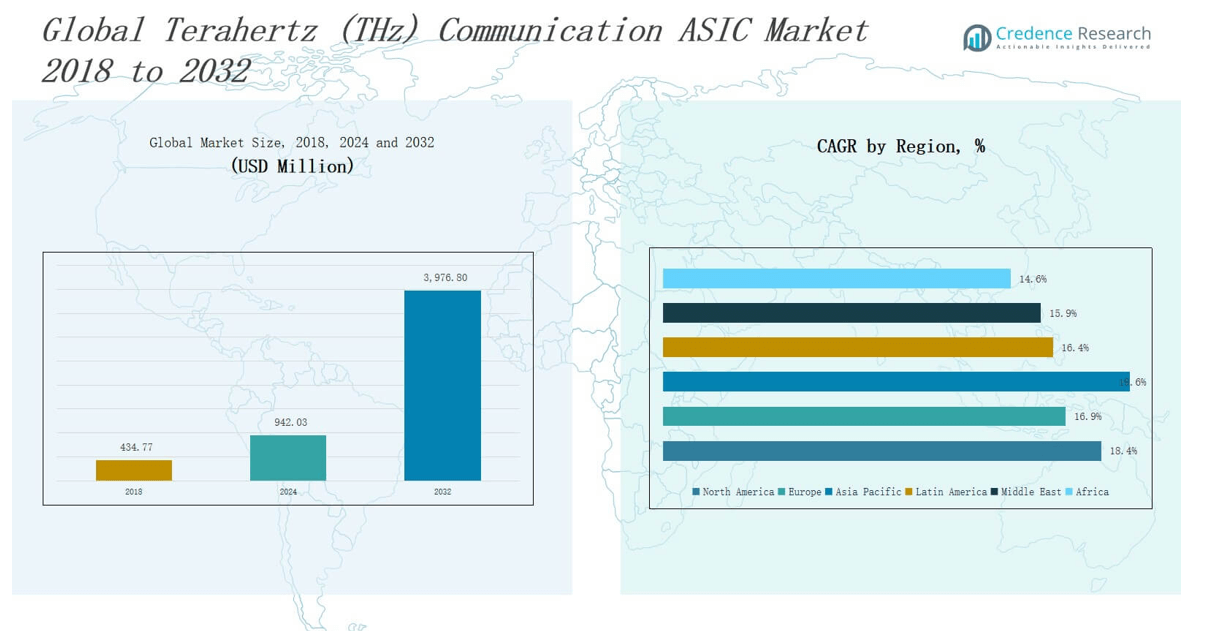
The Terahertz (THz) Communication ASIC Market size was valued at USD 434.77 million in 2018 to USD 942.03 million in 2024 and is anticipated to reach USD 3,976.80 million by 2032, at a CAGR of 18.39% during the forecast period.
| REPORT ATTRIBUTE | DETAILS |
|---|---|
| Historical Period | 2020-2023 |
| Base Year | 2024 |
| Forecast Period | 2025-2032 |
| Terahertz (THz) Communication ASIC Market Size 2024 | USD 942.03 million |
| Terahertz (THz) Communication ASIC Market, CAGR | 18.39% |
| Terahertz (THz) Communication ASIC Market Size 2032 | USD 3,976.80 million |
The Terahertz (THz) Communication ASIC Market is driven by the escalating demand for ultra-high-speed wireless communication to support next-generation technologies such as 6G networks, autonomous systems, and immersive applications in augmented and virtual reality. Increasing data traffic and the limitations of conventional frequency bands have intensified the shift toward THz frequencies, where ASICs enable efficient, low-power, and high-bandwidth signal processing. Government and industry investments in THz research, particularly for secure military communications and high-resolution imaging, further propel market growth. Trends indicate a strong focus on miniaturization and integration of THz components to support compact device architectures. Advancements in semiconductor materials such as GaN and InP are improving ASIC performance in extreme conditions. Strategic collaborations among chip manufacturers, telecom companies, and research institutions are accelerating prototype-to-market cycles. The push for secure, short-range high-capacity data links across aerospace, defense, and healthcare sectors underscores the growing commercial potential of THz ASICs across diversified applications.
The Terahertz (THz) Communication ASIC Market demonstrates strong geographical expansion, with North America leading in revenue share due to early 6G initiatives and robust defense investments. Asia Pacific follows closely, driven by telecom advancements and mass semiconductor production in China, Japan, and South Korea. Europe shows consistent growth through industrial adoption and cross-border R&D programs, while Latin America gradually progresses with digital modernization. The Middle East invests in smart infrastructure and surveillance, and Africa shows early potential through international development efforts. Key players operating across these regions include Advantest Corporation, Luna Innovations, Toptica Photonics AG, Virginia Diodes, Inc., Teravil Ltd, Hübner GmbH & Co. KG, Applied Research & Photonics Inc., Batop GmbH, Menlo Systems GmbH, and TeraView Limited. These companies compete on innovation, strategic alliances, and THz technology integration across emerging applications in wireless communication, imaging, and sensing.
Market Insights
- The Terahertz (THz) Communication ASIC Market reached USD 942.03 million in 2024 and is projected to hit USD 3,976.80 million by 2032, growing at a CAGR of 18.39%.
- Demand is driven by the need for ultra-high-speed wireless communication to support 6G, autonomous systems, and immersive technologies.
- Growth is supported by rising defense and imaging applications, with THz ASICs enabling secure communications, surveillance, and material detection.
- Advances in GaN, InP, and SiGe materials are enhancing performance, heat tolerance, and energy efficiency across compact device architectures.
- North America holds over 30% of the market share, followed by Asia Pacific at 25% and Europe at 12%, with strong R&D and 6G initiatives.
- High capital investment, technical design complexity, and lack of standardization remain major challenges for widespread adoption.
- Key players include Advantest Corporation, Luna Innovations, Toptica Photonics AG, Virginia Diodes, Teravil Ltd, and Applied Research & Photonics Inc., focusing on THz integration, strategic partnerships, and rapid innovation.
Market Drivers
Demand for Ultra-High-Speed Wireless Communication
The Terahertz (THz) Communication ASIC Market is driven by the rising need for ultra-fast, high-capacity wireless networks supporting data-intensive applications. Emerging technologies such as 6G, AI, and real-time holography demand rapid, seamless data transfer, pushing the limits of current frequency bands. THz frequencies enable bandwidths exceeding hundreds of gigabits per second, making them ideal for next-generation use cases. ASICs tailored for THz communication deliver low latency, minimal power loss, and enhanced transmission control. Telecom and technology providers are investing in early deployment strategies to gain a competitive edge.
Growing Applications in Defense, Security, and Imaging
National defense and security agencies are adopting THz communication for covert, secure, and high-frequency communications. The Terahertz (THz) Communication ASIC Market benefits from the growing use of THz signals in radar, spectroscopy, and imaging systems for target identification and material detection. It plays a key role in enabling miniaturized, high-performance signal processing within these sensitive platforms. ASICs ensure precision and speed in real-time data relay, critical for battlefield communications and surveillance. The technology’s ability to penetrate non-metallic materials makes it effective for explosives detection and non-invasive inspections.
- For instance, Advantest Corporation (Japan) integrates terahertz ASICs into its advanced inspection equipment, enabling real-time, non-destructive analysis and fault detection of semiconductor wafers and chips used in defense and security communication systems.
Technological Advancements in Semiconductor Materials
Material innovation is a key factor accelerating the adoption of THz communication ASICs. Gallium nitride (GaN), indium phosphide (InP), and silicon-germanium (SiGe) offer higher electron mobility and heat tolerance than traditional silicon, enhancing ASIC performance in high-frequency environments. The Terahertz (THz) Communication ASIC Market gains from these advancements, enabling energy-efficient chips that operate with precision across diverse conditions. It supports compact form factors for mobile and wearable electronics. Manufacturers are integrating new fabrication methods to support mass production without compromising reliability.
- For instance, in 2023, Intel demonstrated a THz transceiver using SiGe BiCMOS technology that achieved data rates exceeding 100 Gbps, highlighting the material's suitability for high-frequency designs.
Government Initiatives and Research Collaborations
Strong institutional support and strategic partnerships are fueling market expansion. Governments across the U.S., EU, Japan, and South Korea are funding THz research projects for communications, medical diagnostics, and space exploration. The Terahertz (THz) Communication ASIC Market benefits from collaborations between academic institutions, chipmakers, and telecom operators aiming to accelerate lab-to-market timelines. It encourages rapid prototyping, field testing, and standardization of THz ASICs. These efforts are creating a robust innovation ecosystem that supports regulatory alignment and global commercialization. .
Market Trends
Integration of THz ASICs in 6G and Future Wireless Infrastructure
The push toward 6G connectivity is influencing significant design shifts in communication hardware. The Terahertz (THz) Communication ASIC Market is experiencing increased investment to meet the anticipated requirements of 6G networks, including ultra-low latency and terabit-level data throughput. Companies are integrating THz ASICs into advanced base stations, user equipment, and backhaul systems. It enables compact, power-efficient processing of ultra-high-frequency signals with minimal distortion. Researchers are prioritizing chip scalability to support network densification.
- For instance, the Huawei 6G Research Team recently demonstrated an integrated sensing and communications (ISAC-THz) prototype, operating in the 100–300 GHz bands, that enables high-precision sensing on portable devices and achieves outdoor ultra-high-speed transmission for future wireless platforms.
Miniaturization and System-on-Chip (SoC) Integration
Demand for portable and space-efficient communication devices has driven miniaturization across the semiconductor ecosystem. The Terahertz (THz) Communication ASIC Market is shifting toward system-on-chip designs that combine signal processing, modulation, and power management into compact footprints. It supports integration into mobile devices, wearable sensors, and autonomous platforms without compromising performance. SoC-based THz ASICs reduce interconnect losses and power leakage, improving overall system efficiency. Manufacturers are collaborating with foundries to optimize photolithography and etching techniques.
- For instance, SoftBank Corp. recently demonstrated outdoor Beyond 5G/6G terahertz coverage for connected cars, employing proprietary antenna technologies and integrated THz system platforms to enable seamless, high-speed connectivity in real-world scenarios.
Rise of Optical Wireless and Photonic Interconnects
The convergence of photonics and wireless communication is driving innovations in THz ASIC development. The Terahertz (THz) Communication ASIC Market is embracing photonic interconnects for high-speed, energy-efficient data transmission across short and medium distances. It enables seamless communication between high-performance processors in data centers, satellites, and automotive systems. Photonic integration within THz ASICs supports higher bandwidth density with reduced electromagnetic interference. Engineers are designing ASICs with embedded optical modulators and detectors to facilitate full duplex transmission.
Focus on Low-Power, High-Frequency Chip Architectures
Energy efficiency remains central to THz ASIC innovation, especially for deployment in battery-powered and thermally sensitive environments. The Terahertz (THz) Communication ASIC Market is witnessing architectural redesigns aimed at reducing thermal output without sacrificing speed. It drives the use of dynamic voltage scaling, sub-threshold operation, and multi-core parallelism within THz chips. Emerging fabrication methods now support finer transistor geometries that enable higher frequency switching with lower power drain. Research labs and private firms are co-developing thermal-aware packaging to extend chip life and reliability.
Market Challenges Analysis
Complexity in THz Signal Generation and Processing
Designing ASICs for terahertz frequencies involves substantial technical complexity due to signal attenuation, phase noise, and limited power output. The Terahertz (THz) Communication ASIC Market faces challenges in maintaining signal stability and integrity at ultra-high frequencies. It requires highly specialized semiconductor materials and precise fabrication techniques, which increase development time and costs. Integration with conventional RF systems remains difficult due to impedance mismatches and component compatibility issues. These hurdles slow down commercialization and limit mass-market scalability. Continuous investment in advanced modeling, simulation, and packaging is essential to overcome these engineering bottlenecks.
High Capital Investment and Limited Standardization
The market demands significant capital investment in R&D, cleanroom infrastructure, and advanced lithography equipment. The Terahertz (THz) Communication ASIC Market is hindered by a lack of universally accepted standards for THz communication protocols and device interoperability. It creates uncertainty for manufacturers and delays the deployment of interoperable systems. Limited availability of THz test equipment and spectrum regulations adds to the complexity. Small and mid-sized enterprises struggle to enter the market due to high entry barriers. Cross-industry collaboration and regulatory alignment are required to build a supportive ecosystem for accelerated growth.
Market Opportunities
Expansion of 6G and High-Speed Connectivity Applications
The rollout of 6G networks presents a significant opportunity for advanced THz communication systems. The Terahertz (THz) Communication ASIC Market can capitalize on the need for ultra-high-speed, low-latency data transfer in dense urban environments, autonomous mobility, and remote industrial operations. It supports data rates beyond 100 Gbps, enabling real-time transmission for holography, immersive media, and intelligent transportation. Governments and telecom providers are allocating research grants and pilot projects for 6G testbeds. This creates a favorable environment for ASIC developers to integrate THz capabilities into future network hardware. Demand will intensify as infrastructure transitions from experimental to commercial.
Emergence of Non-Telecom Applications in Imaging and Sensing
Beyond telecommunications, THz ASICs hold strong potential in medical diagnostics, industrial inspection, and aerospace imaging. The Terahertz (THz) Communication ASIC Market benefits from rising adoption of THz waves in non-destructive testing and high-resolution imaging. It enables accurate detection of structural flaws, moisture, and chemical compositions without invasive procedures. Healthcare providers are exploring THz-based systems for early cancer detection and tissue analysis. Space agencies and defense sectors also seek compact THz solutions for surveillance and spectroscopy. These emerging applications create long-term opportunities for innovation and diversification across industries.
Market Segmentation Analysis:
By Product Type
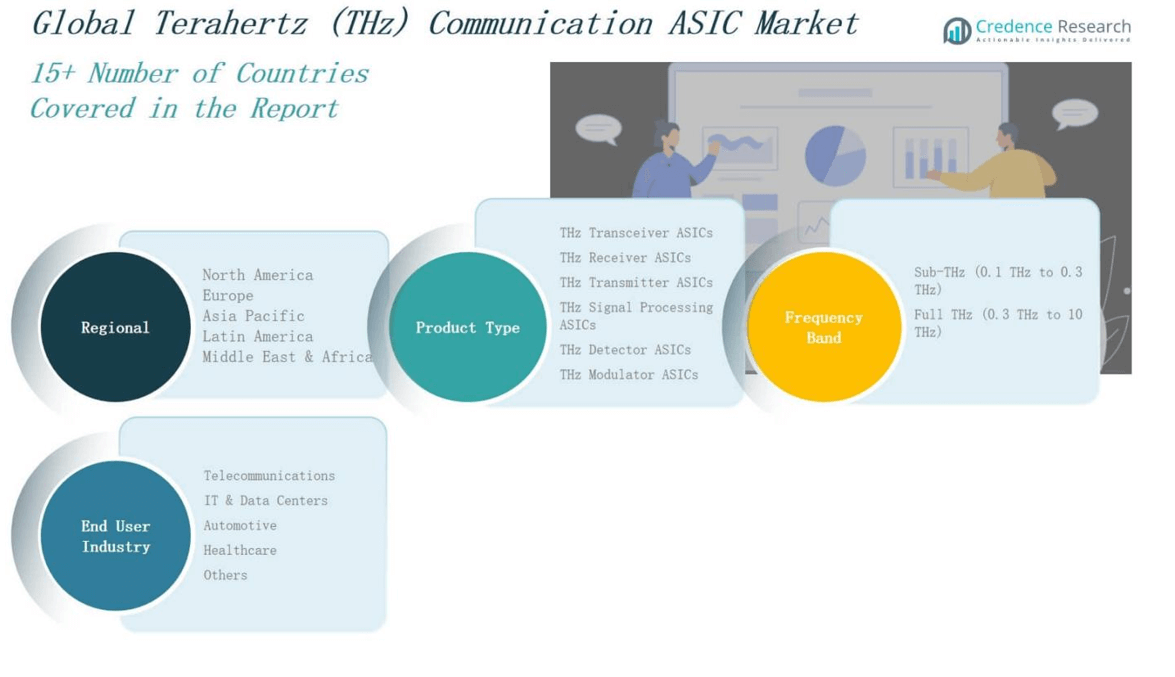
The Terahertz (THz) Communication ASIC Market includes several product categories addressing diverse communication needs. THz Transceiver ASICs lead demand due to their role in enabling bi-directional, high-speed wireless links, especially for 6G applications. THz Receiver and Transmitter ASICs follow closely, used separately where system architectures demand signal separation. THz Signal Processing ASICs are critical in managing real-time data conversion and modulation. THz Detector ASICs support imaging, material sensing, and scientific analysis, while THz Modulator ASICs provide precise control of carrier signals for efficient transmission. These products form the foundation of next-generation short-range and high-capacity wireless systems.
By Frequency Band
The market segments into Sub-THz (0.1 THz to 0.3 THz) and Full THz (0.3 THz to 10 THz) bands. Sub-THz ASICs are gaining adoption in communication infrastructure and radar systems due to better atmospheric penetration. Full THz ASICs are expanding in research, defense, and imaging sectors, offering broader bandwidth and resolution. The Terahertz (THz) Communication ASIC Market benefits from growing interest in high-capacity, short-range links for both categories.
- For instance, Ericsson and Intel developed a real-time sub-THz communication concept platform with extensive beamforming and efficient signal processing, achieving very high data rates and ultra-low latency, directly supporting 6G use cases.
By End User Industry
The market serves telecommunications, IT and data centers, automotive, healthcare, and others. Telecom dominates demand, driven by the transition to 6G and ultra-fast wireless backhaul. IT and data centers require THz ASICs for optical interconnects and low-latency computing. Automotive uses include advanced driver-assistance systems and short-range communication. Healthcare applications span cancer diagnostics and non-invasive imaging. It continues to diversify as adoption spreads into aerospace, security, and industrial automation.
- For instance, in August 2023, Luna Innovations received a major order for its terahertz sensing solution used in electric vehicle battery manufacturing at its Atlanta facility, underscoring real-world uptake in automotive production lines.
Segments:
Based on Product Type:
- THz Transceiver ASICs
- THz Receiver ASICs
- THz Transmitter ASICs
- THz Signal Processing ASICs
- THz Detector ASICs
- THz Modulator ASICs
Based on Frequency Band:
- Sub-THz (0.1 THz to 0.3 THz)
- Full THz (0.3 THz to 10 THz)
Based on End User Industry:
- Telecommunications
- IT & Data Centers
- Automotive
- Healthcare
- Others
Based on Region:
- North America
- U.S.
- Canada
- Mexico
- Europe
- Germany
- France
- U.K.
- Italy
- Spain
- Rest of Europe
- Asia Pacific
- China
- Japan
- India
- South Korea
- South-east Asia
- Rest of Asia Pacific
- Latin America
- Brazil
- Argentina
- Rest of Latin America
- Middle East & Africa
- GCC Countries
- South Africa
- Rest of the Middle East and Africa
Regional Analysis
North America
The North America Terahertz (THz) Communication ASIC Market size was valued at USD 189.66 million in 2018 to USD 406.67 million in 2024 and is anticipated to reach USD 1,721.54 million by 2032, at a CAGR of 18.4% during the forecast period. North America leads the global Terahertz (THz) Communication ASIC Market with a revenue share of over 30% in 2024, driven by advanced R&D infrastructure, early 6G trials, and strong defense sector investments. It benefits from established semiconductor ecosystems in the U.S. and Canada, supported by academic-industry collaborations. High adoption of THz technologies in aerospace, telecom, and healthcare further drives regional demand. Government-backed research funding fosters the commercialization of THz-based ASICs for both communication and imaging applications. The presence of leading players enhances product innovation and deployment across industries.
Europe
The Europe Terahertz (THz) Communication ASIC Market size was valued at USD 78.84 million in 2018 to USD 161.19 million in 2024 and is anticipated to reach USD 616.85 million by 2032, at a CAGR of 16.9% during the forecast period. Europe accounts for nearly 12% of the global revenue in 2024, with Germany, France, and the UK leading in THz research and adoption. The region emphasizes secure communications, high-speed industrial connectivity, and defense-grade chip technology. Strong funding under the Horizon Europe framework supports THz infrastructure development. It benefits from demand in automotive radar systems and smart city deployments. Efforts to standardize THz communication protocols and cross-border research collaboration are strengthening market foundations across the continent.
Asia Pacific
The Asia Pacific Terahertz (THz) Communication ASIC Market size was valued at USD 129.27 million in 2018 to USD 295.30 million in 2024 and is anticipated to reach USD 1,356.54 million by 2032, at a CAGR of 19.6% during the forecast period. Asia Pacific holds over 25% of the global market share in 2024, led by China, Japan, and South Korea. The region benefits from rapid telecom infrastructure upgrades, mass production capabilities, and government-led 6G pilot projects. It has become a focal point for semiconductor manufacturing innovation, with local firms partnering on THz chip development. High demand across smart mobility, data centers, and consumer electronics accelerates adoption. Regulatory flexibility and investment in national tech roadmaps position Asia Pacific as a growth engine for THz ASIC technologies.
Latin America
The Latin America Terahertz (THz) Communication ASIC Market size was valued at USD 18.75 million in 2018 to USD 40.07 million in 2024 and is anticipated to reach USD 147.83 million by 2032, at a CAGR of 16.4% during the forecast period. Latin America contributes a modest 3% share to the global Terahertz (THz) Communication ASIC Market in 2024, with Brazil and Mexico driving regional growth. It is witnessing increased government attention on telecom modernization and digital transformation. Interest in advanced sensor networks for healthcare, agriculture, and industrial inspection is growing. The region’s cost-sensitive market requires localized manufacturing and strategic partnerships. Expansion of data infrastructure and cloud services could support future demand for THz chipsets.
Middle East
The Middle East Terahertz (THz) Communication ASIC Market size was valued at USD 12.23 million in 2018 to USD 24.22 million in 2024 and is anticipated to reach USD 86.35 million by 2032, at a CAGR of 15.9% during the forecast period. The Middle East holds nearly 2% of the global market share in 2024, with increasing focus on smart infrastructure and secure communications. Gulf countries are investing in THz communication as part of broader digital transformation initiatives. It sees early adoption in airport surveillance, oil infrastructure monitoring, and defense systems. Regional universities and innovation hubs are expanding research into high-frequency signal processing. Demand is expected to rise as pilot deployments validate the feasibility of THz ASICs in harsh environments.
Africa
The Africa Terahertz (THz) Communication ASIC Market size was valued at USD 6.02 million in 2018 to USD 14.57 million in 2024 and is anticipated to reach USD 47.69 million by 2032, at a CAGR of 14.6% during the forecast period. Africa represents under 2% of the global revenue in 2024 but shows potential through targeted investments in digital infrastructure. The Terahertz (THz) Communication ASIC Market in Africa is driven by early-stage demand in education, telecom, and satellite communications. It gains momentum from international development programs supporting technology transfer and skills development. Growing interest in non-invasive imaging for healthcare and agriculture is emerging. With enhanced connectivity initiatives and localized semiconductor initiatives, Africa could gradually expand its presence in the THz ecosystem.
Key Player Analysis
- Luna Innovations
- Menlo Systems GmbH
- Virginia Diodes, Inc.
- Toptica Photonics AG
- Teravil Ltd
- Applied Research & Photonics Inc.
- Hübner GmbH & Co. KG (HÜBNER Photonics)
- Batop GmbH
- Advantest Corporation
- TeraView Limited
Competitive Analysis
The Terahertz (THz) Communication ASIC Market features a competitive landscape driven by innovation, specialized expertise, and strategic partnerships. Key players such as Advantest Corporation, Luna Innovations, and Toptica Photonics AG focus on custom ASIC design for high-frequency signal integrity and energy efficiency. Companies differentiate through advanced material usage, photonic integration, and proprietary modulation techniques. The market includes a mix of established semiconductor firms and niche THz technology providers. It rewards players that can balance miniaturization, power performance, and manufacturability. Collaborative efforts with telecom operators, defense agencies, and research institutions strengthen product validation and commercialization. New entrants face technical and capital-intensive barriers, which protect incumbents with strong intellectual property and production capabilities. The increasing demand for 6G, secure communications, and imaging applications is intensifying competition. Companies are expanding their THz portfolios through R&D investments, regional expansions, and mergers to meet evolving performance and integration requirements in dynamic end-use markets.
Recent Developments
- In July 2024, TicWave Solutions GmbH launched a new line of silicon-based THz products, including THz cameras, sources, and imaging systems. The battery-powered chips are designed for easy integration with standard microelectronics and aim to expand the commercial use of THz technology.
- In June 2025, OKI Electric Industry and NTT announced a partnership to co-develop high-power THz components by bonding indium phosphide (InP) onto silicon carbide (SiC) substrates. This innovation boosts THz output power by nearly ten times, aiming to support next-generation 6G systems.
- In February 2025, MIT introduced a chip-based THz system that improves wave propagation through silicon by aligning dielectric constants. This advancement enhances the efficiency and sensitivity of THz electronics for communication and sensing applications.
- In January 2025, ROHM began sampling its smallest THz oscillation and detection devices using resonant tunneling diodes (RTDs). These compact 0.5 mm × 0.5 mm chips operate at ~320 GHz with low power consumption and enable room-temperature detection, opening new opportunities in imaging and sensing
Market Concentration & Characteristics
The Terahertz (THz) Communication ASIC Market exhibits moderate to high market concentration, with a small group of specialized players dominating innovation and supply. It is characterized by high entry barriers due to capital-intensive R&D, advanced fabrication requirements, and a limited talent pool with THz expertise. Leading companies focus on custom ASIC development for specific end-use applications such as 6G infrastructure, defense systems, and high-resolution imaging. The market emphasizes performance optimization, miniaturization, and integration with photonic components. Strategic collaborations between chipmakers, research institutions, and telecom operators play a critical role in accelerating commercialization. It demands long development cycles, strict performance validation, and specialized testing environments. Most players maintain strong intellectual property portfolios to protect proprietary designs and maintain technological leadership. The market operates within a highly regulated framework influenced by regional standards, especially for military and communication uses, contributing to slower but sustained growt
Report Coverage
The research report offers an in-depth analysis based on Type, End-User and Geography. It details leading market players, providing an overview of their business, product offerings, investments, revenue streams, and key applications. Additionally, the report includes insights into the competitive environment, SWOT analysis, current market trends, as well as the primary drivers and constraints. Furthermore, it discusses various factors that have driven market expansion in recent years. The report also explores market dynamics, regulatory scenarios, and technological advancements that are shaping the industry. It assesses the impact of external factors and global economic changes on market growth. Lastly, it provides strategic recommendations for new entrants and established companies to navigate the complexities of the market.
Future Outlook
- Demand for THz ASICs will rise with global 6G deployment and advanced wireless infrastructure projects.
- Telecom companies will adopt THz ASICs to support ultra-low latency and high data throughput applications.
- Defense and aerospace sectors will expand use of THz chips for secure, short-range communication and imaging.
- Semiconductor firms will focus on GaN and InP materials to improve chip efficiency and thermal performance.
- Miniaturized THz ASICs will be integrated into consumer electronics, wearables, and autonomous systems.
- Research institutions and chipmakers will accelerate prototyping through joint development programs.
- Governments will increase funding for THz-based systems in medical diagnostics, surveillance, and space tech.
- Standardization efforts will gain momentum to enable interoperability across global communication networks.
- Companies will scale production with advanced lithography and packaging techniques.
- Emerging markets will invest in THz infrastructure to support industrial digitization and secure data networks.

Request a Free Sample
Fill in your details and we'll send you a free sample report.
- Sample data tables & charts
- Research methodology
Need a Custom Version of This Report?
Tailor the scope, geography, or segments to your exact requirements.
- Custom geography or segment scope
- Direct access to our analyst team
Frequently Asked Questions
What is the current size of the Terahertz (THz) Communication ASIC Market?
What factors are driving the growth of the Terahertz (THz) Communication ASIC Market?
What are some challenges faced by the Terahertz (THz) Communication ASIC Market?
Who are the major players in the Terahertz (THz) Communication ASIC Market?
Table of Content
Chapter 1. Report Introduction
- 1.1 Report Description & Purpose
- 1.1.1 Report Title & Market Definition
- 1.1.2 Unique Selling Propositions (USP) & Key Differentiators
- 1.1.3 Value Proposition for Stakeholders
- 1.2 Research Objectives
- 1.2.1 Market Sizing Objectives (Volume & Revenue) (Volume Where Applicable)
- 1.2.2 Segmentation Objectives
- 1.2.3 Competitive Intelligence Objectives
- 1.2.4 Forecast & Scenario Objectives
- 1.3 Report Scope
- 1.3.1 Terahertz Communication ASIC Scope – Segments & Subsegments Covered
- 1.3.2 Geographic Scope – Regions & Countries Covered
- 1.3.3 Historical Period, Base Year & Forecast Period (2024; forecast to 2032)
- 1.3.4 Inclusions & Exclusions
- 1.4 Industry Classification & Applicable Codes
- 1.5 Currency, Measurement Units & Valuation Basis
- 1.6 Target Stakeholders
- 1.7 Limitations & Assumptions
Chapter 2. Executive Summary
- 2.1 Global Terahertz Communication ASIC Market Snapshot
- 2.1.1 Market Size – Historical (2024) & Forecast (2024-2032) (2024: USD 942.03 million → 2032: USD 3,976.80 million)
- 2.1.2 Volume & Revenue – Global Totals (Volume Where Applicable)
- 2.1.3 Key Market Highlights – Top Five Facts
- 2.2 Terahertz Communication ASIC Market Segmentation Snapshot
- 2.2.1 Market Split by Region – 2024 vs. 2032
- 2.3 Competitive Snapshot
- 2.3.1 Top 10 Players by Revenue Share – 2024
- 2.3.2 Top 10 Players by Volume Share – 2024 (Volume Where Applicable)
- 2.3.3 Recent Strategic Developments (18-Month Summary)
- 2.4 Key Investment Highlights & Strategic Conclusions
Chapter 3. Terahertz Communication ASIC Market Dynamics & Industry Analysis
- 3.1 Market Overview & Context
- 3.1.1 Terahertz Communication ASIC Market Position in the Broader Industry Value Chain
- 3.1.2 Demand Structure & Purchasing Dynamics
- 3.1.3 Market Maturity & Development Stage by Region
- 3.2 Terahertz Communication ASIC Market Drivers
- 3.3 Terahertz Communication ASIC Market Restraints & Challenges
- 3.4 Terahertz Communication ASIC Market Opportunities
- 3.5 Porter's Five Forces Analysis
- 3.5.1 Threat of New Entrants
- 3.5.2 Bargaining Power of Suppliers
- 3.5.3 Bargaining Power of Buyers
- 3.5.4 Threat of Substitutes
- 3.5.5 Competitive Rivalry – Intensity Assessment
- 3.6 Terahertz Communication ASIC Value Chain Analysis
- 3.6.1 Upstream – Key Inputs, Resources & Suppliers
- 3.6.1.1 Key Input/Resource 1
- 3.6.1.2 Key Input/Resource 2
- 3.6.1.3 Key Input/Resource 3
- 3.6.2 Midstream – Core Operations & Value Creation
- 3.6.2.1 Operating Model & Process Overview
- 3.6.2.2 Key Operating Locations & Capabilities by Company
- 3.6.3 Downstream – Market Channels & End Users
- 3.6.3.1 Direct Sales & Customer Engagement Channels
- 3.6.3.2 Indirect Sales, Intermediaries & Partner Channels
- 3.6.4 Value Chain Profitability Analysis
- 3.6.1 Upstream – Key Inputs, Resources & Suppliers
- 3.7 PESTEL Analysis
- 3.7.1 Political Factors
- 3.7.2 Economic Factors
- 3.7.3 Social Factors
- 3.7.4 Technological Factors
- 3.7.5 Environmental Factors
- 3.7.6 Legal Factors
- 3.8 Terahertz Communication ASIC Supply Chain Analysis
- 3.8.1 Critical Input & Resource Availability Risk Assessment
- 3.8.2 Supplier & Operational Concentration Risk (Geographic Exposure)
- 3.8.3 Supply & Service Disruption Impact Analysis
- 3.9 Regulatory & Policy Landscape
Note: The regulatory and policy landscape section covers regulations based on their applicability to the market, Terahertz Communication ASIC category, geography, and scope of the study. Only regulatory frameworks with a material impact on operations, compliance, trade, sustainability, or market access are analyzed in detail.
Chapter 4. Key Investment Pockets & Opportunity Analysis
- 4.1 Terahertz Communication ASIC Market Attractiveness Analysis
- 4.1.1 By Region – Investment Attractiveness Matrix (Market Size × CAGR)
- 4.2 Absolute Revenue Growth Opportunity
- 4.2.1 By Region – Absolute Revenue Growth Through 2032
- 4.3 Incremental Demand Opportunity
- 4.3.1 By Region – Incremental Demand Through 2032
- 4.3.2 Segment – Incremental Demand
- 4.4 Emerging Submarket Opportunity Deep Dive (Subject to Applicability)
- 4.5 Priority Market Opportunity Scorecards
- 4.5.1 United States
- 4.5.2 Europe
- 4.5.3 Asia
- 4.5.4 Middle East & Africa
Note: Priority market opportunity scorecards reflect the geographic scope and strategic relevance of the study. Listed markets are indicative and may be adapted to the industry.
Chapter 5. Terahertz Communication ASIC Cross-Border Trade & Market Access Analysis
- 5.1 International Trade & Cross-Border Activity Overview
- 5.1.1 Global Export Value by Country (2024)
- 5.1.2 Global Export Volume by Country (2024) (Volume Where Applicable)
- 5.1.3 Global Import Value by Country (2024)
- 5.1.4 Global Import Volume by Country (2024) (Volume Where Applicable)
- 5.1.5 Net Trade Balance by Country (2024)
- 5.2 Export Analysis – Segment
- 5.2.1 Category 1 (Applicable Classification Code)
- 5.2.2 Category 2 (Applicable Classification Code)
- 5.2.3 Category 3 (Applicable Classification Code)
- 5.2.4 Category 4 (Applicable Classification Code)
- 5.2.5 Category 5 (Applicable Classification Code)
- 5.3 Import Analysis – Segment
- 5.3.1 Category 1 (Applicable Classification Code)
- 5.3.2 Category 2 (Applicable Classification Code)
- 5.3.3 Category 3 (Applicable Classification Code)
- 5.3.4 Category 4 (Applicable Classification Code)
- 5.3.5 Category 5 (Applicable Classification Code)
- 5.4 Cross-Border Pricing & Transaction Benchmarks
- 5.4.1 Export Pricing – Segment & Country
- 5.4.2 Import Pricing – Segment & Source Country
- 5.4.3 Price Trends (2024)
- 5.5 Key Cross-Border Trade & Delivery Routes
- 5.5.1 Cross-Border Trade/Delivery Route 1
- 5.5.2 Cross-Border Trade/Delivery Route 2
- 5.5.3 Cross-Border Trade/Delivery Route 3
- 5.5.4 Cross-Border Trade/Delivery Route 4
- 5.5.5 Cross-Border Trade/Delivery Route 5
- 5.6 Trade Policy & Market Access Impact Assessment
- 5.6.1 Tariff & Non-Tariff Barriers
- 5.6.2 Regional Trade & Economic Integration Frameworks
- 5.6.3 Bilateral & Multilateral Trade Agreements
- 5.6.4 Cross-Border Operating, Licensing & Localization Requirements
Note: This chapter applies where cross-border trade or delivery is relevant to Terahertz Communication ASIC. Goods, services, and digital offerings are assessed using applicable classifications and transaction measures. Import-export volumes, trade balances, and route analyses are included only where meaningful to the market.
Chapter 6. Competitive Landscape & Company Benchmarking
- 6.1 Terahertz Communication ASIC Market Concentration & Structure
- 6.1.1 Herfindahl-Hirschman Index (HHI) – vs. 2024
- 6.1.2 Leading, Mid-Sized & Emerging Player Structure
- 6.1.3 Global, Regional & Local Player Dynamics
- 6.2 Terahertz Communication ASIC Market Share Analysis – 2024
- 6.2.1 Global Revenue Share by Company
- 6.2.2 Global Volume Share by Company (Volume Where Applicable)
- 6.2.3 Regional Revenue Share
- 6.2.4 Market Share Evolution ( vs. 2024)
- 6.2.5 Company Market Share by Key Segment
- 6.2.6 Company Market Share by Customer Group
- 6.3 Operating Scale, Capacity & Infrastructure Analysis
- 6.3.1 Global Operating Scale & Supply Capacity
- 6.3.2 Resource Utilization & Operating Efficiency
- 6.3.3 Output, Service Delivery & Activity Metrics
- 6.3.4 Operating Footprint & Infrastructure Map
- 6.3.5 Planned Operational & Capacity Expansion
- 6.4 Terahertz Communication ASIC Competitive Benchmarking Matrix
- 6.4.1 Revenue, Growth, Profitability & Operating Metric Comparison
- 6.4.2 Channel Revenue Mix
- 6.4.3 Geographic Revenue Exposure
- 6.4.4 R&D Intensity
- 6.4.5 Sustainability Maturity
- 6.5 Strategic Developments in Terahertz Communication ASIC (Last 24 Months)
- 6.5.1 Mergers, Acquisitions & Divestments
- 6.5.2 New Products, Services & Solutions in Terahertz Communication ASIC
- 6.5.3 Operational & Infrastructure Expansions
- 6.5.4 Strategic Alliances, Joint Ventures & Partnerships
- 6.5.5 Distribution Expansion & Market Entry
- 6.5.6 Sustainability & ESG Initiatives
- 6.6 Competitive Strategy Mapping
- 6.6.1 Leader, Challenger, Follower & Niche Classification
- 6.6.2 Pricing Strategy Comparison
- 6.6.3 Channel Strategy Matrix
Note: Strategic developments are included based on their materiality and the availability of reliable information.
Chapter 7. Global Terahertz Communication ASIC Market – By Sales & Delivery Channel
- 7.1 Segment Overview
- 7.1.1 Volume & Revenue Split by Channel (2024 & 2032) (Volume Where Applicable)
- 7.1.2 Channel Mix Evolution (2024-2032)
Chapter 8. Regional Market Analysis – Global Overview
- 8.1 Global Regional Overview
- 8.1.1 Regional Volume Share (Volume Where Applicable)
- 8.1.2 Regional Revenue Share
- 8.1.3 Regional Volume by Region (Volume Where Applicable)
- 8.1.4 Regional Revenue by Region
- 8.1.5 Regional Forecast Through 2032
- 8.2 Cross-Regional Segment Analysis
- 8.2.1 By Sales & Delivery Channel
- 8.2.2 By Competitive Positioning & Price Tier
Chapter 9. North America Terahertz Communication ASIC Market
- 9.1 United States
- 9.2 Canada
- 9.3 Mexico
Chapter 10. Europe Terahertz Communication ASIC Market
- 10.1 Germany
- 10.2 France
- 10.3 Italy
- 10.4 United Kingdom
- 10.5 Spain
- 10.6 Poland
- 10.7 Russia
- 10.8 Netherlands
- 10.9 Belgium
- 10.10 Sweden
- 10.11 Denmark
- 10.12 Norway
- 10.13 Rest of Europe
Chapter 11. Asia Pacific Terahertz Communication ASIC Market
- 11.1 China
- 11.2 India
- 11.3 Japan
- 11.4 South Korea
- 11.5 Thailand
- 11.6 Indonesia
- 11.7 Vietnam
- 11.8 Malaysia
- 11.9 Australia
- 11.10 Rest of Asia Pacific
Chapter 12. Latin America Terahertz Communication ASIC Market
- 12.1 Brazil
- 12.2 Argentina
- 12.3 Colombia
- 12.4 Chile
- 12.5 Rest of Latin America
Chapter 13. Middle East Terahertz Communication ASIC Market
- 13.1 Saudi Arabia
- 13.2 United Arab Emirates
- 13.3 Turkey
- 13.4 Israel
- 13.5 Iran
- 13.6 Rest of the Middle East
Chapter 14. Africa Terahertz Communication ASIC Market
- 14.1 South Africa
- 14.2 Egypt
- 14.3 Nigeria
- 14.4 Morocco
- 14.5 Rest of Africa
Chapter 15. Terahertz Communication ASIC Company Profiles
- 15.1 [Company 01]
- 15.1.1 Company Overview
- 15.1.2 Key Management Personnel
- 15.1.3 Products & Services Portfolio
- 15.1.4 Financial Performance
- 15.1.5 Key Market Focus & Geographic Presence
- 15.1.6 Recent Developments & Strategic Initiatives
Note: The company profile list is preliminary and may change based on research findings, market developments, data availability, and client requirements.
Chapter 16. Appendices
- Appendix A – List of Abbreviations & Acronyms
- Appendix B – Industry Classification Code Reference – Full Series
- Appendix C – Supply, Output & Operating Capacity Data Tables
- Appendix D – End-Use & Demand Base Tables
- Appendix E – Demand, Adoption & Usage Assumptions
- Appendix F – Pricing & Revenue Metric Reference Tables
- Appendix G – Company Operations & Infrastructure Database
- Appendix H – Cross-Border Trade & Activity Data Tables (Where Applicable)
- Appendix I – Regulatory Summary Tables
- Appendix J – Primary Research Participant List (Anonymized)
- Appendix K – Primary Research Questionnaire Framework
- Appendix L – Data Sources & Bibliography
- Appendix M – Market Size Divergence & Source Comparison
Chapter 17. Research Methodology
- 17.1 Research Framework & Philosophy
- 17.2 Secondary Research – Sources, Hierarchy & Data Extraction
- 17.3 Data Modeling – Bottom-Up & Top-Down Market Sizing
- 17.4 Primary Research – Stakeholder Framework, LOI & Sample Sizes
- 17.5 Forecast Methodology – Regression, Scenario & Sensitivity Analysis
- 17.6 Quality Control – Four-Layer Validation Framework
- 17.7 Limitations & Standard Assumptions
- 17.8 Disclaimer