
Market Overview:
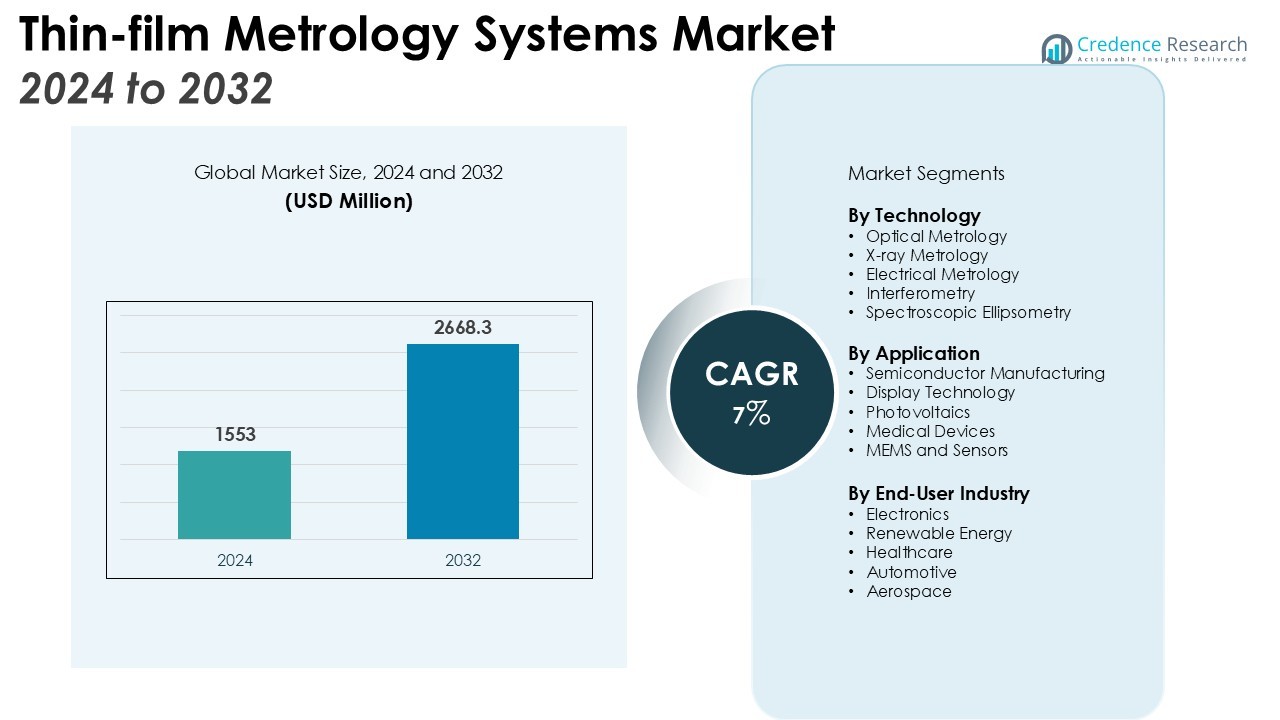
The Thin-film Metrology Systems Market size was valued at USD 1553 million in 2024 and is anticipated to reach USD 2668.3 million by 2032, at a CAGR of 7% during the forecast period (2024-2032).
| REPORT ATTRIBUTE | DETAILS |
|---|---|
| Historical Period | 2020-2024 |
| Base Year | 2024 |
| Forecast Period | 2025-2032 |
| Thin-film Metrology Systems Market Size 2024 | USD 1553 Million |
| Thin-film Metrology Systems Market, CAGR | 7% |
| Thin-film Metrology Systems Market Size 2032 | USD 2668.3 Million |
Key drivers accelerating the Thin-film Metrology Systems Market include continuous technological advancements in non-contact measurement, the growing adoption of automation in semiconductor fabrication, and the increased deployment of advanced process control in electronics manufacturing. The proliferation of miniaturized electronic devices and complex multilayer architectures has heightened the need for high-resolution, real-time thickness and composition analysis, propelling market growth. Additionally, innovation in optical and X-ray-based metrology solutions is expanding the scope of applications and enhancing process yields. Growing investments from key industry players in next-generation metrology equipment further support technological advancements and market expansion.
Regionally, Asia Pacific dominates the Thin-film Metrology Systems Market due to the robust presence of semiconductor foundries, leading display manufacturers, and strong government support for electronics and renewable energy sectors in countries like China, Japan, South Korea, and Taiwan. North America and Europe also represent significant markets, underpinned by strong investments in R&D and advanced manufacturing infrastructure, while emerging economies in Southeast Asia are witnessing rapid adoption driven by expanding electronics production. This regional diversification is creating new opportunities for market players to establish partnerships and strengthen their presence across multiple geographies.
Market Insights:
- The Thin-film Metrology Systems Market was valued at USD 1,553 million in 2024 and is projected to reach USD 2,668 million by 2032, recording a CAGR of 7% during the forecast period.
- Continuous advancements in non-contact measurement technologies and the adoption of automation in semiconductor fabrication are major factors fueling market growth.
- Increasing demand for high-precision measurement in the production of miniaturized and flexible electronic devices drives significant investment in advanced thin-film metrology solutions.
- High capital costs and technical complexity of state-of-the-art metrology equipment remain significant barriers, especially for small and mid-sized manufacturers.
- Asia Pacific commands 49% market share, led by the strong presence of semiconductor foundries and display manufacturers in China, Japan, South Korea, and Taiwan.
- North America holds 27% market share, supported by robust R&D investments and an established base of high-tech manufacturing, while Europe captures 17% market share, underpinned by high manufacturing standards and sustainability initiatives.
- The need for measurement solutions that address next-generation materials and complex multilayer structures is driving continuous research and development, creating opportunities for market innovation and expansion.
Market Drivers:
Rising Demand for High-Precision Semiconductor Manufacturing
The Thin-film Metrology Systems Market benefits significantly from the rapid evolution of semiconductor manufacturing processes. It faces growing requirements for extremely accurate measurement and quality control of thin-film layers used in integrated circuits and advanced chipsets. Advanced metrology solutions are essential for maintaining strict process control, ensuring device performance, and reducing yield loss. The industry’s shift toward smaller nodes and complex device architectures directly drives adoption of state-of-the-art thin-film metrology systems.
- For instance, KLA's SpectraFx 100 optical thin-film metrology system uses a small spot size for measurement that can go down to 40 by 40-micron features.
Advancements in Non-Contact Measurement Technologies
Technological innovation in non-contact metrology methods has fueled adoption in high-throughput production environments. The Thin-film Metrology Systems Market witnesses growing investments in optical, interferometric, and X-ray-based measurement systems that offer rapid, non-destructive analysis. These solutions provide real-time data and accommodate fragile or sensitive substrates without the risk of contamination. Their ability to deliver high accuracy at lower operational costs supports broader industry acceptance.
- For instance, Keyence's IM-8000 Series Image Dimension Measurement System is capable of measuring up to 300 features on a part in a matter of seconds.
Surge in Miniaturized and Flexible Electronic Devices
Consumer demand for compact, lightweight, and flexible electronic devices has intensified the need for advanced thin-film measurement. The Thin-film Metrology Systems Market sees rising deployment in applications such as OLED displays, wearables, sensors, and photovoltaics. Accurate metrology solutions are vital for achieving required film uniformity and functionality in these next-generation products. It enables manufacturers to maintain consistent quality and accelerate new product introductions.
Expansion of Process Automation and Industry 4.0 Integration
Increasing adoption of automation and Industry 4.0 strategies in electronics and semiconductor production environments further propels the Thin-film Metrology Systems Market. Integration of metrology tools with automated production lines allows for continuous process monitoring and data-driven optimization. Smart factories rely on precise, real-time measurements to improve yields and reduce downtime. This trend enhances the strategic importance of advanced metrology systems in modern manufacturing operations.
Market Trends:
Integration of AI and Machine Learning for Enhanced Measurement Accuracy
The Thin-film Metrology Systems Market is experiencing rapid integration of artificial intelligence (AI) and machine learning algorithms to enhance measurement precision and process control. Manufacturers increasingly deploy AI-driven analytics for real-time interpretation of complex thin-film data, enabling early detection of defects and deviations. It supports predictive maintenance and automatic calibration, which minimize downtime and improve operational efficiency. The use of advanced algorithms enables more consistent, repeatable results in multilayer film analysis, even as device architectures become more sophisticated. This trend is creating new opportunities for software and hardware innovation across the metrology sector. It positions metrology systems as critical enablers of next-generation semiconductor and electronics manufacturing.
- For instance, SK hynix Inc. collaborated with Gauss Labs to implement an AI-based virtual metrology solution called Panoptes VM. Since its deployment in December 2022, this technology has been used to conduct virtual measurements on more than 50 million wafers.
Expansion of Applications in Flexible Electronics and Advanced Displays
The Thin-film Metrology Systems Market is witnessing broadening application scope in flexible electronics and advanced display technologies. The proliferation of foldable smartphones, wearable sensors, and flexible OLED displays requires highly specialized metrology systems for precise thickness, uniformity, and compositional measurements. It helps manufacturers overcome unique challenges related to flexible substrates, such as substrate warping and film adhesion. Rising demand for transparent conductive films and advanced coatings in displays and solar cells further drives the need for versatile metrology solutions. The market is responding with multi-functional tools capable of supporting a wide range of substrate materials and device geometries. These trends are expected to accelerate product innovation and quality standards across the electronics and display industries.
- For instance, Toppan’s flexible thin-film transistor (TFT) achieves a carrier mobility more than 10 times greater than that of amorphous silicon TFTs.
Market Challenges Analysis:
High Cost and Complexity of Advanced Metrology Solutions
The Thin-film Metrology Systems Market faces significant challenges related to the high cost and technical complexity of advanced metrology equipment. Many cutting-edge systems require substantial capital investment, which can be prohibitive for small and mid-sized manufacturers. It often demands specialized installation, calibration, and operator training, adding to operational expenses. The rapid pace of innovation means frequent upgrades are needed to remain compatible with the latest semiconductor processes, further straining budgets. For companies with limited resources, cost-effective alternatives may not offer the precision or reliability necessary for critical applications. This financial barrier slows broader market adoption and limits participation by emerging players.
Technical Barriers in Measuring Next-Generation Materials and Structures
Accurately measuring ultra-thin films and complex multilayer structures presents ongoing technical obstacles in the Thin-film Metrology Systems Market. Many new materials used in advanced electronics, such as organic semiconductors and flexible substrates, exhibit properties that challenge traditional measurement methods. It requires the development of new algorithms, enhanced sensitivity, and innovative hardware designs. Maintaining measurement accuracy without compromising throughput or damaging delicate films remains a persistent issue. The demand for higher resolution and speed can expose systems to greater risk of error or drift. Manufacturers must continually invest in research and development to overcome these barriers and address evolving customer requirements.
Market Opportunities:
Expansion of Applications in Emerging Industries and Technologies
The Thin-film Metrology Systems Market holds strong opportunities through its expanding role in emerging industries such as flexible electronics, next-generation photovoltaics, and advanced medical devices. Rapid innovation in these sectors drives demand for precise measurement and analysis of new material compositions and ultra-thin film architectures. It benefits from rising adoption in wearables, sensors, and bioelectronics that require reliable quality control at the nanoscale. Companies that develop adaptable, multi-material metrology solutions can capture new customers across these dynamic applications. The market stands to gain from partnerships with innovators at the forefront of flexible and printable electronics.
Rising Demand for Automation and Industry 4.0 Integration
Automation trends and the global shift toward Industry 4.0 present new growth avenues for the Thin-film Metrology Systems Market. Integrating metrology tools into smart manufacturing environments enables real-time process monitoring, data-driven optimization, and predictive maintenance. It creates opportunities for companies to provide connected, software-driven solutions that support end-to-end digital manufacturing workflows. The expansion of semiconductor fabs and display production lines in Asia Pacific and North America further fuels demand for advanced, automated metrology systems. These opportunities position market players to offer next-generation systems that meet evolving requirements for precision, efficiency, and scalability.
Market Segmentation Analysis:
By Technology
The Thin-film Metrology Systems Market segments by technology into optical metrology, X-ray metrology, and electrical metrology. Optical metrology leads the market due to its non-destructive nature, high measurement speed, and precision. X-ray metrology gains traction for its ability to analyze ultra-thin films and multilayer structures, meeting advanced requirements in semiconductor fabrication. Electrical metrology serves specialized needs, particularly in characterizing film conductivity and uniformity for microelectronics.
- For instance, to avoid damaging delicate films during testing, companies like Ossila have developed four-point probe systems with spring-loaded probes that apply a constant, controlled force of 60 grams during measurement.
By Application
The Thin-film Metrology Systems Market sees significant adoption in semiconductor manufacturing, display technology, photovoltaics, and medical devices. Semiconductor manufacturing accounts for the largest share, driven by strict demands for accuracy in integrated circuit and chip production. Display technology relies on thin-film metrology for OLED and LCD panel quality control. Photovoltaics and medical devices utilize precise measurement solutions to ensure product reliability and compliance with industry standards.
- For instance, Hitachi High-Tech's GT2000 electron beam metrology system achieves low-damage, high-precision measurement by using a pioneering ultra-low acceleration voltage of 100V.
By End-User Industry
Key end-user industries include electronics, renewable energy, healthcare, and automotive. Electronics remains the primary sector, fueled by rapid innovation and volume production of chips and components. Renewable energy leverages thin-film metrology for solar cell efficiency improvements. Healthcare and automotive industries benefit from advanced measurement in medical imaging devices and sensor applications, supporting ongoing technological advancement and product safety.
Segmentations:
By Technology
- Optical Metrology
- X-ray Metrology
- Electrical Metrology
- Interferometry
- Spectroscopic Ellipsometry
By Application
- Semiconductor Manufacturing
- Display Technology
- Photovoltaics
- Medical Devices
- MEMS and Sensors
By End-User Industry
- Electronics
- Renewable Energy
- Healthcare
- Automotive
- Aerospace
By Region
- North America
- U.S.
- Canada
- Mexico
- Europe
- Germany
- France
- U.K.
- Italy
- Spain
- Rest of Europe
- Asia Pacific
- China
- Japan
- India
- South Korea
- South-east Asia
- Rest of Asia Pacific
- Latin America
- Brazil
- Argentina
- Rest of Latin America
- Middle East & Africa
- GCC Countries
- South Africa
- Rest of the Middle East and Africa
Regional Analysis:
Asia Pacific
Asia Pacific holds 49% of the Thin-film Metrology Systems Market in 2024, making it the leading regional market by revenue. The region’s dominant position is driven by the robust presence of leading semiconductor foundries and advanced display panel manufacturers. Countries such as China, Japan, South Korea, and Taiwan anchor the region’s strong manufacturing ecosystem, supported by government incentives and sustained capital investments in electronics and renewable energy. It experiences rising demand for thin-film metrology systems across integrated circuit fabrication, OLED display production, and solar cell manufacturing. The rapid adoption of advanced process control and automation in these sectors accelerates technology deployment and strengthens market leadership. Regional players and global suppliers actively expand partnerships and localize production to serve evolving customer requirements.
North America
North America accounts for 27% of the Thin-film Metrology Systems Market in 2024, ranking as the second-largest market globally. The region’s growth is supported by significant investments in research and development, as well as a strong base of high-tech manufacturing. The United States leads in early adoption of innovative metrology solutions, driven by a focus on next-generation semiconductors, advanced displays, and photovoltaic devices. It benefits from the presence of major technology developers, universities, and research institutes that foster continuous product innovation. The demand for precision measurement and real-time quality assurance supports market growth across the region’s semiconductor fabs and electronics assembly plants. Strategic collaborations between industry and academia help maintain the region’s competitive edge in advanced manufacturing.
Europe
Europe captures 17% of the Thin-film Metrology Systems Market in 2024, supported by its strong manufacturing standards and sustainability initiatives. Leading countries such as Germany, the Netherlands, and France drive innovation in automotive electronics, photonics, and medical devices, creating demand for accurate thin-film measurement solutions. It sees increasing adoption of metrology systems in green technology applications, such as solar energy and energy-efficient electronics, aligning with regulatory requirements and climate goals. Regional firms invest in automation and smart manufacturing to enhance competitiveness and production efficiency. Europe’s focus on quality assurance and sustainable production practices continues to foster new market opportunities.
Key Player Analysis:
- Tokyo Electron Limited
- Semilab Semiconductor Physics Laboratory Co., Ltd.
- Veeco Instruments Inc.
- Horiba, Ltd.
- ZEISS Group
- KLA Corporation
- Onto Innovation Inc.
- Nova Measuring Instruments Ltd.
- SCREEN Holdings Co., Ltd.
- Nanometrics Incorporated
- Bruker Corporation
- Hitachi High-Tech Corporation
- Rudolph Technologies, Inc.
- Thermo Fisher Scientific Inc.
- ASML Holding N.V.
Competitive Analysis:
The Thin-film Metrology Systems Market features a competitive landscape defined by leading technology providers and continuous innovation. Major players such as KLA Corporation, Onto Innovation, SCREEN Holdings, Nova Measuring Instruments, and HORIBA drive market leadership through broad product portfolios and advanced research capabilities. It is characterized by intense focus on non-contact and real-time measurement solutions tailored for semiconductor, display, and photovoltaic manufacturing. Companies prioritize strategic collaborations, acquisitions, and investments in R&D to expand their global footprint and address emerging demands for higher precision and speed. The market sees increasing emphasis on software integration, automation, and AI-driven analytics to enhance system performance. Regional players in Asia Pacific and Europe contribute to localized innovation and offer cost-competitive solutions, further intensifying competition. Continuous technological progress and rapid adoption of next-generation manufacturing processes reinforce the need for market participants to remain agile and invest in product differentiation.
Recent Developments:
- In June 2025, Thermo Fisher Scientific Inc. launched its next-generation mass spectrometers, the Thermo Scientific™ Orbitrap™ Astral™ Zoom and the Thermo Scientific™ Orbitrap™ Excedion™ Pro, at the American Society for Mass Spectrometry (ASMS) conference.
- In June 2025, Onto Innovation, the company formed by the merger of Rudolph Technologies and Nanometrics, announced a definitive agreement to acquire the materials analysis business of Semilab International.
Market Concentration & Characteristics:
The Thin-film Metrology Systems Market demonstrates a moderate to high level of market concentration, with a few established global players holding significant shares. It is characterized by strong barriers to entry due to high capital requirements, advanced technical expertise, and a need for continuous innovation to meet the demands of semiconductor and electronics manufacturing. Leading companies focus on developing proprietary technologies, robust after-sales support, and integration with automation and smart factory systems. The market’s end users demand high accuracy, reliability, and speed, driving providers to invest in advanced research and software capabilities. The presence of regional specialists also fosters niche innovation and ensures tailored solutions for diverse application needs.
Report Coverage:
The research report offers an in-depth analysis based on Technology, Application, End-User Industry and Region. It details leading market players, providing an overview of their business, product offerings, investments, revenue streams, and key applications. Additionally, the report includes insights into the competitive environment, SWOT analysis, current market trends, as well as the primary drivers and constraints. Furthermore, it discusses various factors that have driven market expansion in recent years. The report also explores market dynamics, regulatory scenarios, and technological advancements that are shaping the industry. It assesses the impact of external factors and global economic changes on market growth. Lastly, it provides strategic recommendations for new entrants and established companies to navigate the complexities of the market.
Future Outlook:
- The Thin-film Metrology Systems Market will experience rising adoption in advanced semiconductor manufacturing driven by the demand for smaller nodes and complex chip architectures.
- Optical and X-ray-based metrology solutions will gain prominence for their ability to deliver high-resolution, non-contact measurement across multilayer structures.
- Industry players will invest in AI-driven analytics to enhance real-time data interpretation, process optimization, and predictive maintenance capabilities.
- The expansion of flexible electronics and wearable devices will open new opportunities for tailored thin-film metrology systems.
- Integration with smart manufacturing and Industry 4.0 initiatives will accelerate, enabling automated process control and continuous quality assurance.
- Collaborative research between metrology equipment providers and end-users will drive the development of specialized solutions for emerging materials and novel device formats.
- Market participants will strengthen their global footprint through strategic partnerships and local production facilities, especially in Asia Pacific and North America.
- Rising environmental and quality standards will increase demand for precise, non-destructive measurement in solar and green technology applications.
- Technical challenges in measuring ultra-thin and sensitive films will encourage ongoing innovation in hardware design and algorithm development.
- Competition will intensify as regional manufacturers and new entrants introduce cost-competitive, high-precision metrology tools to serve a broadening array of industries.

Request a Free Sample
Fill in your details and we'll send you a free sample report.
- Sample data tables & charts
- Research methodology
Market Dynamics
Continuous Technological Advancements in Non-Contact Measurement
Ongoing innovation in optical, X-ray, and interferometric metrology technologies enables faster, more accurate, and non-destructive thin-film analysis, meeting the stringent requirements of advanced semiconductor and electronics manufacturing.
Automation and Industry 4.0 Integration
The integration of thin-film metrology systems with automated production lines and smart factory environments allows for real-time process monitoring, data-driven optimization, and predictive maintenance, significantly improving yields and operational efficiency.
Proliferation of Miniaturized and Flexible Electronic Devices
The demand for compact, lightweight, and flexible electronics such as OLED displays, wearables, and sensors necessitates high-precision thin-film measurement, driving adoption of advanced metrology solutions to ensure product quality and performance.
Expansion of Advanced Process Control in Semiconductor Fabrication
As semiconductor devices become more complex with multilayer architectures and smaller nodes, the need for precise, real-time thickness and composition analysis grows, making advanced thin-film metrology systems essential for yield improvement and process control.
Growing Investments in Next-Generation Metrology Equipment
Major industry players are increasing investments in R&D and capital equipment to develop and deploy state-of-the-art metrology systems, expanding the market’s technological capabilities and application scope across electronics, renewable energy, and medical devices.
Need a Custom Version of This Report?
Tailor the scope, geography, or segments to your exact requirements.
- Custom geography or segment scope
- Direct access to our analyst team
Frequently Asked Questions
What is the current market size for Thin-film Metrology Systems, and what is its projected size in 2032?
At what Compound Annual Growth Rate is the Thin-film Metrology Systems market projected to grow between 2024 and 2032?
Which Thin-film Metrology Systems market segment held the largest share in 2024?
What are the primary factors fueling the growth of the Thin-film Metrology Systems market?
Who are the leading companies in the Thin-film Metrology Systems market?
Which region commanded the largest share of the Thin-film Metrology Systems market in 2024?
Table of Content
Chapter 1 Market Segmentation
- 1.1 Segmentation Framework
- 1.1.1 Product and Service Classification
- 1.1.2 Application and End-Use Classification
- 1.1.3 Technology and Solution Classification
- 1.1.4 Customer and Distribution Channel Classification
- 1.1.5 Geographic Segmentation
- 1.1.6 Market Segment Definitions and Boundaries
- 1.2 By Technology
- 1.2.1 Optical Metrology
- 1.2.2 X-ray Metrology
- 1.2.3 Electrical Metrology
- 1.2.4 Interferometry
- 1.2.5 Spectroscopic Ellipsometry
- 1.3 By Application
- 1.3.1 Semiconductor Manufacturing
- 1.3.2 Display Technology
- 1.3.3 Photovoltaics
- 1.3.4 Medical Devices
- 1.3.5 MEMS and Sensors
- 1.4 By End-User Industry
- 1.4.1 Electronics
- 1.4.2 Renewable Energy
- 1.4.3 Healthcare
- 1.4.4 Automotive
- 1.4.5 Aerospace
Chapter 2 Introduction
- 2.1 Report Objectives and Scope
- 2.2 Product Definition and Industry Terminology
- 2.3 Market Inclusions and Exclusions
- 2.4 Research Process
- 2.4.1 Primary Research and Expert Interviews
- 2.4.2 Secondary Research and Source Review
- 2.4.3 Top-Down and Bottom-Up Estimation
- 2.4.4 Data Triangulation and Verification
- 2.5 Market Size Measurement Basis
- 2.5.1 2024: USD 1,553 million → 2032: USD 2,668.3 million
- 2.6 Historical and Forecast Reference Periods
- 2.6.1 Base Year: 2024
- 2.6.2 Forecast Period: 2024-2032
- 2.7 Research Assumptions and Limitations
Chapter 3 Executive Summary
- 3.1 Market Snapshot and Key Findings
- 3.2 Base-Year Market Size, 2024
- 3.3 Forecast Market Size, 2032
- 3.4 Revenue and Volume Growth Outlook
- 3.5 Key Demand and Supply Indicators
- 3.6 Leading Market Segments
- 3.7 Fastest-Growing Market Opportunities
- 3.8 Regional Performance Highlights
- 3.9 Technology and Industry Transformation
- 3.10 Competitive Landscape Summary
- 3.11 Analyst View and Strategic Implications
Chapter 4 Global Thin Film Metrology Systems Market Trends and Developments
- 4.1 Historical Industry Development
- 4.2 Recent Market Trends and Developments
- 4.3 Demand and Customer Behavior Trends
- 4.4 Technology and Product Innovation
- 4.5 Artificial Intelligence, Automation and Digitalization
- 4.6 Local Manufacturing and Supply Chain Realignment
- 4.7 Industry Partnerships, Mergers and Acquisitions
- 4.8 Sustainability and Circular Economy Developments
- 4.9 Government and Private Sector Investment Trends
- 4.10 Emerging Business Models and Commercialization
- 4.11 Industry Developments and Announcements
Chapter 5 Global Thin Film Metrology Systems Market Production, Supply and Demand Analysis
- 5.1 Demand Trend and Consumption Analysis
- 5.2 Demand Forecast, 2024-2032
- 5.3 Production and Output Trend
- 5.4 Production and Output Forecast, 2024-2032
- 5.5 Installed Capacity and Capacity Utilization
- 5.6 Company-Wise Production Plants and Statistics
- 5.6.1 Installed Production Capacity
- 5.6.2 Actual Production
- 5.6.3 Planned Capacity and Expansion Targets
- 5.7 Supply Chain Structure and Procurement Trends
- 5.8 Supply-Demand Gap and Bottlenecks
- 5.9 Import Dependence and Sourcing Structure
- 5.10 Contract Manufacturing and Outsourcing
- 5.11 Regional Supply and Demand Concentration
Chapter 6 Global Thin Film Metrology Systems Market Pricing Analysis
- 6.1 Pricing Structure and Measurement
- 6.2 Historical Pricing Trends
- 6.3 Pricing Outlook, 2024-2032
- 6.4 Average Selling Price and Unit Economics
- 6.5 Pricing by Product and Market Segment
- 6.6 Geographic Pricing Differences
- 6.7 Key Input, Energy, Labor and Logistics Costs
- 6.8 Contract Pricing and Purchasing Models
- 6.9 Pricing Sensitivity and Competitive Positioning
- 6.10 Price, Margin and Profitability Implications
Chapter 7 Global Thin Film Metrology Systems Market Dynamics
- 7.1 Market Growth Drivers
- 7.1.1 Demand-Side Drivers
- 7.1.2 Technology and Innovation Drivers
- 7.1.3 Infrastructure and Investment Drivers
- 7.1.4 Regulatory and Policy Drivers
- 7.2 Market Restraints
- 7.2.1 Cost and Affordability Constraints
- 7.2.2 Technology and Adoption Barriers
- 7.2.3 Supply Chain and Operational Constraints
- 7.3 Market Challenges
- 7.3.1 Competitive Pressure and Margin Erosion
- 7.3.2 Skills, Infrastructure and Implementation Gaps
- 7.4 Emerging Market Opportunities
- 7.5 Market Dynamics Impact and Time-Horizon Assessment
Chapter 8 Global Thin Film Metrology Systems Value Chain Analysis
- 8.1 Industry Value Chain Overview
- 8.2 Upstream Suppliers and Critical Inputs
- 8.3 Technology and Component Providers
- 8.4 Manufacturing or Service Delivery
- 8.5 Distribution, Channel Partners and Integrators
- 8.6 Downstream Applications and End Users
- 8.7 Value Addition and Profit Pools
- 8.8 Vertical Integration and Outsourcing
- 8.9 Supplier Concentration and Risk
- 8.10 Supply Chain Localization and Resilience
Chapter 9 Global Thin Film Metrology Systems Market Regulations and Policies
- 9.1 Relevant Laws, Standards and Compliance Frameworks
- 9.2 Product, Service, Safety and Quality Requirements
- 9.3 Government Policies, Incentives and Subsidies
- 9.4 Imports, Exports and Trade Barriers
- 9.5 Public Procurement and Local Content Requirements
- 9.6 Environmental and Sustainability Compliance
- 9.7 Upcoming Policy Changes and Market Implications
Chapter 10 Global Thin Film Metrology Systems Market Hotspots and Opportunities
- 10.1 Market Opportunity Mapping and Growth Hotspots
- 10.2 High-Growth Applications and Customer Groups
- 10.3 Underserved Markets and White-Space Opportunities
- 10.4 Emerging Technology and Product Opportunities
- 10.5 New Capacity and Investment Hotspots
- 10.6 Market Entry and Expansion Opportunities
- 10.7 Distribution and Partnership Opportunities
- 10.8 Near-Term and Long-Term Commercial Potential
- 10.9 Opportunity Attractiveness and Execution Risks
Chapter 11 Global Thin Film Metrology Systems Market Outlook, 2024-2032
- 11.1 Market Size and Analysis
- 11.1.1 Revenue (Market Measurement: 2024: USD 1,553 million → 2032: USD 2,668.3 million)
- 11.1.2 Market Volume and Quantity Sold
- 11.1.3 Historical Market Size
- 11.1.4 Base-Year Market Size, 2024
- 11.2 Market Forecast, 2024-2032
- 11.2.1 Revenue Forecast to 2032
- 11.2.2 Volume Forecast to 2032
- 11.2.3 CAGR and Year-on-Year Growth
- 11.2.4 Incremental Revenue Opportunity
- 11.3 Forecast Assumptions and Scenario Analysis
- 11.3.1 Base-Case Forecast
- 11.3.2 Optimistic and Conservative Scenarios
- 11.3.3 Technology, Pricing and Policy Sensitivities
- 11.4 Market Attractiveness and Growth Outlook
Chapter 12 Global Thin Film Metrology Systems Market Segmentation and Outlook
- 12.1 Segmentation Summary and Market Shares, 2024
- 12.2 Largest and Fastest-Growing Segments
- 12.3 By Technology - Market Size and Forecast, 2024-2032
- 12.3.1 Segment Definition and Scope
- 12.3.2 Historical Market Size
- 12.3.3 Revenue Forecast, 2024-2032
- 12.3.4 Volume Forecast, 2024-2032
- 12.3.5 Base-Year Market Share, 2024
- 12.3.6 Segment CAGR and Growth Drivers
- 12.3.7 Subsegment Market Size and Forecast
- 12.3.7.1 Optical Metrology
- 12.3.7.2 X-ray Metrology
- 12.3.7.3 Electrical Metrology
- 12.3.7.4 Interferometry
- 12.3.7.5 Spectroscopic Ellipsometry
- 12.3.8 Subsegment Pricing and Adoption Trends
- 12.3.9 Leading Suppliers and Competition
- 12.3.10 Regional Demand and Opportunities
- 12.4 By Application - Market Size and Forecast, 2024-2032
- 12.4.1 Segment Definition and Scope
- 12.4.2 Historical Market Size
- 12.4.3 Revenue Forecast, 2024-2032
- 12.4.4 Volume Forecast, 2024-2032
- 12.4.5 Base-Year Market Share, 2024
- 12.4.6 Segment CAGR and Growth Drivers
- 12.4.7 Subsegment Market Size and Forecast
- 12.4.7.1 Semiconductor Manufacturing
- 12.4.7.2 Display Technology
- 12.4.7.3 Photovoltaics
- 12.4.7.4 Medical Devices
- 12.4.7.5 MEMS and Sensors
- 12.4.8 Subsegment Pricing and Adoption Trends
- 12.4.9 Leading Suppliers and Competition
- 12.4.10 Regional Demand and Opportunities
- 12.5 By End-User Industry - Market Size and Forecast, 2024-2032
- 12.5.1 Segment Definition and Scope
- 12.5.2 Historical Market Size
- 12.5.3 Revenue Forecast, 2024-2032
- 12.5.4 Volume Forecast, 2024-2032
- 12.5.5 Base-Year Market Share, 2024
- 12.5.6 Segment CAGR and Growth Drivers
- 12.5.7 Subsegment Market Size and Forecast
- 12.5.7.1 Electronics
- 12.5.7.2 Renewable Energy
- 12.5.7.3 Healthcare
- 12.5.7.4 Automotive
- 12.5.7.5 Aerospace
- 12.5.8 Subsegment Pricing and Adoption Trends
- 12.5.9 Leading Suppliers and Competition
- 12.5.10 Regional Demand and Opportunities
- 12.6 Segment Growth Comparison
- 12.7 Segment Attractiveness and Priority Matrix
Chapter 13 Global Thin Film Metrology Systems End-Use and Application Market Outlook
- 13.1 End-Use Industry and Customer Demand Structure
- 13.2 Leading Applications and Customer Groups
- 13.3 End-Use Market Size, Share and Forecast
- 13.4 Major End-Use Industry Deep Dives
- 13.4.1 Customer Requirements and Use Cases
- 13.4.2 Demand and Replacement Cycles
- 13.4.3 Technical and Regulatory Considerations
- 13.4.4 Purchasing and Procurement Models
- 13.4.5 Leading Vendors and Distribution Channels
- 13.4.6 Forecast and Commercial Opportunities
- 13.5 Emerging Applications and Cross-Segment Demand
- 13.6 End-Use Industry Investment Priorities
Chapter 14 Global Thin Film Metrology Systems Geographic Market Outlook, 2024-2032
- 14.1 Regional Market Size and Share, 2024
- 14.2 Regional Market Forecast, 2024-2032
- 14.3 Regional Pricing, Production and Demand Differences
- 14.4 North America
- 14.4.1 United States
- 14.4.2 Canada
- 14.4.3 Mexico
- 14.5 Europe
- 14.5.1 Germany
- 14.5.2 France
- 14.5.3 Italy
- 14.5.4 United Kingdom
- 14.5.5 Spain
- 14.5.6 Poland
- 14.5.7 Russia
- 14.5.8 Netherlands
- 14.5.9 Belgium
- 14.5.10 Sweden
- 14.5.11 Denmark
- 14.5.12 Norway
- 14.5.13 Rest of Europe
- 14.6 Asia Pacific
- 14.6.1 China
- 14.6.2 India
- 14.6.3 Japan
- 14.6.4 South Korea
- 14.6.5 Thailand
- 14.6.6 Indonesia
- 14.6.7 Vietnam
- 14.6.8 Malaysia
- 14.6.9 Australia
- 14.6.10 Rest of Asia Pacific
- 14.7 Latin America
- 14.7.1 Brazil
- 14.7.2 Argentina
- 14.7.3 Colombia
- 14.7.4 Chile
- 14.7.5 Rest of Latin America
- 14.8 Middle East
- 14.8.1 Saudi Arabia
- 14.8.2 United Arab Emirates
- 14.8.3 Turkey
- 14.8.4 Israel
- 14.8.5 Iran
- 14.8.6 Rest of the Middle East
- 14.9 Africa
- 14.9.1 South Africa
- 14.9.2 Egypt
- 14.9.3 Nigeria
- 14.9.4 Morocco
- 14.9.5 Rest of Africa
- 14.10 Regional Investment, Policy and Supply Chain Differences
- 14.11 Regional Competitive Landscape
- 14.12 Geographic Growth Hotspots
Chapter 15 Global Thin Film Metrology Systems Technology, Innovation and Sustainability Outlook
- 15.1 Technology Landscape and Maturity
- 15.2 Product, Process and Service Innovation
- 15.3 AI, Automation and Digital Tools in the Industry
- 15.4 Technology Adoption and Performance Benchmarking
- 15.5 Innovation Pipeline and R&D Investment
- 15.6 Patent and Intellectual Property Trends
- 15.7 Energy Efficiency and Resource Management
- 15.8 Sustainability, Recycling and Circularity
- 15.9 Technology Roadmap, 2024-2032
- 15.10 Risks of Obsolescence and Technology Substitution
Chapter 16 Global Thin Film Metrology Systems Market Key Strategic Imperatives
- 16.1 Growth and Market Entry Priorities
- 16.2 High-Return Products and Segments
- 16.3 Pricing, Profitability and Cost Optimization
- 16.4 Technology Investment and Product Differentiation
- 16.5 Supply Chain Localization and Resilience
- 16.6 Distribution and Customer Acquisition
- 16.7 Partnership, Acquisition and Capacity Strategy
- 16.8 Regional Expansion Priorities
- 16.9 Short-, Medium- and Long-Term Actions
Chapter 17 Competition Outlook
- 17.1 Industry Competition Characteristics
- 17.2 Market Structure and Concentration
- 17.3 Market Share and Competitive Positioning, 2024
- 17.4 Company-Wise Revenue and Product Benchmarking
- 17.5 Production and Service Capacity Benchmarking
- 17.6 Technology, Pricing and Differentiation
- 17.7 Regional Footprint and Distribution Strength
- 17.8 Mergers, Acquisitions and Strategic Alliances
- 17.9 New Entrants and Competitive Threats
- 17.10 Porter's Five Forces and Industry Attractiveness
- 17.11 Competitive Outlook, 2024-2032
Chapter 18 Company Profiles
- 18.1 Company Coverage and Selection Criteria
- 18.2 KLA Corporation
- 18.2.1 Business Description
- 18.2.2 Company Ownership and Geographic Presence
- 18.2.3 Product and Service Portfolio
- 18.2.4 Manufacturing and Operating Footprint
- 18.2.5 Production Capacity and Expansion Plans
- 18.2.6 Financial Performance and Investment
- 18.2.7 Market Share and Competitive Position
- 18.2.8 Technology and Innovation Capabilities
- 18.2.9 Strategic Alliances or Partnerships
- 18.2.10 Recent Developments
- 18.2.11 Growth Strategy and Outlook
- 18.3 Onto Innovation Inc.
- 18.4 SCREEN Holdings Co., Ltd.
- 18.5 Nova Measuring Instruments Ltd.
- 18.6 Horiba, Ltd.
- 18.7 Tokyo Electron Limited
- 18.8 Veeco Instruments Inc.
- 18.9 Hitachi High-Tech Corporation
- 18.10 Bruker Corporation
- 18.11 ZEISS Group
- 18.12 Other Relevant Market Participants
Note: Every listed company is profiled on the structure shown under the first company. The company list is preliminary and may change based on research findings, market developments, data availability and client requirements.
Chapter 19 Disclaimer
- 19.1 Research and Forecast Disclaimer
- 19.2 Data Source and Estimation Limitations
Note: The depth of individual sections depends on data availability for this market. Volume, capacity, trade and other unit-based metrics are included where applicable.

