
Market Overview
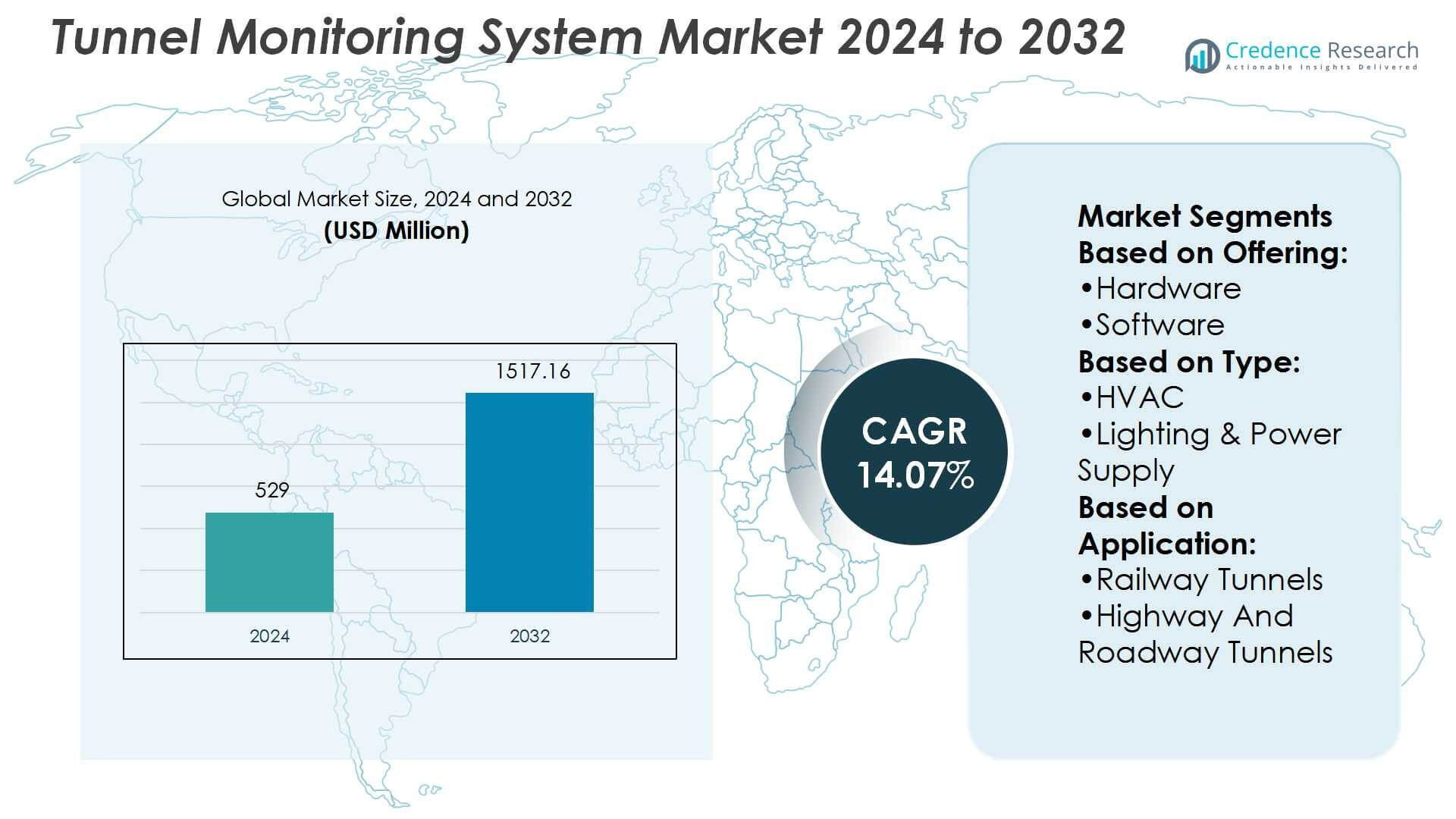
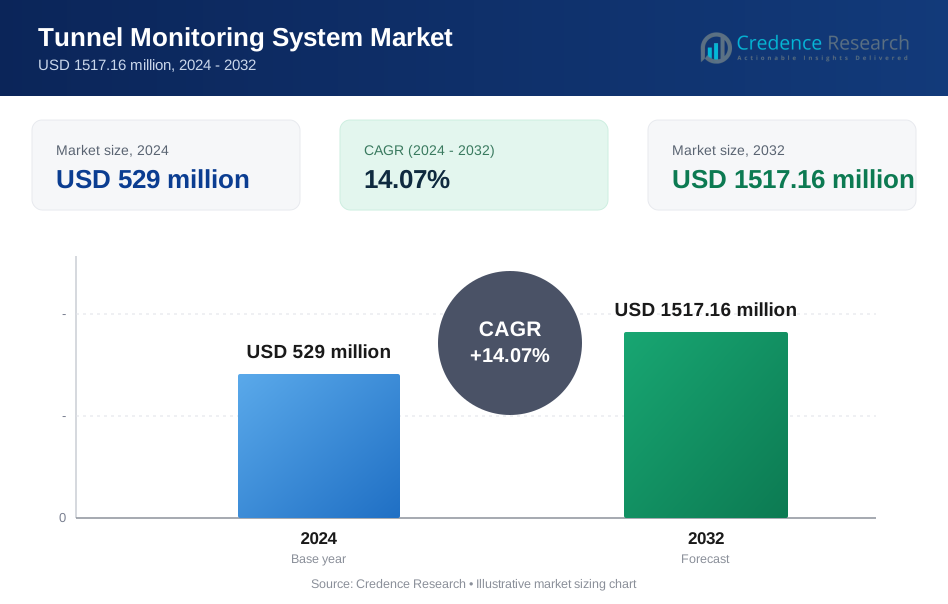
Tunnel Monitoring System Market size was valued USD 529 million in 2024 and is anticipated to reach USD 1517.16 million by 2032, at a CAGR of 14.07% during the forecast period.
| REPORT ATTRIBUTE | DETAILS |
|---|---|
| Historical Period | 2020-2023 |
| Base Year | 2024 |
| Forecast Period | 2025-2032 |
| Tunnel Monitoring System Market Size 2024 | USD 529 Million |
| Tunnel Monitoring System Market, CAGR | 14.07% |
| Tunnel Monitoring System Market Size 2032 | USD 1517.16 Million |
The tunnel monitoring system market is shaped by leading players such as S2S Surgical LLC, Arthrex, Inc., MicroAire Surgical Instruments, LLC, Medical Designs LLC, Smith & Nephew plc, A.M. Surgical Inc., CONMED Corporation, Innomed, Inc., Integra LifeSciences, and PAVmed Inc. These companies focus on technological innovation, regulatory compliance, and expanding global footprints through strategic collaborations and product advancements. Asia-Pacific emerges as the dominant region, holding 34% of the market share, driven by rapid urbanization, large-scale metro rail and highway tunnel projects, and significant government investments in smart infrastructure initiatives across China, India, and Japan.
Market Insights
- The tunnel monitoring system market was valued at USD 529 million in 2024 and is projected to reach USD 1517.16 million by 2032, growing at a CAGR of 14.07%.
- Rising infrastructure investments and strict safety regulations drive adoption of advanced monitoring systems across roadway and railway tunnels.
- Key players focus on innovation, IoT integration, and strategic collaborations to strengthen global presence and capture market growth.
- High installation and maintenance costs act as restraints, limiting adoption in cost-sensitive regions and older tunnel networks.
- Asia-Pacific leads with 34% market share, supported by urbanization and government-backed smart projects, while the hardware segment holds the dominant share due to its critical role in real-time monitoring and safety compliance.
 Market Segmentation Analysis:
By Offering
The hardware segment dominates the tunnel monitoring system market, holding more than 45% market share. Demand is driven by the need for sensors, cameras, and control devices that ensure real-time tunnel safety. Rising investments in smart infrastructure and government mandates for safety compliance further strengthen hardware adoption. Software solutions grow steadily, driven by data analytics and predictive maintenance, while services gain traction from long-term maintenance contracts. Hardware’s role as the backbone of tunnel monitoring systems makes it the leading contributor across global projects.
- For instance, MicroAire’s SmartRelease® ECTR system has been used in over 2 million procedures worldwide, showing its widespread deployment in endoscopic carpal tunnel release.
By Type
Lighting and power supply systems account for the largest share, exceeding 40% of the tunnel monitoring system market. Their dominance is linked to the critical need for continuous illumination and reliable power distribution in tunnels to ensure visibility and operational safety. Rising tunnel construction projects in urban areas and stricter safety regulations increase adoption of advanced LED lighting and energy-efficient systems. HVAC, signalization, and other systems remain essential, but lighting and power supply form the foundation of tunnel safety, ensuring their sustained market leadership.
- For instance, Smith & Nephew LENS 4K Surgical Imaging System features a 3840 × 2160 native resolution camera sensor (10-bit, over 1 billion colors) in a 3-in-1 console that combines camera control, light source, and connectivity, aimed at arthroscopic/endoscopic procedures.
By Application
Highway and roadway tunnels represent the dominant application segment, with a market share above 55%. Growing traffic volumes, urbanization, and the need for safe, efficient transport corridors drive demand for advanced monitoring solutions in these tunnels. Governments prioritize roadway tunnel safety due to higher accident risks and longer operational hours compared to railway tunnels. The integration of smart monitoring technologies, such as IoT-enabled systems, ensures real-time control of ventilation, lighting, and power, reinforcing the segment’s leadership. Railway tunnels, while significant, trail due to lower project volumes.
Key Growth Drivers
Rising Global Infrastructure Investments
The tunnel monitoring system market benefits from increasing infrastructure spending, particularly in transportation and urban development. Governments are prioritizing railway and roadway tunnel projects to improve connectivity and reduce traffic congestion. These projects mandate advanced monitoring solutions for safety and efficiency. Investments in smart city initiatives and cross-border infrastructure development further boost demand. This growth is reinforced by public-private partnerships that fund large-scale tunnel construction, ensuring continuous adoption of advanced monitoring technologies across both developed and emerging economies.
- For instance, Their STRATOS Endoscopic Release System is a sterile-packaged, single-use disposable device. It works with 4 mm, 30° arthroscope and requires no extra capital equipment.
Stringent Safety Regulations
Regulatory authorities worldwide enforce strict safety standards for tunnel operations, driving adoption of monitoring systems. Continuous monitoring of lighting, ventilation, and signalization is mandated to ensure passenger safety and operational reliability. Compliance with environmental and safety standards compels operators to deploy advanced hardware and software systems. Increasing incidents of tunnel accidents also push governments to strengthen legal frameworks. This environment creates strong incentives for stakeholders to invest in reliable monitoring solutions, making regulatory compliance a critical driver of sustained market expansion.
- For instance, CONMED’s BioBrace® Implant has been used in numerous published clinical cases, including for ACL and rotator cuff repairs. A human randomized trial is currently underway, with 268 patients enrolled, to validate its effectiveness for healing and tensile strength in load-bearing tissue repair.
Technological Advancements in Monitoring Systems
The market experiences strong growth from innovations in sensor technology, automation, and IoT integration. Real-time data collection and predictive analytics enable proactive maintenance and reduce downtime. Advanced systems integrate AI-driven algorithms for anomaly detection, ensuring quick response to emergencies. Cloud-based platforms provide centralized monitoring across multiple tunnel networks, improving operational efficiency. As tunnel projects grow in size and complexity, advanced monitoring solutions become essential. Continuous R&D and rising adoption of digital technologies reinforce this driver, creating long-term opportunities for market participants.
Key Trends & Opportunities
Adoption of IoT and Smart Monitoring Solutions
A major trend shaping the tunnel monitoring system market is the integration of IoT and connected devices. IoT-based solutions enable real-time tracking of lighting, ventilation, and power systems, enhancing safety and reducing operational risks. Smart monitoring solutions also support predictive maintenance, lowering long-term costs for operators. Opportunities arise as more governments adopt smart infrastructure initiatives and prioritize digital monitoring. Vendors offering IoT-enabled platforms with remote access and AI integration are well-positioned to capture significant market growth in the coming years.
- For instance, The Carpal Tunnel Release Guide and Blade Set (1124-00) has an overall length of 4.75 inches (12 cm), blade length 1.375 inches (3.5 cm), blade height 0.22 inches (5.6 mm), and blade width 1 mm.
Expansion in Emerging Economies
Rapid urbanization and rising infrastructure investments in Asia-Pacific, Latin America, and the Middle East create significant opportunities for tunnel monitoring systems. Emerging economies are developing metro rail networks, highway tunnels, and underground transit systems to support growing populations. These projects require advanced monitoring for safety compliance and energy efficiency. International vendors expanding their presence in these regions can leverage cost-effective technologies and government support. The growing construction pipeline across developing markets represents a strong opportunity for long-term revenue growth.
- For instance, Integra's Hermetic™ Lumbar Catheter Set (e.g., INS-5010) includes an 80 cm radiopaque lumbar catheter with an outer diameter (OD) of 1.5 mm and inner diameter (ID) of 0.7 mm.
Key Challenges
High Installation and Maintenance Costs One of the major challenges in the tunnel monitoring system market is the high upfront cost of installation. Advanced monitoring equipment, such as sensors, cameras, and control systems, requires significant capital investment. Ongoing maintenance expenses further increase the total cost of ownership, which can discourage adoption, particularly in developing economies. Budget constraints often lead to delays in project implementation or reliance on basic systems with limited functionality. Addressing this challenge requires cost optimization and innovative financing models from solution providers.
Complexity in System Integration Integrating tunnel monitoring systems with existing infrastructure poses operational and technical challenges. Many tunnels, especially older ones, lack standardized platforms that support modern technologies. This creates difficulties in combining HVAC, lighting, and power monitoring with digital systems. Interoperability issues between solutions from different vendors can lead to inefficiencies and higher integration costs. Operators often face delays due to customization needs and compatibility checks. Overcoming this challenge requires standardized protocols, modular solutions, and strong collaboration between system integrators and technology providers.
Regional Analysis North America
North America holds a market share of 28% in the tunnel monitoring system market, driven by significant investments in transportation infrastructure modernization. The U.S. and Canada lead with large-scale highway and railway tunnel projects that demand advanced safety and monitoring systems. Strict regulatory frameworks ensure continuous adoption of hardware and software solutions for ventilation, lighting, and signalization. Growing adoption of IoT-enabled monitoring and predictive maintenance further accelerates market growth. Strong presence of global technology providers and rising government spending on sustainable infrastructure reinforce North America’s position as a leading market contributor.
Europe
Europe accounts for 25% of the tunnel monitoring system market, supported by its extensive railway networks and strict safety compliance standards. Countries such as Germany, France, and the U.K. prioritize modern monitoring technologies for both roadway and railway tunnels to meet EU safety regulations. Adoption of energy-efficient lighting and smart ventilation systems remains a key focus. Ongoing cross-border connectivity projects also boost demand for advanced monitoring solutions. Investments in green infrastructure and sustainability goals further drive technological integration, solidifying Europe’s role as a major regional market for tunnel monitoring systems.
Asia-Pacific
Asia-Pacific dominates the global tunnel monitoring system market with a 34% share, led by rapid infrastructure expansion in China, India, and Southeast Asia. Rising urbanization, population growth, and increased demand for metro rail and highway tunnels significantly drive adoption. Governments in the region invest heavily in smart city projects, integrating IoT-enabled monitoring for efficiency and safety. China leads with large-scale tunnel networks, while India and Japan expand their metro and railway infrastructure. Strong government initiatives, coupled with rapid technology adoption, make Asia-Pacific the fastest-growing and largest regional market for tunnel monitoring systems.
Latin America
Latin America represents 7% of the tunnel monitoring system market, with growth driven by infrastructure upgrades in Brazil, Mexico, and Chile. Rising demand for highway tunnels and urban transit systems creates opportunities for advanced monitoring adoption. Governments focus on improving road safety and efficiency, pushing investments in ventilation, lighting, and power management systems. Although budget constraints limit large-scale implementation, international players expand through partnerships and cost-effective solutions. Ongoing metro rail projects and smart infrastructure development initiatives are expected to strengthen Latin America’s role in the global market over the forecast period.
Middle East & Africa
The Middle East & Africa (MEA) region holds a 6% market share, supported by large-scale infrastructure projects in the Gulf countries. Nations such as the UAE, Saudi Arabia, and Qatar invest heavily in metro rail and roadway tunnels as part of urban development and smart city programs. Adoption of advanced monitoring systems is driven by safety requirements, energy efficiency, and regulatory compliance. Africa’s contribution remains smaller, but countries like South Africa are investing in transport modernization. Strategic investments and rising construction activity position MEA as an emerging market with significant growth potential.
Market Segmentations:
By Offering:
- Hardware
- Software
By Type:
- HVAC
- Lighting & Power Supply
By Application:
- Railway Tunnels
- Highway And Roadway Tunnels
By Geography
- North America
- U.S.
- Canada
- Mexico
- Europe
- UK
- France
- Germany
- Italy
- Spain
- Russia
- Rest of Europe
- Asia Pacific
- China
- Japan
- South Korea
- India
- Australia
- Southeast Asia
- Rest of Asia Pacific
- Latin America
- Brazil
- Argentina
- Rest of Latin America
- Middle East
- GCC Countries
- Israel
- Turkey
- Rest of Middle East
- Africa
- South Africa
- Egypt
- Rest of Africa
Competitive Landscape
The tunnel monitoring system market players including S2S Surgical LLC, Arthrex, Inc., MicroAire Surgical Instruments, LLC, Medical Designs LLC, Smith & Nephew plc, A.M. Surgical Inc., CONMED Corporation, Innomed, Inc., Integra LifeSciences, and PAVmed Inc. The tunnel monitoring system market is highly competitive, characterized by rapid technological advancements and strong emphasis on safety compliance. Companies compete by offering innovative solutions that integrate IoT, AI, and predictive analytics to enhance real-time monitoring and operational efficiency. The focus on energy-efficient lighting, smart ventilation, and cloud-based platforms drives differentiation and strengthens market positioning. Strategic collaborations, mergers, and long-term service contracts are common approaches to expand market reach and customer base. Additionally, growing demand from emerging economies creates opportunities for vendors to provide cost-effective solutions, intensifying competition across global and regional markets.
Key Player Analysis
- S2S Surgical LLC
- Arthrex, Inc.
- MicroAire Surgical Instruments, LLC
- Medical Designs LLC
- Smith & Nephew plc
- M. Surgical Inc.
- CONMED Corporation
- Innomed, Inc.
- Integra LifeSciences
- PAVmed Inc.
Recent Developments
- In January 2025, Siemens Mobility won four HS2 contracts totaling that include Automatic Train Operations and Engineering Management Systems, extending its UK footprint and strengthening the company’s systems-integration credentials.
- In January 2025, Epiroc and ABB executed an MoU to co-develop underground trolley systems for mining, aiming to co-deliver electrification and decarbonization at scale.
- In August 2024, Renesas Electronics Corporation, A global leader in microcontrollers, analogue, power and SoC products launched RRH62000, an advanced all-in-one sensor module designed for indoor air quality monitoring.
- In May 2024, Thermo Fisher Scientific, an America-based life science and clinical research company, launched its ‘Make in India’ Class 1 analyser-based Continuous Ambient Air Quality Monitoring System (CAAQMS).
- In February 2024, Honeywell International Inc. was designated the Official Sustainable Building Technology Partner for the Atlanta Hawks and the State Farm Arena. Through this multi-year partnership, Honeywell International Inc.
Report Coverage
The research report offers an in-depth analysis based on Offering, Type, Application and Geography. It details leading market players, providing an overview of their business, product offerings, investments, revenue streams, and key applications. Additionally, the report includes insights into the competitive environment, SWOT analysis, current market trends, as well as the primary drivers and constraints. Furthermore, it discusses various factors that have driven market expansion in recent years. The report also explores market dynamics, regulatory scenarios, and technological advancements that are shaping the industry. It assesses the impact of external factors and global economic changes on market growth. Lastly, it provides strategic recommendations for new entrants and established companies to navigate the complexities of the market.
Future Outlook
- The market will expand with increasing investments in transportation infrastructure worldwide.
- Adoption of IoT-enabled monitoring systems will enhance real-time safety and efficiency.
- Predictive maintenance solutions will gain importance to minimize downtime and costs.
- Demand for energy-efficient lighting and ventilation systems will continue to rise.
- Regulatory compliance will remain a strong driver of advanced monitoring adoption.
- Emerging economies will create significant opportunities through rapid urbanization and metro projects.
- Integration of AI and automation will transform monitoring accuracy and response times.
- Cloud-based platforms will support centralized tunnel management across multiple networks.
- Long-term service contracts will strengthen vendor-client relationships in the market.
- Sustainability goals will drive innovation in eco-friendly and cost-effective monitoring solutions.
Request a Free Sample
Fill in your details and we'll send you a free sample report.
- Sample data tables & charts
- Research methodology
Need a Custom Version of This Report?
Tailor the scope, geography, or segments to your exact requirements.
- Custom geography or segment scope
- Direct access to our analyst team
Frequently Asked Questions
What is the current market size for Tunnel Monitoring System Market, and what is its projected size in 2032?
At what Compound Annual Growth Rate is the Tunnel Monitoring System Market projected to grow between 2025 and 2032?
Which Tunnel Monitoring System Market segment held the largest share in 2024?
What are the primary factors fueling the growth of the Tunnel Monitoring System Market?
Who are the leading companies in the Tunnel Monitoring System Market?
Which region commanded the largest share of the Tunnel Monitoring System Market in 2024?
Table of Content
Chapter 1. Report Introduction
- 1.1 Report Description & Purpose
- 1.1.1 Report Title & Market Definition
- 1.1.2 Unique Selling Propositions (USP) & Key Differentiators
- 1.1.3 Value Proposition for Stakeholders
- 1.2 Research Objectives
- 1.2.1 Market Sizing Objectives (Volume & Revenue)
- 1.2.2 Segmentation Objectives
- 1.2.3 Competitive Intelligence Objectives
- 1.2.4 Forecast & Scenario Objectives
- 1.3 Report Scope
- 1.3.1 Tunnel Monitoring System Scope – Types & Subtypes Covered
- 1.3.2 Geographic Scope – Regions & Countries Covered
- 1.3.3 Historical Period, Base Year & Forecast Period (2024; forecast to 2032)
- 1.3.4 Inclusions & Exclusions
- 1.4 HS Code & Classification Framework
- 1.5 Currency, Units & Pricing Basis
- 1.6 Target Stakeholders
- 1.7 Limitations & Assumptions
Chapter 2. Executive Summary
- 2.1 Global Tunnel Monitoring System Market Snapshot
- 2.1.1 Market Size – Historical (2024) & Forecast (2024-2032) (2024: USD 529 million → 2032: USD 1517.16 million)
- 2.1.2 Volume & Revenue – Global Totals
- 2.1.3 Key Market Highlights – Top Five Facts
- 2.2 Tunnel Monitoring System Market Segmentation Snapshot
- 2.2.1 Market Split by Region – 2024 vs. 2032
- 2.3 Competitive Snapshot
- 2.3.1 Top 10 Players by Revenue Share – 2024
- 2.3.2 Top 10 Players by Volume Share – 2024
- 2.3.3 Recent Strategic Developments (18-Month Summary)
- 2.4 Key Investment Highlights & Strategic Conclusions
Chapter 3. Tunnel Monitoring System Market Dynamics & Industry Analysis
- 3.1 Market Overview & Context
- 3.1.1 Tunnel Monitoring System Market Position in the Broader Automotive Value Chain
- 3.1.2 OEM vs. Replacement Market Dynamics
- 3.1.3 Market Maturity & Development Stage by Region
- 3.2 Tunnel Monitoring System Market Drivers
- 3.3 Tunnel Monitoring System Market Restraints & Challenges
- 3.4 Tunnel Monitoring System Market Opportunities
- 3.5 Porter's Five Forces Analysis
- 3.5.1 Threat of New Entrants
- 3.5.2 Bargaining Power of Suppliers
- 3.5.3 Bargaining Power of Buyers
- 3.5.4 Threat of Substitutes
- 3.5.5 Competitive Rivalry – Intensity Assessment
- 3.6 Tunnel Monitoring System Value Chain Analysis
- 3.6.1 Upstream – Raw Material/Input Suppliers
- 3.6.1.1 Raw Material/Input 1
- 3.6.1.2 Raw Material/Input 2
- 3.6.1.3 Raw Material/Input 3
- 3.6.2 Midstream – Production/Manufacturing/Service Delivery
- 3.6.2.1 Production/Process Overview
- 3.6.2.2 Key Facility Locations & Capacity by Manufacturer
- 3.6.3 Downstream – Distribution & End Consumer
- 3.6.3.1 Primary Channel – B2B/OEM
- 3.6.3.2 Secondary Channels – Dealer, Retail, Online, Direct
- 3.6.4 Value Chain Profitability Analysis
- 3.6.1 Upstream – Raw Material/Input Suppliers
- 3.7 PESTEL Analysis
- 3.7.1 Political Factors
- 3.7.2 Economic Factors
- 3.7.3 Social Factors
- 3.7.4 Technological Factors
- 3.7.5 Environmental Factors
- 3.7.6 Legal Factors
- 3.8 Tunnel Monitoring System Supply Chain Analysis
- 3.8.1 Raw Material/Input Supply Risk Assessment
- 3.8.2 Manufacturing Concentration Risk (Geographic Exposure)
- 3.8.3 Trade Disruption Impact Analysis
- 3.9 Regulatory & Policy Landscape
Note: The regulatory and policy landscape section covers regulations based on their applicability to the market, Tunnel Monitoring System category, geography, and scope of the study. Only regulatory frameworks with a material impact on operations, compliance, trade, sustainability, or market access are analyzed in detail.
Chapter 4. Key Investment Pockets & Opportunity Analysis
- 4.1 Tunnel Monitoring System Market Attractiveness Analysis
- 4.1.1 By Region – Investment Attractiveness Matrix (Volume × CAGR)
- 4.2 Absolute Revenue Growth Opportunity
- 4.2.1 By Region – Absolute USD Growth Through 2032
- 4.3 Incremental Volume Opportunity
- 4.3.1 By Region – Incremental Volume Through 2032
- 4.3.2 Segment – Incremental Volume
- 4.4 Emerging Submarket Opportunity Deep Dive (Subject to Applicability)
- 4.5 Emerging Market Opportunity Scorecards
- 4.5.1 United States
- 4.5.2 Europe
- 4.5.3 Asia
- 4.5.4 Middle East & Africa
Note: Emerging Market Opportunity Scorecards will be included based on relevance and strategic importance. Regions listed are indicative and may vary depending on data availability and market dynamics.
Chapter 5. Tunnel Monitoring System Import-Export Analysis & Trade Flows
- 5.1 Global Trade Overview
- 5.1.1 Global Export Value by Country (2024)
- 5.1.2 Global Export Volume by Country (2024)
- 5.1.3 Global Import Value by Country (2024)
- 5.1.4 Global Import Volume by Country (2024)
- 5.1.5 Net Trade Balance by Country (2024)
- 5.2 Export Analysis – Segment
- 5.2.1 Type 1 (HS Code)
- 5.2.2 Type 2 (HS Code)
- 5.2.3 Type 3 (HS Code)
- 5.2.4 Type 4 (HS Code)
- 5.2.5 Type 5 (HS Code)
- 5.3 Import Analysis – Segment
- 5.3.1 Type 1 (HS Code)
- 5.3.2 Type 2 (HS Code)
- 5.3.3 Type 3 (HS Code)
- 5.3.4 Type 4 (HS Code)
- 5.3.5 Type 5 (HS Code)
- 5.4 Average Unit Trade Prices
- 5.4.1 Average Export Price – Segment & Country
- 5.4.2 Average Import Price – Segment & Source Country
- 5.4.3 Price Trends (2024)
- 5.5 Key Trade Route Analysis
- 5.5.1 Trade Route 1
- 5.5.2 Trade Route 2
- 5.5.3 Trade Route 3
- 5.5.4 Trade Route 4
- 5.5.5 Trade Route 5
- 5.6 Trade Policy Impact Assessment
- 5.6.1 US Anti-Dumping & Section 301 Tariffs
- 5.6.2 EU Customs Union Impact
- 5.6.3 Major Free Trade Agreements
- 5.6.4 USMCA Rules of Origin
Note: Trade policy analysis will be included only where relevant to the Tunnel Monitoring System market.
Chapter 6. Competitive Landscape & Company Benchmarking
- 6.1 Tunnel Monitoring System Market Concentration & Structure
- 6.1.1 Herfindahl-Hirschman Index (HHI) – vs. 2024
- 6.1.2 Tier 1, Tier 2 & Tier 3 Market Structure
- 6.1.3 Global, Regional & Local Player Dynamics
- 6.2 Tunnel Monitoring System Market Share Analysis – 2024
- 6.2.1 Global Revenue Share by Company
- 6.2.2 Global Volume Share by Company
- 6.2.3 Regional Revenue Share
- 6.2.4 Market Share Evolution ( vs. 2024)
- 6.2.5 OEM Segment Share by Company
- 6.2.6 Replacement Segment Share by Company
- 6.3 Production/Delivery Capacity & Facility Analysis
- 6.3.1 Global Installed Capacity
- 6.3.2 Capacity Utilization Rates
- 6.3.3 Production/Output Volume
- 6.3.4 Facility Locations & Capacity Map
- 6.3.5 Planned Capacity Additions
- 6.4 Tunnel Monitoring System Competitive Benchmarking Matrix
- 6.4.1 Revenue, Volume, CAGR & Profitability Comparison
- 6.4.2 Channel Revenue Mix
- 6.4.3 Geographic Revenue Exposure
- 6.4.4 R&D Intensity
- 6.4.5 Sustainability Maturity
- 6.5 Strategic Developments in Tunnel Monitoring System (Last 24 Months)
- 6.5.1 Mergers, Acquisitions & Divestments
- 6.5.2 New Tunnel Monitoring System Launches
- 6.5.3 Facility Expansions
- 6.5.4 Strategic Alliances, Joint Ventures & Partnerships
- 6.5.5 Distribution Expansion & Market Entry
- 6.5.6 Sustainability & ESG Initiatives
- 6.6 Competitive Strategy Mapping
- 6.6.1 Leader, Challenger, Follower & Niche Classification
- 6.6.2 Pricing Strategy Comparison
- 6.6.3 Channel Strategy Matrix
Note: Strategic developments are included based on their materiality and the availability of reliable information.
Chapter 7. Global Tunnel Monitoring System Market – By Distribution Channel
- 7.1 Segment Overview
- 7.1.1 Volume & Revenue Split by Channel (2024 & 2032)
- 7.1.2 Channel Mix Evolution (2024-2032)
Chapter 8. Regional Market Analysis – Global Overview
- 8.1 Global Regional Overview
- 8.1.1 Regional Volume Share
- 8.1.2 Regional Revenue Share
- 8.1.3 Regional Volume by Region
- 8.1.4 Regional Revenue by Region
- 8.1.5 Regional Forecast Through 2032
- 8.2 Cross-Regional Segment Analysis
- 8.2.1 By Distribution Channel
- 8.2.2 By Brand/Price Tier
Chapter 9. North America Tunnel Monitoring System Market
- 9.1 United States
- 9.2 Canada
- 9.3 Mexico
Chapter 10. Europe Tunnel Monitoring System Market
- 10.1 Germany
- 10.2 France
- 10.3 Italy
- 10.4 United Kingdom
- 10.5 Spain
- 10.6 Poland
- 10.7 Russia
- 10.8 Netherlands
- 10.9 Belgium
- 10.10 Sweden
- 10.11 Denmark
- 10.12 Norway
- 10.13 Rest of Europe
Chapter 11. Asia Pacific Tunnel Monitoring System Market
- 11.1 China
- 11.2 India
- 11.3 Japan
- 11.4 South Korea
- 11.5 Thailand
- 11.6 Indonesia
- 11.7 Vietnam
- 11.8 Malaysia
- 11.9 Australia
- 11.10 Rest of Asia Pacific
Chapter 12. Latin America Tunnel Monitoring System Market
- 12.1 Brazil
- 12.2 Argentina
- 12.3 Colombia
- 12.4 Chile
- 12.5 Rest of Latin America
Chapter 13. Middle East Tunnel Monitoring System Market
- 13.1 Saudi Arabia
- 13.2 United Arab Emirates
- 13.3 Turkey
- 13.4 Israel
- 13.5 Iran
- 13.6 Rest of the Middle East
Chapter 14. Africa Tunnel Monitoring System Market
- 14.1 South Africa
- 14.2 Egypt
- 14.3 Nigeria
- 14.4 Morocco
- 14.5 Rest of Africa
Chapter 15. Tunnel Monitoring System Company Profiles
- 15.1 [Company 01]
- 15.1.1 Company Overview
- 15.1.2 Key Management Personnel
- 15.1.3 Products & Services Portfolio
- 15.1.4 Financial Performance
- 15.1.5 Key Market Focus & Geographic Presence
- 15.1.6 Recent Developments & Strategic Initiatives
Note: The company profile list is preliminary and may change based on research findings, market developments, data availability, and client requirements.
Chapter 16. Appendices
- Appendix A – List of Abbreviations & Acronyms
- Appendix B – Industry Classification Code Reference – Full Series
- Appendix C – Production & Capacity Data Tables
- Appendix D – End-Use & Demand Base Tables
- Appendix E – Consumption & Replacement Rate Assumptions
- Appendix F – ASP Reference Tables
- Appendix G – Manufacturing & Facility Database
- Appendix H – Import-Export Data Tables
- Appendix I – Regulatory Summary Tables
- Appendix J – Primary Research Participant List (Anonymized)
- Appendix K – Primary Research Questionnaire Framework
- Appendix L – Data Sources & Bibliography
- Appendix M – Market Size Divergence & Source Comparison
Chapter 17. Research Methodology
- 17.1 Research Framework & Philosophy
- 17.2 Secondary Research – Sources, Hierarchy & Data Extraction
- 17.3 Data Modeling – Bottom-Up & Top-Down Market Sizing
- 17.4 Primary Research – Stakeholder Framework, LOI & Sample Sizes
- 17.5 Forecast Methodology – Regression, Scenario & Sensitivity Analysis
- 17.6 Quality Control – Four-Layer Validation Framework
- 17.7 Limitations & Standard Assumptions
- 17.8 Disclaimer
