Visitors and dense café clusters keep UAE cups selling
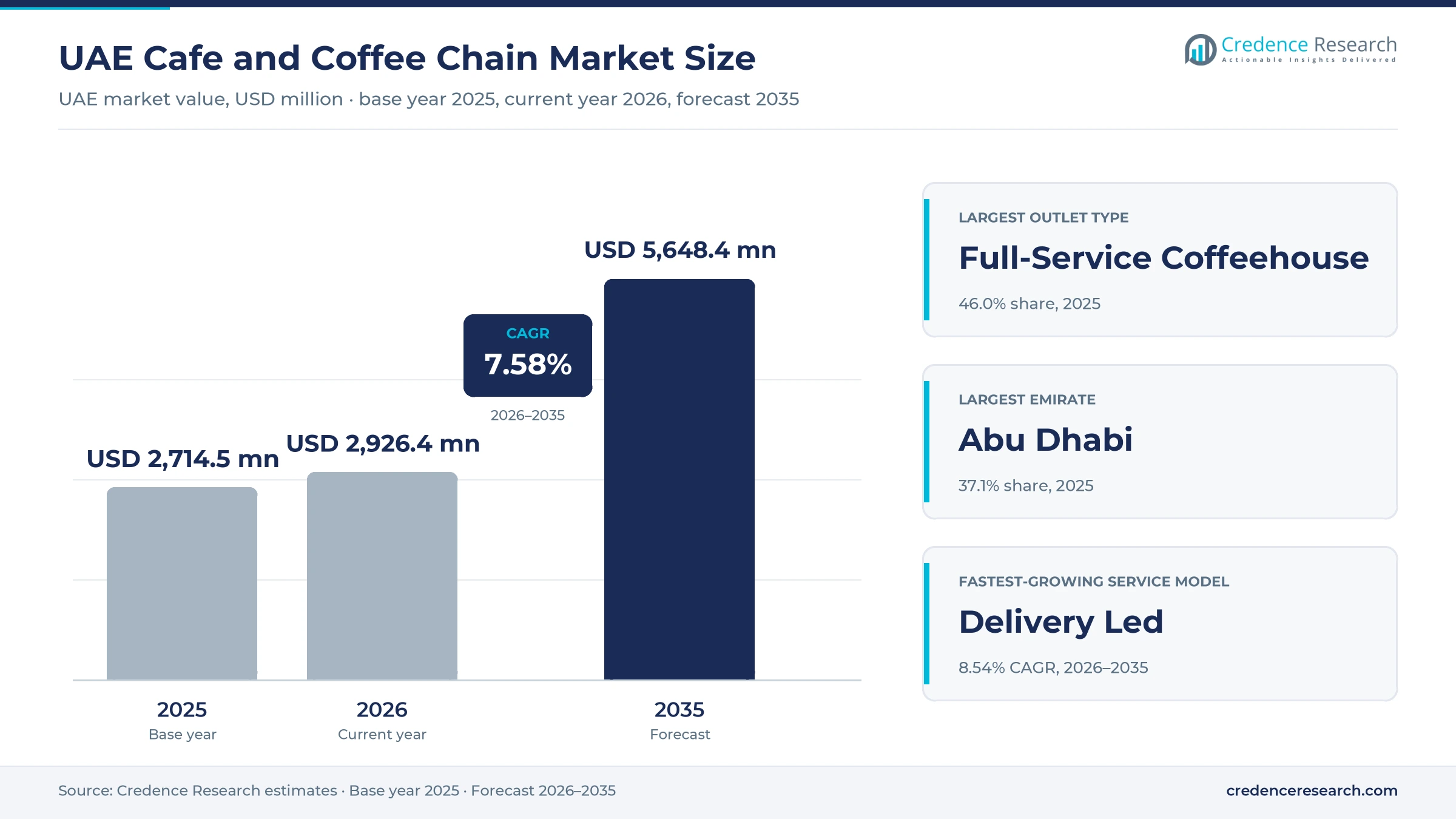
The UAE cafe and coffee chain market was valued at USD 2.71 billion in 2025 and is projected to increase from USD 2.93 billion in 2026 to USD 5.65 billion by 2035, registering a CAGR of 7.58% during 2026–2035. Demand comes from a resident population of more than 11 million people, very high visitor numbers and a social habit of meeting over coffee in malls, offices and neighborhood streets. Abu Dhabi held the largest share among the three emirate groups, 37.1% in 2025, because government offices, hotels and new leisure districts support steady daily and social visits. Sharjah and the Northern Emirates grow fastest at 7.85% a year, as hotel guest numbers and new residential communities expand outside the two largest cities. The most important commercial change is the move of franchise operators into fuel-station convenience stores and airport concourses, which adds quick-serve cups to the traditional mall and street café.
Which cafés and coffee chains does the estimate count?
The estimate measures consumer spending on drinks and food sold by cafés and coffee chains in the United Arab Emirates. It covers full-service coffeehouses, grab-and-go kiosks, bakery-cafés and roastery cafés, whether buyers sit in, take away, order through delivery apps or collect at a drive-thru window. Branded international chains, regional franchise groups and independent specialty cafés are all counted.
The estimate excludes packaged coffee sold in supermarkets, capsules and beans bought for home brewing, and coffee served inside full-service restaurants and hotel banquets. The value chain runs from green coffee importers and roasters through franchise operators, landlords and delivery platforms to residents, visitors and office buyers.
UAE Cafe and Coffee Chain Market Insights
- The UAE cafe and coffee chain market was valued at USD 2.71 billion in 2025 and is projected to reach USD 5.65 billion by 2035, registering a CAGR of 7.58% during 2026–2035.
- Abu Dhabi held 37.1% of 2025 value, as the emirate welcomed a record 26.6 million visitors in 2025 and hosts large office and government districts.
- Full-service coffeehouses led with 46.0% of 2025 value, because UAE buyers use cafés as meeting places for friends, families and business partners.
- Dubai welcomed 19.59 million international overnight visitors in 2025, up 5% from 2024, which keeps mall, beach and airport cafés busy through the year.
- Delivery-led service grows fastest at 8.54% a year during 2026–2035, as app ordering and subscription programs make coffee delivery routine.
Full-service coffeehouses and mall stores lead spending
Why do full-service coffeehouses take the largest share?
Based on outlet type, the market is categorized into full-service coffeehouse, grab-and-go kiosk, bakery-cafe and roastery cafe. Full-Service Coffeehouse formats led with 46.0% of 2025 value, because UAE buyers stay longer, order food with drinks and use the seating for social and business meetings. Grab-and-Go Kiosk formats grow fastest at 8.42% a year, as operators open small counters in fuel stations, offices and transit areas.
How quickly is delivery-led coffee gaining share?
Based on service model, the market is categorized into dine-in led, takeaway led, delivery led and drive-thru led outlets. Dine-In Led outlets led with 48.0% of 2025 value, because long visits in malls and neighborhood cafés lift the average bill. Delivery Led outlets grow fastest at 8.54% a year, since food delivery apps now offer subscriptions and fast courier networks in every major city.
Which customer groups buy the most coffee out of home?
Based on customer type, the market is categorized into UAE nationals, resident expatriates, international tourists and office and institutional buyers. Resident Expatriates led with 52.0% of 2025 value, because they make up most of the population and buy coffee on the way to work. International Tourists grow fastest at 8.03% a year, as hotel capacity, events and airport traffic rise after the 2026 travel disruption eases.
Where do UAE buyers purchase most café drinks?
Based on distribution channel, the market is categorized into street and mall stores, transport hubs and travel retail, digital delivery platforms and corporate and institutional locations. Street and Mall Stores led with 64.0% of 2025 value, because malls remain the main social space in hot months. Digital Delivery Platforms grow fastest at 8.44% a year, as more cafés list menus on delivery apps and open delivery-only kitchens.
| Segment Group | Leading Sub-segment | Share, 2025 | Fastest-growing Sub-segment | CAGR, 2026–2035 |
|---|---|---|---|---|
| By Outlet Type | Full-Service Coffeehouse | 46.0% | Grab-and-Go Kiosk | 8.42% |
| By Service Model | Dine-In Led | 48.0% | Delivery Led | 8.54% |
| By Customer Type | Resident Expatriates | 52.0% | International Tourists | 8.03% |
| By Distribution Channel | Street and Mall Stores | 64.0% | Digital Delivery Platforms | 8.44% |
Request a Free Sample
Fill in your details and we'll send you a free sample report.
- Sample data tables & charts
- Research methodology
Tourism, store density and app ordering lift café sales
Tourism and high-frequency visitor demand
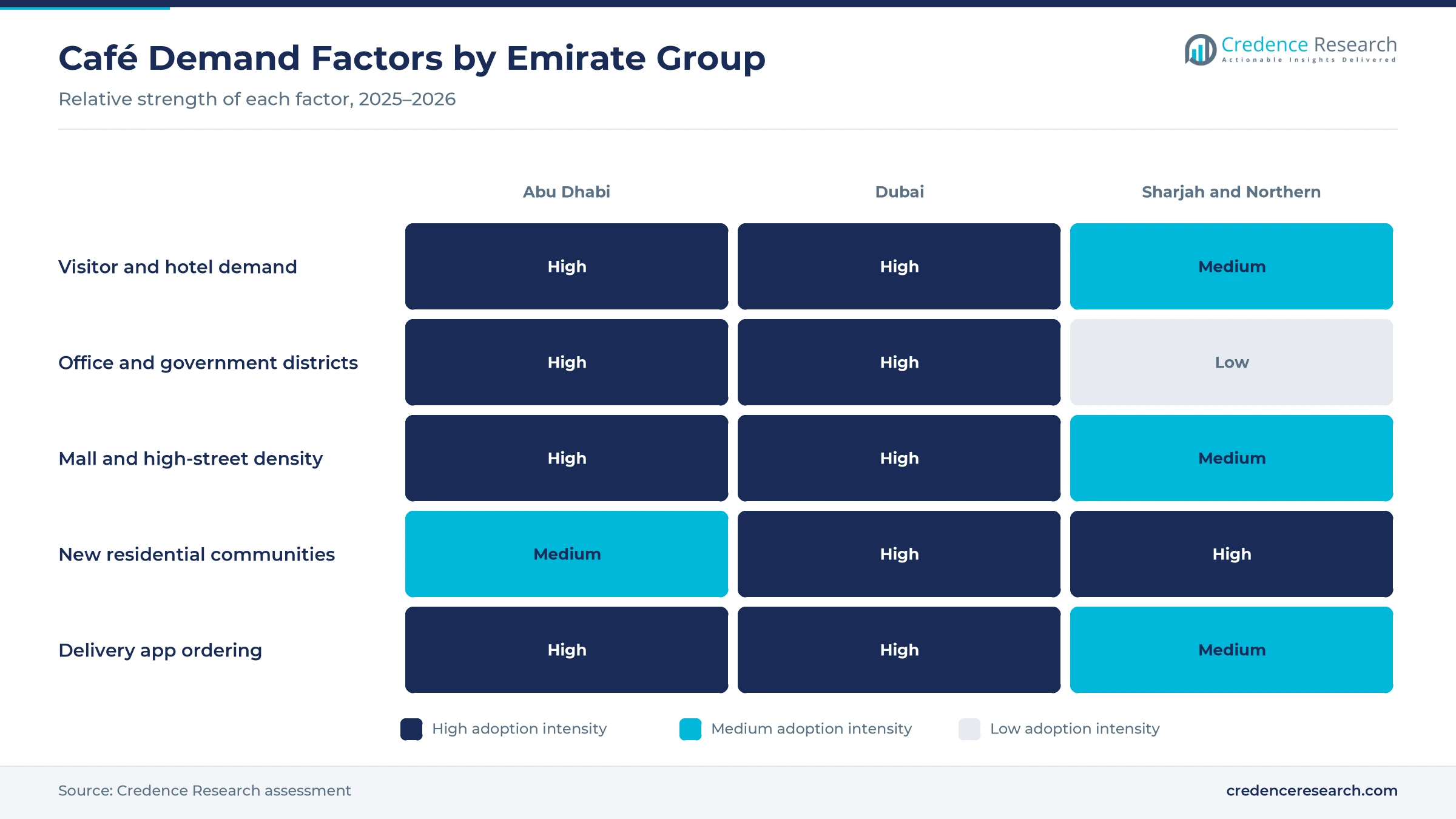
Visitor traffic is the clearest driver of café sales, because tourists buy several drinks a day in malls, hotels and airports. Dubai welcomed 19.59 million international overnight visitors in 2025, up from 18.72 million in 2024, according to the Government of Dubai Media Office. Hotel occupancy in the emirate reached 80.7% in 2025, while 154,264 hotel rooms were open across 827 establishments by December. As a result, international tourists are the fastest-growing customer group at 8.03% a year, because hotel capacity and airport traffic keep rising. This demand also supports late-night trade, because visitors keep cafés busy after office workers go home, which raises sales per outlet in tourist districts.
Urban outlet density and new café formats
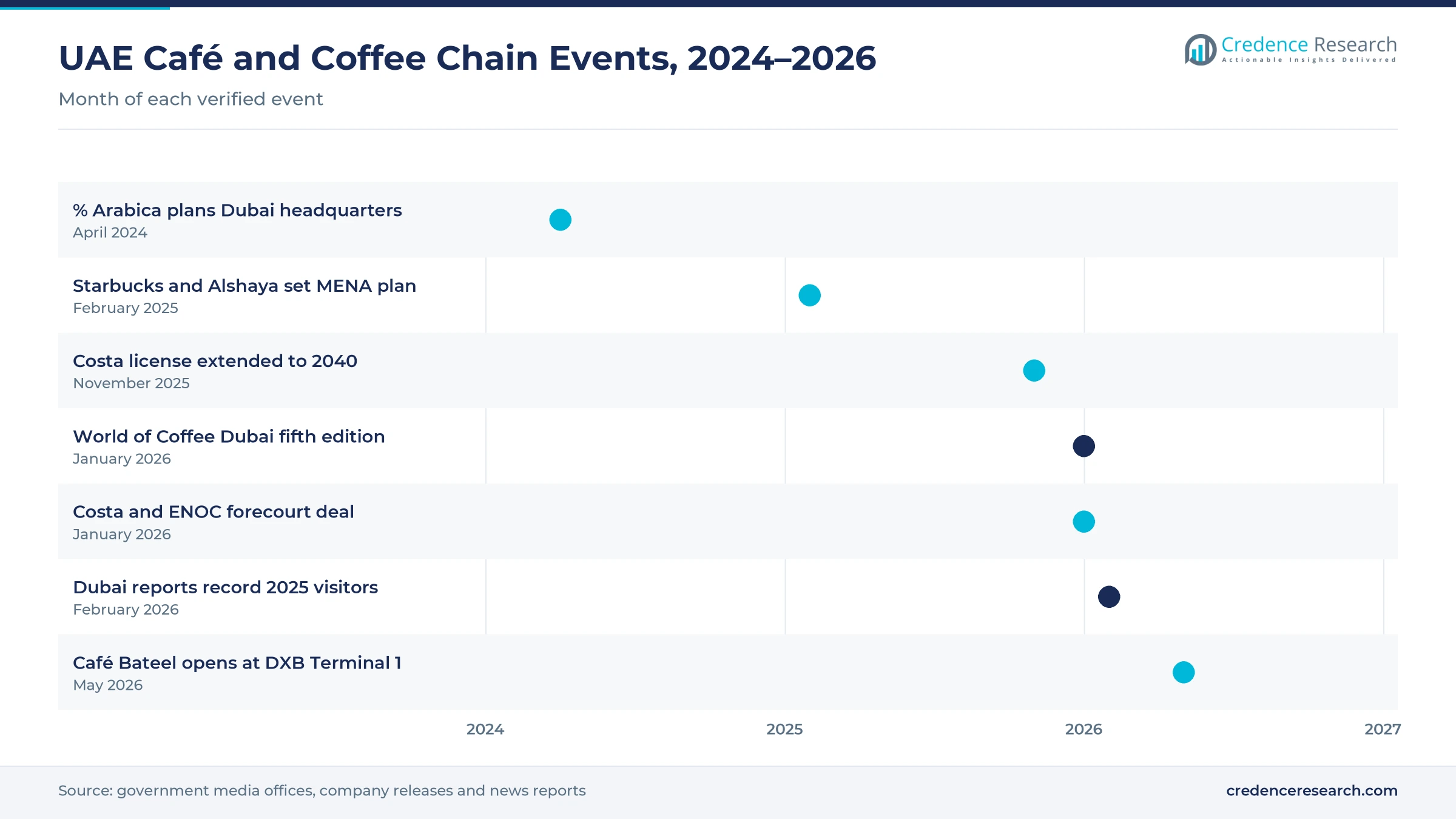
Dense urban districts let chains open many outlets close together, and this lifts sales because buyers find a café on every route. Alshaya Group runs more than 330 Starbucks stores in the UAE, while Emirates Leisure Retail operates 160 Costa Coffee outlets after launching the brand in Dubai in 1999. In November 2025, Emirates Leisure Retail extended its Costa license for 15 years to 2040, which signals long-term confidence in store growth. In addition, Japanese specialty brand % Arabica said in April 2024 that it would move its global headquarters to Dubai. These new formats add specialty and kiosk outlets alongside the established full-service coffeehouses in every major mall.
Digital payments, app ordering and loyalty programs
Digital payments and app ordering raise visit frequency, because buyers can order, pay and collect points in seconds. The Central Bank of the UAE launched the Aani instant payment platform in October 2023 through Al Etihad Payments, which lets businesses accept QR code payments. A Visa survey released in January 2025 found that cash now covers only 23% of transactions among surveyed consumers. Delivery also keeps growing, because talabat reported full-year 2025 gross merchandise value of USD 9.5 billion, up 28%, with its talabat pro subscription available in all eight markets. As a result, delivery-led outlets grow at 8.54% a year, the fastest service model.
A growing resident population buying coffee daily
A fast-growing resident base adds daily coffee buyers, and this supports steady sales in neighborhood cafés and office towers. The UAE population reached 11.51 million in 2025, up from 9.40 million in 2020, according to the World Bank. Most of these residents are expatriates, and they make up the largest customer group with 52.0% of 2025 value. In turn, new residential communities in Dubai, Sharjah and Ajman need nearby cafés, so chains open outlets in community malls rather than only in large shopping centers. Population growth also raises office demand, which supports corporate and institutional locations and morning takeaway sales.
Roasteries, forecourt cafés and travel hubs gain ground
Rise of specialty and roastery cafés
Specialty coffee is gaining ground in the UAE, because buyers pay more for single-origin beans, careful brewing and café design. Coffee re-exports from the UAE exceeded AED 3.5 billion in 2024, according to Arabian Business, which shows how Dubai has become a regional trading hub for green and roasted beans. The fifth World of Coffee Dubai, held Jan. 18–20, 2026, grew its exhibition space from 5,000 square meters in 2022 to more than 20,000 square meters. This growth in trade events and re-export hubs gives roasters local access to green beans and equipment. As a result, roastery cafés grow faster than the market average, and premium price tiers gain share in Dubai and Abu Dhabi.
Shift of coffee chains into fuel-station convenience stores
Coffee chains are shifting part of their growth into fuel-station convenience stores, because drivers want a fast cup without parking at a mall. In January 2026, Emirates Leisure Retail agreed with Emirates National Oil Company Group to scale Costa Coffee across its Zoom convenience-store network. ENOC's Zoom stores sit on main commuter roads across the country, so the deal puts Costa cups in front of drivers who rarely stop at malls. Forecourt sites also let Costa, which runs 160 UAE outlets, compete with larger mall networks for early-morning commuter demand. Street and mall stores still hold 64.0% of 2025 value, so roadside sites give chains room to grow outside malls. As a result, grab-and-go kiosks grow at 8.42% a year, faster than full-service coffeehouses.
Opportunity in airport and travel retail cafés
Airports and transit hubs offer a clear opening, because travelers buy coffee during long waits and pay higher prices. In May 2026, Emirates Leisure Retail opened Café Bateel and FiLLi in Terminal 1 at Dubai International Airport, bringing homegrown brands to international travelers. Sharjah International Airport also handled 19.5 million passengers in 2025, up 14%, Gulf News reported in June 2026. Like airport quick-service restaurants, transport hubs and travel retail hold a smaller share than malls today, but they grow at a faster pace than street stores through 2035. Operators that win airport concessions gain brand exposure to millions of travelers each year, which then supports city-center stores.
Opportunity in Abu Dhabi and the Northern Emirates
Abu Dhabi and the Northern Emirates offer room for new stores, because visitor numbers there are rising quickly. The Abu Dhabi Media Office reported a record 26.6 million visitors in 2025, with 5.9 million hotel guests and hotel revenue up 19.5% to AED 9.1 billion. Sharjah hotels drew 2.1 million guests in 2025, up 22%, while Ras Al Khaimah recorded 1.35 million overnight visitors, up 6%. As a result, Sharjah and the Northern Emirates are the fastest-growing of the three emirate groups in this report. Chains that open early in new resorts and communities there can secure good sites before rents rise.
Travel shocks, bean costs and high rents squeeze margins
Regional conflict that disrupts air travel
Regional conflict is the largest near-term risk, because visitor spending depends on open air routes. AltexSoft travel news reported that the war that began on Feb. 28, 2026, cut Dubai International Airport traffic to 18.6 million passengers in the first quarter, down from 23.4 million a year earlier. Dubai hotel occupancy also fell to 33.1% in March 2026 as bookings dropped. This hurts airport and tourist-area cafés most, although Dubai introduced an AED 1 billion relief package for tourism operators. Chains can reduce the impact by shifting staff and promotions toward resident neighborhoods.
High green coffee prices that raise cup costs
Green coffee prices remain high, and this raises the cost of every cup sold in UAE cafés. Gulf News reported in December 2025 that global arabica futures were near USD 3.54 per pound, with wholesale prices more than double their long-term averages. Value and mainstream chains feel this most, because their buyers are more sensitive to menu price increases. Operators respond with smaller cup sizes, blended beans and loyalty discounts, but these steps can reduce margins or dilute quality for some brands.
Expensive mall rents and crowded high streets
Prime mall and high-street rents are a heavy fixed cost, and they make it hard for new cafés to reach profit quickly. Popular malls in Dubai and Abu Dhabi often host several coffee brands on the same floor alongside the wider food services offer, so footfall is shared among many outlets. Independent cafés feel this most, because they lack the buying power and landlord ties of large franchise groups. Many operators now test smaller kiosks or community sites before committing to large flagship stores in expensive locations.
Delivery commissions that thin café margins
Delivery platforms widen reach, but their commissions and courier fees reduce the margin on each order. Coffee has a low ticket size, so fixed delivery costs take a larger share of each sale than they do for full meals. This affects smaller cafés most, because they have little power to negotiate lower platform rates. Chains respond by pushing their own apps, bundling food with drinks and setting minimum order values, although these steps can discourage some single-cup buyers.
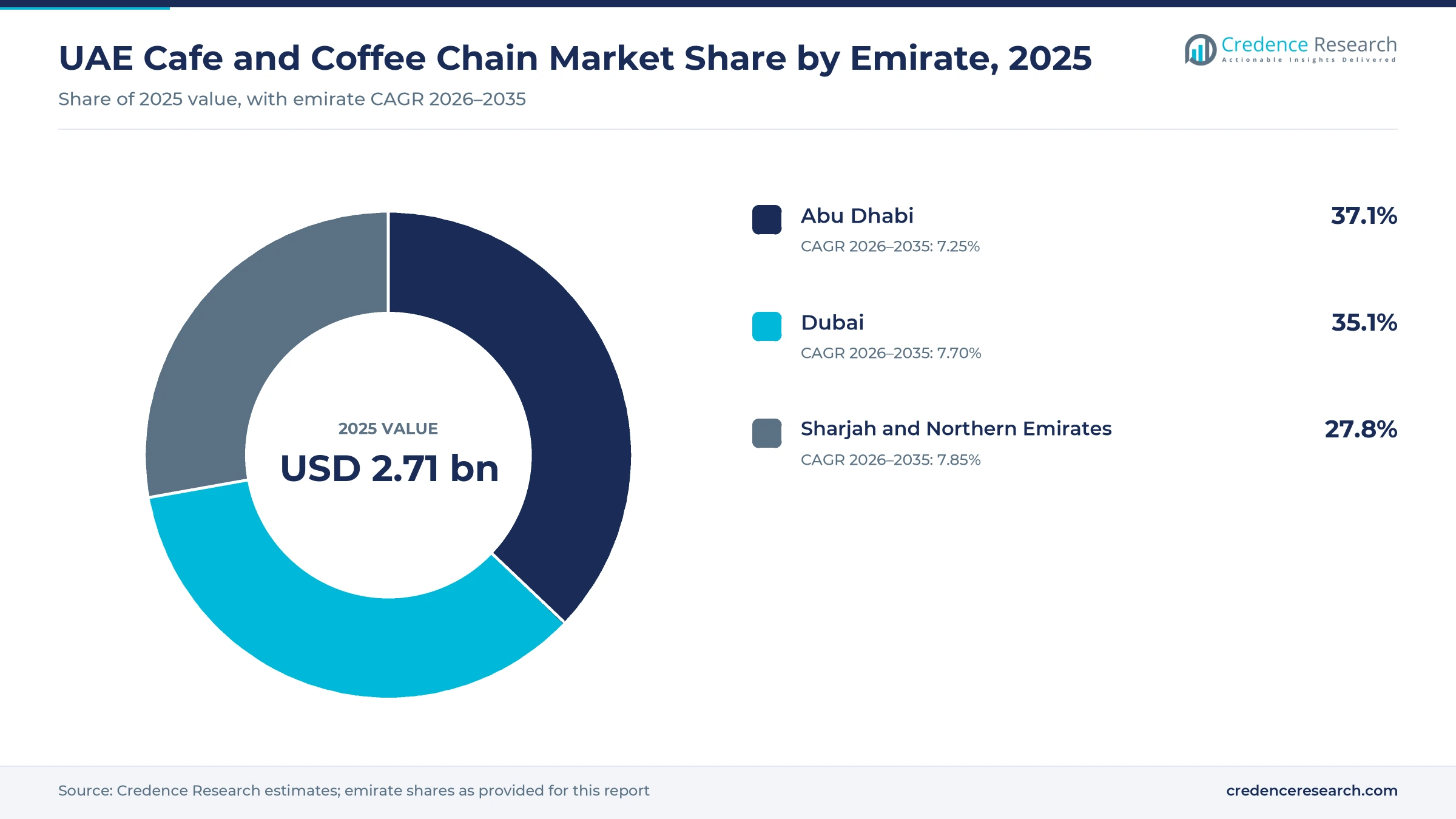
Abu Dhabi leads, Sharjah and Northern Emirates grow fastest
| Emirate | Value, 2025 (USD billion) | Share, 2025 | CAGR, 2026–2035 |
|---|---|---|---|
| Abu Dhabi | 1.01 | 37.1% | 7.25% |
| Dubai | 0.95 | 35.1% | 7.70% |
| Sharjah and Northern Emirates | 0.75 | 27.8% | 7.85% |
Abu Dhabi leads on government, office and visitor demand
Abu Dhabi held 37.1% of 2025 value and grows at 7.25% a year through 2026–2035. The capital combines large government and corporate districts with a growing leisure sector, so cafés serve office workers on weekdays and families on weekends. The emirate recorded 26.6 million visitors and 5.9 million hotel guests in 2025, while hotel occupancy reached 81%. As a result, mall, waterfront and cultural district cafés see steady trade across the year.
Dubai remains the busiest market for international brands
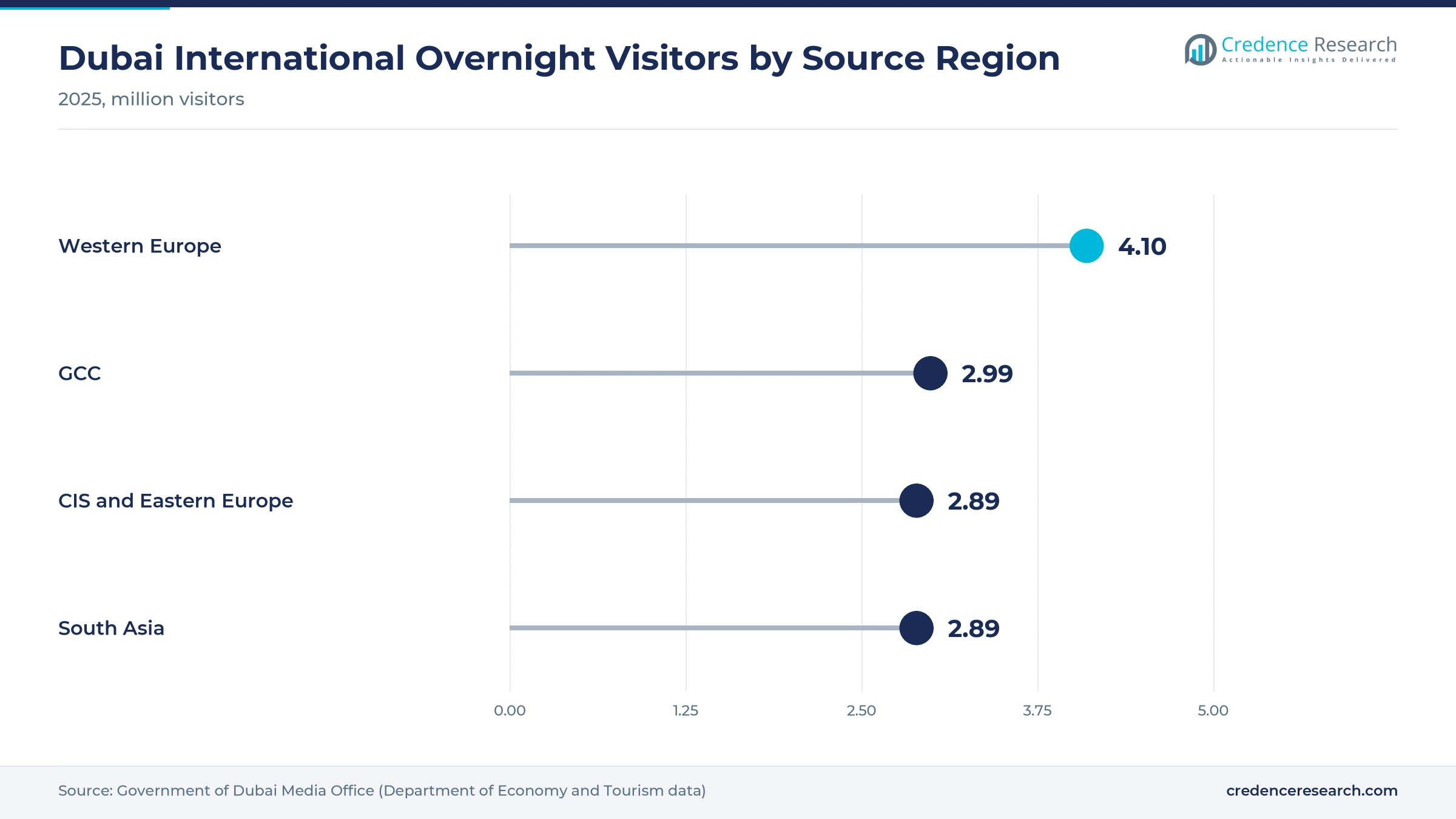
Dubai held 35.1% of 2025 value and grows at 7.70% a year through 2026–2035. The city attracts most international brands first, because it welcomed 19.59 million international overnight visitors in 2025 and hosts large malls, beaches and business districts. Western Europe sent 4.1 million of those visitors, the largest source region. In 2026, airport and hotel disruption hit tourist-area cafés, but resident demand in community malls kept many stores trading.
Sharjah and the Northern Emirates grow fastest
Sharjah and the Northern Emirates held 27.8% of 2025 value and grow fastest at 7.85% a year through 2026–2035. Lower rents attract families and commuters, and new communities in Sharjah, Ajman and Ras Al Khaimah need nearby cafés. Sharjah hotels drew 2.1 million guests in 2025, while Ras Al Khaimah recorded 1.35 million overnight visitors. As a result, chains are opening community and roadside outlets across Sharjah and the Northern Emirates.
Franchise renewals, airport cafés and forecourt deals
| Development | Status and market relevance |
|---|---|
| In April 2024, % Arabica announced plans to move its global headquarters from Kyoto to Dubai. | Makes Dubai a base for specialty café growth |
| In February 2025, Starbucks set a plan with Alshaya Group to open 500 new stores across MENA over five years. | Supports further UAE store openings |
| In November 2025, Emirates Leisure Retail extended its Costa Coffee license in the UAE for 15 years to 2040. | Secures the Costa franchise to 2040 |
| In January 2026, Emirates Leisure Retail and ENOC agreed to scale Costa Coffee across Zoom convenience stores. | Opens a fuel-station channel |
| In May 2026, Emirates Leisure Retail opened Café Bateel and FiLLi in Terminal 1 at Dubai International Airport. | Adds homegrown brands to travel retail |
Instant payments, ordering apps and automated espresso
- Instant QR payments through the central bank's Aani platform let cafés accept phone-based payments that settle in seconds.
- Branded ordering apps let chains such as Starbucks and Costa collect loyalty data, send offers and cut queue times at busy stores.
- Delivery platform integration connects café tills to apps such as talabat, so orders reach baristas without manual re-entry.
- Automated espresso equipment such as bean-to-cup machines helps kiosks and forecourt sites serve consistent drinks with fewer trained staff.
Need a Custom Version of This Report?
Tailor the scope, geography, or segments to your exact requirements.
- Custom geography or segment scope
- Direct access to our analyst team
Franchise groups and specialty brands compete for cups
Competition in the UAE cafe and coffee chain market is led by large franchise groups that run many international brands. Alshaya Group operates more than 330 Starbucks stores in the country, while Emirates Leisure Retail runs 160 Costa Coffee outlets and recently added a fuel-station channel with ENOC. AG Café, a joint venture of Apparel Group and Gateway Partners, has run Tim Hortons in the UAE since opening its first Middle East store in Dubai in 2011. Specialty brands such as % Arabica, EL&N London and Joe & The Juice compete on design, product quality and social media appeal. Homegrown Café Bateel competes on Arabian dates, pastries and gifting. Regional operators also watch growth among roasters in Saudi Arabia, because many brands expand across the Gulf at the same time. Companies compete on location, speed, loyalty programs and menu price.
Companies profiled and their roles in this market
| Company | Type | Role in the market |
|---|---|---|
| Starbucks | International chain (Alshaya Group franchise) | More than 330 UAE stores; 500-store MENA plan announced in 2025 |
| Costa Coffee | International chain (Emirates Leisure Retail franchise) | 160 UAE outlets; license extended to 2040; ENOC Zoom deal |
| Tim Hortons | International chain (AG Café franchise) | Dubai-based AG Café ran 285 Tim Hortons stores in six Middle East markets by October 2023 |
| % Arabica | Specialty coffee brand | Global headquarters moving to Dubai; stores in the UAE and wider MENA |
| Café Bateel | Homegrown bakery-café brand | Opened at Dubai International Airport Terminal 1 in 2026 |
| Joe & The Juice | Juice and coffee bar brand | Run by Lavoya Restaurant Group since its 2022 Dubai launch |
| EL&N London | Boutique café brand | Operates in the UAE among its Gulf markets |
Credence Research view on steady café demand to 2035
Credence Research's view is that the UAE cafe and coffee chain market will grow steadily through 2035, because a large resident population, strong visitor flows and a deep social coffee culture support daily and leisure visits. Full-service coffeehouses hold 46.0% of 2025 value, while kiosks, delivery and roastery formats bring new growth. Large franchise groups benefit from scale, purchasing power and access to prime mall sites. However, the 2026 travel disruption and high bean prices show that margins can tighten quickly. Abu Dhabi keeps the largest share, while Sharjah and the Northern Emirates grow fastest.
How the café and coffee chain estimate was built
The report uses 2025 as the base year, with values in USD million. Market values come from the Credence Research model, which combines population, visitor numbers, outlet counts and average spending per visit. Emirate shares and splits by outlet type, service model, customer type and distribution channel are Credence Research estimates. Sources used are government media offices, World Bank data, company announcements and news reports, and no interviews or surveys were used.
Specialty formats and convenience sites shape 2035
The UAE cafe and coffee chain market is expected to reach USD 5.65 billion by 2035, a 7.58% CAGR during 2026–2035, as residents, visitors and office workers keep buying coffee out of home. Growth should be strongest in delivery-led service, grab-and-go kiosks and travel locations, while Abu Dhabi keeps the largest share. Delivery-led outlets, the fastest-growing service model, should take share from dine-in visits by 2035. Brands that combine strong apps, convenient sites and good value should gain share. In contrast, a long fall in air travel or a further rise in green coffee prices would slow value growth for many operators.
Frequently Asked Questions
How big is the UAE cafe and coffee chain market?
Which emirate leads café spending?
Which emirate group grows fastest?
Which outlet type holds the largest share?
Which service model grows fastest?
How does tourism affect café sales?
Who are the leading companies?
What are the main risks to growth?
Table of Content
Chapter 1 Market Segmentation
- 1.1 Segmentation Framework
- 1.1.1 Product and Service Classification
- 1.1.2 Application and End-Use Classification
- 1.1.3 Technology and Solution Classification
- 1.1.4 Customer and Distribution Channel Classification
- 1.1.5 Geographic Segmentation
- 1.1.6 Market Segment Definitions and Boundaries
- 1.2 By Outlet Type
- 1.2.1 Full-Service Coffeehouse
- 1.2.2 Bakery-Cafe
- 1.2.3 Grab-and-Go Kiosk
- 1.2.4 Roastery Cafe
- 1.3 By Service Model
- 1.3.1 Dine-In Led
- 1.3.2 Takeaway Led
- 1.3.3 Delivery Led
- 1.3.4 Drive-Thru Led
- 1.4 By Customer Type
- 1.4.1 Resident Expatriates
- 1.4.2 International Tourists
- 1.4.3 UAE Nationals
- 1.4.4 Office and Institutional Buyers
- 1.5 By Emirate
- 1.5.1 Dubai
- 1.5.2 Abu Dhabi
- 1.5.3 Sharjah and Northern Emirates
Chapter 2 Introduction
- 2.1 Report Objectives and Scope
- 2.2 Product Definition and Industry Terminology
- 2.3 Market Inclusions and Exclusions
- 2.4 Research Process
- 2.4.1 Primary Research and Expert Interviews
- 2.4.2 Secondary Research and Source Review
- 2.4.3 Top-Down and Bottom-Up Estimation
- 2.4.4 Data Triangulation and Verification
- 2.5 Market Size Measurement Basis
- 2.5.1 2025: USD 2.71 billion → 2035: USD 5.65 billion
- 2.6 Historical and Forecast Reference Periods
- 2.6.1 Historical Period: 2018-2025
- 2.6.2 Base Year: 2025
- 2.6.3 Forecast Period: 2025-2035
- 2.7 Research Assumptions and Limitations
Chapter 3 Executive Summary
- 3.1 Market Snapshot and Key Findings
- 3.2 Base-Year Market Size, 2025
- 3.3 Forecast Market Size, 2035
- 3.4 Revenue and Volume Growth Outlook
- 3.5 Key Demand and Supply Indicators
- 3.6 Leading Market Segments
- 3.7 Fastest-Growing Market Opportunities
- 3.8 Regional Performance Highlights
- 3.9 Technology and Industry Transformation
- 3.10 Competitive Landscape Summary
- 3.11 Analyst View and Strategic Implications
Chapter 4 UAE Cafe and Coffee Chain Market Trends and Developments
- 4.1 Historical Industry Development, 2018-2025
- 4.2 Recent Market Trends and Developments
- 4.3 Demand and Customer Behavior Trends
- 4.4 Technology and Product Innovation
- 4.5 Artificial Intelligence, Automation and Digitalization
- 4.6 Local Manufacturing and Supply Chain Realignment
- 4.7 Industry Partnerships, Mergers and Acquisitions
- 4.8 Sustainability and Circular Economy Developments
- 4.9 Government and Private Sector Investment Trends
- 4.10 Emerging Business Models and Commercialization
- 4.11 Industry Developments and Announcements
Chapter 5 UAE Cafe and Coffee Chain Market Production, Supply and Demand Analysis
- 5.1 Demand Trend and Consumption Analysis, 2018-2025
- 5.2 Demand Forecast, 2025-2035
- 5.3 Production and Output Trend, 2018-2025
- 5.4 Production and Output Forecast, 2025-2035
- 5.5 Installed Capacity and Capacity Utilization
- 5.6 Company-Wise Production Plants and Statistics
- 5.6.1 Installed Production Capacity
- 5.6.2 Actual Production
- 5.6.3 Planned Capacity and Expansion Targets
- 5.7 Supply Chain Structure and Procurement Trends
- 5.8 Supply-Demand Gap and Bottlenecks
- 5.9 Import Dependence and Sourcing Structure
- 5.10 Contract Manufacturing and Outsourcing
- 5.11 Regional Supply and Demand Concentration
Chapter 6 UAE Cafe and Coffee Chain Market Pricing Analysis
- 6.1 Pricing Structure and Measurement
- 6.2 Historical Pricing Trends, 2018-2025
- 6.3 Pricing Outlook, 2025-2035
- 6.4 Average Selling Price and Unit Economics
- 6.5 Pricing by Product and Market Segment
- 6.6 Geographic Pricing Differences
- 6.7 Key Input, Energy, Labor and Logistics Costs
- 6.8 Contract Pricing and Purchasing Models
- 6.9 Pricing Sensitivity and Competitive Positioning
- 6.10 Price, Margin and Profitability Implications
Chapter 7 UAE Cafe and Coffee Chain Market Dynamics
- 7.1 Market Growth Drivers
- 7.1.1 Demand-Side Drivers
- 7.1.2 Technology and Innovation Drivers
- 7.1.3 Infrastructure and Investment Drivers
- 7.1.4 Regulatory and Policy Drivers
- 7.2 Market Restraints
- 7.2.1 Cost and Affordability Constraints
- 7.2.2 Technology and Adoption Barriers
- 7.2.3 Supply Chain and Operational Constraints
- 7.3 Market Challenges
- 7.3.1 Competitive Pressure and Margin Erosion
- 7.3.2 Skills, Infrastructure and Implementation Gaps
- 7.4 Emerging Market Opportunities
- 7.5 Market Dynamics Impact and Time-Horizon Assessment
Chapter 8 UAE Cafe and Coffee Chain Value Chain Analysis
- 8.1 Industry Value Chain Overview
- 8.2 Upstream Suppliers and Critical Inputs
- 8.3 Technology and Component Providers
- 8.4 Manufacturing or Service Delivery
- 8.5 Distribution, Channel Partners and Integrators
- 8.6 Downstream Applications and End Users
- 8.7 Value Addition and Profit Pools
- 8.8 Vertical Integration and Outsourcing
- 8.9 Supplier Concentration and Risk
- 8.10 Supply Chain Localization and Resilience
Chapter 9 UAE Cafe and Coffee Chain Market Regulations and Policies
- 9.1 Relevant Laws, Standards and Compliance Frameworks
- 9.2 Product, Service, Safety and Quality Requirements
- 9.3 Government Policies, Incentives and Subsidies
- 9.4 Imports, Exports and Trade Barriers
- 9.5 Public Procurement and Local Content Requirements
- 9.6 Environmental and Sustainability Compliance
- 9.7 Upcoming Policy Changes and Market Implications
Chapter 10 UAE Cafe and Coffee Chain Market Hotspots and Opportunities
- 10.1 Market Opportunity Mapping and Growth Hotspots
- 10.2 High-Growth Applications and Customer Groups
- 10.3 Underserved Markets and White-Space Opportunities
- 10.4 Emerging Technology and Product Opportunities
- 10.5 New Capacity and Investment Hotspots
- 10.6 Market Entry and Expansion Opportunities
- 10.7 Distribution and Partnership Opportunities
- 10.8 Near-Term and Long-Term Commercial Potential
- 10.9 Opportunity Attractiveness and Execution Risks
Chapter 11 UAE Cafe and Coffee Chain Market Outlook, 2025-2035
- 11.1 Market Size and Analysis
- 11.1.1 Revenue (Market Measurement: 2025: USD 2.71 billion → 2035: USD 5.65 billion)
- 11.1.2 Market Volume and Quantity Sold
- 11.1.3 Historical Market Size, 2018-2025
- 11.1.4 Base-Year Market Size, 2025
- 11.2 Market Forecast, 2025-2035
- 11.2.1 Revenue Forecast to 2035
- 11.2.2 Volume Forecast to 2035
- 11.2.3 CAGR and Year-on-Year Growth
- 11.2.4 Incremental Revenue Opportunity
- 11.3 Forecast Assumptions and Scenario Analysis
- 11.3.1 Base-Case Forecast
- 11.3.2 Optimistic and Conservative Scenarios
- 11.3.3 Technology, Pricing and Policy Sensitivities
- 11.4 Market Attractiveness and Growth Outlook
Chapter 12 UAE Cafe and Coffee Chain Market Segmentation and Outlook
- 12.1 Segmentation Summary and Market Shares, 2025
- 12.2 Largest and Fastest-Growing Segments
- 12.3 By Outlet Type - Market Size and Forecast, 2025-2035
- 12.3.1 Segment Definition and Scope
- 12.3.2 Historical Market Size, 2018-2025
- 12.3.3 Revenue Forecast, 2025-2035
- 12.3.4 Volume Forecast, 2025-2035
- 12.3.5 Base-Year Market Share, 2025
- 12.3.6 Segment CAGR and Growth Drivers
- 12.3.7 Subsegment Market Size and Forecast
- 12.3.7.1 Full-Service Coffeehouse
- 12.3.7.2 Bakery-Cafe
- 12.3.7.3 Grab-and-Go Kiosk
- 12.3.7.4 Roastery Cafe
- 12.3.8 Subsegment Pricing and Adoption Trends
- 12.3.9 Leading Suppliers and Competition
- 12.3.10 Regional Demand and Opportunities
- 12.4 By Service Model - Market Size and Forecast, 2025-2035
- 12.4.1 Segment Definition and Scope
- 12.4.2 Historical Market Size, 2018-2025
- 12.4.3 Revenue Forecast, 2025-2035
- 12.4.4 Volume Forecast, 2025-2035
- 12.4.5 Base-Year Market Share, 2025
- 12.4.6 Segment CAGR and Growth Drivers
- 12.4.7 Subsegment Market Size and Forecast
- 12.4.7.1 Dine-In Led
- 12.4.7.2 Takeaway Led
- 12.4.7.3 Delivery Led
- 12.4.7.4 Drive-Thru Led
- 12.4.8 Subsegment Pricing and Adoption Trends
- 12.4.9 Leading Suppliers and Competition
- 12.4.10 Regional Demand and Opportunities
- 12.5 By Customer Type - Market Size and Forecast, 2025-2035
- 12.5.1 Segment Definition and Scope
- 12.5.2 Historical Market Size, 2018-2025
- 12.5.3 Revenue Forecast, 2025-2035
- 12.5.4 Volume Forecast, 2025-2035
- 12.5.5 Base-Year Market Share, 2025
- 12.5.6 Segment CAGR and Growth Drivers
- 12.5.7 Subsegment Market Size and Forecast
- 12.5.7.1 Resident Expatriates
- 12.5.7.2 International Tourists
- 12.5.7.3 UAE Nationals
- 12.5.7.4 Office and Institutional Buyers
- 12.5.8 Subsegment Pricing and Adoption Trends
- 12.5.9 Leading Suppliers and Competition
- 12.5.10 Regional Demand and Opportunities
- 12.6 By Emirate - Market Size and Forecast, 2025-2035
- 12.6.1 Segment Definition and Scope
- 12.6.2 Historical Market Size, 2018-2025
- 12.6.3 Revenue Forecast, 2025-2035
- 12.6.4 Volume Forecast, 2025-2035
- 12.6.5 Base-Year Market Share, 2025
- 12.6.6 Segment CAGR and Growth Drivers
- 12.6.7 Subsegment Market Size and Forecast
- 12.6.7.1 Dubai
- 12.6.7.2 Abu Dhabi
- 12.6.7.3 Sharjah and Northern Emirates
- 12.6.8 Subsegment Pricing and Adoption Trends
- 12.6.9 Leading Suppliers and Competition
- 12.6.10 Regional Demand and Opportunities
- 12.7 Segment Growth Comparison
- 12.8 Segment Attractiveness and Priority Matrix
Chapter 13 UAE Cafe and Coffee Chain End-Use and Application Market Outlook
- 13.1 End-Use Industry and Customer Demand Structure
- 13.2 Leading Applications and Customer Groups
- 13.3 End-Use Market Size, Share and Forecast
- 13.4 Major End-Use Industry Deep Dives
- 13.4.1 Customer Requirements and Use Cases
- 13.4.2 Demand and Replacement Cycles
- 13.4.3 Technical and Regulatory Considerations
- 13.4.4 Purchasing and Procurement Models
- 13.4.5 Leading Vendors and Distribution Channels
- 13.4.6 Forecast and Commercial Opportunities
- 13.5 Emerging Applications and Cross-Segment Demand
- 13.6 End-Use Industry Investment Priorities
Chapter 14 UAE Cafe and Coffee Chain Geographic Market Outlook, 2025-2035
- 14.1 Domestic Market Distribution and Demand Clusters
- 14.2 State- or Province-Wise Market Size and Forecast, 2025-2035
- 14.3 City and Metropolitan Market Outlook
- 14.4 Industrial, Manufacturing and Commercial Clusters
- 14.5 Geographic Concentration of Key End Users
- 14.6 Local Pricing and Purchasing Differences
- 14.7 Domestic Production Facilities and Capacity Map
- 14.8 Local Infrastructure and Project Pipeline
- 14.9 State-Level Policy and Incentive Differences
- 14.10 Subnational Investment Hotspots and Opportunities
- 14.11 Distribution and Logistics Networks
- 14.12 Domestic Competitive Footprint
Chapter 15 UAE Cafe and Coffee Chain Technology, Innovation and Sustainability Outlook
- 15.1 Technology Landscape and Maturity
- 15.2 Product, Process and Service Innovation
- 15.3 AI, Automation and Digital Tools in the Industry
- 15.4 Technology Adoption and Performance Benchmarking
- 15.5 Innovation Pipeline and R&D Investment
- 15.6 Patent and Intellectual Property Trends
- 15.7 Energy Efficiency and Resource Management
- 15.8 Sustainability, Recycling and Circularity
- 15.9 Technology Roadmap, 2025-2035
- 15.10 Risks of Obsolescence and Technology Substitution
Chapter 16 UAE Cafe and Coffee Chain Market Key Strategic Imperatives
- 16.1 Growth and Market Entry Priorities
- 16.2 High-Return Products and Segments
- 16.3 Pricing, Profitability and Cost Optimization
- 16.4 Technology Investment and Product Differentiation
- 16.5 Supply Chain Localization and Resilience
- 16.6 Distribution and Customer Acquisition
- 16.7 Partnership, Acquisition and Capacity Strategy
- 16.8 Regional Expansion Priorities
- 16.9 Short-, Medium- and Long-Term Actions
Chapter 17 Competition Outlook
- 17.1 Industry Competition Characteristics
- 17.2 Market Structure and Concentration
- 17.3 Market Share and Competitive Positioning, 2025
- 17.4 Company-Wise Revenue and Product Benchmarking
- 17.5 Production and Service Capacity Benchmarking
- 17.6 Technology, Pricing and Differentiation
- 17.7 Regional Footprint and Distribution Strength
- 17.8 Mergers, Acquisitions and Strategic Alliances
- 17.9 New Entrants and Competitive Threats
- 17.10 Porter's Five Forces and Industry Attractiveness
- 17.11 Competitive Outlook, 2025-2035
Chapter 18 Company Profiles
- 18.1 Company Coverage and Selection Criteria
- 18.2 Starbucks
- 18.2.1 Business Description
- 18.2.2 Company Ownership and Geographic Presence
- 18.2.3 Product and Service Portfolio
- 18.2.4 Manufacturing and Operating Footprint
- 18.2.5 Production Capacity and Expansion Plans
- 18.2.6 Financial Performance and Investment
- 18.2.7 Market Share and Competitive Position
- 18.2.8 Technology and Innovation Capabilities
- 18.2.9 Strategic Alliances or Partnerships
- 18.2.10 Recent Developments
- 18.2.11 Growth Strategy and Outlook
- 18.3 Costa Coffee
- 18.4 Tim Hortons
- 18.5 Dunkin'
- 18.6 % Arabica
- 18.7 The Coffee Club
- 18.8 Café Bateel
- 18.9 Joe & The Juice
- 18.10 EL&N London
- 18.11 Caribou Coffee
- 18.12 Other Relevant Market Participants
Note: Every listed company is profiled on the structure shown under the first company. The company list is preliminary and may change based on research findings, market developments, data availability and client requirements.
Chapter 19 Disclaimer
- 19.1 Research and Forecast Disclaimer
- 19.2 Data Source and Estimation Limitations
Note: The depth of individual sections depends on data availability for this market. Volume, capacity, trade and other unit-based metrics are included where applicable.