
Market Overview
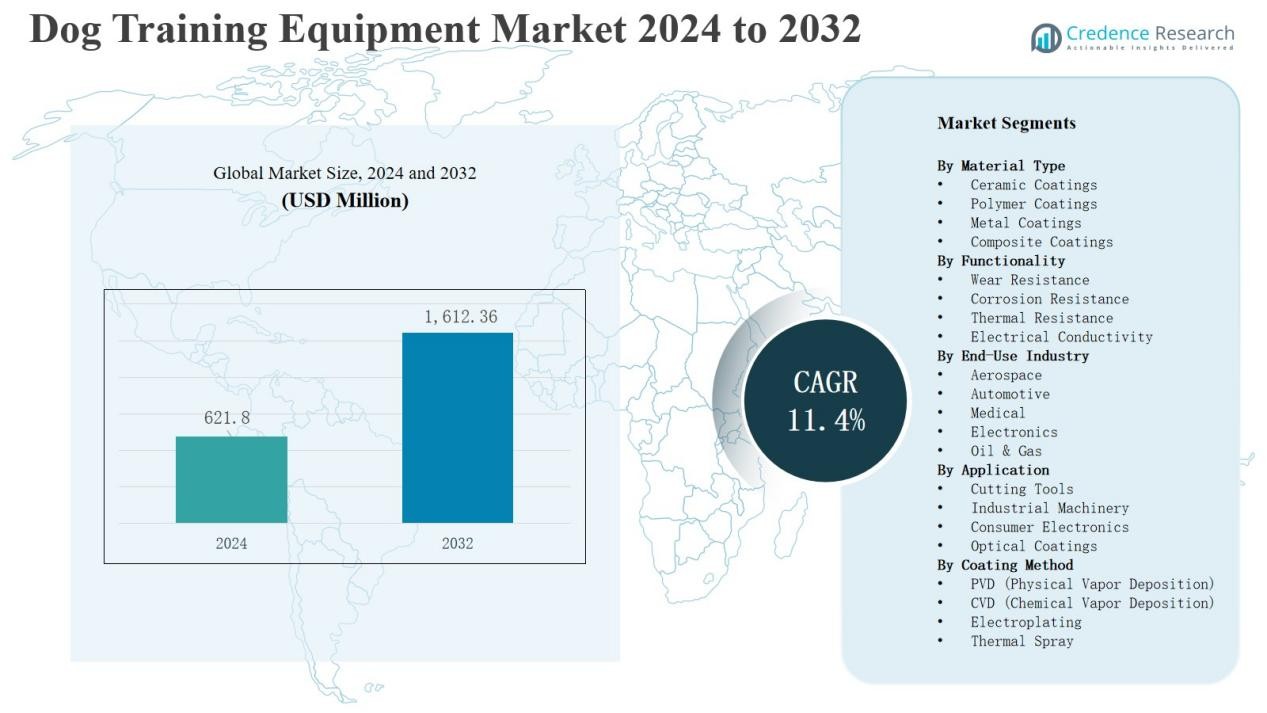
The Dog Training Equipment Market size was valued at USD 621.8 million in 2024 and is anticipated to reach USD 1,612.36 million by 2032, growing at a CAGR of 11.4% during the forecast period.
| REPORT ATTRIBUTE | DETAILS |
|---|---|
| Historical Period | 2020-2023 |
| Base Year | 2024 |
| Forecast Period | 2025-2032 |
| Dog Training Equipment Market Size 2024 | USD 621.8 Million |
| Dog Training Equipment Market, CAGR | 11.4% |
| Dog Training Equipment Market Size 2032 | USD 1,612.36 Million |
The Dog Training Equipment Market features strong competition among major players such as Garmin Ltd., ActiveDogs, Prevue Pet Products, J&J Dog Supplies, Delta Canine, Coastal Pet Products, Ray Allen Manufacturing, Kurgo UK, and Nite Ize. These companies focus on innovation, durability, and smart technology integration to enhance training effectiveness and pet safety. Garmin leads with advanced GPS-enabled collars and connected devices, while Coastal Pet Products and Kurgo UK excel in ergonomic leashes and harness systems. Ray Allen Manufacturing and J&J Dog Supplies cater to professional trainers with specialized, high-strength equipment. North America remains the leading region, commanding a 39% market share in 2024, supported by high pet ownership, strong product innovation, and a well-established retail and e-commerce infrastructure.
Market Insights
- The Dog Training Equipment Market was valued at USD 621.8 million in 2024 and is projected to reach USD 1,612.36 million by 2032, growing at a CAGR of 11.4%.
- North America led the market with a 39% share in 2024, driven by strong pet ownership, innovation in training tools, and robust e-commerce infrastructure.
- The Quartz Surface segment dominated by type with a 52% share, supported by demand for durable and hygienic equipment in premium training centers.
- The Residential segment held a 61% share by application, fueled by home-based training trends and adoption of smart and compact devices.
- The Engineered Quartz segment led material composition with a 57% share, favored for its strength, sustainability, and suitability for modern training environments.
Market Segment Insights
By Type
The Quartz Surface segment dominates the Dog Training Equipment Market with a 52% share in 2024. Its popularity stems from high durability, smooth finish, and superior aesthetic appeal in training environments and facility setups. The segment’s growth is driven by increased use in premium training centers and pet care infrastructures emphasizing hygiene and longevity. Rising demand for customizable and low-maintenance equipment designs further strengthens its market position over quartz tiles and other forms.
- For instance, Cosentino Group launched its Silestone HybriQ+ quartz surface series made with sustainable resins, targeting commercial and animal-training applications requiring durability and easy maintenance.
By Application
The Residential segment leads the Dog Training Equipment Market with a 61% share in 2024. This dominance is driven by growing pet ownership, home-based training practices, and the popularity of smart and compact training devices. Consumers prefer convenient tools such as shock collars, agility kits, and clickers suitable for household use. Increasing awareness of positive reinforcement techniques and behavior training at home continues to drive product adoption in this segment.
- For instance, Garmin expanded its Delta SE series with a lightweight remote dog training collar designed for home use, featuring tone and vibration modes for behavior correction.
By Material Composition
The Engineered Quartz segment holds the largest 57% share in the Dog Training Equipment Market in 2024. It leads due to its strength, consistent texture, and adaptability for various product applications. Manufacturers favor engineered quartz for durable training surfaces, jump bars, and flooring components that resist wear and stains. The segment’s growth is further boosted by rising demand for sustainable materials and design flexibility supporting modern training facility construction.
Key Growth Drivers
Rising Pet Ownership and Training Awareness
Increasing global pet adoption drives higher demand for effective training tools. Pet owners prioritize behavioral management and obedience training to enhance companionship and control. Growing awareness of humane and science-based training methods fuels sales of collars, agility tools, and clickers. Expanding urban pet populations and rising disposable incomes further boost household spending on pet training equipment across developed and emerging markets.
- For instance, PetSafe expanded its Positive Dog Training product range with a new line of vibration collars designed to promote non-invasive communication cues for dogs.
Technological Integration in Training Tools
Smart technologies are transforming conventional dog training products. Devices equipped with sensors, Bluetooth, and app connectivity enable real-time tracking and remote training. These features appeal to tech-savvy consumers seeking precision and convenience. Companies are investing in IoT-enabled collars, automated feeders, and wearable trackers, offering data-driven insights for personalized training programs. Such innovation enhances engagement and drives premium product demand globally.
- For instance, IoT-enabled smart dog collars integrate multiple sensors such as GPS for location tracking, accelerometers to measure activity levels, heart rate monitors, and temperature sensors to track the pet’s health in real time.
Expansion of E-commerce and Specialty Retail Channels
Online retailing significantly broadens accessibility for dog training products. E-commerce platforms offer wide product visibility, competitive pricing, and customer reviews influencing buying behavior. Pet owners benefit from customized recommendations and easy product comparisons. Manufacturers leverage online distribution to reach diverse markets efficiently. The growth of dedicated pet care websites and global retail partnerships strengthens overall market expansion.
Key Trends & Opportunities
Growing Preference for Eco-friendly and Sustainable Materials
Consumers increasingly prefer eco-friendly and durable materials in training equipment. Manufacturers are introducing products made from biodegradable plastics, recycled metals, and non-toxic fabrics. This trend aligns with the global sustainability movement and enhances brand reputation. Eco-conscious pet owners favor durable, low-impact equipment, creating opportunities for innovation in green product lines.
- For instance, WaterRower and NOHrD manufacture high-end wooden fitness equipment using FSC-certified wood from sustainably managed forests, emphasizing eco-conscious sourcing.
Rising Adoption of Professional Training Services
Professional training centers are expanding rapidly, integrating advanced equipment for agility, obedience, and behavioral improvement. This surge drives demand for durable and customizable tools suited for high-frequency use. Partnerships between pet care brands and training academies further strengthen the market. The professional segment’s growth provides opportunities for specialized equipment manufacturers to cater to premium and institutional buyers.
- For instance, DOGPacer announced an upgraded line of motorized treadmills tailored for training academies, featuring reinforced frames to withstand extended use in group environments.
Key Challenges
High Cost of Smart and Advanced Equipment
Smart training devices, though effective, remain expensive for average consumers. Integration of sensors, connectivity, and durable materials raises production costs. These factors limit adoption in low-income regions. Manufacturers face challenges balancing affordability and quality while maintaining innovation and performance standards in cost-sensitive markets.
Limited Awareness in Emerging Economies
Many developing regions still lack awareness about structured dog training and modern equipment. Cultural differences, lower spending on pets, and limited retail presence hinder market growth. Companies must invest in education campaigns and localized marketing strategies to expand penetration and build trust among first-time pet owners.
Risk of Misuse and Ethical Concerns
Improper use of training tools, especially shock or restraint devices, raises ethical concerns. Negative publicity about misuse can affect consumer confidence and regulatory acceptance. Industry players must ensure compliance with animal welfare standards and promote safe, positive-reinforcement-based equipment to maintain credibility and long-term market sustainability.
Regional Analysis
North America
North America dominates the Dog Training Equipment Market with a 39% share in 2024. High pet ownership rates, advanced pet care infrastructure, and strong awareness of animal behavior management drive demand. The U.S. leads the region with growing use of smart collars, agility tools, and remote training systems. Consumers prefer technologically integrated and durable products that ensure safety and efficiency. The presence of major brands and extensive e-commerce networks further strengthen regional growth. It continues to attract innovation-focused manufacturers and investors.
Europe
Europe holds a 27% share of the global Dog Training Equipment Market. Countries such as Germany, the U.K., and France drive strong adoption through high pet ownership and regulatory focus on animal welfare. The market benefits from consumer preference for sustainable and eco-friendly materials in training tools. Increasing investment in professional training services supports segment growth. Manufacturers are expanding retail partnerships to improve product reach. It continues to emphasize innovation and ethical design in pet care accessories.
Asia-Pacific
Asia-Pacific accounts for a 22% share and represents the fastest-growing regional market. Rising middle-class income, urbanization, and the surge in pet adoption across China, Japan, and India fuel expansion. The region’s consumers are adopting advanced training products for both home and professional use. Local manufacturers are introducing cost-effective smart devices to meet diverse consumer needs. Strong online sales growth and growing awareness of dog training benefits enhance market penetration. It is expected to maintain the highest CAGR through 2032.
Latin America
Latin America holds a 7% share in the global market, led by Brazil and Mexico. Increasing awareness of pet welfare and expanding access to imported products drive market momentum. Consumers show rising interest in affordable yet durable training equipment. The presence of pet specialty stores and online platforms strengthens regional distribution. It continues to develop gradually with growing investment in organized pet care services.
Middle East & Africa
The Middle East & Africa region captures a 5% share in 2024. Demand is supported by increasing pet ownership among urban households and expatriate populations. Countries such as the UAE and South Africa are adopting modern training tools for domestic and professional use. Product imports dominate the market, while local production remains limited. It shows steady growth potential with rising awareness of structured pet training.
Market Segmentations:
By Material Type
- Ceramic Coatings
- Polymer Coatings
- Metal Coatings
- Composite Coatings
By Functionality
- Wear Resistance
- Corrosion Resistance
- Thermal Resistance
- Electrical Conductivity
By End-Use Industry
- Aerospace
- Automotive
- Medical
- Electronics
- Oil & Gas
By Application
- Cutting Tools
- Industrial Machinery
- Consumer Electronics
- Optical Coatings
By Coating Method
- PVD (Physical Vapor Deposition)
- CVD (Chemical Vapor Deposition)
- Electroplating
- Thermal Spray
By Region
- North America
- U.S.
- Canada
- Mexico
- Europe
- Germany
- France
- U.K.
- Italy
- Spain
- Rest of Europe
- Asia Pacific
- China
- Japan
- India
- South Korea
- South-east Asia
- Rest of Asia Pacific
- Latin America
- Brazil
- Argentina
- Rest of Latin America
- Middle East & Africa
- GCC Countries
- South Africa
- Rest of the Middle East and Africa
Competitive Landscape
The Dog Training Equipment Market is competitive, featuring established and emerging players focused on product innovation, durability, and user convenience. Key companies include Garmin Ltd., ActiveDogs, Prevue Pet Products, J&J Dog Supplies, Delta Canine, Coastal Pet Products, Ray Allen Manufacturing, Kurgo UK, and Nite Ize. These firms emphasize advanced design, smart features, and ergonomic materials to enhance training efficiency and pet safety. Garmin leads with connected and sensor-based devices, while Coastal Pet Products and Kurgo UK strengthen presence through high-quality leashes, harnesses, and travel gear. Ray Allen Manufacturing and J&J Dog Supplies serve professional trainers with specialized and durable products. Market players are expanding global reach through online platforms, retail partnerships, and eco-friendly product innovations, driving competition and technological advancement in the industry.
Key Players
- Garmin Ltd.
- ActiveDogs
- Prevue Pet Products
- J&J Dog Supplies
- Delta Canine
- Coastal Pet Products
- Ray Allen Manufacturing
- Kurgo UK
- Nite Ize
Recent Developments
- In January 2025, Radio Systems Corporation acquired Lucky Dog Equipment to broaden its training equipment portfolio.
- On April 2, 2025, Ray Allen Manufacturing featured integration of Garmin Fenix 8 with its Alpha tracking system for K9 handlers.
- In January 2025, Porter Labs partnered with NetActuat to enhance its flagship product, PupStation, via low-latency global platform integration.
- In July 2025, Tractive acquired Whistle from Mars Petcare and will phase out the Whistle platform.
Report Coverage
The research report offers an in-depth analysis based on Type, Application, Material Composition, Distribution Channel and Region. It details leading market players, providing an overview of their business, product offerings, investments, revenue streams, and key applications. Additionally, the report includes insights into the competitive environment, SWOT analysis, current market trends, as well as the primary drivers and constraints. Furthermore, it discusses various factors that have driven market expansion in recent years. The report also explores market dynamics, regulatory scenarios, and technological advancements that are shaping the industry. It assesses the impact of external factors and global economic changes on market growth. Lastly, it provides strategic recommendations for new entrants and established companies to navigate the complexities of the market.
Future Outlook
- Demand for smart and connected training devices will continue to increase globally.
- Manufacturers will focus on eco-friendly and recyclable materials to meet sustainability goals.
- Online retail and direct-to-consumer sales will expand market accessibility.
- Growth in professional dog training centers will drive demand for premium-grade tools.
- Integration of AI and IoT technologies will enhance remote and data-driven training.
- Customizable and breed-specific training equipment will gain higher adoption.
- Pet humanization trends will encourage spending on advanced behavioral tools.
- Partnerships between pet brands and training academies will strengthen product visibility.
- Awareness of humane and positive reinforcement training methods will support ethical innovation.
- Emerging markets in Asia-Pacific and Latin America will become major growth contributors.

Request a Free Sample
Fill in your details and we'll send you a free sample report.
- Sample data tables & charts
- Research methodology
Need a Custom Version of This Report?
Tailor the scope, geography, or segments to your exact requirements.
- Custom geography or segment scope
- Direct access to our analyst team
Frequently Asked Questions
What is the current market size for the Dog Training Equipment Market, and what is its projected size in 2032?
At what Compound Annual Growth Rate is the Dog Training Equipment Market projected to grow between 2025 and 2032?
Which Dog Training Equipment Market segment held the largest share in 2024?
What are the primary factors fueling the growth of the Dog Training Equipment Market?
Who are the leading companies in the Dog Training Equipment Market?
Which region commanded the largest share of the Dog Training Equipment Market in 2024?
Table of Content
Chapter 1 Market Segmentation
- 1.1 Segmentation Framework
- 1.1.1 Product and Service Classification
- 1.1.2 Application and End-Use Classification
- 1.1.3 Technology and Solution Classification
- 1.1.4 Customer and Distribution Channel Classification
- 1.1.5 Geographic Segmentation
- 1.1.6 Market Segment Definitions and Boundaries
Chapter 2 Introduction
- 2.1 Report Objectives and Scope
- 2.2 Product Definition and Industry Terminology
- 2.3 Market Inclusions and Exclusions
- 2.4 Research Process
- 2.4.1 Primary Research and Expert Interviews
- 2.4.2 Secondary Research and Source Review
- 2.4.3 Top-Down and Bottom-Up Estimation
- 2.4.4 Data Triangulation and Verification
- 2.5 Market Size Measurement Basis
- 2.5.1 2024: USD 621.8 million → 2032: USD 1,612.36 million
- 2.6 Historical and Forecast Reference Periods
- 2.6.1 Base Year: 2024
- 2.6.2 Forecast Period: 2024-2032
- 2.7 Research Assumptions and Limitations
Chapter 3 Executive Summary
- 3.1 Market Snapshot and Key Findings
- 3.2 Base-Year Market Size, 2024
- 3.3 Forecast Market Size, 2032
- 3.4 Revenue and Volume Growth Outlook
- 3.5 Key Demand and Supply Indicators
- 3.6 Leading Market Segments
- 3.7 Fastest-Growing Market Opportunities
- 3.8 Regional Performance Highlights
- 3.9 Technology and Industry Transformation
- 3.10 Competitive Landscape Summary
- 3.11 Analyst View and Strategic Implications
Chapter 4 Global Dog Training Equipment Market Trends and Developments
- 4.1 Historical Industry Development
- 4.2 Recent Market Trends and Developments
- 4.3 Demand and Customer Behavior Trends
- 4.4 Technology and Product Innovation
- 4.5 Artificial Intelligence, Automation and Digitalization
- 4.6 Local Manufacturing and Supply Chain Realignment
- 4.7 Industry Partnerships, Mergers and Acquisitions
- 4.8 Sustainability and Circular Economy Developments
- 4.9 Government and Private Sector Investment Trends
- 4.10 Emerging Business Models and Commercialization
- 4.11 Industry Developments and Announcements
Chapter 5 Global Dog Training Equipment Market Production, Supply and Demand Analysis
- 5.1 Demand Trend and Consumption Analysis
- 5.2 Demand Forecast, 2024-2032
- 5.3 Production and Output Trend
- 5.4 Production and Output Forecast, 2024-2032
- 5.5 Installed Capacity and Capacity Utilization
- 5.6 Company-Wise Production Plants and Statistics
- 5.6.1 Installed Production Capacity
- 5.6.2 Actual Production
- 5.6.3 Planned Capacity and Expansion Targets
- 5.7 Supply Chain Structure and Procurement Trends
- 5.8 Supply-Demand Gap and Bottlenecks
- 5.9 Import Dependence and Sourcing Structure
- 5.10 Contract Manufacturing and Outsourcing
- 5.11 Regional Supply and Demand Concentration
Chapter 6 Global Dog Training Equipment Market Pricing Analysis
- 6.1 Pricing Structure and Measurement
- 6.2 Historical Pricing Trends
- 6.3 Pricing Outlook, 2024-2032
- 6.4 Average Selling Price and Unit Economics
- 6.5 Pricing by Product and Market Segment
- 6.6 Geographic Pricing Differences
- 6.7 Key Input, Energy, Labor and Logistics Costs
- 6.8 Contract Pricing and Purchasing Models
- 6.9 Pricing Sensitivity and Competitive Positioning
- 6.10 Price, Margin and Profitability Implications
Chapter 7 Global Dog Training Equipment Market Dynamics
- 7.1 Market Growth Drivers
- 7.1.1 Demand-Side Drivers
- 7.1.2 Technology and Innovation Drivers
- 7.1.3 Infrastructure and Investment Drivers
- 7.1.4 Regulatory and Policy Drivers
- 7.2 Market Restraints
- 7.2.1 Cost and Affordability Constraints
- 7.2.2 Technology and Adoption Barriers
- 7.2.3 Supply Chain and Operational Constraints
- 7.3 Market Challenges
- 7.3.1 Competitive Pressure and Margin Erosion
- 7.3.2 Skills, Infrastructure and Implementation Gaps
- 7.4 Emerging Market Opportunities
- 7.5 Market Dynamics Impact and Time-Horizon Assessment
Chapter 8 Global Dog Training Equipment Value Chain Analysis
- 8.1 Industry Value Chain Overview
- 8.2 Upstream Suppliers and Critical Inputs
- 8.3 Technology and Component Providers
- 8.4 Manufacturing or Service Delivery
- 8.5 Distribution, Channel Partners and Integrators
- 8.6 Downstream Applications and End Users
- 8.7 Value Addition and Profit Pools
- 8.8 Vertical Integration and Outsourcing
- 8.9 Supplier Concentration and Risk
- 8.10 Supply Chain Localization and Resilience
Chapter 9 Global Dog Training Equipment Market Regulations and Policies
- 9.1 Relevant Laws, Standards and Compliance Frameworks
- 9.2 Product, Service, Safety and Quality Requirements
- 9.3 Government Policies, Incentives and Subsidies
- 9.4 Imports, Exports and Trade Barriers
- 9.5 Public Procurement and Local Content Requirements
- 9.6 Environmental and Sustainability Compliance
- 9.7 Upcoming Policy Changes and Market Implications
Chapter 10 Global Dog Training Equipment Market Hotspots and Opportunities
- 10.1 Market Opportunity Mapping and Growth Hotspots
- 10.2 High-Growth Applications and Customer Groups
- 10.3 Underserved Markets and White-Space Opportunities
- 10.4 Emerging Technology and Product Opportunities
- 10.5 New Capacity and Investment Hotspots
- 10.6 Market Entry and Expansion Opportunities
- 10.7 Distribution and Partnership Opportunities
- 10.8 Near-Term and Long-Term Commercial Potential
- 10.9 Opportunity Attractiveness and Execution Risks
Chapter 11 Global Dog Training Equipment Market Outlook, 2024-2032
- 11.1 Market Size and Analysis
- 11.1.1 Revenue (Market Measurement: 2024: USD 621.8 million → 2032: USD 1,612.36 million)
- 11.1.2 Market Volume and Quantity Sold
- 11.1.3 Historical Market Size
- 11.1.4 Base-Year Market Size, 2024
- 11.2 Market Forecast, 2024-2032
- 11.2.1 Revenue Forecast to 2032
- 11.2.2 Volume Forecast to 2032
- 11.2.3 CAGR and Year-on-Year Growth
- 11.2.4 Incremental Revenue Opportunity
- 11.3 Forecast Assumptions and Scenario Analysis
- 11.3.1 Base-Case Forecast
- 11.3.2 Optimistic and Conservative Scenarios
- 11.3.3 Technology, Pricing and Policy Sensitivities
- 11.4 Market Attractiveness and Growth Outlook
Chapter 12 Global Dog Training Equipment Market Segmentation and Outlook
- 12.1 Segmentation Summary and Market Shares, 2024
- 12.2 Largest and Fastest-Growing Segments
- 12.3 Segment Growth Comparison
- 12.4 Segment Attractiveness and Priority Matrix
Chapter 13 Global Dog Training Equipment Geographic Market Outlook, 2024-2032
- 13.1 Regional Market Size and Share, 2024
- 13.2 Regional Market Forecast, 2024-2032
- 13.3 Regional Pricing, Production and Demand Differences
- 13.4 North America
- 13.4.1 United States
- 13.4.2 Canada
- 13.4.3 Mexico
- 13.5 Europe
- 13.5.1 Germany
- 13.5.2 France
- 13.5.3 Italy
- 13.5.4 United Kingdom
- 13.5.5 Spain
- 13.5.6 Poland
- 13.5.7 Russia
- 13.5.8 Netherlands
- 13.5.9 Belgium
- 13.5.10 Sweden
- 13.5.11 Denmark
- 13.5.12 Norway
- 13.5.13 Rest of Europe
- 13.6 Asia Pacific
- 13.6.1 China
- 13.6.2 India
- 13.6.3 Japan
- 13.6.4 South Korea
- 13.6.5 Thailand
- 13.6.6 Indonesia
- 13.6.7 Vietnam
- 13.6.8 Malaysia
- 13.6.9 Australia
- 13.6.10 Rest of Asia Pacific
- 13.7 Latin America
- 13.7.1 Brazil
- 13.7.2 Argentina
- 13.7.3 Colombia
- 13.7.4 Chile
- 13.7.5 Rest of Latin America
- 13.8 Middle East
- 13.8.1 Saudi Arabia
- 13.8.2 United Arab Emirates
- 13.8.3 Turkey
- 13.8.4 Israel
- 13.8.5 Iran
- 13.8.6 Rest of the Middle East
- 13.9 Africa
- 13.9.1 South Africa
- 13.9.2 Egypt
- 13.9.3 Nigeria
- 13.9.4 Morocco
- 13.9.5 Rest of Africa
- 13.10 Regional Investment, Policy and Supply Chain Differences
- 13.11 Regional Competitive Landscape
- 13.12 Geographic Growth Hotspots
Chapter 14 Global Dog Training Equipment Technology, Innovation and Sustainability Outlook
- 14.1 Technology Landscape and Maturity
- 14.2 Product, Process and Service Innovation
- 14.3 AI, Automation and Digital Tools in the Industry
- 14.4 Technology Adoption and Performance Benchmarking
- 14.5 Innovation Pipeline and R&D Investment
- 14.6 Patent and Intellectual Property Trends
- 14.7 Energy Efficiency and Resource Management
- 14.8 Sustainability, Recycling and Circularity
- 14.9 Technology Roadmap, 2024-2032
- 14.10 Risks of Obsolescence and Technology Substitution
Chapter 15 Global Dog Training Equipment Market Key Strategic Imperatives
- 15.1 Growth and Market Entry Priorities
- 15.2 High-Return Products and Segments
- 15.3 Pricing, Profitability and Cost Optimization
- 15.4 Technology Investment and Product Differentiation
- 15.5 Supply Chain Localization and Resilience
- 15.6 Distribution and Customer Acquisition
- 15.7 Partnership, Acquisition and Capacity Strategy
- 15.8 Regional Expansion Priorities
- 15.9 Short-, Medium- and Long-Term Actions
Chapter 16 Competition Outlook
- 16.1 Industry Competition Characteristics
- 16.2 Market Structure and Concentration
- 16.3 Market Share and Competitive Positioning, 2024
- 16.4 Company-Wise Revenue and Product Benchmarking
- 16.5 Production and Service Capacity Benchmarking
- 16.6 Technology, Pricing and Differentiation
- 16.7 Regional Footprint and Distribution Strength
- 16.8 Mergers, Acquisitions and Strategic Alliances
- 16.9 New Entrants and Competitive Threats
- 16.10 Porter's Five Forces and Industry Attractiveness
- 16.11 Competitive Outlook, 2024-2032
Chapter 17 Company Profiles
- 17.1 Company Coverage and Selection Criteria
- 17.2 Leading Market Participants – Standard Profile Structure
- 17.2.1 Business Description
- 17.2.2 Company Ownership and Geographic Presence
- 17.2.3 Product and Service Portfolio
- 17.2.4 Manufacturing and Operating Footprint
- 17.2.5 Production Capacity and Expansion Plans
- 17.2.6 Financial Performance and Investment
- 17.2.7 Market Share and Competitive Position
- 17.2.8 Technology and Innovation Capabilities
- 17.2.9 Strategic Alliances or Partnerships
- 17.2.10 Recent Developments
- 17.2.11 Growth Strategy and Outlook
- 17.3 Other Relevant Market Participants
Note: Every listed company is profiled on the structure shown under the first company. The company list is preliminary and may change based on research findings, market developments, data availability and client requirements.
Chapter 18 Disclaimer
- 18.1 Research and Forecast Disclaimer
- 18.2 Data Source and Estimation Limitations
Note: The depth of individual sections depends on data availability for this market. Volume, capacity, trade and other unit-based metrics are included where applicable.

