
U.S. online estate plans replace the law office visit
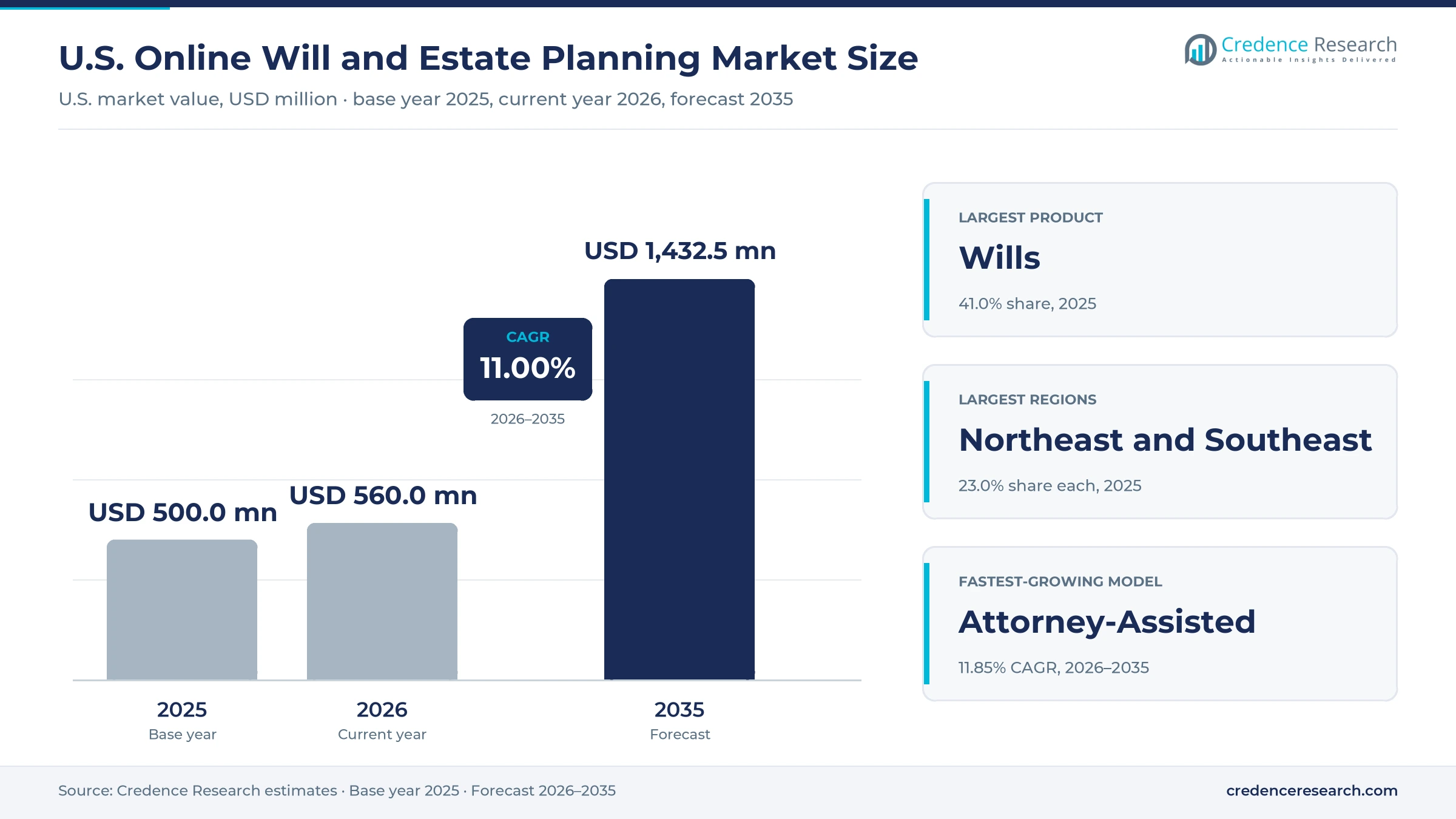
The U.S. online will and estate planning market was valued at USD 500.0 million in 2025 and is projected to increase from USD 560.0 million in 2026 to USD 1.43 billion by 2035, registering a CAGR of 11.00% during 2026–2035. Demand comes from households, employers, financial advisors and nonprofits that pay for wills, trusts, powers of attorney and digital document vaults created online instead of in a law office. The Northeast and Southeast each held 23.0% of 2025 value, supported by older populations in states such as Maine and Florida, while the Mountain region grows fastest at 11.88% a year as retirees settle in Arizona, Idaho and Nevada. Coverage gaps leave room to grow, because Trust & Will's March 2026 estate planning report found that 58% of millennials had no estate planning documents. On the commercial side, Wealth.com raised $65 million in April 2026 to extend AI estate planning tools through more than 50,000 financial advisors at the largest broker-dealers.
What does online will and estate planning spending include in the U.S.?
The market counts what U.S. households, employers, nonprofits and advisory firms pay to create wills, revocable trusts, powers of attorney and health care directives through online platforms. Value covers one-time plan fees, annual memberships that update and store documents, attorney review sold on top of a platform plan, and per-plan fees paid by employers, advisors and charities that sponsor plans for others.
The estimate excludes estate plans drafted entirely in a law office, probate and trust administration fees, and trustee or asset management charges. Life insurance, funeral prepayment and tax preparation are also excluded, because they are bought through different providers even when they sit beside an estate plan.
U.S. Online Will and Estate Planning Market Insights
- The market grows from USD 500.0 million in 2025 to USD 1.43 billion by 2035, an 11.00% CAGR, as online platforms bring wills and trusts to households that still lack a plan.
- The Northeast and Southeast each held 23.0% of 2025 value, and Florida was one of three states where older adults outnumbered children in 2020.
- Wills held 41.0% of 2025 value, as FreeWill reports more than 1.6 million wills created at no cost on its nonprofit-funded platform.
- LegalZoom reported in July 2026 that half of its estate plan customers finish the whole process on a phone or tablet.
- Wealth.com raised $65 million in April 2026, a year after Schwab took a strategic minority stake to support estate planning for its investors.
Wills lead while trusts and attorney review grow fastest
Why do wills lead while trusts grow fastest?
Based on product, the market is categorized into wills, trusts, power of attorney and digital vault. Wills led with 41.0% of 2025 value because a will is the entry document for most households, and FreeWill reports more than 1.6 million wills created on its platform. Trust & Will prices its individual will-based plan at $199, which keeps first purchases small but frequent. Trusts grow fastest at 11.66% a year as buyers move up to probate-avoidance plans, and LegalZoom reported in July 2026 that trust adoption rose 23.2 percentage points in Iowa within a year. Trust-based plans at Trust & Will cost $499, lifting value per customer.
How do DIY tools and attorney-assisted plans split spending?
Based on model, the market is categorized into DIY, attorney-assisted, employer benefit and charity-funded services. DIY led with 46.0% of 2025 value because guided online forms remain the cheapest route, and Rocket Lawyer lets users create wills, trusts and medical directives free through state-tailored questions. Trust & Will says more than 1 million people have started plans on its self-guided platform. Attorney-Assisted services grow fastest at 11.85% a year as platforms add lawyer review, and LegalZoom counted more than 1,000 attorneys in its independent network at the end of 2025. Rocket Lawyer also sells 30- or 60-minute advice sessions starting at $149.
Why do retirees lead while millennials grow faster?
Based on customer, the market is categorized into millennials and retirees. Retirees led with 57.0% of 2025 value because older households hold the assets and face the most urgent decisions, and the Census Bureau counted 64.6 million residents aged 65 and older in July 2025. Trust & Will found in March 2025 that 44% of baby boomers had a will, against 22% of millennials. Millennials grow fastest at 11.56% a year as the coverage gap is large, with Trust & Will's March 2026 estate planning report finding that 58% of millennials still had no estate planning documents.
| Segment Group | Leading Sub-segment | Share, 2025 | Fastest-growing Sub-segment | CAGR, 2026–2035 |
|---|---|---|---|---|
| By Product | Wills | 41.0% | Trusts | 11.66% |
| By Model | DIY | 46.0% | Attorney-Assisted | 11.85% |
| By Customer | Retirees | 57.0% | Millennials | 11.56% |
Request a Free Sample
Fill in your details and we'll send you a free sample report.
- Sample data tables & charts
- Research methodology
Lower costs, older households and lawyer add-ons lift demand
Digital tools cut the cost of preparing a plan
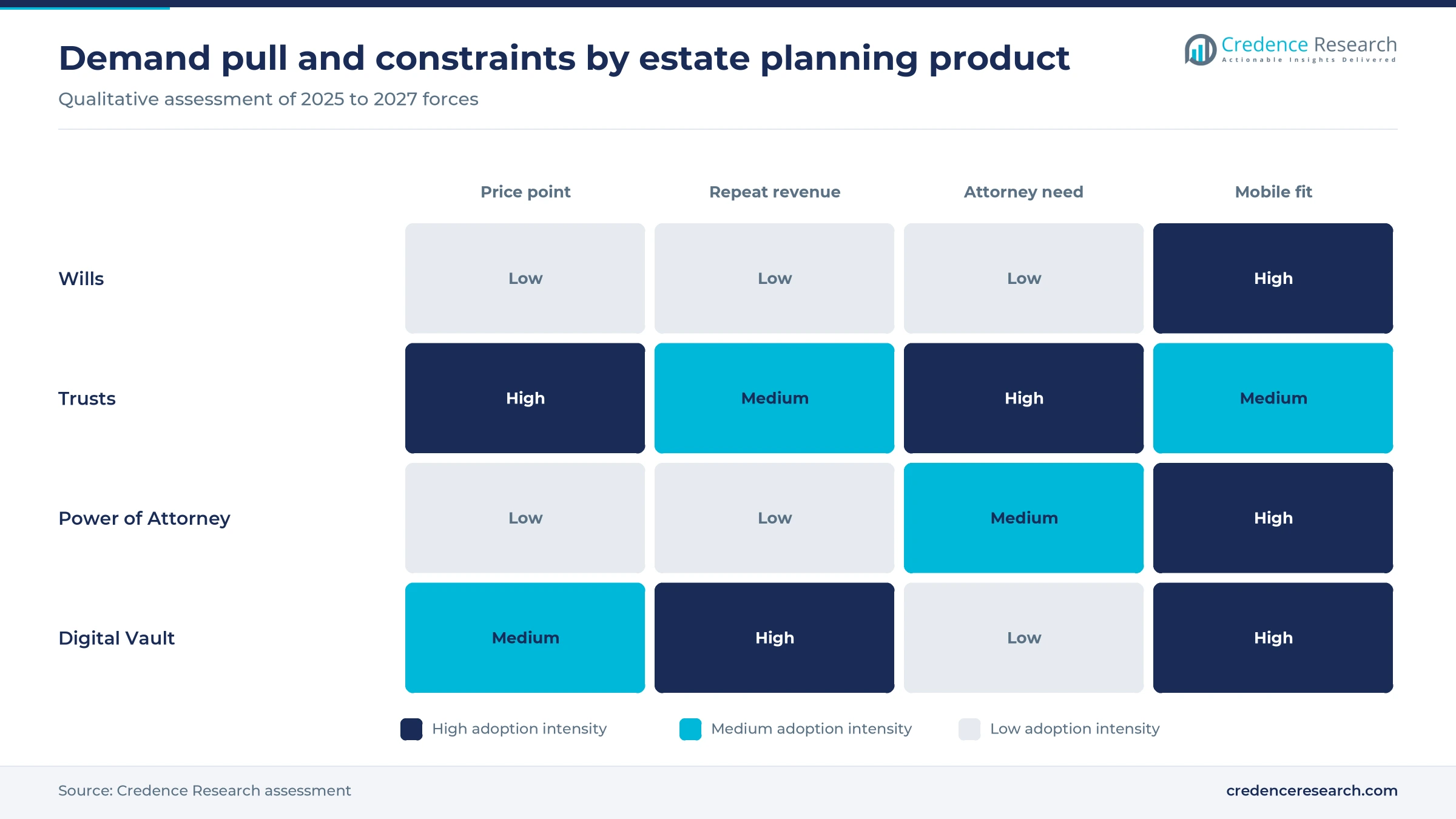
Online platforms turn a lawyer-drafted document set into a guided form, which lowers the price of a first estate plan for ordinary households. Trust & Will charges $199 for an individual will-based plan and $499 for a trust-based plan, while Rocket Lawyer lets users create wills and trusts free during a trial. FreeWill goes further, because nonprofits fund the service and wills cost users nothing. Price resistance is easing as a result, and Trust & Will's 2026 estate planning report found 15% of adults without a plan called it too expensive, down from 24% in 2025. In the Credence Research model this adds about 4.3 percentage points to annual growth to 2035, the largest single effect.
Aging households need wills, trusts and directives
An older population raises the number of households that must settle guardianship, property and medical decisions in writing. The Census Bureau reported in June 2026 that residents aged 65 and older grew 16.2% from 2020 to 2025, far faster than the 3.1% rise in the total population. Deaths also stay high, and the CDC counted 3,072,666 U.S. resident deaths in 2024, each one testing whether an estate plan existed. Coverage remains thin, because Caring.com found only 24% of adults had a will in January 2025, down from 33% in 2022. In the Credence Research model this adds about 3.0 percentage points to annual growth to 2035, with retirees holding 57.0% of 2025 value.
Legal-review add-ons lift revenue per customer
Platforms increasingly sell lawyer access on top of the document, which raises revenue per customer without raising acquisition cost. LegalZoom reported in its annual report for 2025 that more than 1,000 attorneys sat in its independent network at year-end, with subscription legal plans that can include an annual estate planning checkup. Rocket Lawyer sells legal advice sessions starting at $149, and Trust & Will offers a Pro membership at $299 a year above its $49 Essentials tier. LegalZoom also partnered with Eazewell on June 17, 2025, to pass AI-gathered client details into its will and trust platform with optional attorney review. In the Credence Research model this adds about 2.0 percentage points to annual growth to 2035.
Advisors and employers bring plans to their clients
Financial advisors and employers now distribute estate plans as part of wider benefits, which reaches households that would never search for a will on their own. Wealth.com said in April 2026 that approvals from the three largest U.S. broker-dealers open access to more than 50,000 financial advisors, after it raised $65 million in a Series B round. Trust & Will says more than 20,000 advisors and firms have joined its advisor platform, and AARP members receive 10% off its plans. In workplaces, MetLife told HR Dive in November 2023 that 20,000 to 35,000 people a month were completing wills through its digital process, while 32% of employers offered legal benefits.
Phone-first plans and trusts reshape online estate planning
Shift to phone-first plan completion
Estate planning is moving onto phones, which shortens the time from first visit to signed documents. LegalZoom said in July 2026, in a report built on more than 260,000 plans, that 85% of customers start on a phone or computer and half complete the whole process on a phone or tablet. Comfort with software guidance is rising too, as Trust & Will's March 2026 estate planning report found that 30% of adults trust AI more than a human attorney for estate planning guidance, up from 20% in 2025. Wealth.com says its Ester engine processed more than 100,000 estate documents in 2025, showing how quickly AI intake is spreading among advisory firms. As a result, platforms are redesigning flows for short mobile sessions.
Rise of revocable trusts in online plans
Households are moving from simple wills toward revocable living trusts, which carry higher prices and more add-on services. LegalZoom reported in July 2026 that trust adoption on its platform rose 23.2 percentage points in Iowa, 23.1 points in Kentucky and 21.7 points in Arkansas between the first halves of 2025 and 2026. Caring.com found that 13% of adults held a living trust in January 2025, which leaves a large base still to convert. Federal estate tax is not the main reason, because IRS Revenue Procedure 2025-32 set the 2026 exclusion at $15 million, so probate avoidance and privacy drive most trust purchases. Trusts therefore grow at 11.66% a year in the Credence Research estimate.
Opening in charity-funded wills tied to bequests
Charity-funded wills give nonprofits an opening to grow legacy gifts while households pay nothing for the document. FreeWill reports more than $15.2 billion committed to nonprofits and more than 2,400 nonprofit and charity partners using its platform. Bequests are rising at the same time, as Giving USA 2026 reported that bequest giving grew 19.7% in 2025, the largest increase of any source, while total giving reached $617.2 billion. FreeWill raised $30 million in a Series B round in March 2022 to extend its non-cash giving tools, according to Bain Capital. Providers that link plan creation to donor stewardship can therefore win fees from fundraising budgets rather than from household wallets.
Opening among millennials and young families
Younger adults offer an opening because most still lack documents, yet they already buy financial services online by default. Trust & Will surveyed 5,000 adults in early 2026 and found 54% of Gen Z and 48% of baby boomers had no estate planning documents, while millennials showed an even larger gap. Its 2025 report found only 22% of millennials had a will, and Caring.com ranked family expansion as the third most common reason to start planning. Life events create natural entry points, and Trust & Will says it is expanding partnerships tied to milestones such as buying a home or a car. Millennials therefore grow at 11.56% a year in the Credence Research estimate, faster than retirees.
Delay, signing rules and free offers limit platform revenue
Why do so many households delay making a will?
Procrastination remains the largest barrier, because estate planning has no deadline until a health event or a death forces it. Caring.com found in January 2025 that 43% of adults without a will said they had not gotten around to it, and will ownership fell nine points from its 2022 level. This limits conversion for every model, so providers rely on discounts, reminders and life-event partnerships to move buyers. LegalZoom ties its offers to National Make-A-Will Month each August.
Do state signing rules limit fully online wills?
Most plans still need printing, witnesses and sometimes a notary, which adds a step the platforms cannot remove. As of April 2022, only ten states allowed wills to be made entirely electronically, according to the ACTEC Foundation, and just four had adopted the Uniform Electronic Wills Act. Customers in other states must sign on paper, and errors at that stage can void a document. Providers respond with state-specific signing instructions, digital signature tools and remote notary partners.
Will free offers compress platform prices?
Free and discounted offers hold down the price that households expect to pay for a basic will. FreeWill gives wills away at no cost, Rocket Lawyer lets users create wills and trusts free with a trial, and AARP members receive 10% off Trust & Will plans. LegalZoom also offered up to 20% off a will or trust during National Make-A-Will Month in 2026. Margins on simple wills therefore stay thin, so providers push trusts, memberships and attorney review to protect revenue.
Can AI drafting win trust without lawyer review?
Accuracy and liability concerns cap how far legal AI software can go without a lawyer in the loop. Trust & Will's March 2026 estate planning report found that only 5% of adults would use AI to create estate documents without attorney review, and 36% would not use AI for estate planning at all. LegalZoom states in its 2025 annual report that AI cannot provide legal advice, so it promotes its owned law firm and attorney network. Platforms therefore carry review costs that pure software models avoid.
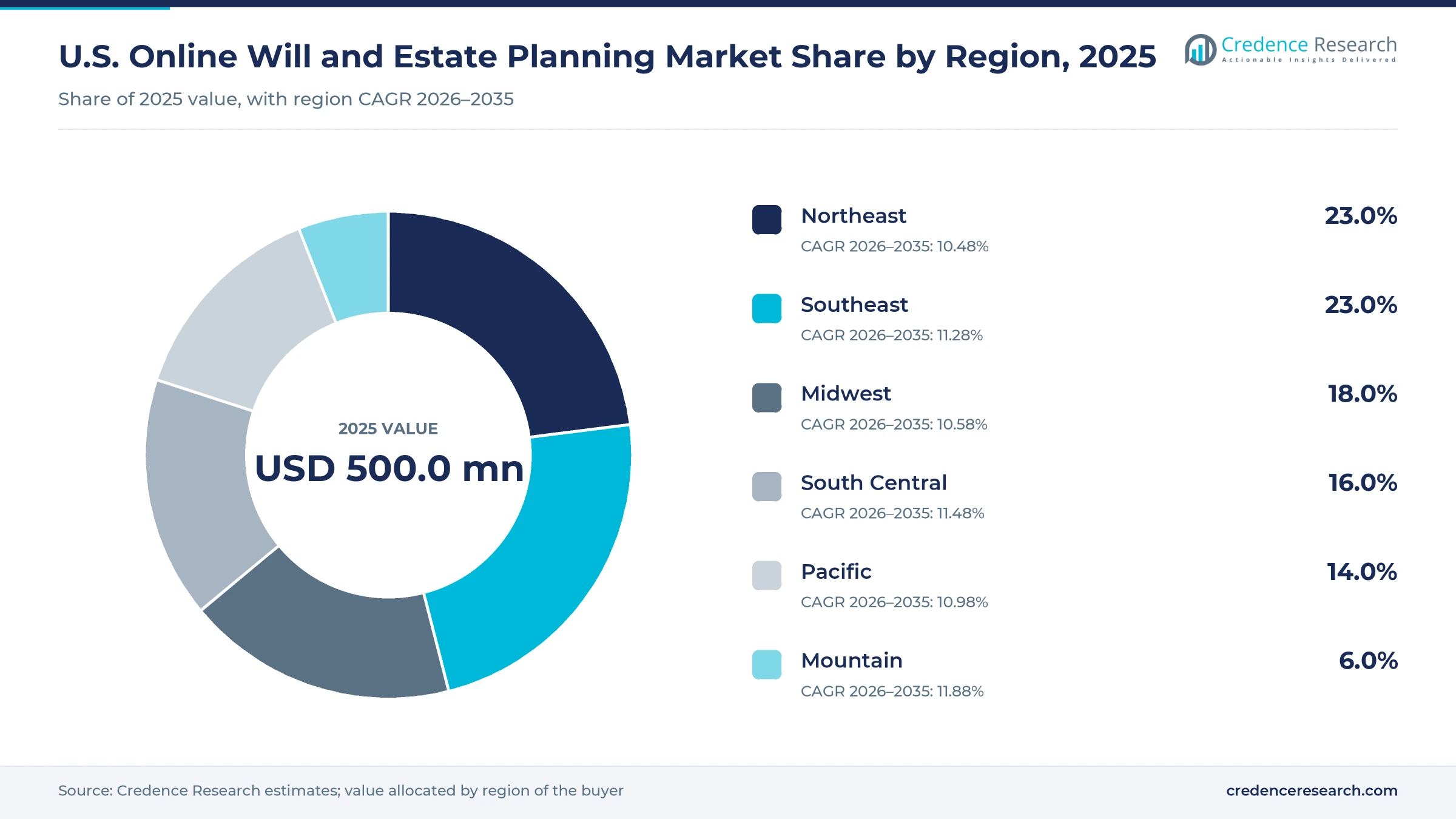
The Northeast and Southeast share the regional lead
| Region | Value, 2025 (USD million) | Share, 2025 | CAGR, 2026–2035 |
|---|---|---|---|
| Northeast | 115.0 | 23.0% | 10.48% |
| Southeast | 115.0 | 23.0% | 11.28% |
| Midwest | 90.0 | 18.0% | 10.58% |
| South Central | 80.0 | 16.0% | 11.48% |
| Pacific | 70.0 | 14.0% | 10.98% |
| Mountain | 30.0 | 6.0% | 11.88% |
The Northeast leads on an older population
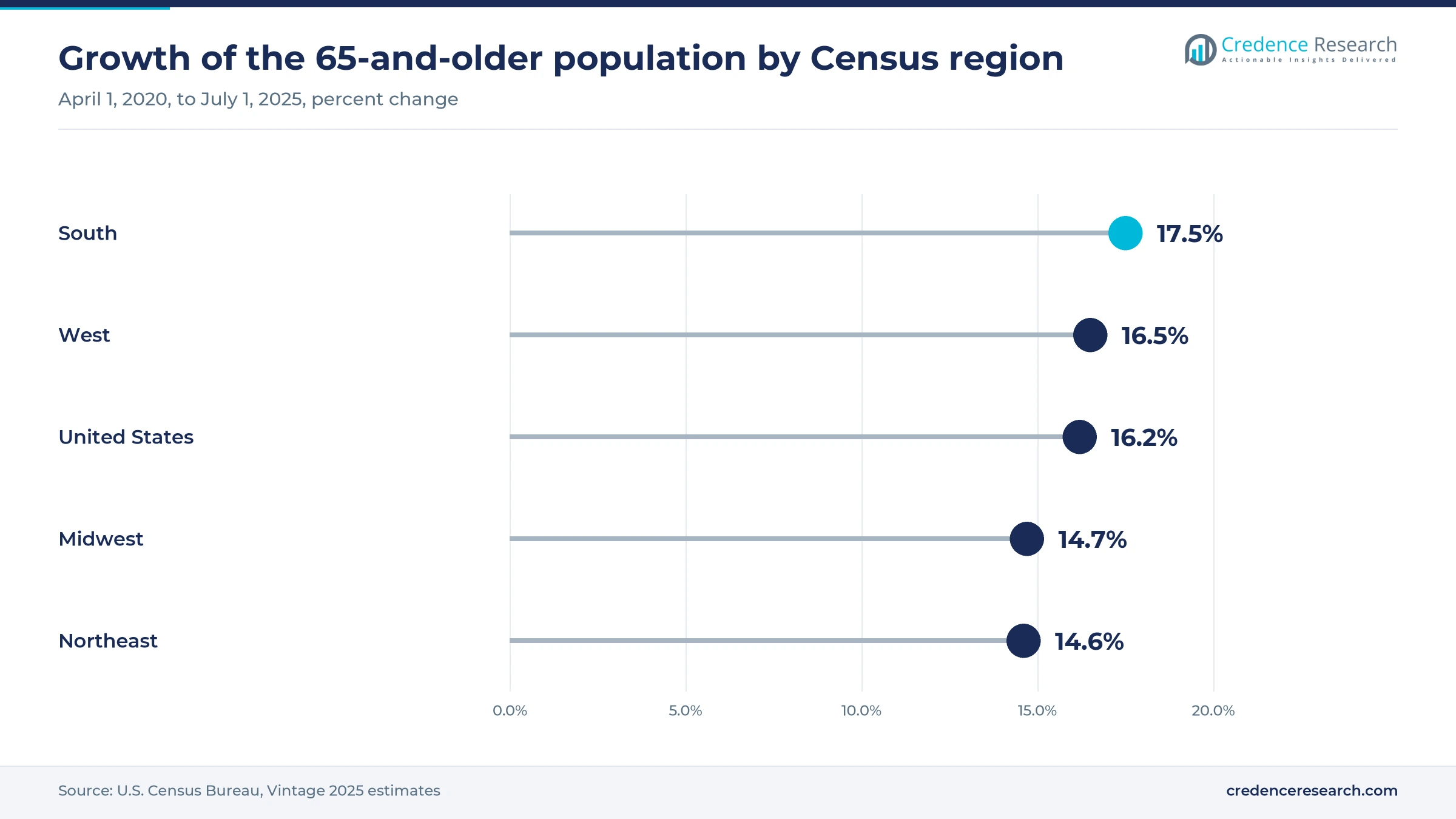
The Northeast held 23.0% of 2025 value and grows at 10.48% a year, tied with the Southeast for the largest share. An older age profile supports demand, because Maine, Vermont, New Hampshire, Pennsylvania and Rhode Island were among the 11 states where older adults outnumbered children in 2024, according to the Census Bureau. Maine also had the highest median age in 2025, at 44.9 years. Growth is slower, however, because the older population of the Northeast rose only 14.6% from 2020 to 2025, the weakest gain of any Census region.
The Southeast matches the lead on retiree migration
The Southeast matched the Northeast for the largest share of 2025 value and grows at 11.28% a year, faster than the Northeast. Florida was one of only three states where older adults outnumbered children in 2020, along with Maine and Vermont, which gives the zone a deep base of retirees planning estates. The Census Bureau found the older population of the South grew 17.5% from 2020 to 2025, the fastest of any region. Florida also enacted its own electronic wills law, which lets residents execute valid wills electronically.
The Midwest converts simple wills into trusts
The Midwest held 18.0% of 2025 value and grows at 10.58% a year, below the national pace. Its population aged 65 and older grew 14.7% from 2020 to 2025, according to the Census Bureau, close to the slow Northeast rate. Product mix is shifting upward, however, because LegalZoom reported a 23.2-point rise in trust adoption in Iowa between the first halves of 2025 and 2026. Illinois and Indiana passed their own electronic wills laws, and North Dakota adopted the Uniform Electronic Wills Act.
South Central gains from trust adoption in Kentucky
The South Central region held 16.0% of 2025 value and grows at 11.48% a year, faster than the national rate. Trust buying is spreading quickly, as LegalZoom reported trust adoption gains of 23.1 points in Kentucky and 21.7 points in Arkansas between the first halves of 2025 and 2026. Population growth helps too, because the Census Bureau found southern metro counties had the fastest growth of residents aged 65 and older from 2020 to 2025. The South also grew 6.0% overall in that period, nearly double the national rate.
The Pacific region favors trusts over simple wills
The Pacific region held 14.0% of 2025 value and grows at 10.98% a year, close to the national pace. Buyers there lean toward trusts, because Trust & Will found in March 2025 that the West had the highest trust ownership at 17% but the lowest will ownership at 27%. Washington adopted the Uniform Electronic Wills Act, and Hawaii and Oregon joined the states where older adults outnumbered children by 2024. Higher plan values offset slower household growth across the coastal states.
The Mountain region grows fastest on retiree inflows
The Mountain region held 6.0% of 2025 value and grows at 11.88% a year, the fastest pace among the six zones. The Census Bureau found the share of residents aged 65 and older was largest in parts of Arizona, Idaho and Nevada in 2025. State law also helps online signing, because Colorado and Utah adopted the Uniform Electronic Wills Act, while Arizona and Nevada passed their own electronic wills statutes. Montana joined the states where older adults outnumbered children in 2024.
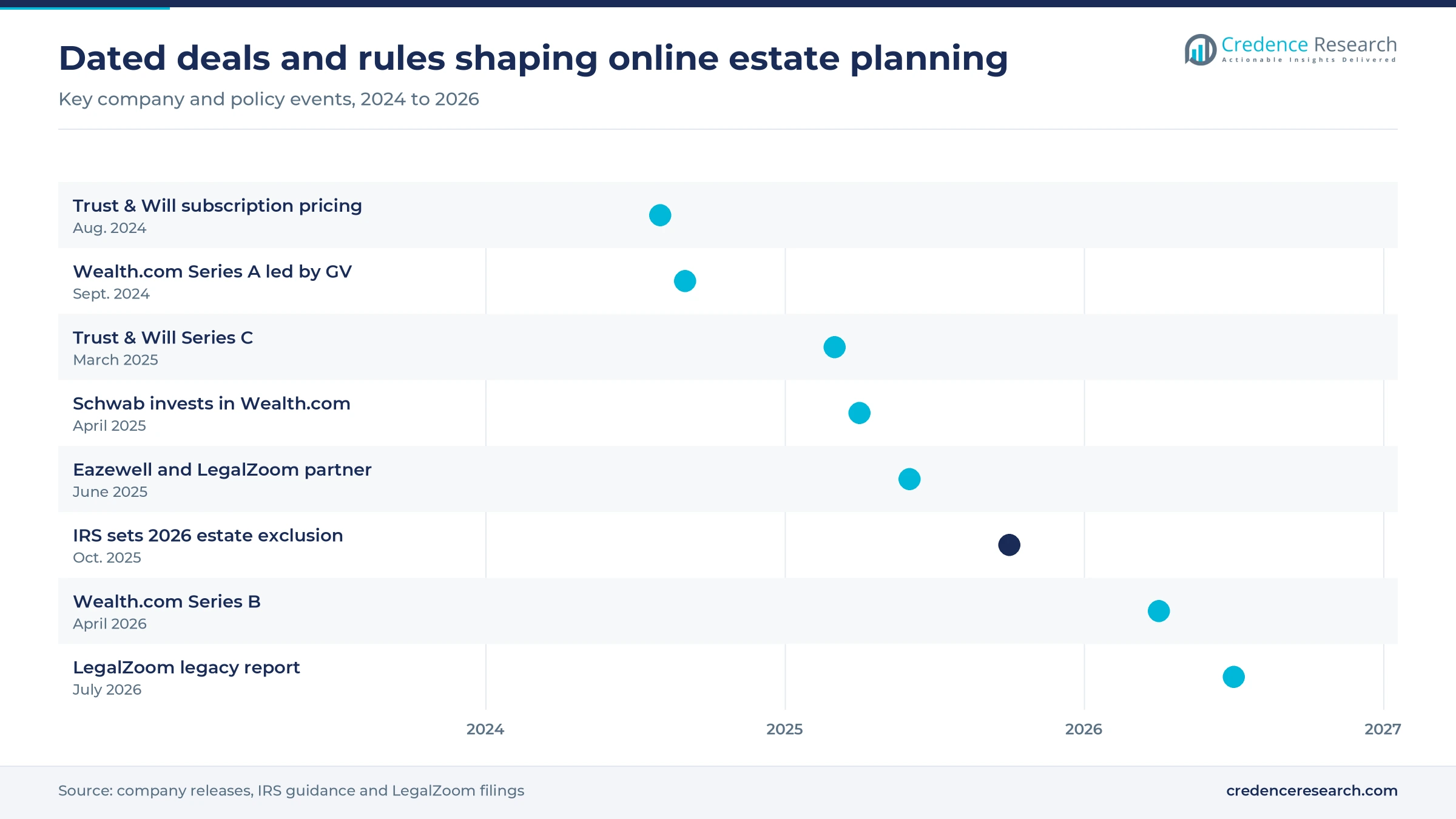
Funding rounds and partnerships from 2024 to 2026
| Development | Status and market relevance |
|---|---|
| In March 2025, Trust & Will raised more than $25 million in a Series C round led by Moderne Ventures, with Northwestern Mutual Future Ventures and UBS. | Closed; funds partner and advisor expansion |
| In April 2025, Schwab announced a strategic minority investment in Wealth.com to support estate planning for its investors. | Announced; client access under development |
| In June 2025, Eazewell partnered with LegalZoom to route AI-gathered details into LegalZoom will and trust documents. | Set for national launch in summer 2025 |
| In April 2026, Wealth.com raised $65 million in a Series B round to expand its AI estate and tax planning platform. | Closed; reaches more than 50,000 advisors |
| In July 2026, LegalZoom released a report on more than 260,000 estate plans created on its platform. | Published; shows mobile completion and trust growth |
AI intake and mobile flows speed up plan creation
- AI intake engines gather family and asset details before drafting, and Wealth.com says its Ester engine processed more than 100,000 estate documents in 2025.
- Mobile document flows let buyers finish on small screens, as half of LegalZoom estate plan customers completed the whole process on a phone or tablet.
- State-specific drafting adjusts documents to local law, and Schwab says Wealth.com users can create wills and revocable trusts in all 50 states and D.C.
- Secure vaults and memberships store and update documents over time, with Trust & Will charging $49 a year for its Essentials membership.
Need a Custom Version of This Report?
Tailor the scope, geography, or segments to your exact requirements.
- Custom geography or segment scope
- Direct access to our analyst team
Consumer brands, charity platforms and advisor tools compete
Competition in U.S. online will and estate planning splits between consumer brands, charity-funded platforms and advisor software. Trust & Will sells will-based and trust-based plans directly, counts more than 1 million people who have started plans and serves as the estate planning provider for AARP members. LegalZoom bundles wills, living trusts and powers of attorney with subscription legal plans backed by more than 1,000 independent attorneys. Rocket Lawyer uses a membership model in which document creation is free during a trial and advice sessions are sold on top. FreeWill takes a different route, charging nonprofits rather than households and reporting more than 2,400 partners. Wealth.com targets financial advisors alongside the wealth management software those firms already run, and Schwab invested in it in April 2025. Distribution matters more than price, so partnerships with advisors, insurers, employers and charities decide which platforms add customers fastest.
How do the leading online estate planning providers position their offer?
| Company | Type | Role in the market |
|---|---|---|
| Trust & Will | Direct-to-consumer and advisor platform | Sells $199 will plans and $499 trust plans and serves AARP members |
| FreeWill | Charity-funded platform | Offers free wills paid for by more than 2,400 nonprofit partners |
| LegalZoom | Online legal services | Pairs will and trust documents with more than 1,000 network attorneys |
| Rocket Lawyer | Membership legal platform | Gives free document creation with a trial and sells advice from $149 |
| Wealth.com | Advisor estate planning software | Uses its Ester AI engine and reaches more than 50,000 advisors |
Distribution and lawyer access decide platform share
Credence Research's view is that distribution and lawyer access, rather than document price alone, will decide share in U.S. online will and estate planning. Basic wills are close to free through FreeWill and trial offers, so revenue growth depends on trusts, memberships and attorney review. Platforms with advisor, employer and nonprofit channels reach households that never search for a will, which matters when fewer than one in four adults has one. The Mountain and South Central regions deserve attention because retiree inflows and rising trust adoption lift value per plan there. Providers that pair AI intake with lawyer review will be best placed.
How online estate plan spending was modeled
The report uses 2025 as the base year and 2035 as the forecast year, with market values taken from the Credence Research model. Product, model, customer and regional splits are Credence Research estimates informed by public data and are not reported by any single source. Inputs include U.S. Census Bureau population estimates, CDC mortality data, IRS guidance, company filings and press releases, published provider price lists, and national surveys released by Caring.com, Trust & Will and LegalZoom. Values cover fees paid for online plan creation, memberships, attorney review and sponsored plans, and they are cross-checked against provider counts and prices.
Aging and cheaper tools carry online plans to 2035
From USD 560.0 million in 2026, the market is expected to reach USD 1.43 billion by 2035 as aging households, cheaper digital tools and lawyer-review add-ons widen the paying base. Wills will keep the largest product share, although trusts will grow faster as buyers seek probate avoidance and privacy. Attorney-assisted services will gain on pure DIY tools, because platforms such as LegalZoom and Rocket Lawyer already sell review and advice on top of documents. Employer and advisor channels should add steady volume, while charity-funded wills keep basic prices low. The Mountain region is expected to grow fastest, supported by retiree inflows into Arizona, Idaho and Nevada.
Frequently Asked Questions
How big is the U.S. online will and estate planning market?
Which product holds the largest share?
Why are more Americans making estate plans online?
Which region leads and which grows fastest?
How do charity-funded wills work?
Which model grows fastest?
What limits growth in online estate planning?
Who are the leading companies?
Table of Content
Chapter 1 Market Segmentation
- 1.1 Segmentation Framework
- 1.1.1 Product and Service Classification
- 1.1.2 Application and End-Use Classification
- 1.1.3 Technology and Solution Classification
- 1.1.4 Customer and Distribution Channel Classification
- 1.1.5 Geographic Segmentation
- 1.1.6 Market Segment Definitions and Boundaries
- 1.2 By Product
- 1.2.1 Wills
- 1.2.2 Trusts
- 1.2.3 Power of Attorney
- 1.2.4 Digital Vault
- 1.3 By Model
- 1.3.1 DIY
- 1.3.2 Attorney-Assisted
- 1.3.3 Employer Benefit
- 1.3.4 Charity-Funded
- 1.4 By Customer
- 1.4.1 Retirees
- 1.4.2 Millennials
Chapter 2 Introduction
- 2.1 Report Objectives and Scope
- 2.2 Product Definition and Industry Terminology
- 2.3 Market Inclusions and Exclusions
- 2.4 Research Process
- 2.4.1 Primary Research and Expert Interviews
- 2.4.2 Secondary Research and Source Review
- 2.4.3 Top-Down and Bottom-Up Estimation
- 2.4.4 Data Triangulation and Verification
- 2.5 Market Size Measurement Basis
- 2.5.1 2025: USD 500.0 million → 2035: USD 1.43 billion
- 2.6 Historical and Forecast Reference Periods
- 2.6.1 Historical Period: 2018-2025
- 2.6.2 Base Year: 2025
- 2.6.3 Forecast Period: 2025-2035
- 2.7 Research Assumptions and Limitations
Chapter 3 Executive Summary
- 3.1 Market Snapshot and Key Findings
- 3.2 Base-Year Market Size, 2025
- 3.3 Forecast Market Size, 2035
- 3.4 Revenue and Volume Growth Outlook
- 3.5 Key Demand and Supply Indicators
- 3.6 Leading Market Segments
- 3.7 Fastest-Growing Market Opportunities
- 3.8 Regional Performance Highlights
- 3.9 Technology and Industry Transformation
- 3.10 Competitive Landscape Summary
- 3.11 Analyst View and Strategic Implications
Chapter 4 U.S. Online Will and Estate Planning Market Trends and Developments
- 4.1 Historical Industry Development, 2018-2025
- 4.2 Recent Market Trends and Developments
- 4.3 Demand and Customer Behavior Trends
- 4.4 Technology and Product Innovation
- 4.5 Artificial Intelligence, Automation and Digitalization
- 4.6 Local Manufacturing and Supply Chain Realignment
- 4.7 Industry Partnerships, Mergers and Acquisitions
- 4.8 Sustainability and Circular Economy Developments
- 4.9 Government and Private Sector Investment Trends
- 4.10 Emerging Business Models and Commercialization
- 4.11 Industry Developments and Announcements
Chapter 5 U.S. Online Will and Estate Planning Market Supply and Demand Analysis
- 5.1 Demand Trend and Consumption Analysis, 2018-2025
- 5.2 Demand Forecast, 2025-2035
- 5.3 Supply Chain Structure and Procurement Trends
- 5.4 Supply-Demand Gap and Bottlenecks
- 5.5 Import Dependence and Sourcing Structure
- 5.6 Regional Supply and Demand Concentration
Chapter 6 U.S. Online Will and Estate Planning Market Pricing Analysis
- 6.1 Pricing Structure and Measurement
- 6.2 Historical Pricing Trends, 2018-2025
- 6.3 Pricing Outlook, 2025-2035
- 6.4 Pricing by Product and Market Segment
- 6.5 Geographic Pricing Differences
- 6.6 Key Input, Energy, Labor and Logistics Costs
- 6.7 Contract Pricing and Purchasing Models
- 6.8 Pricing Sensitivity and Competitive Positioning
- 6.9 Price, Margin and Profitability Implications
Chapter 7 U.S. Online Will and Estate Planning Market Dynamics
- 7.1 Market Growth Drivers
- 7.1.1 Demand-Side Drivers
- 7.1.2 Technology and Innovation Drivers
- 7.1.3 Infrastructure and Investment Drivers
- 7.1.4 Regulatory and Policy Drivers
- 7.2 Market Restraints
- 7.2.1 Cost and Affordability Constraints
- 7.2.2 Technology and Adoption Barriers
- 7.2.3 Supply Chain and Operational Constraints
- 7.3 Market Challenges
- 7.3.1 Competitive Pressure and Margin Erosion
- 7.3.2 Skills, Infrastructure and Implementation Gaps
- 7.4 Emerging Market Opportunities
- 7.5 Market Dynamics Impact and Time-Horizon Assessment
Chapter 8 U.S. Online Will and Estate Planning Value Chain Analysis
- 8.1 Industry Value Chain Overview
- 8.2 Upstream Suppliers and Critical Inputs
- 8.3 Technology and Component Providers
- 8.4 Manufacturing or Service Delivery
- 8.5 Distribution, Channel Partners and Integrators
- 8.6 Downstream Applications and End Users
- 8.7 Value Addition and Profit Pools
- 8.8 Vertical Integration and Outsourcing
- 8.9 Supplier Concentration and Risk
- 8.10 Supply Chain Localization and Resilience
Chapter 9 U.S. Online Will and Estate Planning Market Regulations and Policies
- 9.1 Relevant Laws, Standards and Compliance Frameworks
- 9.2 Product, Service, Safety and Quality Requirements
- 9.3 Government Policies, Incentives and Subsidies
- 9.4 Imports, Exports and Trade Barriers
- 9.5 Public Procurement and Local Content Requirements
- 9.6 Data Protection, AI and Cybersecurity Compliance
- 9.7 Upcoming Policy Changes and Market Implications
Chapter 10 U.S. Online Will and Estate Planning Market Hotspots and Opportunities
- 10.1 Market Opportunity Mapping and Growth Hotspots
- 10.2 High-Growth Applications and Customer Groups
- 10.3 Underserved Markets and White-Space Opportunities
- 10.4 Emerging Technology and Product Opportunities
- 10.5 New Capacity and Investment Hotspots
- 10.6 Market Entry and Expansion Opportunities
- 10.7 Distribution and Partnership Opportunities
- 10.8 Near-Term and Long-Term Commercial Potential
- 10.9 Opportunity Attractiveness and Execution Risks
Chapter 11 U.S. Online Will and Estate Planning Market Outlook, 2025-2035
- 11.1 Market Size and Analysis
- 11.1.1 Revenue (Market Measurement: 2025: USD 500.0 million → 2035: USD 1.43 billion)
- 11.1.2 Historical Market Size, 2018-2025
- 11.1.3 Base-Year Market Size, 2025
- 11.2 Market Forecast, 2025-2035
- 11.2.1 Revenue Forecast to 2035
- 11.2.2 CAGR and Year-on-Year Growth
- 11.2.3 Incremental Revenue Opportunity
- 11.3 Forecast Assumptions and Scenario Analysis
- 11.3.1 Base-Case Forecast
- 11.3.2 Optimistic and Conservative Scenarios
- 11.3.3 Technology, Pricing and Policy Sensitivities
- 11.4 Market Attractiveness and Growth Outlook
Chapter 12 U.S. Online Will and Estate Planning Market Segmentation and Outlook
- 12.1 Segmentation Summary and Market Shares, 2025
- 12.2 Largest and Fastest-Growing Segments
- 12.3 By Product - Market Size and Forecast, 2025-2035
- 12.3.1 Segment Definition and Scope
- 12.3.2 Historical Market Size, 2018-2025
- 12.3.3 Revenue Forecast, 2025-2035
- 12.3.4 Base-Year Market Share, 2025
- 12.3.5 Segment CAGR and Growth Drivers
- 12.3.6 Subsegment Market Size and Forecast
- 12.3.6.1 Wills
- 12.3.6.2 Trusts
- 12.3.6.3 Power of Attorney
- 12.3.6.4 Digital Vault
- 12.3.7 Subsegment Pricing and Adoption Trends
- 12.3.8 Leading Suppliers and Competition
- 12.3.9 Regional Demand and Opportunities
- 12.4 By Model - Market Size and Forecast, 2025-2035
- 12.4.1 Segment Definition and Scope
- 12.4.2 Historical Market Size, 2018-2025
- 12.4.3 Revenue Forecast, 2025-2035
- 12.4.4 Base-Year Market Share, 2025
- 12.4.5 Segment CAGR and Growth Drivers
- 12.4.6 Subsegment Market Size and Forecast
- 12.4.6.1 DIY
- 12.4.6.2 Attorney-Assisted
- 12.4.6.3 Employer Benefit
- 12.4.6.4 Charity-Funded
- 12.4.7 Subsegment Pricing and Adoption Trends
- 12.4.8 Leading Suppliers and Competition
- 12.4.9 Regional Demand and Opportunities
- 12.5 By Customer - Market Size and Forecast, 2025-2035
- 12.5.1 Segment Definition and Scope
- 12.5.2 Historical Market Size, 2018-2025
- 12.5.3 Revenue Forecast, 2025-2035
- 12.5.4 Base-Year Market Share, 2025
- 12.5.5 Segment CAGR and Growth Drivers
- 12.5.6 Subsegment Market Size and Forecast
- 12.5.6.1 Retirees
- 12.5.6.2 Millennials
- 12.5.7 Subsegment Pricing and Adoption Trends
- 12.5.8 Leading Suppliers and Competition
- 12.5.9 Regional Demand and Opportunities
- 12.6 Segment Growth Comparison
- 12.7 Segment Attractiveness and Priority Matrix
Chapter 13 U.S. Online Will and Estate Planning End-Use and Application Market Outlook
- 13.1 End-Use Industry and Customer Demand Structure
- 13.2 Leading Applications and Customer Groups
- 13.3 End-Use Market Size, Share and Forecast
- 13.4 Major End-Use Industry Deep Dives
- 13.4.1 Customer Requirements and Use Cases
- 13.4.2 Demand and Replacement Cycles
- 13.4.3 Technical and Regulatory Considerations
- 13.4.4 Purchasing and Procurement Models
- 13.4.5 Leading Vendors and Distribution Channels
- 13.4.6 Forecast and Commercial Opportunities
- 13.5 Emerging Applications and Cross-Segment Demand
- 13.6 End-Use Industry Investment Priorities
Chapter 14 U.S. Online Will and Estate Planning Geographic Market Outlook, 2025-2035
- 14.1 Domestic Market Distribution and Demand Clusters
- 14.2 State- or Province-Wise Market Size and Forecast, 2025-2035
- 14.3 City and Metropolitan Market Outlook
- 14.4 Industrial, Manufacturing and Commercial Clusters
- 14.5 Geographic Concentration of Key End Users
- 14.6 Local Pricing and Purchasing Differences
- 14.7 Domestic Production Facilities and Capacity Map
- 14.8 Local Infrastructure and Project Pipeline
- 14.9 State-Level Policy and Incentive Differences
- 14.10 Subnational Investment Hotspots and Opportunities
- 14.11 Distribution and Logistics Networks
- 14.12 Domestic Competitive Footprint
Chapter 15 U.S. Online Will and Estate Planning Technology, Innovation and Sustainability Outlook
- 15.1 Technology Landscape and Maturity
- 15.2 Product, Process and Service Innovation
- 15.3 AI, Automation and Digital Tools in the Industry
- 15.4 Technology Adoption and Performance Benchmarking
- 15.5 Innovation Pipeline and R&D Investment
- 15.6 Patent and Intellectual Property Trends
- 15.7 Energy Efficiency and Resource Management
- 15.8 Sustainability, Recycling and Circularity
- 15.9 Technology Roadmap, 2025-2035
- 15.10 Risks of Obsolescence and Technology Substitution
Chapter 16 U.S. Online Will and Estate Planning Market Key Strategic Imperatives
- 16.1 Growth and Market Entry Priorities
- 16.2 High-Return Products and Segments
- 16.3 Pricing, Profitability and Cost Optimization
- 16.4 Technology Investment and Product Differentiation
- 16.5 Supply Chain Localization and Resilience
- 16.6 Distribution and Customer Acquisition
- 16.7 Partnership, Acquisition and Capacity Strategy
- 16.8 Regional Expansion Priorities
- 16.9 Short-, Medium- and Long-Term Actions
Chapter 17 Competition Outlook
- 17.1 Industry Competition Characteristics
- 17.2 Market Structure and Concentration
- 17.3 Market Share and Competitive Positioning, 2025
- 17.4 Company-Wise Revenue and Product Benchmarking
- 17.5 Production and Service Capacity Benchmarking
- 17.6 Technology, Pricing and Differentiation
- 17.7 Regional Footprint and Distribution Strength
- 17.8 Mergers, Acquisitions and Strategic Alliances
- 17.9 New Entrants and Competitive Threats
- 17.10 Porter's Five Forces and Industry Attractiveness
- 17.11 Competitive Outlook, 2025-2035
Chapter 18 Company Profiles
- 18.1 Company Coverage and Selection Criteria
- 18.2 Trust & Will
- 18.2.1 Business Description
- 18.2.2 Company Ownership and Geographic Presence
- 18.2.3 Product and Service Portfolio
- 18.2.4 Manufacturing and Operating Footprint
- 18.2.5 Financial Performance and Investment
- 18.2.6 Market Share and Competitive Position
- 18.2.7 Technology and Innovation Capabilities
- 18.2.8 Strategic Alliances or Partnerships
- 18.2.9 Recent Developments
- 18.2.10 Growth Strategy and Outlook
- 18.3 FreeWill
- 18.4 LegalZoom
- 18.5 Rocket Lawyer
- 18.6 Wealth.com
- 18.7 Other Relevant Market Participants
Note: Every listed company is profiled on the structure shown under the first company. The company list is preliminary and may change based on research findings, market developments, data availability and client requirements.
Chapter 19 Disclaimer
- 19.1 Research and Forecast Disclaimer
- 19.2 Data Source and Estimation Limitations
Note: The depth of individual sections depends on data availability for this market. Volume, capacity, trade and other unit-based metrics are included where applicable.

