
Market Overview
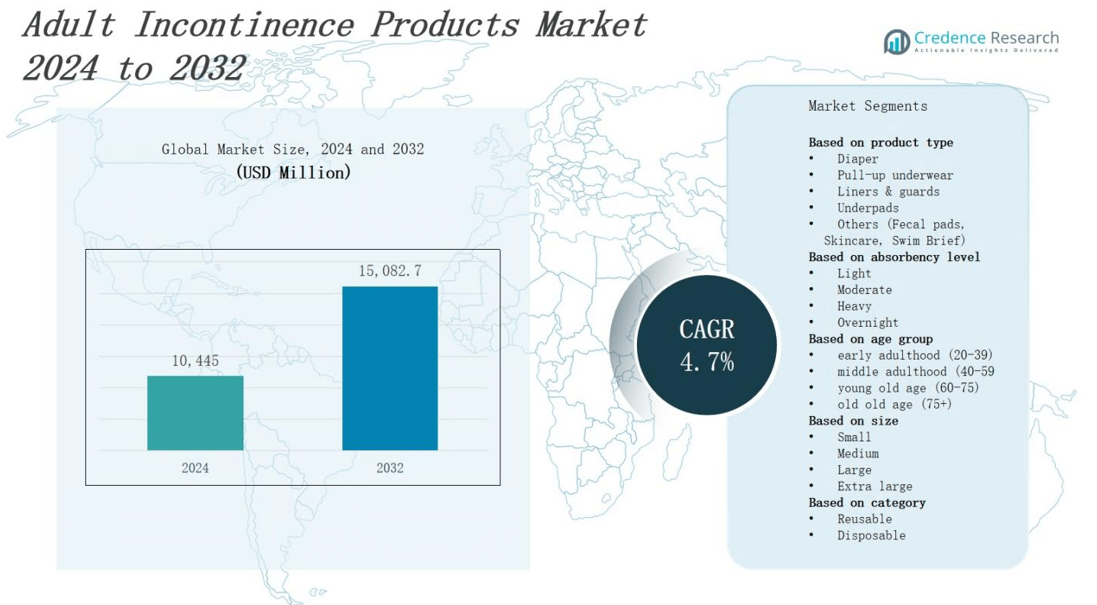
The adult incontinence products market is projected to grow from USD 10,445 million in 2024 to USD 15,082.7 million by 2032, registering a compound annual growth rate (CAGR) of 4.7%.
| REPORT ATTRIBUTE | DETAILS |
|---|---|
| Historical Period | 2020-2023 |
| Base Year | 2024 |
| Forecast Period | 2025-2032 |
| Adult Incontinence Products Market Size 2024 | USD 10,445 million |
| Adult Incontinence Products Market, CAGR | 4.7% |
| Adult Incontinence Products Market Size 2032 | USD 15,082.7 million |
The adult incontinence products market grows steadily due to the increasing aging population and rising prevalence of chronic conditions such as diabetes and neurological disorders. Growing awareness and reduced stigma around incontinence drive higher product adoption. Advances in product design, including improved absorbency, comfort, and discreetness, enhance user experience and expand the consumer base. Additionally, the rise in outpatient care and home healthcare services boosts demand for convenient, easy-to-use products. Technological innovations and expanding distribution channels, especially e-commerce, further support market growth by increasing accessibility and product variety. These factors collectively propel the market forward.
The adult incontinence products market spans key regions including North America, Europe, Asia-Pacific, Latin America, and the Middle East & Africa. North America leads with 34% market share, followed by Europe at 28%. Asia-Pacific, holding 22%, shows the fastest growth due to rising healthcare awareness. Latin America and the Middle East & Africa account for 9% and 7% respectively, driven by improving infrastructure and aging populations. Leading players such as Procter & Gamble Co, Kimberly-Clark Corporation, Unicharm Corporation, Hollister Incorporated, Essity, and McKesson Corporation actively compete across these regions to expand their global footprint.
Market Insights
- The adult incontinence products market is projected to grow from USD 10,445 million in 2024 to USD 15,082.7 million by 2032, registering a CAGR of 4.7%.
- Increasing aging populations and rising prevalence of chronic diseases like diabetes and neurological disorders drive steady market growth.
- Advances in product design improve absorbency, comfort, and discreetness, enhancing user experience and expanding the consumer base.
- Growing awareness and reduced stigma encourage higher adoption rates, supported by public health campaigns and digital education platforms.
- Diversified distribution channels, especially e-commerce, boost product accessibility and availability, contributing to consistent sales growth.
- North America leads with 34% market share, followed by Europe at 28%, while Asia-Pacific grows fastest with 22% due to rising healthcare awareness.
- Latin America and the Middle East & Africa hold 9% and 7% shares respectively, driven by improving healthcare infrastructure and increasing aging populations.
Market Drivers
Aging Population and Rising Chronic Conditions Fuel Demand
The adult incontinence products market benefits significantly from the global increase in the aging population. Older adults face higher risks of urinary and fecal incontinence due to natural physiological changes and age-related diseases. Chronic conditions such as diabetes, obesity, and neurological disorders further contribute to incontinence prevalence. It drives the need for reliable, comfortable products that improve quality of life. Healthcare providers emphasize early intervention, which increases product adoption across medical and homecare settings.
- For instance, Ontex has introduced innovative technologies like the X-Core channeled system, which absorbs moisture twice as fast while enhancing skin dryness and comfort, supporting women who make up most urinary incontinence sufferers.
Advancements in Product Innovation Enhance User Experience
Product innovation plays a critical role in expanding the adult incontinence products market. Manufacturers focus on improving absorbency, skin-friendliness, and odor control to meet consumer expectations. Lightweight and discreet designs reduce user embarrassment, encouraging broader acceptance. It also develops eco-friendly and reusable options to align with sustainability trends. Enhanced comfort and functionality strengthen consumer loyalty, increasing repeat purchases and market penetration.
- For instance, Eco by Naty offers biodegradable incontinence pads made from natural bamboo fiber, which are gentle on the skin and reduce plastic waste, aligning with sustainability goals.
Growing Awareness and Reduced Social Stigma Increase Adoption
Rising awareness about incontinence and its management drives the market’s growth. Public health campaigns and educational programs help reduce stigma, making consumers more willing to seek solutions. It empowers caregivers and patients to adopt incontinence products confidently. The increasing availability of information through digital platforms educates users on product choices and benefits. These factors contribute to higher market demand and support long-term expansion.
Expansion of Distribution Channels Boosts Accessibility
The adult incontinence products market grows through diversified distribution channels that improve product accessibility. E-commerce platforms enable discreet purchasing, attracting privacy-conscious consumers. Retail pharmacy chains and specialized medical stores expand their incontinence product offerings to meet rising demand. It also gains traction in emerging markets where healthcare infrastructure develops rapidly. Efficient supply chains ensure timely availability, supporting consistent sales growth and market stability.
Market Trends
Rising Adoption of Advanced Absorbent Materials Enhances Product Performance
The adult incontinence products market increasingly embraces advanced absorbent materials to improve product effectiveness and comfort. Innovations such as superabsorbent polymers and breathable fabrics provide better moisture retention and skin protection. It leads to reduced leakage and irritation, which significantly boosts consumer satisfaction. Manufacturers invest in research to develop thinner, more discreet products without compromising absorption capacity. This trend drives differentiation and attracts a broader customer base seeking reliable incontinence solutions.
- For instance, Manufacturers also integrate breathable, soft fabrics and LeakGuard™ leg cuffs to prevent side leakage and skin irritation, resulting in thinner yet highly absorbent products that offer discretion without compromising performance.
Shift Toward Eco-Friendly and Sustainable Product Options Gains Momentum
Sustainability gains importance within the adult incontinence products market, with growing demand for environmentally friendly alternatives. Companies focus on biodegradable materials, reusable products, and reduced plastic usage to address consumer concerns about environmental impact. It supports the shift from disposable to sustainable options, balancing convenience with ecological responsibility. This trend also encourages innovation in product design and packaging, helping brands position themselves as socially responsible and attract eco-conscious buyers.
Digital Platforms Facilitate Consumer Education and Product Accessibility
The adult incontinence products market benefits from increased engagement through digital platforms that offer product information and support. Online resources, including videos, reviews, and expert advice, empower consumers to make informed decisions. It facilitates discreet purchasing through e-commerce, enhancing convenience and privacy. Social media campaigns help normalize incontinence conversations, reducing stigma and encouraging product adoption. Digital tools also assist healthcare professionals in recommending suitable products, strengthening market penetration.
- For instance, Ontex’s iD brand includes consumer and professional support services such as ID-Direct, which facilitate product guidance and enhance user confidence through expert advice integrated with their product offerings.
Expansion into Emerging Markets Drives Global Market Growth
The adult incontinence products market sees rapid expansion in emerging economies due to rising healthcare awareness and improving infrastructure. Increasing urbanization and growing middle-class populations fuel demand for accessible and affordable incontinence care solutions. It benefits from government initiatives and rising investments in home healthcare services. Market players actively enter these regions through partnerships and localized product offerings. This geographic diversification strengthens overall market growth and opens new revenue streams.
Market Challenges Analysis
Social Stigma and Consumer Reluctance Hinder Market Expansion
The adult incontinence products market faces significant challenges due to persistent social stigma surrounding incontinence. Many potential users hesitate to acknowledge their condition or seek appropriate products because of embarrassment and cultural taboos. It limits early adoption and reduces overall market penetration. Caregivers and patients often delay using incontinence aids, which impacts product demand. Overcoming these psychological barriers requires targeted awareness campaigns and sensitive marketing strategies to normalize usage and foster acceptance.
High Product Costs and Limited Reimbursement Impact Affordability
Cost remains a major obstacle for the adult incontinence products market, particularly in low- and middle-income regions. Premium products with advanced features often come with higher price points, restricting access for price-sensitive consumers. It affects adoption rates, especially for prolonged usage where recurring expenses accumulate. Limited insurance coverage and reimbursement policies further reduce affordability for many users. Market players must balance innovation with cost-efficiency to broaden accessibility and sustain growth in diverse economic environments.
Market Opportunities
Growing Home Healthcare and Aging-in-Place Trends Expand Market Potential
The adult incontinence products market stands to benefit from the increasing preference for home healthcare and aging-in-place solutions. More seniors and patients with chronic conditions seek comfortable, convenient care at home rather than in institutional settings. It creates strong demand for easy-to-use, effective incontinence products that support independence and dignity. Healthcare providers and caregivers also prioritize products that simplify daily management. This trend opens avenues for tailored product lines and service models focused on home use, enhancing market reach and consumer loyalty.
Technological Integration and Personalized Solutions Offer New Growth Avenues
The adult incontinence products market can capitalize on technological advances and the rising demand for personalized care. Smart incontinence products with sensors and real-time monitoring improve patient outcomes and caregiver support. It enables proactive management of symptoms and reduces complications. Customized products based on individual needs and preferences gain traction among consumers seeking better comfort and fit. Embracing innovation in digital health and personalization enhances product differentiation and attracts new customer segments, driving sustainable growth.
Market Segmentation Analysis:
By Product Type
The adult incontinence products market segments prominently by product type, with diapers and pull-up underwear holding the largest shares. Diapers offer high absorbency and ease of use, making them preferred for moderate to severe incontinence cases. Pull-up underwear appeals to users seeking discreet, comfortable options that resemble regular underwear. Liners and guards cater to light absorbency needs, while underpads provide surface protection in bedding and furniture. Other products such as fecal pads, skincare items, and swim briefs address specialized requirements, broadening the market’s scope.
- For instance, Kimberly-Clark’s adult diapers feature adjustable tabs that ensure a secure and customizable fit, enhancing comfort and leak prevention, which is particularly valued by caregivers managing moderate to severe incontinence cases.
By Absorbency Level
Segmenting the adult incontinence products market by absorbency level reveals significant demand for heavy and overnight products. Heavy absorbency products meet the needs of users with moderate to severe leakage, providing extended protection and comfort. Overnight products offer maximum absorbency for prolonged use during sleep, addressing a critical market niche. Light and moderate absorbency segments serve consumers with minor leakage, often targeting early intervention or less severe cases. The variety in absorbency levels allows manufacturers to cater to diverse user needs effectively.
- For instance, the MEGAMAX Brief is the only 12-hour adult diaper on the market, offering maximum absorbency with a waterproof plastic backing and an extra-wide core to contain heavy leaks, serving users with complete bladder and bowel incontinence.
By Age Group
The adult incontinence products market shows strong segmentation by age group, with the young old (60-75) and old old (75+) age brackets driving most demand. Physiological changes and higher chronic disease prevalence in these groups increase incontinence incidence. Middle adulthood (40-59) represents a growing segment due to early onset conditions, while early adulthood (20-39) remains a smaller but emerging group linked to lifestyle and medical factors. Tailoring products to specific age-related needs supports better user experience and market penetration.
Segments:
Based on product type
- Diaper
- Pull-up underwear
- Liners & guards
- Underpads
- Others (Fecal pads, Skincare, Swim Brief)
Based on absorbency level
- Light
- Moderate
- Heavy
- Overnight
Based on age group
- early adulthood (20-39)
- middle adulthood (40-59
- young old age (60-75)
- old old age (75+)
Based on size
- Small
- Medium
- Large
- Extra large
Based on category
- Reusable
- Disposable
Based on price range
- Low (25$)
- Mid(25$-50$)
- High (>50$)
Based on consumer group
- Male
- Female
Based on distribution channel
- Online channels
-
- E-commerce
- Company websites
- Offline channels
-
- Specialty Stores
- Mega retails stores
- Others (Individual stores, Departmental stores)
Based on the Geography:
- North America
- U.S.
- Canada
- Mexico
- Europe
- Germany
- France
- U.K.
- Italy
- Spain
- Rest of Europe
- Asia Pacific
- China
- Japan
- India
- South Korea
- South-east Asia
- Rest of Asia Pacific
- Latin America
- Brazil
- Argentina
- Rest of Latin America
- Middle East & Africa
- GCC Countries
- South Africa
- Rest of the Middle East and Africa
Regional Analysis
North America
North America commands the largest share of the adult incontinence products market, holding 34% of the global market. The region benefits from a well-established healthcare infrastructure and high awareness of incontinence management. It experiences strong demand due to the aging population and high prevalence of chronic diseases. Innovations in product design and wide availability through diverse distribution channels further fuel market growth. The presence of leading manufacturers and robust insurance coverage supports consumer access to premium products. North America continues to lead with significant investments in research and development, enhancing product offerings and user experience.
Europe
Europe accounts for 28% of the adult incontinence products market. The region demonstrates steady growth driven by increasing elderly demographics and growing healthcare expenditure. Countries such as Germany, the UK, and France contribute heavily to market demand due to advanced healthcare systems and public awareness campaigns. It benefits from government initiatives promoting home care and patient comfort. The market also experiences rising adoption of sustainable and innovative products. Strong regulatory frameworks encourage quality and safety standards, reinforcing consumer confidence.
Asia-Pacific
Asia-Pacific holds 22% of the adult incontinence products market and represents the fastest-growing region. Rising urbanization, expanding middle-class populations, and improving healthcare infrastructure propel market expansion. It witnesses increased awareness and reduced stigma around incontinence, boosting product acceptance. Emerging economies like China, India, and Japan drive demand with growing aging populations. Market players focus on affordable and localized products to capture this diverse market. E-commerce and retail penetration further enhance accessibility across urban and rural areas.
Latin America
Latin America accounts for 9% of the adult incontinence products market. Growing healthcare investments and rising awareness about incontinence management support steady market growth. It faces challenges related to affordability and infrastructure, but urban centers show higher product adoption. Brazil and Mexico lead regional demand with increasing focus on elderly care. The market benefits from expanding distribution networks and rising availability of innovative products.
Middle East & Africa
The Middle East & Africa holds 7% share of the adult incontinence products market. Market growth stems from improving healthcare facilities and growing aging populations in key countries such as Saudi Arabia and South Africa. It faces challenges including limited awareness and cultural stigma, which restrict wider adoption. However, government initiatives and increasing private sector participation encourage market development. Product customization and awareness programs offer opportunities to expand consumer base in this region.
Key Player Analysis
- Essity
- Procter & Gamble Co
- Hayat Kimya
- McKesson Corporation
- Kimberly-Clark Corporation
- Unicharm Corporation
- Hollister Incorporated
- First Quality Consumer Products LLC
- Abena Holding A/S
- Kao Corporation
Competitive Analysis
The adult incontinence products market features intense competition among key players such as Procter & Gamble Co, Kimberly-Clark Corporation, Unicharm Corporation, and Hollister Incorporated, who lead through continuous innovation and product differentiation. It focuses on developing advanced absorbent materials and enhancing comfort to meet diverse consumer demands. Companies like Essity, First Quality Consumer Products LLC, McKesson Corporation, Abena Holding A/S, Hayat Kimya, and Kao Corporation strengthen their market position by expanding geographically and tailoring products to regional preferences. The rising demand for sustainable and eco-friendly options drives players to adopt biodegradable materials and responsible packaging. Strategic collaborations and competitive pricing further intensify rivalry, emphasizing quality, accessibility, and consumer education to capture and retain market share in a rapidly evolving healthcare sector.
Recent Developments
- In February 2023, Medline partnered with Synthase Collaborative to become the primary supplier of medical supplies, including incontinence care items, to several hospice and care organizations.
- In November 2023, Nobel Hygiene Pvt Ltd. launched Friends UltraThinz, slim disposable absorbent underpants designed for adult incontinence.
- In August 2023, Nexwear expanded its product range by acquiring Lily Bird, a direct-to-consumer brand focused on women’s incontinence products, enhancing innovation and customer reach.
- In 2024, Kimberly-Clark announced its "Powering Care" strategy, focusing on innovation to improve adult incontinence products like Depend and Poise to better serve consumers.
Market Concentration & Characteristics
The adult incontinence products market exhibits a moderately concentrated competitive landscape dominated by a few key multinational corporations such as Procter & Gamble Co, Kimberly-Clark Corporation, and Unicharm Corporation. These players leverage strong brand recognition, extensive distribution networks, and continuous product innovation to maintain market leadership. It also includes several regional and local manufacturers focusing on niche segments and price-sensitive consumers. The market features high entry barriers due to stringent regulatory requirements and significant investment in research and development. Consumer demand emphasizes product quality, comfort, and sustainability, prompting companies to invest in advanced materials and eco-friendly solutions. The market characteristics reflect steady growth driven by demographic shifts, evolving healthcare practices, and expanding homecare services. Strategic partnerships and mergers further shape the market dynamics, enabling companies to enhance their product portfolios and geographic reach. Overall, the market balances innovation with affordability to meet diverse consumer needs globally
Report Coverage
The research report offers an in-depth analysis based on Product Type, Absorbency Level, Age Group, Size, Category, Price Range, Consumer group, Distribution Channel and Geography. It details leading market players, providing an overview of their business, product offerings, investments, revenue streams, and key applications. Additionally, the report includes insights into the competitive environment, SWOT analysis, current market trends, as well as the primary drivers and constraints. Furthermore, it discusses various factors that have driven market expansion in recent years. The report also explores market dynamics, regulatory scenarios, and technological advancements that are shaping the industry. It assesses the impact of external factors and global economic changes on market growth. Lastly, it provides strategic recommendations for new entrants and established companies to navigate the complexities of the market.
Future Outlook
- The aging global population will significantly increase demand for adult incontinence products worldwide.
- Manufacturers will prioritize developing products with improved absorbency, comfort, and skin-friendly materials.
- Sustainable and biodegradable products will gain popularity due to growing environmental awareness among consumers.
- Rising preference for home healthcare will boost the need for easy-to-use incontinence solutions.
- Digital platforms will expand consumer education, enabling informed choices and discreet online purchases.
- Emerging markets will experience rapid growth driven by improving healthcare infrastructure and awareness.
- Personalized products and smart technologies will offer better management and monitoring of incontinence conditions.
- E-commerce sales will grow rapidly, providing convenient access and discreet purchasing options.
- Increased awareness initiatives will help reduce stigma and promote early product adoption among users.
- Partnerships and acquisitions will enhance innovation, distribution, and global market presence for key players.

Request a Free Sample
Fill in your details and we'll send you a free sample report.
- Sample data tables & charts
- Research methodology
Market Dynamics
Aging Population and Rising Chronic Conditions
The global increase in the aging population, along with higher prevalence of chronic diseases such as diabetes and neurological disorders, is driving demand for adult incontinence products as more individuals require reliable and comfortable solutions for incontinence management.
Advancements in Product Innovation
Continuous improvements in absorbency, comfort, and discreetness, as well as the introduction of eco-friendly and reusable options, are enhancing user experience and expanding the consumer base, leading to higher adoption rates.
Growing Awareness and Reduced Social Stigma
Public health campaigns, digital education, and increased information availability are reducing the stigma around incontinence, empowering more consumers and caregivers to seek and adopt incontinence products confidently.
Expansion of Distribution Channels
The growth of e-commerce and diversified retail channels has made incontinence products more accessible and convenient to purchase, especially for privacy-conscious consumers, supporting consistent sales growth across regions.
Technological Integration and Personalization
The integration of smart technologies, such as sensors for real-time monitoring, and the development of personalized product solutions are improving patient outcomes and attracting new customer segments seeking tailored care.
Need a Custom Version of This Report?
Tailor the scope, geography, or segments to your exact requirements.
- Custom geography or segment scope
- Direct access to our analyst team
Frequently Asked Questions
What is the current market size for adult incontinence products market, and what is its projected size in 2032?
Which adult incontinence products market segment held the largest share in 2024?
Who are the leading companies in the adult incontinence products market?
Which region commanded the largest share of the adult incontinence products market market in 2024?
Table of Content
Chapter 1 Market Segmentation
- 1.1 Segmentation Framework
- 1.1.1 Product and Service Classification
- 1.1.2 Application and End-Use Classification
- 1.1.3 Technology and Solution Classification
- 1.1.4 Customer and Distribution Channel Classification
- 1.1.5 Geographic Segmentation
- 1.1.6 Market Segment Definitions and Boundaries
- 1.2 By Age Group
- 1.2.1 Early adulthood (20-39)
- 1.2.2 Middle adulthood (40-59)
- 1.2.3 Young old age (60-75)
- 1.2.4 Old old age (75+)
- 1.3 By Product Type
- 1.3.1 Diaper
- 1.3.2 Pull-up underwear
- 1.3.3 Liners & guards
- 1.3.4 Underpads
- 1.3.5 Others (Fecal pads, Skincare, Swim Brief)
- 1.4 By Absorbency Level
- 1.4.1 Light
- 1.4.2 Moderate
- 1.4.3 Heavy
- 1.4.4 Overnight
Chapter 2 Introduction
- 2.1 Report Objectives and Scope
- 2.2 Product Definition and Industry Terminology
- 2.3 Market Inclusions and Exclusions
- 2.4 Research Process
- 2.4.1 Primary Research and Expert Interviews
- 2.4.2 Secondary Research and Source Review
- 2.4.3 Top-Down and Bottom-Up Estimation
- 2.4.4 Data Triangulation and Verification
- 2.5 Market Size Measurement Basis
- 2.5.1 2024: USD 10,445 million → 2032: USD 15,082.7 million
- 2.6 Historical and Forecast Reference Periods
- 2.6.1 Base Year: 2024
- 2.6.2 Forecast Period: 2024-2032
- 2.7 Research Assumptions and Limitations
Chapter 3 Executive Summary
- 3.1 Market Snapshot and Key Findings
- 3.2 Base-Year Market Size, 2024
- 3.3 Forecast Market Size, 2032
- 3.4 Revenue and Volume Growth Outlook
- 3.5 Key Demand and Supply Indicators
- 3.6 Leading Market Segments
- 3.7 Fastest-Growing Market Opportunities
- 3.8 Regional Performance Highlights
- 3.9 Technology and Industry Transformation
- 3.10 Competitive Landscape Summary
- 3.11 Analyst View and Strategic Implications
Chapter 4 Global Adult Incontinence Products Market Trends and Developments
- 4.1 Historical Industry Development
- 4.2 Recent Market Trends and Developments
- 4.3 Demand and Customer Behavior Trends
- 4.4 Technology and Product Innovation
- 4.5 Artificial Intelligence, Automation and Digitalization
- 4.6 Local Manufacturing and Supply Chain Realignment
- 4.7 Industry Partnerships, Mergers and Acquisitions
- 4.8 Sustainability and Circular Economy Developments
- 4.9 Government and Private Sector Investment Trends
- 4.10 Emerging Business Models and Commercialization
- 4.11 Industry Developments and Announcements
Chapter 5 Global Adult Incontinence Products Market Production, Supply and Demand Analysis
- 5.1 Demand Trend and Consumption Analysis
- 5.2 Demand Forecast, 2024-2032
- 5.3 Production and Output Trend
- 5.4 Production and Output Forecast, 2024-2032
- 5.5 Installed Capacity and Capacity Utilization
- 5.6 Company-Wise Production Plants and Statistics
- 5.6.1 Installed Production Capacity
- 5.6.2 Actual Production
- 5.6.3 Planned Capacity and Expansion Targets
- 5.7 Supply Chain Structure and Procurement Trends
- 5.8 Supply-Demand Gap and Bottlenecks
- 5.9 Import Dependence and Sourcing Structure
- 5.10 Contract Manufacturing and Outsourcing
- 5.11 Regional Supply and Demand Concentration
Chapter 6 Global Adult Incontinence Products Market Pricing Analysis
- 6.1 Pricing Structure and Measurement
- 6.2 Historical Pricing Trends
- 6.3 Pricing Outlook, 2024-2032
- 6.4 Average Selling Price and Unit Economics
- 6.5 Pricing by Product and Market Segment
- 6.6 Geographic Pricing Differences
- 6.7 Key Input, Energy, Labor and Logistics Costs
- 6.8 Contract Pricing and Purchasing Models
- 6.9 Pricing Sensitivity and Competitive Positioning
- 6.10 Price, Margin and Profitability Implications
Chapter 7 Global Adult Incontinence Products Market Dynamics
- 7.1 Market Growth Drivers
- 7.1.1 Demand-Side Drivers
- 7.1.2 Technology and Innovation Drivers
- 7.1.3 Infrastructure and Investment Drivers
- 7.1.4 Regulatory and Policy Drivers
- 7.2 Market Restraints
- 7.2.1 Cost and Affordability Constraints
- 7.2.2 Technology and Adoption Barriers
- 7.2.3 Supply Chain and Operational Constraints
- 7.3 Market Challenges
- 7.3.1 Competitive Pressure and Margin Erosion
- 7.3.2 Skills, Infrastructure and Implementation Gaps
- 7.4 Emerging Market Opportunities
- 7.5 Market Dynamics Impact and Time-Horizon Assessment
Chapter 8 Global Adult Incontinence Products Value Chain Analysis
- 8.1 Industry Value Chain Overview
- 8.2 Upstream Suppliers and Critical Inputs
- 8.3 Technology and Component Providers
- 8.4 Manufacturing or Service Delivery
- 8.5 Distribution, Channel Partners and Integrators
- 8.6 Downstream Applications and End Users
- 8.7 Value Addition and Profit Pools
- 8.8 Vertical Integration and Outsourcing
- 8.9 Supplier Concentration and Risk
- 8.10 Supply Chain Localization and Resilience
Chapter 9 Global Adult Incontinence Products Market Regulations and Policies
- 9.1 Relevant Laws, Standards and Compliance Frameworks
- 9.2 Product, Service, Safety and Quality Requirements
- 9.3 Government Policies, Incentives and Subsidies
- 9.4 Imports, Exports and Trade Barriers
- 9.5 Public Procurement and Local Content Requirements
- 9.6 Environmental and Sustainability Compliance
- 9.7 Upcoming Policy Changes and Market Implications
Chapter 10 Global Adult Incontinence Products Market Hotspots and Opportunities
- 10.1 Market Opportunity Mapping and Growth Hotspots
- 10.2 High-Growth Applications and Customer Groups
- 10.3 Underserved Markets and White-Space Opportunities
- 10.4 Emerging Technology and Product Opportunities
- 10.5 New Capacity and Investment Hotspots
- 10.6 Market Entry and Expansion Opportunities
- 10.7 Distribution and Partnership Opportunities
- 10.8 Near-Term and Long-Term Commercial Potential
- 10.9 Opportunity Attractiveness and Execution Risks
Chapter 11 Global Adult Incontinence Products Market Outlook, 2024-2032
- 11.1 Market Size and Analysis
- 11.1.1 Revenue (Market Measurement: 2024: USD 10,445 million → 2032: USD 15,082.7 million)
- 11.1.2 Market Volume and Quantity Sold
- 11.1.3 Historical Market Size
- 11.1.4 Base-Year Market Size, 2024
- 11.2 Market Forecast, 2024-2032
- 11.2.1 Revenue Forecast to 2032
- 11.2.2 Volume Forecast to 2032
- 11.2.3 CAGR and Year-on-Year Growth
- 11.2.4 Incremental Revenue Opportunity
- 11.3 Forecast Assumptions and Scenario Analysis
- 11.3.1 Base-Case Forecast
- 11.3.2 Optimistic and Conservative Scenarios
- 11.3.3 Technology, Pricing and Policy Sensitivities
- 11.4 Market Attractiveness and Growth Outlook
Chapter 12 Global Adult Incontinence Products Market Segmentation and Outlook
- 12.1 Segmentation Summary and Market Shares, 2024
- 12.2 Largest and Fastest-Growing Segments
- 12.3 By Age Group - Market Size and Forecast, 2024-2032
- 12.3.1 Segment Definition and Scope
- 12.3.2 Historical Market Size
- 12.3.3 Revenue Forecast, 2024-2032
- 12.3.4 Volume Forecast, 2024-2032
- 12.3.5 Base-Year Market Share, 2024
- 12.3.6 Segment CAGR and Growth Drivers
- 12.3.7 Subsegment Market Size and Forecast
- 12.3.7.1 Early adulthood (20-39)
- 12.3.7.2 Middle adulthood (40-59)
- 12.3.7.3 Young old age (60-75)
- 12.3.7.4 Old old age (75+)
- 12.3.8 Subsegment Pricing and Adoption Trends
- 12.3.9 Leading Suppliers and Competition
- 12.3.10 Regional Demand and Opportunities
- 12.4 By Product Type - Market Size and Forecast, 2024-2032
- 12.4.1 Segment Definition and Scope
- 12.4.2 Historical Market Size
- 12.4.3 Revenue Forecast, 2024-2032
- 12.4.4 Volume Forecast, 2024-2032
- 12.4.5 Base-Year Market Share, 2024
- 12.4.6 Segment CAGR and Growth Drivers
- 12.4.7 Subsegment Market Size and Forecast
- 12.4.7.1 Diaper
- 12.4.7.2 Pull-up underwear
- 12.4.7.3 Liners & guards
- 12.4.7.4 Underpads
- 12.4.7.5 Others (Fecal pads, Skincare, Swim Brief)
- 12.4.8 Subsegment Pricing and Adoption Trends
- 12.4.9 Leading Suppliers and Competition
- 12.4.10 Regional Demand and Opportunities
- 12.5 By Absorbency Level - Market Size and Forecast, 2024-2032
- 12.5.1 Segment Definition and Scope
- 12.5.2 Historical Market Size
- 12.5.3 Revenue Forecast, 2024-2032
- 12.5.4 Volume Forecast, 2024-2032
- 12.5.5 Base-Year Market Share, 2024
- 12.5.6 Segment CAGR and Growth Drivers
- 12.5.7 Subsegment Market Size and Forecast
- 12.5.7.1 Light
- 12.5.7.2 Moderate
- 12.5.7.3 Heavy
- 12.5.7.4 Overnight
- 12.5.8 Subsegment Pricing and Adoption Trends
- 12.5.9 Leading Suppliers and Competition
- 12.5.10 Regional Demand and Opportunities
- 12.6 Segment Growth Comparison
- 12.7 Segment Attractiveness and Priority Matrix
Chapter 13 Global Adult Incontinence Products Geographic Market Outlook, 2024-2032
- 13.1 Regional Market Size and Share, 2024
- 13.2 Regional Market Forecast, 2024-2032
- 13.3 Regional Pricing, Production and Demand Differences
- 13.4 North America
- 13.4.1 United States
- 13.4.2 Canada
- 13.4.3 Mexico
- 13.5 Europe
- 13.5.1 Germany
- 13.5.2 France
- 13.5.3 Italy
- 13.5.4 United Kingdom
- 13.5.5 Spain
- 13.5.6 Poland
- 13.5.7 Russia
- 13.5.8 Netherlands
- 13.5.9 Belgium
- 13.5.10 Sweden
- 13.5.11 Denmark
- 13.5.12 Norway
- 13.5.13 Rest of Europe
- 13.6 Asia Pacific
- 13.6.1 China
- 13.6.2 India
- 13.6.3 Japan
- 13.6.4 South Korea
- 13.6.5 Thailand
- 13.6.6 Indonesia
- 13.6.7 Vietnam
- 13.6.8 Malaysia
- 13.6.9 Australia
- 13.6.10 Rest of Asia Pacific
- 13.7 Latin America
- 13.7.1 Brazil
- 13.7.2 Argentina
- 13.7.3 Colombia
- 13.7.4 Chile
- 13.7.5 Rest of Latin America
- 13.8 Middle East
- 13.8.1 Saudi Arabia
- 13.8.2 United Arab Emirates
- 13.8.3 Turkey
- 13.8.4 Israel
- 13.8.5 Iran
- 13.8.6 Rest of the Middle East
- 13.9 Africa
- 13.9.1 South Africa
- 13.9.2 Egypt
- 13.9.3 Nigeria
- 13.9.4 Morocco
- 13.9.5 Rest of Africa
- 13.10 Regional Investment, Policy and Supply Chain Differences
- 13.11 Regional Competitive Landscape
- 13.12 Geographic Growth Hotspots
Chapter 14 Global Adult Incontinence Products Technology, Innovation and Sustainability Outlook
- 14.1 Technology Landscape and Maturity
- 14.2 Product, Process and Service Innovation
- 14.3 AI, Automation and Digital Tools in the Industry
- 14.4 Technology Adoption and Performance Benchmarking
- 14.5 Innovation Pipeline and R&D Investment
- 14.6 Patent and Intellectual Property Trends
- 14.7 Energy Efficiency and Resource Management
- 14.8 Sustainability, Recycling and Circularity
- 14.9 Technology Roadmap, 2024-2032
- 14.10 Risks of Obsolescence and Technology Substitution
Chapter 15 Global Adult Incontinence Products Market Key Strategic Imperatives
- 15.1 Growth and Market Entry Priorities
- 15.2 High-Return Products and Segments
- 15.3 Pricing, Profitability and Cost Optimization
- 15.4 Technology Investment and Product Differentiation
- 15.5 Supply Chain Localization and Resilience
- 15.6 Distribution and Customer Acquisition
- 15.7 Partnership, Acquisition and Capacity Strategy
- 15.8 Regional Expansion Priorities
- 15.9 Short-, Medium- and Long-Term Actions
Chapter 16 Competition Outlook
- 16.1 Industry Competition Characteristics
- 16.2 Market Structure and Concentration
- 16.3 Market Share and Competitive Positioning, 2024
- 16.4 Company-Wise Revenue and Product Benchmarking
- 16.5 Production and Service Capacity Benchmarking
- 16.6 Technology, Pricing and Differentiation
- 16.7 Regional Footprint and Distribution Strength
- 16.8 Mergers, Acquisitions and Strategic Alliances
- 16.9 New Entrants and Competitive Threats
- 16.10 Porter's Five Forces and Industry Attractiveness
- 16.11 Competitive Outlook, 2024-2032
Chapter 17 Company Profiles
- 17.1 Company Coverage and Selection Criteria
- 17.2 Procter & Gamble Co
- 17.2.1 Business Description
- 17.2.2 Company Ownership and Geographic Presence
- 17.2.3 Product and Service Portfolio
- 17.2.4 Manufacturing and Operating Footprint
- 17.2.5 Production Capacity and Expansion Plans
- 17.2.6 Financial Performance and Investment
- 17.2.7 Market Share and Competitive Position
- 17.2.8 Technology and Innovation Capabilities
- 17.2.9 Strategic Alliances or Partnerships
- 17.2.10 Recent Developments
- 17.2.11 Growth Strategy and Outlook
- 17.3 Kimberly-Clark Corporation
- 17.4 Unicharm Corporation
- 17.5 Essity
- 17.6 McKesson Corporation
- 17.7 Hollister Incorporated
- 17.8 First Quality Consumer Products LLC
- 17.9 Abena Holding A/S
- 17.10 Kao Corporation
- 17.11 Hayat Kimya
- 17.12 Other Relevant Market Participants
Note: Every listed company is profiled on the structure shown under the first company. The company list is preliminary and may change based on research findings, market developments, data availability and client requirements.
Chapter 18 Disclaimer
- 18.1 Research and Forecast Disclaimer
- 18.2 Data Source and Estimation Limitations
Note: The depth of individual sections depends on data availability for this market. Volume, capacity, trade and other unit-based metrics are included where applicable.

