
One dominant network and many challengers shape charging
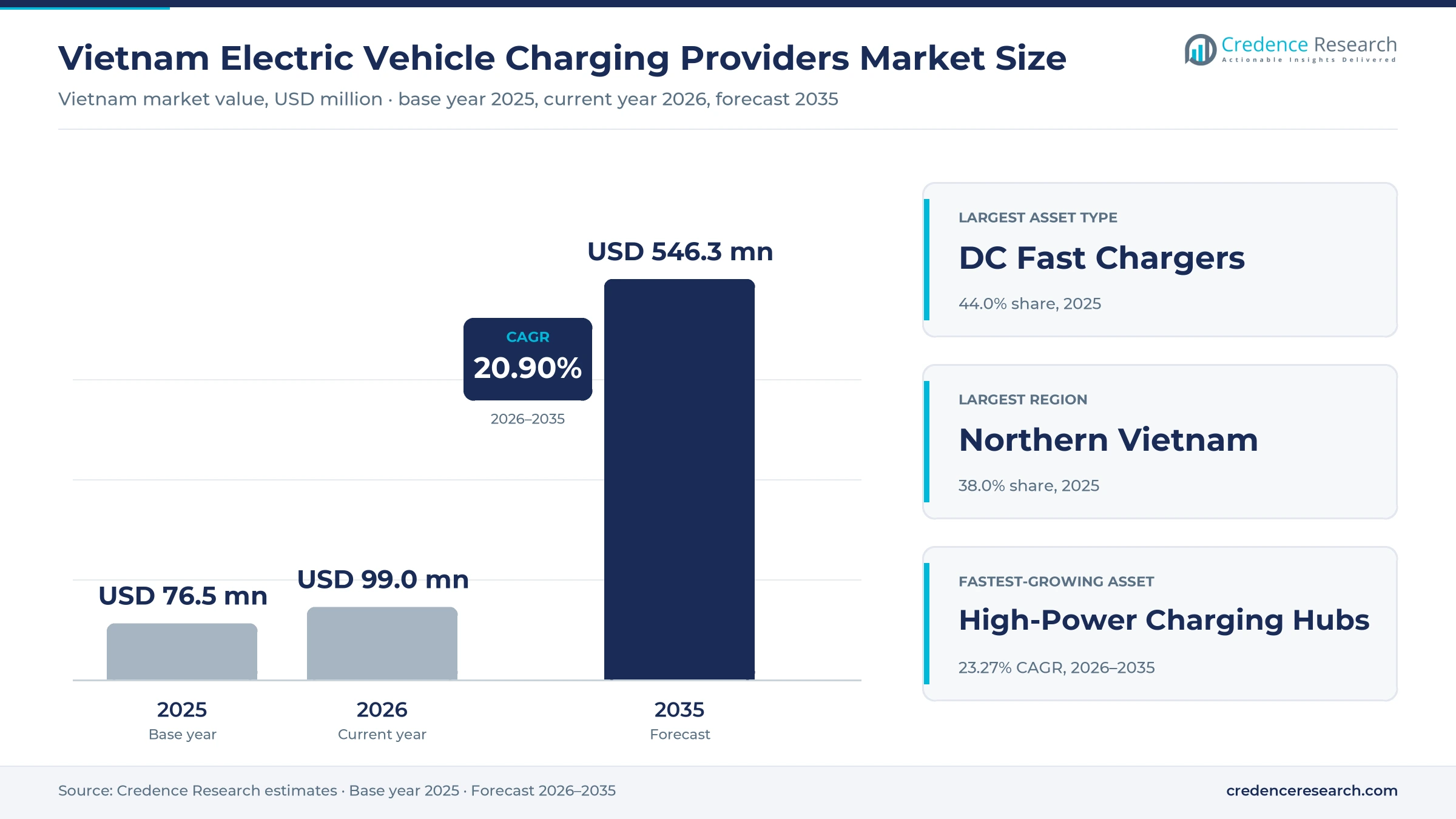
The Vietnam electric vehicle charging providers market was valued at USD 76.5 million in 2025 and is projected to increase from USD 99.0 million in 2026 to USD 546.3 million by 2035, registering a CAGR of 20.90% during 2026–2035. Demand comes from electric car drivers, a fast-growing base of electric motorbikes, and ride-hailing and taxi fleets that charge daily. Northern Vietnam held the largest regional share, 38.0% in 2025, supported by Hanoi taxi electrification and low-emission rules, while Southern Vietnam is the fastest-growing region at 21.38% a year. V-Green operates about 150,000 ports, a scale no rival matches, yet multi-brand operators, fuel retailers and swap networks are adding sites quickly. The main regulatory change is a Ministry of Industry and Trade rule requiring stations to serve compatible vehicles from July 1, 2027, which could open captive demand to other operators and change how charging is priced across the country.
What does the Vietnam charging provider market cover and how is it bought?
The market covers revenue earned by charging providers that build, own or operate public and semi-public charging and battery-swapping sites in Vietnam, including AC posts, DC units, high-power hubs and swap cabinets. Drivers pay per kilowatt-hour or per swap, while site hosts and fleets buy through turnkey, revenue-share, service and managed-operations contracts.
Vehicle sales, private home charging equipment bought by households, onboard chargers and electricity sold by utilities for general use are excluded. The value chain runs from equipment makers and grid suppliers through installers and operators to app platforms, fleets and drivers.
Vietnam Electric Vehicle Charging Providers Market Insights
- The market rises from USD 76.5 million in 2025 to USD 546.3 million by 2035, a 20.90% CAGR across 2026–2035, as paid public charging and swap fees expand.
- Northern Vietnam led with 38.0% of 2025 value, helped by a Hanoi taxi fleet where about 60% of licensed cars have already gone electric.
- DC fast chargers held 44.0% of 2025 value because about 90% of Ho Chi Minh City drivers in a UNDP assessment preferred 60 kW to 180 kW units.
- A rule effective July 1, 2027 requires stations to serve compatible vehicles, which is the largest structural change facing Vietnamese operators and their pricing.
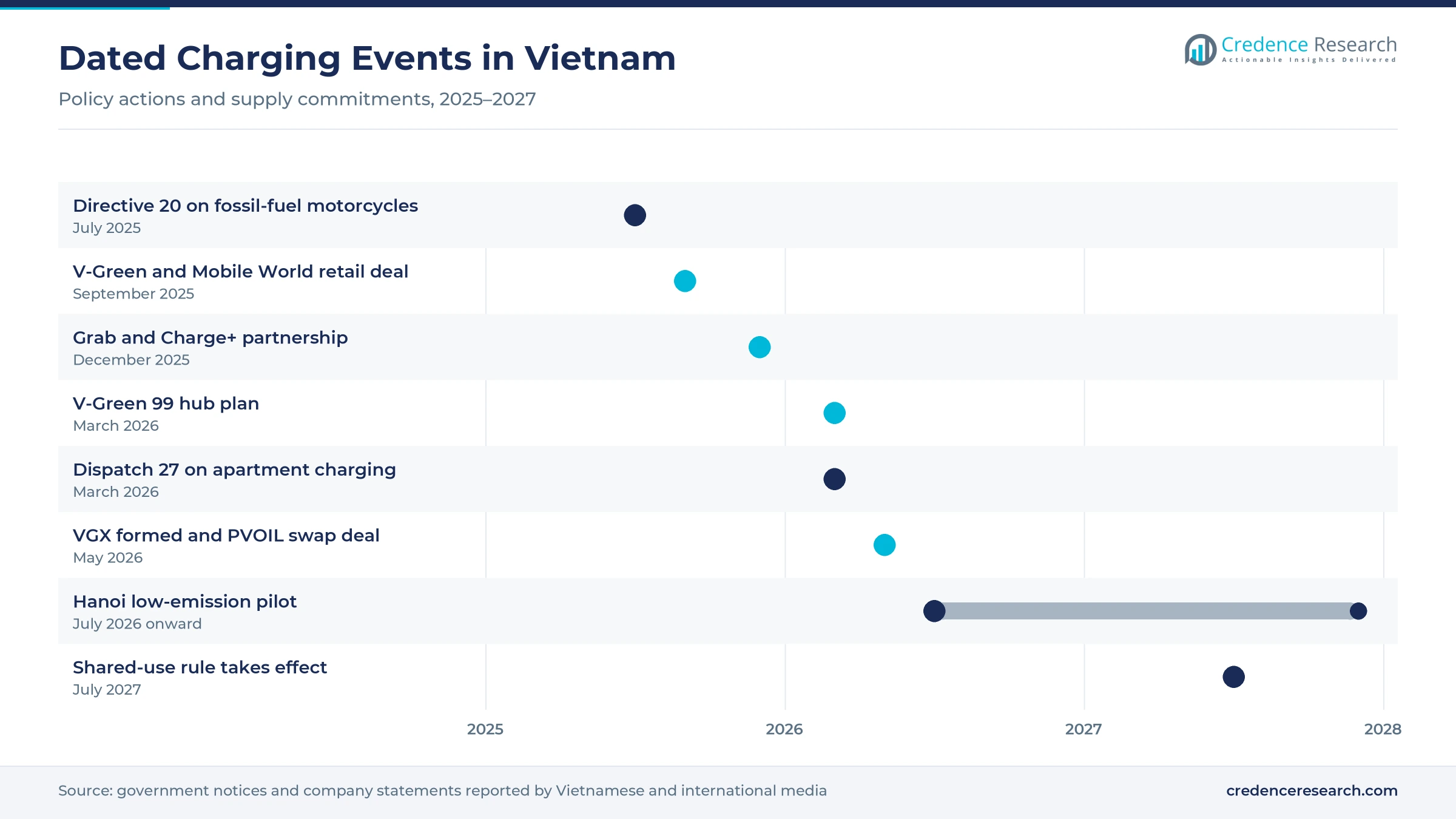
- V-Green committed VND10 trillion to 99 hubs in 2026, while Petrolimex, Selex Motors and Xuan Cau formed VGX in May 2026 to build open infrastructure.
DC units and car drivers lead as hubs and scooters gain
Why do DC units lead while high-power hubs grow fastest?
Based on asset type, the market is categorized into AC destination chargers, DC fast chargers, high-power charging hubs and battery-swapping stations. DC Fast Chargers led with 44.0% of 2025 value because about 90% of drivers in a UNDP assessment of Ho Chi Minh City preferred 60 kW to 180 kW units, according to Vietstock in May 2026. High-Power Charging Hubs grow fastest at 23.27% a year as V-Green plans 99 sites in 2026, each with up to 100 points rated at 150 kW. As a result, operators are moving capital toward fewer, larger sites on national and provincial highways.
Why do passenger cars lead while two-wheelers gain fastest?
Based on end-use sector, the market is categorized into passenger cars, electric two-wheelers, ride-hailing and taxi fleets, and logistics and commercial fleets. Passenger Cars led with 54.0% of 2025 value because VinFast alone delivered 175,099 electric cars in Vietnam in 2025, according to Vietnam Investment Review, and each car draws far more energy than a scooter. Electric Two-Wheelers grow fastest at 22.59% a year as 513,742 electric motorcycles sold in the first seven months of 2026, up 97.2%, according to Viet Nam News. This shift moves new provider revenue toward low-ticket, high-frequency swap and slow-charge sessions.
Why do operators own most sites while host deals gain?
Based on ownership model, the market is categorized into operator-owned, franchise-owned, site-host partnership and utility and state-linked assets. Operator-Owned sites led with 60.0% of 2025 value because V-Green runs about 150,000 points across 34 provinces and cities, according to The Investor in April 2026. Site-Host Partnership arrangements grow fastest at 22.36% a year as PVOIL and V-Green agreed on May 7, 2026 to survey nearly 1,000 fuel stations, according to Index.vn. Because retail hosts already control scarce urban land, these deals shorten the search for permitted sites and reduce the land cost that operators carry.
Why does turnkey work lead while service contracts gain?
Based on contracting model, the market is categorized into turnkey EPC, revenue share, charging-as-a-service and managed operations. Turnkey EPC led with 41.0% of 2025 value because hosts and operators still commission sites as capital projects, with a three-to-five-unit grid station costing at least VND1 billion, according to Mekong Eye in April 2025. Charging-as-a-Service grows fastest at 22.42% a year as Grab and Charge+ agreed in December 2025 to link swap and charging services to the Grab platform through an API. Fleet buyers therefore pay for access rather than for equipment, which moves utilization risk to the operator.
| Segment Group | Leading Sub-segment | Share, 2025 | Fastest-growing Sub-segment | CAGR, 2026–2035 |
|---|---|---|---|---|
| By Asset Type | DC Fast Chargers | 44.0% | High-Power Charging Hubs | 23.27% |
| By End-Use Sector | Passenger Cars | 54.0% | Electric Two-Wheelers | 22.59% |
| By Ownership Model | Operator-Owned | 60.0% | Site-Host Partnership | 22.36% |
| By Contracting Model | Turnkey EPC | 41.0% | Charging-as-a-Service | 22.42% |
Request a Free Sample
Fill in your details and we'll send you a free sample report.
- Sample data tables & charts
- Research methodology
EV sales, hub capital and city rules lift charging revenue
Mass-market EV adoption builds a paying user base
Vehicle electrification in Vietnam has moved beyond early buyers, and that gives operators a far larger pool of regular charging customers. The International Energy Agency put electric cars at roughly 40% of new car sales in 2025, more than double the 2024 level, according to Viet Nam News in September 2026. VinFast then delivered 137,697 electric cars in the first seven months of 2026, against 175,099 in all of 2025. Electric two-wheelers add a second base, with sales of about 700,000 in 2025 reported by VietNamNet in April 2026. VinFast car deliveries help explain why passenger cars still account for 54.0% of provider value.
Large-scale network investment raises the service standard
Capital is flowing into larger sites, and that raises what drivers expect from every operator in the market. V-Green plans 99 fast-charging stations in 2026 across 34 provinces and cities, backed by VND10 trillion and designed for up to 100 points each. Those sites use 150 kW DC fast units, and the company says a stop can take about 15 minutes. Vikki Bank agreed on April 1, 2026 to provide V-Green with investment and operating finance, according to The Investor. V-Green also holds a target of 500,000 points within three years, which is why rivals now plan hubs of their own on highway corridors and why High-Power Charging Hubs grow at 23.27% a year.
Policy-led electrification pushes demand toward public sites
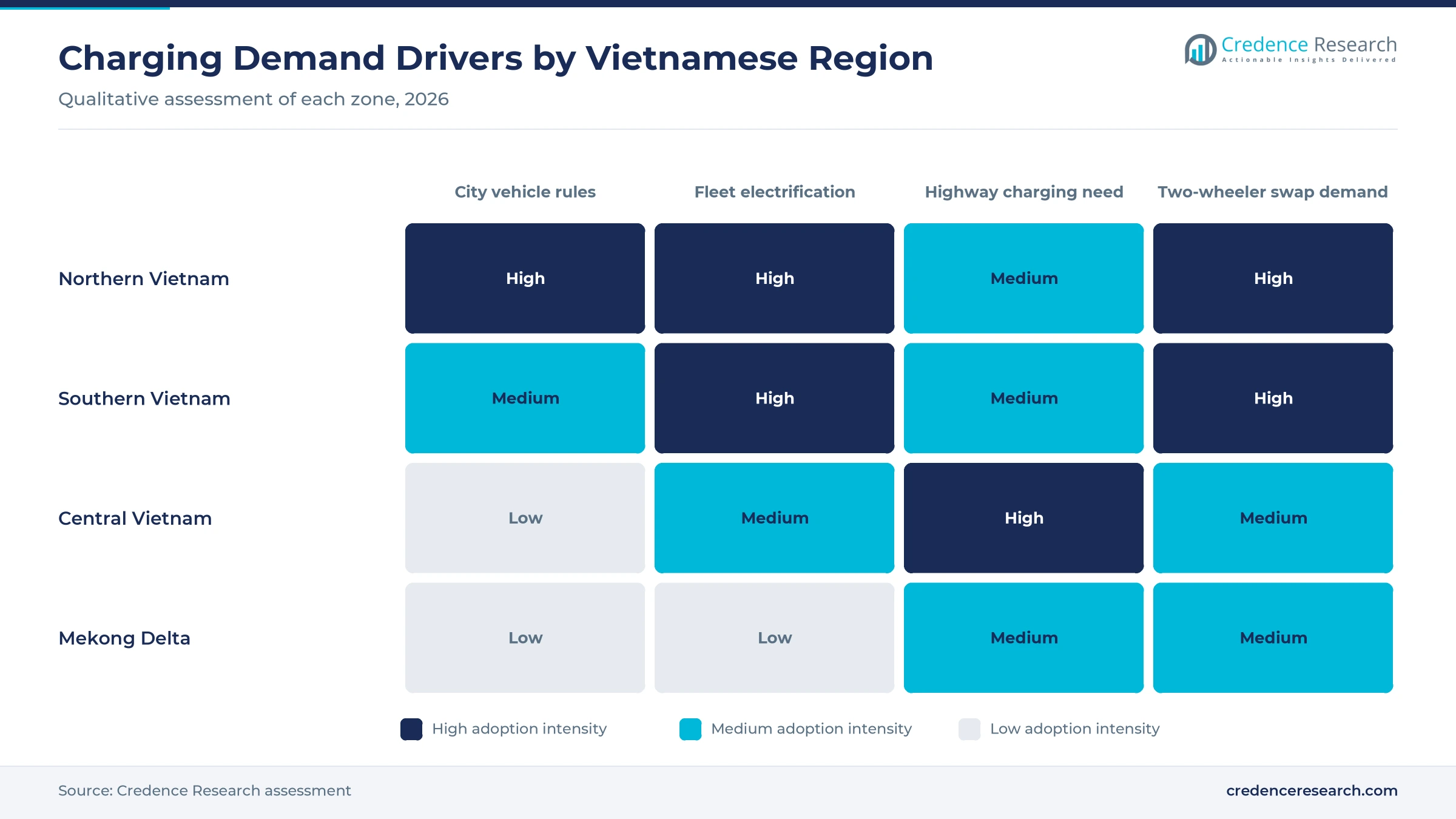
Government orders now tie vehicle restrictions directly to charging access, so providers gain from rules as well as from sales. Directive 20, issued July 12, 2025, ordered faster action on fossil-fuel motorcycles, and Hanoi began its low-emission pilot on July 1, 2026, according to the Vietnam Government Portal. Dispatch 27 of March 31, 2026 then told ministries to write standards for charging in apartment complexes and asked EVN to simplify grid connection. National goals are also firm, because all buses and taxis and half of urban vehicles are targeted to run on electricity by 2030. Together, these steps give operators a dated demand schedule in Hanoi, where the zone widens in 2028 and again in 2030.
Commercial fleets create steady daily charging volume
Ride-hailing, taxi and delivery fleets charge far more often than private drivers, and that makes them attractive anchor customers for new sites. About 60% of the more than 14,300 licensed taxis in Hanoi had switched to electric by June 2026, according to VietNamNet. Ho Chi Minh City also plans to move about 400,000 ride-hailing and delivery motorbikes to electric models within three years, according to Viet Nam News in October 2025. Grab made a strategic investment in EBOOST in July 2026, after building its network into the Grab Driver app, where more than 70% of driver-partners kept using the service during their first week. Fleet contracts therefore support Charging-as-a-Service, which grows at 22.42% a year.
Fuel forecourts, open access and swap cabinets gain ground
Fuel forecourts are shifting into multi-energy hubs
Fuel retailers are moving from hosting chargers to shaping the network, because their sites already offer land, power and traffic. PVOIL had chargers at 423 petrol stations by March 2025, or 50% of its network against an initial 15% target, according to The Investor. PVOIL and V-Green then agreed on May 7, 2026 to add more than 3,000 swap cabinets across its stations, according to Index.vn. Petrolimex took a 35% stake in VGX, a VND100 billion venture with Xuan Cau Holdings and Selex Motors announced in May 2026, and plans solar and storage after 2028. Those moves explain why Site-Host Partnership arrangements grow at 22.36% a year.
Open access is shifting competition toward price and apps
Multi-brand access is emerging as the main competitive line, since V-Green sites currently serve only VinFast vehicles, according to Tuoi Tre News. Circular 61/2026/TT-BCT and QCVN 32:2026/BCT require stations to accept compatible vehicles from July 1, 2027, and operators must display prices before and during each transaction, according to Viet Nam News. The price gap is already wide, because V-Green lists VND3,858 per kWh while Esky lists about VND7,000, according to Tuoi Tre News in July 2026. VETC connected more than 350 stations within about a month of launch, or about half of the multi-brand network, while TMT EGreen targets 2,100 stations by end-2026. Aggregators may therefore gain as much bargaining power as owners.
Battery swapping offers a large opening in two-wheeler fuel
Swapping is a clear opportunity because charging an e-bike takes six to eight hours while a swap takes under two minutes, according to Viet Nam News in October 2025. The same report put swap prices at Selex Motors at VND8,000 and its plan at 300 cabinets by 2026 and 3,000 by 2028. V-Green targets 150,000 cabinets nationwide and estimated cabinet costs near USD 500 each, which is well below the cost of a car charging site. Ho Chi Minh City already counted 1,132 swapping points in May 2026, according to Vietstock. LG Energy Solution is also working with Hanoi on a network for about 100,000 e-scooters, so the opening favors operators able to sign manufacturers and fleets.
Apartments and retail sites open room for destination charging
Residential and retail parking is a sizable opening because drivers who cannot charge at home need a reliable place close to where they live. Dispatch 27 ordered national standards for apartment charging, and the Ministry of Construction draft covers parking, swap areas and fire safety, according to Viet Nam News in May 2026. Mobile World agreed on Sept. 15, 2025 to host more than 1,000 charging points and over 1,000 swap cabinets by end-2026, according to the company. Hanoi is also reviewing about 110 public sites, which suits AC posts and small DC units. Operators that bundle separate metering, fire compliance and resident billing could win these buildings early.
Free charging, fire rules and grid limits slow new entrants
Free VinFast charging holds down paid session demand
Free charging from the largest operator is the main commercial barrier for smaller networks. VinFast keeps V-Green sessions free for its electric cars until June 30, 2027, and for its e-scooters until May 31, 2027, according to Vietnam Investment Review. Vcharge told Mekong Eye in April 2025 that operators outside V-Green need about 70% daily usage to survive, a high bar for new sites. As a result, independents depend on fleets and non-VinFast brands until those free periods end, and their expansion plans remain cautious.
Apartment fire concerns block charging in existing buildings
Fire risk keeps many residential buildings closed to new charging, and that strands demand in dense city districts. At No. 987 Tam Trinh Street in Hanoi, managers stopped accepting new electric motorbikes for parking and charging in early 2026, according to Viet Nam News, because the wiring may not carry multiple simultaneous loads. Providers lose access to these captive customers until standards are final. The draft apartment standard should ease this problem, although retrofits still need resident approval and funding.
Grid capacity and connection delay high-power sites
High-power charging concentrates load in the places where urban grids have the least spare capacity. The Ministry of Industry and Trade calculated that 100,000 cars fast-charging together at 60 kW to 120 kW would draw 6,000 MW to 12,000 MW, according to Viet Nam News in May 2026. The World Bank estimated up to USD 9 billion of extra power investment by 2030 to support EV growth. Operators are responding with on-site storage at V-Green hubs and time-of-day tariffs at TMT EGreen, although storage adds cost per site.
Capital costs and land limit independent operators
Upfront cost and scarce land make it hard for smaller operators to reach useful density. A solar-powered site costs at least VND2 billion to VND3 billion against VND1 billion for a grid site, according to Mekong Eye, and SolarEV estimated an ideal payback of three and a half years. VietNamNet reported in June 2026 that land is a major constraint in large cities. Consequently, independents increasingly rely on host agreements and strategic investors, while VAMA has asked for lower land rents and import tax relief.
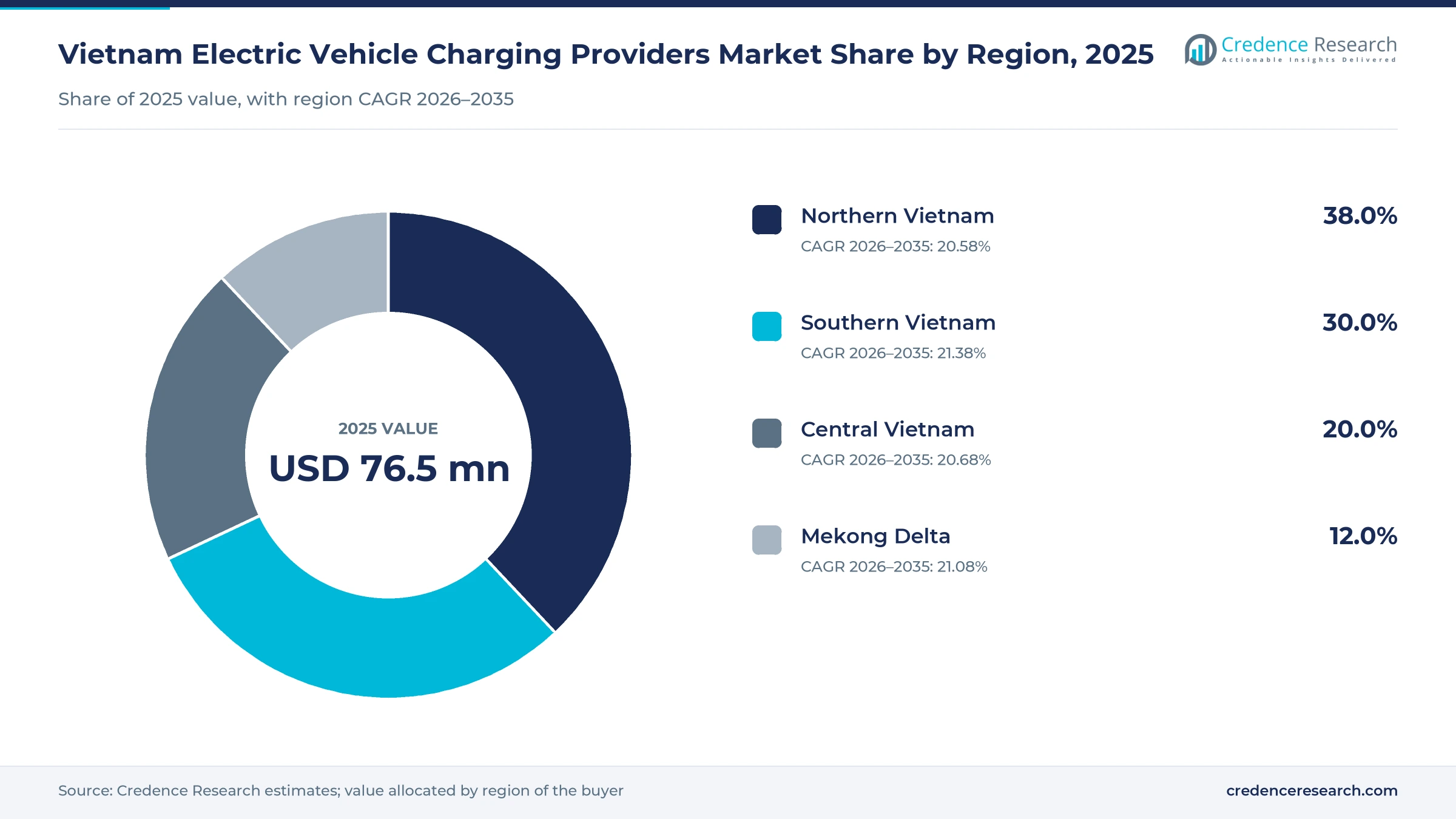
Hanoi rules give the north the lead as the south gains fast
| Region | Value, 2025 (USD million) | Share, 2025 | CAGR, 2026–2035 |
|---|---|---|---|
| Northern Vietnam | 29.1 | 38.0% | 20.58% |
| Southern Vietnam | 22.9 | 30.0% | 21.38% |
| Central Vietnam | 15.3 | 20.0% | 20.68% |
| Mekong Delta | 9.2 | 12.0% | 21.08% |
Northern Vietnam leads on Hanoi rules and taxi fleets
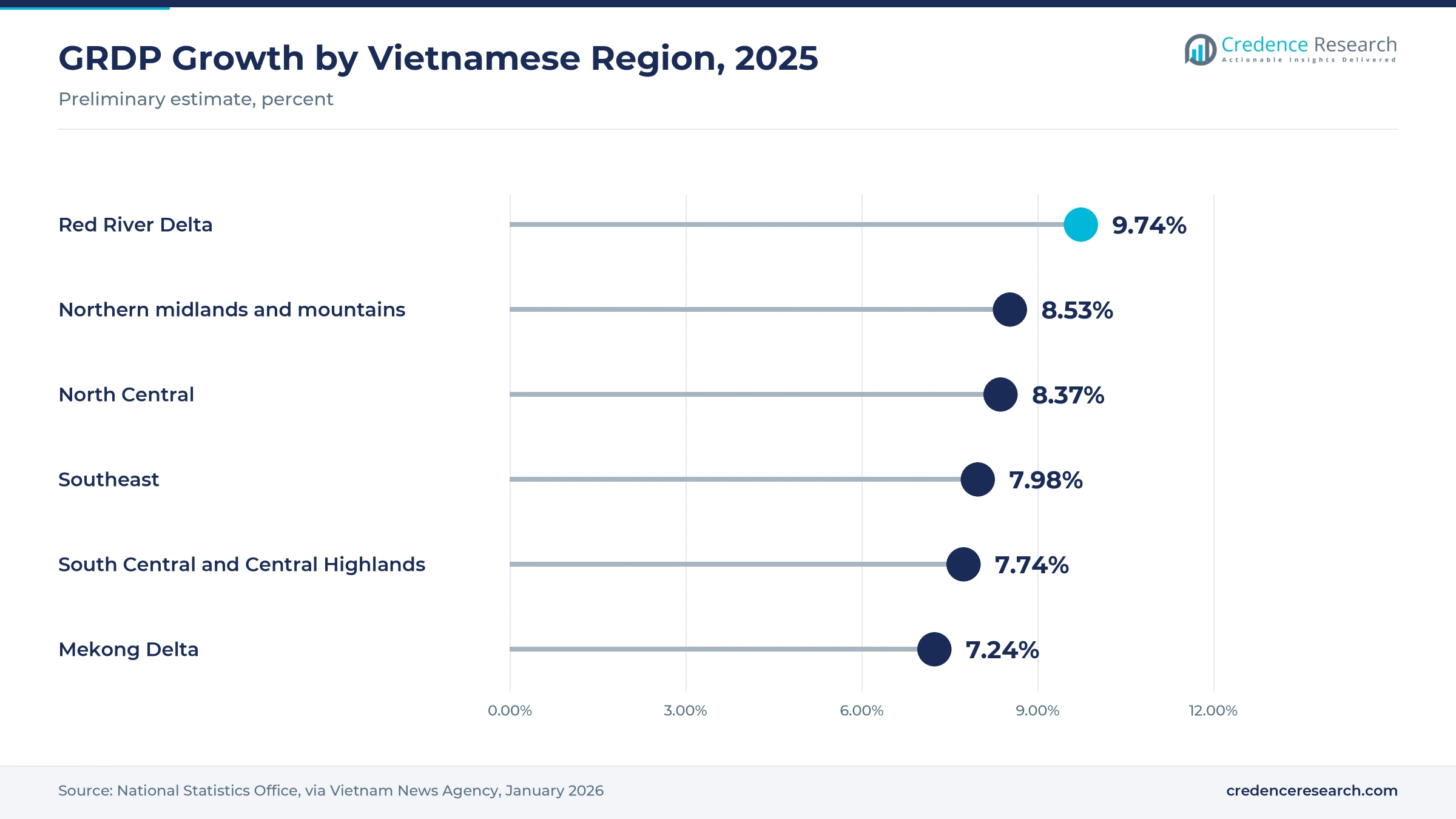
Northern Vietnam held 38.0% of 2025 value and grows at 20.58% a year, because Hanoi combines the strictest vehicle rules with a heavily electric taxi fleet. The city began its low-emission pilot on July 1, 2026 and bars fossil-fuel ride-hailing motorbikes from the zone, according to the Vietnam Government Portal. The National Statistics Office also estimated 2025 Red River Delta growth at 9.74%, the highest of any region, which supports car buying and new urban projects. However, apartment restrictions in the capital still limit where residents can charge overnight.
Southern Vietnam gains on Ho Chi Minh City fleet conversion
Southern Vietnam held 30.0% of 2025 value and is the fastest zone at 21.38% a year, since Ho Chi Minh City plans to electrify about 400,000 ride-hailing and delivery motorbikes. Ho Chi Minh City alone counted 1,052 charging stations, 300 motorbike fast-charging stations and 1,132 swap points in May 2026, according to Vietstock. Even so, the city reported about 18 vehicles per charger against a benchmark of 10, and about 74.76% of pillars sit in urban areas. This gap gives operators room to add sites in the former Binh Duong area and other industrial districts around the city.
Central Vietnam grows on highway stops and coastal cities
Central Vietnam held 20.0% of 2025 value and grows at 20.68% a year, as long north-south trips make the zone a natural corridor for fast charging. V-Green signed a memorandum with Bac Tay Nguyen in Gia Lai in April 2025 covering 3,000 VinFast charging posts in the Central Highlands and surrounding provinces, according to Viet Nam News. City demand is also firm, because the National Statistics Office estimated 2025 growth of 9.18% in Da Nang and 8.5% in Hue. Lower traffic between cities means utilization risk is higher than in the two largest metros.
Mekong Delta builds from fuel stations and provincial towns
The Mekong Delta held 12.0% of 2025 value and grows at 21.08% a year, starting from a smaller base of cars and urban apartments. The National Statistics Office estimated 2025 growth of 7.24% for the delta and 7.23% for Can Tho, both below the national 8.02%. Provider reach here relies heavily on fuel retail, since PVOIL plans swap cabinets and car chargers across its nationwide stations, according to Index.vn. Two-wheelers are likely to set the pace, which favors low-cost cabinets over large hubs in provincial towns.
Hub plans, forecourt deals and rules marked 2025 and 2026
| Development | Status and market relevance |
|---|---|
| In September 2025, V-Green and Mobile World agreed to place more than 1,000 charging points and over 1,000 swap cabinets at retail stores by end-2026. | Signed; retail store rollout under way |
| In December 2025, Grab and Charge+ agreed to connect charging and swap services to the Grab platform, while Charge+ targets 5,000 points by 2030. | Partnership announced; fleet access focus |
| In March 2026, V-Green committed VND10 trillion to 99 fast-charging stations along national and provincial highways in 34 provinces and cities. | Planned for 2026; each site up to 100 points |
| In May 2026, Petrolimex, Xuan Cau Holdings and Selex Motors formed VGX, a VND100 billion venture for open charging and swap infrastructure. | First phase 2026–2027 in key cities |
| In July 2026, Grab announced a strategic investment in EBOOST, which reported more than 2,500 charging points and over 10,000 users. | Completed; motorbike drivers are the next phase |
Load control, app payment and storage shape site economics
- Networked smart charging links sites to operator apps and aggregators, and VETC connected more than 350 stations within about a month of launch, according to Tuoi Tre News.
- Dynamic load management spreads demand across connectors and hours, which matters because EVN was told under Dispatch 27 to adjust demand programs and support separate meters for charging stations.
- Automated payments and authentication let Grab drivers find a station, start a session and pay inside the Grab Driver app, where the EBOOST network has been integrated since April 2026.
- Renewable-integrated charging pairs solar with storage, and V-Green says its 99 hubs will run on wind and solar with VinFast storage systems, while SolarEV runs four solar sites in the south.
Need a Custom Version of This Report?
Tailor the scope, geography, or segments to your exact requirements.
- Custom geography or segment scope
- Direct access to our analyst team
V-Green scale faces forecourt groups and open networks
Competition among charging providers centers on network density, site access and who controls the customer relationship, rather than on hardware alone. V-Green, which is closely linked to VinFast, has the widest reach and sets the price reference with a flat listed tariff of VND3,858 per kWh. Fuel groups are the strongest counterweight because they own permitted roadside land, and Petrolimex and PVOIL are taking different routes through the VGX venture and the V-Green alliance respectively. PV Power aims for 1,000 stations by 2035 and is working with EN Technologies of South Korea on charging systems. Independent networks such as EBOOST and CHARGE+ compete through open access and fleet contracts, with Charge+ also having built a 17-station corridor of about 1,700 km with Porsche. SolarEV focuses on solar sites in the south, Selex Motors on swap cabinets for two-wheelers, and EVN supplies grid connection across all of them, so its connection procedures influence the pace for every rival.
Leading companies and their roles in Vietnam
| Company | Type | Role in the market |
|---|---|---|
| V-GREEN Global Charging Station Development JSC | Network operator | About 150,000 points in 34 provinces and cities; 99 hubs planned in 2026 |
| VinFast Auto | Vehicle maker | 175,099 Vietnam deliveries in 2025; supplies storage systems for V-Green hubs |
| Vietnam Electricity (EVN) | State utility | Grid connection and metering support under Dispatch 27 of March 2026 |
| Vietnam National Petroleum Group (Petrolimex) | Fuel retailer | 35% holder in VGX, formed in May 2026 for open infrastructure |
| PetroVietnam Oil Corporation (PVOIL) | Fuel retailer | 423 stations with chargers by March 2025; swap cabinet deal in May 2026 |
| PetroVietnam Power Corporation (PV Power) | State-linked developer | Targets 1,000 stations by 2035; started with Hanoi pilot plans in 2024 |
| CHARGE+ | Network operator | Targets 5,000 points by 2030; Grab partnership in December 2025 |
| EBOOST | Multi-brand platform | More than 2,500 points; Grab strategic investment in July 2026 |
| SolarEV Electric Vehicle Charging Stations JSC | Solar charging operator | Four solar sites in the south, as reported in April 2025 |
| Selex Smart Electric Vehicle JSC | Swap operator | Plans 3,000 cabinets by 2028; VGX partner; Grab agreement in October 2025 |
Open access in 2027 will test who can earn from charging
Credence Research's view is that the July 1, 2027 access rule matters more than any single station announcement. Until then, free V-Green sessions keep paid volumes thin for independent charging providers, so fleet contracts and host agreements offer the safest early revenue. After mid-2027, the end of free charging and open access could reveal real price competition, and aggregators such as VETC may gain influence. Charging providers should therefore secure sites and fleet customers now and treat swap cabinets as a separate business, because two-wheeler users pay small amounts and return often. A 20.90% CAGR in this market leaves room for several networks only if utilization improves after 2027.
How the charging provider model and splits were built
The report uses 2025 as the base year and 2026–2035 as the forecast period. Market values come from the Credence Research model and were checked against public fleet, tariff and network data. Regional and segment splits are Credence Research estimates built from those same public data. Sources include government and regulator statements, World Bank and International Energy Agency material, national statistics and company announcements reported in the Vietnamese and international press. No interviews or surveys were conducted by the team for this edition.
Paid charging, swap fees and hubs shape value to 2035
Through 2035, value earned by charging providers should shift from network construction toward paid sessions, swap fees and managed services as free charging ends and vehicle numbers climb. The International Energy Agency projects that electric cars could exceed 80% of new sales by 2035, while VAMA expects about 1 million electric cars on the roads by 2028. Hubs and two-wheeler swap networks are likely to take the largest share of new capital, and Hanoi widens its zone in 2028 and 2030. The market should reach USD 546.3 million by 2035, with Southern Vietnam gaining ground as the fleet conversion moves ahead and northern cities remaining the policy pacesetters.
Frequently Asked Questions
How big is the Vietnam electric vehicle charging providers market?
Which region leads the market?
Which region grows fastest?
Which asset type holds the largest share?
What will open access change after 2027?
Why is battery swapping important in Vietnam?
What are the main challenges for operators?
Who are the leading companies?
Table of Content
Chapter 1 Market Segmentation
- 1.1 Segmentation Framework
- 1.1.1 Product and Service Classification
- 1.1.2 Application and End-Use Classification
- 1.1.3 Technology and Solution Classification
- 1.1.4 Customer and Distribution Channel Classification
- 1.1.5 Geographic Segmentation
- 1.1.6 Market Segment Definitions and Boundaries
- 1.2 By Asset Type
- 1.2.1 DC Fast Chargers
- 1.2.2 AC Destination Chargers
- 1.2.3 Battery-Swapping Stations
- 1.2.4 High-Power Charging Hubs
- 1.3 By End-Use Sector
- 1.3.1 Passenger Cars
- 1.3.2 Electric Two-Wheelers
- 1.3.3 Ride-Hailing & Taxi Fleets
- 1.3.4 Logistics & Commercial Fleets
- 1.4 By Ownership Model
- 1.4.1 Operator-Owned
- 1.4.2 Site-Host Partnership
- 1.4.3 Franchise-Owned
- 1.4.4 Utility and State-Linked
- 1.5 By Contracting Model
- 1.5.1 Turnkey EPC
- 1.5.2 Revenue Share
- 1.5.3 Charging-as-a-Service
- 1.5.4 Managed Operations
Chapter 2 Introduction
- 2.1 Report Objectives and Scope
- 2.2 Product Definition and Industry Terminology
- 2.3 Market Inclusions and Exclusions
- 2.4 Research Process
- 2.4.1 Primary Research and Expert Interviews
- 2.4.2 Secondary Research and Source Review
- 2.4.3 Top-Down and Bottom-Up Estimation
- 2.4.4 Data Triangulation and Verification
- 2.5 Market Size Measurement Basis
- 2.5.1 2025: USD 76.5 million → 2035: USD 546.3 million
- 2.6 Historical and Forecast Reference Periods
- 2.6.1 Historical Period: 2018-2025
- 2.6.2 Base Year: 2025
- 2.6.3 Forecast Period: 2025-2035
- 2.7 Research Assumptions and Limitations
Chapter 3 Executive Summary
- 3.1 Market Snapshot and Key Findings
- 3.2 Base-Year Market Size, 2025
- 3.3 Forecast Market Size, 2035
- 3.4 Revenue and Volume Growth Outlook
- 3.5 Key Demand and Supply Indicators
- 3.6 Leading Market Segments
- 3.7 Fastest-Growing Market Opportunities
- 3.8 Regional Performance Highlights
- 3.9 Technology and Industry Transformation
- 3.10 Competitive Landscape Summary
- 3.11 Analyst View and Strategic Implications
Chapter 4 Vietnam Electric Vehicle Charging Providers Market Trends and Developments
- 4.1 Historical Industry Development, 2018-2025
- 4.2 Recent Market Trends and Developments
- 4.3 Demand and Customer Behavior Trends
- 4.4 Technology and Product Innovation
- 4.5 Artificial Intelligence, Automation and Digitalization
- 4.6 Local Manufacturing and Supply Chain Realignment
- 4.7 Industry Partnerships, Mergers and Acquisitions
- 4.8 Sustainability and Circular Economy Developments
- 4.9 Government and Private Sector Investment Trends
- 4.10 Emerging Business Models and Commercialization
- 4.11 Industry Developments and Announcements
Chapter 5 Vietnam Electric Vehicle Charging Providers Market Production, Supply and Demand Analysis
- 5.1 Demand Trend and Consumption Analysis, 2018-2025
- 5.2 Demand Forecast, 2025-2035
- 5.3 Production and Output Trend, 2018-2025
- 5.4 Production and Output Forecast, 2025-2035
- 5.5 Installed Capacity and Capacity Utilization
- 5.6 Company-Wise Production Plants and Statistics
- 5.6.1 Installed Production Capacity
- 5.6.2 Actual Production
- 5.6.3 Planned Capacity and Expansion Targets
- 5.7 Supply Chain Structure and Procurement Trends
- 5.8 Supply-Demand Gap and Bottlenecks
- 5.9 Import Dependence and Sourcing Structure
- 5.10 Contract Manufacturing and Outsourcing
- 5.11 Regional Supply and Demand Concentration
Chapter 6 Vietnam Electric Vehicle Charging Providers Market Pricing Analysis
- 6.1 Pricing Structure and Measurement
- 6.2 Historical Pricing Trends, 2018-2025
- 6.3 Pricing Outlook, 2025-2035
- 6.4 Average Selling Price and Unit Economics
- 6.5 Pricing by Product and Market Segment
- 6.6 Geographic Pricing Differences
- 6.7 Key Input, Energy, Labor and Logistics Costs
- 6.8 Contract Pricing and Purchasing Models
- 6.9 Pricing Sensitivity and Competitive Positioning
- 6.10 Price, Margin and Profitability Implications
Chapter 7 Vietnam Electric Vehicle Charging Providers Market Dynamics
- 7.1 Market Growth Drivers
- 7.1.1 Demand-Side Drivers
- 7.1.2 Technology and Innovation Drivers
- 7.1.3 Infrastructure and Investment Drivers
- 7.1.4 Regulatory and Policy Drivers
- 7.2 Market Restraints
- 7.2.1 Cost and Affordability Constraints
- 7.2.2 Technology and Adoption Barriers
- 7.2.3 Supply Chain and Operational Constraints
- 7.3 Market Challenges
- 7.3.1 Competitive Pressure and Margin Erosion
- 7.3.2 Skills, Infrastructure and Implementation Gaps
- 7.4 Emerging Market Opportunities
- 7.5 Market Dynamics Impact and Time-Horizon Assessment
Chapter 8 Vietnam Electric Vehicle Charging Providers Value Chain Analysis
- 8.1 Industry Value Chain Overview
- 8.2 Upstream Suppliers and Critical Inputs
- 8.3 Technology and Component Providers
- 8.4 Manufacturing or Service Delivery
- 8.5 Distribution, Channel Partners and Integrators
- 8.6 Downstream Applications and End Users
- 8.7 Value Addition and Profit Pools
- 8.8 Vertical Integration and Outsourcing
- 8.9 Supplier Concentration and Risk
- 8.10 Supply Chain Localization and Resilience
Chapter 9 Vietnam Electric Vehicle Charging Providers Market Regulations and Policies
- 9.1 Relevant Laws, Standards and Compliance Frameworks
- 9.2 Product, Service, Safety and Quality Requirements
- 9.3 Government Policies, Incentives and Subsidies
- 9.4 Imports, Exports and Trade Barriers
- 9.5 Public Procurement and Local Content Requirements
- 9.6 Environmental and Sustainability Compliance
- 9.7 Upcoming Policy Changes and Market Implications
Chapter 10 Vietnam Electric Vehicle Charging Providers Market Hotspots and Opportunities
- 10.1 Market Opportunity Mapping and Growth Hotspots
- 10.2 High-Growth Applications and Customer Groups
- 10.3 Underserved Markets and White-Space Opportunities
- 10.4 Emerging Technology and Product Opportunities
- 10.5 New Capacity and Investment Hotspots
- 10.6 Market Entry and Expansion Opportunities
- 10.7 Distribution and Partnership Opportunities
- 10.8 Near-Term and Long-Term Commercial Potential
- 10.9 Opportunity Attractiveness and Execution Risks
Chapter 11 Vietnam Electric Vehicle Charging Providers Market Outlook, 2025-2035
- 11.1 Market Size and Analysis
- 11.1.1 Revenue (Market Measurement: 2025: USD 76.5 million → 2035: USD 546.3 million)
- 11.1.2 Market Volume and Quantity Sold
- 11.1.3 Historical Market Size, 2018-2025
- 11.1.4 Base-Year Market Size, 2025
- 11.2 Market Forecast, 2025-2035
- 11.2.1 Revenue Forecast to 2035
- 11.2.2 Volume Forecast to 2035
- 11.2.3 CAGR and Year-on-Year Growth
- 11.2.4 Incremental Revenue Opportunity
- 11.3 Forecast Assumptions and Scenario Analysis
- 11.3.1 Base-Case Forecast
- 11.3.2 Optimistic and Conservative Scenarios
- 11.3.3 Technology, Pricing and Policy Sensitivities
- 11.4 Market Attractiveness and Growth Outlook
Chapter 12 Vietnam Electric Vehicle Charging Providers Market Segmentation and Outlook
- 12.1 Segmentation Summary and Market Shares, 2025
- 12.2 Largest and Fastest-Growing Segments
- 12.3 By Asset Type - Market Size and Forecast, 2025-2035
- 12.3.1 Segment Definition and Scope
- 12.3.2 Historical Market Size, 2018-2025
- 12.3.3 Revenue Forecast, 2025-2035
- 12.3.4 Volume Forecast, 2025-2035
- 12.3.5 Base-Year Market Share, 2025
- 12.3.6 Segment CAGR and Growth Drivers
- 12.3.7 Subsegment Market Size and Forecast
- 12.3.7.1 DC Fast Chargers
- 12.3.7.2 AC Destination Chargers
- 12.3.7.3 Battery-Swapping Stations
- 12.3.7.4 High-Power Charging Hubs
- 12.3.8 Subsegment Pricing and Adoption Trends
- 12.3.9 Leading Suppliers and Competition
- 12.3.10 Regional Demand and Opportunities
- 12.4 By End-Use Sector - Market Size and Forecast, 2025-2035
- 12.4.1 Segment Definition and Scope
- 12.4.2 Historical Market Size, 2018-2025
- 12.4.3 Revenue Forecast, 2025-2035
- 12.4.4 Volume Forecast, 2025-2035
- 12.4.5 Base-Year Market Share, 2025
- 12.4.6 Segment CAGR and Growth Drivers
- 12.4.7 Subsegment Market Size and Forecast
- 12.4.7.1 Passenger Cars
- 12.4.7.2 Electric Two-Wheelers
- 12.4.7.3 Ride-Hailing & Taxi Fleets
- 12.4.7.4 Logistics & Commercial Fleets
- 12.4.8 Subsegment Pricing and Adoption Trends
- 12.4.9 Leading Suppliers and Competition
- 12.4.10 Regional Demand and Opportunities
- 12.5 By Ownership Model - Market Size and Forecast, 2025-2035
- 12.5.1 Segment Definition and Scope
- 12.5.2 Historical Market Size, 2018-2025
- 12.5.3 Revenue Forecast, 2025-2035
- 12.5.4 Volume Forecast, 2025-2035
- 12.5.5 Base-Year Market Share, 2025
- 12.5.6 Segment CAGR and Growth Drivers
- 12.5.7 Subsegment Market Size and Forecast
- 12.5.7.1 Operator-Owned
- 12.5.7.2 Site-Host Partnership
- 12.5.7.3 Franchise-Owned
- 12.5.7.4 Utility and State-Linked
- 12.5.8 Subsegment Pricing and Adoption Trends
- 12.5.9 Leading Suppliers and Competition
- 12.5.10 Regional Demand and Opportunities
- 12.6 By Contracting Model - Market Size and Forecast, 2025-2035
- 12.6.1 Segment Definition and Scope
- 12.6.2 Historical Market Size, 2018-2025
- 12.6.3 Revenue Forecast, 2025-2035
- 12.6.4 Volume Forecast, 2025-2035
- 12.6.5 Base-Year Market Share, 2025
- 12.6.6 Segment CAGR and Growth Drivers
- 12.6.7 Subsegment Market Size and Forecast
- 12.6.7.1 Turnkey EPC
- 12.6.7.2 Revenue Share
- 12.6.7.3 Charging-as-a-Service
- 12.6.7.4 Managed Operations
- 12.6.8 Subsegment Pricing and Adoption Trends
- 12.6.9 Leading Suppliers and Competition
- 12.6.10 Regional Demand and Opportunities
- 12.7 Segment Growth Comparison
- 12.8 Segment Attractiveness and Priority Matrix
Chapter 13 Vietnam Electric Vehicle Charging Providers End-Use and Application Market Outlook
- 13.1 End-Use Industry and Customer Demand Structure
- 13.2 Leading Applications and Customer Groups
- 13.3 End-Use Market Size, Share and Forecast
- 13.4 Major End-Use Industry Deep Dives
- 13.4.1 Customer Requirements and Use Cases
- 13.4.2 Demand and Replacement Cycles
- 13.4.3 Technical and Regulatory Considerations
- 13.4.4 Purchasing and Procurement Models
- 13.4.5 Leading Vendors and Distribution Channels
- 13.4.6 Forecast and Commercial Opportunities
- 13.5 Emerging Applications and Cross-Segment Demand
- 13.6 End-Use Industry Investment Priorities
Chapter 14 Vietnam Electric Vehicle Charging Providers Geographic Market Outlook, 2025-2035
- 14.1 Domestic Market Distribution and Demand Clusters
- 14.2 State- or Province-Wise Market Size and Forecast, 2025-2035
- 14.3 City and Metropolitan Market Outlook
- 14.4 Industrial, Manufacturing and Commercial Clusters
- 14.5 Geographic Concentration of Key End Users
- 14.6 Local Pricing and Purchasing Differences
- 14.7 Domestic Production Facilities and Capacity Map
- 14.8 Local Infrastructure and Project Pipeline
- 14.9 State-Level Policy and Incentive Differences
- 14.10 Subnational Investment Hotspots and Opportunities
- 14.11 Distribution and Logistics Networks
- 14.12 Domestic Competitive Footprint
Chapter 15 Vietnam Electric Vehicle Charging Providers Technology, Innovation and Sustainability Outlook
- 15.1 Technology Landscape and Maturity
- 15.2 Product, Process and Service Innovation
- 15.3 AI, Automation and Digital Tools in the Industry
- 15.4 Technology Adoption and Performance Benchmarking
- 15.5 Innovation Pipeline and R&D Investment
- 15.6 Patent and Intellectual Property Trends
- 15.7 Energy Efficiency and Resource Management
- 15.8 Sustainability, Recycling and Circularity
- 15.9 Technology Roadmap, 2025-2035
- 15.10 Risks of Obsolescence and Technology Substitution
Chapter 16 Vietnam Electric Vehicle Charging Providers Market Key Strategic Imperatives
- 16.1 Growth and Market Entry Priorities
- 16.2 High-Return Products and Segments
- 16.3 Pricing, Profitability and Cost Optimization
- 16.4 Technology Investment and Product Differentiation
- 16.5 Supply Chain Localization and Resilience
- 16.6 Distribution and Customer Acquisition
- 16.7 Partnership, Acquisition and Capacity Strategy
- 16.8 Regional Expansion Priorities
- 16.9 Short-, Medium- and Long-Term Actions
Chapter 17 Competition Outlook
- 17.1 Industry Competition Characteristics
- 17.2 Market Structure and Concentration
- 17.3 Market Share and Competitive Positioning, 2025
- 17.4 Company-Wise Revenue and Product Benchmarking
- 17.5 Production and Service Capacity Benchmarking
- 17.6 Technology, Pricing and Differentiation
- 17.7 Regional Footprint and Distribution Strength
- 17.8 Mergers, Acquisitions and Strategic Alliances
- 17.9 New Entrants and Competitive Threats
- 17.10 Porter's Five Forces and Industry Attractiveness
- 17.11 Competitive Outlook, 2025-2035
Chapter 18 Company Profiles
- 18.1 Company Coverage and Selection Criteria
- 18.2 V-GREEN Global Charging Station Development JSC
- 18.2.1 Business Description
- 18.2.2 Company Ownership and Geographic Presence
- 18.2.3 Product and Service Portfolio
- 18.2.4 Manufacturing and Operating Footprint
- 18.2.5 Production Capacity and Expansion Plans
- 18.2.6 Financial Performance and Investment
- 18.2.7 Market Share and Competitive Position
- 18.2.8 Technology and Innovation Capabilities
- 18.2.9 Strategic Alliances or Partnerships
- 18.2.10 Recent Developments
- 18.2.11 Growth Strategy and Outlook
- 18.3 VinFast Auto
- 18.4 Vietnam Electricity (EVN)
- 18.5 Vietnam National Petroleum Group (Petrolimex)
- 18.6 PetroVietnam Oil Corporation (PVOIL)
- 18.7 PetroVietnam Power Corporation (PV Power)
- 18.8 CHARGE+
- 18.9 EBOOST
- 18.10 SolarEV Electric Vehicle Charging Stations JSC
- 18.11 Selex Smart Electric Vehicle JSC
- 18.12 Other Relevant Market Participants
Note: Every listed company is profiled on the structure shown under the first company. The company list is preliminary and may change based on research findings, market developments, data availability and client requirements.
Chapter 19 Disclaimer
- 19.1 Research and Forecast Disclaimer
- 19.2 Data Source and Estimation Limitations
Note: The depth of individual sections depends on data availability for this market. Volume, capacity, trade and other unit-based metrics are included where applicable.

